



Abstract
It is well known that management concepts tend to spread from corporate to public organizations. Branding is an example of such a concept, with suggestions that it can address not only economic but also social issues, often referred to as “inclusive branding.” This ethnographic study explores how branding is received and spreads in a Swedish city, and analyzes efforts to use branding to tackle inequality and segregation. Our findings reveal that the initial focus on social problems was glossed over in favor of following corporate branding ideals, but also that city communicators expressed critique, confusion, and doubt regarding the relevance of branding to their work. Surprisingly, this did not slow down but rather energized the branding process. Through an interactionist analysis, we suggest that rather than addressing social problems, branding in cities may give rise to an Eigendynamik, signifying a self-energizing inner dynamic fueled by a tension between “frames,” specifically between the branding frame and the civic frame of the city. This theorization lays the groundwork for contributions to the understanding of inclusive branding: it can start with good intentions to address civic issues but may get swept up in corporate branding concepts and activities that are ill equipped to deal with social issues. More generally, complementing established notions of translation and colonization, our study provides a novel understanding of how management concepts migrate from corporate to public organizations through what we call frame-induced Eigendynamik. Overall, we contribute by shedding light on the role of self-energizing processes as reasons why organizational members engage with management concepts even when they struggle to see their relevance to their work.
Keywords
It is well known that management concepts tend to migrate from corporate to public organizations. Branding is one of these management concepts and has become commonplace in public organizations, especially in cities as a way to competitively attract tourists, citizens, and workforce (Jacobsen, 2009). However, this use of branding in cities has been criticized for turning cities into market actors, relying too heavily on market mechanisms and neglecting cities’ social issues (Kaneva, 2017) and scholars have pointed to a tension between branding and civic ideals (Bertilsson & Rennstam, 2018; Vanolo, 2017; Wæraas & Sataøen, 2014). In response to this tension, under the label of “inclusive branding,” scholars have suggested that branding should include diverse stakeholders, focus less on economic aspects and more on addressing social problems (e.g., Kavaratzis, Giovanardi, & Lichrou, 2017), which may be issues of segregation, poverty, or crime, to name a few (Jones & Kubacki, 2014).
Regarding the migration of branding into public sector organizations, we see three challenges. First, at a theoretical level, further attention to internal organizational processes of using management concepts is needed to add nuance to the somewhat polarized view of how concepts (such as branding) migrate from private to public contexts. This phenomenon is often framed as a part of new public management (Hyndman & Lapsley, 2016), and understood either in terms of “translation” of management concepts into public contexts (Waldorff & Madsen, 2023), or as “corporate colonization” and a manifestation of the neoliberalization of the public sector (Aroles, Hassard, & Hyde, 2022). In other words, the concepts tend to be seen either as valuable but in need of translation to fit the public context, or as expressions of a colonizing neoliberal ideology (cf. Lucarelli, 2018). While these understandings are useful, both translation and colonization suggest that tensions between managerial concepts and their new contexts are resolved, either through adaptation or domination. However, as our study will show, tensions can be persistent, and translation and colonization do not account for processes where tensions remain but management concepts nevertheless spread in organizations, despite organizational members’ hesitation about the relevance of such concepts to their work. Thus, there is a need for development and variation in the theoretical understanding of how management concepts are received and spread in public organizations, and the theoretical development of our paper advances such an understanding.
Second, while inclusive branding scholars suggest that branding ideologies and practices can be made more socially just and mindful of their political role, other scholars maintain that branding fails to reconcile the tension between branding and civic ideals (Bertilsson & Rennstam, 2018; Vanolo, 2017). Whether branding can be inclusive is thus a contentious issue, and further analysis is needed to understand the role of branding as part of a solution to social problems (Kaneva, 2017).
Third and relatedly, despite claims for the potential that branding can be used to address social problems, relatively little attention has been paid to the internal organizational activities that result from cities’ ambitions to do so (Lucarelli & Brorström, 2013). For instance, Vanolo (2017, p. 265) notes that “we know very little about the practices and routines which produce city brands. [. . .] Who develops the initial ideas in branding a city? Who writes the first draft of the project, and in what way?” Addressing these questions by studying internal organizational branding processes is important because it enables a broadened understanding of the role and relevance of branding as a management concept, including how addressing social problems through branding plays out in practice.
In addressing these challenges, we employ an interactionist perspective. The interactionist lens, a methodology largely missing in studies of branding in cities, offers valuable tools for making sense of how and with what tensions branding is used. In particular, it enables a focus on process and the view of branding as a “frame” that simultaneously governs and is defined by the participants of an interaction (Goffman, 1974; Silverman, 1993). This provides a nuanced perspective that acknowledges a critical view of branding in cities (Broudehoux, 2007) without overstating the muscle of corporate concepts, and pays attention to how the role of branding is emergent and dependent on how it is used (Lucarelli, 2018). In light of this, we pursue the question: How is the imperative to engage in city branding to address social problems received and enacted by communication managers and brand consultants?
To explore this question, we conducted an ethnographically inspired study in Granit, a pseudonym for a large Swedish city, in which we followed the development of a branding process that unfolded after the local government cited the social problems of inequality and segregation as a threat to the city’s attractiveness, whereby they gave city communicators the task to “strengthen the brand of the city.” Our analysis of the process provided ground for the empirical insights that (1) despite communication managers’ critique, confusion, and doubt, grounded in civic concerns, the branding process did not slow down but gained momentum, and (2) the focus on the social problems disappeared in the process in favor of a focus on developing a brand narrative that could stimulate positive associations with the city.
Grounded in these insights, our study aims to advance the understanding of branding and the use of management concepts in cities in three ways. First, theoretically, we introduce an interactionist lens to the analysis of branding in cities and expand on the concept of Eigendynamik—a self-energizing inner dynamic (Nedelmann, 1990; Simmel, 1957)—as an organizational phenomenon. 1 We do so by relating Eigendynamik to “frames” (Goffman, 1974) and suggesting that tensions between frames, and not only between opposing forces as in the prevailing understanding of Eigendynamik, can be generative and make management concepts such as branding take on a life of their own, despite organizational members struggling with their relevance to their work. Second, we advance the understanding of inclusive branding in city organizations. While advocates suggest that branding can become more inclusive and aimed at addressing social problems (e.g., Kavaratzis et al., 2017), our findings show how the tension between frames can give rise to an Eigendynamik that serves as a catalyst for conventional branding activities despite initial intentions to be inclusive. Third, beyond cities and branding, our version of frame-induced Eigendynamik offers a novel understanding of how management concepts are received and spread in public organizations that complements the established notions of translation (van Grinsven, Sturdy, & Heusinkveld, 2020) and colonization (Aroles et al., 2022).
Branding as a Management Concept
Scholars have shown interest in how management concepts are adopted across non-management contexts, specifically in public sector organizations (Kornberger, Meyer, Brandtner, & Höllerer, 2017; van Grinsven et al., 2020). Branding is one such management concept that provides guidelines on how to deal with specific organizational issues (Balmer, 2001). In other words, it has migrated from private sector corporations to the public sector domain, where it has been adopted as a way to manage the activities of public sector organizations (Eshuis & Edwards, 2013; Wæraas, 2008; Zavattaro, Marland, & Eshuis, 2021).
Translation and colonization are the two predominant ways of conceptualizing the migration of management concepts in the public sector. Grounded in the work of Latour (1984), translation involves processes by which general management concepts are transferred and reinterpreted in new settings (Morris & Lancaster, 2006), and is “concerned with the modification and variation of ideas as they travel the ‘distance’ between source and new ‘recipient’ settings” (van Grinsven et al., 2020, p. 874). For example, Levay and Waks (2009) showed how healthcare professionals exposed to external monitoring did not blindly accept the monitoring but engaged with it through various translations, such as adjusting general guidelines into specific recommendations and everyday practice into measurable quality indicators. Another example is a study of the city of Vienna, in which Kornberger et al. (2017, p. 181) used translation to conceptualize how democratic ideals, such as open government, were transformed into “administrable objects” and incorporated in the bureaucracy without significantly changing its basic principles. A last example is Waldorff and Madsen (2023) who studied the adoption of value-based healthcare in a hospital. They focused on the “micro-tactics” involved in the translation and demonstrated how a heterogeneous institutional context can encourage translators to not only change their practices but also to decouple and maintain most of the existing practices due to their enactment of institutionalized rationalities. While these various findings suggest that concepts are adapted, they tend to suggest that the tension between original and new contexts is resolved through translation.
From a critical perspective, colonization is a second common way of conceptualizing the migration of management concepts into non-corporate domains. It is rooted in Deetz’ (1992) concept of “corporate colonization,” which signifies “corporate encroachment into nonwork life and transformation of other institutions” (p. 17). Central in this line of thought is that corporate language, ideals, and practices (e.g., the language and practices of corporate branding) spread to and are adopted by institutions other than corporations, where it operates by allowing these other institutions (such as cities) to constitute and/or transform themselves on the corporate behalf. For instance, Hyde, Burns, Hassard, and Killett (2014) demonstrated how the organization of elderly care can become overshadowed by corporate ideas as the elderly become disciplined in the corporate world of “residential care.” In Aroles et al. (2022) corporate colonization was shown to be a “vehicle that claims museums for corporate interests” (p. 348), which led to a structural weakening of the UK museum sector.
Both translation and colonization acknowledge a tension between corporate and public or civic values. Yet, they differ in how they theorize the effects when concepts move from one context to another. In contrast to translation (cf. Levay & Waks, 2009), which suggests that management concepts are modified and adapted in public organizations, colonization implies that management concepts take over or dominate (Aroles et al., 2022).
Branding and the management of cities
As noted above, branding is an example of a management concept that has moved into the public sector, particularly into the management of cities. In what follows we will discuss two ways in which scholars view branding in cities: corporate branding and inclusive branding.
The first, corporate branding, is a business-oriented philosophy that argues that cities and corporations are similar in that they have diverse products, a high level of intangibility and complexity as well as a need to address multiple groups of stakeholders (Green, Grace, & Perkins, 2016), and as such, they can be branded similarly to corporations (Hankinson, 2007; Kavaratzis, 2009). Succinctly put, corporate branding puts forth relatively homogeneous advice that “involves the conscious decision by senior management to distill and make known the attributes of the organization’s identity in the form of a clearly defined branding proposition” (Balmer, 2001, p. 281).
Corporate branding concepts become the main constituents of what we refer to as the branding frame, which includes practices devoted to the management of a corporation’s vision, culture, identity, and image; where alignment between these entities is considered crucial to the presentation of specific, consistent, and uniform messages to internal and external stakeholders (Hankinson, 2007; Hatch & Schultz, 2003). City branding that adheres to this philosophy is top-down, caters to the needs of the few, and is concerned with economic growth through the attraction of a skilled workforce, inbound investments, tourists, and visitors (Eshuis & Edwards, 2013; Jacobsen, 2009; Sataøen & Wæraas, 2015). When the branding frame is used in public organizations, research has shown that it can lead to tensions between civic and branding ideals, illustrated in Table 1.
Tension between branding frame and civic frame.
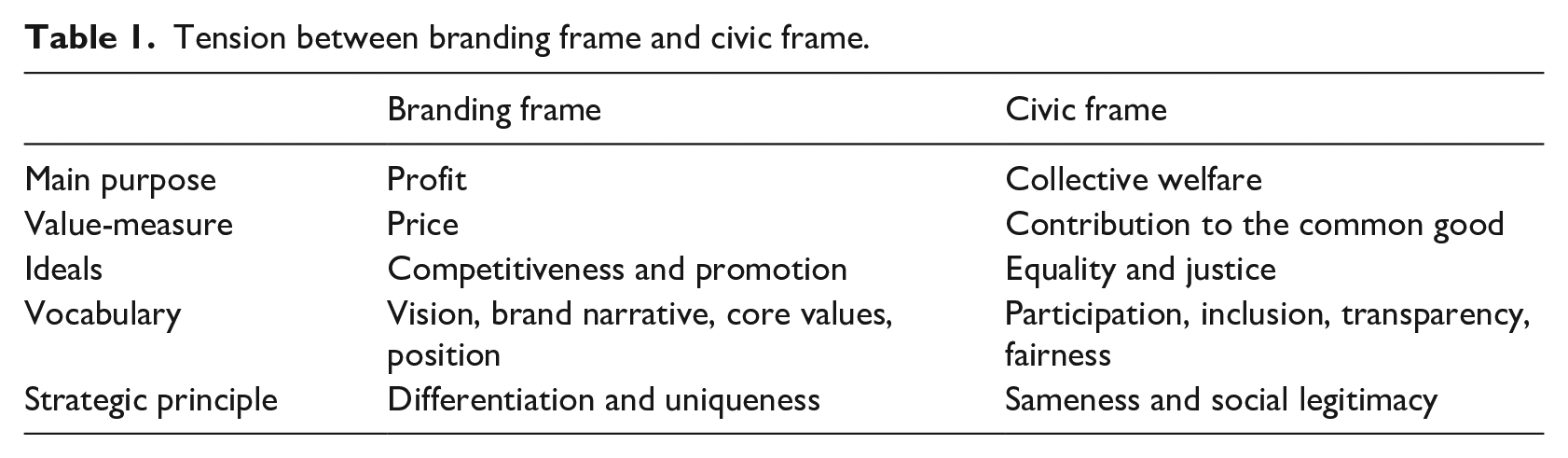
In contrast to the branding frame, the civic frame values vocabulary, activities, and ideals that are inclusive and that contribute to the common good (Bertilsson & Rennstam, 2018; Boltanski & Thévenot, 2006). The branding–civic tension has been observed in public sector organizations, where hospitals, for example, have struggled to align the strategic principles of corporate branding (uniqueness and differentiation) with the civic demand to provide equal or same healthcare services to all (Sataøen & Wæraas, 2015). Further, scholars note that corporate branding’s aim to communicate a single, differentiated, and unique brand (Wæraas, 2008) is at odds with the ambition of public organizations to create a positive perception that is welcoming to multiple stakeholders (Leijerholt, Chapleo, & O’Sullivan, 2019).
Connected to the tension between a branding frame and a civic frame, the second way in which scholars understand branding in cities is called inclusive branding, which in theory promotes a civic frame and a branding frame by noting that branding must be holistic, participative, mindful of social problems, and integrated in local communities (Kavaratzis et al., 2017). Often packaged as an alternative to corporate branding, the inclusive branding literature appears to leave open the possibility that branding can be conducted in the service of social justice if motivations and practices are adjusted, an idea that rhymes with the notion of translation.
Although variations exist, inclusive branding seeks to address social issues by moving branding beyond the economic focus of corporate branding, which some inclusive branding scholars note is akin to colonization, to foreground collective and social processes and outcomes (Kaneva, 2017; Kavaratzis et al., 2017). In doing so, less emphasis is placed on cohesion and uniqueness, as advocated by corporate branding, and more emphasis is placed on celebrating diversity and including as many diverse voices as possible in the process (Cassinger & Thelander, 2017). In practice, inclusive branding advocates for “a stakeholder-centric approach” (Björner & Aronsson, 2022, p. 1587), with a focus on the participation and inclusion of diverse stakeholders, especially those whose voices are not usually heard in the branding process (Källström & Siljeklint, 2021; Rebelo, Mehmood, & Marsden, 2020). However, advocates of inclusive branding practices also warn that even the most inclusive place brands will exclude something. For instance, Björner and Aronsson (2022) explained that even though Syrian refugees were included as one of the many stakeholders involved in co-creating an inclusive place brand in a small town in Sweden, “all residents, including immigrants, who do not engage in the work of the development council are portrayed as less influential authors” (p. 1605).
The sections above assist us in understanding how branding has moved into the public sector and cities and how inclusive branding is an emergent conversation and practice. At the end of this review of literature, several tensions remain around how the concept of branding is understood and used in the public sector, including how people manage the tensions between a branding frame and a civic frame. For instance, although the inclusive literature stream has seemingly pushed the place branding field in a more civic direction (Rebelo et al., 2020), there is still debate around whether or how the concept of branding, even from an inclusive lens, can be translated and transformed to support civic values (Lucarelli, 2022; Vanolo, 2018). For instance, Vanolo (2018, p. 68) suggests that invoking ideas of justice in branding practices is an expression of a “new spirit of capitalism” that incorporates social values and justice “just to make brands attractive.” This debate sheds light on the tensions between merging branding and civic ideals, but more insight is needed into the organizational processes in which branding is used to address social problems. We agree with Kaneva (2017) who argues that it remains to be seen whether inclusive place branding can reconcile contradictions and tensions, but that it is one way to encourage place branders to engage in more socially responsible ways.
Given these questions and tensions, it is important to explore how inclusive branding is practiced and received by branding professionals, who in many cases lead branding initiatives. So far, few studies have paid attention to how branding processes in public sector organizations are received and managed by those tasked with doing branding work (cf. Lundholt, Jørgensen, & Blichfeldt, 2020). While it may sound appealing that branding can be inclusive and address social problems, studying the interactions and internal processes of branding enables us to understand what happens when public sector managers try to put it into effect. It also makes up a fertile ground for advancing theory of how management concepts are received and spread in organizations despite unresolved tensions between the concepts and the new context, particularly as the concepts migrate from private to public sector organizations. With our research question—How is the imperative to engage in city branding to address social problems received and enacted by communication managers and brand consultants?—in mind, we turn to method, including the use of interactionism as a way to analyze the reception of management concepts.
Methodology
The empirical context for this study is the administration of “Granit,” a large Swedish city, with a focus on how they engaged with branding. One of the authors conducted the fieldwork beginning in 2017 when the city was in the early phase of developing a new branding project. Seeing this as an opportunity to study how city managers engage with branding in real time, we received permission, as independent researchers, to follow the branding project by reviewing documents, interviewing key actors, and observing meetings where branding was discussed. As such, we conducted an ethnographically inspired study, striving for proximity to the work with the branding project (e.g., Schwartzman, 1993), which is particularly relevant for capturing the use of management concepts such as branding. It is also in line with the interactionist approach, explained below, which often relies on participant observation to capture naturally occurring interaction (Silverman, 1993).
An interactionist perspective
As perspective to assist our analysis, we draw on some key tenets of interactionism, broadly understood as research “concerned with the creation and change of symbolic orders via social interaction,” which emphasizes the situated character of interaction and how meaning, which has implications for action, is constructed in social interaction (Silverman, 1993, p. 47). The interactionist view thus assumes that one actor’s actions become understandable through other actors’ actions. It also assumes that interactions make up and are made up of “situations”—for instance, “going for an after work,” “having a ladies’ night,” or “working on the organization’s brand”—and a key challenge for actors in any kind of situation is to find an answer to questions such as “What is it that’s going on here?” (Goffman, 1974, p. 8), and “How should one act in situations such as this?” (Persson, 2018, p. 104). The situations thus indicate norms of what is considered proper and relevant behavior (Goffman, 1963; Persson, 2018). Interactionism thereby helps us pay attention to how a “branding situation” is created and evolves in the organization, how various stakeholders act and respond to action, which meanings branding acquires in the process, and what perspectives are included and excluded as the branding situation is sustained (Goffman, 1961, p. 19; Silverman, 1993).
We also make particular use of the interactionist concept of frames, which are “schemata of interpretation” that allow their users to identify and make sense of what is going on around them; they are “principles of organization which govern events—at least social ones—and our subjective involvement in them” (Goffman, 1974, p. 21, pp. 10–11). Frames are invoked by actors and are thus collective and interactive accomplishments that legitimate certain types of actions (Benford & Snow, 2000), but actors do not invoke frames independently. Rather, resources for enacting a frame are taken from the larger social world (Goffman, 1974, pp. 1–2). Therefore, as a methodological concept, analyzing frames implies the analysis of both the interaction as such and the “norms, rules, conventions, etc. that define, control and frame interaction” (Persson, 2018, p. 76).
Notably, research often neglects the interactions and analyzes phenomena—such as branding activities—as if they didn’t depend on interactions and situations. If interactions and situations are neglected, branding in a city becomes something that city managers simply do, without paying attention to the interactions through which it is given meaning. The risk with this is that single phenomena—for instance, a city’s decision to strengthen its brand—are too swiftly understood either as the result of general categories, such as neoliberalism, or as the result of inherent traits (e.g., cities are inherently market players). An interactionist analysis—as part of a general micro-sociological paradigm—often avoids using such categories and traits as a priori explanations of social phenomena, but instead pays attention to them insofar as they are made present in the interactions (Verhoeven, 1985).
As mentioned, we make use of the notion of Eigendynamik, which is also a concept developed in the interactionist tradition. The origin of Eigendynamik is ascribed to the sociology of Georg Simmel, who suggested that conflict between opposing forces can generate its own inner dynamic. Instead of the one-way relationship between cause and effect, he wanted to highlight the circular interaction between them: If the effect that one element produces upon another then becomes a cause that reflects back as an effect upon the former, which in turn repeats the process by becoming a cause of retroaction, then we have a model of genuine infinity in activity. (Simmel, 1978, p. 117)
Simmel showed this, for instance, in his class analysis of fashion, arguing that the conflict between imitation (the lower classes imitating the upper classes) and differentiation (the upper classes differentiating themselves from lower classes) generated more fashion (Simmel, 1957). Thus, accepting this view implies that processes of social interaction do not unfold only because of the impetus of an external force, but “these processes create their own momentum: they are [. . .] eigendynamisch” (Nedelmann, 1990, p. 244), which signifies processes that, once they have been started, continue by themselves without any external influence (Mayntz & Nedelmann, 1987, p. 648). We employ Eigendynamik to make sense of how the management concept of branding enters a social situation in a city and gains its own momentum, and combine it with the notion of frames (Goffman, 1974).
Data collection
To identify relevant informants and important sites for observing the branding project, we employed a combination of purposive and snowball sampling. We started by interviewing Magnus, the top communication manager of Granit, for the purpose of identifying key actors. He gave us initial insight into the branding project and was able to point out key players such as Hampus, the project leader from Granit, and Anders from the consultancy Nova, working in close contact with the city. Granit’s communication group, consisting of the communication managers of different city departments, were also heavily involved, and were interviewed to provide insight and give feedback as the branding project progressed.
We interviewed the actors mentioned above except for one communication manager. In total, this amounted to 27 interviews lasting 40 to 100 minutes (see Table 2 for details).
Interviews with Granit and Nova employees.
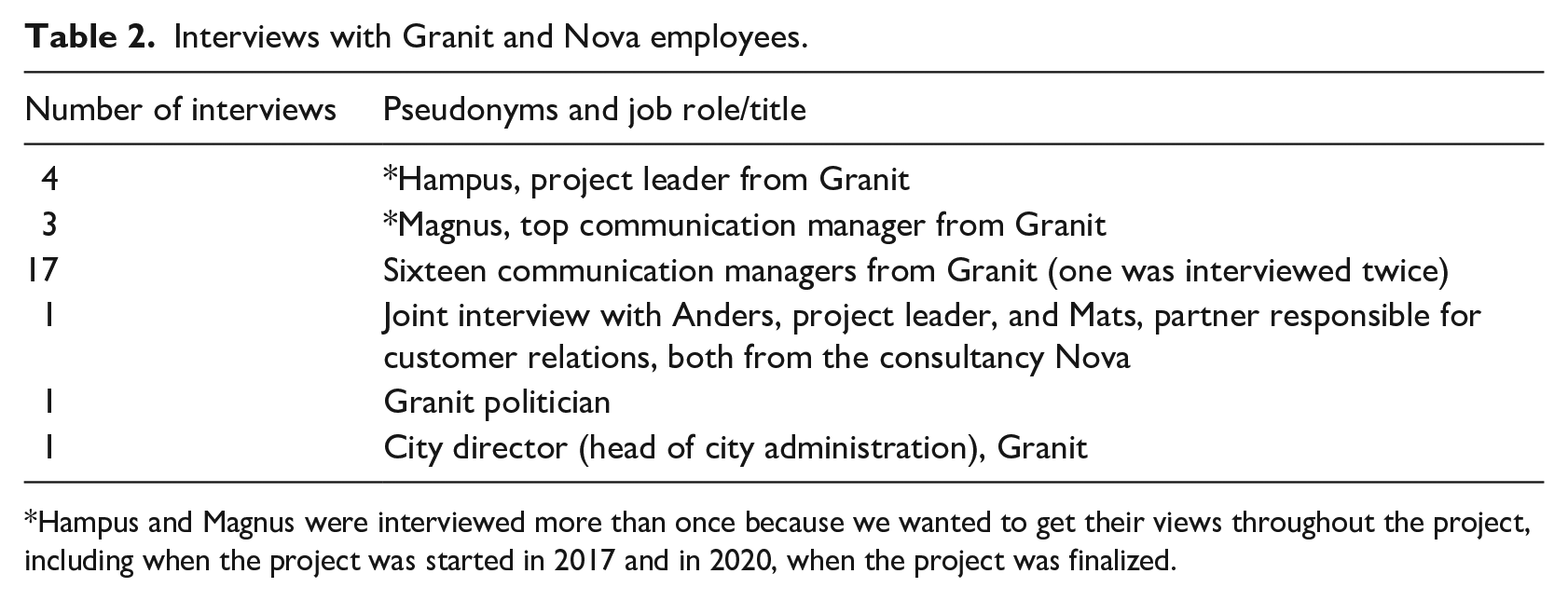
Hampus and Magnus were interviewed more than once because we wanted to get their views throughout the project, including when the project was started in 2017 and in 2020, when the project was finalized.
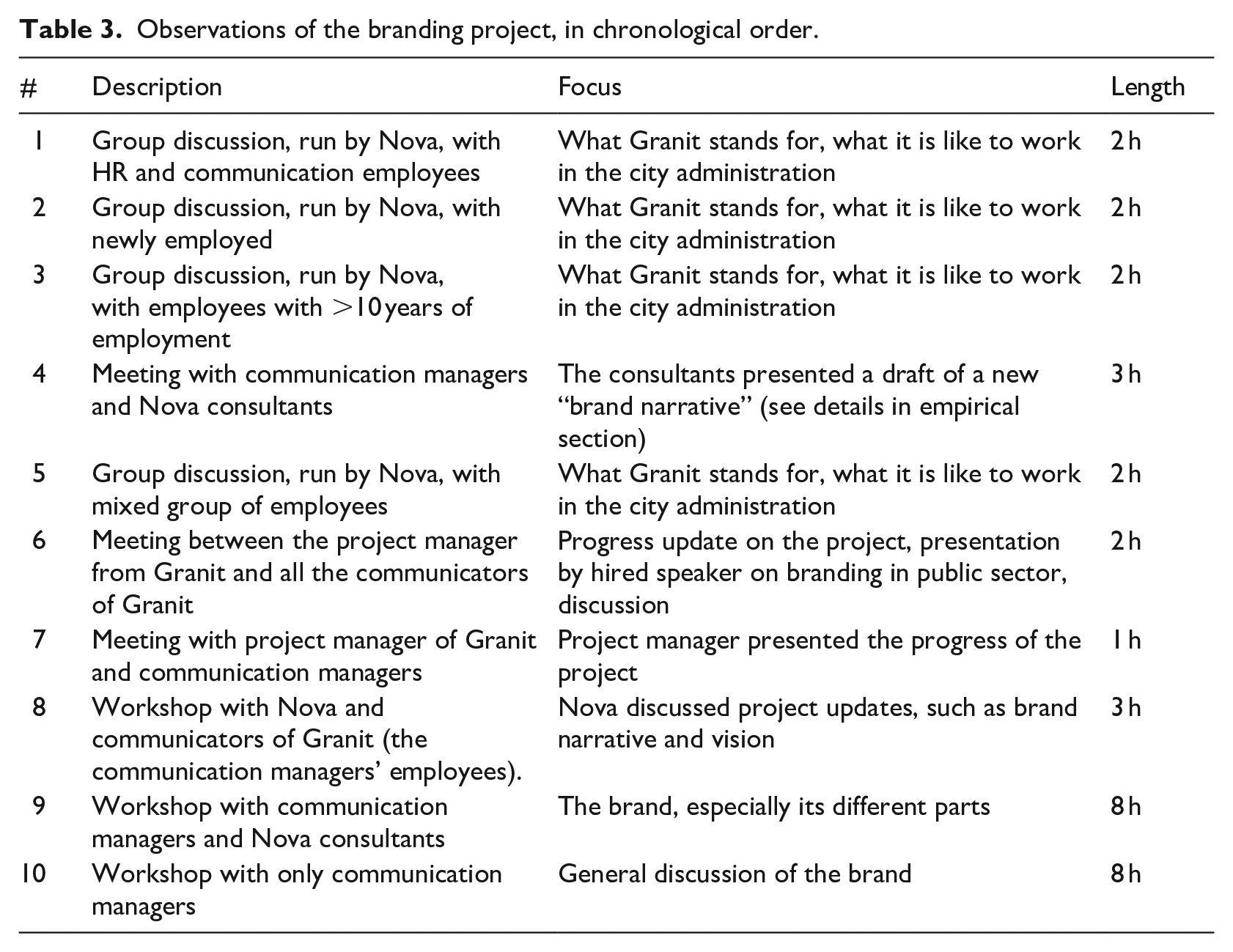
We also observed the communicators’ naturally occurring interactions (Silverman, 1993), including 10 observations of meetings where branding was discussed, lasting between one hour and a full day, between fall 2017 and fall 2018 (34 hours of observation, see Table 3).
Observations of the branding project, in chronological order.
Data analysis
In line with our ethnographic approach, we started the analysis of the data (conducted by all authors) openly. We coded the interviews based on content and identified broad themes, such as the communicators’ views on the city of Granit, the use of external consultants, communication, and branding, both in general and in relation to their city in particular. What stood out early in the analytical process was that a branding situation was created, initially by the city council, linking the city’s social problems (i.e., inequality and segregation) to its perceived attractiveness, which was to be enhanced through branding. This rested on the assumption that it was necessary to redefine Granit’s identity. We also noted that the communicators experienced the branding process as tension filled in that the branding consultants brought with them a vocabulary that the communicators seemed to both embrace and criticize. For instance, they identified how working with consultants was good because they brought experience and an outsider’s perspective, but they also recognized that this could disempower the city’s communicators by allowing the consultants to articulate important aspects of Granit. This critique was further and more vividly expressed at the meetings we observed.
What the insights above did not capture was the phenomenon that the communicators’ criticism seemed to expand the branding process rather than slow it down. Seeking a way to conceptualize this, we consulted our interactionist repertoire and found appropriate the notion of Eigendynamik, which signifies processes in which friction produces momentum (e.g., Nedelmann, 1990). Thus, although our analytical process started out fairly openly it should not be understood as inductive in the sense of non-theoretical, but rather as an interpretive process developed through a movement between the data and the theoretical knowledge of the analysts (e.g., Charmaz, 2014).
Creating a Branding Situation in the City of Granit
The following section describes how branding was set in motion by politicians as a means to solve a social problem, and how it was received and enacted by communication managers in interaction with branding consultants in Granit.
Branding to solve social problems
In 2017, the city council of Granit—a city known for being both diverse and vibrant, but also segregated and struggling with gang-related crime—set a goal to “strengthen the brand of the city and communicate this to its external environment” (Granit, 2017, p. 8). They further explained, “The goal [to strengthen the brand] was chosen because the City Council points out the importance of strengthening the city’s attractiveness by reducing inequality in Granit” (Granit, 2017, p. 8). This reason was also expressed in a “brand investigation” report commissioned by Granit and conducted by the consultancy firm Nova. The report used interviews and focus groups with various city stakeholders—citizens, entrepreneurs, and representatives of key institutions such as the police, the local university, the immigration service, and the employment agency—to find out how they viewed the city. The study found that while people perceived Granit to have many strengths, these were challenged by perceptions of segregation, racism, crime, drugs, and violence (Nova, 2016). As a result, the city’s communication department was tasked to implement branding to strengthen the city’s brand, especially as it related to segregation and inequality. In interactionist terms, this work created a branding situation, defined by the actors involved in it.
In the branding process that unfolded, the consultants continued to follow a key tenet of inclusive branding: gathering information from various internal and external stakeholders to hear what they had to say about Granit’s identity (Kavaratzis et al., 2017). Nova also used secondary sources, including formal city documents, a book on brands in public service, and a 2015 employee survey that investigated how city employees believe citizens perceive Granit.
From this data, Nova found the same challenge as in their 2016 brand investigation regarding perceptions of segregation, racism, crime, drugs, and violence, but now more clearly defined in terms of urgency and threat. Stakeholders’ views were polarized regarding the fact that Granit has become more demographically diverse, less industrial, more international, and quite segregated. Granit’s strengths—youth and dynamism—could become its weaknesses: The young and dynamic Granit is vulnerable—increased segregation and social exclusion can make Granit develop in the wrong direction. There must be a movement in the right direction, and a feeling that something is happening here and now. In this work, Granit [the city administration] plays a very important role, taking the lead both rhetorically and in terms of action. The brand document is part of the work to make the employees of Granit realize that their work is important and significant, and in the long run decisive for the future of Granit. (Nova, 2017, p. 7)
Alongside the social problems, Nova also reported an internal need for unity and an updated identity. In a key takeaway, Nova wrote that the city’s communicators and HR professionals “experienced a need to clarify the organization’s common denominator—we stand for this, this is our role and this is the way we are working” (Nova, 2017, p. 5). Thus, the branding situation was filled with new meaning in the sense that branding was presented as a tool to address not only social problems but also internal identity-related issues.
After it had been established that the lack of a common identity was also a problem, the social problem aspect began to disappear in favor of corporate branding ideals. Increasingly, the importance of developing a cohesive identity was emphasized and Nova’s solution to the problems outlined was to develop a brand narrative of the city: Today, there is no uniting narrative for Granit, which makes the brand vulnerable and exposed to how the external environment describes the organization (p. 6). [. . .] An important part of branding is to clarify a common direction for the organization brand/employer brand and the destination brand. Therefore, our general recommendation is that a common narrative for these brands is developed and that a common brand document is produced. (Nova, 2017, p. 3)
Nova again used inclusive practices via surveys and focus groups with different employee categories, discussing core values and identity-related questions such as: What is good about Granit? What is good about working in Granit? What might be good about working in other cities? [our italics] Notably, Nova began to distill the branding work around positive aspects of the city.
Thus, the section above shows how a branding situation was interactively defined, in which it was seen as proper to engage in branding to solve social problems by including diverse stakeholders, but also how those social problems were backgrounded. In the sections below, we turn to how the development of the brand narrative played out in the interactions between city communicators and consultants.
Branding struggles producing Eigendynamik
Nova authored the first version of the Granit brand narrative and presented it to the city’s communication managers. While the process that unfolded was characterized by cooperation between the consultants and the communication managers in the sense that they agreed that a narrative should be produced, the process also involved tension. One key focus in interactionist analysis regards the relationship between frames/schemata of interpretation (Alasuutari, 1996). Here, this is characterized by a tension between the branding frame and what we call the civic frame, as described earlier (see Table 1).
As we will see in the following sections, this tension was expressed by the communication managers’ critique of the content of the brand narrative, their confusion about what to do with the branding vocabulary, and their occasional doubt about whether they should engage in branding work on the city at all. Yet, despite their concerns, they enacted the process. This tension-ridden acceptance, we suggest, can be understood as an Eigendynamik (Åkerström, Jacobsson, Andersson, Cederholm, & Wästerfors, 2021; Simmel, 1957), highlighting that the tension between frames did not result in the cancellation or slowing down of the branding initiative, but rather in the development of an inner dynamic in which the friction between the branding frame and the civic frame created its own momentum and energized the process.
Critique of the branding frame
The brand narrative was first presented to the communication managers at a half-day workshop (observation #4). The narrative emphasized the young, dynamic, and entrepreneurial part of Granit. While the communication managers generally supported the idea of a brand narrative, there was critique of the narrative itself, reflecting the view that it excluded civic and social aspects, as illustrated in the following account from the presentation: Mats, the head of the consultancy, introduces the workshop. He speaks abstractly by noting humans’ desire to climb up a hierarchy of needs, how diversity stimulates creativity, that Granit’s strength is its cultural contrasts, and that they have tried to capture Granit’s “areas of possibility.” He then introduces his colleague Maria to dive deeper into the brand narrative. Maria says that this is about “finding Granit’s voice” and emphasizes that it is important that “everybody in the organization can recognize themselves.” Speaking quickly, Maria then reads the narrative out loud, sometimes pausing to add explanations. The narrative stresses dynamism, change, and youth, with phrases like continuous change; faster pace than ever; young city; a place for progressive companies, brave entrepreneurs, and curious creators; and a place where food trends, music, culture and fashion begin. Maria underlines the main message that “the future is here,” and says that “Granit is the future, in a way.” She sells it to the group of city communicators by explaining that “it sounds a bit upfront, but that’s the idea. It indicates that ‘now we need to move on’.” Driving home this message of progress and community, she also shows images of men who appear to be in a pride parade, images of a school, of kids, of a beekeeper, and of a person using virtual reality, among other things. As Maria finishes her talk, the room stays silent and the communicators look slightly uncomfortable. When they comment and ask questions it’s clear that they are not satisfied, seeing little relevance to their city and workplace. One manager says, “It lacks identity. I’m thinking, where’s the core work here? This is the cool young Granit. Where are the people above 39?” Another says, “this could be the description of the event industry,” and a third comments that “the people working in the city are missing, it has more entrepreneurs and creators than nurses.” In response to the managers’ challenges, Maria explains, “I see what you mean. It’s open and so on,” But she persists with the narrative by advocating and seeking to close the conversation, “That’s often the case with texts, it’s many words and many people need to recognize themselves. But if you feel comfortable with the big story it can be a good point of departure to move on.” The communication managers don’t move on, however. Although Maria suggested that the “big story” was set, the communication managers get engaged in a discussion of what the identity of Granit is, including its unique features. Maria interrupts and says that it’s easy to get too detail oriented. She switches to a new focus and asks, “Can I just borrow your time for three more minutes. It’s a little film . . . you will understand at the end.” She shows a film clip from a TED talk about “re-imagining the future” that features a child who thinks school is pointless because he believes that in the future there will be a machine that can make him smart. It introduces Doomsday Dan, a guy who has spent seven million dollars preparing for a huge catastrophe he believes is on its way and then points out that the poor countries of Ethiopia and Bangladesh have space programs primarily to inspire young people to be involved in science and technology. The clip’s point appears to be that how people imagine the future affects how they act, and that being curious about alternatives can help us rethink what is possible. When the clip stops Maria says, “What if . . . Granit could be the city that has solved the problems before everybody else? That could be the goal.” It gets awkwardly silent as the managers are left to connect Doomsday Dan and Ethiopia’s space program with solving “the problems” in Granit. Mats breaks the silence by thanking Maria and transitioning to talk about the schedule for the work.
This interaction expresses the tension between the branding frame and the civic frame. A key function of frames is to indicate what is relevant and irrelevant in a situation (Silverman, 1993). Above, Maria and Mats invoke a branding frame, making aspects such as dynamism, change, achievement, and creativity relevant, while what the communicators understand as the “core work” of the city is deemed less relevant. The clash between the norms in the branding and civic frames is perhaps best expressed by the sudden presentation of the TED talk, which contained messages that were abstract and detached from everyday life in Granit, leaving the communicators even more alienated.
Communication managers also expressed critique of the workshop in interviews, such as: “it sounded like we were some ice cream vendors” and “It was a catastrophe, what they suggested.” However, the idea of a brand narrative was not abandoned, but edited. Nova was tasked to change the narrative to bring it closer to the empirical realities of the city, after which the communication managers further edited and ultimately accepted the narrative.
Futhermore, the communication managers not only edited the narrative, but also expanded the branding vocabulary. Instead of perceiving the “disaster” and “ice cream vendor” feelings as an indication that this branding process might not be a very good idea, the process expanded to, in Hampus’ words, “talk about core values and vision, and about position,” all of them central concepts in the (corporate) branding toolbox (e.g., Hankinson, 2007).
Confusion within the branding frame
When engaging with the new vocabulary, the communication managers expressed confusion. As one commented, this type of work on their identity had “never been an integral part of the municipality’s work”, and therefore required an element of learning the branding vocabulary. Patricia, one of the communication managers noted this struggle to understand the meaning of the branding vocabulary (vision, brand narrative, core values, position): The first step is that the communicators understand this, because brand narratives and the vision, and how the different parts fit together and when it should be used for what, it’s quite clear that it can be difficult even for the communicators. We noticed that at a workshop with my unit.
We also observed this confusion at an all-day workshop (observation #9) with all the communication managers where the extended branding vocabulary was discussed. A small group discussion with five communication managers and one of the researchers began in a positive spirit. But when they started talking about how to implement the conceptual elements, the tone changed and difficulties were raised, such as the difference between core values, promise, position, and the brand narrative:
I have a bit of trouble with . . . you know, core values and so on, but then, our promise and our position . . . what is, when do we use [what], you know?
What is what, or?
Yeah, . . . well I understand what position and promise mean but how is it supposed to, sort of . . .
Yes. When we talked about this in our management group, a lot of people said, “What are we going to do with the brand narrative?”
Yes, yes.
I don’t understand how it’s supposed to be used [referring to what they said in the group].
No, right [agreeing].
At this workshop, the civic frame, and in particular the problems with inequality and segregation, was absent. It was as if they had left the civic frame and its focus on social problems behind and were now within the branding frame where, instead of focusing on social problems and inclusion, they were struggling to connect the dots between the branding concepts. And they expressed the reasonable concern that if the communication managers themselves do not understand the different parts of the branding frame, how will the rest of the organization know how to use it? As with the brand narrative being perceived as a “disaster” (observation #4), this confusion could also be understood as a (second) indication that there is something problematic about the city branding process. However, they continued with the branding process despite the confusion about its meaning or use-value.
Fundamental doubt about the branding frame
We have shown so far how the conflict between frames and the confusion within the branding frame did not stop the process of engaging with the language and practice of corporate branding, but rather energized it. However, although it was not brought to the forefront of the open discussions, we also observed profound doubt about the adequacy of engaging in branding and identity work on the city at all. The last large workshop we observed (observation #10) was a full-day retreat with all communication managers to discuss the branding initiative. In a small group discussion, Patricia explained to Carl how she had heard a presentation by a Swedish professor of business administration who studies public sector organizations. Patricia had asked the professor for advice on how Granit should go about identifying who they are as a “part in a larger cosmos.” The professor had replied, “Perhaps you should give it some thought, if you really should do that?” Carl then seems to ask the same thing, chiming in:
Yes, is that our mission?
Yes, is that really our mission? Are we supposed to . . . are we supposed to do that? Find a bunch of core values about flying to the moon you know?
The discussion continues for a while, and the researcher observing the meeting asks Patricia if there might be core values in the municipal law. It would be interesting to look into that, Patricia replies, and then proceeds in a sarcastic tone: But we want to invent our own core values. We don’t want to take anything from the municipal law. That’s kind of the point. That we should create our own [words] in the search for our identity. And not draw strength from the wording in the [law] . . .
What are you talking about now? (smiles) Let’s drop this whole thing, is that what you’re saying? [smiles]
Nah, I just wanted to fight a little. [both laughing]
Patricia’s doubt arguably brings back the conflict between the branding frame and the civic frame as she wonders if they should be doing this at all, expressing that there is something grandiose about the idea of finding a new identity for a city. When asked if they could look for values in the municipal law, a very “civic” document that communicates core values common to all municipalities, she says that they would never do that, but want to “invent” their own values, sarcastically invoking the branding frame that suggests that municipalities should differentiate themselves from each other.
Patricia was not the only one expressing doubt. So did Anders, the Nova consultant. After a presentation, the researcher approached him to chat, and Anders said, “I think it’s difficult” and that “some people don’t think we should do this at all.” Anders invoked the civic frame to explain further: It is a large organization and many interests, and it is difficult to put together a brand narrative. If you write “solidarity”, you will be criticized because it is too politically charged, for example. As soon as something stands out a little, it doesn’t work because someone feels trampled on. If you write “two empty hands,” someone will say that they work with people who don’t have two hands.
Thus, although Anders is the main carrier of the branding project, he seems unconvinced about its value given the civic context, a politically charged context with multiple stakeholders.
This doubt was also expressed by Hampus, the project leader in Granit, who gave voice to both doubt and advocacy of branding. For instance, he published two posts on Granit’s intranet, stating that “Branding in public organizations is often questioned,” where he showed awareness that others doubted the value of branding. In the first post he explained brands and branding, and in the second he discussed the value of engaging in branding. The fact that he felt the need to explain and discuss branding indicates doubt, and when asked about the challenges he said, “This concept, branding, can be problematic and the image of communicators as window dressers, it has been no surprise. I’ve been aware of that all along.”
Hence, this last part shows how key actors involved expressed doubt about the language and practice of branding in public organizations, invoking the tension between the branding and civic frames. But despite the doubt, the new branding guide, including the brand narrative, was accepted, and developed by the communication managers.
Discussion
The empirical section above explores the development of a branding project that was initiated to address social problems in a city. In our study, as illustrated in Figure 1, this process started with Granit’s city council stating that the social problems of inequality and segregation were a threat to the attractiveness of the city and suggesting that this could be addressed by strengthening the city brand. This initiated a branding situation that brought together the branding frame and the civic frame, which set in motion a process of developing a brand narrative that expanded to include a number of other branding concepts such as core values, position, and vision. While the branding frame guided the process, it came into tension with the civic frame, expressed by actors’ critique, confusion, and doubt about the relevance of branding in their work—as depicted by the opposing arrows in Figure 1. But the tension paradoxically did not slow down the process but rather energized it, illustrated by the upward spiral in Figure 1, in a process that we conceptualize as frame-induced Eigendynamik. In addition, when the process expanded, the social problems were glossed over and largely disappeared from the rest of the process. In light of this, we discuss below our three main contributions: one theoretical, by introducing the notion of frame-induced Eigendynamik, and two directly addressing the literatures on inclusive branding and the use of management concepts in public organizations.
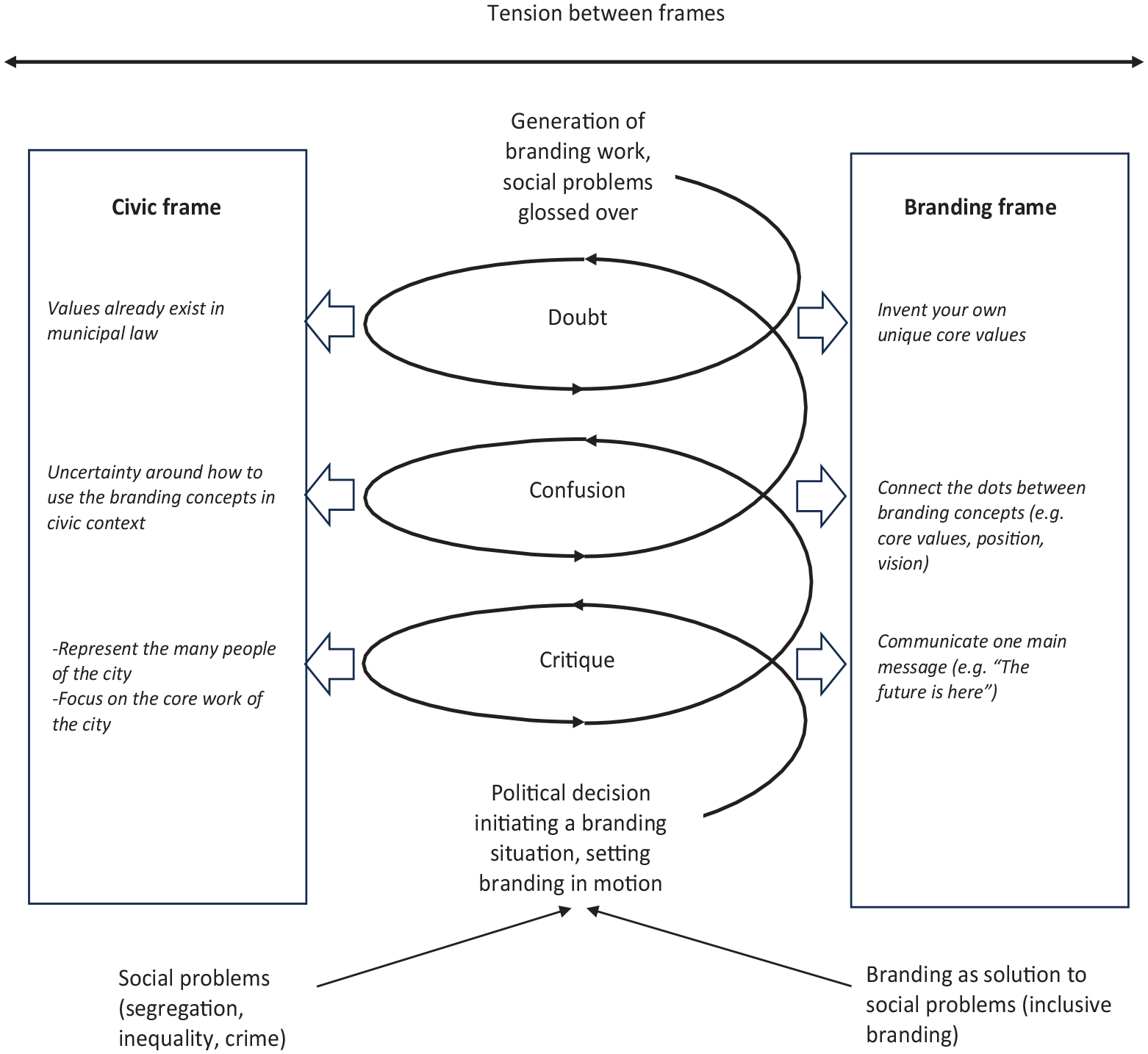
Process model of frame-induced Eigendynamik of branding in a civic context.
Frame-induced Eigendynamik in city branding
Theoretically, we have drawn on the interactionist, Simmelian, point that tension and conflict between contradictory forces can be generative, a phenomenon that has been described in terms of Eigendynamik. Simmel analyzed broader social phenomena such as fashion, but Eigendynamik has recently been used also to describe organizational phenomena, particularly how administration expands not only because of pressure from above but through inner dynamics created by contradictions between opposing forces of order and disorder (Åkerström et al., 2021; Stenström, 2023). For instance, Åkerström and Jacobsson (2019) suggest that the desire to create order is expressed by organizing meetings and creating documents, but the meetings and documents also create disorder, which is dealt with by organizing new meetings and creating new documents.
But while Simmel and his followers focus on fundamental tensions between contradictions or opposites—such as rest/motion, order/disorder, integration/segregation, imitation/differentiation (Sellerberg, 1994, p. xvi)—we focus on the less fundamental tension between frames. We thus bring forward the notion of a “frame-induced” Eigendynamik, which is based on the same logic as Simmel’s notion, but whose focus on frames broadens its analytical scope by not relying on opposites, thereby making it more useful for studying the reception and use of management concepts. Frames are “principles of organization which govern events [. . .] and our subjective involvement in them” (Goffman, 1974, pp. 10–11). One frame is always different from another, which implies that there is always a tension between them, but they are not necessarily opposites. Our study exemplifies this: the branding frame and the civic frame are not presented as opposites, but they are presented as being in tension with each other to varying degrees.
Frame-induced Eigendynamik thus refers to self-generating processes energized by tensions between frames. It sheds light on the phenomenon that when management concepts are introduced into an organizational setting governed by frames other than the one introduced by the management concept, the resulting tension may energize rather than slow down the management concept. Specifically, we demonstrate how the tension between the branding frame and the civic frame can give city branding a “life of its own,” enabling it to survive and expand even when the organization’s members struggle to see how it is relevant to their work. This is the frame-induced Eigendynamik of branding in a civic context (see Figure 1), which lays the ground for our additional contributions: to the understanding of inclusive branding and, more generally, to the understanding of how management concepts are received and enacted in public organizations.
Eigendynamik and inclusive branding
Our study particularly addresses the inclusive branding idea that branding can be transformed to shed its corporate baggage to better address the social problems of cities. Previous studies tend to focus on how branding should change to become more inclusive (Kavaratzis et al., 2017) and on the development of tools for inclusivity and participation (e.g., Källström & Siljeklint, 2021; Lichrou, Kavaratzis, & Giovanardi, 2017; Rebelo et al., 2020). We rather respond to the call for studies of the organizational activities that inclusive branding triggers (Lucarelli & Brorström, 2013; Vanolo, 2017), and we do so by highlighting the tensions this creates for managers and consultants tasked with branding, and what happens to the inclusive and social ambitions throughout the process of addressing social problems through branding. As noted, our study shows how the inclusive ambition was difficult to put into practice and disappeared from the process, while the engagement with corporate branding remained and even increased, as illustrated by the upward spiral in Figure 1.
To make theoretical sense of this loss of inclusivity in the process, it is useful to pick up the interactionist point that frames are not stable but rather they are “vulnerable” (Goffman, 1974, p. 10). Vulnerability refers to frames being dependent on “interacting individuals defining reality in roughly the same way” and frames are therefore threatened if their norms and conventions are broken (Persson, 2018, p. 60). The tension between the branding frame and the civic frame materialized in the process as each frame was “threatened” by the other. This was evidenced by the interactions in our case. For example, the glossy branding vocabulary presented by the consultants in observation #4 threatened the civic frame, which led the communication managers to respond with criticism, which in turn threatened the branding frame. The branding frame was kept, however, which again threatened the civic frame, as evidenced by the communication managers’ and consultant’s doubt. Nevertheless, the process evolved into corporate rather than inclusive branding. Thus, while acknowledging that city representatives can draw on inclusive ideas to introduce branding, our study challenges the view that inclusive ambitions can be maintained throughout a branding process. It rather suggests that the civic frame is vulnerable to the vocabulary and practices of the branding frame, demonstrated by the fact that the latter was kept and energized despite the criticisms and doubts.
This suggests that the idea of inclusive branding may be somewhat idealistic, and that studies of inclusive branding underestimate the strength of the frame surrounding conventional branding—with its ideals of competitiveness and promotion, and its accompanying vocabulary of vision, identity, image, core values—and the pull it has on branding practice. Put bluntly, our study shows how inclusive branding theory becomes corporate branding practice. We thereby support those who argue that the social elements of branding tend to be used superficially (Vanolo, 2018), but we also argue that close attention needs to be paid to how the branding frame interacts with the frames in the setting in which branding is used. Anyone who wants to take inclusive branding seriously must not be naive that a change in mindset and practice will lead to inclusivity, but rather contend with the fact that the civic frame is vulnerable to the branding frame, meaning that there is a dynamic tension at play that is difficult, but perhaps not impossible, to resolve. This challenges the assumption that you can take branding and turn it into a force for inclusivity. It seems like inclusive branding would require the elimination of the branding frame, with its ideals and vocabulary, and then it is questionable whether it makes sense to call it branding at all.
Eigendynamik and reception of management concepts
In addition to contributing to the understanding of inclusive branding, our study addresses the more general phenomenon of the migration of management concepts from private to public organizations. The predominant way of understanding this migration is through translation and colonization, to which our notion of frame-induced Eigendynamik offers a complementary view. Table 4 briefly summarizes key differences between translation, colonization, and Eigendynamik.
Understandings of how management concepts migrate.
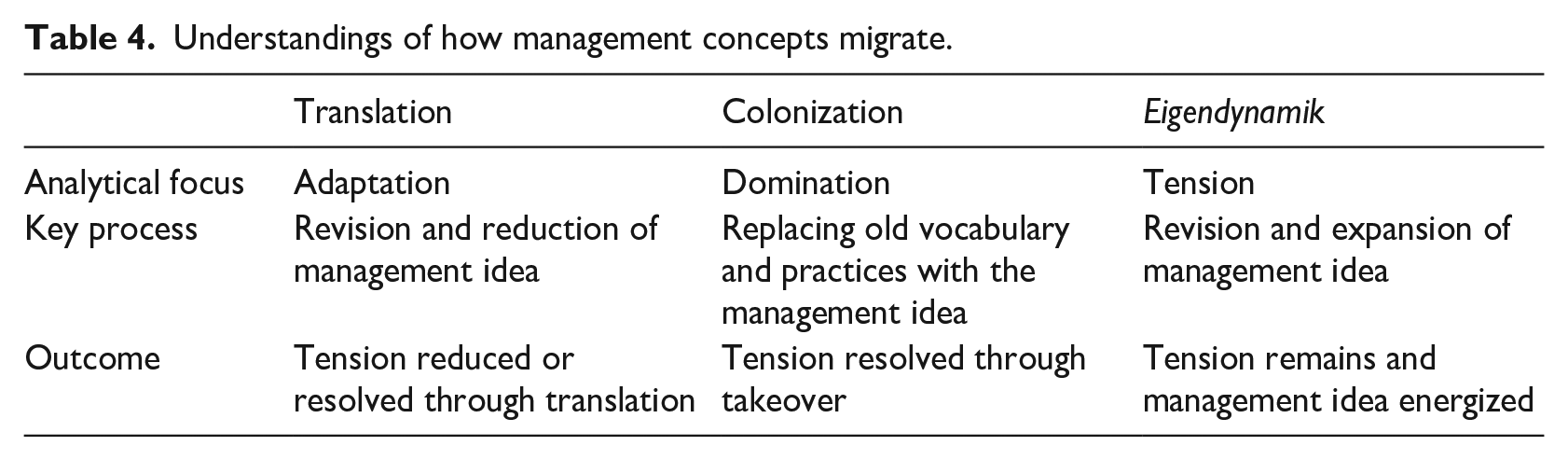
The most common ways of analyzing the reception of management concepts are through the lenses of translation (e.g., Kornberger et al., 2017; Levay & Waks, 2009; Waldorff & Madsen, 2023) and colonization (Aroles et al., 2022; Deetz, 1992). Translation directs analytical focus on the adaptation of management concepts in new contexts (Sataøen & Wæraas, 2015) and tends to be viewed as a process in which the original content (e.g., branding ideas) is revised and reduced and tensions are reduced or resolved. The colonization lens, in contrast, directs its analytical focus on how management concepts dominate new contexts, a process in which the original content of the management concept remains unchanged (e.g., Deetz, 1992). Eigendynamik, in turn, focuses on the tension and interaction between the frame around the management concept and the frame(s) around the setting in which it is used. By introducing frame-induced Eigendynamik, our study helps us to make sense of an organizational phenomenon that is related to, but not the same as, translation or colonization. The key distinction is that Eigendynamik highlights that the tension that arises when management concepts originating in the private sector are used in the public sector is not reduced or resolved, but remains, and that it can, somewhat paradoxically, energize the management concept.
Eigendynamik thereby offers a novel way of understanding how management ideas developed for the private sector (e.g., lean, diversity management, or branding) can be introduced into the public sector and survive and prosper despite criticism from both practitioners and researchers. At a general level, the use of branding in cities is not without critics (e.g., Vanolo, 2017), but it still produces new management techniques that are received and enacted. How do we make sense of this acceptance in general, and the rise of branding in the public sector as a way to solve social problems in particular? Here, Eigendynamik offers something that complements the focus on overt external control through neoliberal ideology (colonization) or on adaptation (translation) of corporate management concepts to a civic context. Eigendynamik highlights not so much that something takes over something else, but rather how people are “swept up” into the engagement with management concepts that they perceive as confusing and unfit, while at the same time capturing the energizing element of tension and critique.
In addition to making sense of how management concepts are received, Eigendynamik also proposes an answer to the question “Why”? Why are they doing this, especially if they criticize and doubt it? Here we build and expand on the colonizing view. The colonizing view answers the question “Why?” with reference to the external force of neoliberal politics, accompanied by an institutional field of consultants and branding gurus, that dominates city management and pressures cities to engage in branding (e.g., Broudehoux, 2007; Eisenschitz, 2010; Vanolo, 2018). Our study, through the notion of frame-induced Eigendynamik, sees no reason to deny the pressure of neoliberal politics and discourses, but rather than a totalizing force, assigns to them the role of an initial push that sets the Eigendynamik in motion. Such a push is suggested by our case: without the existence of the concept of branding, the city council couldn’t possibly have chosen it as a tool to reduce inequality and address problems of segregation. This was the initial push, and it arguably would not have been possible without a neoliberal discourse suggesting that (inclusive) branding is a reasonable way of dealing with social problems. But rather than using this neoliberal push as the explanation for what happened next, Eigendynamik encourages us to delve into the interactions that took place, focus on the tension that characterized them, and suggest that this tension creates a generative force. In Simmel’s (1957) analysis of fashion the tension between imitation and differentiation generated more fashion; in Åkerström et al.’s (2021) study of administration the tension between order and disorder generated more administration; and in our study of branding the tension between the branding frame and the civic frame generated more branding.
To sum up, we argue that Eigendynamik is an underexplored concept for making sense of how management concepts are received and expand in organizations. And it does a better job than translation and colonization to help us understand how and why management concepts gain traction despite organizational members’ doubts about their value. Furthermore, and we turn to this next, our understanding that the introduction of management concepts can be self-energizing suggests that a range of organizational concepts and processes can be energized by tensions between frames.
Theoretical reach and implications for future research
The theoretical reach of frame-induced Eigendynamik thus goes beyond city branding and tensions between branding and civic frames. It arguably represents a quite common situation in which practitioners are confronted with new concepts and ideas and the engagement with them feels somewhat contrived. A general implication of our study is therefore that management and organization studies need to explore the use of management concepts with attention to the tensions and challenges that emerge in interactions because Eigendynamik can push the best intentions in unexpected and unwanted directions. Based on our work, scholars interested in the migration and use of management concepts should reconsider the role of tensions, not only focusing on how they are reduced or resolved, but also on how they remain and in what ways they are generative of new work that may or may not be useful to the organization. Our study leads scholars to ask questions such as: what work goes into managing the tension between the frames actualized by the management concepts; in this work, which frame(s) tend to be more vulnerable; what consequences and costs are associated with this work; and how is this work related to the core work or mission of the organization?
For future research, this implies that frame-induced Eigendynamik can be used to study other contexts, seeking to identify the relevant frames and how the tensions between them play out in interaction. Our conceptualization may be particularly relevant to other situations in which corporate concepts are used to address social issues, but may miss their targets because practitioners are drawn into activities that are prescribed by the frame surrounding the concepts. For example, diversity management may have good intentions of increasing inclusivity but has been found to sometimes miss its target and focus more on documentation than inclusion (Ahmed, 2012). Another example is social entrepreneurship, in the sense of addressing social issues through business methods (Roundy, 2014). While entrepreneurs can have good intentions, they may get swept up in an Eigendynamik characterized by tension between business and socio-ecological frames, which may generate more business rather than address socio-ecological problems. Furthermore, there is no reason to limit the relevance of frame-induced Eigendynamik to the analysis of attempts at addressing social issues of inclusion and inequality. With the questions suggested above in mind, it could lead scholars to analyze a broad range of empirical areas. For instance, it would be interesting to explore how processes of leadership, performance management, quality control and accreditation systems, digitalization, and AI are granted a “life” of their own despite the fact that they are in tension with existing frames guiding the organizations, and despite practitioners’ hesitation about their value.
Footnotes
Acknowledgements
The authors would like to thank senior editor Martin Kornberger and the three anonymous reviewers for their helpful comments on our manuscript.
Authors’ note
All authors contributed equally to this work.
Funding
The author(s) disclosed receipt of the following financial support for the research, authorship, and/or publication of this article. This work was funded by a grant from Handelsbankens forskningsstiftelser. Grant number: P2017-0123:1
