




Abstract
The practice-driven perspective in organizational institutionalism has proposed that what actors say and do is decisive for the enactment of practices in everyday situations. However, this perspective has predominantly considered the role of doings and has disregarded the distinct role of sayings used in everyday situations. Our theoretical argument proposes the co-constitutive coexistence of sayings and doings in the enactment of practices that explains why and when doings inform specific sayings and why and when sayings prefigure specific doings. Theorizing this coexistence reveals when it is that sayings bolster the reproduction and stabilization of doings, when they contribute to change, and when sayings cannot coordinate doings because actors literally cannot understand one another. We argue that the consideration of the coexistence of sayings and doings is relevant for practice-driven institutionalism, as it enables the differentiation of the situated impact of doings and sayings on the development of practices. To develop this argument, we build on insights from the embodiment perspective within the philosophy of mind (i.e. philosophy of embodiment), which suggests that the body and its sensorimotor states in practices play an instrumental role in cognition and language use.
Keywords
Introduction
The importance of sayings and doings in institutional processes is widely acknowledged in organizational institutionalism (Scott, 2014). In particular, practice-driven institutionalism has proposed that what actors say and do is decisive for the enactment of practices in everyday situations in social settings (Smets, Aristidou, & Whittington, 2017). ‘Practices’ are thus bundles of sayings – sentences in everyday verbal activities – and doings – the everyday non-verbal activities of human bodies – in pursuit of a specific purpose (Schatzki, 2002). ‘Social settings’ such as organizations are orders in which practices are situated (Berger & Luckmann, 1967; Zucker, 1977).
However, because the practice-driven perspective within organizational institutionalism has predominantly studied the role of doings (Malhotra, Zietsma, Morris, & Smets, 2020; Smets & Jarzabkowski, 2013; Smets, Jarzabkowski, Burke, & Spee, 2015; Smets, Morris, & Greenwood, 2012), the role of sayings in the enactment of practices and the coexistence of sayings and doings have not yet been systematically theorized. This is problematic because doings and sayings hang together and interact in practices (Schatzki, 2002). Accordingly, we aim to advance practice-driven institutionalism by conceptualizing the relationship between sayings and doings in practices and have therefore formulated the following guiding question: How are sayings related to doings in the enactment of practices, and what consequences arise from this relationship? To answer our question, we theorize the coexistence of sayings and doings in practices. Our theorization reveals why and when certain doings inform the construction of specific sayings, why and when sayings can prefigure and maintain doings, and why and when sayings cannot coordinate doings because actors literally cannot understand one another. The coexistence of sayings and doings thus provides insight for differentiating the situated effects of doings and sayings on the reproduction, stabilization and change of practices.
The contemporary focus on doings in practice-driven institutionalism can be understood as a reaction to the contemporary treatment of language in organizational institutionalism (Phillips & Malhotra, 2017; Smets et al., 2017). In this context, the focus in organizational institutionalism has been on bundles of content words – systems of vocabularies – that occur in sayings in discourse (Loewenstein, Ocasio, & Jones, 2012). In this sense, in organizational institutionalism, ‘sayings’ have been limited to discursive speech that provide and justify the definition of actors, behaviours and objects involved in practices. However, as discourses are collections of texts that exist at the so-called field or societal level, they are not situated within practices (Lizardo, 2020; Phillips, Lawrence, & Hardy, 2004). Accordingly, in organizational institutionalism, doings are separated from sayings, based on the claim that ‘institutions are externalized and objectified meanings’ (R. E. Meyer & Vaara, 2020, p. 902). In other words, vocabularies enable the externalization of meaning in discourses and exist detached from doings, which reside in everyday situations (J. W. Meyer & Rowan, 1977; Ocasio, Loewenstein, & Nigam, 2015). Vocabularies in discourses may point to potential doings but are not considered an integral part of everyday practices (R. E. Meyer & Vaara, 2020). Thus, from this perspective, sayings and doings do not emerge and evolve in coexistence in social settings.
As a result, the contemporary perspective on language in organizational institutionalism is of limited use for theorizing the role of sayings in the enactment of practices in everyday situations. From a practice-driven perspective, sayings are mundane, interactive verbal activities in everyday situations that hang together with doings (Schatzki, 2002). In this context, sayings refer to actors’ situated use of sentences within the enactment of practices rather than discursive speech employed to define and justify practices. Because actors typically engage in both doings and sayings to enact practices, our theoretical approach contributes to practice-driven institutionalism by situating sayings within social settings and considering the coexistence of doings and sayings. To provide such an approach, we employ insights from the embodiment perspective from the philosophy of mind (i.e. philosophy of embodiment; Barsalou, 2008; Clark, 1997; Lakoff & Johnson, 1999).
Drawing on the philosophy of embodiment, we develop two arguments in the following sections. First, we argue that sayings in everyday situations are not symbolic in a narrow sense but are a fusion of both the practical meaning of doings and the contentual meaning indicated by vocabularies. The term ‘practical meaning’ emphasizes that even if individual doings appear trivial, ‘together they have meaning and order because of their common purpose’ (Smets et al., 2012, p. 879). In other words, the assembly of doings into a purposive, sensorimotor pattern imbues them with practical meaning (Bourdieu, 1990; Schatzki, 2002). Contentual meaning, in turn, reflects generalized knowledge about the definition of the actors and objects involved in practices (Berger & Luckmann, 1967). Our second argument emphasizes the co-constitutive relationship of sayings and doings, where ‘constitutive’ implies the formation of one element of practices (i.e. sayings or doings) by the respective other element. In detail, we argue that the degree of institutionalization – the prefiguration of practices through human coexistence in a self-enforcing material arrangement – within social settings influences whether practical meaning constitutes contentual meaning or vice versa. With our approach, we succeed in providing a more nuanced understanding of the conditions under which sayings convey the practical meaning of established doings and accompany the reproduction of mundane practices. In other words: what actors say is here linked to and reinforces what they do. Our approach also points to the conditions under which the contentual meaning indicated by vocabularies in sayings prefigures doings and accounts for the change and stabilization of practices. In this case, what actors do is informed by what they say.
Conceptual Background: Doings and Sayings in Organizational Institutionalism
Practice-driven institutionalism: doings in everyday situations
Practice-driven institutionalism focuses on the situatedness of actors’ activities within social settings. This perspective has, in particular, connected the doings of actors to their experiences in the material and social world (Bourdieu, 1990; Schatzki, 2002; Smets et al., 2017). By emphasizing the relevance of doings for actors’ experiences, practice-driven institutionalism has brought into focus the role of practical meaning. Practical meaning assigns a purpose to doings (Bourdieu, 1990; Schatzki, 2002; Smets et al., 2012). It arises from the bodily mediated sensorimotor experiences of actors within social settings, such as organizations (Goldenstein & Walgenbach, 2021), and enables the selection and performance of doings in response to the demands of everyday situations (Waldorff & Madsen, 2023; Malhotra et al., 2020; Smets & Jarzabkowski, 2013; Smets et al., 2012; Zietsma & Lawrence, 2010). For example, Smets et al. (2015) found that brokers at Lloyd’s of London intuitively know what to do to maintain the practices that ensure the continuity of the social setting.
Practice-driven institutionalism, however, has not systematically theorized the role and nature of sayings used within the enactment of practices (Smets et al., 2017). This neglect to consider the role of sayings within the enactment of practices is surprising, as seminal work in practice theory suggests that doings and sayings coexist in practices: ‘This means that the doings and sayings composing them hang together’ (Schatzki, 2002, p. 77). We argue that practice-driven institutionalism can benefit from further theorizing the coexistence of doings and sayings as components of practices. Theorizing this coexistence allows the study of the effects of the relationship of sayings and doings on the reproduction, stabilization and change of practices. In this sense, practice-driven institutionalism could advance its understanding of how and when sayings and doings support or hamper the continuity or shift of practices.
Vocabularies and discourse: sayings beyond everyday situations
There is widespread agreement within organizational institutionalism that language plays an important role in institutional processes (Cornelissen, Durand, Fiss, Lammers, & Vaara, 2015; Phillips & Malhotra, 2017).
First, proponents of organizational institutionalism agree that sayings reflect contentual meaning – i.e. the definition of actors, behaviours and objects involved in practices – by means of vocabularies (Loewenstein et al., 2012). The central assumption of this perspective is that bundles of content words – systems of vocabularies – enable the externalization of meaning in discourse (i.e. text collections; Bohn & Gümüsay, 2023; Lizardo, 2020; Loewenstein et al., 2012; R. E. Meyer, Jancsary, Höllerer, & Boxenbaum, 2018; Ocasio, 2023; Phillips et al., 2004). The notion of discourse implies that vocabularies carry contentual meaning in the sense of content words being used in discourses at the so-called field or societal level to be ‘available as “guidelines” for action’ (R. E. Meyer & Vaara, 2020, p. 901). That is, the combination of content words such as ‘management’, ‘decision’ or ‘hierarchy’ in discourse objectifies practices. Stability and change in the combination of content words in turn indicate the persistence or development of contentual meaning (Loewenstein et al., 2012; Ocasio & Joseph, 2005). The idea of externalization in discourse implies that sayings exist beyond everyday situations (Lizardo, 2020; J. W. Meyer & Rowan, 1977; Ocasio et al., 2015).
Second, within organizational institutionalism, there is agreement on the use of vocabularies as discursive means (Phillips & Malhotra, 2017). The term ‘discursive means’ describes the rhetorical use of vocabularies to either justify practices or to facilitate the externalization of contentual meaning in discourses (Harmon, 2019; Harmon, Green, & Goodnight, 2015; J. W. Meyer & Rowan, 1977; Ocasio et al., 2015; Phillips et al., 2004). Precisely these discursive means have already been referred to in practice-driven institutionalism when pointing to struggles among actors over practices (Waldorff & Madsen, 2023; Malhotra et al., 2020; Smets & Jarzabkowski, 2013). The term ‘discursive means’ is also consistent with Schatzki’s (2002) concept of general understandings that are ‘discursive formations’ and ‘may invoke or adjudicate normative controversy in the proper enactment of practice, both in the sense of justification and conventions discursively deployed’ (Welch & Warde, 2016, pp. 195–197). However, because ‘discursive mean’ describes the use of vocabularies, employed to justify a preference for a particular practice in discourse, it does not refer to sayings used within social settings in the enactment of practices.
That is, contemporarily, sayings and doings have not been studied as interrelated components within the enactment of practices (Schatzki, 2002). In other words, the focus within organizational institutionalism, including practice-driven institutionalism, has been on a different, more general, type of sayings, namely objectified contentual meanings in the form of vocabularies that provide general definitions and justifications for practices (Harmon et al., 2015; J. W. Meyer & Rowan, 1977). Assigning sayings to discourses overlooks the coexistence of sayings and doings within social settings (e.g. an organization) and does not take into account that discourses are different from everyday verbal activities within the accomplishment of practices. That is, studying the situatedness of sayings and the coexistence of sayings and doings in everyday situations takes into account the insight that the emergence of language once helped the human species leverage its capacity for cooperation in practices (Tomasello, 2000). As the focus in organizational institutionalism is on vocabularies and discourse, it ignores the fact that in human cooperation, content words are used in verbal activities in everyday situations and are embedded within the grammatical order of sentences, which contributes to the understanding of vocabularies in practices.
To situate sayings within social settings and consider the coexistence of doings and sayings, we draw on insights from the philosophy of embodiment (Barsalou, 2008; Clark, 1997; Lakoff & Johnson, 1999). In the following sections, we will illustrate that sayings situated in everyday situations fuse the contentual meaning indicated by vocabularies with the practical meaning of doings linked to the grammatical constructions used in sayings. We have therefore formulated our guiding question more precisely: How are sayings a fusion of the contentual meaning indicated by vocabularies and the practical meaning of doings, and what are the consequences of this situated fusion for the reproduction, stabilization, and change of practices?
The Philosophy of Embodiment: Meaning and the Linguistic Nature of Sayings
Central theoretical concepts
The philosophy of embodiment posits that the body and its sensorimotor states play an instrumental role in cognition and language use (Barsalou, Santos, Simmons, & Wilson, 2008; Bergen & Chang, 2005; Evans, 2019; Goldberg, 1995; Lakoff & Johnson, 1999; Langacker, 1987; Tomasello, 2003). With this emphasis, the philosophy of embodiment departs from the classical neo-Cartesian perspective, which limits cognition to the processing of propositional and amodal representations (i.e. mental models that represent an objective reality and have no explicit reference to personal experience). From a neo-Cartesian perspective, sayings and doings have meaning because actors have propositional and amodal representations (Johnson, 1987). However, because this perspective failed to explain how this meaning arises from the personal ways in which actors approach and experience the world, the central merit of the philosophy of embodiment was to show that meaning is directly linked to the sensorimotor states of the body in social settings. That is, sayings and doings have meaning because this meaning is directly linked to actors’ modal (i.e. bodily) and sensorimotor experiences (Barsalou, 2008; Clark, 1997; Lakoff & Johnson, 1999).
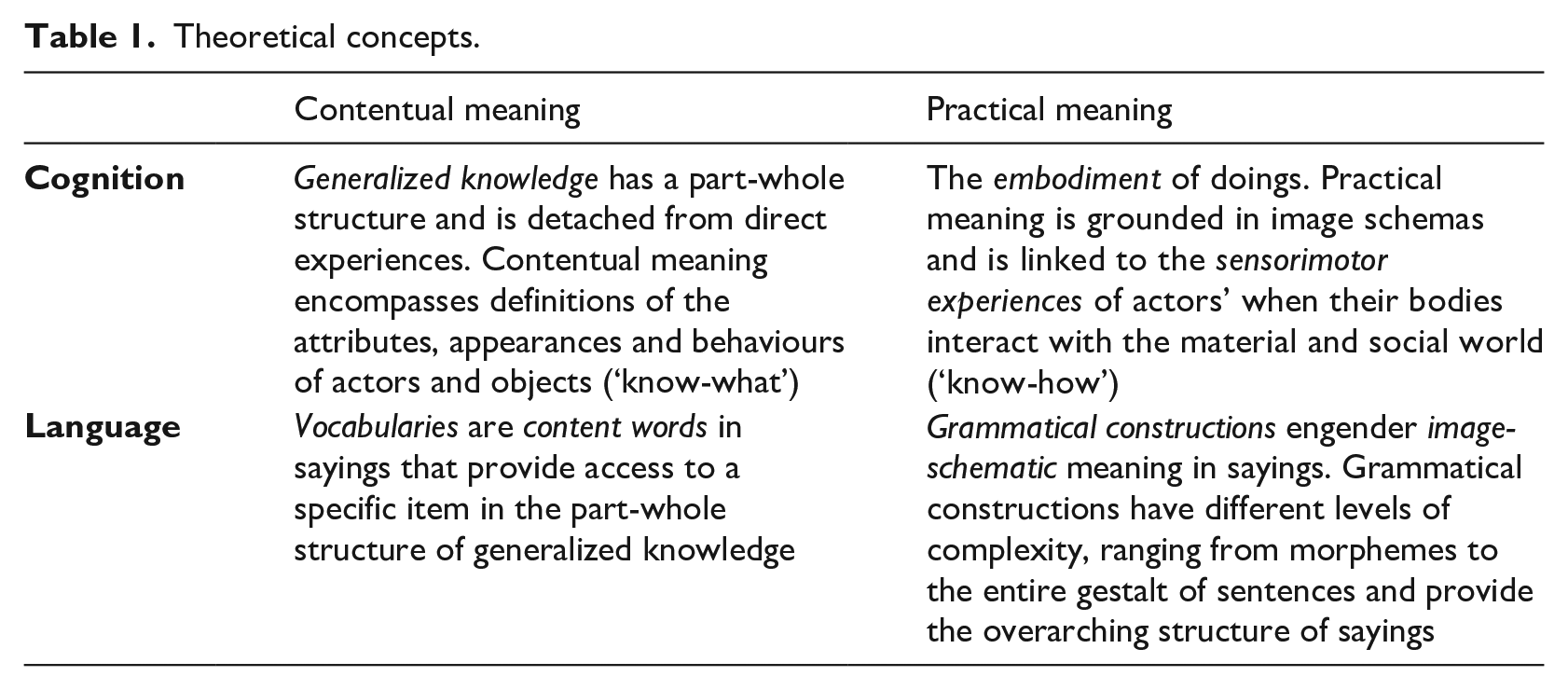
We draw on insights from the philosophy of embodiment and the definition of practices as situated bundles of sayings and doings within social settings to introduce four theoretical constructs required for conceptualization of the coexistence of sayings and doings. First, we explain in detail the cognitive characteristics of the two key constructs relevant to the enactment of practices: contentual meaning and practical meaning. Contentual meaning is associated with generalized knowledge about what actors and objects in practices are. Practical meaning is linked to sensorimotor experiences about how to act within the material and social world in pursuit of a specific purpose (Lizardo, 2017).
Second, we explain how contentual meaning and practical meaning are related to language and how they are fused in sayings within everyday situations to enact practices. Building on work from the philosophy of embodiment, we argue that content words convey contentual meaning. We further argue that grammatical constructions in sentences provide and engender practical meaning (Bergen & Chang, 2005; Evans, 2010; Goldberg, 1995; Lakoff, 1994; Langacker, 1987). Table 1 summarizes the theoretical constructs.
Theoretical concepts.
Contentual meaning and practical meaning in cognition
Contentual meaning
Contentual meaning depicts generalized knowledge that is abstracted from concrete experiences. This generalized knowledge refers to the attributes, appearances and behaviours of actors and objects (Berger & Luckmann, 1967; R. E. Meyer et al., 2018). Such knowledge can originally be acquired through multiple direct experiences with actors and objects but can also be acquired through indirect channels (e.g. textbooks, media). The process of generalization results in contentual meaning becoming impersonal (Barsalou, 1999; Lakoff, 1994; Lizardo, 2017).
Generalization means that knowledge about actors and objects has a part-whole structure (Evans, 2010; Langacker, 1987). For example, generalized knowledge about ‘organization’ includes knowledge about how organizations function (organizing), in what fields they operate (types), or their societal role (actorhood). Furthermore, generalization also involves some actors potentially having more detailed knowledge about some of these aspects than they do about others, for example, ‘how organizations function’. Such knowledge can be broadly applied to ideas of organizing. That is, by considering its function, ‘organization’ can refer to a hierarchically structured entity, a network of individuals, or a nexus of contracts (Davis, 2009; Oberg & Walgenbach, 2008). Accordingly, the contentual meaning of ‘organization’ encompasses multiple aspects, which may include even contradictory understandings. Figure 1 depicts an exemplary excerpt of a structure of contentual meaning for ‘organization’.
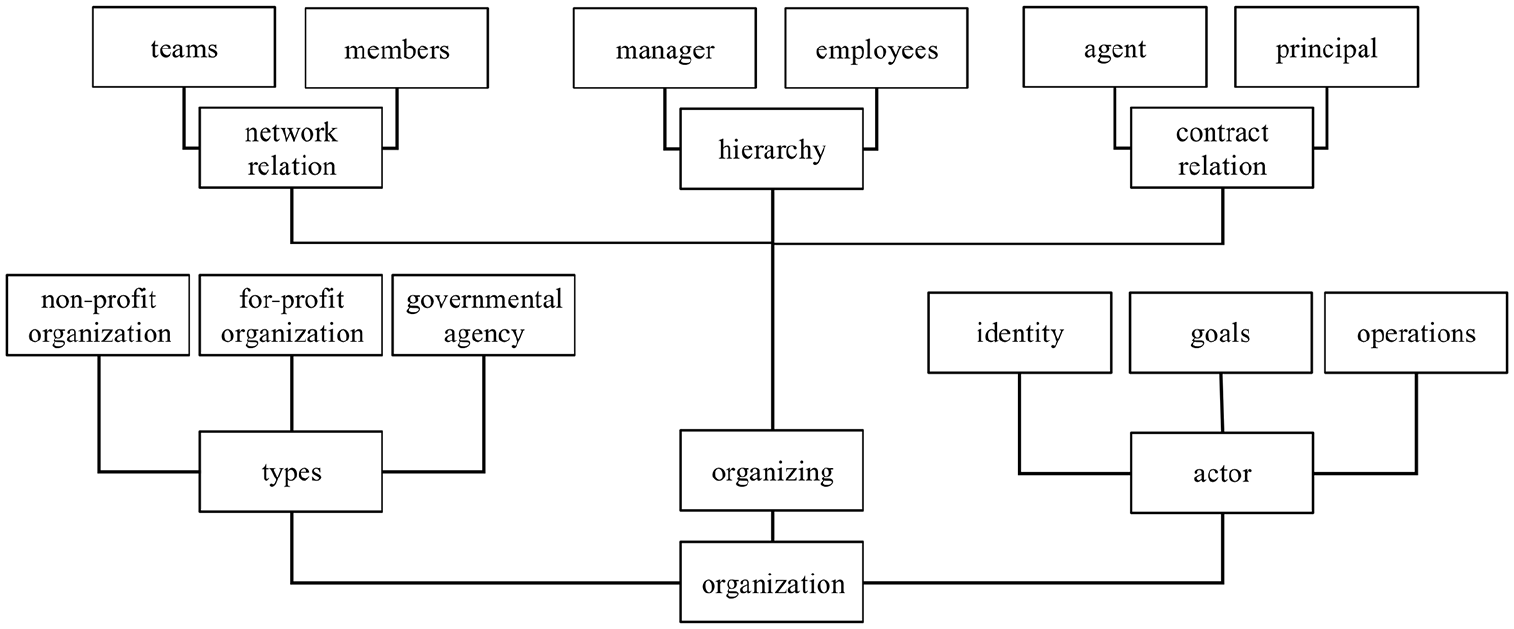
An exemplary excerpt of the part-whole structure of generalized knowledge about ‘organization’.
Practical meaning
Practical meaning is linked to doings (i.e. non-verbal [human-] bodily activities) in everyday situations and thus to actors’ multimodal sensorimotor experiences – visual, haptic, auditory, motor and vestibular (Barsalou, 2008; Clark, 1997; Lakoff & Johnson, 1999) – when (inter)acting within the material and social world (Bourdieu, 1990; Schatzki, 2002). For example, to accomplish regularly occurring daily tasks within an organization, actors must undergo identical interactions in identical spatial and material setups, and use identical material objects in the same way. Practical meaning denotes that individual doings achieve order in these interactions as a result of their common purpose (Smets et al., 2012). The order of doings is inherently meaningful because sequences of sensorimotor experiences provide actors an intuitive understanding of everyday situations and what constitutes appropriate doings (i.e. an intuitive understanding of how to act) in those situations (Bourdieu, 1990; Clark, 1997; Lizardo, 2007; Smets et al., 2012; Weik, 2019).
The body is essential for the intuitive understanding and enactment of doings. That is, actors’ embodied ‘motor- or perceptual-cognitive skills’ (Schatzki, 2002, p. 81), which Bourdieu (1990, p. 69) refers to as ‘motor schemes’, provide actors a perceptual and motor-schematic orientation as a ready-made means for employing the body in doings to pursue a specific purpose. Accordingly, motor- and perceptual-cognitive skills involve schemes of ‘knowing how to x’ and ‘knowing how to prompt as well as to respond to x‑ings’ (Schatzki, 2002, p. 77). The sensorimotor experience of one’s own body and movements, as well as the movements of others in the material and social world, has empirically proven to be critical for the intuitive understanding of individual intentions, motivations behind behaviour, and the means used to accomplish certain purposes (Tomasello, 2000; Tomasello, Carpenter, Call, Behne, & Moll, 2005). Lizardo (2007, p. 336) states: ‘Goals and strategies are not locked inside the head of the actor but are immanent in the organism-object and organism-organism relations made possible in a given field of striving.’ Because practical meaning is linked to recurring sensorimotor experiences in everyday situations, actors’ motor- and perceptual-cognitive skills provide the impetus for the reproduction of doings (Bourdieu, 1990; Goldenstein & Walgenbach, 2020, 2021; Lizardo, 2017). The impetus for the reproduction of doings reflects the ‘taken-for-granted assumptions about activities and interactions’ (Barley & Tolbert, 1997, p. 97) in practices. In other words, practical meaning imbues doings with harmony and rhythm (Weik, 2019), which can be ‘best illustrated by homeostatic processes that come together in a manner that allows them to feed off and perpetuate each other, creating a dynamic but stable system’ (Weik, 2019, p. 327). In this sense, practical meaning is inscribed in motor- and perceptual-cognitive skills – ‘located in the actual physical soma of the human body’ (Lizardo, 2007, p. 323) – and is essential for actors in coping with the demands of social settings (Smets, Jarzabkowski, et al., 2015; Smets, Morris, & Greenwood, 2012).
To specify the embodied nature of actors’ motor- and perceptual-cognitive skills, we rely on image schemas as a central concept from the philosophy of embodiment. Despite the existence of literature reviews (e.g. Evans, 2019; Gibbs & Colston, 1995; Hampe, 2005; Mandler & Pagán Cánovas, 2014), there is no comprehensive encyclopedic compendium covering all image schemas discussed in the literature. The reason for this is that image schemas are linked to multimodal sensorimotor experiences, which must be studied and described in detail in the literature to document their cognitive reality. We have ensured that our illustrations of the practical meaning of doings that follow refer to sensorimotor experiences that have been shown to be linked to the image schemas we mention in these illustrations (the image schemas referred to in this manuscript appear in small caps and are drawn from Cienki, 1998; Clausner & Croft, 1999; Evans, 2019; Gibbs & Colston, 1995; Goldberg, 1995, 2006; Hampe, 2005; Johnson, 1987; Lakoff, 1994; Lakoff & Johnson, 1999; Langacker, 1987, 2002; Mandler, 2004; Mandler & Pagán Cánovas, 2014; Rohrer, 2005; Schubert, 2005; Sweetser, 1984; Talmy, 1988, 2000). Image schemas are essential because they help to explain how it is that actors are able to intuitively understand everyday situations and why practical meaning provides the impetus for appropriate doings. Image schemas have already been addressed in previous sociological research and organizational studies (Goldenstein & Walgenbach, 2021; Ignatow, 2007; Lizardo, 2007; Wood, Stoltz, Van Ness, & Taylor, 2018). 1
In more detail, image schemas are body-related descriptions of perceptual information based on sensorimotor experiences (Johnson, 1987). Image schemas are directly grounded in sensorimotor experiences within the material arrangements of social settings – they are linked to the bodily mediated ways in which actors manipulate objects or other actors, or how they themselves are manipulated by others, orient themselves in time and space, and direct their perceptual and motoric focus to accomplish their doings (Gibbs & Colston, 1995; Johnson, 1987; Lakoff, 1994). In this sense, image schemas are a significant factor for ‘experience at the level of bodily perception and movement’ (Gibbs & Colston, 1995, p. 379). Each image schema is a body-related description of perceptual information in the context of specific and similar types of sensorimotor experiences (Mandler, 2004). For example, the image schema ‘
Image schemas explain why exposure to social settings directly and durably shapes the motor- and perceptual-cognitive skills of actors within those settings (Bourdieu, 1990; Schatzki, 2002). In this sense, image schemas are linked to practical meaning because, first and foremost, they are grounded in perceptual and bodily interactions with the material and social world and provide the perceptual and motoric basis for doings: Image schemas enable actors to mentally and physically (re)enact doings pertaining to their own body (Rohrer, 2005; Zlatev, 2005). Bourdieu (1990, p. 69) states that practical meaning, or ‘social necessity turned into nature, converted into motor schemes and body automatisms’, is what results in practice. Image schemas thus engender the body-centred description of social settings keyed to the relationship between everyday situations and the doings usually applied in these settings (Gallese & Lakoff, 2005). Image schemas function as an ‘associative engine and pattern-completion system’ (Clark, 1997, p. 67) in the sense that they allow actors to understand and perform doings (Bourdieu, 1990) by intuitively ‘knowing how to x’ in everyday situations (Schatzki, 2002, p. 77). In a review of the empirical evidence in this context, Lizardo (2007) concludes ‘that motor schemes can acquire a “practical logic” 2 derived from their endemic diachronic juxtaposition in recurrent situations’. More recently, Lizardo and Stand (2010) have made it clear that when referring to practice theories and the embodiment of motor- and perceptual-cognitive skills, ‘the practice account is consistent with recent proposals in cognitive science to the effect that the building blocks of culture are [. . .] cognitive models built from “image-schemas” (Johnson, 1987)’. In this sense, ‘image schemas can generally be defined as dynamic analog representations of spatial relations and movements in space’ (Gibbs & Colston, 1995, p. 349). This statement is consistent with Goldenstein and Walgenbach’s (2021, p. 4) conclusion that the learning of appropriate doings within social settings involves the sharing of ‘image-schematic representations of situationally dependent praxes’. 3
Practical meaning involves sequences of multiple sensorimotor experiences and, accordingly, involves patterns of image schemas that provide actors an intuitive understanding of everyday situations and allow them to comprehend the internal structure of doings in everyday situations and enact appropriate doings (Gibbs & Colston, 1995; Mandler & Pagán Cánovas, 2014). That is, the situated patterns of image schemas modify actors’ abilities to perceive and act – situated patterns of image schemas contribute to actors’ motor- and perceptual-cognitive skills (Bourdieu, 1990; Lizardo, 2007). This argument is further supported by findings that doings are directly perceived to be meaningful because the same brain areas responsible for the intuitive understanding of doings are also responsible for their enactment (Barsalou, 2003; Chapman & Anderson, 2013; Gallese, 2006; Gallese & Lakoff, 2005; Glenberg, 1997; Rizzolatti & Craighero, 2004; Rohrer, 2005; Zlatev, 2005).
In what follows, we illustrate one way in which the practical meaning of doings is linked to sensorimotor experiences. In this context, we describe how a pattern of image schemas provides actors an intuitive understanding of everyday situations and doings. To this end, we refer to the sensorimotor experiences that employees regularly undergo related to decision-making processes in hierarchically organized organizations. These experiences are linked to patterns of image schemas that suggest appropriate doings and the avoidance of specific doings by mirroring the way in which hierarchical decision-making is practised.
In general, in this context, doings in everyday situations involve image schemas that are linked to ‘
From a spatial perspective (‘
Contentual meaning and practical meaning in sayings: content words and grammatical constructions
Language in the philosophy of embodiment
A prominent stream in the philosophy of embodiment takes a usage-based perspective on language. This perspective suggests that the usage of sayings is based on the same general mechanisms and processes as all other aspects of human cognition, most of which require only limited processing resources. In the same context, the philosophy of embodiment points to sayings as a cooperative effort to collaborate in accomplishing tasks within a specific community of practice (Croft, 2009). Accordingly, the usage-based perspective proposes that the acquisition, comprehension and production of language are connected to recurring sensorimotor experiences (Bybee, 2010; Evans, 2019; Langacker, 1987; Tomasello, 2003).
The usage-based perspective suggests that sayings consist of content words and grammatical constructions (Bergen & Chang, 2005; Evans, 2010; Goldberg, 1995; Langacker, 1987; Talmy, 2000). Content words (e.g. nouns) point to contentual meaning about actors or objects in the material and social world.
4
Grammatical constructions provide the structure of sentences, which engender practical meaning (Bergen & Chang, 2005; Evans, 2010; Goldberg, 1995; Langacker, 2002). Grammatical constructions may have different levels of complexity, ranging from morphemes to the entire gestalt of sentences. That is, morphemes (e.g. -ed in ‘managed’ and -s in ‘managers’), prepositional and modal phrases (e.g. into in ‘into the corporation’ and must in ‘must implement’), and the entire, yet abstract, gestalt of sentences (e.g. the structure of ditransitive sentences [X causes Y to receive Z]) ‘themselves carry meaning, independently of the [content] words in the sentence’ (Goldberg, 1995, p. 1). We use two short example sentences to provide an intuitive idea as to why and how the gestalt of sentences (e.g. ditransitive sentence) has image-schematic meaning: ‘The manager gave the employee the order.’ The sentence has the image-schematic meaning of ‘
On the contrary, the usage-based perspective on language suggests that the image-schematic meaning provided by grammatical constructions significantly influences the understanding of content words (Bergen, 2012; Bergen & Chang, 2005; Evans, 2010). Accordingly, the meaning conveyed by sayings arises from the fusion of grammatical constructions and content words (Evans, 2010). In other words, grammatical constructions motivate a particular understanding of these content words (Bergen & Chang, 2005). Proponents of the usage-based perspective take sentences as discrete units of analysis. They consider them to be embedded in everyday situations within a specific social setting for the enactment of practices (Evans, 2019). Note that several approaches to grammar exist within the philosophy of embodiment. The most prominent approaches are Langacker’s (1987) cognitive grammar and Goldberg’s (1995) construction grammar. In our paper, we build on Evans’ (2010) theory of lexical concepts and cognitive models (LCCM), which combines the insights of cognitive grammar and construction grammar and links them to what the author terms ‘access semantics’ (Evans, 2019) and what we call the fusion of contentual meaning and practical meaning in sayings.
Contentual meaning and content words
Contentual meaning is linguistically conveyed in sayings by content words, that is, vocabularies (Bohn & Gümüsay, 2023; Loewenstein et al., 2012; Ocasio & Joseph, 2005). For example, sentences referring to decision-making within organizations are likely to include content words such as ‘management’, ‘organizing’, ‘corporation’ or ‘employees’. In the sections that follow, we will use three example sentences to analyse sayings and content words in more depth. As contentual meaning refers to a body of generalized knowledge regarding the attributes, appearances and behaviours of actors and objects, content words are subject to a considerable degree of ambiguity. For example, the noun ‘organization’ could refer to types of organizations (e.g. corporations or non-profit organizations). It can also be understood as either describing a hierarchy that uses division of labour and serves purposes detached from the interest of individuals or a network that draws on self-management and the limited use of formal rules (Oberg & Walgenbach, 2008).
Practical meaning and grammatical constructions
In line with the philosophy of embodiment, we suggest that grammatical constructions provide the structure of sayings and engender practical meaning. The understanding and learning of grammatical constructions involves recurring sensorimotor experiences and, thus, the bodily mediated, body-centred description of social settings through patterns of image schemas (Bergen & Chang, 2005; Evans, 2019). The underpinning of grammatical constructions by image schemas explains why grammatical constructions (re)induce sensorimotor experiences when actors listen to or articulate sayings. That is, listening to or articulating grammatical constructions induces similar sensorimotor experiences that were or would have been made during doings in everyday situations (Bergen & Chang, 2005; Evans, 2010; Zwaan, 2004). As image schemas underpin grammatical constructions, grammatical constructions engender practical meaning at ‘a level of schematic representation directly encoded by language’ (Evans, 2019, p. 469). This argument is supported by studies that reveal grammatical constructions to be cognitively processed in their entirety, as are patterns of image schemas (Barsalou et al., 2008; Goldberg, 1995; Langacker, 1987). The relevance of image schemas is further underscored by studies suggesting that grammatical constructions in sayings indeed allow actors to unwittingly simulate sensorimotor experiences (Barsalou et al., 2008; Bergen & Chang, 2005; Gallese & Lakoff, 2005; Taylor & Zwaan, 2009; Zlatev, 2005). The term ‘simulation’ implies that grammatical constructions immediately engender the practical meaning of doings. Empirical findings also show that children first acquire grammatical constructions (e.g. verb-prepositional phrases [‘move into’]) that refer to bodily movements and then use these grammatical constructions to infer the (unknown) meaning of content words (Barsalou, 2008; Glenberg & Kaschak, 2002; Tomasello, 2003). We will illustrate how grammatical constructions engender sensorimotor experiences in sayings by referring to the same image schemas introduced above.
As outlined above, a grammatical construction can be the abstract gestalt of an entire sentence. We will use the following example sentence to illustrate how image schemas underpin grammatical constructions: ‘We, the management, have introduced post-bureaucratic organizing in the corporation, which employees must implement.’ This sentence is basically a
Our example illustrates that grammatical constructions infuse image-schematic meaning into sayings that induce the same sensorimotor and bodily mediated experiences that actors undergo when acquiring practical meaning (Bergen, 2012; Evans, 2019; Gallese & Lakoff, 2005; Langacker, 2002). In this sense, the usage-based perspective on language posits that grammatical constructions in sayings can (re)induce actors’ sensorimotor experiences. In other words, upon hearing our example sentence, actors who have acquired practical meaning identical or similar to hierarchal decision-making in organizations will mentally go through the same bodily mediated doings linked to that practical meaning (Bergen & Chang, 2005; Evans, 2010; Taylor & Zwaan, 2009; Zwaan, 2004). This argument is supported by findings suggesting that the same brain areas responsible for enacting doings become activated by neuronal processes when the grammatical constructions in sayings encode these practical meanings (Barsalou, 2003; Barsalou et al., 2008; Bergen, 2012; Evans, 2010; Gallese & Lakoff, 2005; Glenberg & Kaschak, 2002; Rohrer, 2005). In the words of Zwaan (2004, p. 36): ‘language is a set of cues to the comprehender to construct an experiential (perception plus action) simulation of the described situation’. Consequently, the philosophy of embodiment points to the importance of considering sayings beyond content words.
The Co-Constitutive Relationship Between Sayings and Doings
The degree of institutionalization of social settings
The philosophy of embodiment points to the interrelation of content words and grammatical constructions in sayings. According to this perspective, the understanding of sayings thus involves actors mentally fusing sensorimotor experiences (i.e. practical meaning) with generalized knowledge pointed to by vocabularies (i.e. contentual meaning) during mundane verbal activities. Grammatical constructions, here, engender understandings of how doings proceed within a social setting, whereas content words point to what (e.g. actors, objects) is specifically involved in doings (Barsalou et al., 2008; Evans, 2010; Taylor & Zwaan, 2009). The formation of sayings can be initiated by either contentual meaning or practical meaning (Evans, 2019).
To understand whether the practical meaning of grammatical constructions constitutes the contentual meaning of vocabularies or vice versa, it is necessary to take the social setting itself into consideration. To this end, we again draw on the philosophy of embodiment (Barsalou, 2008; Clark, 1997; Lakoff & Johnson, 1999) and organizational institutionalism and theorize the role of institutionalization within this context (Lizardo, 2020). We refer to institutionalization as the degree to which practices are prefigured (i.e. imbued with meaning) through human coexistence in a self-enforcing material arrangement in social settings. Prefiguration thus describes the degree to which practices appear as inevitable, meaningful facts (J. W. Meyer & Rowan, 1977; Thornton, Ocasio, & Lounsbury, 2012) and are maintained in a ‘repetitively activated activity sequence’ (Jepperson, 1991, p. 145).
This definition of institutionalization is based upon recent work in organizational institutionalism, which suggests that practices reside both within social settings and within actors. Practices get into social settings through material arrangements and get into actors through meaning-construction (Lizardo, 2020). In this sense, this work combines so-called state and process approaches of institutionalization. State approaches focus on practices as exogenous facts for actors (J. W. Meyer & Rowan, 1977; Thornton et al., 2012). Process approaches in turn emphasize the establishment of practices as a process of meaning-construction (Berger & Luckmann, 1967; Jepperson, 1991). However, state and process approaches have neglected to specify what in the context of practices is institutionalized where, namely exogenous facts in material arrangements in social settings and meanings in actors (Lizardo, 2020). Due to this specification, this recent work in organizational institutionalism is well suited to describing the interrelation between material arrangements and meaning, which we will do below.
Social settings (e.g. an organization) are characterized by human coexistence within material arrangements (Schatzki, 2002). Human coexistence denotes that actors perceive themselves as meaningfully interrelated with other actors in an everyday situation and that any change results in a new situation for each actor (e.g. the implementation of a new way of organizing). In this sense, contentual meaning and practical meaning are interwoven into human coexistence in material arrangements. Materiality structures human activities and triggers ‘socio-somatic reactions that are not cognitively verbalized and are often entirely sensory and perceptive’ (Eisenman & Frenkel, 2021, p. 12). This notion of material arrangements is maximal in that it includes the physical and spatial arrangements of all kinds of perceptible objects, architectures and buildings, tools and technologies, documents and, especially, the human body (de Vaujany, Adrot, Boxenbaum, & Leca, 2019; Lizardo, 2020; Malafouris, 2013). In other words, we define material arrangements as body-in-material-context. Human coexistence in social settings thus transpires as an interaction between actors’ bodies and the materiality of the setting. ‘Instead of attributing agency to humans alone (often an heroic individual), actions are now conceived as the outcome of objects as well, or even better, as stemming from inter-action between humans and objects’ (Zilber, 2018, p. 69). In line with the philosophy of embodiment, motor- and perceptual-cognitive skills (Bourdieu, 1990; Schatzki, 2002) thus enable actors to enact practices by relying on the sensorimotor clues within their material environment (Clark, 1997). We suggest that the coexistence of actors within material arrangements provides the domains that enable and/or constrain specific and recurring sensorimotor experiences (Barsalou, 2008; Clark, 1997; Lakoff & Johnson, 1999). Materiality is not the only stimulus for recurring sensorimotor experiences – human activity also (re)creates material arrangements that reify and enable these sensorimotor experiences in the first place (Clark, 1997; Schubert, 2005). The coexistence of actors, combined with materiality, defines what actors perceive, how practices come about, and how these can be carried out (Goldenstein & Walgenbach, 2020; Höllerer, Daudigeos, & Jancsary, 2017; Wood et al., 2018). Social settings thus constrain actors’ sensory and motoric perceptions of acting on objects, arrangements of objects and bodies, and their experience of temporality (Barsalou, 2003; Eisenman & Frenkel, 2021; Gieryn, 2002).
In this paper, we broadly consider two ideal-typical conditions of social settings that are important for the co-constitutive relationship of sayings and doings: a high and a low degree of institutionalization. A high degree of institutionalization is characterized by the experience of a stable material arrangement that enables recurring sensorimotor experiences and, thus, a reliable understanding of space and temporality. It is important to note that even the most stable material arrangements do not determine practices (Schatzki, 2002, p. 24), but make some courses of practice appear more reasonable and feasible than others (Bourdieu, 1990; Schatzki, 2002; Zilber, 2018; Zucker, 1977). A high degree of institutionalization thus increases the likelihood that essentially identical interactions will repeatedly take place in identical situations, using the identical materiality in an identical way. Such social settings provide actors with an unambiguous, taken-for-granted and predictable bodily experience (Barley & Tolbert, 1997; Goldenstein & Walgenbach, 2020; Weik, 2019). For example, from studying the social setting of Lloyd’s of London, Smets et al. (2015) suggest that the setting’s high degree of institutionalization allows actors to interact smoothly, even in light of conflicting-yet-complementary cooperative and competitive practices. This does not imply that change is impossible but that contemporary doings are perceived to be more appropriate and more intelligible than other available alternatives (Schatzki, 2002). In other words, change is more likely to be a subtle adaptation of doings in response to everyday demands (Smets & Jarzabkowski, 2013; Smets et al., 2012). In this sense, recurring bodily mediated experiences within social settings enable the emergence of a common practical meaning among actors (Bourdieu, 1990; Lizardo & Strand, 2010; Schatzki, 2002).
In contrast, a low degree of institutionalization is characterized by the experience of flux in the material arrangement and the usage of materiality. This experience of flux can result, for example, from organizational adaptations to exogenous events (Clemens & Cook, 1999) or contradictions arising from internal organizational change (Reay & Hinings, 2005; Smets et al., 2012). Exogenous events and organizational change typically lead to changes in human coexistence and the way actors interact as well as how they create and use materiality. A low degree of institutionalization induces ambiguity in sensorimotor experiences and, thus, provides a less marked understanding of space and temporality. This ambiguity makes multiple and conflicting courses of practices likely (Reay & Hinings, 2005; Thornton et al., 2012). Creative thinking and (potentially) conflicting actions characterize social settings of this kind (Lizardo & Strand, 2010). This does not imply that practices change permanently and erratically, but that doings lack the status of intelligibility and self-evidence (Schatzki, 2002). In this sense, due to the subjectivity of actors, social settings with a low degree of institutionalization hamper the development of a common practical meaning.
Sayings within social settings with a high degree of institutionalization
In highly institutionalized social settings, the stability of practices is ensured by a common practical meaning among actors that allows the unimpeded enactment of doings without much cognitive effort (Bourdieu, 1990; Goldenstein & Walgenbach, 2021; Lizardo, 2017; Weik, 2019). We argue that sayings within highly institutionalized social settings are structured by grammatical constructions that engender the practical meaning linked to the regular doings within these settings. Grammatical constructions do so because they are underpinned by the same pattern of image schemas on which the practical meaning of doings in these settings is grounded. These grammatical constructions in turn inform the specific contentual meaning of vocabularies in sayings. Put more simply, because actors share a common practical meaning of doings in highly institutionalized social settings, this practical meaning is reinforced by grammatical constructions in sayings and constitutes the understanding of vocabularies (see Figure 2). In this sense, sayings tend to bolster doings by mentally reinforcing the same sensorimotor experiences of actors (Barsalou, 2003; Evans, 2010; Taylor & Zwaan, 2009).
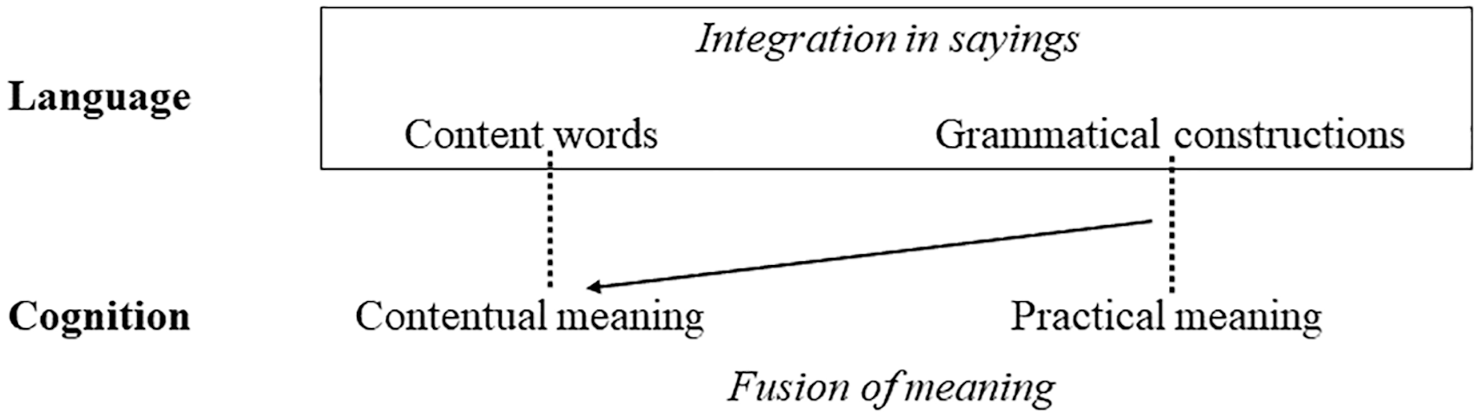
The constitution of contentual meaning by practical meaning.
Grammatical constructions in sentences thus have a control function (Barsalou et al., 2008; Goldberg, 2006). They lay the groundwork for the specific contentual meaning of the vocabularies in the same sentences (Evans, 2010). Research has shown that in unambiguous settings, the brain areas responsible for comprehending grammatical constructions become activated earlier than the brain areas responsible for selecting the specific contentual meaning of vocabularies (Barsalou et al., 2008). For example, in a study of how actors subjectively perceive a known setting, Bergen (2012, p. 114) found that ‘grammar is acting as the director’ and strongly guides the actors’ perceptions. Similarly, other studies have found that actors approximate the contentual meaning of vocabularies according to the pattern of grammatical constructions in sayings. This research has underscored this important relationship by showing that actors can even acquire an understanding of fictional content words when they are embedded in grammatical constructions (Glenberg & Kaschak, 2002; Tomasello, 2003).
We will illustrate our argument based on the same example sentence we used when discussing grammatical constructions and practical meaning. However, this time, we will use it to illustrate how grammatical constructions inform the contentual meaning of the vocabularies in this sentence. It is conceivable that this sentence could be used by a manager at an employee meeting to announce an impending organizational change: ‘We, the management, have introduced post-bureaucratic organizing in the corporation, which employees must implement.’ In highly institutionalized settings, because sayings reinforce the practical meaning of doings, sayings are arranged around grammatical constructions that engender this practical meaning. Building on the previous sections, Table 2 recapitulates the facets of practical meaning implied in the grammatical constructions found in the example sentence provided.
The practical meaning of grammatical constructions (example 1).
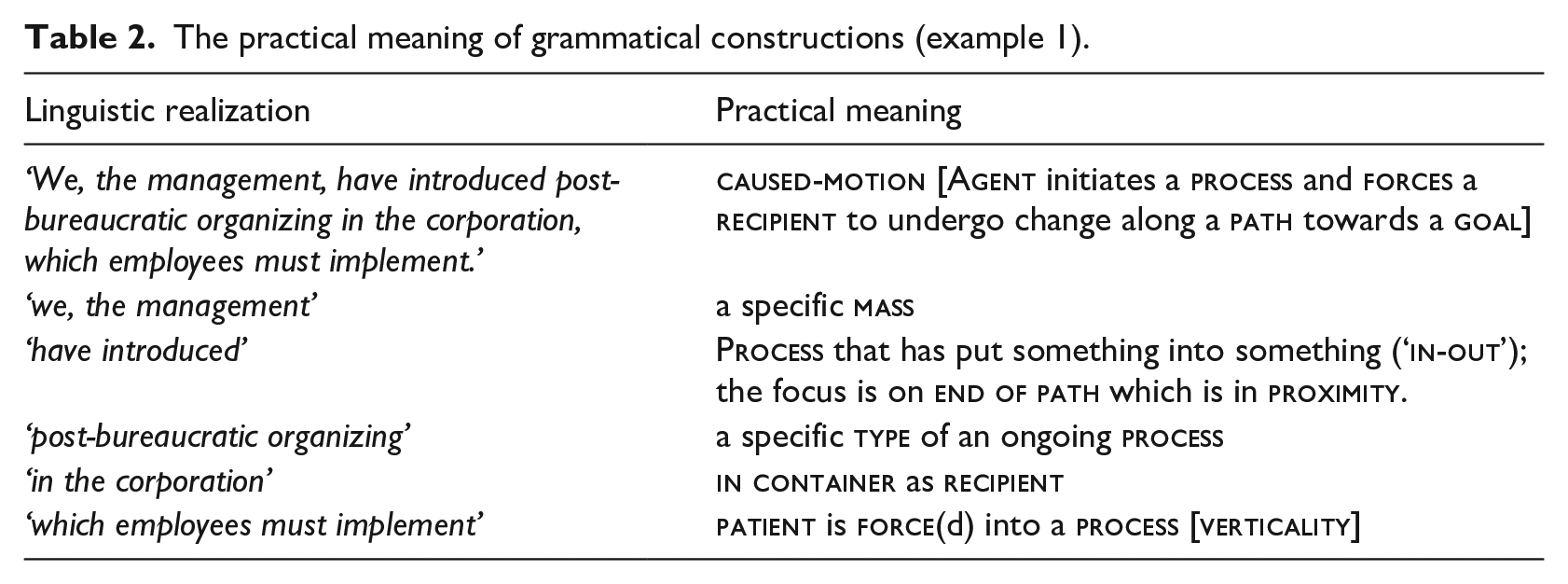
In this example sentence, the grammatical constructions point to the contentual meaning of ‘management’ as a uniform collective (‘
Consequently, in social settings with a high degree of institutionalization, practical meaning is engendered by the structure of grammatical constructions in sayings that, in turn, influence the understanding of the contentual meaning of vocabularies. Accordingly, even if actors were to attempt to bring about organizational change by using vocabularies aimed at replacing an old way of organizing with a new one, the grammatical constructions in sayings are likely to mentally reactivate the old way of organizing on the part of listeners. In this situation, organizational change is more likely to fail because the listeners do not understand the vocabularies of these sayings as intended but align them with the practical meaning to which they are accustomed.
Sayings within social settings with a low degree of institutionalization
Social settings with a low degree of institutionalization exhibit a considerable flux in the material arrangement. This flux induces perceptions of ambiguity resulting from ongoing shifts in actors’ sensorimotor experiences of acting on materiality, as well as in the use and arrangement of materiality and human bodies in time and space. Flux in social settings prevents actors from developing a common practical meaning and requires the exertion of much more cognitive effort in the consideration of doings (Lizardo, 2017).
We argue that a low degree of institutionalization facilitates an increased sense of creativity – a reflexive orientation toward doings to solve existing problems in everyday life and to enable coordination among actors in this context (Goldenstein & Walgenbach, 2020; Gray, Purdy, & Ansari, 2015). Institutional research has pointed to the possibility of creatively applying sayings to establish and coordinate doings (Harmon et al., 2015; Ocasio & Joseph, 2005; Werner & Cornelissen, 2014). However, organizational institutionalism lacks a theoretical account that provides a practice-driven understanding of how sayings within social settings with a low degree of institutionalization contribute to the constitution of doings in the enactment of practice.
Following the usage-based perspective on language, the constitution of doings by sayings has two components (Evans, 2010, 2019): First, actors’ creativity is required in selecting an appropriate contentual meaning for vocabularies that envisions the type of change the actors want to bring about (Czarniawska & Joerges, 1996; Gray et al., 2015). For example, when implementing a post-bureaucratic way of organizing, actors will define the contentual meaning of vocabularies such as ‘management’, ‘post-bureaucratic organizing’, ‘corporation’ and ‘employees’ in a way that reflects the post-bureaucratic idea that employees manage their work relatively autonomously within a common enterprise. Second, actors’ creativity is required in arranging the grammatical constructions in sayings in such a way that they mentally induce practical meaning that elicits the intended type of practice. For example, sayings can use grammatical constructions that point to the sensorimotor experiences of actors as part of a group of interrelated persons accomplishing their doings in the relative absence of constraints. Such grammatical constructions enable actors to mentally and sensorimotorly imagine situations of collegiality rather than hierarchy, even if they have never heard the term ‘post-bureaucracy’. Put more simply, in social settings with a low degree of institutionalization, actors can begin with the selection of a specific contentual meaning for vocabularies and select grammatical constructions that elicit a practical meaning consistent with the type of change they envision (see Figure 3).
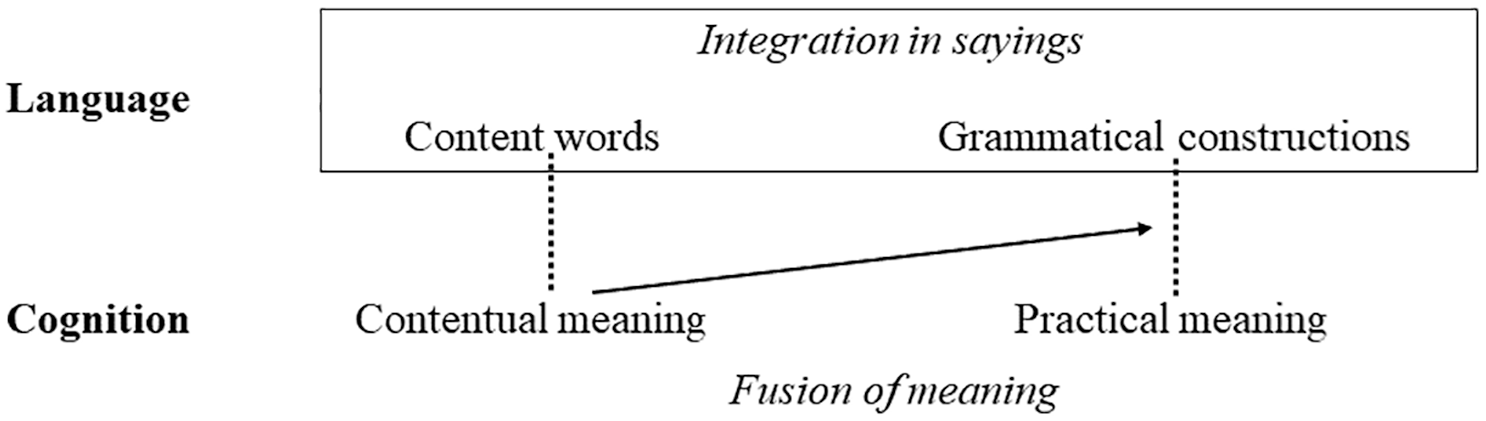
The constitution of practical meaning by contentual meaning.
Our argument can be illustrated with two additional example sentences that might likewise be used by a manager during an employee meeting. The first example sentence reads: ‘The employees turn the corporation’s management into a post-bureaucratic way of organizing.’ This example sentence is a
The second example sentence reads: ‘The post-bureaucratic organization of management involves all employees within the corporation.’ The practical meaning conveyed by the second example sentence builds on the first one. This sentence is an
The practical meaning of grammatical constructions (example 2).
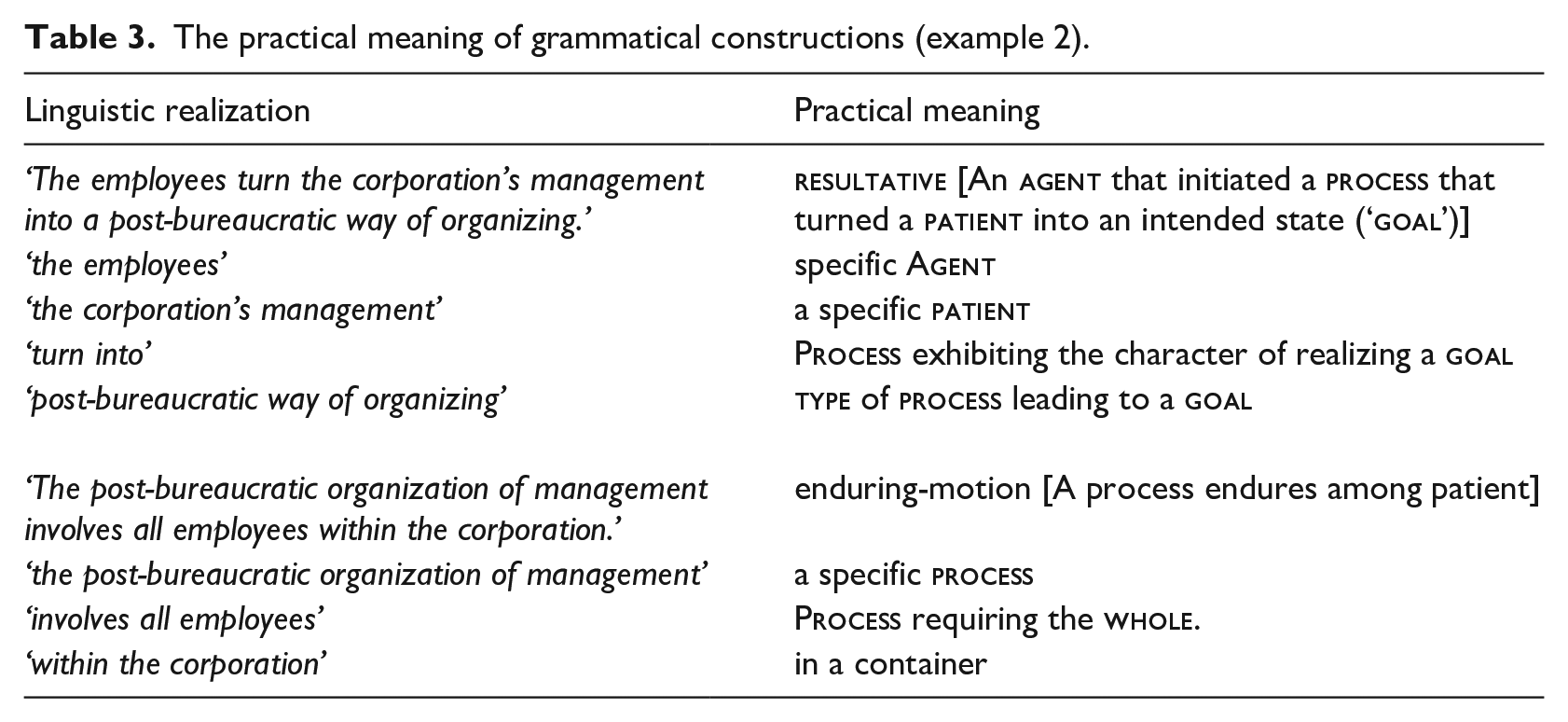
When considering the practical meaning engendered by the grammatical constructions in the two example sentences, the contentual meaning conveyed by the vocabularies ‘management’, ‘post-bureaucratic organizing’, ‘corporation’ and ‘employees’ most likely evoke actors’ experiences of interacting with others in the absence of hierarchical constraints. That is, ‘employees’ take an active role and ‘management’ is referred to as a bundle of procedures ensuring the functioning of the organization. The contentual meaning of ‘corporation’ may either refer to a location or an attribute of ‘management’. ‘Post-bureaucratic organizing’ in turn is a process that requires the active engagement and contribution of employees. Accordingly, the term ‘post-bureaucratic organizing’ is more likely to be associated with a contentual meaning pointing to the emergence of a collegial structure among employees, rather than something imposed by managers. In other words, the grammatical constructions in the example sentences engender a practical meaning consistent with the intended contentual meaning of vocabularies.
In this sense, as a result of their association with sensorimotor experiences, sayings within a social setting with a low degree of institutionalization enable actors to imagine doings that would be appropriate in this setting under a post-bureaucratic way of organizing (Taylor & Zwaan, 2009; Zwaan, 2004). Accordingly, sayings in such social settings can support the constitution of doings, as the sensorimotor experiences are implied in grammatical constructions. Because doings occur within a certain spatial and material setup, a particular way of using and arranging materiality may further contribute to the institutionalization of a social setting by making certain types of actions more reasonable than others (Greenwood & Suddaby, 2006; Malhotra et al., 2020; Reay & Hinings, 2005; Zietsma & Lawrence, 2010). Further, in line with the philosophy of embodiment, the more often sayings convey the same practical meaning and the more frequently these sayings are uttered, the more likely it is that actors will agree on common doings (Lizardo, 2020; R. E. Meyer et al., 2018; Werner & Cornelissen, 2014). In this regard, sayings can support the constitution of doings through the frequency of connecting the contentual meaning of vocabularies with the suggested practical meaning engendered by grammatical constructions.
Discussion
Theoretical implications for organizational institutionalism
With our theoretical approach, we provide a nuanced understanding of the coexistence of sayings and doings in practices. With this, our paper provides a conceptualization of sayings for practice-driven institutionalism and connects sayings to notions of doings as well as to materiality in institutional research (de Vaujany et al., 2019; Eisenman & Frenkel, 2021; Jepperson, 1991; Lizardo, 2020; Smets et al., 2017; Zilber, 2018). Our approach suggests that the contentual meaning of vocabularies and the practical meaning of doings are fused within sayings. We conceptualize sayings as being situated within everyday situations and their formation as intertwined with the doings and materiality in social settings. Conceptualizing sayings as a situated fusion of contentual meaning and practical meaning allows theorization as to why and when certain doings inform the construction of specific sayings, why and when sayings prefigure or maintain doings, and why and when sayings cannot prefigure or coordinate doings because actors literally cannot understand each other. Our theoretical approach, in this context, allows consideration of the conditions, i.e. the degree of institutionalization of a social setting, which explains when and why it is that actors’ understanding of vocabularies constitute their doings and when and why it is that their doings inform the understanding of vocabularies. Taking the co-constitutive relationship of sayings and doings into consideration enables organizational institutionalism to differentiate the situated impact of both, i.e. sayings and doings, on the reproduction, stabilization and change of practices. A situated perspective on sayings thus yields the implications described below.
First, practice-driven institutionalism is interested in when and why practices change endogenously in actors’ everyday activities (Smets et al., 2017). Previous studies have considered change to be a result of the adjustment of doings when actors experience problems with the execution of their practices in everyday situations (Smets & Jarzabkowski, 2013; Smets et al., 2012). However, the adaptation of doings is regularly coordinated by sayings (Burling, 2007; Tomasello, 2000). Our theoretical approach allows the distinguishing of cases in which sayings hamper the application of novel doings by reinforcing established doings from cases in which sayings initiate, accompany and stabilize novel doings. In this context, our approach allows a procedural perspective that reveals how the co-constitutive relationship between sayings and doings brings about change – that is, how the mutual relatedness of sayings and doings leads to their synchronization over time, which is likely to be a necessary condition for successful change.
Second, practice-driven institutionalism seeks to deepen notions of institutional work. In this context, it has highlighted that the literature on the purposive and intentional maintenance or change of practices (Lawrence & Suddaby, 2006) has largely overlooked the role of practical meaning for the manner in which actors accomplish their work in everyday situations (Smets & Jarzabkowski, 2013; Smets et al., 2017). Our theoretical approach reveals that even language as a symbolic system, regularly treated by institutional work scholars as a tool that actors can use creatively (Suddaby, 2010), fuses both contentual meaning and practical meaning. In this sense, we underscore the interconnectedness of sayings, doings and materiality, and suggest ‘the understanding of institutional dynamics as on-going and un-finished business’ (Zilber, 2018, p. 76). In detail, our theoretical approach sheds light on when it is that actors can successfully constitute novel doings by the creative application of sayings and when it is that sayings are likely to fail because the recipients literally do not understand them. That is, the vocabularies used in sayings intended to establish novel doings are likely to be interpreted differently or remain incomprehensible.
Third, the notion of a relationship between contentual meaning and practical meaning also resolves a limitation of the contemporary perspective on language and vocabularies, which confines the function of sayings to the conveyance of objectified contentual meaning through vocabularies in discourse, which can be applied by actors to justify their preference for a particular practice (Malhotra et al., 2020; Smets & Jarzabkowski, 2013). The vocabulary perspective claims to provide ‘a detailed account of the meaning of words’ (Loewenstein et al., 2012, p. 75). However, our theoretical approach emphasizes that the contentual meaning of words (i.e. vocabularies) is construed in mundane sayings and depends on the embeddedness of vocabularies within the grammatical order of sentences. In other words, the philosophy of embodiment emphasizes that sayings not only make use of vocabularies, but that the grammatical structure of sayings is also linked to the sensorimotor experiences of actors in social settings. This insight forces institutionalists to ‘see the discursive and material, linguistic and non-linguistic, not as “separate and separable” but as “co-emergent”’ (Zilber, 2018, p. 70). Our theoretical approach thereby outlines significant boundary conditions for the ability of actors to initiate change and coordinate doings in practices through language use.
Illustration of the implications for empirical research
To illustrate the potential contribution of our theoretical argument, we revisit a puzzle reported by Battilana and Dorado (2010) involving the social settings of two microfinance organizations in Bolivia. Both organizations aimed at establishing a new practice, namely providing loans to the poor, i.e. social banking. The novel combination of an economic practice with a social development practice meant that, at their founding, both organizations were social settings in which there was a rather low degree of institutionalization. However, the participating actors originated from two different social settings (i.e. banks and social work organizations) in which there was a high degree of institutionalization.
Both organizations invested in the coalescence of the economic practice and the social development practice. However, Battilana and Dorado (2010) found that while organization 1 faced significant internal conflict, organization 2 was successful in reconciling both practices. The authors speculated that this result may have been due to the focus of organization 1 on hiring experienced professionals and then relying heavily on classroom training to instruct its employees in the organization’s mission. Our argument provides a complementary perspective on the results reported in Battilana and Dorado’s (2010) study: all employees had a professional background in the social setting of either banking or social work organizations; each of these settings provided the employees there with an incompatible practical meaning, which they actualized in their doings. Further, their particular professional backgrounds provided them with incompatible contentual meanings of vocabularies associated with the concepts of ‘banking’ and ‘social work’. Indeed, one employee with a social work background reported: ‘I would tell them: “You do not understand this business; you just arrived.” And they would tell me: “You know nothing about banking”’ (Battilana & Dorado, 2010, p. 1427).
According to our theoretical approach, microfinance organizations could have used sayings in the following manner to accomplish the coalescence of banking and social work practices: first, the organizations could have defined the contentual meaning of vocabularies used in sayings to convey the definition and practice of ‘social banking’. Apparently, both organizations had at least slightly taken this task into consideration, as they developed mission statements addressing what social banking is. Second, the organizations could have embedded these vocabularies in sayings within grammatical structures that engender a practical meaning pointing to how social banking can be put into practice – that is, a practical meaning that engenders the doings associated with social banking. In fact, the two organizations differed significantly in how they used sayings and implemented the doings of their employees.
Battilana and Dorado (2010) reported that organization 1 focused foremost on vocabularies in sayings in classroom instruction to communicate the organization’s mission. However, according to the representatives of organization 1, the organization did not accord much attention to sayings that grammatically convey the practical meaning of novel doings. The authors note: ‘Otero [President of Organization 1] believed that the transition to a commercial microfinance organization did not entail a radical change of mission’ (Battilana & Dorado, 2010, p. 1425). This statement indicates that the grammatical constructions of sayings with regard to the organization’s mission were not significantly modified. Consequently, bankers and social workers would likely have produced sayings that still supported the (contradictory) doings they deemed appropriate in light of their two different practical meanings.
In contrast, organization 2 used sayings to convey the contentual meaning of social banking by constituting this contentual meaning likely using grammatical structures that engender the practical meaning of appropriate doings. Battilana and Dorado (2010) reported that representatives of organization 2 stated in an interview: ‘We are speaking of a loan officer that is the heart of the institution. You give them a lot of training time both theoretical and practical.’ Practical training involved, for instance, training at the workplace and that candidates for job promotions demonstrate their doings through role-playing tests. In the context of our theoretical approach, the success of organization 2 indicates that training is more likely to be successful when it draws upon sayings during theoretical training that engender practical meanings that, in turn, are reinforced by extensive practical training at the workplace.
Our approach thus allows the study of cases in which sayings do or do not lead to the initiation, change and stabilization of doings in practices. The case of organization 1 represents a situation in which actors produced sayings based on incompatible grammatical constructions that, in turn, induce a fundamentally different interpretation of vocabularies used to make the practice of social banking understandable. In contrast, organization 2 appears representative of a situation in which sayings are used to constitute and stabilize intended doings.
Conclusion
We provide organizational institutionalism with a framework that departs from limiting sayings to discursive speech and, instead, conceptualizing sayings as emerging and evolving in coexistence with doings in practices. Our framework clarifies why and when doings constitute a specific understanding of vocabularies in sayings and why and when sayings constitute doings through an intended meaning of vocabularies. As our revisit of the study by Battilana and Dorado (2010) illustrates, sayings cannot coordinate practice when actors in social settings use sayings with grammatical constructions that engender incompatible doings and understandings of vocabularies. In contrast, sayings can constitute and stabilize practices when the grammatical constructions of sayings engender intended doings and are synchronized with them. Our theorization thus provides insight for the coexistence of doings and sayings and the consequences of this relationship for the reproduction, stabilization and change of practices.
Footnotes
Acknowledgements
We are grateful to Philipp Poschmann and participants in Friedrich Schiller University’s research colloquium on management and organization studies for their supportive comments on previous drafts of this manuscript. Moreover, we thank Organization Studies guest editor Haridimos Tsoukas and anonymous reviewers for their great support and recommendations during the review process.
Declaration of conflicting interests
The author(s) declared no potential conflicts of interest with respect to the research, authorship, and/or publication of this article.
Funding
The author(s) disclosed receipt of the following financial support for the research, authorship, and/or publication of this article. This work was supported by the Deutsche Forschungsgemeinschaft under Grant GO 3213/3-1.
