




Abstract
This study examines the maintenance of highly institutionalized practices during periods of vehement contestation and changing external demands. Employing a cross-level longitudinal research design, we explore how the recruitment model of elite French business schools persisted, remaining fundamentally intact despite serious questions raised about its functional utility and social legitimacy. Comparing three periods of contestation, we document shifting coalitions of dispersed actors that were incentivized to “thematically” maintain the practices in the focal field with little formal orchestration. Our findings indicate that practices which contribute to social stratification often foster meta-routines that cajole constituencies in multiple fields to, collectively and self-interestedly, promote and regulate conservative change. We identify three meta-routines—referential comparison, generative improvisation, and distributed monitoring and policing—that introduced flexibility and encouraged “unforced” adaptations. In elaborating these meta-routines, we contribute to extant theory on the mechanisms of institutional maintenance, and shed further light on the role of complex embeddedness as a constraint on institutional processes.
Keywords
Introduction
There has been a resurgence of interest in understanding how institutions are maintained. Much of this work is a response to the recent prominence given to understanding processes of conflict and tension that upend or transform institutionalized arrangements. The emphasis upon disruptive change not only runs counter to the widely held acceptance that institutional prescriptions are highly resilient (March & Olsen, 2006; Meyer & Rowan, 1977; Scott, 2013); it also ignores the “work” that field incumbents often undertake to reproduce and protect the status quo (Hampel, Lawrence, & Tracey, 2017; Maguire & Hardy, 2009). Thus, while we have gained considerable insights into the conditions that enable change, “the real mystery” remains institutional maintenance (Lawrence & Suddaby, 2006, p. 234). As Friedland and Alford (1991, p. 247) noted some time ago, “sources must be found for the stability and routinization of interests, just as much as their transformation.”
Our interest is to contribute to theory on institutional maintenance by examining how highly institutionalized practices—and their implicated patterns of privilege—are maintained despite vehement contestation and changing external demands. Typically, it is expected that as consensus around the utility or social legitimacy of a practice erodes, the practice will be abandoned or “deinstitutionalized” (Maguire & Hardy, 2009; Oliver, 1992). Yet we observe a case where highly criticized practices have persisted and remained fundamentally intact for well over a century. Employing a longitudinal cross-level research design, we examine the recruitment practices of elite French business schools, which, over the course of their long history, have faced unrelenting criticism for being elitist and undemocratic. By unpacking the practices’ durability and resilience, this study contributes to extant research in two ways. First, it shows how a complex and nested institutional infrastructure of interlocks fosters a “distributed” form of maintenance wherein, instead of a central actor enforcing compliance, actors from within and across fields are thematically mobilized (at times unconsciously and automatically) to maintain the practices. Drawing upon multiple data sources, we identify three types of interlocks that marshal uncoordinated coordination among actors, each pursing their own interests and agendas. In articulating these interlocks, our study extends recent efforts to develop “a more fragmented and less strategic conception” of maintenance that moves beyond emphasis on power inequalities (Dacin, Munir, & Tracey, 2010, p. 1394).
Second, the study implicates a nuanced and richer consideration of institutional maintenance, shifting attention beyond traditional portrayals of maintenance tactics as largely reactive responses to episodic attempts to introduce change. Pulling our findings together, we surface a model of institutional maintenance that foregrounds meta-routines—i.e., the loosely connected activities of disparate actors that coalesce into repetitive, interdependent actions promoting change (Adler, Goldoftas, & Levine, 1999; Feldman & Pentland, 2003). By showing how meta-routines fuel the self-reforming capacity of institutionalized practices, the model contributes to understanding of how patterns of stratification and privilege are maintained in the face of disruptive forces.
Theoretical Context
Research on institutional maintenance has typically adopted one of three approaches. The earliest characterizes maintenance as an automatic and largely taken-for-granted process, whereby institutional inhabitants follow scripted patterns of behavior (DiMaggio & Powell, 1983). Much of this work emphasizes the role of routines and socialization processes in generating consensus around the value and propriety of institutionalized arrangements (Berger & Luckmann, 1966; Bjerregaard & Nielsen, 2014). Goffman’s foundational work (1959, 1961) on interaction orders, for example, showcased the importance of socialization processes in maintaining broader cultural institutions. Developing this theme, Van Maanen and Schein (1979, pp. 212–213) detailed how socialization resulted in the transmission of “patterns of thought and action” across generations, such that “certain cultural forms may persist long after they have ceased to be of individual value.” More recently, Zilber (2009) documented how socialization enabled the transmission of institutional meta-narratives, which helped maintain the feminist and therapeutic institutions within Israeli society. The underlying implication is that particular schemas and patterns of interaction become routinized through repeated application and transmission to others, to the extent that they become taken for granted and reproduced relatively automatically (Ashforth & Fried, 1988; Levitt & March, 1988).
In contrast, a second approach has argued that most institutions are vulnerable to atrophy, and require some form of deliberate and continuous action if they are to endure (Hwang & Colyvas, 2011; Lawrence, Suddaby, & Leca, 2009; Zucker, 1977). As Lawrence and Suddaby (2006, p. 229) put it, “few institutions have such powerful reproductive mechanisms that no ongoing maintenance is necessary.” Studies in this tradition show how institutions are maintained through formal and informal mechanisms of policing, which correct minor deviations that occur on a day-to-day basis (Powell & Colyvas, 2008; Sminia, 2011). Dacin and colleagues’ (2010) study of formal dining at Cambridge, for example, shows how the meticulous monitoring of rituals contributes to the maintenance of the British class system. Smets, Jarzabkowski, Burke and Spee’s (2015) study of reinsurance trading in Lloyd’s of London, similarly, illustrates how social controls sanction instances of non-compliance with community norms. Other studies have also noted similar remedial actions that repair small-scale breaches and reaffirm the status quo (Heaphy, 2013; Lok & De Rond, 2013).
Whereas the above approaches are typically applied to relatively stable contexts, a third approach examines more disruptive situations, i.e., when a “shock” disturbs institutionalized settlements (Jarzabkowski, Matthiesen, & Van de Ven, 2009; Trank & Washington, 2009). Here, institutional maintenance is portrayed as a strategic process, whereby actors with vested interests are motivated “to defend existing beliefs and practices” (Battilana, Leca, & Boxenbaum, 2009, p. 78; see also, Rojas, 2010; Weiss & Huault, 2016). In an illustrative account of mounting conflict over harvesting practices in the forest industry in British Columbia, Ziestma and Lawrence (2010) show how firms vigilantly maintained their ranks in order to bolster field boundaries and defend field practices. Currie, Lockett, Finn, Martin and Waring (2012), similarly, document how new policy-driven roles in the English National Health Service prompted elite professionals to actively defend their privileged positions, following the disturbance of inter- and intra-professional hierarchies. The same type of dynamics was illustrated by Wright, Zammuto and Liesch (2017), who detail how specialists in an Emergency Department engaged in maintenance work after episodic and systemic problems threatened the normative values of the medical profession.
An emerging variant of this third approach examines how institutional inhabitants may attempt to reverse disrupted institutionalized settlements. Micelotta and Washington (2013), for example, show how the legal profession in Italy reinstated traditional institutional arrangements that were disrupted by governmental reforms that sought to increase competition in professional sectors. In a similar vein, Anteby (2010) documents how professionals rebuilt occupational boundaries after legislative changes in the commerce of cadavers blurred the distinction between their work and the “less moral alternative” of independent business ventures. Herepath and Kitchener (2016) provide another illustrative example in their account of how government inquiries into medical misconduct rewrote performance scripts of breached institutionalized medical practices.
Together, the three approaches provide valuable insights into the longevity of institutionalized practices and structures. They highlight a continuum of mechanisms—from unconscious reproduction through day-to-day “custodial” work to more active reparative processes—that maintain the status quo and/or restore threatened interests and arrangements (Lawrence et al., 2009; Lok & De Rond, 2013; Wright & Zammuto, 2013). Implicit in much of this work is the assumption that social position matters (Bourdieu, 1994; Lawrence & Suddaby, 2006). Institutional reproduction, in other words, is assumed to be motivated by inequalities of privilege and enabled by the relative capability of “institutional defenders” to rebuff challengers that champion rival symbolic orders (Battilana et al., 2009; Levy & Scully, 2007; Rojas, 2010). Yet there is not always such a clear distinction between incumbents and challengers, particularly in fragmented fields, where there is no central actor with the power or authority to enforce compliance (Pache & Santos, 2010; Raynard, 2016; Zietsma, Groenewegen, Logue, & Hinings, 2017). Moreover, maintenance need not imply a strong resistance to change (Zietsma & Lawrence, 2010), as stability and change may reflect “different outcomes of the same dynamic rather than different dynamics” (Feldman & Orlikowski, 2011, p. 1245).
Our motivating interest is twofold. First, we aim to extend understanding of institutional maintenance by illuminating how highly criticized practices are maintained by actors within and across fields, despite little formal coordination. Oftentimes, contestation can lead to an erosion of consensus around the value of practices, triggering processes of deinstitutionalization (e.g., Maguire & Hardy, 2009) or gradual dissipation and deterioration (Dacin & Dacin, 2008; Oliver, 1992). However, it could also be the case that challenging and defending parties mobilize to transform “contestation into collaboration” (O’Mahony & Bechky, 2008, p. 422). Comparing across periods of contestation, we argue, may shed some additional light by rendering more visible the conditions and issues wherein actors and interests coincide and those where they diverge (Vaara & Lamberg, 2016). This leads to our second motivation, which centers on extending conceptualizations of maintenance beyond the current emphasis on inflexibility and resistance to change. Indeed, despite the adage that sometimes things have to change in order to stay the same, studies have tended to overlook the adaptive side of maintenance, that is, the modest and “unforced” change efforts that help preserve and maintain the institutional character of a practice (Ansell, Boin, & Farjoun, 2015).
The “Golden Path” to the Privileged Elite
Tracing its roots to the revolutionary Napoleonic period, the modern French higher education system is bifurcated along parallel tracks, with universities on the one hand and Grandes Écoles on the other (Kaiser, 2007; Kipping, Usdiken, & Puig, 2004). Whereas access to universities is open to all holders of a high school diploma, access to the Grandes Écoles is highly exclusive, based on post-secondary preparatory classes (prépas) and a highly competitive national concours examination (Eicher, 1997). Acceptance into a prépa represents the initial fork in the lives of many young students (New York Times, 2005)—the so-called “boundary” separating “the ‘masses’ from the ‘elite’” (Bourdieu, 1989, p. 106). Much like a “total institution” (Goffman, 1961), the prépas are characterized by a tightly controlled environment that is designed to cultivate well-rounded individuals—proficient in cultural, social, and physical extracurricular activities (van Zanten & Maxwell, 2015): What distinguishes the preparatory classes from all other institutions of higher learning is above all the system of institutional means—encouragements, constraints, and controls—that together reduce the entire existence of people. . .to an uninterrupted succession of intensive academic activities. . .What is important. . .is less what is explicitly taught than what is tacitly taught. . . (Bourdieu, 1989, p. 84)
The prépas are expressly designed to help students succeed at the concours—which tests an applicant’s knowledge of highly specialized material, as well as his/her personal characteristics, cultural knowledge, and “linguistic capital” (Bourdieu, 1977). Applicants, in short, are “not only expected to know the material but to be engaging and witty” (Langan, 2012, p. 34).
This specialized selection process through the prépas and concours was originally intended to end the nepotistic tendencies of the Ancien Regime by shifting emphasis from birth and social status to objective assessments of merit (Darchy-Koechlin & Draelants, 2010). The emphasis on merit and “achievement” is a key differentiating factor between the French recruitment model and the “aptitude-oriented” SAT model used in the United States (Brezis & Crouzet, 2004). Despite the democratic underpinnings of the French recruitment model, it has, over time, become “the symbol of a new ‘Republican elitism’” (van Zanten & Maxwell, 2015, p. 75). Indeed, those embarking on the Golden Path of attending a prépa, passing the concours, and entering a prestigious Grande École see themselves as entering a separate, sacred group: [E]ven before gaining entry into a Grande École, a student who prepares for the concours comes to see himself as preparing for a privileged position in society. Once he succeeds in gaining entry into a Grande École, that privileged position is secured. He is treated as a future member of the elite, and he is made aware that his education is distinct from that of the rest of the population. (Suleiman, 1978, p. 134)
Today, the focused specialized curriculum of the preparatory schools is still the principal channel leading into the Grandes Écoles: “Of the 350,000 students graduating annually from French high schools, the top few grandes écoles accept only about 1,000, virtually all of whom come from a handful of elite preparatory schools” (New York Times, December 2005). The significance of the Golden Path has no equivalent on the international scene, as both history and tradition have imbued its defining practices with a “symbolic weight” well beyond its instrumental value (Darchy-Koechlin & Draelants, 2010, p. 432). Some observers lament that “France has built a system for selecting and formatting its political, administrative and business leaders which makes ‘Eton and Oxbridge’ or the ‘Ivy League’ look like a utopian experiment in social levelling” (Independent, May 2013). As reported in a recent study, 84 percent of executives in France’s top 40 companies are graduates of a Grande École—a stunning figure when compared to that of the US, where only about 10 percent of top executives in the top 100 companies are from Ivy League schools (Dudouet & Joly, 2010). Indeed, the whole GE system is set up to “supply the elite to run virtually every human activity in France” (Nadeau & Barlow, 2003). It is virtually “woven into French cultural DNA” (Financial Times, August 2014) to believe that performing well on the concours and entering a top Grande École will guarantee professional success.
Method
Given the exploratory nature of the study, we relied upon an inductive theory-building approach to unpack how the GE recruitment model was maintained. We focus, in particular, on the business school branch of the Grandes Écoles, as it has been recognized for being particularly innovative and responsive to changing demands and pressures.
Data sources
To identify key events and changes in the French higher education sector, we examined documents from national and field-level organizations, including the Chamber of Commerce of Paris, the Conference of Grandes Écoles (CGE), the Ministry of Higher Education, and the French Foundation for Management (FNEGE). We also collected articles from a wide range of newspapers and national magazines relevant to higher education, including l’Étudiant, Le Monde, L’Express, Nouvelobs, Hommes et Commerce, Le Figaro, l’Observatoire, Les Echos, Challenges, Le Parisien, Financial Times, Economist, Independent, and New York Times. Additionally, we consulted texts written by historians and field experts that provided detailed descriptions and contextualized narratives of major changes in the French higher education sector.
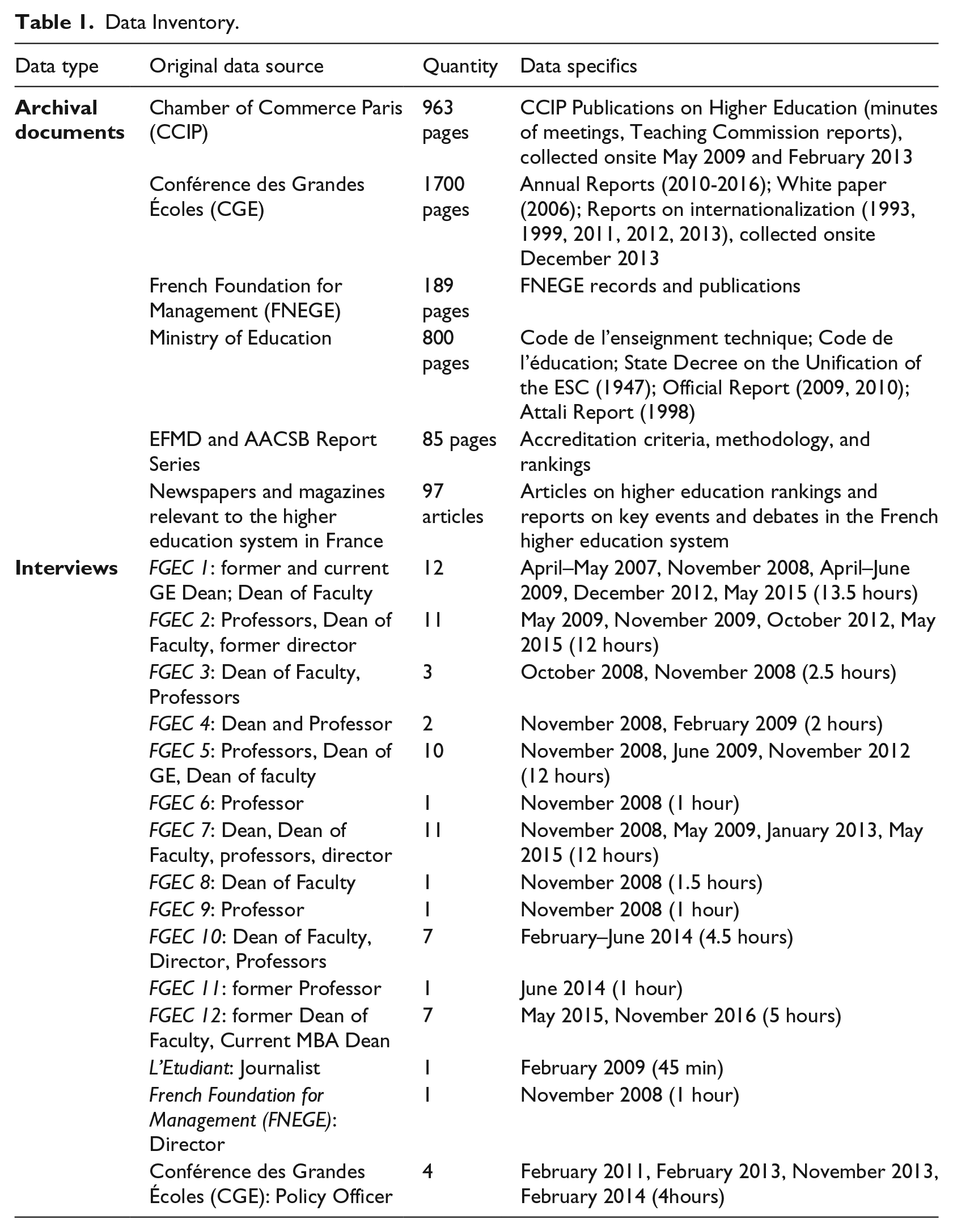
We supplemented this archival data with 67 semi-structured interviews, conducted between 2008 and 2016. We interviewed informants from twelve FGECs, the Conference of Grandes Écoles, the French Foundation for Management, and l’Étudiant magazine in order to capture different perspectives and accounts. The FGECs were selected through purposive sampling, with the aim of identifying a representative sample in terms of location, age, size, and governance structure. To gain a nuanced understanding of how different schools perceived and benefited from the recruitment model, we conducted follow-up interviews in three top-tier schools located in Paris and three mid-tier schools located outside Paris. Treating these six schools as distinct cases, we followed a “replication logic” wherein each case served to confirm or disconfirm inferences drawn from the others (Eisenhardt & Graebner, 2007; Yin, 2003). The interviews lasted on average one hour and were open-ended, following a protocol adapted to each organization as well as to the position of the informant. Informants were asked to reflect upon the practices that made up the Golden Path, and to recount memorable events that had a significant effect on their organizations and the field as a whole (see Table 1 for a detailed inventory of the data used in this study).
Data Inventory.
Data analysis
Data analysis progressed in three stages. In each stage, we cycled between the data, emerging theory, and relevant literature, as is typical of inductive qualitative studies (Strauss & Corbin, 1998). To ensure trustworthiness, we triangulated our data sources and relied on “member checks” with select informants to confirm and improve the accuracy of our interpretations (Lincoln & Guba, 1985). Additionally, having both “insider” and “outsider” authors enabled us to combine intimate insights of the local setting with a more distant perspective, which served as a sounding board (Langley & Abdallah, 2011). At each stage in the process, we met regularly to compare and refine the coding scheme. Disagreements were discussed and used to identify areas requiring further data collection and/or re-conceptualization of key constructs.
Stage 1: Developing a multi-level event history database
In the first stage of the analysis, we mapped important events in the history of the French Grandes Écoles. Relying primarily on archival materials, we captured changes in the number and types of actors influencing the field, and changes in field-level discourse around the challenges facing the schools. We paid particular attention to public discussions on how the schools should respond to these challenges—situating pressures and responses within broader shifts in the higher education sector. As we developed a chronological narrative of events, we identified three periods, marked by intense debate and contestation. The first was in the early 1960s, when the efficacy of the model was called into question. The second was in the late 1990s, when the internationalization of higher education drew attention to a clear misfit between the model and changing competitive demands. The third was in the early 2000s, when there was a resurgence of conflict over unequal access to higher education.
Stage 2: Identifying actors, relationships, and responses
Examining our archival documents and interview data, we identified the key players involved in each period of contestation. After identifying the actors, we began coding for their respective interpretations and responses. As patterns and relationships among the codes were identified, we compared them to our emerging conceptual framework and to insights from existing literature. Two themes surfaced during this process. First, it became clear that maintenance work was not primarily directed at preventing change—as is often portrayed in the literature. Instead, disparate constituencies within and outside the FGEC field actively promoted conservative reform. Once this became clear to us, we began to probe deeper into the nature of institutional continuity in the FGEC context. Of particular interest was how various actors positioned themselves in relation to maintenance and change efforts, and how the specialized recruitment system evolved.
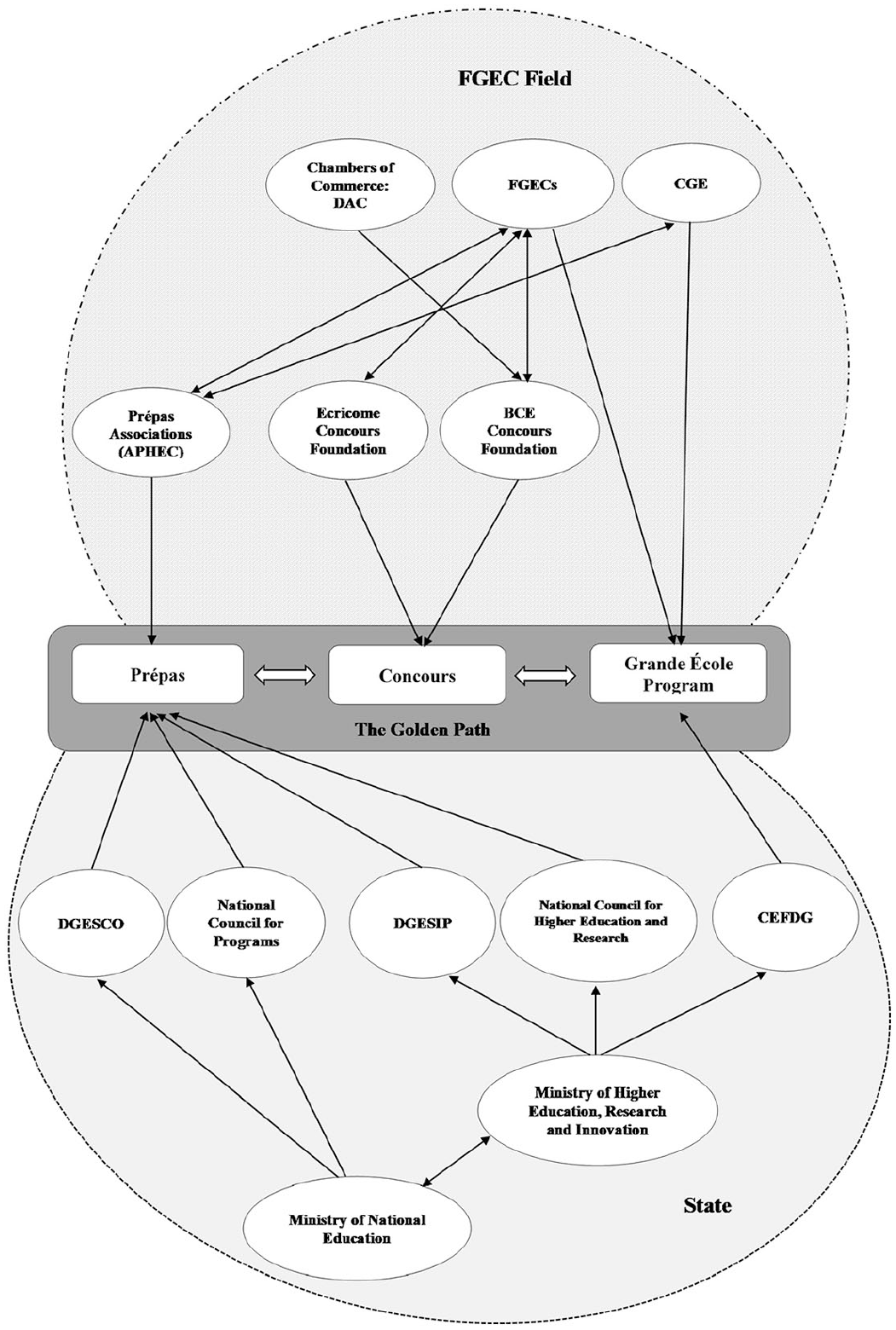
The second emergent theme was the significance of the maturing institutional infrastructure, reflected in the entry of new actors from diverse societal sectors and geographic regions and in growing efforts at policing members of the field (Hinings, Logue, & Zietsma, 2017). In mapping these changes, we identified three types of interlocks that pulled actors into the maintenance process. By interlocks, we mean connections, formal or otherwise, that influence the respective behaviors of actors. For example, French high schools provide students for the prépas, who then prepare students for the concours—which, in turn, supply the students for the GE program. This type of sequencing interlock also pulls in agencies such as the Ministry of National Education and Concours Foundations, who monitor and certify these activities. A second type of connection, credibility interlocks, involves actors that derive rewards and privileges from patronizing the Golden Path (e.g., alumni, industry headhunters, and parents of GE students). The third type, competitive interlocks, involves other higher education institutions that compete for the resources associated with the Golden Path (e.g., students, funding, and status positions).
Stage 3: Articulating the role of the interlocks and meta-routines
In the final stage, we sought to understand how these interlocks influenced the maintenance process. As we noted the shifting coalitions of actors and their stances on the evolving discourse around the Golden Path, we identified three higher-order meta-routines that appeared to encourage conservative change (Adler et al., 1999; Massini, Lewin, & Greve, 2005). Referential comparison surfaced when our coding alerted us to how the emphasis upon “elite” status fueled an attendant compulsion to engage in continuous comparisons with positive and negative referents—that is, referents for which to aspire to and emulate, and those from which to differentiate themselves. Generative improvisation was distilled from codes describing how initiatives at different stages of the Golden Path encouraged both mimetic responses and recalibrations across the system. Distributed monitoring and policing emerged as we noted the distributed network of actors, whose independent activities helped identify opportunities and threats, as well as regulate parameters of change—that is, the scope and range of options considered. Having identified these field-level meta-routines, we explored their relationship in balancing the dynamics of retention and conservative change. As we went back through the data with these analytical concepts in mind, we began to flesh out a conceptual model of distributed maintenance.
Findings
France’s distinctive model of elite recruitment through the Golden Path has long been a source of contention within the government and much of civil society (Bourdieu, 1989; van Zanten & Maxwell, 2015). Yet despite serious questions regarding its efficacy and repeated attacks for its role in undermining equality in education and society, the model has persisted and remained surprisingly stable (Archer, 2008). Below, we present our findings in two sections. We begin by detailing three types of infrastructure interlocks that nurtured conditions for a “distributed” form of institutional maintenance. We then delineate how meta-routines explain the self-reforming capacity of the recruitment model, illustrating them through periods of contestation.
Infrastructure interlocks
Our analysis revealed three types of interlocks that connect disparate actors within and across fields to the so-called “Golden Path.” The first, and most closely connected, web of actors are those directly responsible for the activities that make up the Path—i.e., prépas, the concours, and the Grande École program. We refer to these co-dependency relationships as sequencing interlocks, wherein actors are akin to “custodians” (Dacin, Dacin, & Kent, 2018), each with a part to play in the pre- and co-requisite activities that make up the system (Shove, Pantza, & Watson, 2012): The preparatory classes are a component of the higher education system. . .They are designed by commissions under the authority of the higher education department, comprising senior inspectors, university professors, and Grande École and prépas teachers, before being submitted to the National councils. This process guarantees. . .an effective consideration of the reality of secondary education. . .to fully satisfy the demands of the Grandes Écoles and more generally of higher education establishments. (APHEC website, January 2006)
The prépas are monitored by an Association (APHEC) and several governing bodies associated with the Ministry of National Education. The concours is organized and overseen by two foundations—with input from Chambers of Commerce, the Conference of Grandes Écoles (CGE), and the Grande Écoles. The GE programs are accredited by the Ministry of Higher Education; while being managed and monitored by the schools, the CGE, and, in some cases, local Chambers of Commerce.
As Figure 1 shows, each activity in the Golden Path produces an output on which another depends—much like a supply chain. These co-dependencies engender strong pressures for maintenance, as change in one activity is likely to cause rippling effects across the entire system: [Preparatory schools] while retaining their identity, want to cooperate with the other components of the higher education system. For the key aim, which they know they share with all of the actors in higher education, is the success of each student, and beyond this, of our country. (APHEC website, January 2006)
Sequencing Interlocks.
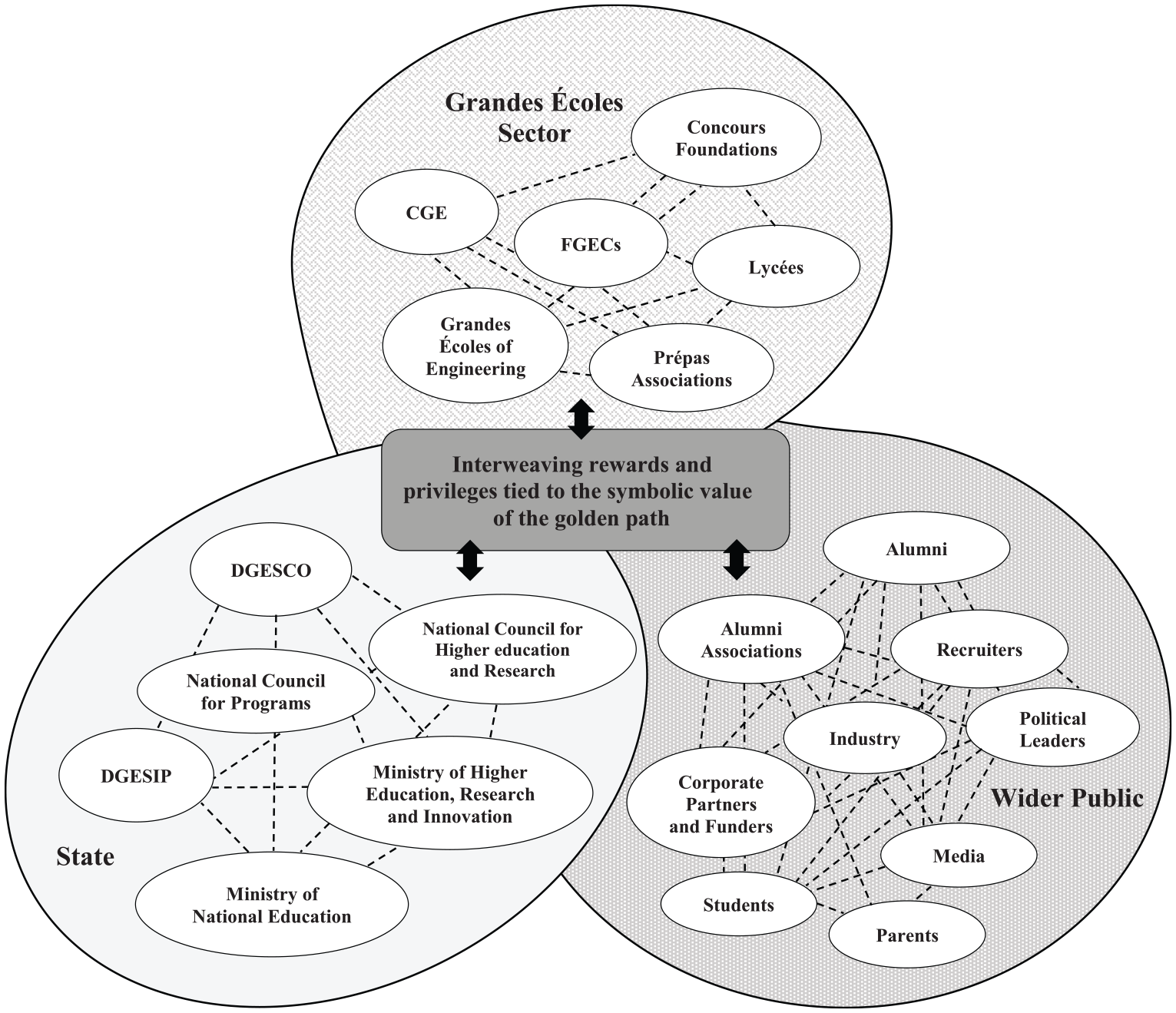
A second type of interlock involves a wider set of actors, who are tied to the Golden Path through its symbolic value—for, in France, there is an implicit distinction drawn between those who traverse the Path and those who do not (Darchy-Koechlin & Draelants, 2010). We refer to these relationships as credibility interlocks, which manifest in the interweaving of rewards and privileges of patronage, as well as reputational and status spillovers. Powerful leaders in industry, finance, and politics, for example, are pulled in because their legitimacy and their status are linked to the perceived exclusivity of the Golden Path; and its “inimitable stamp” (Bourdieu, 1996, p. 90) of achievement: “The taste for effort and capacity for hard work acquired by prépas students. . .are recognized as guaranteeing an absence of serious deficiencies and constituting a reliable foundation for the career of future senior executives” (CGE President, Le Monde, Apr 2005). Industry recruiters and executive headhunters are, similarly, expected to place considerable value on the recruitment model: “opinion about a school. . .is almost exclusively based on the ‘sacred’ variable: the selectivity of the concours” (Challenges, February 1987). In the same way, media outlets gain readership and credibility through their coverage of the Golden Path, with most leading industry magazines and journals, for example, featuring annual “hit parades” that show the relative success rates of the prépas (i.e., GE placements): How students of prépa fare on the concours has significant impact not only on the schools’ reputation and attractiveness on the national market, but also on the preparatory classes themselves and the lycées that host them. Results of the concours are thoroughly scrutinized by high school students and future preparatory class candidates. . . (White Paper, CGE records, 2006)
Credibility interlocks, in short, connect disparate actors—who are not organized in the form of a coordinated collective, but comprised of constituents whose independent activities reinforce the symbolic value of the recruitment model: “If you look at the HEC Alumni Association, you have ministers, celebrities, heads of the largest French companies, heads of the Paris Stock Exchange, journalists, public figures. . .that’s some group!” (FGEC interviewee, May 2009). Whether wittingly or otherwise, these constituencies perpetuate the virtuous circle of status reproduction and social capital that is invested in and derived from the Golden Path (see Figure 2).
Credibility Interlocks.
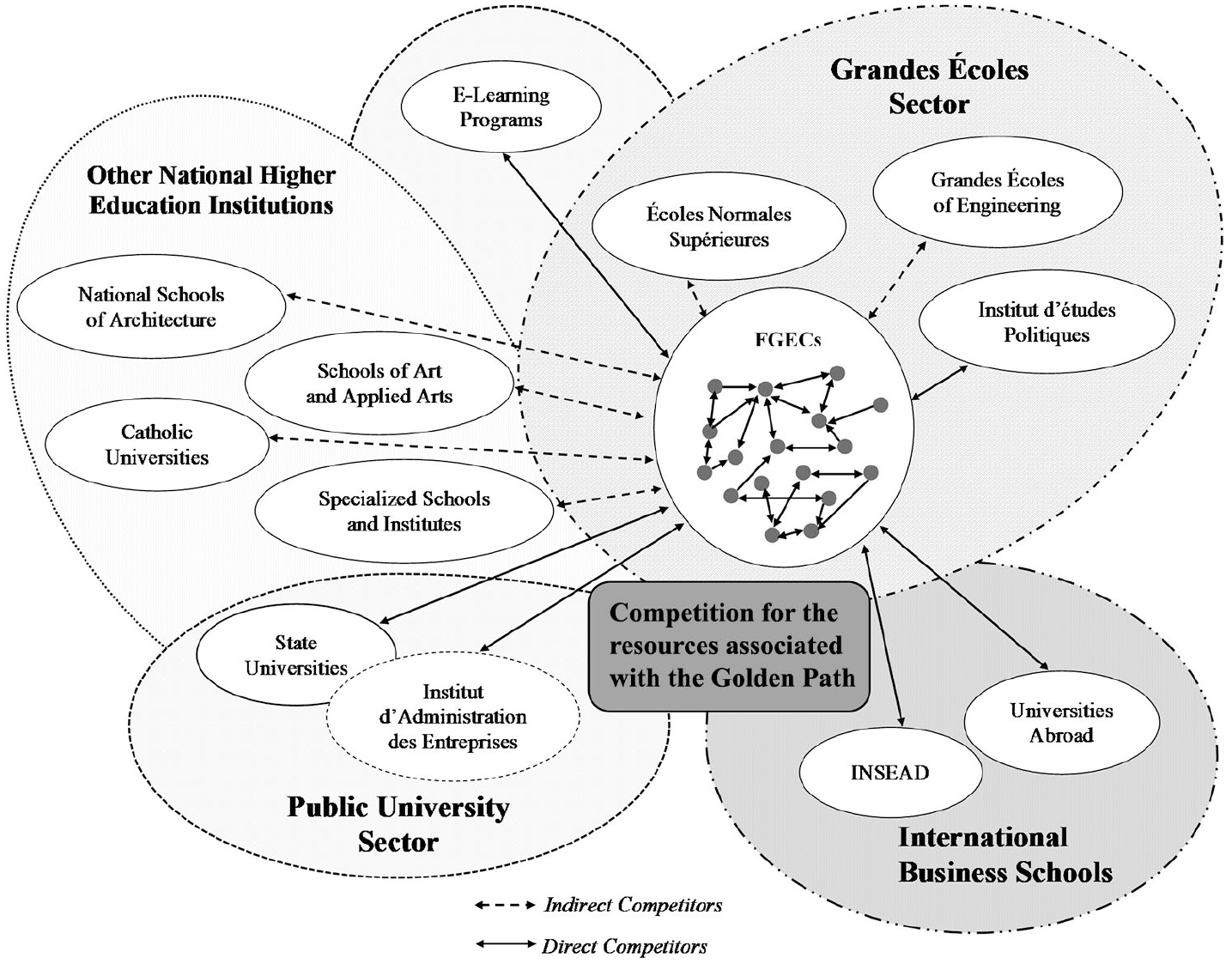
The third type of interlock—competitive interlocks—involves actors that directly or indirectly compete for the resources associated with the Golden Path, e.g., students, funding, and status positions: “[t]he competition for resources is fierce between Grandes Écoles and universities. They are both fighting the same fight. They are looking for additional funding and they are both turning to the private sector” (Le Figaro, February 2011). 1 Within the Grandes Écoles sector, competition for students and for better positions in national rankings is particularly intense. The longstanding rivalry between engineering and business schools, for instance, dates back to the inception of FGECs in the late 1800s. Indeed, for much of their early history, the FGECs were referred to as “Petites Grandes Écoles”—a less prestigious companion to the prominent GE engineering schools. Many FGECs started out emulating their engineering counterparts, with some even incorporating physics and chemistry into their concours examinations (Locke, 1989). However, as management education became increasingly recognized as a discipline in its own right from the 1960s onwards, the focus of competition shifted to, and intensified among, the FGECs themselves. Then, beginning in the late 1990s, competitive interlocks expanded significantly beyond French borders (see Figure 3) following the harmonization of European higher education and the increasing internationalization of management education (Hedmo, Sahlin-Andersson, & Wedlin, 2007; Kipping et al., 2004).
Competitive Interlocks.
Together, these three types of interlock foster a set of higher-order meta-routines that animate a distributed maintenance process. We illustrate the operation of these meta-routines during periods of contestation, highlighting, in particular, how meta-routines infuse flexibility into a highly institutionalized system, and encourage conservative change.
Questioning the efficacy of the recruitment model
In the early 1960s, the growing global prominence of US industry drew attention to a widening technological gap between the US and Europe. Servan-Schreiber’s widely popular book, The American Challenge, decried the training of management elite in France, and warned that major reforms in higher education were needed: “We should have the courage to recognize that our political and mental constructs—our very culture—are being pushed back by this irresistible force. . . if we fail to catch up, the Americans will have a monopoly on know-how, science, and power” (Servan-Schreiber, 1967, p. 101). By problematizing the future of France’s economy and global standing, the book roused public opinion and fueled a resurgence of French nationalism.
Mounting criticism of the ineffectuality of how future leaders of French industry were being trained led to widespread scrutiny of the GE recruitment model. Even those whose legitimacy and status were tied to the system began to raise serious questions about its efficacy. Alumni associations called for an overhaul of the schools’ curricula and teaching methods. Likewise, the Chamber of Commerce of Paris pushed for reform: “The entrance examination is still based on knowledge acquired at high school. . .Preparatory studies and concours should no longer be a sort of examination of high school knowledge” (CCIP records, 1957).
With the survival of French industry at stake, actors from across multiple fields were incentivized to respond. The State made education a national priority and established the FNEGE Foundation to develop a specialized body of professional academics. The Grandes Écoles, also mindful of systemic problems in higher education, formed the Conference of Grandes Écoles—an inter-organizational network responsible for defining and promoting the GE system. Instead of collective mobilization, however, disparate constituencies’ independent activities aggregated into a kind of uncoordinated coordination, i.e., thematic mobilization. This mobilization was reflected in three meta-routines: referential comparison, generative improvisation, and distributed monitoring and policing.
Referential comparison
Although the quest for national elite standing had long compelled the FGECs to emulate their engineering counterparts, the criticism over “American managerial superiority” pushed high-status FGECs to expand their referential comparisons outside France (Locke, 1989, p. 164). Funded by the Ministry of Education and the FNEGE Foundation, several waves of French scholars began making their way to the US: “we looked up to the US and considered it to be the Mecca of management education” (FGEC interviewee, June 2009). Echoing this sentiment, another informant recalled: “I was invited by the American government to visit several universities: Harvard, Stanford, and Cornell. I was like Christopher Columbus, I discovered America!” (Former Dean, Hommes et Commerce, 2012). By expanding their frame of reference to include aspirational comparisons to prestigious US business schools, the FGEC altered the nature of the institutional infrastructure, in essence, making it less insular and less “French.”
Generative improvisation
The FGECs’ routine compulsion to compare themselves with referents that were deemed to be of elite standing or high status fostered an atmosphere of constant awareness and mimetic experimentation. Direct exposure to US business schools had important implications for the Golden Path. Indeed, when scholars returned to France, they imported new ideas and introduced alternative practices. HEC, for example, made a bold move to reform the concours by removing scientific disciplines—a legacy of the school’s attempt to emulate the Grandes Écoles of engineering: “In 1958, when I became Dean at HEC, I was convinced by the necessity to profoundly reform the school’s teaching . . .physics and chemistry were suppressed from the concours, and I succeeded in introducing mathematics instead—not without difficulty” (former HEC Dean, Hommes et Commerce, 2012). In keeping with the meritocratic principles of the recruitment model and the desire for objectivity, mathematics became the cornerstone of candidate screening and selection across most schools (Barsoux & Lawrence, 2013; Defever & Gaston-Breton, 2007). HEC’s initiative laid the foundation for its counterparts to evolve along similar lines—spurring a greater focus on analytical and reasoning skills in both the prépas and concours (De Fournas, 2007).
Distributed monitoring and policing
Despite these initiatives, there was an unwritten and essential boundedness of change possibilities—which largely stemmed from the embeddedness of the practices in broader cultural codes, i.e., “into French cultural DNA.” As underscored by the Chamber of Commerce of Paris: there are certain “cultural traditions to which we will always stay true” (CCIP report, 1952). Being a symbol of the “French republican ideal of meritocracy and of the egalitarian passion that animates it” (Darchy-Koechlin & Draelants, 2010, p. 443), the Golden Path was a point of convergence among “unexpected allies” (O’Mahony & Bechky, 2008), corralling disparate actors to police deviant behaviors. This was clearly evident in HEC’s highly publicized and unsuccessful attempt to become a full-fledged American-style business school in the mid-1960s. The project was motivated, in large part, by the concern that the traditional method of recruitment might be too restrictive: “The concours carries so much weight in the screening of applicants that. . .the country may be missing out on individuals whose energy and potential could benefit the business world” (HEC archives, 1966). Strident backlash on multiple fronts attacked the project for being “too American” (field expert, Editions de l’Observatoire, 2009; see also Pavis, 2003).
Thus, even HEC, the most prestigious and influential school in the FGEC field, was unable to break from the status quo. Perhaps more surprisingly was that it tried to in the first place, as HEC is one of the main beneficiaries of the specialized recruitment model. Underscoring this point, one report argued: “If some are thinking of divesting the practice of recruiting through prépas and concours, they need to be reminded that this system is what has provided HEC with students of an exceptionally high quality” (HEC Archives, November 1999).
Taken together, the three meta-routines encouraged a thematic pull in the direction of change—yet the tone of reform was constructively framed in alignment with the interests of preserving the “rite of passage for the future elite” (André, 2013, p. 5).
Questions of “fit” with changing competitive landscape
The second period of contestation was triggered by the intensification of competition at home and abroad. With the global integration of higher education through the late 1990s, competitive interlocks became more complex and extensive: “Suddenly the stakes were beyond the French market. We were playing outside the familiar field of the French Grandes Écoles” (FGEC interviewee, November 2009). The underlying issue, as one article bluntly put it, was that “schools like ESSEC and HEC are not recognized at all in the United States and Singapore, while Harvard and MIT are famous all over the world. This situation could undermine the sustainability of French schools” (Le Point, 1997). To make matters worse, the rise of national and international rankings “gave a certain materiality to the competition between French business schools, ‘freezing’ them into a single, well-defined hierarchy” (Blanchard, 2009, p. 595).
As the basis of status competition and success shifted, systemic problems in the GE model surfaced, in particular, the difficulty of opening admission to international students: “Preparatory classes are. . .like UFOs in the higher educational landscape. . .completely unintelligible overseas” (Challenges, December 2005). According to the Bologna BMD model, which was designed to harmonize European higher education, a bachelor’s degree was to be awarded after a three-year undergraduate program. However, under the traditional GE model, students did not enter the Grandes Écoles after graduating from high school—instead, they enrolled in prépas: How can we position the preparatory classes within the Bologna process? Currently, the preparatory class system is incomprehensible. It is a black box and this damages the students, the schools, and their degrees. . .In a closed Franco-French environment, there was no need to shed light on things, but the system is opening up and we have students who, in most cases, will work in an international context. (meeting minutes, APHEC website, November 2005)
Although there was growing consensus around the need to alter the recruitment system to fit new competitive requirements, there was little agreement as to how. The State actively embraced internationalization as a means to elevate French management education: “It is an undeniable asset to enable these schools to gain recognition at the European and global levels” (press release, Minister of Education, October 2003). Others, such as the Chambers of Commerce, were less enthusiastic because, for them, the fundamental purpose of the recruitment model was the “vocational imperative related to the local environment” (FGEC interviewee, November 2009). The Grandes Écoles and prépas were, similarly, circumspect about the need to accommodate international students because it meant that new paths of admission were necessary: “Obviously, such discourse worries not just prépas teachers but also competing grandes écoles, for which the entrance exam remains the panacea for admission” (Les Echos, November 2012). As these different actors began responding in ways pursuant to their own interests and agendas, the meta-routines once again reasserted themselves, albeit in slightly different ways.
Referential comparison
In this period of contestation, the nature of referential comparisons and their implications differed. With the proliferation of rankings, not only did the category of aspirational referents become more fluid and encompassing, but comparisons became more structured and systematic. Differences between the schools became “more conspicuous” (Blanchard, 2009, p. 595) and students were increasingly susceptible to being “poached” by business schools abroad (Independent, 2006). Lower-tier schools looked to their high-status counterparts, and top-tier schools looked to other elite institutions around the world. Importantly, seeded in this routine compulsion to compare themselves with others was a general openness to change: “The desire to succeed is in their genes, and they know that they must continually question themselves—that it is their job to think differently, to shake up existing practices” (director of the Business School Chapter, Les Echos, October 2014).
Generative improvisation
Through the late 1990s and early 2000s, the CGE organized conferences to discuss the challenges of internationalization: “We have been thinking a lot about a way to develop the French business education. . .How do we recruit the best international students and convince them to come study in our Grandes Ecoles? . . .We still have a long way to go” (conference minutes, The Internationalization Challenge, 1999). However, as the director of the Business School Chapter explained, “There’s no real coordination about broad policy because each school follows its own line. . .Nobody decreed that everyone had to move in this direction. It just happened that everyone was in perfect agreement without necessarily having discussed it” (May 2015). Echoing this, another informant stated: “The CGE is a platform where strategic issues of common interest are put on the agenda. It is not a space where schools coordinate their strategies. There’s very little coordination” (FGEC interviewee, May 2015).
As schools introduced new initiatives and programs, peers were made aware of and encouraged to follow suit. This awareness was largely facilitated by the increasing number of opportunities for engagement and information-sharing: We have a good idea about what other schools are doing not necessarily because of benchmarking strategies, but because we meet in conferences and seminars—often abroad. French people enjoy meeting in these venues and discussing what’s happening in France. . .and also because that kind of information is relayed by journalists and media. (CGE Business School Chapter Director, May 2015).
There was, in other words, an atmosphere of constant awareness and learning, wherein disparate constituencies could be kept apprised of what was happening at the practices’ “leading edge(s)” (Shove et al., 2012, p. 103). In this way, mutual adjustments and re-calibrations could be made across the system as a whole. Preparatory programs were extended from one to two years, after which a student could obtain a bachelor’s degree by completing one year at a Grande École. Other reforms were introduced to make the Golden Path more “understandable” to the international community: It is necessary to strengthen the linkage between the prépas and Grande École programs. The goal is not to teach the curriculum of the GE in prépas and vice versa; instead, we are aiming to adapt the concours. . .. This will not undermine or call into question the overall architecture of the concours. (APHEC website, January 2006)
Perhaps most significantly, an alternative recruitment path was established: “When international students enter the program, they arrive in the second year through the parallel admission process. There is still a selection process, but there is no concours” (FGEC interviewee, December 2012).
Distributed monitoring and policing
Although these changes demonstrated the capacity of system to adapt, they did little to alter the longstanding belief that the model was the “legitimate form of election” to the elite of France (Bourdieu, 1989, p. 79). Indeed, students not vetted on the basis of “the republican meritocratic competitive examination” were stigmatized as somehow “less ‘meritorious’ and less ‘outstanding’” (Darchy-Koechlin & Draelants, 2010, p. 441). Such deep-seated biases compelled lower-tier schools to continue reproducing the very structures and arrangements that undergirded their disadvantaged positions in the GE hierarchy: “Even the lowest status schools have adopted this recruitment practice to signal their belongingness to the Grande École system and to benefit from status spillovers” (Le Monde, 2014). At the same time, the biases created parameters around the scope of change considered: To guarantee the level of reliability of business schools, the Conférence of Grandes Écoles (CGE) recommended that schools should limit the admission of students who have not gone through preparatory classes to no more than 30% of the first-year intake. “A proportion in line with that already applied in engineering schools” explained the Director of the Business School Chapter at the CGE. (Le Figaro, February 2002)
Thus, despite concerted efforts to modernize recruitment practices, changes remained peripheral—such that, even though an alternative path was introduced, it had virtually no effect on the specific and distinctive sequencing of the Golden Path. Moreover, it did little to dilute the symbolic value and perceived exclusivity of the model. As reported in Le Monde (2007): “French schools are considered to have taken the best from International Business Schools, while keeping their French specificities as French Grandes Écoles.” That being said, however, the system was about to face its most serious threat, when the government and other powerful stakeholders began to directly and publicly challenge the social legitimacy of the Golden Path.
Contesting the social legitimacy of the recruitment model
Although the need for greater social diversity in the Grandes Écoles has long been a source of contention, the issue was again pushed to the forefront amid growing social unrest in the French suburbs over social discrimination and unequal access to education. Taking up this crusade, Jacques Attali, an advisor to the Ministry of Higher Education, lamented: “It is virtually impossible today for a child from an immigrant family living in a disadvantaged suburb to access a Grande École. . .This can have potentially disastrous consequences on social cohesion” (Attali Report, May 1998).
The need for social diversity became a national call to arms. At the heart of the debate was the GE recruitment system—with questions being raised about whether the recruiting process should be harmonized at the national and international levels; and whether the specificity of national entrance examinations should be maintained (Darchy-Koechlin & Draelants, 2010). Disadvantaged actors pulled in through competitive interlocks were especially vocal, with the Union Nationale des Étudiants de France demanding “an end to the de facto, exclusive right of the Grandes Écoles to recruit the best and brightest in certain key fields” (Le Figaro, January 2010). Similarly, universities advocated ending the longstanding bifurcation between the Grandes Écoles and public university sectors: The preparatory classes must become part of the University system. . .There is no reason to have 30,000 undergraduate students each year [take classes] outside universities. We do not want the abolition of the preparatory classes, but. . .they must be integrated within the university system. (Vice-President, Conference of University Chancellors, March 2005)
Even those at the highest level of government advocated the imposition of student quotas: “[President] Sarkozy wants the grandes écoles to shed their elitist white, middle class image and improve their record on giving access to students from poorer backgrounds—as much as 30 per cent of their places” (Financial Times, July 2010). Still others called for major reforms to the curricula: “Advocates of reform are targeting the sacred concours—a peculiar form of recruitment in the higher education landscape—that is perceived to nurture social inbreeding” (Les Echos, January 2010). Under direct scrutiny were specific sections of the concours: “candidates from under-privileged backgrounds. . . tend to do poorly on the ‘culture’ and ‘general knowledge’ portions of the test. . .many of them did not frequent museums or theaters, nor did they grow up in houses filled with books” (Le Parisien, January 2010). Reflecting on the debate over social diversity, one FGEC professor complained: It is very difficult to achieve “diversity” when much of the student population goes through the concours system. Here’s an anecdote: There was a white student from “quartiers difficiles” (an underprivileged neighborhood) whose parents were teachers. One of the jury members was opposed to recruiting the candidate because his profile was not consistent with the “GE profile”. What the hell is the GE profile anyway? . . .This kind of elitism has created tension in the selection committees that I have taken part in. Oftentimes committee members have a narrow understanding of the schools’ criteria of admission. (FGEC interviewee, April 2007)
Amid acrimonious debates and pressures to increase social diversity in the schools’ student body, the varied responses of disparate constituencies, again, coalesced into a thematic pull in the direction of conservative change.
Referential comparisons
Whereas in the previous periods of contestation, adaptive efforts were largely driven by positive or aspirational comparisons, this period was distinctly different. The FGECs stressed the importance of maintaining the high standards and selectivity of their recruitment practices as a way to differentiate themselves from universities. They did not, in other words, want to be lumped together with the so-called “second-class institutions” of higher education, i.e., those that were open to all holders of the Baccalauréat (Kumar & Usunier, 2001). As reported in an article in Le Monde: The relationship between the grandes écoles and universities has always been a thorny topic in our country. When someone talks about combining the two systems, the grandes écoles, proud of their undeniable and long-lasting success, fear that they will lose their specific strengths, that they will face the persistent problems of the university system and inherit its evils in some way. (Former Minister of Higher Education and Research, July 2006)
For most of the FGECs’ history, and particularly in this period, the universities served as a negative referent from which the schools strove to distance themselves. They were an “antagonistic form” (Perkmann & Spicer, 2014) for which members could reaffirm their specialized practices, and clarify what the schools were not. As one informant explained: “Universities do not select the students they admit. . .and, for me, this is a major problem because classes end up being filled with students who have no real interest in the discipline and who might waste a whole year” (FGEC Director and CGE Officer, February 2014). Other constituencies adopted a similar position, strongly resisting proposals to integrate the prépas into the university system: “The associations of prépas professors oppose this aggressive project which refuses to recognize the reality of higher education and reflects a systematic attack of the preparatory classes” (APHEC website, January 2006).
Generative improvisation
In light of these disruptive pressures, the CGE and its member schools introduced various initiatives to encourage greater social diversity: “We have to experiment with new practices and methods to broaden the range of students applying to and admitted to the Grandes Écoles” (CGE press release, December 2010). For the most part, these initiatives involved developing mentoring programs in secondary schools in disadvantaged neighborhoods (or banlieues) as a way to increase awareness of preparatory programs among working class and immigrant families (Le Figaro, September 2009; Les Echos, January 2010; CGE records). One of the leading schools, ESSEC, created a mentoring program in 2002 called “Une grande école pourquoi pas moi?” (“A grande école, why not me?”). The program was designed to provide upstream support by addressing psychological and cultural barriers, which led students to self-select out of the GE track (André, 2013; Zingraff-Vigouroux, 2017). After receiving widespread support and praise from the CGE, the government, and the media, ESSEC’s initiative “became official and was taken up by many grandes écoles, who launched similar schemes for high school pupils from modest backgrounds” (Zingraff-Vigouroux, 2017, p. 142).
The schemes that emerged through generative improvisation were, importantly, concentrated on activities that occurred before the Path. They were not, however, part of the Path as they were not prerequisite activities, producing an output on which the next activity (i.e., the prépas) depended. Indeed, for the FGECs, the mentoring programs were a clear signal that they would not follow in the controversial footsteps of Sciences-Po (a prestigious Grande École in political science)—which broke a “real French taboo” by introducing a separate admissions examination for students from disadvantaged backgrounds (André, 2013, p. 6).
Distributed monitoring and policing
As initiatives were introduced, the distributed manner of the field’s monitoring and policing mechanism again resurfaced. Because social diversity had become a national call to arms, however, overt defense of the recruitment model became a sensitive issue, especially for actors in government, industry, and the media: “The government has been throwing up roadblocks and has not supported us even though most of the government officials are themselves alumni of Grandes Écoles” (CGE officer, November 2013). As such, the Conference of Grandes Écoles stepped in and took a more explicit stance in this period. The CGE President made it clear that affirmative action was not the appropriate response—arguing that the imposition of admissions quotas for students from underprivileged backgrounds would “inevitably lead to a drop in the academic level” and “undermine the colleges’ meritocratic principles” (Les Echos, December 2009). Reinforcing this stance, another informant explained: “we don’t promote elitism, we promote excellence” (CGE Officer, November 2013).
For their part, the FGECs resisted affirmative action because differential treatment was seen as antithetical to the meritocratic ideals of their selection procedures (Langan, 2008). After interviewing a number of senior executives and business leaders, Le Figaro, similarly, concluded: “Most of them support the CGE’s decision and are in favor of upstream support for students from modest/poor backgrounds. Some. . .fear a ‘devaluation’ of the degree/diploma delivered by the Grandes Écoles. Very few support the quotas system” (Le Figaro, January 2010). Despite strong resistance to mandatory student quotas, the FGECs and their patrons were “not adamantly opposed to a reform of concours content” (Les Echos, January 2010). Yet, there were boundaries around the range of change options that would be considered. One such boundary was the culture, general knowledge, and languages sections of the concours—which were widely criticized as being social screening devices. In their defence, one FGEC Director argued: “We have developed alternative ways to access the schools. We are certainly not going to miss out on candidates who are proficient in languages or those who have had the opportunity to travel abroad” (Le Figaro, September 2009). Similarly, others emphasized the importance and value of these components to industry recruiters and employers: Business school leaders consider the culture and general knowledge components an appropriate screening tool. . . “It is an unavoidable part of management training,” explains the Director of Admissions and Competitive Exams . . .General culture is also an asset in a world that values open-mindedness: it is a layer of varnish that is essential to the intellectual coloring of a career. (Le Monde, April 2012)
One field expert went even further, stating: “Removing or reducing the weight of the cultural components, would be a way of saying that culture does not count. With this type of reasoning, we might as well just give everyone multiple-choice tests” (field expert, Le Figaro September 2009).
Even amid vehement contestation and calls for reform from government officials, universities, and powerful student unions, the Golden Path and its core components remained largely inviolate—as seen in the strong reaction to one school’s plan to stop recruiting through prépas and concours: They explained that their project was going to revolutionize the business school sector, and that it was going to mean the disappearance of the old-fashioned “has been” model of the preparatory classes . . . In the end, they had all the preparatory class students, all the teachers of those classes, all the families and parents . . . and a lot of their colleagues against them. (FGEC former Director and CGE officer, February 2014)
Not only was the school excluded from the Conférence des Grandes Écoles and SIGEM (the joint entrance examination network of the business schools), it became a “second-class” institution according to one of France’s largest trade unions. The Director of the school admitted that they had “underestimated the resilience of the Grandes Écoles institution. . .We made some mistakes with regard to the prépas that we are going to put right” (School Director, Les Echos, June 2014).
Pulling the above together, the so-called “Golden Path” has remained singularly resistant to proposed reforms, other than modest alterations. Even today, emphasis is placed on the Path, with a recent study by the CGE showing that 66.5% of FGEC students are recruited directly from preparatory programs (CGE records, 2014). Not only has the recruitment model of the French Grandes Écoles of Commerce retained much of its original structure and function, it has helped the GE system gain greater symbolic and material importance—for, as Bourdieu (1989, p. 79) noted some time ago: When the process of social rupture and segregation that takes a set of carefully selected chosen people and forms them into a separate group is known and recognized as a legitimate form of election, it gives rise in and of itself to symbolic capital that increases with the degree of restriction and exclusivity of the group so established.
Discussion
Our starting motivation was to understand how the elite recruitment model of the French Grandes Écoles has persisted, despite repeated attacks and vehement contestation, even from those within and privileged by that system. Comparing across periods of contestation rendered the mechanisms of maintenance more salient, enabling us to surface a model to explain the self-reforming capacity and, thus, maintenance of the Golden Path. The model is illustrated in Figure 4.
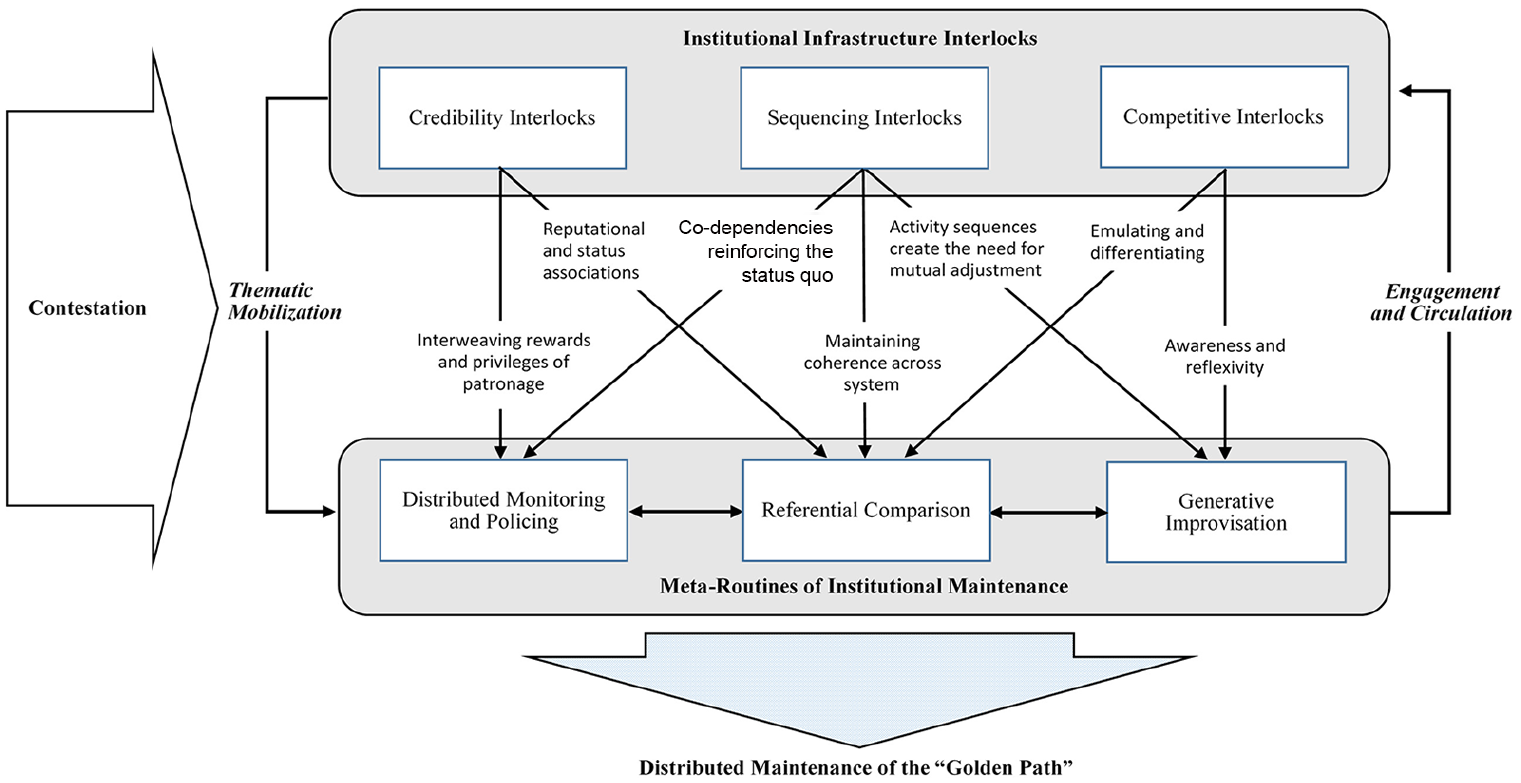
Model of Distributed Institutional Maintenance.
By unpacking the durability and resilience of social practices that underpin patterns of privilege, our study makes two main contributions. First, it contributes to understanding of “a more fragmented and less strategic conceptualization of institutional maintenance” than has typically been portrayed in the literature (Dacin et al., 2010, p. 1394; see also, Wright et al., 2017). We have shown how the embeddedness of institutionalized practices, and the complex social relations supporting them, encourages and motivates a rather different “change agent” than suggested by previous studies. Whereas emphasis is typically on a homogeneous and coordinated body of like-minded actors vying for or against preserving the status quo (Battilana et al., 2009; Hampel et al., 2017), we have identified a more dynamic pattern of shifting coalitions that can underpin institutional maintenance (Wright & Zammuto, 2013).
As Figure 4 shows, three types of infrastructure interlocks nurture conditions for a “distributed” form of institutional maintenance, involving disparate self-interested actors from within and across fields. Sequencing interlocks are co-dependent relationships among actors whose activities form a kind of supply chain, where each activity produces an output on which another depends (see Figure 1). Prior studies have shown that such co-dependencies generate vested interests to police and maintain the status quo, as a change in one part requires “complex rearrangements of all the other parts” (Ansell et al., 2015, p. 100). Yet such dynamics do not straightforwardly fit our case. Specifically, we found that actors’ mutual awareness of their co-dependencies can encourage continuous adjustments and unforced recalibrations to ensure coherence across the system.
Credibility interlocks also foster dynamics of stability and change. The interweaving of rewards and privileges of patronage, on the one hand, incentivizes disparate actors to self-interestedly police deviant behaviors. Reputational and status implications, on the other hand, motivate them to monitor external events that might intrude upon or threaten the symbolic value of the practices in the focal field. We found that when questions were raised about the utility and efficacy of the recruitment practices, disparate constituencies were incentivized to actively pull the practices towards realignment, with the implication being that the practices “experience regular incremental change that maintains their legitimacy” (Zietsma & Lawrence, 2010, p. 217). In contrast, we found that when the practices were attacked on the grounds of social legitimacy, these same actors were much less vocal. Those at the highest level of the government even began distancing themselves from the model, despite many of them having traversed the Golden Path to reach their current positions. Thus, our findings suggest that distinctions between incumbents and challengers may not be as clear-cut as commonly portrayed, and that focusing on particular episodes of contestation may “miss the forest for the trees.” In other words, it may mask how interests coincide under certain conditions and on certain issues, but not others (O’Mahony & Bechky, 2008; Wright & Zammuto, 2013).
Competitive interlocks directly or indirectly pull actors together, as they compete for the same pool of resources that feed into or come out of the Golden Path—e.g., students, funding, and status positions (see Figure 3). This network of actors tends to be quite fluid—evolving and changing with shifts in the competitive playing field, and with the individual actions and initiatives of embedded actors. As prior studies have shown, the expansion, contraction, or reconfiguration of competitive interlocks may disrupt institutionalized settlements, prompting actors to engage in collaborative and defensive tactics (Anteby, 2010; O’Mahony & Bechky, 2008). In our case, we found that as competitive interlocks expanded, not only did the institutional infrastructure become inherently less insular and “French,” there was a significant shift in the basis of competition and success in the FGEC field. Specifically, the changes brought greater pressure upon the schools to demonstrate their elite status not only nationally, but also internationally. Such fluidity in competitive interlocks can generate pressures for both stability and change by making differences among actors more conspicuous, or strengthening categorical distinctions (Blanchard, 2009; Kodeih & Greenwood, 2014; Lounsbury, 2002).
Whereas the first contribution of the study focuses on unpacking questions around who and why, the second centers on explaining how highly institutionalized practices are “adaptively” maintained. Too easily, the idea of maintenance can take the form of inflexibility and resistance to change, an imagery that is implicit in much of the existing literature. We have found that, instead of the intentional defensive tactics and repair work observed in previous studies (e.g., Lok & De Rond, 2013; Micelotta & Washington, 2013; Sminia, 2011), institutional inhabitants may implicitly anticipate and actively embrace conservative change. As Figure 4 shows, infrastructure interlocks foster thematic mobilization in the form of meta-routines—i.e., the loosely connected activities of disparate actors, which coalesce into repetitive interdependent actions that encourage change (Adler et al., 1999; Feldman & Pentland, 2003).
The role and importance of routines in institutional processes has long been acknowledged. Berger and Luckmann (1966, p. 149), for example, argued that: “the reality of everyday life maintains itself by being embodied in routines, which is the essence of institutionalization.” More recently, Lawrence and Suddaby (2006) describe institutional arrangements as being “maintained and reproduced through the stabilizing influence of embedded routines and repetitive practices” (p. 233). Routines, however, are not restricted to dynamics of inflexibility and inertia but can, instead, enable evolutionary change (Feldman & Pentland, 2003; Parmigiani & Howard-Grenville, 2011). In the case of meta-routines, the locus of change is not situated in the performance of the routine, but in the routine itself—that is, they are designed to promote and regulate change (Adler et al., 1999; Massini et al., 2005).
As we traced how constituent groups within and outside the focal field came to be aligned in the maintenance of contested practices, it became clear that actors—each pursuing their own interests and agendas—cultivated an openness to, and appreciation of, the possibilities of change. Yet the tone of reform was constructively framed in alignment with the interests of maintaining the system. Referential comparisons, for example, peg performance to a moving target of positive and negative referents (DiMaggio & Powell, 1983; Perkmann & Spicer, 2014). In our case, these comparisons were enacted by actors within and outside the FGEC field: e.g., the schools’ compulsion to compare themselves with referents for which to aspire to or differentiate themselves from; the presentation of rankings by the media and accreditation agencies; and, the State and industry’s determination to elevate elite management in France to the global stage. This compulsion infused some flexibility into the system by encouraging schools to step out of their fishbowl and consider new perspectives, as well as to reflexively acknowledge problems, i.e., to move “from unreflective participation in institutional reproduction to imaginative critique of existing arrangements to practical action for change” (Seo & Creed, 2002, p. 231).
Generative improvisation, similarly, encourages a collective pull in the direction of conservative change, notably, through loosely coordinated experiments and recalibrations across the system. In our case, we found that despite differences and competition between members of the FGEC category (Kodeih & Greenwood, 2014), being embedded in an atmosphere of constant awareness and learning fueled an isomorphic impulse towards continuous adaptation. Distributed monitoring and policing also fueled this impetus by activating a dispersed network of spectators to monitor and identify potential opportunities and threats, as illustrated, in our case, through the response to the growing prominence of US industry in the 1960s.
An important implication of such a distributed form of monitoring and enforcement is that it is especially difficult, as Elsbach and Sutton (1992, p. 700) put it, to “mask or distract attention from. . .activities that may be unacceptable to some key constituencies.” Oftentimes, policing is depicted as coercive auditing and inspections, largely conducted by field-level, legitimacy-conferring agents (Hoffman, 1999; Lawrence & Suddaby, 2006; Quinn Trank & Washington, 2009). In these arrangements, emphasis is on the dyadic relationship between the inspecting and inspected parties, wherein coercive enforcement is explicit and visible, entailing either a loss or retention of legitimacy depending upon the demonstration of compliance (Greenwood & Suddaby, 2006). While our case underscores and confirms policing as a mechanism for compliance, we have shown that policing need not be carried out in a centralized or coordinated fashion by powerful legitimacy-conferring agents. Instead, it can be performed by a variety of spectators collectively and self-interestedly incentivized to monitor and sanction infractions. In this respect, distributed policing differs from the coercive dyadic in that the motivation for enforcement is not regulatory, but normative and cultural.
Importantly, our study suggests that social practices that underpin patterns of privilege are maintained through a nested institutional infrastructure of interlocks and meta-routines. Interlocks animate meta-routines by marshaling dispersed self-interested constituencies to thematically mobilize, i.e., in an uncoordinated fashion, yet with the same intention (Smets, Aristidou, & Whittington, 2017). Meta-routines, in turn, reinforce interlocks by promoting engagement, active participation, and information-sharing (Fan & Zietsma, 2017; Shove et al., 2012). We refer to this in the model as engagement and circulation—wherein meta-routines encourage mutual awareness and create a “repository” for collective knowledge and experience (Scott, 2013). Together, these observations suggest that the original definition of institutional work, i.e., “the purposive action of individuals and organizations” (Lawrence & Suddaby, 2006, p. 215), may unwittingly have focused attention on the actions of particular actors, while neglecting the maintenance effect of multiple actors acting thematically. That is, it misses the collective work of distributed actors pulling in the same direction, with little formal orchestration.
Conclusion
Despite acrimonious debates and unrelenting calls for reform, France’s model of elite recruitment has remained surprisingly intact. Although other countries have evolved similar models of elite recruitment in their higher education systems (e.g., Germany’s Handelshochschulen, England’s Oxbridge, and the US’s Ivy League Schools), “[n]othing on the international scene can compare with the meaning that these schools have in France” (Darchy-Koechlin & Draelants, 2010, p. 433). Indeed, the symbolic weight of France’s Golden Path has been virtually woven into French cultural DNA, such that the “whole society cooperates to single out the great ones among them” (Nadeau & Barlow, 2003, p. 49). A promising line for future research would be to investigate whether certain types of disruptions are more or less amenable to the distributed responses identified here. For example, would “detrimental fit-destroying” competitive changes (Siggelkow, 2001) render the self-reforming capacity of referential comparison, generative improvisation, and distributed monitoring and policing insufficient? Alternatively, studies could examine how expansions or contractions in interlocks might affect meta-routines. One might expect, for example, that the expansion of interlocks would increase the number of conflicting perspectives, thus increasing the complexity of enacting meta-routines and potentially sowing the seeds for transformational change. Future studies might also examine whether other fields, whose core practices have acute societal implications (e.g., national healthcare; tobacco, and firearms), spawn similar infrastructure interlocks and meta-routines.
In raising these questions and issues, we aim to reinforce calls to better appreciate the nestedness of institutional infrastructures—for, as Scott (2013, p. 236) convincingly argues, “societal institutions provide a wider institutional environment within which more specific institutional fields and forms exist and operate.” We hope that our distributed account of institutional maintenance encourages a rebalancing of current scholarship, which has increasingly tended towards emphasizing dramatic power battles and processes of institutional change.
Footnotes
Acknowledgements
We would like to thank our Action Editor and the anonymous reviewers for their developmental feedback and uncompromising efforts to help us shape this paper. We also wish to thank Henri Schildt, Giuseppe Delmestri, Diane-Laure Arjaliès, Michael Lounsbury, and colleagues from our respective departments for providing comments on previous versions of the manuscript. Additionally, we would like to recognize the feedback received from audience members at the conferences and workshops where this work was presented.
Funding
The author(s) received no financial support for the research, authorship, and/or publication of this article.