




Abstract
Agency and institutions are essential concepts within institutional theory. In this Perspectives issue, we draw on a select group of Organization Studies articles to provide an overview of the topic of agency and institutions. We first consider different ways of defining agency and institutions and examine their implications for institutional theory. We then analyse the relationship of actors and institutions through four lenses – the wilful actor, collective intentionality, patchwork institutions and modular individuals. Our analysis leads us to dissociate agency from individuals and view it as a capacity or quality that stems from resources, rights and obligations tied to the roles and social positions actors occupy. Roles and social positions are institutionally engineered. It is social actors qua occupants of roles and positions (not individuals) that enter the social ‘stage’ and exercise agency.
Introduction
In this Perspectives issue 1 , we examine the topic of agency and institutions within Organization Studies with a focus on the long running debate on how actors relate to institutions, a recurrent and contested theme in institutional theory and across the social sciences (e.g. Emirbayer & Mische, 1998). Early critiques (DiMaggio, 1988) voiced concern that the original texts of institutional theory (Meyer & Rowan, 1977; DiMaggio & Powell, 1983; Fligstein, 1985) considered actors and their agency to be subordinate to institutions. This apparent neglect was felt to be both analytical and empirical; agency as a causal force was not adequately conceptualized and the detailed actions of individual and collective actors not analysed in empirical studies of institutionalization.
The critique would soon inspire a prolonged effort to demonstrate that actors do more than simply enact rules and cultural scripts, resulting in a veritable turn for institutional theory towards agency-centred theories and empirical studies (Beckert, 1999; Dorado, 2005). The outcome of this ‘agentic turn’ includes the literature on institutional entrepreneurship (e.g. Battilana, Leca, & Boxenbaum, 2009; Greenwood & Suddaby, 2006; Leca & Naccache, 2006), institutional work (e.g. Lawrence, Suddaby, & Leca, 2009, 2011; Zeitsma & Lawrence, 2010), and a growing field of theories devoted to analysing the active involvement of actors in institutional change and reproduction (see Greenwood, Oliver, Sahlin-Andersson, & Suddaby, 2008). These came to offer new perspectives and problems relating to the relationship of actors and institutions. An example is the so-called ‘paradox of embedded agency’, which places agency in a double bind between actors and structure (see Seo & Creed, 2002).
Guiding empirical studies in these agency-oriented research currents is the belief that actors have much greater leeway to interpret rules and enact institutional patterns and relationships than previously assumed in institutional theory. The agentic turn within institutional theory is so wide-ranging and profound it raises many important questions for consideration. For instance: What is agency and how does it relate to individuals? To what degree is agency nested in the very fabric of institutions? Can recent trends in institutional theory be reconciled with the original ideas that stress the significance of cultural schemes and rationalized beliefs for the constitution of agency? Does the paradox of embedded agency appropriately capture the multiple, delicate and historical links that bind actors to institutions (Emirbayer & Mische, 1998)?
With these questions in mind we searched the archive of Organization Studies and identified a number of relevant and highly cited articles on the topic of agency and institutions. Our selection includes the following articles: Barley and Tolbert (1997); Labatut, Aggeri and Girard (2012); Lounsbury and Crumley (2007); Scott (2008a); and Wijen and Ansari (2007). In addition, we feature two papers that do not explicitly adopt an institutional perspective but deal with the subject of how individuals are tied to organizations and institutions: Hirst and Humphreys (2015) and Kallinikos (2003).
There is no way to cope with the issue of agency and institutions without ultimately confronting how individuals relate to and work within organizations. Drawing on the selected articles as well as debates in organization studies and social theory more broadly, we first consider different ways of defining agency and institutions and examine their implications for institutional theory. We then deploy four lenses through which to analyse the relationship of actors and institutions – the wilful actor, collective intentionality, patchwork institutions and modular individuals. Through these lenses, we illuminate the significant concepts that have framed the debate on agency within institutional theory in recent decades, and provide an overview of the topic in a way that transcends the common pattern of juxtaposing agency to structure and individuals to institutions.
Defining Agency and Institutions
The concept of agency maintains ‘an elusive, albeit resonant, vagueness’ across the social sciences (Emirbayer & Mische, 1998, p. 962). This is also true for institutional theory and organization studies more broadly. For instance, individual actors are regularly portrayed as driving institution building and change with little or no consideration for the precise mechanisms through which individual pursuits influence collective arrangements (Hasselbladh & Kallinikos, 2000). In some cases, actors are assumed to be institutional superheroes with the ability to purposefully ‘create, alter, and destroy institutions’ (Bitektine & Haack, 2015, p. 50). Crucially, when agency as a reflective capacity is not clearly distinguished from individuals, scholars risk succumbing to the lure of methodological individualism – that social phenomena result from the actions of atomized (socially unconnected) individuals. Thankfully, there exists a rich literature from which to thoughtfully critique simplifications relating to the concepts of agency and institutions.
The seminal article by Emirbayer and Mische (1998) offers a rich and complex definition of human agency ‘as the temporally constructed engagement by actors of different structural environments – the temporal-relational contexts of action – which, through the interplay of habit, imagination, and judgment, both reproduces and transforms those structures in interactive response to the problems posed by changing historical situations’ (p. 970). Theirs is a historically contingent, temporally and context-dependent notion of agency conditioned by culture, social structure and intra-individual propensities. Though organization theorists have used this definition to emphasize the idea that institutions enable purposive action (e.g. institutional entrepreneurship, Garud et al., 2007), for Emirbayer and Mische (1998), human agency is both constrained and enabled, and is so along three institutional contexts. The first is a cultural context that ‘encompasses those symbolic patterns, structures, and formations (e.g., cultural discourses, narratives, and idioms) that constrain and enable action by structuring actors’ normative commitments and their understandings of their world and their possibilities within it’ (p. 970, footnote 5). The second is a social-structural context involving networks and social ties ‘that comprise interpersonal, interorganizational, or transnational settings of action’ (p. 970, footnote 5). The third is a social-psychological context, whereby ‘psychical structures that constrain and enable action’ (p. 970, footnote 5). From this, actors are theorized to express agency through iteration (conditioned by routines and habits), projectivity into the future (conditioned by imagination) and practical evaluation; though we do not explicate these further, we encourage anyone interested in the topic to read Emirbayer and Mische’s powerful work.
This definition demonstrates some of the complexity attributed to notions of human agency within sociology, a founding field of institutional theory. Agency is ‘wired’ on different levels of social reality with different immediacy to and impact on individuals, and is correspondingly enacted in different modes of social action. Culture refers to symbolic patterns, social discourses and narratives of different reach while social structures define interpersonal, interorganizational, or transnational patterns of action and social positions. These two dimensions frame and define different forms of agency, something we recognize from early agenda-setting works in institutional theory (see Meyer & Jepperson, 2000; Barley & Tolbert, 1997). The simultaneously pervasive and context-specific effects of culture and social structure support the distinction between personal worlds and the institutionalized forms of agency we associate with modernity; agency is always defined by and enacted within these cultural-structural frameworks. Indeed, enduring and central manifestations of culture and social structure are what we usually refer to as institutions. The very notion of ‘institution’ signals that the individual as such is not the building block of society. Yet neither does it convey a distinctive, singular contrary argument. In fact, varying understandings of agency and institutions exist within the umbrella of institutional theory. Next, we explore three different definitions of institutions that reflect contrasting perspectives on the topic of agency and institutions in Organization Studies.
Institutions as social categories and cultural scripts
Barley and Tolbert (1997) offer a definition of institutions as ‘shared rules and typifications that identify categories of social actors and their appropriate activities or relationships’ (p. 96). In this definition, institutions connect with everyday action by establishing types of actors and their recurrent context-relevant patterns of interaction. From their perspective, agency is unconditionally framed by and exercised within the constraints of structure and context.
Barley and Tolbert (1997) reflect the position of early institutional theory, which considered institutions integral to how agency is structured and expressed. Indeed, they acknowledge that institutional theory has, since its beginnings, considered institutions to simultaneously arise from and constrain social action. Drawing on the work of Giddens they postulate how ‘scripts’, as ‘observable, recurrent activities and patterns of interaction characteristic of a particular setting’ (p. 98), are inscribed in the practical knowledge of actors. In this way, abstract principles of institutions – such as democracy, markets, hierarchy, etc. – are tailored to and made operable in particular social settings as interpretive schemes, resources and norms. Additionally, the notion of ‘script’ is equally applicable to all forms of actors and for different levels of analysis. In congruence with Emirbayer and Mische (1998), the understanding of agency offered by Barley and Tolbert (1997) embraces the idea that observable patterns of social action are associated with relational networks (interactional order) that link to broader (trans-contextual) patterns of institutions and institutional change.
The approach advocated by Barley and Tolbert (1997) has a strong inductive flair; it is firmly oriented towards identifying observable patterns of actions in specific contexts but at the same time links these patterns to institutions beyond the confines of local work settings. The interaction order, rather than single actors, comes across as the primary unit of analysis on a micro level. In this sense, agency is primarily seen as a collective, interaction-attuned phenomenon in organizational settings. Barley and Tolbert (1997) are far from delving into the biographies and emotions of individuals, and insist that patterns of collective action reflect changes that transcend specific contexts. Still, their approach is actor-centric in the sense that recurrent patterns of social interaction are the overriding focus when analysing organizations. Stated alternatively, organizational action is seen as a particular form of social interaction located to certain environments, occupied with technical activities and nested in a formalized status order.
To summarize, Barley and Tolbert (1997) consider practices, technology, rules and division of labour to be external to actors and distinctly separate from the social being involved in situated interaction. Agency is thus partially constituted by institutions and conditioned through the interaction of actors in situated role-sets and their institutional environments. We appreciate that this definition of institutions recognizes agency to have multiple sources that are simultaneously enacted as local scripts with a considerable degree of longevity. However, we also sympathize with the openness of such a definition and the freedom it offers theorists wanting to operationalize abstract notions of institutions and agency in their work.
Institutions as cultural-cognitive, normative and regulative pillars
A very different approach is the popular ‘three pillars’ framework advanced by Scott (2008a), whereby ‘institutions are comprised of regulative, normative, and cultural-cognitive elements that, together with associated activities and resources, provide stability and meaning to social life’ (p. 222). A key interest of the framework is to understand how institutions relate to individuals through manifest rules and sanctions, as well as legitimacy and socio-cognitive mechanisms that affect what is taken to be real and relevant. For Scott (2008a), these pillars ‘depend on different bases of compliance, employ varying mechanisms, evoke differing logics of action, are signalled by different indicators, and offer multiple bases for determining legitimacy’ (p. 222). The regulative pillar ‘stresses rule-setting, monitoring and sanctioning activities, both formal and informal’, while the normative ‘introduces a prescriptive, evaluative, and obligatory dimension into social life’, stressing situation-appropriate and self-interested behaviours, and finally, the cultural-cognitive emphasizes ‘common schemas, frames, and other shared symbolic representations that guide behaviour’ (Scott, 2008a, p. 222).
When compared with Barley and Tolbert (1997), the definition of institutions offered by Scott (2008a) is more encompassing and for this reason analytically flexible to many research possibilities. This certainly contributes to its popularity but also renders it open to important critiques. For instance, articulating institutions along three encompassing pillars may encourage the view that ‘everything is an institution’. Similarly, dissecting institutional pillars into sub-categories and associated attributes reduces the framework to an empirical taxonomy, which risks losing the wider view of institutional relations under investigation. Indeed, many (if not most) studies using the framework focus solely on one institutional pillar. By permitting analyses to focus on institutional sub-elements the pillars framework enables the narrow operationalization of institutions, which in turn supports linear-longitudinal analyses of institutional change and diffusion. In doing so the pillars framework may de-emphasize the constraining influence of institutions in relation to actors, action and agency itself. Perhaps recognizing this potential consequence, Scott (2008b) offers the sensible yet rarely followed advice that a holistic understanding of institutions requires consideration of the three pillars in tandem. Accordingly, the framework is intended to capture dimensions of institutions that tend to shape all forms of formal organizing – rules, legitimacy and the socio-cognitive effects that follow.
Institutions as ideals, discourses and techniques of control
Hasselbladh and Kallinikos (2000) offer an alternative definition of institutions as part of their critique of the ‘institutionalization-as-diffusion’ paradigm within institutional theory. According to Hasselbladh and Kallinikos (2000, p. 704): ‘Institutions are conceived as consisting of basic ideals that are developed into distinctive ways of defining and acting upon reality (i.e. discourses), supported by elaborate systems of measurement and documentation for controlling action outcomes.’ In this approach, institutionalization theoretically occurs at the intersection of abstract ideals (logics), discourses (systems of knowledge) and techniques for structuring practices. By proposing an analytical link between broad ideals and techniques for structuring and reproducing practices, Hasselbladh and Kallinikos (2000) claim to advance a framework for studying patterns of organizing that ‘constitute distinct forms of actorhood that transcend local contexts’ (p. 703).
According to Hasselbladh and Kallinikos (2000), the ideals, discourses and techniques model of institutions offers a conceptual link among abstract logics, knowledge systems and practices, and supports analyses of both agency and institutions. Their model is closely aligned with early institutional thinking such as the definition of Barley and Tolbert (1997), in that it presents a bounded conception of what an institution is and, accordingly, what the study of agency may or may not entail. At the same time, it relates to one of the strengths of the pillars framework in that it conceives institutions to have three analytic components. However, in contrast to the pillars approach, an institutional analysis using this model inevitably requires the simultaneous consideration of the three elements. Techniques for structuring practices are essential to locally embed wider systems of knowledge and materialize ideals.
Though Hasselbladh and Kallinikos (2000) emphasize that theirs is not a linear or top-down model of institutions (from ideals through discourses to techniques of control), it is sometimes interpreted in this way (e.g. Dambrin, Lambert, & Sponem, 2007). Moreover, though the model is designed as an analytic framework to theorize institutions among abstract ideals, knowledge systems and professional roles and practices (e.g. Brandl & Bullinger, 2009; Hasselbladh & Bejerot, 2007), it risks stopping at the level of description. Although the model is widely used in specific topic communities (e.g. management accounting), it would benefit from further application and refinement within institutional theory; in this regard, its critical packaging may hinder its uptake as Cooper, Ezzamel and Willmott (2008) have claimed.
The above definitions offer different perspectives on agency and institutions, demonstrating a variety of means to study agency within institutional theory. Each illustrates a means to consider the relationship between actors and institutions, particularly the source of agency and its enablers and constraints. Barley and Tolbert (1997) point out how micro-oriented studies of situated organizing can make use of the rich intellectual resources found in the tradition of institutional studies. Scott (2008a) suggests a model of what he considers the most distinctive dimensions of institutions impinging on formal organizations – rules, legitimacy and socio-cognitive effects. Hasselbladh and Kallinikos (2000) have a somewhat similar approach, but insist that any understanding of institutionalization must explore the way ideals and forms of knowledge are inscribed in formalized practices and instruments of measurement and control. These definitions serve as reference points to analyse the relationship of agency and institutions through four lenses elaborated below (see Table 1).
Overview of Agency and Institutions.
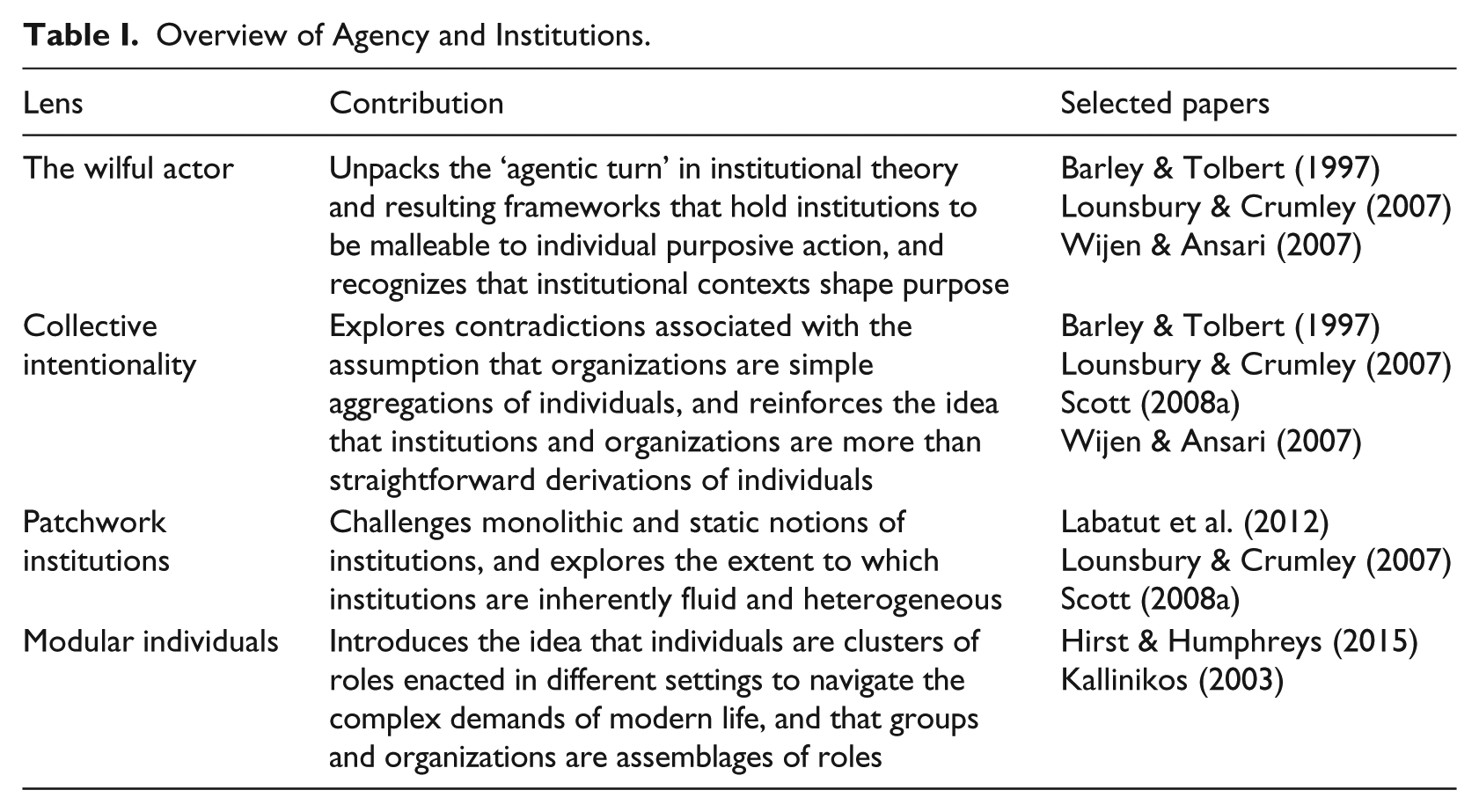
In the first lens, the wilful actor, we discuss and critique some of the implications of the agentic turn in institutional theory against the founding assumptions that understood institutions as constitutive of actors and their choices. We further analyse this delicate relationship through the second lens, collective intentionality, by considering the contradictions and puzzles intrinsic to approaches that conceptually scale individual actions to institution-level change. Through the third lens, patchwork institutions, we consider institutional fields to be inherently heterogeneous and crisscrossing, features currently glossed over by simplified assumptions of institutional inertia, stability and change. Institutional diversity and heterogeneity, we show, are critical conditions for and forces of institutional change. Our fourth lens, modular individuals, deconstructs the notion of the unitary individual and introduces the idea that individuals are themselves patchworks of social roles enacted across differentiated settings. Through the deployment of roles, persons step out from their individuality into the public realm (Sennett, 1977) and become social actors able to exercise agency through resources, rights and obligations usually tied to roles and social positions. Outside these networks, individuals qua persons are virtually (institutionally) powerless.
The Wilful Actor
The agentic turn in institutional theory has dramatically shifted the way scholars think about and study the relationship of actors and institutions. Conventional wisdom in institutional theory once held ‘that organizations, and the individuals who populate them, are suspended in a web of values, norms, rules, beliefs, and taken for-granted assumptions, that are at least partially of their own making’ (Barley & Tolbert, 1997, p. 93). Today, agency-centric trajectories consider individual actors, wittingly or unwittingly, to have an almost heroic capacity to manipulate institutions. These are very different and seemingly irreconcilable positions. Do institutional environments enable and constrain actors, or is the mode of being of actors independent of institutions, allowing them to design strategies to cope with and manage institutional effects? Below we account for this conjuncture by examining some of the key concepts and trajectories that have shaped institutional theory in recent decades.
A significant outcome of the agentic turn in institutional theory is the influential contribution of institutional entrepreneurship. The literature on institutional entrepreneurship evolved through the concerted efforts of scholars to ‘reinstate agency’ into institutional theory. The result includes the radical reformulation of the concept of agency in modern organizations in ways that heighten the agentic capabilities of actors in relation to institutions. This process continues in the more recent and growing literature on institutional work, which might be seen as an outcome of the ‘practice turn’ in management and organization studies (Whittington, 2006).
Garud et al. (2007) describe institutional entrepreneurship (quite literally) as institutional theory infused with an entrepreneurial worldview. Though they embrace the definition of agency by Emirbayer and Mische (1998), they focus on the activities of actors who purposefully leverage resources to create or transform institutions (e.g. new systems of meaning) over the cultural and network contexts within which actors are embedded. Drawing on the work of DiMaggio (1988), they argue that institutional entrepreneurship ‘reintroduces agency, interests and power into institutional analyses of organizations’ (Garud et al., 2007, p. 957). At the same time, they advance the assumption that power derives from the purposeful activities of actors in ways that are independent of institutions.
This, according to Garud et al. (2007), is how actors address the so-called ‘paradox of embedded agency’, a ‘theoretical puzzle’ that places purposeful change-seeking actors against the institutions that ‘define their interests and produce their identities’ (p. 961). Beckert (1999) presents the core problematic of this paradox for institutional theory as follows: ‘If, however, we assume that in many situations agents “make a difference”, it becomes a weakness of institutional theories if they cannot account for the role of strategic agency in processes of organizational development’ (p. 778). Hence, for proponents of institutional entrepreneurship, the question of embedded agency is a theoretical problem specific to the role of actors in institutional change. According to Battilana and D’Aunno (2009), early institutional theory could account for institutional shifts within fields (e.g. diffusion, isomorphism), but did so with the assumption that such shifts are imposed upon actors who in turn adapt accordingly; institutional entrepreneurship and work ‘resolve’ this puzzle by attributing actors with heightened agentic capabilities vis-a-vis institutions. The ability of actors to overcome the paradox of embedded agency thus has the appearances of addressing the long-running debate on agency and structure within the social sciences (see Seo & Creed, 2002).
However, the ability of actors to overcome institutional constraints remains unaddressed. From where does such ability spring, if not from the prevailing fabric of institutional relations and what it enables? Rather than engage with the agency–structure debate as a genuine theoretical problem and object of analysis, the literature on institutional entrepreneurship tends to use the paradox of embedded agency to legitimate the need for a theory of institutional entrepreneurship or to frame situations that actors purposefully seek to hurdle, usually successfully (Mutch, 2007; Weik, 2011). As a result, institutional entrepreneurship and work do more than simply conceptually heighten the agentic capabilities of actors vis-a-vis institutions; they weaken the very notion of institutions to the point where purposeful actors are institutionally disembedded. Interpreted this way, the paradox of embedded agency leaves institutional entrepreneurship studies open to the critique of ignoring ‘at least three decades worth of debates in social theory’ (Weik, 2011, p. 469). Of course, some scholars have gone to great lengths to theoretically fortify the notion of agency within institutional entrepreneurship (e.g. Dorado, 2005). However, without a serious analysis of how socio-cultural contexts and agency implicate one another, institutional entrepreneurship risks ‘smuggling elements of the rational actor model back in through the back door’ (Mutch, 2007, p. 1124). Ultimately, advancing the paradox of embedded agency as a problem easily resolved through purposive action blurs the boundaries between agency and individuals (as mentioned in the introduction of this paper). Without disengaging agency from individuals, theorists risk falling back to simplified and woefully inadequate models of organizations and society as linear derivatives of individual pursuits.
Czarniawska (2009) comments that the very concept of an ‘institutional entrepreneur’ is an oxymoron since institutions are very slow to change whereas entrepreneurs act quickly. In this way, studies of institutional work similarly risk conflating descriptions of observed practices with theories of institutional action (Weik, 2011). Moreover, though the concept of purposive action is core to the notion of the institutional entrepreneur, there is little discussion as to the complex notion of ‘purpose’ and whether or not (and how) institutional contexts and situations shape actor purposes and expectations. In this regard, Garud et al. (2007) do imply an important role for institutions when they write that ‘institutional structures do not necessarily constrain agency but, instead, may also serve as the fabric to be used for the unfolding of entrepreneurial activities’ (pp. 961–2). This is a very important observation that underscores how institutions both define and support social actors. Overall, however, the simplification of the institutional contexts in which actors are embedded and the disproportional power often granted to individual actors is so evident, authors who share the presuppositions of the agentic turn are sometimes forced to contend with their implications.
With these issues in mind, we turn to Lounsbury and Crumley (2007, p. 993) and, to a certain degree, Wijen and Ansari (2007, p. 1080), who set out to restore a more nuanced and institutional perspective on agency and social action within the institutional entrepreneurship view. Lounsbury and Crumley (2007) focus on the historical creation of institutional relations by investigating the ascent of finance from a craft practice of passive investment (mutual funds, that is investments spread over a rather diversified portfolio) to an active fund management exercise, permeated by the notion of risk and the sciences of microeconomics and statistics (modern finance). They trace the relevant developments from the very creation of mutual funds in Boston in 1912, showing how the emergence of modern finance coincides with the diffusion of scientific developments and techniques, and the concomitant repositioning of actors and their power within the field of finance and beyond.
Institutional research on practice, Lounsbury and Crumley (2007) contend, has to leave behind its predominant micro-orientation and reconnect with the broader context (cultural and institutional) in which practice fields are embedded. When linked to wider institutions, the variation in practice that results from the enactment and performativity of rules and routines at micro levels can significantly contribute to understanding innovation and institutional change. This approach expands, revises and complements the strong individualistic focus and micro-orientation of institutional entrepreneurship and institutional work.
In a different way, the paper by Wijen and Ansari (2007) raises concerns regarding the extent to which institutional entrepreneurship can explain complex collective decisions. Their paper focuses on the problem of collective action, particularly under complex conditions entailing many diverse interests and dispersed actors. Achieving collaboration under such conditions, the authors claim, may require overcoming problems of divergent interests, free riding, or indifference that may result in state of collective inaction. The unity of actors and the concentration of authority that institutional entrepreneurs are assumed to rally in their efforts to change institutions are conditions that often transcend the capacity of single actors.
The works of Lounsbury and Crumley (2007) and Wijen and Ansari (2007) attempt to reconnect the broad interest in actors, strategies and institutional change (what we might regard as organizational change in many cases) to the roots of institutional theory. 2 Yes, actors certainly do and accomplish many things. Nevertheless, the quest of institutional research has always been to analyse what propels and restrains actors, why certain strategies appear as relevant and legitimate, and how complex change unfolds over time. As the mentioned articles testify, these concerns cannot be answered by recourse to assumptions that, wittingly or unwittingly, equate individuals to social actors and posit the individual as the sole source of agency. The critique against the sanguine re-introduction of excessively agency-centric theories demands a more thorough review of the social and institutional roots of agency.
Collective Intentionality
As noted, the critique against the original contributions of institutional theory is often underpinned by a notion of agency as being an attribute of singular individuals, aggregated to collective action in groups, organizations and society. This is the very idea institutional theory once revolted against. Drawing upon a long-standing tradition of non-individualist, non-reductionist approaches in social science (from Marx, Durkheim, Mead and onwards), institutional theory conceived of agency as something to explain (see e.g. Friedland, 2009; Meyer & Jepperson, 2000). In this view, agency forms are institutionally contingent and multi-faceted, displaying provisional ties to individuals and collectives that need to be accounted for. The object of empirical investigation of these matters is the ways individuals are institutionally shaped to act along predefined, recurrent and often predictable paths.
Lounsbury and Crumley (2007) and Wijen and Ansari (2007) seek to alleviate some of the implications of actor-centric notions of agency and restore some of the promise of institutional theory’s original ideas concerning the level of analysis and role of individual actors in collective processes. They attest (by what they critique and assume) to a recurrent problem whereby agency is attributed to both individual and collective actors without explicating the social mechanisms inherent in moving from individuals to collectives and vice versa. In the absence of such mechanisms or processes, one is led to assume that institutional fields are straightforward aggregates of organizations, an organization the aggregate of individuals, and an individual the aggregate of inherent preferences and intentions. This problematic is often manifested in frameworks that assume agency is fixed at specific levels of analysis or that action can easily induce change across levels. For instance, Bitektine and Haack (2015) propose a multi-level model whereby individual-level cognitive judgements are capable of inducing organizational and field-level change.
We do not oppose treating collectives as actors, nor do we deny that individuals qua social actors may occasionally have a strong impact in their organization contexts. Yet we would do so without violating the foundational and extremely insightful position of institutional theory: organizations and institutions are not a straightforward derivation of individuals (Meyer & Rowan, 1977). If collective entities are treated as actors then the characteristics of their collective agency must be more complex than the simple accretion of individuals and their interests (King, Felin, & Whetten, 2010). Too often, collective agency is studied without appropriate concern for the origins of collective intentionality, the socialization of individuals into collectives, the diversity of agency forms, or contests within organizations and fields. Such limitations may be related to the exigencies of empirical studies, yet they are often noticeable in conceptual works that attempt to directly theorize the relation among individuals, agency and institutional change (e.g. Bitektine & Haack, 2015). This cardinal issue raises a number of important questions concerning the relationship between individuals and collectives, the collective roots of individuality, and the contribution of individuals qua actors to collective action.
Though this problematic recurs across most of the selected articles, two papers straightforwardly confront the capacity for collective agency within fields, namely Scott (2008a) and Wijen and Ansari (2007). In Scott (2008a), the professions are postulated to be institutional agents who define, interpret and apply institutional elements through clinical (problem-solving), carrier (translation) and creative (knowledge) work. All of this activity occurs against an understanding of institutions as the unintended consequences of uncoordinated action. Where the professions and their associated organizations are seen as key institutional actors, the characteristics of fields remain in the analytical background while individuals are not theorized as actors. A somewhat different approach to collective action is offered by Wijen and Ansari (2007), who look to the structures and processes that facilitate agency among actors at various levels, such as individuals, collectives, and collectives of collectives. For them, collective intentionality entails the calibration of expectations held by different actors.
The distinction between individual and collective agency highlights several issues. For instance, if collective action does not straightforwardly derive from individual interests, then the mechanisms that allow individuals to act on behalf of more inclusive entities (e.g. organizations, interest groups or professions) need to be unravelled. Awareness of the distinction between individual and collective interests, actors and organizations is an essential prerequisite to avoid essentializing (idealizing) agency and considering organizations as simple derivations of individual choices. As Lounsbury and Crumley (2007) note, the problem of reifying agency and idealizing individuality is not simply an issue of micro-orientation. Rather, such a position is often closely associated with simplified models of social interaction. This problem, which is often glossed over, is largely responsible for the idealization of individual agency, the misattribution of causality, and the erosion of one of the most interesting insights of institutional theory, namely, that agency forms are culturally constructed and historically contingent.
A way to address these perplexing issues is the recognition that individuals are involved in collective settings qua roles and positions, and not as persons. Barley and Tolbert (1997) support this idea when they suggest that scripts are empirically identifiable interactions of roles (not ‘individuals’) within a role-set in an organized setting. In doing so, they demonstrate how a relational view of agency is useful for detailed micro-level studies of organized action without relapsing to individualist notions (see also Knorr Cetina, 2001). As important as the contributions of Scott (2008a), Barley and Tolbert (1997) and several others are, to situate agency into the complexities of institutional theorizing must also take into account the idea that agency in modern societies can be heterogeneous with multiple (and sometimes contradictory) sources.
Patchwork Institutions
The complexity of the institutional ideas, forms of knowledge and practices that underpin modern society are indeed daunting creations to conceptualize. The articles by Scott (2008a) and Lounsbury and Crumley (2007) offer empirical evidence and theoretical arguments with respect to the diverse forces that populate institutional fields as well as the contradictions and power struggles underlying them. Scott (2008a), in particular, conceives of the diversity of forces prone to generate change in institutions along the exogenous–endogenous distinction. By ‘endogenous change’ Scott (2008a) implies the development of knowledge claims, practices and techniques within a profession. This also relates to the deepening division of labour and the gradual differentiation of skill profiles and occupational groups that together define the broader confines of a profession. By ‘exogenous change’ Scott (2008a) refers to societal changes that are largely independent of professions. These reflect the growing importance of organizations (distinct from professions), shifts in the nature of clients (individuals or organizations) and change in institutional logics. The endogenous–exogenous distinction is a convenient (but perhaps over-simplified) way to show that the sources of institutional change and their influence on agency forms are diverse, dynamic and crisscross one another at several junctures. Indeed, it is difficult to imagine institutions and actors as static constructions, particularly when considered over time.
The article by Labatut et al. (2012) also suggests how established practices constitute an ever-present battlefield where different occupational groups, professions and organizations engage, struggle and compete with one another. Labatut et al. (2012) seek to reinsert the study of routines (a micro component) into the wider institutional contexts in which routines are embedded. This is of interest to the study of institutions and agency because standardized ways of doing things, consequent upon the introduction of technologies in organizations or fields, impinge upon and change the ostensive nature of routines (understood broadly) and how routines are enacted in particular settings. In their paper, technology is an embodiment and carrier of wider managerial philosophies and prescriptions, and is thus predominantly understood to be an exogenous force. Labatut et al. (2012) empirically explore these ideas in the context of breeding technologies and artificial insemination of sheep in two different areas, namely, Roquefort and the Western Pyrenees, France. The introduction of artificial insemination technology may at first glance seem unproblematic, yet the difference in outcomes realized in each area is striking. The authors conclude that the creation of a new practice (and the routines it implicates) reflects a confluence of varying factors at different levels and stages. Technologies, cultural patterns, organizational arrangements and institutions mingle together to shape the emergence of new practices, but such configurations are variable and shifting. Within this field, agency as a collective form becomes a decisive force. The reception and interpretation of new technology-mediated routines (e.g. breeding practices) are critically conditioned by how farmers (collective actors) and their occupational associations uniquely understood and responded to these changes in each area.
Taken together, the articles by Labatut et al. (2012), Lounsbury and Crumley (2007) and Scott (2008a) attest to the diverse and intermingling forces that populate organizational fields. Technologies, routines, working traditions, skill profiles and competences, actors, formal arrangements, rules and social positions constitute a thick and layered patchwork that is prone to steadily produce frictions and new institutional configurations (see also Kallinikos, Hasselbladh, & Marton, 2013). This state of affairs becomes even more evident when the investigation of institutional relations is placed in a larger time purview, as the articles by Lounsbury and Crumley (2007) and Scott (2008a) testify. Of course, how to meaningfully conceptualize such diversity and study it empirically remain important challenges. The boundaries of fields are often shifting and so are the forces that constitute them. Placed in such a context, the exogenous–endogenous distinction used by Scott (2008a) and other researchers (see e.g. Fligstein & McAdam, 2012) is nothing more than a good start.
One way to circumnavigate the dangers of getting stuck in the image of local organizing as ‘boxed in an environment’, a sediment from our contingency theory past, is to more clearly distinguish between what are persistent patterns in our societies and what is more fluent, flexible and prone to change. For sure, not everything is in flux. Many traits of social action and organizations in modern society – from family, to working life, religion, civil society and government – are stable over decades, sometimes centuries, and sometimes remarkably homogenous across countries and contexts. Of course, the individual wilful actor, conceived as the smallest ingredient of society, is itself an institution that has steadily increased in potency for almost two centuries (Boli, Ramirez, & Meyer, 1985; Giddens, 1991). Apart from the institutional patterns that constitute the increasingly ideational and structural homogeneity of world society, many societal domains display a much more variegated, contested and inherently multi-faceted pattern (Fligstein & McAdam, 2012). More delimited institutional regimes exist in the sense that we can empirically discern stable patterns of ideals, knowledge systems and techniques for longer or shorter periods. In cases where institutions undergo dramatic or sudden change, institutional fields may transform in shorter periods and affect agency forms and organizing across levels of analysis (e.g. humanitarian response, Abdelnour & Saeed, 2014).
The relevance of these observations for this Perspectives issue is that institutional diversity and the dynamic character of fields admit a variety of agency forms and support a varied capacity for acting. Seen in this light, the paradox of embedded agency is a cerebral fabrication, disconnected from the dynamic and patchwork nature of institutions and fields. Individual actors are seldom embedded within one single field but assume roles that usually expose them to more than one field. Their boundaries and self-referential forces notwithstanding (Bourdieu, 1993), fields are not cocoons but open social spaces in which actors and organizations vie for status and resources under conditions that epitomize a variable geometry of links or relations. Critically, institutions are fashioned to accommodate adaptation and change. Social actors learn and institutional principles evolve in response to field-level outcomes as well as wider cultural and economic changes. The ability of institutions to reflect upon themselves and question their doing is constitutive of modernity as a social order (Giddens, 1990, 1991). Hence, the argument that actors are embedded in institutional realities they supposedly are unable to question should be qualified. ‘Boxing’ actors and fields in this way tends to simplify institutional diversity, omit institutional history and ignore future possibilities (Emirbayer & Mische, 1998). Ultimately, this implies a rigid relation between actors and place, which is of limited analytic value for the study of institutions, agency forms and practices.
As we emphasize and show through the selected articles, rarely are institutional fields a static equilibrium; rather, they entail differences, drifts and contradictions that are often the antecedents of institutional change. The reproduction of institutions and social life is always partial and unfinished. What at first glance appears a settled set of forces is most often a provisional accomplishment. The seeds of change are thus contained in the diversity of organizations and organizational fields and the links they maintain with other organizations and fields. Our point is that institutional fields are inherently dynamic and the practices and organizations that populate and constitute them are far from settled or unitary. The seemingly uniform institutional forces constituting an organizational field, predicated on shared ideals and mandatory techniques, are often underlain by incompatible goals, diverse skills and competences, as well as different traditions with unique role structures, positions, agency forms or cultures. This suggests a need to reconsider the very definition of institutions in a way that lends itself to the study of agency forms in the context of institutional diversity and fragmentation.
Modular Individuals
No study of agency and institutions is ever complete without confronting the ways individuals qua persons are made social actors. Our final theme draws on the selected articles and related work to address this issue by advancing the notion of modular individuals as a key element for the study of agency in institutional theory.
We begin by noting that recent trajectories in institutional theory rarely offer a clear distinction between actors and individuals. The conflation of actors and individuals is reinforced by self-evident phenomenological observations of biological individuality (Abbott, 2001) and our personal experiences of being distinct and separate from others. The same holds largely true for the context or social entities to which individuals are embedded. We tend to experience our individuality and the collectives to which we belong as bounded, inclusive and complete. In turn, we extend this experience into taken-for-granted analytic categories and units (i.e. self, group, organization, state). Yet, as we have sought to demonstrate through the selected articles and lenses through which to analyse them, individuals and institutions are far more diverse and complex than these assumptions and categories warrant. This is particularly apparent when considering that individuals and organizations may express multiple forms of agency that overlap, conflict and change over time.
Acknowledging these conditions leads us to analytically separate actors from individuals. This is a step of critical analytical importance that lays the ground for understanding how individuals are made social actors in the context of institutions. Our point of departure is the idea of individuals as modular: an assemblage of roles, social skills and capacities held loosely together by perceptions of consistency and human experience. Conceiving individuals as modular enables the social (rather than cultural-cognitive or psychological) deconstruction of individuals. It also enables us to trace the variable and contingent links that individuals maintain with groups and organizations. Individuals can, quite obviously, be members of more than one group or collective at the same time, a condition that clearly indicates that they join groups and organizations not as the existential units we call persons or selves, but as distinct action modules we refer to as roles. It is through the enactment of roles that individuals step out to the public realm and become social actors (Sennett, 1977).
Roles are socially engineered templates of action. According to Kallinikos (2003), roles are structural devices that link individuals and organizations in variable and revocable terms. Roles enable individuals to address the contingent and varying demands of a complex and multidimensional daily life. Individuals engage multiple roles simultaneously, which enable individuals to invoke roles as they see fit while moving between different life situations and frames of reference. Similarly, organizations are collective entities by virtue of different roles, linked together via formal status orders (usually in the form of hierarchy) whereby different roles are assigned different rights and obligations. In this view, organizations are not accretions of individuals or groups but assemblages of roles (Kallinikos, 2003). Role structures are the fundamental means by which groups and organizations decouple collective intentionality from individuals and acquire collective status. According to Weick (1993), groups are ‘an organization by virtue of a role structure of interlocking routines’ with a ‘generic subjectivity’ (collective identity or intentionality) ‘that enable individuals to be interchanged with little disruption to the ongoing pattern of interaction’ (p. 633). Roles are thus functional scripts for the accomplishment of tasks (e.g. job specifications) and social devices for ordering relationships. Hence, the prospect of roles for institutional theory requires studying the conditions that establish roles and social positions in organizations and fields rather than the biographies of powerful individuals.
The concept of roles thus decouples institutions from individuals and allows the study of social actors as distinct from persons. Roles and the modular constitution of individuals do not contradict the idea of persons as placeholders of experience and expectations (Bourdieu’s concept of habitus). Rather, modularity presupposes a loose framework, perhaps an identity, within which various role modules stay together. Role modularity thus serves as an analytical device for studying behavioural scripts, context adaptability and power struggles, without reverting to an essentialist understanding of individuals as irreducible or the ultimate source of change (Bourdieu, 1977; Gellner, 1983, 1994; Heller, 1999). The articles of Hirst and Humphreys (2015) as well as Kallinikos (2003) suggest that modular individuals are themselves carriers of variety. This occurs through shifting occupational identities and roles, which enable individuals to enter and exit the boundaries of organizations and fields. Stated alternatively, modular capacities and individual orientations (such as habit, training and socialization) connect individuals to different institutions and fields of practice.
Hirst and Humphreys (2015) directly address the question of agency and social change through the concept of role modularity. Building on the work of Gellner (1994) and Kallinikos (2003), they argue that the rise of a modern rationalized substitutable modular person fundamentally alters how social and institutional change occurs. Role modularity, in the sense discussed by Hirst and Humphreys (2015), is characterized by the way actors connect to different locations and contexts. Actors express forms of agency according to the contextual particularities of their public, private and working lives. Kallinikos (2003) suggests the slightly varied position that while individuals may express different roles across institutional domains (as family member, employee, believer, or citizen), these roles and their attributes need not arise primarily through situated social interaction but are rather institutionally derived. Put differently, the involvement of an individual to a setting is ‘non-inclusive’; a setting rarely (if ever) exhausts the roles that an individual may assume in social life.
An immediate consequence of modularity is the potential for a high degree of role flexibility independent of a person’s attitudes, emotions, behaviours and technical skills (see e.g. Hirschman, 1977). Role flexibility enables people to adapt and reassemble their existing role requirements and skills and, as a result, how they undertake tasks and connect with a certain social order. This flexibility allows actors to think and act across separate domains and to exchange one type of action with another without affecting who they are (their personality, identity or social being). Hence, today Galileo could be both believer and scientist. Both Kallinikos (2003) and Hirst and Humphreys (2015) suggest that the prerequisites of change are amplified by the ever-present, unobtrusive modularity of instrumental action and work-related roles, and partially detached from the wills and whims of individuals. Individuals are thus susceptible to change through the modular nature of their work (which is institutionally embedded) without involving the deeper layers of their personality.
As an analytic tool, role modularity captures important dimensions of the basic preconditions of exercising agency in working life. Consequently, it also offers a less individual-centric perspective on institutional change. Modular, flexible agency forms offer a way to analyse the interface between individuals and collectives and their work by unpacking (supposedly monolithic) individuals into analysable components of prescribed behaviours, practices and competencies that are essential building blocks of institutions. These can be studied as ‘modules’ of various ontologies, from interfaces with technical systems to role attributes, appropriated and enacted by people in a detached, non-inclusive, professional way. The analysis of institutional change is also possible through the lens of roles and the social positions with which roles are associated. Indeed, some of the papers included in this Perspectives issue (e.g. Labatut et al., 2012; Lounsbury & Crumley, 2007) can be reread and reinterpreted by considering how the shifts in roles, clusters of roles and positions recreate the fabric of the social practices they investigate.
Concluding Remarks
The elevation of individuals qua purposive actors at the centre stage of institutional theory simplifies the institutional fabric of organizations, fields and the social processes of institutional reproduction and change. This realization led us to pose a number of significant questions that we set out to explore. In this Perspectives issue, we drew upon a select group of important and often highly cited articles from Organization Studies that expand our understanding of actors, agency and institutions. Our journey took us through various definitions of agency and institutions and the use of four overarching lenses to analyse the relationship of actors and institutions: the wilful actor, collective intentionality, patchwork institutions and modular individuals. We hope these lenses encourage discussions on agency and institutions that reflect on the collective roots of individuality and action in ways that appreciate the original contributions of institutional theory, which held agency to be socially and historically contingent.
A fundamental idea that runs throughout our text is that individuals and institutions do not straightforwardly mirror one another. Institutions are better seen as rationalized patterns, general principles and cultural schemes variously manifested across social settings. Social entities such as organizations are not made of individuals but of action scripts and roles held together by institutions and institutional principles tied to work, property rights, employment forms, performance measurement and rewards, etc. An analogous argument can be made with respect to institutional fields. In no way can organizations or fields be fruitfully understood as straightforward derivatives of individuals and their actions. To do so unduly simplifies the fabric of social life and the ways it is spun by institutions. Further, such a position ignores decades of analytic and empirical work on institutions.
Correspondingly, individuals as persons are rarely social actors. Individuals participate in social life as actors by assuming roles and the positions to which roles are usually tied. Agency is thus a capacity of social actors tied to the resources, rights and obligations of roles and social positions. Actors enter the social ‘stage’ and exercise agency, not individuals. In the section ‘modular individuals’ we have gone at some length to analyse these conditions, which we recognize as emblematic of modern society and organizations. The enactment of roles and the social positions to which they are tied provide enough space for reflexivity (Bourdieu, 1993) without simplifying institutional processes to a reductive social ontology characteristic of methodological individualism. These ideas, we contend, contribute to thinking of institutions as principles that embody their own questioning via the reflexivity of actors and the changing nature of roles and positions. In Giddens’ much acclaimed works, institutions are reflexive and constantly evolving principles (Giddens, 1990, 1991). Organizing principles such as liberal democracy, the capitalist economy and the nuclear family are ever-evolving objects of debate, collective intervention and change across the modern world.
Taken together, the four lenses we use to analyse agency and institutions suggest that institutions are moving orders: they are inherently fluid and heterogeneous with available and potentially competing ideals, knowledge systems and techniques of control. Even though stability often prevails for a time, other modes of legitimizing, conceptualizing and organizing are always at hand. Individuals, contrary to what is often argued, are quite flexible in their manner of adopting and dealing with the fluidity of organizations and fields. Similarly, institutional fields and society at large offer a constant reservoir of alternatives and possibilities. Such changes seldom break with the overarching patterns of modern society, as conceived in the original and agenda-setting works of institutional theory, but rather draw upon and elaborate their generalized systems of meaning and action (Castoriadis, 1987; Emirbayer & Mische 1998; Giddens, 1990, 1991).
The original and, in a sense, standard version of institutionalism is a strong brew that must be drunk with afterthought and some caution. Indeed, some ‘rationalized patterns’ are pervasive across the modern world: the notion of the wilful human agent, generalized rights and capacities ascribed to that same individual, the modern state, and forms of organizing such as market and hierarchy. Even so, these increasingly dominant patterns of world society do not imply that individuals are ‘cultural dopes’ caught in a solidified web of ideas and valorized patterns of action beyond their capacity to reflect. In fact, the more universal and general an ideal is, the more elaborate the work required for its local appropriation and re-contextualization (Kallinikos, 2006). Work of this sort, we have been at pains to show, is doubly institutional: in the sense of renewing/maintaining institutions and, critically, in the sense of relying on the established socially available role structures, agency forms and cultural understandings that engender institutional renewal or maintenance.
Footnotes
Funding
This research received no specific grant from any funding agency in the public, commercial, or not-for-profit sectors.