



Abstract
Experimentation is key in wicked situations; it provides small wins while keeping several options open for the future. The literature is, however, scarce on how experimentation is framed, a crucial aspect to the understanding of how actors identify and pursue experiments in situations that are constantly changing and lack a clear resolution. We address this gap by drawing on the concept of ‘action frames’ and deploying a comparative case study of nine cases in diverse contexts in which activists experimented with wicked problems. We find that activists pragmatically shy away from pursuing a permanent solution to focus instead on achieving small wins, diagnosing ‘symptoms’ rather than ‘root causes’ of problems, and ‘working around’ institutional constraints instead of directly ‘confronting’ them. This pragmatic action frame prompts them to initiate pilot experiments that involve trial-and-error and collective learning, and that sometimes scaffold into cumulative small wins. Reflecting on our findings, we build a model of how pragmatic action frames fuel distributed possibilities to experiment in wicked situations. Our model contributes to the literature on wicked problems by revealing how activists ‘welcome’ complexity instead of ‘taming’ it. We contribute to the literature on action frames by demonstrating how multiple viable pragmatic action frames are constructed iteratively without threatening an alternative, dominant frame. Lastly, we contribute to the literature on robust action by demonstrating how pragmatic action frames pave the way for distributed experimentation and by unpacking the core attributes that make ‘robust actors’ accepting of open-ended wayfinding journeys.
Introduction
Wicked problems are fast-evolving and have no clear end-point in sight; they involve plural policy challenges and are situated in complex and distributed institutional contexts (Dorado & Ventresca, 2013). In these situations, experimentation is crucial to what has been labelled ‘robust action’ – immediate action that accomplishes short-term objectives while preserving flexibility to adapt to evolving situations (Eccles, Nohria, & Berkley, 1992). Through experimentation, actors can cumulatively address different aspects of a wicked problem (Ferraro, Etzion, & Gehman, 2015), aiming for ‘small wins’ instead of long-lasting institutional changes (Weick, 1984). While researchers have described the importance of experimentation for robust action (e.g. Ferraro et al., 2015), they underspecify how actors comprehend the conditions and possibilities to initiate heterogeneous experiments in wicked situations.
The concept of ‘action frame’, borrowed from the social movements literature, can help explain experimentation in wicked situations. Framing drives attention to what is ‘in need of change’, ‘make[s] attributions regarding who or what is to blame, articulate[s] an alternative set of arrangements, and urge[s] others to act in concert to affect change’ (Benford & Snow, 2000, p. 615). The current literature looking at framing in the context of wicked problems focuses primarily on central actors, such as governments or large organizations aiming for broader and more ambitious institutional goals (Nyberg, Wright, & Kirk, 2020). We turn, instead, to marginal, more agile actors: activists in smaller, scrappy organizations (Savaget, 2023). These actors are notably experimental and their approach to framing action opportunities is quick and iterative, as they get pushed by a sense of urgency, scarce financial resources and practicality (Berrone, Gelabert, Massa-Saluzzo, & Rousseau, 2016). We ask: how do activists construct action frames for experimentation in wicked situations?
To answer our research question, we chose cases of different social issues and in various geographical settings, where activists navigated through and across complex contexts (DeJordy, Scully, Ventresca, & Creed, 2020) aiming to obtain small wins through experiments. We compared nine cases where activists addressed the following wicked problems: (a) anti-choice abortion laws worldwide; (b) lack of access to paediatric diarrhoea treatment in Zambia; (c) irregular public expenses in Brazil; (d) challenges for cash-based transfers for humanitarian aid in Nepal; (e) caste discrimination in India; (f) lack of access to water and energy in rural Pakistan; (g) child marriage in India; (h) lack of access to healthcare products in the world; and (i) eviction of settlers in India. We find that, motivated by ‘small wins’ rather than seeking a ‘permanent fix’, activists diagnose ‘symptoms’ of complex problems (instead of ‘root causes’) and prognose workarounds (rather than direct ‘confrontation’) of institutional constraints. We call this a ‘pragmatic action frame’ and show how this frame prompts the initiation of pilot experiments, which open opportunities for trial-and-error and collective learning, thereby paving the way for scaffolding into further experimentation that might lead to cumulative small wins.
Reflecting on our findings, we build a process model of how pragmatic action frames lead to distributed experimentation, i.e. multiple viable ways activists can frame experiments, and then initiate, build on (with the same frame) and branch out from them (with an alternative frame). Our model contributes to the literature on wicked problems, action frames and robust action. To the literature on wicked problems, our work shows that instead of ‘taming’ complexity in wicked situations (Ney & Verweij, 2015; Reinecke & Ansari, 2016), activists ‘welcome’ complexity to match that of their environment. To the literature on action frames, we first contribute by demonstrating how pragmatic action frames can lead to multiple, coexisting frames (Benford & Snow, 2000; Cornelissen & Werner, 2014; Reinecke & Ansari, 2021), and second, by revealing how a pragmatic action frame can be constructed without necessarily threatening an alternative, dominant frame (Kaplan, 2008; Vedres, 2022). To the literature on robust action, we first contribute by explaining how pragmatic action frames open prospects for distributed experimentation through cycles of collective learning and scaffolding (Gehman, Etzion, & Ferraro, 2022; Mair, Wolf, & Seelos, 2016), and second, by revealing the attributes that make ‘robust actors’ accepting of open-ended wayfinding journeys (Bouty, Gomez, & Chia, 2019).
A Framing Perspective on Robust Action in Wicked Situations
Revisiting the assumptions of wicked problems research
Management scholars have a keen interest in organizational responses to large-scale socio-environmental problems (George, Howard-Grenville, Joshi, & Tihanyi, 2016). Much of this work emerged from the premise that addressing grand challenges requires structural change aiming for permanent institutional fixes, which often involve long time frames, vast resources, and the coordination of actors with shared agendas (Gümüsay, Claus, & Amis, 2020). However, in wicked situations, change-making efforts do not necessarily start from an attempt to drive durable change. Because there are many different stakeholders involved and diverse understandings of what is an acceptable solution, the practicalities of addressing wicked problems are hard to grasp (Reinecke & Ansari, 2016). One cannot objectively specify where a problem starts or ends, and the parameters used to interpret these problems change over time too (Ney & Verweij, 2015).
To investigate how wicked situations are addressed through incremental steps rather than radical changes, we build on Weick’s (1984) concept of ‘small wins’. The author demonstrates that wicked problems often preclude innovative action because they activate dysfunctional levels of arousal, frustration and helplessness. For example, in planning to address hunger, one will notice the need to produce ‘more food, which requires greater use of energy for farm equipment, fertilizers, and transportation, adding to the price of energy, which raises the cost of food, putting it out of the price range of the needy’ (p. 40). While permanent fixes require appraising and addressing the multiple facets of a complex problem, a ‘small win’ reduces the stakes. Small steps can be made quickly and incrementally; they ‘do not rock the boat, do not stir up the great antagonisms and paralyzing schisms, as do proposals for more drastic change’ (Lindblom, 1979, p. 520).
Small wins can then be used as entry points that may as well look ‘clumsy’ in institutional terms at first (Ney & Verweij, 2015), but can initiate transformative change (Reay, Golden-Biddle, & Germann, 2006). This is because small wins expand the realm of opportunities that are both observed and pursued, and disparate solutions may eventually become scaffolds for higher-order institutional change (Casasnovas & Ferraro, 2022; Mair et al., 2016). These ‘scaffolds point to a collective but distributed learning process’ (Gehman et al., 2022, p. 270). As actors address different facets of a problem, they see more nuances in the contexts in which they find themselves and adapt solutions to these dynamic environments, thus setting in motion repeated cycles of learning, which, as detailed in the following section, are critical for robust action.
Experimentation in the context of robust action
To examine how small wins help actors address a wicked problem, we build on the ‘robust action’. The concept foregrounds political-cognitive models of action that provide more useful guidance in wicked situations than rationality and efficiency models (Gehman et al., 2022). It acknowledges ‘a situated, distributed, and processual approach to problem-solving’ (Ferraro et al., 2015, p. 2), emphasizing noncommittal approaches for short-term gains that keep a multiplicity of paths open for the long term (Padgett & Ansell, 1993).
Key to robust action is the actors’ ‘creativity and their willingness to experiment’ as it shapes ‘the complex environments they face’ (Farjoun, Ansell, & Boin, 2015, p. 2). Robust action relies on experimentation to dynamically address problems in situations that involve multiple stakeholders with conflicting perspectives and goals (Ferraro et al., 2015). Consistent with its pragmatic roots (Dewey, 1938; Gross, 2009), experimentation assesses the situation in its complexity and gives primacy to plural meanings and agendas (Eccles et al., 1992). Experimentation focuses on the ‘practical adequacy’ (Dewey, 1938) of situated actions that create ‘emancipatory moments’ (Johnson & Duberley, 2000) to reframe wicked problems into actionable specifics. These experiments recursively change what is seen as viable and desirable (Eccles et al., 1992), in processes that lack clarity between means and ends (Etzion, Gehman, Ferraro, & Avidan, 2017) and between actions and meanings (Weick, 1979).
While initial robust action models have theorized that ‘bringing together diverse actors, allowing for plural understandings, and fostering collective experimentation and learning could catalyze progress in tackling grand challenges’ (Gehman et al., 2022, p. 170), they underspecify the dynamics between experimentation, scaffolding and collective learning. This issue is partly because robust action literature focuses on why experimentation helps accomplish short-term objectives while preserving flexibility to adapt to evolving situations (e.g. Etzion et al., 2017), rather than how it is framed. Framing is crucial to experimentation processes, as it acts as a ‘schemata of interpretation’ (Goffman, 1974) for the complex, uncertain and evaluative (Ferraro et al., 2015) challenges activists face. In the following section, we highlight how frames can help us understand how actors experiment in wicked situations.
Frames of experimentation
The framing literature builds on long traditions of studying how individuals, groups and societies perceive, organize and communicate desirable and viable action steps, and how these turn into frames that channel attention, efforts and resources (Goffman, 1974). Framing plays an interpretative function in simplifying a complex environment (Nyberg et al., 2020); it consists of the construction of meaning that mobilizes and guides how individuals and groups perceive and respond to a situation (Cornelissen & Werner, 2014).
A framing lens has the power to reveal how actors make sense of the conditions and possibilities for experimentation in wicked situations. ‘Frames’ allow people to process, organize and interpret information, therefore shaping how one forms conjectures as to what occurred, makes predictions as to what is likely to happen, and identifies desirable, appropriate and viable repertoires of action in every situation (Goffman, 1974). Frames are also socially situated and malleable, and therefore, meaning can be constructed, negotiated and aligned in multiple ways (Cornelissen & Werner, 2014).
The concept of ‘action frames’ (Benford & Snow, 2000), from the study of social movements, is particularly helpful in revealing how actors are organized around a frame as they experiment in a wicked situation. Action frames incorporate a diagnosis of the problem, a prognosis of actions and impacts, and a motivation for taking on the challenge (Snow & Benford, 1988). A diagnostic framing focuses on identifying the causes of a problem or situation. It involves analysing the situation and trying to understand the sources of the problem. In wicked situations, it refers to how a problem – or rather a complex web of interlocked conditions – is defined and communicates causation: What is the problem, why is it a problem, why does it remain a problem, and who’s (or what’s) to blame? Prognostic framing identifies the potential outcomes of different actions or strategies. It connects the problem with a solution, laying out ways forward and the rationale for action – therefore, narrowing down multiple viable pathways to address a wicked problem into a subset of actions to pursue. Motivational framing is a ‘call to arms’ and is the agency component of action frames (Benford & Snow, 2000). It can help individuals and groups to develop a sense of purpose and direction in wicked situations, which involve plural multiple meanings and agendas (Eccles et al., 1992).
Scholars have utilized action frames to investigate how actors approach complex problems (Nyberg et al., 2020). However, literature is scant on how experimentation opportunities come to be framed. This framing is an important lever of robust action and is our focus. To understand this process, scholars must examine the ‘neglected situations’ (Goffman, 1964, p. 134). Studies on action frames often focus on central and well-resourced actors, or big groups mobilized through social movements, overlooking the experimental ‘wayfinding‘ (Bouty et al., 2019; Chia & Holt, 2009) efforts of those at the margins (Dorado & Ventresca, 2013). Recognizing that framing by peripheral actors can be (a) different and (b) more experimental than framing by central actors, we seek cases of the former, as described in the next section.
Research Methods
In this study, we explore how activists construct action frames for experimentation in wicked situations. Our theory-building, qualitative approach, is based on a comparative case study approach as per Granqvist and Ritvala (2016). In this section, we describe our data selection, collection and analysis.
Selection of the cases
This study has adopted an information-oriented, maximum variation case selection strategy (Curtis, Gesler, Smith, & Washburn, 2000). We started from the assumption that multiple cases yield a more robust and parsimonious theory than studies based on single cases (Eisenhardt & Graebner, 2007) since they can be systematically contrasted to identify consistent patterns and themes. We chose cases that addressed different social issues and geographical settings. To ensure comparability, we held three factors constant (Granqvist & Ritvala, 2016) in our search for cases: (a) they were reported as experimental and unconventional, different from typical ways that large organizations or governments address problems; (b) conducted by activists individually or through small non-profits or informal groups; (c) activists report that the problems they addressed were inherently complex.
We only selected cases where experimentation had already occurred and whose activists could inform us on how they identified these opportunities – i.e. recount the ‘emancipatory moments’ (Johnson & Duberley, 2000) in the inception of their experiments. We recognize some scholars may consider these accounts flawed due to ‘hindsight bias’ (Bukszar & Connolly, 1988). However, we start from the epistemological assumption that meaning making happens recursively through actions and post-action reflections: as Weick (1979) suggests (p. 5), ‘How can I know what I think until I see what I say?’ Examining how actors reflect on what their actions meant and how they made them feel, we answer calls for an interactive understanding of how meaning is co-constructed (Cornelissen & Werner, 2014), with a focus on action frame emergence rather than deployment (Reinecke & Ansari, 2021). We use our cases as a sensemaking resource – not to specify the ‘correct’ way to intervene, but rather to make a first step in understanding how activists report on their experiences with distributed experimentation.
We also intentionally chose cases where activists navigated through and across various complex contexts (DeJordy et al., 2020) aiming to obtain small wins (Weick, 1984) through experiments. These cases were described by our interviewees themselves as anomalous or unconventional and were chosen precisely because they were ‘extreme cases’ (Eisenhardt & Graebner, 2007) of practical action in wicked situations. With heterogeneity, we wanted to identify patterns in how action frames were constructed in ways that prompted activists to experiment to address problems that seem unsolvable but could be ‘moved around’ even by activists with limited resources.
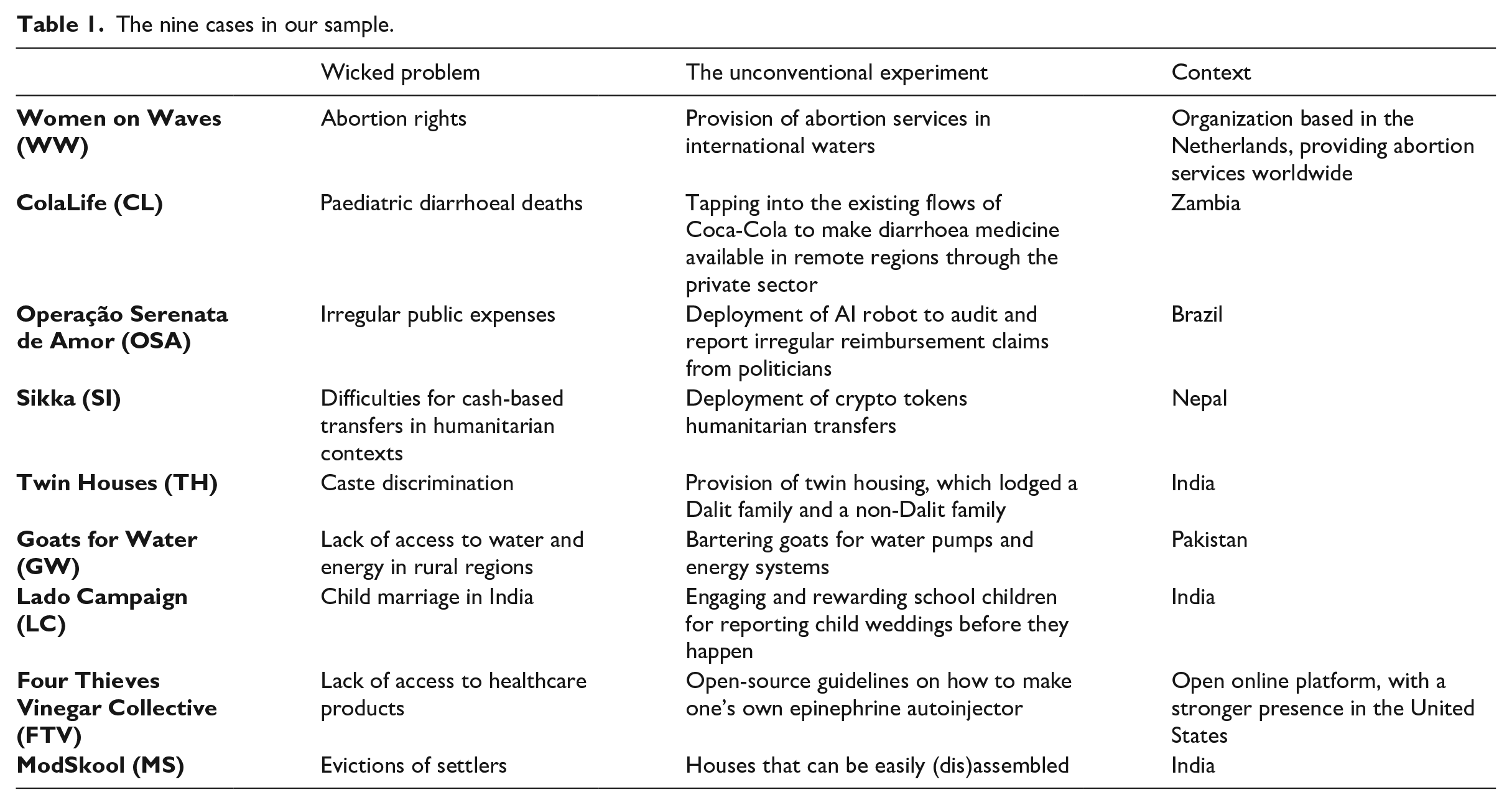
We identified the cases through a recursive and exploratory process informed by our literature review (Klein, Dansereau, & Hall, 1994). We searched online media, such as CNN, BBC and Vice, for articles that described unconventional and experimental attempts at addressing social problems; searched platforms of social entrepreneurs to identify approaches that seemed experimental and were described as unconventional; and approached academics and social entrepreneurs asking for suggestions of individuals or organizations that had experimented with complex social problems creatively. We stopped approaching new cases when patterns in how activists identified opportunities became visible. Table 1 offers a primer on our cases, with a brief description of each and an acronym for each that we use in the remainder of the article.
The nine cases in our sample.
Data collection
Instead of following a single template for data collection, we considered a flexible approach important to our study (Pratt, Sonenshein, & Feldman, 2022), as we investigated cases of activists who experimented with wicked problems in small-scale, resourceful and fragmented ways. This means that in all cases in our sample, the activists we interviewed were directly involved in framing the experimentation opportunity. We were interested in the framing, not the execution or the perceived impact by beneficiaries. This reduces the realm of interviews we could conduct for each case or the availability of archival materials we could use for each of them.
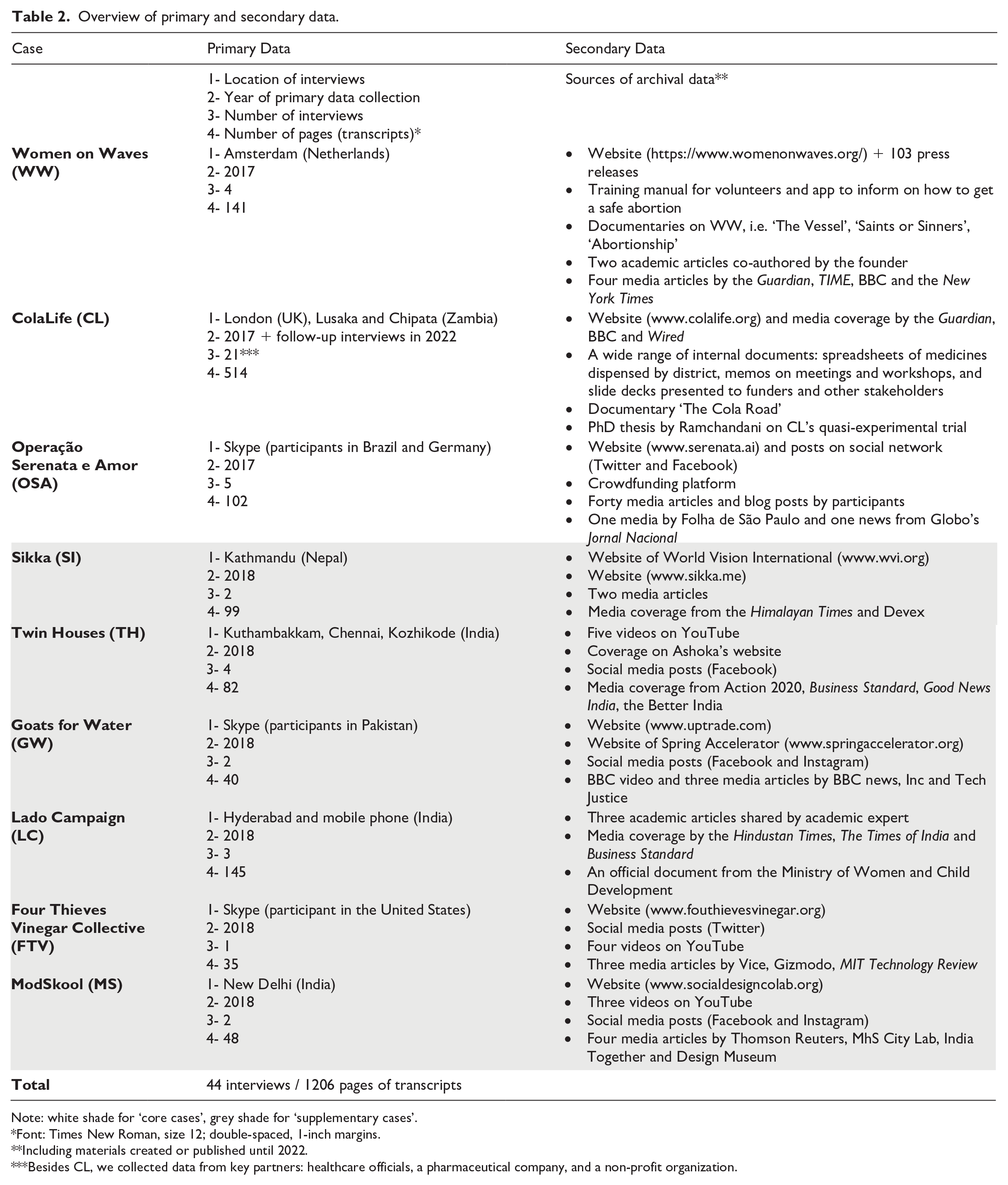
We started from the assumption that for data collection of small-scale fragmented cases, data collection had to consist of an assemblage of fragmented data. To build our comparative case study analysis, we compiled primary and secondary data, summarized in Table 2. The primary data of this study came from semi-structured interviews conducted by the first author, with informants who were directly involved with the cases and, for some, with relevant stakeholders. In total, the first author conducted 44 interviews between January 2017 and July 2022. Most interviews were conducted through two rounds of fieldwork, the first in 2017 with three cases (WW, CL, OSA) and the second in 2018 with the other six cases. All interviews were manually transcribed, except for a follow-up interview in 2022 for CL that we transcribed with Otter.ti, leading to a dataset of approximately 1206 pages for qualitative analysis.
Overview of primary and secondary data.
Note: white shade for ‘core cases’, grey shade for ‘supplementary cases’.
Font: Times New Roman, size 12; double-spaced, 1-inch margins.
Including materials created or published until 2022.
Besides CL, we collected data from key partners: healthcare officials, a pharmaceutical company, and a non-profit organization.
We treated as a ‘case’ the primary agency involved in the experimentation on a particular policy challenge. For WW, OSA, SI and GW, we interviewed founders and key staff – the activists directly involved in framing the experiment. For TH and LC, we interviewed the community leaders and civil servants who conceived the experiment. We supplemented primary interviews with academics who had expertise on the wicked problem (respectively, caste prejudice in India and gender inequality, as the authors of this article are not Indian and identify as cismen). Since FTV and MS were composed exclusively of volunteers, we interviewed the ones who conceived the experiment and led the respective groups. CL counts with vaster data: besides interviewing founders and key staff, we also interviewed key stakeholders. This discrepancy in data collection reflects the different characteristics of the experiments in our study: the experiment by CL revolves around articulating several stakeholders responsible for the flow of diarrhoea treatment (ranging from pharmaceutical industries to local retailers), who were consulted as the organization framed its experimentation opportunity. CL, differently from the other cases, strongly emphasized consultation of local stakeholders in a collective framing process. We, therefore, intentionally collected substantially more data from this case than the others that had been framed more autonomously by our interviewees.
We used a protocol of semi-structured questions that focused on unpacking how activists conceived the opportunity for acting. The protocol includes queries on how they look at their problems; how they attempt to address problems; how they recognize opportunities to act; their organizational and personal goals, ambitions and expectations; and with whom they engage as they conceive opportunities to act. We also developed questions related to each case (on context-specific characteristics and contingencies). The first author also kept the interview protocols flexible enough to accommodate and explore issues that had not been anticipated.
For seven cases, interviews were conducted in person, including visits to India, Nepal, the Netherlands, the UK and Zambia. Interviews for OSA, FTV and GW were done online – for OSA and FTV because the informants were scattered across different countries and only worked and interacted remotely, and for GW because the first author could not obtain a visa for Pakistan. Interviews were done in English for all cases, except for OSA, which was conducted in Portuguese. Because some initiatives were small-scale and often framed by a single or a few individuals (e.g. MS, GW, TH, FTV), we could not get many informants per case. Data collection for WW, CL and OSA ended when key informants (all the individuals actively involved in the initiatives) who agreed to participate in the study had been interviewed (Strauss & Corbin, 1998).
The interviewees across the cases, including agency officials responding for their respective organizations, granted the researcher the right to access and use primary and secondary data, including proprietary data entries (e.g. spreadsheets, internal memos, conversations within internal communication channels). Most informants waived confidentiality. However, for consistency and following accepted practice in qualitative research, the subsequent analysis of this article refers to each informant with an assigned number to preserve their anonymity. More specifically, interviewees are quoted exclusively through acronyms (e.g. WW1. . .WW4; CL1. . .CL28; etc.), with a randomly assigned number to the acronym for each interviewee.
We integrated data from extensive public archival documentation (such as websites, reports, videos, promotional documents, publicly facing media) to complement and triangulate core insights obtained from interviews; to identify possible untold tensions and controversies; obtain complementary information that could lead to follow-up interviews; help to establish a timeline of events; and understand how the activists publicly portrayed themselves. Table 2 also highlights the sources of archival documentation for each case.
Data analysis
The data analysis started with the verbatim transcription of all interviews, followed by building a dataset that combines interviews with noted observations and archival records for the sample cases. The interview transcriptions, combined with our notes from secondary data, informed further rounds of data collection. We relied primarily on interview data. We have not transcribed videos, and we have not compiled and systematically coded the archival data; we reviewed these materials to fill gaps in our understanding as we processed interview data.
Figure 1 demonstrates how we analysed our data. We started analysing data from the first three cases from our first round of fieldwork: CL, WW and OSA. These were treated as the primary cases for analysis – the ones with which we engaged most extensively. As demonstrated in Figure 1, data from these cases were analysed following the theoretical apparatus of ‘action frames’, transposed from the work on the sociology of social movements (Benford & Snow, 2000). We used three macro-categories from this literature – i.e. motivational, diagnostic and prognostic – to guide our data analysis. We also added a fourth category, ‘outcomes’, which describes what resulted from the action frames.
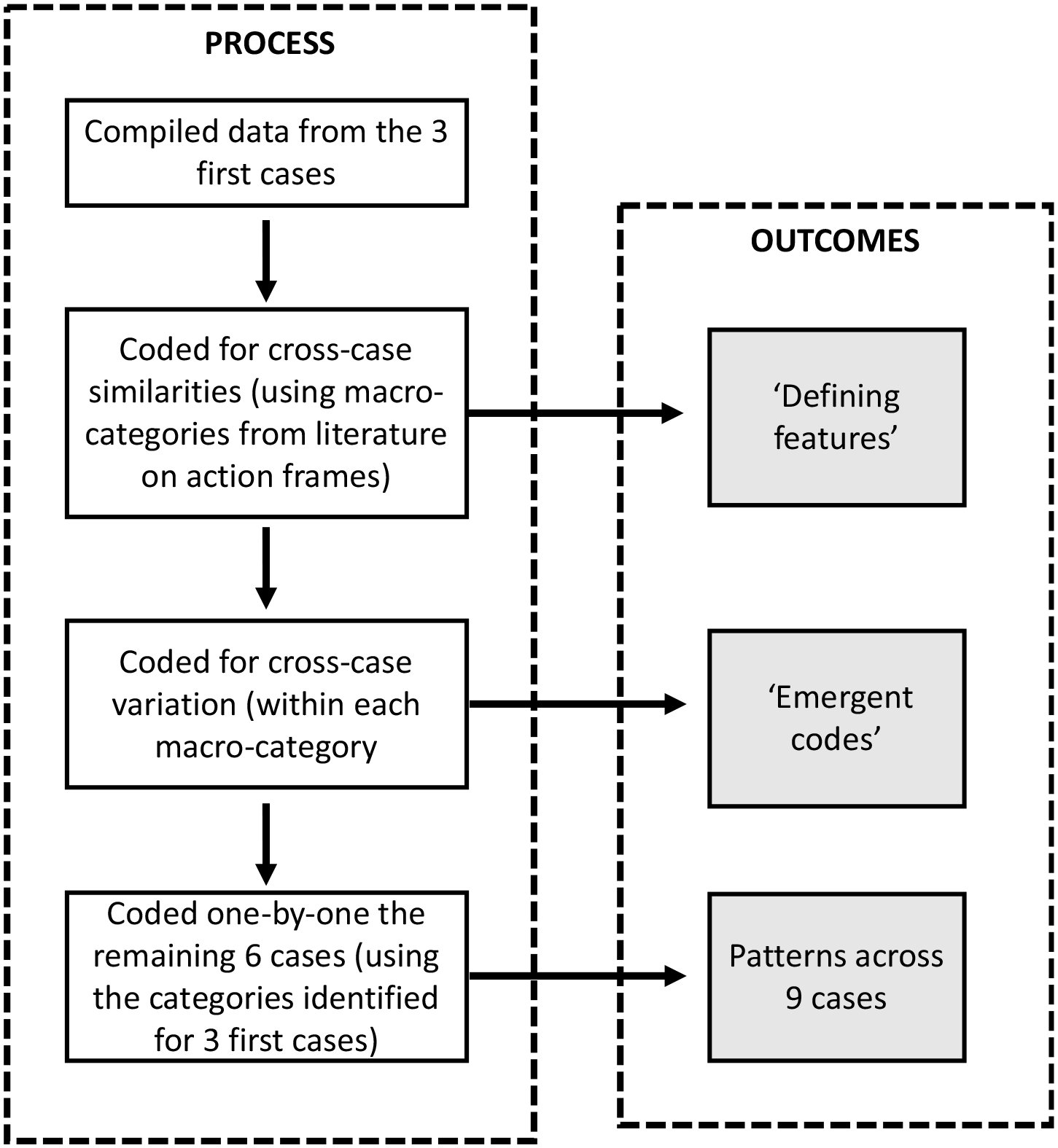
Overview of data analysis.
Guided by this strong theoretical apparatus, we started identifying patterns of similarities and variance across cases within each of our theory-driven macro-categories, coding raw data from our interviews with the assistance of the software NVivo 10. We were also attentive to how actors justified the ways they framed their approach in that situation and to the timing and the different ‘moments’ participants had to go through when conceiving their experiments to address a wicked problem. Throughout this process, we related theories underpinning this research with evidence from our cases (Strauss & Corbin, 1998); in other words, the researchers iterated emergent codes with extant literature in search of explanations of the phenomena (Sætre & Van de Ven, 2021). We tried to understand how each of our three core cases conceived its experiments and how (dis)similar they were to other cases, moving back and forth between the data and our emerging theoretical understanding to abstract the ‘frames’ through which experiments were conceived. In this process, we identified defining features across the three cases that qualified the motivational (i.e. focus on good enough), diagnostic (i.e. find symptoms) and prognostic (i.e. work around obstacles) frames, as well as the outcomes (i.e. distributed experimentation). These were the characteristics that were dominant and shared across the three cases.
However, up to that moment, we had not scrutinized the variance across them. For that, we followed a semi-structured approach, also with the support of NVivo 10: emergent codes were used to tag excerpts of the cases to identify and group the ones that seemed relevant to each of these theory-driven categories that explained the defining features. For example, for WW we identified that they justified their motivation to ‘aim for small wins’ because they understood the problem they addressed (i.e. the illegality of abortion services in many jurisdictions, leading to unsafe abortions and violations of human rights) as ‘too urgent’ to wait for changes in legislation, and they also thought these processes ‘exclude relevant actors’, such as the women who are most affected by the laws they deemed unfair. CL had a third motivation that was not evident in WW. They also manifested an ‘attraction to complexity’; the complexity of the problem they faced (i.e. access to diarrhoea treatment in Zambia) puzzled and prompted them to approach it from different angles. Through a similar process conducted across the three core cases and for the three theory-driven categories, we identified what is shared (i.e. the defining features) and what discerns the three cases (i.e. the emergent codes).
When we identified key codes for our three primary cases, we incorporated the remaining six cases, one by one. These six cases have overall fewer data entries, but these were used in our analysis to expand on the first three cases – in other words, they did not have the same weight in our analysis. For example, as we went through data for case 4, we were no longer open coding, we were checking whether the same patterns observed in our first three cases repeated, or if something else stood out (a feature that had not been observed in the previous cases). We did that sequentially for the six remaining cases, using a combination of interview and archival data. When we completed our analysis, we did not aim to be exhaustive of the experiences of activists with experimentation in wicked situations, but at that moment, we considered we had observed consistent patterns of similarities and variances throughout, with novel insights as we juxtaposed our findings to the literature.
Figure 2 depicts the emergent findings from our cross-case analysis. Our data coding revealed a defining feature of each of the theory-driven macro-categories and emergent observations that reflect variance across our sample, and our arrows show how we have started from broad theory-driven categories that allowed us to identify similarities across our cases and then, gradually, identified variance within each of them. For example, in the first macro-category, motivational, we noted that, across all cases, actors aimed for small wins, because actors considered that the problem is too urgent, they were attracted by the complexity of the problem, and believed conventional approaches marginalize activists. We then unpack each of these in a further level of granularity to make explicit the variance across our cases. For example, for problem is too urgent, cases varied in whether activists believed ‘one cannot wait for a long-term solution’, ‘problem is too persistent and affects many people’, ‘vulnerability requires quick answers’, ‘it is important to offer a “patch” while waiting for long-term solutions’, and ‘provisional action is a gateway for bigger change’. The same logic applies to our four macro-categories: within each macro-category from the literature, we identified defining features, and for those, we systematically coded and grouped our data in two levels of abstraction (1st and 2nd order codes).
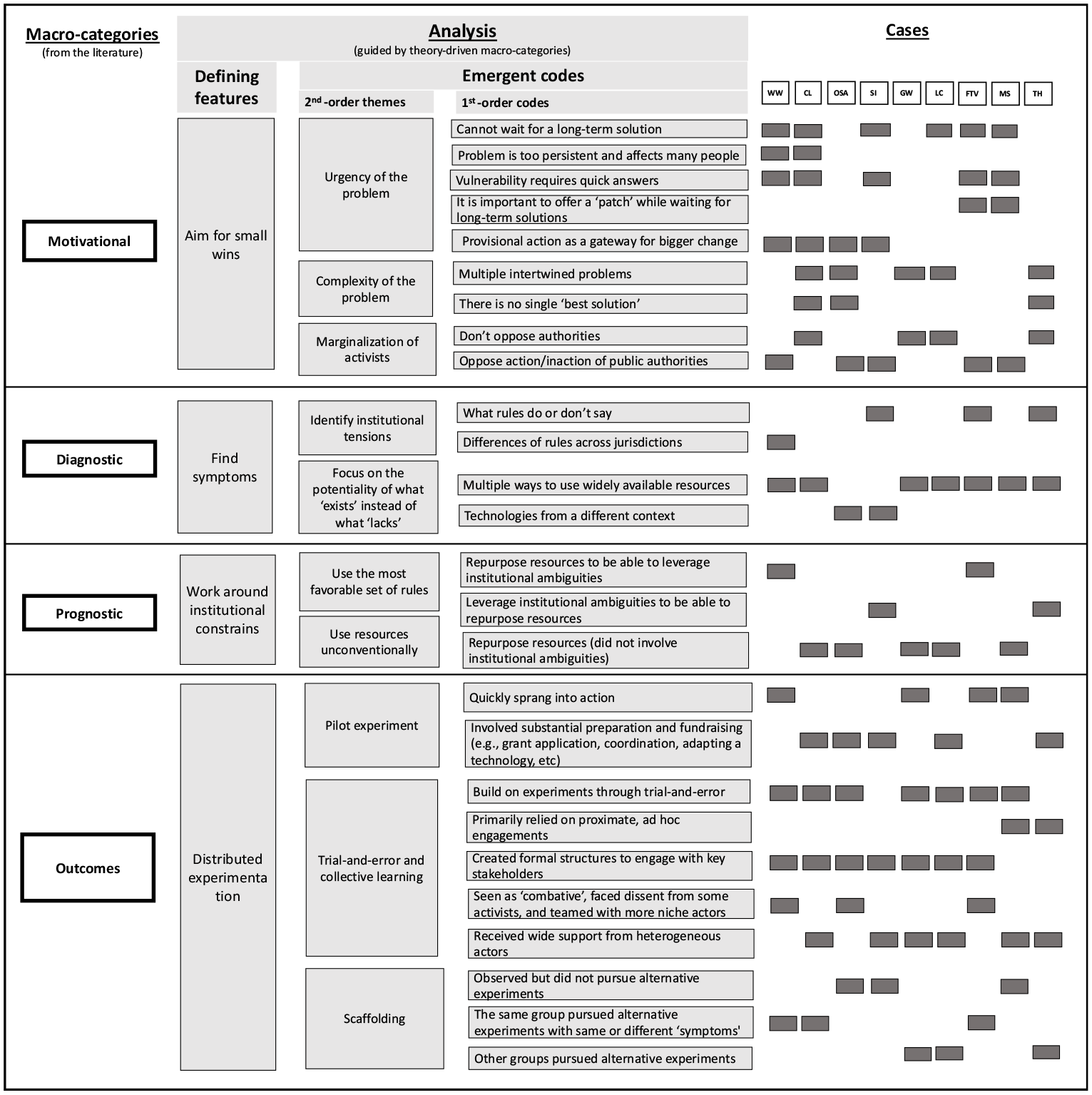
Result from data analysis.
Findings
We adopted a coding approach commonly used in comparative case analysis, drawing on existing theoretical categories of action frames: motivational, diagnostic and prognostic (Benford & Snow, 2000). We then cover the fourth macro-category, on the outcomes from these action frames. Within each of these macro-categories, we identified emergent themes, highlighting cross-case similarities and variances.
Despite presenting the macro categories sequentially, they are recursive. While activists recounted ‘emancipatory moments’ (Johnson & Duberley, 2000) of implemented experiments, we could not infer the precise sequence in which diagnostic and prognostic framings were constructed, only that that they were first prompted by a motivational frame. Additionally, we identified recursiveness across different framings; for example, as actors initiate an experiment, they may identify new ‘small wins’ involving alternative diagnostic and prognostic frames.
Motivational framing: Aim for small wins
Our sampled activists show frustration with the ‘conventional’ perspective that a complex problem must be addressed through large-scale efforts aiming for long-lasting structural change. Instead, they are motivated to adopt experimental approaches, which aim for a small win instead of a definitive solution. We identified three factors that make activists see shades of grey in wicked problems and be prone to experimenting in these situations: they see the problem as urgent, are attracted by the complexity of the problem, and believe that ‘conventional’ solutions exclude relevant actors.
Urgency of the problem
Six cases prioritize urgency over waiting for an ‘ideal solution’ that tackles their perceived root causes. Activists emphasize the need for accessible entry points, enabling them to achieve immediate results, even if only partially addressing the problems. Various justifications contribute to the actors' sense of urgency, and these reasons are not mutually exclusive.
Six cases claim that people cannot wait for a long-term solution. FTV, for example, emphasized the critical need for timely access to medicines: I was getting like 50 emails a day: ‘I have no way of getting my medication. I am going to die in 90 days because that is when my supply runs out’ . . . There are a lot of medical technologies on the shelf that can help people but to which a lot of people don’t have access, right? That is fucked up.
Two cases highlight the persistence of a problem of great magnitude to justify their sense of urgency. In WW, for example, actors emphasized that ‘every 10 minutes a woman dies because of these [anti-choice] laws’.
In five cases, urgency is grounded in the belief that specific vulnerable populations must be attended to promptly. As emphasized by LC: If a child is married off early, the right to get educated, the right to live a life to its full potential and the right to choose as to how to live a life [is severely compromised].
Two cases justified their intentions to offer provisional patches: activists think structural changes are ‘ideal’, but it does not mean other good-enough, short-term approaches are not necessary for the interim. As described by MS: Ideally, they [squatters] shouldn’t always have to live in transients like a homeless person when we build the shelter, it was really a band-aid solution, right? You are bleeding so you kind of put a band-aid . . . unless it ties in with the government’s initiatives, I don’t think it can make a big change. Otherwise, you keep doing these like innovative, experimental hacks which are exciting for us . . . But many times, real change is long-term and boring.
Four other cases explained that urgency motivates them to spring to action, but their experiments are not solely meant as provisional patches. Their motivation stems from either challenging perceived unfair rule systems or believing that conventional approaches are not inherently superior to experiments that could later scale up. Women on Waves exemplifies the former: We know that bypassing [laws] facilitates legal change as well . . . It catalyzes the possibility for the mainstream political organizations to take a stance. (WW1)
These actors did not intend merely to provide a patch for abortion rights; they saw provisional action as a gateway for more structural change. SI represents the latter. The actors were motivated to offer financial transactions for humanitarian relief post-earthquake in Nepal, a country where most of the population was unbanked: ‘To get financial services, beneficiaries have to go out to the district headquarters which is at least a day or two away from their village.’ They thought their experiment, though only ‘good enough’ at first, could subsequently turn into a new ‘ideal’ for humanitarian aid, as new technologies such as blockchain could bypass traditional banking systems.
Complexity of the problem
Some actors highlighted that the complexity of the problems they aimed to tackle puzzled them and made them engage with problems from different angles.
Some activists highlighted that the problems they aimed to address had different facets. For example, a TH interviewee described how the caste culture is intrinsically interwoven with other social problems in India: It’s crazily complicated . . . you can’t talk about class without talking about caste. You can’t talk about gender without talking about caste. You can’t talk about sexuality without talking about caste. (TH1)
The interviewee understood that the problem was amalgamated with many others, making it difficult (if not impossible) to identify a single root cause.
We also noted that some activists express frustration with depicting a single solution as the ‘only way forward’ as it implies a ‘total solution’ to problems shaped by various factors. The CL interviewees, for example, describe the lack of access to life-saving medicine stemming from interconnected problems – such as inadequate funding, governance and incentives for the private sector to sell treatments for neglected diseases. They reject the notion of an external ‘total’ solution: ‘People from outside the country coming into the country with THE solution, never, ever, ever, works! But it’s still what happens to this day’ (CL1). They stress the problematic nature of this approach in international development, arguing that funding organizations often impose a one-size-fits-all solution that overlooks contextual characteristics and views intervention areas only as places of ‘scarcity’ instead of places with an abundance of institutions and activities.
Marginalization of activists
Activists manifested frustration with conventional solutions, citing their need for vast resources, extensive coordination, long time frames and reliance on public authorities, thus marginalizing relevant actors who do not have the same resources and power. Interviewees imply that public authorities are accountable for large-scale societal problems, and activists are not the ones traditionally ‘meant’ to address them; they describe themselves as unconventional outsiders. For example, WW is composed of foreigners intervening where abortion is illegal, and OSA is formed by a group of computer geeks who feel disenfranchised from mainstream politics.
However, the extent of their dissent to authorities varied across cases. Four cases did not oppose authorities; on the contrary, they aimed to recognize and engage local authorities. An LC interviewee, for example, described that they aimed to engage formal and informal authorities: various stakeholders meaning the religious leaders, the people who carry out marriages, the band people, the tent, the people who print cards, then the leaders of the community like you know in India we have various communities, and we have leaders for various communities. (LC1)
Other cases were imbued with a sense of solidarity, mutualism and cooperation among group members that largely opposed the action (or inaction) of public authorities. In WW, for example, there is a strong feeling of sorority – of women helping others, from other countries, to get the abortions they need. The group started with anonymous, unpaid volunteers, most of whom had a different source of income and felt strongly about gender inequality and women’s health. The notion of sorority surpassed that of a profession or centralized authority; they deliberately aimed to make abortions ‘out of the control of the medical professions’ (WW1) and of the government’s rules.
Diagnostic framing: Find symptoms
Our activists recognize a conventional way of diagnosing a wicked problem, which typically focuses on identifying the ‘root cause’ of a problem. Instead, our cases diagnose ‘symptoms’ as more accessible ways to frame problems. This shift involves identifying institutional tensions and different uses for available resources.
Identify institutional tensions
The diagnostic framing of four cases involved identifying institutional tensions either through looking for what rules do or do not say (in other words, the ‘technicalities’ within a jurisdiction) or examining the differences in rules across jurisdictions.
FTV exemplifies the former. The group is composed of individuals who are discontent with poor access to healthcare products: People are blocked for access usually for one of the 3 reasons; price, legality or infrastructure . . . Hepatitis C drug is $84,000 for a course of treatment; those things are out of reach for most people. Legality [because] you can’t get the abortion drugs [in most countries] or there is a new lung cancer vaccine that was developed in Havana and so you can get it in the United States . . . Infrastructure, [because there is a] lot of places where you can’t get stuff. There is no way to get it there.
A symptom of this complex problem, for our interviewee, was that people in need rely exclusively on products commercialized through regulated organizations, i.e. pharmaceutical companies.
WW exemplifies the latter. By looking for different rules across jurisdictions, the activists diagnosed a symptom of the complex problem they aimed to address: unsafe abortions are directly connected to illegality. Dr Gomperts, WW’s founder, began her work in the mid-1990s as a ship’s doctor for Greenpeace. In her country, the Netherlands, pregnant people had access to safe abortions based on request. But while working for the organization in countries where abortion was illegal, she saw people suffering the consequences of botched abortions that could have been offered safely with pills. She recognized that the root cause of the problem was anti-choice laws, but these were practised in most countries and were difficult to change. She cited that ‘every 10 minutes a woman dies because of these [anti-choice] laws’ and that approximately 45% of all abortions performed worldwide were unsafe and predominantly happened in countries where abortions are illegal.
Focus on the potentiality of ‘what exists’ instead of ‘what lacks’
Actors reframed from ‘what lacks’ to ‘what exists’ (but is overlooked in their respective contexts) in two ways: they either note multiple ways to use readily available resources or the potential of technology typically used in a different context.
GW is a case of the former. The founder described the nature of the problem of economic remoteness in peri-urban regions of Pakistan in terms of ‘scarcity’: locals did not have access to basic water and energy services, often expected to be provided through integrated infrastructure (such as power grids and water systems). They were also cash-strained because they did not have access to formal markets, thus preventing them from purchasing fuel and other basic products. However, she recounts that when she changed her perspective to look at the potentialities instead, she realized they had many goats, which they struggled to sell and turn into cash to purchase products: ‘There are lots of goats and I asked them if they would be able to give me goats and they said “yeah”’ (GW1).
OSA is an example of the latter. Actors looked for technology arising in other fields that had not yet been used in the wicked situations they were interested in. OSA’s members realized that artificial intelligence robots allow for processing sheer volumes of data, but they had not been used for civic auditing of public expenses, and small expenses such as reimbursements often passed unmonitored: ‘Governmental agencies [responsible for auditing] look at big, [while an AI robot could] look at small expenses’ (OSA2).
Prognostic framing: Work around institutional constraints
A prognostic framing narrows down multiple possible responses to a problem into action priorities. All cases aimed to address ‘symptoms’ instead of the durable structures perceived as ‘root causes’ of problems, and for that, they prognosed ‘workarounds’. The process of prognosing workarounds involved using the most favourable set of rules and using resources unconventionally.
Use the most favourable set of rules
Informed by their diagnoses of what rules do or do not say and the differences of rules across jurisdictions, two cases explored possibilities to leverage institutional ambiguities to work around what they saw as a pernicious and persistent institutional constraint. For example, as FTV looked closely at what rules do or do not say, they identified that through open-source platforms, people could learn how to make their own medicines without violating the intellectual property rights of pharmaceutical companies, so long as they did not commercialize these products: Really is the open-source magic. Open-source magic is a mechanism that is very useful for getting stuff to happen, but the loophole is that science is reproducible. That is the whole point of science. And so, if there is somebody in a lab somewhere who makes something happen and it works consistently under specific conditions, you can recreate those conditions, you can do it yourself.
The workaround was, therefore, to create a platform through which the group could demonstrate how people could make their own medicine, leveraging institutional ambiguities. Activists aiming at institutional ambiguities needed to repurpose resources too. As FTV activists wanted to show how medicines can be made autonomously by users to bypass intellectual property, they had to repurpose equipment; for example, they identified how to make an equivalent to an epinephrine autoinjector using off-shelf products from large retailers such as Amazon.
Use resources unconventionally
All cases in our sample identified possibilities to use resources unconventionally, which would enable them to work around what they saw as durable constraints.
In CL, for example, the conventional prognosis consists of providing improved infrastructure, funding and governance for disease prevention and treatment. CL’s alternative prognosis was to tap into the flows of Coca-Cola’s crates, which reach even the country’s remotest areas. Their idea was to fit the treatment between soda bottles to get a ‘free ride’ to regions with less than 1% usage, where they could be sold through the same shops selling soda. While resources from fast-moving consumer goods are not typically used for expanding access to healthcare products, CL saw no constraints in doing so: ‘The logistics pathway for Coca-Cola, for cooking oil, exists . . . all you have to do is maybe use that same framework to move this product [diarrhoea treatment] (CL2).
Some cases employed high-tech solutions such as artificial intelligence or blockchain in novel ways, while others repurposed everyday resources. An example of the former is OSA. Informed by the diagnosis that small-scale public expenses, such as reimbursement requests, were not adequately investigated by public agencies in Brazil, OSA created Rosie: an artificial intelligence capable of analyzing expenses reimbursed by the Quota for Parliamentary Activity, of congresspeople and senators, in the exercise of their functions, identifying suspicious expenses and incentivizing the population to question them. (OSA3)
AI robots had not been used to monitor the reimbursement expenses of politicians; this prognosis allowed activists to use it in a new context. GW exemplifies the repurposing of everyday resources. Having diagnosed that rural populations in arid regions of Pakistan are cash-strained, but have goats, the activist conceived ‘something called “Pay as you Goat”. So, instead of paying cash, they can just pay in goats or a combination of cash and goats because cash is the constraint.’ With this workaround, GW could barter goats for water pumps and solar-powered energy grids, thus helping populations who do not have access to formal markets.
Some activists who had identified opportunities to repurpose resources also needed to leverage institutional ambiguities. SI, for example, wanted to use blockchain to offer financial transactions to populations affected by the 2014 earthquake in Nepal, working around the lack of banking facilities; however, the government prohibited transactions of cryptocurrency in the country. The activists then leveraged the ambiguity in the regulations and created a ‘crypto-token’ instead of a ‘crypto-currency’. In the words of an interviewee: We had to design Sikka into a token so that it would not go against Nepal Rastra Bank’s [the country’s Central Bank] directives . . . We are working on a grey zone with all the national bank’s directives.
While the common sequence involves diagnosing symptoms to enable the prognosis of workarounds, a prognosis that activists had already conceived could help frame or reframe a diagnosis too. In CL, actors had thought of the workaround of taking free rides with Coca-Cola, working around poor healthcare infrastructure and logistics. However, they had not yet determined which medicine to use. This prompted them to examine healthcare reports and data, discovering that diarrhoea was one of the biggest killers of children under the age of five, that the correct treatment was rarely found in remote regions, and that it has no intellectual property rights, is cheap and over-the-counter, has no over-dosage risk and requires no refrigeration.
Outcomes: Distributed experimentation
Activists, upon identifying a preferred workaround, piloted experiments addressing symptoms through workarounds that sidestepped perceived causes of inertia. Starting with small-scale efforts, activists pragmatically tackled wicked problems without seeking definitive solutions. As experiments progressed, collective learning unfolded, occasionally revealing opportunities to scaffold their experiments through alternative or complementary small wins.
Pilot experiment
Once equipped with a workaround idea that they deemed viable, our sampled activists started a pilot experiment. Experiments took the form of service or product provision (e.g. the provision of water pumps, medicines, abortion services, or housing). Despite their temporary and small-scale nature, activists believed these experiments provided practical and immediate relief to wicked problem symptoms; as described by an MS interviewee, ‘We were finding solutions around constraints, instead of having a clean solution’ (MS1). The key cross-case variation we observe is how swiftly they initiated pilot experiments, with some taking immediate action while others required substantial preparation.
GW is one of the four cases of the former. GW’s activist started experimenting right after conceiving the prognosis of bartering much-needed water pumps in arid regions of Pakistan for goats (which she subsequently sold for a higher price during Eid al-Asha – a Muslim festivity in which people typically sacrifice goats and, therefore, their prices sometimes increase threefold). In her words: It’s totally experimental . . . I sold the goat the first time to expats who would send money back to fulfill this sort of cultural religious obligation . . . I didn’t know what price I would get. I didn’t know what price to even charge. I just randomly called up someone in Karachi. I said, ‘Listen, how much are the goats right now in Karachi market’ and I just priced it at that. (GW1)
On the contrary, five cases reported the need for substantial preparation to initiate their experiments. CL, for instance, started with a trial in two districts in Zambia, with two comparators. The goal was to test the hypothesis of whether value chains of fast-moving consumer goods could be emulated to make diarrhoea treatment available through the private sector. Despite the experimental nature and the smallest scale possible, a formalized plan was essential to engage local partners and fundraise from international organizations.
Trial-and-error and collective learning
Once pilots started, activists developed them further through trial-and-error. This quote from OSA represents a characteristic we observed across six cases: There are lots of complex theoretical criticisms to representative democracy, but in practice, change happens only by trial-and-error, experimenting to see what is effective and what isn’t. (OSA1)
Trial-and-error meant implementing interventions in the simplest ways and learning from them. Case informants perceived the stakes for experimentation as low; as described by ColaLife, He was also another ‘let’s go with the flow, it’s going to happen, let’s do it’. He said a couple of times ‘this may or may not work, but we have to try’. (CL2)
As activists experimented, they created small wins that became valuable learning experiences. LC’s experience reflects a common thread: The program developed gradually, it was a learning for us every day and on the basis of feedback from the field that we would add on to the program. (LC1)
Some also described failures as pivotal learning moments, refining their experiments for future success. WW exemplifies learning from failure: it had its first campaign in 2001 in Ireland, the country with the then-most restrictive abortion laws in Europe. The activists failed to provide abortion services on board because they had not realized they needed a licence from the Dutch government to provide abortion services. This setback spurred them to secure a Dutch medical licence through another workaround leveraging legal ambiguities in Dutch law. The Dutch government would not give a licence if the boat did not have a clinic, so ‘[even though we] didn’t need a full clinic to give abortions with pills, we built it [a shipping container with a treatment room] to help us get the Dutch medical license’. Since then, they launched successful campaigns to provide safe abortions to people restricted by their country’s laws, such as Poland, Morocco and Ecuador.
All activists emphasized contributions from others not only in implementing or building on the experiments but also in adapting them. For example, CL gained international attention for the package for diarrhoea treatment they created to fit between Coca-Cola bottles. Yet, they report that, once they ‘talked to SAB Miller [the company that bottles Coca-Cola in Zambia]’ they realized that physically having the kit in the crate itself was not going to get the [anti-diarrhoea] kit to the villages in the proportions that we wanted, and in the way that we wanted, however willing Coca-Cola were. You know, it was a sexy idea, and it was a visual metaphor, but the practicality on the ground was not. (CL1)
Since then, they adapted their experiment from merely taking a free ride with Coca-Cola bottles to tapping into existing flows of fast-moving consumer goods to make diarrhoea medicine available in remote regions.
In experimenting, all activists sought input from others; however, while some relied primarily on proximate, ad hoc engagements, others created formal structures for engagement. FTV exemplifies the former: I went looking for chemists who could show me how they actually do that reaction in a lab . . . a buddy of mine, he is really good with hacking hardware, he was just like ‘oh, come to my garage. I have a bunch of spare parts; we can throw something together’. And, so, we sort of hackathoned our way through it . . . and then finally I got enough things together just barely to get . . . the alpha prototype. (FTV1)
Others created or identified from the outset structured ways to engage with others. OSA, for instance, gave new participants ‘an explanatory map, like the one you receive when you go to the museum with the galleries . . . to show what we understand as good practices’ (OSA1).
As the experiments evolved, activists facilitated collective learning by involving advisers and more participants. While three cases reported that they teamed up primarily with niche actors because they were seen as ‘combative’ and faced dissent from mainstream groups, the other six cases described that they actively pursued support from heterogeneous actors.
WW is an example of the former. Besides opposition from anti-choice governments and religious groups, they surprisingly faced dissent from some mainstream pro-choice groups too: When we started preparing the campaign . . . the mainstream women’s organizations didn’t want to participate, they were very critical. So, we worked with really young groups that were not part of the mainstream political networking system. (WW1)
TH exemplifies the latter – the activists avoided any conflict so that they could receive support from heterogeneous actors. Throughout the experiment of building twin houses for Dalits and non-Dalits to address caste prejudice in Kuthambakkam, a small village in India, the leading activist made others look at the matter pragmatically, rather than trying to change public opinions on caste: I called all the people and said, ‘I am not deliberately making you mix with Dalits . . . but the space is available only with the Dalit community. If you’re interested, instead of fifty houses, we will make one hundred houses; fifty houses you people can come and occupy, fifty houses let the Dalit people occupy. (TH1)
OSA shows that ‘combative’ activists may adjust how they engage with others, as they learn from heterogeneous actors. Initially driven by the goal to ‘fight corruption’, OSA activists, through engagement, shifted their focus: We were no longer claiming we are fighting corruption, which is a very broad, confrontational, and imprecise term. We are assisting society to have more control of public expenses, to keep track of how public money is being used. (OSA2)
This shift allowed them to become more appealing to civil society actors, while intentionally keeping their distance from influential players (such as politicians and big corporations) to prevent being ‘labeled and delegitimized as leftist, or rightist, or serving interests of conspirators’ (OSA2).
Scaffolding
As activists piloted experiments, they learned through hands-on experience and interactions. With increased experience and support, all cases reported that they identified possibilities for alternative or complementary experiments. We note variance, however, on whether they pursued these possibilities.
Three cases – OSA, SI and MS – at the time of our data collection had identified but not enacted alternative or complementary experiments because they received more attractive professional opportunities or felt financial pressure (i.e. they could not raise enough funds for further experiments or struggled to make an adequate income). MS, for example, identified the possibility of expanding on their experiments by building more schools and homes that could be disassembled in India not only for evicted populations but also for homeless individuals or migrant workers. However, as reported by the activist: I wasn’t making any money for 2 months . . . So financially, that was quite difficult for me. I can’t build more schools like that. But I can build more schools for NGOs. So, [I’d be keen] if there is an NGO that wants to build a school for kids of migrant workers. (MS1)
The other six cases reported that their pilot experiments revealed viable possibilities to expand and extend their impact. Four of these pursued alternatives themselves, while two reported that other groups pursued experiments inspired by theirs.
WW is one of the cases that explored complementary experiments to broaden its impact. While working around anti-choice legislation by taking women to international waters, WW identified other legal loopholes to expand service provision without the need for the activists’ physical presence. They started mailing abortive pills with a prescription from a Dutch doctor or instructing women to autonomously purchase and take off-label abortive pills (originally designed for ulcers) that could be found over the counter in some countries. They argue that ‘it is something that women can actually handle themselves’ (WW1), as it is safe, and in the unlikely case the woman needs medical support, she can go to a local hospital and argue she had a miscarriage because the symptoms are the same. Furthermore, while early in their experiments they were focused on institutional tensions across jurisdictions, they gradually identified different ways to leverage tensions from within institutional environments too. For example, they inform Brazilians to exploit a local legal loophole: claiming rape enables women to obtain a safe abortion in a public healthcare facility without reporting it to the police.
While WW aimed for the same symptom of a wicked problem, other groups started exploring different symptoms as they pursued their experiments. CL, for example, started by leveraging the existing flows of fast-moving consumer goods so that diarrhoea medicine could reach (and be sold through) existing outlets in remote regions of Zambia. In this process, they learned about systemic failures hindering correct treatment availability in public healthcare facilities. Health officers did not always prescribe the combined treatment, recommended by the World Health Organization (ORS and zinc); public facilities often stocked out one of the components (ORS or zinc), as these were procured separately; and the procured medicines were not adequate for home dispensation, as ORS sachets were designed instead for dispensation in large batches for a high number of children in hospitals. To address these issues, CL co-packaged ORS and zinc to bypass these limitations. The intellectual property of this combined treatment was freely available to a Zambian pharmaceutical industry, and the activists influenced the government to procure this package.
The pilot experiments in three cases sparked further experimentation by other groups. Inspired by the TH experience of building twin houses in Kuthambakkam by tapping into a ‘housing budget’ from the government to address casteism, others replicated this idea in other regions: After my example, the State government . . . adopted more than 250 such initiatives in different places . . . It started from my village and the then State government was very good [in quickly replicating it]. (TH1)
Some cases reported that groups from other countries facing similar challenges reached out to implement adapted versions of their experiments: Someone reached out from Somalia saying that they want to try this model. And now we’re hoping to do it there because they have a similar market where, around Eid time, the prices increase. (GW1)
Although we do not have data from groups that were inspired to adopt or adapt these experiments, we consider this an important finding, as it shows how a pragmatic action frame creates distributed possibilities to experiment in wicked situations.
A Process Model of How Pragmatic Action Frames Foster Distributed Experimentation
Building up on our qualitative findings, we offer a process model (see Figure 3) of how pragmatic action frames are constructed in wicked situations and lead to distributed experimentation.
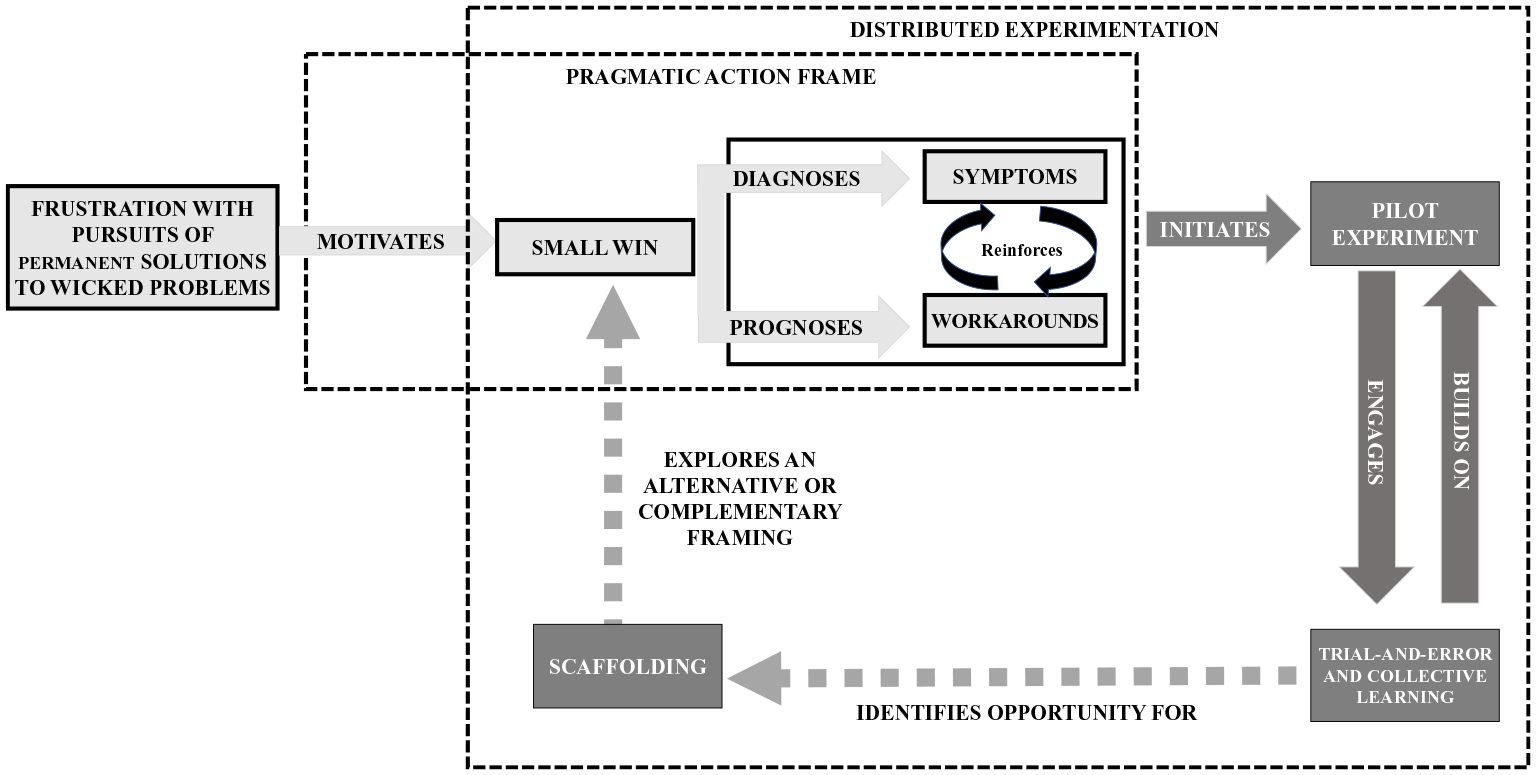
How pragmatic action frames lead to experimentation.
Our sampled activists depart from frustration with the conventional way of tackling wicked problems, employed by governments and other central and powerful actors, who have the ambition to find permanent institutional fixes by identifying the root cause of the problem and confronting whichever obstacles lie in their way to ‘solve’ the problem. This frustration takes them to pragmatic action frames. In these frames, actors first seek small wins; they do not aim to ‘eliminate’ the problem, but rather to ‘address’ it in different ways, by diagnosing and prognosing with an emphasis on practicality and immediacy. Their diagnosis is centred on symptoms – the visible part of the iceberg that can be addressed in the short term. This diagnosis looks for entry points for immediate action through the identification of institutional tensions and a focus on what exists but is overlooked instead of what lacks a wicked situation. The prognosis consists of identifying possibilities to work around obstacles. For that, they use resources unconventionally and, in some instances, leverage ambiguity within and across institutional environments by selectively choosing the most favourable set of rules to address a symptom of the problem.
We also observed a recursive link between diagnosed symptoms and prognosed workarounds in the emergence of a pragmatic action frame, which shows how this learning process can be iterative. When a symptom is diagnosed, it enables the workaround prognosis, and this direction is the most described by the activists in our sample (e.g. once WW diagnosed differences in abortion rights across jurisdictions, it prognosed ways of leveraging pro-choice legislation of the Netherlands in international waters). However, a prognosis that activists had already conceived could help frame or reframe a diagnosis (e.g. in CL, they first conceived the workaround of taking free rides with Coca-Cola bottles to deliver medicines, then they identified that diarrhoea treatment would be suitable for this intervention). These iterations between symptoms and workarounds can happen multiple times until a good ‘fit’ is found for experimentation.
When activists are satisfied with a workaround idea, they initiate pilot experiments crescively and flexibly. Once they start an experiment, they engage in a process of collective learning (sometimes with proximate contacts, in other cases with heterogeneous groups of actors) and through trial-and-error. Through this process, they build on their small-scale experiments.
Our model then shows how heterogeneous and cumulative experiments might arise from a small-scale pilot, in ways that crescively address more facets of a wicked problem. This happens because, with more experience and support, activists sometimes identify possibilities to scaffold their experiments by adding more layers to (or adapting) their experiments for greater impact. In these cases, they are still working with the same pragmatic action frame; in other words, they still focus on the same diagnosis and prognosis that prompted their initial experiments. For example, WW started with the provision of abortion services in international waters on board a Dutch boat and, subsequently, started mailing off-label abortive pills with a prescription from Dutch doctors. This was a new experiment that builds on the same pragmatic action frame (i.e. leveraging Dutch law for the benefit of women who reside in countries where abortion is illegal).
Some activists, alternatively, while scaffolding with the same pragmatic action frame, may identify opportunities to explore an alternative or complementary framing that loops them back to another round of diagnosis–prognosis. This means they engage with the construction of new pragmatic action frames that are different from the ones that prompted their pilot experiment, and these may lead to substantially different experiments. For example, the pilot from CL focused on offering diarrhoea medicine through the private sector, but the activists subsequently branched out with a new pragmatic action frame to promote access to this treatment in the public sector, too.
The dotted lines in our model signify that not all identified alternatives, whether explored with the same or a different framing, are enacted, as actors have varying priorities and financial constraints. Yet, this recursiveness between framing and experimenting demonstrates how pragmatic action frames may lead to distributed experimentation opportunities in wicked situations. It is distributed because there are multiple viable ways actvists can frame experiments, and then initiate, build on and branch out from them, whether exploring possibilities to scaffold with the same or a different frame. Another reason that contributes to distributed experimentation is that, through cycles of collective learning, other groups may be influenced by the activists’ experiments and autonomously pursue their own alternatives (e.g. GW reported that activists connected with them to develop a similar experiment in Somalia).
Through pragmatic action frames, activists in our cases thus see the complexity of a problem not as a limiting factor for action, but rather as opening an array of possibilities to address wicked problems from different angles; these are more accessible in the shorter run, and open possibilities for collective learning and distributed scaffolding of experimentation opportunities.
Discussion
Reflecting on how pragmatic action frames emerge and how they enable the scaffolding of distributed experiments, we contribute to the literature on wicked problems, action frames and robust action strategies.
Contribution to the literature on wicked problems
Our study contrasts with previous writing on wicked problems that emphasized ‘taming’ complexity (Ney & Verweij, 2015; Reinecke & Ansari, 2016), by showing how activists ‘welcome’ complexity instead to match that of their environment (Ashby, 1958; Walby, 2007), in ways that leverage the ‘wickedness’ of a situation.
Wicked problems often activate dysfunctional levels of arousal, frustration and helplessness (Weick, 1984). Scholars have described how actors tame complexity, finding common ground and mobilizing around a ‘way forward’ to resist those tendencies to inaction (Ney & Verweij, 2015; Reinecke & Ansari, 2016). Our activists, however, see those efforts as leading to cumbersome and homogeneous solutions that require vast resources, coordination and long time frames, consequently excluding them from taking an active stance on a problem they care about. By contrast, our activists welcome complexity: the flexibility in attributing meaning to wicked situations, the multiple possible symptoms of a problem, and the impossibility of solving complex problems in the short run. By welcoming complexity, they find entry points for experimenting with (instead of despite of) coexisting tensions (Etzion et al., 2017; Roulet & Bothello, 2022), in ways that empower them to approach wicked problems from different angles. For example, in WW, rather than trying to change regulative institutions constraining people from having safe abortions (i.e. the institutionalized way of tackling the problem), activists benefitted from institutional tensions across different national jurisdictions to work around anti-choice laws.
We thus argue that in wicked situations there are no ‘directly traceable causes’ (Gioia, 1992, p. 381); therefore, taming complexity is not an adequate way to respond to them, and is particularly problematic for actors in the margins. An approach that welcomes complexity is best apt to motivate them to leverage the ‘wickedness’ of situations, experimenting with coexisting and contradictory meanings, agendas and actions (Eccles et al., 1992). This interpretative ‘situatedness’ (Ferraro et al., 2015) in wicked situations, which sees possibility in the complexity of the situation, reveals a wide range of provisional and distributed ways of addressing multifaceted problems through cumulative small wins (Reay et al., 2006).
Contributions to the literature on action frames
Our work contributes to the literature on action frames in two ways. First, we reveal how multiple action frames coexist in wicked situations. The literature on action frames typically characterizes framing as strategic processes that are ‘deliberate, utilitarian, and goal directed’ (Benford & Snow, 2000, p. 624) and problems attributed to controllable causes. An action frame is seen as offering a ‘temporary truce’ (Benford & Snow, 2000) – a way forward to interpret the situation at hand and mobilize collective action (Cornelissen & Werner, 2014). This emphasis on simplifying environments and identifying controllable causes, however, underspecifies the multiple and recursive ways actors can collectively build action frames based on different interpretations of wicked situations. Our work underscores that pragmatic action frames can lead to many coexisting temporary truces (instead of a single temporary truce to account for the causes of a problem) (cf. Vedres, 2022). This is because, through pragmatic action frames, activists focus on the practical adequacy (Dewey, 1938; Gross, 2009) of the situation, aiming to address symptoms instead of offering structural fixes to complex problems. In this process, they aim for small wins to ‘shape the complex environments they face’ (Farjoun et al., 2015, p. 2), and these are often seen as entry points to develop more robust interventions in a wicked situation.
Our second contribution is in revealing how a pragmatic action frame can be constructed without necessarily threatening an alternative, dominant frame. The literature on action frames describes how a dominant frame is seldom consensual; through framing, actors contest a dominant frame (Kaplan, 2008), presenting an alternative interpretative schema to influence pivotal actors and mobilize action in ways that could displace the dominant frame (Vedres, 2022). As a frame benefits some more than others, frame contestation arguably threatens the goals of the ones who most benefit from a dominant frame; examples include when new market entrants defy the action frames of industry incumbents (Gurses & Ozcan, 2015), or when social movements engage in political processes of contestation with opposing or constituent parties (Briscoe & Gupta, 2016). We argue that this is an incomplete account of frame contestation, as our work reveals that pragmatic action frames are constructed and instantiated without inherently threatening a dominant action frame. In several of our cases, activists were not seen as ‘combative’, and, in fact, attracted support from heterogeneous actors, including from actors that were prone to a more ‘conventional’ approach. This shows that pragmatic action frames, although marginal, are not necessarily against a central, dominant frame. They may be seen instead as complementary to it. One can dissent from the means but not the goals of a dominant frame, and multiple frames can, therefore, coexist without threatening one another.
Contributions to the literature on robust action
Our model of how pragmatic action frames facilitate experimentation contributes to the literature on robust action in two ways.
First, our model explains how pragmatic action frames initiate experiments that, despite their small scale, are flexible and crescive, opening prospects for distributed experimentation (Gehman et al., 2022). Despite being recognized as a key robust action strategy (Ferraro et al., 2015), to date, the process through which distributed experimentation occurs is not fleshed out in the literature. In our model, we show that there are multiple viable ways activists can frame experiments, and then initiate, build on and branch out from them, whether exploring possibilities to scaffold with the same or an alternative frame. We also demonstrate that, through cycles of collective learning, other groups may be influenced by the activists’ experiments and autonomously pursue their own alternatives. Activists and collaborators thus engage in recursive processes that allow for distributed scaffolding of experiments; they may improve or adapt an existing experiment, pursue an experiment that addresses a different symptom of the wicked problem, or inspire other activists to act in different contexts or geographies. It is through this open-ended and recursive process, which lacks clarity between means and ends, that activists keep a multiplicity of paths open for the long term (Padgett & Ansell, 1993).
A second contribution to research on robust action comes from attention to who ‘robust actors’ actually are and what makes them more accepting of journeys with no finish line. These attributes fade all too often into the background of accounts of change-making pursuits or are reduced to ‘chance’ (Dooley & Van de Ven, 1999). Our paper takes the first step in unpacking them. We see robust actors as distinct from both the over-socialized actors that populate traditional studies of institutions (Gümüsay et al., 2020) and the uber-change agents that reside in some accounts of institutional entrepreneurship (e.g. Tracey, Phillips, & Jarvis, 2011). The agency of robust actors is enacted in a form that combines constraint and possibility, as they are focused on defying without violating what they interpret as ‘conventional’. For that, robust actors look beyond what they consider conventional institutional scripts (Sewell, 1992); they are propelled by the belief that other change agents, and primarily well-resourced ones, are too structurally constrained, and that is why their attempts at changing institutions are slow-moving or fruitless. Alternatively, robust actors are willing to experiment with different symptoms of wicked problems in search of small wins (Weick, 1984), as they recognize that it is not ‘a matter of shifting from one equilibrium state to another, but the continuously negotiated accomplishment of an assemblage of humans and things involving deviation and contestations’ (Garud & Gehman, 2012, p. 984). In these purposeful wayfinding efforts (Bouty et al., 2019; Chia & Holt, 2009), robust actors experiment with open-ended, fluid situations in ways that leverage tensions through and across institutions (DeJordy et al., 2020; Dorado & Ventresca, 2013) to work around (without confronting) institutional constraints.
Conclusion
At a time in which complex socio-environmental problems have garnered substantial interest among management scholars, we unveil how activists frame experimentation to address those problems. Through pragmatic action frames, actors identify symptoms of wicked problems and possibilities of working around deep-rooted institutional constraints for small wins. By doing so, actors experiment in ways that keep future lines of action open, welcoming situated complexity instead of attempting to tame it. We invite researchers to build on our work by, for example, investigating how experimentation confronts operational and coordination challenges, and how experiments are replicated or adapted by groups in different contexts or addressing different wicked problems.
Footnotes
Acknowledgements
We would like to warmly thank our editor, Nina Granqvist, editor-in-chief, Paolo Quattrone, and three anonymous reviewers who were crucial to shaping this paper. We are also grateful for the friendly insights from Akshay Mangla, Aoife Brophy, Marya Besharov, Sally Maitlis and Tom Lawrence as we improved our manuscript.
Funding
The author(s) received no financial support for the research, authorship, and/or publication of this article.
