




Abstract
In this article, we theorize a novel approach to addressing the world’s grand challenges based on the philosophical tradition of American pragmatism and the sociological concept of robust action. Grounded in prior empirical organizational research, we identify three robust strategies that organizations can employ in tackling issues such as climate change and poverty alleviation: participatory architecture, multivocal inscriptions and distributed experimentation. We demonstrate how these strategies operate, the manner in which they are linked, the outcomes they generate, and why they are applicable for resolving grand challenges. We conclude by discussing our contributions to research on robust action and grand challenges, as well as some implications for research on stakeholder theory, institutional theory and theories of valuation.
The issues we face are so big and the targets are so challenging that we cannot do it alone, so there is a certain humility and a recognition that we need to invite other people in. When you look at any issue, such as food or water scarcity, it is very clear that no individual institution, government or company can provide the solution.
Organization scholars increasingly advocate for research that addresses grand challenges, noting that “the fundamental principles underlying a grand challenge are the pursuit of bold ideas and the adoption of less conventional approaches to tackling large, unresolved problems” (Colquitt & George, 2011, p. 432; see also George, 2014). The emphasis on grand challenges resonates with scholars who have advocated for problem-oriented and impact-focused approaches to organization studies more generally (Hinings & Greenwood, 2002; Margolis & Walsh, 2003; Selznick, 1996; Stern & Barley, 1996). Consistent with these suggestions, a growing number of organization theorists have studied organizational responses to large, unresolved problems such as poverty alleviation (Battilana & Dorado, 2010; Dorado, 2013; Dorado & Ventresca, 2013; Mair, Martí, & Ventresca, 2012), climate change (Ansari, Wijen, & Gray, 2013; Wijen & Ansari, 2007; Wittneben, Okereke, Banerjee, & Levy, 2012), and exploitative labor (Bartley, 2007; Crane, 2013; Khan, Munir, & Willmott, 2007; Locke, 2013), among others.
These papers are motivated by a concern with understanding how organizations can contribute to tackling grand challenges. To date, this research has been grounded primarily in institutional theory, and has largely framed grand challenges as a form of institutional change. From this theoretical perspective, we have learned that opportunities for change emerge at the intersection of conflicting fields and logics (Seo & Creed, 2002; Thornton, Ocasio, & Lounsbury, 2012). There is also widespread agreement on conceptualizing institutional entrepreneurship as a collective process (Battilana, Leca, & Boxenbaum, 2009; Garud, Hardy, & Maguire, 2007), rather than the achievement of a single organization. Finally, we understand better the private regulatory processes that can create opportunities for affecting change (Ansari et al., 2013; Reay & Hinings, 2009).
However, as many institutional theorists have noted (Fligstein & McAdam, 2012; Hallett & Ventresca, 2006; Hirsch & Lounsbury, 1997; Powell & Colyvas, 2008), there is a need to deepen our understanding of the connections between organizational action and field-level changes. Indeed, while there is substantial agreement on the distributed nature of this process, we lack a systematic understanding of the mechanisms linking distributed action and the emergence of novel solutions to grand challenges (Padgett & Powell, 2012). Given the recent research emphasis on grand challenges, the need for a richer theoretical understanding of these linkages becomes all the more acute, particularly if we aim to translate our scholarship into practical, strategic, and policy advice (Colquitt & George, 2011; Howard-Grenville, Buckle, Hoskins, & George, 2014; Tsui, 2013).
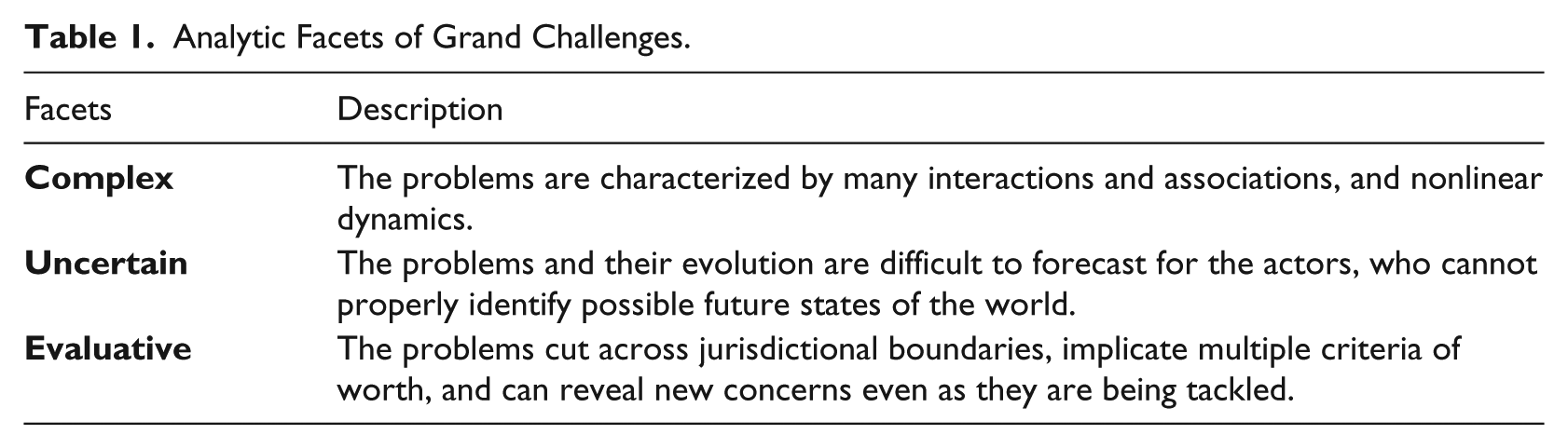
To give analytical traction to our exposition, we begin by highlighting three facets of grand challenges that have been emphasized in prior organizational research. 1 First, grand challenges are complex, entailing many interactions and associations, emergent understandings, and nonlinear dynamics. Second, grand challenges confront organizations with radical uncertainty, by which we mean that actors cannot define the possible future states of the world, and therefore cannot forecast the consequences of their present actions, or whether future others will appreciate them. And third, grand challenges are evaluative, cutting across jurisdictional boundaries, implicating multiple criteria of worth, and revealing new concerns even as they are being tackled. Taken together, these three facets pose formidable organizational challenges.
Next, we show how an effective response to grand challenges could draw from the philosophical school of pragmatism that emphasizes a situated, distributed, and processual approach to problem solving. To show how this approach can illuminate the relationship between organizational action and field change, we start from the sociological concept of robust action (Leifer, 1991; Padgett & Ansell, 1993) and revisit it in a pragmatist light. We start from the traditional definition of robust action as “noncommittal actions that keep future lines of action open in strategic contexts where opponents are trying to narrow them” (Padgett & Powell, 2012, p. 24), and explain why robust action strategies might allow organizations to contribute to tackling grand challenges. Specifically, we identify three robust strategies for dealing with grand challenges: participatory architecture, multivocal inscriptions, and distributed experimentation. We illustrate these strategies by drawing on prior empirical studies of organizational engagement with grand challenges, demonstrating how they mobilize heterogeneous actors and generate novel solutions. Finally, we discuss implications of our theory and sketch out some potentially promising research directions.
Understanding Grand Challenges
Given the emerging interest in grand challenges, in this section we identify several facets that distinguish these large unresolved problems from other organizational phenomena. Fundamentally, grand challenges affect large populations, meaning their impacts extend beyond the boundaries of a single organization or community. Moreover, they significantly and adversely affect human welfare and well-being. They also are seemingly intractable, resisting easy fixes. Although grand challenges such as climate change, water scarcity, poverty alleviation, and the safeguarding of human rights may not appear to have much in common, our analysis suggests that such grand challenges share three key analytical facets or dimensions. We label these as complex, uncertain, and evaluative (see Table 1 for a summary). Below we describe each of them in turn.
Analytic Facets of Grand Challenges.
Complex
Grand challenges confront actors with numerous complexities (for reviews of complexity theories in organization studies, see Garud, Gehman, & Kumaraswamy, 2011; Maguire, McKelvey, Mirabeau, & Öztas, 2006). For instance, Dorado and Ventresca (2013) refer to poverty alleviation and healthcare provision as “complex social problems.” Similarly, in a recent report, the Committee on Sustainability Linkages in the Federal Government (2013, p. 93) concluded: “Sustainability linkages are by their nature extraordinarily complex, involving multiple domains, multiple locations, and multiple time frames.” The complexity of grand challenges is due in no small part to the large array of actors involved, and the manner in which they associate and interact (Dooley, 1997; Simon, 1996). 2
Importantly, despite their involvement, those tackling grand challenges are generally unable to glimpse the entire system, but instead are limited to discerning the local actions of a few disaggregated individuals (Stacey, 2001). Root causes and key perpetrators often are assumed to be single actors, but may in fact be systems, institutions, and networks (Sterman, 2001). As one consequence, grand challenges are likely to be comprehended in multiple ways, depending on actors’ identities and field positions. Or as Simon (1996, p. 215) explained: “How complex or simple a structure is depends critically upon the way in which we describe it.”
Moreover, grand challenges are likely to be dynamic and nonlinear, comprised of an evolving set of interlocking issues and constraints (Maruyama, 1963; Senge, 1990), and thus, subject to feedback loops, phase shifts, and other tipping points (Chiles, Meyer, & Hench, 2004; Lichtenstein, Carter, Dooley, & Gartner, 2007; Plowman et al., 2007). As a result, it is difficult to shift complex phenomena away from their current state, rendering many grand challenges remarkably immutable. Even when solutions emerge, side effects or unintended consequences are not merely possible, but often likely (Sterman, 1989). For instance, in the context of climate change, ethanol fuel was initially promoted on the grounds that it reduced overall greenhouse gas emissions. However, it was later criticized, for instance, by a United Nations food expert as a “crime against humanity” (United Nations, 2007), for diverting corn from feeding the poor. More generally, “solutions” frequently expose or create new aspects of the problem, requiring further adjustment of the ostensible solution (Callon, 1998; Merton, 1936).
Uncertain
Grand challenges are also characterized by a radical form of uncertainty (Piore, 1995). Outcomes are not just a matter of risk, or random probability distributions, but are plagued by Knightian uncertainty. Actors cannot even enumerate what the possible future states of the worlds may be, let alone assign probabilities to them (Knight, 1921). In such instances, “science often proves to be incapable of establishing the list of possible worlds and of describing each of them exactly” (Callon, Lascoumes, & Barthe, 2009, p. 21).
One barrier to assessing possible future states of the world is that the preferences of actors are not stable, but rather evolving. Much of the work on decision-making under ambiguity has studied how the lack of coherence and consistency in our preferences affects how we think about the future (Camerer & Weber, 1992). As March noted: “Theories of choice under uncertainty emphasize the complications of guessing future consequences. Theories of choice under conflict or ambiguity emphasize the complications of guessing future preferences” (March, 1978, p. 589). In line with March, we understand uncertainty to problematize both future consequences and future preferences.
Economic and decision analysis approaches to these problems have focused on generating methods to treat situations of uncertainty as situations of risk (Beckert, 1999), while sociologists and organization theorists have emphasized that in these situations actors resort to social cues to act (DiMaggio & Powell, 1983; Granovetter, 1985; Meyer & Rowan, 1977). As some critics have already noted, however, these shifts do not actually deal with the challenges but rather translate them into traditional models of decision-making (Beckert, 2003; Stark, 2009). In other words, grand challenges are situations in which many facts are known, but these facts alone are not sufficient to provide a definitive basis for taking action.
Evaluative
As actors come to grips with grand challenges, they realize there is no one “correct” label, or categorization that easily defines them (Bowker & Star, 1999). Instead, grand challenges can be approached and understood in multiple ways: “People bring varying perspectives, interests and fundamental philosophies to problems of environmental governance” (Dietz, Ostrom, & Stern, 2003, p. 1909), and to other grand challenges. 3 Grand challenges are multidisciplinary, cutting across conventional epistemic and professional boundaries. As one consequence, the issues at stake cannot be defined as discrete economic, political, or social problems (Ansari, Gray, & Wijen, 2011). Different actors have different views about what the problem actually “is” and therefore what constitutes an acceptable solution (Lindblom, 1958). In a sense, grand challenges are constructed, because their representation melds objective facts with subjective representations (Landry, 1995). “Many parties are equally equipped, interested, and/or entitled to judge [them]” (Rittel & Webber, 1973, p. 163).
In other words, grand challenges can be understood as having variable ontologies (Callon, 1998); their definition, stakes, and consequences are caught up in processes of continual reconfiguration, depending on whom and what becomes associated with them. For instance, “climate science” increasingly describes not only a set of social and material arrangements, but offers an evaluation of these arrangements, with an eye to their potential reconfiguration (Edwards, 2010). As the debate over climate science makes clear, the very definition of the problem and the actors assembled around its resolution are value-laden issues that came into sharp relief during the “Climategate” scandal (Garud, Gehman, & Karunakaran, 2014; Maibach et al., 2012). At the same time, because grand challenges are matters of concern, a particular evaluation can never be conclusively demonstrated, and consensually determined to be superior (Latour, 2004).
Climate change as a grand challenge
As just one example of a grand challenge, consider the case of climate change. It is well established that climate change is complex. For instance, it entails associations and interactions between many different elements. There are positive feedback loops, in which some effects contribute directly to further global warming (for example, as the polar ice caps melt, less sunlight is reflected back from them into space, more is captured by oceanic waters, thereby heating them, leading to further melting of sea-ice, in a vicious cycle). The planetary climate has been stable for many years, but as more heat is captured, a tipping point becomes increasingly likely, shifting the planet to an alternative stable state, from which reversal could be difficult.
At the same time, our understanding of climate change remains uncertain. Human-environment interactions, such as climate change, “will always be uncertain because of inherent unpredictability in the systems and because the science is never complete” (Dietz et al., 2003, p. 1908). Lorenz (1963, p. 141), one of the intellectual forefathers of chaos theory, argued that “in view of the inevitable inaccuracy and incompleteness of weather observations, precise very-long-range forecasting would seem to be nonexistent.” Now known as the butterfly effect, the fundamental insight is that for many complex problems, uncertainty is inevitable.
And so it is with climate change today. Even though thousands of scientists worldwide study climate change, its expected long-term effects cannot be fully predicted. Forecasts regarding sea-level rise, for example, are in the range of 0.28 to 0.90 meters (IPCC, 2013). Temperature increases by the end of the 21st century range from 1.5 to 4.0 degrees Celsius. Of course, the attendant impacts of these direct effects are even more uncertain. Higher temperatures and changes in global precipitation patterns will affect human health, food production, and bio-system integrity, but the magnitude of these impacts is, in essence, unknown. Furthermore, we do not know how future generations will assess these impacts, adding to the difficulties in plotting courses of action (Elster, 2000; Garud & Gehman, 2012; Wade-Benzoni, 2002).
Climate change is of course also an evaluative problem. The cultural studies approach pioneered by Mary Douglas and collaborators posits three distinct climate change “stories” (Verweij et al., 2006). The first is a “profligacy” story that identifies the extravagant consumption and production patterns of the global North as the fundamental causes of global climate change; it is framed as a moral and ethical problem. The second is a “hierarchy” story that depicts climate change as a “tragedy of the global commons” attributable to the lack of global governance and planning that would rein in global markets and protect global commons. And third is an “individualistic” story that considers climate change as a minor problem, if at all, pointing to human ingenuity as an unlimited resource that, if harnessed effectively, can resolve all problems.
As Verweij et al. (2006, p. 828) explain: “The three stories tell plausible but conflicting tales of climate change. All tales use reason, logic and science to argue their points. None of the tales is ‘wrong,’ in the sense of being implausible or incredible. Yet, at the same time, none is completely ‘right’; each argument focuses on those aspects of climate change for which there is a suitable solution cast within the terms of a particular form of organization” (see also Hoffman, 2011; Lefsrud & Meyer, 2012).
Institutional responses to grand challenges
While it may be expected that the complexity, uncertainty, and evaluativity that characterize grand challenges are so daunting as to dissuade organizational actors from attempting to address them, in fact the opposite is true. The mainstream press, as well as the academic literature of the past few decades, has documented a multitude of initiatives spearheaded by individuals and organizations to address grand challenges. Paul Hawken, a renowned sustainability advocate, has argued that the diverse “environmental and social justice movement” has no charismatic leader, follows no unifying ideology, and remains unrecognized by politicians, the public, and the media, but is nonetheless the largest movement in history, numbering some one million organizations globally (Hawken, 2007).
Academic interest in organizational action targeted at tackling grand challenges has increased correspondingly with their ubiquity over the last several decades. In large part, the organizational literature has harnessed a case study approach to understand the worldviews and strategies utilized by these organizations. Notable studies have examined organizational action to reduce poverty and economic inequality in the developing (Battilana & Dorado, 2010; Dorado, 2013; Dorado & Ventresca, 2013; Mair et al., 2012) and developed worlds (Jay, 2013; Pache & Santos, 2013); to reduce the harms caused by climate change and other forms of environmental degradation (Ansari et al., 2013; Wijen & Ansari, 2007; Wittneben et al., 2012); and to influence policy through transnational standards and governance approaches (Bartley, 2007; Buhr, 2012; Etzion & Ferraro, 2010; Wijen, 2014).
This growing body of work investigates how, as a practical matter, various actors tackle such problems in fields characterized by institutional complexity (Greenwood, Raynard, Kodeih, Micelotta, & Lounsbury, 2011), that is fields in which organizations confront incompatible prescriptions from multiple institutional logics (Friedland & Alford, 1991; Thornton et al., 2012). Indeed, in tackling grand challenges, organizations operate at the intersection of conflicting demands, and the institutional contradictions they experience can be the source of change, as they “transform the embedded social actors into the change agents of the very institutional arrangements” (Seo & Creed, 2002, p. 223). Prior research has focused primarily on how organizations respond to institutional complexity, and we have learned much about how organizations can survive (and thrive) in these contexts. But the link between organizational action and resultant institutional change has been much more elusive to theorize, and empirically explore.
Notwithstanding, there is substantial agreement in the literature on the distributed nature of institutional entrepreneurship (DiMaggio, 1988; Garud et al., 2007). Institutional change is not the result of individual entrepreneurial action, but rather, the efforts of multiple individuals and organizations that purposefully spearhead change and mobilize cooperation. Fligstein (1997) provided a useful micro-foundation for this macro process by introducing the notion of social skill, defined as “the ability to induce cooperation by appealing to and helping to create shared meanings and collective identities” (Fligstein & McAdam, 2012, p. 46). This concept, rooted in symbolic interactionism (Goffman, 1959) and pragmatist philosophy (Joas, 1996; Mead, 1934), provided a useful set of ideas to consider how actors can engage in strategic action in processes of institutional change, but focused primarily on the mobilization of cooperation. Much less developed in this perspective, but equally critical to understanding how organizations can tackle grand challenges, is the articulation of why a distributed, problem solving approach, nurtured by skilled actors, might generate viable solutions for grand challenges. Such a problem solving approach is at the core of the pragmatist philosophy.
A Pragmatist Perspective to Grand Challenges
The philosophical tradition of American pragmatism provides a wealth of ideas that social scientists have employed in order to study alternative theories of action. Sociologists, in particular, have shown how departures from philosophical dualisms (mind and body, thought and action, theory and practice, means and ends), can foster the development of a genuinely pragmatic theory of social action (Joas, 1996; Whitford, 2002). Indeed, according to pragmatists “humans are problem solvers and the function of thought is to guide action in the service of solving practical problems” (Gross, 2009, p. 366). For pragmatists, problems do not come neatly defined. Instead, the definition of the problem is itself an essential part of its possible resolution: [I]t is artificial, so far as thinking is concerned, to start with a ready-made problem, a problem made out of whole cloth or arising from a vacuum. In reality such a “problem” is simply an assigned task. There is not at first a situation and a problem, much less just a problem and no situation. There is a troubled, perplexed, trying situation, where the difficulty is, as it were, spread throughout the entire situation, infecting it as a whole. If we knew just what the difficulty was and where it lay, the job of reflection would be much easier than it is … In fact, we know what the problem exactly is simultaneously with finding a way out and getting it resolved. (Dewey, 1933, p. 140)
Importantly, a pragmatist theory of action recognizes that means and ends are not always clearly determined prior to action. As actors initiate action, they might come to see themselves in a different way, and change their ends. For Dewey, ends are “steps in the continuous stream of life, means for the next action, and, very importantly, are subject to investigation because they arise only in relation to ‘problem situations’” (Whitford, 2002, p. 341). In other words, actors are active experimenters; rather than being driven by a predetermined set of preferences and beliefs, they hypothesize chains of means and ends to choose a course of action, and later adjust their actions as they observe the outcomes they generated. Such an approach to problem solving seems applicable to the complexity, uncertainty, and evaluativity that characterize grand challenges.
Further, pragmatist philosophy, especially the work of Mead (1934), emphasized the intersubjective nature of human action; actors do not define the situations they face atomistically, but through a distributed process. Because problem solving is a form of inquiry, pragmatism highly values the diversity of perspectives that different individuals and organizations bring to the definition of the problems, and to the generation of possible solutions.
Bringing together different streams of pragmatist philosophy, Ansell described pragmatism as a “philosophy of evolutionary learning [emphasizing] the ability of both individuals and communities to improve their knowledge and problem-solving capacity over time through continuous inquiry, reflection, deliberation and experimentation” (Ansell, 2011, p. 5). 4 Three conditions are prerequisite for evolutionary learning: a problem-solving perspective, reflexivity, and deliberation. The problem-solving perspective of pragmatist philosophy starts from the idea that specific problems challenge existing knowledge and therefore provide critical learning opportunities. Reflexivity is what distinguishes pragmatism from mere utilitarianism and consequentialism, because in applying a pragmatist perspective actors learn by scrutinizing their own habits and actions (and changing in the process). Finally, as this is a distributed process, different views and controversies are adjudicated in a public deliberative process. These three conditions, Ansell concludes, need to work together in a recursive fashion for evolutionary learning to occur: “problems generate reflection, which generates deliberation, which may produce a refined definition of the problem” (Ansell, 2011, p. 12). 5
The evolutionary learning focus of pragmatist philosophy therefore provides a conceptual toolkit that can help us better understand and tackle grand challenges. It emphasizes a problem-solving approach that is situated, distributed, and processual. In organization theory, a pragmatist approach has been used to understand the evolution of firm boundaries in automotive industry supply chains (Sabel, 1994; Whitford & Zirpoli, 2014). Pragmatism is also the philosophy underlying innovative public policy theories such as “democratic experimentalism” (Dorf & Sabel, 1998), “experimentalist governance” (Sabel & Zeitlin, 2012), and “pragmatic democracy” (Ansell, 2011), in which public agencies engage in continuous problem-solving experiments, conducted with clear monitoring rules that facilitate collaboration and social learning.
Success stories based on the implementation of these principles have been documented in both national and transnational settings, such as American drug treatment courts, (Dorf & Sabel, 2000), child welfare agencies (Noonan, Sabel, & Simon, 2009), the European Union Water Framework Initiative (Sabel & Zeitlin, 2012), and transnational institutional experiments (Bruszt & McDermott, 2014). Yet, with the emphasis placed in these approaches on the state as the focal actor, they do not specify how concerned stakeholders and other nongovernmental organizations (NGOs), informed by pragmatism, can initiate and guide processes aimed at resolving grand challenges. We argue that robust action is one such approach; it is both consistent with the principles of pragmatism, and offers a wellspring of generalizable theoretically informed prescriptions for tackling grand challenges.
Robust Action Revisited
Over the past two decades, a growing number of organization scholars have invoked the term “robust action.” Despite widespread usage, to our knowledge, no comprehensive review of this work has been undertaken previously. In this section, we trace the origins of robust action to Eric Leifer (1983, 1991), who invoked the term in his analysis of strategies employed by chess players. 6 This work was highlighted by Padgett and Ansell (1993), through which it has become widely known. Subsequent work focused on the role of robust action in bringing about innovation and institutional change (e.g., Carpenter & Moore, 2007; Furnari, 2014; Hargadon & Douglas, 2001; Sgourev, 2013).
Pioneering work on robust action: Strategic action and network structure
Early work on robust action conceptualized it as a form of strategic action in competitive settings. In particular, contrary to conventional wisdom, Leifer found that what separated chess masters from novices was not an ability to see many moves ahead, but an ability to devise moves that advanced a particular strategy while preserving the ability to improvise based on the moves of an opponent. From his study, he concluded “an ex ante framework will be useless, as evaluations and strategies are in continuous flux” (Leifer, 1991, p. 26). Because an opponent’s moves can never be predicted with much certainty, Leifer theorized that chess masters exploited a robust action strategy, one that preserved flexibility until the time was right to consolidate gains or win the game. Building on these insights, one prominent definition construes robust actions as “noncommittal actions that keep future lines of action open in strategic contexts where opponents are trying to narrow them” (Padgett & Powell, 2012, p. 24; see also Bothner, Smith, & White, 2010).
Building on Leifer’s study, Eccles and Nohria’s (1992) book, Beyond the Hype, introduced robust action into organization and management theory. Following Leifer, they defined robust action as “action that accomplishes short-term objectives while preserving long-term flexibility. Because future problems and opportunities are always uncertain, present actions should not constrict a manager’s ability to adapt to new situations as they evolve” (Eccles & Nohria, 1992, p. 11). They subsequently adduced “seven principles of robust action” (pp. 41–44): acting without certitude; constantly preserving flexibility; being politically savvy; having a keen sense of timing; judging the situation at hand; using rhetoric effectively; and working multiple agendas.
Padgett and Ansell’s (1993) study of Cosimo de’ Medici has become the most widely cited reference to Leifer’s work. In their paper, Padgett and Ansell (1993, p. 1263) used the term robust action “to refer to Cosimo’s style of control” and credited Leifer (1991) as inspiring their use of this term. Their account emphasized multivocality: “the fact that single actions can be interpreted coherently from multiple perspectives simultaneously, the fact that single actions can be moves in many games at once, and the fact that public and private motivations cannot be parsed” (p. 1263). Such action maintains “discretionary options across unforeseeable futures in the face of hostile attempts by others to narrow those options” (p. 1263). Based on their study, Padgett and Ansell concluded: robust action is not just a matter of behaving ambiguously. Others are too shrewd not to see through behavioral facades down to presumed self-interested motivations. To act credibly in a multivocal fashion, one’s attributed interests must themselves be multivocal … Robust action by the Medici was credible precisely because of the contradictory character of their base of support. (1993, p. 1307)
According to this account, Cosimo’s position as a broker between different networks was critical in creating this contradictory base of support. Much of the pursuant research on robust action has emphasized this structural dimension (e.g., Bothner et al., 2010; Padgett & Powell, 2012; White, 2008).
Recent advances in robust action: Innovation and distributed action
Compared with Padgett and Ansell’s structural account, Hargadon and Douglas (2001) drew attention to the role of robust action in fostering innovation. Their analysis of Edison and the design of electric light emphasized the importance of “skeuomorphic design.”
7
They posited that Edison and his team designed the lightbulb and its accompanying electric lighting system to superficially follow the templates of the dominant gas lighting technology in order to appear familiar to the public, while not constraining the potential evolution of understanding and action that follows use. Much of the “signaling” involved the incorporation of features that served little or no objective function (e.g., lampshades), while retaining those objective features that provided the foundation for the envisioned future (e.g., higher watt bulbs). In explaining these accomplishments, Hargadon and Douglas emphasized the multivocality of artifacts, as well as texts and individual actions: Edison triumphed over the gas industry not by clearly distinguishing his new system from but, rather, by initially cloaking it in the mantle of these established institutions … At the same time, by structuring his system as he did, he also maintained its ability to evolve beyond that limited understanding and use. (2001, pp. 479–480)
Multivocality is critical also in more recent work linking robust action and the emergence of innovation (Furnari, 2014; Padgett & McLean, 2006; Sgourev, 2013). For instance, in his work on “interstitial spaces,” Furnari (2014) theorizes how multivocality enables coordination among culturally diverse actors. Essential to such multivocal coordination are symbols and artifacts “that can simultaneously appeal to the diverse individuals interacting in interstitial spaces, and that can be interpreted consistently from their different institutional perspectives” (Furnari, 2014, p. 32). Similarly, Sgourev’s (2013, p. 1611) study of Picasso and the rise of Cubism found that “disconnected actors may be successful in innovation not because of the specific actions that they undertake but because of the favorable interpretation of these actions by members of the audience.” As a result, Sgourev concluded that radical innovation can be facilitated by multivocality.
These latter contributions also have suggested that robust action need not be limited to individual actors; instead it is possible to tease out further insights on robust action as a distributed effort. Hargadon and Douglas (2001), for instance, stressed the distributed and collective nature of innovation. Specifically, they considered the term “Edison” to be a “collective noun,” and used it to refer to Edison, the other engineers involved, and the team’s Menlo Park laboratory (Hargadon & Douglas, 2001, p. 477). This approach is consistent with insights from research on distributed cognition, and its emphasis on robustness (Hutchins, 1990). 8 Compared with the intimate game of chess, the context for Hutchins’ research was “piloting,” which is the principal method of guiding large ships in and out of a harbor. He was intrigued by how modern ships relied on a mix of new and old technologies. In turn, these technologies supported “a distribution of knowledge among the members of the navigation team that makes the system very robust in the face of individual component failures” (p. 193). However, he found that these devices do not communicate with each other directly. Instead, people are “a sort of connecting tissue” (p. 210) that hold the system together by moving information from one device to another. The ability of this connecting tissue to adapt to changing circumstances is what gives the system its “flexibility and robustness” (p. 211). Without this robustness, “the system would surely fail whenever one of its components failed” (Hutchins, 1990, p. 211; see also Weick & Roberts, 1993). Together, these studies showcased how robust action strategies can be distributed across networks of humans and objects, and also can be harnessed for positive distributed outcomes, rather than for individual gain.
In sum, Leifer and Padgett and Ansell developed the concept of robust action in the context of situations characterized by competition and changing environmental conditions, and used the term robust action to refer to specific moves of individual actors. Emphasis was placed on situated action that is flexible and pliant, allowing actors to maintain engagement across conflicting positions and in the face of disruption and changing environmental conditions. As the focus shifted to robust action as an enabler of innovation, scholars began to conceptualize it more as a distributed process. This shift highlights the presence of actors with different interests and agendas, and gives more explicit focus on the role of material artifacts, technology, and sociotechnical systems more broadly.
Robust Action Strategies for Tackling Grand Challenges
So far, we have identified three facets of grand challenges, suggested pragmatism as a promising theoretical starting point, and reviewed the concept of robust action and its key features, suggesting it as an overlooked approach to organizing for complex, uncertain and evaluative problems. In this section, we propose a model of robust action for addressing grand challenges. We refer to these as strategies because they are purposive sets of action undertaken by focal actors. In our conceptualization, focal actors spearhead robust action, with the goal of tackling grand challenges by fostering conditions that generate novelty and enable sustained engagement.
In revisiting robust action and exploring its applicability to grand challenges, we focused on three critical dimensions that underlie pragmatism (see Table 2). First, organizing for grand challenges is likely to require a structural dimension for bringing stakeholders together, both at a point in time and over time. This is consistent with pragmatist insights on the importance of distributed deliberation and problem solving (Sabel, 1994). Second, for these events to make a difference, they likely will need to be instantiated into various tangible forms (e.g., principles, policies, metrics, presentations, and so forth). Here, a pragmatist approach points to an interpretive dimension to facilitate the articulation, discussion, and negotiation of meaning across different actors, times, and places. Third, and again in keeping with pragmatism, there is a practice dimension, founded upon ongoing local experimentation, whereby actors may solve not only one particular problem or another, but also improve their capacity for subsequent problem solving.
Robust Action Strategies.
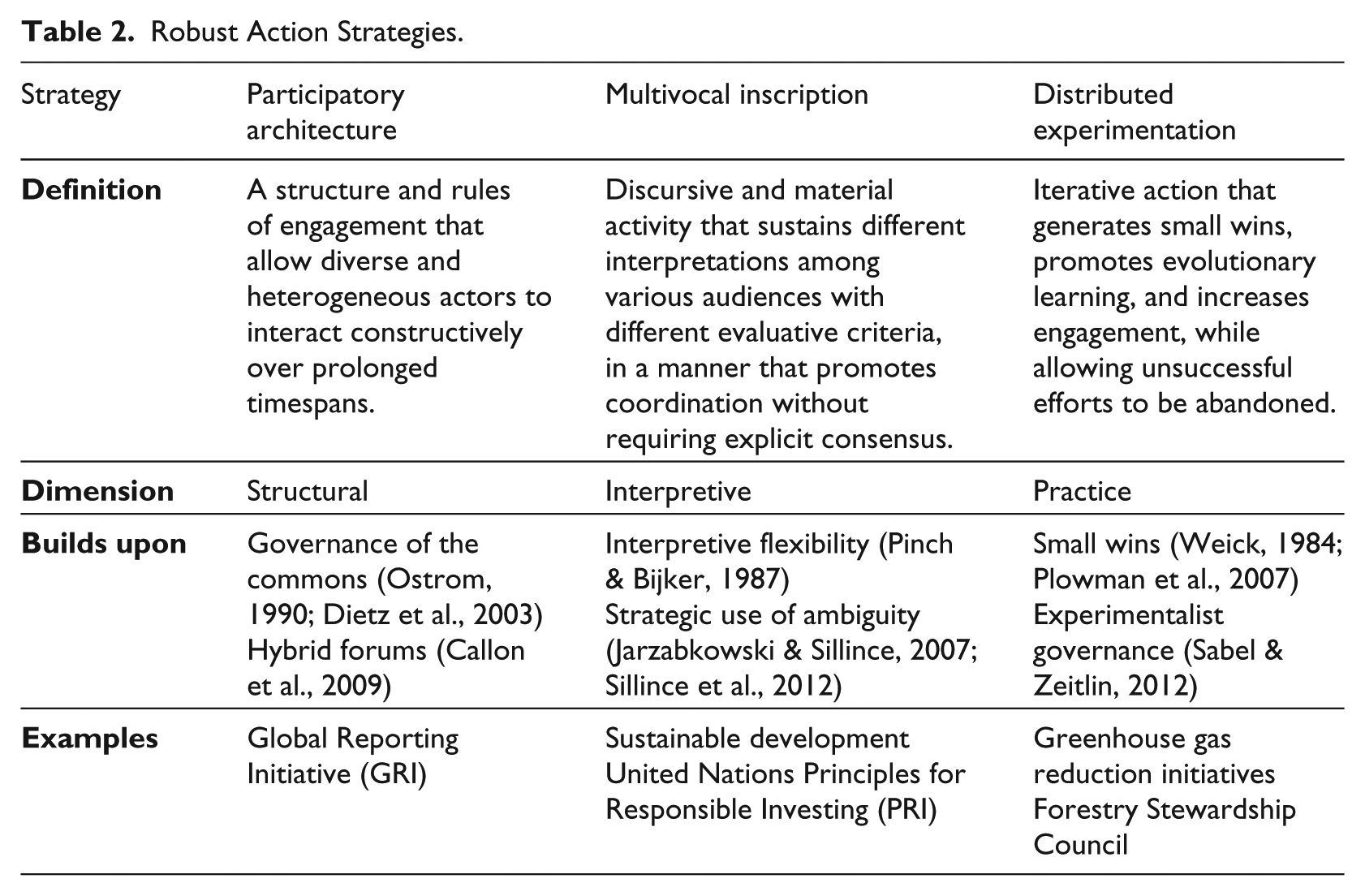
We theorize that these outcomes are facilitated through the establishment of a participatory architecture, the design and diffusion of multivocal inscriptions, and the pursuit of distributed experimentation. Jointly, these strategies allow novelty to emerge even as action unfolds, interdependencies are discovered, and actors refine their understanding of the issues and their stakes. In this way, robust action does not prematurely terminate potential pathways to success, but fosters sustained engagement along multiple, distributed paths of action, increasing the probability of positive field-level outcomes.
Participatory architecture
As noted by the CEO of Unilever, even when undertaken by large and powerful entities, unilateral action cannot contribute dramatically to the resolution of grand challenges. For organizations interested in addressing grand challenges, a requisite first step is therefore the organization of participation, or the establishment of a participatory architecture, which we define as a structure and rules of engagement that allow diverse and heterogeneous actors to interact constructively over prolonged timespans. Given their complexities, uncertainties, and evaluativities, successfully addressing concerns such as climate change and other forms of environmental degradation requires the participation of scientists, local communities, consumers of resources, and other vested populations (Dietz et al., 2003; Ostrom, 1990).
The greater the complexity and interdisciplinarity of a challenge, the greater the number of concerned stakeholders (Callon, 1998; Freeman, 1984). This simultaneous emergence of concerns and stakeholders is consistent with Dewey’s (1933) insight about the relationship between problems and solutions. Complicating matters, evaluative criteria vary among diverse stakeholders and may well be contested. To initiate and maintain distributed action when stakeholder priorities and worldviews are likely to be unaligned is no easy task. As in Leifer’s description of chess, initial engagement is perhaps not the difficult part – prolonged engagement is (see also Fligstein, 2001). And given the long-term horizon that grand challenges require, participatory architectures must facilitate the engagement of diverse stakeholders in a series of temporally and spatially interconnected events, thereby setting in motion an ongoing process.
Recognizing the importance of such participatory architectures, Callon and his colleagues (Callon et al., 2009) have proposed the concept of hybrid forums. 9 Hybrid forums provide an architecture, or a platform, that facilitates participation. They are considered hybrid because of the variety and heterogeneity of the actors involved and the different evaluative criteria with which they participate. Additionally, such venues are characterized by distributed authority, lateral accountability, mutual monitoring, and multiple justifications (see also Boltanski & Thévenot, 2006; Stark, 2009). In turn, these architectures create a space where actors can meaningfully engage with counterparts, even when relations between them are publicly adversarial (Bartley, 2007; Mair & Hehenberger, 2013). Successful examples suggest the need to devise sometimes intricate membership standards and rules of participation so as to ensure legitimacy, innovation, and meaningful interaction (Gilbert, Rasche, & Waddock, 2011; Mena & Palazzo, 2012).
Hybrid forums allow for participation in ways that are both similar to and different from participation in chess. As with chess, a robust strategy calls for ongoing engagement, both at any point in time, as well as over a prolonged period of time. Yet, from the point of view of a particular stakeholder, hybrid forums may at first glance appear to be battlefields, arenas for gaining and losing the upper hand. After all, questions about what is at stake, who counts, and how to proceed are all in the dock. But to the extent that hybrid forums become competitive arenas, then they will have failed. According to Verweij et al. (2006), what is needed for meaningful participation is for the “rules of the game” to permit or even require that diverse and heterogeneous actors take seriously the different types of stories that are in circulation, so that no voices are excluded, and any contestation is harnessed in constructive if “noisy” ways. Actors with divergent interests require a structure where they can interact and engage (Furnari, 2014). The key challenge for the focal actor is to prevent premature termination and to sustain engagement.
In other words, critical to the success of a particular participatory architecture is the ability to forestall disengagement, which can easily ensue in these contexts given the diversity of interests and concerns. The case of the Global Reporting Initiative (GRI) is instructive, highlighting the power of participation. This organization develops and maintains the standard for writing organizational sustainability reports. Even though its founders have far-reaching aspirations for promoting sustainability, primarily in the corporate world, they have consciously restrained themselves from articulating them explicitly. Instead, they have focused on engaging corporations, activists, NGOs, standard setting bodies, accounting organizations, and other stakeholders. The emphasis was not on reaching consensus, but on sustaining engagement, and in fact expanding the network of participants (Brown, de Jong, & Lessidrenska, 2009). In particular, the GRI invested, and continues to invest, considerable effort in designing, modifying, and staffing an intricate organizational structure comprised of elected and non-elected, technical, advisory, governance and oversight working groups, staffed with representatives from corporations, NGOs, investors, labor organizations, multilateral organizations, and research institutes. This elaborate, formalized, organizational structure ensures continuous engagement and enables meaningful collaboration at strategic and tactical levels (Etzion & Ferraro, 2010).
Multivocal inscription
Sustaining the engagement of participants at hybrid forums is important but does not in and of itself yield action. To guide action, scripts, routines, processes, norms, guidelines, or other inscriptions need to be developed. But if grand challenges are evaluative, how can inscriptions be designed in ways that will be acceptable to diverse participants? We argue that effective inscription must allow for multivocality, defined as discursive and material activity that sustains different interpretations among various audiences with different evaluative criteria, in a manner that promotes coordination without requiring explicit consensus (see also Furnari, 2014 on “multivocal symbols”).
Underlying multivocality is the notion that artifacts are interpretively flexible (Pinch & Bijker, 1987; see also Mody & Nelson, 2013 on “multivocal technologies”). In other words, meaning is not inherent to an artifact, but is constituted through an ecology of interactions between actors from different domains. The concept of “sustainable development” provides an example of multivocal inscription in the context of grand challenges (for reviews, see Ansell, 2011, pp. 54–60; Kidd, 1992). This concept was introduced in the World Commission on Environment and Development’s 1987 report Our Common Future. In the Brundtland report, as it is commonly known, “a conscious effort was made to conceptually link (and morally bind) environment and development” (Lafferty, 1999, p. 123). Key to the success of this concept has been its ability to enable different groups to interpret it in very different ways: sustainability “means so many different things to so many different people and organizations” (Robinson, 2004, p. 373). This multivocality in turn has provoked additional engagement, providing “some common ground for discussion among a range of development and environmental actors who are frequently at odds” (Sneddon, Howarth, & Norgaard, 2006, p. 254). It has proven highly useful in a complex, evaluative context.
The notion of multivocal inscription also is apparent in work by Mary Douglas and her colleagues who advocated for climate change policies that “creatively combine all opposing perspectives on what the problems are and how they should be resolved” (Verweij et al., 2006, p. 817). “Only innovative combinations of bureaucratic measures, risky entrepreneurship and technological progress, as well as frugality and international solidarity, can be successful” (Verweij et al., 2006,p. 829). By comparison, these scholars concluded that the Kyoto Protocol failed precisely because it offered “merely a single way of perceiving the problem of climate change” (Verweij et al., 2006, p. 829). Importantly, multivocal inscription allows for flexible ways of organizing, perceiving, and justifying social relations.
This view is not limited to cultural sociology; political scientists and organization theorists too recognize the power of multivocal inscription, notably in the literature on ambiguity (Cohen & March, 1974; March & Olsen, 1976; Page, 1976). A recent review of the literature on ambiguity in political science concluded that “the political view of ambiguity is one of appreciation and even admiration” (Gioia, Nag, & Corley, 2012, p. 366). In organization theory, a number of studies have demonstrated how ambiguity facilitates the diffusion of organizational forms and practices. Jarzabkowski and Sillince (2007) showed how university managers rhetorically constructed academic values in discussing multiple goals associated with teaching, commercial activities, and research: “Ambiguity can be rhetorically constructed by actors to align particular actions with the interests of different audiences and persuade them to take part in those actions” (Sillince, Jarzabkowski, & Shaw, 2012, p. 633). Similarly, Eccles and Nohria suggested that: effective rhetoric aims to be clear but never too clear. It aims to be robust across as many different situations as possible, and to be flexible enough to incorporate the different meanings, emphases and interpretations that different people will inevitably give to it. (1992, p. 35, emphasis in original)
In the context of grand challenges, the ideas of multivocal inscription are evident in the United Nations-supported Principles for Responsible Investment (PRI), in the sense that they introduce the possibility of new evaluative criteria without requiring the dismantling of prevailing practices: As institutional investors, we have a duty to act in the best long-term interests of our beneficiaries. In this fiduciary role, we believe that environmental, social, and corporate governance (ESG) issues can affect the performance of investment portfolios (to varying degrees across companies, sectors, regions, asset classes and through time). We also recognise that applying these Principles may better align investors with broader objectives of society. (http://www.unpri.org/about-pri/the-six-principles/)
By referring to both fiduciary duties and the alignment of investing practice to societal interests, PRI harnesses multivocality to appeal to both mainstream investors and to governments and NGOs concerned about realigning the financial system with broader societal needs.
In other words, multivocal inscriptions allow coordination within and between multidisciplinary communities with different evaluative criteria, without requiring explicit consensus (Bechky, 2003; Bowker & Star, 1999; Mody & Nelson, 2013). To the extent that these designs invite multiple plausible interpretations, they foster connections with new problems not originally envisioned during their creation, and support the participation of still more stakeholders (Beunza & Stark, 2004; S. Kaplan, 2011). In this regard, multivocal inscriptions promote enrollment of others into the game, and invite new moves to be made.
Distributed experimentation
Given their complexities, uncertainties, and evaluativities, there are potentially multiple solutions to grand challenges. Accordingly, there is no way of knowing in advance how best to proceed. And yet, consistent with a pragmatist perspective, action must be taken (Ansell, 2011). In circumstances such as these, actors rely on what pragmatists term “abductions,” in which plausible explanations are inferred from specific observations and general principles (Bartel & Garud, 2003; Mantere & Ketokivi, 2013). We conceptualize such interventions as distributed experimentation: iterative action that generates small wins, promotes evolutionary learning, and increases engagement, while allowing unsuccessful efforts to be abandoned.
Distributed experimentation is evident in the plethora of local efforts to reduce greenhouse gas (GHG) emissions in the United States. Even as the US has been criticized as lacking a top down commitment to reducing GHGs, when viewed from the “bottom up” there are numerous state and regional policy initiatives; in other words a large number of distributed experiments. Remarkably, “[t]he realization of all existing subnational initiatives, as of September 2007, could stabilize US emissions at 2010 levels by the year 2020” (Lutsey & Sperling, 2008, p. 673). According to Lutsey and Sperling’s analysis, local policies are often more innovative and more responsive to local environmental preferences and economic circumstances. At the same time, those at the forefront provide examples for resource-constrained or less innovative local and state governments to learn from, or emulate, “in a cascading process” (Lutsey & Sperling, 2008, p. 682).
Moreover, distributed experiments such as regional climate change policies have opened up new spaces for public discussion about sustainability at the local level, and have expanded the range of stakeholders involved, meaning that participatory architectures were extended as a result of experimentation. Achieving beneficial local outcomes activates a positive reinforcing cycle of small wins: “Once a small win has been accomplished, forces are set in motion that favor another small win. When a solution is put in place, the next solvable problem often becomes more visible. This occurs because new allies bring new solutions with them and old opponents change their habits. Additional resources also flow toward winners, which means that slightly larger wins can be attempted” (Weick, 1984, p. 43; see also Plowman et al., 2007; Reay, Golden-Biddle, & Germann, 2006). In other words, iteration, repetition, and continuous learning help maintain engagement and pursue additional experimentation (Dietz et al., 2003; Simon, 1996).
Experimentation can also be highly generative of novel institutional arrangements. Bartley (2007) emphasized the importance of generativity in his study of the emergence of private transnational regulation regimes to address global social and environmental challenges. In both the cases he studied, the Forestry Stewardship Council and the Fair Labor Association, he found evidence that the experiments that resulted from multivocal inscriptions produced by participatory architectures led to innovative institutional arrangements: No set of actors would have chosen, ex ante, precisely the set of arrangements [for forest certification] that emerged. This is not to suggest that certification was a politically neutral compromise … This conflict was not a simple contest among equals [governments, business and activists], but it was generative of an innovative and politically charged institutional form. (Bartley, 2007, p. 301)
When experimentation occurs on a distributed basis, it is “possible to analyze, design, and implement a variety of alternative solutions simultaneously” (De Young & Kaplan, 1988, p. 276). This means that as experiments proliferate, there is the possibility of combining different prototypical solutions in ways that complement their differential strengths and weaknesses. For instance, as described above, there are now a wide number of jurisdictions that have experimented with market-based, tradable environmental allowances as a way of limiting environmental withdrawals or emissions and permitting trading of allocated allowances (Callon, 2009; Lutsey & Sperling, 2008; MacKenzie, 2009). At the same time, we now understand some limits of these programs, such as failing to protect any resources not explicitly covered by the trading rules. Whereas simple strategies that rely on a single or centralized governance approach can result in catastrophic failures, when combined into nested and overlapping arrangements, the result is increased redundancy and resilience (Dietz et al., 2003).
Of course, not every experiment will prove successful, at least not in real-time. This could be because the experiment has gone “wrong” in the sense that it failed to deliver the hoped for results. Or the experiment itself can lead to the emergence of new and previously unidentified concerns. For instance, the emergence of carbon markets has prompted various controversies as to the ways in which these markets are organized, the calculative devices used to value carbon, and the role that markets should play vis-à-vis alternatives such as regulatory measures or technology research (Callon, 2009). But such “overflows” may be an asset, as they frequently provoke stakeholder participation and increase the multivocality of any solutions that are proposed, thus potentially inaugurating another cycle of robust action. Sabel and Zeitlin (2012, p. 175) refer to this as experimentalist governance, “based on the reciprocal redefinition of ends and means through an iterated, multi-level cycle of provisional goal-setting and revision,” aligned with the pragmatist understanding of problems and solutions as conjoined and inseparable.
A model of robust action
In sum, participatory architecture, multivocal inscription, and distributed experimentation are potentially powerful strategies for tackling grand challenges. Participatory architecture provides a means for creating the necessary structure and involvement of diverse actors, and fosters long-term engagement. Multivocal inscription provides the discursive and material activity required to sustain engagement even when consensus is unlikely to be attained. And distributed experimentation ensures that learning and generativity are repeated continuously, based on both successes and failures of a variety of initiatives.
The three strategies are complementary, creating outcomes not attainable if pursued independently. The incremental advances that experiments yield can be interpreted in multiple ways – multivocally – giving different stakeholders the ability to perceive, and declare, successful outcomes. Distributed experimentation, coupled with multivocality, thereby helps reduce the risk of disengagement, which can easily ensue in these contexts given the diversity of interests and concerns, thus keeping the architecture intact. Participation of diverse actors helps increases the potential for novelty to emerge and more experiments to be carried out.
Of course, these strategies do not directly resolve grand challenges. From a pragmatist perspective, robust action sparks a process of evolutionary learning that contributes to the discovery and production of new understandings and novel alternatives, pursued not independently and autonomously, but rather in a distributed fashion. When linked together in an ongoing process, the three strategies are resilient and adaptive in the face of changing dynamics, divergent and evolving preferences, and heterogeneous criteria of worth (for an overview of our model, see Figure 1). Rather than reaching some final conclusion, the process fosters repeated participation, inscription, and experimentation, continuously generating novelty and sustaining engagement.
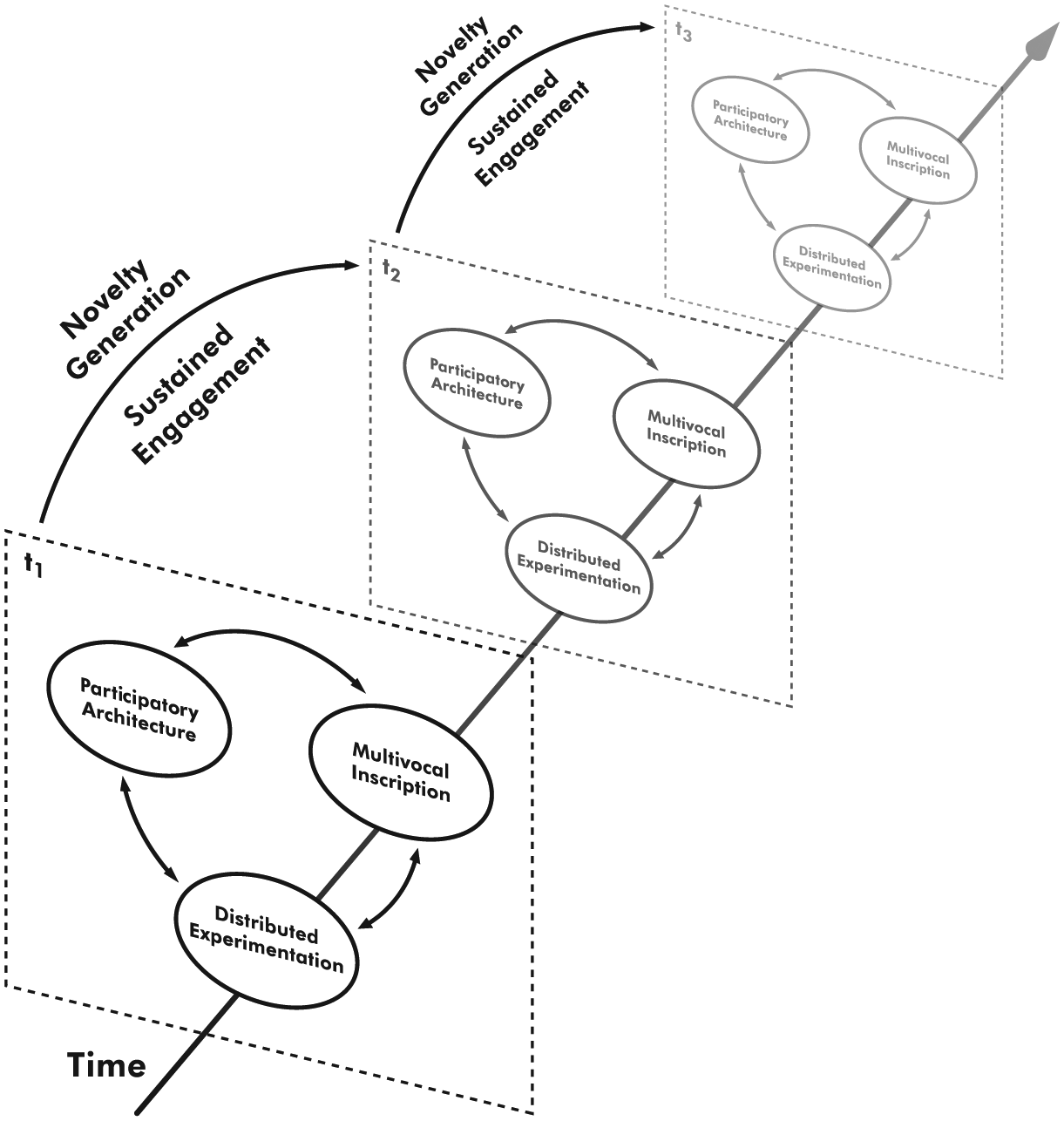
Theoretical Model of Robust Action Strategies.
Discussion
We started this article by noting the growing interest in grand challenges. Analytically, we proposed that such problems entail complexities, uncertainties, and evaluativities. To address these challenges, we introduced pragmatism as a theoretical toolkit capable of conceptualizing the processes whereby situated actors engage in distributed problem solving. Building on a pragmatist perspective, we revisited how robust action strategies might allow organizations to contribute to tackling grand challenges. Specifically, we proposed three robust action strategies: participatory architectures, multivocal inscriptions, and distributed experimentation.
These robust action strategies raise several questions, which we reflect upon in this section. First, we consider how our work contributes to the literature on robust action. Second, how does a robust action approach extend and enrich academic research on grand challenges? And third, there is a question of effectiveness: how can those involved know whether their efforts are working?
Contribution to the literature on robust action
Our work contributes to the literature on robust action (Hargadon & Douglas, 2001; Leifer, 1991; Padgett & Ansell, 1993) in several ways. First, our recasting of robust action in a pragmatist light helped us go beyond the structural flavor of Padgett and Ansell’s (1993) well-known treatment of the concept, in which they emphasized network conditions that enable robust action – essentially brokerage (Burt, 1992; Hargadon & Sutton, 1997; Obstfeld, 2005) positions across multiple network domains. Even in their most recent work, Padgett and Powell (2012, p. 25) retained an actor-centric structuralist approach, describing multivocality as “the tactical capacity of robust-action brokers to sustain multiple attributions of identity through uttering sphinx-like statements that plausibly can be interpreted in multiple ways.” In contrast, our analysis has delved more deeply into what robust action means in terms of fostering participation and engagement, particularly at the organizational, and not just individual level.
Our second contribution was to demonstrate novel ways in which actors can nurture multivocality, other than through mere utterances. Building on work such as Hargadon and Douglas (2001), Pinch and Bijker (1987), and Furnari (2014), we have shown how multivocality is both social and material (Mody & Nelson, 2013; Orlikowski & Scott, 2008; Pickering, 1995). Accordingly, robust action is not limited to discourse, but can entail a variety of inscriptions, in the form of texts and artifacts, that sustain multiple interpretations. For researchers, this opens up new questions about the role of multivocal artifacts, and with it, draws attention to the need for methods suited to tracing how these artifacts and their meanings are transformed over time.
Our third contribution was to identify commonalities between actor-centric research on robust action (e.g., Eccles & Nohria, 1992; Padgett & Ansell, 1993) with the research on socio-cognitive systems (e.g., Hutchins, 1990; Weick & Roberts, 1993). The former emphasizes strategic choices that enable success in the face of adversity, whereas the latter examines the ways in which collective action can incorporate novelty and remain “on track” in uncertain environments. Starting from this expanded understanding of robust action, we were able to build a theoretical foundation for exploring how individual and organizational action can instigate and promote system level changes, precisely of the type required for tackling grand challenges.
Advancing research on grand challenges
Our application of robust action can help address one of the shortcomings of the dominant theoretical perspectives on corporate responses to grand challenges: stakeholder theory (Freeman, 1984). Organizational theorists have noted that stakeholder theory suffers from a certain naïveté in dealing with “the political, ideological and cultural challenges involved in creating and sustaining cooperation in any complex, pluralistic organization” (Kraatz & Block, 2008, p. 264). Robust action does not shy away from the contentiousness inherent in grand challenges, and can help researchers working in the stakeholder tradition to better fathom governance processes applicable to these contexts. Furthermore, to the extent that stakeholder theorists have examined grand challenges, they have done so primarily from the perspective of corporations that interact with stakeholders; our approach, in contrast, suggests that corporations need not necessarily be prioritized as the focal organizations; these also can be governments, communities, NGOs, or any other entity. Taking a distributed approach to stakeholder theory could help researchers better understand current developments in the governance landscape, both at the national and transnational level (Bruszt & McDermott, 2014; Djelic & Sahlin-Andersson, 2006; Sabel & Zeitlin, 2012), as well as the growth of private regulatory initiatives and cross-sector partnerships (Bartley, 2007; Koschmann, Kuhn, & Pfarrer, 2012; Mair et al., 2012).
Indeed, by shifting attention away from the corporation as the locus of attention, we open up additional paths for how corporations can contribute to tackling grand challenges. As quoted in our epigraph, Paul Polman, CEO of Unilever, has noted how solutions to grand challenges will necessarily involve individuals, companies, governments, and institutions. Perhaps unintentionally, this view resonates with arguments set forth by Gerald Davis following the financial crisis of 2007–2008, according to which, increased financialization and decentralization of the global economy is leading to the demise of the public corporation (Davis, 2010) and the ascendance of local forms of organizing (Davis, 2013). We concur on the need to rethink how to conceptualize the role of large corporations in this network of action. Rather than assuming they are the nexus of agency, organizations and organizational scholars require new ways of understanding how corporations are involved in and engage with larger systems and issues. In this regard, our conceptualization of robust action shares an affinity to research that integrates sustainability and complexity theory (Gladwin, Kennelly, & Krause, 1995; Senge, Smith, Schley, Laur, & Kruschwitz, 2008), and highlights the importance of inclusiveness and engagement (Ostrom, 1990), while resonating with institutionalists who de-emphasize the role of heroic actors (Battilana et al., 2009; Seo & Creed, 2002).
Finally, robust action, and particularly the notion of multivocal inscription, suggests that the continued emphasis on persuading audiences, and the general population, with compelling facts about sustainability, may be misguided (Kronrod, Grinstein, & Wathieu, 2012; Norgaard, 2011). Such rhetoric and attempts at suasion often conflict with strongly held beliefs and normative positions, and in fact succumb to them (Kahan, 2014; Maibach et al., 2012). The robust action strategies we identified follow a pragmatic approach to tackling grand challenges, inspiring local and situated responses without requiring consensus on either means or ends.
Multiple orders of worth
The three robust action strategies also raise questions about how to track progress and measure success in the context of grand challenges. At the most basic level, robust action strategies call for embracing multiple performance indicators, explicitly rejecting commensuration and its attendant attributes of simplicity and accountability (Espeland & Stevens, 1998). As such, robust action shares an affinity with the problematization of simple metrics for tracking performance highlighted in the strategy and accounting disciplines (Hamann, Schiemann, Bellora, & Guenther, 2013; R. S. Kaplan & Norton, 1996; Venkatraman & Ramanujam, 1986).
More demanding, and perhaps more applicable to grand challenges, is the insight that progress and success must be tracked and measured using multiple accounts of worth (Boltanski & Thévenot, 2006; Stark, 2009). Because of their participatory, multivocal, and distributed constitution, grand challenges are likely to generate value in multiple registers. Clearly commensuration is unattainable in these contexts, but these contexts draw attention to the possibility that incommensurability could even be an asset to cultivate and highlight. For example, Lamont (2012) has argued that differential valuation can help sustain heterarchies. Conversely, Huault and Rainelli-Weiss (2011) demonstrated how the creation of a market for weather derivatives was hindered by simple commensuration, because it brought into stark relief the incompatibility of competing metrics of worth, associated with distinct institutional logics.
Here, our theorization suggests it may be worthwhile to link grand challenges explicitly to recent work on institutional complexity and the consequences of multiple institutional logics (Greenwood, Díaz, Li, & Lorente, 2010; Greenwood et al., 2011). According to this literature, organizations are embedded in multiple normative orders, which foster incompatible prescriptions (Lounsbury, 2007; Marquis & Lounsbury, 2007) and generate “persistent and deep-rooted tensions within the organization” (Kraatz & Block, 2008, p. 243), potentially leading to divisiveness (Almandoz, 2012), paralysis (Pache & Santos, 2010), and resistance (Marquis & Lounsbury, 2007). Whereas this literature tends to see plurality and complexity as problematic (Besharov & Smith, 2014), our account suggests that in tackling grand challenges multiple logics are likely to be beneficial and generative. To adequately mirror and encapsulate the complexity inherent in grand challenges, the institutional environment may well need to be proportionately complex. The ability to manage and navigate institutional complexity is perhaps a necessary organizational competency for engagement in grand challenges. A better understanding of how packages or configurations of logics support or thwart robust action strategies would seem to be another promising research direction.
Conclusion
American pragmatism developed in the aftermath of the tragic experience of the Civil War, and perhaps it is no surprise that it is enjoying a revival in recent years, given the need we have to rethink how we act in a world characterized by deeper complexity, uncertainty, and evaluativity (Menand, 2001). Resonating with this sentiment, our field has witnessed a recurrent, insistent, rallying cry to become more involved in tackling the world’s most intransigent problems. 10 In harnessing our knowledge and skills to contribute to solutions, given the urgency of the problems and the evident need to make a lot of progress, quickly, it is perhaps alluring for scholars to espouse simple, straightforward management panaceas, particularly those that are effective for managing individual organizations. We have argued that grand challenges are different, requiring a different set of tools and perspectives than the standard tools that we use and teach (Cabantous, Gond, & Johnson-Cramer, 2010; Jarzabkowski & Kaplan, 2014). In revisiting robust action, and applying it to the pursuit of grand challenges, we advocate for an approach that is more participative and less heroic; more ambiguous and less prescriptive; more experimental, and less directive; perhaps less intuitive, but hopefully more effective.
Footnotes
Acknowledgements
The authors contributed equally to this research. For their comments on earlier drafts of this paper we thank Shaz Ansari, Irene Beccarini, Daniel Beunza, Marie-Laure Djelic, Matthew Grimes, Johanna Mair, Guido Palazzo, Tom Vandebroek, and Marc Ventresca. An early version of this paper was presented at the Richard Ivey School of Business.
Funding
The first author gratefully acknowledges funding from the European Research Council under the European Union’s Seventh Framework Programme – ERC-2010-StG 263604-SRITECH.