



Abstract
The first quarter of the 21st century is witnessing an efflorescence of right-wing populism that is flourishing in a period of heightened precarity, global trauma, anxiety, and gross inequalities. One branch of right-wing populism, neoconservatism, aims to restore patriarchy; entry into organizations would help it achieve those ends. This article uses an extreme case study of a profession in which chauvinism flourishes to examine organizations’ receptivity, at “shop-floor” level, to neoconservative political ideologies and the restoration of patriarchy as an entry-route. Using Judith Butler’s work and psychoanalytical theory for theoretical inspiration we develop a theory of “chauvinizing”—that is, the performative constitution of chauvinism. This incorporates a contrast between “old” and “new” chauvinism and the conscious and unconscious allure of misogynistic practices to practitioners. We argue that chauvinizing practices may offer neoconservatism both a means of entry into organizations and opposition to its infiltration. This article contributes to political organization studies an understanding of how organizations may be permeated by unwelcome political activities, and a warning for organizations of the need for both wariness and strategies of resistance.
Keywords
Introduction
Neoliberal intensification of precarity (Moore & Robinson, 2016) and redistribution of income from the poorest to the highest paid (Piketty, 2014) has produced anxiety and global trauma (Butler, as cited in Lempinen, 2022) that is exploited by a protean right-wing populism (Fischer, 2020) that encompasses new- or neoconservative politics. This increasingly influential politics challenges both traditional and left-wing liberalism. The well-funded “National Conservativism” in the United Kingdom, for example, espouses traditional Christian values, is anti-globalist, and is radically opposed to identity politics (see https://nationalconservatism.org for insights). Our particular interest is its strategies that focus on “the family” and the return of “the housewife,” and hence the reinstatement of patriarchy (Butler, 2022). Misogyny, by which is meant the desire to limit women’s freedom and keep them away from the public stage (Benn & Gaus, 1983), is integral to this masculinist political project; they are so closely intertwined that neoconservatism in some ways rests on chauvinism. 1 Should neoconservatism penetrate into organizations via the entry-point of a receptive chauvinism, it could not only threaten the achievements of hard-won battles for equity, diversity, and inclusion (EDI), but also challenge organizations and organizational cultures more generally.
This article therefore aims to gauge the receptivity of organizations to the renascent chauvinism of neoconservatism. It does this through using an extreme case study (Eisenhardt, 1989; Eisenhardt et al., 2016) of points of entry that may facilitate the infiltration and spread of this regressive politics. The #MeToo movement highlighted misogyny’s continuing prevalence in some corners of organizations, locations that may offer a sympathetic hearing to neoconservatism’s anti-feminist arguments. Our case study explores how such pockets of chauvinism may make organizations susceptible, or not, to neoconservatism’s spread. It aims, therefore, to explore how vestiges of chauvinism in organizations may lead them, albeit unknowingly, to foster the growth and negative effects of neoconservatism, while at the same time opening pathways for resistance.
Achieving these aims requires understanding of the forms chauvinism takes in contemporary organizations. To do this, we draw on Judith Butler’s work and explore the performative constitution of chauvinism and the influence of the psyche in that constitutive work. Our extreme case study’s focus is on chauvinism’s operation in the lower tiers of organizations—“the shop floor”—that may or may not be more vulnerable than other parts of organizational hierarchies to the insidious spread of neoconservative strategies. We ask:
How is chauvinism performatively constituted in those corners of organizations where it flourishes?
What sustains its continued presence in organizations despite 50 years of attempts to eradicate it?
In what ways might this continued presence facilitate neoconservative politics’ infiltration into organizations?
We establish the context for this study by exploring the history of organizational chauvinism and how it slowly became taboo. We find that the libidinal energy of breaking that taboo enlivens contemporary chauvinism but also undermines it. We conclude that contemporary chauvinism takes the form of an invigorated “new” chauvinism that incorporates unconscious fantasy and desire and offers fertile ground in which neoconservatism may grow. However, the situation is complex and neoconservatives may not find their entry unimpeded—there is space for resistance.
This article therefore contributes to what could be called “political organization studies”—that is, an endeavor to understand organizations within their wider political contexts. We join scholars who, perhaps spurred by Tourish’s (2017, 2020) critique of the isolationism of management and organization studies (MOS), and accusations that organization theorists do little more than handwringing about political influences (De Cleen, Glynos, & Mondon, 2018), are starting to bridge the politics/organizations divide (see also O’Doherty, De Cock, Fernandez, Durepos, & Scully, 2023). Kerr, Robinson, and Sliwa (2024), for example, offer powerful insights into how right-wing populism is organized, while other MOS scholars show how neoliberalism’s reach is limited because it provokes resistance from feminist social movements (Fotaki & Daskalaki, 2021), and may not only fail to achieve its aims (De Coster & Zanoni, 2023) but also can foster the imbrication of resistance in the texture of workers’ lives (Sanson & Courpasson, 2022). Rhodes (2021), meanwhile, analyzes the subordination of progressive politics to profit-making purposes.
Our contribution to political organization studies involves building on the few studies of neoconservatism in MOS. The dangers of this political philosophy’s legitimation of “alternative organizational facts” has been shown by Knight and Tsoukas (2019) while De Cock, Just, and Husted (2018) demonstrate its capacity to exploit the trauma and suffering that saturate ordinary working lives. We contribute an analysis of how organizations may become recruiting grounds for this “restoration project” of reinstating patriarchy (Butler, as cited in Lempinen, 2022).
We next discuss neoconservative politics and expand upon the study’s aims, before outlining chauvinism’s history and the Butlerian inspiration that guided our methodology and analysis.
Neoconservatism
Right-wing populism’s increasing influence cannot be underestimated: neoconservative politicians are now vying for or in power in the United States and across Europe and the United Kingdom (see the chapters in De Souza Guilherme, Ghymers, Griffith-Jones, & Ribeiro Hoffmann, 2021). Neoconservatism shares with neoliberalism an economically liberal agenda and belief in governance by market criteria (Brown, 2006). It differs in its anti-globalist desire to return to mercantilism, and its social conservativism—the restoration of “traditional family values,” qua the Christian, heterosexual, patriarchal family. It argues that battles for social justice are aberrant, extremist, and politically deviant (Green, 2023). It uses misogyny to demonize, silence, diminish, degrade, feminize, and devalue opponents, using the distortion of their ideas as a deliberate strategy for the exercise of power (Díaz & Valji, 2019; Dignam & Rohlinger, 2019; Nitasha, 2021). It thus espouses a “war on woke” that picks up and amplifies online “anti-woke” forums, legitimizing and bringing respectability to the hate speech circulating both online and, increasingly, offline (Ashcraft, 2022).
That is, neoconservatism’s vernacular counterpart is an uncouth sibling nurtured in the “manosphere” (Ashcraft, 2022), online forums that host reactionary political movements. The manosphere’s anti-feminist men’s movement spreads pernicious hate speech that promotes misogyny (hatred of women) and portrays white men as victims of “gynocracy” (political supremacy of women) (Bates, 2019). Its chauvinism increasingly permeates offline groups, societies, and organizations (Nagle, 2017). For example, female teachers in the United Kingdom face verbal harassment by teenage boys influenced by the American-British “Internet personality” and avowed misogynist Andrew Tate (Safer Schools, 2023). Counter-terrorism officers are concerned by the “emerging risk” presented by online misogynistic groups. 2 Neoconservatism and the “manosphere” are two sides of the same coin, differing in the feeling, tone, and intensity of their language but not in their over-arching philosophy. There is a danger that these movements’ culture war discourse may seep into organizations, thereby “abnormalizing” social justice struggles against sexism, racism, ableist, and LGBTQIA+ struggles (Cammaerts, 2022), amongst others.
Neoconservative politics is manifested through misogynistic, chauvinistic discourses articulated in both formal speech and the Internet’s demotic language. Its adherents are engaged in an energetic “restoration project” whose final aim is the re-establishment of patriarchy (Butler, 2022). As De Meco and MacKay (2022, n.p.) point out, neoconservatism threatens to “change social norms by providing new strength to misogynistic language and narratives that had been latent in society, disseminating and normalizing them at scale.” What is not known is how receptive might organizations be to this political revivification of discredited attitudes. That problem guides this study.
Our contention, following accumulating knowledge of the performativity of organizational language/discourses (e.g., Butler, 1990, 1993) is that insight may be found in the performativity of neoconservative “anti-woke” or hate speech. As indicated above, our study examines the potential of organizations to foster the growth and spread of neoconservatism—that is, their receptivity to this form of politics. Our motivations arise from our own struggles against chauvinism and homophobia, and our experiential knowledge of the difficulty of expunging such language when it is part of the everyday organizational quotidian. The language that demeaned and offended our younger selves, resurgent in neoconservatism, circulates in extant pockets of chauvinism within some organizations. These offer convenient locations for empirical study. Our empirical materials come from a case study of one such location, the profession of software development (Harvey, 1997; Tapia, 2006). To engender insights into organizational receptivity to neoconservative politics, we aim to generate theory from the particular (a case study) (Yin, 2018). We seek philosophical inspiration in Butler’s work that guides our interrogation of “violating interpellations” (Butler, 1997a, p. 49) of political hate speech.
Our contributions are threefold. The first, to political organization studies, is a theory of organizational receptiveness to neoconservatism. The second, to feminist organization studies, is a theory of the performative constitution of chauvinistic misogyny. The third, to methodology, is development of a Butlerian approach to data analysis. We next discuss chauvinism and misogyny before turning to this study’s empirics.
Chauvinism and Misogyny
Organizational actors may be unfamiliar with the chauvinism that permeated organizations less than 50 years ago (Ford, Atkinson, Harding, & Collinson, 2020) and unaware of its violence. Its norms, often veiled or masquerading as “common sense” or “in the interests of the family,” now celebrated by neoconservatism, reduced women to receptacles for producing the next generation. This is echoed today in the United States’ overturning of the right to abortion and thus women’s control of their own bodies (Butler, 2022). National Conservatism’s 2023 conference saw “rising star” U.K. Member of Parliament (MP) Miriam Cates give a plenary speech advocating that women should have more children to tackle an “existential threat” from falling population levels. Echoing policies espoused by Hungarian and Italian populist heads of state (Guardian, 15th May 2023), 3 she argued that spending money on women’s education militated against their role as child-bearers.
This reduction of women to bodies is chauvinistic. Defined as “believing that or behaving as if women are naturally less important, intelligent, or able than men,” 4 the term “male chauvinism” emerged in the 1970s and helped identify, label, and critique culturally embedded, centuries-long, taken-for-granted assumptions about women’s presumed inferiority to men. The word “chauvinist” was coined in France in the 1830s and was taken up initially in anti-racist and then feminist campaigns in the United States from the 1920s. Defined as “the patronizing assumption of male superiority” (Mansbridge & Flaster, 2007, p. 642), the term was recuperated in the late 1960s by second-wave feminists and soared in usage, becoming a “vogue” academic and political phrase. It entered the vernacular, circulating in everyday speech in the “world of micro-negotiations with husbands, boyfriends and bosses” (Mansbridge & Flaster, 2007, p. 642), before declining in use from the 1990s.
Today, the term “chauvinism” appears interchangeable with the more commonly used “misogyny”: both words share a troubled heteropatriarchal history and each resonates with the discrimination, disdain, fear, and loathing of masculine for feminine. We keep both words in play to prevent installation of a boundary between a seemingly past age of chauvinism and a present era of misogyny. That said, we emphasize a hitherto untheorized aspect of chauvinism, namely chauvinizing, in which elements of fantasy and desire contribute to chauvinism’s constitution, as we explain below.
Although made illegal through various governmental Acts, as a “behavior” male chauvinism continued to flourish behind organizations’ closed doors (Pullen & Vacchani, 2019). In public, however, legal restrictions and public recrimination meant the language through which its beliefs are articulated became unspeakable for 50 years—that is, it became taboo. By “taboo” is meant something forbidden that evokes strong emotional responses (Douglas, 1966; Imber, 2014) and moral outrage (Tetlock, 2003). Today, language and practices are punished that, 50 years ago, were regarded as “normal.”
Punishments include exclusion from, for example, universities (Jackson & Sundaram, 2020), the Metropolitan Police Service (Baroness Casey Review, 2023), and employment by trade unions (Carr, 2022; Kennedy, 2023; Monaghan, 2020). Perpetrators regularly find themselves in media storms (e.g., Blum, 2017; Ghosh, 2019). Most recently, the rich and influential hedge-fund manager Christopher Odey was removed from office for treating women as if they were his property, 5 and the future of an influential lobby group, the Confederation of British Industry, was jeopardized by accusations of sexual harassment against its chief executive. 6 Language and practices speakable and doable in organizations until quite recently are now punishable: they are taboo.
Neoconservatism breaks those taboos by reintroducing into circulation and normalizing language, if not practices, whose elimination had been hard fought for. We call this resurgent chauvinism “new,” in contrast to “old” chauvinism. The latter involved younger generations’ challenge to an older age cohort of moral and cultural conservatives; today, moral and cultural conservatives challenge radicalism. Their language may not contain explicit chauvinistic statements, but its chauvinism is identifiable by its indirect, elusive inferences: for example, Cates implies but does not state that women “belong in the kitchen.”
In contrast, online forums that echo the “anti-woke” agenda of right-wing conservate politics use overtly chauvinistic language. In the “manosphere” (Ging, 2019), online communities foster what Menzie (2022) calls a “new wave of misogyny.” Here, radical misogyny (Ashcraft, 2022) meets a love of transgression for its own sake (Nagle, 2017). It is perhaps ironic that contemporary information technologies provide platforms for revivifying ancient, seemingly outdated, attitudes, but they host groups such as “incels” (involuntary celibates) that espouse open hatred of women and believe men are victimized by a gynocentric order (Chang, 2020). The “Proud Boys” question women’s intellectual abilities (Stern, 2022) and articulate what Kitts (2021) describes as chauvinistic and toxic virility that resembles late-19th-century masculinism. The reach of online groups is vast, and their misogyny, racism, homophobia, and anti-Semitism are crossing from online into non-digital realms 7 where they meet neoconservatism’s political rationale for misogyny (Abi-Hassan, 2017), hatred (Hochschild, 2016), and demonization of minority populations (Judis, 2016) and women (Dietze & Roth, 2020). The revalorization of stay-at-home housewives is fundamental to neoconservatism’s desire to return to an older order (Kitts, 2021).
This necessarily brief account emphasizes the need for concern about neoconservatism’s resurrection of a destructive language that took decades to (seemingly) extinguish and for which organizations may become crucibles for forging and strengthening neoconservatism. We turn next to our empirical study that explores contemporary organizational chauvinism and how it may or may not offer a point of entry to neoconservatism.
The Study: Theoretical Location, Methodology, and Methods
Theoretical location
We explore an organizational corner from which chauvinism has never been eradicated to understand organizations’ receptiveness to neoconservatism. We use a qualitative case study and apply Butler’s theory to our data analysis. Butler is a thinker whose writing and speeches, despite their complexities and difficulties, “spark something precious, something resonant” (Kenny 2021, p. 1665) amongst MOS scholars. Borgerson’s (2005) ground-breaking introduction of Butler’s work to the discipline has been followed by an ever-increasing number of “Butlerian” papers: a literature search in only three MOS journals using the search term “Judith Butler” in March 2023 produced 140 references, 8 58 of them in this journal alone. This study therefore contributes to a vibrant field to which it is impossible to do justice in a short article, especially given the breadth and depth of the analysis of that work in Melissa Tyler’s (2020) recent book. We draw primarily on four aspects of Butler’s (1990, 1993) work; the theory of performativity with which they 9 are arguably most associated; their extension of a Hegelian theory of recognition (Butler, 1997b); a much less cited theory of how words can injure and even threaten survival (Butler, 1997a); and their emerging work on right-wing populism (Butler, 2022; Lempinen, 2022). These together form a cumulative body of thought.
Briefly, Butler’s (1990, 1993) theory of performativity challenges the metaphysical presumption of the given-ness of structures such as gender, markets, “the economy,” etc. They appear to be but are not “singular and monolithic”; they are performatively constituted through moment-to-moment movements that present an “effect” or illusion of solidity (see, for example, Gond, Cabantous, Harding, & Learmonth, 2016a, 2016b; Harding, Ford, & Lee, 2017; Hodgson, 2005; Kelan, 2009; Kenny, 2010b; Tyler & Cohen, 2010). Thus, gender is not something one “is” but something one constitutes, from moment to moment, “instructed” by norms and discourses into which one was born. Secondly, in developing a Hegelian theory of recognition, Butler moved the focus from individual subjects into the performative constitution of the self within and through interactions with others within a social world (see Fotaki & Harding, 2017; Tyler, 2020). That is, ‘our very sense of personhood is linked to the desire for recognition, and that desire places us outside ourselves, in a realm of social norms that we do not fully choose, but that provides the horizon and the resource for any sense of choice that we have’ (Butler, 2004, pp. 33–34; for a detailed discussion of ek-stasis see Kenny, 2010b). The self cannot exist without others.
Finally, we draw on the politics that inform Butler’s work throughout: how individuals or populations can be denied the status of “the human.” In 1992, writing with Joan Scott, they asked: Who qualifies as a “subject” of history, a “claimant” before the law, a “citizen”? Indeed, what qualifies as “reality”, “experience” and “agency”, “the unified self”, the “materiality of bodies”, the domain of “ethics” and, indeed, of “politics”? Through what differential and exclusionary means are such “foundational” notions constituted? And how does a radical contestation of these “foundations” expose the silent violence of these concepts as they have operated not merely to marginalize certain groups, but to erase and exclude them from the notion of “community” altogether? (Butler & Scott, 1992, p. xiv).
This problematic informs their current explorations of right-wing populism, at the time of writing available only in interviews (Butler, 2022; Lempinen, 2022) in which they analyze the “phantasms” deployed in neoconservatism as “constellations of anxiety and hatred that take hold in language. They condense and simplify a complex terrain. This is not an analysis, or a reading or even a coherent set of claims. It is excitable speech, inflammatory rhetoric” (in Lempinen, 2022, p. 9).
That reference to “excitable speech” returns us to the book of that name (Butler, 1997a) whose interpretive power guides our analysis. It explores how words can injure, even threaten survival. Butler asks: “What would it mean for a thing to be ‘done by’ a word or . . . for a thing to be ‘done in’ by a word?” (p. 44). Injury is made possible, they answer, through our vulnerability to a language that is necessary for constituting a ‘tentative ontological status’ (p. 27). Being called a name is a necessary condition for that constitution. Addressees of injurious words, in the chauvinistic speech we explore, in responding to such “violating interpellations” identify themselves as its addressee (this is “me”), find subject-hood challenged, context or place in the community lost, and survival jeopardized.
Together, these four aspects of Butler’s work offer a theory of the vulnerability of subjects engaged in moment-to-moment “self-making” in a social world on which one is dependent and to which one is vulnerable. Below, we translate these ideas into a method of data analysis after first introducing our methodology.
Methodology: An extreme case study
The general taboo on chauvinistic speech makes it difficult to access. However, the software engineering profession, in which chauvinistic speech circulates freely (Tapia, 2006; Tassabehji, Harding, Lee, & Dominguez-Pery, 2021), provides a theoretical sample of a unique or an extreme case that makes “transparently observable” (Eisenhardt, 1989, p. 537) the otherwise unseen or, in this case, unheard. Extreme cases are by definition non-representative but their uniqueness facilitates examination of “signature situations in rich depth” (Eisenhardt, Graebner, & Sonenshein, 2016, p. 1118), allowing generation of insightful theory from rich data (Eisenhardt & Graebner, 2007). We therefore study the software development profession not as an object of study in itself but as an extreme case that helps link the chauvinism of neoconservatism with extant organizational practice. We do not imply that the profession is necessarily more receptive to right-wing politics than other professions, only that its misogynistic practices, like those hidden behind closed doors in other organizations, could offer a point of entry into organizations by political actors seeking places for infiltration.
Software developers write computer codes fundamental to enabling technologies to work. They provide more than half of organizations’ digital skills and are the highest-paid workers within the digital skills cluster (Nania Bonella, Restuccia, & Taska, 2019). Globally, 91.8% are male, 10 5.17% women, 1.67% LGBT++, and 1.65% not saying (Statista, 2023). Women’s representation fell, whereas it rose markedly in other professions (Howcroft & Trauth, 2008), with numerous strategies aiming to address this under-representation proving largely unsuccessful (Vaillshery, 2023), and the COVID-19 pandemic further derailing glacially slow progress (Sullivan-Hasson, 2021; Hupfer, Mazumder, Bucaille, & Crossan, 2021). The profession’s misogynistic culture is widely blamed for women’s exclusion (Adam et al., 2006; Tapia, 2006); its “bro culture” perpetuates an “exclusionary, monolithic, inflexible rhetoric” (Whitaker & Guest, 2020, n.p.) and practices “a regressive form of masculinity that seeks to return to the days when men could sexually harass women with impunity.” It rebuts any critical assessment of its sexist, racist, homophobic, and xenophobic bigotries with mocking and bullying (Thomas, 2021).
This profession offers an opportune site for a case study of the performative constitution of chauvinistic misogyny and its potential receptiveness to right-wing populist politics. In defying the general taboo on chauvinism it is mimetic of neoconservatism’s delight in its self-defined radicalism.
Methods: On interviews and their analysis
Interviews are the primary source of our empirical materials. In the feminist, post-structuralist approach we adopt, the researcher is not that distanced, objective, and powerful interviewer of traditional qualitative methods (Maclure, 2013) but a participant at a scene of recognition (between interviewing- and interviewee subjects) governed by norms and discourses (Butler, 1997b). There is contingency and non-mastery (Lather, 2013), and “no methodological instrumentality to be unproblematically learned” (p. 635). Our approach is thus post-qualitative, located in an ontology of immanence that resists being corralled within strict methodological boundaries (St. Pierre, 2021). In Butlerian terms, participants are asked to “give an account of themselves” but that account can only ever be partial: constituted within and through discourses and norms into which they are born, that both enable and control subjectivities (Butler, 1997b), many aspects of the self remain opaque or unknown (Butler, 2005). ‘My account of myself is partial, haunted by that for which I can devise no definitive story . . . my efforts at narrative reconstruction are always undergoing revision. There is that in me and of me for which I can give no account’ (Butler, 2008, p. 36) This does not nullify interviews as a research tool because they provide “linguistic fragments of something called a person” that, given close attention, can do justice to the speaker (Butler, 2004).
Fieldwork consisted of 24 one-to-one and 2 focus group interviews (10 members), 34 participants in total, with engineers from the United Kingdom and France. Table 1 gives details of participants.
Profile of Interviewees.
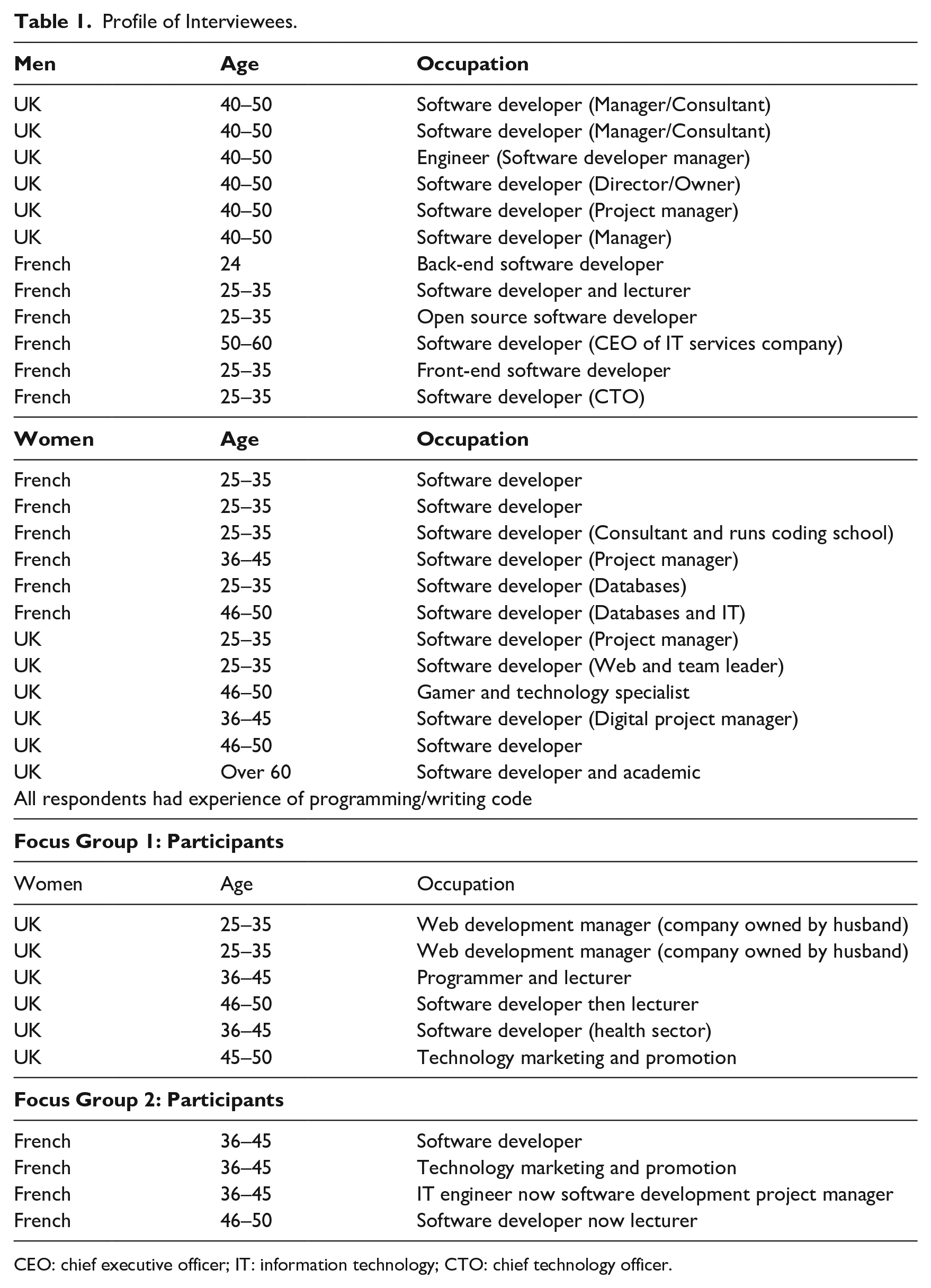
CEO: chief executive officer; IT: information technology; CTO: chief technology officer.
Fieldwork took place over 6 months in 2015 when the neoconservatism that undermines neoliberalism (Brown, 2019) was already burgeoning. Recruitment was through purposive and snowball sampling via personal and professional networks, websites, and professional events. Seeking depth rather than breadth of understanding, empirical materials from 34 participants were sufficient to decide “the data were saturated.” There were equal numbers of males and females in the one-to-one interviews (12 each) but focus groups, with 4 participants in France and 6 in the United Kingdom, were female-only: male participants could not be recruited. Participants were aged between 24 and 65. Interviews lasted 46–120 minutes. Six were held virtually, the rest face to face in locations chosen by participants. These “conversations with a purpose” (Robson, 2002) explored personal histories, the workplace, colleagues, how work is carried out, gender, and change. All were recorded and fully transcribed, providing more than 250,000 words. A professional translator transcribed French-language interviews in French and translated them into English.
Analysis had two stages. The first identified the chauvinistic language present in the data, language that had disturbed the interviewer’s usual calm. To avoid forcing rich findings into boxes (Reay, Zafar, Monteiro, & Glaser, 2019) and substituting reasoning with a procedural application (Harley & Cornelissen, 2020), we eschewed protocols or templates. In Stage 1 we adopted a free-flowing process of immersing ourselves in the recordings. We analyzed male and female interviews separately, identifying numerous examples of language that demeaned women. Our aim in this phase was to take statements that often seemed mundane when divorced from the wider context of the interview, to develop understanding of: (a) how and why they are chauvinistic; and (b) their performative power—that is, the “continuously interweaving and co-emergent dynamics” of power and performativity (Simpson, Harding, Fleming, Sergi, & Hussenot, 2021, p. 1775). Through this we identified “chauvinizing”—that is, the violent performativity of chauvinistic language occurring through iteration of little discursive arrows, “micro-aggressions” (Kim & Meister, 2023), rather than big, overt, anti-female bomb-blasts.
The second stage required translating Butler’s work into a data analysis method that would break open discursive practices to explore how “the real” is constituted, especially “the processes of subjectification and the kinds of gendered subjectivities that are available within particular discourses” (Davies & Gannon, 2005). In such post-qualitative approaches, there is no linear set of defined stages but open-endedness, uncertainty, creativity, and fluidity: researchers live with the data and play with scientific, philosophical, literary, and other works and ideas (Rantala, 2019). This license to “play” led us to a process, after much experimentation, that involves analyzing discourses (what languages and materialities are circulating that interpellate speaking subjects?), subject positions (what forms of the self can speak within and through those discourses?), and identities (who/what is performatively constituted?). “Operationalizing” this translation from philosophy into empirical analysis required experimentation. We moved iteratively between Butler’s work and the examples of chauvinistic language accumulated in Stage 1. This involved numerous “creative leap[s] that imagine . . . what might be, a moment of choice in which the various options for ongoing action are evaluated” (Simpson & den Hond, 2022, p. 8). The process we evolved has several phases:
The first asks who is speaking at this point? Throughout their work, Butler draws on the first-person singular—they “do not shirk from that pronoun” (Butler, 1990, p. 9)—but argues adamantly that the first person singular is not “prior to intersubjectivity or to the complex textures of social life” (Butler & Worms, 2023, p. 71) or indeed to the subject itself. We used personal pronoun analysis to identify firstly the numerous forms of the “I” that speak from within that position of the first person and, secondly, the “you” without whose address it cannot be “constituted as socially viable beings” (Butler, 2004, p. 2), because the “I” is “unthinkable” without others (Butler, 2015, p. 9).
The second explores both the “regimes of discourse” (Butler, 1993, p. 15) that constitute and thus make speakable these forms of the self that parade under the category “I” and the norms circulating within those regimes that both make possible but also constrain the subject that emerges (Butler, 1997b, 2004). We explored what “ideals, phantasms or norms” had taken hold of the speakers so that they appeared as “natural essences” or “internal truths” (Butler, 2016, p. 17) and the disciplinary effect—that is, the “kind of action that language exercises on the body” (Butler, 2015, p. 18) and the emergent subject.
The third identifies and analyzes the interpellative calls that performatively constitute subject/position. Drawing on Butler’s (1997b) extension of Althusser’s theory of interpellation (see Harding, Gilmore, & Ford, 2022 for a discussion), we focused intensely on participants’ accounts of recalled incidents of interactions with others, seeking to identify in participants’ talk responses to interpellative calls and the subject that emerges through that turning.
Finally, we read the emerging insights within and through each other to confirm the work of hate speech (Butler, 1997a)—that is, what male- and female-speaking subjects are interpellated and performatively constituted within and through chauvinistic interactions.
In presenting the analysis we follow Reay et al. (2019), not only in their advice that authors should structure their findings in ways most appropriate for their studies, but also in their recognition of a two-stage data presentation process. Here we combine a short data excerpts approach with vignette analysis. The first provides a breadth of data presentation similar to the Gioia approach (Gioia, Corley, & Hamilton, 2013) but avoids forcing the excerpts into categories; the second develops the intensity of interpretation facilitated by application of Butlerian theory.
Presentation of the Analysis: Stage 1—Exploring Chauvinistic Language
Stage 1 of our data analysis focused on identifying examples of chauvinistic language in the interview transcripts. In the 1970s the popular British TV chat-show host, Michael Parkinson, asked actor Helen Mirren how she, so “sluttishly erotic” and with “big bosoms,” could be regarded as a serious actress (Roberts, 2015). Such language became taboo in public until, in 2022, TikTok influencer Andrew Tate, whose videos had been watched 11.6 billion times (Das, 2022), said that women belong in the home (a sentiment widely echoed in neoconservatism), shouldn’t drive (resurrecting a stereotype that aimed to “keep women in their place” [Berger, 1986]), and are men’s property (returning women to that status of chattel rescinded by law in 1870). Such language is overtly chauvinistic and immediately recognizable as such. This is not the case in our study, in which chauvinistic language appears at first sight to be somewhat anodyne and is often indirect. Our analysis suggests it operates through the repetition of small verbal assaults rather than Parkinson’s or Tate’s big bomb-blasts, so chauvinism is better understood as chauvinizing. We next analyze interview quotes to develop this theory of ‘chauvinizing’ and establish the context for Stage 2’s “deep dive.”
We start with women’s reports of explicit examples of offence. Ava, for example, left one job because men “would use body parts as insults,” while Zoey reported women’s isolation in teams where “there is . . . loud laughing [from the men], whistling, and laughing between each other with sexist comments and making jokes or [saying] they are not sure of the quality of the work of the woman.” What women experienced as a scene of denigration, men regarded as territory they should defend against women. They did not want to work with women because “I can say something that can be a joke when you are between men, and that may make girls feel uncomfortable” (Freddie) or, as Jack said, implying all women are unlikeable: “you only did it with the people you liked”: those people were men. In other words, chauvinistic language can present as, and be justified as, pertaining to personal likes and dislikes: men do not “like” working with women for what they regard as rational reasons.
Such language, however, is epistemologically violent (Spivak, 1988)—that is, it lays out the “proper domain” (Butler, 1994) within which women belong, rendering them recognizable only within a framework imposed by male engineers, and thus imposing ontological rules on who or what will qualify as “a woman” and an “engineer.” By dictating how women will and can be identified, a classification system is imposed that genders the profession (Acker, 1992), to which only “proper [male] objects” are allowed entry. To paraphrase Butler (1994, p. 5), it articulates relations of power by constructing an imaginary that radically separates engineers into “male” and “female” and disbars the latter. George illuminates this by stating that “[women have a] natural need to have an interaction with others . . . being all day long behind a computer is not attractive [to them].” He is echoed by both Ben who believes that women “are better at persuading people and managing people [than working with IT]’, and Oliver who thinks engineers “need controlled anarchy . . . to create ideas and stuff . . .. [Women require] a more civil structured place.” Women themselves used this language. Sarah’s statement that women are good at “anything that requires a bit of cuddling” positions women at a distance from impersonal technology, as does Brooke’s observation that women are “really good communicators”—that is, they possess skills not necessary to engineering. Marina echoes this: “In web graphics there are many women. because it’s easier, it’s a lot softer.”
An ontological reality is thus imposed upon females—this is what a female is—that renders female engineers into category errors: “women” and “engineers” cannot be placed in the same category. Women’s unrecognizability as engineers is emphasized in responses to the interviewer’s request that participants describe female engineers with whom they had worked: male engineers could rarely identify any. Oliver admitted that “I’m terrible with names and can’t remember them but faces spring to mind so quickly,” and then he verbally invisibilized women through describing not a female but a male engineer. Frank did something similar, saying he did not think there was a female version of a male engineer he admired greatly. There was a curious resistance to even contemplating the notion of a female engineer: Theo found the question “very complicated” before adding that “I have never worked with a woman directly, erm not a single one,” while Freddie found the question “difficult. . .. I don’t like the question. . .. I don’t see how my answer is actually relevant.” Women experienced this as a general refusal of recognition: as Amelia explained: “when people ask me what I do, I say ‘I work for a software development company.’ I get ‘oh you’re in admin?’ ‘No!’ [indignant tone]”, while Zoey reported that “[s]ometimes when I have people on the phone at work. . .. They go ‘I didn’t know that a woman can do this job!’ ”
Ontology (what exists) and epistemology (how we know what exists) together negate women’s recognition as engineers: they are allowed to be, at best, failed engineers, as seen in the descriptions of female engineers that men dredged up from the recesses of their memories. Freddie, overcoming his distaste at the question, eventually recalled working with someone who “is a lazy person, I don’t think she likes IT [information technology]” and remembered how “when there is a problem she tries to put the fault on someone else and er she [has little] knowledge.” George similarly refers to women’s lack of skills: “It was harder for women to follow the strict rules of coding. They didn’t really understand their importance.” Liam remembered someone who “may have been a little bit abrasive with individuals . . . she might have been trying to be a bit more male to fit in,” while Jack remembered “Christine—she was useless—she didn’t know anything—she was really useless.” Theo described “a typical girl—she was very strong but she did not know it [long laugh]. . .. She told me ‘I can’t understand a thing, it doesn’t work’ er . . . [in a whiney voice].” This accumulation of negative comments suggests women can be recognized only as inferior and flawed beings.
Thus apprehended, women receive the message that they are unwanted in this profession. In an explicit act of verbal othering, George referred to developers as “we” and women as a “they” excluded from the “we.” That “we” is “a really geeky industry” and the “they” any woman who comes in who is “an outsider [who] is always an outsider” (Logan). Thus, there is “astonishment” if a woman enters this workplace: “ah there is a woman working there” (Freddie), because the engineering workplace is “not a place . . . for women. [If] a woman came in and she wasn’t quite robust and self-assured . . . she’d have a really hard time” (Oliver); she is “a weak spot” (Logan). Women reported the effects of these straitjackets of identity. They must remain constantly alert because “we are observed more” (Scarlett) and “if you show that you are weak, they [men] will use it” (Emma)—that is, “they wait to catch us out” (Scarlett). Marina said women had to do “twice as much” work as men to avoid “being ostracized, marginalized.” Sarah reported that “[w]omen often get the worst jobs . . . we call it the glass cliff.” The transcripts were replete with these small barbs.
Thus, chauvinistic language may not immediately be recognizable as misogynistic—it may not arrive as a fully formed insult but as numerous repeated small or disguised insults. Women do not possess engineering skills but are good at other skills; they can do some things men cannot (but do not want to) do; or there is a “common sense” desire for a workplace conducive to men’s enjoyment, with enjoyment requiring banning women’s entry into male space. Women experienced this as a need to be constantly alert to the denigratory male gaze.
So, chauvinistic language today can take the form of iterative firing of numerous small arrows. This resonates with Butler’s (1993, pp. 12, 240 ff.) definition of performativity as “not an act, nor a performance, but constantly repeated “acts” that reiterate norms” (ibid) and that “cannot be understood outside of a process of iterability” (Butler, 1997b, p. 51). That is, chauvinism is a status incessantly reproduced so it becomes an active verb: chauvinizing. The “acts” here are speech-acts arising from within a language that existed prior to the subject, such that “one does not own one’s words and so speaking is always in some ways the speaking of a stranger through and as oneself” (Butler, 1993, p. 242). In other words, it is not only women who are recipients of this language but men, who hear themselves speak and, turning to the sounds of their own voices, experience interpellation turned back on them. Chauvinist and oppressed are constituted in the same move (Butler, 1997a).
Presentation of the Analysis: Stage 2—Taboo and not Taboo
There was something puzzling about the “insistent and faulty imaginary relations” (Butler, 1997a, p. 69) in men’s talk of female engineers. Denigration of women was often accompanied by applause for them, and the interviewer felt strongly that interviewees sought “her approval.” Our Butlerian analysis suggested male speakers’ language took one form when talking about themselves to the interviewer and shifted when they spoke about female engineers. Analysis of the spaces from which the masculine “I” speaks suggested the interview space became constituted as two different places; interview-place (in which the interviewer’s validation was sought) and working-place (in which she was invited to collude in denigration of females). Tyler and Cohen’s (2010) merging of Butlerian with Lefevrian theory emphasizes the importance of space as something that is not simply occupied but “we become ourselves in and through it” (p. 192). Our study, similarly informed by Lefebvre’s (1991) theory of space, builds on their work through demonstrating the ontological mutability of space: one space can become numerous places, effecting and affecting self-making. Working-place is mimetic of the material place in which engineers work and in which chauvinistic language flourishes (Tassabehji et al., 2021). By ‘mimetic’ we mean ‘the faculty to copy, imitate, make models, explore difference, yield into and become Other. The wonder of mimesis lies in the copy drawing on the character and power of the original, to the point whereby the representation may even assume that character and that power’ (Taussig, 1993, p. xiii).
Rather than interviews being plugged into (Coleman & Ringrose, 2013) and reconstitutive of everyday workplaces, this suggests that interview spaces consist of multiple places each with subject positions that participants move between. Chauvinistic language is spoken in working-place but the taboo against such language becomes operative in interview-place. We demonstrate this through focusing closely on two interviews with men, starting with Arthur’s reply when asked: “What is your experience of women developers—what was the quality of their work?” The eight statements in his immediate response illuminate place-shifting (see Table 2).
The mutability of space: moving between interview- and working-place.
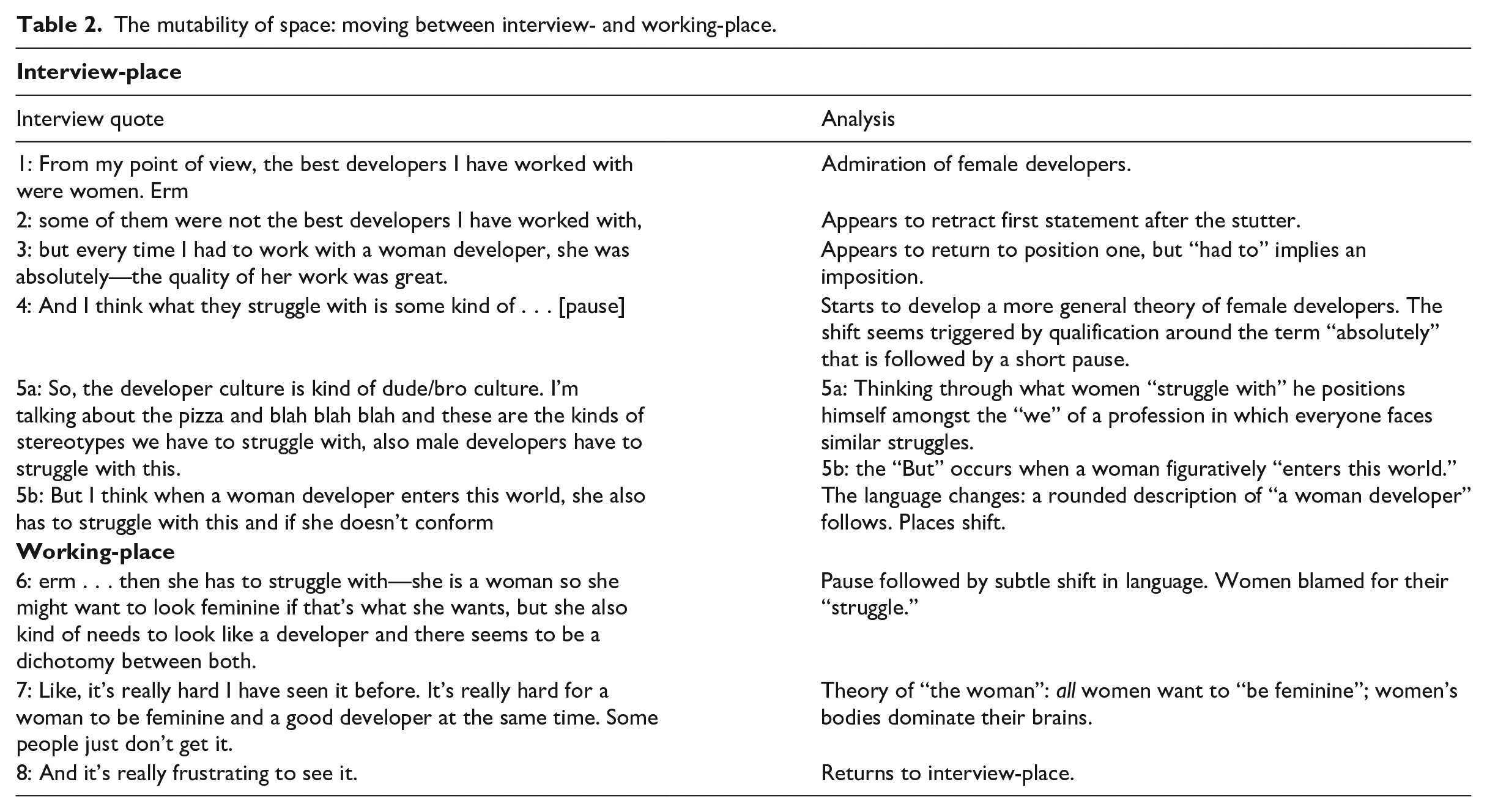
Arthur begins by positioning himself as a responsible citizen in an egalitarian world. This is a discourse of social liberalism. The statement at 5b in Table 2, “when a woman developer enters this world,” literally brings a woman into the discussion. The female entrant lacks specificity, is an image and not a reality, but represents (takes the place of) all female engineers, as the declarative statement “she is a woman” reveals. The shift in language when a fantasized female engineer appears signals a shift from interview-place to working-place: the circulating discourses through which he now speaks denigrate women and he breaks the taboo against such language. His final statement positions him as a “good” man, back in interview-place. In one statement he thus moves between what Butler (as cited in Lempinen, 2022) describes as “a world of hierarchy, domination and violence” and another “demanding equality, freedom and a life free of violence.”
The working-place’s denigratory speech is chauvinistic because it metonymically positions female desire as the agent behind women’s exclusion (Butler, 1997a, p. 60). This misread desire means the woman cannot speak qua professional worker but only within the terms of this fantasy. Professing no interest in her appearance would represent a failure to conform and she could not be “a woman.” Indeed, Hazel, in a one-to-one interview, observed: “We’re told that we’re not real women sometimes.” In Butler’s (1997a, p. 91) terms she is an actor “who is excluded from the universal [the engineer], and yet belongs to it nevertheless,” so she can be neither woman nor engineer.
Frank, meanwhile, used overtly chauvinistic language but seemed determined to impress the interviewer. He answered the question “Is your workplace quiet or noisy?” with an unrelated comment: To be honest it’s a really good set of lads erm that I enjoy working there with erm [short pause] . . . and we all help each other. [short pause] . . . When I go down there, they’ll arrange, we’ll arrange something for the evening because they know I’m down there on my own . . . so yeah a good set of lads.
Much happens in this short quote. The interviewer’s use of the word “workplace” projects him into the day-to-day realities of his current job. He describes a “really good set of lads” and brings himself into the account with the first person “I.” The second short pause offers a liminal space in which he moves from outsider to insider, signaled by the swift shift from “they” to “we,” becoming one of that “good set of lads.” He moves between interview- and working-places throughout the interview, complimenting women when in the former (the taboo is operative), denigrating them when in working-place (the taboo is ignored). Sometimes he qualifies earlier statements after much intervening talk. Two examples are given in Table 3.
Shifting language, shifting place.
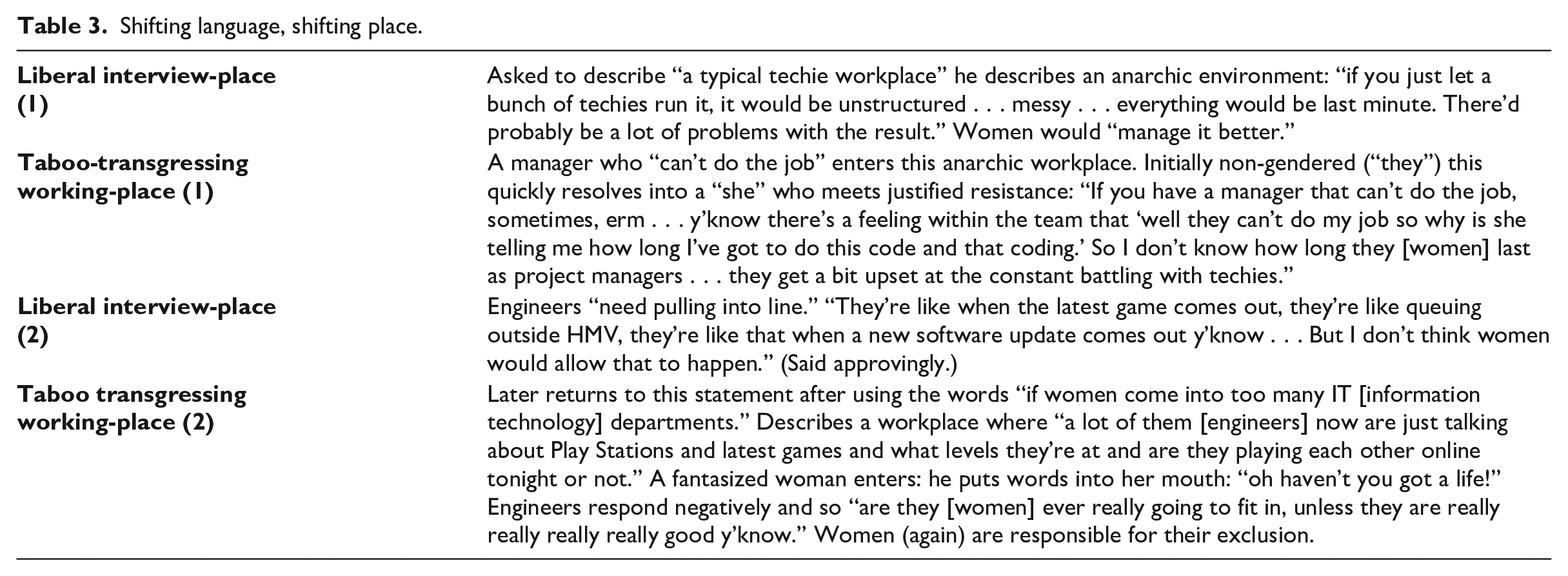
These extracts show clearly the different languages circulating in interview- and working-places. In interview-place, speakers’ language valorizes women—the taboo is operative. Entry of a fantasized female into the talk shifts the space into working-place and chauvinist expressions become speakable: the taboo is transgressed. This fantasized female not only cannot speak, as noted above, but agency itself is precluded because, as Butler articulates (Butler, Laclau, & Žižek, 2000, p. 275), she is determined “on an ostensibly more fundamental level. By prioritizing that fundamental level over any analysis of specific practice, [they] also privilege a certain philosophical vantage point over any and all cultural analysis” or, more prosaically, fantasy over reality. That is, male engineers when in working-place know what women are. This ontological fantasy “builds the truth it purports to reveal, a metaleptic function of discourse that works most efficiently when it remains undisclosed” (Butler, 1997a, p. 68). It allows male speakers to presume that women are both the authors of this representation and responsible for the prejudice induced.
We cannot conclude that male engineers when in interview-space, in using language that valorizes women, believe what they say. Feminist analyses of ontological mimicry, that form of mimesis we see here in which interview-place can mimic working-place, indicate the necessity of distinguishing between the “true” and the copy, because “in all cases, the epistemological, morphological, universal standard for measuring the true is the masculine, the universal male” (Diamond, 1989, p. 58). If so, then engineers’ tongues are loosened when in working-place, but their thoughts and beliefs may carry between both places.
Female participants also moved between interview- and working-places. Resistance dominates the former, all-female, place but collapses on the figurative entrance of a male colleague whose appearance facilitates the switch to working-place. Resistance in interview-place took the form of belittling, through humor, of male colleagues. We join the all-female U.K. focus group as they describe the denigratory language to which they are subjected. A lecturer’s description of a rocket-launching competition between “teams of boys with the odd girl who’s there to paint the rocket” provoked laughter, as did another’s reference to her husband: “according to him I had a little brain [group: laughter] that’s why I can’t understand Java.” Numerous reports of being mistaken for secretaries or wives were greeted with laughter, as in “[at a recent conference] the room was full of 90 men and one . . . came up to me and said ‘are you somebody’s wife?’ and I . . . [Group response: Oooh. Indignant laughter].” Allocation of stereotypical women’s jobs similarly provoked laughter: the only female programmer on a works trip described how “one of the directors asked me to fetch everybody tea [laughter]. . .. And I had to walk up and down [the coach] and give—[Laughter].”
Why did they laugh rather than, for example, respond with anger? Butler does not help us here but Partington’s (2011) theory suggests this laughter is anomalous: these experiences are not funny. Such anomalies are bisociative: suddenly an unexpected script replaces the first. Here, the first script, “we are constantly subjected to demeaning treatment,” is replaced by the second script, “attempts at disparaging us are hilarious.” The mechanism used is evaluation reversal: women denigrate men through turning masculine speech narratives against men, saying, in effect, “only stupid people could say such stupid things.” This hilarity, it follows, is performative, constituting resistant females who reverse the discourse of denigration: men become the belittled sex. This is observed in a discussion instigated by Anna who reported a male colleague’s observation that “women are good at talking and that is why they are good at soft side.” Group laughter was followed by Robyn observing: “that is so untrue [group laughter] . . . [in meetings] I’m the one trying to say will you stop talking, eating biscuits, drinking tea.” Bella talked over Robyn: “half the men in our department are such gossips, always sat drinking tea and gossiping.” Robyn continued: “I don’t think women are the talkers, I think they are the doers.” The group agreed: “Mmm yeah.” Bella’s statement that “I think it’s just a stereotype” provoked a counter-stereotype:
I think you’re right and I think men in meetings have to talk, it is a law somewhere that men have to talk even—
it’s like workmen they have to scratch their heads don’t they?
it’s just that they have nothing to say.
Group speaking at once: Yes, yeah, [laughter].
This stereotype lacks the power of the male’s fantasy: it is not transgressive and does not challenge the discourses that structure daily lives (E. R. Douglas, 2015). It is ineffectual because, articulated in a female-only interview-place, resistance collapses in the presence, albeit figurative, of male colleagues, as seen in a discussion of career progression:
A lot of these values are laid down by men, [group: yep, yeah] so we’re . . . trying to play ourselves to their rules all the time and actually—
yeah, that’s true, I mean to be successful you have to kind of got to go in there and prove that you’re a bit of a bloke 11 [Poppy: Oh yeah] to the blokes—
Laughter disappears and place shifts as the first-person “you” takes participants “in there” to a workplace dominated, inevitably, by male engineers. Resistance collapses in the presence of men, even though their presence in the room in which the interview took place is immaterial. Participants conform with a familiar trope—to succeed women must be better than men:
I don’t feel that I have to be a man. . .. But I do feel I have to do my job a lot better than perhaps I would if I was working with a lot of women, just to get that recognition.
Group agreement: yeah yeah.
Women in this study, just like the older workers in Cutcher, Riach, and Tyler’s (2022) Butlerian exploration of the dynamics of subjectivity, vulnerability, and resistance, are both vulnerable and resistant, “able to disrupt the conditions on which organizational recognition is premised” (p. 989) but not securely placed in that resistant location. Male colleagues, belittled in interview-place, occupy positions of power over women’s careers in working-place.
Together, women’s and men’s reconstructions of working-place shows that male speakers freely break taboos against chauvinism; it silences female speakers. We do not say females are always silenced, but when grossly outnumbered by men this potential for silencing exists and must be understood. In interview-place the parties meet each other as equals. They shift between chauvinistic and liberal subject positions.
Discussion: Workplace Chauvinizing and Neoconservative Chauvinism
We have seen that chauvinizing involves moment-to-moment firing of little arrows of discriminatory criticisms by men at women, but also how chauvinism and liberal/egalitarian attitudes are both absent and present in this contemporary workplace: actors can hold contradictory ideas. This suggests neoconservatism may find receptive hosts in organizations, but that receptivity may be neither whole-hearted nor stable: the potential for resistance exists. To understand that potential better we need to explore in depth how agency is both quashed and flourishes in the workplace. Butler’s (1997a) Burning Acts: Injurious Speech is invaluable for this task.
We start with Butler’s distinction between speech and conduct: words do not themselves perform acts—representing something is not the same as performing it. Thus the female coder, told by her husband that she cannot code, does not become a poor coder—his words, lacking the power to produce such effects as “the poor coder,” are not felicitous. But they do produce injury. They constitute an injurious act that “may appear to fix or paralyze the one it hails” (Butler, 1997a, p. 4). So, addressees of such chauvinistic language as “your brain is small” “suffer a loss of context” and, losing their place within the community of speakers, become disoriented, undone. The question follows, paraphrasing Butler (1997a, p. 28), how can injurious language strike like this at the very possibility of persistence and survival? Riley’s (2005) extension of Butler’s (2005) arguments answers thus: ‘The worst words revivify themselves within us, vampirically. . .. In its violently emotional materiality, the word is indeed made flesh and dwells amongst us – often long outstaying its welcome” (p. 9).
If, as Butler (2005) argues, linguistic injury can only be discussed through the language of physical injury, then injurious speech has a “somatic dimension” (p. 9). An immaterial substance, words become materialized in flesh through “the ventriloquy of inner speech” (Riley, 2005, p. 6). The compulsive circulation within one’s thoughts of the injurious speech directed at the thinker is interiorized and becomes “my own creation.” The words “you are a woman with a small brain” become “I am a woman with a small brain.”
Importantly, such speech carries a history of denigration passed down through generations (Butler, 1997a). Chauvinism was until recently most women’s experience: older female workers remember experiences that would be unconscionable today (Ford et al., 2020); their granddaughters relive their trauma when subjected to chauvinistic speech. “You have a small brain” produces an “ongoing subjugation” achieved through that restaging of earlier injuries (Butler, 1997a, p. 36) that have been repeated through decades, even centuries, of ongoing subjugation of females to males. Working- and interview-places thus operate in different times: in working-place language that demeans women is not yet labeled “chauvinistic,” and a feminist movement that will incorporate that word, and with it develop a language of resistance, is yet to arrive. There are no ready-to-hand words through which to express resistance. That language circulates in interview-place. Just as men move between contradictory liberal and chauvinistic subject positions, so do women, but between resistant, feminist-inspired space and their grandmothers’ silenced space.
That is, chauvinizing involves the moment-to-moment repetition of little acts of chauvinism and moves between subject positions that are in opposition to each other. Chauvinizing is unstable. To understand this instability we invite male and female participants to meet at that Hegelian scene of recognition that informs Butler’s (2009) work throughout, drawing particularly on her introduction of “framing” to recognition theory. That is, although recognition is vital to self-hood and identity (Butler, 1997b), the parties at the scene of recognition may apprehend but not see the other person: they see instead their fantasy of that party and mis-recognize them. Where chauvinism flourishes, male subjects are positioned as the normative ideal against which women fall short, and are the agents who “frame” females—that is, impose an impossible definition of “the woman” upon them. In such male-dominated working-places, women can conform with neither the masculine normative ideal nor the fantasized female (Butler [2009]; see also Kenny’s [2010a] review of Frames of War).
This takes us into the iterative micro-scenes (Harding et al., 2017; Harding et al., 2022) of chauvinizing: the powerful masculine occupant of that momentary stage apprehends a woman on which he imposes his own fantasy of what/who she is. There is thus only a simulacrum of the woman at this scene. She is accused (of being incapable) and judged guilty without right of appeal. The moment-to-moment moves of chauvinizing are therefore court trials in micro. There is no scene of recognition, only scenes of mis-recognition in which little misogynistic arrows are thrown at the simulacrum of the woman but experienced by the real woman who is denied recognition as a professional person. Neoconservatism will thus find a receptive home: its phantasms will reinforce chauvinistic workplaces.
At the same time, however, we saw that chauvinizing is absent from interview-place where the taboo appears operative and occupants conform with socially liberal agendas. Chauvinism is thus both present (in some subject positions) and absent (from others). Importantly, it is not that different people have different stances, but the same individual can move between both. At the very least, neoconservatism may find itself trying to enter situations that are not wholly conducive to its embedding itself.
What are the implications for other workplaces? Could chauvinism/chauvinizing be both absent and present elsewhere? We cannot generalize from a case study but it is plausible to suggest so. Ever more incidents of sexual harassment are coming to light 12 and powerful managers and politicians are losing their jobs because of their chauvinistic behaviors. Their behavior flourished out of sight, kept secret under the governance of the taboo, but was nevertheless active. For example, three recent reports (Carr, 2022; Kennedy, 2023; Monaghan, 2020) show that trade union officials transgressed the very EDI policies they espouse; that espousal rendered their sexism necessarily secret but at the same time they broke the taboo. Misogyny thus haunts organizations even as serious attempts are made to eradicate it. If so, then neoconservative entry-ism may be opposed but at the same time encouraged. Worryingly, it may build on or encourage an almost inevitable backlash against #MeToo (Grady, 2023).
To interrogate further these conditions for both resistance to and acceptance of neoconservatism into organizations, we need to understand what our study has not so far addressed: why does chauvinism, although tabooed, persist in organizations? To answer, we turn again to Butler’s (1997a) analysis of injurious speech and engage in a thought experiment in which we follow a woman into the chauvinistic workplace we have been studying. The thought experiment builds on our earlier recognition of interview-spaces as many places: it introduces “reader-space,” where storyworlds engage readers in complex, spatio-temporal totalities where the imagination assists understanding, as when making sense of a novel’s plot (Gibbons, 2021). This thought experiment helps track the path to the conclusions. Observing Butler’s (1997a) recognition that understanding injurious speech’s performativity requires interrogation of the unconscious, we take along with us their application of Freudian theory to hate speech. Psychoanalytical theory is invaluable in organization studies in general and this study in particular, not only because it allows understanding of “affective attachments to ideologies [that] are crucial to reproducing capitalist relations” (Özdemir Kaya & Fotaki, 2024, p. 931), but also because of its facility for understanding subjectivity (p. 937). Where other approaches may struggle to understand chauvinism’s refusal to disappear, reading across from Butler’s Freudian interpretation offers intriguing insights. The power of combining Butlerian with psychoanalytic theory is demonstrated by Kenny, Fotaki, and Vandekerckhove’s (2020) revelations regarding whistle-blowers who were shown to be not the rational characters of previous representations but “founded in complex psychic structures of recognition” (p. 339).
We follow those examples in our thought experiment in which we enter, in imagination, an engineering workplace in which workers, all male, are immersed in their work; we, the newcomer, the only female. Butler (1997a), whose now familiar argument is that subjects are constituted within and through language, observes that injurious speech works through “the invocation of convention” (p. 34)—that is, historical antipathies are passed down within language. This directs us to the two histories of the chauvinistic language encountered in this study. The first is that long period when women’s subordination was “natural.” What became defined in the last half-century as chauvinistic language—that is, language that systematically positions women as men’s inferiors—had circulated largely unchallenged for centuries, carrying within itself deeply felt “truths” about “women’s place” (Calás & Smircich, 1991). Although banned both socially and legally, it continued to circulate not only in private spaces but encoded within cultural products (Pollock, 2007), extending its reach into organizations through popular culture (Griffin, Harding, & Learmonth, 2017). An always-already-there language into which contemporary speakers are born, it is a centuries-old instrument of belittling and silencing.
The second history, less than 50 years old, saw chauvinistic language and practices slowly become anachronistic, outdated, and, eventually, taboo, although not extinct. Both female- and male-speaking-subjects born within the last 50 years are thus socialized within a wider culture in which chauvinism is archaic, its expression illegal, but its language still available.
Chauvinistic speech thus catapults women back in time, in Freud’s sense of time as non-linear and archaeological, to before a language of female resistance existed; they re-experience the historicity of that abusive naming. That history is replete with trauma (Butler, 1997a, p. 36) passed down through generations via the unconscious. Trauma is non-cognitive, consisting of “undigested shocks and affecting impacts” as another Freudian feminist, Griselda Pollock (2013, p. xxiv), writes. That which is traumatic is outside memory but perpetually present; its wounds echo in the unconscious and break through into conscious activities. “Trauma,” Pollock (2013) writes, “possesses and inhabits us” (p. 1) but is outside the “grammar of representation” (p. 3) so cannot be named. It can be encountered only through its traces, through affective rather than cognitive knowing. Trauma renders symbolization impossible.
This, we suggest, is why the feisty speech we heard in female-only spaces may be silenced upon a woman’s entry into masculine space. In a small minority, perhaps the only woman present, she is pinned to the spot when greeted by such words as, to paraphrase Frank, “you are never going to fit in unless you are really, really, really, really good,” but also, to paraphrase Logan, “you will never be good enough because you do not push yourself hard enough.” Those words, resonating with centuries of misogyny, steal from the addressee her power of speech. Traumatized, she cannot fight back. Our study suggests this trauma is not totalizing: in other places she expresses resistance. We therefore add empirical support to Fotaki and Harding’s (2017) analysis of how women move between subject positions of confident, assertive, passionate selves and a self that can also turn masculine hate speech against itself.
We move next into the position of male occupants who, witnessing a woman’s entrance into what they think of as their space, are provoked to use such chauvinistic language as, to paraphrase Theo discussing a female engineer, “you are a typical girl—you say [adopting a high-pitched, whiney voice] ‘I can’t understand a thing, it doesn’t work.’ ” Such language is taboo. The taboo is fundamental to Butler’s (1997a) analysis of injurious speech. Citing Freud, Butler observes that taboo involves both prohibition of something deeply desired and an unconscious yearning to violate that prohibition. In the unconscious, the prohibition itself and not the prohibited object/practice “becomes the ‘site and satisfaction of desire’ ” (Butler, 1997a, p. 110). That Freudian interpretation suggests chauvinism is now energized by the unconscious pleasures speakers obtain from articulating tabooed language. That is, it is the banning of chauvinistic language that invests that language with libidinal or psychic energies not present when such speech was the stuff of everyday talk. Unlike their grandfathers, contemporary chauvinists experience unconscious pleasures arising from the danger of potential punishment; hence we must distinguish between “old” and “new” chauvinism.
The breaking of taboos, Butler (1997a) continues, is contagious. Freud argued that “[a]nyone who has violated a taboo becomes taboo himself because he possesses the dangerous quality of tempting others to follow his example . . . . Thus he is truly contagious in that every example encourages imitation” (Freud, 1950, as quoted in Butler, 1997a, p. 115). In other words, chauvinistic subjects encourage each other’s violation of the taboo. This is accompanied by a paradoxical unconscious impetus: paranoid fantasy. Butler (1997a), exploring this at length, argues that paranoia arises from the dread of losing the love of fellow humans, of becoming an outcast from the community. If so, then a homosocial group whose membership is vital to its members not only shares the guilty pleasures of taboo-breaking but is bonded by those transgressions. At the same time, the language that bonds them is criminal; its use can be punished by exclusion from the group, or worse, as seen in the cases of Tony Danker, whose dismissal from the Confederation of British Industry for claims of sexual harassment threatened the existence of the organization, 13 and Crispin Odey whose hedge fund was disbanded after similar claims. 14 That is, chauvinists’ very identity requires that they speak chauvinistic language but, if caught mouthing its words, expulsion from or collapse of the group will follow and identity will be lost. They both must and must not articulate such speech.
This, in turn, provokes unconscious paranoid fantasies about being overheard: a regulating, watching, and judging Other is fantasized (Butler, 1997a, p. 119). Can it be that this feared Other is this female who has just pushed open the door, walked in, and become a witness to male sinning? This is what we speculate: we have seen that a fantasy of “the woman” substitutes for real, flesh-and-blood women in male participants’ imagination. If our borrowing of Butler’s Freudian analysis is correct, then the woman may be loathed because of the fear that she could reveal their dirty little secrets, bringing about the group’s demise. Thus, chauvinizing is reinforced by an unconscious need to keep the woman out because of a conscious desire to keep the woman out.
Neoconservatism could thus find fertile soil for its growth in organizations; not only would it be welcomed by chauvinists who find in it a receptive language, but neoconservatism itself could become buttressed by the libidinal energy of the taboo. Until, that is, its position becomes sufficiently powerful that it (again) becomes the norm.
This casts light on how male-speaking subjects move between egalitarian and chauvinist subject positions: the two subject positions are closed to each other, so that the difficulties of occupying such contradictory selves are overcome by unawareness of how the speaking subject contradicts itself. Both male- and female-speaking subjects, in at least some aspects of the self, are undone by neoconservatism.
Conclusion: Neoconservatism’s Dream
This study aims to contribute to political organization studies through developing understanding of organizations’ receptivity to being infiltrated by right-wing political projects such as neoconservatism. We focused on one potential entry-route: chauvinistic misogyny. Using an extreme case study of a profession that was known to be misogynistic, and drawing on Judith Butler’s work for theoretical inspiration and understanding, we explored the performative constitution of chauvinism and how it has been sustained despite decades-long attempts to eradicate it. We concluded that those pockets of chauvinism could offer a receptive organizational home to neoconservatism, with the danger that once embedded it could spread and pollute the wider organization. However, 50 years of movement towards equity, diversity, and inclusivity mean that neoconservatism will meet formal opposition as it struggles to find a foothold. Indeed, we illuminated how “the chauvinist” moves into and out of liberal, egalitarian subject positions and thus how organizational chauvinism may be occluded or hidden, and perhaps in some ways fragile. However, a great deal of damage is done by occupants of the chauvinistic subject position: they undo both women and liberal colleagues, and their own liberalism. It is difficult, in this analysis, to see how organizations can remain immune from neoconservatism’s territorial assertiveness, although attempts at entry-ism will meet with resistance.
We explored how chauvinism is performatively constituted in those parts of organizations where it flourishes, and suggest the active verb “chauvinizing” to encapsulate the moment-to-moment, aggressive, micro-scenes of recognition that deny women recognition of their status as fully human. “Chauvinizing” is invigorated by the libidinal energy of chauvinism’s tabooed status, distinguishing “new” from “old” chauvinism as the latter had been normative practice and lacked the unconscious pleasures of rule-breaking. Thus, the very act of outlawing chauvinism eradicated a great deal of unwelcome behavior, but also brought new pleasures for those who would be chauvinists.
That analysis answered our first two questions, regarding: (a) the performative constitution of chauvinism; and (b) why it persists against opposition. In answer to our final question—in what ways might this facilitate neoconservative politics’ infiltration into organizations?—this study points to some of the reasons why feminism’s gains may be more fragile than expected. That is, chauvinism is both absent from, and present in, organizations, so is an elusive object. Where it is present it may find neoconservativism and its project of reinstating patriarchy alluring. This form of politics must therefore be guarded against, not least because, as this study shows, women can be undone when outnumbered by chauvinists.
We cannot generalize from women’s experiences to those of other subjugated populations, but these arguments may also be significant for race, ethnicity, gender, and other forms of (intersectional) identities whose positions in organizations may be even more tentative than that of the largely white, European women in this study. But, as Butler (1997a, p. 1) observes, hate speech’s power is not totalizing; there are always possibilities of responding critically, of disrupting and subverting its effects, of becoming agentive, and we saw how through acting together women subordinate misogyny, laugh at it, and undermine aspirations to turn the clock back 50 years. We therefore should have rephrased that third question to ask what could facilitate neoconservative politics’ expulsion from those corners of organizations which it may have infiltrated? We have no answers to that question: as always, more research is needed, and, echoing the words of an anonymous reviewer of this article, attentiveness to desire and fantasy may provide a useful starting point.
Finally, we wish to pay homage to feminist management and organization studies. This study is inspired not only by a major feminist theorist, Judith Butler, but by those many feminist organization theorists on whose shoulders we have leaned to write this paper. Space has precluded direct reference to their many works that informed our thinking, but their influence is palpable throughout this article. This study suggests that, working together, we can challenge neoconservatism.
Footnotes
Acknowledgements
We would like to give effusive thanks to Barbara Simpson, senior editor at Organization Studies, and the three anonymous reviewers without whose advice, guidance, suggestions, and insights this article would have languished in the doldrums.
Funding
The author(s) disclosed receipt of the following financial support for the research, authorship, and/or publication of this article: The original fieldwork was funded by a small British Academy grant, (10k) in 2013.
