




Abstract
This article explores possible subversions of heteronormativity through transgender performativity in the workplace. Drawing on insights from Judith Butler we focus on how employees construct (un)intelligible subject positions that can create ‘moments’ of subversion, which go against the disciplinary, powerful and normative gender binary. We explore this possibility through an analysis of qualitative material generated through encounters with 11 Italian trans workers. Our analysis shows that subversion manifests in diverse ways according to how individual performativities combine with organisational context. Within this diversity we highlight three moments of subversion: subversion through intrigue; subversion through incongruence; and subversion through betrayal. We argue that where transgender identity contrasts strongly with gender norms, subversion is most intense. The subversion of strongly heteronormative working contexts is difficult as moments of subversion are unpredictable, varied and can come at personal cost, but are necessary in order to accommodate different gender identities.
Keywords
Introduction
In this article, we focus on how trans workers can subvert heteronormativity within organisational contexts. Our focus on trans individuals within heteronormative organisational constraints, and the possibilities for subversion is relevant theoretically and practically. Theoretically, our study contributes to debates over the potential of trans people to disrupt gender binarism (Connell, 2010; Moulin de Souza and Parker, 2022) by analysing trans identity through the lens of subversion. Trans workers are often subject to discrimination, harassment and violence, despite gender identity being a protected characteristic in many contexts (Mills and Owens, 2021). Although practical guidance on more trans inclusive workplaces has grown (Schwartz et al., 2017), the experiences and challenges of being trans at work remains an underdeveloped research agenda (Hadjisolomou, 2021).
In Butler’s perspective gender is performative – a doing, constrained by the power structures within which the subject is positioned. According to Butler, cultural expectations of what constitute intelligible gender identities shape how people do gender, the heterosexual model of gender is considered the normal relation between genders. This heteronormativity reinforces gender binarism, heterosexuality is expected, and other gender identities are regarded as less or even unintelligible. Although gender is always shaped and constrained by norms, Butler also affirms the possibility of subverting these constraints (Butler, 1999).
Subjectivities that occupy alternative positions within the heterosexual matrix raise important questions for workplaces that play a role in shaping discourses that produce subjectivities. This research is important politically because it considers the perspectives of trans people, who are often unheard, for fear of recrimination and discrimination from aspects of government, organisations and religious groups, among other sectors of society (Köllen, 2016). There is increasing attention to the need for workplaces to adopt practices that are inclusive and supportive to trans workers (Robinson et al., 2017), yet their experiences are often marked by discrimination, harassment and violence (Davidson, 2016). This is particularly relevant in Italy, where anti-trans and anti-LGBT prejudices colour the political and social landscape and the religion has a powerful grip on the popular imagination (Benozzo, 2013).
For this article, we adopt the term trans to describe those outside the binary categories of male and female and whose gender identity differs from that assigned at birth. In contrast to cisgender, which describes a person whose gender identity is continuous with that assigned at birth (Schwartz et al., 2017). Trans is a commonly used term (e.g. Tyler and Vachhani, 2020) and has been suggested to be the most inclusive (Collins et al., 2015), although we acknowledge this is open to question (see Yavorsky, 2016; as well as Singer, 2014 for fuller discussion of terminology).
The article first outlines key concepts of gender performativity, heteronormativity and subversion, and how they have been applied in organisational research. We then present our methodology and moments from our data considering their potential to subvert heteronormativity within the workplace. We discuss how the experiences of trans workers can be considered subversive and what this implies organisationally and individually.
We contribute to literature theorising gender at work; specifically, we develop Butler’s concept of subversion as a potential way of countering heteronormativity in theory and practice. Butler’s performative view of gender and the related lens of doing gender have been widely and usefully applied in the organisational literature. However, the notion of subversion at the core of Butler’s Gender Trouble has not been taken up so extensively. This study shows the manifestation of subversion through moments of individual performativity that are interrelated with organisational context. Trans identities can lead to moments of curiosity, incongruity and betrayal that reshape and question fixed, binary gender norms. We find that subversion may not be desirable at the individual level, since it is intertwined with vulnerability, even though subversion is necessary to reshape norms that allow greater freedom of gender identity/s. We therefore contribute to theorisation of transgender identity as subverting gender norms and related practical implications for workers and workplaces. We highlight the importance of organisational context in how subversion is made possible through gender performativity.
Heteronormativity and subversion: Troubling gender and the heterosexual matrix in the workplace
There is an ongoing conversation amongst scholars interested in problematising binary and asymmetrical gender identities in organisations (Benozzo et al., 2015; Pullen et al., 2017) and within this literature a focus on the working life of trans people (Brewis et al., 1997; Connell, 2010; Moulin de Souza and Parker, 2022; Muhr et al., 2016; Schilt and Connell, 2007; Thanem and Wallenberg, 2016). Some scholars argue that trans people do not disrupt gender binaries, while others recognise the possibility of thinking with trans to challenge gender norms (Moulin de Souza and Parker, 2022). The work of Judith Butler, a prominent American philosopher and gender theorist, has been central to these discussions and her influential theory of performativity has been widely applied to study gender in work and organisational settings. In this article, we draw on her work to extend theorisation of how trans experiences of the workplace may be disruptive or subversive to a binary notion of gender.
Butler’s notion of performativity conceives gender identity as constituted in interactions through ‘a set of repeated acts within a rigid regulatory frame that congeal over time to produce the appearance of substance, of a natural sort of being’ (Butler, 1999: 33). Repetition of practices appears to normalise and naturalise them, what Butler refers to as the incorporation of norm. However, this appearance of stability and normality belies the fluidity of gender, which must always be done or re-done, but can also be undone (Connell, 2010). Therefore, identity and gender are performatively enacted through discourse and discursive practice, all of which cite previously established practices, placing the subjects within existing relations of power.
From the nature of gender identity as discursive and citational, follow dominant norms that establish an apparently consistent relationship between sex, gender and desire – the heterosexual matrix (Butler, 1999). Gender identities that depart from these norms are denied.
[The heterosexual matrix] requires certain kind of ‘identities’ cannot ‘exist’ – that is, those in which gender does not follow from sex and those in which the practices of desire do not ‘follow’ from either sex or gender. ‘Follow’ in this sense is a political relation of entailment instituted by the cultural laws that establish and regulate the shape and meaning of gender, desire and sexuality. (Butler, 1999: 23–24)
Moulin de Souza and Parker (2022) argue that trans can trouble the heterosexual matrix through practices of freedom, understanding freedom as ‘a creative commitment to disrupting existing limits’ (p. 76). Their understanding of trans practices embodied in speech, bodily postures, dress, etc. as disruptive to binary heteronormativity builds on Butler (and Foucault) in their understanding of power and resistance as co-productive in gender performativity rather than oppositional. The constant doing of gender as an open-ended process creates the possibility to depart from gender norms that appear dominant.
Opportunities to resist or subvert gender norms take shape as moments within a dynamic interplay of discourses, materialities, identities, psyches and emotions (Harding et al., 2017: 1210). In this respect, Butler’s theory of performativity is subversive to a binary and naturalised view of gender and provides the basis for thinking about how a much broader range of gender identities can be enacted performatively. Following Butler, Thanem and Wallenberg (2016) foreground the materiality of different expressions of gender. While they acknowledge that concealing a stigmatised identity may lead to alienation and diminish self-esteem for trans workers, they also show how gender ‘inappropriate’ dress may further opportunities for gender diversity without stigmatisation. However, transgression of gender norms may invite discrimination and mistreatment at work (Boncori et al., 2019), reflected in higher levels of workplace stress (Beauregard et al., 2021; Davidson, 2016), higher unemployment and under employment amongst trans workers (Sawyer et al., 2016) and is somewhat at odds with studies that highlight positive experiences of being ‘out’ at work.
This apparent contradiction is reflective of the oppositional elements in Butler’s concept of performativity. Butler does not intend that individuals have unbounded agency to do gender as they wish, rather the subject is also ‘done’ by gender, in that they are shaped by discursive practice and norms (Salih and Butler, 2003). These oppositional elements have led to both voluntarist (excessive agency) and deterministic (a lack of agency) interpretations of performativity, but these interpretations mistake Butler’s position, which considers gender both intentional and performative.
The process of gender transition may trouble fixed gender hierarchies but trans workers are also concerned with preserving job security and managing workplace relations (Schilt and Connell, 2007). Subversion of dominant norms through gender performativity is therefore bound up with a certain vulnerability (Harding et al., 2017) and the power balance underlying this vulnerability is intensified for transgender workers (Hadjisolomou, 2021). Subversion brings the self that acts for its own ends, to make life more liveable, into tension with the self that is dependent on the other, who shapes expectations for what is considered intelligible and acceptable through established discourse (Butler, 2015).
Our desire to have a sense of social/organisational belonging means our gender identities must be intelligible to others and there are strong, if not compulsory, reasons for conforming to norms (Butler, 2004). However, heteronormativity is determined not only by what it is, but also what it refuses. Desires and identities regarded as taboo must be produced by heteronormativity, to be repressed (Butler, 1999). This dialectical nature introduces a ‘vital instability’ suggesting it is possible to enact gender in ways that are subversive (Salih and Butler, 2003). Butler turns this insight toward the phenomenon of Drag and its parody of gender performativity, which can subvert gender norms by exposing their constructed nature (Butler, 1999).
Theoretically then, trans identities can expose the performative nature of gender by exhibiting inconsistency with gender norms that expect alignment between seemingly natural dimensions of biological sex, gender identity and gender performance. How trans identity is lived within the workplace determines the extent to which it exposes gender as performative. Connell (2010) differentiates between trans people who do gender (by embodying conventional feminine and masculine presentation to avoid disclosing their trans identity) and those who undo or redo gender (by consciously adopting hybrid gender styles that resist conventional views of gender demanded by their co-workers). The notions of undoing and redoing gender can be mapped onto different ways of reading the concept of subversion in Butler’s work. Undoing gender questions the very notion of gender categories and their normative power, whereas redoing gender cites existing norms, but in new and unexpected ways, counter to heteronormative expectations opens up new or different gender categories/norms beyond the binary.
There is a key difference between these two forms of subversion for Butler, in that the latter is regarded as ‘a positive normative task’ (Salih and Butler, 2003: 101). Whereas Butler is reluctant to specify subversion or define new norms that redo gender, since any norm is infused with the potential power to oppress. Rather than specifying what is subversive, Butler (1999) prefers to observe the effects that potentially subversive acts can produce in questioning the reality of gender as fixed and natural. However, this parody of gender as an original notion, rather than of the original notion does not guarantee subversion, since much depends on how this performance is received and in what context.
Butler’s concepts of performativity and subversion have been taken up in different and not always consistent ways (Xie, 2014). However, we interpret subversion in Butler’s terms, gender identities that call into question a fixed binary notion of gender underline its inherent tenuousness – in short, its character as performative. Butler also has an important political goal allied to theorisation of gender as performative, which seeks to increase ‘possibilities for a livable life for those who live, or try to live, on the sexual margins’ (Salih and Butler, 2003: 103).
What is individually desirable for trans workers may not necessarily coincide with a political project to trouble the gender binary. Yet, at the same time the reification of this binary establishes legitimacy (or not) of different kinds of lives and identities. The workplace can be a site where denial leads to stigma and discrimination, and trans workers can experience major and micro aggressions (Hadjisolomou, 2021), but there are also instances of kindness and support (O’Shea, 2018). Positive trans experiences of the workplace underline the practical imperative to develop managerial training, workplace policies and a physical environment that is more inclusive (Schwartz et al., 2017) and where subverting gender identity is less likely to provoke negative experiences. This then raises theoretical and practical questions for how we interpret lives lived on the ‘sexual margins’: Are they subversive? In what way? How can they be interpreted to create more welcoming and inclusive workplaces? Xie (2014: 36) frames this challenge well: ‘The real task of subversion remains precisely to negotiate the equal status between “failures” and “successes” of gender performances, to transform current social conditions so as to occasion and allow, rather than oppress and punish, gender resignification and proliferation’.
This leads to our research question: How are trans subjectivities in the workplace potentially subversive to a fixed and binary notion of gender? In addressing this question, we also consider how trans subjectivities are shaped by organisational context and what constraints exist for trans workers, both in organisational and individual terms.
Methods
Encountering trans people
It was not our intention to adopt a question and answer interview format, but to create an atmosphere of friendly-open conversation, hence encounter describes the time spent with trans people during the research. Following growing critique of interview as a conventional research technique in social sciences (Tilley, 2003), we considered our encounters as data producing events and data possibilities, not data collecting instances (Koro-Ljungberg et al., 2017). We did not intend to treat participants’ accounts as unveiling a true self, but rather a self that was constructed and constituted in the very process of speaking (Riach et al., 2016). Our encounters with trans workers produce accounts of their experiences in which they themselves are constituted not only by their actions, but by the way in which those around them and the wider organisation shapes and responds to their actions. This understanding of subjectivity is central to our reading of the data as well as our method.
The trans people who participated in this project were recruited through contacts provided by colleagues, the promotion of the research at a conference on transgender interests in Italy, word of mouth, and a post published on Facebook. These actions allowed us to encounter 11 trans people and here we focus on presenting moments from these encounters most relevant to our research question. We recruited a limited number of people, for several reasons: 1) sexual minorities are difficult to recruit due to their ‘invisibility’(Rumens, 2012); 2) qualitative research that aims to study the construction of self and gender identity (Harding et al., 2010) requires a sensitive and in-depth approach; 3) we did not gather data for representative generalisation but to open conversations about experiences of being trans at work. The interviews were framed as opportunities for participants to share experiences and open-ended conversations. 4) In line with Crouch and McKenzie (2006: 483) small samples are preferable when scholars wish to be ‘immersed in the research field, to establish . . . fruitful relationships with respondents and through theoretical contemplation to address the research problem in depth’.
Encounters happened in the participants’ offices, at one of the researchers’ homes, via skype, or at local cafes near participants’ workplaces. They began as open conversations on the kind of job the person was employed in, and this led into dialogue about their workplace experience in relation to their trans life.
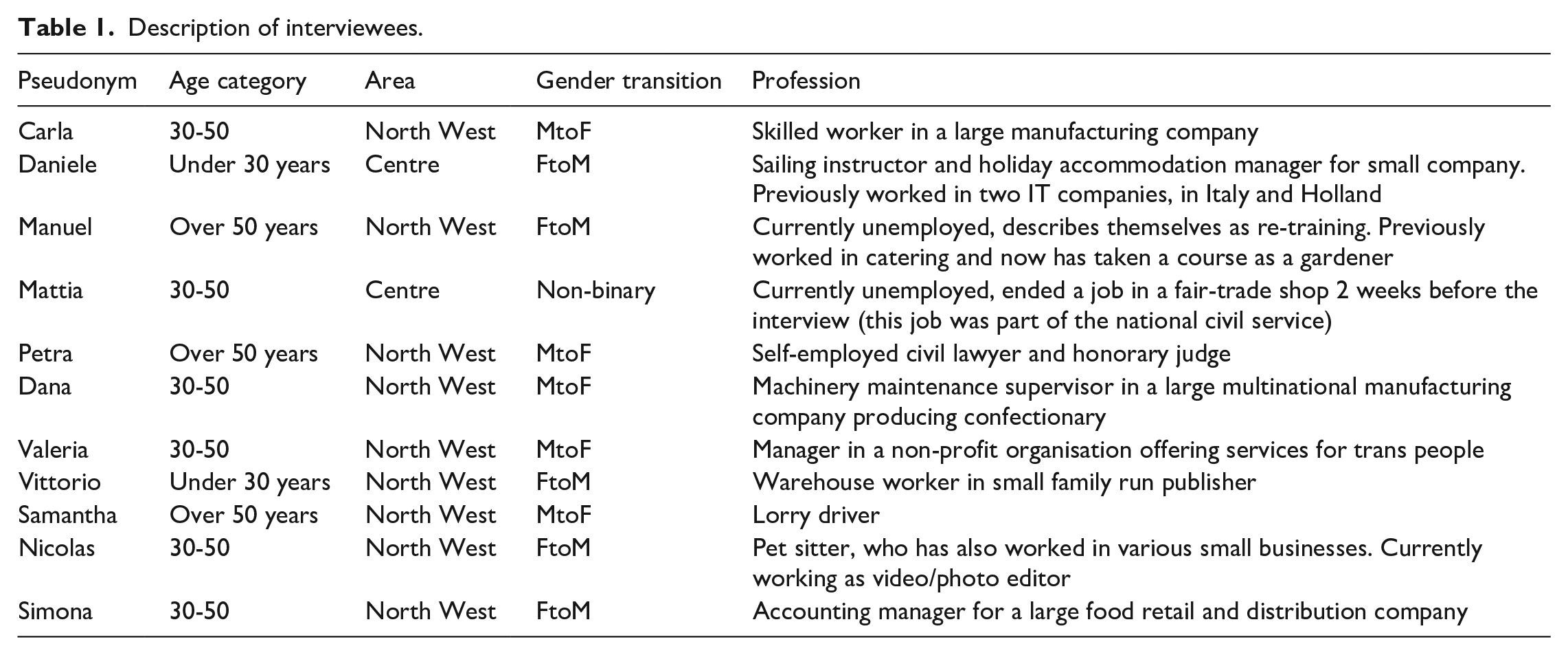
Only the second author was present during the encounters and shared his own workplace experiences to open conversation. This conversational style was intended to build trust between the researcher and those encountered by sharing experiences (Mills and Owens, 2021). During the conversation participants were prompted to describe themselves from the point of view of gender and encouraged to talk about different workplace experiences; the researcher tried to follow the flow of the conversation. All encounters lasted between 60 and 90 minutes and were recorded and transcribed verbatim. Transcriptions were translated into English to enable all members of the research team to read and discuss. The participants gave informed consent for their data for research purposes. In presenting the findings and to protect confidentiality we have given participants pseudonyms in line with their preferred gender identity, which sometimes reflects a more neutral gender identity as appropriate. Table 1 summarises the details of the interviewees we encountered through the research.
Description of interviewees.
In this research we were guided by an iterative-abductive approach, rather than deductive. We sought to understand participants’ experiences on their own terms first, our reading of these experiences was then informed by literature on transgender experiences of work. All authors initially analysed transcripts to identify emergent themes in the data (Gill, 2014). Following iteration between the transcripts, the literature and discussion among the research team we applied a Butlerian lens to the data that sought to understand participants’ experiences of heteronormative organisational contexts but also the possibility of subverting them. We follow Riach et al. (2016), in their invitation to attend to anti-narratives, not just narratives of interviewees, to reflexively undo the appearance of coherence imposed upon subjects through heteronormative organisational contexts.
Our dialogue between the data generated by encounters with trans workers and the literature led us to identify moments within the data. We concentrated on how the interaction of organisational context and individual performativity shaped experiences as moments of subversion or conformity to a binary view of gender. Our focus on subversion was motivated by what we ‘saw’ in the data and identified as theoretically interesting and relevant. While we acknowledge our ‘epistemic privilege’ (Riach et al., 2016: 2071), we take seriously the struggles of our participants. We aim to think productively with trans workers (Moulin de Souza and Parker, 2022) about how their experiences might inform organisational contexts that make their lives more liveable. Guided by this theoretical (and practical) interest all authors re-read the interview transcripts considering the research question:
How are trans subjectivities in the workplace potentially subversive to a fixed and binary notion of gender?
Subsequently, all authors discussed their interpretations of how the encounters with trans workers described moments of subversion. In the findings section we present different moments of subversion that seem to trouble a heteronormative view of gender within the workplace. These moments are ‘not archetypal representations of the populations under study but rather methodological devices mobilised to shed light on’ (Burchiellaro, 2021: 769) the possibility of subversion. Multiple moments of subversion were evident in the data; moments that arise from the way in which trans workers, gender identity combines with organisational context to produce performativity/s that are subversive to dominant gender norms. We characterise these moments under three headings (intrigue, incongruity and betrayal) that emerge from the data and describe the way transgender identity was experienced by participants and those around them in their workplaces. We centre three interviewees who are evocative of each heading but in conversation with other interviewees’ accounts. This conversation is necessary, although our headings are representative of the way in which subversion manifested, they are not specific to individuals or moments themselves, rather they are overlapping and emergent from the dynamic interplay between individuals and working contexts.
Findings
Moments of subversion
In line with our theorisation of subversion according to Butler, we present moments from our data where the experiences of our interviewees seemed to provoke a questioning of the gender binary in their workplace, thereby undoing it. We call these moments precisely because they are instances in time and space and describe not only the interviewees’ experience, but also that of others and their working context. While these moments cannot be generalised as such, they provide a basis for thinking about subverting heteronormativity in the workplace.
Subversion through intrigue? – ‘There was this wonder and surprise’ (Carla)
Subversion through intrigue describes moments in the workplace that are characterised by curiosity to transgender identity. We see this in the account of Carla who began the transition from male to female after several years on temporary contracts and having initially passed as cisgender. The phenomenon of passing, whereby trans individuals adhere to binary cisgendered expectations (Schilt and Connell, 2007) was common to many of the interviews. When Carla joined the company, she pretended ‘. . . to be heterosexual. Alas! With also an attached girlfriend. The years passed. . . The girlfriend did not exist. . .’. As Carla’s comments imply, how comfortable and secure she felt in her role at work influenced whether she might risk provoking curiosity by revealing their transition pathway. For Petra, who has professional standing in her work as a lawyer, the decision to reveal gender identity through dress is cautiously approached to manage curiosity even though passing as their birth gender becomes difficult to sustain:
then I decided that. . . it was no longer the case to continue like this, then always pass, pass, I introduced something a little more explicit . . . rings, things like this, bracelets, these things a little. . . I also had very critical moments because I saw my female colleagues dressing in a certain way, and I was on this side and I had to dress in another way, I could not do what they did and sometimes there was times I wanted to interrupt the hearing, sending them all out, because I felt like crying. . . (Petra)
Petra’s attention to managing possible curiosity by underdoing gender creates a disconnect between her preferred gender identity and what is presented causing her distress, which is captured by the term ‘gender dysphoria’ (Giraldi, 2020). Even though both Petra and another interviewee Dana viewed their workplace transitions positively it also generated curiosity that was unwelcome. However, this interest was also a path to greater understanding and acceptance.
. . . sometimes I feel a bit caught in the viewfinder, in a sense, a bit ‘observed, I do not like but. . . above all my colleagues. . . they have shown acceptance, warmth and even the relationship has improved and because there has been understanding on their part and curiosity, admiration, for having dealt with this path that is not for everyone . . . and to have had the courage to face it. (Dana)
Carla did not encounter much discrimination prior to her gender reassignment surgery and was positioned as a subject of intrigue for male colleagues: ‘No swear words, nor offensive comments, there were only a lot of surprise and curiosity’ because she was ‘a bit woman and a bit man’.
I wanted to get to, let’s say, to the complete change, let’s say definitive . . . However, at the beginning, in the moment in which the transsexuality appeared, most of the men were not let’s say troubled in the negative sense. (Carla)
Carla is accepted by her co-workers while she is intriguing, someone that generates surprise and fascination. This intrigue leads to gossip and a meeting with HR that appears to legitimate Carla as a woman, a binary gender identity.
The HR manager summoned me . . . and I went to this meeting completely female: make-up, well dressed, smart, even better than I am now, with earrings and all pretty jewellery. . . . he told me: “In any case in front of me I see a female worker and I see a woman, then starting from tomorrow you are allowed to go to work dressed [as a woman] and also with make-up. . .” (Carla)
Carla constructs a scene of dependence, of hierarchy, where the HR manager through his gaze and words, recognises and legitimises Carla as a woman. According to Butler (2004) the subject desires to be recognised and only through recognition are we constituted as possible social human beings. But gender is not a single act, Carla can and must maintain the intelligible identity of woman in front of her colleagues with a ‘new’ appearance, with make-up and jewellery. Although legitimised as woman through an organisational process, this is problematic with her colleagues. Her identity is more accepted when it was unintelligible – when her position on the heterosexual matrix was uncertain rather than fixed (inappropriately).
. . .at the beginning. . . they were not afraid of me, they started to be afraid when I said: “I am a woman”, when I wanted to claim to the world that in any case I was born as Carla and that I would have been like all women, this thing was not accepted, and it is not accepted yet. . . (Carla)
It is as if the subversion of the norm through the possibility of ‘other’ gender identities is tolerable, but acceptance becomes an impossibility when attempting to fix a new position in the matrix through a surgery path. Positing herself as an object of curiosity and fun is more acceptable (‘for them I would be better if I were something strange and at the same time something fun and curious’ (Carla)). This acceptance can be accompanied by stigmatisation and brings to mind a fascination in subjects that have the power to attract and repel (Thanem, 2006). However, when the final word that fixes meaning is pronounced (‘I am a woman’) it entails an incoherent and therefore unacceptable gender identity and this subversion is resisted.
The importance of organisational context and the subjects’ position within it is highlighted when comparing Carla’s experience with others, since this influences how subversive curiosity is, what follows from it and how it is experienced. Mattia who worked in a fair-trade shop describes an environment where workplace attitudes are more open:
. . .a fair-trade shop maybe gathers a little people also interested in issues concerning migrants, ehm precisely fair work conditions, in short, there are people already sensitised in different ways but anyway, you do not find people who express conservative ideas here. (Mattia)
The level of education of other employees was also identified by Petra as important in shaping her experience. Curiosity among colleagues may lead to a questioning of gender as binary and stable, possibly even initiating or shaping organisational responses to trans workers, which may make future experiences easier or more liveable. Some interviewees describe the educational process their transition has on those around them and the need to make a concerted effort to do this. As Nicolas explained when discussing interactions with a work colleague:
I sent some information, links just trivially on gender dysphoria, etcetera, from Wikipedia, I posted a few things . . . and I must say that then, from this thing, what seemed in fact he had understood a little more. . .since then he has not broken the (gender) boxes anymore. . . that is, he respected me. (Nicolas)
This does appear to be a burden for trans workers though and Valeria describes various instances where she distributed educational brochures about trans workers during the interview process to negate prejudice. Despite this Valeria had many negative experiences, often in working contexts where the work is less secure and well paid. Simona dares not invite the speculation of colleagues and risk attempting subversion of norms. Despite having been in the same working context for 12 years, he invents a boyfriend to conform to norms and avoid shift work at weekends, continuing to pass as cisgender.
I don’t have the strength to do it: these people here terrify me. I have no desire to . . . it’s bad but I wouldn’t be able to fight because it’s too heavy, I wouldn’t . . . I’d struggle, I wouldn’t be able to go there to work. (Simona)
Subversion through incongruence? – ‘But. . . arrrre you a woman from the physical point of view?’ (Manuel)
Subversion through incongruence describes moments where transgender identity brings together seemingly incompatible elements of gender identity. The contrary aspects of gender identity are captured by Manuel’s experience who chose their name for its neutrality and described their ongoing transition from female to male as a ‘revolution, a human revolution’, in their life.
Completing professional re-training as a chef, Manuel attended a course and here other course participants thought they were lesbian.
. . .At the beginning, they speak with me as if I were a woman, I corrected them, then they saw that I went to the male toilets, that is a bit peculiar. . . then at a certain point, I explained that I am a transgender person . . . I spoke as little as possible about my children, I cannot be like other mothers. . . in short, at the end, I managed to explain myself. . . (Manuel)
In not speaking about their children, Manuel seeks to reduce incongruity, this connects to the notion of passing and invention of cisgender appropriate partners as described by other interviewees. Organisational culture and working context play a role in how incongruity manifests. For example, Daniele has a working situation where they feel freer from expectations (and curiosity) because they do not have colleagues in proximity. From their perspective, proximity implies the need to conform and avoid incongruity that leads to an accumulation of stress.
It is difficult to sustain in the long run the work in the office. . . always having to do with the same colleagues . . .that was an environment very masculine and I didn’t find myself very at ease. . . let’s say that after a while, the fact that I still do not declare myself (regarding gender) at a certain point of view. . . it accumulates a bit of stress with colleagues so ehm it is difficult for me in the long run to continue having relationships . . . without having stress. (Daniele)
Likewise, in another workplace, Daniele’s experience was very stressful, with distasteful jokes from the colleagues who played with the pronouns, she/he and her/his. In that instance, performativity of gender identity in-between categories invited problems. In their opinion, this was exacerbated by inability to build relationships at work due to turnover and the lack of explicit signifiers of their gender identity, for example the fact that in the identity card he was a woman and never explicitly declared ‘I am trans’. The disjuncture between gender identity and official documents recurs in other interviewees’ experiences, such as Mattia, Valeria and Vittorio who avoids incongruity between identity documents and gender identity by not seeking to change jobs.
I am fine with having a perspective of stability at least economic. . . and then also from this point of view I must say that the perspective of not having to face job interviews and give explanations that I do not want to have to give every time by force. (Vittorio)
Valeria’s experience of this incongruity explains why trans workers may seek to avoid this.
I introduced myself to the temporary agency . . . the interview was fine. At the time of the document, when he tells me “give me the document” . . . when he saw the document he says “Ah, Male . . . here why?” I explained the whole long story that I am a transsexual person, who is in transition and “Yes, yes we will let you know” . . . I, not only I but all the trans people in my situation, know very well that that “we will let you know” is, that is . . . you do not pass. . . They too will probably have prejudices because in any case we still live today in a context in which the binary is essential, to come back into these boxes, man or woman, male or female. (Valeria)
Manuel describes how in another position, colleagues try to place them in an ‘appropriate’ box, but struggle with this incongruity:
. . . they knew that I am Manuela because it is my first name. . . but I introduced myself as Manuel and the next two days there, since I put myself to the masculine, the chef, who was the person in charge of the canteen, said to me: “But you have to tell me something? . . . but why is your name Manuel? You have to be honest, because I am open, you have to explain to me.” And I said “Because I feel to be a male, I am in the transition process.” And he asked: “Ah, from man to woman?” “No, from woman to man.” And then he: “But how, then. . . arrrre you a woman from the physical point of view?” “Yes, woman from the biological point of view.” . . .In the next days he tried to put me to the masculine, and after a few days also some female colleagues started to put me to the masculine and to ask me questions, a bit more such as: “But then, how do you feel?” They told me: “But you are also a mother. But perhaps you should stay there in the cook’s locker room”. And I say: “Yes, you are right, but my presence could make the cook embarrassed, because from the physical point of view when I have to change myself, I am still a woman”. But also they, they felt embarrassed because I said that I like women and they are women, that is . . . they were female colleagues, and they had a quite ambiguous person [as colleague]. They did not know and also they entered the bathroom to change clothes. These [actions] marked quite a bit the discourse that as a man, in the men’s locker room, also I could feel embarrassed but also between women I feel embarrassed, I feel embarrassed alone with my body. . . (Manuel)
The use of the term explanation that returns throughout this encounter; the circularity of embarrassment and the heteronormativity of organisational space (the bathrooms), which only allows binary options demands explanation. While Dana described a very positive workplace transition the bathrooms also create incongruity, when moving between gender categories. More generally the organisational space can highlight incongruity as Simona describes when moving from the office, a more gender-neutral space, to the retail spaces in her company:
in the office where I work – at the level of the shops it is a bit different – everybody has this very strong style and from this point of view I am a fish out of water because I do not dress up like a woman, I do not dress up like a man. I know I am . . .. However, regarding my work however, I have been appreciated but I always take care not to make a mistake, not to say who I am. (Simona)
Organisational context and actors shape the moments of incongruity that transgender identity produces. For Manuel there seems extreme incongruence, their presence confuses norms and workers around him continually try to make sense of where to place him, in binary categories or moving between them on a clear path. Manuel is exposed to the curiosity also experienced by Carla, and is demanded rather than invited to explain, yet does not themselves feel clear on their gender identity.
I do not feel myself as a woman, we can say, I do not feel myself as a member of female gender. Automatically, as we live in a binary system, we define ourselves males, that’s ok, it can be. In fact, I want to be perceived as male. I am taking the hormones. . . In Italy my name, Manuel, is perceived as a male name, in reality it’s more neutral. . . In a certain way, it contains exactly what I am, because those characteristics that from a cultural point of view, we define as female, are, in any case, part of myself. . . I feel myself as both male and female. (Manuel)
Incongruence can be read as subversion in different ways. On one hand, Manuel embodies elements of gender identity that seem incongruous, for example being a mother (although this is played down) and being attracted to women. This gender identity cites existing gender norms, but combined incongruously according to the heterosexual matrix, which the organisational space struggles to accommodate. To resolve this issue, perhaps, a third space for other genders is required? Alternatively, Manuel’s presence can be accommodated in binary spaces, but this requires acceptance and understanding from colleagues. In this sense Manuel’s presence provokes doubts and dialogue, questions and confusion, which can open possibilities and is potentially subversive insofar as it contradicts understandings of gender as fixed and singular. Manuel’s experiences in different contexts also illuminate how the support (or not) of colleagues and supervisors in the workplace is important in creating a supportive workplace climate (Beauregard et al., 2018).
Subversion through betrayal? ‘You’re no longer the man I hired’ (Samantha)
Subversion through betrayal captures a perceived unfaithfulness to gender identity that in transitioning between genders individuals betray their ‘genuine’ gender and the norms it expects, which cannot be accepted. The experience of Samantha who is confronted with a lack of acceptance in her workplace highlights this moment.
Confronted with the embodied reality of Samantha’s gender performativity, her colleagues and supervisor refuse to recognise her and instead maintain a fiction that is more intelligible to them. By repeatedly calling her Samuel, her supervisor assigns her to the gender category of man. He (re)inaugurates Samuel repeatedly in space and time deliberately ‘deadnaming’ her by repeatedly using her birth name (Sinclair-Palm and Chokly, 2022), which she has sought to cast off. For her employer Samantha is not recognisable, not intelligible, as Butler (1999) reminds us: she is reduced to a category of ‘gendered beings who appear to be persons but who fail to conform to the gendered norms of cultural intelligibility by which persons are defined’ (p. 23). Samantha’s supervisor not only fails to recognise her; he disciplines her for transgressing norms.
Her supervisor is authorised by law and his organisational power to pronounce ‘Samuel’; he is authorised by the force of convention. The incongruity between Samantha’s official identity document and her identity is used to highlight a betrayal of gender identity. Repeated denomination indicates and establishes a subject in subjection, that has the effect of solidifying gender norms; the subject needs an appeal (to be called by a name) to exist, which grounds the linguistic vulnerability of the subject. Samantha narrates the negation strategy by her supervisor:
In a moment of great conflict with my employer . . . it happened to him sometimes to let slip some phrases like “You’re no longer the man I hired.” . . . is not an offensive phrase, it is nothing. . . . For me it was offensive, . . . ehm I felt very bad, I felt very bad. I never let myself go to answering in a bad way to him because the situation was extremely strained. Then knowing me . . . caught in anger, maybe I could have also put my hands on him . . . (Samantha)
Heteronormativity is intertwined with Samantha’s organisational context: a masculine culture of ‘machines and engines’, of ‘lorry drivers’, of ‘strong men’. In this exchange, it seems her supervisor was telling her that with this (unintelligible) gender identity she is no longer worth as much as before, as a worker and as a person. For her supervisor this is betrayal, she has confounded his heteronormative expectations and the rules of the heterosexual matrix. Valeria describes a similar experience, her official name is written in front of colleagues as a way of outing her for a minor transgression at work, bringing to light her betrayal of gender norms, but she fights this misnaming officially.
I remember that at that time I was crying I saw it as a punishment, as something, it was within everyone’s reach, it was a violation of privacy . . . that is, you put my situation in public. . . Because this is stupid!. . . Bah! We will notify you so that you write Valeria out of respect for the person. . . From there she was silent. This was a victory for me. Even the municipal office said, ‘but this cretin?’ . . . This also they saw as a spite, like a childish dispute. (Valeria)
Other interviewees also experience some misuse of gender pronouns and mis- or deadnaming, although sometimes it is difficult to say whether this is malicious, done by accident or through ignorance. As Valeria highlights there are courses of action to contest this verbal betrayal and even persistence despite the actions of colleagues may be important in subverting views as Vittorio describes:
. . .he spent the whole summer never calling me by name, trying never to use any pronoun, nor anything, so I said: “oh well, it’s okay even so, in short, better than nothing” and instead suddenly, in September, he began to call me by name, so it struck me more, because it was not necessary at this point to make this step because now he could go on like this, this middle way in short, this neutral thing even if we want, instead he started to talk to me too, oh well I take it almost as an apology in an indirect way. . . (Vittorio)
It seems Samantha is not able to challenge her supervisor’s normative point of view and his accusation of betrayal (even if she feels like doing him physical harm), but she can continue to subvert the heterogender matrix, through an assemblage of body-language-matter-space:
[Just before my supervisor] knew this thing, however, it was already a little bit that I went with the nails polished, with a little make-up, with hair longer than usual. Sometimes with clothes not decidedly masculine though . . . because if I have to drive the truck with the trousers that’s ok . . . but you did not say what kind of trousers. Even if I have trousers that are clearly feminine . . . but are still trousers. . . . I mean, when I finished my job, I take off my boots, I put on high heeled shoes and with a make-up always perfect, always in order, always with my jewellery and everything, go on. . . And colleagues at the end have, let’s say . . . they got used to this presence of mine as well as in the harbour of my city. Now I think I am a character there . . . (Samantha)
We can envisage Samantha before getting off the truck preparing her entry to the scene. This entry, which is the manifestation of the desire to live a female identity in the masculine culture, represents the possibility for subversion, gender inappropriate dress in a company of truck drivers confounding senses and knowledge (Brewis et al., 1997). However, perhaps this affirmation of self and re-signification only goes so far.
On one hand, the form of dress and open conflict with her supervisor are ways of continuing to question binary structured gender relations. On the other, there is self-surveillance here and power differences mean she must be careful not to go too far. The notion of betrayal can also be turned inward as trans workers also consciously think about their position in relation to their birth gender and a future gender identity, which is not always certain.
. . .I tried to adhere to the stereotype that is of the standard guy . . . and so this made me feel bad, and then it also made me see in a way that I am not and then this. . . I had made certain statements, but I didn’t mean it, that is to say I had done them in a way that was not sincere. . . that is to say, because maybe even adhering to the stereotype, I felt it was the right thing, so it wasn’t. (Daniele)
In several interviewees’ accounts gender dysphoria experienced in passing as cisgender (an attempt not to betray heteronormative gender norms) is central to the timing of their transition at work because they cannot continue to betray their preferred self-gender identity.
many people do it at the last moment, that is, just when it is no longer possible to say nothing and even there . . . what I saw is that it does not always end badly, in the sense that many times there is a readjustment and therefore most people are also welcoming, then there are maybe those few elements that, in case it is maybe a boss or a reference figure is already quite dramatic . . . (Mattia)
In Samantha’s experience her boss calls out her betrayal, whereas for Dana fears of how her transition will be perceived are unwarranted, underlining the importance of the interrelationship between subject and context in how subversion materialises through gender identity.
Discussion: Possibilities for subverting gender binaries
While heteronormativity is pervasive in the politics of everyday and organisational life, this does not preclude the possibility of subversion. We make three key contributions in this article, firstly we illustrate potential subversion through interrelated moments of intrigue, incongruity and betrayal. In these moments a binary notion of gender is subverted by identity practices that cite existing gender norms in new and unexpected ways. Secondly, we build on Butler’s theory of performativity and develop the concept of subversion to establish the dynamic relationship between an individual’s performativity and the social context of their work as determining the nature of subversion. Finally, we show subversion through gender performativity to be bound up with vulnerability highlighting a possible tension between personal freedom and a political project to reshape gender norms that curtail this freedom. The redoing of gender norms appears to betray heteronormativity through the incongruity of combining opposing gender norms in singular gender identities that provokes curiosity. In redoing norms, the gender identities of trans workers can subvert the notion of a binary gender, so rather than trans identities being seen to either redo or undo gender norms (Connell, 2010), the gender binary is undone by redoing gender.
Literature on LGBT in the workplace has highlighted organisations as predominantly heteronormative spaces, with heterosexuality taken for granted, or more forcefully expected and privileged (Chambers and Carver, 2008). In challenging this heteronormativity, trans workers are also, but not only, vulnerable (O’Shea, 2018) and our encounters convey some of the stigma and harms that trans workers can experience (Collins et al., 2015; Moulin de Souza and Parker, 2022; Muhr et al., 2016). In organisations that re(iterate) heteronormative discourses and practices (Chambers, 2003; Rumens, 2012), trans workers can be alienated from social relationships at work, subject to transphobic attitudes; revulsion and open hostility from co-workers, customers and supervisors or fired from their jobs (Davidson, 2016; Hadjisolomou, 2021; Moulin de Souza and Parker, 2022). According to Muhr and colleagues, trans people’s bodies have transgressive potential because they unveil the artificiality of gender binarism (Muhr et al., 2016) and its harmful consequences in the workplace (Beauregard et al., 2021). However, this transgressive potential is mediated by situated contexts and shifts across different roles, locales and in interaction with others (Schilt and Connell, 2007).
In moments of gender fluidity and even more intensely where trans people stake a claim to a gender identity that is (hetero)normatively resisted they subvert a binary notion of gender. Their performativities reveal gender to be norms cited and cemented through organisational and individual practice, with only the appearance of stability, but which they question. Non-binary individuals can occupy the liminal space of ‘other’, enlarging possible gender identity beyond the binary of male and female rather than explicitly countering existing binary gender categories. However, adhering to expected gender norms can also be subversive if individuals move between gender categories, which subverts the notion of gender as fixed.
Our findings may imply that some trans workers transitioned between gender categories without seriously troubling gender; this highlights how moments of subversion are formed by the interrelation of the individual and their context. Long tenure in the work environment (Dana), professional standing (Petra), supportive HR process and open-minded colleagues (Mattia) may shape moments where gender non-conformity does not make subjects vulnerable to hostility. Likewise, gender fluid identity may appear less troubling than when a final claim is made to belong to a new gender identity, regardless of whether an organisation legitimises gender transition (Carla) or delegitimises it (Samantha). Yet all these moments of subversion are characterised by curiosity, incongruity and betrayal where a rejection of trans identity can itself be refused (Valeria) and overcome (Vittorio).
The specificity of these moments is shaped by the interaction of an individual with their particular social context at work in a specific space and time, but all can contribute to unravelling binary views of gender. How these performative moments are formed is not only important in determining subversion of gender norms, but also the vulnerability of the subject. However, in our interviews, we also encountered positive experiences. It could be argued positive transitions experiences occurred where trans workers’ colleagues and organisations did not comprise a context where a fixed binary dominated, so subversion was not possible or necessary. On the other hand, it might be argued that rather than challenging gender binaries they reproduce them realising a performativity in a new but opposite gender in line with normative expectations (Schilt and Connell, 2007).
The crossing of gender categories while trying to adhere to binary gender norms, might imply a kind of transnormativity: a particular model of transgenderism that privileges certain trans experiences and diminishes other forms of gender non-conformity (Johnson, 2016). It is certainly the case that our encounters reflect an awareness and obligation to gender norms as well as potential for subverting them. This highlights a tension between a political project to challenge binary gender norms and personal life that is ‘liveable’ to use Butler’s terms.
Gender is not an imperative easily subverted (as Samantha’s experience attests) and challenging gender norms can of course have consequences. The ‘outness’ of trans in relation to their gender identity is associated with unemployment as well as reduced likelihood of being hired (Davidson, 2016; Robinson et al., 2017) and our encounters reiterate risks for trans workers. A calm and quiet transition in the workplace may be more important for trans workers than the political project of subverting the gender binary, even if its subversion may improve trans experiences of the workplace more generally. When the desire to live out our preferred gender identity goes against prevailing and constraining norms this puts the subject in difficult positions entailing both subversion and vulnerability. Attempting to conform to norms against personal desire can internalise transphobia or hetero trans-normativity through denial of self-identity (Scandurra et al., 2017).
Ultimately any (trans) individual’s performativity always exposes vulnerability in connecting gendered embodiment and experience with gender’s discursive force. There is additional vulnerability for those who live on the margins. An accepted understanding of gender as fluid and unfixed, in line would no doubt make organisations more receptive spaces for trans and non-binary workers. The costs of establishing this notion of gender should not only fall on those living non-binary or trans lives.
Subversion is always potential and not assured, as Butler (1993) notes, we cannot ‘plan or calculate subversion. . . subversion is precisely an incalculable effect’ (p. 38). We see this uncertainty in the varied moments of subversion, reflecting the importance of the intentionality of organisational actors and context in determining how gender norms can be disrupted (Connell, 2010; Muhr et al., 2016) and how moments of subversion are experienced as more or less painful. Only through understanding how performativity interacts with context can we discern the subversiveness of gender identities, in what ways they subvert and the implications of this. Organisations can address stigma and potential harms trans workers face by fostering an understanding of gender as fluid and not binary. However, attempting to ‘normalise’ or formalise such a view through organisational culture is in opposition to Butler’s understanding of gender as unstable. Subversion is not a given and/or a receipt to be replicated.
Conclusion
The lives of trans workers show how performativity of gender identities that depart from dominant binary gender norms can produce moments of subversion, questioning this binary. Organisational context is key in shaping gender performativity as subversive and in determining the possible vulnerability arising from particular performativities. Departing from expected gender norms exposes individuals to vulnerabilities, although it may also prompt reflection on the nature of gender, thereby encouraging acceptance and reducing vulnerability for others. The desirability of subverting gender norms depends on what those gender norms are, how they constrain and harm individuals. Therefore, the need is not for individuals to be subversive in their gender performativity – although this may be desirable for some – but rather to subvert binary gender norms in the workplace to enable individuals to freely express gender identity.
Footnotes
Acknowledgements
We would like to thank firstly those trans people who chose to share their experiences and stories with us in the course of this research. Secondly we would like to thank colleagues who have taken the time to listen to the presentation of this research and provide constructive feedback. In particular, the associate editor and the two anonymous reviewers who have improved the quality of the article through the review process.
Funding
The author(s) received no financial support for the research, authorship, and/or publication of this article.
