




Abstract
How does corruption adopt gendered guises and how do women combat it in practice? Theorizing from the basis of a 30-month ethnography within a women’s non-governmental organization (NGO), the article proposes gaslighting as a way of interpreting gendered corruption, owing to its elusive but pernicious nature. Gaslighting is posited as the deployment of tactics to make women doubt their sanity and as a means of securing personal advantage. Gaslighting triggers embodied forms of struggle, and the article offers the notion of dispelling as denoting the persistent, patient and reiterative counter-practice of NGO practitioners to assert democratic norms of liberty and equality. The article provides rich empirical insight both into how corruption is enacted through the citing of patriarchal norms and how such norms are contested through the bodies of practitioners. These insights are important at a time when governments globally claim gender equality while undermining it in practice.
Keywords
Introduction
In young democracies, where corruption is often endemic (Gershman and Allen, 2006), women’s non-governmental organizations (NGOs) are frequently hailed as saviours, tasked with being ‘watchdogs’ against undemocratic practices (Antlöv et al., 2010). In such countries, research has either assumed that women are a panacea against the corrupt practices of government organizations (Jezierska, 2015) or focused on the effects of corruption on women’s freedom (Nazneen et al., 2010). What has been insufficiently explored is how corrupt organizational practices interleave with and are constituted through gendered norms within heavily patriarchal contexts.
The article offers a rich account of how gendered corruption manifests as gaslighting. It does so by outlining how gaslighting is accomplished in everyday practice and how those who navigate it offer a counter-practice of ‘dispelling’. The term gaslighting is adopted to denote the elusive character of gendered corruption. In theorizing it, the article underlines the incongruency between patriarchy and the professed values of liberal democracy, highlighting how masculine practices of corruption target and marginalize women who challenge a status quo. The study presents a performative (Butler, 2004, 2011, 2015; Kenny, 2018; Tyler, 2019) and ethnographic account to enrich understanding both of how corruption is enacted in gendered ways but also how women experience and struggle against it.
The study derives from a 30-month ethnography of a women’s NGO, the Women’s Rights Centre (WRC), based in Montenegro. Women’s economic and political power in Montenegro has been gradually eroded since the dissolution of Yugoslavia, despite advanced legislation that prescribes gender equality (Smolović-Jones, 2019). Several decades of ‘democratizing’ and accompanying corruption have led to the destruction of the welfare system, previously a ‘guarantor of women’s social, economic and political equality’ (Lokar, 2007: 111), rendering them ‘the biggest losers’ (p. 111) in this process. A focus on NGOs in such contexts is important for better understanding the creep of corruption, as it can acknowledge a distributed form of hegemonic power, where civil society organizations constitute a ‘powerful system of fortresses and earthworks’ behind the ‘outer ditch’ of the state, locations where struggle ensues regarding the ideological norms and ‘common sense’ of a territory (Gramsci, 1976: 238). In-depth and rich ethnographic engagement with WRC promises a lived and embodied sense of the everyday manifestations of corruption and the struggles against it.
This article contributes by introducing a performative and embodied focus by drawing on Judith Butler’s work, enabling a view of organized corruption as enacted within a scene of performative gender norms, which can be enforced and resisted as much through the body as through language (Butler, 1999, 2011). This insight is enriched by introducing the notion of gaslighting as a corrupt practice, one that can trigger embodied forms of struggle where corrupt actors seek to exclude and undermine women through deploying tactics aimed at making them doubt their own sanity. Seeking to break the spell of gaslighting, the notion of dispelling is offered, denoting a persistent, patient and reiterative counter-practice.
The article proceeds as follows. First, literature on corruption and gender is reviewed, highlighting the need for better understanding of how gender and corruption intertwine in practice. Second, the value of gaslighting for theorizing gendered corruption is introduced, with Judith Butler’s theory of performativity employed to interrogate such practice. Third, ethnography is presented as suitable for exploring the embodied enactments of gendered corruption. Fourth, the experiences of gaslighting and dispelling are presented through an ethnographic account. The article concludes by considering the value of a performative and ethnographic analysis of gendered corruption.
Gendered corruption and NGOs
Organizational corruption in the public domain is defined as ‘the abuse of public office for private gain’ (Epperly and Lee, 2015: 176). It is usually described as a collective practice, which takes place when organizations are caught in a ‘grandiose fantasy’ (Levine, 2005: 732) about their right to exert power and when their members feel that they ‘cannot be bound by [the] normal constraints’ (p. 732) one would expect in a liberal democracy. Such people may see themselves as imbued with a higher authority, which enables them to engage in ‘differential treatment of particular groups of people’ (Corsianos, 2012: 58) and to determine what is ‘considered to be unacceptable or illegitimate’ (Kenny, 2018: 1025). Corruption is closely tied to the manifestation of greed in practice, informed by a sense of personal entitlement and an inability to distinguish between organizational and personal ends. Such abuse can manifest in the form of ‘state capture’ (Sadiku, 2010: 42), where powerful individuals influence and control political decisions through private payments or favours (Granter, 2017). Corruption is, thus, the ‘perversion of . . . public trust’ (Levine, 2005: 724), where undemocratic norms are often codified into laws to enable a corrupt elite to operate lawfully (Granter, 2017). Symptoms can be seen in ‘erratic and opaque laws and regulations . . . [and] favouring cronies and family members’ (Pearce, 2001: 88). Such practices represent ‘an attack on norms’ (Levine, 2005: 724) professed by democratic modes of governance, such as liberty and equality. Acknowledging this definitional basis, patriarchy can be considered a significant form of corruption, which undermines democratic norms. The public sphere globally is dominated by men, who are ‘given precedence in interpreting reality’ (Crevani and Lennerfors, 2009: 127). It is a ‘reality’ in which patriarchal relations reproduce practices that are unequal, restrictive – and, by extension, corrupt (Lokar, 2007). Such corruption serves one gender at the expense of another, which makes it a gendered phenomenon.
These dynamics are evident in autocratic environments where ‘poor women are disproportionately subjected [to corruption]’ (Mahtani, 2013: 261); targeted as a source of easy cash (e.g. fees charged through confusing legal processes), imprisoned when they speak up and dealt harsher prison sentences (Hui, 2021). In non-authoritarian but nevertheless corrupt settings, the gendered nature of corruption is evident in subtler ways. Johnson et al. (2013) explore covert forms of clientelism – associations of patronage, where men support one another through networks of quid pro quo relations, which entrench inequality in formal democracies. In clientelist settings, corrupt practice is driven by ‘egoism, selfishness, greed and abuse of trust’ (Lennerfors, 2007: 387), which bear material consequences for women. However, the routinization of ‘gender biases’ (Stensöta et al., 2015: 479) through everyday social norms can make these harder to identify. This is why Stensöta et al. (2015) advocate employing feminist theories to explore corruption and gender, as they can help surface its hidden dynamics. ‘New’ democracies are often more prone to corruption (Sadiku, 2010) and NGOs have been recognized by some researchers as a solution (Kolstad and Wiig, 2016). They are described as organizations that serve either as ‘watchdogs against government abuses’ (Antlöv et al., 2010: 419), or as ‘conduits of citizen interests’ (Herrold, 2016: 191) but are also perceived as responsible for ‘empowering marginalised and disadvantaged societal groups’ (Antlöv et al., 2010: 419). Posited as crucial for democratization, they can ‘pressure, prod, and advise transitional government institutions to become more transparent and accountable’ (Herrold, 2016: 192).
The literature acknowledges gendered corruption in that it proffers women’s NGOs as a solution. Some researchers claim women are more likely to be impervious to corruption and orientated towards ‘honest government’ (Dollar et al., 2001: 423), advocating for ‘human rights, tolerance . . . conflict-resolution’ (Mulalić, 2011: 53) and fighting against ‘inequality, deprivation, exploitation’ (Nazneen et al., 2010: 240). In young democracies, ‘women have become . . . saviours’ (Sung, 2012: 196), with increased representation of women in decision-making processes viewed as important in countering corruption (Mulalić, 2011; Sung, 2012). However, the literature is short on detail about how women, via NGOs, organize against corruption. Studies of feminist organizing can help develop understanding of how such processes may work in practice. One premise of feminist organizing is foregrounding the personal as political, that is, articulating from the standpoint of personal experiences how ‘patriarchal social formations . . . oppress and exploit’ (Bell et al., 2019: 5). This offers a basis to forge solidarity that is generated not through abstract commonality but bonds of affection (Vachhani and Pullen, 2019) as well as conflict and difference (Smolović-Jones et al., 2021). Assembling coalitions in this way is flagged as significant in post-communist contexts (Lazda, 2018; Tsetsura, 2013), where gender oppression is acute. This framing suggests that employing more discreet tactics in fighting inequality may be prudent – that is, exercising ‘infrapolitics’ – fighting and organizing under the radar to avoid direct confrontations with and exposure to masculine power (Vachhani and Pullen, 2019).
However, the lack of focus on the practices of women’s NGOs means that knowledge of their methods is insufficiently explored. The article now moves on to consider the phenomenon of gaslighting for making sense of gendered forms of organizational corruption.
Gaslighting: A gendered form of manipulation
‘Gaslighting’ is a term adopted mostly by psychologists to describe a type of abuse that usually takes place within intimate relationships, predominantly by men over women (Spear, 2020). The verb is derived from George Cukor’s film Gaslight, in which a husband ‘manipulates his wife into believing she is going insane’ (OED, 2020a) through such methods as insisting that she is imagining gaslights flickering (Thomas, 2017). He does so to steal her jewels. The term is now used colloquially to describe a practice of masculine control where a gaslightee is ‘made to feel crazy’ (Foster, 2017: 23) – ‘the gaslighter tries . . . to induce in someone the sense that her reactions, perceptions, memories and/or beliefs are not just mistaken, but utterly without grounds . . . so unfounded as to qualify as crazy’ (Abramson, 2014: 2). A gaslighter’s aim is to get ‘another not to take herself seriously as an interlocutor’ (p. 2), as an ‘autonomous locus of experience, thought, and judgment’ (Spear, 2020: 230), shaking the target’s belief in themselves as a source of reason (Sweet, 2019). According to Stark (2019), gaslighters employ two strategies to confuse and control: ‘sidestepping’ and ‘displacing’. Sidestepping is the strategy abusers assume against women by ‘belittling . . . turning the table . . . or changing the subject’ (p. 225). Displacing is a complementary strategy to ‘distract the target (and others) from attending to the evidence’ and instead focus on ‘the character or capacities of the target’ (p. 226).
Some of the main features of gaslighting, such as the exercising of a power imbalance and victimization, may resemble bullying but there are some key differences. Unlike bullying, which is recognized as a form of conflictual behaviour (Salin, 2003), gaslighting lacks direct confrontation; instead, the goal is to appear concerned for the gaslightee’s wellbeing, positioning her as someone incapable of autonomous reasoning (Sweet, 2019). The logic of bullying is inverted. Perpetrators often pose as victims to position their targets as the bullies. Bullying is predominantly an overt practice that draws its force from a power imbalance (Soylu and Sheehy-Skeffington, 2015), whereas gaslighting is more veiled, so much so that victims often do not realize they are being abused (Spear, 2020). Finally, whereas bullying can be performed both intentionally and unintentionally (Ng et al., 2020; Parzefall and Salin, 2010), gaslighting is purposive, with targets persistently worked upon until they begin to ‘doubt [their] critical capacity’ (Thomas, 2017: 128).
Gaslighting is also used to denote manipulative practices in the arena of politics (Honig, 2021), the courts (Foster, 2017) and (in)formal institutions (Sweet, 2019). In politics, Honig (2021) outlines how Donald Trump adopted gaslighting to manipulate the electorate, achieved through a blizzard of controversy and evocation of conspiracy to engender intimacy with followers and wrong-foot opponents. As Honig notes, the proliferation of social media and the avid way in which Trump supporters follow him implies an intimacy that can develop between gaslighters and gaslightees in the public realm. It is therefore worth noting the possibility that public figures may adopt some of the tactics of gaslighting to further their (corrupt) ends.
Some authors have worked with this broader application of gaslighting by exploring how it can be systematically enacted within organizations. Thomas (2017) provides an account of being gaslit when she questioned her fellow psychologists’ methods in shaping interrogation procedures with and for the intelligence services. Her attempts to gain clarity were met by statements and questions that made her ‘doubt [her] critical capacity’, ‘[feel] naïve’ and make her believe that she ‘had to work harder to understand’ (2017: 128). Similarly, Foster (2017) reports on the practice of systematic gaslighting in the US judiciary, employed to inhibit women’s legal careers, where they are routinely made to second-guess their acts. Neither explicitly recognizes gaslighting as a form of corruption, yet it is discussed in terms of how it benefits abusers in organizations, demonstrating its potential as a conceptual focus.
Sweet (2019) clarifies understanding of the practice of gaslighting within the public realm and organizations further in a sociological reading. For her, gaslighting is ‘rooted in social inequalities’ (Sweet, 2019: 852), implying the possibility for the translation of these from the ‘macro-level . . . into micro-level strategies of abuse’ (p. 852) in three ways. First, gaslighting relies on ‘structural and institutional inequalities’ (p. 856), making vulnerable groups, often women, susceptible to victimization. As ‘women do not typically have the cultural, economic, and political capital’ (p. 852) to make them more impervious to gaslighting, it is rendered a ‘gendered phenomenon’ (p. 852). Second, gaslighting mobilizes both ‘power-unequal [and] intimate relationships’. In Montenegro, a small country, institutional representatives and NGO workers know one another well through repeated work interactions, but also familial or friendship ties. Government workers capitalize on such connections, creating a ‘friendly’, ‘familial’ and ‘paternalistic’ atmosphere only to enact corrupt practice when NGO workers drop their guard. Third, according to Sweet (2019), gaslighting leverages power and intimacy to re-enforce gender bias through applying stereotypes, drawn upon to stifle alternative enactments of gender. Yet missing from studies of gaslighting is more detail on how to understand and interpret the struggles and unfolding of its institutional and organizational forms in practice, suggesting the value for a performative interpretation.
Performativity and corruption
Judith Butler’s theory of performativity (1999, 2004, 2011, 2015) is selected to surface the enactment of corruption, and how it bears on the bodies and subjectivities of women. Butler’s account of norms, recognition and embodiment are particularly relevant, helping to identify the ways in which gendered corruption, and responses to it, may be routinized and countered.
Butler’s account of reiterative norms can help understanding of the normalization of corrupt practice. She approaches norms as disciplinary and as a source for ‘agentic’ (2011: 83) practice; as ‘socially produced’ (Komporozos-Athanasiou et al., 2018: 1267), ‘compelling . . . fictions’ (Butler, 1999: 191), the sedimentation of which engenders ‘a set of corporeal styles which, in reified form, appear as . . . natural’ (Butler, 1999: 191). From this basis, acts produce norms and vice versa, and we can therefore more clearly understand how forms of corruption enacted via patriarchal practices might be passed off as ‘natural’. Yet norms are not only reproduced but are also impregnated with the ‘potential production of difference emerging from required modes of behaviour – not necessarily to be understood as intentional resistance’ (Borgerson, 2005: 68). Although this view implies a totalizing power of social norms, they are not perceived as ‘mono-deterministic forces’ (Schaefer and Wickert, 2016: 217), because the norm can be ‘turned against itself to spawn re-articulations that call into question [its] hegemonic force’ (Butler, 2011: xi). Such an agentic act appears incidental – a side effect of citing a norm that can ‘go awry’ (Butler, 2015: 31). For example, succumbing to public pressure, Montenegrin legislators drafted a law on gender equality, yet they did so without including sanctions for breaking it, which meant that no one could be punished for non-compliance. This seemed to reconfirm the norm of patriarchal dominance in Montenegrin society. However, this did not stop NGO practitioners citing the provisions of the law to draw attention to gender equality violations within and outside government institutions. Such citing emphasized the prevalence of inequality (as defined in the law) – a practice that ultimately led to the adoption of a series of sanctions that are now legally codified. Norms can therefore be contested from within their own logic, thus spawning adaptation; or norms can be undermined by others, necessitating adaptation. One’s sense of self derives from norms, which are nevertheless constantly rearticulated via discursive/bodily enactments (Butler, 1999). Citing norms is an ongoing process and while it ‘plays the role of producing identities and foreclosing others’ (Borgerson, 2005: 68), it also serves as a vehicle through which a subject can be ‘undone’ (Butler, 2004: 333; Kenny and Fotaki, 2014). The rupture within such citing often occurs at the borders of foreclosure (Butler, 1999: loc287), when life is perceived as ‘unliveable’ (Butler, 2004: 4) or, in the case of this study, when corruption is perceived as too oppressive.
Butler’s account of recognition adds depth to understanding of how norms make certain subjects/practices (un)intelligible and socially (un)accepted (Tyler, 2019). Subjects are driven by the desire to be socially recognized, as recognition secures belonging to a community; they are being continuously (mis/un)recognized by the context that they are part of (Butler, 2015). Such a process may involve violence, with bodies emerging as sites of ‘discriminatory exclusionary practices and violence’ (Fotaki et al., 2014: 1241), suggesting that struggle lies at the heart of asserting non-corrupt norms. Being recognized as someone entitled to speak and enact agency is a foundational basis for the intervention of NGO practitioners, yet this must come from the very corrupt actors they seek to challenge – presenting a key tension. Even when such recognition is granted, there is no guarantee that substantive points made by NGO workers will fit within the frame of ‘intelligibility’, that is, the normative order of corrupt actors.
Finally, it is necessary to consider the role of the body and language. The Butlerian view acknowledges that discourse is performed through competing and repetitive discursive norms but also offers a way of interpreting subjectivation and counter-positioning within this field. A point of analysis in this study is therefore ‘the persistence of disidentification’ with prescribed identities/practices (Butler, 2011: xii). Butler posits this as akin to proof of ‘democratic’ (p. xii) life. This is because the process of disidentification with the pervasive normative framework denotes contestation and resistance, as well as the possibility of generating multitudes of identities and practices that spill over and subvert the boundaries of such frameworks. Refusal of corruption, in this study, can be interpreted as such a deviation from dominant norms. Yet, Butler argues that performativity also occurs via ‘bodily acts’ (Butler, 2004: 198; 2015). The body conveys and enacts meaning through its presence, even when seemingly passive (Coupland, 2015); it undermines and informs linguistic practices and is not completely linguistically ‘intelligible’ (Butler, 2011: xv; Cabantous et al., 2016). However, the effects of language on the body are often tangible (Butler, 2004). For example, language privileging male offspring in Montenegrin public and private domains has a tangible effect on the bodies of women who are pressured to abort female pregnancies. Adopting a Butlerian view means never separating body from language. When we speak, we also perform something through the body, and vice versa – we assert our bodily presence (Butler, 2004; Jenkins and Finneman, 2018). The implication is that corruption and counter-practices are felt and enacted through the body, requiring a research approach that evokes the rich and immersive ways in which they work within organizations.
Methodology
The national context
Montenegro has suffered endemic corruption as well as ‘rapid repatriarchalisation’ (Đokanović et al., 2014: 134) since the introduction of multi-party democracy (Smolović-Jones, 2019). It is departing from democratic principles of liberty and equality, according to Freedom House (2020), earning the label ‘hybrid regime’. Such regimes hover between autocratic and democratic, suffering from an ‘overweening executive branch . . . [and] rampant corruption’ (Gershman and Allen, 2006: 37). NGO practitioners persevere despite numerous attacks, particularly directed at women, who are slandered in pro-government media and intimidated (Kvinna till Kvinna, 2016). The parliament states that its mission is to ‘represent all its citizens . . . and their interests’ (Skupština, 2020), yet inequality between genders has widened (Dabižinović, 2015). Decision-making power and wealth remain in the hands of men, with women owning merely 4% of housing, less than 10% of businesses (CEDAW, 2017) and occupying only 19 of 81 seats in parliament (Skupština, 2020). The role of purportedly democratic institutions in maintaining such inequalities is evident in the uneven application of laws to benefit men (GREVIO, 2017) and the simulation of gender equality through tokenism. Local and international NGOs, the EU delegation to Montenegro and other supranational organizations repeatedly emphasize the need to correct such practices and build institutions that ‘with their composition, structure, methods and engagement reflect the needs and interests of both men and women’ (OSCE, 2017: 6) and to recognize that inequality is deeply rooted in ‘laws, cultural norms and practices that . . . limit access of women to property law or public space’ (p. 10). Such recommendations are routinely ignored.
Scene of study and data generation
This study is based on an ethnography of a small women’s NGO – the WRC – conducted over 30 months, 11 of which I spent as a participant-observer in the field. WRC tasks itself with generating gender-equal democratic practice through the provision of legal and psychological aid, advocacy with government institutions and artful activism. It employs only five permanent members of staff, 1 yet is impactful, frequently quoted in national media, and sought by numerous international organizations for its views. WRC collaborates closely with government institutions to pursue its equality mission by monitoring institutional practice, participating in policy working groups, drafting amendments to legislation and organizing training (e.g. for the police and judiciary).
I combined ethnography and poststructuralist discourse analysis (PDA) to foreground the dynamics of practice. Fieldwork began as an ‘online ethnography’ (Courpasson, 2017: 1282) – tracking WRC’s activities, following and communicating with it through social media. Once in the field, I engaged in observations, participating shoulder-to-shoulder with staff and volunteers. I worked full-time, with work usually continuing into evenings and weekends. Being a participant-observer afforded me embodied knowledge of life in a community of practice, where the boundaries between me as a researcher and research participants could not be neatly separated (Gilmore and Kenny, 2015). As a Montenegrin who had prior experience of working in the country’s civil sector, I was well positioned to notice subtleties and tensions in relations between NGOs and institutions, gaining insight into the web of ‘power, corruption and lies’ (Brannan, 2017: 641). This approach involved engaging with survivors of gender-based violence, national and supranational institutions, protesting in the streets – merging my flesh with the setting and opening myself up to the ‘affectual intensities of other[s]’ (Katila et al., 2020: 1326). I recorded my experiences in an ethnographic journal each evening and weekend, resulting in approximately 70,000 words. I also audio-recorded immediate impressions on my phone, especially in moments of heightened intensity. This was a means of venting ‘emotional dirt’ (McMurray and Ward, 2014: 1134), helplessness or anger that would have appeared ‘out of place’ (p. 1134) if expressed in the presence of others.
I conducted 28 semi-structured interviews with practitioners, volunteers and associates, as a way of generating additional texture to observations: 25 with women and three with men, all aged 25–45 (lasting an average of 1.5 hours), producing 43 hours of audio. These served as a means of co-exploring issues noted through observations, but also enabled practitioners to voice important discussion points. Interviews, online discussions and staff meetings were used as spaces for ‘collective reflection’ (Gilmore and Kenny, 2015: 55), where we made sense of events. All data were first distributed across folders labelled as ‘observations’ and ‘interviews’ and then redistributed within folders denoting significant events that the NGO was focusing on (e.g. ‘organizing protests’; ‘advocacy’; ‘victim aid’). Gradually, I began reorganizing data across folders and subfolders denoting topics/themes that surfaced through reflections.
Data analysis
Analysis was conducted through poststructuralist discourse analysis, underpinned by Butlerian principles of performativity (Riach et al., 2016). The decision derived from an assumption that analysis should be approached as ‘a complete package’ (Jørgensen and Phillips, 2002: 2), with performativity offering a way of reading events in the field. I therefore began immersing myself within the discursive milieu early in the research process, tracing dominant discourses from the onset (Pritchard, 2012). This approach allowed me to analyse ethnographic data throughout, rather than after completing the fieldwork, making sense of observed events in my journal but also through engagements with practitioners. These moments helped me reflect on and surface patterns in practice. Through such reflection, I began noticing how often practitioners complained about being made to feel ‘crazy’ by government actors and how much energy they expended trying to disprove this to themselves and others. They would spend a disproportionate amount of time interrogating whether certain phone calls, emails, meetings and agreements had occurred and, if so, when and how. These occurrences were overwhelmingly gendered, occurring in situations pertaining to gender-based violence, alimony disputes, gender equality legislation and the financing of gender equality projects.
I approached my own writing as performative (Pullen et al., 2020), paying attention to the process of writing up observations as a means of simultaneously analysing and communicating embodied experiences (Kenny, 2010 and 2018). Some aspects of this process bore similarities to autoethnography in that I reflected on my embodied feelings and the embodied performances of others in relation to me (van de Berg, 2021). In approaching writing in this way, I tried to induce the sensory experiences (Fernando et al., 2020) that practitioners and I experienced as we were subjected to patriarchal and corrupt norms: feelings of triumph, defeat, frustration, embarrassment, tiredness, despair, sorrow, happiness, loss, and so forth. However, I was also interested in pulling together a range of voices from the field, particularly of women practitioners, as this approach seemed more aligned to the feminist norms of equality guiding my research project.
Once the dominant themes were surfaced and confirmed through private and collective sensemaking, and consolidated in folders denoting these, I embarked on a second stage of analysis focusing on the deployment of language. Important was the argumentation processes of subjects in the field, myself included, especially the discursive repertoires drawn upon. I analysed how meaning was grounded through the repetition of arguments and the ways in which some repetitions went awry (Smolović-Jones et al., 2020), creating alternative possibilities for constructing non-corrupt practices. Within argumentation, it was important to analyse micro uses of language, as, following a Butlerian logic, these were taken to be performative of social norms (Ford et al., 2017; Harding et al., 2014). I focused on verbs and nouns: verbs for better understanding how an act appeared to be bearing on a subject; noun choice and their repetition as indicative of dominant discursive norms at play. I analysed the use of pronouns, which were interpreted as signalling the presence of discursive identity work. Finally, other units of speech – adjectives, prepositions, conjunctions and interjections – were analysed, particularly as they related to the use of nouns, verbs and pronouns, to enrich a sense of how practice and self were constructed relationally and in embodied ways over time. Having outlined how gaslighting may be conceived as a gendered and corrupt practice, and approached methodologically through an immersive and discursive strategy, the article now proceeds to explore how gaslighting and the counter-practice of dispelling were performatively enacted during the fieldwork.
Gaslighting and dispelling in practice
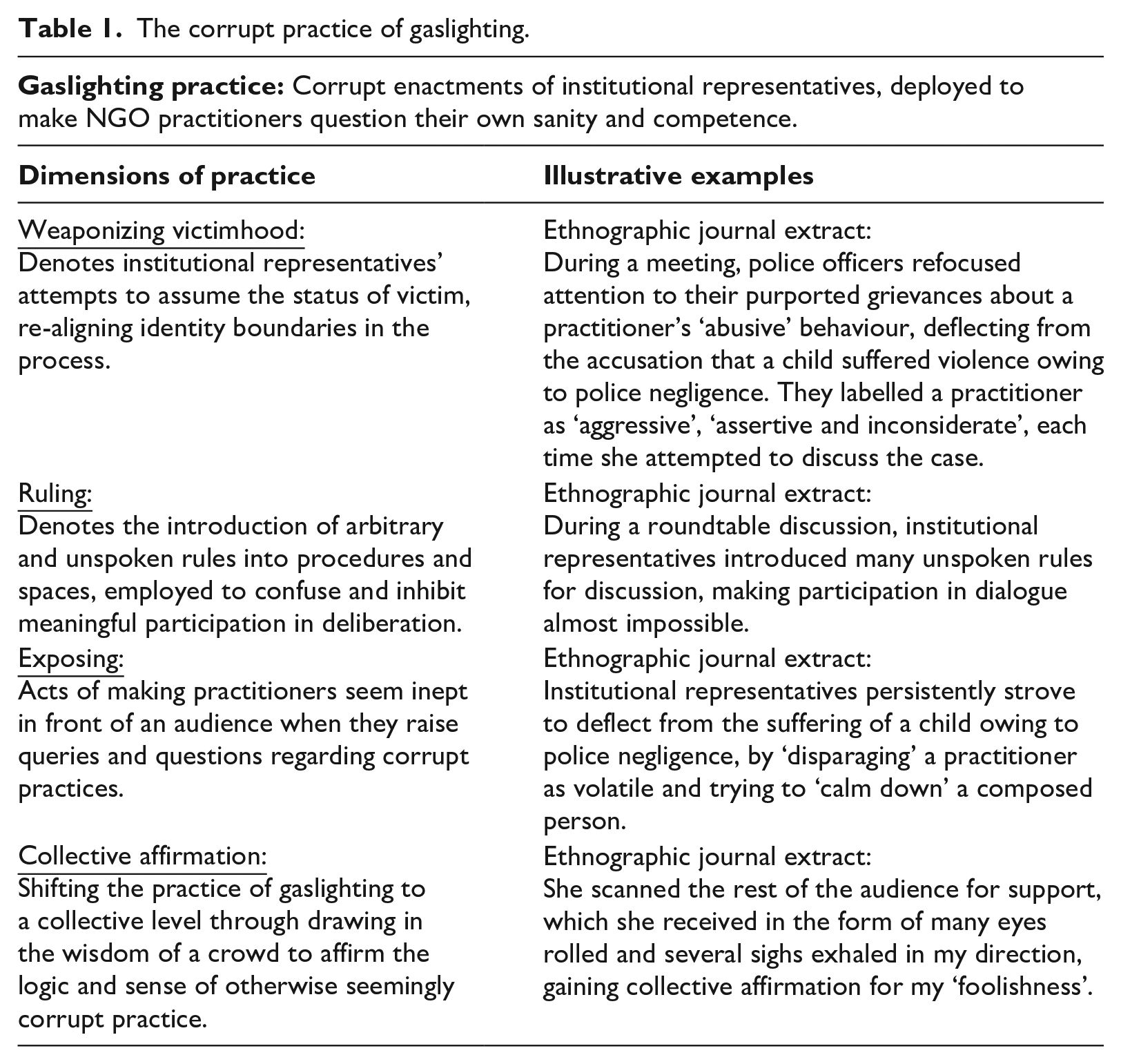
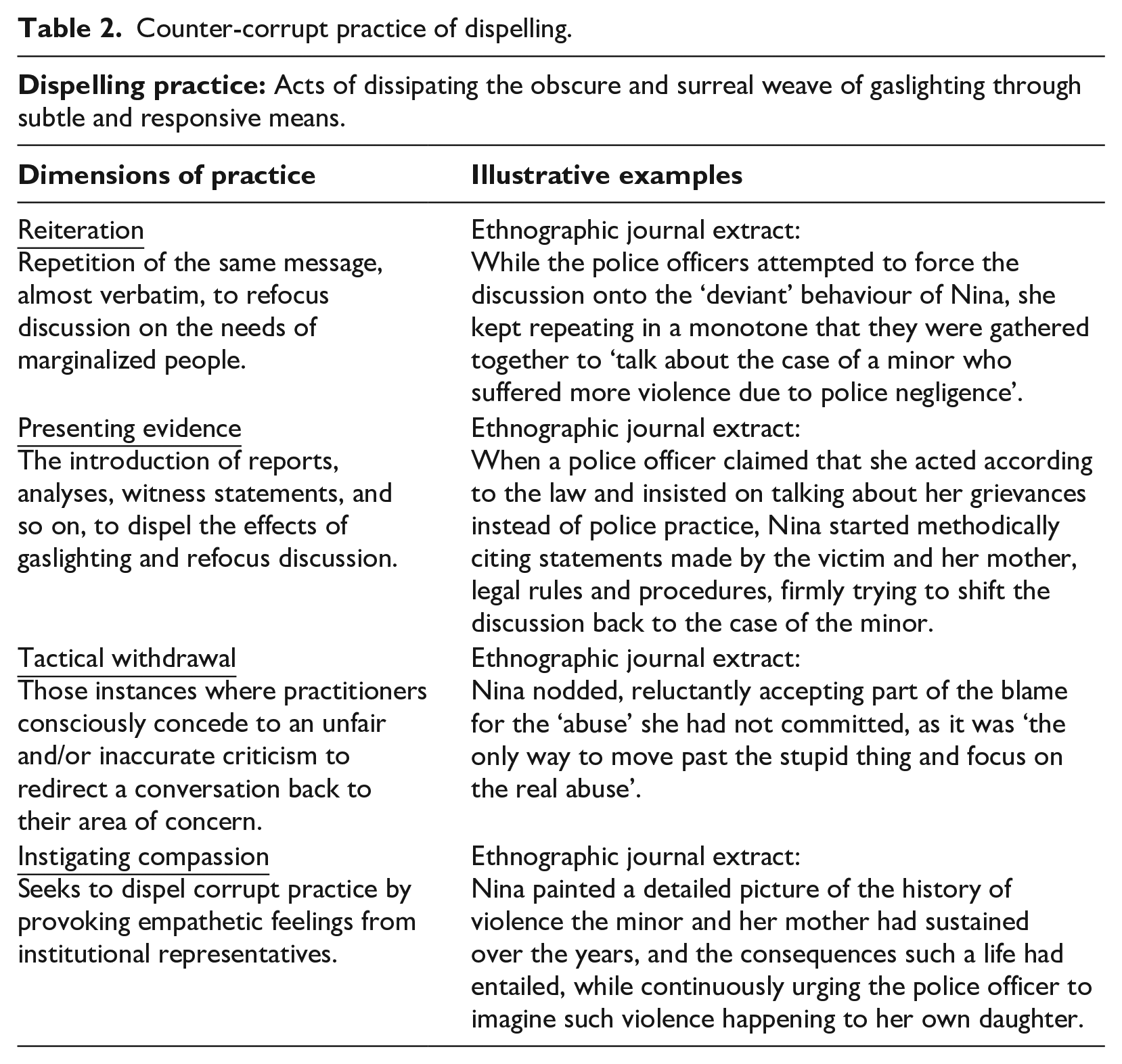
Practitioners often complained about ‘feeling crazy’, ‘participating in a parallel reality’ to that of institutional representatives. They would list examples of agreements and action points made with government representatives, which would be ignored in practice, as if they had never existed, and practitioners made to feel lost and confused by their justifications. When institutional representatives were challenged, they would routinely play victim, claiming they were being bullied by ‘unhinged’ NGO practitioners. They would do so persistently and convincingly, so much so that practitioners would often second-guess their actions, memories of events and evidence. I term such instances gaslighting, to capture the often abstract, obscure and surreal performances of corrupt actors. I theorize four dimensions of such corrupt practice, defined and summarized in Table 1. In response, the practice of dispelling denotes the perseverance and stamina of NGO practitioners in finding a way through. This practice features four dimensions, defined and summarized in Table 2. Dispelling means ‘to drive away in different directions or in scattered order; to disperse by force, dissipate’ (OED, 2020b) and I chose it for its evocative power, to signal the practice of undoing a ‘spell’. The practices of gaslighting and dispelling are explored through two ethnographic episodes. The first offers a first-person experience of gaslighting during a roundtable discussion about an important legal document. The second also provides an example of gaslighting, as an NGO practitioner, Nina, deals with police officers trying to shift attention away from victims of violence to a synthetic conflict. It also shows the counter-practice of dispelling, as Nina absorbs and deflects, enacting an embodied and subtle approach.
The corrupt practice of gaslighting.
Counter-corrupt practice of dispelling.
Gaslighting: Am I going mad?
The practice of gaslighting and its dimensions are summarized in Table 1.
Only when I experienced gaslighting first-hand did I truly understand what practitioners went through routinely and how difficult it is to dispel such practices. The experiences recounted here occurred during a ‘roundtable’ discussion with government representatives about a newly produced ‘Commentary on the Law on Gender Equality’. The Commentary is normally drafted with stakeholders who have experience with the law’s application in practice, such as NGO practitioners, with the purpose of identifying loopholes and strengthening provisions. I was surprised to learn that, in this case, the authors of the law were the same people who now acted as the sole commentators on its application. Moreover, no one present, apart from the authors, had laid eyes upon the document. I kept re-reading the discussion agenda, as I could not believe that a group of people could stage a discussion about something no one was familiar with. The authors-commentators provided an elaborate introduction about the importance of having such a law within the legal framework, underlining the status of the law as a ‘cherished milestone in the history of the country’, before receiving questions and comments.
Doubting my own judgment, I sent a text to Lana (NGO practitioner) asking if she was sure the organization had never read the Commentary, to which she texted back that each time they had asked, the response had been the same: ‘The document is not ready for distribution.’ I listened to the audience comments, variants of the same praise and admiration, wrapped in a discourse of historical significance, a form of collective affirmation. Such seemingly strange reactions from audience members I had become familiar with through interactions in the field only made me question myself further as an ‘autonomous locus of . . . judgment’ (Spear, 2020: 230). Sweating with panic at appearing ignorant for having not read the document, I continued to frantically search the agenda, hoping something on those pages would suddenly clarify my confusion, as not one person posed the obvious question: what does the Commentary say?
Finding nothing, I raised my hand only to realize that I was ‘invisible’, my request rendered ‘unintelligible’ (Butler, 2011: xv) in whatever rules the facilitator had determined for selecting speakers, rules not made explicit prior to or during the session, yet understood by this community of close-knit government actors. I eventually managed to ask for an opportunity to comment, after numerous unsuccessful attempts to make eye contact. The facilitator acknowledged my request but continued to ignore me. I felt ‘awkward’, like a ‘nuisance’, as my journal noted, exposed because my persistence in raising my hand was drawing looks of disapproval, as a socially unaccepted practice ‘in opposition to normative regimes governing recognition’ (Tyler, 2019: 50). Subsequently, I learned that this was common practice, governed by ‘socially instituted and maintained norms of intelligibility’ (Butler, 1999: 23), where institutional representatives render certain participants invisible and irrelevant through the subtle tactics of ruling deliberation spaces with their arbitrary routines, such as deciding who can speak and when, delaying and setting inconsistent limits on speaking time, as well as making people question the appropriateness of their gestures and acts – for example, Was my hand raised enough? Did I formulate my request clearly? Such questions, combined with the selection of nouns and adjectives I assigned to myself in my journal (‘invisible’, ‘irrelevant’, ‘nuisance’, ‘awkward’), signal the inception of doubt in myself as a legitimate source of reason (Stark, 2019). The ruling dimension therefore performed an important function in gaslighting practice: it is through assigning arbitrary rules to practice that ‘power imbalances’ (Sweet, 2019: 852) are underlined and secured – a platform upon which other aspects of gaslighting can unfold.
After more time passed, the facilitator finally approached and asked if I could allow a ministry representative to comment first. I agreed but wanted to know why she was insisting on it. ‘She is from the ministry’, she enunciated, expecting me to understand, which I did not at the time – another unspoken rule. Visibly irritated with my reaction, she passed the microphone over my shoulder. It was reverence for a ‘higher’ authority that informed the practice of the facilitator – establishing ‘a power differential between the gaslighter and his target’ (Stark, 2019: 223). By insisting to be heard and asking questions, I threatened to disrupt the normative order at play through an ‘enduring moment of resistance’ (Butler, 2016: 25).
The topic was equality, yet the entire event was abundant with unequal practice. Speakers used the masculine gender as a form of neutral gender, a practice legally sanctioned by the same law that was being discussed, ironically. Such a form of speech is overtly patriarchal, ‘rooted in social inequalities’ (Sweet, 2019: 852) where dominance of one gender over another is demonstrated and exercised through language. They also asserted power through pronoun choice, with authors-commentators using the informal pronoun ‘you’ (ti), while audience members addressed the authors-commentators with the formal ‘you’ (Vi) – a kind of demonstrative respect. Notable here is how ‘citing the [patriarchal] convention’ (Butler, 2011: xxi) in the context of discussing the Law on Gender Equality (using masculine forms as gender-neutral and underlining hierarchies through the use of ‘Vi’/‘ti’ forms of address) sets the discursive conditions for gaslighting through a form of unnamed ruling. Such ‘citations expose precisely what is excluded from them’ (p. 18), in this case, signalling masculine authority within a space designated for women.
When I finally had the opportunity to speak, I asked the convenors to elaborate on their rationale for providing a commentary on the law they had also drafted, as well as to explain why we were not sent the document in advance. The main speaker shot me a lingering and perplexed look, reflected in similar embodied ripples from supporters, exposing me as foolish for asking. She scanned the rest of the audience for support, which she received in the form of many eyes rolled and sighs exhaled, gaining collective affirmation for my ‘foolishness’, the feeling I noted at the time. Despite my best efforts to appear undeterred, my ‘body exceeded [my] intentions’ (Butler, 2004: 199): my brow and palms were sweating with anxiety because the body language of the speaker and others impressed upon me that I had asked something stupid, a feeling common among targets of gaslighting. Finally, she cleared her throat, smiled innocently and said, ‘Sorry, I don’t understand’, which made me feel as though the fault was mine for not keeping up. When I repeated my questions, she shrugged and apologized for ‘simply not understanding’, resisting my challenging of the normative framework at play, her facial expression appearing confused, as if I were speaking a foreign language. This is akin to Stark’s (2019: 225) practice of ‘sidestepping’, which involves ‘ridiculing or belittling the accuser for making the accusation’, although in my case the ridiculing/belittling took place implicitly and was achieved as a collective endeavour between facilitator and audience. Seeing the microphone being carried away, I temporarily woke up from my self-doubt and shouted across the room:
You are the people who wrote the law and now you have written a commentary on it without the input of people who use it in practice. No one knows what aspects of the law you commented on because no one has read it. Can you comment?
She was startled by this challenge and provided a clumsy response that the document was not printed until late the previous evening, making offended and hurt facial expressions, glancing around the room for more support, looking for collective affirmation. I realized, upon reflection, that she was assuming the identity of victim, even weaponizing victimhood, which would, in turn, render me a bully. Here, in gaslighting practice, the logic of bullying (Soylu and Sheehy-Skeffington, 2015) is inverted – perpetrators assume the role of victims and turn it into a weapon against their targets. Before I could say anything, people started praising the Commentary as ‘one of the best documents’, ‘a document we will be returning to over and over again’, affirming their respect for the authors. By this point, I was bathing in adrenaline and had lost all sense of propriety, so I shouted back like a feisty drunkard: ‘How the hell do you know when you haven’t read it?’ Yet, instead of the kind of cinematic resolution I was hoping for, where the audience cracks under the burden of a pointed question and admits the fallacy of the staged event, my voice, alongside my sense of pride, was drowned out by a cacophony of Odes to the Commentary. I was made to feel crazy and then I acted crazily, confirming the identity subtly assigned to me. Subsequently, however, applying a performative lens allowed insight into a moment of rupture within a normative framework that took place at the ‘borders of foreclosure’ (Butler, 1999: loc287). Although the pleading for explanations did not yield desired results, the act of yelling did signal a disturbance – I could not bend under the unyielding pressure to be subjected to patriarchal norms – so I broke, and in this way temporarily usurped the normative ‘foreclosure’. Yet, although I defied the framework at play, my actions did not permanently ‘disrupt’ (Butler, 2004: 43) the status quo. I was not merely discounted as a serious discussion participant but I began suspecting my own legitimacy as a ‘serious . . . interlocutor’ (Abramson, 2014: 2).
After the event, I started panicking, fearing that I may have compromised my colleagues’ relationship with these representatives. I walked back to the office, feeling stupid, ashamed and angry. Upon arrival, I came clean about everything, expecting the worst. However, they cheered and congratulated me on my ‘baptism by fire’. Luka and Andrea shared their ‘firsts’ of similar situations that resembled mine. Andrea explained: They want you to feel as if you’re losing your mind. My first encounter was surreal. I had to re-check to make sure I was saying what I thought I was saying because her reaction was completely incongruent to what was coming out of my mouth . . . She wanted to confuse and shut me up . . . It’s a well-rehearsed network of practices: destroying the evidence that we’ve seen with our own eyes, claiming it never existed, denying having ever said something, pinning something on us that we didn’t do, slandering us in the media, inventing meetings and agreements that never happened. It’s exhausting.
Using gaslighting to hijack the time and space designated for democratic practice (meetings, conferences, roundtable discussions), institutional representatives performatively restrict opportunities for practitioners to engage meaningfully through a range of gendered, patriarchal practices. Practitioners are forced to be vigilant, to stay ahead of corrupt practices and to dispel those already enacted, which I will now elaborate upon.
Dispelling: ‘Brutalizing’ the police
Here, I illustrate the practice of combating corruption, dispelling, the responsive actions of practitioners to achieve results for gender equality in the face of sophisticated gaslighting. The episode drawn upon comes from a WRC colleague, Nina, and her experiences of seeking justice for victims of domestic violence. Nina, in common with many WRC staff members, had an intimate connection with these police officers, dealing with them routinely and sharing mutual friends and family members. Before the episode, however, the practice of dispelling and its dimensions are summarized in Table 2.
Nina challenged a police officer for exposing a victim of domestic violence to further abuse. The victim was a minor, so the officer could not take a statement in the absence of a representative from the Centre for Social Protection. Yet, instead of advising the victim to contact the Centre, the officer stated in the report that there were ‘no legal grounds for undertaking further action’ and sent the victim home to more abuse. When Nina reacted to this negligence by phoning the police and following up with a visit to the station, accompanied by the victim, the police officer deflected by accusing Nina of ‘verbal attack’ (Stark, 2019: 225). This was an instance of weaponizing victimhood, an inversion of roles common in gaslighting. I listened to Nina asking for an explanation, reiterating the legal obligations of police officers: You were legally obliged to direct the victim to the Centre. Your role is to execute the law [interruption]. The girl could have been murdered, do you understand? The law stipulates that a statement is to be taken in the presence of the Centre and special measures applied and instead you sent them home.
There were two parallel dialogues unfolding – Nina was talking about the case, performatively repeating the provisions from the law, and the police officer was talking about Nina’s ‘disrespect of the police’. Instead of focusing on the case, the officer chose to complain about Nina’s behaviour to the civic police monitor, as well as to a police inspector, shifting the conversation from the main topic to the ‘character . . . of the target’ (Stark, 2019: 226), the effects of which took a long time to dispel. The issue was raised in meetings with the civic police monitor, as well as in ‘conferences on complex cases’, 2 and it was stated that Nina was ‘aggressive’, ‘too emotional’, ‘assertive and inconsiderate’, ‘out of control’, that she should ‘curb her emotions’, each time she attempted to discuss the predicament of the minor. Police officers here ‘cited’ (Butler, 2011: xxi) a normative repertoire ‘rooted in social inequalities’ between genders (Sweet, 2019: 852), employing sexist stereotypes to deflect from the case.
Each time, Nina had to employ denial as an ‘instrument for the refusal of recognition’ (Butler, 2004: 112) by those she deemed corrupt, patiently comparing the police report with the victim’s statement and explaining the legal obligations of the police in dealing with minors, a form of reiteration – an attempt to assert a different, democratic, normative order (p. 112): Nina: The police statement says there were ‘no legal grounds for undertaking further action’, signed by you. But the statement from the victim’s mother provides ample grounds for further action. They made a distress call at 7pm . . .
I was struck by her calm demeanour and patience but later in an interview Nina explained it was important to stay composed, as ‘it is their tactics to provoke you into losing your temper so they can dismiss you as crazy . . . so you have to suppress whatever you feel even when your blood boils’. To combat the gaslighting, she used ‘speech that occludes the body’ (Butler, 2004: 172), that is, a corporeal response to the corruption. She continued to present the evidence calmly – reports, victim statements and legal obligations – performatively, as if a proper ‘dialogue’ was unfolding. Yet the officers continued to ‘sidestep evidence’ (Stark, 2019: 224), acting as if they had not heard a word; they would continue steering a different ‘dialogue’, placing guilt upon Nina, like a song caught in a loop. I continued to observe Nina in the meeting, kneading her fingers in her lap under the table while maintaining a serene facial expression and a level voice, a signal that the practice of dispelling was performed simultaneously through body and words. Below is a short excerpt of a verbal exchange between participants:
I think we’re at risk of losing track of the real issue here, which is the illegal practice and how we can prevent it from happening in the future . . .
Nina, there’s no need for raised voices, we’re all friends here . . .
Who’s raising a voice? I’m just . . .
Nina cares about her clients and sometimes that leads her to react explosively. As a woman she can sometimes be too emotional and can act irrationally, but she has to understand that we’re on the same side . . .
I’m not a child she can yell at . . . I have feelings . . . I did my job who broke the law: conscientiously . . . she’s too aggressive . . .
In this extract, different dimensions of gaslighting intersect. The representatives first expose Nina as unstable, when she raises the issue of the minor, and then collectively affirm this description through coordinated remarks. It is through the act of ruling that Nina becomes the main topic of the conference – through the unspoken collective decision to use the time and space reserved for dialogue about a complex case for an analysis of the apparently deviant behaviour of Nina, who had tried to defy the normative order.
She is portrayed as a bully – someone who ‘raises [her] voice’, acts ‘explosively’, is ‘too emotional’, ‘irrational’, who ‘yells’ at ‘friends’, disregards their ‘feelings’ and is ‘too aggressive’. Simultaneously, the officer and civic monitor are portrayed as victims who suffer Nina’s ‘irrational’ outbursts. It is interesting to note the repetition of the noun ‘friends’, rooted in longer-term familiarity between the actors, denoting intimacy, but that is employed as a pacifying (and patronizing) tactic by the police inspector and civic monitor – positioning Nina as someone who needs calming, as they are ‘on the same side’. Akin to bullying practice (Salin, 2003) such positioning serves to transform Nina’s objection to the malpractice into a personal conflict, albeit with a role reversal at play where bullies are posited as victims and victims as bullies. The exposition stages a polarity between ‘the good guys’ (police) and ‘villain’ (Nina), and the case of the minor is pushed aside through the concerted action of police officers and civic monitor, a form of collective affirmation where ‘multiple parties play the role of gaslighter, or cooperating with a gaslighter’ (Abramson, 2014: 2).
Unlike the previous episode, where I was overcome by gaslighting, Nina was more adept at dispelling corrupt practice. She calmly presented statements, timelines and legal provisions in the face of continuous sexist accusations as ‘a ritual reiterated under and through constraint’ (Butler, 2011: 60). Time was passing and the conference was locked in endless repetition of two distinct normative frameworks (Butler, 2004): attacks from the police and evidence from Nina. It was a game of endurance, ‘a tactic designed to distract the target (and others) from attending to the evidence’ (Stark, 2019: 226). To everyone’s relief, one of the inspectors, perhaps keen to leave, finally suggested a ‘resolution’, where ‘[Nina] must understand that police officers are made of flesh and blood; they make mistakes, have feelings and dignity’, suggesting that Nina should be gentler in communication. This was the crack in the gaslighting practice Nina had been waiting for, I learned later. She nodded, accepting part of the blame, and the conversation finally returned to the case. Absorbing attacks and accepting blame was ‘the only way to move past the stupid thing and focus on the real abuse’, Nina later told me in an interview. This is an example of a tactical withdrawal, where Nina could see no point in confronting gaslighting head on, as that would mean more time and energy wasted, and instead absorbed attacks to try to transition to the topic they had gathered to address. Through tactical withdrawal, bodies emerge as the site of ‘discriminatory exclusionary practices and violence’ (Fotaki et al., 2014: 1241) – the collateral damage of countering corrupt practice.
As the conversation continued, Nina used the opportunity to draw attention to the repercussions of the negligent practice, shifting from citing legal provisions to instigating an emotional response from the challenged officer. Continuing to cite the legal provisions, Nina also started painting a detailed picture of the history of violence the minor and her mother had sustained: presenting evidence to describe the consequences of such a life for victims, urging the officer to imagine such violence happening to her own daughter. By doing this, Nina was seeking to instigate compassion by invoking the recognition of ‘human vulnerability [and] our collective responsibility for the physical lives of one another’ (Butler, 2006: 30). People’s body language visibly changed, signalling potential for the corrupt norm to ‘go awry’, to deviate from its seamless repetition. The officer dropped her eyes, blood rushing to her cheeks. Sensing this small glitch in the reiterative cycle of the norm, Nina offered help in a carefully worded question denoting unity: ‘How can we assist you in improving practice, drawing on our experience?’ This was further tactical withdrawal, framing the question around collective ‘improvement of practice’ to avoid placing blame on the officer in order to gain justice for the victims. Evident here is a rupture within the normative framework, where the officer became aware of her own ‘sense of expendability and disposability’ (Butler, 2011: 15) through Nina’s instigation of compassion. Such moments of rupture are important in dispelling gaslighting because they act as a kind of glitch in the apparently seamless reiteration of patriarchal norms – glitches that inhibit further sedimentation of corruption. During this period, Nina looked weary. She complained of not being able to ‘shake off the thoughts and feelings that keep [her] up at night’ linked to the case, which made her ‘go over and over again through evidence to make sure that [she had] covered all facts and details’. The acts of presenting evidence and reiteration occur beyond interactions with corrupt practice, rehearsed in the private spaces of practitioners, playing upon their tired bodies. Hence, dispelling and gaslighting unfold at the level of the subject. Practitioners interrogate themselves and reiteratively rehearse tactics to, in the words of Nina, ‘make sure I did all that can be done to save the girl from this endless abuse’, referring to both the domestic violence and institutional corruption exerted upon the girl.
Discussion
To better understand the persistence and tactics of gendered corruption, gaslighting was theorized as a practice that confuses and distracts – corruption that draws heavily on patriarchal norms. Recognizing the futility of direct confrontation with corruption in an intimate environment, the ecosystem of government-civil society in a small country in transition, practitioners counter with a patient, subtle and varied repertoire of dispelling. Understanding the intertwined dynamics of gaslighting and dispelling surfaces some of the gendered ways in which corruption operates but also provides insight into the lived experiences of those who navigate it, establishing a basis for exploring differences and similarities in other contexts.
The first point of discussion relates to the gender of gaslighters, namely that gaslighting may be enacted by women as well as men. This is not to say that women are equally responsible for corruption as men, but to draw attention to the power of the patriarchal normative dictate to turn women against women. It is possible to make sense of this contradiction by accepting that gender is a performative practice, enacted through a matrix of reiterative norms (Butler, 1999; Linstead and Pullen, 2006), where some women emerge as committed soldiers of patriarchy. In the findings, gender norms were entangled with corrupt and counter-corrupt practices, performatively enacting the subjects of ‘institutional representative’ and ‘NGO practitioner’ (Butler, 1999). There was no clearly delineated and universal subject of a ‘victimised woman’ gaslit by an unambiguous ‘patriarchal man’, but both men and women entangled in patriarchal norms and counter-norms enacted through embodied engagements. Within the complex normative entanglement of democracy and patriarchy, subjects emerged ‘as incoherence, disruption [and] a threat to [their] own systematicity’ (Butler, 2011: 13). Such incoherence may in itself make it harder to see the problem of gendered forms of corruption and therefore also for these problems to be addressed, in research and practice. Although in this study women emerged as adept gaslighters, it is worth underlining that such corrupt practice works in the service of patriarchy and to maintain the status quo, where most of the power and wealth rests with men. Further research might therefore investigate the material dimensions of gaslighting, seeking to make more explicit the material interests of women who perpetuate patriarchal norms.
The second point relates to a possible sociological interpretation of gaslighting, as outlined by Sweet (2019). At the core of her analysis is the case that for gaslighting to qualify as such, it requires both a power imbalance and intimacy to be present. In this study, the presence of such gaslighting from public officials is clear. First, in terms of a power imbalance, government employees often enter into employment through nepotism and connections, enjoying comparative job security and higher pay than the norm. NGO practitioners also have a degree of power, gleaned from their expertise and association with international organizations and donors. However, their jobs are less secure, their pay worse and their power more voluntaristic and relational than institutional. Second, in terms of intimacy, in small countries such as Montenegro, the connection between government and NGO workers is usually close. They may share family members, certainly friendship groups, and will come into contact frequently, even on a daily basis, at work or in the network of cafes and bars of the capital city. Hence, they become intimately familiar with one another’s behaviours and lives in excess of what one would expect of more regular working relationships. Methodologically, these tendencies of gaslighting suggest an approach to research that is embedded and longitudinal. This is because the ambiguous nature of gaslighting may only become visible through observing patterns over time, through noticing aside, informal and apparently mundane interactions; for example, exhibiting warmth on a one-to-one basis, or being invited to important life events of government employees, only later and intermittently undercut through hostile collective behaviour. More research is needed on how such intimate relations form and are navigated over time within a range of contexts.
Connecting gaslighting to corruption holds the possibility of extending Sweet’s (2019) insights by showing how gaslighting goes beyond interpersonal abuse. It is performed for the purpose of gaining a benefit, be it tangible, such as material wealth, intangible, such as gaining power, or a mix of the two (Abramson, 2014; Stark, 2019). Honig (2021) has started the work of demonstrating how gaslighting is used to secure power in the realm of politics, resting her case on an assumption that the proliferation of social media has created hermeneutic bubbles for both opponents and supporters who consume the pronouncements and imagery of certain leaders on a repetitive and micro level. Being unable to escape the proliferation of such leaders can radicalize followers and generate despair amongst opponents, who are unable to escape the presence and influence of such people. However, her account remains focused on senior political leaders and the ways in which they generate effects through the production and reproduction of media. This study offers a different perspective, providing insight into gaslighting enacted organizationally through everyday, collective and corrupt practices. Such a reading enriches understanding of how gaslighting emerges as an abuse and securing of organizational power that has profound consequences for women’s lives. These consequences are not only evident in the skewed distribution of wealth and power across genders, but also in more immediate and embodied ways, such as the self-doubt, imposed shame, stress, fear, insecurity and anxiety generated in the lives of NGO practitioners.
As a third discussion point, reflecting on the relevance and implications of the study for feminist organizing is important. The dynamic of personal friendship and professional conflict draws to the surface the value of viewing dispelling as a form of underground, ‘infrapolitical’ practice (Vachhani and Pullen, 2019). If practitioners adopt overtly oppositional tactics, they risk losing access, so must, to a certain degree, enter and live with the internal logics of gaslighting, learning how to navigate and neutralize their worst effects for the sake of an ethical responsibility towards victims of abuse. That practitioners must accept some elements of an oppressor’s practices (e.g. absorbing blame) in order to strategically deflect corruption, denotes the ‘fluid, ambiguous and . . . contradictory character of the power relations through which resistance is . . . enacted’ (Gagnon and Collinson, 2017: 1254; Smolović-Jones et al., 2021). This ambiguity manifests in a key challenge for dispelling practice: accepting enough of an oppressor’s logic to make gains for gender equality but not so much as to reproduce and amplify the very corrupt power that is being resisted.
Dispelling adopts an important civic and ethical significance, not attaining the status of formal policy interventions or initiatives but crucial nevertheless. Reflecting on my earlier experiences of gaslighting in the field, it would undoubtedly have been useful to have had a richer and more systematic understanding of what I was experiencing and potential responses to it. Outlining practices of gaslighting and dispelling may play some role in assisting practitioners who follow to prepare and plan more deliberately for their own context-specific engagements. Conceptually, the unrecognized and personal nature of this work underlines the importance of Butler’s theory for better understanding the operation of gendered corruption as unfolding through a continuous contest of norms, enacted daily on and through bodies (Butler, 2015). Corruption can be made to matter at the level of the bodies of practitioners, who lose sleep, experience anxiety and exhaustion. More research that explores the subjective and bodily experiences of navigating gaslighting would help further knowledge of how corruption operates in practice and the toll it takes on women who pursue equality. Relatedly, a fascinating area for future research in relation to gendered corruption lies in the contest over the personal nature of the political and the political nature of the personal. Dispelling could be interpreted as a set of tactics deriving from the personal experiences of abused women but used to make a political case for reform of institutional practice. These dispelling tactics are therefore always rooted in personal experience but aimed at more systemic change. However, a hallmark of gaslighting in corrupt contexts can be positioned as the making personal of the political, an inversion of feminist organizing logics. Hence, ‘weaponizing victimhood’ is a reduction of a political point that every woman and victim deserves fair and equal treatment to a personal issue concerning the feelings of government employees.
Finally, it is important to note how solidarity works in and against gendered forms of corruption. Not the topic of this study, it is nevertheless worth noting that the dispelling practice of NGO workers operated from a basis of a larger and collective network of support from other NGOs, international organizations and ad-hoc campaigns against injustices. Furthermore, dispelling adopts some characteristics of solidarity usually visible within feminist groups – most obviously ‘instigating compassion’. However, this is enacted pragmatically, in ways that are tactical and included within a broader repertoire of practices – the aim is not to immediately enrol government actors in a durable formation of solidarity with women. Nevertheless, the most notable instances of solidarity were visible at the level of corrupt actors. That these people display very different behaviours in one-to-one situations than when operating together indicates the presence of shared understanding and tacit acceptance of the gaslighting tactics that are deployed and repeated collectively, through united efforts. More research is needed to better understand the solidarity practices of gaslighters from within their communities, acknowledging of course the obvious difficulties in gaining access for this work. In response to such patriarchal and corrupt solidarity, there is a need to develop a shared set of counter-tactics that can be designed and honed amongst women seeking to resist. Dispelling is an attempt to do so and further research can refine this and similar approaches.
Conclusion
Perpetuating patriarchal norms cannot be anything other than corrupt within organizations that claim to stand for the values of liberal democracy, as they erode the liberty and equality of women. This point is vital for understanding contemporary organizational dynamics in a global context where anti-democratic populist movements hinge their rhetoric and practice on the oppression of women. Corruption related to electoral processes in the United States, for example, seems indivisible from the antipathy of the populist right towards a woman’s right to choose; in the UK, at a time of surging domestic violence, the police violently subdue a women’s vigil while the government proposes harsher punishments for damaging statues than for assaulting women; in Poland, constitutional norms are eroded by a combination of judicial and political undermining of the rule of law guaranteeing women bodily autonomy, a process ongoing through various scales of governance for decades. This inquiry has offered a qualitative and embodied view of such processes of gendered corruption at work and a conceptual and methodological means of understanding how they unfold and are contested in dynamic local contexts. We need further study in different contexts to understand in more depth and richness the systematically organized practice of gaslighting: the spaces in which it occurs, the tactics deployed and the effects it has on both democratic norms and on the bodies of non-corrupt actors. Globally, women and their allies dispel such practice daily, and this is subtle, arduous but hidden work. Drawing on our conceptual and methodological resources, as well as our privileged positions within the system of knowledge production, can help not only acknowledge the existence of dispelling but also elevate its status as a vital organizational practice.
Footnotes
Funding
The author received no financial support for the research, authorship, and/or publication of this article.
