




Abstract
In this paper, we examine community collectives – place-based, community-led initiatives for sustainable livelihood, as an alternative to the top-down, efficiency-driven economic model. Drawing on the theoretical framework of prefigurative organizing, we examined the strategies employed by community members in confronting entrenched inequalities and overcoming marginalization as they envision and engage in inclusive futures. We conducted a comparative case study of two exemplary community collectives in India that exhibited differences in the degrees of internal and external marginalization. We identified two key cross-cutting themes of prefigurative organizing: projective cultural adjustment – whether a community leverages their traditional culture or breaks away from it, and tempered autonomy – negotiating autonomy without overtly challenging dominant groups, and exercising self-imposed restraints to make independent decisions. We show how these two themes manifested across three key processes of prefigurative organizing: prefiguring self-governance; commoning; and cultivating discursive spaces. These findings help us theorize that in communities where the degree of internal marginalization is high due to persisting social hierarchies, breaking away from past discriminatory practices, incorporating suspension of consent in the decision-making process, and introducing multiple constructive works are essential components of prefigurative organizing. In communities where the degree of external marginalization is high, building on the past, incorporating refusal in decision-making, and introducing unified constructive work are important components of prefigurative organizing. We suggest that prefigurative organizing against the dominant power structure, whether within community social hierarchies or external exploitative political-economic structures, is based on selective and strategic engagement without seeking an exit, as exit might not be an option for place-based communities. We discuss the theoretical and practical implications of this research for alternative organizing and grand challenges.
Keywords
Community collectives (CCs)—community-owned, community-governed, place-based initiatives—are emerging as potential sustainable solutions to grand challenges. CCs are self-structured by the community members on the principle of solidarity and self-governance and show a significant departure from the top-down, growth-driven approaches of the current economic system (Barin Cruz, Aquino Alves, & Delbridge, 2017). CCs are viewed as prefigurative, as they demonstrate alternative societal structures by ‘creating imaginaries of an alternative future’ and ‘showing their viability in their everyday practices’ (Schiller-Merkens, 2022, p. 1). Organizational scholars have used a prefigurative lens to examine alternative organizing, like the anti-globalization and anti-austerity movements, and worker collectives (Daskalaki, Fotaki, & Sotiropoulou, 2019; Reinecke, 2018) that are issue-based temporary gatherings, sometimes in a symbolic place, e.g. Occupy Wall Street. However, less attention has been given to the autonomous struggles of place-based marginalized communities, such as Maya and Zapatista (Gahman, Penados, & Greenidge, 2020), to enact a desired future in the present (Jeffrey & Dyson, 2016). Building on the emerging research that highlights the struggles inherent in prefigurative organizing (De Coster & Zanoni, 2023; Schiller-Merkens, 2022), we suggest that CCs face various challenges in cultivating alternative practices.
Externally, CCs as an alternative form of organizing face severe constraints from the dominant system and are often repressed by or co-opted within the capitalist structure (Dinerstein, 2015; Gibson-Graham, 2006). Internally, CCs are confronted with entrenched inequalities and the resulting marginalization of certain social groups (Bhatt, 2022; Cucchi, Lubberink, Dentoni, & Gartner, 2022; Hota, Bhatt, & Qureshi, 2023; Riaz & Qureshi, 2017), particularly in heterogeneous and hierarchical contexts, such as caste-based stratification (Bhatt, Qureshi, & Sutter, 2022; Chrispal, Bapuji, & Zietsma, 2021; Qureshi, Sutter, & Bhatt, 2018). As these initiatives are based on the participation of community members in governance and management of scarce resources, the social hierarchy and resulting fragmented vision of the desired future can engender conflicting interests and misalignment, interfere with participatory decision-making, and create barriers to identifying a common solution to local problems (Barin Cruz et al., 2017). However, we have little understanding of how these challenges are navigated in the process of prefigurative organizing. In the dominant narratives, prefigurative organizing has become synonymous with immediate, direct actions – the here and now (Parker, 2023). As CCs are rooted in the historical and cultural context, the entrenched inequalities and resulting marginalization could hinder prefigurative potential. In this paper, we explore how CCs confront entrenched inequalities and overcome marginalization in the process of prefigurative organizing.
We undertook a qualitative study involving over seven years of fieldwork and subsequent follow-up interviews of two revelatory cases of CCs in rural India that exhibited varying degrees of internal and external marginalization experienced by the respective communities. Our research contributes to prefigurative organizing in place-based communities by identifying two key themes—projective cultural adjustment 1 and tempered autonomy—and demonstrating how these themes manifested across the three key processes of prefigurative organizing: prefiguring self-governance; commoning; and cultivating discursive spaces. We define projective cultural adjustment as the deliberate and pragmatic decisions of actors to build on or move away from past rituals and practices in their pursuit to reach an imagined future and suggest that its enactment is contingent upon the marginalization experienced by the community. We define tempered autonomy as the process of negotiating autonomy by and for marginalized groups without overtly challenging dominant groups and exercising self-imposed restraints to make independent decisions in their pursuit to reach an imagined future. Building on our finding of tempered autonomy, we suggest that prefigurative organizing against the dominant power structure is based on selective and strategic engagement without seeking an exit, as exiting might not be an option for place-based communities.
Our research also has implications for alternative forms of organizing and their role in addressing grand challenges. Our analysis of CCs shows how entrenched inequalities and resulting marginalization challenge the sustainability of alternative organizations. Our findings demonstrate how these challenges can be navigated through prefiguring self-governance, commoning and cultivating discursive spaces that allow for strategic and selective engagement, and depending on the cultural history, either build upon preexisting practices and rituals or move away from them to achieve the desired future.
Prefigurative Organizing
Organizational scholars increasingly explore alternative initiatives through prefigurative organizing (De Coster & Zanoni, 2023; Schiller-Merkens, 2022). Prefigurative organizing commonly refers to the experimentation with practices that ‘anticipate or enact some feature of an “alternative world” in the present’ (Yates, 2015, p. 4). It shows a commitment to live up to the standards of an ideal future that does not yet exist (Jeffrey & Dyson, 2016). The means of prefigurative organizing must be consistent with that of the end (Boggs, 1977). They could involve short-term, immediate actions or long-term processes of building counter-institutions and social arrangements based on equality and solidarity (Schiller-Merkens, 2022). Consequently, prefigurative organizing promotes anti-hierarchical, decentralized and egalitarian decision-making and rejects representative politics (Boggs, 1977). Often, these alternatives emerge from ‘below’ to negate given realities and engage collectively in creating new realities (Holloway, 2010). Many examples of such community-led, autonomous struggles challenge social and economic inequality through prefigurative organizing (Jeffrey & Dyson, 2016). However, little is known about their emergence and sustainability, as such efforts are underexplored in management and related disciplines (Bacq, Hertel, & Lumpkin, 2022). Next, we discuss CCs as one such community-based initiative and its implications for prefigurative organizing.
CCs and entrenched inequalities: The struggle of prefigurative organizing
CCs are community-owned and -governed place-based initiatives aligned with the prefigurative principles of self-governance and solidarity; they aim to address local needs by leveraging local resources and promoting decentralized governance (Gibson-Graham, 2006; Peredo & Chrisman, 2006). As CCs are embedded in a place, the spatial and social characteristics of a place – including physical and material attributes and a sense of belonging – have important implications for prefigurative organizing by CCs, which can influence their actions and potential for social change (Bridger & Alter, 2008; Gieryn, 2000). Consequently, the literature views shared identity and culture as enablers of place-based community initiatives (Bridger & Alter, 2008).
However, unlike issue-based temporary gatherings, culturally heterogeneous place-based communities can be exclusionary toward certain social groups through practices, rituals and traditions that sustain social hierarchies (Gieryn, 2000). Evidence from South Asia shows how place-based cultural and social practices marginalize women and some castes (Chrispal et al., 2021; Qureshi et al., 2022; Qureshi, Bhatt, Sutter, & Shukla, 2023). Practices and rituals to maintain control over marginalized groups can also substantially affect power dynamics and participation in community endeavours (Bhatt et al., 2022; Sutter, Bhatt, & Qureshi, 2023) and have implications for prefigurative organizing.
Organizational scholars have increasingly highlighted the role of entrenched inequalities and the struggle of prefigurative organizing. Many studies show how the control, power and domination that these initiatives seek to escape simply reassert themselves in a different form (De Coster & Zanoni, 2023; Reinecke, 2018). These internal struggles in prefigurative organizing are further complicated by their contested relationship with the state and their struggle against the dominant economic institutions (De Coster & Zanoni, 2023; Gomes, 2012). One example is the struggle of marginalized communities, particularly indigenous, to defend their way of life and livelihood and protect the environment (Gomes, 2012). Evidence shows various constraints on their quest for freedom from oppression, recognition of their rights, control over resources, and authority to make independent decisions to reach the imagined future (Dinerstein, 2015). In this context, some argue for exiting the dominating system (Day, 2005), strengthening community decision-making, and promoting deliberative processes to exert their autonomy (Bell & Reed, 2021). However, as critics argue, such efforts to segregate a space of autonomy are often unsuccessful, as they fail to recognize the dominant system’s pervasiveness (Parker, 2023). Further, the decision-making structures that are required for sustaining such an exit are only possible when diverse social groups can visualize a common future and engage in projective deliberations. However, such deliberations are not possible without addressing existing internal marginalization.
We argue that the entrenched inequalities in place-based communities can result in conflicting interests and fragmented visions about the desired future. Due to the differences in social positions and the resulting sociocultural experiences, different groups develop varying expectations about what is fair, feasible and desirable within a specific situation. This creates challenges in identifying a common solution to solve local problems (Mische, 2009), resulting in uncertainties and intergroup tensions. Addressing these tensions requires a deeper understanding of cultural history and relating prefigurative actions to the past, present and future. However, in the dominant narratives, prefiguration is inherently about the future and ‘sometimes rests upon a self-conscious denial of the past’ (Jeffrey & Dyson, 2016, p. 80). Accordingly, the extant literature on prefigurative organizing has paid little attention to historical context and how past practices, experiences and rituals of social groups affect efforts to create a desired future in the present (Gillan & Edwards, 2020). Since place-based communities are rooted in the historical and cultural context and the entrenched inequalities and resulting marginalization hinder prefigurative potential, in this paper, we ask how CCs overcome marginalization in the process of prefigurative organizing.
Research Context and Methodology
We conducted case studies of two revelatory CCs in India, Kappa and Lambda, in a resource-constrained rigid rural context fragmented around gender, caste and class hierarchies. The Constitution of India recognizes four categories of social groups: scheduled castes (SCs); scheduled tribes (STs); other backward classes (OBCs); and others. The SCs and STs have faced discrimination based on their perceived lower social status in the caste-based hierarchy (Bhatt, 2022).
Our case selection was based on the degree of internal and external marginalization faced by respective communities. We chose these two cases through engaged fieldwork that started in 2008 as part of a research programme on market inclusion and women’s empowerment. Kappa had a high degree of internal marginalization due to caste and gender-based discrimination. It also faced external marginalization due to water scarcity and its dependence on the government. It is a socially diverse village of 650 inhabitants with a composition of 31% SCs and 17% STs, the rest being OBCs and ‘others’. Almost 90% of the population relied on agriculture for their livelihood. This village was representative of most non-indigenous Indian villages. Over time, it has become a model village due to its relatively better awareness of social inclusion, women’s empowerment and environmental issues.
Lambda, our second case, is an indigenous village of 400 ST inhabitants located within forests, on which they rely for their livelihood. Compared to Kappa, Lambda had a lower degree of internal marginalization and a higher degree of external marginalization. Being an indigenous village, Lambda did not have a caste-based hierarchy. Its internal marginalization was gender-based. However, it suffered from extreme external marginalization due to the remoteness of the village and its total dependence on forest produce, which government agencies controlled. The village covers an area of about 2000 hectares, with 80% of it covered by forest. It had been engaged in a peaceful, three-decade-long struggle since the 1980s and finally gained ownership rights to the surrounding forest under the Forest Rights Act of 2006. Lambda also became one of the few villages where all the land, including that privately owned, was declared village commons under the Gramdaan 2 Act of Maharashtra. In the last three decades, Lambda has built an inclusive village assembly, established community ownership of resources and inspired over 100 villages. Therefore, with different degrees of internal and external marginalization, Kappa and Lambda represent interesting cases for understanding the emergence and sustainability of community organizing.
Data collection
We used a variety of approaches to gather data: informal conversations, semi-structured interviews, nonparticipant observations and archival data sources. Our research team comprised researchers who were strongly connected with the communities studied in this paper. For example, the first author has spent six months learning the community-led model in Kappa and gained a deep understanding of the social-economic dynamics of the community. The second author was familiar with Lambda; has deep knowledge of the local language, culture and context; and has multiple entry points through academics, activists and other stakeholders. These two authors collected data and performed analysis. The third author critically reviewed the analysis, and the fourth author remained disassociated with the data to provide an ‘uncontaminated’ critique of the themes and interpretation. In Kappa (with figures for Lambda shown in parentheses), we conducted interviews with 14 (15) key informants and 36 (29) community members. In addition, we held informal conversations with 21 (17) stakeholders and 83 (58) community members. We also conducted 12 (7) interviews and 12 (9) informal conversations in group settings. We observed 21 (16) Gram-Sabha sessions.
The interviews were conducted in Hindi, Marathi and English. We aimed to explore the challenges and potential of the community-based alternative to the top-down economic development model. The initial interviews were open-ended (unstructured). In addition, we conducted informal conversations with stakeholders and community members during data collection, which yielded candid information about sensitive topics such as gender, caste, government agencies and outside influences. As we progressed, the themes emerged around prefigurative organizing. We then used it as a conceptual toolkit to frame semi-structured interviews. However, even during semi-structured interviews, we kept an open mind toward emerging themes and followed interesting tangents in our interviews. The semi-structured interview protocol contained questions about the structure of community institutions; the governance of resources; the level and type of participation in community institutions; and the alignment of members’ expectations with these institutions. In addition, the interviews in the later years focused on issues related to the stability and sustainability of the various community initiatives. We observed community dynamics in two CCs for 145 days, including Gram-Sabha meetings and sociocultural interactions among the members. Field observations helped us understand decision-making in both formal and informal settings, including when and how consensus was reached. We made 250 pages of detailed notes of observation in multiple field diaries. We also collected internal documents, published reports, local media, newspapers and development professionals’ blogs on these communities. Secondary sources helped us understand a chronological account of events for triangulation with field observations and interview-based participants’ perspectives.
Data analysis
Multiple stages of data collection helped us use an abductive approach for analysis (Tavory & Timmermans, 2014), incorporating iterative cycles between data and conceptual frameworks of CCs and prefigurative organizing. The approach also allowed for data triangulation, comparing initial insights from archival data and interviews with later field observations. Themes were identified through the constant re-reading of data, discussion among researchers, and incorporation of emergent insights.
We first engaged in open coding of the key stakeholder interviews. Initial codes were related to resource scarcity; processes to overcome scarcity; village institutions; and processes for creating, protecting and regenerating commons (commoning). These codes also highlighted the issues around external marginalization. We then coded the data from the community member interviews and noticed a tension between the key stakeholders’ and community members’ accounts, as community members highlighted internal marginalization. Coding of community data resulted in codes such as caste-based exclusion (in Kappa), gender-based exclusion (present in both but higher in Kappa) and initial (lack of) participation by marginalized groups in commoning.
We then revisited our field notes, key stakeholder interviews and secondary data sources, which helped us reinterpret our coding; the emerging themes were related to prefigurative self-governance, commoning and cultivating discursive spaces. We saw a pattern emerge from our field notes that became increasingly nuanced in the later years. The seven-year fieldwork allowed us to focus on the tension and contradictions we observed in our earlier data, and we could ask key stakeholders and community members follow-up questions and use this new data to refine our analysis. In this coding round, our attention turned to internal and external marginalization issues, autonomy (at the individual, social group and community levels), and how culture was reflected in prefigurative organizing. The third iteration of the analysis revealed that communities and key informants were alluding to building on or moving away from the culture, a consistent theme that we labelled projective cultural adjustment. Respondents referred to interesting dynamics around constraints on autonomy, which we labelled tempered autonomy.
Processes of Prefigurative Organizing
We explored how CCs overcome marginalization in the process of prefigurative organizing. Both communities – Kappa and Lambda – faced internal and external marginalization, albeit to different degrees. The external threat to Kappa was depleting water resources and the government’s apathy; to Lambda, it was a lack of control over forest resources. Kappa’s trigger for change was a series of droughts in the 1990s, culminating in a significant water shortage in 2000. Lambda’s trigger was an increased struggle for forest produce, culminating in the stand-off for Ghotul, 3 in which women played a significant role in protecting men from police brutality. These triggers led the progressive members within these communities to identify various issues of internal marginalization that necessitate a resolution to counteract external marginalization. Thus, progressive members envisioned a more equitable community to secure it from external threats (Figure 1 – schematic representation of processes observed in the field). They prefigured a self-governance structure by organizing their decision-making activities to be horizontal, participatory and consensus-based. To provide a voice to everyone and engage various stakeholders, these communities cultivated discursive spaces where anyone could bring up any issues. These communities also resorted to the commoning of critical resources – water for Kappa and forest for Lambda – that were dwindling due to a lack of community control. Commoning these resources helped communities to have sustainable access to critical resources and create mutually beneficial interdependencies among the community members and social groups. This was an iterative process. As the community moved incrementally toward an envisioned future, more issues of marginalization were identified and addressed through the processes of prefiguring self-governance, commoning and cultivating discursive spaces (Figure 1). Thus, consistent with prefigurative literature, we identified three essential processes of prefigurative organizing in both the CCs: prefiguring self-governance through consensus-based decision-making, protecting and creating resources through commoning, and sustaining prefigurative self-governance and commoning through cultivating discursive spaces. More importantly, we found that the internal and external marginalization experienced by the two CCs manifested in the similarities and differences in two higher-level cross-cutting themes – projective cultural adjustment and tempered autonomy – and our analysis helped identify how these themes were reflected in three processes of prefigurative organizing. Table 1 provides definitions and representative quotes for the three processes and two cross-cutting themes (additional information in online Appendix B). We now provide detailed field evidence for how these processes unfolded.
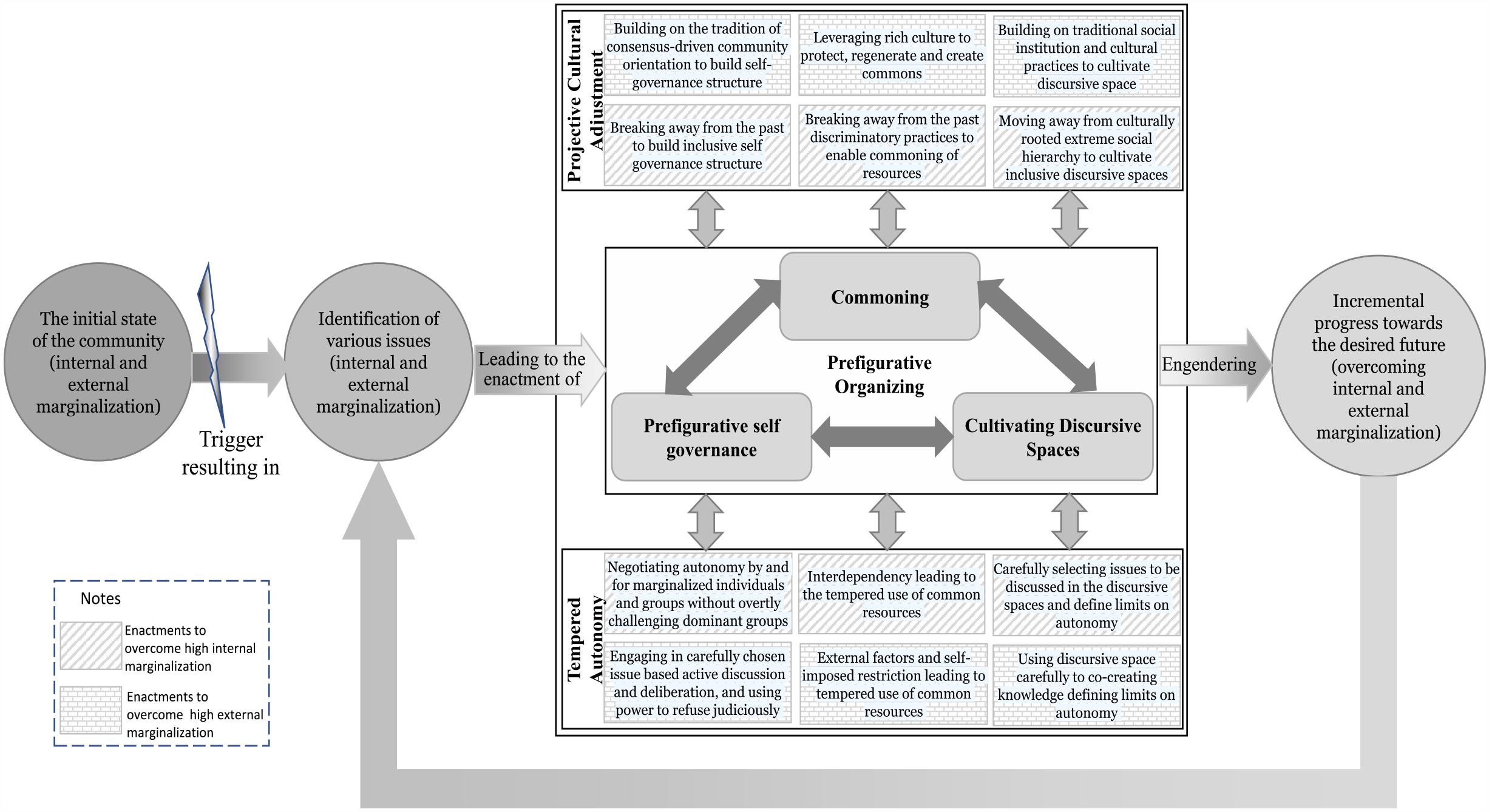
Process of prefigurative organizing.
Definitions of processes and illustrative quotes.
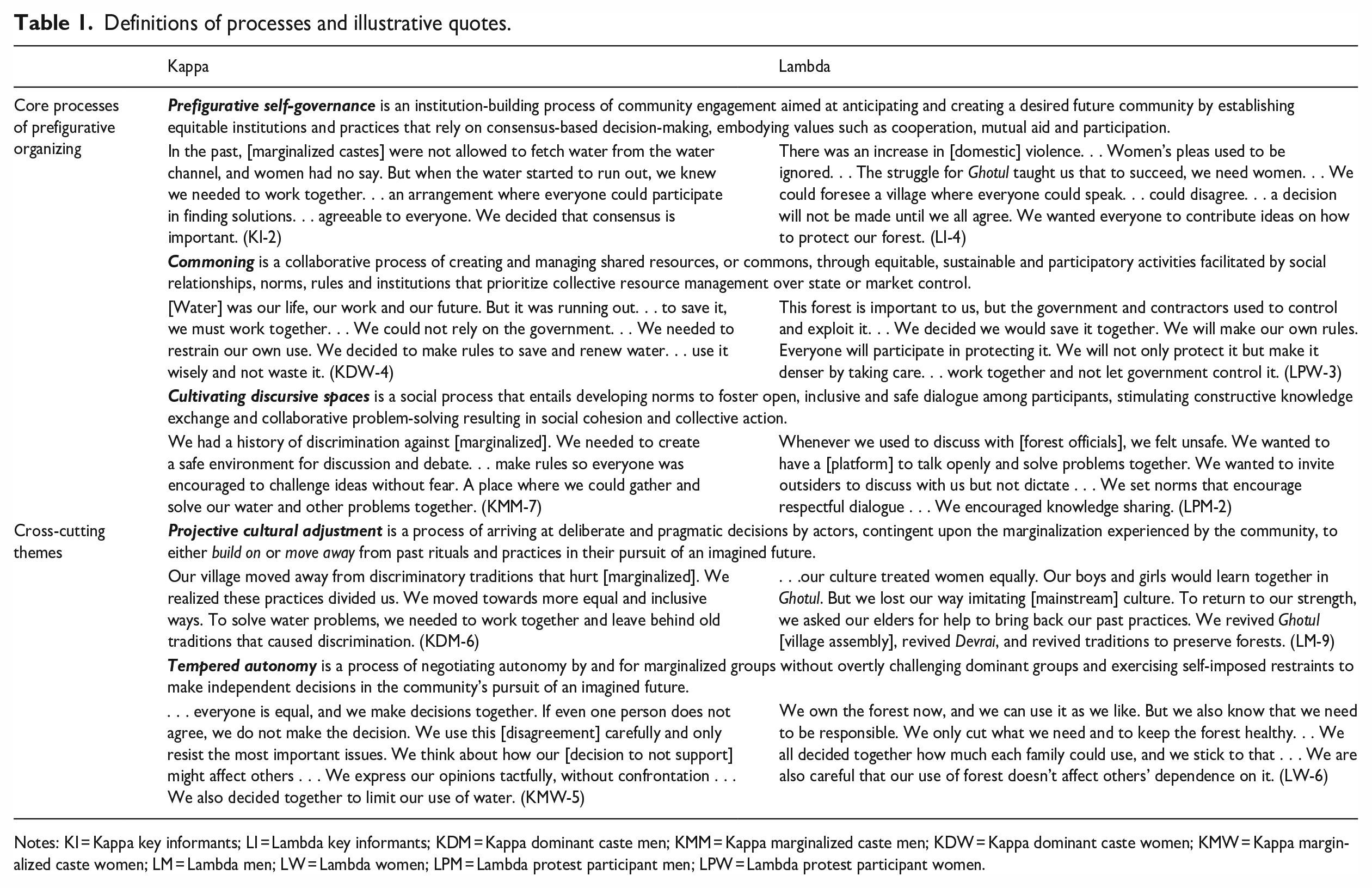
Notes: KI = Kappa key informants; LI = Lambda key informants; KDM = Kappa dominant caste men; KMM = Kappa marginalized caste men; KDW = Kappa dominant caste women; KMW = Kappa marginalized caste women; LM = Lambda men; LW = Lambda women; LPM = Lambda protest participant men; LPW = Lambda protest participant women.
Projective cultural adjustment and prefigurative organizing
We found differences in how the progressive members of Kappa and Lambda critically reflected upon their cultural repertoires (practices and rituals) to construct their action strategies. In Kappa, we found the progressive community members inspired everyone to break away from the discriminatory and exclusionary past rituals and practices by reimagining a future that would address marginalization and be based on equality and inclusion. In Lambda, we found deliberate strategies by the community leaders to build on and revive equitable and inclusive past rituals, stories, symbols and practices, e.g. Devrai (sacred grove) and Ghotul, to navigate marginalization.
Projective cultural adjustment and prefiguring self-governance
Our findings show that Kappa and Lambda built an inclusive village administrative body (Gram-Sabha) to manage village-level affairs. Further, several members in these CCs envisioned a more equitable society through a consensus-based decision-making process rather than voting. While both CCs structured their Gram-Sabha to align well with prefigurative organizing, we found differences in how they enacted their cultural history (past rituals, stories and symbols).
Prefigurative self-governance in Kappa: Breaking away from the past
Building an inclusive self-governance structure in Kappa, where gender inequality, untouchability and discrimination based on caste were rooted in rituals and practices, required confronting the past to reimagine the future of an equitable society. However, this proved to be challenging. A caste-based segregated village structure reflected traditions of purity and pollution, where the dominant castes were considered pure and the marginalized castes were considered polluted.
Caste hierarchy in rural India is rigid. It was the same in this village. [Dominant caste used to] believe they are next to God. They are holy. They should be deferred to. They also used to believe that [marginalized caste] is unclean and uncouth. Because of such beliefs, [dominant caste] used to exclude [marginalized caste] from all activities. (KI-4
4
)
When the conversation about building an inclusive self-governance structure in the village started, it was met with strong opposition. Based on their past experiences of exclusion and exploitation, the members of the marginalized groups had learned to rely on their kinship network for support. They were sceptical of the proposed inclusive governance structure – not of the idea per se but its feasibility and honest implementation. Many members narrated their past experiences and recalled their apprehension about meaningful inclusion.
In the past, we were invited to meetings when [outsiders] from the city visited us . . . We used to go to these meetings, we used to listen, but no one asked what we thought, what we wanted . . . no one listened to what we had to say. Officers used to come, share the information. [Dominant] people from the village used to attend meetings and ask questions. They used to get benefits. It was not beneficial for us. (KMM-2)
The dominant caste also held negative prejudices before Gram-Sabha was constituted.
Many [dominant caste] used to think [marginalized caste] had no education, no experience of working with outsiders. What do they know about how the outside world functions? They know nothing about how things are done. They do not know what we need for the development of the village. They have very narrow thinking. There are still some who think that way. (KDM-6)
Prefiguring an inclusive and consensus-based governance structure in such a context required breaking away from the past rituals and practices to overcome this culturally rooted exclusion, exploitation and inequality. As explained by the village leader: We wanted to accept everyone as a part of the family. The [Gram-Sabha] wanted to keep its door open to everyone. It required that we bury these bitter memories of the past and start fresh to create the [Gram-Sabha] that rejects discrimination and untouchability. (KI-2)
This process of breaking away from the past was complex, multifaceted and iterative. For clarity, we summarize it in three interconnected reinforcing stages. The initial engagements to build inclusive governance took place in each tola (hamlet) due to caste-based segregation in the village. Families were informed about their responsibilities and the benefits of a strong Gram-Sabha. Understanding each social group’s past experiences and grievances continued for about a year – a new experience for many marginalized groups, as most were never consulted earlier. It made them feel included in the process. The dominant caste group was also informed about the benefits they could receive from the new initiative. We observed that the subsequent engagements aimed to identify individual and collective needs and explored the possibility of creating commons to address those needs. The discussions focused on breaking away from cultural practices and rituals of caste-based occupations to promote inclusivity in the self-governance of commoning (see the subsection on commoning). Once needs and willingness to contribute were identified, village-level conversations were initiated to establish governance structures. The village-level executive committee, chosen through consensus, managed infrastructure implementation, promoted inclusivity among all groups (including marginalized ones), and facilitated the functioning of the Gram-Sabha for a two-year term, ensuring consensus-based decision-making to prevent dominance.
Consensus-based decision-making helps us understand everyone’s perspective. Everyone gets a chance to speak. Everyone is heard. (KDW-2) Some people will not be heard if we make a decision based on the majority. They may not say in the meeting, as they may not have support from the majority. This will lead to domination by the majority. We wanted to avoid this. We wanted to have a consensus-based decision. Even if only five persons have different opinions, we want to hear their concerns. (KI-2)
The Gram-Sabha was not a contestation-free zone, and tensions around different roles and responsibilities frequently occurred and were resolved by arriving at a consensus, no matter how long it took to reach one. The deliberate strategies of creating new narratives of inclusion and putting them into practice through the strategies discussed above initiated the path toward inclusive, equitable, consensus-based governance, which needed to move away from past cultural practices and rituals.
Prefigurative self-governance in Lambda: Building upon the past
The prefigurative organizing efforts in Lambda were built on the tradition of consensus-driven community orientation. While Lambda did not have a caste-based social hierarchy, their main challenge in building inclusive Gram-Sabha was gender discrimination and alcohol consumption-related violence against women. Our field data show the influence of patriarchal norms in the community.
Some men were not convinced that women should get an equal say in Gram-Sabha. They doubted women’s ability to take part in the discussion and argue in the Gram-Sabha. But some older men supported women’s demand to be equal participants in the Gram-Sabha. They also insisted that everyone in the village should fully participate. Then only our village will become strong. (LI-5)
We observed a strong reservation by some men over women’s capacity to inspire change and their role in the village governance body. They expressed their desire to confine women to a nominal role in decision-making. However, women were unprepared for this tokenism and refused to accept a nominal role. Many of them recalled their past roles and experience: We told them. We [women] took part in protests [against dam]. We led the movement for Ghotul construction. We have played an important role in all these activities . . . we [can] contribute to the future of our community. (LW-2)
By sharing their previous experiences of being actively involved in protests, women reminded the community of their role in achieving forest rights. Community elders could envision and commit to a gender-inclusive governance model by leveraging this process of reliving and retelling women’s past experiences. The elders developed a more inclusive governance model based on past cultural practices, like the inclusive conflict-resolving system, Ghotul, and gender-equal constructive work. This model emphasized the importance of discussion and dialogue before making decisions, drawing on the tradition of arriving at a consensus through participating in debate.
[Elderly] in this community were aware of the past. Our culture deteriorated in the last 40–50 years . . . Before that, our women had an equal say in everything. Our tradition of Ghotul gives them freedom . . . They used to take active participation in all decision-making . . . We had this Nyay Panchayat [Adivasi justice process], and all the women used to attend . . . We decided to return to our roots. (LI-2)
Our interviews with other observers, such as social activists, teachers and government officials in nearby towns, also helped us link the source of consensus-based decision-making to the tribal system of governance.
[They have a] culture of discussion and dialogue. All villagers would sit together and discuss the issue that affected their village. It seems to me that the elders in the village used this tradition of consensus to bring everyone together and discuss their concerns openly in the meeting. (LI-15)
Women utilized the inclusive self-governance structure to bring attention to the negative impact of alcohol consumption on men’s decision-making and women’s safety. They insisted measures be taken to address alcoholism and domestic violence among village men and made their participation in the Gram-Sabha conditional upon such action.
What is the point of coming to these meetings when drunk men speak incoherently? (LW-7)
Over 16 months of discussion, alcohol production, consumption and effect were explored, including developing alternative livelihoods for individuals previously involved in the alcohol business.
In the meeting, we also discussed the livelihood of people who were making alcohol. They wanted to know what their options were. Gram-Sabha needed to provide a solution. Only saying that alcohol is bad and we should stop making alcohol will not be enough, as it used to provide a livelihood to people. (LM-1)
Thus, consensus-based participatory decision-making ensured even small groups’ concerns were addressed. Building on past cultural practices of discussion and debate on contested issues allowed Lambda to move toward an equitable imagined future.
Projective cultural adjustment and commoning
Projective cultural adjustment was also reflected in the process of commoning. Our data analysis shows that Kappa and Lambda have been protecting, regenerating and creating commons to care for the environment and sustainable livelihood. While commoning in both CCs aimed to address the dwindling of essential resources due to lack of community control over them (external marginalization), building these commons required addressing internal marginalization and creating mutually beneficial interdependencies among community members and social groups. We also observed differences in how each CC enacted its cultural repertoire to create commons.
Commoning in Kappa
The process of creating commons in Kappa required breaking away from discriminatory past cultural practices and rituals. Kappa was located in a drought-prone area with water scarcity. Therefore, as indicated by the interviewees, most community members recognized the challenges of depleting water resources and the need for building check dams and water-recharge ponds. However, the concept of purity and pollution was rooted in cultural practices in Kappa. In the past, the dominant caste did not allow those from a marginalized caste anywhere near the water sources they used. Under such circumstances, it was challenging to engage in the process of commoning around shared water resources without breaking away from past rituals and practices. Also, differences existed about who would contribute what, who would take care of maintenance, and who should be allowed to use water from these resources. The caste hierarchy was the main hurdle to equitable access to water.
Water is sacred, very closely linked to purity and pollution. For centuries, some water sources only belonged to the [dominant caste], and a person from [marginalized caste] was not allowed to use [water]. If they do, it would be a huge scandal. So, when we proposed creating a water source that will be shared with others, some from the [dominant caste] were not happy. (KDM-8)
Similarly, there was a lack of a common reserve of seeds to support farmers in crop failures. Due to caste-based farming practices (i.e. certain castes were allowed to cultivate certain crops), it wasn’t easy to agree upon the common seeds bank without breaking away from past practices. Our field data show community members in Kappa recognized the value of building small water reservoirs to regenerate water resources and created seeds bank to revitalize agricultural activities further.
Most villagers are small farmers. They do not have money to buy good-quality seeds. Even farmers with larger fields used to be left without seeds after a poor monsoon when crops failed. We decided to create a shared seeds bank that would be accessible to all the farmers. (KDM-1)
Interestingly, even though they did doubt the feasibility, the marginalized groups, who bear the brunt of water shortage during the low rainfall season, were relatively easily convinced of the shared water source arrangement. However, convincing the rich and powerful in the village was challenging.
Initially, people from my caste did not agree with the arrangements. They said it goes against our [ritual and practices]. We can not fetch drinking water where [marginalized caste] fetch their water . . . [water resources] belonged to us in the past. We decided who could use them and who could not. So, asking us to pay [repair and maintenance] money for something that has always been ours and that has always been free was not easy to accept. (KDW-7)
The progressive members encouraged everyone through various narratives, and Gram-Sabha spent fourteen months building consensus on breaking away from discriminatory caste-based rituals and practices.
Don’t you want to live in a village that sets an example for other villages? Which has facilities that even the towns [don’t have]? (KI-8) We need to make our village an ideal village, a village where there is no discrimination, a village where everyone gets along well. We need to make our village where everyone has work . . . In order to achieve that, each of us has to take charge and contribute our labour, our time, our resources . . . everyone in the village should be part of this. (KI-1)
To promote community unity and overcome discriminatory practices, the Gram-Sabha engaged in constructive work around noncontroversial activities like plantations and soil-erosion prevention using idle resources (e.g. unused land and old water-harvesting structures). Later, the constructive work approach was used to create water and seeds bank commons, carefully applying it to non-drinking water commons first and then to drinking water commons.
We used anything available and allowed everyone willing to contribute. We did not force anyone to participate. We kept meeting everyone and told them how proud they would feel living in this village once we finish this work and how they could help us create an ideal village. (KI-2) It was helpful to start with [plantations] and other soil erosion projects. They are useful to everyone. Anyone can participate in these projects. There are no conflicts around such projects . . . These projects helped bring the community together . . . They helped start dialogues. (KI-8)
Thus, commoning in Kappa was a prolonged process with multiple constructive programmes, which helped them move away from past purity rituals and resulted in equitable access to water resources.
Commoning in Lambda
In Lambda, the commoning process was shaped by the intricate dependence of the villagers’ livelihoods on the forest, which was restricted by the state for several decades, impacting their livelihoods and sociocultural existence. Under the government’s watch, commercial activities increased and depleted the forest, while villagers’ access was restricted. Therefore, Lambda community members developed an elaborate system built on their rich culture to protect, regenerate and create commons, initially through constructive works and later through Gramdaan and ownership of the surrounding forest. To create solidarity toward a common cause, the elders engaged everyone in unified constructive work, which involved protecting and managing the forest. Such activities included plantations within their village and the vicinity, reviving the donated land and rejuvenating the acquired forest. Once the solidarity through initial constructive work was achieved and helped develop confidence in their ability to manage commons, villagers laid claim to the surrounding forest.
We are the custodian of this forest. We have always been for generations. Our ancestors have protected these forests and everything they represent . . . But we were told not to use it. We were stopped from entering our own forest. We could not enter, but contractors from anywhere could come and cut our trees. We used to watch helplessly . . . After our successful Ghotul protest, we decided to protect and manage our own forest. (LPM-1)
Community members also built on the past tradition of Devrai, whereby a substantial portion of the forest is left aside in perpetuity for sustainable forest management.
For [forest department] and contractors, all these trees are money. They see the forest as a way to earn money. For us, the forest is our life, the forest is our God, the forest is our culture, and the forest is our existence. We cannot think of cutting even a branch in our Devrai. Devrai is for the [perpetual sustainability] of the forest. But a contractor will not care about Devrai or any other aspect of the forest. (LM-4)
Community members in Lambda used commoning for the long-term sustainability of shared resources. They had various rituals and practices that prevented them from cutting certain trees or collecting fruits before specific periods so that birds and animals could eat those fruits. They also used their vast traditional knowledge of managing and protecting forests to ensure the survivability of people, animals and the forest. One example of this was declaring land as village commons. This enabled landowning farmers in a village to donate their land to the Gram-Sabha, which was then empowered to manage it for the collective good.
We don’t give preference to individual rights but to community rights. We decide what is in our [community’s] best interest and stick to it. (LI-1) In our community, it is not common to say this land belongs to me. We don’t think that way. People born and die. Land is always there. You can give and take money. How can you give and take the land? So when it was proposed that land should belong to the village and not to the people, most of us agreed. (LM-1)
However, the decision to have community ownership of land by Gram-Sabha required endorsement by government agencies, even though it was a consensus-based decision by the community. Nevertheless, the communal ownership of the land, which was rooted in past cultural practices, was seen as an important step toward the shared vision of a future rooted in the tribal anthem Jal, Jungle and Jameen (meaning forest dwellers should have rights over water, forest and land). The protection of natural resources and their sustainable use was also negotiated carefully to balance the present needs with the envisioned future.
Village elders have skillfully managed this. They have found a balance in meeting their regular needs from the forest and preserving the forest. They allow the forest [produce] to be used but limit how much forest [produce] can be consumed and what forest [produce] can be consumed. (LI-5)
Gram-Sabha devised various strategies to balance the present needs and the envisioned future, an extension of their traditional cultural practices of living within their means and preserving forests in perpetuity. For example, after extensive discussions, the Gram-Sabha unanimously decided on a limit for cutting bamboo. To build self-reliance, the Gram-Sabha kept a provision of receiving a fraction of individual gains in forest produce, which could then be spent on building infrastructure and other facilities.
Similarly, having farming land in the stewardship of Gram-Sabha avoided land grabbing by outsiders who would have no interest in commoning. Through Gramdaan, the village ensured that the land stayed in the ownership of the village, and individual owners were not tempted or forced by circumstances to sell to opportunistic land buyers operating in the region.
People from the city have started grabbing land in many of the nearby villages. Like vultures, they wait for a bad season. Farmers [in other villages] fall into a debt trap after a bad crop year. These people from the city then get poor farmers’ land at a throwaway price . . . Such a situation is avoided if the land is [controlled by] Gram-Sabha. (LI-7)
Preventing land grabbing and using land for commoning through constructive work helped Lambda overcome external marginalization. The balance between the long-term sustainability of forest through Devrai and short-term sustainable use was achieved by building on the indigenous cultural practices of protecting and managing resources.
Projective cultural adjustment and discursive spaces
Creating mechanisms and spaces that enabled individuals to come together, discuss and co-create knowledge were essential elements of prefigurative organizing in Kappa and Lambda. We also saw the manifestation of projective cultural adjustment in cultivating discursive spaces.
Cultivating discursive spaces in Kappa
The influence of dominant caste men was culturally rooted in Kappa. In the past, they were the ones who spoke at all the events. Marginalized groups either never attended such events or used to remain silent because of extreme internal marginalization. It was important for Kappa to move away from the culturally rooted extreme social hierarchy to achieve the goal of creating inclusive spaces for discussion. Therefore, when Gram-Sabha, a formal decision-making body, was constituted in Kappa, it was decided that it would simultaneously serve two purposes: first, as a platform for prefiguring self-governance, and second, as a discursive space.
Before we developed Gram-Sabha, we did not have any space where all members of our community could come together and discuss new things that were happening. We did not know the ecological way of doing agriculture. We did not realize our own role in building small ponds and check dams. (KMM-1)
As a discursive space, Gram-Sabha allowed members to present their vision of the community’s future. Members frequently expressed that they wanted their community to become a model village and debated how to achieve that objective. However, in a community that suffered from gender- and caste-based marginalization, it was impossible to make discursive space functional without moving away from the cultural practices that allowed dominant caste men to exert complete control over participation and discussion.
To facilitate engagement of the marginalized group, progressive members of Kappa initially chose topics that were of interest to everyone but were more familiar to members of marginalized communities and women. The discursive space was made more inclusive using a series of deliberate initiatives. Unlike the regular activities of Gram-Sabha, participation in discursive activities was encouraged but voluntary, as informal discussions were aimed at soliciting many different views rather than arriving at a consensus.
We deliberately created opportunities for [marginalized caste] and women to speak. To share their knowledge. We knew they could provide insights on many issues. We also knew that they normally do not get opportunities to speak. (KI-1) Our goal was to create an atmosphere where everyone was willing to speak and present their views. A difficult goal to achieve when [dominant caste] even won’t let [marginalized caste] enter the same premises. We had to slowly and intentionally create situations where [marginalized caste] and women’s knowledge and their views would be sought . . . They won’t be afraid to share their insights. (KI-2)
The opportunities to discuss and debate in Gram-Sabha that were otherwise unavailable to villagers increased the community members’ knowledge, confidence and conversational skills.
The district officers and other government staff often visit our village. Before, we would be very shy and would have just listened to what they said. But now, we all share what we are doing . . . I mean, we say whatever we want to. We do not hesitate. (KMW-2) Now our Gram-Sabha is very popular for its work on [climate change]. People come to our village to learn from us. We also debate new issues through the Gram-Sabha. (KMW-1)
Cultivating discursive spaces in Lambda
Community members in Lambda, in contrast, modelled study circles building on the traditional social institution of Ghotul (a space for learning through interactions) and the cultural practices surrounding it. Study circles as discursive spaces evolved separately from Gram-Sabha. While Gram-Sabha was a formal decision-making body, study circles were informal, voluntary institutions for reflection, experimentation and co-creation of knowledge.
Members of [study circle] discuss among themselves. If they need more information, they look for it. They go to other villages. They go to [cottage] industries. They talk to local experts. They try new ideas. (LI-6)
The members of Lambda realized that without building on their culture of knowledge exchange within the community and extending participation to outsiders, they would not receive information about their rights and responsibilities to use forest products. The study circles evolved into a discursive space where ideas from community members and outsiders were discussed, debated and co-created.
It was important for us to continue our culture of learning from each other . . . We wanted to take this a step further and involve others [from outside Lambda] to be a part of our study circles. (LM-5)
Based on the tradition of open exchange of ideas and social interactions in Ghotul, study circles encouraged discussion on various topics within an informal setting.
[Study circles] keep Gram-Sabha informed. Not everyone in Gram-Sabha can do all the reading and learning. [Study circles] help people learn. They bring all the information. Any new government rules. Any new methods to gain benefits from the forest without destroying it. [Study circles] play a crucial role in their success. (LI-5)
The study circles also engage in knowledge creation to resist external structures. Our respondents acknowledged that core challenges to alternative organizing arise from the external power structures that exploit indigenous communities and marginalize them. Moreover, collectivizing people to challenge authority is severely limited in resource-poor communities due to illiteracy and lack of rights awareness. Thus, study circles provided a crucial space for villagers to debate current and emerging issues, resulting in the co-creation of knowledge and understanding of what was important and urgent for the community.
When villagers were not knowledgeable, outsiders used to take advantage of them. [Forest guards] used to fine them even for entering or passing through the forest. Police used to fine them for drinking even when there was no prohibition. [Study circle] helped create awareness. Villagers now know their rights. They now know what they can and cannot do. If something is not clear to them, they bring it to [study circle] and request to know more. (LI-3)
However, arriving at the structure of study circles as discursive spaces was difficult. It took great effort to decide how to make them more egalitarian spaces and determine the role of outsiders, the process of deliberations, and the relationship between study circles and Gram-Sabha.
We wanted to keep it flexible . . . We also wanted to have some norms to encourage everyone to speak. We kept flexibility in topics. Anyone can bring any topic. But those who bring the topic should not do all the talking. Others should get a chance to express themselves. (LI-1)
The above discussion demonstrates how projective cultural adjustment as a cross-cutting theme manifests in all three prefigurative organizing processes. Kappa moved away from its exclusionary cultural practices and rituals in prefiguring self-governance, commoning and cultivating discursive spaces. In contrast, Lambda built on its cultural practices and rituals, like Devrai and Ghotul, which were more egalitarian.
Tempered autonomy and prefigurative organizing
In our extensive observations, interviews and reading of archival material, we found that in the communities that suffer extreme internal or external marginalization, members or social groups resorted to tempered autonomy in prefigurative organizing. Prefigurative organizing in place-based communities differs from issue-based temporary gatherings, as the exit is not an option for place-based community members. Their culture, livelihood and lives are intricately associated with the place they belong to, and they have no way of leaving that place if their demands are not met. Therefore, their struggle for autonomy is embedded in the context and moderated by it.
Our land is here. Our relations are here. My great-grandfather was born in this village and died in this village. My grandfather was born and died in this village. I will also die here. I cannot imagine leaving this village for any reason. (KDM-5) Even during the peak protest time (three decades ago) and during severe repression by [agencies], we never thought of leaving this place . . . We were born in our forest, and we will die here. (LPW-2)
At the community level, this personal and emotional attachment to place constrains the autonomy the community members or social groups would like to exert. In the community’s interaction with external forces (e.g. agencies), the attachment with place tempered the willingness to declare total independence from the authority, as that might result in the state uprooting the entire community. Tempered autonomy was reflected in all three processes of prefigurative organizing.
Tempered autonomy and prefiguring self-governance
Tempered autonomy and prefiguring self-governance in Kappa
Prefiguring self-governance involved negotiating autonomy by and for marginalized individuals and groups without overtly challenging dominant groups. In Kappa, where the social hierarchy was high, marginalized group members hesitated to express their opposition to an idea proposed by dominant caste men. However, as Gram-Sabha required consensus to implement any suggestions, withholding consent (i.e. suspension) rather than actively opposing had the same effect. Thus, even though marginalized groups in Kappa did not exert absolute autonomy in prefiguring self-governance, their tempered autonomy had a similar impact due to consensus-based processes.
In our [Gram-Sabha], everyone needs to agree on a suggestion . . . If I do not agree with something, I do not say anything immediately. I wait for someone else to disagree. Even if one person disagrees, the suggestion is not implemented. I know many women who do that. They do not directly disagree. They simply don’t agree and ask for more time to think. (KMW-9) I do not say no. I do not say I don’t agree. I feel uncomfortable saying that. If I do not agree with something, I simply say I need time to think. I am still trying to understand . . . I want to avoid appearing that I am trying to [block] their suggestion. (KMM-6)
Tempered autonomy and prefiguring self-governance in Lambda
In contrast, Lambda had no caste-based hierarchy, and women had a better say in Gram-Sabha activities than women in Kappa. Women were able to refuse their permission actively. As noted above, when Gram-Sabha was originally constructed around the principle of consensus, women identified alcohol consumption by men as a root cause of various social evils. They insisted on not attending Gram-Sabha unless alcoholism among men was addressed. They refused to participate.
One demand we made was that the village should stop alcohol [consumption]. If they cannot stop, then at least put some restrictions. We do not want to discuss with men [in Gram-Sabha] when they are drunk. (LW-4)
However, women used their refusal strategically. They reserved refusal for the most significant issue from their perspective and used discussion and deliberation strategies for other minor issues of disagreement. Thus, Kappa and Lambda reflected the tempered autonomy in prefiguring self-governance differently.
Tempered autonomy and commoning
Tempered autonomy and commoning in Kappa
Tempered autonomy was also reflected in the process of commoning. In Kappa, the successful commoning of water resources through building check dams and ponds meant that while there was, in general, more water available for everyone compared to previous years, everyone had to follow implemented quota. Therefore, in a year of poor rainfall, even relatively wealthy dominant caste farmers could irrigate only one crop instead of using water for three yearly crops. Thus, the interdependency in water use, which resulted from commoning, tempered the autonomy of using water at will by the dominant caste, wealthy farmers.
Some [dominant caste] farmers still feel that their freedom to use water at will is being curtailed. But most of them have started recognizing that they need to cut their water consumption for farming activities so that others have some water left for drinking and other necessities. [Dominant caste farmers] also realized that even if there is water in the check dam, they still need to use caution just in case there is poor rainfall in the next year. (KI-3)
A similar manifestation of tempered autonomy on account of interdependency was seen in the seeds bank and other diverse programmes implemented by Kappa’s Gram-Sabha.
At the village level, autonomy was also curtailed due to the shared nature of streams and rivulets under state jurisdiction. An excessive blockade of these channels through check dams could invite state intervention and punitive measures. Moreover, this being a semi-arid drought-prone area, the villages downstream of these streams and rivulets had conflicting demands on the water. These external stakeholders put additional constraints on the autonomy that Kappa’s Gram-Sabha and the community members could have enjoyed. However, Kappa overcame these constraints by constructing ponds with no conflicting external claims. Thus, as prefigurative organizing progressed, tempered autonomy was more due to self-imposed restrictions than external dependence.
Tempered autonomy and commoning in Lambda
The process of commoning – regenerating forests and establishing community ownership of land for a shared purpose, a village corpus fund and a community grain bank – required intensive deliberations to convince each member in Lambda. Depending on individual situations and the diversity of interests, some were focused on short-term gains, some were aligned with long-term objectives, and others perceived commoning as curtailing their freedom to use forests or their land freely.
People have different ideas and goals. Some would like to preserve the forest as such. Some would like to preserve forest but also use forest produce without destroying it. Others might see the forest as a resource to be utilized for their benefit. Gram-Sabha has to listen to everyone. Try to convince extreme views and find a middle path that everyone can agree on. (LI-4)
When the forest ownership rights were given to Lambda, some in the community felt they would have unrestricted access to the forest produce. However, this right also entailed the responsibility of managing the forest sustainably. Therefore, in consultation with study circles, the Gram-Sabha imposed restrictions on the amount and type of forest produce each family could harvest to promote sustainable forest management. Similarly, restrictions were imposed on communal land to curtail the autonomy of individual families in using contributed land at will. As a result, the commoning process in Lambda resulted in a tempered autonomy in the use of resources by community members.
It was not easy to get [forest rights] . . . Some villagers believed that once they got forest, they would be free to use it as they liked . . . These people were not happy when Gram-Sabha set the limit on various use. (LPM-4)
Externally, forest use was governed by various state laws that conflicted with indigenous communities’ traditional forest management approach. Moreover, powerful contractors, miners and industries were looking to buy the forest land cheaply, get forest produce by any means, or find the opportunity to mine mineral wealth buried below this forest cover. Similarly, neighbouring indigenous and non-indigenous villages had a claim on the contiguous forest, and the boundaries were not always clearly defined. All these external factors had a tempering effect on the autonomy exerted by Lambda over the commoning process. The constraints imposed by external factors were reduced through the clear demarcation of boundaries, increased awareness of rights through study circles, and the creation of monitoring groups. Thus, as prefigurative organizing progressed, tempered autonomy in commoning manifested more due to self-imposed restrictions than external constraints.
Tempered autonomy and discursive spaces
Tempered autonomy and discursive spaces in Kappa
We also observed the manifestation of tempered autonomy in the discursive spaces. In Kappa, as Gram-Sabha was the discursive space, we observed similar instances of marginalized groups resorting to tempered autonomy, as discussed above. In the initial years, women and marginalized caste members did not directly oppose the views of dominant caste men. Over the years, their participation increased substantially. However, they remained guarded, wary of appearing as though they opposed everything proposed by dominant caste men. They carefully picked the issues most affecting them to express their disagreement.
I liked [informal discussions]. There was no pressure to speak. There was no pressure to debate. But I was still not comfortable. I was still hesitant to speak after [dominant caste] men. I did not want to be seen as not giving them respect . . . But now I am comfortable speaking. I am still respectful, but I am not hesitant. (KMW-8)
In addition, the issue of defining limits to the autonomy of water use by the community members was informally discussed and debated in the Gram-Sabha in its capacity as a discursive place. To an extent, the tempered autonomy initially constrained the co-production and co-creation of knowledge; however, over time, such constraints eased.
Tempered autonomy and discursive spaces in Lambda
Study circles played the role of discursive space in Lambda, facilitating knowledge-sourcing interactions where external stakeholders could also participate. The discussion around the sustainable use and protection of forests revealed that most community members in Lambda felt an intricate and inseparable sociocultural relationship with the forest and created new terminologies, like Anant Vanpalak (custodian of forest in perpetuity), to express the revival of old traditions.
[Study circles] were initiated with the simple objective of creating awareness, providing information . . . Over time, they gained importance as informal discussion forums. They become the center of debates. Not only debate existing issues but bring forth new issues . . . They also come up with many new ideas and phrases. (LI-13)
The study circles then co-created knowledge defining limits on the autonomy of consumption to balance it with the role of forest custodian in perpetuity. The study circles themselves did not have unfettered autonomy in implementing these limits. While study circles had the autonomy to choose the topic they wanted to discuss and debate and conduct their discussions interactively, they could only offer suggestions and had no voice in implementing those recommendations.
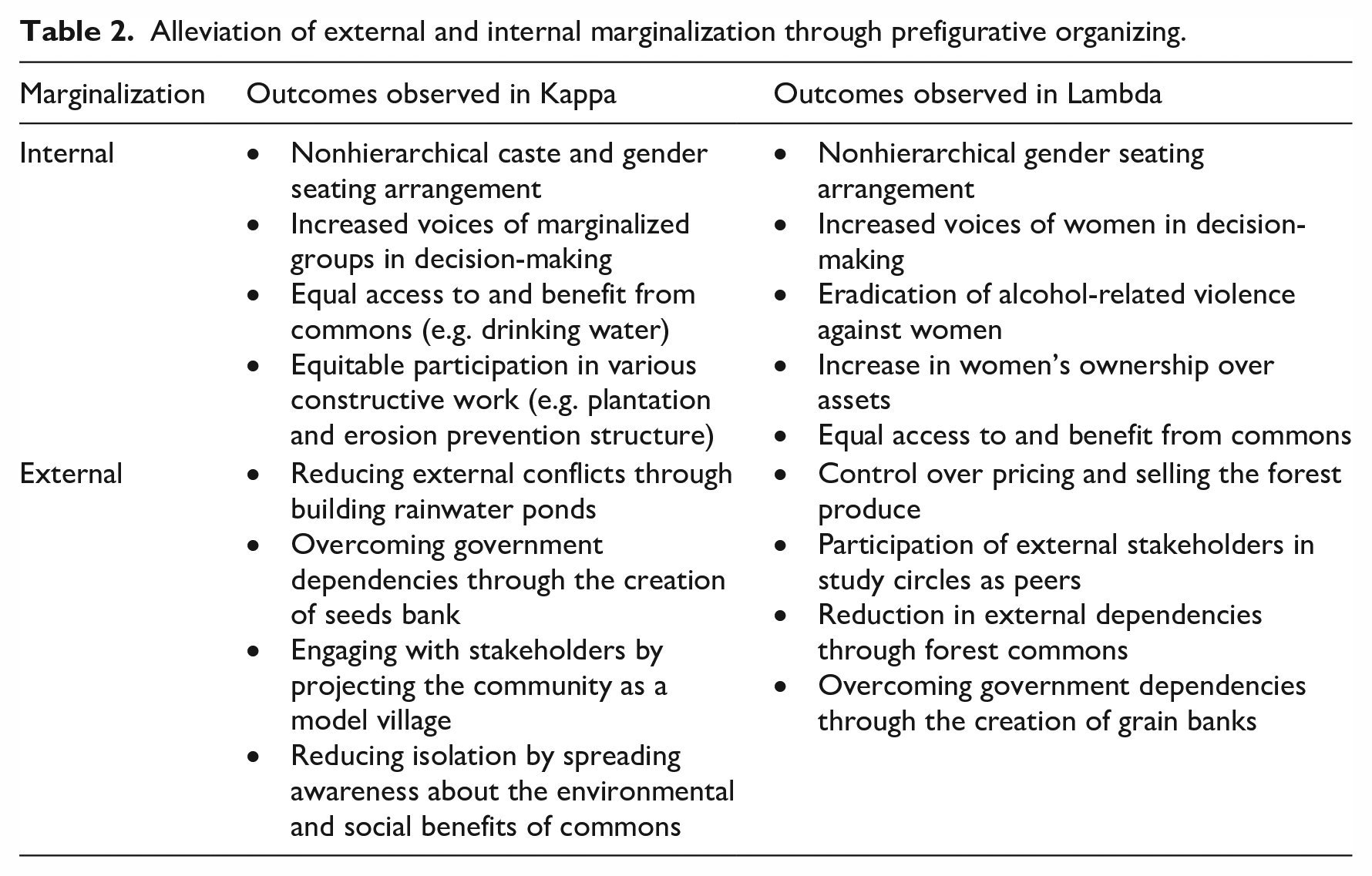
In general, tempered autonomy was manifested in all three processes of prefigurative organizing, and the overall findings suggest the changing nature of how autonomy was tempered. Over time, as prefigurative organizing took root in both CCs, the external dependencies or constraints were reduced and communities could exert more autonomy in their commoning process vis-à-vis the external stakeholders. At the same time, self-imposed restrictions remained to temper the autonomy to use resources at will. Similarly, the marginalized groups in both CCs, more in Kappa and less in Lambda, followed the suspension strategy initially and withheld their views; however, this kind of self-imposition by marginalized groups reduced over time. Thus, the findings in both the CCs jointly provide insights into reducing external marginalization and internal marginalization through prefigurative organizing (Table 2; also online Appendix B).
Alleviation of external and internal marginalization through prefigurative organizing.
Discussion
In this study, we sought to understand prefigurative organizing by two place-based communities, Kappa and Lambda. Figure 1 succinctly captures the process of prefigurative organizing and demonstrates the dynamicity and incremental progress towards the desired future. In the following subsections, we discuss the theoretical and practical implications of these findings for associated literature on prefigurative organizing and sustainability of alternative organizing.
Contributions to the prefigurative organizing literature
Our study of place-based communities helps extend the theory of prefigurative organizing in the following ways. First, our research extends the recent work in prefigurative literature that highlights cultural history as a critical resource for prefigurative organizing (Jeffrey & Dyson, 2016; Schneider, 2013). As prefigurative organizing in issue-based temporary gatherings is concerned with the here and now, the place that is being occupied and the occupiers do not necessarily have a shared cultural history (cf. De Coster & Zanoni, 2023). Thus, prefigurative organizing can involve a conscious decision to overlook the past (Jeffrey & Dyson, 2016), where participants often abandon their personal and broader history to be part of a movement. This presents a conundrum for place-based communities involved in prefigurative organizing. Prefiguration is inherently about the future and often requires overlooking past historical and cultural experiences (Gillan & Edwards, 2020). However, place-based communities are shaped by culture and history (Gieryn, 2000). Generations of social groups living in a place develop myriad rituals and practices that give meaning to their association with that place. Consequently, the land, the forest and the water bodies have cultural and temporal significance for people who have lived there for generations. To the extent, some cultural practices might be inclusionary and others exclusionary, the progressive actors in the communities could decide whether to enact the preexisting cultural templates – practices and rituals – to reimagine an inclusive future, or to move away from them to gain the desired outcome. We label these deliberate strategies of using preexisting cultural templates as a source for reimagining the future as projective cultural adjustment, which helps address the conundrum of prefigurative organizing in place-based communities.
This finding also extends the research in the organizational context that has noted the importance of culture and history in organizational change (Giorgi, Lockwood, & Glynn, 2015) and highlights how actors can motivate strategic change by ‘retrospectively reconstructing a degree of coherence and continuity between the organization’s history and a, largely predefined, future direction’ (Suddaby & Foster, 2017, p. 28). Our findings further add to this stream of research by bringing attention to the sociocultural context and nuances of internal and external marginalization. Drawing insights from our case studies, we theorize that when historical and structural exploitation prevails within the communities, as in Kappa, moving away from the past becomes an essential component of prefiguration. On the contrary, when the exploitation of communities is external and internal marginalization is not severe, as in Lambda, we theorize that building upon the past is a key component of prefiguration. As such, our research contributes to the cultural perspective in organizational research, which suggests that actors could effectively use the past to make sense of the future and make the imagined future legitimate.
Second, we build on the insights from the anarchist tradition and the recent work on concrete utopia. This research conceptualizes prefigurative organizing as the contestation and negotiation of the role and manifestations of autonomy (Dinerstein, 2015; Holloway, 2010). We extend this work by introducing the concept of tempered autonomy, as a cross-cutting theme of prefigurative organizing, that manifests in prefiguring self-governance, commoning and cultivating discursive spaces due to the multifaceted struggles of communities against internal and external marginalization. Tempered autonomy illuminates that for marginalized groups, prefiguration is about fighting domination while being embedded in and shaped by their past and contemporary socioeconomic context. Thus, the notion of tempered autonomy helps us reject a dichotomous view of alternative organizing by marginalized groups as either autonomy located outside constraining structures through exit or autonomy achieved through revolution by completely overthrowing such structures. Instead, we propose that prefigurative organizing by marginalized groups is about creating alternative futures within the interstices of the dominant structure and, from there, expanding the cracks (Holloway, 2010). We extend this work by providing strategies to address power structure. We argue that when internal power differences are high and saying ‘no’ might result in violence, the marginalized groups seek autonomy by engaging in suspension. Suspension implies an act of reserving consent without overtly rejecting domination and the decision-making process. The case of Kappa illustrates this. Our analysis also reveals that when the internal power difference is not high, marginalized groups could engage in overt refusal to consent. We observed this in the case of Lambda, where women refused to participate in meetings until their demands were met. Further, instead of withdrawing from the external structures (e.g. state apparatus in the case of Zapatista; Holloway, 2010), our research suggests selective and strategic engagement can be used to overcome systemic barriers.
Third, we show the implications of tempered autonomy and projective cultural adjustment for commoning and cultivating discursive spaces in prefigurative organizing. Our study shows that commoning is an important strategy for collectivizing and reproducing resources for place-based communities, but it is shaped by the socio-structural context. In a community where the vision of the future is fragmented due to entrenched inequalities, commoning with a multiplicity of constructive work (i.e. diversified constructive work) is an essential component of prefiguration. In contrast, when the external threat to survival is higher, building commons could be supplemented by unified constructive work. Our research also identifies the pathways to cultivate discursive spaces in heterogeneous and hierarchical communities. We show that independent and informal discursive spaces are more critical for prefigurative organizing than formal discursive spaces in resource-poor communities. We also suggest that in resource-poor communities, creating discursive spaces could lead to the co-creation of knowledge and shared meaning around protecting and generating natural resources.
Implication for grand challenges and sustainability of alternative organizing
Our research also has broader implications for research on sustainability and grand challenges. Communities are increasingly seen as social change agents (Bacq et al., 2022). Previous research highlights the role of local and trans-local organizing practices in co-producing new forms of resistance (Daskalaki & Kokkinidis, 2017) and that of joint performance of value practices in alternative organizing (Daskalaki et al., 2019). We contribute to this research by demonstrating how the place-based, situated efforts of the community can proactively resist the ‘downside’ of the exploitative capitalist model and construct alternatives that are not based on externalizing cost and internalizing profits. Instead, through constructive work-driven commoning, communities can reimagine social relationships as they organize to resist domination.
Further, by identifying mechanisms through which CCs address the issues of internal and external marginalization, our study also provides preliminary insights into the emergence and sustainability of alternative organizing. Specifically, our study of two CCs revealed that entrenched inequality could make alternative organizing vulnerable and has severe implications for their sustainability. Our findings show that CCs could address these challenges through a deliberate strategy of projective cultural adjustment – either using a preexisting cultural template or moving away from the preexisting templates. Further, our analysis of the process of building CCs brings the structure of power and its transformation to the centre of alternative organizing and proposes suspension and refusal as pragmatic strategies to avoid direct conflict with dominant entities. Such practical strategies can enhance the sustainability and effectiveness of alternative organizing in addressing grand societal challenges (Angeli, Metz, & Raab, 2022).
While our findings are derived from a particular empirical context, they are transferable to other settings. The internal–external marginalization that is salient in our case studies is a feature of many place-based communities (Gieryn, 2000). In our context, gender- and caste-based marginalization were salient; in other communities, marginalization might result from deprivation based on gender, race, religion, or an interplay between these identities. Therefore, the mechanism identified in our study could inform conversations in other contexts as well. Second, the prefigurative mechanisms identified in our case study also make ‘imagined futures visible and empirically accessible’ for other actors imagining and deliberating an inclusive, equitable future in the present (Gümüsay & Reinecke, 2021).
Supplemental Material
sj-docx-1-oss-10.1177_01708406231203295 – Supplemental material for Prefiguring Alternative Organizing: Confronting marginalization through projective cultural adjustment and tempered autonomy
Supplemental material, sj-docx-1-oss-10.1177_01708406231203295 for Prefiguring Alternative Organizing: Confronting marginalization through projective cultural adjustment and tempered autonomy by Babita Bhatt, Israr Qureshi, Dhirendra M. Shukla and Pradeep K. Hota in Organization Studies
Footnotes
Acknowledgements
We are thankful for the excellent constructive and developmental guidance from Guest Editors, Rick Delbridge, Markus Helfen, Andi Pekarek, Elke Schüßler, and Charlene Zietsma, and three anonymous reviewers. We especially thank each of our research participants for generously giving their time.
Funding
The author(s) disclosed receipt of the following financial support for the research, authorship, and/or publication of this article: This research was supported by IDRC Doctoral Research Award (# 107473-99906075- 074 to Babita Bhatt) and the Research Grants Council of Hong Kong (GRF Grants: PolyU 548210 to Israr Qureshi and PolyU 549211 to Babita Bhatt and Israr Qureshi).

Notes
Author biographies
References
Supplementary Material
Please find the following supplemental material available below.
For Open Access articles published under a Creative Commons License, all supplemental material carries the same license as the article it is associated with.
For non-Open Access articles published, all supplemental material carries a non-exclusive license, and permission requests for re-use of supplemental material or any part of supplemental material shall be sent directly to the copyright owner as specified in the copyright notice associated with the article.
