




Abstract
This paper introduces the concept of ‘organizational readiness’: socio-cultural expectations about working selves that prepare young people (albeit indirectly and in complex and multi-faceted ways) for their future life in organizations. This concept emerges from an analysis of Disney animations and how they constitute expectations about working life that may influence children through their representations of work and gendered workplace roles. The paper’s exploration of Disney’s earlier animations suggests they circulated norms of gender that girls should be weak and avoid work. In contrast, its contemporary productions circulate gender norms that suggest girls should be strong and engage in paid work. In this reading, the continued circulation of earlier alongside contemporary animations may convey to young viewers a paradox: girls must and must not work; they must be both weak and strong. We thus offer new insights into the puzzle of the continued relegation of women to the sidelines in organizations; more optimistically, we also point to ways in which future generations of employees may forge ways of constituting forms of gendered selves as yet hardly imaginable.
‘Just whistle while you work, and cheerfully together we can tidy up the place….It won’t take long when there’s a song, to help you set the pace. And as you sweep the room, imagine that the broom is someone that you love. And you’ll find you’re dancing to the tune. When hearts are high, the time will fly so whistle while you work’ (Snow White and the Seven Dwarfs, ‘Whistle while you work’, 1937) ‘No right, no wrong, no rules for me. I’m free!’ (Frozen, ‘Let it go’, 2013)
Introduction
In September 2014, the UN’s Gender Bias without Borders report into the marginalization of women in TV and film roles confirmed what many people had suspected for some time (Smith, Choueiti, & Pieper, 2014), that ‘less than one third of all speaking characters in film are female [and] less than a quarter of the fictional on-screen workforce is comprised of women (22.5 per cent)’ (UN Women, 2014). When depicted as part of the workforce women are under-represented in prominent professions, with male characters more likely to be judges (by a ratio of 13 to 1), professors (16 to 1), medical practitioners (5 to 1) and in science, technology, engineering and mathematics (STEM) fields (7 to 1).
We start our paper with the assumption that films are performative (Cabantous, Gond, Harding, & Learmonth, 2016; Gond, Cabantous, Harding, & Learmonth, 2015; Learmonth, Harding, Gond, & Cabantous, 2016). So, for example, how women are (or are not) represented in film and other cultural media influences constructions of the female self (Stacey, 1994) and the continued depiction of women as somehow inferior and powerless, as revealed in the UN report, has effects in the world outside the cinema. By representing versions of gendered practices films inevitably contribute to the circulation of gendered norms: this continued representation of women as silenced and inferior is therefore deeply problematic. But as feminist research has long shown (e.g. Kuhn, 1985), the analysis of films may not only assist with potentially understanding gender inequalities – but also help to challenge these inequalities. Film analysis can provide insights into the ‘simultaneous production and subjugation of subjects’ (Butler, 1993, p. 130) and the mechanisms that sanction certain imaginaries as ‘real’ and others as ‘fantasies’.
Although films have been used within research to understand gender and organization (Godfrey, Lilley, & Brewis, 2012), the influence of children’s films on young people’s expectations about working life has so far been under-explored. This is important because young girls are just as silenced in movies aimed at them as are adult women in broader film culture. In the hugely popular ‘Disney Princess’ animations, for example, male characters speak between 68% and 77% of the time, effectively silencing female characters (Fought & Eisenhauer, 2016; see also Hamilton, Anderson, Broaddus, & Young, 2006). However, the representations of work in those animations, and in Disney animation more generally, have not been much researched, so we have little to go on in understanding how the films they watch in childhood produce expectations that may influence girls’ future working lives. In this paper, therefore, we explore possible readings of the messages about work in Disney’s most popular animations. Our intent is to develop a theory of how these animations may give rise to expectations about work, especially in young female audiences; expectations that prepare them (albeit indirectly and in complex and multi-faceted ways) for their adult experiences of organizational life. We call these expectations ‘organizational readiness’.
We develop a theory of organizational readiness through analysing changing representations of work and gender in Disney animations that span more than 70 years. These animations make ‘crucial contributions’ to the most important discourses of the self (Miller & Rode, 1995, p. 86). We ask about their power to create representations that their young viewers are likely to negotiate and inhabit; and in so doing are being educated into norms both of organization and working lives and of gender, including masculinity’s supposed superiority over femininity (Bell, 1995; de Lauretis, 1987). We argue that the organizational readiness provided by Disney animations incorporates the dynamics of a jostling between ‘reconfigured’ and seemingly outdated femininities. While later animations may offer new ways of conceptualizing femininity in organization, they are also trapped by the past, consciously and unconsciously citing back to previous ‘traditional’ performances of gender.
This paper’s introduction of the concept of ‘organizational readiness’ to organization studies explores the cultural products (Disney animations) consumed by the future workforce, and from our own readings of those films we explore ways in which they might influence – exert power over – taken-for-granted images, ideals and expectations of work. In presenting our readings of the Disney animations we have no way of knowing how children themselves respond. Nevertheless, as hooks (1996/2009, pp. 2–3) argues:
Whether we like it or not, cinema assumes a pedagogical role in the lives of many people. It may not be the intent of a film-maker to teach audiences anything, but that does not mean that lessons are not learnt. … Movies … provide a narrative for specific discourses.
The aim of this paper, therefore, is to develop new insights into the social and discursive production of ‘organizational readiness’, and through analysing Disney animations we speculate about how young girls may configure ideas of their future working lives. We thus follow the tradition of theorizing from films aimed at children rather than using empirical material from children themselves. Nevertheless, we agree with Kavanagh (2013, p. 1492) that if we include children in organization studies we need to be wary about following conventional academic discourses which are ‘typically not about giving children a voice, or presenting a child’s view of the world – even if it professes to be doing precisely this – but rather about presenting knowledge of (and hence power over) children’. With Kavanagh’s warning in mind, we are not making our arguments on the level of the individual. We are not arguing that Disney animations somehow determine children’s later organizational behaviour, or even influence that behaviour in any directly correlational, one-to-one relationship. Rather, we believe that Disney animations, as cultural artefacts, represent a complex and ambiguous stock of lore (Zipes, 1995) that has both representational and performative power. This lore may underpin and transmit taken-for-granted expectations, images and ideals of organizational life. At the same time, however, the lore is itself a product of the cultural expectations, images and ideals that have influenced its production and interpretation between the 1930s and today. As Ingersoll and Adams (1992, p. 497) argue:
Within a seamless process, people, through their thoughts and behaviour, continuously enact and construct social reality, the culture at large or national culture. At the same time, the culture at large, through a wide variety of social processes, shapes and moulds people’s thought and behaviour.
The paper proceeds as follows. After a discussion of the theoretical basis of our analysis and our methods, we explore the depictions and imitations of gendered work found within Disney’s ‘classic’ animations. We focus initially upon the ‘traditional’ period of Disney feature-length animations from Snow White (1937) to The Rescuers (1977) in which the production process was dominated by a group of animators and directors collectively referred to (by Walt Disney initially and others subsequently) as ‘Disney’s nine old men’ (Canemaker, 2001). We then compare these earlier animations with contemporary Disney classics and the perspectives on gender represented in the last few years. We conclude by arguing that Disney animations can be seen as an important preparation for working life in organizations – for their key audience, children.
Organization and Cultural Representation
New beliefs about issues of political or social significance often find prominence by being presented in a variety of cultural vehicles. In the words of Richard Rorty, ‘the novel, the movie, and the TV program have, gradually but steadily, replaced the sermon and the treatise as the principal vehicles of moral change’ (Rorty, 1989, p. xvi). Movies, in other words, have a capacity to shape and influence the world, albeit often without our conscious awareness, and in complex and subtle ways. The work of the Disney studio, in particular, ‘appear[s] to inspire at least as much cultural authority and legitimacy for teaching specific roles, values, and ideals as more traditional sites of learning such as public schools, religious institutions, and the family’ (Giroux, 2004, p. 164).
Furthermore, how we discuss and view work (in common with any social phenomenon) is inevitably selective, such that our view of it is, at least in part, necessarily constructed from the melee of cultural ideas we have already imbibed about the nature of work. Czarniawska and Rhodes (2006) show how fiction of all kinds can transmit ideals, identity models and patterns for sense-making about work and organization. Thus, our experiences of the world are inescapably mediated via stories, images and aphorisms. It follows that both ‘common-sense’ and academic understandings of work and organization and the quotidian practices therein are infused with and, to some extent at least, shaped by influential portrayals of work from the wider culture. Importantly, however, movies are themselves produced from within the wider culture(s). Influential portrayals of work (or anything else) in movies are therefore as much shaped by the wider culture as they shape it (hooks, 1996/2009).
Unsurprisingly then, there is a substantial literature which explores the sociology of popular culture (Clark, 2008) and the way that movies, in particular, have been used or can be interpreted as critical insights on modern life (Stam, 2000; Storey, 2012). Organizational theorists are contributing to a steadily growing academic literature that explores the two-way interaction between popular culture on the one hand, and work and organization on the other (see for example, Hassard & Halliday, 1998; Parker, 2006; Rhodes & Parker, 2008; Rhodes & Westwood, 2008). This literature typically focuses on the way that novels (Czarniawska, 2009; Grey, 1996; Land & Sliwa, 2009; McCabe, 2015; Michaelson, 2015a, 2015b; Morrell, Learmonth, & Heracleous, 2015; Styhre, 2016) and television or films (Bell, 2008; Buzzanell & D’Enbeau, 2013; Höpfl, 2002) represent and influence the understanding of organization.
There has also been an increasing engagement with the way that gender in organization is represented through popular culture (Czarniawska, 2008; Czarniawska, Eriksson-Zetterquist, & Renemark, 2013; Panayiotou, 2010, 2014) reflecting an increased willingness to consider and analyse TV shows such as The Office as valuable ‘cultural texts’ (Tyler & Cohen, 2008). Work has also been produced that engages specifically with the way in which animation interacts with organizational life. For example, Pullen and Rhodes (2013) consider subversion and the politics of gender found in Futurama; Matanle, McCann and Ashmore (2008) explore the representation of ‘salary men’ or workers in Japanese manga; and Ellis (2008) considers the representation of professional service markets in The Simpsons (see also Rhodes, 2001; Rhodes & Pullen, 2007).
These studies focus on their cultural influence on adults. There is far less exploration of the expectations that might arise within children. However, Ingersoll and Adams’ (1992) study discusses how children’s literature informs images, ideas and symbols of organizational life to understand how they filter through to form a part of shared consciousness of the reality of organization (see also, Grey, 1998). They argue that a certain ‘perceptual readiness’ (Ingersoll & Adams, 1992, 498) for organizational life is developed during childhood, and that children’s literature, including fairy tales, plays a role in developing this readiness (see also Tatar, 1993; Warner, 1996; Tatar, 1993). While they are unable to claim that the literature shapes behaviour directly, they argue that it contributes towards a construction of social reality in which themes like selfish motivations and subjugation of women in job roles become culturally dominant understandings of organizational life. This argument has started to have an influence upon research conducted into organizational socialization (Kramer, 2010) including the way that college students are socialized into various career choices (McAlpine, 2008). We feel that the concept of organizational readiness has even more potential and is particularly helpful in a contemporary context when thinking about alternative (and now arguably much greater) cultural influences such as animation.
One of the pleasures of animation is its wonderful capacity to engage with multiple audiences often simultaneously, interweaving material that works for a 5-year-old girl with material that works for a 50-year-old man. We struggle to think of another cultural medium that does so as effectively. Even so, animation is primarily part of what Kavanagh (2013, p. 1489) identifies as ‘those spaces inhabited by children, and the phenomenon of childhood more generally, [that] have been unexplored, unmapped and ignored by organization studies’. Since Laura Mulvey’s seminal paper on the female spectating subject of film, much research has been carried out into women and film, but the child as spectating subject has been explored only through theory, and not empirically (see, for example, Cheu, 2013), although Kuhn (2002) has studied elderly people’s memories of their childhood cinema-going experiences. The absence of studies may be due to difficulties of studying abstract experiences with young people whose language does not yet allow for them to articulate experiences which work on them through affect (Kuhn’s participants’ memories were not of films’ contents, but of how they made them feel).
Nevertheless, we know from previous studies that children’s attitudes, behaviours and self-esteem are affected and influenced by the TV and film they watch (Livingston & Bovill, 2001; Meltzoff, 1988; Vanderburg, 1985) – albeit not uniformly nor without some semblance of agency (Tulloch & Lupton, 1997). TV, film and animation shape how children begin to make sense of and demystify the world around them. In Western societies like the UK (where children now watch an average of two and a half hours of TV and film a day; Sellgren, 2011), films’ images and characterizations have a substantial role in most children’s play and social development (Marsh, 2014; Marsh & Bishop, 2012). They influence their understanding of the world. For example, Pugh (2012) argues that depictions of the Middle Ages in Disney animations and the studio’s other movies have come to figure as the Middle Ages in many people’s imaginaries. Ostensibly concerned with entertainment, Disney animations also have a pedagogical dimension: as cultural artefacts they represent certain versions of ‘the world’, particularly, perhaps, to young girls. The power of these representations has concerned critics who argue that their ‘culture of innocence’ disguises a desire to produce specific knowledge, values and desires (Giroux, 1995), that is, a normative child and its attentive parent.
Our analysis of Disney’s animated features in this paper builds on work that has documented the influence in them of such themes as romance and adventure. Perhaps most well-known are the numerous studies looking at the Disney princess phenomenon (e.g. Cummins, 1995; Do Rozario, 2004; England, Descartes, & Collier-Meek, 2011; Lieberman, 1972; Orenstein, 2014; Wohlwend, 2009). Indeed, the Disney Corporation uses the (currently) eleven princesses appearing within Disney animations to generate profits and an attachment to the brand, primarily through marketing related products ranging from costumes and cosmetics to cutlery and car booster seats. Although studies point towards the corrosive effect of the Disney Princesses’ apparent worklessness (Orenstein, 2014), very few explore what women and girls actually do within animations in terms of work (although see Davis, 2006, 2014). The relative absence of literature on work in Disney animation is odd because the theme of work and organization is arguably just as dominant as romance and adventure.
In Disney’s first four feature-length animations, for example, work and (forced) labour are paramount. In Snow White and the Seven Dwarfs (1937), songs like ‘Whistle while you work’ and ‘Heigh ho!’ offer distinct perceptions of work that are important parts of the representation of Snow White and the dwarfs. In a similar vein, Pinocchio (1940) and Dumbo (1941) provide a somewhat chilling (perhaps racist) account of forced labour involving imprisoned circus animals, ‘happy hearted’ workers who ‘slave until [they’re] almost dead’ (Dumbo) and young boys kidnapped to be abused and exploited on stage and in the mines (Pinocchio). Meanwhile, the most memorable and most repeated segment of Fantasia (1940), ‘The Sorcerer’s Apprentice’, famously depicts Mickey Mouse struggling with heavy buckets of water and misusing his master’s powers to try and make his job easier, with terrible, but humorous implications. We suggest these first four Disney animations are by no means the exception. They capture a distinct and sequential characterization of work that, we argue, can be found in a large number of their subsequent animations either through close imitation or, more recently and exceptionally, through clear and conscious rejection.
Some may argue that these earlier animations are out of date because they were produced at a time when women’s subordination to males was widely regarded as ‘normal’ – that the animations merely articulated the discourses of male superiority/female inferiority that were then in circulation. However, this ignores the fact that today’s children see these early films as much as a hundred times (Miller & Rode, 1995). Not only have the animations been re-released in cinemas; the advent of video and DVD technologies, and latterly the internet, ensures they reach new, young audiences. For example, Snow White and the Seven Dwarfs was released in cinemas in 1937, 1944, 1952, 1958, 1967, 1975, 1983, 1987 and 1993. It was released on video/DVD/Blu-ray in 1994, 2001, 2009 and on 2 February 2016 (IMDb, 2016). In other words, this discourse of female inferiority continues to circulate through the vehicle of early Disney animations. Furthermore, Walt Disney himself was explicitly involved in an educational project from very early in his animation career (Van Riper, 2011). The context of these early films was one in which the concept of childhood, involving children’s separation from the world of work, was only a few decades old (Kuhn, 2002). By the 1930s concern with the moral and psychological welfare of the child had emerged, and Disney (an FBI informer in the 1940s) collaborated with educationalists in developing stories that focused on moral growth and production of a ‘normative child’ (Holdzkom, 2011; Sammond, 2005). This normative child was white and middle class. Disney animations conveyed a message to children about what would happen if they were not good: they would fall into the working class and be one of the managed rather than a manager. The message simultaneously conveyed to parents was of the importance of appropriate childcare practices if their child was to avoid this dreaded future (Sammond, 2005).
Such histories suggest that Disney animations were both a reflection of contemporary culture and a producer of it. Today’s theorists argue similarly about Disney’s recent animations. In what follows, therefore, we speculate about the effect of Disney animations’ continuing circulation of pre-World War II discourses of gender, class and work, alongside contemporary Disney animations that are articulated within and through very different concepts of gender and work, if not of class. That is, contemporary Disney animations reflect assumptions that women’s position is no longer governed ‘solely in terms of exclusion connected to a dominant masculine norm’, but within reconfigured femininities experienced in contemporary organization (Lewis, 2014, p. 1849).
Let us turn now to the Disney animations themselves. We start with an account of the way they were analysed.
Methods
The data for this study are productions found within the ‘Disney Animated Canon’, based on the Disney Corporation’s own classification of its best or ‘classic’ animations regardless of when they were released. The ‘classics’ or ‘Disney Animated Canon’ label is one of which there has been much discussion (Pallant, 2013) and there are numerous ‘non-classic’ animations – often straight to DVD – that could have been explored. Nevertheless, building and extending upon similar studies (Tanner, Haddock, Zimmerman, & Lund, 2003; Towbin, Haddock, & Schindler, 2004) the 54 animations of the animated canon – officially considered by the Disney Corporation itself as their best and most well-known animations (IMBd, n.d.) – were considered sufficient. The 54 animations were watched and analysed, from Snow White and the Seven Dwarfs (1937) to Big Hero 6 (2014). Although Davis’s (2006) analysis of women in Disney animations uses the Disney company’s financial performance to categorize them into three periods, we found it more appropriate to use two categories, ‘traditional’ and ‘contemporary’, that roughly divide into before and after second-wave feminism’s impact. This division is somewhat arbitrary but for the purposes of analysis we used it as a heuristic device to structure the research.
During the first stage of the research, the animations (all in DVD format) were watched and extensive notes were taken on each by author 1 following in the qualitative content analysis tradition (Schreier, 2014). Important work-related events, narratives, occurrences and quotes were observed and recorded. As part of this first stage of the study, gender and the types of work portrayed were also recorded (Macnamara, 2005). Work was defined both traditionally – ‘oriented towards producing goods and services for one’s own use or for pay’ (Reskin, 2000, p. 3261) and non-traditionally – to include housework, unpaid or forced labour as well as other non-paid forms of work as distinct from leisure and play-time or time for relaxation and sleeping. Before the films were watched, 14 categories were created for a wide variety of jobs from sportsperson to business owner, from royalty to armed forces (see Appendix I). Whenever characterizations of these jobs appeared within the films, they were recorded. Within this process the gender was also captured for each work representation in the broadest extent, expanding the female to the feminine to include those times when, as Lewis (2014, p. 1847, following Alvesson, 1998) suggests, ‘women and men can successfully mobilize femininity when managing and doing business’. Animators develop and use what one might characterize as feminized male characters (e.g. Dumbo, Pinocchio) (see Putnam, 1995) in working situations.
The second stage of the research comprised an in-depth analysis of those issues relating to work identified and recorded in the first stage (Boyatzis, 1998). In this part of the study, following previous investigations into TV and film (Bowman, 2011; Panayiotou, 2010), specific codes were produced relating to work including violence, crying and manipulation at work (see Appendix II). The authors discussed the animations (and notes) over a number of weeks and generated codes such as ‘accentuating the positive’ (from the ‘whistle while you work’ scene in Snow White and the Seven Dwarfs) and ‘crying in work’ (from the huntsman sobbing at being unable to murder Snow White). This included codes such as ‘moral guidance’ which was observed in Pinocchio (1940) through the working representations of the Blue Fairy and Jiminy Cricket. A full set of the codes generated is presented in Appendix II.
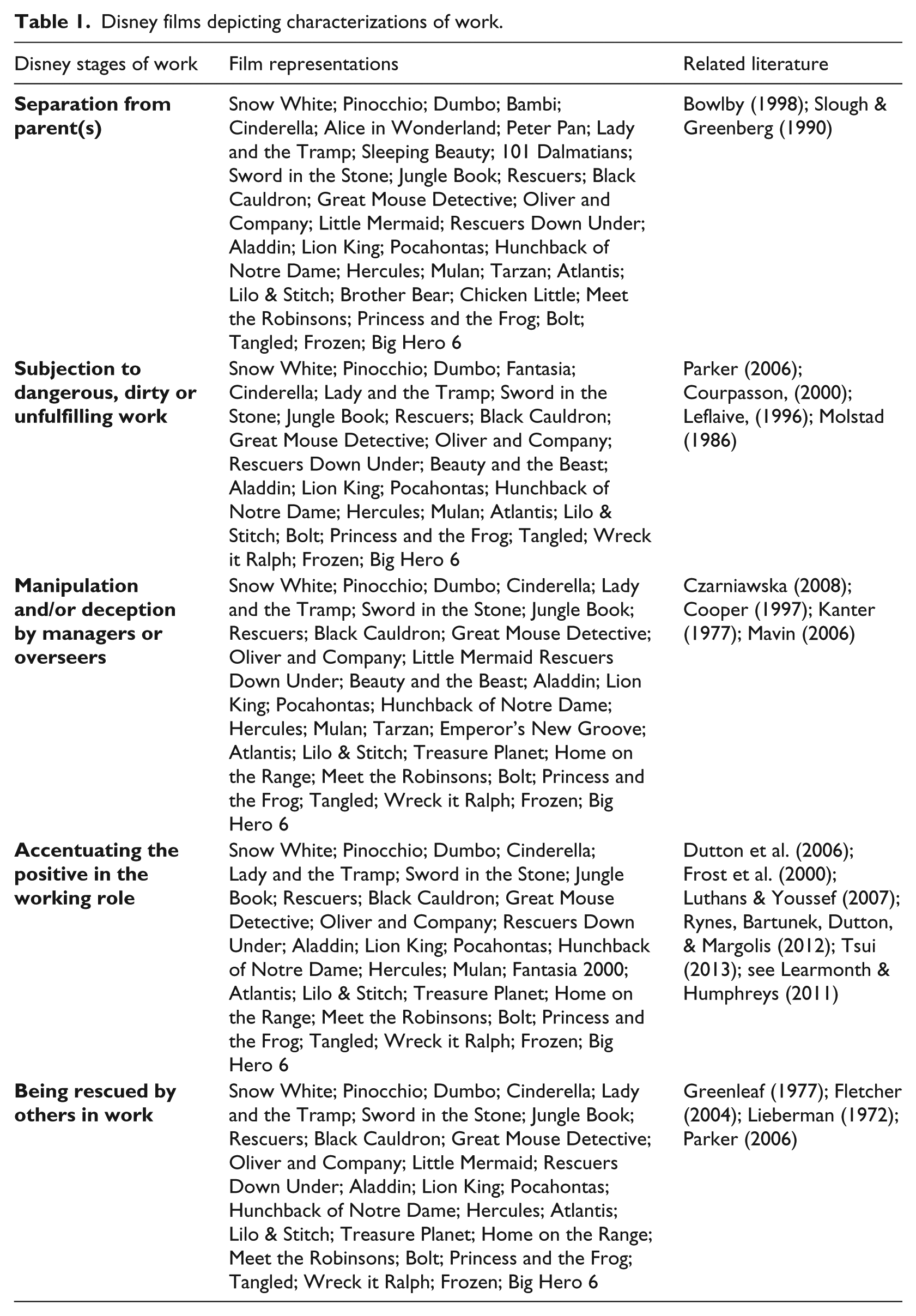
The coding and notes were then used to look for repeating patterns or themes that exist within and between the animations (Fereday & Muir-Cochrane, 2006). However, ultimately, there can be no systematic way to show that our claims are anything other than our own interpretations of the animations. Indeed, we acknowledge that there will always be multiple readings (Boje, 1995; Learmonth & Humphreys, 2012; Rhodes, 2000) of these animations available to viewers. With this in mind, we organized our readings following Czarniawska’s (2008, p. 165) approach of seeking ‘repeated patterns of emplotment’, leading us to identify a five-stage pattern in Disney’s characterization of work. This sequence of work (and the codes related to each from Appendix II) involves: (i) separation from parents (by way of codes such as ‘child labour’; ‘forced labour’); (ii) subjection to dangerous, dirty or unfulfilling work (through ‘violence at work’, ‘death at work’, ‘boredom’, or being ‘scared/frightened in work’); (iii) manipulation and deception by managers (by way of ‘manipulation/deception’, ‘domination’, ‘bullying’); (iv) accentuating the positive at work (by way of the corresponding code); and (v) being rescued and returned to a safe environment (by way of ‘quitting job’). We discuss each in turn, first in their representation in Disney’s traditional animations (pre-second wave feminism, between 1937 and 1977), and then in the more recent animations. See Table 1.
Disney films depicting characterizations of work.
Disney Constructing Work and Gender
Separation from parent(s)
In this first stage, individuals – usually children – are subjected to work due to their vulnerability, invariably through the death of (or separation from) one or both parents. Separation from parents is a common story device in fairy tales (Propp, 1968), and Disney drew deliberately on European fairy tales, sanitizing them through replacing tales of common experiences, erotic encounters and violent struggles with nostalgic longing for well-ordered patriarchal realms (Borland, 1991; Zipes, 1995). Separation from parents is an overriding theme in Disney animations, with main characters suffering this fate in 35 of these 54 ‘classic’ feature animations. In such well-known animations as Snow White and the Seven Dwarfs (1937) and Cinderella (1950) a loving parent dies, leaving the child at the mercy of a wicked stepmother; in animations like The Rescuers (1977) a secret agency is entirely devoted to saving orphaned children who have been forced to work. We do not know how young children respond to being immersed, via the screen, in such a sphere of vulnerability, but people now in their 70s and 80s remember most clearly the films that scared them, with long-lasting effects, in their pre-teenage years (Kuhn, 2002). If we follow Judith Butler’s argument about vulnerability, then the child ‘must attach [to a powerful other] in order to persist in and as itself’ (Butler, 1997, p. 8). We can imagine children cuddling up to adults who are watching the film with them. However, in a large number (28) of these animations, resolution of this separation from a parent is found in work, to which the character – now alone or otherwise uncared for – is subjected.
Subjection to dangerous, dirty or unfulfilling work
The work to which the character is subjected is invariably characterized as violent, degrading and frightening, with numerous depictions of characters crying or being subjected to abuse and domination (Courpasson, 2000; Le Flaive, 1996). Parker (2006, p. 2) evokes what he calls organizational gothic to remind us that:
workplaces are often imagined as places of repetitive violence. Bored bodies serving machines; lowering mills and office blocks; rows of heads bent in sullen silence. Whether in Marx, Dickens, Weber, or Kafka, the image is one of repeated acts of indignity, leaving hidden injuries that last a lifetime.
To Marx, Dickens, Weber and Kafka we add Disney. Pinocchio (1940) encapsulates this phenomenon particularly clearly. The enslaved puppet – separated from his loving adopted father Gepetto – weeps as he is put to work and then caged by his boss Stromboli who declares ‘Pinocchio, you will make lots of money for me, and when you are too old, you will make good fire wood’. In these early Disney animations feminine work is either portrayed as forced (Snow White, Dumbo, Cinderella, The Rescuers) or unskilled and unfulfilling labour (Lady and the Tramp (1955), The Jungle Book (1967)). In The Jungle Book a young girl, Shanti, fills jugs of water from the river. She sings to herself, both resigned to unfulfilling work and content at her place in the order of things: ‘Father is hunting in the forest; mother is cooking in the home. I must go to fetch the water, until the day that I am grown … Then I will have a handsome husband, and a daughter of my own. And I will send her to fetch the water; I’ll be cooking in the home.’ This sense of either normalized monotonous work (Molstad, 1986) or dangerous and frightening work (Jermier, Gaines, & McIntosh, 2006) is ubiquitous in these early animations, and the work of women and girls is portrayed in an almost universally negative fashion.
Manipulation and/or deception by managers or overseers
Third, the work being experienced is usually controlled by duplicitous and manipulative individuals – often portrayed as managers or overseers – whose pretence to be caring and compassionate hides their deceitful exploitation of the abandoned child (see Dutton, Worline, Frost, & Lilius, 2006; Frost, Dutton, Worline, & Wilson, 2000). The theme of manipulation by managers or overseers appears in no less than 33 of the Disney classic animations. Bosses are represented as pursuing their own high status and wealth accumulation at any cost. Children are tricked into situations where they can be exploited. For example, in Cinderella (1950) the wicked stepmother agrees to let Cinderella go to the ball if she can do all of her chores. When Cinderella miraculously does them all the stepmother still refuses to let her go to the ball and locks her in the attic. Many of these fairy stories have been located in the dominant (managerialist) language of the day – by people in powerful positions in society – i.e. by white, male authors and animators. It could be argued that Disney was not actively or even consciously conspiring to ensure they reproduced patriarchal norms; a defence would be that they were constructing young (usually female) people in crisis through the culturally dominant lenses available to them at that time. However, although the Disney Corporation is notoriously private, we have noted above that historians have found sufficient evidence to argue that Disney himself sought to contribute cinematic works that educated young people into desiring to be middle class and to uphold the conventional American dream. So successful has Disney been at ‘educational entertainment’, blurring the border between entertainment and pedagogy, that the corporation and its products have been called ‘a public school system’ (Bell, Haas, & Sells, 1995, p. 7). As these historians of Disney have suggested about the earlier animations, the ‘lesson’ we also find about work is that manual labour (and thus working class status) is to be avoided, especially, we find, by young women.
This running critique of capitalist manipulation and exploitation could be seen as ironic, given that Disney is often portrayed as embodying American capitalism (‘Disney constructs childhood as to make it entirely compatible with consumerism’ (Smoodin, 1994, cited in Giroux & Pollock, 2010, p. 96). However, its intent, we tentatively suggest, was perhaps not to undermine or even critique capitalism, but rather to construct the normative child who would be expected to work hard at school so as to avoid the hard labour of manual work (Sammond, 2005).
But the gender norms in these animations can be read as equally oppressive. The exploitative female boss, the ‘Queen Bee’ (Cooper, 1997; Kanter, 1977; Mavin, 2006) or dominant, aggressive woman who blocks the progress of younger females for her own ends, appears in Disney in various guises. For example, Snow White’s stepmother exploits Snow White for her own purpose of remaining the prettiest in the land; female elephants bully and cast out young Dumbo from the circus; the psychopathic Queen of Hearts in Alice in Wonderland is another example, ordering her guards ‘off with her head!’ Perhaps most famous is Cruella De Ville in 101 Dalmations (1961) as the ‘boss’ in charge of her paid henchmen. All these characters encapsulate the ‘role trap’ (Kanter, 1977) of the Queen Bee. In The Rescuers (1977) Medusa, as Queen Bee, explains to her henchman how to manipulate a young girl into mining a rare diamond for her – ‘you must gain their confidence, make them like you’. This portrayal of powerful older working women as deceptive, manipulative and underhand features strongly during this stage of Disney’s characterizations of work.
In this pre-feminist phase of Disney animations, therefore, we see girls represented on screen as vulnerable subjects who must find work in order to exist. Feminine passivity is to be admired: its opposite, powerful, strong women, are portrayed as wicked, evil and requiring to be overthrown. In our reading, then, a message conveyed by these films is that the ‘strong’ woman is an excrescence that is to be resisted. The norms circulating in the story-lines of these classic animations are thus (a) the necessity of employment (in the home if one is female) while (b) women who remain on the public stage of the organization are evil. The disavowal of strength in women is reinforced in one of the few portrayals of a strong woman in traditional Disney. In a short segment of Melody Time (1948) Cowboy Bill meets Sue, ‘the first female cowboy Bill had ever seen’. He falls in love with her and they agree to marry. Sue is a superb horsewoman, an excellent buckaroo, but eventually she bounces off (‘due to her bustle’), and bounces higher and higher until she reaches the moon, never to return. The strong woman, we are invited to imagine, cannot exist. Work is thus something that is necessary but feared, and organization is no place in which to be a strong woman.
Accentuating the positive in the working role
The fourth stage of the Disney characterization of work involves the character directly responding to this individual crisis. The apparent pedagogic message at this point concerns conformity. Despite all of its dangers and negative experiences, individuals should accentuate the positive in organization and bravely soldier on in the face of adversity and abuse (Learmonth & Humphreys, 2011; Luthans & Youssef, 2007). This theme appears in 30 of the feature-length animations, and is perhaps most famously represented within Snow White, Disney’s first full-length animation, in which she sings: ‘Just whistle while you work, and cheerfully together we can tidy up the place. It won’t take long when there’s a song, to set the pace.’ Kanter (1977) again gives us insights into women and work in the era before second-wave feminism started to effect changes. Kanter talks of ‘role traps’, which are a narrow range of ‘roles’ available to women at work. It is at this stage of work that we encounter the full force of the role trap which Kanter (1977, p. 393) calls the ‘pet’ or ‘younger sister’, reflecting an ‘amusing little thing’ with ‘good humour’ about her place in the order of things. This is reflected in subsequent animations. Cinderella, for example, tells herself to ‘keep on believing and that dream you wish will come true’, and in The Rescuers (1977) a captive girl, subjected to forced labour, is told ‘faith is a bluebird you see from afar. It’s for real and as sure as the first evening star. You can’t touch it or buy it or wrap it up tight, but it’s there just the same making things turn out right.’ It is this blind attachment in many of these animations to the belief that things will turn out well that is imitated within the world of work (Rynes et al., 2012; Tsui, 2013).
Work, as portrayed in Disney’s classic animations, holds an expectation and a promise of a better future if one labours in the present, albeit a future that (as we adults believe we know) never comes. One of the animations’ messages, therefore, seems to be that manual work is something that must be experienced; it is not to be enjoyed but endured; and if it is endured then perhaps something better might emerge, some time in the future. This bright future will arrive without agentive action on the part of the subject (and indeed females must not be agentive) and, as we see next, rescue arrives.
Being rescued and returned to a non-working environment
Finally, the Disney characterization of work suggests that if individuals persevere in exploitative situations they will eventually be rescued by well-meaning and decent heroes (Fletcher, 2004). Often these are men saving women (usually pet-like in sensibility and from privileged backgrounds), as in Snow White (1937), Cinderella (1950) and Sleeping Beauty (1957). Numerous critical pieces have been written on the passivity of the Disney Princess and her need to be saved or rescued by a man (Lieberman, 1972; Orenstein, 2014; Zipes, 1995).
However, another female working ‘role trap’ is represented at this stage, the ‘mother’ who helps those in crisis (Bowman, 2011). According to Kanter (1977, p. 233) this is a woman – in an organizational context – to whom men ‘brought their private troubles, and she was expected to comfort them … [reflecting] the assumption that women are sympathetic, good listeners and easy to talk to about one’s problems’. The caring mother is represented in 22 of the Disney animations and is no better captured than in Peter Pan (1953) in which the children’s mother, Mrs Darling, is portrayed as doting and loving, the father as angry and uncaring. Peter Pan continuously returns to the idea that ‘boys [and we are to assume girls] all need a mother’ and how important she is for moral guidance and growing up correctly. When Wendy sings about how a mother is ‘the helping hand that guides you along whether you are right, whether you are wrong’, Disney can be read to be deliberately conveying a message to its adult audience about how mothers should behave.
The mother figure is regularly used to resolve crises experienced by one (or more) of the characters. Examples include fairy godmothers employed to care for and rescue the princesses in Cinderella and Sleeping Beauty as well as the Blue Fairy, an aged and motherly character who saves Pinocchio from mortal danger. Snow White is both a pet or younger sister and also a mother. On finding the dwarfs’ house Snow White assumes they are orphans because ‘a mother would never leave a house like this’. She ‘naturally’ assumes the mantle of mother within the household despite having little experience in this area (at least we presume this is the case – she is a Princess, after all), sending the dwarfs off to the mines with a kiss on the cheek, cleaning the house and cooking the dinner. She checks their hands on their return, as a mother might do, ordering them to wash them clean before they enjoy their food, chastising them ‘straight outside and wash or you’ll not get a bite to eat!’
Contrast the villainesses, discussed above, who are powerful, agentive, strong, fearless, mature, independent and in control. As Davis (2006) points out, they all suffer the same fate – they are destroyed. The mother, on the other hand, who keeps the home and cares for the family, is valorized. She is the person whose absence has precipitated the child’s terrible adventure, and the person who should be waiting on her return. This takes us to the theme of rescue from unpleasant working experiences that appear in 29 of the feature animations. Classics such as Lady and the Tramp (1955) and The Aristocats (1970) follow a pattern of taking female animals (a dog, Lady, and a cat, Duchess, respectively) away from their pampered non-working lifestyles with wealthy owners into a world of poverty and danger. Their male ‘rescuers’ must grift and use street-wise skills to return the females (and in Duchess’s case her young fatherless family) to their homes, in the process saving themselves from difficult lives. The metaphors of class and gender in these accounts are too obvious to need interpretation.
Rescue from dire organizational situations acts as an end point and ‘happily ever after’ that disarms all previous problems. It often locates safety from oppressive working conditions within the home. Parker (2006, p. 2) argues that ‘the assumption that work is boring and degrading, and that escaping from it can be fun, reflects a wider culture that simultaneously celebrates and denigrates management and organization’. Disney, and the contradictions found within the Disney stages of work, suggests something slightly different. Disney is part of a Western culture which celebrates management and organization, but denigrates exploitative management, manual labour and the working class.
Both boys and girls watch these films, and boys would not be immune to their messages. The communications directed at boys about their future working lives in the classic Disney canon that contribute to ‘organizational readiness’ is the importance of having high aspirations. The future male entrant to work is told that if he makes it into the managerial class he will avoid denigrated hard, physical work. For the female audience however the opposite message seems to be given. Should she aspire to a senior position at work she will transgress laws of gender and will not be permitted to survive (at least as someone who is appropriately feminine). Any expectation of a girl’s rescue therefore comes from returning to the safety of the home, where the mother figure resides.
Summary
Traditional Disney animations and organizational readiness
Work is an important theme in Disney’s traditional animations. Our analysis suggests that in the pre-second-wave feminist era these animations represented work as no place for women, and especially not for strong women. To performatively constitute one’s gender as female, within the domain of this norm, is therefore to constitute a self that rejects the public space of organization in favour of the private space of the home.
In our reading, a precise image of femininity is therefore offered to young girls. Stacey’s (1994) study of the production and reproduction of feminine identities in relation to the idealized feminine images of Hollywood stars of the 1940s and 1950s suggests that adult women’s femininity is based centrally upon appearance. ‘Femininity,’ she writes (Stacey, 1994, p. 225), may be characterized as ‘the constant reproduction of self as object of consumption for others, which is achieved through the consumption of other objects.’ Disney’s princesses are slim and beautiful and walk like ballet dancers (Do Rozario, 2004); they offer the image of beauty to which young girls may aspire as they grow. But in our reading of Disney animations, femininity is concerned not only with beauty, important though that is, but with ‘character’, and the ideal female is passive, nurturing and belongs in the home. The exiling of women from public spaces was a dominant theme in feminist organizational studies until the turn of the century (Bondi & Domosh, 1998) but what those earlier studies did not show was how childhood influences, speaking within and through animations, could perhaps instigate in girls a desire for (and expectation of) their own subordination. This, we suggest, was the work of the classic Disney animations; the generation of norms of femininity in which work should be left to men who will heroically battle through its trials in order to bring home the monthly salary (note, not the working-class weekly wage).
However, that second-wave feminism could take hold so effectively, so that women now occupy public spaces in large numbers, suggests the limitations of even such a popular producer of culture as Disney to influence constructions of the (female) self. Disney’s animations have adapted to changes in gender culture, as we will explore in the next section, where we analyse Disney animators’ articulation of changed dominant gender norms in its contemporary animations.
Contemporary Disney animations and their characterization of women and work
Of the 1388 directors and writers of the 158 feature animations of the top production companies from 1937 to 2014, 1294 (93.23%) were men; of directors alone, 96.28% were men (Internet Movie Database; IMDb). Although women have contributed to animation since Disney was founded (in particular, in the colouring process, see Tupper, 2014) it was not until 2013 that Disney finally had a female director on one of its classic feature animations (Jennifer Lee, Frozen) – a co-director credit with a man. But despite the absence of women from senior positions, Disney have adopted a ‘revisionist fairy tale slate’ (Fleming, 2015). This is seen most clearly in a live action re-working of Sleeping Beauty, Maleficent (2014), which rewrites the story of its ‘iconic’ female villain and is avowedly feminist. It has a brutal rape scene (metaphorized as the cutting off and stealing of Maleficent’s wings, its horrors all the more vivid because they are left to the imagination) but Maleficent herself finds happiness through love for the young daughter of the rapist. The ‘true love’s kiss’ that awakens the sleeping princess is not that of a prince (a rather weak character in Maleficent), but of a powerful, strong female, transmogrified from wicked witch to mother figure.
This ‘feminist turn’ by Disney is, in part, no doubt a reaction to pressure to include new representations of gender, and is seen in portrayals of a cross-dressing female Chinese soldier (Mulan, 1998), an African-American waitress (Tiana in The Princess and the Frog, 2009) and a white scientist (Jane in Tarzan, 1999) all of which have been praised for their somewhat different portrayals of femininity (Lester, 2010; Towbin et al., 2004). However, Disney CEO Michael Eisner has said:
We have no obligation to make history. We have no obligation to make art. We have no obligation to make a statement. To make money is our only objective. (Cox, 2000)
This is a statement which suggests that Disney’s new generation of managers are tapping into the current zeitgeist in order to capitalize even further on the multi-billion-pound cinema and merchandizing industry. Nevertheless, companies are not able to control the effect of their animations once they are in circulation: the performativity of the norms and discourses (perhaps sometimes cynically) circulated through these animations may become part of the discursive formations of new gender norms. We turn now, therefore, to considering how these changes influence the five-stage sequence of work presented in the most recent Disney animations.
The common story device of separation from parent(s) to create a sphere of vulnerability continues to inform the first stage. Indeed, the original fairy stories on which the animations were based that did not include this device are often adapted to include it: the tragic death of parents was a new plot device in both The Princess and the Frog (2009) and Frozen (2013). The Princess and the Frog features an orphaned African-American girl – Tiana – who works in two menial jobs to save for her dream of buying her own restaurant. Frozen is a coming-of-age love story between two young princesses who – following the death of their parents – suddenly have the working responsibility (and associated anxieties) of managing a whole kingdom. Jennifer Lee, Frozen’s writer and co-director, encapsulates the difference between, say, Cinderella (1950) and Frozen: ‘Elsa and Anna are princesses because they’ve got the weight of a kingdom on their shoulders, not as the solution to a happy ending’ (cited in Applebaum, 2014).
This new generation of animations therefore continues to represent its female characters as vulnerable. However, the characters now more typically seek subordination through immersion in organization, as seen in the second stage of work – subjection to frightening or monotonous labour. This theme is carried on in rather interesting ways that consciously interact with, i.e. cite (and so in some cases undermine) what has gone before. For example, we might contrast the confident, intelligent scientist Jane in Tarzan (1999) with the compliant, house servant Shanti in The Jungle Book (1967), who both meet ‘wild’ male characters in the forest. They each experience the dark sides of labour; but where Shanti expected rescue by a man, Jane has agency: she is resistant (including, initially at least, resisting Tarzan’s advances), ensuring that romance happens on her own terms.
The third stage – manipulative and deceptive bosses – remains as strong in recent Disney animations as in their predecessors. Lawyers accept a rival’s bid for the restaurant Tiana wishes to purchase in The Princess and the Frog. She is told: ‘A little woman of your background would have had her hands full running a big business like that … now you’re better off where you are at.’ Frozen has numerous manipulative characters, including the capitalist Duke of Weselton, who is excited about the prospect of ‘unlocking [the kingdom’s/the princesses’] secrets and exploiting its riches’. Bosses are described as ‘vampires’ (Lilo & Stitch, 2002) and ‘fat cats’ (The Princess and the Frog, 2009) embarking on ‘hostile takeovers’ (Hercules, 1997) and requiring ‘witless peasants to dig up my gold’ (Pocahontas, 1995). Many of these stories are couched in a managerialist language that constructs young women’s crises through the dominant cultural lens of the early 21st century: neo-liberal capitalism. But rather than aspiring to become corporate managers, young viewers are now encouraged to think of themselves as future entrepreneurs. This is reflected in the terms by which the characters are rescued, as we will see, because the female becomes agentive and her own rescuer.
The fourth stage of work – accentuating the positive – continues in recent animations, but is represented differently. The accentuation of the positive is now portrayed through agentive female characters whose destinies are in their own hands. In The Princess and the Frog, Tiana experiences a flashback to her father saying
You wish and you dream with all your little heart but you remember Tiana that old star can only take you part of the way. You gotta help it along with some hard work of your own and then you can do anything you set your mind to.
The ‘star’ references several previous appearances of this image in Disney animations including Jiminy Cricket singing ‘When you wish upon a star’ in Pinocchio and Penny wishing upon a star in The Rescuers – but now the element of individualized, hard work by females if their dreams are to be achieved is added. The contrast between the passive Cinderella also wishing upon a star, waiting to be rescued by her prince, and Tiana’s female ‘capitalist spirit’, is encapsulated in her song ‘Almost there’:
I remember Daddy told me ‘fairy tales can come true you gotta make ‘em happen, it all depends on you’. So I worked real hard each and every day. Now things for sure are going my way. Just doing what I do, look out boys I’m coming through.
We suggest, however, a need for caution before applauding Disney’s portrayal of women as agentive and in charge of their destinies. In Frozen, Elsa’s fear of the danger to others from her inability to control her new powers (as queen and sorceress) causes her to escape the kingdom following her coronation (and inadvertent creation of a perpetual winter). She has a revelatory moment, captured in song:
It’s funny how some distance can make everything seem small, and the fears that once controlled me, can’t get to me at all. It’s time to see what I can do, to test the limits and break through. No right, no wrong, no rules for me. I’m free!
Elsa gives up trying to be a ‘good girl’ who fulfils the responsibilities of her work, and makes a physical transition before the viewers’ eyes from a relatively plainly dressed girl into a glamorous woman. In this ‘vision of female self-actualization as narrow and horizon-diminishing as a makeover …. the “good girl” goes over to “the bad side” thanks to a quick cosmetic fix-up’ (Stevens, 2014). There is a paradox here. Elsa is transformed into a beautiful, seductive woman: she may be freed from her duties as ruler, but she is not freed from the imposition of rules about how a woman should look (Stacey, 1994). Thus her sense of freedom is a false one: she cannot escape from the norms that govern gender.
In the fifth stage in contemporary Disney animations, the female or feminine lead character’s need to be rescued from work takes a new direction. In Frozen, despite teasing the audience (and playing on its collective memory and its expectations of previous performances) with the prospect of a prince as the saviour, in a surprise twist to the animation Elsa’s sister is her (agentive) rescuer and ‘true love’s kiss’. Elsa is saved from her anxieties about managing her kingdom but is not delivered from them: she confronts them head-on with her sister by her side. She seeks resolution of her fears through work and its responsibilities. Frozen, in this reading, is exemplary in articulating and circulating some of the contemporary dominant norms about women and work: women must take on the responsibilities of work, must work hard, but at the same time they must conform to norms of femininity, notably in regard to looks.
Meanwhile, the villainess seems to have more or less disappeared from Disney films in the 1990s and the 21st century (Davis, 2006). She is replaced by a wise mother figure, such as Mama Odie in The Princess and the Frog. Mama Odie, like Maleficent (2014), is not exploitative but is an ethical agent; she may adopt a motherly stance but is not self-sacrificial because she has her own needs and desires. The earlier animations’ portrayal of strong women as execrable is replaced by valorization of female strength, both in the young protagonists and the older woman.
Contemporary Disney animations and organizational readiness
Although contemporary Disney animations continue with similar story-lines as in earlier productions, the characters are portrayed very differently, with the female passivity and retreat from the work and organization of the earlier animations replaced by active, agentive girls and women. Rescue comes not from princes or other male characters who return females to the home, but from themselves as strong females or other females who help these characters face up to the responsibilities of work.
Second-wave feminists fought for the rights of women both to enter the public space of organization and to enter as the equals of men. The norms circulating within contemporary Disney animations testify not only to the achievement of at least the first of these goals, but to perhaps unexpected consequences. The recent animations can be read to encapsulate a normative, ethical requirement and expectation that women be active and agentive within public space. Strength rather than weakness is now desirable. In short, our reading of the earlier Disney animations in terms of organizational readiness is that girls could not be women if they were workers; whereas our reading of contemporary Disney animations is that girls cannot be women if they are not visible and active within organization. At the same time they are not freed from a focus on their looks, nor the need to seek a ‘happy ever after’ through finding the appropriate love object.
Discussion and Conclusion
Our reading of Disney animations as cultural artefacts illuminates how, over the course of three-quarters of a century, the norms of organizational gender have shifted substantially. But there is no neat division between eras and epochs: the echoes of the old continue to reverberate through the new. Disney’s contemporary animations represent particular gendered norms about work and organization that have moved significantly since its earlier features, but audiences watch the older animations alongside the new. We have suggested that the world of work as shown in the contemporary animations is one where females are expected to be active and agentive occupants of the public space of organization, but that young viewers will also be well versed in the older animations, and they continue to be subjected to ideas governing the necessity to work on their appearance, much as their mothers, grandmothers and great-grandmothers were enjoined to do.
This reading is encapsulated in a curious scene repeated in contemporary Disney animations; one that might suggest that girls cannot escape from the taint of that past understanding – that as they become women they should expect to be weak, passive, in need of rescuing, carers rather than creators. The clearest example of this understanding is in Wreck it Ralph (2011), set in a games arcade where Ralph and Venelope are in-game characters. At the animation’s climax Venelope learns that she has been tricked and should in fact be the lead racer and princess of her own video game. Venelope – a feisty, independent character – is transformed into a princess wearing a stereotypical dress. She acts like a princess, changing her voice and mannerisms. This playful citation by Disney of Cinderella or Snow White is revealed to be a ruse: ‘Oh Ralph, what are you, nuts? This isn’t me! [she spins around out of her gown and into her normal clothes] This is me! The code may say I’m a princess but I know what I really am, I’m a racer with the greatest super power ever.’
This extract, we suggest, can be read as a condensation of the circulation of traditional Disney animations alongside the company’s contemporary creations. We noted above how the pre-second-wave feminism Disney films continue to be widely watched. The first, Snow White, for instance, ‘still holds up as a movie, fully immersing audiences young and old in a fairy tale forest of terror and delight’ (Moviefone, 2013). The two epochs are thus not separate and so older discourses of women and work circulate within, through and alongside contemporary understandings. Young viewers are immersed in presentations of contradictory norms of work and women, in our reading: to be a woman requires that you do not enter the public space of organization; to be a woman requires that you engage actively in the public space of organization, looking like a woman ‘should’ look. Indeed, as McDowell and Court (1994, p. 727) have shown, subversion of norms can take many forms, because of the multi-faceted ways in ‘which women are embodied and/or represented as “woman” in the workplace’.
This discussion leads to the question of the power of such representations to influence the identity work and work aspirations of young girls as they perhaps sit in their Disney Princess or Pirate outfits, watching Snow White or Wreck it Ralph. Pollen (2011, p. 162) argues that the popularity of the Disney Princess outfits and other similar dressing-up clothes reinforces ‘cultural scripts and brand narratives literally woven into the fabric of the clothes they have been given’, such that the fantasy realm of the playing child is manipulated in such ways that traditional gender stereotypes are perpetuated. However, Wohlwend’s (2012) empirical study of children at play contradicts Pollen’s analysis of the clothes rather than their wearers. Wohlwend (2012) observed how young boys’ play with ‘girl’s’ dolls suggested no such transmission mechanism from agentive object to malleable subject. Rather, young boys’ play rehearsed fluid gender identities that were neither stereotypically masculine nor feminine. At the moment we therefore cannot know how the contradictory message to young girls watching Disney animations – they are told they are expected to work and they are expected not to work – is played out at the level where it may influence how they later prepare themselves for work.
We can, however, speculate. Kuhn’s (2002) study of recollections in their later life of early cinema-going experiences suggests that what is remembered is not story-lines or ideas, but feelings. So although film-watching is self-evidently an embodied experience involving sight and sound, Kuhn’s study emphasizes the life-long impact of the emotions that cinema arouses. We add to this Barker’s (2009) analysis of the work the film does on the embodied, emotion-saturated viewer. Action adventure films, for example, invite our bodies to experience the chase and the escape. They seduce us, hold us tight, trap us, and then suddenly throw us off, again and again. The body and the affect constituted in, around and on that body are actively incorporated into understanding of films’ stories. Of animations, she writes that their ‘modus operandi is hands-on play, at which every child is an expert’ (Barker, 2009, p. 137), and she indicates that the tactility of animations taps into sensuality and even the revolutionary potential of children’s play. In Wohlwend’s terms, children take a story from the films they have seen and turn them into new stories that seem hardly explicable to the adult. If so, then children’s bodies are engaged actively in watching films – they are pulled and pushed by them, muscles are engaged and emotions evoked by them. What might have looked like passive absorption of ideas as the child sat in front of the screen becomes in the playground fodder for play, or rather for a visceral and emotive re-enactment and re-invention of story-lines.
This haptic theory points to the value of reading emotions invoked when watching Disney animations. In Sobchack’s (2004, p. 76) words, ‘Our embodied experience of the movies … is an experience of seeing, hearing, touching, moving, tasting, smelling, in which our sense of the literal and figural may sometimes vacillate.’ Disney animations provoke fear (of loss of the mother, of being alone, of being stuck in a terrible workplace), hope (of rescue), confusion (if I am a girl and there are such contradictory ways of being a girl, who can I be?), strength (the strength merely to survive in the earlier films, but of agency in the recent films), excitement (at taking responsibility for my own rescue into my own hands), care (for others who need caring for), loathing (of the wicked, whether portrayed as a manager or an older woman), and so on. What such an experience may incorporate into the child’s body is ‘unrepresentable memories’ (Marks, 2000), that is, memories that exist in images and bodies but for which there is no language.
Speaking of intercultural cinema in terms that perhaps tell us much also about the child viewer, Marks (2000, p. 195) writes that when language fails, the memory of the senses offers alternative modes of remembering. Thus she talks about ‘sense knowledge’ as a source of social knowledge; and of how we may have two or more sensoriums, such as those of the child and those of the young adult as she decides upon her career choice and makes herself ready to enter the workplace. That is, it is in the child’s sensorium that the impressions of Disney animations’ telling of the gendered world of work are stored, memories that precede the sophisticated language that would make more sense of them, but whose affects are recalled in young adulthood and later.
This then is our theory of how Disney animations influence organizational readiness: immersed in their stories the child viewer is engaged in a visceral, affective encounter in which she experiences loss, longing, danger and passive waiting for rescue as she watches the earlier films. But when she views the later films she knows what it is like to be agentive and possess the power to rescue herself (and others) from villains and all they throw at her. She may be dressed like a Princess, in frills and lace, but Princesses, she feels (literally) can act upon the world.
Thus we disagree with Miller and Rode’s (1995, p. 102) typification of Disney animations as ‘extracurricular identity-schooling’. Haptic film theory suggests there is no simple cause/effect mechanism in which children absorb the animations’ messages and make their norms their own reality. Further, contemporary film theory, in abjuring earlier accounts of women as passive viewers (e.g. Mulvey, 1975), suggest the relationship between viewer and film is not one-way – in our terms the child does not merely wish to emulate, say, the hero, but engages in a back-and-forth movement with her (Tisseron, 2013). Served up complexly contradictory messages, children are likely to interpret, re-interpret and re-interpret again what they have seen. In other words, they are far from passive: although they are born into languages, discourses and cultures that preceded them and restrict the possibilities of identities, they also play with as well as within the terms of the always-already there. Thus they may learn resistance even as they absorb ways of conforming.
If a ‘major virtue of the visual arts is their capacity to make the invisible visible’ (Bersani & Dutoit, 2004, p. 1), then our study suggests important insights into the continuation of organizational gender inequalities. Women who currently occupy organizational space, our account suggests, are there only under sufferance but at the same time they are also there as legitimate occupants – the two positions battle against each other. The scene from Wreck it Ralph condenses within one short scene the problem of continuing gender inequalities: women’s place in organization is won but not yet secured. Indeed, since the completion of our study the release of Disney’s 55th animated classic, Zootopia (2016), has perhaps the clearest example of this dilemma yet. Set in an anthropomorphic city of animals, a young female rabbit secures a position as a rookie police officer (graduating top of her class) but is told by her new (angry male) boss she can do no more than carry out parking duty. The film takes us on an insightful and humorous journey through the difficulties she faces in her working life in successfully trying to find acceptance and equality in an organizational context.
And yet, in terms of future generations of women workers and their organizational readiness, the complexities of the paradoxical gendered identities portrayed in Disney animations, and the visceral affective responses we suggest they may evoke in young girls, point towards a certain optimism. So while the earlier animations may arouse fear and the desire for rescue, the more recent may induct young viewers into a sense of their own power and strength. By power, here we mean a corporeal, affective refusal to be passive. Organizational readiness, in this reading, emerges within and through a sensorium that is alert to an expectation of oppression – and how it can be resisted – and the possibilities of refusing passivity in favour of agency. If this is the case, then Disney animations may be far more radical than ever intended by the Disney Corporation: the ‘organizational readiness’ of the next generation of female workers may incorporate an intolerance of contradictions, an understanding of the self as agentive, and therefore a knowledge that the future working self will be able to resist intolerable, paradoxical, or contradictory gendered organizational norms.
At least, that is our reading, as adults who have watched 54 Disney animations. We have watched them as cultural artefacts for this paper, but we have also watched them many times – laughing and singing along with them – with our children (and grandchildren).
Footnotes
Appendix I
Appendix II
Funding
This research received no specific grant from any funding agency in the public, commercial, or not-for-profit sectors.