




Abstract
Although we have seen a growing interest in participatory strategy-making, there is a paucity of knowledge about the role of polyphony and how it may be orchestrated. Our longitudinal analysis of a revealing case shows how narrative strategy-making unfolded in four temporally overlapping phases: First, a top-down effort to lead participatory strategy-making resulted in polyphony, which was nevertheless largely controlled from the top. Second, it was followed by autonomous narrative strategy-making in units, leading to polyphony that was less but still partly controlled from the top. Third, all this triggered an emergence of counternarratives offering alternatives to the overall narrative, thus generating ‘genuine’ polyphony not controlled from the top. Fourth, partly as a response, top decision-makers launched an update, again seizing more control in polyphony. Thus, our study advances prior research by elucidating how orchestration of participatory strategy-making both generates and reduces polyphony. By so doing, our analysis helps us to move from a dichotomous view of participation and openness towards a more nuanced appreciation of alternative voices and how they may or may not emerge or be controlled in strategy-making.
Scholars have focused increasing attention on participatory strategy-making, that is, processes where different stakeholders are involved and can exercise at least a degree of influence (Laine & Vaara, 2015; Mantere & Vaara, 2008; Tavella, 2021). This is especially the case with research on open strategy which, by focusing on inclusion and transparency, holds great promise in terms of incorporating different voices into organizational strategy-making (Dobusch, Dobusch, & Müller-Seitz, 2019; Hautz, Seidl, & Whittington, 2017; Splitter, Dobusch, von Krogh, Whittington, & Walgenbach, 2023). Such new forms of strategy-making are theoretically interesting because they challenge the tradition of top-down control – which has been the key point in more critical analyses in this area (Ezzamel & Willmott, 2008; Hardy & Thomas, 2014; Knights & Morgan, 1991; Kornberger & Clegg, 2011). Yet, there is a conundrum: Participatory strategy-making does not happen by itself but needs to be organized. Furthermore, even if people are included and encouraged to have a voice, there is an expectation that the process leads to some kind of shared understanding, implying a degree of control in the process. However, to date we lack in-depth understanding of how such strategy-making deals with a multiplicity of emerging voices over time.
We approach this question by focusing on polyphony and orchestration in participatory strategy-making. Polyphony, originally a term used in music and literary studies, refers to relational emergence of voices and how meaning is formed in dialogue (Bakhtin, 1984a; Jabri, 2016; Shotter, 2008). Organization scholars have mainly studied polyphony from a discursive or narrative perspective that highlights the coexistence of multiple realities and a struggle between different voices (Belova, King, & Sliwa, 2008; Kornberger, Clegg, & Carter, 2006). Our view resonates with Kornberger et al.’s (2006) perspective according to which polyphony as a plurality of voices is an inherent part of organizations, manifesting itself in organizational discourses and language games.
But how to manage such polyphony in participatory strategy-making? In this paper, we suggest conceptualizing such work as ‘orchestration’. Orchestration allows us to focus not only on polyphony but also how the people involved try to deal with it. Thus, for our purposes, orchestration means procedural control amid a multiplicity of voices. By focusing on orchestration, we believe, one can go beyond the question of whether strategy-making may be polyphonic or not, but instead take a step further to focus on how orchestration may generate or reduce polyphony in participatory strategy-making. This calls for a processual view that would help us to uncover the dynamics involved.
To better understand these dynamics, we zoom in on the role of narratives in strategy-making. Narratives are essential sensemaking devices for building coherence between past events and future plans (Barry & Elmes, 1997; Boje, 2008; Fenton & Langley, 2011). By narratives, we mean temporal, discursive constructions that provide means for individual, social and organizational sensemaking and sensegiving (Vaara, Sonenshein, & Boje, 2016). Strategy narratives and related storytelling processes have received increasing attention as scholars have elaborated on their characteristic features and dynamics (Dalpiaz & Di Stefano, 2018; Kaplan & Orlikowski, 2013). But there is a need to take an additional step to link these insights into how different voices may be orchestrated.
Our study is based on a longitudinal analysis of a revealing case of narrative strategy-making and its orchestration in a Nordic city organization. As a result of our analysis, we elaborate how narrative strategy-making unfolded in four temporally overlapping phases: First, a top-down effort to lead participatory strategy-making at the organizational level resulted in polyphony, which was nevertheless largely controlled from the top. Second, this was followed by autonomous narrative strategy-making in units, resulting in polyphony that was less but still partly controlled from the top. Third, all this triggered an emergence of counternarratives offering alternatives to the overall narrative, thus generating ‘genuine’ polyphony that was not controlled from the top. Fourth and finally, partly as a response to the increasing polyphony, top decision-makers launched an update of the narrative strategy, again seizing more control in polyphony.
Thus, our study advances prior research by elucidating how orchestration of participatory strategy-making both generates and reduces polyphony. In this view, orchestration is a double play of wresting control but still allowing for some strategic heft: control is suspended and yet not relinquished entirely. Thus, such procedural control is always partial, involves a variety of forms of control, is at times more about appearances than genuine, and – above all – triggers new and unanticipated reactions steering the process dynamics. By unravelling how these dynamics play out, our analysis not only advances understanding of orchestration in strategy work but also adds to the more general discussion of polyphonic organizations (Belova et al., 2008; Hazen, 1993; Kornberger et al., 2006; Lorino & Tricard, 2012).
Towards an Understanding of Orchestration in Narrative Strategy-Making
Participatory and open strategy-making
While participatory strategy-making in its narrow sense may be considered only as gathering informational inputs from stakeholders, a broader view implies exercising some form of influence and/or fostering commitment in strategy-making (Mack & Szulanski, 2017; Quick & Feldman, 2011). In our argument, this means having voice. This is far from a trivial issue as the following review of previous research reveals.
Strategy-making has been traditionally seen as the responsibility of top management, and participation remained a non-issue in the strategy literature for a long time (Burgelman et al., 2018; Knights & Morgan, 1991; Laine & Vaara, 2007; 2015; Mantere & Vaara, 2008). Strategy process research has, nevertheless, promoted the crucial role of middle managers in strategy-making (Floyd & Wooldridge, 2000; Wooldridge & Floyd, 2017). Strategy-as-practice scholars have in turn focused attention on the role of sensemaking and sensegiving by middle managers (Balogun & Johnson, 2004; Rouleau, 2005; Rouleau & Balogun, 2011). This research has also shown how specific practices or tools used in strategy meetings (Jarzabkowski & Seidl, 2008; Kaplan, 2011; Spee & Jarzabkowski, 2011; Tavella, 2021) can either enable or restrict open discussion and inclusion. In addition, more critical work has highlighted issues of subjectivity and resistance in strategy-making (Ezzamel & Willmott, 2008; Hardy & Thomas, 2014; Knights & Morgan, 1991; Kornberger & Clegg, 2011).
In particular, work on open strategy – implying both inclusion and transparency (Hautz et al., 2017; Seidl, Whittington, & von Krogh, 2019; Whittington, Cailluet, & Yakis-Douglas, 2011) – has called for more participatory strategy-making – implying a voice that is heard. Thus, recent studies have shown how openness may be promoted online (Dobusch et al., 2019), in virtual communities (Hutter, Nketia, & Füller, 2017), through crowdsourcing (Aten & Thomas, 2016), or via external stakeholder engagement (Mack & Szulanski, 2017). At the same time, openness is very difficult to manage in practice (Vaara, Rantakari, & Holstein, 2019). Dobusch et al. (2019) examined whether ‘open’ practices of strategy-making enact ideals of organizational openness and showed that openness necessitates certain forms of closure related to the procedures of crafting strategy content. Hutter et al. (2017) concentrated on various forms of virtual participation and showed how its effects may also have a counterproductive impact on engagement with strategy-making. In a recent study focusing on the role of organizational spaces in open strategizing, Holstein and Rantakari (2023) in turn showed why openness may turn to closure, despite managerial attempts to keep the strategizing process open.
Related ideas have also been developed in recent discussions about open innovation and open governance. For instance, Diriker, Porter and Tuertscher (2023) have explained how ‘punctuated openness’ (open organizing interrupted by moments of closure) serves as an organizing principle in open innovation. Kornberger, Meyer, Brandtner and Höllerer (2017) have demonstrated how open government implies balancing between the ‘decentralizing’ (involving a number of stakeholders) and the ‘centralizing’ principles of administrative bureaucracy. All these contributions relate to the idea that developing more participatory processes promotes openness more generally both in organizing and strategy-making.
Nevertheless, our understanding of participatory strategy-making remains partial. For example, studies have indicated that even open strategy-making tends to involve power imbalance, open-washing and ceremoniality – phenomena that are still not adequately addressed in this context (Dobusch et al., 2019; Hautz et al., 2017; Vaara et al., 2019). In this paper, we argue that there is also a more fundamental theoretical deficiency underlying these phenomena: we lack comprehensive understanding of how the multiplicity of voices characterizing open strategy processes may be managed.
Polyphony and orchestration in narrative strategy-making
To better understand this key issue, we draw from ideas of organizational polyphony (Belova et al., 2008; Hazen, 1993; Kornberger et al., 2006; Lorino & Tricard, 2012; Tsoukas, 2009). By referring to relational emergence of voices and how meaning is formed in dialogue (Boje, Haley, & Saylors, 2016; Jabri, 2016; Shotter, 2008), polyphony is particularly useful to examine participatory strategy-making since it is associated with possibilities to both gather information and to sustain engagement by using organizational discourses, stories and texts (Hazen, 1993).
In organization research, polyphony is a key topic that has inspired scholars in the past decades (Belova et al., 2008; Lorino & Tricard, 2012; Pedersen, 2009; Vaara & Tienari, 2011). For instance, Hazen (1993) has helped to explain how polyphony allows an inclusive change in patterns of organizing, Jabri (2016) offered a comprehensive view of the role of polyphony and dialogue in managing organizational change, and Belova et al. (2008) highlighted the multiple ways in which polyphony may manifest itself in organizations and what that implies, especially for discursive and narrative organization studies. These studies have often relied on Bakhtin’s (1981, 1984a, 1984b, 1993) work and paved the way for a better understanding of the role and implications of polyphony in organizing. In what follows, we are inspired by Bakhtinian theorizations, but do not approach polyphony from a strictly Bakhtinian perspective.
Instead, we draw from Kornberger et al. (2006) who have argued for broadening the perspective from a narrower discursive or narrative analysis towards considering polyphony as a discursive practice embedded within other social practices in organizations. Kornberger et al. (2006) sought inspiration in ideas of translation and deconstruction in making sense of polyphony. Based on this, we suggest that any analysis of polyphony should be contextualized into its surrounding social practices – which can either offer space for voicing in specific settings or impede people from having voice. In line with this metaphor of voice/voicing, we propose that the term ‘orchestration’ helps make sense of essential elements in the management of such polyphony and we see special value in focusing on how such orchestration – even in its subtle forms – impacts polyphony in strategy-making. This perspective is particularly useful for more in-depth study of the various forms of control that may otherwise pass unnoticed in more participatory or open strategy processes.
Thus, aligned with studies of polyphony in organization research (Belova et al., 2008; Hazen, 1993), we connect our ideas on polyphony to the narrative perspective on strategy-making (Barry & Elmes, 1997; Brown & Humphreys, 2003; Fenton & Langley, 2011; McLean, Harvey, Golant, & Sillince, 2021; Rindova & Martins, 2022). Narrative strategy research has revealed the multiple and often conflicting meanings produced by organizational members in the various phases of strategy-making and strategic change (Balogun, Bartunek, & Do, 2015; Boje, 2008; Küpers, Mantere, & Statler, 2013; Sonenshein, 2010). In their article, Fenton and Langley (2011) have underscored the multifaceted and polyphonic nature of strategy narratives. Their analysis explains how narratives provide meaning that emerges from strategic sensemaking activities and constitutes an overall sense of direction, purpose, or control, and also how narrative strategy-making may involve many alternative narratives. In this view, strategies can be seen as future-oriented narratives (Barry & Elmes, 1997), which must be credible (or believable) and defamiliarizing (or novel), and there is often tension between these two aims. Furthermore, temporal construction of the past, present and future is an essential part of strategy narratives, sometimes involving deliberate choices of what to highlight or emphasize to manage meaning (Kaplan & Orlikowski, 2013). Such narratives may also build upon each other and be reconstructed and reinterpreted in new ways over time (Dalpiaz & Di Stefano, 2018). Notably, these temporal constructions may either promote or hinder the obtaining of strategic goals (Myllykoski & Rantakari, 2022) – control, in our terms.
However, it is fair to say that we still have a limited understanding of to what extent polyphony may be orchestrated, the kind of control it involves, and the dynamics of such processes. This leads us to formulate our research question as follows: How may orchestration generate or reduce polyphony in participatory narrative strategy-making processes?
Methods
Research design and context
Our analysis is based on a longitudinal study of narrative strategy-making in a Nordic city organization between 2012 and 2018. The case offers a revealing setting in which to explore the orchestration of polyphony in narrative strategy-making for three reasons. First, the city in question can be seen as a pluralistic organization involving multiple actors with distinctively different interests and values (Denis, Dompierre, Langley, & Rouleau 2011; Jalonen, Schildt, & Vaara, 2018; Sorsa & Vaara, 2020), thus offering a fruitful setting for analysis of polyphony. Second, in this city organization, the strategy process was highly participatory in nature, reflecting the key ideas of inclusion and transparency in open strategy (Hautz et al., 2017). Third, the key actors saw their strategy-making process as the construction of a narrative or storytelling. In fact, the strategy was often referred to as the ‘City Story’ in both discussions and formal documents.
Like several other Nordic cities, this city organization had already adopted ideas and practices of strategic planning in the early 2000s but had maintained a conventional top-down approach to planning that allowed the mayor and the city council to work together in developing guidelines for the future. Thus, the strategic plans had become detailed documents, usually over 100 pages long. However, as our informants put it, the problem was that ‘no one read them’ or that ‘people deeper in the organization didn’t have a say’.
A new mayor was elected by the city council in 2011. Before his election, he had presented a new approach to strategy-making. The new mayor wanted the city strategy to be a ‘story’ shared by all stakeholders, beginning with the managers and employees of the city, but also including politicians, residents and the businesses based there. Hence a story-form strategy process was initiated in 2012 with the aim of involving as many of the stakeholders as possible. Our analysis is based on unique access offered by long-term collaboration between the city and members of our research team. In practice, we were able to meet with and interview almost all the key actors and obtain access to all documentation as well. This also involved participant observation, as explained below.
Empirical material
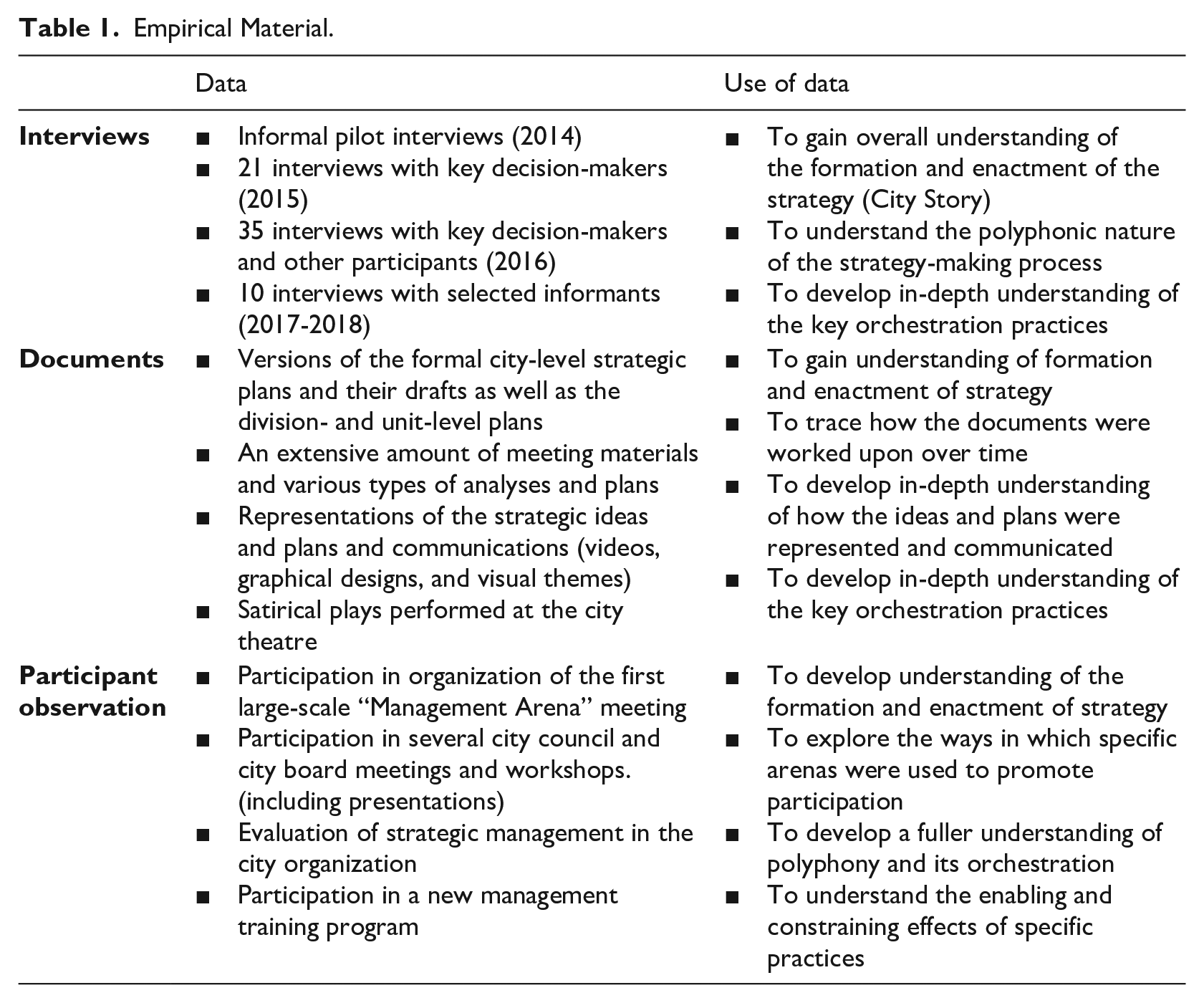
The empirical material for our study was collected by extensive interviews, documentary analysis and observation. Table 1 offers a summary.
Empirical Material.
Interviews
After first contacts and observations in 2013–2014, we conducted three rounds of semi-structured interviews comprising a total of 66. The first interview round (21 interviews) took place in spring 2015 with the initial purpose of gaining an overall understanding of the formation and enactment of strategy, namely the City Story. This round focused on the key decision-makers including the mayor, the executive management team, the principal directors, heads of most of the areas and units, the chairperson, and other key people in the city council. We asked questions about the content and process of strategy-making, different practices of participatory strategy-making, and the role of narratives. The second round (35 interviews) took place in spring 2016. Here the purpose was to focus on the polyphonic nature of the strategy-making. We posed specific questions about the roles of individual actors, their involvement, and potential diverging views of the ‘City Story’. The third round consisted of 10 targeted interviews in 2017–2018. Furthermore, we had an opportunity to meet and have informal conversations with dozens of key actors throughout the research process as well as receive their feedback on our analysis while working on this paper.
Documents
In addition to the interviews, we gained access to a large set of documents related to the strategy-making process. This included different versions of the formal city-level strategic plans and their drafts as well as all the area-level and unit-level plans and ‘strategies’. We also gathered an extensive amount of meeting material and various types of analyses and plans. This material included videos on the city’s website and YouTube, graphic designs in the form of ‘maps’, and visual themes used extensively in the city. For instance, the meeting rooms in the city hall were named after the key themes of the strategy narrative. It also became a regular practice to include text and visuals on the approved strategy narrative in presentations and events. Other material included a satirical play performed at the city theatre, complete with ironic reflections on the strategy process we were observing, and thereby forming a counternarrative that we later focused on in more detail.
Participant observation
A member of our research team was closely involved in the early parts of the strategy process; particularly in organizing the first large-scale ‘management arena’ to discuss strategic ideas. We were also able to observe a number of city council and city board meetings and workshops. This entailed presentations made to those involved in strategy-making, but not participation in actual decision-making or work on the strategy documents. It led us to gather extensive information about the strategy discussions and how they changed over time; we took observation notes and photos. Later, the city organization asked us to evaluate and provide feedback on strategic management in the city organization. Between 2015 and 2018, we were also involved in a new management training programme, which provided us with a number of occasions to reflect on strategy-making in workshops with most of the top 30 decision-makers and later with 60 middle managers. In addition, we had an opportunity to meet with key people on numerous other occasions and obtain feedback.
Analysis
Step 1: Mapping of key events and reconstruction of the strategy-making process
In the first step, we mapped out the key events related to the strategy process. We first focused on the role of the City Story and how that was developed over time, then on the area- and unit-level strategies, and their interpretations, including critique. Later, we concentrated on the ‘update’ of the overall strategy: City Story 1.1. This led to a reconstruction of the key events and issues for the entire observation period. Figure 1 offers a timeline of the key events.
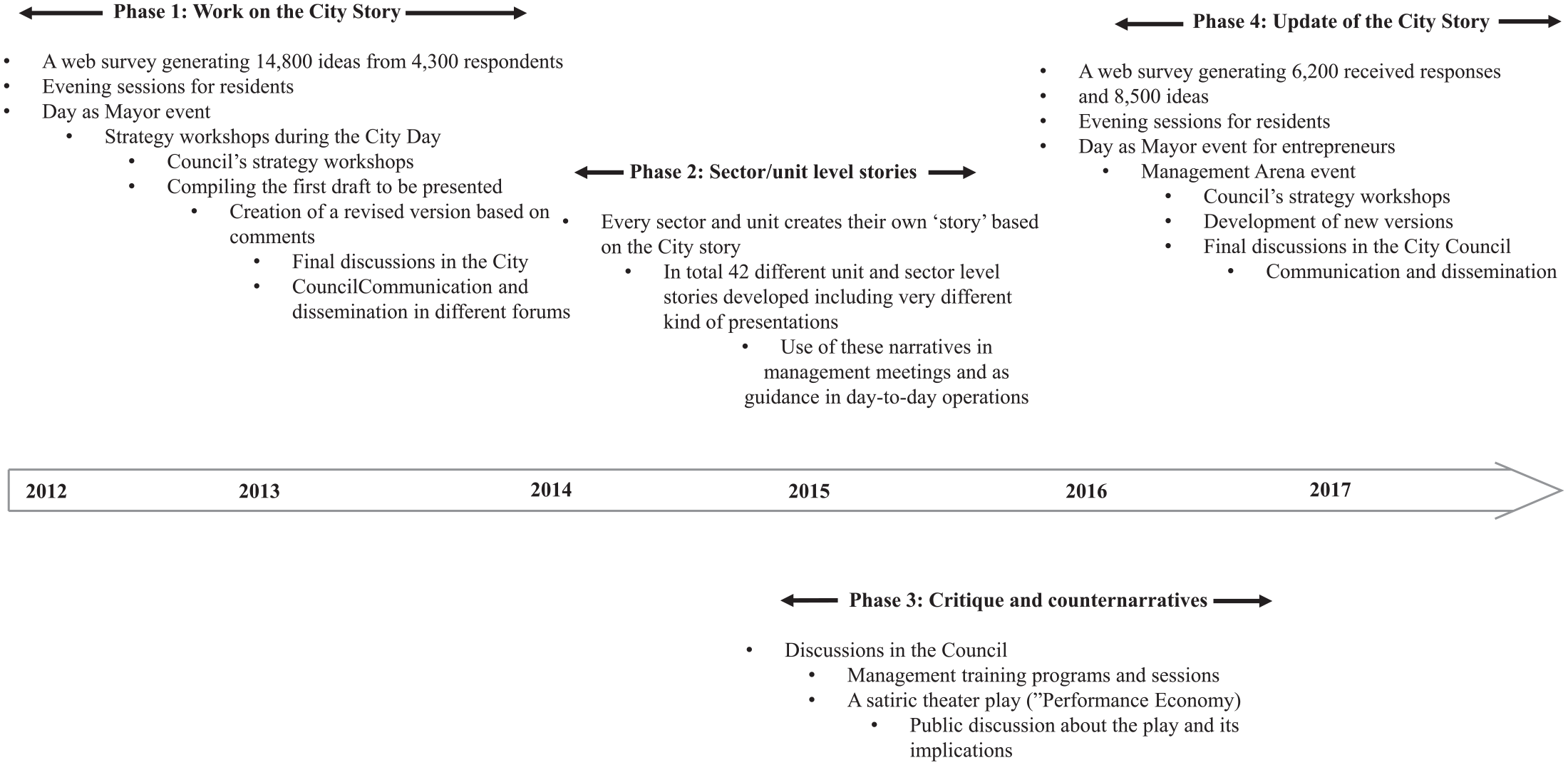
Timeline of narrative strategy-making.
Step 2: Analysis of key actors and their roles in narrative strategy-making
The second step in our analysis focused on the actions of various key people and their roles in the strategy process. They included the mayor and top management, politicians, area and unit managers, rank-and-file employees, and inhabitants of the city. We started with a comprehensive mapping of participatory strategy-making, implying exercising at least a form of influence in this process. This analysis of different organizational actors and their various forms of influencing strategy-making led us to focus on polyphony, meaning having or not having a voice in these processes. Thus, we focused on whether and to what degree specific groups could exercise influence in terms of having an impact in the strategy-making process either in terms of what was discussed, what the various versions of the strategy narratives included, or how the process was managed. This included an ‘a-ha’ moment when we realized that involvement outside the formal process and beyond the organizational boundaries was a key part of polyphony. In this way, we ended up including, for example, the satirical play at the city theatre as a form of participatory strategy-making. By so doing, we developed increasingly detailed understanding as to how polyphony as a multiplicity of voices emerged, took distinctive forms, and dissipated in the different phases of strategy-making (see Tables 3 to 6).
Step 3: Analysis of orchestration in narrative strategy-making
We then focused attention on the orchestration of these processes and zoomed in on the procedural control involved. After some iterations, we realized that this orchestration played out differently in the various parts of this process. We then concentrated on the process dynamics, which led us to distinguish specific chronologically overlapping phases, which would not only be important in this case but characterize the process dynamics in other settings too.
In addition to the orchestration of the organization-level strategy-making, the area- and unit-level translations of the City Story and the new versions created played a major role in this organization. Thus, we focused on how these translations and versions were used as media for organizational polyphony, namely, whether they reproduced the City Story or deviated from it and how. We discovered that alongside more formal or official strategy-making, unexpected forms of polyphony emerged in the form of counternarratives. This was a ‘surprise’ that we had not initially anticipated; it led us to zoom in on the satirical play in the city theatre as a particularly revealing example of these counternarratives. Finally, we focused on the revision round of narrative strategy process, the City Story 1.1.
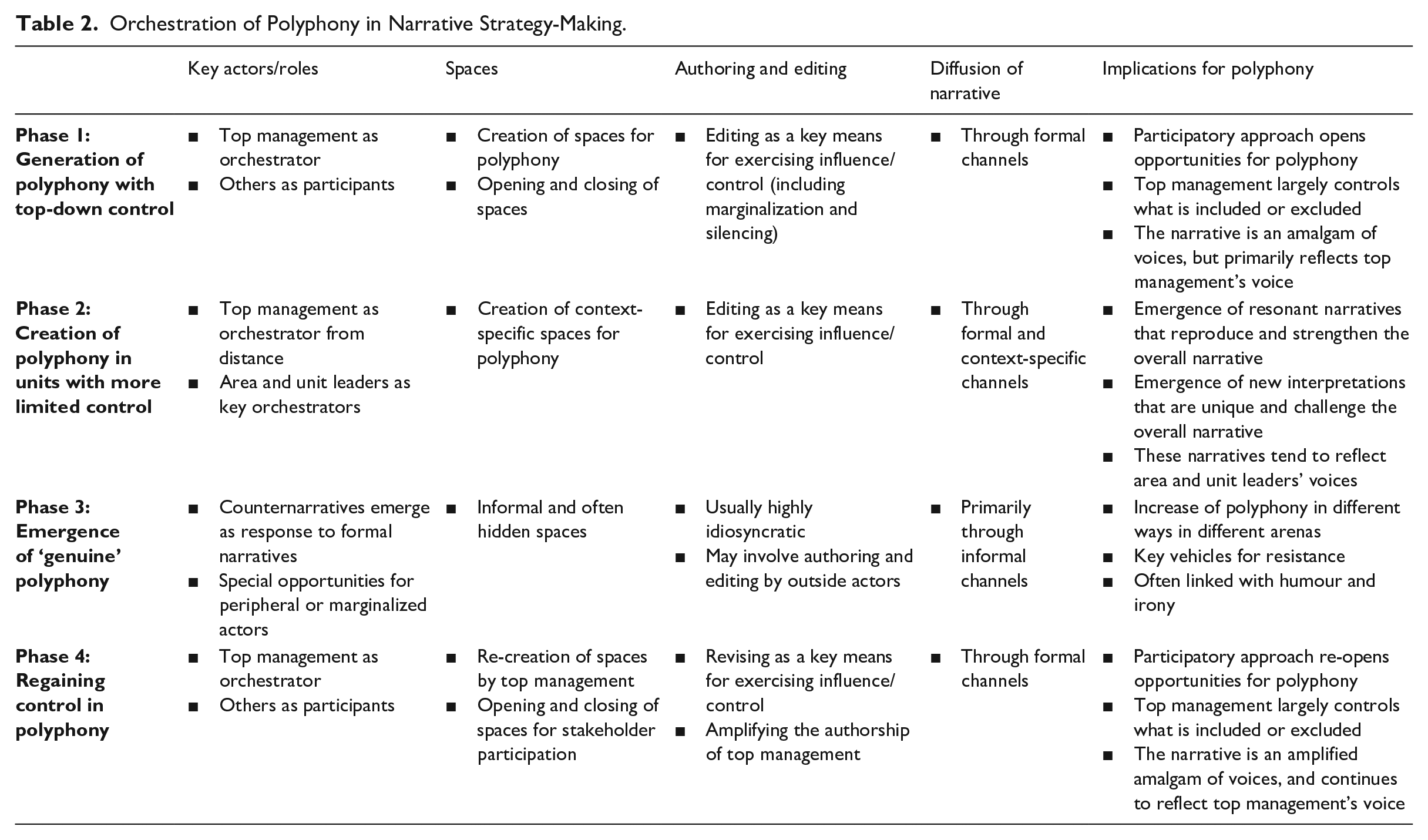
By examining these four phases of narrative strategy-making, we realized that each phase involved distinctive types of orchestration. Thus, we moved on to a more detailed analysis to focus on how this polyphony was orchestrated in terms of the procedural control exercised via specific practices: opening and closing of spaces and then authoring and editing the narratives. Analysis of each phase revealed different forms of orchestration and its effects on polyphony. For example, while in the first phase orchestration reflected top-down control, in the third phase the counternarratives could be seen as more genuine polyphony. This revealed how orchestration in different situations may lead to both generating and/or reducing of polyphony. Finally, this led us to identify and elaborate on the characteristics features of these four phases of orchestration in narrative strategy-making (see Table 2).
Orchestration of Polyphony in Narrative Strategy-Making.
Orchestrating Narrative Strategy-Making
As a result of our analysis, we identified and elaborated how orchestration of narrative strategy-making unfolded in four phases. First, a top-down effort to lead participatory strategy work at the organizational level resulted in polyphony, which was nevertheless largely controlled from the top. Second, this was followed by autonomous strategy-making in units, resulting in polyphony that was less but still partly controlled from the top. Third, all this triggered an emergence of counternarratives, thus generating ‘genuine’ polyphony that was not controlled from the top. Fourth and finally, partly as a response to the increasing polyphony, top decision-makers launched an update of the strategy work, again seizing more control in polyphony. Although we will next focus on this specific case, we believe that such dynamics are also likely to characterize many other types of narrative strategy-making. Table 2 offers an overview of the key characteristics of orchestration and impact on polyphony in these four phases.
Phase #1: Generation of polyphony with top-down control
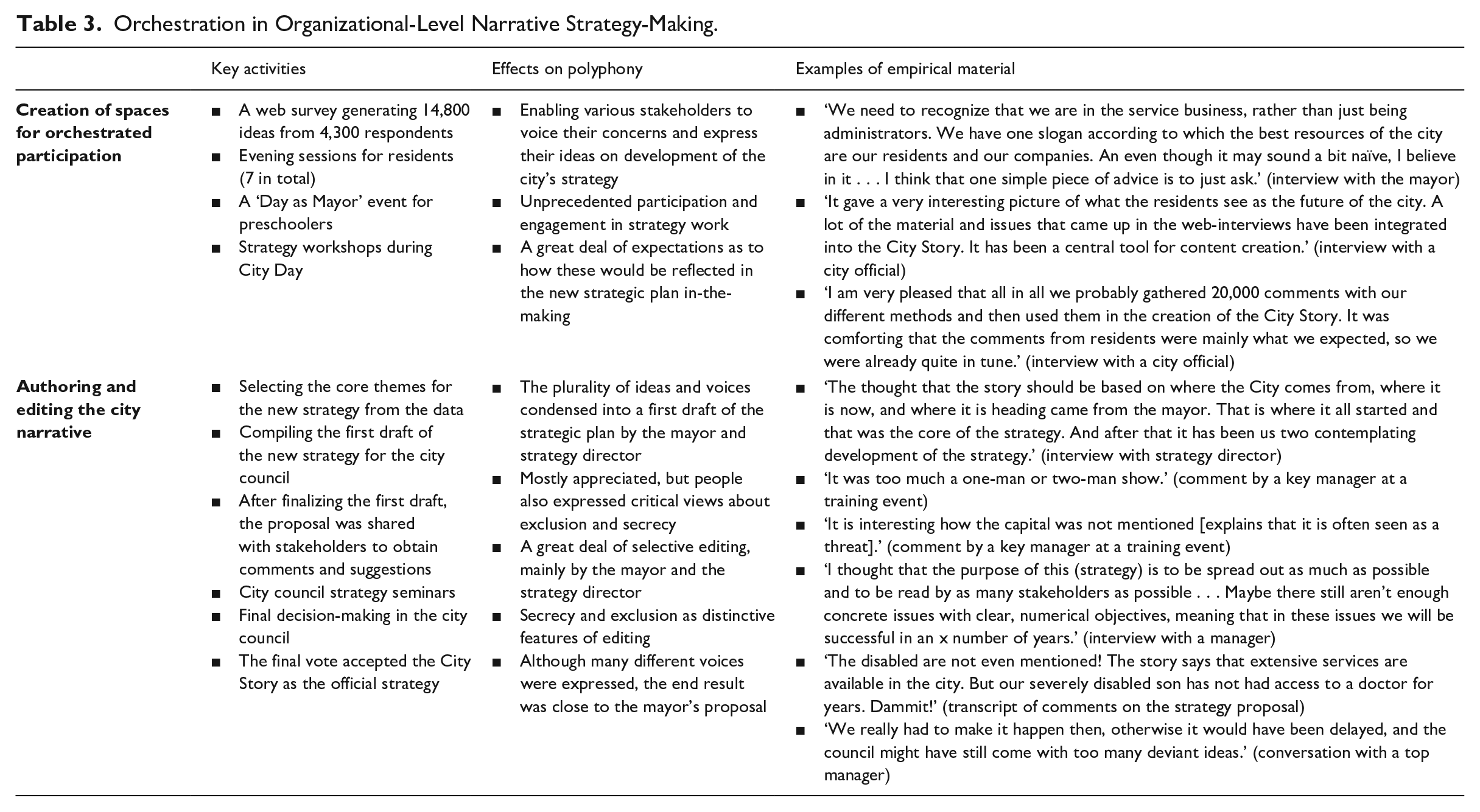
The strategy process started with top-down orchestration of organizational-level participatory strategy-making. This involved creation of new spaces for polyphony to emerge and authoring and editing an overall strategy narrative. Table 3 below provides a summary of the key activities and their impact on polyphony.
Orchestration in Organizational-Level Narrative Strategy-Making.
Creation of spaces for orchestrated participation
A key aspect of orchestration was the creation and management of new spaces allowing various actors to participate in narrative strategy-making. These spaces included a web survey, evening sessions for residents, a city day event, and a ‘day as mayor’ event for 6-year-olds. The web survey was opened in April 2012 and was kept open for approximately four and a half months to allow stakeholders to contribute. This survey collected 14,800 ideas and comments from 4,300 respondents. Soon after, evening sessions were held where residents had an opportunity to discuss how the future of their city should look. These events were marketed on the city’s official webpage by the mayor in the following manner:
The city has the best possibility to succeed in providing service in areas where the residents have been involved in development. In addition, dedicated officials are also needed [in this strategy work]. (mayor, official communication)
The strategy process also included a ‘city day’ event in August 2012, where residents were invited to brainstorm about the city’s future. The main workshop was ‘Let’s create the future city together.’ In this workshop residents were invited to ideate ingredients for the new strategy. The city also arranged ‘day as mayor’ interviews, where children had an opportunity to tell what they would do if they were mayors of the city for one day. The idea was to involve children, but also to encourage their parents to identify what they considered the City’s main strategic issues. Interviews with the preschoolers were broadcast live at three major shopping malls.
These activities generated an extensive set of material reflecting a multiplicity of voices and ideas related to what the new strategy should be. As a result, there was unprecedented participation in strategy-making, which in some ways resembled crowdsourcing. It was significant that even though a large number of responses were attracted with a variety of data-gathering methods, many of the comments and suggestions proved to be unrelated to the city’s strategy.
Authoring and editing the City Story
After a five-month period of keeping the above-mentioned spaces open, the mayor and strategy director began to analyse and edit the material to draft an initial proposal for the new strategy. To develop a proposal, the mayor formed a storyline that would integrate the city’s history – ‘Where we are coming from’ (starting roughly with the first 500 years of the city’s history) – with the future aspirations and visions collected through the web surveys and workshops during the opening phase.
Through this story we can tell the City Story to our residents, our elected officials and why not the whole country. Everyone knows the story of the capital city . . . This city and this area have its own story, and that story is valuable. It is a growth story and now that it has been told, it will be easy to build on it further. It takes our intent further. (interview with a city official)
This led to a five-page draft containing the main elements of the city’s narrative strategy. All this involved a great deal of selective and exclusive editing. However, while this was regarded as ‘necessary’ and many people appreciated the work done, the writing-up process was also criticized as an exercise of power and control ‘not in line’ with the participatory approach taken.
I don’t know if it should have been linked to our strategy-making or to some other resident-influence project. The most interesting part was to discover what the residents are expecting. If we look at the end result, it is possible that we would have ended up there on our own. (interview with a city official)
After forming the initial proposal for the strategy narrative, the process was reopened to stakeholders for comments. Commenting was organized in three different spaces: a web survey, the ‘management arena’ event for city officials, and a city council seminar on strategy. Many applauded the new shorter and more effective way of presenting strategy and found the new strategy easy to read and inspiring. The following were typical comments:
Simplicity and clarity are probably the best part of the draft. The voices of the residents can be heard in the draft. The goals are concrete, resident-oriented, and ambitious to just the right extent. When reading the draft, I get the feeling that “wow, what a place our city will become through this. The city strategy has been created to become very versatile and positive. The presentation style guides thinking toward a really positive 2025 . . . I also find it good that there is a possibility to comment freely. That they even ask and try to consider the opinions of the people for whom this is being done. (Transcripts of comments on the strategy proposal, 2013)
However, not all feedback was positive. Opposing comments focused on both the substance and form of the strategy. For example, the strategy lacked focus on young people, the disabled, or religious activities. There were also many ideas for developing the draft, and many stakeholders had high expectations about how they would appear in the plan.
How do people experience it if we organize those evening sessions for residents with both city officials and elected representatives present, and we have a good discussion but then it is like . . . then what? They came there and told us about their concerns and problems, we listened and replied. Maybe we even discussed some ideas on how to proceed . . . Does it seem to them like we once again listened and [then] everything continued as before? (interview with a city official)
These comments led to revisions, which were again implemented mainly by the mayor and his team. Next, the strategy document had to be formally approved by the city council. The final council meeting was held in June 2013. To the surprise of the mayor and top management, members of the council proceeded to suggest amendments. However, after a break preceded by several hours of work, the council was urged to convert their amendments into ‘wishes’ so that the strategic plan could be approved without changes to the document itself. A city official explained this as follows:
In politics, we solve conflicts by voting and we are used to voting. Voting is not a bad thing but of course when [a proposal] has been thoroughly processed and almost everyone is satisfied, it feels awkward and annoying to still vote on it, but I feel that it’s a part of politics. (interview with a city official)
Finally, after lengthy discussion and voting, the council approved the City Story. Although many different voices were expressed, the end result was close to the mayor’s proposal.
Phase #2: Creation of polyphony in areas and units with more limited control
All this was followed by relatively autonomous strategy-making in the areas and units. Table 4 offers an overview of the key activities and their effects on polyphony.
Creation of Polyphony in Areas and Units with more Limited Control.
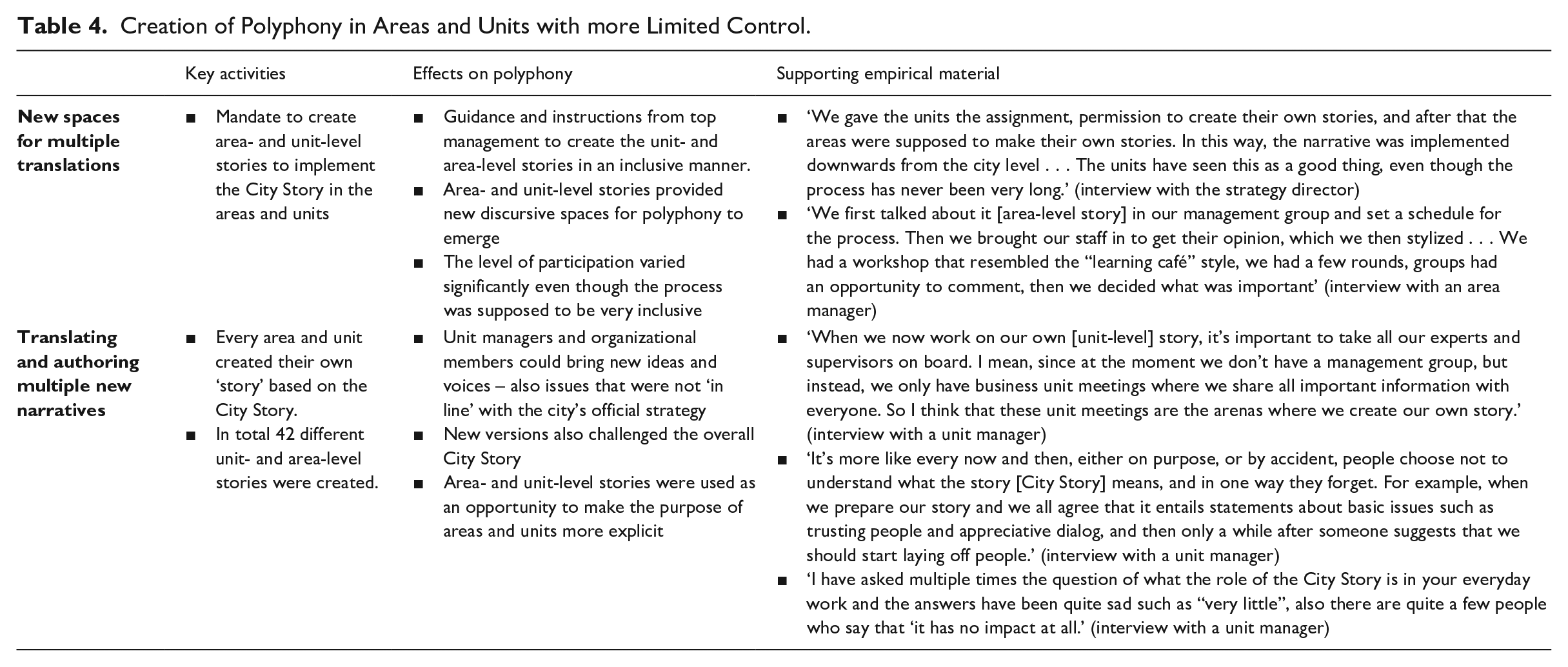
New spaces for multiple translations
After the new strategy had been approved by the council, the top management team launched a ‘mobilization’ phase for implementation at the end of 2014. In this phase, all areas and units were encouraged to create their own area/unit level ‘story’ based on the city strategy approved by the council. This resulted in 42 stories with unique features.
I think that writing the area and unit stories made it clearer that we have common goals and a common point of departure. Instead of stepping outside [the system] and complaining, individual units should join in. Just having 5,000 employees here who understand that this is a single enterprise, or ship or whatever, is already of great value. (interview with a top manager)
All the areas and units were asked to create their own separate strategy story. Notably, even though creation process was mandated to be participative, the processes varied considerably. For example, while some of the units organized multiple face-to-face workshops, others only used email lists.
Translating and authoring multiple new narratives
The mayor emphasized that each area or unit story should be created ‘together’ – just like the city strategy. However, the area or unit heads were ultimately responsible for creation of their stories. In most of the units and areas, substantial collective effort was put into keeping the storytelling process inclusive.
Previously, we put a lot of effort into trying to show others that we are a huge unit in this city and deal with huge numbers of residents daily. Regardless of this fact, we were previously just superficially given the task of forming our own [unit-level] objectives. Now, in relation to the storytelling process, we were able to draw and create our own ‘unit tree’ [their own strategic plan including a tree-shaped summary figure] to show our own objectives that of course entail the values of the city as a whole. (interview with a manager) It created a lot of collaboration in our unit and in the workshops and opened new forums. In a way, our management group has been managed from above, we have been told how to manage . . . But this story has really inspired us. We needed this, and we organized the process in a way that everyone could participate. (interview with a unit manager)
While the initial purpose of writing the area- and unit-level stories was to ‘implement’ the official City Story, some of the area- and unit-level directors realized that their stories served as a new space for promoting the views and agendas of their own organization. In other words, to some extent the implementation seemed to change direction. The storytelling process allowed the areas and units to bring forth new strategic ideas and legitimate them with ‘official’ status – and many of these ideas were different and even in contradiction with the overall City Story. In other words, the storytelling process allowed the areas and units to have their voices heard beyond the City Story:
We started to think of our strategizing in a different way. We realized that if we wanted our views to be seen in the overall strategy that would ultimately define our unit’s work, we would have to start our process a year earlier [laughing]. So, at the same time we got for example the budget for the current year, we had to already think about what we would need to ‘feed’ first to the area management group and ultimately up to the city council. (interview with a unit manager)
Phase #3: Emergence of counternarratives with ‘genuine’ polyphony
All this also triggered critical discussions in wider arenas and the creation of specific counternarratives, resulting in ‘genuine’ polyphony not controlled from the top. Table 5 provides a summary.
Emergence of Counternarratives with ‘Genuine’ Polyphony.
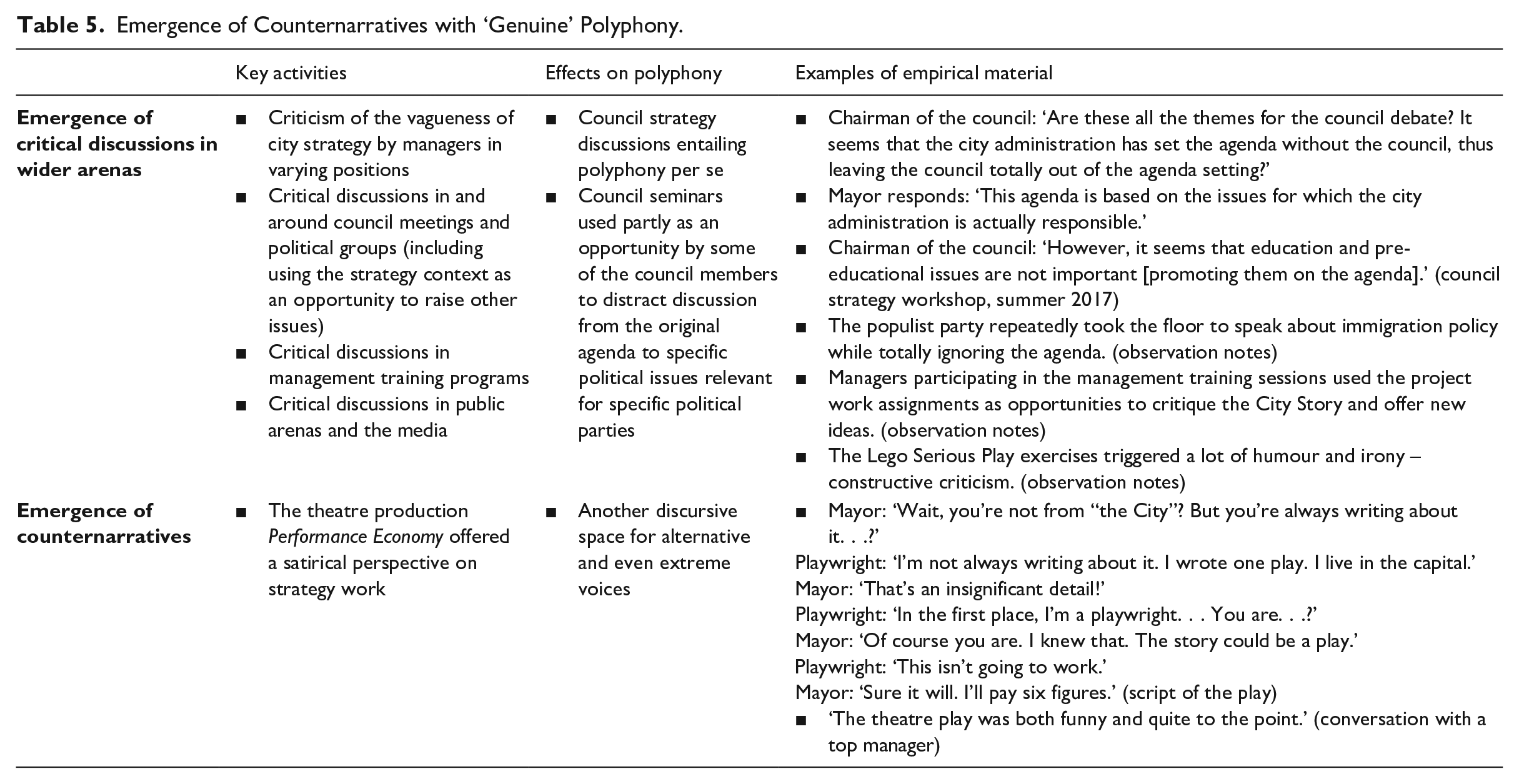
Emergence of critical discussions in wider arenas
The strategy process evoked critical discussion in several arenas. One of the most common critiques coming from within the organization addressed the alleged vagueness of the City Story, which did not help the units and areas to make actual decisions.
I thought that the purpose of this [strategy] is to be spread out as much as possible and to be read by as many stakeholders as possible . . . Maybe there still aren’t enough concrete issues with clear, numerical objectives, meaning that in these issues we will be successful in an x number of years. (interview with a manager)
The discussions in and around the council meetings and in political groups offered another important space for critical discussion. The discussion among politicians challenged both the form and substance of the new city strategy. In various council meetings and workshops council members raised issues that were apparently ignored in the City Story or its drafts.
It is interesting how the [neighbouring] capital city was not mentioned [explains that it is often seen as a threat]. (comment by a key manager at a training event)
In addition, due to the political struggles between the various political parties, some council members also used strategy workshops to raise issues related to their own political agenda even though they were unrelated to the strategy process. In particular, the populist party seemed repeatedly to take the floor to discuss immigration policy, thus ignoring the agenda regarding the strategy process.
The management training sessions in 2015–2018 – where participants of the city organizations were encouraged to work on strategic issues – became another arena for critical discussion. Although in many discussions the key ideas of the official city narrative took centre stage, these sessions could also lead to critical discussions, alternative views and outright resistance. This included the mayor’s key role and the central themes, but also the sharing of new strategic ideas and alternatives that became popular among groups of managers:
It was too much a one-man or two-man show. (comment by a key manager at a training event)
Emergence of counternarratives
The strategy process was not left unnoticed in the broader public discussion either. In particular, the city’s theatre staged a satirical play titled Performance Economy, which became a striking box office success. The key theme of the play was strategic management in the city organization. This play included characters such as the mayor, representatives of key parties that resembled their real-life counterparts, and even a business school professor. The play expressed criticism of the strategy-making process and the contents of the official City Story, but with humour and irony. One of these key themes of criticism was targeted at the attempts of the mayor and his team to emphasize the role of the City as an independent international hub while forgetting the Capital City next to it – linked with the unclear identity of the City as a ‘suburb’ of the Capital. In the play, the actors repeatedly mocked the alleged origins of the city in the City Story and joked about the lack of a city centre.
Let’s say I’m from district X. I have certain experiences; I always took the train downtown. You mean Capital Downtown? [not their own city] Yes. Good to make that clear. (Script from the play Performance Economy 2)
There were numerous other ironical lines in the play about the historical foundations described in the official City Story. In many scenes, the jokes revolved around the absence of a unified community. The identity of the inhabitants is instead tied to the various districts or neighbourhoods in the city as the excerpt below describes:
So, this is the one City experience? Well, one of my friends told how they used to rumble with the kids from across the highway. A bike would get stolen, so they’d grab baseball bats and head over to have a fight. . .. Well that might not be the first image of the City we want to communicate? But it happened, it’s true. (Script from the play Performance Economy 2) Furthermore, critique of the mayor as the face of the process were an overarching theme. Although the slogan ‘Creating the City Story together’ emphasized collective achievement, the storytelling approach seemed to be strongly personified in the mayor. The gist of the critique was the fact that despite the promised participatory process, the mayor was still largely in control. The play focused on mocking this process and the mayor’s actions. An a cappella rendition of Björk’s ‘Human Behavior’ in the performance seemed to set the stage for carnivalizing the process and thereby opening the floor for a variety of voices. This included reflections about the role of the audience as participants in the play but also more generally as inhabitants of the City managed from the top: ‘One should not laugh too much, as you are also performing while we speak.’
Phase #4: Regaining control in polyphony
Partly as a response to the increasing polyphony, top decision-makers launched an update of the strategy process, again seizing more control in polyphony. This was framed as an update: City Story 1.1.
While we are preparing the new strategy round, we don’t call it the City Story 2.0 but instead we talk about the City Story 1.1. And there is a strategic choice behind this, namely, we don’t want to focus on creating a totally new story. Instead, we want to develop and be better in implementing and operationalizing the story . . . This is in line with our initial plan that during the first strategy round we learn how to use a story-form strategy and during the following round we focus on improving implementation. (interview with a top manager)
Table 6 provides a summary of this new phase of orchestration.
Regaining Control in Polyphony.
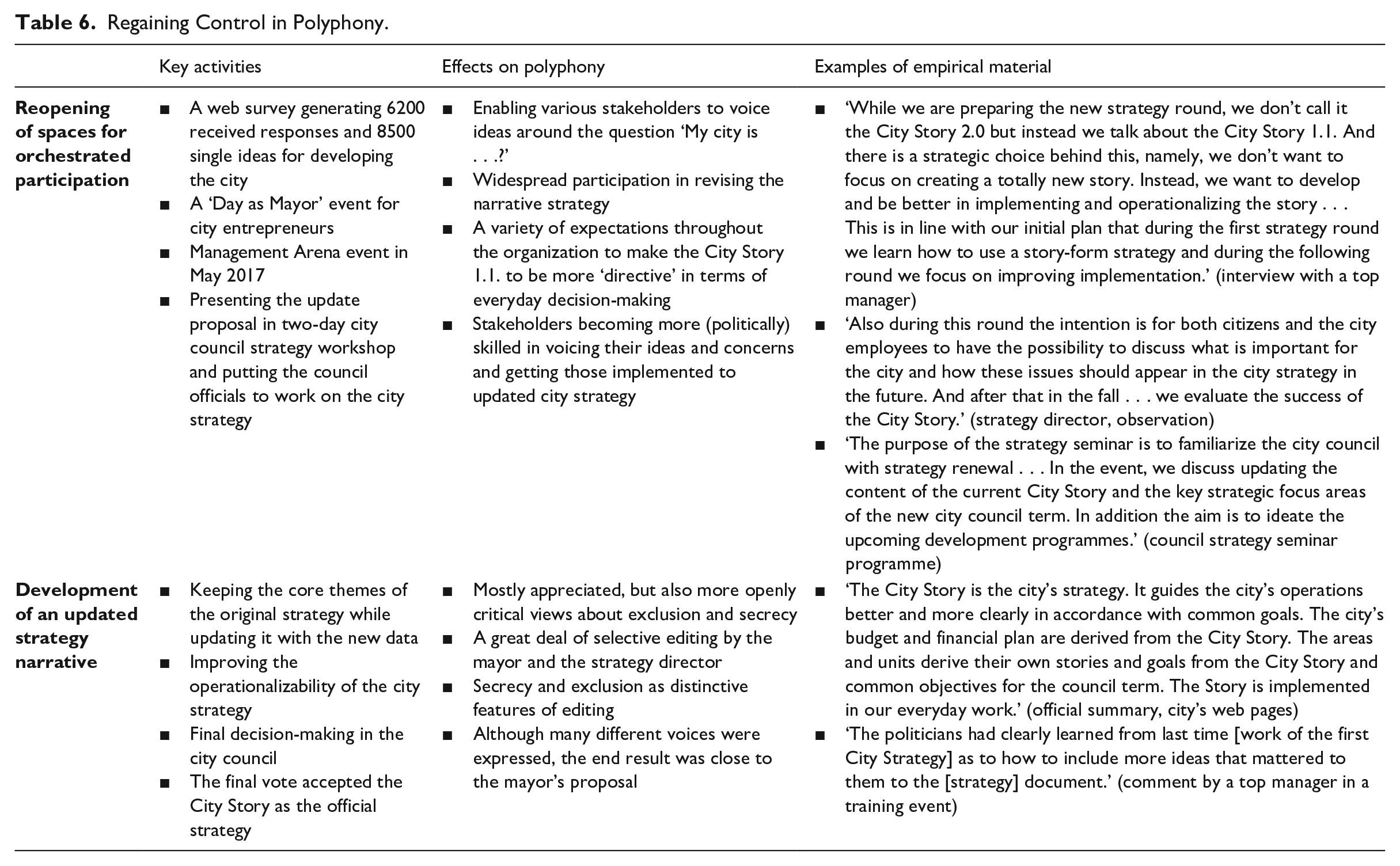
Reopening of spaces for orchestrated participation
The update process started in summer 2016 when the mayor again opened the discussion. First, the city’s employees were invited to discuss the main development topics in the revised City Story. After this, the process continued by opening a web poll where both citizens and employees could discuss potential issues of importance and how these should appear in the update. Data collection via the web poll was built around the general question ‘My city is . . . ?’ and it was opened during a city day event. Altogether, the survey received 6,200 responses, 5,700 different definitions of ‘what my city is like’, and 8,500 single ideas for developing the city. In addition to the web poll, the data collection included a ‘day as mayor’ event for local entrepreneurs instead of preschoolers.
All these data collected were analysed by an external consultant, and the initial results were presented in a council seminar in February 2017. These issues were also dealt with at a new management arena event in May 2017, where the City Story 1.1 was discussed with all organizational members in supervisory positions.
Mayor: ‘Our attention is to collect all these data and then the new council will decide on the updated City Story. Of course, this will require a lot of effort, but it must proceed in a certain way: we collect the data, and based on that we prepare the draft of the new strategy. After that, we work on that draft together with the new council. Based on the joined work, the new City Story will be written and only then the new council can decide whether to accept the new strategy . . . and of course all these phases may eventually result in a City Story 2.0., even though we are now aiming [only] for version 1.1.’ [laughing]
Development of an updated strategy narrative
This was followed by revising the strategy document. In June 2017, a two-day open space strategy workshop was organized for the council. In introducing the workshop, the mayor presented the update proposal and, in this way, opened the proposal for discussion and suggestions for alterations and/or amendments. At the beginning of the workshop, the mayor emphasized that the main purpose of this workshop was to ‘put the council officials to work on the city strategy’ by asking all the council members to ponder the question ‘What is important for you?’ However, even during the introduction, council members raised criticism about missing topics such as sustainability and why the topics of the workshop were decided in advance by the city management group without first hearing the new council. In this workshop, key council members succeeded in making limited, but from their perspective significant, modifications. In particular, it was important for several leading politicians to have their key themes mentioned in the document. As the strategy director put it:
The politicians had learned from last time and now made the strategy [document] was much more, even too detailed. (conversation with strategy director)
After the council strategy workshop, with the help of the strategy director, the mayor started to edit all the data and ultimately devise a proposal for the revised strategy, City Story 1.1. The city board and the council negotiation committee discussed the proposal in August 2017. In these meetings, adjustments were made but ultimately the updated strategy reflecting top management’s key themes was handed over to the city council to vote on September 2017. The city council voted for accepting the city strategy for 2017–2020.
Discussion
Orchestration as generation and reducing of polyphony
Although we have seen increasing interest in participatory strategy-making in general (Mantere & Vaara, 2008; Tavella, 2021) and open strategy research in particular (Dobusch et al., 2019; Hautz et al., 2017; Splitter, Jarzabkowski, & Seidl, 2021), there is a lack of understanding and especially critical reflection of how a multiplicity of voices can be managed. This is not a trivial issue but one that requires serious attention if we are to better comprehend the ways in which strategy-making unfolds and involves inclusion and exclusion. Hence, we have focused on the orchestration of polyphony in a revealing case of participatory strategy-making. The case analysis shows that orchestration is not only about offering a new way to engage a lot of people, as open strategy scholars tend to emphasize (Dobusch et al., 2019; Hautz et al., 2017; Splitter et al., 2021), but neither is it ultimately about impeding people from having a real voice, as critical management scholars could argue (Ezzamel & Willmott, 2008; Kornberger & Clegg, 2011). It rather turns out that orchestration of strategy-making is a double play involving generation of polyphony but also reducing it.
Thus, orchestration can be seen as a procedural form of control that is based on seemingly contradictory or paradoxical elements: control is suspended but not relinquished entirely. Our case helps to unravel this puzzle by revealing how these processes play out over time. Although our case has special features, we believe that the pattern we uncover can be found in other settings, too. First, the initial top-down efforts generate polyphony, which is nevertheless largely controlled and limited. Second, when people in different parts of the organization engage in more or less autonomous strategy-making, polyphony strengthens in several ways. Third, if and when people then are able to voice their own critical alternatives, this leads to what we call more genuine polyphony beyond top-down control. Fourth and finally, this tends to trigger a need to again gain control from the top, as we can see in our case with the update reducing control.
Our analysis highlights the role of two sets of activities in orchestration: managing spaces and authoring and editing of the narratives. First, the creation and management of spaces (Hardy & Maguire, 2010) is a key aspect of orchestration of polyphony in which a variety of actors take part. As our case illustrates, these include both physical spaces such as top management or council meetings (Holstein & Rantakari, 2023; Jarzabkowski & Seidl, 2008), and also virtual ones such as web surveys or online discussions (Hutter et al., 2017). Each of these arenas is characterized by specific conditions regarding participation rights and the nature and duration of discussion and they have a fundamental impact on the nature of polyphony in the strategy process. In our case, the key actors – such as the mayor – played a crucial role in creating and opening the spaces for polyphony to emerge in different stages. However, it was also through closing of these spaces that top management was able to orchestrate polyphony. Furthermore, when top management closed those spaces, what was to follow was largely in the hands of top management.
Second, authoring and editing of the strategy narrative is crucial for understanding how polyphony can be orchestrated into a more or less coherent narrative. While this involves more than work on conventional strategic plans, our analysis highlights the importance of strategy narratives and drafts thereof (see also Abdallah & Langley, 2014; Kornberger & Clegg, 2011; Vaara, Sorsa, & Pälli, 2010). While the various voices had a major impact on the shaping and content of the document, in our case writing the City Story was mainly in the hands of two key people: the mayor and the strategy director. They exercised significant power over deciding which ideas or voices were picked up from the discussions and which were not included in the various versions of the document. A particularly interesting aspect of this process is the editing out of elements that are not or are seen to be not ‘in line’ or to ‘cohere’ with the principal ideas and messages. Hence, editing is crucial in dealing with deviant voices or the unsaid. This is also a key question related to participation and openness in strategizing since widespread participation may create expectations that are not met (Kornberger & Clegg, 2011). However, our findings illustrate how others may take authorship in editing texts such as the plans crafted in the areas and units. In those cases, unit and area managers emerged as the key authors and translators. And finally, our case also shows how other actors outside the organization can take initiative, such in the satirical play, and offer their own narratives.
All this has implications for research on participatory strategy-making (Mantere & Vaara, 2008; Splitter et al., 2021; Tavella, 2021). First and foremost, our analysis of orchestration elucidates how procedural control is used and unfolds over time. This has special relevance for the current discussion about open strategy, which is starting to acknowledge the dilemmas and unintended consequences this kind of strategy work involves (Dobusch et al., 2019; Hautz et al., 2017; Splitter et al., 2021; Whittington & Yakis-Douglas, 2020). In particular, while prior research has shown that issues and questions about openness are also related to closure (Dobusch et al., 2019; Diriker et al., 2023; Holstein & Rantakari, 2023), we link this discussion to inclusion and exclusion as inherent parts of opening and closing in open strategy work. The key point is that control is not simply about opening or closing but that the polyphony generated over time also starts to live a life of its own, with paradoxical implications for the ensuing strategy work episodes.
Furthermore, the pattern we reveal helps to understand how such orchestration is likely to play out, thus illuminating what kinds of issues – whether looked at from a more pragmatic or critical perspective – characterize different parts of these processes. By so doing, our analysis underscores the value of further critical thinking in open strategy scholarship (Splitter et al., 2023) – including the appreciation of alternative and critical voices as an inherent part of the processes. The emerging view is that inclusion in open strategy involves combinations of voices that are brought out or silenced in different ways over time in a dynamic of orchestrated control.
All this leads us to underscore the processual aspects of such participatory strategy work. From a pragmatic perspective, it seems that the obvious value of these kinds of processes is the sense of being able have a voice and to be heard, which is likely to foster engagement with strategic issues and thus promote strategic thinking. This may be at least as significant an outcome as any shared understanding of strategic direction. From a more critical point of view, this also means that seemingly participatory or open strategy processes may turn out just ‘window-dressing’ or ‘ceremonial’ performances to force people to accept ideas that are not in their interests.
Our analysis also shows that orchestration does not merely create a single organizational-level strategy narrative, which has been the focus of prior research (Barry & Elmes, 1997; Dalpiaz & Di Stefano, 2018; Rindova & Martins, 2022; Spee & Jarzabkowski, 2017). In fact, it often leads to translations and new narratives in various parts of the organization, as well as to the emergence of counternarratives. By elucidating this complexity, our analysis adds to theoretical reflections about polyphony in narrative strategy-making (Fenton & Langley, 2011; Vaara & Pedersen, 2013). While the creation of the overall organizational narrative may be controlled by key individuals, the situation is different as the process unfolds and new versions are created. As our case vividly shows, the translations and new narratives in the various parts of the organization may look very different and even challenge the overall narrative. Counternarratives are by definition meant to challenge the prevailing views coming from the top and leaders are overall unable to control their emergence or impact. Moreover, our study illustrates how different versions of the narrative, counternarratives, and thus polyphony may emerge also outside the organization by various stakeholders. Hence, our analysis reveals the limits of top-down discursive control over narrative strategy-making.
By illuminating the role of these different narratives, our analysis contributes more generally to research on organizational narratives where calls have been made to shift attention from narratives per se to their production and performative effects (Dailey & Browning, 2014; Rantakari & Vaara, 2017; Vaara et al., 2016). While there are exceptions (Boje et al., 2016; Myllykoski & Rantakari, 2022; Vaara & Tienari, 2011), our understanding of how various voices, alternative narratives, or different interpretations are woven together is partial. This is at least in part due to conceptual challenges – related for instance to how we make sense of the multifaceted and dynamic nature of narratives (Vaara et al., 2016).
Our analysis helps to advance this issue in three ways: by illuminating how polyphony plays out not only in and around one narrative but across different types, by demonstrating how partially shared understanding may emerge but always involves alternatives, and by offering a needed empirical example to elucidate how orchestration may play out in such processes. First, our analysis demonstrates that narrative strategy-making involves a multiplicity of narratives (Vaara & Pedersen, 2013). According to this view, rather than focusing on specific narratives, a more comprehensive understanding of organizational polyphony requires recognition of the emergence and development of alternative narratives that complement and challenge the dominant ones. This also helps us to understand what is often lacking in organizational narrative analysis: the role of counternarratives and their carnivalistic versions as critical alternatives that may undermine the dominant organizational interpretations but also perpetuate dialogue (Belova et al., 2008; Jabri, 2016; Kornberger et al., 2006). We would argue that this is a necessary step for comprehending not only the dynamics of narrative strategy-making but also the production and consumption of organizational narratives more generally.
Second, our analysis can also be seen as an example of how partial shared understanding may emerge, but how there are always alternatives in the production and consumption of organizational narratives as well. On the one hand, in cases such as ours, it is easy to see how narrative work is characterized by a need to create convergence out of polyphony, which in turn implies a need to control the multiple voices and create shared understanding. This includes editing out specific voices or silencing them. On the other hand, our analysis also reveals how such convergence – for example, in developing the organization-level City Story – may be followed by divergence because new narratives and versions thereof emerge and complement, challenge, or criticize the dominant ones.
Third and finally, with its focus on orchestration, our analysis also adds to the work of others and responds to calls for examples of how polyphony may be dealt with (Belova et al., 2008; Jabri, 2016; Kornberger et al., 2006). By detailing the practices of orchestration, it shows how influence is exerted in more or less open or subtle ways. As discussed above, this requires both managing the spaces and authoring and editing the narrative versions. By detailing these practices, our analysis offers an empirical example that complements the more theoretical and philosophical work in prior research (Lorino & Tricard, 2012; Shotter, 2008; Vaara & Pedersen, 2013). Moreover, it also shows how it is impossible to fully control polyphony and that such exercise of power is always only partial.
Ideas for future research
While our analysis is based on a theoretically grounded understanding of orchestration (Kornberger et al., 2006), future studies could go further in theorizing organizational polyphony and its orchestration. Our analysis has been inspired by Bakhtin’s (1984a) seminal work, but we have remained at a relatively general level in our analysis of the dialogical processes, their manifestations and critical analysis. Thus, there is a need to dig deeper into what polyphony means, which can also enable more critical analyses of strategy-making. A fundamental philosophical question that deserves special attention is whether the discourse of strategy, which is linked with procedural control, and the ideals of polyphony, which are based on releasing control, can be fully compatible. It seems that there are limits to bringing them together, but at the same our analysis shows that this paradox is the crucial element in participatory strategy work – both inspiring people and then ultimately limiting the opportunities for polyphony. From a Bakhtinian perspective, such analysis could focus on the utterance level to be able to develop more fine-grained understanding of polyphony and its forms (Jabri, 2016). Another idea would be to concentrate on the role of different chronotopes, or space-time configurations, in strategy narratives. Such study could add to prior research (Lorino & Tricard, 2012; Vaara & Pedersen, 2013), for example by focusing on the struggles between different forms and how they are used in dialogue.
It would also be interesting and important to focus more attention on the role of counternarratives in strategy work. As shown in our case, such counternarratives may play a key role in strategy-making – especially in helping alternative voices and ideas to be heard and gain ground. Such analysis would enrich our understanding of resistance in strategy-making (Ezzamel & Willmott, 2008; Hardy & Thomas, 2014; Rantakari & Vaara, 2016). In this context, the carnivalistic aspects (Bakhtin, 1984b) of strategy-making deserve special attention, especially in the open strategy context. This is because the carnival can be seen as the ultimate form of collective engagement allowing for the expression of a full variety of voices. In Bakhtin’s (1984a) terms, the carnival suspends ‘hierarchical structure and all the forms of terror, reverence, piety, and etiquette connected with it . . . or any other form of inequality among people’ (pp. 122–123). As our case shows, in strategy-making this can mean liberation from the dominant voice with means such as humour and irony. Studying these different carnivalistic elements and their interplay offers an intriguing opportunity for future research.
In addition, it would be valuable to focus explicit attention on the dialogical dynamics of strategy-making beyond narrative form, and such analysis could draw on different conceptions of dialectics and dialogicality (Tsoukas, 2009). Furthermore, the various practices used in orchestration warrant theoretical and empirical attention. While our analysis highlights the key role of opening and closing of spaces and authoring and editing, future research could examine other social practices and dynamics. For instance, the role of front vs. backstage strategy work deserves special attention (Whittle, Gilchrist, Mueller, & Lenney, 2021).
Our empirical case analysis is subject to boundary conditions and limitations that should be taken seriously. Strategy-making in this city organization has specific features and thus it would be useful to compare it with others in future research. It would be interesting to study orchestration in other types of institutional and cultural settings, and it would be important to complement this analysis with other cases using less inclusive approaches and with other types of open strategy cases.
In all, we hope that our analysis of orchestration inspires others and paves the way for new studies. We believe that the notion of orchestration has potential to change the way scholars and practitioners think about strategy-making. It allows one to move beyond a dichotomous understanding of participation and openness towards a more nuanced appreciation of alternative voices and how they may or may not emerge, be controlled, or orchestrated in strategy-making.
Footnotes
Acknowledgements
We wish to express our gratitude to our brilliant Editor Mike Zundel and the anonymous reviewers for very insightful comments that have greatly improved the paper. We are also indebted to the representatives of our case organization for the unique access and long-term collaboration.
Funding
The author(s) disclosed receipt of the following financial support for the research, authorship, and/or publication of this article: We also want to thank the Academy of Finland for financial support in this project.
