




Abstract
The prominence of inter-organizational networks for innovation raises questions about how to support collaboration between multiple, diverse stakeholders. We focus on network orchestration and examine the practices that support orchestrators in dealing with the challenges brought by the number and diversity of stakeholders. Using qualitative, longitudinal data from an innovation network of 57 stakeholders, we identify three types of orchestration practices – connecting, facilitating and governing – and observe how they underlie innovation trajectories over time, each supporting the achievement of distinct network outcomes. Within and across trajectories, we observe how orchestrators rely on hybrid orchestration: they switch between dominating and consensus-based orchestration modes, in response to emergent network challenges. By switching between modes, orchestrators address the complexities of simultaneously and temporally dealing with a large number and diversity of stakeholders. With these findings, we present a toolbox of practices for network orchestrators to address distinct challenges in different types of networks and underscore that network research should consider the plurality of networks, rather than treat them as universalistic. Orchestrators play a key role in managing this plurality: they act as environmental scanners who address emergent network challenges through hybrid orchestration. This realization opens new avenues for network research, for example, relating to the skills and capabilities of orchestrators.
Complex challenges in science and business drive a multitude of organizations to collaborate in networks (Eisenhardt, Graebner, & Sonenshein, 2016; Ferraro, Etzion, & Gehman, 2015). In these networks, multiple, diverse stakeholders (i.e., a large number of different types of network members such as universities, governmental bodies and firms) interact over time to develop innovative solutions (Levén, Holmström, & Mathiassen, 2014). Here, we address a key question for understanding such network interactions (Denis, Langley, & Sergi, 2012; Paquin & Howard-Grenville, 2013): how do orchestrators in multi-stakeholder networks mobilize network members across organizational boundaries?
Prior research offers two orchestration modes to manage a plurality of actors in networks. One mode is dominating: a core actor (or a group of core actors) sets the collaborative agenda, recruits partners, and typically relies on formal contracts to steer relationships (e.g. Kazadi, Lievens, & Mahr, 2016). The other is consensus-based: partners collectively negotiate the agenda, membership is often voluntary, and trust predominantly governs relations (e.g. Gray, 1989; Roloff, 2008).
We advance the notion of hybrid orchestration, building on the work of Gronn (2009) and Collinson and Collinson (2009) who suggest that in networks multiple forms of leadership can exist at the same time. Specifically, we propose that a mix between dominating and consensus-based orchestration may be required to simultaneously deal with the challenges brought by the number and diversity of stakeholders involved. For example, researchers have pointed out how in networks with a high number of stakeholders, network relationships become increasingly difficult to observe, a phenomenon known as network opacity (Fonti, Maoret, & Whitbred, 2015). When opacity is high, inclusive negotiations and trust development among stakeholders will likely be hindered, making consensus-based orchestration difficult to achieve. As a result, when dealing with many stakeholders, dominating orchestration may be more effective than consensus-based orchestration. However, the diversity of stakeholders can undermine the legitimacy of a dominating authority. Indeed, when expertise is dispersed among various stakeholders, orchestrators may be less knowledgeable than the network members, reducing their legitimacy (Bridoux & Stoelhorst, 2016). To simultaneously manage the number and diversity of stakeholders involved, we therefore suggest that hybrid orchestration may be required.
We examine such hybrid orchestration in a revelatory, extreme case (Yin, 2003): a multi-stakeholder network consisting of 57 stakeholders. The network included public and private partners such as pharmaceutical companies, universities, small and medium-sized enterprises (SMEs) and patient organizations. The network had a co-orchestration structure: a public partner and a private partner were jointly responsible for achieving network outcomes, reflecting the stakes of both sides. Informed by research on inter-organizational networks (Lumineau & Oliveira, 2018; Oliveira & Lumineau, 2017), orchestration (Denis et al., 2012; Huxham & Vangen, 2000), and stakeholder theory (Freeman, 1984; Roloff, 2008), we examined the practices orchestrators draw on over time to deal with the large number and diversity of stakeholders involved. Based on Dhanaraj and Parkhe (2006), we define orchestration practices as the activities through which actors purposefully build and manage the multi-stakeholder innovation network.
In this paper, we develop a process map of hybrid orchestration. In doing so, we offer two contributions. First, we identify three types of orchestration practices – connecting, facilitating and governing – and specify how they underlie innovation trajectories over time, each supporting the achievement of distinct network outcomes. Second, we further conceptualize the notion of hybrid orchestration. Within and across trajectories, we show how orchestrators switch between dominating and consensus-based orchestration modes. We propose that this hybrid approach helps orchestrators address the complexities of simultaneously and temporally dealing with a large number and diversity of stakeholders. We suggest that they act as environmental scanners who address emergent network challenges by switching between orchestration modes. With these findings, we present a toolbox of practices for network orchestrators and underscore the plurality of network relationships. Future network researchers should therefore consider the network challenges that call for dominating and/or consensus-based orchestration and examine how networks evolve through hybrid orchestration.
Orchestration in multi-stakeholder networks
To understand the complexities of multi-stakeholder networks, Roloff (2008) proposes stakeholder theory as a theoretical lens. Stakeholder theory is a framework for examining an organization’s relationships with an array of actors (Freeman, 1984). However, since its inception, researchers have predominantly adopted stakeholder theory as a ‘theory of the firm’ (Freeman, 2010, p. 7), mostly taking the perspective of a focal organization (e.g. Tantalo & Priem, 2016). In contrast, Roloff (2008) calls for a broader approach, which extends beyond the focus on a focal organization’s welfare. Ferraro et al. (2015) mirror this view; acknowledging that complex challenges necessitate cooperation across disciplines, they call for shifting the focus away from the corporation as the focal organization. According to Roloff (2008), this shift requires a new stakeholder management approach to understand how stakeholders work together across the phases of a network. A key question then is how orchestrators can mobilize multiple, diverse stakeholders to collaborate across organizational boundaries to achieve common objectives.
Two Network Orchestration Modes: Dominating versus consensus-based
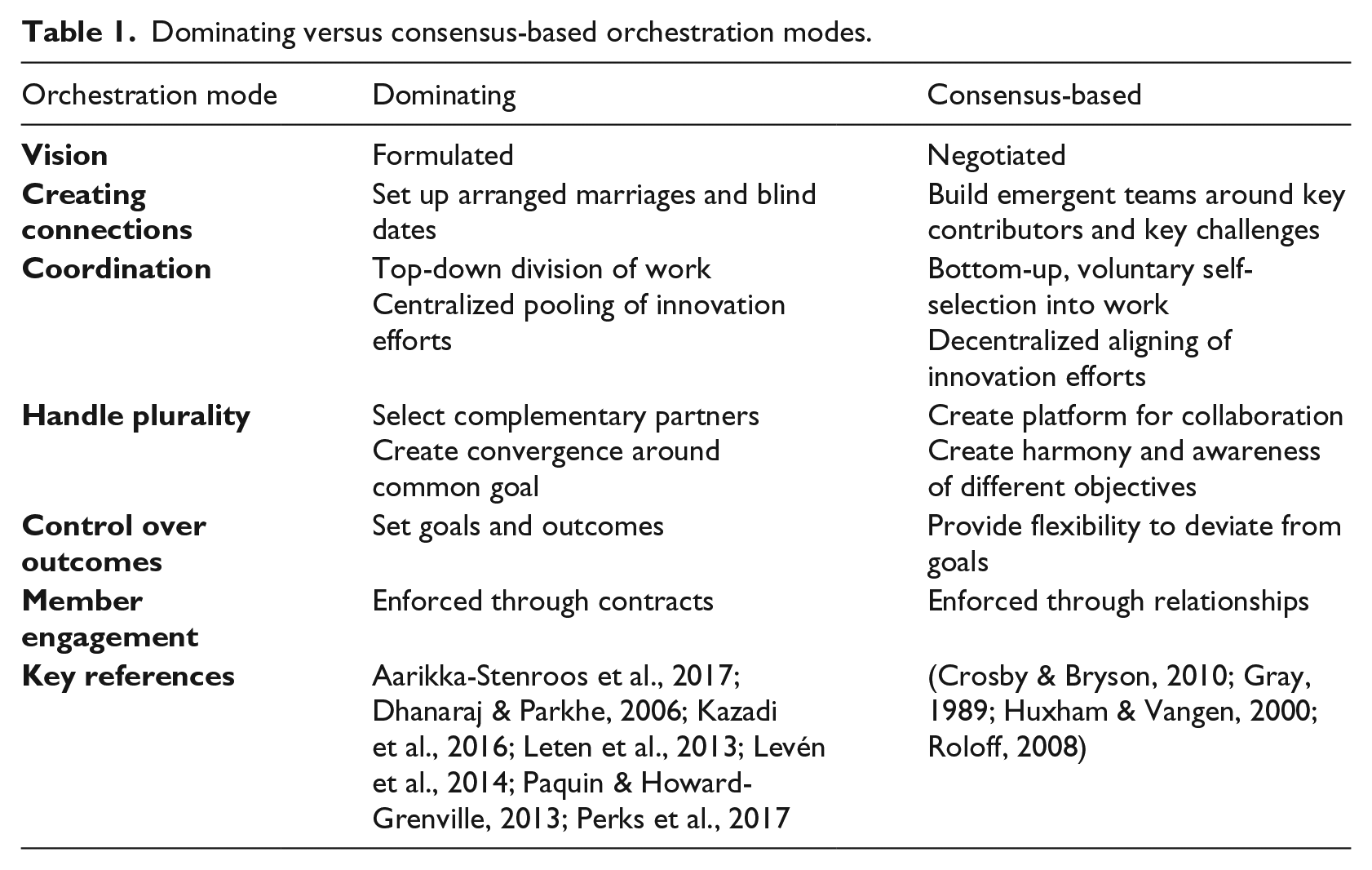
Network orchestration denotes the act of performing a leadership role, without the benefit of hierarchical authority (Dhanaraj & Parkhe, 2006). The literature offers different classifications of such network orchestration (e.g. Denis et al., 2012; Provan & Kenis, 2008). Here we borrow the terminology of Davis and Eisenhardt (2011) and distinguish between ‘dominating’ and ‘consensus-based’ orchestration. Table 1 provides an overview of the main differences between these orchestration modes, based on our review of the literature.
Dominating versus consensus-based orchestration modes.
Dominating orchestration
Dominating orchestration typically occurs within networks that are governed by a central entity, which is referred to as the hub or lead organization. These hub organizations are the initiators of the network and take the lead in various activities such as partner selection (Kazadi et al., 2016), goal setting (Aarikka-Stenroos, Jaakkola, Harrison, & Mäkitalo-Keinonen, 2017), and ensuring the distribution of value (Leten, Vanhaverbeke, Roijakkers, Clerix, & Van Helleputte, 2013).
In networks with dominating orchestration, orchestrators develop, communicate and refine the strategic vision of the network (Aarikka-Stenroos et al., 2017; Levén et al., 2014; Paquin & Howard-Grenville, 2013). They assemble the network by recruiting members and providing the resources to collaborate (Aarikka-Stenroos et al., 2017; Levén et al., 2014). To create connections, they actively link partners and create platforms where they can spontaneously meet (Paquin & Howard-Grenville, 2013). To handle the plurality of partners, dominating orchestrators select complementary partners, for example through competence mapping (Kazadi et al., 2016), and converge them around a common goal (Aarikka-Stenroos et al., 2017; Perks, Kowalkowski, Witell, & Gustafsson, 2017). They coordinate the flow of information and resources within the network, by pooling the innovation efforts of the various partners from the top down (Dhanaraj & Parkhe, 2006; Kazadi et al., 2016). Finally, dominating orchestrators control the outcomes of the collaboration, by setting the rules for innovating, creating incentives to collaborate, and in some cases sanctioning underperforming members or entirely dissolving the collaboration (Aarikka-Stenroos et al., 2017). To ensure the engagement of members, they typically rely on contracts such as intellectual property agreements (Leten et al., 2013).
Consensus-based orchestration
In networks with consensus-based orchestration, organizations act as partners who interact in a non-hierarchical way to fix common issues (Roloff, 2008). Orchestrators negotiate a shared vision (Crosby & Bryson, 2010) and share control over the project goals and outcomes (Roloff, 2008). To create connections, they form cross-boundary groups such as task forces that draw together participants with different expertise to work on specific problems (Crosby & Bryson, 2010). Participation in such networks is often voluntary (Roloff, 2008), so orchestrators enthuse and empower those who can deliver the collaboration’s aims (Huxham & Vangen, 2000). Orchestrators thus mostly rely on bottom-up coordination and align the various innovation efforts and resources. To handle the plurality of partners, they host workshops where they develop common understanding, language and definitions (Huxham & Vangen, 2000). To achieve network outcomes, orchestrators ensure flexible systems that can respond to shifting priorities. Although orchestrators forge agreements, for example, concerning the purpose, resource commitments and decision-making structures (Crosby & Bryson, 2010), the engagement of members is primarily enforced through relational mechanisms such as trust.
How the Number and Diversity of Stakeholders Influences Network Orchestration
Researchers point to the increased complexity of networks with multiple partners compared to dyadic ones (e.g. Amabile et al., 2001; Davis, 2016; García-Canal, Valdés-Llaneza, & Ariño, 2003). Beyond the number of partners, researchers have highlighted the importance of considering the diversity of partners in networks, particularly when public-private interests need to be managed (Mahoney, McGahan, & Pitelis, 2009). Various differences between stakeholder groups impact network dynamics or outcomes, for example in terms of diverging agendas and expectations (Denis, Dompierre, Langley, & Rouleau, 2011; Mitev & Venters, 2009), or different problem-solving styles and organizational cultures (Amabile et al., 2001; Browning, Beyer, & Shetler, 1995; Huxham & Vangen, 2000). In the following, we consider how the number and diversity of stakeholders may impact network orchestration.
How the number of stakeholders affects orchestration
When the number of partners increases, consensus-based orchestration becomes increasingly difficult to sustain. Compared to dyadic alliances, network opacity, conceptualized by Fonti et al. (2015, p. 149) as ‘the degree to which members find network relations difficult to observe’, is considerably higher. Such opacity hinders consensus-based orchestration, which requires that all stakeholders are directly engaged in decision-making and meet in a formal, deliberative way to reach consensus (Gray, 1989).
Moreover, when the number of partners increases, each partner’s specific contribution becomes more ambiguous and anonymous, resulting in higher levels of freeriding (Fonti, Maoret, & Whitbred, 2017). In dyads, partners can rely on direct reciprocity to overcome such collective action problems, while in multi-partner settings reciprocity is only indirect, which undermines the development of trust (Das & Teng, 2002). Indeed, comparing dyadic and multi-party joint ventures, García-Canal et al. (2003) found that in the latter relational governance mechanisms such as trust are less effective. Instead, the authors suggest that multi-party ventures require more formal control. However, such formal control is hard to achieve in networks with consensus-based orchestration, because they rely heavily on establishing trusting relations, often in the absence of formal control. As such, dominating orchestration may be more effective to manage the relations between many stakeholders.
How the diversity of stakeholders affects orchestration
At the same time, the diversity among stakeholders challenges orchestration in multi-stakeholder networks (Aarikka-Stenroos et al., 2017), particularly the legitimacy of a single, dominating orchestrator. In a retrospective, longitudinal case study of a public-private innovation network system, Berends, van Burg and van Raaij (2011) found that interpersonal relations among individuals with diverse beliefs and interests led to the defiance of orchestration by a focal firm. Bridoux and Stoelhorst (2016) also point to the difficulty of sustaining legitimacy when partners with diverse expertise areas interact: orchestrators are likely to be less knowledgeable than the participants, because the knowledge is heavily distributed among a wide range of participants. Likewise, Denis, Lamothe and Langley (2001) note that when partners have diffuse objectives, the likelihood increases that orchestrators’ actions will be viewed as unacceptable.
In a multiple case study of innovation projects, Davis and Eisenhardt (2011) offer direct evidence that dominating orchestration by one party may be counterproductive. Consequently, they suggest that rotating orchestration between partners facilitates innovation. However, they studied the topic in dyadic alliances and, in a later study, Davis (2016) acknowledges that rotating orchestration may not be feasible in collaborations consisting of three or more partners. As a result, in collaborations with a high diversity of stakeholders, consensus-based orchestration may be required to sustain the legitimacy of the orchestrators’ actions.
Towards Hybrid Orchestration in Multi-stakeholder Networks
The above studies illustrate how the number and diversity of stakeholders respectively challenges consensus-based and dominating orchestration as distinct modes in multi-stakeholder networks. For this reason, we acknowledge the hybrid character of network orchestration. Past research has primarily focused on describing distinct orchestration modes (mostly those carried out by hub organizations, e.g. Kazadi et al., 2016; Levén et al., 2014), or predicting which mode is most suited to achieve network outcomes (e.g. Davis & Eisenhardt, 2011). Following Gronn (2009) and Collinson and Collinson (2009), we argue that multiple forms of orchestration can co-exist at the same time.
Such a hybrid form of network orchestration is also evident in the work of Oliveira and Lumineau (2017) who examined the joint use of project management firms and contracts as coordination mechanisms in inter-organizational networks. They found that these mechanisms respectively perform important connecting and steering functions, which should match the coordination needs in each phase of the project. Likewise, in a meta-analytic review of the use of contractual and relational governance in inter-organizational networks, Cao and Lumineau (2015) observed that both types of governance can be complementary. Finally, analysing the formation processes of 53 research and development (R&D) consortia, Doz, Olk and Ring (2000) identify two distinct paths: engineered and emergent. The engineered path involves a triggering entity that recruits partners for the collaboration. In contrast, consortia that took the emergent path developed from common interests among potential partners. At the same time, they note that there is ‘no one best path’ to follow (Doz et al., 2000, p. 255), pointing to the hybrid nature of network formation.
Here, we aim to study the orchestration practices that drive collaborative innovation between multiple, diverse stakeholders. We consider how orchestration develops over time, following recent efforts in research on network orchestration (Aarikka-Stenroos et al., 2017; Paquin & Howard-Grenville, 2013) and calls for considering network dynamics (Ahuja, Soda, & Zaheer, 2012; Majchrzak, Jarvenpaa, & Bagherzadeh, 2015). By examining these activities over time, we aim to advance the notion of hybrid orchestration and uncover how it may support orchestrators in mobilizing multiple, diverse stakeholders across organizational boundaries.
Method
Research context
We purposely selected an unusual, revelatory case of a multi-stakeholder innovation network as our research setting (Eisenhardt & Graebner, 2007; Yin, 2003): the European Medical Information Framework project (EMIF). The EMIF project is supported by the Innovate Medicines Initiative (IMI), a joint endeavour by the European Commission and the European Federation of Pharmaceutical Industries and Associations (EFPIA) with the aim of addressing ‘the unmet medical need’. EMIF aimed to develop a platform that pools data so researchers can rely on larger sample sizes to gain new insights into diseases and treatments.
The EMIF project consisted of 57 public and private partners, with over 300 participating individuals and 14 European countries represented. Private partners included nine EFPIA members and eight SMEs. Most EMIF partners were public, including 37 research institutions such as universities, public bodies and non-profit groups, and three patient organizations. To guide the development of the information framework, EMIF was initially focused on addressing research questions pertaining to two disease areas: Alzheimer’s disease (AD) and metabolic complications. Thus, stakeholders with different functional backgrounds worked on three sub-projects, EMIF-platform, EMIF-AD and EMIF-metabolic, which were further divided into work packages. The total project was divided into 16 work packages.
No single lead firm was in charge, but public and private stakeholders acted as partners whose interests needed to be balanced. This set-up is referred to as the consortium model (Leten et al., 2013). EMIF, like other IMI projects, had a co-orchestration structure to reflect the equal stakes of public and private partners in the collaboration. Two representatives, one public and one private, were assigned to each work package, topic and the entire project (in the results section, we elaborate on how these roles were assigned). In total, there were 40 orchestrators in EMIF (two per work package, two per topic and two for the entire project). The activities performed by these orchestrators are the focus in this paper. This co-orchestration structure supported our research objective of understanding how orchestrators can mobilize multiple, diverse stakeholders across organizational boundaries. Specifically, it allowed us to study the practices performed by multiple orchestrators at different levels of the collaboration.
We also selected EMIF as our research setting because of the number and diversity of stakeholders involved. Many researchers focus on collaborative innovation in networks, but mostly use the term to denote (a constellation of) bilateral alliances between firms (Davis, 2016, p. 622). Here, the final consortium consisted of over 300 participants, representing 57 public and private partners. Studying this extreme case allowed us to contrast our empirical observations of multi-stakeholder interactions with the literature on dyadic/single stakeholder settings. Our research setting therefore enabled insights that are absent from cases that are less extreme in terms of the number and diversity of stakeholders involved (Eisenhardt et al., 2016).
Data collection
The EMIF project lasted five years, but our data collection took place in the first three years. We also asked participants to reflect in hindsight on the year before the project started, when the collaborative structures were being set up (labelled year 0 in the results). We collected data from three sources: in-depth interviews, project documents and prolonged engagement at the research site. We collected interview data at two points in time. The first round of interviews that took place covered the initiation of the project, when stakeholders started enacting the agreed project proposal and collaborative dynamics were initiated among the full set of participants. The second round of interviews covered years 2 and 3, when stakeholders had gained experience in cooperating with each other, and started to produce results.
We conducted a total of 41 in-depth, semi-structured interviews with key informants in EMIF (Appendix A). During the first wave of data collection, we conducted 29 interviews. Informants were selected using formal and snowball sampling. First, we made a list of highly knowledgeable informants based on their time commitment to the project and their position in EMIF. Second, we used snowball sampling when interviewees suggested other informants. To capture different perspectives, our respondents represented the different organizations (public and private) and topics (platform and disease areas) in EMIF. To ensure knowledgeability, we selected respondents with key positions in EMIF (co-lead on the work package, topic and/or project level) and in their respective organizations (senior directors, professors). During the second wave of data collection, we conducted 12 follow-up interviews. We selected those informants from the first round of interviews that were orchestrators on the project, topic and work package level. All interviews were conducted face-to-face or over the telephone.
We conducted semi-structured interviews and followed an interview guide (Appendix B). The first part of the interview focused on understanding the role of informants in the project. We then asked them to describe what it is like to work with multiple, diverse stakeholders and probed into the mechanisms that hindered or stimulated collaboration between stakeholders. Next, we invited interviewees to talk about how they experienced the co-orchestration structure and how they perceived the roles of orchestrators. Finally, we asked participants to reflect upon differences between EMIF and other projects they had participated in and the lessons they had learned from participating in this project. In the follow-up interviews, we asked informants to reflect on the evolution of the collaboration in the past year, again probing into the role of multiple stakeholders. Interviews lasted between 15 and 110 minutes, and were recorded and transcribed.
Although the interview data were the primary form of data, we triangulated these with two other data sources: internal project documents and observation of ongoing activities. We had access to a wide variety of internal project documents such as the full project proposal, meeting minutes and presentations. This access helped us understand the content of the project and allowed us to keep track of how the collaboration was evolving. Moreover, we collected observational data by spending time at the office in which the overall project was coordinated. The passive, unobtrusive presence by one member of the research team allowed for in-depth insights into the different stakeholders and how the collaboration was managed on a day-to-day basis. This helped us stay up to date on current events and allowed for informal discussion and feedback during and after data collection. We also attended meetings during a general assembly where all stakeholders discussed the project. Interesting insights that emerged from these observations were noted verbatim as field notes.
Analysis
We used an abductive approach (Peirce, 1903), as we were examining a complex situation in which multiple, diverse stakeholders collaborated in an uncertain environment. Given the limited prior research on collaborative innovation between multiple, diverse partners (Davis, 2016), we did not have a clear theory in mind a priori, but rather looked for empirical evidence of the emerging phenomenon. We then analysed our data against the background of existing theories, eliminating concepts and theories that did not match emerging patterns. Therefore, abduction allowed us to use surprising empirical findings to further develop existing theories.
Data analysis was an iterative process (Appendix C), constantly moving back and forward between our collected data, relevant literature and our emerging findings. To code our transcripts, we first labelled relevant words, phrases and/or passages as closely to the data as possible, without a coding scheme. After this initial coding step, we grouped the empirically derived codes into higher-order conceptual constructs (Spiggle, 1994). We relied on constructs highlighted in the literature (e.g. formulating the project vision), but also refined constructs, created subcategories and relabelled them (e.g. showcasing the project). We repeated this coding process after the second round of interviews and refined and added constructs based on the new insights that emerged. This process resulted in a list of orchestration practices and key challenges. Next, we returned to our coding and specified relationships between the concepts. In this step, we paid specific attention to the processual nature of the network.
We observed that the orchestration practices could be grouped into three categories (connecting, facilitating and governing). Mapping them over time allowed us to identify three innovation trajectories. In a final step, we contrasted the orchestration practices with the existing literature to categorize them as dominating or consensus-based, allowing us to observe how orchestrators switched between both modes. Throughout the analytical process, we continuously elaborated and refined our constructs, and relabelled them by contrasting them with prior research. All coding was conducted using the qualitative text analysis software NVivo (QSR International, 2012).
To ensure the trustworthiness of our findings, we applied several validation techniques. First, we triangulated data from interviews, field notes and project documents (Maxwell, 1996). Second, our respondents were purposefully sampled and were promised confidentiality and anonymity. Moreover, we allowed them to review transcripts, thereby mitigating bias (Lincoln & Guba, 1985). Third, we had extensive contact with the empirical site of our study. During and after data collection, one of the researchers spent two days per week on average at the coordinating office. Moreover, regular meetings and informal conversations took place with the overall coordinator to discuss current events and receive preliminary feedback. Hence, we had prolonged, committed engagement at the empirical site and were deeply immersed in our research setting, as recommended by Eisenhardt et al. (2016). Finally, we sought respondent validation by presenting our findings during several meetings, both to participants in EMIF and to representatives of IMI.
Results
Figure 1 represents a process map of hybrid network orchestration in multi-stakeholder innovation networks. We examined how the collaboration was set up (labelled year 0) and then followed how it evolved over three years. The map consists of three building blocks: (1) the orchestration practices that orchestrators draw on to mobilize multiple, diverse stakeholders across organizational boundaries over time; (2) the main network challenge orchestrators faced each year; and (3) the network structures that supported them.
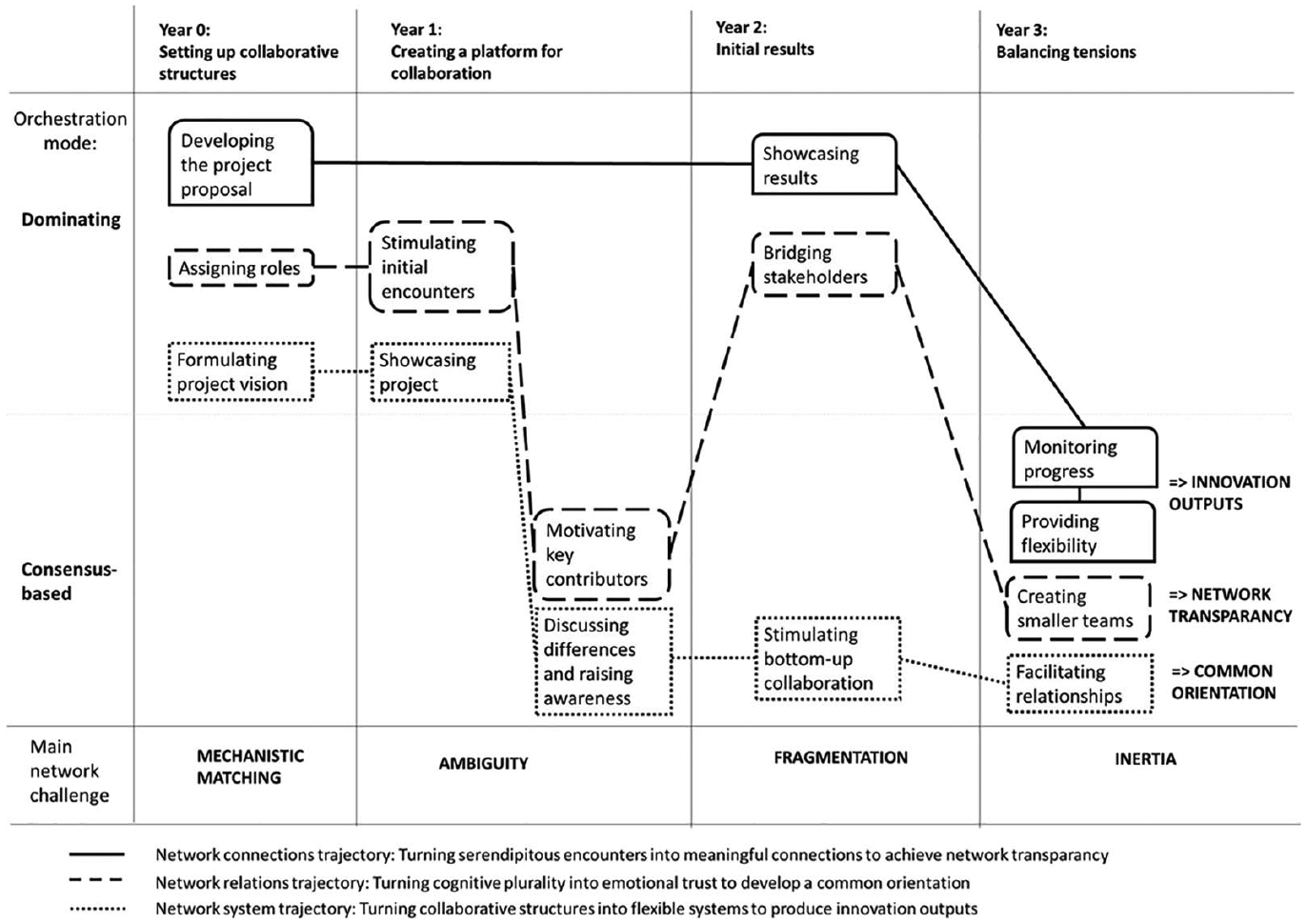
A process map of network trajectories in multi-stakeholder networks.
As we mapped the various orchestration practices over time, we observed how they fell within three categories: connecting, facilitating and governing practices. These practices, carried out by orchestrators over time, form the basis of distinct innovation trajectories, each driving the creation of unique network outcomes. In the process map, we also distinguish between orchestration practices that are dominating and consensus-based to visualize how orchestrators switch between orchestration modes within and across trajectories. In the following, we present a narrative of how the collaboration was set up and enacted by orchestrators at multiple levels of the collaboration (i.e. the work package, topic and entire project level).
Year 0: Setting up collaborative structures
Formulating the vision
EMIF was initiated by a pharmaceutical company that submitted a proposal to IMI. In the proposal, the initiating pharmaceutical company acted as a dominating orchestrator who spelled out the project vision and explained how it aligned with IMI’s objectives. Once the proposal gained support from IMI and other EFPIA members, the EFPIA members jointly drafted a topic text in collaboration with IMI. Next, a call was launched that invited groups of academics, SMEs and patient organizations to form a consortium and express their interest in participating in the project. Each consortium submitted a proposal that contained an overview of how they would approach the project if selected, including an outline of projected work packages and who would oversee them. During a first review round, EFPIA members and external experts assessed each proposal and selected the winning consortium. The winning consortium then jointly developed a full project proposal with the EFPIA partners.
Developing the project proposal
To develop the full project proposal, a group of key representatives from each public and private partner took a dominating role. They further developed the project vision and discussed work packages, deliverables, milestones, roles and responsibilities, based on the proposal submitted by the winning consortium. They divided the workload into three topics (EMIF-platform, EMIF-AD and EMIF-metabolic), which were further subdivided into 16 work packages.
Assigning roles
Next, the group of key representatives assigned partners to each of these work packages, still as dominating orchestrators. Most roles of non-EFPIA partners (research institutions, SMEs, patient organizations) were already assigned in the initial proposal, but EFPIA members still needed to determine which work packages they would be involved in. Each EFPIA member had agreed to commit a number of ‘full-time equivalents’ (FTEs) to the project, so company representatives now decided how to distribute these FTEs over the work packages. After the FTEs had been assigned to work packages, representatives sourced within their companies to find people to work on the project.
Orchestration roles were also allocated at this stage. Those who had a key role in the development of the project proposal were likely to take up an orchestration role, either on a work package, topic or entire project level. These roles also came by the position people held in their own organizations. Some were principal investigators in academic institutions or chief executive officers (CEOs) of an SME. As for EFPIA partners, mostly senior directors were expected to orchestrate the work packages. In hindsight, the allocation of participants to work packages and roles was perceived as a mechanistic matching process where representatives made sure that the number of FTEs that they promised to commit added up, rather than through a process of strategically matching the right roles to the right work packages.
During a second review round, external reviewers and IMI representatives evaluated the final proposal, after which the project was launched and the proposal could begin to be implemented.
Year 1: Creating a platform for collaboration
Showcasing the vision
When the project was launched, informants sensed ambiguity around the project goals, structures and participants. At this point, participants were assigned to one or more work packages, but they were often still unfamiliar with their specific role or the role of others. Although a core team of representatives who developed the project proposal had already interacted, many participants had never met before. Reflecting on this time, one mentioned: ‘In the beginning you notice that partners do not really know who is who and who knows what, they still need to find each other’ (SME4, interview 15).
In the first month, structures were set up so that participants could start interacting. Each topic first organized a separate ‘kick-off’ meeting where participants could meet. An online portal was also launched that allowed internal team members to communicate, disseminate information and store team documents. The first general assembly, a face-to-face meeting among all EMIF participants, took place in the second month.
The EFPIA project orchestrator opened and closed each of these meetings to showcase the project vision, present a high-level overview of the project and set the stage for further discussions. Then, the topic and work package orchestrators presented a more detailed outline of the project aims and expectations. In these sessions, orchestrators were the primary communicators of the project proposal. They took a dominant position as they brought the formal structures – the written work plan, the online portal, the vision – to life. Participants saw them as ‘the sustainable owner of EMIF’s mission’ (EFPIA2, interview 1). With these practices, orchestrators aspired to achieve a shared understanding of the collaborative environment: ‘clarity of the vision is what we want to achieve, especially in such an environment, diverse in so many ways, in geography, culture and so on’ (EFPIA3, interview 5).
Stimulating initial encounters
Between the plenary sessions, orchestrators stimulated initial encounters between participants. They used dominating orchestration to create platforms where stakeholders could meet. They set up break-out sessions where participants worked in smaller groups to define the steps to undertake in the coming months. The goal of these break-out sessions was for participants to get to know the members in their work package and familiarize themselves with their tasks and deliverables. After the formal sessions, plenary dinners were organized so that participants could get to know each other in an informal way.
Motivating key contributors
After the kick-off meetings, participants started to enact the project proposal. This 324-page document was referred to as ‘the description of work’, which laid out the project plan and contained a description of each of the 16 work packages and their milestones and deliverables. In the first six months, the initial project proposal was further developed, resulting in detailed project and risk plans. Although such formal governance mechanisms are often viewed as imperfect instruments for value creation (Bridoux & Stoelhorst, 2016, p. 236; Dyer & Singh, 1998), informants agreed that these systems offered a much-needed structured framework that facilitated collaboration. As one mentioned, ‘the fact that we are in a work package and have certain tasks and deliverables assigned, and that this is written down, it helps to collaborate’ (EFPIA2, interview 7). In the eyes of informants, these systems helped reduce the ambiguity surrounding the project: ‘there is less uncertainty because the description of work is so carefully laid out’ (Research4, interview 40).
To carry out the work, orchestrators could not use dominating orchestration; that is, they could not unilaterally assign work and rely on formal authority to ensure its delivery. Instead, they were dependent on participants to take the initiative, as one remarked: ‘there is no formal reporting structure like on a job, where you’re allocating tasks, basically things work on a volunteer basis’ (EFPIA2, interview 26). Consequently, orchestrators used consensus-based orchestration to motivate key contributors to take up an active role in the collaboration. Unlike a year ago when participants were assigned to work packages in a mechanistic way, orchestrators now observed participants’ interests, skills and resources and strategically matched them with the work that needed to be done. This way, they steered the project and participants in the desired direction: ‘you find the people who are willing to do the work, who are interested in the project, and have the resources to do it, and then you try to match the work with their interests and resources to move forward’ (EFPIA2, interview 26).
Project managers supported orchestrators in enacting the project proposal. They provided administrative and organizational support, but they also managed relations between stakeholders. Project managers were seen as a neutral party that ensured inclusion of stakeholders and handled conflicts: ‘They are really focused on making sure that all partners are involved, that everybody gets the opportunity to collaborate, that everything is clearly divided and that rules are followed’ (EFPIA2, interview 7).
Discussing differences and raising awareness
While Dyer and Singh (1998) theorized that partners need organizational complementarity in systems and cultures to facilitate value creation, we observed that in a diverse multi-stakeholder network such as EMIF complementarity was initially non-existent. Instead, a common platform for collaboration still had to be created and took a long time to develop, contributing to the ambiguity noted in year 1. Many informants echoed this view. ‘In the beginning it was like you were talking to a blind wall’, one participant stated as he reflected on the difficulty of entering a multi-stakeholder collaboration, ‘and the cause of it was that on the one hand you were caught up in your own world, and on the other hand you didn’t appreciate or were unable to assess what something meant to someone else’ (Research6, interview 10).
To create a common platform for collaboration, orchestrators used consensus-based orchestration; they organized workshops where participants could discuss differences in working styles and languages: ‘We are organizing a workshop so that each organization can explain which procedure they use, without judging, [. . .] but to make sure that everybody understands the extremes in which we are working’ (EFPIA1, interview 19). They also made participants aware of differences between stakeholders. For example, one mentioned how orchestrators ‘take people on the side for a second and tell them “look at it from this perspective” and “also think about this”’ (SME4, interview 15).
Year 2: Initial results
A year after the project started, informants reported how they started to act and think in terms of the collaboration rather than in terms of their own organization. ‘I work for company X, but EMIF is not a project by company X’, one mentioned, and spoke of an identify shift: ‘so if I talk to partners, I no longer speak in the name of my company, but I speak for EMIF instead’ (EFPIA2, interview 9). At the same time, there was fragmentation among stakeholders. Informants sensed a disconnect between the overall mission and how it was translated in different parts of the project: ‘We lack a truly common goal, we have one that is formalized, a utopian one that everyone can agree on, but it lacks substance and further translation into concrete actions’, one observed, concluding that ‘so there is not really one team in EMIF, there are different teams who are doing their own thing’ (EFPIA2, interview 2). The different organizational cultures of stakeholders complicated the development of a common mission. In their interactions with other stakeholders, informants noticed different working procedures and ways of thinking. As a representative from a pharmaceutical company said, ‘we are interested in implementing a solution. I have the impression that in academia, thinking about solutions, sometimes in a semi-esoteric way, is more important than actually implementing them’ (EFPIA2, interview 2). Likewise, an academic researcher mentioned: ‘I think there are big differences between academia and industry, mostly in terms of ways of working, and that really took time for me to get used to’ (Research5, interview 18).
In the eyes of informants, the collaboration also still had a high level of network opacity. So, even a year after the project started, many participants still did not know each other: ‘I can tell you that I haven’t met everybody yet. More and more new faces every time’ (PO, interview 27). Another stated: ‘Sometimes someone calls in during teleconferences and then I wonder, where do these people come from and who are they?’ (Research5, interview 18).
Bridging stakeholders
Between face-to-face meetings, communication mostly took place among members of the same work package, often through voice-to-voice (teleconferences, phone calls) or bit-to-bit (email, team website). One informant illustrated the difficulty of this approach: ‘We are working mostly by telecommunications, at a distance, in different time zones, with people whom we might not know as well’ (EFPIA5, interview 6). Face-to-face meetings were considered most effective: ‘The progress we make during face-to-face workshops is enormous, it determines the rhythm of the project. It is really where you start discussing and determine a course of action’ (EFPIA1, interview 19). However, they only took place once or twice per year because of the logistical challenges of meeting with over 300 participants from different countries.
Aware of the value of face-to-face meetings, orchestrators acted as dominating orchestrators: they organized meetings strategically to maximize the opportunities for stakeholders to interact across work packages and topics. One co-orchestrator mentioned how she planned a meeting so that partners from different topics would be able to attend: ‘I made sure that the metabolic meeting was in the same week as the platform meeting so people could go to both’, and she observed how that meeting created a platform for future interactions: ‘During that meeting we came to an understanding, ever since we have set up a call every two months to continue those interactions’ (EFPIA3, interview 4). Adopting the terminology of Paquin and Howard-Grenville (2013), orchestrators’ role expanded from encouraging ‘blind dates’ by initiating spontaneous encounters, to setting up ‘arranged marriages’ by actively liaising between partners who had to know each other.
Empowering bottom-up collaboration
Compared to the kick-off meetings, orchestrators no longer took a strictly dominant role. They realized the difficulty of bringing stakeholders together around a common goal from the top down, due to the plurality of stakeholders: ‘Top-down coordination is probably a fantasy, coordination in a smaller project is making sure that A and B and C work, but when you got A to Z and 1 to 40, that is probably not possible’ (Research4, interview 11). As such, they tried to align partners to the best of their ability: ‘it is just a matter of understanding the different contexts and trying to get them aligned as much as possible’ (SME1, interview 22). Although strong hub firms can use their reputation or authority to bind partners together (Dhanaraj & Parkhe, 2006), here orchestrators empowered bottom-up collaboration, for example, by enthusing participants: ‘sometimes you have to empower the bottom up by asking questions, by bringing people together by being enthusiastic’ (Research4, interview 11).
Showcasing results
The collaboration started to benefit from a growing amount of shared data and knowledge, as the participant-specific expertise was turning into a shared expertise: ‘Because there are so many of us who are experts in different aspects [. . .], we see that there are things that we can answer together that perhaps we couldn’t address as well individually’ (EFPIA5, interview 35). Partners were developing what Dyer and Singh (1998) refer to as ‘partner-specific absorptive capacity’; that is, they were increasingly aware not just of who is who, but also of who knows what. This knowledge allowed partners to identify new opportunities for value creation, beyond what was specified in the description of work.
As the collaboration started producing initial results, orchestrators relied on dominating orchestration to showcase these results that were achieved by all partners. In their eyes, this helped create an atmosphere in which participants realized that the entire project was successful due to the joint effort of all organizations involved: ‘We have to show results, [. . .] and that it is everybody’s efforts together that make the result possible’ (PO1, interview 27). The results were also shared among participants through newsletters that were issued four times per year, starting in the second year.
Because of these efforts, trust started to develop among participants. ‘You notice that trust is being built, in the beginning everybody is new, and a lot of people didn’t know what to do, but now people are starting to find each other a lot faster’ (SME4, interview 15). They respected each other’s competences and expertise: ‘We have people within the project who are truly experts in their field’, one informant noted (EFPIA5, interview 6).
Year 3: Balancing tensions
At the end of the second year, an ‘EMIF week’ had taken place. During this week, participants had the opportunity to interact with others across work packages and topics for the first time since the first general assembly in year 1. After these meetings, informants sensed a growing understanding of each other’s backgrounds: ‘there is more appreciation between the different research disciplines and we better understand the different worlds in which other partners are working’, a researcher said (Research6, interview 36). They also noted how network opacity started to decrease: ‘As we have spent more time on phone calls and meeting in person, working together has become a little bit more efficient and we are getting to know each other more’ (EFPIA4, interview 32). At the same time, informants noted how there was inertia, because of the number of people involved: ‘Often there is a dozen or more people on a phone call from companies and academics, so it is very slow to get anything done’ (EFPIA4, interview 32).
Developing emotional trust
Although informants noted that trust had developed, this trust mostly referred to cognitive trust – respect for other partners’ competences and expertise: ‘Trust has been developed, we still do our own thing, but there is respect when we see each other at meetings or workshops’ (EFPIA2, interview 36). Such cognitive trust does not equate to emotional trust – trust in stakeholders’ goodwill. This distinction became apparent when informants expressed suspicion as to whether partners would be willing to share data: ‘Sometimes there is a bit of a mistrust between pharma and academia for example, one of the big issues in EMIF is if the different data sources are willing to share data and that is a big challenge’ (EFPIA3, interview 34). Further relational challenges arose due to the lack of participation of some partners: ‘We currently have a list of 25 or 30 people in our work package, but maybe 15 people participate actively and the others I almost never hear from’, one informant illustrated, ‘[so] it is not good for team morale and it is not good for dividing tasks, when people who are supposed to be participating almost never do’ (EFPIA5, interview 35). This lack of collaboration by some partners slowed down the project.
Orchestrators realized that they had to rely on trust to facilitate relations between participants in the absence of formal mechanisms: ‘One of the most important things in public-private collaborations is trust building’, one informant explained, ‘you do not get anything from another partner through the usual channels, because we do not have any line management reporting relationships’ (EFPIA6, interview 23). Orchestrators used consensus-based orchestration to facilitate good relations between stakeholders by creating a collaborative environment in which trust could develop. Orchestrators referred to their role as ‘a lot of influence in the background, a lot of communicating with people, getting them on board, and explaining the project’ (EFPIA3, interview 4).
Creating smaller teams
To overcome inertia, informants referred to creating smaller groups of people. To benefit from smaller groups, orchestrators relied on consensus-based orchestration: they gathered input from task forces that pooled experts across the collaboration to work on specific topics. These task forces were seen as a valuable way to make progress: ‘The imaging task force, I think is working smoothly; we have a good group of people calling in to each of the meetings, we have a mixture of people from industry and university so that is working nicely’ (EFPIA5, interview 35). Others also saw the promise of smaller groups to ensure progress: ‘setting up small groups to advance projects, I think that would be a really critical factor to making more progress’ (EFPIA4, interview 32).
Monitoring progress
In the third year of the project, participants had to submit a review to IMI. Leading up to the review, orchestrators monitored the collaboration’s progress. Rather than setting the agenda as dominating orchestrators, orchestrators made sure that the deliverables and milestones were enacted as agreed upon in the project proposal. To do so, they relied on consensus-based orchestration. Orchestrators mentioned how they reminded participants of deadlines: ‘If a milestone is coming up, then you need to check in advance if we are heading in the right way’ (EFPIA2, interview 1). They also monitored whether partners lived up to the agreements: ‘The leadership team has a monstrous responsibility to make sure that the work packages are proceeding, and they are ultimately responsible to IMI and they must give reports and show that we produced results’ (PO1, interview 27). And they participated in several governance bodies to discuss the progress of the collaboration: ‘The programme board has meetings every month, to ensure that the topic leads have an update on how the other topics are going and then specific actions can be taken if needed’ (SME1, interview 22).
When there was disagreement about how to achieve deliverables, orchestrators sought consensus, rather than determined the outcome. Comparing EMIF with another multi-stakeholder project, one noted that ‘in another project we also worked with different stakeholders, but in the end we determined the outcome [as the lead firm], while in EMIF we really are partners, so I can’t push my opinion, we always have to find consensus’ (EFPIA2, interview 38).
Providing flexibility
As the collaboration progressed, informants sensed a lack of flexibility to divert from the initial project proposal: ‘We had to develop a project proposal for five years, without having a clue of what we were going to do, so there should be a mechanism to re-plan and allocate funding differently’ (EFPIA2, interview 31). Whereas the network systems supported collaborative advantage in the first year, it now contributed to the collaborative inertia. In the first year, the project proposal supported the coordination of the project because it reduced the ambiguity surrounding the project goals and members. In the third year, the project proposal created inertia, while participants needed flexibility. Orchestrators used consensus-based orchestration to provide such flexibility despite the pre-assigned deliverables: ‘we have to both make sure that the project specific goals are delivered on, while also not wanting to crush, wherever we can, innovative ideas’ (Research4, interview 11).
Discussion: Hybrid Orchestration
Based on our analysis of how network orchestrators mobilize multiple, diverse stakeholders over time, we develop a process map of hybrid orchestration in multi-stakeholder networks. The map consists of dynamic interactions among orchestration practices and network challenges that network orchestrators need to carefully balance (Figure 1). As we grouped orchestration practices in three categories (connecting, facilitating and governing) and mapped them over time, three innovation trajectories emerged. The practices mirror those observed in prior studies (Crosby & Bryson, 2010; Huxham & Vangen, 2000; Kazadi et al., 2016), but to these we add temporal dynamics, that is, we observed how practices varied across the phases, as the network evolved over time, adding to a process theory of network orchestration (Paquin & Howard-Grenville, 2013). In each trajectory, we observed how orchestrators switched between dominant and consensus-based modes to achieve distinct network outcomes.
By offering a process map, we integrate and add to existing evidence on the challenges of collaborating with multiple, diverse stakeholders (Amabile et al., 2001; Browning et al., 1995; Das & Teng, 2002; Davis, 2016; Dhanaraj & Parkhe, 2006; Mitev & Venters, 2009). We thereby contribute to the development of a stakeholder theory ‘of the network’ by underscoring the plurality of ways stakeholders work together to achieve collaborative outcomes. We propose that hybrid orchestration, i.e. blending dominating and consensus-based orchestration, helps orchestrators sustain collaboration between multiple, diverse stakeholders. In the following, we highlight two ways in which such hybrid orchestration unfolds in complex multi-stakeholder systems – temporal and simultaneous hybrid orchestration. Next, we elaborate on what may trigger orchestrators to switch between modes. Finally, we discuss implications for other types of networks with different stakeholder compositions in terms of their number and diversity.
Temporal hybrid orchestration: Orchestrators switch between orchestration modes over time within innovation trajectories
By identifying innovation trajectories, we answered the call of Ahuja et al.’s (2012, p. 433) call for understanding ‘the main evolutionary trajectories of network evolution’ and ‘the forces operating behind them’. We identified three trajectories and found that the forces behind them are orchestrators who balance dominating and consensus-based orchestration modes over time. As such, orchestrators play a fundamental role in tying together key network constructs in practice – through their connecting, facilitating and governing practices, they influence the network structure, content and governance.
In the network connections trajectory, orchestrators used connecting practices; they created and made the connections between stakeholders visible. To create the initial connections, orchestrators first relied on dominating orchestration: they assigned participants to work packages and initiated encounters during the first face-to-face meetings. When initial connections were made and participants started carrying out the project proposal, orchestrators switched to consensus-based orchestration, because they lacked the formal authority to unilaterally divide the work. So, rather than assigning work to participants, orchestrators collaboratively discussed the tasks and motivated key contributors to take up an active role. When initial results were produced, orchestrators turned to dominating orchestration to have the reach to make these results visible and to connect stakeholders around opportunities to collaborate further. Finally, when the network opacity started to decrease, orchestrators switched back to consensus-based orchestration to ensure progress. They now relied on smaller, emergent teams that sourced experts across the collaboration to work on specific problems. In sum, over time, orchestrators worked to turn initially serendipitous encounters into meaningful connections. In so doing, they attempted to achieve network transparency.
In the network relations trajectory, orchestrators relied on facilitating practices to ensure harmony between stakeholders. Initially, leaders used dominating orchestration to ensure stakeholders had common cognitive representations of the project; leaders first formulated and then showcased the project vision at meetings. As the collaboration evolved, orchestrators focused more on the emotional rather than cognitive side of the collaboration. To do so, they switched to consensus-based orchestration, that is, they discussed and raised awareness of the differences between stakeholders. After two years, cognitive trust had developed, but emotional trust remained weak. To support the development of both types of trust, orchestrators then enthused participants to stimulate bottom-up collaboration and facilitated good relationships between them. In sum, in the network relations trajectory, orchestrators aimed to turn the initial cognitive plurality into emotional trust. In so doing, they sought to achieve a common orientation among stakeholders.
In the network systems trajectory, orchestrators used governing practices to create an effective network system. As dominating orchestrators, they first set up collaborative structures and defined milestones and deliverables, resulting in a project proposal. Once the network participants started enacting the project proposal, orchestrators used dominating orchestration to showcase the results that were being produced. When deadlines for deliverables were coming up, orchestrators switched to consensus-based leadership, in absence of formal control over participants; they monitored progress and provided flexibility to deviate from predefined project goals. In sum, over time, orchestrators aspired to turn the predefined collaborative structures into flexible systems to support the creation of innovation outputs.
Simultaneous hybrid orchestration: Orchestrators simultaneously rely on both orchestration modes across trajectories
By simultaneously relying on dominating and consensus-based orchestration across trajectories, orchestrators were able to address specific network challenges that arise as the collaboration progressed over time. In the first year, orchestrators blended orchestration modes to reduce the ambiguity surrounding the project structures, goals, and participants, as they created a platform for collaboration. As dominating orchestrators, they stimulated encounters between participants and explained the project’s structures and goals. At the same time, they relied on consensus-based orchestration to match participants and their interests with the work that needed to be done and to raise awareness about differences between stakeholders. In the second year, orchestrators mixed orchestration modes to prevent fragmentation among stakeholders as the initial results were produced. They relied on consensus-based orchestration to stimulate bottom-up collaboration among stakeholders. At the same time, they used dominating orchestration to actively connect stakeholders around new collaborative opportunities. To align collaborative efforts, they kept stakeholders in the loop of the results that were produced, as dominating orchestrators.
Interestingly, the collaboration started with full dominating orchestration (year 0) and evolved to complete consensus-based orchestration (year 3). This may be a natural tendency in collaborative situations: a lack of personal relationships in the beginning is compensated by the reliance on formal structures (Ring & Van de Ven, 1994). Over time, as ambiguity decreases and relationships form, the reliance on formal structures decreases. However, our findings suggest that an overreliance on one orchestration mode may have been counterproductive in our specific case. Indeed, an overreliance on dominating orchestration before the project started may have resulted in mechanistic matching of participants to collaboration structures. Likewise, an overreliance on consensus-based leadership as the collaboration progressed may have contributed to inertia. We therefore suggest that in complex multi-stakeholder systems, simultaneous hybrid orchestration may be required throughout the collaboration.
What triggers orchestrators to switch between modes over time?
By shifting between orchestration modes, orchestrators alter how they influence and reach network participants to achieve network objectives. As dominating orchestrators, they take a visible position and act as visionaries who develop and convey project goals and actively connect stakeholders. As consensus-based orchestrators, they create a productive, flexible environment where trust and bottom-up collaboration can develop.
We observed a fine line between orchestrators using these modes to steer versus respond to the collaborative dynamics. Sometimes, orchestrators directly intervene in the collaborative dynamics by means of their practices, thereby actively shaping the innovation trajectories, for example, when they use dominating orchestration to develop the project proposal and to showcase the project and its results. Often, however, the innovation trajectories emerge as the result of orchestrators’ responses to observed or anticipated challenges. This occurred, for instance, when orchestrators switched to consensus-based orchestration in the network relations trajectory because they perceived a lack of emotional trust among participants. Likewise, in the network systems trajectory, orchestrators switched to consensus-based orchestration because they perceived a lack of formal control to steer participants. Finally, in the network connections trajectory, orchestrators switched to dominating orchestration because some stakeholders were not yet connected due to high network opacity. We therefore suggest that network orchestrators act as environmental scanners who track collaborative dynamics and intervene to address emerging challenges by altering between orchestration modes.
A toolbox of practices for network orchestrators
To summarize, we propose that a hybrid form of network orchestration can support orchestrators in dealing with network challenges in multi-stakeholder networks. However, other than the network we studied, various other network types exist that vary in their number and diversity of stakeholders, such as business ecosystems (Adner & Kapoor, 2010), multi-party alliances (García-Canal et al., 2003) and cross-sector partnerships (Levén et al., 2014). Our findings can inform the growing literature in each of these streams by highlighting which types of practices are likely to support collaboration in these networks, depending on the distinct challenges that arise. In Table 2, we present a toolbox of practices for orchestrators depending on the idiosyncratic challenges in their respective networks. As mentioned, we propose that orchestrators scan the collaborative environment for these challenges and use dominating and/or consensus-based orchestration to address them.
How dominating and consensus-based orchestration help orchestrators address distinct network challenges brought by the number and diversity of stakeholders.
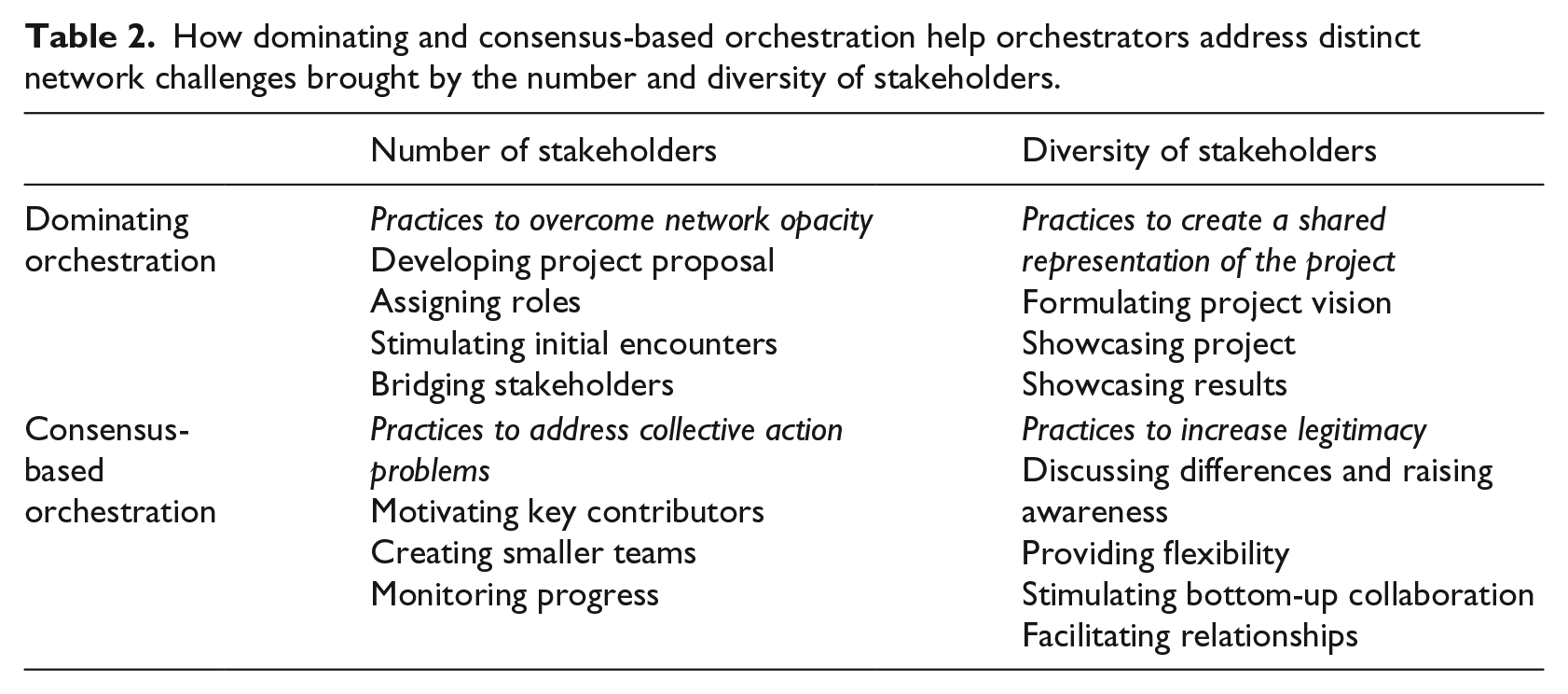
To manage the challenges that arise because of the number of stakeholders involved, we propose that orchestrators can blend dominating and consensus-based orchestration. Dominating orchestration can help overcome the network opacity. Specifically, orchestrators can use dominating orchestration to structure relationships between partners (Kazadi et al., 2016; Levén et al., 2014) by dividing the workload and assigning participants to work packages. As dominating orchestrators, they can also encourage spontaneous encounters and actively liaise between partners (Paquin & Howard-Grenville, 2013) to further reduce network opacity. Although dominating orchestration helps overcome opacity, orchestrators can rely on consensus-based leadership to address collective action problems, such as freeriding and collaborative inertia, brought by the number of stakeholders. In particular, in the absence of formal control, they can create emergent, smaller teams (Crosby & Bryson, 2010) by identifying key contributors and sourcing experts from inside and outside the collaboration. They can also seek consensus over how to achieve outcomes (Gray, 1989) and monitor progress by reminding participants of milestones and deadlines.
To harness the diversity of stakeholders, we propose that orchestrators also mix dominating with consensus-based leadership. They can adopt dominating orchestration to create a shared representation of the project: they formulate the project vision and communicate the project and its results to the participants (Aarikka-Stenroos et al., 2017; Levén et al., 2014). At the same time, they can adopt consensus-based orchestration to ensure that partners view the project and each other as legitimate. Specifically, they can stimulate bottom-up collaboration and provide flexibility to deviate from the predefined project goals (Crosby & Bryson, 2010). Orchestrators can also facilitate relations between stakeholders and actively discuss and raise awareness of the differences between them (Huxham & Vangen, 2000).
Implications for network research
The literature commonly views dominating orchestration as an effective mode in networks with a large number of stakeholders (García-Canal et al., 2003) and recommends consensus-based orchestration in networks with a high diversity of stakeholders (Sloan & Oliver, 2013). Here, we adopt a more granular view: we suggest that the effectiveness of orchestration modes likely depends on which network challenge(s) arise. As a result, even in networks with a high number of similar stakeholders, both dominating and consensus-based orchestration may be required to overcome potential problems of network opacity and collective action problems respectively. Likewise, in networks with a smaller number of highly diverse stakeholders, a mix of dominating and consensus-based orchestration may be required to create a shared representation and increase legitimacy.
We therefore advise against ‘binary, normative thinking’ that is sometimes adopted in the literature on network management, for example, in trying to understand whether formal or relational management tools are more effective. Although the narrative is increasingly shifting to the importance of consensus-based, relational mechanisms, we suggest that the role of dominating, formal tools should not be overlooked, following Oliveira and Lumineau (2017). In dyads or smaller networks, the two are often seen as alternative ways of management (Dyer & Singh, 1998; García-Canal et al., 2003). In our study, one mechanism was not emphasized over the other, but both served co-existing needs to address distinct network challenges during all phases of the collaboration. We therefore support calls to take the complexities of inter-organizational networks into account in order to uncover the subtleties of how to manage these relationships, rather than treat them as universalistic (Lumineau & Oliveira, 2018; Majchrzak et al., 2015).
Managerial implications
With this research we offer a process map and a toolbox of practices that can support orchestrators in various types of networks. We identified three categories of practices that orchestrators can draw on to support collaborative innovation between multiple, diverse stakeholders. Orchestrators are advised to use a hybrid form of network orchestration, switching between dominating and consensus-based modes as the collaboration evolves over time and distinct challenges emerge. Orchestrators need the right capabilities to deal with the uncertainty, novelty and complexity that hybrid orchestration entails. Given orchestrators’ role in sustaining collaborative innovation in multi-stakeholder networks, we advise organizations and educators to train and nurture these capabilities.
We also identified the key collaborative structures and network challenges that respectively support and hinder the collaboration over time. Insights into these mechanisms can provide guidance to orchestrators and network members by helping them navigate in the collaboration and develop a better understanding of their role in the network. These insights can also support policy makers in their aim of creating optimal conditions for public and private organizations to collaborate. For example, since these collaborations require both flexibility and structure, we suggest that procedures are in place that enable such flexibility on top of the pre-existing network structure.
Limitations and suggestions for future research
Our study is based on a single case study and therefore the generalizability of our findings may be limited. To validate and expand on our findings, we highlight three areas for future research. First, future research is required into whether and how hybrid orchestration occurs in different network models. We suggest that our findings can act as a toolbox of practices that orchestrators can apply in different networks, depending on the unique challenges that arise. Future research can explicitly compare hybrid orchestration in networks with a large number, but low diversity of stakeholders (e.g. multi-university research projects) and vice versa (e.g. smaller interdisciplinary project teams) to highlight which orchestration practices gain importance. Another avenue for future research would be to explicitly contrast the consortium model with shared leadership (as adopted in our study) and the hub model with a dedicated lead firm (as discussed in previous research).
Second, further insights are required into the nature of orchestration trajectories. For example, we observed how orchestrators in our case study use orchestration practices largely in a reactive way, in response to various network challenges. Under what circumstances are these practices proactive? Moreover, it is important to note that the trajectories we identified are tangled and do not come in neat, separate packages, but are likely to influence each other. For example, as leaders are bridging stakeholders, they are likely to facilitate relations at the same time. Thus, the trajectories may be mutually enabling. Future research can spell out these interrelationships.
Finally, given the complex nature of these networks, we emphasize the role of orchestrators’ skills and capabilities. We position orchestrators as environmental scanners that respond to network challenges by balancing orchestration modes simultaneously and temporally. These activities require specific skills that should be examined in greater detail. Future research can draw on ambidexterity theory to understand how orchestrators balance between orchestration modes over time.
Supplemental Material
online_appendices – Supplemental material for Hybrid Orchestration in Multi-stakeholder Innovation Networks: Practices of mobilizing multiple, diverse stakeholders across organizational boundaries
Supplemental material, online_appendices for Hybrid Orchestration in Multi-stakeholder Innovation Networks: Practices of mobilizing multiple, diverse stakeholders across organizational boundaries by Vera Blazevic, Charlotte Reypens and Annouk Lievens in Organization Studies
Footnotes
Acknowledgements
The authors thank the editors and reviewers for their valuable suggestions and feedback. We are grateful to Bart Vannieuwenhuyse and Caroline Sage for their kind support and input in this research over the years. The authors also thank the interviewees for their time and willingness to share their insights.
Funding
The author(s) disclosed receipt of the following financial support for the research, authorship, and/or publication of this article: We received funding from Research Foundation Flanders (FWO) and from an Advanced Research Grant from the European Research Council, grant agreement no. 695256.
Supplemental material
Supplemental material for this article is available online.
Author biographies
References
Supplementary Material
Please find the following supplemental material available below.
For Open Access articles published under a Creative Commons License, all supplemental material carries the same license as the article it is associated with.
For non-Open Access articles published, all supplemental material carries a non-exclusive license, and permission requests for re-use of supplemental material or any part of supplemental material shall be sent directly to the copyright owner as specified in the copyright notice associated with the article.
