




Abstract
This paper draws on a longitudinal, qualitative study to develop an empirically grounded model of strategic change as a future-making process. We provide an alternative to linear models of strategic change and illustrate how, through iterative future-making cycles, an abstract vision for the future transforms into action. Our study exposes how shifts in the locus of situated actions and movement of people and ideas between organizational spaces widen participation and transform an imagined future into the everyday ways of working across an organization. We highlight the inclusionary affordances of bounded spaces as sites for interactions where movement of ideas and participants designing a desired future ‘give form’ and ‘make’ the future in the present.
Time and again, leaders share a ‘vision’ or ‘future image’ of an organization when embarking on strategic change (Gioia & Chittipeddi, 1991; Venus, Stam, & van Knippenberg, 2019). Visions, however, are imaginary depictions of the future and it is not clear how organizations transform these abstract ideals into tangible ways of working. Research has long questioned the assumption that futures can be brought into existence through a phase of blueprint design followed by adaptation (e.g. Balogun & Johnson, 2004). Even when plans and outcomes align with initial visions, strategic change processes are emergent and dynamic with unanticipated outcomes, breakdowns, reversals and redesigns (e.g. Jarzabkowski, Lê, & Balogun, 2019). In their recent model, Weiser, Jarzabkowski and Laamanen (2020) capture the dynamic relationship between plans and outcomes but do not account for how visions transform into ways of working.
Future making, defined as ‘the work of making sense of possible and probable futures, and evaluating, negotiating and giving form to preferred ones’ (Whyte, Comi, & Mosca, 2022, p. 2), emphasizes that situated actions in the present make the future (Comi & Whyte, 2018; Wenzel, Krämer, Koch, & Reckwitz, 2020). A growing body of work reveals how desired futures are envisioned (Augustine, Soderstrom, Milner, & Weber, 2019; Thompson & Byrne, 2022; Whyte et al., 2022), and how within an abstract vision, future-making practices give form to ‘realizable courses of action’ (Comi & Whyte, 2018, p. 1055). There is, however, little empirical evidence outlining how, in circumstances of strategic change, a vision for a desired future is transformed into ways of working.
The challenge is twofold. On the one hand, our current models of strategic change do not explicitly embrace the perspective that actions in the present shape the future (cf. Tsoukas & Chia, 2002). On the other hand, research adopting a future-making perspective of strategic change contend that managers with ‘declarative powers’ must intervene to create new models of ‘talking and acting’ (Tsoukas & Chia, 2002, p. 579). Change agents are not always senior managers (e.g. Balogun, Bartunek, & Do, 2015) and, indeed, adapting ways of working requires a much wider involvement (Balogun & Johnson, 2005). Our study addresses these challenges by examining the following question: How does future making facilitate the transformation of visions into actions?
We explored our question through a real time, 20-month qualitative case study of a general manager (GM)-initiated strategic change process at Brandco Greece, a subsidiary of a fast-moving consumer goods (FMCG) multinational. In the early stages of the process, prior to any specific blueprint for change (detailed plan) being developed, we observed participants transforming their ways of working consistent with abstract ideas presented by the GM. Given that our observation diverged from existing research, we adopted a future-making perspective to uncover how participants were embedding an abstract vision for the future into ways of working so early in the process.
Our study illustrates how, in the absence of a formal plan, future-making cycles enable the transformation of a set of abstract ideas (vision) into actionable ways of working to deliver change. As the change process unfolds, interactions among employees involved in designing a future increasingly widen to include more participants, embedding an imagined future into ways of working across the organization. We develop a process model that accounts for how ongoing and iterative cycles of future making that involve two intertwined types of activities – imagining and adapting – transform abstract ideas into actions. In our model, ‘spaces’, or ‘bounded social settings in which interactions among actors are organized in distinctive ways’ (Bucher & Langley, 2016, p. 595; Kellogg, 2009), enable widening participation in the strategic change process by shifting the locus of activity from senior and middle manager workshop spaces to department and project spaces. In this way the shift in location and ongoing iteration of future-making cycles facilitates the embedding of a vision into actions.
Our model contributes to research on future making which has, to date, largely focused on how futures are imagined (e.g. Alimadadi, Davies, & Tell, 2022; Augustine et al., 2019; Thompson & Byrne, 2022). Our empirically derived model supports those arguing for future making as a process of ongoing inquiry (Wenzel et al., 2020; Whyte et al., 2022) and shows how, through future-making cycles, imaginings of a desired future are embedded into ways of working to deliver change.
Strategic Change and Future Making
Strategic change
Strategic change is a deliberate process of setting future organizational goals and priorities, typically at a point in time when an organization requires a significant adaptation to ways of working to remain competitive (Balogun et al., 2015; Gioia, Thomas, Clark, & Chittipeddi, 1994; Mantere, Schildt, & Sillince, 2012; Weiser et al., 2020). Process models of strategic change begin with creating a vision for the desired future (Gioia & Chittipeddi, 1991; Gioia et al., 1994; Spee & Jarzabkowski, 2011, 2017), followed by a plan to implement it (e.g. Floyd & Lane, 2000). There is substantial empirical evidence, however, that organizational members construct alternative meanings of visions and plans leading to divergence while adapting ways of working (Balogun & Johnson, 2004, 2005; Bartunek, Rousseau, Rudolph, & DePalma, 2006; Mantere et al., 2012).
This is not to say that visions cannot eventually lead to required changes in ways of working. Jarzabkowski et al. (2019) explore a mandated strategic change that leads to a future consistent with requirements. The process begins with a plan to deliver the vision. However, Jarzabkowski et al. (2019) show that implementing the plan creates new interactions across the organization, but often in ways that lead to breakdowns in what the envisioned change needs to achieve, requiring resolution and redesign. Their process model captures how, through resolution of breakdowns, sets of reformed interactions make the future. Their findings illustrate how design emerges from interactions, some of which occur at a very micro level, and the need for the development of interactions through quasi-experimentation. These findings, however, raise questions as to how abstract visions transform into actions in the absence of plans and breakdowns while implementing.
Building on such findings, in a recent review, Weiser et al. (2020) integrate strategic change research into a process model that accounts for change as a ‘flow of experience over time’ (p. 993). Their model brings much-needed attention to the interactional nature of strategic change as identified by Jarzabkowski et al. (2019) and others who study change outcomes (e.g. Balogun & Johnson, 2005), by drawing attention to the way interactions between organizational members ‘make’ the future. Weiser et al. (2020) are drawing closer to an alternative conception of change in which organizations are continuously changing in an ongoing flow of ‘reweaving of actors’ webs of beliefs and habits of action as a result of new experiences obtained through interactions’ (Tsoukas & Chia, 2002, p. 570). Nevertheless, although their model contains feedback loops between adapting and planning to align outcomes, it continues to assume that adapting only begins after senior managers, in their role as change agents, begin implementing a plan.
Future making
In a departure from models of strategic change, a future-making perspective shifts the focus from the implementation of a plan to the emergence of futures through the situated actions of organizational members using tools at hand (Chia & Holt, 2006; Comi & Whyte, 2018; Tsoukas & Chia, 2002). Tools can include strategic plans (Beckert, 2021), abstract visions (Comi & Whyte, 2018) and beliefs (Lê, 2013). Organizational members use these tools as they act and interact (Wenzel et al., 2020; Whyte et al., 2022). A future-making perspective shares the emphasis with strategic change research on the need for guided actions. For example, Lê (2013) demonstrates how beliefs in whether or not the oil sands would be developed shaped organizational responses ranging from no response to lobbying to developing technology. Lê (2013) argues that beliefs about the future ‘create different strategic environments that necessitate divergent responses’ (p. 722). The question for strategic change, however, is what type of guidance is needed to incorporate abstract visions into the daily activities of organizational members.
In their recent theoretical article on the exploration process involved in developing novel strategies, Rindova and Martins (2021) offer some insight into this question by arguing that intention, defined as ‘a representation of how the world is to be as a result of my intervention, a representation which, if my intervention is successful, will be true’ (Bratman, 1981 as cited in Rindova & Martins, 2021, p. 807), enable envisioning alternatives by ‘connect [ing] preferred future states to unfolding courses of action’ (Rindova & Martins, 2021, p. 807). Abstract visions such as those shared in early stages of strategic change can be conceptualized broadly as ‘intentions’, but it is not clear how visions guide the activity change necessitated during strategic change.
Empirical work on future making focuses on how organizations imagine ambiguous and desirable futures (e.g. Alimadadi et al., 2022; Augustine et al., 2019; Thompson & Byrne, 2022); yet imagining is insufficient for bringing a desired future into being. In a notable exception, Comi and Whyte (2018) identify how, during a process of architectural redesign, participants used visual artefacts as tools at hand in four future-making practices – imagining, testing, stabilizing and reifying – while moving the redesign of Kew Gardens from an abstract vision into a realizable course of action reflected in the final design.
While the study of Comi and Whyte (2018) advances our understanding of how future-making practices shape action, it does not account for how future making shifts ways of working. Indeed, one of the substantial challenges encountered during strategic change is how visions for an imagined future, reified in settings such as strategy workshops, can recouple into an organization’s everyday activities (Hendry & Seidl, 2003; Johnson, Prashantham, Floyd, & Bourque, 2010). The detached and episodic nature of meetings and workshops enable envisioning by providing a dedicated space separate from daily tasks and responsibilities to create and hone a vision (Hendry & Seidl, 2003; Johnson et al., 2010), but their separation from daily activities and their liminal nature are also an obstacle to embedding imagined ideals into ways of working. Workshops can be characterized as spaces, with particular characteristics such as boundaries, distance and movement that allow organizational members to sense-make and experiment together in ways that do lead to change (Bucher & Langley, 2016; Holstein & Rantakari, 2023; Kellogg, 2009; Weinfurtner & Seidl, 2019). What is missing, however, is an understanding of how sensemaking and experimenting in particular spaces result in widescale shifts in ways of working across an entire organization.
We believe adopting a future-making perspective has potential to explain our observation that abstract ideas imagined in workshops are being embedded in ways of working, alongside designing a more formal plan. Current models of strategic change do not embrace the assumption that organizations are continuously moving towards their future. Nor does current literature bring together research on future making with what we know about the importance of organizational spaces for change-related experimentation in ways that explain how desirable futures become embedded in ways of working. Consequently, it is not clear how, during strategic change, visions transform into actions. Addressing this puzzle is the focus of our study.
Methods
Research setting
We use a single-site, longitudinal case study of strategic change at Brandco Greece, a sales and marketing subsidiary, over a 20-month period between February 2006 and October 2007. Our initial focus was on sense-giving and sensemaking processes, but this shifted to understanding future making more generally, based on our early observation of significant adaptations in ways of working. We used our in-depth access to track what was changing as well as the contextual dynamics and the participants’ points of view (Balogun & Johnson, 2004; Mantere et al., 2012; Nag, Corley, & Gioia, 2007). Prolonged field engagement, real-time data collection using multiple methods and creation of a thick description from the findings contributed to the trustworthiness of our data (Lincoln & Guba, 1985).
Brandco resulted from a merger in 2000. By 2005 the European region, which included Brandco Greece, was pursuing a strategy to integrate previously independent subsidiaries with heterogeneous modes of operating. Between 2003 and 2004, the new European president centralized previously autonomous subsidiary brand marketing and development functions. By the end of 2004, the president shifted focus to require country-based subsidiaries to adapt to the restructured model.
Brandco Greece did not proactively adopt the European changes and by 2005 it was underperforming compared with other subsidiaries and country-based competitors. The existing general manager (GM) retired and a new GM, who had once worked for Brandco Greece but more recently in one of the new European teams, was appointed. He was tasked with restoring performance and integrating Brandco Greece into the European organization. He concluded that meeting these goals required significant change to the autocratic, paternalistic, inward looking and ‘Greco-centric’ (focused on being Greek) culture at Brandco Greece.
Data collection
Our study is part of a larger study at Brandco where the third author had access to multiple European subsidiaries between 2005 and 2008, all of which were adapting to the new European model. The data for this study commences in 2006 when the new Greek GM approached the third author with a request to help change Brandco Greece. Independent of the third author’s involvement, the GM of Brandco Greece selected the Cultural Web framework (cf. Johnson, 1988) to guide the strategic change process. The Cultural Web is a diagnostic tool which can be used to develop a central paradigm to support a new strategy and identify what ways of working must change to support this new paradigm. The GM witnessed the successful building of a new post-merger organization using the Cultural Web framework, which was facilitated by the third author in Brandco UK. He wanted to try a similar approach in Brandco Greece.
The gap between data collection and analysis heightened our reflexivity. To deepen this, we adopted an insider–outsider approach similar to Gioia et al. (1994). The third author was an actor-observer during the first six months of the change process, helping the GM and his newly appointed human resources (HR) and organizational development (OD) directors with the process, but also building a database from which to develop her PhD. Her access was agreed at the outset with the GM and his senior team. The second author had a prior research relationship with the new Greek GM and supported access for the third author. Since the third author worked with the GM and his HR and OD directors in designing the change process in the early days, she was afforded privileged access, being present in all behind-the-scenes discussions and workshops, and also collecting data in interviews. The second author took the outsider role, challenging the third author during the research to ensure significant reflection. In particular, the second author visited the organization twice to conduct interviews with senior and middle managers, providing additional triangulation for the third author’s observations and findings. Finally, the first author provided an arm’s length perspective by joining the team after all data was collected.
We observed three change-related workshops: two senior manager off-site workshops (April and May 2006) and a middle manager (MM) off-site workshop (June 2006). The third author’s workshop role was limited to giving an introductory presentation (she was not involved in process or content decisions related to the workshops themselves) on the Cultural Web framework, leaving her free to observe and take field notes. Her role became that of a traditional researcher as change advanced beyond these workshops; she visited the organization only to observe and interview.
Data includes observation of workshops, interviews, focus groups, meeting observations, general site observations and archival documentation such as presentations, flipchart notes, workshop summaries, newsletters and planning documents. The third author made extensive field notes during site visits, meetings and workshops, including notes on pre- and post-workshop and meeting conversations with the GM and his appointed HR and OD directors. These handwritten notes filled five 100-page A4 notebooks. The HR and OD directors were important informants since they managed all workshop inputs and outputs, monitored progress against plans, and compiled documentation, all of which was provided to the author team. Table 1 provides a timeline and details of the data collection process by both the second and third authors. Semi-structured interviews lasting between 30 and 90 minutes were conducted with the GM, the HR and OD directors, and all members of the senior management team (SMT). Each individual was interviewed multiple times. Interviews were also conducted with middle managers and employee focus groups from across the organization to gather their perspectives and interpretations of the change process. All but five of the interviews were recorded and transcribed. Detailed notes of the five not recorded were captured in the third author’s field notebooks. Interviews with the GM and the OD and HR directors focused on their views of how change was progressing, with the OD director often going through related documentation. Interviews with the SMT focused on their roles and perceptions of the change process.
Data Collection Summary.
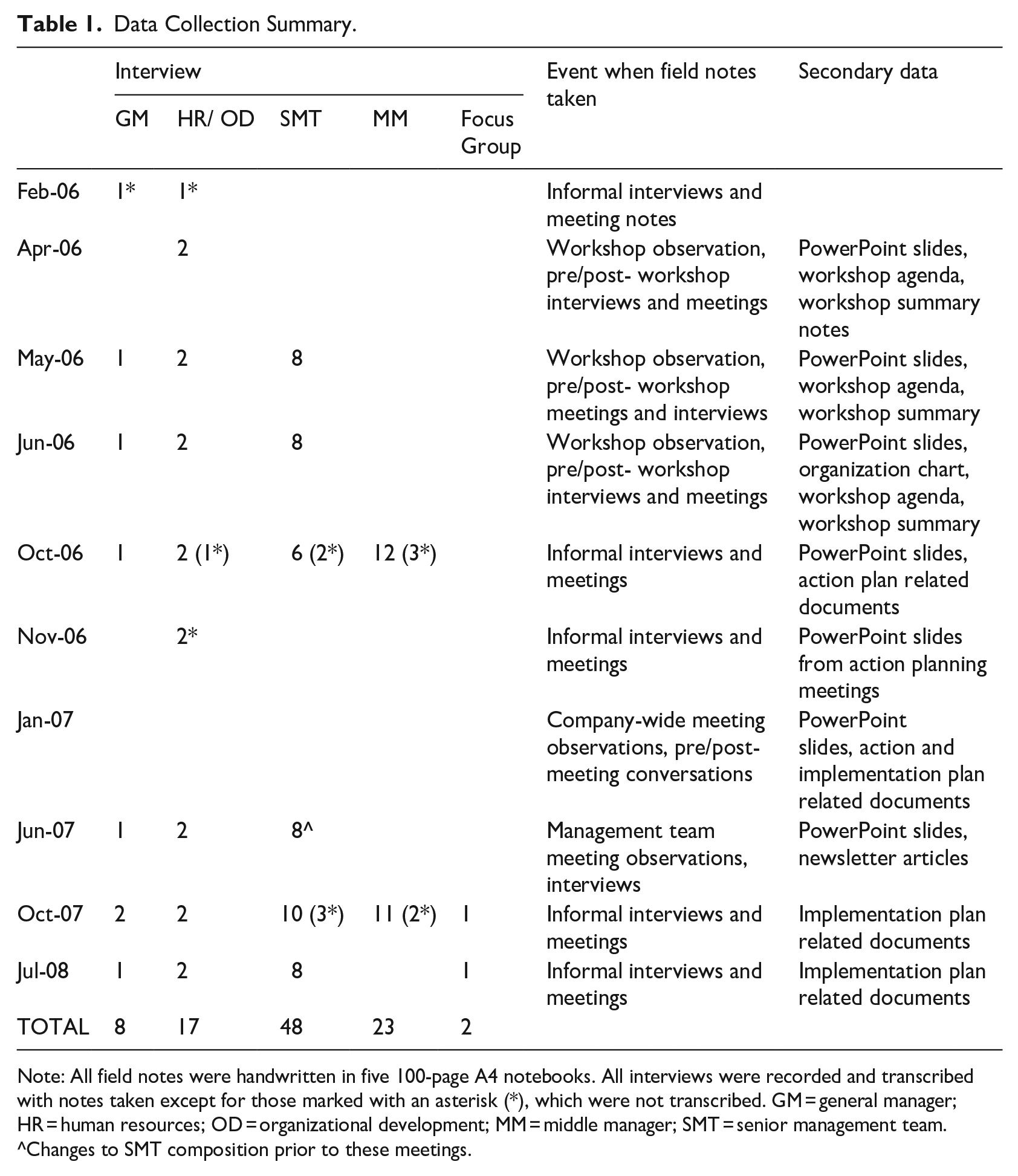
Note: All field notes were handwritten in five 100-page A4 notebooks. All interviews were recorded and transcribed with notes taken except for those marked with an asterisk (*), which were not transcribed. GM = general manager; HR = human resources; OD = organizational development; MM = middle manager; SMT = senior management team.
Changes to SMT composition prior to these meetings.
Data analysis
We conducted our analysis in four stages. First, we developed a chronological narrative, a thick description (Van Maanen, 1979) and a timeline (Langley, 1999) from our field notes and interview data. We observed that the strategic change process began with a traditional envisioning phase where the senior management team came together to create and hone a vision; however, there seemed to be substantial shifts to ways of working while envisioning. For example, in our initial interviews, the GM and SMT described Brandco Greece as siloed and lacking teamwork. Yet during the initial strategic change workshops, the SMT was working together, bringing about change as they did so, and describing how different this was. It was such observations that pushed us towards the future-making literature.
Building on the future-making perspective, in our second stage we focused on the activities in our efforts to understand how participants were ‘giving form to preferred futures’ (Whyte et al., 2022, p. 2). We open coded observations, mentions of activities in our data and which organizational member was performing them. For example, a MM interview statement (‘This is not like the old management team, they are working together and sharing information with us’) was separated into senior manager activity (working, sharing) and middle manager activity (observing). Through an iterative process, we honed our coding and identified two distinct types of activities: imagining activities, focused on understanding what a desired/preferred future could look like; and adapting activities, which give form to this future through ways of working.
Similar to other future-making studies, we identified that imagining involved relating the future to alternatives and imagining a desired future (Alimadadi et al., 2022; Augustine et al., 2019; Comi & Whyte, 2018). In adapting, some participants were giving form to this future through role modelling future ways of working while others were observing (these) future ways of acting (see Table 2). Adapting occurred alongside imagining. For example, in the first two workshops, the previously siloed SMT members were working with the GM and HR on activities such as analysing the corporate environment, which involved everyone contributing to identifying as is versus to be aspects of ways of working (imagining). The SMT members were also observing the GM and HR role modelling ways in which to collaborate through this design activity.
Activity Coding.
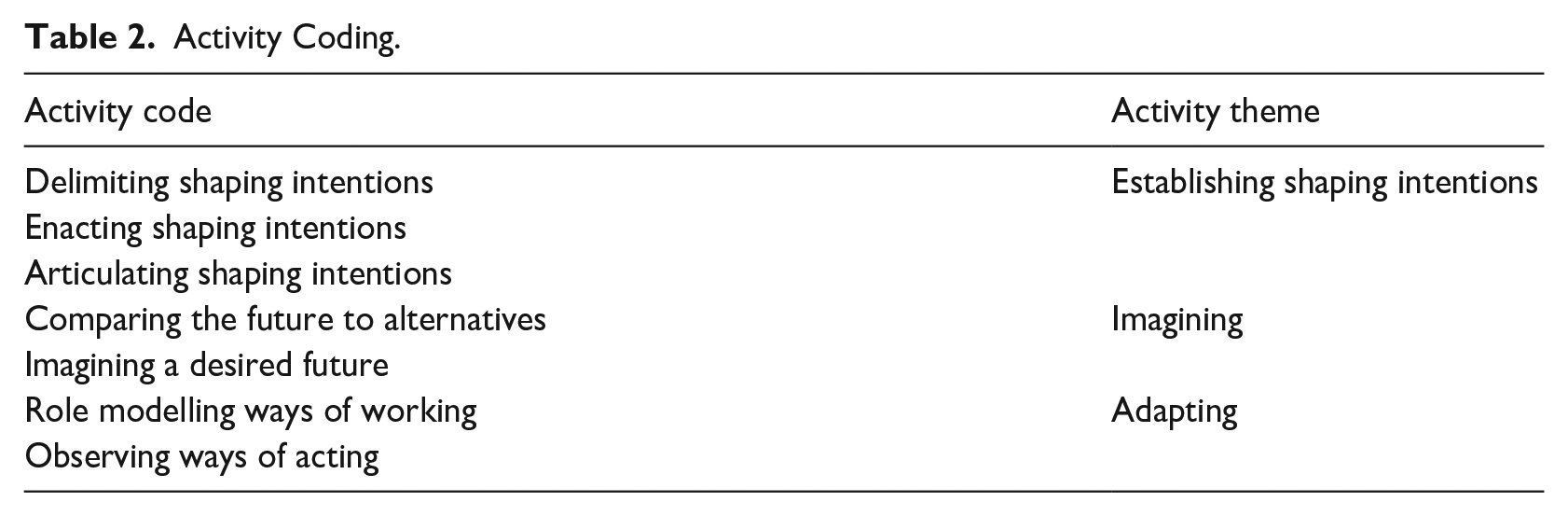
During this step we also identified space [consistent with the definition of space (see Introduction) as determined by Bucher and Langley (2016) and Kellogg (2009)] as theoretically significant for our model, since the physical space in which the activity took place was critical for SMT members in observing ways of acting. We went back to our activity coding and identified where space occurred. For example, the middle manager statement was coded as workshop space. We also traced how these spaces shifted in their nature, location and participation as the strategic change process unfolded.
In the third stage of analysis, we dedicated our attention to identifying what was guiding these activities in the absence of a formal plan. For example, in our middle manager interview example, we probed our data to understand how and why senior managers, who historically were siloed, were working together. We turned to the arguments of Rindova and Martins (2021) and examined how change intentions were articulated, and traced where the articulated intentions came from (e.g. in the opening GM presentation). We identified two additional activities – delimiting, or setting boundaries for shaping intentions (e.g. setting a workshop agenda, selecting the Cultural Web as a framework) and enacting shaping intentions (e.g. the HR team offering support to the SMT to craft presentations). Together we group these three activities – delimiting, enacting and articulating – into one activity theme: establishing shaping intentions. These guided and served as a basis for evaluating both imagining and adapting activities. We analysed our data to identify shifts in shaping intentions as the process unfolded and identified three distinct shifts in establishing shaping intentions which we label T1, T2 and T3. Since it was clear that the change process was continuing beyond our research, we used Tn to indicate the ongoing process (see Figure 1).
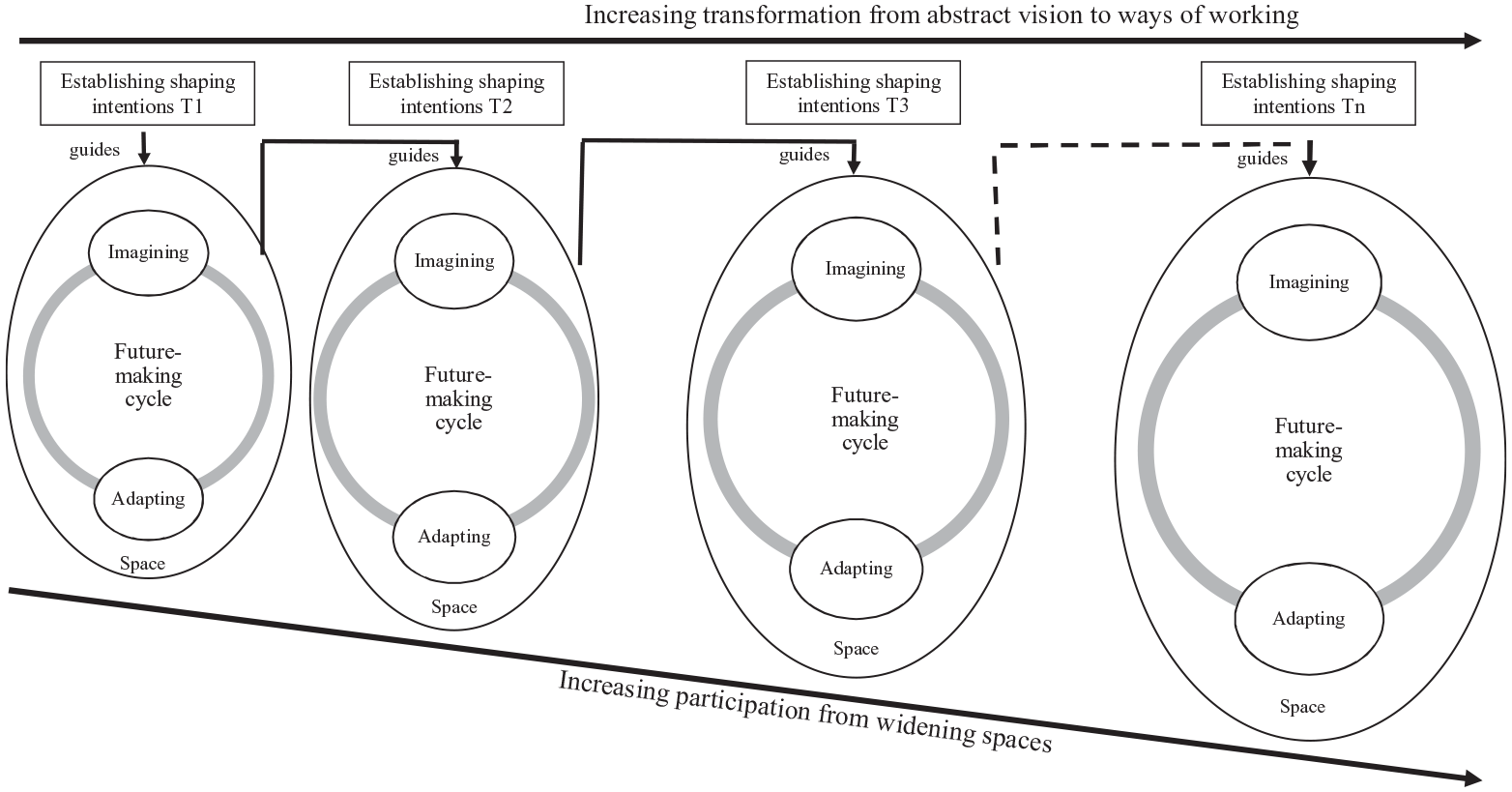
Future-making cycles during strategic change.
In the fourth stage we combined the insights from the analytical steps outlined above to develop a process model of how visions, originating from the GM launch presentation in T1, were embedded into ways of working (see Figure 1). The process model contains multiple and iterative future-making cycles unfolding over time and across different spaces across the organization. Each cycle is triggered by establishing shaping intentions, which together guide activities in a future-making cycle. Each future-making cycle has imagining and adapting activities situated in specific spaces that enable the interactions of participants in each future-making cycle. In the beginning, workshops were the enabling space, but as participation and interactions expanded, departments became crucial spaces enabling future-making activity. Importantly, the model captures that despite no upfront formal plan, the abstract ideas (vision) presented by the GM in his presentation in T1 were given form and concretized into ways of working. We present our findings below.
Findings
Each cycle of our process model, illustrating how visions for change are concretized into ways of working (see Figure 1), starts by (a) establishing shaping intentions, which (b) guide imagining through relating the future to alternatives and imagining a desired future, while simultaneously (c) guiding adapting ways of working through role modelling future ways of working and observing future ways of acting. Our model illustrates how spaces expanded from workshops to departmental and project spaces as participation in future making widened.
We explain the processual dynamics of our model by presenting a detailed explanation of one complete cycle. Similar to others (see Jarzabkowski et al., 2019), due to space constraints, we only describe one cycle (cycle T2) in detail, with additional cycles presented in Table 3 (see Appendix). We also include here a summary of cycle T1 to provide context for cycle T2 and the establishing of shaping intentions in cycle T3 to illustrate the processual dynamics between cycles.
Future-making cycle T1: Summary
The GM, with the help of HR and OD directors, kicked off the strategic change process with two SMT off-site workshops in April and May 2006. The workshops focused on bringing a fragmented SMT together to develop a shared understanding of why Brandco Greece needed to change and to develop a shared vision. Outside the workshop space and before the first workshop, the GM established shaping intentions by selecting the Cultural Web framework (delimiting) to design a future Brandco Greece, and approached the third author to support him by introducing the framework to his team (enacting). Inside the workshop space he kicked off the process with his Rationale for Change presentation (see Figure 2.i), which outlined the reasons for change and his high-level abstract vision (articulating), including his desire to change from a ‘centralized, paternalistic “one-man show” to an interactive [participative], cross-fertilizing management team’ (archival document). By the end of the workshops, through imagining and adapting activities, the SMT were already adapting to more interactive ways of working, and alongside the GM, HR and OD, had created a vision statement and an eight-item paradigm (see Figure 2.ii and Figure 2.iii) that were critical to establishing shaping intentions for T2.
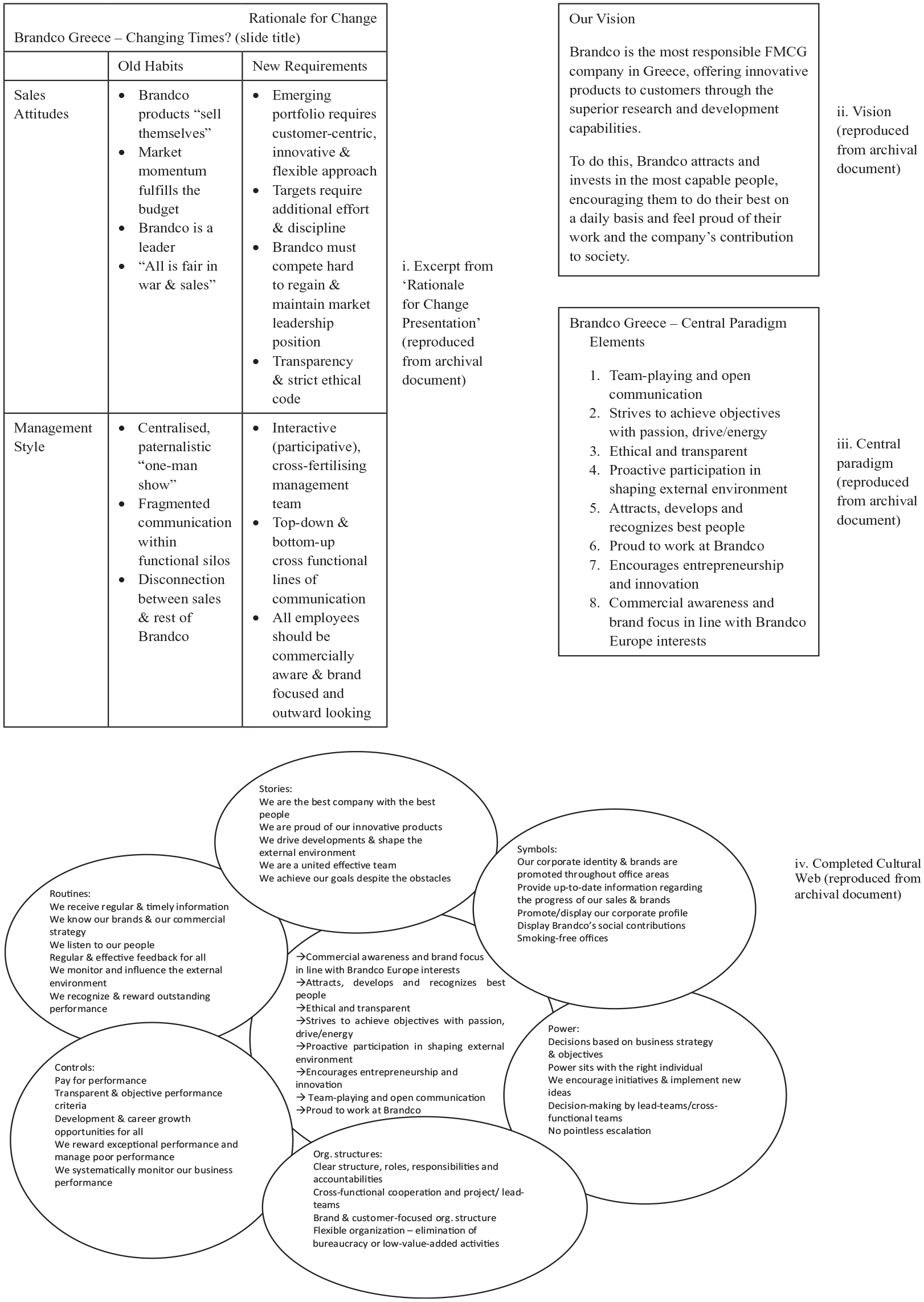
Evolution of shaping intentions.
Future-making cycle T2
At the end of T1, the SMT identified a need to broaden participation: ‘I believe that there is a long distance between the lower level and the senior level. So, I think the middle manager is essential to discuss the changes in ways that are easily understood’ (SMT interview). They planned a workshop for 80 middle managers in June 2006. The goal of the workshop was to share their jointly crafted vision statement and work together to complete the remaining elements (eight outside circles) of the Cultural Web (see Figure 2.iv for version completed in T3).
Establishing shaping intentions
Our analysis revealed that establishing shaping intentions involves three distinct activities: delimiting, enacting and articulating. For ease of reading we present them sequentially.
Delimiting shaping intentions (outside middle manager workshop space)
The HR and OD directors delimited shaping intentions by curating the ideas about Brandco Greece’s desired future generated in the SMT workshop space from cycle 1: ‘After the workshop I prepared some workshop notes and distributed to all the management team members in order to refresh and to reinforce’ (HR interview). These notes included initial brainstorming by the SMT on what the future would look like and were organized in the Cultural Web framework. For example, in the SMT workshop space participants proposed future ideals under the heading Controls, that included: ‘Differentiate and pay for performance; Measure commitment to cultural dimensions’ (archival documents). The OD director compiled these future ideals to guide workshop discussions.
The SMT jointly decided that they, none of whom had facilitation experience, would co-lead the middle manager workshop. The OD director provided the SMT notes from the workshops to help the SMT facilitate effectively. ‘And I put them [the ideas from the workshop] here because later on it was very useful. During the third workshop each member of the management team was obliged to front one of the components, so we needed their first reactions for each element to remind them’ (archival documents).
Enacting shaping intentions (outside middle manager workshop space)
The OD director supported each SMT member in crafting and rehearsing their individual presentations: ‘My role was . . . going around the management team, pushing them to do things, sending them emails, by preparing stuff, running one-to-one meetings to prepare them for the presentations’ (OD director interview). The HR team committed to supporting the SMT in this process because facilitation and collaboration were new to most members. SMT members not fully committed to proactively making the future were replaced. ‘Just the fact that they will be very complacent doesn’t help in itself, because when you are trying to foster change you want your people at a high level to drive that process through their behaviour, through role modelling, through what they do’ (HR interview). Replacing complacent members of the team was an early enactment of the GM’s vision for an ‘interactive [participative]’ SMT (see quote under Future-Making Cycle T1: Summary).
Articulating shaping intentions (inside middle manager workshop space)
The GM articulated shaping intentions in the middle manager workshop by giving his Rationale for Change presentation to the 80 participating middle managers. Following the GM, the SMT articulated their intentions by presenting the vision statement and eight-item paradigm created in the SMT workshop. They introduced the Cultural Web framework as the organizing framework to guide how they would imagine a desired future. The 80 middle managers rotated in groups through eight breakout rooms, each representing one of the elements of the central paradigm and facilitated by a different member of the SMT. Shaping intentions, articulated through the content of the presentations by the GM and SMT, were reinforced with the structure of the breakout rooms in the workshop space and guided future making in this cycle.
Imagining the future (inside the middle manager workshop space)
Within the workshop space, the participating SMT and middle managers used the articulated shaping intentions to relate the future to alternatives and imagine a desired future.
Relating the future to alternatives
The middle managers related their ideas of a desired future for Brandco Greece to their dissatisfaction with the present. Some middle managers had experienced more successful organization in the past, which they used to articulate their desired future: ‘There are performance issues, we’re losing ground . . . we were the top selling company in this country, now we’re the fifth selling company’ (MM interview).
In addition to their experiences with a past Brandco Greece, participants used the new European operating model outlined in the presentation as an alternative for Brandco Greece: ‘I am Greek but also I’m a European . . . we have to have our own identity, but we have to share the same values as Europe overall’ (MM interview). Even when embracing alternative models, participants highlighted local differences between other European locations and Brandco Greece: ‘We should be ethical and transparent. You wouldn’t get that written down in the UK as that is a given there, it’s not like a new paradigm element. And team playing is probably also a given in the UK, and probably open communication, too. Whereas over here it is not. Team playing is not part of the game’ (SMT interview).
Imagining a desired future
The middle manager workshop provided space for interactive discussions imagining what a desired future might look like. There were breakout rooms dedicated to discussions about each paradigm element and the SMT invited discussions by asking ‘If we are to achieve our vision for Brandco Greece, and how we do things around here is represented by our central paradigm, what would we need to do in this circle in order to make this happen?’ As the workshop progressed, ideas on a desired future were refined in situ. ‘The SMT took notes on flipcharts and as the day progressed ideas were proposed, debated and honed in each room’ (field notes). Each participant could contribute to imagining aspects of a desired future covered in the breakout rooms. ‘They spent 45 minutes in the first room as there were instructions, then 30 minutes in each subsequent room. They were building from what was already on the flipcharts. The HR team compiled the information overnight into a completed Cultural Web’ (field notes). The participation of middle managers increased the number of participants in actively imagining the future of Brandco Greece.
The decision during the workshop to create a non-smoking policy illustrates how imagining a desired future was guided by intentions and shaped in new ways. In the previous workshop the SMT, most of whom were smokers, proposed creating non-smoking areas. In the middle manager workshop space this idea was heavily debated. The middle managers argued that creating non-smoking areas was inconsistent with the paradigm created in the SMT workshop. ‘I am a smoker but since I work in a company that cares about health, I cannot accept in my company that works to enable people to feel better [sic] to have smoking in the building. It’s inconsistent’ (MM interview). The SMT and middle managers jointly decided that creating a non-smoking policy was more aligned with their desired future.
Adapting (inside the workshop space)
Our analysis revealed that adapting activities unfold alongside imagining activities.
Role modelling future ways of working
Creating the Cultural Web together in the middle manager workshop space enabled senior managers to role model the paradigm element of team playing and open communication. ‘This was really weird for them. They are so used to the management team being this kind of people [sic] who hide their notes and . . . never shared anything’ (SMT interview). Role modelling future team playing ways of working helped break down positional differences between the SMT and middle managers by revealing common goals. ‘We see five different things depending on our position. But there is only one point for the company and for all of us to change, and we have to focus on this common thing because everybody would have a resistance due to his or her position’ (SMT interview). Collaborating around common goals and across levels enabled participants to ‘trust colleagues in other departments’ (MM interview).
Middle managers, encouraged by the GM’s open communication style, adopted similar behaviour in the workshop. ‘I mean, the GM is the general manager, but you feel free to address something to him, or through the directors. It’s more open. I think the communication is [becoming] more open and there is some transparency’ (MM interview). In this way, collaborative activity between participants in the workshop space transformed an imagined ideal into action.
Observing new ways of acting
Through physical co-presence, the workshop provided a space for interactions where middle managers could observe the new ways of acting being role modelled by the SMT and GM. Imagining a future together in the workshop space sent a signal to the middle managers that the future involved collaboration with their senior colleagues. ‘Culture is a new thing for us and the senior management team are learning with us, they are embracing it by working in a new way; this is very good’ (MM interview).
Observing future ways of acting embedded imagined ideals. ‘Already [in the workshops] I can see things are happening and I guess this has happened through role modelling and this probably starts through the GM and it’s happened through some management team members’ (HR interview). Middle managers interacting with the SMT in the workshop space witnessed how some members of the SMT were already adopting the envisioned transparent ways of working: ‘He’s open and that’s very good, and since he is an open person, then everybody from his management team shares his view, his mentality about that’ (MM interview).
Upon conclusion of the workshop, departments became an important space for future making as the 80 middle managers returned to their daily responsibilities and started enacting shaping intentions for the next future-making cycle (see below). The increase in participation in future-making cycles and expansion into non-workshop spaces further propelled the transformation of the abstract vision portrayed in the Rationale for Change presentation into tangible ways of working.
Future-making cycle T3
Establishing shaping intentions for cycle T3
Delimiting shaping intentions
After the middle manager workshop, the HR and OD directors met regularly with the SMT to prioritize the ideas captured in the workshop space and translate them into 17 projects. ‘We took each circle [of the Cultural Web] – for example, here is the controls [sic]. We put each bullet in here [points to slide] and then we start writing actions. What should we do in order to achieve better performance? So, we added a lot of actions and then we took all the actions from all circles and we put it [sic] in a common project’ (OD director interview). By prioritizing the ideas and capturing them in 17 projects, the HR and OD directors created the foundation for the shaping intentions for T3.
One SMT member was appointed to lead each of the 17 projects. ‘We named them, we distinguished them according to if they are major projects, ongoing projects, if it has to do with the basic ways of working . . . and then we had the prioritization – which project is going to start when, and the assignment of each project to a director’ (OD director interview). At this stage the projects ‘were descriptive with no implementation details’ (field notes), but each project contained enough information to prioritize and serve as an outline of an implementation plan. ‘The management team recognized from the outset that many of the projects would take a number of months to complete and that the resources were not available to complete all projects simultaneously . . . . So, the GM and the management team made a strategic decision to phase the starting month of many of the projects’ (OD director interview). This phased approach was discussed further in a meeting in November 2006.
Enacting shaping intentions
Upon return to their regular responsibilities, both the SMT and the middle managers brought their workshop experiences into their departments. ‘You know it’s consistently on my mind . . . I almost unconsciously check and say: Is that consistent with our paradigm?’ (GM interview). Many continued to enact the role-modelled new ways of working, which further embedded the ideas from the change vision into everyday ways of working. ‘I became more open to listening to new ideas, new challenges, because I can say that I can understand that there is room for improvement. You can never say “I’m perfect, and don’t have any aspects for change.” It was a very big lesson I’m learning’ (MM interview).
Prior to the launch of an implementation plan, middle managers began incorporating new ways of working: ‘And we have organized a regular meeting, [a] monthly meeting, and this is something that was not a procedure in the past. It could be included in an action plan, let’s say, but . . . I did not wait. I don’t wait for an action plan to do things that I feel that fit with the model of working’ (MM interview). Subtle changes such as scheduling regular meetings helped increase transparency and participation and further embedded the collaborative vision outlined by the GM. ‘Not a major change, but let’s say that the fact that five months ago no one was using the calendar and just knocking on the door and saying, “I would like to have a discussion with you”; now things are more scheduled. I think this is contributing in changing, transforming the way we work. It’s not a huge change but they all add up’ (SMT interview).
Articulating shaping intentions
Prior to November 2006, middle managers were informally articulating shaping intentions to departmental members by sharing their experience in the change process. ‘First of all, I have communicated the process till now. Now I am having a special meeting to try and give them some examples and to give them the vision that the future is coming’ (MM interview). In November 2006, Brandco Greece launched a plan with 17 unique projects to the same group of 80 MMs from June. Each SMT member presented their projects and solicited middle manager volunteers. ‘There was a lot of people – managers – wanting to work on four projects but the teams were really huge, so the management team decided which volunteer to put in which project according to their wish, of course’ (OD director interview). The overwhelming and positive response to the project plan suggests middle managers were eager to continue and deepen their participation. The 17 projects and enthusiastic support established shaping intentions to guide the future-making cycle in T3 (see Table 3 in the Appendix).
Discussion
We set out to explore the role of future making in strategic change, using what seemed to be a successful process in which an abstract vision was being transformed into ways of working prior to the launch of any formal plan. In so doing, we provide an empirically grounded strategic change model that captures how, through cycles of future making, organization members embed an abstract vision into ways of working (cf. Tsoukas & Chia, 2002; Whyte et al., 2022).
We make two substantial contributions to our understanding of strategic change and future making. Our most significant contribution is a process model which accounts for how visions transform into actions through cycles of future-making activity. Our future-making process model reveals how these cycles iterate across the process to make the future by transforming abstract visions into tangible ways of working. It also uncovers how three characteristics of organizational spaces – boundaries, distance and movement – facilitate this process. Second, our study contributes to future-making research by providing an empirical example of how future making unfolds beyond the imagination of a desired future.
Transforming visions into actions
Our conceptual model depicted in Figure 1 reimagines strategic change as a future-making process that transforms abstract visions into new ways of work, theorized in terms of two key components, differentiating it from prevailing models of strategic change (e.g. Stouten, Rousseau, & De Cremer, 2018; Weiser et al., 2020). First, the process is composed of future-making cycles, consisting of intertwined imagining and adapting activities. Second, the process captures the enabling role of organizational spaces, sites of interaction and experimentation (Bucher & Langley, 2016), in imagining and adapting future-making activity in a way that widens participation across the organization. Our model shows that a fully formed plan need not precede adaptation (see Stouten et al., 2018; Weiser et al., 2020 for reviews of ‘plan first’ models). Abstract visions can provide sufficient guidance (cf. Rindova & Martins, 2021) for situated action in the present to shape a desired future (Tsoukas & Chia, 2002).
Embedding change visions while designing a plan
Our conceptual model eschews traditional and linear conceptions of strategic change, where plans precede adaptation, by adopting the idea that organizations are continuously moving towards the future (Tsoukas & Chia, 2002). We illustrate that future making involves both imagining and giving form to desired futures (Whyte et al., 2022), where, consistent with a change vision, participants act in future ways in the present. We argue that shaping intentions guide the imagining and adapting activities in each future-making cycle and our conceptualization of cycles captures the iterative, and at times concurrent, nature of these activities. For example, in T3, the locus of activity shifts to projects, each with a future-making cycle guided by a relevant set of shaping intentions.
The intertwining of imagining and adapting activities in each future-making cycle fosters changes in ways of working alongside designing a plan. The imagining activities in our model involve relating the future to alternatives and imagining a desired future which, similar to others, highlights the importance of evaluating relative desirability (Alimadadi et al., 2022; Augustine et al., 2019; Comi & Whyte, 2018). For example, the GM proposed the idea of team-based ways of working as desirable, and participants compare this to their current siloed ways of working.
Imagining is intertwined with adapting activities: role modelling ways of working and observing new ways of acting. For instance, the GM begins the process by leading discussions and ensuring all of the SMT participate and interact with each other. Thus, they role model the imagined team-based collaborative behaviour. The SMT observe this new way of acting (the previous GM did not solicit input or hold group meetings), which they embed into their own ways of working. The complementary activities – of role modelling and observing – shift patterns of interaction between SMT members as early as T1 (see Table 3 in the Appendix).
Our findings illustrate how establishing shaping intentions, such as the abstract vision presented by the GM of Brandco Greece in his opening presentation, guide the future-making cycles responsible for transforming visions into actions. We find that conceptualizing change visions as intentions (Bratman, 1981; Rindova & Martins, 2021) explains how activity change is possible prior to a formalized change plan. A change vision is ‘available in the present’ to participants as a ‘representation[s] of the future’ (Whyte et al., 2022, p. 4) and a tool at hand, guiding future-making cycles (Chia & Holt, 2006; Comi & Whyte, 2018).
Our process model of ongoing and iterative future-making cycles explains how Brandco Greece avoids the multiple interpretations and disparate outcomes common in strategic change (Balogun & Johnson, 2004, 2005; Bartunek et al., 2006). We reveal that as cycles of future making iterate and participation widens across spaces, the separation between designers and implementers disappears and understanding passes on through role modelling and observing. This reduces the need for participants to interpret in isolation from planners, reducing reinterpretation of plans and disparate outcomes (cf. Balogun & Johnson, 2005).
Moreover, future-making cycles enable joint imagining when there are differences in interpretation such as the shift from non-smoking areas to non-smoking offices at Brandco Greece. In this way, the middle managers in our study are co-creators, not the passive implementers portrayed elsewhere. Thus, our empirical findings suggest that in addition to the transparency and inclusion benefits from widened participation (Dobusch, Dobusch, & Müller-Seitz, 2019; Hautz, Seidl, & Whittington, 2017), the unfolding of future-making cycles across organizational spaces fosters consistency between visions and actions.
Future making and the enabling role of space
Our study enhances our understanding of how organizational spaces enable strategic change, and also shows that spaces are central to how future making facilitates the transformation of an abstract vision into new ways of working. Similar to other strategic change research, we find that workshops are episodic sites isolated from daily responsibilities, which facilitates imagining activities and improves interpersonal relations between participants (Hodgkinson, Whittington, Johnson, & Schwarz, 2006; Johnson et al., 2010; Whittington, Molloy, Mayer, & Smith, 2006). Workshops are bounded, bringing relevant participants together in a physical location, but are also situated sites of ‘interactions among actors’ (cf. Bucher & Langley, 2016, p. 595), enabling the imagining, role modelling and witnessing activities constituting future-making cycles. We find, however, that episodic and linear models of strategic change that privilege the bounded nature of spaces such as workshops underspecify how spaces enable future making during strategic change.
In a recent review, Weinfurtner and Seidl (2019) argue that spaces are defined by three dimensions: boundaries, distance and movement. These dimensions are present to varying degrees when assessing the distribution of spaces relative to each other and the impact of isolation, differentiation and intersection of spaces in shaping organizational processes, including strategic change. Examining our findings across these dimensions illustrates how spaces, as sites of interaction in future-making cycles, have distinct qualities that facilitate future making. In particular, movement is one of the most salient characteristics of spaces facilitating the transformation of ideas into actions.
Boundaries, like those delineating workshops, departments and projects, distribute spaces physically and temporally, and determine which actors have access to space-relevant activity, such as change (see, for example, Kellogg, 2009). At Brandco Greece, however, the potentially exclusionary and isolating characteristics of boundaries are tempered through movement. During future-making cycles, movement across boundaries and physical locale fosters wider inclusion. The workshops in studies by those such as Johnson et al. (2010) occurred in spaces of isolation, creating a liminal character inhibiting reconnection. Our analytical emphasis on the situated activities reveals that in future-making cycles, participants move effortlessly across boundaries (e.g. between workshops, departments and projects). This movement fosters inclusion, not exclusion (cf. Dobusch et al., 2019). As the locus of activity shifts across spaces, the elasticity afforded by soft boundaries between spaces opens participation in future-making cycles to different groups of participants, spreading participation across the organization. Subsequent cycles of imagining and adapting require more than the movement of participants, however, because the spaces of interaction don’t intersect. Rather, shaping intentions alongside participants carry content and thinking across spaces. Shaping intentions are honed across future-making cycles but are grounded in the abstract visions from the first cycle, creating connectivity without intersection. This movement of participants and shaping intentions across time and space is critical in transforming abstract visions into new ways of working across the organization. Our findings indicate that movement across relatively pliable boundaries reduces the impact of isolation on strategic change and fosters an inclusionary change process in ways consistent with those envisioned.
These findings on boundaries and movement are important when examining how distance within and across spaces (Weinfurtner & Seidl, 2019) impacts future making. Research examining the shaping role of space in organizational processes exemplifies how actors reinforce hierarchical distance (Holstein & Rantakari, 2023). In contrast, our findings reveal how future-making activities bridge traditional divides to enable learning and co-creation (as seen particularly clearly in the example of the creation of a non-smoking policy). At Brandco Greece there is differentiation in distance in terms of who is doing the role modelling and who is observing and adapting. Yet, hierarchical divisions and role distance diminish or disappear as participants simultaneously act as designers and implementers, including those traditionally conceived of as recipients. Our findings on change as future making therefore challenge the design assumptions embedded within traditional linear change models, in which spaces for change designers, change implementers and change recipients are bounded and prevent shared interaction and observation. This boundedness is consistent with the view of these roles as fixed, separate and discrete. In future making, spaces are not organized in a static and linear fashion but are dynamic; they unfold across time in future-making cycles with pliable boundaries and shifting role participation as organizational members move between role modelling and observing. Hierarchical and role distance, then, is bridged through joint activity in future-making cycles.
Our findings also show that in future making, differences occur in the nature of spaces as the abstract ideas in the upfront vision start to develop and become more concrete. We see this at Brandco Greece as the change process moves into project mode with future-making cycles unfolding across simultaneously occurring spaces (departments and projects) and the locus of the activity shifts to focus less on imagining and more on adapting. Earlier spaces, such as workshops, are replaced with those allowing wider participation, with earlier participants (the senior and middle managers) distributed across them. In this way, future-making cycles during strategic change unfold in non-traditional spaces such as departments (see Holstein & Rantakari, 2023), which opens up participation at earlier stages in the process than that which is portrayed in traditional strategic change models. Spaces evolve and morph over time to widen participation, supporting the transformation of ideas into action across an organization.
As opposed to highlighting the influence of bounded spaces on a specific activity (see Weinfurtner & Seidl, 2019), our findings reveal the influence of flexibility and movement. During strategic change, ideas and participants engaging in ongoing future-making cycles move across different spaces (e.g. workshops, departments and projects). It is porosity and fluidity of movement across spaces that enables both the widening of participation and transformation of change visions into ways of working across the organization. This more expansive conceptualization of spaces as sites for future-making activity provides a counterpoint to studies identifying how organizations struggle to recouple change visions imagined in workshops back into the organization more broadly.
Future Making
Our study contributes to our understanding of future making by providing an empirical example of activity adaptation. Future-making research is either theoretical (Wenzel, 2022; Wenzel et al., 2020; Whyte et al., 2022) or emphasizes the challenges in imagining futures (e.g. Alimadadi et al., 2022; Augustine et al., 2019). We uncover how abstract visions, conceptualized as intentions, provide a way to evaluate means–ends coherence (Rindova & Martins, 2021), while transforming them into ways of acting.
Our focus on situated activities and interactions of organizational members shows that future ways of working occur in the present. Whereas Comi and Whyte (2018) emphasize the agentic role of visual artefacts in making a future through reifying a design, our aim is to explain how abstract visions transform into ways of working. In architectural design, reifying the future includes building models to bring the future into being through ‘conferring concreteness, realism and physicality’ (Comi & Whyte, 2018, p. 1072). Strategic change, by comparison, requires materiality through adapting ways of working to confer concreteness. Our study also extends our understanding of future making by exposing the relevance of spaces for future-making activity. Other research examines individuals working in spaces toward a desired future (e.g. Comi & Whyte, 2018; Thompson & Byrne, 2022), but does not theorize on the importance of spaces as sites of interaction in translating a desired future into being.
We bring the theoretical arguments of Rindova and Martin (2021) on how intentions ‘give shape’ (p. 807) to a desired vision into our understanding of future making. We extend their arguments by demonstrating that abstract visions (shaping intentions) are sufficient guides for activity adaptation. Shaping intentions continue to serve as a ‘cognitive mechanism that connects preferred future states’ (p. 807) to the situated actions of participants (Bratman, 1981). Stated in the language of future making, shaping intentions are tools at hand and representations that allow participants to engage with the future both through imagining and acting (Whyte et al., 2022).
Additionally, we provide a more nuanced understanding of shaping intentions than proposed by Rindova and Martins (2021). During change, three activities – delimiting, enacting and articulating – establish shaping intentions. This nuance is important because delimiting shaping intentions, such as the selection of the Cultural Web as an organizing framework in T1, puts boundaries on the content and topics that once articulated shape imagining and adapting (Kaplan, 2011; Spee & Jarzabkowski, 2011; Werle & Seidl, 2015). Similarly, we find enacting shaping intentions, as with appointing HR to co-lead strategic change in T1, reifies the delimited shaping intentions into something more concrete (Comi & Whyte, 2018) by translating shaping intentions – in this case, collaboration – from an abstract idea into ways of working. Finally, shaping intentions are articulated as the GM did in his Rationale for Change presentation. These combined activities established shaping intentions for T1 and guided the future-making activities in the cycle.
Limitations and Suggestions for Future Research
Ours is a single-site case study of a relatively unusual change process without the resistance and unexpected outcomes so frequently noted in other studies. In addition, our case study focuses on a single subsidiary, rather than change spanning multiple subsidiaries or divisions, as have other studies (Balogun & Johnson, 2005; Balogun et al., 2015; Jarzabkowski et al., 2019). Hence, our findings highlight some boundary conditions that suggest avenues for future research.
In particular, there are unanswered questions about the role of desirability in future-making cycles. Our research shows that future-making cycles that transform an abstract vision into ways of working are generative for the organization. It is not clear if, for example, the role of future-making cycles would change if an organization considered undesirable and desirable visions simultaneously (cf. Alimadadi et al., 2022). It is also not clear if future-making cycles would be generative in situations where the visions guiding future-making cycles were misaligned with the required changes needed to ways of working (e.g. Tripsas, 2009) or failed to consider factors critical for long-term success (Lee, Bansal, & Mascena, 2023).
It is also not clear how important autonomy in execution is to the generativity of future-making cycles. We would expect our conceptual insights to be relevant to other settings of strategic change with similar levels of autonomy. Regulatory contexts such as Jarzabkowski et al. (2019), however, may constrain the senior manager’s autonomy over design and execution. Further research could examine whether the future-making model proposed here unfolds in different ways in more complex and bureaucratic change contexts. We would expect that these contexts would limit imagining activities, but that other aspects of our theoretical model, such as the iterative nature of future-making cycles and the enabling role of spaces, would be transferable to other settings. Similarly, variations in how organizations establish shaping intentions may impact future-making cycles. Future research could determine if the ways shaping intentions are delimited, enacted and articulated impact their effectiveness as a guide for a future-making cycle.
In spite of these limitations, our empirically grounded theoretical model of strategic change as a future-making process provides an alternative to prevailing linear models of strategic change. We highlight how the situated actions unfolding in organizational spaces transform abstract ideas into concrete actions. In so doing, we provide a foundation for researchers and practitioners interested in exploring how actions today ‘make’ the future.
Footnotes
Appendix
Supplementary Data for Future-Making Cycles.
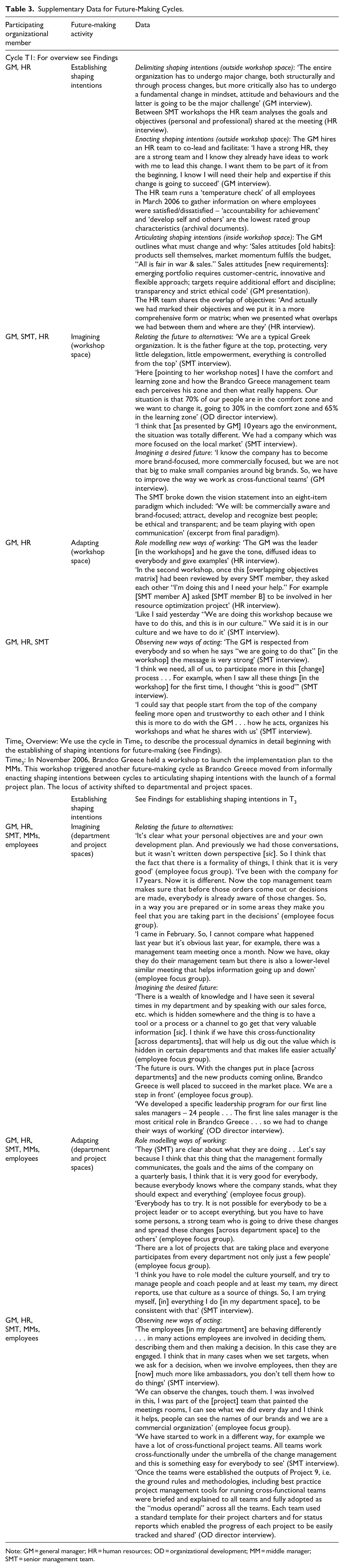
| Participating organizational member | Future-making activity | Data |
|---|---|---|
| Cycle T1: For overview see Findings | ||
| GM, HR | Establishing shaping intentions | Delimiting shaping intentions (outside workshop space): ‘The entire organization has to undergo major change, both structurally and through process changes, but more critically also has to undergo a fundamental change in mindset, attitude and behaviours and the latter is going to be the major challenge’ (GM interview). Between SMT workshops the HR team analyses the goals and objectives (personal and professional) shared at the meeting (HR interview). Enacting shaping intentions (outside workshop space): The GM hires an HR team to co-lead and facilitate: ‘I have a strong HR, they are a strong team and I know they already have ideas to work with me to lead this change. I want them to be part of it from the beginning, I know I will need their help and expertise if this change is going to succeed’ (GM interview). The HR team runs a ‘temperature check’ of all employees in March 2006 to gather information on where employees were satisfied/dissatisfied – ‘accountability for achievement’ and ‘develop self and others’ are the lowest rated group characteristics (archival documents). Articulating shaping intentions (inside workshop space): The GM outlines what must change and why: ‘Sales attitudes [old habits]: products sell themselves, market momentum fulfils the budget, “All is fair in war & sales.” Sales attitudes [new requirements]: emerging portfolio requires customer-centric, innovative and flexible approach; targets require additional effort and discipline; transparency and strict ethical code’ (GM presentation). The HR team shares the overlap of objectives: ‘And actually we had marked their objectives and we put it in a more comprehensive form or matrix; when we presented what overlaps we had between them and where are they’ (HR interview). |
| GM, SMT, HR | Imagining (workshop space) | Relating the future to alternatives: ‘We are a typical Greek organization. It is the father figure at the top, protecting, very little delegation, little empowerment, everything is controlled from the top’ (SMT interview). ‘Here [pointing to her workshop notes] I have the comfort and learning zone and how the Brandco Greece management team each perceives his zone and then what really happens. Our situation is that 70% of our people are in the comfort zone and we want to change it, going to 30% in the comfort zone and 65% in the learning zone’ (OD director interview). ‘I think that [as presented by GM] 10 years ago the environment, the situation was totally different. We had a company which was more focused on the local market’ (SMT interview). |
| Imagining a desired future: ‘I know the company has to become more brand-focused, more commercially focused, but we are not that big to make small companies around big brands. So, we have to improve the way we work as cross-functional teams’ (GM interview). |
||
| GM, HR | Adapting (workshop space) | Role modelling new ways of working: ‘The GM was the leader [in the workshops] and he gave the tone, diffused ideas to everybody and gave examples’ (HR interview). |
| GM, HR, SMT | Observing new ways of acting: ‘The GM is respected from everybody and so when he says “we are going to do that” [in the workshop] the message is very strong’ (SMT interview). |
|
| Time2 Overview: We use the cycle in Time2 to describe the processual dynamics in detail beginning with the establishing of shaping intentions for future-making (see Findings). | ||
| Time3: In November 2006, Brandco Greece held a workshop to launch the implementation plan to the MMs. This workshop triggered another future-making cycle as Brandco Greece moved from informally enacting shaping intentions between cycles to articulating shaping intentions with the launch of a formal project plan. The locus of activity shifted to departmental and project spaces. | ||
| Establishing shaping intentions | See Findings for establishing shaping intentions in T3 | |
| GM, HR, SMT, MMs, employees | Imagining (department and project spaces) | Relating the future to alternatives: |
| makes sure that before those orders come out or decisions are made, everybody is already aware of those changes. So, in a way you are prepared or in some areas they make you feel that you are taking part in the decisions’ (employee focus group). |
||
| GM, HR, SMT, MMs, employees | Adapting (department and project spaces) | Role modelling ways of working: |
| GM, HR, SMT, MMs, employees | Observing new ways of acting: |
|
Note: GM = general manager; HR = human resources; OD = organizational development; MM = middle manager; SMT = senior management team.
Acknowledgements
We are forever grateful to the constructive and continued engagement by Editor Paul Spee and two phenomenal reviewers whose guidance was instrumental in shaping our paper. We would also like to offer special thanks to Jane Lê for her insightful and invaluable feedback. Additional thanks to the countless reviewers along the way at Organization Studies and in the Strategy-as-Practice Interest Group at EGOS and AOM who offered advice. Finally, this paper is dedicated to our third author, Mandy Bennett, who sadly passed away before publication. The insights we share here would not be possible without her work.
Funding
The author(s) received no financial support for the research, authorship, and/or publication of this article.

Author biographies
†