




Abstract
Even though organizational activities have always been future-oriented, actors’ fascination with the future is not a universal phenomenon of organizational life. Human experience of the future is a rather young product of modernity, in which actors discovered the indeterminacy of the future, as well as their abilities to ‘make’ and, in part, even control and de-problematize it through ever-more sophisticated planning practices. In this essay, we argue that actors have recently ‘rediscovered’ the future as a problematic, open-ended category in organizational life, one that they cannot delineate through planning practices alone. This, we suggest, has been produced through a pluralization of what we refer to as ‘future-making practices’, a set of practices through which actors produce and enact the future. Based on illustrations of the experienced problematic open-endedness of the future in prevalent discourses such as climate change, digital transformation and post-truth politics, we invite scholars to explore future-making practices as an important but under-appreciated organizational phenomenon.
Years ago I left the wide, flat fields of rural Minnesota for the island of Manhattan to find the hero of my first novel. When I arrived in 1978, he was not a character so much as a rhythmic possibility, an embryonic creature of my imagination, which I felt as a series of metrical beats that quickened and slowed with my steps as I navigated the streets of the city. [. . .] My unformed hero and I were headed for a place that was little more than a gleaming fiction: the future.
Introduction
This opening paragraph of Siri Hustvedt’s (2019, p. 1) recent, widely acclaimed novel, Memories of the Future, anticipates the journey on which the author would take readers. The novel tells the story of ‘SH’, an aspiring writer who ventured into the future in the 1970s. By engaging her present and past selves in dialogue, SH notes: ‘I didn’t know then what I know now: As I wrote, I was also being written’ (p. 1). She recognizes how her past self ‘made’ her future, how she would become the person she is now through her actions in the past.
There have, of course, been other future-related novels published over the years. So, why does a novel on the future attract so much interest now? Is this just a coincidence, just like the recent opening of the Einstein Center laboratory for experimenting with digital futures (digital-future.berlin), or the emergence of the ‘Fridays for Future’ movement that is fighting for a sustainable future (fridaysforfuture.org)? We believe not. In this essay, we argue that actors in organizations have recently ‘rediscovered’ the future as a problematic temporal category, namely, as one that is unknowable. This overlooked rediscovery, we argue, provides organization scholars with an opportunity to examine the myriad ways in which actors produce and enact the future.
Perhaps this is a strange claim to make, given that the future has been widely addressed in the broader social sciences. Though their emphases may differ, philosophers and sociologists (e.g. Mead, 1932; Schatzki, 2010; Schütz, 1967) as well as some organization scholars (e.g. Helin, Hernes, Hjorth, & Holt, 2014; Hernes, 2014; Tsoukas & Chia, 2002) have pointed out that social life in the present is inherently interwoven with the future, just as much as it is connected with the past. In this view, the future is ‘integral to the experience of being human’ (Hernes, Simpson, & Söderlund, 2013, p. 3). It takes on a ubiquitous quality that is, and has always been, implied in the performance of organizational activity.
This essay goes one step further. We argue that, even though it might be true from a philosophical perspective that social life has always been future-oriented, the human experience of the future is not a universal, self-evident feature of organizational activity. It is, instead, a rather young product of modernity that emerged from relativizing eschatological expectations, which had trivialized the future as a predetermined and uncontrollable end state in premodern times. This ‘discovery of the future’ (Hölscher, 1999) was ‘made’ through the planning practices that emerged at that time, whose greater sophistication contributed to de-problematizing the future as a temporal category that could be anticipated and controlled. However, more recently, actors have begun to experience the future as a problematic, open-ended temporal category that they could not fully master through planning practices alone. This renaissance of the future as a prevalent and unknowable temporal category in organizational life is what we refer to as the ‘rediscovery’ of the future. 1 This rediscovery, we argue, has been produced through a pluralization of the ways in which actors engage with the future, with planning being just one of many approaches. Yet, very few, if any, of these activities and practices are well understood in organization studies.
To invite scholars to examine the myriad ways in which organizational actors produce and enact the future, we draw on sociological and historical writings (e.g. Hölscher, 1999; Koselleck, 1988; Reckwitz, 2016) to provide a historical overview of how experienced futures as well as the dominant ways of (re)producing them have evolved. We then relate the recent rediscovery of the future to prevalent discourses, all of which illustrate the current experience of the future as a problematic, open-ended category and demand a deeper engagement with what we refer to as ‘future-making practices’. To do so, we first introduce a practice perspective, one that enables us to reveal the ‘discovery’ and ‘rediscovery’ of the future.
Discovering the Future: A Practice Perspective
Scholars are increasingly interested in philosophically inspired process views of organizing (e.g. Helin et al., 2014; Hernes, 2014; Tsoukas & Chia, 2002). In these views, the present, past and future are not aligned in a linear way, as much of the organizational literature suggests (Reinecke & Ansari, 2017). Rather, organizational actors constantly and simultaneously enact and reinterpret these temporal categories in action (Hernes, 2014). As Emirbayer and Mische (1998, p. 973) specified, the present, past and future constitute tones of a ‘chordial triad’, with each tone ringing out louder than others in specific situations and ‘in different periods’. Organizational activities, then, can be ‘more (or less) engaged with the past, more (or less) directed toward the future, and more (or less) responsive to the present’ (p. 972). Consequently, we may identify certain eras with their ‘own time’ (Hernes, 2014), in which actors in organizations produced and enacted different futures in more or less pronounced ways.
One conceptual apparatus that helps us uncover such developments is practice theory. Practice theory relates to a ‘family of theories’ (Reckwitz, 2002) that draws attention to webs of interconnected practices through which actors performatively produce and recreate social and organizational life (Feldman & Orlikowski, 2011; Schatzki, Knorr Cetina, & von Savigny, 2001). In this view, ‘social practices’ refer to structured activity, i.e. action and structure at the same time. Practice theory, then, focuses attention on the discursive, bodily and material dimensions of social practices (Reckwitz, 2002). These dimensions include, among others, strategic accounts (Kaplan & Orlikowski, 2013), articulated visions (Venus, Stam, & van Knippenberg, 2019), narratives (Garud, Schildt, & Lant, 2014) and fabulations (Hjorth, 2013) (discourse); gestures (Wenzel & Koch, 2018) and gazes (Liu & Maitlis, 2014) (body); and prototypes (Knight, Daymond, & Paroutis, 2020), strategy tools (Jarzabkowski & Kaplan, 2015), models and algorithms (Lindebaum, Vesa, & den Hond, 2019), and sketches and drawings (Comi & Whyte, 2018) (materiality).
Given that the performance of practices constantly produces social realities ‘for another first time’ (Garfinkel, 1967, p. 9), every social practice, mundane or not, is inherently related to unprecedented futures (Schatzki, 2010). For example, through the practice of cooking, actors might rely on tried-and-tested recipes to prepare an upcoming dinner, but the dinner will not be identical to previous meals in that its situated preparation produces, say, slightly different conversations, seating arrangements and table decorations. In contrast, many, if not all of the above-mentioned examples of discursive, bodily and material dimensions of social practices ring out the future particularly loudly in the ‘chordial triad’ (Emirbayer & Mische, 1998). For example, in planning practices, managers might garner employees’ commitment to achieving formulated goals by articulating compelling visions of the future. Founders might ‘stage’ a startup’s future through bodily performances of investor pitches. And participants in strategy workshops might visualize the future by crafting vivid material representations on flipcharts. When the discursive, bodily and material dimensions of social practices foreground the future as ‘the dominant tone [. . .] in the chordial triad’ (Emirbayer & Mische, 1998, p. 972), we refer to such practices as ‘future-making practices’. In this sense, future-making practices are the specific ways in which actors produce and enact the future.
Unlike much of the organizational literature, which typically treats time as a linear trajectory that flows independent of organizational activity (Reinecke & Ansari, 2017), focusing on future-making practices implies that the future is not an objective ‘thing’ out there, waiting to be measured through supposedly more or less accurate planning techniques (e.g. Bacon-Gerasymenko, Coff, & Durand, 2016). From this perspective, the future is also not just a subjective perception in the minds of individuals, as cognitive approaches to time and temporality implicitly frame it (e.g. Ganzin, Islam, & Suddaby, 2020). A practice perspective transcends objectivist and subjectivist understandings of time and the future in that it views the future as a more or less experienced temporal category that actors produce and enact through future-making practices; and such practices involve both the mind and the body, and both the discursive and nondiscursive (i.e. bodily and material) dimensions of the ways in which actors engage with the future.
Thus, this perspective draws our attention to the experience of the future as a prevalent temporal category in social and organizational life. This experience is what Hölscher (1999) referred to as the ‘discovery’ of the future. As Emirbayer and Mische (1998, p. 972) specified, the prevalence of temporal categories is ‘historically variable’. Thus, if one can distinguish historical eras based on varying experiences of the future, and if such experiences are produced and enacted through future-making practices, it follows that one may identify variations in the prevalent future-making practices performed by actors in different historical eras.
The Discovery and Rediscovery of the Future
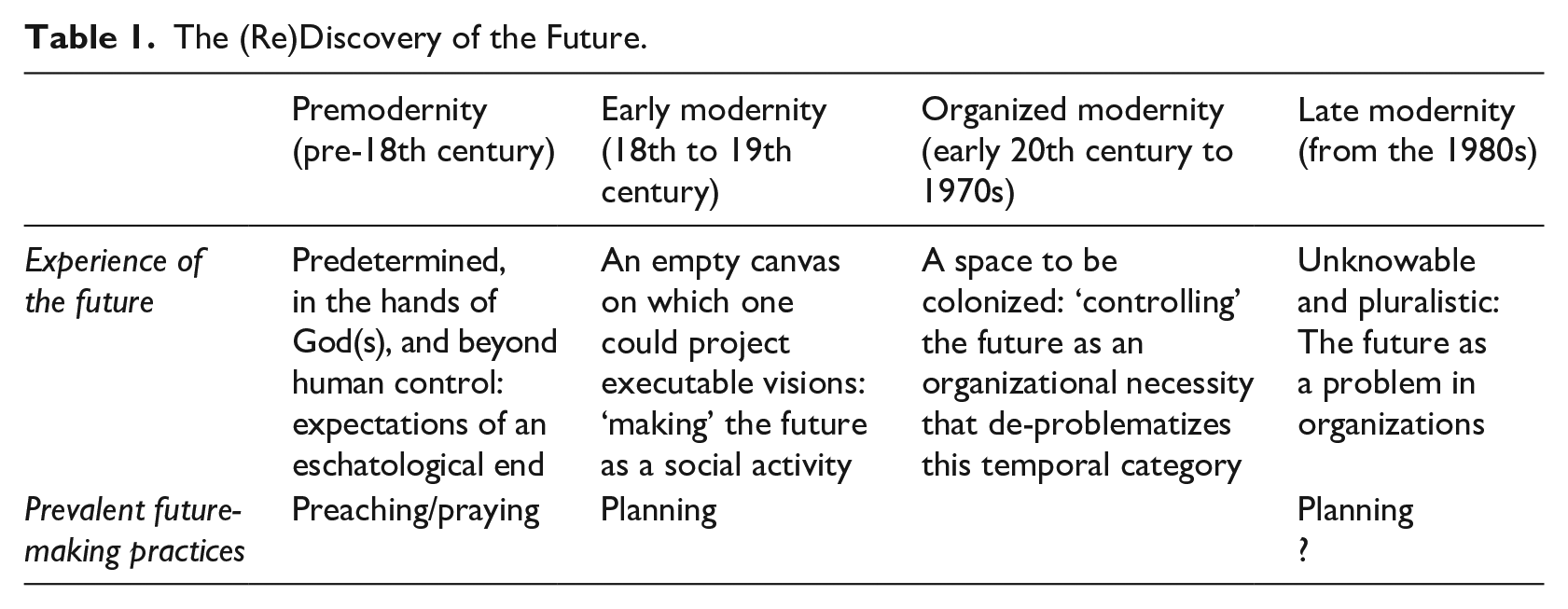
Actors’ fascination with the future is not a universal feature of social and organizational life. As sociological and historical analyses (e.g. Hölscher, 1999; Koselleck, 1988; Rosa, 2005) point out, human experience of the future is a recent phenomenon of modern times (see Table 1).
The (Re)Discovery of the Future.
Premodernity (pre-18th century)
Up until the 18th century, the future was not a prevalent aspect of human experience in the here-and-now (Diesseits). In premodern societies, people expected a predetermined eschatological end, a Last Judgment. Therefore, the future was in the hands of God(s) and located beyond the eschatological end (Jenseits) (Koselleck, 1988). Consequently, actors experienced the future as beyond human control, given that Armageddon, the future end of the world, was fixed. Even Martin Luther’s seminal contribution to the Reformation in the 16th century failed to change this absence of the future in the present. By warning society of the approaching Armageddon, he continued to consider the future as being located beyond a predetermined eschatological end, which, he said, would come sooner than expected (Rosa, 2005).
This experience of the future as an uncontrollable, divinely ordained non-issue was produced and enacted through two prevalent future-making practices. Church representatives continually ‘preached’ the end of the world as an upcoming and unchangeable matter of fact. Thus, they instrumentalized the future to ensure compliance with church doctrines in the expectation of divine salvation. In doing so, church representatives reproduced their power position in people’s daily lives (Koselleck, 1988). In turn, earthly actors in organizations and societies attempted to connect with the future by ‘praying’ for divine salvation at the Last Judgment (Hölscher, 1999). In doing so, they themselves reproduced the future as a predetermined temporal category that is beyond human experience.
Given the determination of the future as a fixed and uncontrollable end state, actors in premodern societies mostly did not expect anything new to emerge in the future: ‘Nil novum sub sole’ (Koselleck, 1988, p. 183). Actors mainly believed that history would repeat itself based on ‘natural’ cycles, such as seasons, the course of the celestial bodies and the succession of ruling monarchs. Surprises or unexpected events that deviated from past experiences were believed to be divinely ordained and nullified as being beyond human control, or actors would experience such changes as unfolding so slowly that past experience would still suffice to make sense of them (Rosa, 2005). Consequently, actors primarily grounded their actions in their learnings from the past in order to avoid repeating mistakes in the future (Koselleck, 1988).
Early modernity (18th to 19th century)
In the 18th century, the future became a central part of human experience. Specifically, actors began to ‘discover’ the future as part of their everyday lives (Hölscher, 1999). Rather than being predetermined, the future turned into an empty canvas, a space of finite possibilities on which paradisiac visions as well as economic, social, legal and other goals could be projected, and all of which were to be executed in the here-and-now. Consequently, the ontological status of the future shifted in early modernity. Rather than viewing the future as something uncontrollable that one could only ‘tell’ others about, ‘it is a modern insight [. . .] that one is increasingly capable of [. . .] executing [a] makeable’ (Koselleck, 1988, p. 262, emphasis in original) future. Therefore, society became a ‘future-making society’ (Reckwitz, 2016, p. 31), one that turned the ‘previously unexperienced future [into a] new daily experience’ (Koselleck, 1988, p. 90).
This experience of the future was produced and enacted through emerging variants of ‘planning practices’ (Reckwitz, 2016). 2 That is, in early modernity, ‘making the future’ meant envisioning, predicting, projecting and executing upcoming times. Specifically, emerging predictions by astrologists and scientists suggested that the end of the world would occur much later than the church would repeatedly announce, e.g. in 2000, or even 50,000 years later. By shifting the eschatological end into a ‘distant future’ (Hernes, 2014) it became less relevant in the present. The resulting erosion of the church’s sovereignty over the future opened up a space for further reflections on this temporal category (Koselleck, 1988).
This space was, then, filled by a movement toward ‘progress’, which was pursued by actors who emancipated themselves from churchly paternalism and absolutistic submission. These actors envisioned and planned for a ‘better’ future and aimed to attain their visions in their lifetimes (Reckwitz, 2016). By working toward a desired future through their planning practices, the future seemed to arrive faster. They, thus, experienced an ‘acceleration’ (Rosa, 2005) of the flow of events. Consequently, actors increasingly deemed past experience as insufficient for making sense of present events. As they argued, ‘[t]he uniqueness of events [. . .] knows no repetition and, therefore, does not permit a direct prescriptive advice’ (Koselleck, 1988, p. 155). Therefore, actors ‘denaturalized’ the future as the ceaseless repetition of the past and dismissed past experience as ‘medieval history’.
Thus, whereas actors in premodernity enacted ‘natural’ cycles, actors in early modernity began to live in ‘planning cycles’, carried by goal formulation, execution and control. These planning cycles fostered the industrialization of economies and societies, which implied a division of labour for the sake of improving productivity. Shared planning practices contributed to such improvements by enabling the required predictability and harmonization of dispersed organizational units and their production schedules (Reckwitz, 2016). The resulting increases in productivity turned ‘planning [into] the instrument of coordination and control’ (Hassard, 2002, p. 886, emphasis in original). Consequently, planning became an imperative in that actors ‘eventually were to plan [. . .]. Ever since, goal determinations are extrapolated from generation to generation, and the effects implied in plans and predictions become legitimation titles for [. . .] action’ (Koselleck, 1988, p. 363).
Organized modernity (early 20th century to 1970s)
The mouldable experience of the future reached its high point in what Wagner (1994) referred to as ‘organized modernity’. Although early intellectual debates on the future pointed in a different direction (e.g. Mead, 1932; Schütz, 1967), actors increasingly experienced the future as a temporal category that they could not only ‘make’ but ‘control’ (Reckwitz, 2016). Specifically, organizational actors increasingly aimed to ‘discipline’ (Kornberger, 2013) and ‘colonize’ (Reckwitz, 2016) the future in order to ‘be ahead of, [. . .] catch up with, or overtake other’ (Koselleck, 1988, p. 364) organizations.
This quasi-instrumental view of the future was, again, produced and enacted mainly through planning practices. In fact, Wagner (1994) referred to this modern era as ‘organized’, precisely because by then most asynchronicities between different business units and parts of society were resolved through planning-based coordination and control. Therefore, planning practices became a prevalent part of future-making in many, if not all, types of organizations, from corporations to kindergartens and city administrations (Knights & Morgan, 1991).
In organized modernity, planning practices became even more technologically sophisticated, thanks, in part, to the planning tools and statistical techniques that the emerging strategic management discipline began to deliver (Whittington, Yakis-Douglas, Ahn, & Cailluet, 2017). But with greater technological sophistication, these practices, ironically, became less complex. Through popular techniques and tools such as scenario planning and decision trees, supposedly knowledgeable experts predicted future states and their probability of occurrence. They, thus, ‘scientized’ the future by converting future ‘uncertainty’ into situations of ‘risk’ (Beck, 1992; Beckert, 2016; Hardy & Maguire, 2016). In doing so, analysts created a sense of ‘statistical certainty’ about the future: One could be X percent sure that Y would happen – statistically. This, then, produced and recreated the future as a manageable temporal category that was under human control (Kornberger, 2013).
In turn, the planning-based synchronization of social and organizational life contributed to de-problematizing the future as a controllable temporal category. As actors collectively produced the futures that they anticipated through their planning practices, they created a sense of certainty about the future (Reckwitz, 2016). Even if unexpected futures emerged, organizational actors could relativize these occurrences as temporary deviations that upcoming planning cycles would absorb (Koselleck, 1988). Planning practices, thus, enabled actors to treat unexpected events as ‘externalities’ that they could ‘control’ for in their models (Tsoukas, 1999).
Late modernity (from the 1980s)
This certainty about the future eroded in late-modern societies. Whereas planning practices had long kept futures together under the ideological umbrella of ‘progress’, organizational actors began to operate under increasingly pluralistic time regimes (Wagner, 1994). Consequently, the previously uniform forward march of progress turned into ‘the contemporaneity of the noncontemporaneous’ (Koselleck, 1988, p. 363), which undermined the sense of predictability that planning practices had created (Bauman, 2000; Beck, 1992; Giddens, 1994). This invoked experiences of the future as a temporal category that ‘must be unknowable’ (Tsoukas & Shepherd, 2004, p. 1, emphasis in original). That is, actors increasingly experienced the future as a problematic, open-ended temporal category that they could not fully master through planning practices alone. Borrowing Hölscher’s (1999) terminology, this experience is what we now refer to as the ‘rediscovery’ of the future.
The experience of an unknowable future was produced through the emergence of a myriad of future-making practices. By then, the future had become a commodity that not only strategists, economists and analysts but also many other actors aimed to ‘sell’ to organizations, such as consultants, members of think tanks, coaches, tabloid journalists, tech evangelists and, in part, even fortune sellers, prophets and messiahs (Sherden, 1998). These actors enacted (and still do) a plurality of future-making practices, ranging from the very old to the all-new, few of which are particularly well understood. This polyvocality generated numerous competing and sometimes even contradictory futures that muddied the certainty about the future that planning practices had produced (March, 1995; Mintzberg, 1994).
These developments did not imply, however, that organizational actors had fully stopped the performance of planning practices (Wolf & Floyd, 2017). In fact, proclaimed management gurus continued to advocate planning as the conditio sine qua non for organizational success (e.g. Ackoff, 1981; Drucker, 1993; Hamel & Prahalad, 1994). For example, in response to doubts that were raised concerning the abilities of planning practices to predict a future that was increasingly experienced as unpredictable (Mintzberg, 1990), Ansoff (1991) still defended planning-based prediction as a superior approach to engaging with the future, even in unpredictable contexts. As he astonishingly argued, organizational actors without planning procedures ‘would find the market pre-empted by more foresightful competitors, who had planned their strategic moves in advance’ (Ansoff, 1991, p. 455). Views like these led organizational members to capture the experienced unknowability of the future through even more technically sophisticated variants of planning practices, ranging from advanced forms of strategic control as compensation for potentially failed planning (Schreyögg & Steinmann, 1987) to statistical, data-driven approaches that the increasing availability of computing power had enabled (Cabantous & Gond, 2015).
Yet, disenchantment with the performance of planning practices (e.g. Cabantous & Gond, 2015; March, 1995; Mintzberg, 1994) seemed to grow in late modernity not in spite but because of their survival. In a sense, ‘progress’ as the underlying ideology of planning-based coordination and control not only served as a catalyst for modernity, but also eventually spurred its crisis, as it led to an ‘acceleration’ of social and organizational life that ever-shorter planning cycles could no longer fully anticipate (Rosa, 2005). In addition, this ideology fostered advances in information and communication technology that enabled global connectivity, spurring social dynamics that even comprehensive statistical models can no longer reliably predict (Tilson, Lyytinen, & Sørensen, 2010). Therefore, planning turned into a contested ‘risky practice’ (Reckwitz, 2016, p. 48). This self-erosion of the dominance of planning practices further fuelled the quest to produce and enact manifold futures through alternative ways of engaging with upcoming times.
The Future as a Problem in Organizations: Toward an Understanding of Future-Making Practices
As this overview suggests, actors in late-modern societies have recently ‘rediscovered’ the future as a prevalent temporal category in social and organizational life that is far from self-evident. This rediscovery has paved the way for many of the dominant discourses of our time, e.g. on climate change, post-truth politics and digital transformation. These discourses show that the future has, in fact, become a problematic, open-ended temporal category for actors in organizations that they cannot master through planning practices alone. The discourses, thus, highlight the importance of examining future-making practices in organization studies.
Climate change
Debates on climate change have probably never been as fierce as they are today (see Augustine, Soderstrom, Milner, & Weber, 2019; Nyberg, Wright, & Kirk, 2018; Slawinski & Bansal, 2012). Meanwhile, actors struggle over different ecological futures, including: (1) climate change as a matter in the distant future, leaving us plenty of time for incremental responses; (2) climate change as an issue of the near future requiring urgent action; (3) climate change as an actuality that requires a revolution now in order to achieve a sustainable future; (4) fatalistic references (Wenzel, Cornelissen, Koch, Hartmann, & Rauch, 2020) to climate change as an irreversible matter of the past that will invoke ecological and social catastrophes; and (5) outright denial of climate change, which supposes that the future will (or should) be similar to the past. Given the pervasiveness of the climate change discourse, the plurality of produced futures instils uncertainty about the appropriateness and future viability of activities to be performed. It thereby illustrates the current status of the future as a problematic temporal category in organizations (Lê, 2013).
Much of this struggle relates to the United Nations Sustainable Development Goals for 2030, which specify targets for the reduction of global warming and carbon dioxide emissions, among others (George, Howard-Grenville, Joshi, & Tihanyi, 2016). The formulation of such goals is a key part of planning practices. Doing so may direct actors’ attention toward climate change as an important issue (see Langley, 1989). However, planning practices may also direct attention away from such issues. For example, the German government responded to its failure to meet its climate change goals for 2020 by setting even more ambitious goals for 2030, without formulating how they are to be achieved (Kersting & Stratmann, 2018). 3
Some actors increasingly display their impatience and dissatisfaction with such planning-based procrastination, demanding solutions for climate change in their lifetime. In fact, the recent Fridays for Future movement, which operates as a central driver of attention to climate change, can be understood as a vast ‘bundle’ (Schatzki et al., 2001) of future-making practices through which actors produce manifold ecological futures, both hopeful and daunting, many of which break through the conventional planning horizon. Hence, it is the emergence of a plurality of future-making practices that contributes to extending the debates on climate change beyond planning-based futures. Examining these unexplored practices, then, allows scholars to generate insights into constructions of and responses to climate change that extend beyond current planning-based approaches in organization studies (see George et al., 2016).
Post-truth politics
Central to debates on climate change is the continual questioning of scientists’ predictions of ecological futures as ‘fact’ and ‘truth’ (Lefsrud & Meyer, 2012). This goes hand in hand with discourses referred to as ‘post-truth politics’, i.e. the formation of public opinion through ‘alternative facts’ that contradict claims that are accepted as truth.
As prior analyses suggest (e.g. Knight & Tsoukas, 2019; Thøger Christensen, Kärreman, & Rasche, 2019), the presentation of ‘alternative facts’ greatly contributed to partly unexpected events, such as Brexit and Donald Trump winning the 2016 US presidential election. Historically, the mass media have held power over public perceptions of ‘fact’ versus ‘fiction’ by producing, recreating and editing dominant understandings of social reality. As a result, political struggles between coalitions and oppositions remained rather predictable and, thus, accessible through planning practices. However, with the emergence and growing usage of social media, the distribution of noncurated content eroded the powerful position of the mass media in shaping public opinion. This opened up a space for ‘alternative facts’ that, in turn, participate in the production of alternative futures. Such polyvocality generates ambiguity about what is ‘fact’ and what is ‘fiction’, instilling uncertainty about future outcomes of political struggles. This uncertainty implies that, nowadays, ‘it is difficult [for organizational actors] to infer reliable lessons from the past to guide future actions’ (Knight & Tsoukas, 2019, p. 190) based on systematic planning procedures.
A deeper engagement with post-truth politics, therefore, provides opportunities for organization studies to generate insights into the production of alternative futures as a form of ‘fact-making’ (see Cabantous, Gond, & Johnson-Cramer, 2010), extending the current understanding of engaging with the future beyond well-known planning technologies. Yet, given the production of multiple futures through alternative facts, how is it possible for proclaimed organizational ‘experts’, such as strategists and analysts, to still be able to establish a ‘right to know’ the future based on planning procedures (Berg Johansen & De Cock, 2018; Kornberger, 2013)? As Tsoukas (1999, p. 499) anticipated, actors in ‘organizations do not only compete in the marketplace but, increasingly, in a discursive space in which winning the argument is just as important’. Thus, in times of post-truth politics, the performance of future-making practices involves engaging in struggles over meaning, in which actors legitimize, de-legitimize and re-legitimize alternative futures. Consequently, the examination of future-making practices allows organization scholars to further unpack meaning-making, as well as the power dynamics involved in this process.
Digital transformation
The emergence of social media also relates to the burgeoning discourse on ‘digital transformation’. Futuristic terms such as ‘artificial intelligence’, ‘algorithms’, ‘machine learning’, ‘robots’ and ‘cyborgs’ promise no less than a revolution of organizations and sociotechnical environments based on bits and bytes. By using these terms, actors draw both hopeful and daunting pictures of the future, from major business opportunities to massive job losses (Fleming, 2019).
As scholars have observed (Kumaraswamy, Garud, & Ansari, 2018, p. 1025), organizational actors experience such a revolution not as a one-off event but as ‘an age of continual disruptions’ in which they constantly engage with unexpected futures. Thus, whereas actors used to ‘surf [on] waves of technology [that] you can see [. . .] way before they happen [and] actually unfold fairly slowly’ (Morris, 2008, p. 13, citing Steve Jobs), they now tend to view the future as unpredictable and, thus, with no reliable means of providing a guide for action. Hence, current debates on digital transformation also reflect actors’ experience of the future as a problematic, indeterminate temporal category – one that they cannot master through planning practices alone.
Consistent with the experienced indeterminacy of the future, debates on digital transformation are partly interwoven with ‘new forms of organizing’ (Schreyögg & Sydow, 2010) as potentially digital alternatives to more formal, bureaucratic and planning-based ways of engaging with the future. Partly under the label ‘future of work’ (Gratton, 2014), these forms of organizing position entrepreneurship and creativity at the heart of ‘the new normal [of] organizational life’ (Hjorth, Strati, Drakopoulou Dodd, & Weik, 2018, p. 165). Accordingly, new forms of organizing promise to apply less conventional and, perhaps, more artistic and artisan practices of producing and enacting the future, such as improvisation (Weick, 1998), craft work (Bell & Vachhani, 2019), play (Hjorth, 2005) and theatrical performances (Schreyögg & Höpfl, 2004), all of which deserve greater attention in organization studies. A focus on future-making practices, then, offers to deepen our understanding of the production and consumption of digital transformation through new forms of organizing.
The examination of future-making practices also enriches recent debates on algorithms (Lindebaum et al., 2019). Some view algorithms as nonhuman actors that analyse ‘big data’ from the past to make better predictions about ‘what [. . .] likely happens next’ (Mayer-Schönberger & Cukier, 2013; Simsek, Vaara, Paruchuri, Nadkarni, & Shaw, 2019, p. 972). In doing so, they seem to be partly responsible for the burgeoning use of ‘algorithmic predictions’ in organizations in an attempt to master the future through even more statistically sophisticated planning procedures (e.g. Cabantous & Gond, 2015; Glaser, 2017). Others respond by arguing that, however ‘big’ the database may be, algorithmic predictions are inherently ‘inaccurate’ because the past is unable to inform the future (Gigerenzer, 2014). In principle, such arguments are aligned with the increasing rejection of planning practices, which are seen as a cause of predictive ‘inaccuracy’ in late-modern societies (e.g. March, 1995; Mintzberg, 1994). However, the latter may underestimate the performativity of algorithms. That is, just as Amazon ‘anticipates’ buying behaviour through algorithms and then entices consumers to buy the very same products through ads (Weise, 2019), algorithms may (co)create the futures that they predict. Such (co)creation remains poorly understood. Therefore, an examination of future-making practices offers new understandings of how actors use algorithms to construct and enact the future.
Conclusion
We argue in this essay that many prevalent issues of our time, including climate change, post-truth politics and digital transformation, are essentially manifestations of organizational actors’ recent rediscovery of the future as a problematic, unknowable temporal category. As these debates illustrate, the problematic status of the future has emerged through a pluralization of what we have referred to as ‘future-making practices’, i.e. the specific ways in which actors produce and enact the future. Due to this pluralization, actors in organizations have begun to produce and enact multiple futures. This profusion of futures erodes actors’ certainty about upcoming times as previously produced by once-dominant, unidirectional planning practices. In doing so, it creates uncertainty about the appropriateness of organizational activities to be performed in the present. Despite the prevalence of the future as a problematic temporal category in organizations, we know very little about the pluralistic future-making practices through which actors produce and enact upcoming times. We therefore invite scholars to extend and deepen our understanding of future-making practices as an important organizational phenomenon.
Focusing attention on future-making practices, however, implies eroding the status of the future as a universal feature of organizational life (Holt & Johnsen, 2019; Reinecke & Ansari, 2017). As our historical account shows, actors have highlighted this temporal category in the ‘chordial triad’ of the present, past and future (Emirbayer & Mische, 1998) to a greater or lesser degree in different eras. Specifically, actors’ experience of the future as a prevalent temporal category is a rather recent product of modernity, in which they began to ‘make’ the future through the performance of future-making practices. Building on the musical metaphor, such performances produce the future as a specific tone that actors hear loudly and clearly when playing and listening to the ‘song of time’. In turn, the specific sound of this tone is a product of the instruments (materiality), trained playing techniques (body) and voices (discourse) that constitute these performances. In other words, an examination of future-making practices focuses attention on the specific discursive, bodily and material dimensions of the ways in which actors produce and enact the future.
But if every organizational activity is inherently future-related (e.g. Hernes, 2014), how can scholars discern future-making practices empirically? As we have argued, a distinctive feature of such practices is to produce and recreate the future as a dominant temporal category in organizational life. Yet, practice-based onto-epistemology (Reckwitz, 2002; Schatzki et al., 2001) defies the privileging of either ‘objective’ judgements by outsiders or ‘subjective’ interpretations by insiders of the extent to which a performed practice is consequential for such dominance. Rather, it foregrounds actors’ often tacit practical understanding as inscribed into the practices that they perform. Against the backdrop of this understanding, actors experience the prevalence of the future and the performance of a practice as ‘future-making’ in specific periods and situations to a greater or lesser extent. Thus, in order to discern those practices that are ‘future-making’, scholars must acquire such practical understanding by becoming skilful performers of these practices themselves. Here, we consider detail-sensitive, ‘get-your-hands-dirty’ approaches such as ethnographies particularly useful.
Given their strong track record of ethnographies, organization scholars are well positioned to master the methodological challenges involved in examining future-making practices. Therefore, we believe that organization studies is capable of generating intriguing insights into the performance of future-making practices.
Footnotes
Acknowledgements
The authors gratefully appreciate the insightful thoughts and suggestions by Daniel Hjorth and three anonymous reviewers that greatly helped us shape this essay. In addition, we thank Shaz Ansari, Jens Beckert, Dubravka Cecez-Kecmanovic, Anja Danner-Schröder, Raghu Garud, Daniel Geiger, Damon Golsorkhi, Ali Gümüsay, Ella Hafermalz, Tor Hernes, Jeannie Holstein, Lærke Højgaard Christiansen, Robin Holt, Jennifer Howard-Grenville, Thomas Lopdrup-Hjorth, Ann Langley, Gordon Müller-Seitz, Davide Nicolini, Günther Ortmann, Mar Pérezts, Caroline Ramsey, Juliane Reinecke, Hartmut Rosa, Ted Schatzki, Georg Schreyögg, Majken Schultz, David Seidl, Camilla Sløk, Silviya Svejenova, Iben Sandal Stjerne, Roy Suddaby, Jörg Sydow, Hari Tsoukas and Jane Bjørn Vedel for insightful comments on earlier versions of the manuscript.
Funding
The author(s) disclosed receipt of the following financial support for the research, authorship, and/or publication of this article: This work was supported by the Viadrina Center B/ORDERS IN MOTION based on funds from the Ministry for Science, Research, and Culture of the State of Brandenburg.
