




Abstract
Research points to the challenge of delivering strategic change in pluralistic contexts. We explore this challenge through a real-time, qualitative case study of the implementation of strategic change in a post-1992 United Kingdom university. Our findings enable us to account for how a change leader can create sensegiving and sensemaking opportunities that influence others to engage in activities that facilitate change implementation through an orchestrated meetings-based process and which also leads to change action consistent with intended goals. In doing so we contribute to research on strategic change in pluralistic organizations, research on strategy meetings and research on change leader sensegiving.
Keywords
Universities are quintessential pluralist organizations (Brès, Raufflet, & Boghossian, 2018; Spee & Jarzabkowski, 2011), traditionally associated with collegial, decentralized and democratic forms of decision-making (Chandler, Barry, & Clark, 2002; Langley, Denis, & Cazale, 1996; Tuckermann, 2019). Universities have, however, increasingly adopted managerialist models of organizing (Aboubichr & Conway, 2023; Bleiklie, Enders, & Lepori, 2015; Deem & Brehony, 2005; Nixon & Scullion, 2022; Ogbonna & Harris, 2004). This trend is particularly pronounced in the United Kingdom (Bleiklie & Michelsen, 2017; Gjerde & Alvesson, 2020).
Nevertheless, UK universities remain complex pluralistic organizations (Jarzabkowski & Sillince, 2007; Spee & Jarzabkowski, 2017). Corporate approaches to management thus remain subject to criticism and resistance (Deem & Brehony, 2005; Ezzamel, 1994). Expectations of collegial decision-making and professional autonomy remain (Bleiklie et al., 2015; Brès et al., 2018). Such contextual factors create significant challenges for those tasked with managing in the university (Brown, Lewis, & Oliver, 2021), raising questions about how strategic change can be implemented (Denis, Langley, & Rouleau, 2007; Sorsa & Vaara, 2020).
Meetings, a generic feature of university contexts, have been identified as one mechanism that can be used to support strategic change. In UK universities meetings can serve as an important forum for strategy making (Spee & Jarzabkowski, 2011, 2017). Research has, however, primarily focused on their role in strategy formulation. We know little about their possible role in strategy implementation, once a plan of strategic action has been agreed. This leads to our central research question: How can meetings enable the implementation of an agreed plan for strategic change in the contemporary UK university context?
To study this question we adopt a sensemaking perspective. Senior manager sensemaking and sensegiving are important to the sensemaking and implementation of strategic change by others (Balogun, Bartunek, & Do, 2015; Maitlis & Christianson, 2014; Weiser, Jarzabkowski, & Laamanen, 2020), including in university contexts (Gioia & Chittipeddi, 1991; Gioia, Thomas, Clark, & Chittipeddi, 1994). Studies show meetings can be an important venue for such sensemaking and sensegiving (Maitlis & Lawrence, 2007; Rouleau & Balogun, 2011; Spee & Jarzabkowski, 2011, 2017). Thus, we focus on how change leader sensegiving and sensemaking in university meetings can influence the sensemaking of a change team, in a way that galvanizes change action.
We focus on a real-time two-year qualitative study of strategic change implementation in a post-1992 UK university. The change involves a merger of two faculties (Architecture and Art & Design) also involving a radical shift to harmonized ways of working. The change process apparently achieved outcomes similar to those laid out in the original change plans for the merger, and more or less to schedule. Given what we know about change in pluralistic contexts this was an unexpected outcome. We seek an explanation for this, building on early findings pointing to the significance of the meetings-based process which the dean, who designed and led the merger, put in place to manage its implementation.
We develop a process model from our findings to account for how a change leader creates sensegiving and sensemaking opportunities that influence others to engage in activities that facilitate change implementation through an orchestrated series of senior manager meetings. Drawing on our contemporary university context, our model makes three contributions. First, we contribute to studies of strategic change in pluralistic contexts through elucidating the role meetings and their skilled management can play in change implementation. Second, we extend studies of strategy meetings to account for their role in change implementation. Third, we contribute to findings on sensegiving competence.
Strategy and Pluralistic Contexts: Contemporary UK universities
Since the mid-1980s, higher education institutions have come under pressure to increase their market orientation and adopt managerialist mechanisms and structures (Kallio, Kallio, Tienari, & Hyvönen, 2016; Paradeise & Thoenig, 2013). To varying degrees, many universities internationally have thus adopted managerial practices often associated with new public management and performance management, although not without criticism with concerns about their effectiveness in an otherwise pluralistic context (Kallio, Kallio, & Grossi, 2017; Nixon & Scullion, 2022).
The pace of such change has been particularly pronounced in the UK (Bleiklie & Michelsen, 2017; Bleiklie et al., 2015; Paradeise & Thoenig, 2013). Before the mid-1980s, with little management control, decision-making was characterized as collegial, decentralized and democratic with freedom from competitive pressure (Chandler et al., 2002; Deem & Brehony, 2005; Ezzamel, 1994; Kallio et al., 2016; Langley et al., 1996). Since then, UK universities have become more similar to large corporations in terms of their market orientation, hierarchies and bureaucratization (Deem & Brehony, 2005; Gjerde & Alvesson, 2020; Ogbonna & Harris, 2004). Strategy activity has become prevalent, with practices such as strategic planning (Spee & Jarzabkowski, 2011, 2017), and other practices such as objective setting and performance management which increase top-down control (Aboubichr & Conway, 2023; Bleiklie et al., 2015).
Yet universities remain pluralistic organizations (Brès et al., 2018; Denis et al., 2007). Consistent with this, they have features that make strategy formation difficult, such as multiple stakeholders with differing priorities and objectives, and professional knowledge-based work which typically requires high levels of individual autonomy (Denis et al., 2007; Sorsa & Vaara, 2020; Tuckermann, 2019; Waldorff & Madsen, 2023). Diffuse power makes it difficult to dictate direction: decisions tend to be negotiated or democratic (Langley et al., 1996). The prevalence of conflicting interests is a challenge (Glynn, Barr, & Dacin, 2000). Academic leaders, such as deans, often face criticism as they attempt to steer faculty members in a particular strategic direction (Brown et al., 2021; Ezzamel, 1994).
The Role of Meetings
Since universities are pluralistic organizations, it is no surprise that the imposition of more direct forms of managing and strategy development generates conflict (Ezzamel, 1994; Ogbonna & Harris, 2004). Resistance may be overtly oppositional, such as strike action, or subtle, including humour and cynicism (McCabe, 2018; Ybema & Horvers, 2017). More blatant conflict is particularly apparent when change is perceived to be introduced in an overtly aggressive fashion (Chandler et al., 2002; Kallio et al., 2016; McCann, Hyde, Aroles, & Granter, 2020). However, studies show that meetings, an established feature of university decision-making, can provide a means through which strategy and strategic activity can be directed in nuanced ways (Jarzabkowski & Sillince, 2007; Spee & Jarzabkowski, 2011, 2017). They provide top managers with more subtle and symbolic forms of power and influence that compensate for the lesser managerial authority typical of university settings (Jarzabkowski & Seidl, 2008).
More generally meetings have been identified as a forum for strategy activity (Jalonen, Schildt, & Vaara, 2018; Kwon, Clarke, & Wodak, 2014; Samra-Fredericks, 2004; Vaara & Whittington, 2012; Veltrop, Bezemer, Pugliese, & Nicholson, 2021; Whittle, Gilchrist, Mueller, & Lenney, 2020). Yet, work is still needed to understand their utility (López-Fresno & Cascón-Pereira, 2022; Tuckermann, 2019). Connecting from decisions taken to subsequent action is consistently the most challenging aspect (Ybema & Horvers, 2017; Whittle et al., 2020). The ceremonial nature of strategy workshops and their removal from everyday practice make it difficult to reconnect decisions back into the workplace (Johnson, Prashantham, Floyd, & Bourque, 2010). Particularly in pluralistic contexts such as universities where individuals have divergent goals and interests, a meeting might temporarily invest the chair with managerial authority, but this may not be sufficient to result in action following the meeting (Jarzabkowski, 2008; Jarzabkowski & Seidl, 2008).
Thus, while studies point to the importance of meetings in enabling strategic activity in contemporary UK universities (Jarzabkowski & Seidl, 2008; Spee & Jarzabkowski, 2011, 2017), we still do not know if this extends beyond formulation of change to its implementation. Studies by Jarzabkowski and her co-authors remain some of only a handful that analyse successive meetings over time in a way that could throw light on this issue, despite calls for further studies of this nature (Vaara & Whittington, 2012). Furthermore, these studies focus on meetings that are predominantly about strategy formulation (Jarzabkowski & Seidl, 2008; Jarzabkowski & Sillince, 2007; Spee & Jarzabkowski, 2011, 2017), and are also in a particular university context – namely pre-1992 UK research intensives. Even beyond the university context, studies of strategy meetings and workshops have mostly focused on episodes of strategy development (Jalonen et al., 2018; Johnson et al., 2010; Kwon et al., 2014; Samra-Fredericks, 2004; Sorsa & Vaara, 2020).
Sensemaking, Sensegiving and Change
Sensemaking is an important facilitator of strategic change (Balogun et al., 2015; Maitlis & Christianson, 2014; Mantere, Schildt, & Sillince, 2012). Sensemaking is the social process of creating intersubjective meaning through which individuals in interaction with others construct shared accounts of their changing context that enable them to act collectively (Maitlis & Christianson, 2014). Equally critical to change is senior manager or change leader ‘sensegiving’, the ‘process of attempting to influence the sensemaking and meaning construction of others toward a preferred redefinition of organizational reality’ (Gioia & Chittipeddi, 1991, p. 442). Studies also find sensegiving and sensemaking to be important in supporting shared meaning making in the conduct of meetings, including in university contexts (Gioia & Chittipeddi, 1991; Gioia et al., 1994; Jarzabkowski & Seidl, 2008; Maitlis & Lawrence, 2007; Spee & Jarzabkowski, 2011, 2017).
Yet studies of sensemaking and change show the challenge of sensegiving, often focusing on its contribution to unexpected outcomes found to commonly accompany strategic change implementation (Jarzabkowski, Lê, & Balogun, 2019). A position of formal power cannot enable an individual to unconditionally impose meaning on others (Maitlis & Sonenshein, 2010). Change leader sensegiving is a skilled, political activity (Brown, Colville, & Pye, 2015), requiring influencing skills such as explicit attempts at framing (Logemann, Piekkari, & Cornelissen, 2019; Maitlis & Christianson, 2014; Maitlis & Lawrence, 2007) and ‘discursive competence’ involving, for example, scene setting to create receptivity to sensegiving as well as framing through use of particular words and phrases (Rouleau & Balogun, 2011). Sensegiving cannot be divorced from considerations of power: research shows it is associated with efforts at covert and overt influence and manipulation with effects of sensemaking of seniors ‘particularly strong when superiors are present at meetings where subordinates engage in sensemaking’ (Schildt, Mantere, & Cornelissen, 2020, p. 253).
At the same time, studies of sensemaking and change acknowledge that subordinates have the ability to resist. This resistance can be productive preventing bad change decisions through ‘constructive disagreement’ (Baikovich, Wasserman, & Pfefferman, 2022; Schildt et al., 2020; Veltrop et al., 2021). Yet resistance can also be obstructive in university contexts (McCabe, 2018). Furthermore, in contexts such as meetings, recipients can use frontstage compliance to create space for ‘backstage resistance’, developed through peer-to-peer communication outwith the presence of senior managers (Ybema & Horvers, 2017; see also Balogun et al., 2015). Thus, it is timely to explore how senior manager sensegiving and sensemaking in meetings can facilitate implementation of change in a university consistent with goals for a new strategy, despite the particular challenges that we know the pluralistic nature of universities presents.
Methods
Our research is based on a real-time, longitudinal study of a merger between two faculties in a UK post-1992 university, here called Unik. Unik is a former polytechnic granted university status through the Further and Higher Education Act 1992. Like other UK universities, it is managed with an increasingly commercial mindset under mounting competitive pressure (Jarzabkowski, 2005). The merger was part of a broader change process intended to reposition Unik to achieve a stronger reputation and financial position. A merger is suitable for exploring how senior managers implement strategic change since mergers typically involve a change to purpose and mission, consistent with contexts of strategic change (Balogun et al., 2015; Mantere et al., 2012). A single qualitative exploratory case study is appropriate as we are researching a poorly understood phenomenon through a sensemaking perspective which requires access to contextualization and the worldviews of people under study (Clark, Gioia, Ketchen, & Thomas, 2010).
Following the retirement of the Dean of Art & Design, the Dean of Architecture was appointed as conjoint dean of both faculties to deliver a merger. After a 3-month review his strategic plan for the merger was approved by the university board. His vision for the merger went beyond the significant cost cutting required by Unik and included shared practices and synergies between art and architecture, such as joint live projects, a new studio system and common modules. This was a radical redesign effectively imposing methods of teaching and assessment more common in architecture than art and design, with the intent to facilitate artistic collaboration and enhance the reputation of the combined faculties, consistent with the best architecture schools. The implementation design involved sets of change initiatives, such as the creation of a single faculty management team, building work to remodel the arts building to enable co-location of both schools in a space suitable for studio-based teaching, and the design of the new curriculum realigned across both faculties (see summary of key deliverables in Table 1). This plan included a ‘harmonization’ year, from September 2011, where the two faculties would start working more closely, followed by full merger at the start of the new academic year in September 2012.
Summary of Planned Change Initiatives.
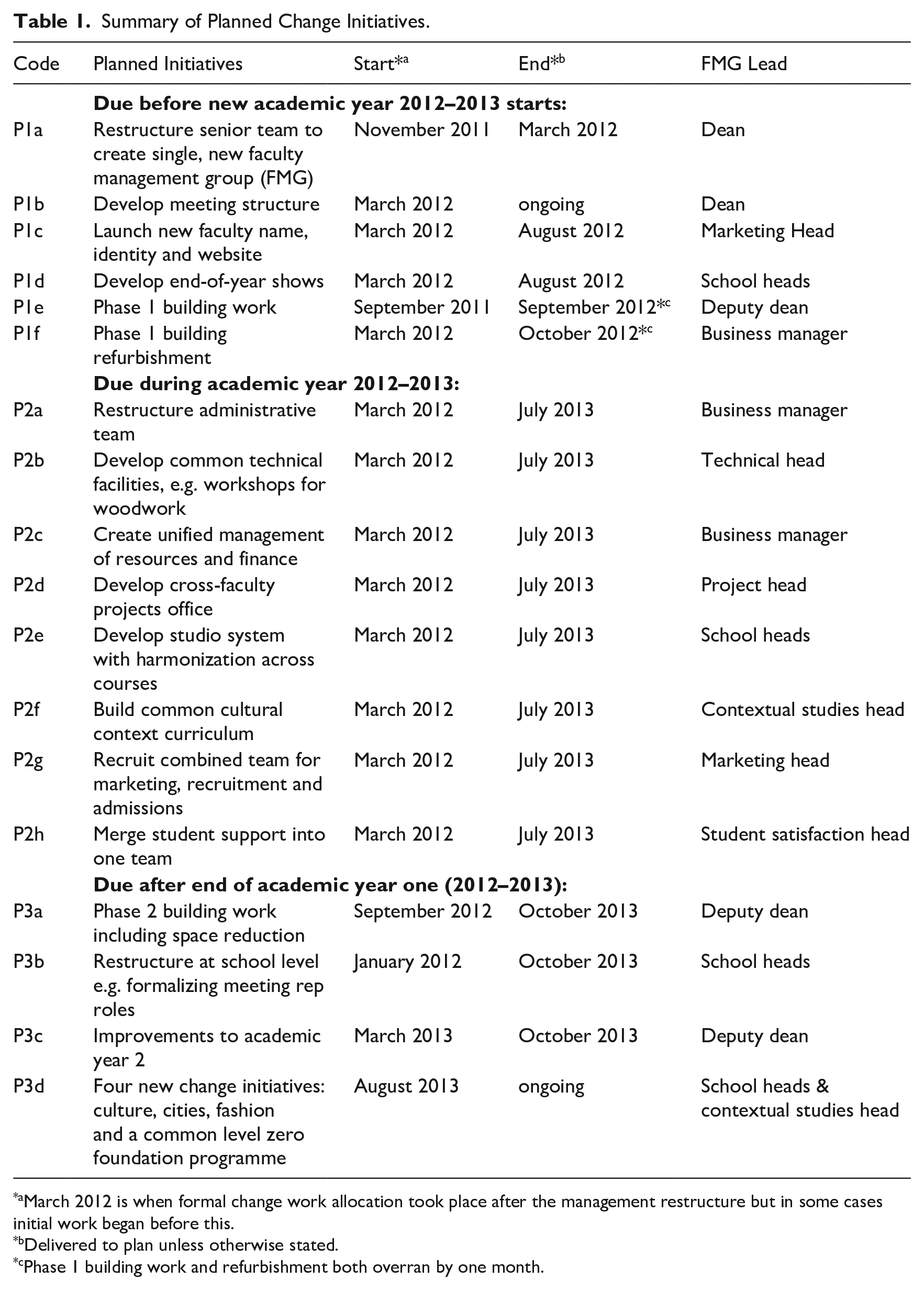
March 2012 is when formal change work allocation took place after the management restructure but in some cases initial work began before this.
Delivered to plan unless otherwise stated.
Phase 1 building work and refurbishment both overran by one month.
Working to deliver the plan, from October 2011, the dean developed a new faculty organization structure and appointed a new faculty management group (FMG), who were in place by March 2012. FMG included a deputy dean; three school heads for design, fine art and architecture plus two deputies; heads for contextual studies, student satisfaction, marketing, technical and the projects office; and a business manager. The first phase change priorities included the building work; the launch of a new faculty name, identity and website; restructuring the administration (admin) team; devolving budgets and financial accountability to school heads; and the launch of a cross-faculty projects office with a portfolio of live projects and short courses.
To manage the change process and the merged faculty going forwards, the dean initiated a new meeting structure. This consisted of fortnightly FMG meetings chaired by himself, with area meetings in-between chaired by the relevant FMG member with their team, in which they were expected to initiate actions to deliver agreed decisions from the FMG meetings. The minutes from the area meetings along with action reports were to form part of the board-pack for the following FMG meeting.
The new FMG team first met as a single team in April 2012. As change got under way, problems inevitably arose. For example, there were delays to the building work and the supply of new furniture. In addition, the contentious aspects of the change process, such as the creation of a single curriculum for the faculty, and the creation of a single admin team with cross-functional responsibility, created pushback. However, the dean pushed forwards, so that by January 2013 he was ready to introduce the next set of planned changes, including phase 2 of the building work which would enable all students to be co-located. By summer 2013, he was looking towards the next academic year with more incremental planned improvements such as an enhanced student induction programme (‘welcome week’), at which point the research was concluded having followed the main implementation phase of the merger. Consistent with others we argue that successful execution of a strategy is an important achievement irrespective of organizational performance outcomes which may simply reflect a particular point in time (Whittington, 2006). Here, notwithstanding delays, and contrary to expectations for pluralistic contexts, the change was more or less delivered to plan and we sought to explore why and how.
Data collection
Our research began in September 2011. The FMG meetings became a key focus of our research since it became evident from interviews with the dean that he established these meetings as the main venue for managing the change process. The first author collected all the data, having obtained permission to track the merger process for two years, and attend all relevant meetings as a part-time, non-participant observer with close access to the dean leading the process and his faculty management team. Permission was granted by the vice chancellor and the dean, and by a show of hands at the first FMG meeting attended. Meeting attendance provided detailed, direct observation of the dean and FMG members and their meeting-based interactions. The meetings were audio-recorded and detailed field notes taken. In total 105 meetings, were observed, including lower-level area meetings that FMG members chaired. In this particular study, we focus primarily on the 51 FMG meetings chaired by the dean, as this was the main forum for the dean to discuss and make decisions about the strategic and operational issues arising from the change process with the FMG. The typical length of meetings was two hours.
To supplement the meetings data, we audio-recorded interviews with the dean to capture his reflections on the change process as it progressed, and with FMG members to explore how they were interpreting the dean’s sensegiving activities. In total 56 interviews were conducted. The average interview length was 61 minutes. Other relevant documents were also collected including newsletters and meeting minutes, to see what was being communicated through the organization, as well as documents shared within or prior to the meetings. Interviews and meetings were transcribed in full.
Consistent with established practice (Clark et al., 2010) we took a number of steps to ensure the trustworthiness of the data, including prolonged engagement with the research site, collection of data using multiple methods and sources, and developing a thick description of the findings.
Data analysis
We first developed a chronological narrative of events to create a thick description (Jarzabkowski et al., 2019; Sorsa & Vaara, 2020) as an account, of how change moved forwards. Consistent with early observations that the dean was using the FMG meetings as the main vehicle for managing and coordinating the team’s change related actions, we focused our analysis on what was said and done in them. We identified patterns in the way the dean set up and ran the FMG meetings, which were based on different sensemaking cues and related to change progress. We established that these meetings enabled the dean, as chair, to agree change implementation actions with the FMG to create change progress aligned with his original change plans.
This analysis was then extended to examine the wider meeting-based process. We also explored the interview and meeting data to understand how the fortnightly area meetings held between the fortnightly FMG meetings, and chaired by the FMG members with their own team, were used to progress decisions from the FMG meetings, how that moved change forwards, and in turn influenced what was said and done in the FMG meetings.
We focused in particular on the period from March 2012, following the appointment of the new FMG. We identified a repeating pattern of organize upcoming meeting (managed by the dean), run the meeting (also managed by the dean), and galvanize action which involved the FMG taking agreed decisions and actions forwards through their area meetings. This cyclical meeting activity was prefaced by a one-off phase we labelled establishing meeting protocol in which the dean set up the system of meetings and that seemed significant to what followed.
To develop the analysis of our identified higher-level phases and patterns we adopted an inductive approach (Miles, Hubermann, & Saldaña, 2019). We constructed a set of first-order and second-order codes by coding all data from interviews and meetings in NVivo, and then developed this emerging data structure (see Figure 1) into a process model in order to capture and show the relational dynamics between the different concepts (Gioia, Corley, & Hamilton, 2013). Consistent with this analytical approach we created detailed tables of quotes and have extracted evidential quotes from these to include in the paper (see findings below). Rather than label these as ‘sensemaking’ or ‘sensegiving’, we adopted conceptual labels that closely reflected what we had observed such as ‘positioning new information’ which is a sensegiving activity and ‘monitoring progress’ which is a sensemaking activity.
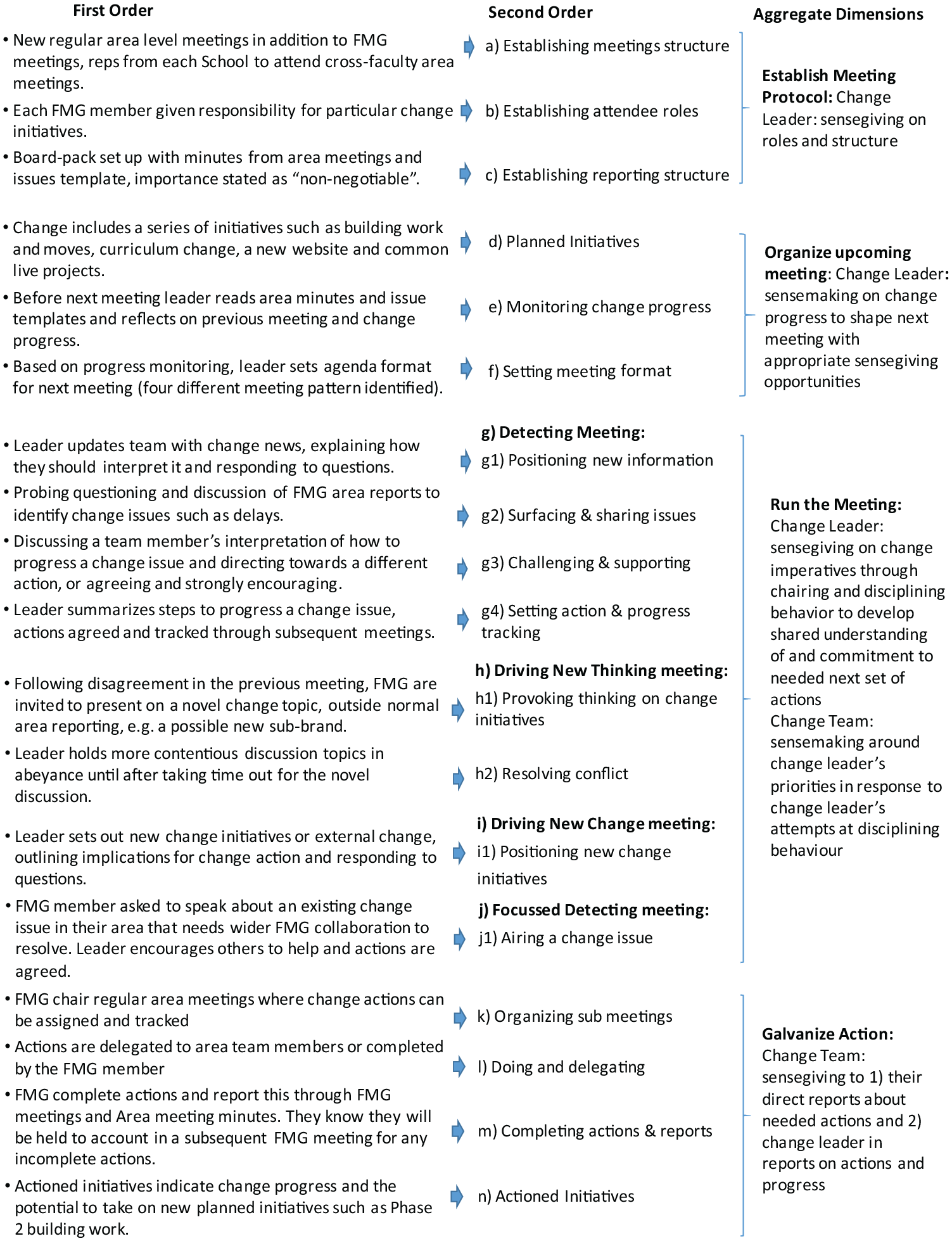
Data structure.
We focused first on the phase ‘run the meeting’ as the most significant phase in which the dean interacted with the FMG to influence change activity. We identified four different meeting formats: ‘detecting’, ‘driving new thinking’, ‘driving new change’ and ‘focused-detecting’ (see Appendix 1, provided as online supplemental material, for summary of meeting dates and analysis of meeting format). To identify what differentiated the meetings, similar to others we used meeting transcripts to study the conversations (Spee & Jarzabkowski, 2017). We noted interactions that were outside of the usual pattern of conversation, such as heated argument and irritability, and unusually strong praise or leisurely time-keeping. This analysis enabled us to identify different patterns of sensegiving in the way the four types of meetings were run using two broad categories which we labelled ‘chairing’, and ‘disciplining behaviour’. Chairing refers to activities such as time keeping and moving the meeting along while ‘disciplining behaviour’ refers to diverse tactics used by the dean to influence the FMG meeting attendees to adopt what he sees as the change related behaviours and actions required of them. We use the term ‘disciplining’ consistent with Rouleau (2005) rather than in its more commonplace use as a term connotating control and punishment. Rouleau (2005) draws on Foucault (1977) to define this sensegiving activity as to do with managing meaning by generating sensemaking in others through the use of symbolic, corporal, and discursive tactics, to subjectively influence these others by creating sense for them and diffusing meanings around a change. As such, it is consistent with the representation of the skilled practice of sensegiving as ‘sense wrighting’ (Mangham & Pye, 1991; Rouleau & Balogun, 2011) and which is intertwined with the simultaneous cycles of sensemaking and sensegiving of others in processes of negotiation. We also noted, however, that the meetings were informed by what went on outside of them.
Our analysis revealed the dean to adopt different meeting formats in different circumstances for different purposes. The ‘detecting’ format was the most common meeting format, selected by the dean to enable his ongoing oversight and guidance of the change process. It involved a consistent agenda focused on area reporting of issues and progress by every attendee. The dean would adopt a ‘driving new thinking’ format when there had been intense and prolonged disagreement over the change process and needed activities among the FMG in the previous meeting. The agenda that characterized this format involved asking two or more FMG attendees to present on a novel topic outside normal area reporting. By comparison, the dean would adopt a ‘driving new change’ format when he judged the need to move the change process forward through additional (new) change initiatives. This format enabled him to delegate these new change initiatives and activities to relevant members of the FMG. Finally, the dean would resort to a ‘focused-detecting’ format when he identified an issue in one area that required wider cross-functional support to resolve it. An additional agenda item was allocated to one FMG attendee, the issue owner, providing an extended opportunity to share the issue with other attendees.
We then found ‘disciplining behaviour’ to involve a number of different sensegiving tactics dependent on meeting format. See Figure 1. For example, in detecting meetings disciplining behaviour included ‘positioning new information’ where the dean used sensegiving to guide attendee understanding around recent events, while ‘surfacing and sharing issues’, involved probing questions to develop a shared understanding of each FMG attendee’s change issues. Through ‘challenging and supporting’, the dean then sought to guide attendees’ actions and behaviours by challenging them to do things differently or supporting and encouraging existing ideas. In the ‘driving new thinking’ format disciplining behaviour involved a two-phased approach in which the dean was able to agree actions on a contentious issue, aided by phase one. First, in ‘provoking thinking on change initiatives’ a novel topic was presented and the dean encouraged participant sensemaking. Discussions on the topics that had caused heated debate in the previous meeting were held in abeyance, enabling the dean to rebuild rapport with the team. Second, the dean engaged in ’resolving conflict’ returning to the contentious issue and agreeing actions with the team through a cordial, unheated discussion. In the other three meeting formats, ‘chairing’ typically involved brisk time-keeping but during ‘provoking thinking on change initiatives’ time-keeping was unhurried and people were uninterrupted for longer.
We sought to understand if and how the actions from the meetings resulted in the completion of change initiatives. We identified that different meeting formats or patterns of dean sensegiving generated different patterns of sensemaking in the FMG members, relevant to subsequent action. Detecting meetings involved diagnostic sensemaking, in which FMG members had to share change progress for their individual area, respond to probing questions and adjust their ideas about how issues might be resolved based on sensegiving by the dean. Driving new change involved adaptive sensemaking in which FMG members needed to make sense of new change initiatives and consider how to incorporate this into their work area. Focused detecting meetings involved FMG members in collaborative sensemaking, in which they were required to work together to solve the specific issue being addressed in the meeting (of one FMG member) and agree a supportive plan. Driving new thinking involved a mix of all three types of sensemaking. These sensegiving and sensemaking patterns contributed to agreed decisions and change implementation actions from the meetings that led into galvanize action.
‘Galvanizing action’ occurred through each FMG member ‘organizing sub meetings’ in their areas in the week between the fortnightly FMG meetings, and ‘doing and delegating’. Importantly, the progress of those actions was then tracked by the dean through the area meeting minutes and action reports, against which FMG were held to account in subsequent FMG meetings. Drawing on interview data with FMG we found that this transparency, and the experience of being held to account, encouraged FMG in ‘completing actions’ and progressing the change implementation.
This enabled us to understand the importance of the organize upcoming meeting phase. We identified that sensemaking activity by the dean before each FMG meeting involved ‘monitoring progress’ through activities such as reading minutes of the area meetings, reflecting on the previous meeting and how it had played out, and considering what he wanted to achieve from the next meeting. He then used this sensemaking insight in ‘setting meeting format’ for the next meeting, deciding which of the four meeting formats was most appropriate for what he wanted to achieve.
This analysis in turn gave us insight to the criticality of establish meeting protocol: ‘establishing attendee roles’, involved each FMG member being allocated responsibility for a portfolio of change activities; ‘establishing new meeting structures’ included the introduction of the synchronized fortnightly meetings, and ‘establishing reporting structures’, involved providing area meeting minutes and issue templates to the dean in advance of the subsequent FMG meeting. This designed meeting structure enabled the dean to maintain an oversight of the change process and how its implementation was progressing.
Figure 2 below captures the meetings-based change process we identify from our aggregate constructs, and that enables a change leader (here the dean) to guide and galvanize change action of a senior management team (here the FMG). The long arrow at the top represents the dean’s high-level change plan against which he monitors progress, drawing down and updating planned initiatives as change implementation moves forwards.
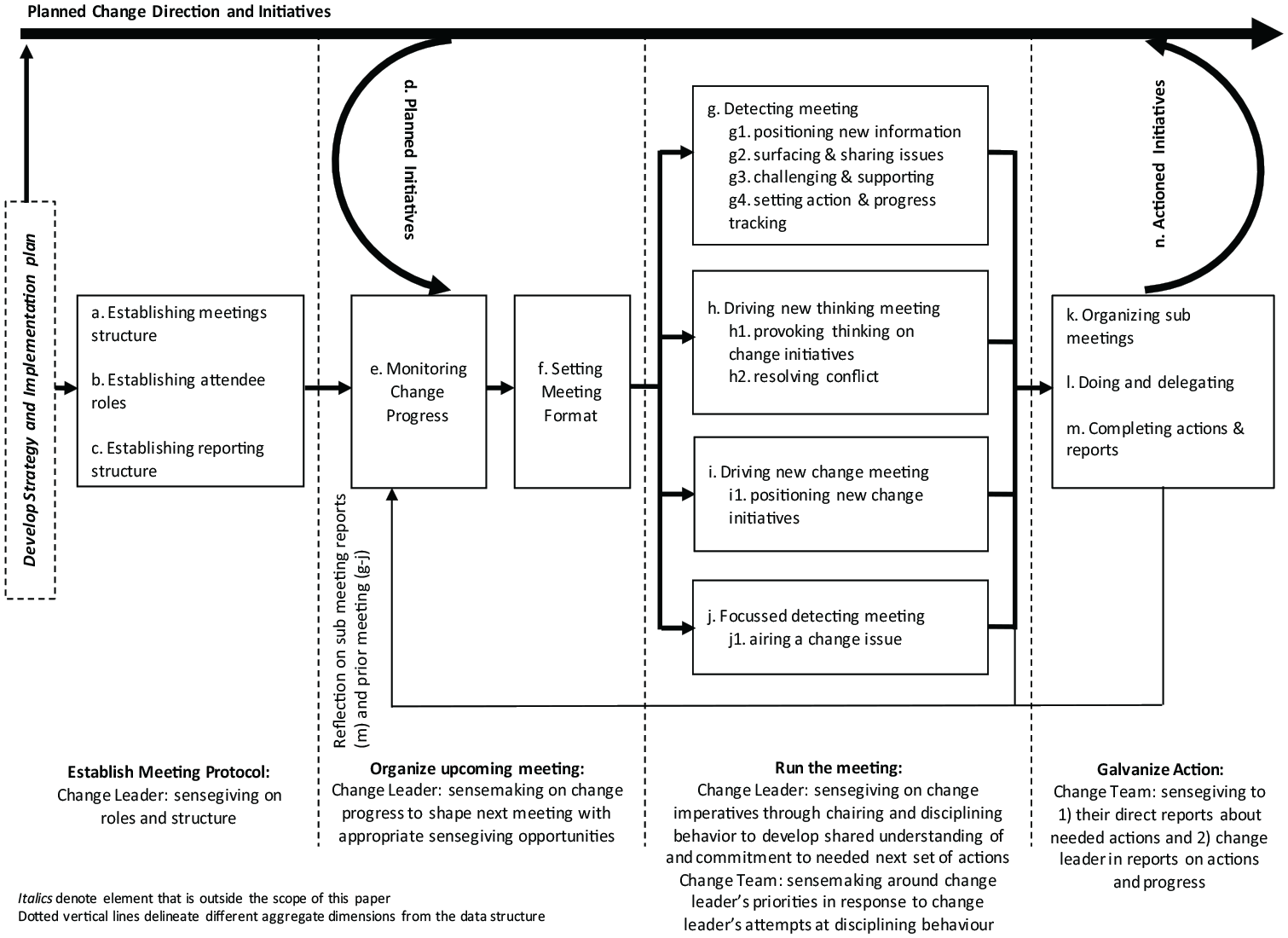
Process model of the role of meetings in implementing change in a pluralistic context.
Findings
In what follows we present our findings on the meeting-based process model we identify in Figure 2. The letters (a) to (n) refer to the second order concepts in the data structure (see Figure 1) while the letters P1a to P3d refer to the planned change initiatives in Table 1.
We present evidence for a particular sub-set of meetings from 25 July 2012, when the undergraduate summer shows were closing (P1d) and the 2011–12 academic year was almost complete, to 14 November 2012. This time period is a representative part of the process, featuring all four meeting formats. The main priority was preparation for the new academic year in October 2012. The team were managing the key change initiatives for this, which included temporary relocations so the building and refurbishment work could commence (P1e–f), and the introduction of new administrative and curriculum changes such as managing the development of the new studio system and studio modules (P2a–h).
We start with an overview of how the dean established the meeting protocol.
Establishing meeting protocol
Establishing meetings structure (a)
Interviews reveal that the dean intended the fortnightly FMG meetings to be the main forum for policy discussion:
The aim is to have. . . no sort of major discussion of faculty policy except through FMG . . . what I’m trying to avoid is this constant bypassing of the hierarchy. (dean interview)
Establishing attendee roles (b)
FMG meetings were attended by the 12 FMG senior managers. The dean met with each attendee following the restructure and delegated a portfolio of change work for which they were responsible and which was reported on at each meeting.
I introduced exactly the same system [elsewhere]. . . the first thing I did there was to do exactly the same which was to give each of the members of council a portfolio. . .and they had to deal with that themselves and they had to report back to council about their portfolio. (dean interview)
Establishing reporting structure (c)
FMG attendees were required to provide their area meeting minutes and a template highlighting key issues, which was circulated as a board-pack on the Friday before the subsequent Wednesday FMG meeting. The dean was insistent that the reporting process should be maintained even at the busiest times.
The cycle is really non-negotiable. So even at times of high pressure, those meetings need to happen in that weekly cycle and the minutes need to be with us on the Friday. . . because we do not have time to go dark. . . there’s too much on our plates. (dean FMG meeting)
FMG meetings: 25 July to 14 November 2012
Movement between different meeting formats enabled different sensegiving opportunities which facilitated sensemaking of the FMG through different types of interaction between them and the dean, feeding into change action.
25 July: Driving new thinking
As usual, the dean set the meeting format based on his monitoring of change progress (e). Using his overall change plan, he assessed progress in actioned initiatives (n), as reported through the area meeting minutes (m), and considered what new planned initiatives (d) to introduce, and considered behaviour in the prior meeting (g–j), to determine the format of the meeting on 25 July. For example, he reviewed area minutes to identify topics he wanted to probe further.
A couple of things I picked up from architecture’s minutes. [Architecture head] reported a meeting with [technical head] regarding additional computer-based training programmes for CPD and short courses. . .this is all joined up, is this? (dean)
He identified no significant delays or issues related to most of the change initiatives currently being implemented. However, as was typical when strong disagreement arose in one meeting, the dean set up the 25 July meeting as a driving new thinking meeting in response to an unusual level disagreement in the prior 11 July meeting about how to manage the MA summer show. In an exchange between the dean and the technical head the dean’s tone had been critical, emphasizing that he was having to repeat himself, ‘all I’m saying all over again’, with the design head telling the dean his choice was wrong.
So, can we identify someone other than [the marketing head], I’m not volunteering in any shape or form. . . My view is that it shouldn’t be any of us [managing the MA show] because we are involved in all this other stuff. (design head)
As for all meetings of the ‘driving new thinking’ format, the dean asked one or more members of FMG to prepare to talk about something that was outside the normal discussion topics. On 25 July this involved the dean telling FMG to come to the meeting with their five key priorities for the next year. As was typical of this format, the dean chaired the meeting (h) by provoking thinking on change initiatives (h1), a pattern of sensegiving, where the dean relaxed his typically fast-paced, blunt chairing style and adopted a more relaxed approach. Extended time was given for people to speak at length on a novel topic, without interruption or criticism, while the dean listened attentively and made notes.
I want each of you just to share . . .the five key points that you think are the most significant ones for the year ahead. So we’ll have a conversation about that for about forty minutes or so. . . (dean)
FMG responded in kind, adapting their own sensegiving to a more reflective style. The architecture head, for example, talked about developing a common craft making culture.
. . .really to begin to deliver the kind of . . . the new Bauhaus as a kind of model in terms of that craft making agenda, moving on to live projects, so that as a studio culture is something that unifies us. . . (architecture head)
As with other meetings of this format, this encouraged collaborative sensemaking, between the FMG members and adaptive sensemaking as FMG members considered the implications for their own change activities, holding in abeyance any residual tension from the previous meeting. Then the dean engaged the second form of disciplining behaviour typical of this format of meetings, namely resolving conflict (h2). He returned to the contentious issue of the MA summer show, having attempted to dissipate tensions before tackling this difficult subject.
So let’s just stop that and let’s just talk about this MA show for just a moment because it seems to highlight a lot of the issues. (dean)
A series of actions were now agreed in contrast to the 11 July meeting with its significant disagreement and resulting lack of shared understanding. Shared management of the show was agreed between the marketing head, business manager and deputy dean, and the technical head took on an action to arrange technical support for the show.
Following the meeting, connection from FMG agreed planned actions to actual change activities was galvanized by the area meetings in the following week (organizing sub meetings (k)), where the FMG members could delegate work (doing and delegating (l)). This resulted in actioned initiatives (n) which once completed were reported to the dean through the reporting structure of sub-meeting minutes and issue reporting (completing actions and reports (m)). For example, the technical head’s action to arrange technical support was tracked through the actions and minutes of the technical area meeting. The transparency of this process, and the knowledge that people would be held to account in the meetings, had a galvanizing effect, increasing pressure on FMG attendees to complete actions.
It drives me mad at some level. But it functions as well because I used to think ‘oh my God FMG is coming up have I done that stuff’, as does everybody else because you don’t want to be named and shamed as the one who has not done it. . . . (design head interview)
8 August: Focused detecting
By the next meeting on 8 August, the new website was launched (P1c) and the building and refurbishment work (P1e–f) was under way and change initiatives that would continue through the new academic year (P2a–h), such as the new studio system, were largely on track. However, the dean identified an ongoing issue with the launch of a new series of short courses (P2d) in his monitoring change progress (e). In the 13 June meeting, the project head had been encouraged to launch in time for the autumn season and was assigned an action to agree a list of courses by 1 August. However, subsequent minutes and meetings showed limited progress. The dean, therefore, set up the meeting on 8 August with a focused detecting format; a format adopted when there was something problematic that needed wider action from FMG to move it forward. The dean pre-established the meeting format (f) by asking the project head to lead an extended discussion on the short course portfolio. In running the meeting (j) the dean adapted his typical chairing style by speeding up the normal area reporting to provide the speaker with sufficient time to air the change issue (j1), here the short course portfolio. Then, as with the chairing of other meetings with this format, he handed over to the FMG issue owner to lead the discussion, to generate collaborative sensemaking within the FMG.
I have been talking to . . . the faculty, and various school reps and heads of school. This is a combination of proposals that we have received and courses that already exist and courses that [colleague] and I are now proposing should exist. . . but we need to put people to them. We don’t have any tutors for them. (project head)
Following the presentation, the team discussed the issue together and a series of actions were agreed to facilitate change progress. For example, it was agreed that the projects team would ‘buy’ staff time to provide teaching from the different schools for 30 courses and that the courses could now be listed on website. As with all meetings, action was galvanized through the area meetings held by FMG members and the monitoring and tracking of the meetings through the FMG meeting minutes. By 28 November 2012 the short course area had done so well that the dean agreed additional support with an extra part-time person.
22 August: Detecting meeting
By 22 August progress on all current change initiatives (P1d–f, P2a–h) was proceeding broadly in line with expectations. Therefore, the dean set up the meeting with a detecting format, the default format adopted when no issues were identified in monitoring change progress (e) that would warrant a different meeting format. In running the meeting, the dean followed the typical agenda for such meetings, including reviewing prior meeting minutes and chair’s announcements to position new information (g1). The main part of the meeting was area reporting where disciplining behaviour took on different forms (surfacing and sharing issues (g2) and challenging and supporting (g3)) as each attendee was required to speak in turn about change progress in their area. In the example here, during surfacing and sharing issues (g2), the technical head voiced concerns about how he could prioritize access to workshops for different groups (P2b). The dean challenged (g3) the technical head to develop a calendar and galvanized action (g4) by setting a deadline to deliver the calendar.
. . .how we can review the program of delivery that gets students what they need, when they need it, in a manner that they can clearly understand and still enable the staff to have holidays. (technical head) I would imagine that what you need now . . . is a very simple calendar for each of your workshops. . . (dean) That’s what I started, I’m about 50 percent there. . . (technical head) Well, could I help by just setting a deadline? [laughter] (dean)
When running a detecting meeting, the dean’s chairing style was formal with strong time-keeping creating a sense of urgency, such as ‘okay speed up. Chop chop!’. Attendees compared the meetings to a site meeting on a building project.
He does proper management. Very accountable. He runs [FMG meetings] like proper site meetings. . . something goes wrong you can trace why it’s gone wrong and how it’s happened. (contextual studies head interview)
Despite being rather monotonous, area reporting was part of generating diagnostic sensemaking in the FMG members leading to agreed actions. In this instance the technical head was actioned to produce the calendar by the end of September.
29 August: Driving new change
For the meeting on 29 August, current change initiatives were still proceeding broadly in line with expectations, however, the dean identified the need for a driving new change meeting (i) to introduce change arising from a university-level issue, namely a breach of government recruitment guidelines that had serious implications for student numbers. This was a threat to change progress as it could significantly impact recruitment (P2g) and therefore budgets (P2c), including money for building and refurbishment work (P1e–f and P3a). In setting the meeting format (f), as with other meetings of this format, greater time was allocated to extended leader sensegiving through a significant reduction in / elimination of area reporting. In disciplining behaviour through positioning new change initiatives (i1) the dean used extended sensegiving to introduce new change and generate adaptive sensemaking, to guide shared understanding in line with his own intent and to encourage the team to take on new activities relating to the change. In this example, he attempted to persuade the team that the faculty was well-positioned to mitigate the external change impact, due to their efforts to distance the faculty identity from the wider university identity, steering them to focus their attention back on planned change activities.
I don’t think it’s any accident that we’ve been pushing quite hard for the [faculty] identity to be as autonomous from the mothership as possible. . . we’ll carry on cleaning the floor really well, doing what we do really well because that. . . allowed us to sail through the last sort of university debacle. . . we have to be very strong and just carry on with the move, with the website launch. . . (dean)
New actions were agreed by the dean and FMG members which were distinct from existing planned change initiatives. For example, the student satisfaction head was tasked with obtaining university-level data needed to reforecast the phase 2 building work (P3a), and consider lower-cost scenarios.
5 September to 14 November
By early September, the new academic year was imminent and FMG members were very busy with associated change activity (P1e–f and P2a–h) including completion of the building work and the launch of new short courses and a common, year-long cultural context theory module. There was a series of detecting meetings which was typical in busy change periods, but which was brought to an end by the 31 October FMG meeting.
At this meeting, there was significantly more disagreement than usual. Teaching was under way and issues with furniture that had arisen (P1f) were mostly resolved. However, disagreement occurred over screens that were needed to divide open teaching spaces and reduce noise. The design head linked issues with missing furniture to a wider criticism of the management of the faculty and the speed at which problems were fixed.
The dean appeared determined to counter her criticism by guiding the team to resolve the screen problem quickly. In surfacing and sharing issues (g2), he interrogated the technical head who was using the faculty’s workshop for manufacturing the screens and actually asked him to leave the meeting to get more information.
What’s the situation with the screens? . . .Are they being manufactured? (dean) Not precisely at this moment, no. (technical head) [discussion continues for 10 minutes] It depends on whether or not we can get the material fast enough. I don’t know yet, unfortunately. I mean only to have asked the question. (technical head) Could you leave the meeting and ask the question before we come back to you, so we can crack this one today? (dean)
The design head’s level of criticism, directed at FMG and by implication the dean, was unusual as was the lengthy interrogation of the technical head by the dean, including asking him to leave the meeting to find information, which did not happen in any other meetings we observed. This exchange was an example of strong and sustained disagreement, with levels of irritability that went beyond the established meeting norms. Thus, on 14 November, the long run of detecting meetings was broken with a driving new thinking meeting.
Change Epilogue
By the time the main changes were coming to an end in August 2013, the FMG members were able to reflect back in interviews on the change process and the outcomes being achieved, suggesting that more than change compliance had been achieved through the meetings-based process despite disputes and differences in opinion. For example, the design head remarked, ‘We’ve done an amazing amount, you know, we really have and when you write it all up and read it all out, you know, it’s like, Jesus!’, and ‘We’re starting to get some really significant national competition prize winners consistently across the school and industry is much more seriously looking at us for creative students’. For the fine art head, the new studio system had ‘generated a lot of enthusiasm and excitement . . . it engages the students and there’s a sense of ownership and sense of community’. The technical head perceived FMG members as more collegial, ‘people are more willing to talk. . . more open. . . having the confidence to express feelings’.
Discussion and Contribution
Despite the inherent difficulties in managing strategic change in a pluralistic context, we find a change leader can guide the change-related actions of others to achieve change outcomes similar to those initially set out. This is achieved through a process of orchestrated and coordinated meetings, linked through time in a recurrent meeting cycle, and underpinned by change leader sensemaking and sensegiving (see Figure 2). The change leader chooses different meeting formats based on how they assess implementation progress, to create different sensegiving opportunities to influence change activities of the wider implementation team, keeping change moving forwards against plan. This meeting cycle enables ongoing conceptualization by the change leader and the implementation team of the more detailed change actions required to achieve the higher-level change plan, and in a way that also follows through into implementation of these actions.
Our findings enable us to make three contributions to research. First, we contribute to research on strategic change implementation in pluralistic contexts. Second, our findings enable us to contribute to research on strategy meetings and change. Third, we contribute more generally to research on enablers of change leader sensegiving during strategic change implementation.
Strategic change implementation
Our meetings-based process model contributes to a growing body of research (see for example, Jarzabkowski et al., 2019) that explores how strategic change implementation is facilitated rather than how it leads to unintended outcomes, although with particular relevance to pluralistic contexts. It also extends what we know about change leader sensemaking and sensegiving in university contexts that to date are only in the context of change initiation (Gioia & Chittipeddi, 1991; Gioia et al., 1994), contributing to limited studies exploring challenges for senior managers in sustaining strategic change over time (Huy, Corley, & Kraatz, 2014). We identify four inter-linked phases.
First, initiation of a meetings structure through ‘establish meeting protocols’ is critical to generating a structure that enables ongoing oversight of the unfolding change progress, leaving what the dean here described as ‘no dark corners’. The next three phases of organizing upcoming meeting, running the meeting, and galvanizing action then form the recurrent meeting cycle through which relevant change activities to meet the change plan are agreed and actioned.
Organizing the upcoming meeting is a phase of change leader sensemaking, in which the leader gathers information from reports of the change implementation team on their actions since the last meeting and, importantly, reflects on the change team reactions in the prior meeting. Through this sensemaking phase the change leader decides on one of four formats for the next meeting (detecting, driving new thinking, driving new change and focused detecting), enabling the leader to create sensegiving opportunities in the meeting that align with their perception of what influence is needed to keep the change implementation team moving forwards.
The second phase, running the change meeting, is a phase of change leader sensegiving. How the meetings are chaired and how the participants and their reactions are managed is central to outcomes achieved. As we illustrate in our findings, the different meeting formats involve different types of sensegiving tactics that we label ‘disciplining behaviour’ consistent with other research in sensemaking (Rouleau, 2005), because so often the sensegiving is about achieving a productive dialogue to influence the sensemaking of the change team in a direction consistent with the intent of the change leader. Thus, running the meetings involves significant sensegiving skill to generate different patterns of sensemaking in the change team. Resistance and pushback to the change leader’s plans do occur in the meetings, as our findings demonstrate. Yet the change leader has ways of managing this through the range of tactics deployed. The outcome from this phase is a number of agreed actions the change implementation team are then supposed to make happen, either through doing things themselves or delegating in turn to their team.
Linkage to action is facilitated through the final phase of galvanizing action. In contrast to studies that cite a lack of linkage to subsequent action as a reason meetings fail to deliver change (Jarzabkowski, 2008; Johnson et al., 2010), we find activities that support connection. It is not just that sub-meetings take place. The awareness that the change leader would monitor the sub-meeting minutes holding people to account for agreed actions in the next management meeting with potential for ‘naming and shaming’ was important, as was the use by the dean of information on actions taken in the sub-meeting minutes in his design of the next meeting.
Our first contribution is that we show ‘disciplining behaviour’ to be critical to change outcomes. A range of diverse ‘discipling behaviour’ tactics are needed at different points in the change meetings, to balance the management of tensions and multiple priorities commonly identified in studies of pluralistic organizations and still evident here, while also maintaining a forward momentum. These tactics and their synchronization over time balance negotiation and persuasion, both the covert and overt we know to be part of sensegiving activity (Schildt et al., 2020), to generate sensemaking in participants consistent with the required change direction and that support relevant change related behaviour and actions. As such, discipling behaviour requires judgement as to its appropriate form at any one point in time, linking to our second and third contributions detailed below. These findings go beyond those who associate the skill of chairing meetings in university contexts with practices such as the ability to move people through agenda and manage time (Jarzabkowski & Seidl, 2008), and the rhetorical skill identified more generally in pluralistic contexts (Jarzabkowski & Sillince, 2007; Sorsa & Vaara, 2020).
Importantly, as we explain in our methods section, the term ‘discipling behaviour’ can be seen to imply coercion, particularly when coupled with tactics such as achieving compliance through monitoring mechanisms. From a critical perspective (for example, Kallio et al., 2016; McCabe, 2018; Ogbonna & Harris, 2004) these would be illegitimate approaches more likely to engender resistance. However, the term is consistent with other sensemaking studies, particularly Rouleau (2005), and with recent research into sensemaking and power (Schildt et al., 2020) with its acknowledgement of what could be termed the ‘dark side’ of sensegiving involving covert influencing. Findings are also consistent with those arguing for recognition of productive resistance (Schildt et al., 2020; Veltrop et al., 2021). The change leader specifically sets out certain meeting formats to take advantage of such dynamics, harnessing disagreements to find workable solutions to issues and problems as they arise, by using within meeting negotiation and persuasion to unite the team around actions which support the change process. It might be that we are finding that combining overt performance management (‘progress tracking’) with more collegial ‘sharing issues’ and ‘supporting’ reduces perceptions of high control known to generate discontent in university settings (Kallio et al., 2016; McCann et al., 2020). And there is no denying that our findings support those developing a dramaturgical strategy perspective (Whittle et al., 2020), showing change leaders to stage manage interactions to influence others. The dean’s ‘no dark corners’ principle is evident, and this might be uncomfortable for some in a university context. On the other hand, there is no evidence of the organized resistance identified elsewhere (McCabe, 2018) or backstage resistance (Ybema & Horvers, 2017) which suggests that the meetings process did enable the dean to skilfully negotiate though points of resistance.
Second, similar to other studies of change in pluralistic contexts (Langley et al., 1996), our findings show that establishing and working consistently with a tight-knit group of players is important. However, the meetings-based process we identify brings the differing stakeholder priorities and objectives, tensions and conflicting interests identified as characteristic of pluralistic contexts (Denis et al., 2007; Glynn et al., 2000; Sorsa & Vaara, 2020), together in one place to be revealed and resolved, through processes of ‘discipling behaviour’, such as airing and sharing issues, challenging and supporting, provoking thinking and resolving conflict. These practices and processes seem to be the way interactive dialogue enables the ‘integrative strategizing’ that Jarzabkowski (2008) identifies as successful to strategy in a pluralistic university context.
Strategy meetings and change implementation
Our findings respond directly to calls for greater understanding of the role of meetings over time, not just to develop strategies but also implement them (Vaara & Whittington, 2012). In addition, we show that the meeting liminality (for example, Johnson et al., 2010) and ceremonial nature of meetings (Ybema & Horvers, 2017) identified by others to work against connection back into an organization to deliver change can be overcome by a meetings-based process involving a linked series of recurrent orchestrated meetings.
Individuals propensity to engage in frontstage demonstrations of change compliance within meetings, while engaging in backstage resistance or sabotage outside (Ybema & Horvers, 2017), would suggest that within meeting behaviour in change programmes requiring more than straightforward structural and physical changes, such as ours, is not alone evidence of achievement. Yet frontstage resistance in the meetings we explored was rare. Thus, the way conflict was managed through, for example, holding issues in abeyance and setting up the next meeting with a ‘driving new thinking’ format, supports those who identify the positive effect of conflict management in strategy meetings (Tuckermann, 2019; Veltrop et al., 2021). Veltrop et al. (2021) similarly identify that intense disagreements in board meetings required a switch to a more participative style of chairing for their resolution. This also avoided illusions of harmony at the expense of change progress by hiding conflict through omission from minutes (Tuckermann, 2019).
We particularly extend research on strategy development meetings in universities. Extending Jarzabkowski and Seidl (2008) we find meetings can provide the chair with enhanced influence opportunities through the use of different meeting formats to create different sensegiving opportunities. Much of this activity is to do with the exercise of soft power, extending findings on the importance of subtler forms of power and influence in meetings in pluralistic contexts (Jarzabkowski & Sillince, 2007; Spee & Jarzabkowski, 2011, 2017). To link meetings to action, the frontstage and backstage activity identified by Ybema and Horvers (2017) is relevant to the change leader as well as meeting attendees, relating to what others call overt and covert sensegiving activity (Schildt et al., 2020). Backstage activity by the chair includes designing meetings in certain formats, in response to progress against plan and recent change recipient responses and actions (receptivity versus resistance). In terms of frontstage, a chair needs to take advantage of the different sensegiving opportunities they create through varied meeting formats in how they chair and practise disciplining behaviour. Similarly, Sorsa and Vaara (2020) argue that in pluralistic organizations more generally unanimity may never be reached; persistent, nuanced negotiation and influencing is needed to progress change.
Change leader sensegiving
An absence of close senior management sensegiving engagement with those responsible for implementing change (Balogun & Johnson, 2005; Kanitz, Huy, Backmann, & Hoegl, 2022; Maitlis & Lawrence, 2007) can lead to change being reinterpreted in its implementation in unexpected ways. Building on others who identify meetings as an important venue for sensemaking and sensegiving opportunities (Maitlis & Lawrence, 2007; Rouleau & Balogun, 2011; Spee & Jarzabkowski, 2011, 2017), our model reveals how this engagement can be achieved in meetings, and which provides the change leader with particular sensemaking and sensegiving advantages. We were initially surprised at the dogged insistence of the dean on regular meetings. However, this approach ensured close engagement over time, through an ongoing process of conceiving the detail of change action and actioning it, through regular small battles of persuasion and guidance rather like hand-to-hand combat. ‘Disciplining behaviour’ was critical to this engagement, involving the skill of crafting and shaping meaning for others in a reciprocal relationship with the sensemaking and sensegiving of these others, captured in the notion of ‘sense wrighting’ (Mangham & Pye, 1991; Rouleau & Balogun, 2011). We found discipling as part of change leader sensegiving to involve a variety of discursive tactics deployed in response to responses of others, as did Rouleau (2005), but to also include the conflict management we discuss above, consistent with sensemaking and sensegiving as processes of negotiation among different groups in an organization. Thus our findings support those who argue that sensegiving skill is intertwined with power and the political skills to influence the meanings of a situation (Maitlis & Christianson, 2014; Maitlis & Sonenshein, 2010).
More specifically, we build on Maitlis and Lawrence (2007) and the notion of ‘discursive competence’ (Rouleau & Balogun, 2011), to how this goes beyond language use. First, our findings extend understanding of ‘setting the scene’ (Rouleau & Balogun, 2011). We show the need for skilled sensemaking judgement as to the type of meeting to run and the nature of its chairing and management, through feedback on progress but also assessment of the current capacity and mood of those responsible for taking the decisions from the meeting. Second, we extend understanding of the sensegiving skill in performing conversations to influence, through identifying the many different and complex forms of ‘disciplining behaviour’ in meetings. We advance Sorsa and Vaara (2020) who demonstrate the importance of being able to apply a variety of different conversational practices. In addition, adding to a dramaturgical strategy perspective (Whittle et al., 2020), we demonstrate the subtlety needed through time in scene setting, requiring an ability to stage manage an upcoming interaction to exert influence based on anticipation of how that interaction might play out. The forum for sensegiving was always the same: a meeting. Yet the format of the meeting and what was done in it varied to provide appropriate sensegiving opportunities.
Limitations and Future Research
Our study has limitations. Consistent with many qualitative studies, we study change in one university and in one particular change context - namely a faculty merger. In addition, our study was in a UK post-1992 university, which are typically more corporate than pre-1992 research intensive universities (Karran & Mallinson, 2019).
We acknowledge that our findings will be surprising for many since it is expected that in pluralistic contexts, such as universities, a process which appears very ‘managerialist’ will be doomed to failure given expectations of democracy and consultation. This leads into a future research agenda. In making suggestions for this we also acknowledge that our setting may have had characteristics that create conditions for lower than expected resistance. It might be that this was perceived as a more positive change process than others (for example, McCabe, 2018) involving as it did the excitement of a new and more prestigious building, and the chance to improve the reputation of the newly forming School. It might also be, of course, that although as we show in our epilogue those involved in the meetings did feel the change outcomes were positive, over a longer period stronger resistance manifested in, for example, staff turnover may emerge. Thus, future research should explore the extent to which our findings hold in different types of universities and different types of change processes, and possibly also different disciplines.
Having said that, it might be that the change process we study is relatively unique with not many other deans attempting such an approach. As a result in our contributions above we have sought to link to other research on sensegiving, meetings and change that may provide theoretically an explanation as to why this change process did deliver against original intentions. Research on sensegiving, power and politics is in its infancy (Schildt et al., 2020) and perhaps this is really where a future research agenda should build, both in pluralistic contexts and others.
Finally, there is a high possibility that our findings apply outside the university context and equally to non-pluralistic contexts and so future research should explore the relevance of meetings for enabling implementation of strategic change in other more corporate settings. Research should also explore the relevance of meetings for change implementation in contexts, pluralistic or otherwise, where frequent close interaction is challenging, such as geographically dispersed organizations. This is all the more relevant in a context of hybrid working which has become far more common following the coronavirus pandemic. Studies could consider whether alternatives, such as online meetings, can provide the chair with the same forms of subtle authority as we identify in face-to-face meetings.
Supplemental Material
sj-docx-1-oss-10.1177_01708406231166815 – Supplemental material for Strategic Change in a Pluralistic Context: Change leader sensegiving
Supplemental material, sj-docx-1-oss-10.1177_01708406231166815 for Strategic Change in a Pluralistic Context: Change leader sensegiving by Lisa Day, Julia Balogun and Michael Mayer in Organization Studies
Footnotes
Acknowledgements
We would like to thank Senior Editor Janne Tienari and the anonymous reviewers for their invaluable contribution to this paper and for their support and guidance throughout the review process.
Funding
The author(s) received no financial support for the research, authorship, and/or publication of this article.

Supplemental material
Supplemental material for this article is available online.
Author biographies
References
Supplementary Material
Please find the following supplemental material available below.
For Open Access articles published under a Creative Commons License, all supplemental material carries the same license as the article it is associated with.
For non-Open Access articles published, all supplemental material carries a non-exclusive license, and permission requests for re-use of supplemental material or any part of supplemental material shall be sent directly to the copyright owner as specified in the copyright notice associated with the article.
