




Abstract
The rise of digital technologies provides an opportunity to study smart cities as new organizational forms. We ask whether and how digital platforms and ecosystems affect the bureaucratic governance of municipal governments. To this end, we offer a multiple case analysis based on rich empirical, longitudinal data of seven European smart cities. We find that the contradicting logic of platform governance creates organizational tensions within the bureaucratic municipal government and at the interface between the municipal government and its external partners. We distil a process that describes how these tensions are resolved through a temporary shift to a non-bureaucratic work mode, and the subsequent formalization and institutionalization of those practices as new bureaucratic rules. We make three contributions. First, we contribute to the smart-city literature by outlining an overarching process of how data-driven technologies affect bureaucratic municipal governments. Second, we contribute to the ongoing conversation about the changing nature of Weberian bureaucracy showing how bureaucracy preserves its core while simultaneously adapting to and shaping its environment. Third, we highlight the role of lower-echelon bureaucrats as change agents who devise rules at the intersection of technological and societal development.
Keywords
Introduction
One approach to conceptualizing smart cities is to view them as municipality-based platforms with surrounding innovation ecosystems (Appio, Lima, & Paroutis, 2019). The platform serves as the core structure and several city constituents – such as citizens, research institutions and private companies – form the surrounding ecosystem. This approach to organizing has been labelled ‘government as a platform’ (O’Reilly, 2010, p. 13), with municipal governments serving as providers of digital technologies and city-related data with the aim of facilitating data-driven urban services and digital entrepreneurship (Barns, 2016; Barns, Cosgrave, Acuto, & Mcneill, 2017).
The promise of a more efficient organization that enables economic value creation based on data has sparked the interest of many bureaucratically organized municipal governments. In Europe, 120 municipal governments
1
are implementing smart tools to enhance their services (EU SCIS, 2022). However, despite the scholarly attention recently paid to this phenomenon (Appio et al., 2019; Mora, Deakin, & Reid, 2019), we lack empirical investigations of the encounter between Weberian government bureaucracy and this new organizational form (i.e. a platform and its ecosystem) (see Kornberger, Meyer, Brandtner, & Höllerer, 2017, for a notable exception). We also have few insights into how municipal governments cope with the tensions that arise in such contexts. As Alaimo (2022) emphasizes: Data objects [the aggregation of data and meta-data that form a new digital entity] and their technological infrastructure radically redraw the links between institutions and bring new modes of knowing and acting which crucially remake the space of individual and organizational agency. (Alaimo, 2022, p. 1092)
To address this issue, we ask the following question: How do urban platforms and ecosystems affect the bureaucratic governance of municipal governments? More broadly, we aim to examine ‘the extent to which decentralized management approaches [such as platforms] alter, replace, or reinforce bureaucratic authority systems’ (Lounsbury & Carberry, 2005, p. 515). Given the lack of empirical studies on this phenomenon and the call for more research on public organizations in general (Arellano-Gault, Demortain, Rouillard, & Thoenig, 2013), we use an inductive multiple-case methodology (Eisenhardt, 1989; Eisenhardt & Graebner, 2007) to cross-examine seven bureaucratic organizations (i.e. municipal governments) in Europe. We document a process of organizational adaptation that deals with the decentralizing principles of the government-as-platform approach and depicts ‘the changing nature of Weberian bureaucracy’ (Kornberger et al., 2017, p. 181).
Our contributions are threefold. First, we contribute to the smart-city literature (Appio et al., 2019; Coletta, Heaphy, & Kitchin, 2019; Kitchin & Moore-Cherry, 2020) by outlining an overarching process of how ‘data-driven technologies’ influence ‘the forms and practices of municipal government’ (Kitchin & Moore-Cherry, 2020, p. 10). We show that senior officials provide the initial strategic impetus for platform governance projects, which is then significantly shaped by cross-functional project teams on the fringes of bureaucracy. The logic of platform governance contradicts bureaucracy and thus creates organizational tensions within the bureaucratic municipal government (official competencies) and at the interface between the municipal government and its external partners (official secrecy). We describe how these tensions are resolved through a temporary shift to a non-bureaucratic work mode inside the municipal governments, which encompasses experimentation and novel practices, and the subsequent formalization and institutionalization of those practices as new bureaucratic rules, roles and processes.
Second, we contribute to the debate about the changing nature of Weberian bureaucracy (Byrkjeflot & du Gay, 2012; Courpasson, 2000; Greenwood & Lawrence, 2005; Kornberger et al., 2017) in the context of smart cities (Pansera, Marsh, Owen, Flores López, & De Alba Ulloa, 2023). Our data suggest that modern government bureaucracies are adapting to the changing environment while preserving their core. To increase their flexibility and innovativeness, bureaucracies have developed a repertoire of add-on possibilities, which include tasking teams with projects that reach across several functional areas and departments. In addition to enhancing flexibility, bureaucracies understand the importance of data for societal development. They combine their administrative capabilities with their regulatory competencies to design rules that inform and govern local data-driven innovation ecosystems with a particular emphasis on civil rights.
Third, we contribute to work on the changing nature of Weberian bureaucracy by highlighting the roles of upper-echelon bureaucrats as initiators of strategic change and lower-echelon bureaucrats as change agents who devise rules at the intersection of technological and societal development. We show that although the platform teams in our case studies were keen to collaborate with external technology partners, they were careful to retain control, and to ensure that technology did not ‘interfere’ in the shaping of society and democracy in the urban sphere. Thus, we observe that lower-echelon officers simultaneously serve as change agents and preservers of municipal bureaucracy.
Theoretical Background
Platforms and innovation ecosystems in smart cities
Digitization introduces a new relationship between the environment, technology and organization (Mikołajewska-Zając, Márton, & Zundel, 2022). Digital platforms are the most ‘revealing instantiation’ (Mikołajewska-Zając et al., 2022, p. 1130) of this new relationship and can be defined as: Evolving organizations or meta-organizations that: (1) federate and coordinate constitutive agents who can innovate and compete; (2) create value by generating and harnessing economies of scope in supply or/and in demand; and (3) entail a technological architecture that is modular and composed of a core and a periphery. (Gawer, 2014, p. 1245)
Notably, this conceptualization of platforms regards ‘technology as that by which organization arises as a possibility’ (Beyes, Chun, Clarke, Flyverbom, & Holt, 2022, p. 1003) instead of confining it to a tool that is being used by humans (Beyes et al., 2022). Due to their layered modular architecture, platforms often provide the technological core for innovation ecosystems. Multiple actors can connect to a platform through shared or open-source technologies and/or technical standards (Gawer, 2014; Jacobides, Cennamo, & Gawer, 2018). These actors increase the platform’s value for its users because of ‘the collaborative arrangements through which firms combine their individual offerings into a coherent, customer-facing solution’ (Adner, 2006, p. 98).
Appio et al. (2019) suggest the application of the platform/ecosystem concept to the smart city. 2 Based on work by Hutchison, Bedford, and Bedford (2011) and Giffinger et al. (2007), their framework depicts platforms and ecosystems as the nexus between the physical infrastructure and the quality of life in smart cities. Conceiving of smart cities as urban platforms instead of just ‘places’ significantly shifts the ways in which cities might function (Bollier, 2016), due to the role of technology as a mediator of everyday life (Beyes et al., 2022). Municipal governments converge towards the role of platform provider in smart-city ecosystems because of their status as local authorities and as a result of the ‘step change in urban data’ (Kitchin, Maalsen, & McArdle, 2016, p. 93) generated by embedding digital technologies into urban infrastructure. By running their governments as platforms (Appio et al., 2019; Kitchin et al., 2016; O’Reilly, 2010), municipal authorities seek to create a single core data structure (Kitchin et al., 2016) that software developers can access through standardized interfaces to build applications for citizens.
This approach to conceptualizing smart cities extends beyond the idea of government smartness (i.e. capturing real-world data, using platforms to make the data accessible and available for data-based decision making) (Gil-Garcia, Zhang, & Puron-Cid, 2016). Moreover, it emphasizes co-creation and innovation in efforts to ‘better solve collective problems at a city, state, national, and international level’ (O’Reilly, 2010, p. 11). Thus, the government-as-platform approach to smart-city design embraces three core principles: transparency, participation and collaboration (O’Reilly, 2010). 3
While the government-as-platform approach promises to create social, environmental and economic value in cities, some scholars question its relevance. The main critiques highlight the complexity of urban life and the inability of technology to accurately replicate reality (Hollands, 2008, 2015; Kitchin, 2015). Platform applications are not exact mirrors of reality – those working with the data construct their own visions of the city (Kitchin et al., 2016; Shaw & Graham, 2017). Consequently, the outcomes of government-as-platform projects depend on the people working on those projects and political circumstances (Coletta et al., 2019). For example, Peter and Meyer (2023) find that visionaries in African smart cities neglect the marginal poor and informal sector, as they wish to avoid the ‘messiness’ (p. 9) of African cities. Critics also stress that placing digital affordances in the hands of a small group of software entrepreneurs may have a splintering effect on society (Hollands, 2008). Van der Graaf and Ballon (2019) describe the complex interactions between the multiple stakeholders as ‘digital standoff’ (p. 356) between city planners and application providers regarding who drives the design of future smart cities. Moreover, the effects of this process on municipal governments remains unclear (Kitchin & Moore-Cherry, 2020), with scholars suggesting wider structural changes and the creation of new modes of municipal governance (Kitchin, Coletta, Evans, Heaphy, & MacDonncha, 2017). Given these critical voices, this paper sheds empirical light on how European municipal governments adapt their bureaucratic governance to accommodate urban platforms and their ecosystems, with a focus on tensions and organizational changes.
Bureaucratic organizations, platforms and innovation ecosystems
Weber (1921/1976) introduced the ideal type of bureaucratic organization in his seminal work Wirtschaft und Gesellschaft. He claimed that bureaucracies are technically superior to other organizations. Their rational and machine-like operations allow them to attain the highest degree of efficiency through precision, stability, reliability, unambiguity and strict subordination (Weber, 1946, p. 214). Authority and power are legitimized by law, and there are clear rules for exercising that authority that overrules actors’ personal preferences. In addition, bureaucracy follows the principle of fixed and official competencies, which entails the explicit distribution of official duties; only people with qualified competencies (i.e. experts) are given the authority to carry out official duties (Weber, 1946, p. 216). Bureaucracy also follows the principle of office hierarchy – a fixed system of superordination and subordination in which higher offices supervise lower offices. Management is based on written documents or files. These files, together with the continuous operations of the office, constitute the bureau. The recording and filing of official decisions are important devices for the practice of bureaucracy (Weber, 1946, p. 197).
Weber views bureaucracy as the most rational organization of control. The source of this superiority lies in the control of technical knowledge and in the documented processes of how bureaucracies conduct their business (Weber, 1946, p. 214). These internal documents are kept secret and the concept of official secrecy is an important source of bureaucracy’s prevalence. By dehumanizing itself, bureaucracy – predictably and successfully – eliminates personal and emotional elements from business, thereby protecting itself from arbitrary actions.
Interestingly, while Weber regards technology as the ‘pacemaker for bureaucratization’ (1946, p. 213), digital technology has generated a shift towards networked organizational structures that foster knowledge-based work (Greenwood & Lawrence, 2005). Consequently, many scholars have proclaimed bureaucracy’s downfall. However, bureaucracy might be more nuanced than previously believed (Adler, 2012; Adler & Borys, 1996; Kornberger et al., 2017). 4 For example, Courpasson (2000) finds that ‘soft bureaucracies’ consist of structures of domination and legitimacy, which allow them to simultaneously pursue and control innovation. This suggests that the adaptability of bureaucracy has been underestimated (Gazell & Pugh, 1990). Moreover, some organizational scholars have criticized the oversimplified description of bureaucracy in the discourse concerning its end (du Gay, 2005; Kallinikos, 2004).
In the empirical context of smart cities, some of the organizing principles behind platforms and ecosystems seem to be theoretically at odds with bureaucracy. Decision-making processes are distributed among ecosystem members, who are loosely connected but interdependent actors (Jacobides et al., 2018). Innovation ecosystems rely on openness (Boudreau, 2010) and generativity (i.e. the ability of a self-contained system to produce something novel without input from the system’s originator) (Cennamo & Santaló, 2019; Zittrain, 2008). By enabling generativity, platforms erode organizational boundaries (Yoo, Henfridsson, & Lyytinen, 2010), accelerating the extension of human organization into the external sphere, and thereby they transform the nature of managerial and social control (Mikołajewska-Zając et al., 2022). This requires a delicate balance between constraining actors to avoid value-decreasing activities and providing ecosystem members with enough autonomy to foster generativity (Boudreau, 2012; Wareham, Fox, & Cano Giner, 2014). A recent example of tight bureaucratic controls constraining citizen participation is Pansera et al.’s (2023) investigation of smart-city development in Mexico City. Their findings suggest that bureaucratic and technocratic logics restrict the role of citizens to users instead of participatory co-creators of the urban sphere.
The extant smart-city and bureaucracy literature lacks a sufficient empirical focus on the adoption of the government-as-platform approach by municipal governments. Hence, we lack a clear understanding of how the distributed decision-making processes on platforms and ecosystems (Jacobides et al., 2018) affect municipal government bureaucracies. To fill this void, we inductively investigate seven bureaucratic municipal governments in Europe that tried to introduce the government-as-platform approach in their organizations.
Method
We followed the multiple-case methodology (Eisenhardt, 1989; Eisenhardt & Graebner, 2007). Specifically, we selected seven relevant cases and collected data from various sources within each case. We then undertook an in-depth within-case analysis for each case, followed by cross-case analysis (Eisenhardt, 1989). These analyses resulted in a ‘process theory’ (i.e. a common pattern of how an entity changes and develops; 5 Van de Ven, 2007) of how smart cities adopt platforms and how this changes their bureaucracies. We treated the cases as ‘multiple experiments’ to confirm or disconfirm patterns found in the other cases (Yin, 1994). As our findings are grounded in empirical evidence from multiple cases, the resulting process (a pattern that is common across cases) should be more valid and generalizable than results from a single case study (Eisenhardt & Graebner, 2007).
Research Context and Sample
We studied municipal governments located in smart cities because these public organizations are well suited for studies of organizational change infused by novel technologies (Greenwood & Lawrence, 2005) and, more generally, studies of the changing nature of Weberian bureaucracy (Arellano-Gault et al., 2013; Kornberger et al., 2017). We focused on the municipal governments of Munich, Lyon, Vienna, Rotterdam, Stockholm, Santiago de Compostela and Barcelona.
We adopted the following theoretical sampling strategy (Eisenhardt, 1989). First, we selected cases that fulfilled the criteria of Weberian bureaucracy to ensure that they fit our research focus (Eisenhardt, 1989). Based on interviews, archival data (organization charts and other internal documents) and observations, we confirmed that all sampled cases had the ‘core features of the bureaucratic form’ (Adler & Borys, 1996, p. 61): ‘hierarchy, workflow formalization, specialization’ (p. 61) and legitimacy by law (Table I, available as online supplementary material). Second, we sought similarities within the set of potential cases that could aid in comparison and replication. All of the selected cities were supported by the European Commission’s Horizon 2020 ‘Smart Cities & Communities’ programme, which distinguished them as leading European examples of smart-city initiatives (European Commission, 2018). The programme revolved around energy, urban, technical, financial and social ‘smart’ solutions, and emphasized big data, data management and digitalization (European Commission, 2018). Finally, we sought heterogeneity to enhance representativeness in the sample and increase generalizability. We chose municipal governments in cities of different sizes, in different geographical contexts and with different starting dates for their platform-projects. The characteristics of the municipal governments are summarized in Table II (available as online supplementary material).
Data Collection
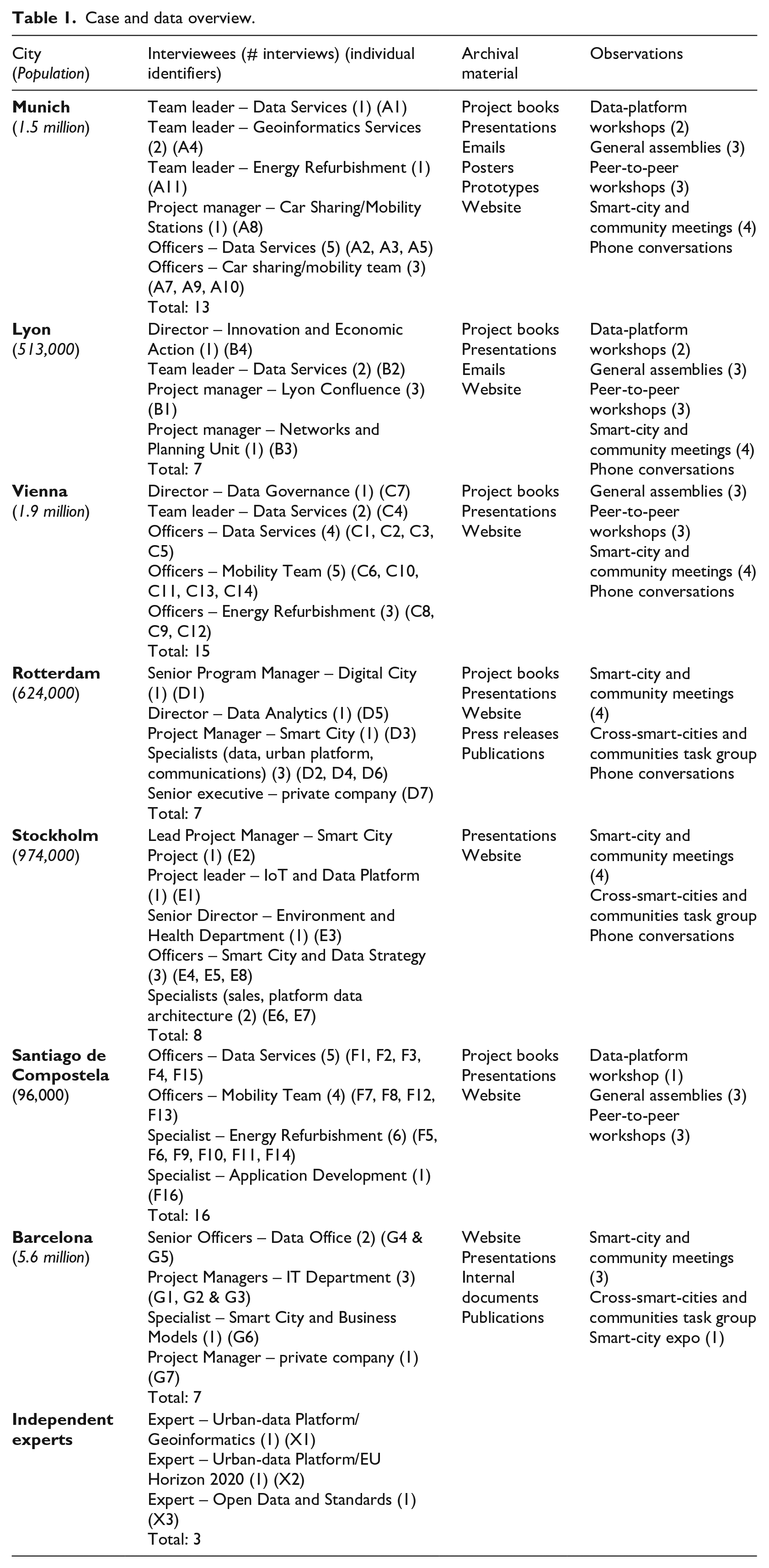
Our data collection stretched over three years. We used different data sources: semi-structured interviews, emails, follow-up calls, archival data and observations (see Table 1). The bulk of our data came from semi-structured interviews with informants directly involved in government-as-platform projects in smart cities. The archival data and the observations expanded our understanding of each case and the broader context and offered insights that corroborated or rejected our interview findings (Yin, 1994).
Case and data overview.
Interviews
We conducted a total of 76 semi-structured interviews between August 2017 and August 2020. Of the interviewees, 73 were directly involved in the design and development of the government-as-platform projects. Three were independent experts on urban-data platforms with extensive experience in European government-as-platform projects who were able to corroborate our findings. We talked to people across varying levels and disciplines, including officers responsible for: (1) the technical development of the urban platform, (2) urban planning, (3) use-case development, (4) energy and (5) transportation. To include the most knowledgeable informants, we used a ‘snowball’ technique in which we asked each initial informant for recommendations on additional interviewees. The interviews lasted an average of 80 min, and they were recorded and transcribed verbatim. The interviews were undertaken in German, Spanish and English. We wrote the case notes within 24 hours of each interview (Eisenhardt, 1989; Miles & Huberman, 1994).
Our interview protocol revolved around tensions related to collaboration, organization and data privacy. Notably, we did not directly ask about tensions. Rather, we started with general questions (Spradley, 1979) about the informant’s role in the city, and about the project, their tasks and their relationships with employees in other departments. We encouraged respondents to wander freely in their narratives and probed whenever possible. After each interview, we assessed the interview protocol and redesigned some of the questions. We continuously and systematically iterated between analysis and data collection in order to become increasingly focused in our interviews (Glaser & Strauss, 1967). We conducted additional and follow-up interviews until we achieved theoretical saturation (Strauss & Corbin, 1990).
Archival data
We gathered written documentation from the municipal governments and their project partners to corroborate our findings. We collected internal documents, such as presentations, studies, press material, project books and other deliverables for the European Commission. In addition, we gathered materials that the cities distributed externally, such as press articles, presentations, websites and other publicly available material. In the project’s initial phases, we used these materials to confirm the informants’ reports about the bureaucratic nature of their organizations. In later phases, we used this archival data to corroborate data from the interviews and to identify other avenues worth exploring.
Observations
Between September 2017 and October 2019, we observed city-internal workshops, cross-collaboration workshops, meetings of representatives of all Horizon 2020 projects and telephone conferences. We also observed knowledge-exchange meetings organized by the European Commission with focus groups working on topics such as data platforms, the digital twin (i.e. a three-dimensional model of the city), smart energy and smart mobility. We documented our observations in writing and engaged in numerous informal conversations regarding the municipal governments’ views on platforms in smart cities.
Data Analysis
Our analysis followed a systematic and iterative approach in line with Glaser and Strauss (1967) and Miles and Huberman (1994). We moved back and forth among the data, emerging patterns and extant literature to better understand the organizational challenges faced by the municipalities during their platforms’ unfolding.
First, we analyzed the data by building individual case studies synthesizing the interview transcripts and archival data (Eisenhardt, 1989). To categorize the raw data, we followed a technique suggested by Van Maanen (1979) in which we coded the interview data using in vivo codes (i.e. first-order codes composed of language used by informants) or descriptive phrases when in vivo codes were not available. This allowed us to gain initial insights into the challenges associated with coordinating different stakeholders, collaborating on tasks without clear goals, and dealing with issues like data quality and data privacy. Two researchers independently coded all interviews. Coding discrepancies were resolved through discussion, which occasionally involved a third colleague as a moderator.
Second, we searched for links among the first-order concepts. This enabled us to group the first-order concepts into second-order themes. A crucial aspect of this inductive analysis was that the codes emerged from the data rather than from pre-defined hypotheses (Strauss & Corbin, 1990). The preliminary results of this stage were shared with several trusted senior-level respondents in order to incorporate their views. This within-case analysis focused on describing the process experienced by each individual municipal government.
Third, we moved from within-case analysis to cross-case analysis. Using standard cross-case analysis techniques (Eisenhardt, 1989; Miles & Huberman, 1994), we searched for similar concepts and categories by comparing the second-order themes of each case. We also compared case pairs to identify similarities and differences (Eisenhardt, 1989). Similar themes were aggregated into dimensions, which served as the building blocks of the emerging framework. To label these dimensions, we looked for similar descriptions of organizational challenges, tensions and potential solutions. To achieve interrater reliability, we involved a second researcher, who probed the labels, and occasionally a third colleague as a moderator. Disagreements were resolved through discussion and additional rounds of probing until the coders reached agreement. We refined emerging relationships by revisiting the data to determine whether each case demonstrated the same pattern, using charts and tables to facilitate comparison (Miles & Huberman, 1994). The process was iterative and lasted five months. The coding structure is illustrated in Figure 1.
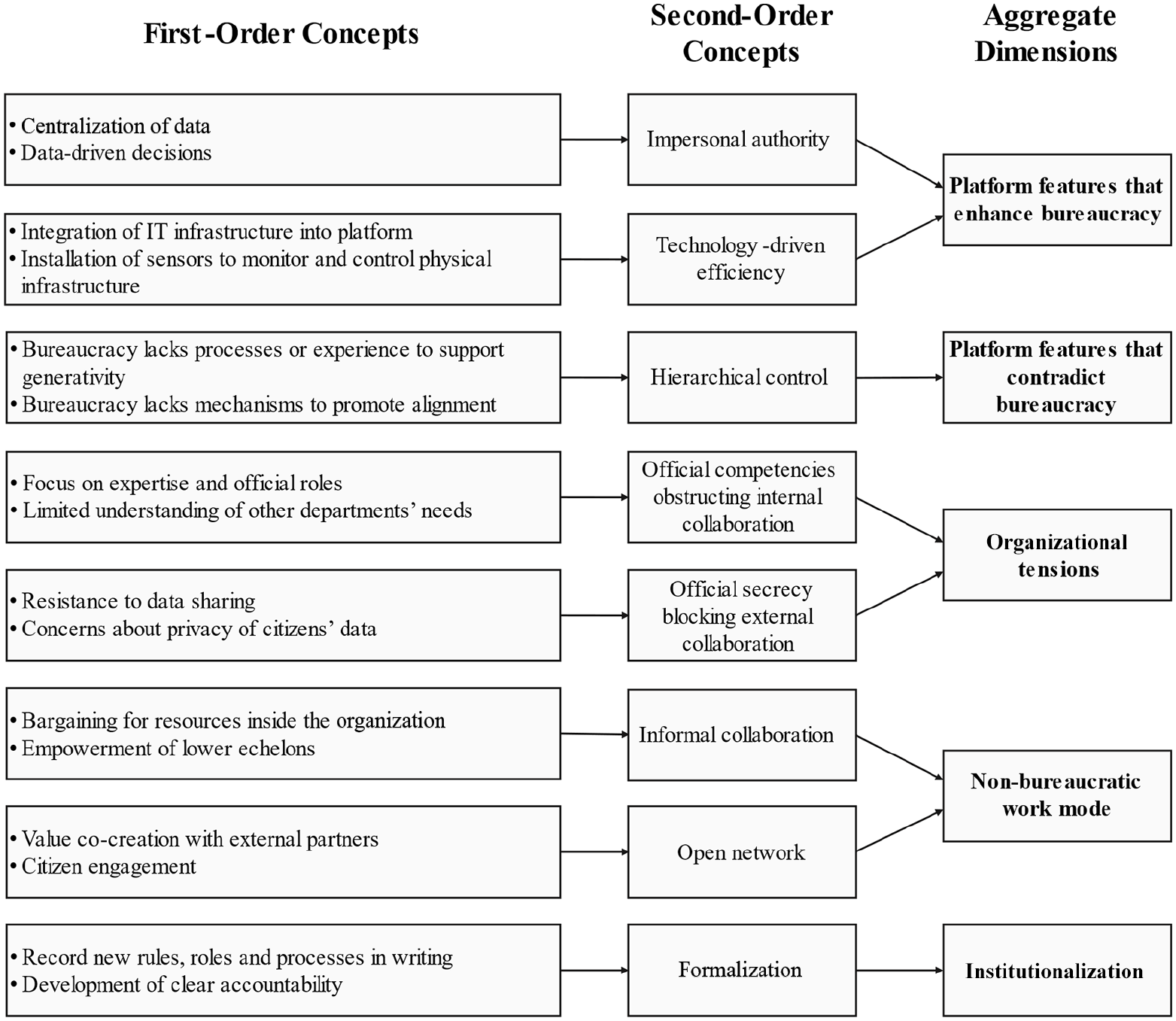
Data structure: The process of unfolding digital platforms in smart cities.
Findings
We investigated how a platform and its surrounding ecosystem (i.e. government-as-platform) affected municipal government bureaucracy in seven European smart cities. Despite some practice differences among the cases (e.g. outsourcing the technology versus developing it in-house; see Table III, available as online supplementary material, for more information), we observed an overarching pattern. Specifically, we uncovered a process on the fringes of bureaucracy through which municipal government officers resolved organizational tensions arising from the bureaucracy-opposing features of platforms as well as the subsequent institutionalization of new roles, rules and processes to incorporate urban platforms in municipal bureaucracies (see Figure 2).
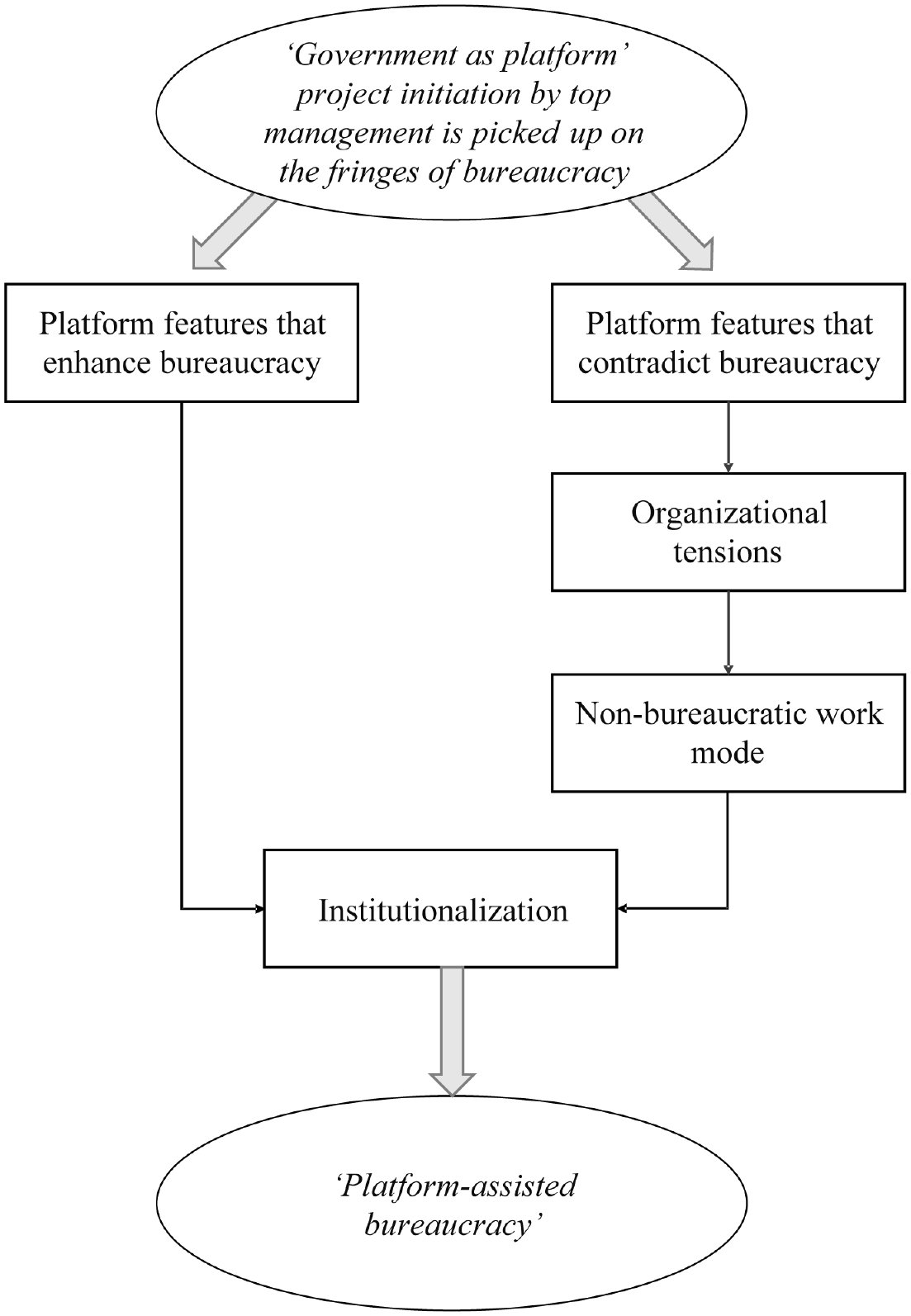
Visualization: The process of unfolding digital platforms in smart cities.
First, project teams were tasked by upper-echelon officials with projects (i.e. designing urban platforms) that reached across the functional areas of bureaucracy. Second, these teams identified platform features that enhanced or contradicted bureaucracy. Third, tensions arose from dealing with the poorly fitting platform features. Fourth, the tensions were resolved through a temporary shift to a non-bureaucratic work mode. Finally, new roles, rules and processes were developed to ‘marry’ the new logic of platform governance with the bureaucratic organization. These new rules were then swiftly institutionalized via written files – one of the most important tools of bureaucracy.
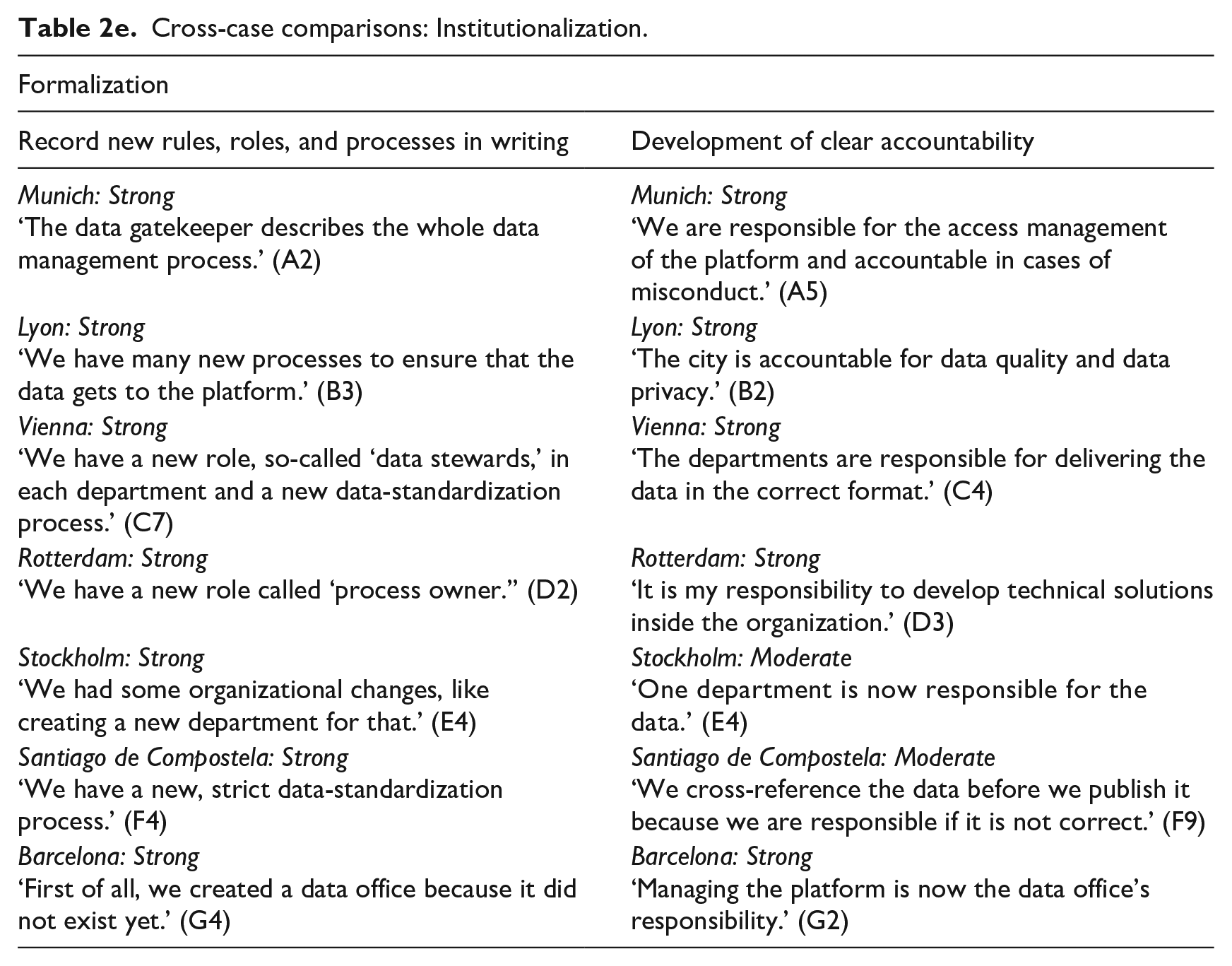
In the following sections, we elaborate on our findings. In line with the comparative case-study method, we do not present individual case narratives. Instead, we structure the findings around the overarching pattern (i.e. the concepts and the process we observed) (Eisenhardt & Graebner, 2007). We present key evidence in two forms: (a) ‘power quotes’ in the text, which are compelling bits of data that serve to illustrate a point, and (b) ‘proof quotes’ in tables (see Tables 2a–2e in the Appendix), which provide evidence of the point across the cases (as advised by Pratt, 2008). We determined the strength of the evidence for each code and case (i.e. strong, moderate, weak) by assessing its frequency as well as the tone used by informants, and we corroborated this evaluation with archival and observational data. Examples of how we assessed the strength of the evidence can be found in Table IV (available as online supplementary material). Finally, to further illustrate the process for an individual case, we present an example of an unbroken narrative for Munich in Table V (available as online supplementary material).
Government-as-Platform Project Initiation: Top Management’s Strategic Impetus is Picked up on the Fringes of Bureaucracy
If you really want to develop an urban platform that is used by the whole municipality, you must develop it across functions. (C2)
The initial strategic decision to pursue a government-as-platform approach was made by the municipal governments’ top management with the aim of building a digitally enhanced backbone for decision-making processes. However, despite the approval of these projects, their scope and details were not further defined. Instead, responsibility for the government-as-platform projects was passed down to lower-echelon officials. Subsequently, these bureaucrats took the initial steps towards the projects’ realization through the creation of cross-functional teams. In Vienna, officers from the IT department formed a team with officers from the energy department. In Lyon, a small data-specialist team inside the municipal government joined forces with the urban planners of the Lyon Confluence project. While Vienna and Lyon did not initially hire additional staff to handle the platform’s development, Munich created a team consisting of new and existing officers. The teams differed in size but typically did not include more than seven members. Larger teams generally included more than two functions (e.g. IT specialists, urban planners, energy experts).
Notably, the change towards ‘government-as-platform’ happened on the fringes of municipal bureaucracy. Upper-echelon bureaucrats provided the initial strategic impetus, but the project teams were generally composed of lower-echelon officers who had little hierarchical power. Thus, the teams had to rely on their ability to convince powerful officers within the bureaucracy of the relevance and legitimacy of the initiative.
Platform Features That Enhance Bureaucracy: Data Centralization and System Integration
From the interviews with the project teams, we identified two platform features that enhanced the municipalities’ bureaucracy. The informants repeatedly emphasized the importance of data as a tool that fosters the core bureaucratic principle of impersonal authority. By centralizing the data on the platform, municipalities created ‘a joint map of the data’ (C7). This increased the information available to government officers, who could use it ‘to make strategic decisions for tomorrow’ (B4). Most importantly, the ability to cite data points as the basis for decisions and use data to measure key performance indicators helped to legitimize actions, thereby fostering impersonal authority.
Moreover, in the spirit of bureaucracy, municipal government officers aimed to leverage platform technologies to increase efficiency by integrating the IT infrastructure into a single digital platform. As stated by the team leader for data services in Munich: The city has developed a strategy for the different departments to run and implement their own digital solutions. It is important that we integrate those solutions into the new platform. (A1)
Efficiency was enhanced by upgrading the physical and digital infrastructure by installing ‘a number of different sensors’ (E2) around the city. In Munich, for example, sensors were integrated into ‘intelligent lampposts’ (A2). In Lyon, they were used to measure energy flows in a new zero-energy district.
Platform Features That Contradict Bureaucracy: Generativity and Stakeholder Alignment
This agile and open innovation process is unique and not very typical for our city. (E1)
The project teams also identified two platform features that clearly contradicted bureaucracy. The bureaucratic municipal governments lacked the processes and experience needed to enable the platform feature of generativity. While it was important to co-create innovative services together with external and internal partners to build a ‘community of knowledge’ (D1), the platform teams did not know where to start. Informants stated that they ‘did not know what to do’ (D2) because they were not accustomed to this type of work. Participants emphasized that they were ‘experimenting’ (A1, C4): The platform will not deliver the use cases by itself. We need to figure out which data are interesting and what we want to use them for. (C3)
One data specialist stated that the municipality’s official bureaucratic processes made it ‘much more difficult’ (D2) to find the right people. Moreover, even when the right partners were identified, it still took ‘a lot of time’ (D2) to determine how to structure and manage a use case. A project manager in Barcelona added that it was difficult to decide which use cases ‘made sense’ (G3). A project manager in Stockholm explained that the departments were not asking the right questions (e.g. ‘How do we collect data so that they support our use case?’) because city officials were ‘not accustomed to working like that’ (E1).
Another feature of platform governance that respondents found at odds with their municipal bureaucracies was that of aligning stakeholders. A data officer explained: There are so many stakeholders, and we are not able to assemble all of them in one room. Therefore, we are trying to act as the interface for everyone. (A3)
The task of finding solutions to ‘bigger problems’ (B1) required the coordination and alignment of actors from multiple departments. While the municipal government officers hoped the platform would facilitate coordination, it proved difficult to align multiple parties. Our respondents emphasized that they could not ‘give orders to other departments’ (D2) to ensure alignment. Similarly, a data-services officer stated that ‘we are stuck in discussions, and we do not even know what we are talking about’ (A5). Another informant highlighted confusion about ‘how to provide all of the information to the right people at the right time’ (G3). A data-services officer from Munich further outlined this issue, stating ‘coordination becomes more complex, and we have to invest more time and resources into coordinating all of the partners’ (A3).
Emerging Organizational Tensions
Two worlds are colliding: the rapid speed of digitalization and the municipality with its rules. (A1)
While the platform teams realized that the platform requirements for generativity and horizontal alignment conflicted with the bureaucratic structures, they were still surprised by the practical difficulties of overcoming this discrepancy. The lack of alignment between bureaucratic structures and platforms surfaced as a pair of organizational tensions. Not only was internal collaboration among departments obstructed by the bureaucratic principle of official competencies, but official secrecy also prevented municipality officers from pursuing projects with external partners that were not part of the official procurement and outsourcing process.
Official competencies obstructing internal collaboration
Convincing other municipal departments to collaborate on the platform proved difficult for two reasons. First, municipal government officers were mainly focused on their areas of expertise and their official roles. Our informants referred to these departmental separations as ‘silos’, as there was ‘a lot of resistance to working together’ (G4). In the silo structure, every department had its own budget and its own internal processes. Therefore, the departments coexisted but were independent from each other. A senior official from Stockholm explained: What we saw as a challenge was [that] the city departments were not used to getting together to create common solutions to their common problems. (E3)
Members of the platform teams explained that other departments did not see a need to support the platform’s development. Data officers from Vienna suggested that this was due to the lack of an ‘official mandate’ requiring other departments to engage in the project. Departments not originally part of the platform team were often quick to state that ‘this is not our responsibility’ (A5, C2). As each department focused on its own function and area of expertise (A5), the joint development of use cases or applications for the platform was viewed as ‘intrusive’ (A1).
Interestingly, many departments began to develop their own platforms and did not see a reason to join the larger platform project (A4). Respondents from Stockholm and Barcelona explained that this was a question of ‘funding and resources’ (E1, G4). The departments were unwilling to contribute resources to a project they did not feel would directly support their functions. Some informants said it was ‘typical’ for ‘everyone [in their organization] to just do their own thing and not talk to each other’ (A5, G5). One data officer explained that people were accustomed to working with their own tools and technologies (G4). He emphasized that an organizational culture change was needed to help people understand that integrated services in a holistic system could offer support instead of ‘making their lives harder’ (G4).
The second issue restricting internal collaboration was a lack of understanding of other departments’ needs. This became evident when platform teams tried to develop cross-departmental applications. One respondent stated that the fact that one department’s data could be useful for other departments was a ‘revelation’ (E7) to many in the organization. The platform teams realized that the development of use cases and demonstration projects was more about identifying the needs and processes of other departments than addressing the technical challenge. In other words, the problem was related more to creativity (i.e. to designing solutions) than to technical skill. As described by one data specialist: Data, IT and technology are not important. It is more important to understand what you are trying to do and what your needs are. (E2)
Consequently, the platform teams were caught in a difficult situation. They could not develop prototype applications that might convince departments to support the platforms because they did not know what the departments needed or ‘how they worked’ (B3). At the same time, departments did not approach the platform teams to request new applications because they lacked an understanding of how the platform might deliver value to them (A2, C2). One data specialist discussed the situation in the municipal government in Barcelona: ‘[The project team] has come to a screeching halt because it has a million solutions and no one talks to each other’ (X3).
Official secrecy blocking external collaboration
External collaboration was impeded by organizational tensions regarding official secrecy. First, departments resisted sharing their data with other departments and external partners (D2) because they regarded their data ‘as their own assets’ (G6) rather than a shared resource of the municipal government. This caused problems for the platform teams trying to develop new solutions that required data inputs from multiple departments: We call it ‘data hogging’. People [inside the municipality] are hogging data because they do not see the purpose of others using their data. (D2)
One data specialist explained that some departments saw no reason to collaborate with external partners, as they thought ‘maybe we can build an application or earn money from this’ (D2). Another cause of the resistance to data sharing was an unwillingness to accept standardized data formats. Some departments felt that because ‘we own the data, we can define how we share it’ (E1). These tailor-made solutions for data formatting allowed each city to address the individual needs of its departments. However, they reduced the ability of technology companies to offer scalable, standardized solutions, thus making smart cities a less attractive business case for them. A representative of a large multinational technology company stated: ‘It is very difficult for us to support these cities in an efficient way’ (G7). For instance, Stockholm decided to use only a fraction of the functions embedded in its platform, which was designed by a large technology partner. A representative of the technology partner indicated that this decision created tension: ‘our whole approach to smart cities has changed’ because ‘we could not implement a one-size-fits-all solution’ (E5).
Second, the municipality departments were concerned about potential violations of data-privacy standards. One data officer stated that even when departments were convinced to share their data, they were concerned about compliance with data-privacy regulations: ‘The data that include interesting information are difficult to share’ (G3).
In fact, the biggest challenge in relation to privacy regulations was whether the aggregation of different types of open data could lead to breaches of privacy. A data and technology specialist explained that this ‘purple Lamborghini problem’ prevented officials from sharing data with external partners: When you know, for example, that Michael Jackson always visits a particular restaurant at a particular time and you observe that there is always a purple Lamborghini parked somewhere around that location, then you know that Michael Jackson drives a purple Lamborghini. (D2)
This statement highlights how the combination of seemingly impersonal data points can generate highly personal information. While this might seem like a minor problem given people’s willingness to share their data on social media, our respondents emphasized that the cities wanted to be perceived as ‘the good guys’ (A5) with respect to data protection. They also wanted to set an example in data governance. The lack of legal frameworks created even more ambiguity, as the cities did not know which data they could share. The European Union introduced the General Data Protection Regulation (GDPR) in May 2018, which reduced this ambiguity, but many ‘shades of grey’ (C7) remained. The fear of misconduct inhibited the flow of information. For example, a special team of data-privacy specialists was established in Rotterdam to handle data-privacy ambiguity. The team adopted a conservative approach and advised colleagues to refrain from publishing ‘risky data’ (D2).
Moreover, the platform teams started to take back some of the tasks they had outsourced to technology companies because of inherent mistrust. Our respondents felt that they had to ‘ensure that the know-how is inside the city’ (C5) and that they could control the servers storing the data. They suggested that private companies might ‘treat data privacy rather lightly’ (B1), while municipal administrations had to ensure high standards of accountability with respect to data management. To this end, the cities went as far as blocking important private partners from their platforms. In Lyon, for example, an international software company unwilling to sign a data-usage agreement was blocked from accessing the software interface (B3).
A Temporary Switch to a Non-Bureaucratic Work Mode: Breaking Away From the Ordinary
Have the courage to implement things and do not ask legal experts for permission – just do it and see what happens. (C4)
Our informants indicated that platform-team leaders decided to switch to a different work mode to resolve the tensions. While working at the fringes of municipal bureaucracy, platform teams switched to a non-bureaucratic work mode characterized by informal collaboration among the city’s departments and an open network that included external partners.
To enable informal collaboration, the platform teams negotiated access to resources because they had ‘no official mandate’ (A5) to give orders to other departments. Confronted with the long-established silo thinking, the platform teams focused on showing the other departments how they could benefit from the platform. Their ultimate aim was to develop and demonstrate ‘win-win situations’ (C4) to ensure buy-in. For example, with the assistance of a business school, the platform team in Barcelona calculated how much time and money the municipality’s departments could save by storing information in a central data repository on the platform. They asked the departments to invest some time and resources in harmonizing and standardizing their data in order to profit from considerably leaner processes in the future: ‘The role of the data office is to break through the municipal government’s silos to extract and derive value from data for all departments’ (G4).
Another example was discussed by the senior director of the Environment and Health department in Stockholm, who was working on a smart-lighting project. High-ranking city officials could not be convinced to collaborate because ‘the old system had worked fine for literally 100 years’ (E3). However, the director succeeded in convincing the city’s governing body to grant his team a small area in which to demonstrate the application of smart lighting using funds provided by the European Union. The demonstration won over the local government, which ‘decided to change most of the streetlights’ (E3) because of the considerable energy savings. The informant summarized the new way of working: ‘Most of our work involves persuading people from other departments to work with us.’
The second strategy that platform teams pursued to enable informal collaboration was empowering lower echelons by educating them. For example, they facilitated knowledge exchange among the different departments and organized workshops with ‘everyone in the room’ (A1). This strategy of ‘educating the people’ was possible because the platform teams ‘did not have to ask the mayor for consent every time’ (A5), which created flexibility. The platform teams started by presenting potential use cases to forward-thinking department officers ‘who were motivated’ (A5) to join digital projects. After these gatekeepers were convinced, the platform teams presented the use cases to the departments that needed to be involved. Furthermore, the teams sought to demonstrate theoretical use cases in cross-departmental workshops, which highlighted the platforms’ potential to improve the organizational workflow. After a basic understanding of the platform and its role as an enabling tool that made use cases ‘feasible’ (E2) was established, people became more willing to engage. Empowered by new knowledge and the informal working group set-up, people started developing their own ideas.
Some ideas could not be realized without involving external stakeholder groups, such as sensor providers and the ‘community’ (A1) (i.e. citizens). Therefore, the platform teams fostered an open network in order to engage external partners and citizens in value co-creation. For example, the platform team in Stockholm was ‘dependent on external consultants’ (E4). Barcelona also chose to ‘open the ecosystem and have conversations with big and small companies’ (G4). Our respondents described these collaborations as innovative and different from usual routines. This experimental mindset allowed them to ‘try out new things and find what worked’ (D2) without facing severe consequences for failure. In Munich, the platform team focused on collaborating with start-ups, which they perceived as more innovative than big companies (A5). Respondents from Rotterdam, Lyon and Vienna described similar attempts to foster open networks.
Another important pillar of the open network was citizen engagement. For example, the platform team in Munich used a group of 15 citizens that emerged from citizen participation events as a sounding board on issues related to data protection in the city.
Notably, younger citizens were more open to sharing their data while some older citizens had concerns, emphasizing that they did not want cameras or other kinds of surveillance (A5). Such community involvement was important for building trust between the municipal government and the public: ‘Trust is the key ingredient for getting stakeholders on board’ (D5).
In Lyon, the inhabitants of zero-energy buildings were open to the idea of sharing building-performance data (B1). Munich and Vienna stood out from the other cities, as they engaged with their citizens via workshops and interviews. One data officer described Munich’s approach: We wanted to know what our citizens thought were important data points that we could measure using our sensors. They were interested in traffic and air pollution – they wanted to take the fastest and cleanest route to work . . . They did not want us to collect video-surveillance data. (A2)
In Vienna, workshops were held to increase acceptance of the collection of performance data from refurbished buildings, and to explain how the data would be collected and used. In addition, the municipal government collaborated with a local business to set up an open space near the refurbished buildings, where discussions on the data-collection issue could be held. The space was open for walk-ins during specific times, and the municipal government used it to report developments and decisions directly to the citizens.
Institutionalization: The Engine of Bureaucracy
The temporary switch to a non-bureaucratic work mode characterized by informal collaboration and open networks allowed the platform teams to resolve the tensions related to official competencies and official secrecy. The bottom-up solutions developed through informal collaboration among the lower echelons were formalized and were subsequently institutionalized within the municipal bureaucracy. Institutionalization was enabled through the establishment of new rules, processes and roles, which were recorded in writing. The new written rules and processes could guide and coordinate interactions, thereby allowing the platform teams to break with early problematic routines of ‘going up the hierarchy to get support and down the hierarchy to collaborate with other departments’ (A2). In addition, new digital innovation and data-governance roles were established, including ‘process owner’ (Rotterdam), ‘data steward’ (Vienna) and ‘data advisor’ (Rotterdam). These new roles elevated initial, small-scale strategic efforts to an institutionalized, ‘official’ part of the municipalities. Those in the new roles worked in close collaboration with the platform teams and served as an enabling structure within the municipal governments. Top-level support was also key (C7) (‘You need to make sure that the politicians support you because they also have the power to block you’ (C4)), and our respondents indicated that the upper echelons’ backing support for new leaders with new titles, such as ‘chief innovation officer’ and ‘chief digital officer’, helped to legitimize their roles in the municipalities. In fact, the platform teams gradually moved from a peripheral, ‘alien’ (A2) position within their organizations to centre stage.
Moreover, data protection and data quality were ensured through clear accountability. This involved the development of new governance rules describing access rights to the data stored on the platform. In all of the municipal governments, only the data owners had unlimited access to the data. Other departments that needed data for their operations had the next level of access. In some cases, external users could access the data, but only after submitting a request. Municipality officers with formal expertise in data management then checked whether the external parties’ requests fit with the precisely defined data-usage rules. For example, Munich developed a ‘data-gatekeeper’ concept in collaboration with a leading research institution. The concept included detailed guidelines about data classification, data formats, data ownership and access rights.
Discussion
In this study, we examined how the decentralized governance of urban platforms affects municipal government bureaucracy. We sought to address a call from organizational scholars to study public organizations (Arellano-Gault et al., 2013) to develop a better understanding of the changing nature of Weberian bureaucracy (Kornberger et al., 2017) under the influence of decentralized management approaches (Lounsbury & Carberry, 2005) and data-driven technologies (Kitchin & Moore-Cherry, 2020). Based on empirical data from seven smart cities in Europe, we showed that a government-as-platform approach to organizing simultaneously challenges and reinvigorates bureaucratic organizations.
Our first contribution is to the smart-city literature on urban platforms (Appio et al., 2019; Coletta et al., 2019; Kitchin & Moore-Cherry, 2020). We outline an overarching process of how ‘data-driven technologies’ affect ‘the forms and practices of municipal government’ (Kitchin & Moore-Cherry, 2020, p. 10). We show that government-as-platform projects are initiated by strategic directives from high-ranking bureaucratic officials. However, the power centre’s will does not simply propagate from top to bottom as one might expect from a classical bureaucracy. Instead, it is picked up and significantly shaped by cross-functional project teams operating on the fringes of bureaucracy. We then describe how the lower echelons steer municipal governments towards an adapted form of bureaucracy by experimenting with new ways of working and institutionalizing some of those methods in new governance rules. We identify several platform features that reinforce the bureaucratic principles of impersonal authority and efficiency and demonstrate that other features related to managing the ecosystem create tensions within municipal governments. To address these tensions, the platform teams temporarily switch to a non-bureaucratic work mode inside the municipal governments, which encompasses experimentation with novel practices. The subsequent formalization and institutionalization of those practices as new bureaucratic rules, roles and processes for platform-based collaboration leads to an adapted form of bureaucracy (platform-assisted bureaucracy), which allows for internal and external collaboration while maintaining stability through tight controls.
These bureaucratic controls constrain the influence of tech-savvy individuals (e.g. software entrepreneurs, IT specialists) on the development of urban platforms, thereby addressing a major critique of urban platforms (Coletta et al., 2019; Hollands, 2008; Kitchin et al., 2016). Our findings suggest that the role of technology companies in shaping the urban sphere seems to be overestimated by some smart-city scholars (e.g. Hollands, 2008; Van der Graaf & Ballon, 2019). Contrary to existing smart-city research, we were not able to identify empirical evidence that portraited government-as-platform projects as ‘divorced from actually existing urban politics’ (Barns, 2016) and vendor-oriented visions of ICT-led urban growth (Barns, 2016; Hollands, 2008). Scholars have also criticized the limited or negligible role of citizens in the co-creation of smart cities (Coletta et al., 2019). However, our findings show that cities such as Munich and Vienna emphasized the role of citizens and leveraged the government-as-platform approach to jointly develop new solutions with citizens.
Furthermore, our results describe how municipal governments take an active stance regarding the issue of open data. While Barns (2016) describes a process in which open data is transformed from being central to citizen empowerment to only serving entrepreneurial activities, we demonstrate that bureaucratic officials implement control mechanisms to balance public and private interests. Moreover, our results suggest that the government-as-platform approach is influenced by institutional norms and individuals’ decisions, which relates to the study of dashboards by Kitchin et al. (2016). Like the authors of this study, we observe that the building of the government-as-platform approach was shaped by the wider institutional landscape, and by complex social and economic constraints and power geometries. Finally, our findings support previous empirical results in the smart-city literature that outline the slow pace of change in municipal governments because ‘city administrations are to a degree like an oil tanker’ (Kitchin et al., 2017, p. 279), with bureaucratic departmental silos making it difficult to collect and locate data (Kitchin et al., 2016). We add to this stream of research by defining the root cause of this (perceived) inertia and describing how project teams were able to overcome these organizational challenges.
Our second contribution is to the ongoing conversation about the changing nature of Weberian bureaucracy (Byrkjeflot & du Gay, 2012; Courpasson, 2000; Greenwood & Lawrence, 2005; Kornberger et al., 2017). We explore and document how Weberian bureaucracies preserve their core while adapting to a changing environment and shaping that environment (e.g. by enabling and governing local innovation ecosystems).
In general, Weberian bureaucracies serve two major functions: (1) efficiency based on substantial procedures, hierarchies, staff and standards manuals (Adler, 1999); and (2) legitimacy based on rule-bound bureaucratic processes designed to ensure procedural justice (Kallinikos, 2004). With regards to efficiency, our results suggest that bureaucracies have by now understood that they are not particularly well suited for adapting to environmental change. Therefore, they have developed a repertoire of add-on possibilities (i.e. enabling structures) (Adler & Borys, 1996) to improve their flexibility and innovativeness including, most importantly, cross-functional and temporary teams tasked with projects that reach across several departments. We describe how project teams and departments work together as well as what it takes for project teams to convince the decision makers in charge. With regards to legitimacy, municipal governments have apparently understood the importance of data not only for informing administrative processes but also as key aspect of civil rights and societal development. Therefore, they have integrated data governance into the municipal bureaucracy. In addition, they have combined their administrative capabilities with their regulatory competencies to design rules to inform and govern local innovation ecosystems, with a particular emphasis on civil rights. Our findings show that bureaucracy can remain flexible by ‘reshuffling and re-assembling the roles and role patterns by which it is made’ (Kallinikos, 2004, p. 13).
Moreover, our findings support Nelson’s (2001) suggestion that ‘non-hierarchical patterns can thrive’ (p. 815) in bureaucratic organizations. We illustrate a process whereby bureaucratic officers engage in informal interactions with members of the municipal governments and stakeholders such as citizens outside of the organization bypassing bureaucratic structures. We therefore provide empirical evidence of how ‘the informal organization’ (i.e. the project teams) deal with the paradoxical tensions and once these tensions are resolved, ‘the formal hierarchy can codify the solution with minimal resistance’ (Nelson, 2001, p. 817). In summary, our study not only describes how digital platforms affect bureaucracy, but also shows how bureaucracy ‘strikes back’ by adapting the platform approach so that it is coherent with its inner workings (a two-way street).
Finally, we highlight the role of lower-echelon bureaucrats as change agents who devise rules at the intersection of technological and societal development. We show that while the upper echelons approved or commissioned the government-as-platform projects, they did not define specific strategies or roadmaps. Instead, the projects became grass-root efforts driven by lower echelons. We note that the upper echelons played a dual supportive role: (a) the concentration of high formal power at the top-management level of the municipal government bureaucracies (i.e. power awarded to organizational positions (Blau, 1964)) enabled strategic change (Greve & Mitsuhashi, 2007) by providing the initial impetus; and (b) the upper echelons ultimately legitimized strategic change by formally acknowledging the new roles, rules and processes.
However, most of the work was carried out by lower-echelon officers, who adapted the existing bureaucracy in order to navigate the paradoxical organizational tensions. Therefore, our findings support and extend Greve and Mitsuhashi’s (2007) work by showing that a high concentration of formal power triggers change. However, the direction of change is determined by lower-echelon bureaucrats with low formal power, and by bureaucracy’s core principles. Moreover, our research provides insights into the interplay between agency and structure (Tomaselli, Ebbers, & Torluccio, 2022) by outlining the two sources of legitimacy that elevate the new rules, roles and processes designed by the project teams to an adapted form of bureaucracy: the actions of bureaucratic senior officials (agency) and the legitimacy derived from bureaucratic rule-bound processes (structure).
Interestingly, although the platform teams were keen to collaborate with external technology partners, they were careful not to hand over control, and to ensure that technology did not ‘interfere’ in the shaping of society and democracy in the urban sphere. Specifically, while remaining open to external data contributions, municipal governments managed the ecosystem and tightly controlled the data (via new institutionalized rules and processes). In addition, relationships with ecosystem partners were not aligned through joint incentives (e.g. joint value propositions) (Adner & Kapoor, 2010; Jacobides et al., 2018), but instead through contractual relationships or license agreements. This suggests tight control mechanisms. Thus, we observe how variance-inducing mechanisms, such as experimentation, redundancy and the loose coupling of ecosystem stakeholders, led to stable outcomes (i.e. institutionalization), while variance-decreasing mechanisms, such as routines, control and commitment, simultaneously enabled change (i.e. platform-enhanced bureaucracy) (Farjoun, 2010). Overall, our results support the duality perspective on stability and change, which suggests that the two should be viewed as the twofold character of one object and not as antithetical or separate concepts (Farjoun, 2010).
Implications for Future Research
Our research was motivated by the new conceptualization of smart cities as platform-based ecosystems (Appio et al., 2019). While our study provides empirical insights into how bureaucratic organizations adapt their governance mechanisms to incorporate platforms, we encourage additional research on the effects of digital technologies on municipal governments. Specifically, we believe that future research could benefit from investigating how the management of the ubiquitous information flows stemming from a sensor-enhanced infrastructure shapes bureaucracy.
Furthermore, organization scholars acknowledge that organizational identity can foster or impede change (Dutton & Dukerich, 1991; Zilber, 2002). Our findings suggest that bureaucracies can renew themselves, as certain traditional values, such as efficiency and rationality, echo promises made by novel technologies. We believe that the smart-city phenomenon offers an opportunity to study how bureaucracies manage the broader tensions between identity and change, and to examine which elements of bureaucratic organizations allow them to sustain themselves over time. We strongly encourage additional research in this area.
Conclusion
In pursuit of becoming ‘smart’, some municipal governments are adopting a government-as-platform approach. This entails organizing actors around a municipality-run, platform-based ecosystem to enable technology-driven urban entrepreneurship. In our study of seven European municipal governments, we outlined a process of how digital technologies affect municipal bureaucracy. We revealed how lower-echelon bureaucrats served as both change agents and preservers of bureaucracy by institutionalizing change without contradicting key bureaucratic principles. We also offered insights into the changing nature of Weberian bureaucracy, and the valuable role of formalization in enabling stability and change in platform-based ecosystems.
Supplemental Material
sj-docx-1-oss-10.1177_01708406221130857 – Supplemental material for Bureaucracy Meets Digital Reality: The Unfolding of Urban Platforms in European Municipal Governments
Supplemental material, sj-docx-1-oss-10.1177_01708406221130857 for Bureaucracy Meets Digital Reality: The Unfolding of Urban Platforms in European Municipal Governments by Charlotte-Katharina Lekkas and Vangelis Souitaris in Organization Studies
Footnotes
Appendix
Cross-case comparisons: Institutionalization.
| Formalization | |
|---|---|
| Record new rules, roles, and processes in writing | Development of clear accountability |
| Munich: Strong
‘The data gatekeeper describes the whole data management process.’ (A2) |
Munich: Strong
‘We are responsible for the access management of the platform and accountable in cases of misconduct.’ (A5) |
| Lyon: Strong
‘We have many new processes to ensure that the data gets to the platform.’ (B3) |
Lyon: Strong
‘The city is accountable for data quality and data privacy.’ (B2) |
| Vienna: Strong
‘We have a new role, so-called ‘data stewards,’ in each department and a new data-standardization process.’ (C7) |
Vienna: Strong
‘The departments are responsible for delivering the data in the correct format.’ (C4) |
| Rotterdam: Strong
‘We have a new role called ‘process owner.’’ (D2) |
Rotterdam: Strong
‘It is my responsibility to develop technical solutions inside the organization.’ (D3) |
| Stockholm: Strong
‘We had some organizational changes, like creating a new department for that.’ (E4) |
Stockholm: Moderate
‘One department is now responsible for the data.’ (E4) |
| Santiago de Compostela: Strong
‘We have a new, strict data-standardization process.’ (F4) |
Santiago de Compostela: Moderate
‘We cross-reference the data before we publish it because we are responsible if it is not correct.’ (F9) |
| Barcelona: Strong
‘First of all, we created a data office because it did not exist yet.’ (G4) |
Barcelona: Strong
‘Managing the platform is now the data office’s responsibility.’ (G2) |
Acknowledgements
We would like to thank the anonymous reviewers and the Special Issue editors for their detailed and constructive comments in the process of developing this manuscript. We also thank Karin Kloeti, Jan Albers, Alexander Churyukanov, Tobias Meister and Stefan Schlatter, who helped with data collection. Further, we would like to extend our thanks to Oliver Gassmann and Maximilian Palmié for valuable input at the design stages of this research.
Funding
This project has received funding from the European Union’s Horizon 2020 research and innovation programme.

Supplemental material
Supplemental material for this article is available online.
Notes
Author biographies
References
Supplementary Material
Please find the following supplemental material available below.
For Open Access articles published under a Creative Commons License, all supplemental material carries the same license as the article it is associated with.
For non-Open Access articles published, all supplemental material carries a non-exclusive license, and permission requests for re-use of supplemental material or any part of supplemental material shall be sent directly to the copyright owner as specified in the copyright notice associated with the article.
