




Abstract
Research has demonstrated how ignorance is made, manipulated and called upon; how it is the result of strategies, activities and structures. This article extends the literature on ignorance by exploring actors’ own explanations of their self-inflicted ignorance following acts of ignoring. By means of a case analysis, we explore how actors explain and justify ignoring data they themselves produced. We provide a multifaceted model of how ignoring actors’ own rationales, facilitated by contextual conditions, enables persistent acts of ignoring the content and dysfunction of collectively upheld systems. We contribute to the understanding of ignorance by demonstrating how self-inflicted ignorance is made possible by the combination of ignoring rationales and their facilitators, which configures buffers against knowledge-seeking efforts.
Keywords
Introduction
Although virtually everyone agrees on the significance of information and knowledge, it is perhaps of equal theoretical and practical interest to pay attention to the will to bypass potentially relevant information and knowledge. This intentional production and maintenance of ignorance has recently been given increasing attention (Bakken & Wiik, 2017; Gross & McGoey, 2015; Schaefer, 2019), pointing out how ignorance is not just a lack of knowledge, the not-yet-investigated or the beyond-our-cognitive horizon. On the contrary, ignorance is often made, manipulated and called upon; it results from strategies, activities and structures (McGoey, 2019). In this article, we investigate a special kind of ignorance – namely, self-inflicted ignorance.
Nascent literature on how individuals and organizations ignore what they find inconvenient to know suggests that acts of ignoring may take place through mechanisms of decoupling (Heimer, 2012; Schaefer, 2019), denial (Rayner, 2012) and inattentiveness (Knudsen, 2011). We supplement these studies as we investigate how the actors themselves understand ignoring. Ignoring has a self-reflective dimension because the knower and the ignoramus are identical. It is therefore possible to ask the actors how they explain that they do not use the potentially relevant knowledge they have or know that they could have. We explore in depth how the ignoring actors explain and justify that they ignore data they themselves produced. We condense the explanations into what we call ignoring-rationales. As we demonstrate, the rationales have organizational, ideological, technological and image-related preconditions that shape what counts as valid ignoring-rationales. We refer to such contextual conditions as rationale-facilitators. Rationale-facilitators shape what for the actors is a valid explanation for their own acts of ignoring. The ignoring-rationales and rationale-facilitators are, we suggest, part of what makes acts of ignoring possible. In combination, they fend off the call for response implicit in certain types of information.
We draw empirically on a longitudinal case study of the public release of performance data in the Swedish Public Comparisons (Comparisons) reports, which are examples of transparency and accountability initiatives (Cucciniello, Porumbescu, & Grimmelikhuijsen, 2017) or ‘visibility devices’ (Grossman, Luque, & Muniesa, 2008, p. 113) aiming to improve the governance and accountability of public-service provisioning. Following the display of data about a chronic-care specialty in the Comparison reports during the 8 years between 2008 and 2015 1 , we were struck by all the involved organizational actors’ lack of reaction to the results displayed. The actors, however, were happy with the Comparisons and unconcerned that, since 2008, they had invested time and effort to maintain a system that produced data no one seemed to use. This triggered our interest in what enabled the actors to ignore the results displayed in the Comparisons (as a source of potential information to act upon) and to ignore that all the other actors also seemed to ignore the results. We refer to this as ignoring the system’s dysfunction relative to its officially announced purpose.
The empirical observations made us ask two questions: (a) What are the involved actors’ rationales for ignoring both the data produced in the Comparisons and the fact that no one seemed to use the system as intended? (b) How are these rationales facilitated? In other words, how do actors ‘do’ and legitimize ignoring, and what helps them in their ignoring enterprise? Based on our analysis of this case, we conceptualize how a rich texture of ignoring-rationales and rationale-facilitators in combination enabled the actors to neglect their self-produced data and the fact that no one else used it.
We contribute to the literature on ignorance in two ways. First, we investigate how actors explain their own acts of ignoring. Because ignoring involves knowledge, the rationales for ignoring are themselves involved in making the ignoring possible; the rationales are thus important explanations for continued acts of ignoring over time. Second, we identify a range of contextual conditions that enable the ignoring-rationales, including fragmented accountability arrangements, prevailing ideology of professionalism, wider technological development and uncertainty and external admiration of the system. We thus contribute to the understanding of the organizational, ideological, technological and image-related conditions that indirectly enable ignoring by supporting actors’ justifications of their own acts of ignoring; that is, their invention of and reference to rationales. In sum, we contribute to the understanding of ignorance by demonstrating how self-inflicted ignorance is made possible by the combination of ignoring-rationales and their facilitators, which form configurations that buffer against knowledge-seeking efforts and, together, provide a reservoir of available explanations for acts of ignoring. We argue that the configuration of ignoring-rationales and rationale-facilitators identified here can pave the way for further theorizing aimed at explaining from what perspectives collective knowledge-avoiding and ignorance-seeking behaviours make sense and can be expected, not least because of the formal and informal structures that legitimize them.
Self-inflicted ignorance: Strategies, mechanisms and rationales
The emergence of terms such as ‘agnotology’ (Proctor & Schiebinger, 2008), ‘non-knowledge’ (Gross, 2007, 2012; Luhmann, 1998), ‘functional stupidity’ (Alvesson & Spicer, 2016), ‘new obscurities’ (Power, 1994), ‘mindlessness’ (Ashforth & Fried, 1988), ‘non-learning’ (Brunsson, 1998) and ‘forms of inattentiveness’ (Knudsen, 2011) indicates increasing awareness of the importance of the ‘other’ side of knowledge and visibility. The concept of ignorance, until recently, gained only limited attention in the organizational literature (Bakken & Wiik, 2017; Roberts, 2013; Schaefer, 2019; Schwarzkopf, 2020) but has attracted increasing interest in fields such as economics (Davies & McGoey, 2012), anthropology (High, Kelly, & Mair, 2012), sociology (Mueller, 2018; Ungar, 2008), science and research studies (Elliott, 2013), environmental studies (Gross, 2010; Kleinman & Suryanarayanan, 2013), sociology of medicine (Duttge, 2015; Heimer, 2012; Hoeyer, Jensen, & Olejaz, 2015) and feminist- and race-theory studies (Sullivan & Tuana, 2007; Tuana & Sullivan, 2006). For an overview, see Gross and McGoey (2015). These studies convincingly demonstrated the importance of ignorance in social and organizational life.
Different aspects of ignorance have been studied, including the relationality between ignorance and knowledge (Schwarzkopf, 2020; Smithson, 1989, 2015), sources and functions of ignorance and types of ignorance (Gross, 2007; Roberts, 2013). In addition, the more strategic and political sides of ignorance have been studied – as indicated by terms such as ‘wilful’ (Schaefer, 2019) and ‘strategic’ ignorance (McGoey, 2019). Ignorance is strategic when powerful actors make others ignorant by concealing knowledge from them (Proctor & Schiebinger, 2008) or when actors deny liability by referencing their lack of knowledge (Luhmann, 1998; McGoey, 2007, 2012a; Somin, 2015). The literature on strategic ignorance has discussed the functions of ignorance (McGoey, 2012a; Moore & Tumin, 1949) and the ‘mechanisms involved in producing or maintaining ignorance’ (Proctor, 2008, p. 8). In her programmatic outline of a sociology of ignorance, McGoey (2012b) stated that it asks for ‘the political and social practices embedded in the effort to suppress or to kindle endless new forms of ambiguity and ignorance’ (p. 3). Ignorance serves in this light as a resource ‘helping individuals and institutions to command resources, deny liability in the aftermath of crises, and to assert expertise in the face of unpredictable outcomes’ (McGoey, 2012a, p. 553). McGoey (2019) claimed that ‘strategic ignorance rules the world’ and suggested the term ‘oracular power’ as the ability to draw the boundary between ignorance and knowledge (p. 61).
We also found studies focusing on instances in which the distinction between ignorance and knowledge was problematized in the form of self-inflicted ignorance or acts of ignoring. In 1949, Moore and Tumin stated, ‘For the purposes of this paper, ignorance is to be kept distinct from . . . the act of ignoring what is known’ (p. 788). This quote points to the complex relationship between acts of ignoring and knowledge. Ignore comes from ‘in’ (not) and ‘gno’ (know); that is, to ‘not-know’. To ignore what is known thus means not to know what one does know, or – with some effort – could know. This paradoxical situation shows itself, we suggest, in a lack of response to what one (partially) knows. That knowledge is ignored means the available knowledge is not responded to or used for guiding action (Dedieu & Jouzel, 2015). Whereas most ignorance studies investigated the ‘strategic’ and deliberate use and production of ignorance relative to others (thus, focusing on the way oracular power produces a distinction between the knower and the ignoramus), we found an emerging body of literature focusing on self-inflicted ignorance, that is, the act of making oneself ignorant.
The literature on self-inflicted ignorance did not treat ignorance as the opposite of knowledge or as simply a lack of knowledge. Rather, it related self-inflicted ignorance to the existence of uncomfortable (Rayner, 2012), awkward (Heimer, 2012), disconfirming (Schaefer, 2019) or potentially destructive (Knudsen, 2011), excessive and toxic (Schwarzkopf, 2020) knowledge and information. Studies investigated how such unwanted knowledge can be avoided. Uncomfortable knowledge, according to Rayner (2012), can be denied (by refusing to acknowledge or engage with information), dismissed (refusing information as erroneous), diverted (distracting attention) or displaced (substituting management of the problem with management of a representation of the problem). In a study of strategic ignorance among HIV clinics, Heimer (2012) observed the sequestering of inconvenient facts (thus making them inert) and the omission of putting distributed facts into proper relation with each other. Decoupling of different elements (such as visions and objectives on the one hand and practices, routines or experiences on the other) also was key in Schaefer’s (2019) analysis of wilful managerial ignorance. In that analysis, managers did not seem to be interested in the consequences of their acts (supposedly supporting innovations) but at various intervals happily signalled to others and to themselves that they were into creativity management and thus good leaders. Knudsen (2011, pp. 977ff.) found forms of inattentiveness, such as ‘substitution of signs of knowledge for knowledge’ and ‘exclusion of experience’, related to tight deadlines and distractions. Dedieu and Jouzel (2015) found three ‘mechanisms’ enabling non-use of available knowledge for guiding action: weakening, displacement and fragmentation. Finally, based on a reading of Miéville’s novel, The City and the City, Otto, Pors and Johnsen (2019) used Miéville’s term, ‘unseeing’, and drew ‘attention to the practical skill involved in the everyday enactment of the open secret’ (Otto et al. 2019, p. 100).
A guiding question in the studies on self-inflicted ignorance is how unwanted knowledge was avoided. In the previously mentioned studies, the answers to this question are based on external perspectives, as indicated by terms such as ‘mechanisms’ (Dedieu & Jouzel, 2015), ‘denial’ (Rayner, 2012), ‘forms of inattentiveness’ (Knudsen, 2011), ‘sequestration’ (Heimer, 2012), ‘decoupling’ (Schaefer, 2019) and ‘fetishization’ (Schwarzkopf, 2020). Whereas studies of strategic ignorance focused on deliberate ignorance, these studies of self-inflicted ignorance tended to analyse what Rayner (2012) called tacit and unconscious information management strategies. These strategies are close to what Dedieu and Jouzel (2015) termed mechanisms. Being tacit and unconscious, these mechanisms call for an external observer to be detected. The studies of self-inflicted ignorance investigated how ignorance results from certain actions – and not how the actors themselves understood their acts of ignoring. We too have an interest in self-inflicted ignorance but we take a different point of departure. We extend the literature on ignoring and strategic ignorance as we explore how the actors doing the ignoring explain the ignoring.
In sum, we extend studies of ignorance that focused on deliberate strategies (how ignorance is ‘made, maintained, and manipulated’ (Proctor, 2008, p. 8) and more-or-less unconscious mechanisms (how self-inflicted ignorance results from certain actions) with a study of ignoring-rationales and their facilitators. Being post-hoc explanations, these rationales are neither conscious strategies outlining certain directions of action nor (unconscious) mechanisms diagnosed by an external analyst. Instead, ignoring-rationales are actors’ own explanations for their acts of ignoring.
Method
This study is based on an embedded case study (Eisenhardt, 1998) broadly focused on public disclosure of data about a Swedish healthcare specialty (hereafter, the ‘Specialty’). Based on observations that no one used the produced data, we investigated why and how that happened.
Empirical setting: the Comparisons
In 2007, the National Board of Health and Welfare (NBHW) and Swedish Association of Local Authorities and Regions (SALAR) were assigned to coordinate publication of annual performance reports of healthcare services in Sweden (Public Comparisons). A group (Comparison team) consisting of NBHW and SALAR employees and a few external consultants was formed to perform the task. The Public Comparisons then were made publicly available online via a downloadable pdf file on the NBHW webpage. Introductory Public Comparisons texts from 2008 to 2015 stated their purpose was to increase healthcare transparency and improve accountability and governance of care. More specifically, the official idea was that the Public Comparisons would inform the actors responsible for monitoring and governing Swedish healthcare about care providers’ processes and results across and within counties. Divergent positions then could trigger actions to reduce differences, and competition could stimulate innovation. As stated in the 2009 Introduction, ‘The Public Comparisons trigger the county councils to engage in more in-depth analysis and improve their opportunity to learn from each other. The county councils also acquire an improved knowledge support for monitoring and governing their own operations’ (SALAR & NBHW, 2009, p. 12, author’s translation).
Data about the Specialty were included in the Public Comparisons reports since 2008. We refer to this subset of the overall Public Comparison report as the ‘Comparisons’, and to the specialists who worked in the compared specialty as ‘specialists’. The data were transferred from the quality registry (Registry) that the specialists used to document their interventions and results. Each year, the comparison team approached the Registry board and asked which variables to include in the Comparisons. The reports then were made available online to county councils and chronic-care clinics. Table 1 outlines the organizational actors involved in production and maintenance, or were alleged users, of the Comparisons.
Studied Actors, Duties, Accountability and Roles Relative to the Comparisons.
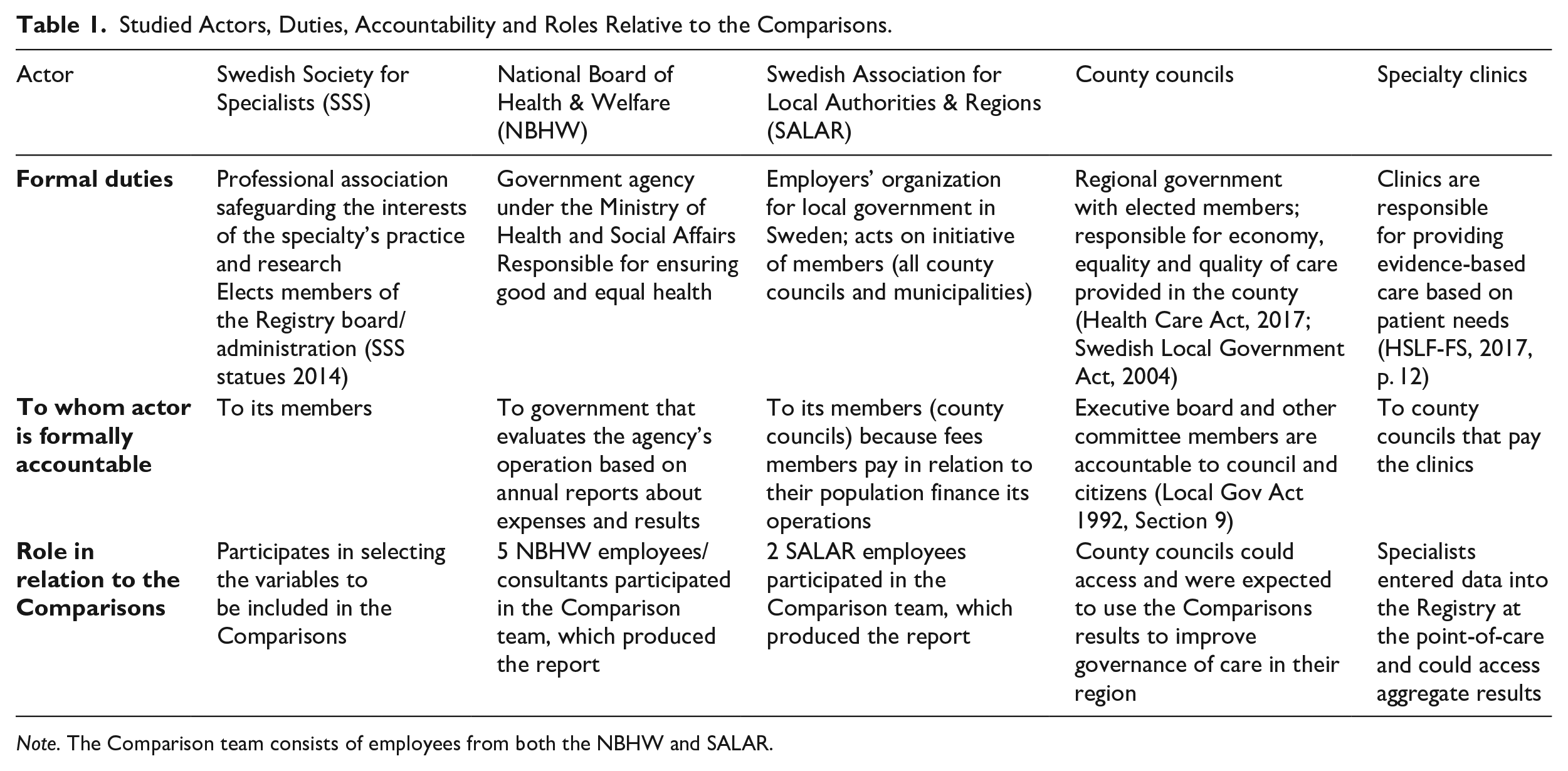
Note. The Comparison team consists of employees from both the NBHW and SALAR.
Data generation
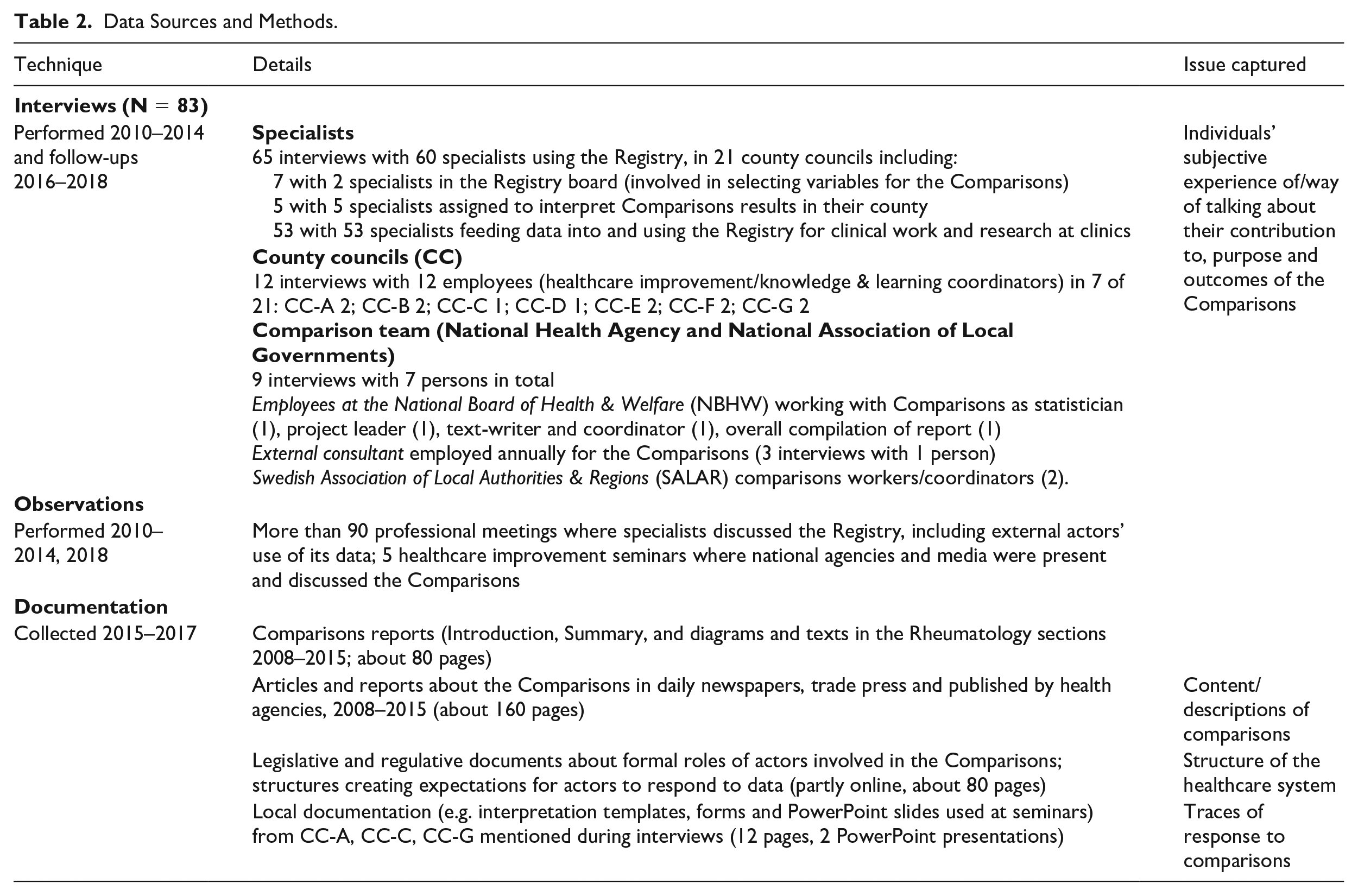
This study used several data sources generated from 2010 to 2018, summarized in Table 2. Interview questions concerned selection of variables, use of the data, reactions and non-reactions to public disclosure of the Registry data and, for clinician specialists, if, how and why external parties influenced – or did not influence – their daily practice based on the disclosed data. It became increasingly clear that there was a complete lack of examples of the interviewees’ organizations acting on the results. This was initially unexpected by the interviewer but resulted in efforts to make the interviewee reflect on and explain the current lack of use of the results by their own – or possibly any – organization in combination with the widespread acceptance of the Comparisons. These efforts typically led to a discussion in which the interviewees gradually articulated the reasons for their own non-use of the results but their simultaneous support for the Comparisons. They clearly had not considered this a problem (at least not before the issue was raised in the interview). When the interviewer questioned the explanations, the interviewees added new dimensions to their explanations to justify – to themselves as much as to the interviewer – their simultaneous ignoring of, but investment, in the system content.
Data Sources and Methods.
Data analysis
As noted, the focus of this study – ignoring – emerged unexpectedly during the data-collection phase. We expected resistance among the specialists to being ‘surveilled and measured’ through the Comparisons. However, it increasingly became clear that everyone was happy with the system, although no one could point at any consequence on the operation on healthcare the system had produced. This led us to focus on acts of ignoring, and a comprehensive effort to confirm that ignoring had occurred in the initial analysis phase. We found no extracts pointing at any concrete responses to the specific results. Our analysis furthermore showed that the actors were implicitly aware of the possibility of a collective non-engagement with the results. We hence conceptualized our case as involving two levels of ignoring: ignoring of the results displayed in the Comparisons, and the actors’ ignoring of their own and all other actors’ ignoring of the results; that is, each actor ignored the collective ignoring of the results. We referred to this as ignoring of the system dysfunction. Although we acknowledge that the system can be considered functional depending on to which object it is related, we refer to the ignoring of the system’s dysfunctionality based on the system diverging from its stated, officially announced objective.
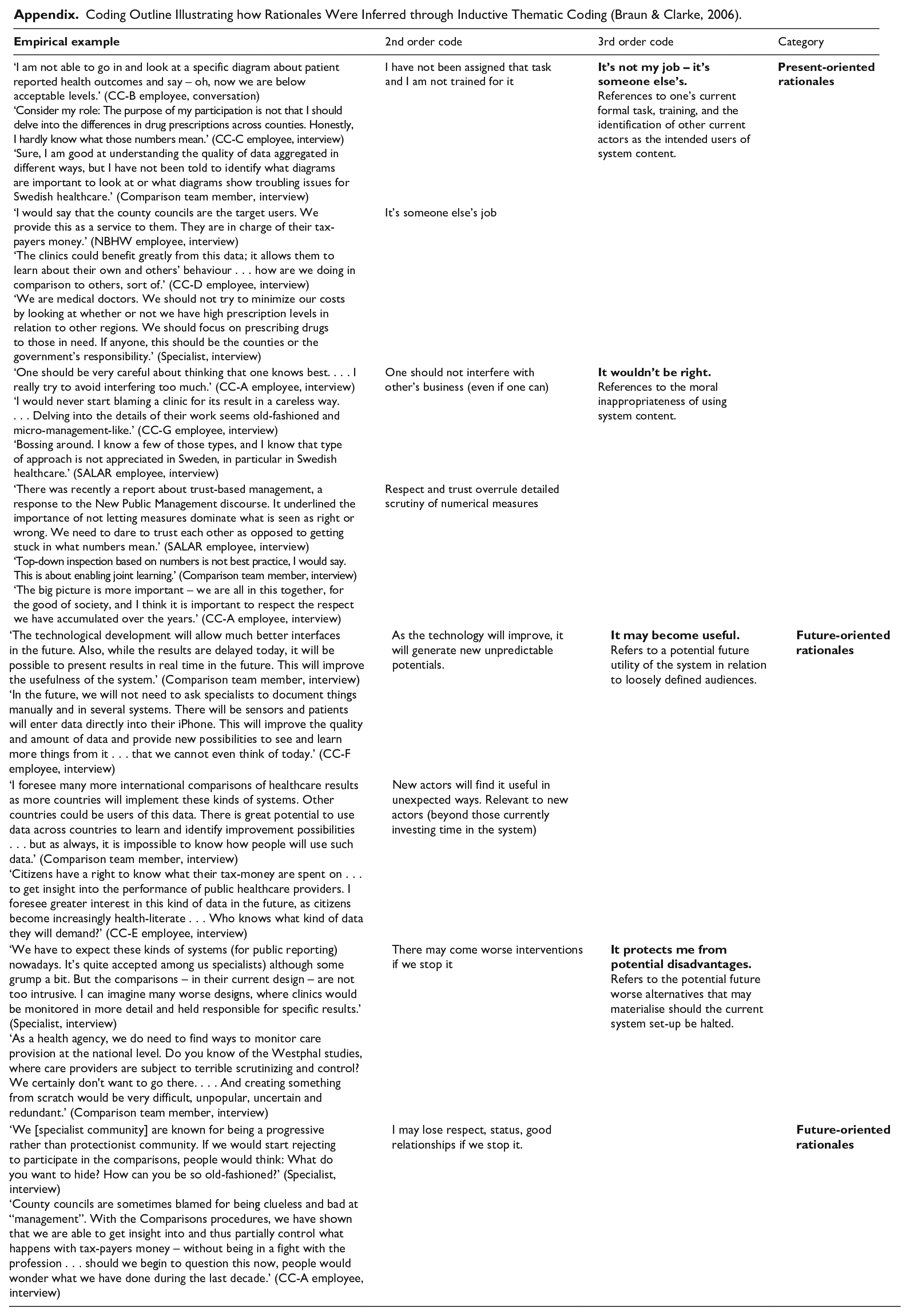
In our attempt to identify the ignoring actors’ rationales and their facilitating conditions, we analysed the most salient themes in the actors’ own local explanations of the two levels of ignoring (part one), combined with an analysis of the wider institutional arrangements and developments that legitimized and supported the invention of and referral to the rationales (part two). By interviewing across the entire chain of actors, we avoided being interested in only a limited group’s understanding; thus, we could relate individual accounts to the system’s broader (dys)function. After several rounds of inductive coding (Braun & Clarke, 2006), we identified four group-level rationales for continuing to invest in the system while (1) ignoring data and (2) ignoring the system’s dysfunction. The appendix provides examples of how we inferred present-oriented and future-oriented rationales from interview extracts in part one. In part two, we used a variety of techniques to trace the rationale-facilitators, that is, the contextual conditions supporting and enabling them. In some cases, we identified the contextual conditions through our own questioning of whether there were formal arrangements in place that could support the ignoring-rationales. We reviewed formal documentation about each actor’s role in the Comparisons and according to Swedish healthcare legislation, allowing us to identify the lack of accountability tied to the use of the data in the prevailing arrangement. In other cases, the conditions were initially inferred from the interviewees’ accounts, such as their frequent references to how they ‘shouldn’t’ be bossy/intervening/micro-managing by acting on the data. We inferred the seemingly shared norm of professionalism (Abbott, 1988; Currie, Lockett, Finn, Martin, & Waring, 2012) underlying (and reproduced by) these statements among the participants. We triangulated such accounts with observational notes from seminars and meetings where the Comparisons were discussed and coded expressions of how things ‘should’ be done as extracts supporting the prevalence of this shared view (cf. Essén & Winterstorm Värlander, 2019) among the Comparisons participants and the stakeholders in their environments. Based on our combined analysis of the interviewees’ explanations, meeting observations, healthcare-system documentation and media articles and reports about the Comparisons, we identified several rationale-facilitators. We iterated these among ourselves to arrive at a parsimonious set of distinct facilitators. This resulted in several rounds of modifications in which we challenged the tentative conditions with alternative explanations (Essén & Winterstorm Värlander, 2019) until we agreed upon the rationale-facilitators presented herein.
Rationales and Rationale-Facilitators Enabling Ignoring in the Comparisons Case
The Comparisons is a great example of how we in Sweden can achieve great things by collaborating. It has been such a journey to get this machinery going. I think we are all a bit proud of what we, as a collective, have managed to achieve! (Comparison team member)
This quote illustrates the enthusiasm for the Comparisons that was salient throughout our interviews, together with the lack of interest among the actors to engage with its data and overall function. The underlying view seemed to be, ‘The system is great but of no use’. Next, we illustrate the rationalizations the actors’ used when explaining their non-engagement with (a) the displayed results and (b) the system’s overall dysfunction.
Present-oriented rationales for ignoring results in the Comparisons
During all interviews, the actors spontaneously detailed the many tasks they engaged in to produce and maintain the Comparisons. However, when asked about the actual meaning and implications of the results, their answers typically took longer. The answers were vague, hesitant and uncertain and, in combination, communicated an absence of interest in and a feeling of inability to delve into the results’ meaning or implications. When explaining this situation, the actors’ rationales referred to current structures and arrangements; more specifically, they communicated that engaging with the data was neither within the scope of their present job nor appropriate for them as responsible individuals.
It’s not my job – it’s someone else’s
‘That is beyond my task’ was a recurrent theme in our data. Consider the members of the Comparison team. Although they invested much time in processing the data and compiling the overall reports, the task of delving into the actual meaning and potential warnings the results suggested appeared somewhat peripheral from their perspective. For example, a Comparison team statistician tested and cleaned the Registry data to ensure the data diagrams were ‘accurate’ and appropriately presented in statistical terms. However, questions about potentially disturbing differences suggested by specific diagrams in the report seemed to surprise and make him uncomfortable. He clearly did not think that it was ‘his role’ to make that kind of observation. Similarly, the NBHW employees in the Comparison team who wrote the reports’ introductory and concluding texts referred to the specific content of the results as impossible – for them – to act on. One NBHW Comparison team member noted: There is no point in me analysing the diagrams. . . . I don’t try to see what kinds of healthcare problems they point at. . . . I am not trained in that. . . . That is not the idea here.
It may not be surprising that individual actors perceived analysis of the results as beyond their professional tasks. However, it was noteworthy that none of the interviewed individuals seemed to view the in-depth analysis of the implications of the displayed results as ‘their job’. When probed about specific results tied to their counties, civil servants with positions related to healthcare development at the county councils (CC employees) and assigned to ‘deal with’ the Comparisons typically responded that they were not assigned to identify problems based on the results. As outsiders, the research team found it relatively easy to note potentially problematic issues displayed in the Comparisons simply by reviewing results across counties. For instance, the results raised questions about potential overuse or ineffective use of expensive biological drugs, which could be viewed as potentially significant data given the county councils’ formal responsibility to ensure high-quality care and efficient use of taxpayer money. However, the CC employees referred to the specific results as incomprehensible and impossible to act upon, given their inability to determine what the data said about reality. One CC employee noted: While we appreciate accessing the results, we are not to say, ‘That is a bad health outcome’! We do not know medical science. It is not our formal responsibility.
When reflecting further about their own non-response, the actors reverted to the idea that the Comparisons results were relevant for and tied to the job of other identifiable actors as a complementary line of reasoning. For instance, Comparison team members referred to the county councils and specialists as the ‘target group’ and intended users of the results. The CC employees, however, pointed at the specialists – ‘the profession’ – as the ones who could and should interpret the results displayed in the Comparisons. One CC employee remarked, ‘The specialists are of course the ones who can judge the data. For them, the data can provide actionable insights, as opposed to us, as we are far away from their local dilemmas’. Specialists in turn explained that if anyone should ‘react’, it would be the county councils: ‘The county councils are obviously the most natural party to take action’ (Specialist, interview).
It wouldn’t be right – who am I to interfere?
Our data also pointed at a moral analysis among the interviewees that seemed to go beyond the idea that acting on the data was not their job. Instead, it emphasized that delving into the data could mean that one was too interfering, intruding on others’ business; it was simply not appropriate to be nosy about data of this kind. Consequently, many interviewees seemed confident of their non-judgemental attitudes relative to the results.
For instance, some county councils assigned a specialist at a clinic to interpret the region’s results by filling in forms and sending them back to the county councils. These medical specialists, who were appointed ‘interpreters’, acknowledged that they sometimes noted potentially disconcerting results about their county. However, those we interviewed did not act on the results by articulating such issues in the forms, let alone initiate any action based on the noted results. A form completed by a medical specialist employed by County Council A illustrates this behaviour. The diagrams displayed for the county in the (2013–2014) Comparisons suggested a problematic relationship between high prescription levels and low health improvements. In the form tied to that year (completed by the medical specialist), however, the outlined aspects justified the results – rather than questioned what problems or improvement possibilities they indicated. When probed, the specialist explained that, for her, communicating the potentially problematic issues signalled by the results was not the right thing to do: ‘They cannot expect me to take on the role of bossing around my colleagues.’ Other specialists mentioned the fundamental need to ‘show respect for others and trust that they know what they do rather than being nosy about small divergences suggested by data’. Along similar lines, many CC employees and Comparison team members often referred to how they were not interested in ‘micro-managing’ in that way – acting based on the results would be seen as interfering and even disrespectful. It would ‘signal the wrong values’, as one CC employee said.
Overall, these examples illustrate behaviours we noted across counties and over years, suggesting that none of the actors participating in the Comparisons perceived themselves as assigned the task, or morally responsible, to explore the meaning – let alone make a decision or initiate interventions – of the results displayed in the Comparisons. By viewing such attempts as both outside their role within the Comparisons and morally inappropriate, it made sense and became possible for them to avoid analysing and responding to the results. The actors’ continued investment in the system, however, was explained by the fact that they saw other current participants as the assigned users of the results.
Future-oriented rationales for ignoring the dysfunction of the Comparisons
Although most interviewees were persistent and confident when explaining that responding to specific Comparisons results was somebody else’s job, they were less certain when asked whether this delegation of responsibility seemed to ‘work’. As the interviews progressed, it often became increasingly clear that interviewees were very uncertain about whether anyone actually analysed or responded to the results, and they did not reject the possibility that the answer may be no. Reflecting upon this during interviews, the actors reverted to rationales that involved constructions of the future and interpretations of the overall Comparisons initiative and system, rather than its data.
It may become useful in the future, for someone, out there
When reflecting on their non-engagement with the potential absence of substantial consequences of the Comparisons’ results, many interviewees framed it as a ‘non-issue’. They underlined the probability that things would change over time, emphasizing the uncertainty regarding how exactly processes like the Comparisons evolve. To illustrate, when asked if they saw any problems with the lack of concrete uses of the displayed results at the system level, the CC employees often redirected the conversation to data issues and the Comparisons’ potential future utility: The dysfunctions we have noted [with the Comparisons] is inconsistent data and coverage. This is getting better, though. It is important to invest in facilitated registration and automated import/export among the systems to increase our capacity to compare more aspects. This will create possibilities that we may not be able to foresee now. (CC-D employee)
This line of reasoning was sometimes combined with expectations that new audiences would find the Comparisons results interesting and relevant in the future. For instance, the actors expressed that the Comparisons, which in the future would contain improved content (by allowing real-time publication, fine-grained search possibilities, etc.), most likely would become useful for various partly known audiences (e.g. ‘media’, ‘researchers, ‘general public’ or ‘Swedes’). Engaging in this reasoning, the actors often mentioned abstract purposes, such as fostering fairness, innovation, democracy and patient choice: I am thinking Swedish citizens, they should want to know what they get for their tax payments. They won’t be happy with a situation where they get no possibility to review the qualities of different care providers or counties. . . . But also other groups, this is hard to predict, but I am sure this kind of data can be useful for many different kinds of actors. (Comparison team member)
Hence, from the actors’ viewpoint, the (non-articulated) problem of non-use would most likely pass; the system would most likely become relevant and useful, sometime, somewhere, for someone – although it was impossible to know exactly how and when.
The system protects me – there may come worse interventions if we question it
At times, respondents acknowledged that their hope regarding the Comparison’s future usefulness could be questioned. Although providing different details, many interviewees then reverted to accounts that in some way or another suggested that investigating and ‘stirring up a fuss’ regarding potential non-response to the Comparisons results – critiquing and thus threatening the system’s current operation – could raise many questions around, and perhaps disrupt, what they considered the ‘well-functioning’ system relationships tied to the current unobtrusive and comfortable setup. Thus, they perceived acting on a frail observation of the non-use of the system – which may not even be valid –as a high-risk endeavour that could lead to a deterioration of the current situation. The Comparisons may not work as intended but, from the respondents’ viewpoint, brought several other benefits or, rather, made it possible to avoid worse alternatives. Hence, on these occasions, their rationales incorporated more self-interest-oriented aspects and motivations for their investments in the Comparisons. They referred to these seemingly to explain – at least to themselves – why it made sense to ignore and invest in the Comparisons’ functionality, even if no one actually used or ever would use their content.
For instance, conversations with the specialists revealed their imaginings that seriously investigating whether anyone used the Comparisons’ content – and thus, potentially ultimately halting the project – might lead to a future discussion about new, more intervening ways to monitor and compare the specialists’ practices. Hence, the Comparisons’ sustained operation not only was perceived as relatively harmless, it also implicitly served the important purpose of safeguarding the specialists’ current (and, for them, preferable) autonomy.
They [NBHW] in fact let us choose what aspects we will measure against [in the Comparisons]. . . . If we would refuse, . . . they would most likely come up with something themselves, perhaps . . . introducing new, even more time-consuming documentation procedures and other inspection routines. (Specialist)
The risk of being forced to accept alternative ways to open chronic-care data to others was high, given that the national funding of quality registries was contingent on a degree of openness (external reporting of data to authorities). The Comparisons’ existence could imply that the specialists would be left undisturbed while their own Registry’s maintenance and financing was secured. Supporting, rather than questioning, the Comparisons thus made sense from the specialists’ perspective despite – or perhaps due to – uncertainty regarding whether the content would ever be used. Similarly, the Comparison team and CC employees expressed that the Comparisons allowed them to fulfil the government’s expectation for them to monitor and act in a data-driven way. Questioning whether the Comparisons were effective might lead to being forced to initiate other, more comprehensive monitoring systems and to ‘inspect’ healthcare units in ways that may lead to multiple unforeseen conflicts between the current actors, who preferred a more laissez-faire system.
Rationale-facilitators
Although the rationales demonstrate how the acts of ignoring make sense from the actors’ viewpoint, one could argue that the ignoring also make the Comparisons system meaningless relative to its official purpose. Considerable time and money are spent to produce results that are persistently ignored. This lack of overall fulfilment of the official goal of the system could potentially threaten the ignoring-rationales of individual actors who spend time on (re)producing the overall system. A broader outlook at the Comparisons’ system-level organization and at the wider institutional context in which the system was situated allowed us to identify four types of facilitators that legitimized and contributed to the seeming ease with which the actors could produce rationales (and become surprised at the interviewer’s questioning of those rationales). More generally, we identified conditions that enabled the disconnect between the actors’ local interpretations of their work and tasks, on one hand, and the total consequences of the system of which they were a part, on the other.
Fragmented accountability
The tasks required to produce and maintain the Comparisons were distributed across a set of actors: organizations with different positions in the healthcare system (healthcare agencies supervising care, clinics producing care and regions paying for care) and individuals with different job roles within these organizations and with different disciplinary backgrounds (political scientists, economists, statisticians, medical specialists, etc.): What’s nice about this is that we are so many involved in this project. We collaborate; each of us contributes with a small piece and then we produce this whole system. No single organization could do it alone. It hinges on each actor doing their part: entering the data, producing the statistical results, compiling reports, implementing procedures. . . . And, as there is a clear recipient for each actor, we can see when the task is done. (CC-B employee)
Within the agreements underpinning the Comparisons, each organizational and individual actor was implicitly instructed and evaluated internally, as well as by the next actor in the chain, relative to their limited task of producing diagrams or reports or implementing formal procedures to ‘incorporate the Comparisons results’. This unidirectional flow resulted in the produced report. No actor, however, was evaluated in terms of how they put the results into practice. 2 Nowhere in the documentation about the Comparisons was an indication of an actor being responsible for monitoring whether any actor acted on the data or whether the system had any productive effects. No knowledge was produced about the (lack of) use of the Comparisons. Without an interaction mechanism allowing discussions about actual use, it was easy to maintain the rationale that use was not one’s own job and that others – other organizations or other individuals with other job-roles or disciplinary backgrounds – were the intended and appropriate users.
Laissez-faire professionalism
The view ‘mind your own business’ seemed to prevail in the field in which the studied actors operated during the study period. Discussions at several seminars and open healthcare debates suggested that interfering in detail with issues that related to other people’s or organizations’ work context more than one’s own or being a ‘controlling’ manager were seen as ‘old-fashioned’ and ‘obsolete’ behaviours. For instance, a participant at a seminar focusing on data in the Comparisons expressed: The Swedish system is not like the English healthcare system, where actors inspect each other at minute level. We run our partnerships more based on trust and respect, which allows flexibility.
3
Indeed, ‘being professional’ often was equated with delegating responsibility to others, and ‘being responsible’ related to refraining from ‘being nosy’ by intervening or interfering. This seemed to provide a foundation for the rationale that it was somehow inappropriate and immoral to delve into the business of ‘others’ by trying to understand or doing something about the results the Comparisons displayed. Hence, paradoxically, the combination of having a monitoring system in place while ignoring its specific content seemed, at least for the studied actors, to be a sign of taking ‘professional responsibility’.
Technical development and uncertainty
The ongoing wider technological development, combined with uncertainty about its potential, supported the rationales in which optimism about the future was key. It would be difficult to negate that opportunities to collect, transfer and visualize data in Swedish healthcare had improved over the last years. For instance, the storage and communication capacity of the Swedish national health IT infrastructure and standards for interchanging data improved in technical terms between 2008 and 2015. In addition, the Registry hardware, software and associated systems the Comparison team used for data storage, analysis, communication and graphical interfaces became increasingly sophisticated. This fuelled the actors’ hope that the Comparisons would improve – technically – and that this would make the Comparisons more useful as well: If you look back at the last 5 years, there has been a tremendous improvement in how we transfer data and are able to clean and analyse it. The security is better. This implies that if we look ahead, we can expect improved possibilities to transfer data in real time, from practitioners to the registry, and online. The system features will be continuously upgraded.
No one questioned this extrapolation and prediction during the meetings we observed, which made it relatively safe for the actors to point at future development as a factor that could solve today’s problems. Any investigation would probably not tell everything about the future, anyway. As one CC employee said, ‘One can never predict what will happen with digitalization in detail in the future, . . . but for sure, things will go faster.’
External admiration
External actors who were not actively involved in maintaining the Comparisons often complimented the initiative as an exemplary way of executing the contemporary ideal of transparency. For instance, Swedish public media, trade press and governmental reports associated the Comparisons with collaboration, transparency, learning and, more generally, achieving things (Ministry of Health and Social Affairs, 2015; Journal of the Swedish Medical Association, 2009). Discussions at healthcare conferences and seminars involving global actors also suggested that the Comparisons’ ongoing operation allowed the actors to achieve external admiration for ‘executing’ the government’s strategy to increase transparency and – for the national health agencies and county councils – ‘control’ production of public services. Thus, ‘doing rather than slowing things down’ in a ‘collaborative’ way that ‘was acceptable’ to the profession generated admiration not only to the government and medical profession, but also among foreign health agencies and researchers (Observation, Healthcare Day, 2015). As one Comparison team member explained, this attracted foreign health agencies to visit: People are looking at us, you know, they want to learn how we achieved this system that is accepted rather than resisted by professionals. . . . To achieve this, you cannot focus on all the obstacles and potential problems. . . . It’s about having a problem-solving attitude.
The external support for the Comparisons, and the values allegedly manifested in its initiative, made the Comparisons seem like a good alternative to other transparency initiatives the interviewees expected would be required if the Comparisons were halted. This made it easier for the actors to avoid exploring the system’s potential dysfunction but instead resort to the rationalizations referring to the overall system benefits, which, according to others, were good and a worthwhile pursuit.
Discussion: Ignoring-Rationales and their Rationale-Facilitators
It may come as no surprise that actors produce data they do not use or that they seldom make a fuss about the lack of substantial implications of the systems maintained (Feldman & March, 1981). In many cases, this could be considered the right thing to do – indeed, ignorance is often a resource enabling actors to gain power to avoid, as well as to do, things (McGoey, 2007; Rappert & Balmer, 2015; Smithson, 2015). In our case, the acts of ignoring were not the result of lack of intellectual capacity. On the contrary, the actors mobilized what could be seen as good reasons for ignoring both the results displayed in the Comparisons and the fact that all other actors also ignored those results. Conversely, the seeming ease with which the actors could for 7 years invest time, enthusiasm and tax-money in a system whose content no one seemed to use triggered our interest in identifying not only the actors’ rationales for their acts if ignoring, but also the wider contextual conditions within which their rationales made sense. Figure 1 depicts our inductively inferred model of how ignoring-rationales and rationale-facilitators in combination created a rich texture of ignoring-enablers that explained the persistent acts of ignoring we observed.
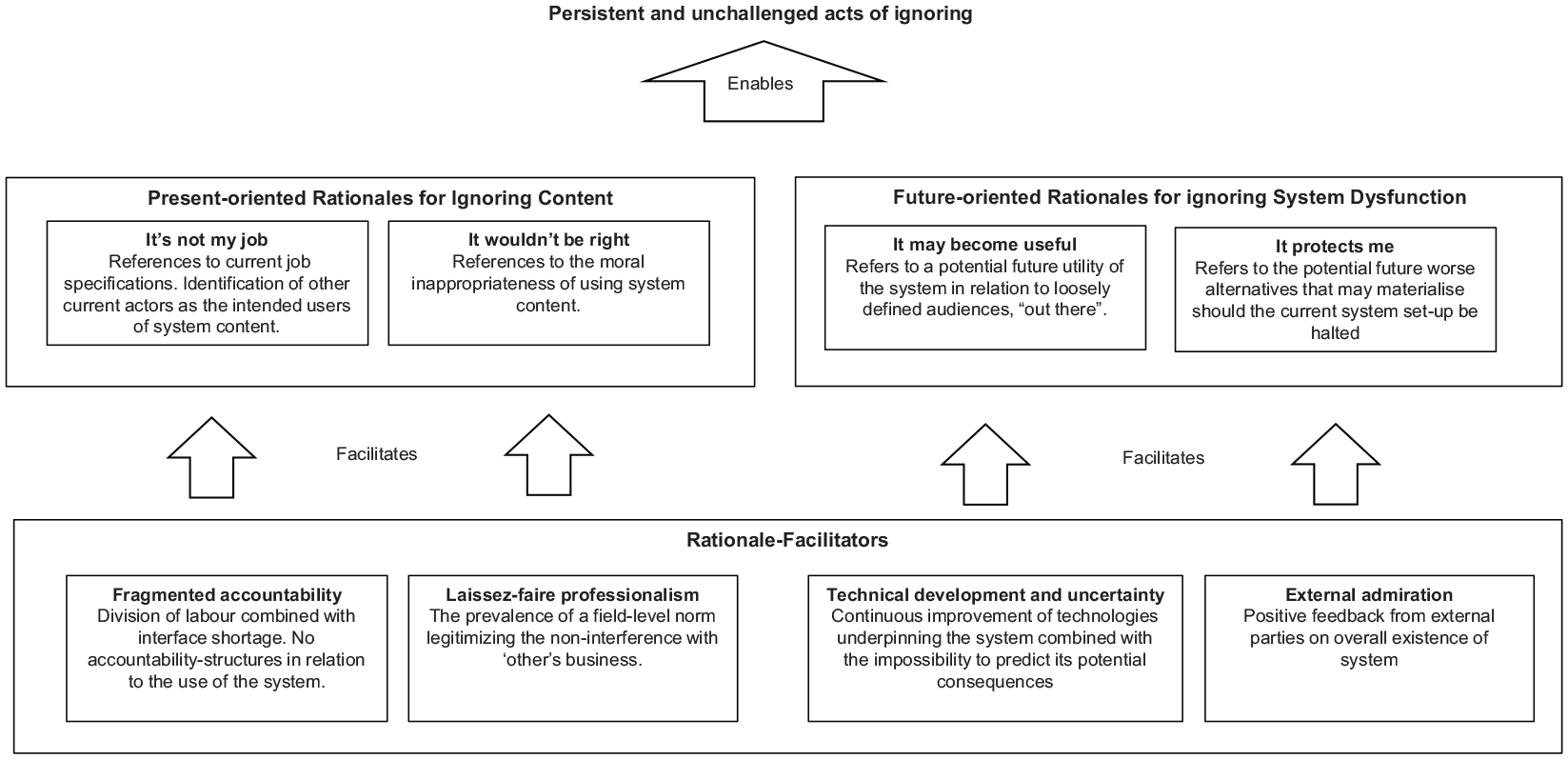
Inductivelly inferred model of how present-oriented and future-oriented ignoring-rationales and rationale-facilitators in combination enable persistent and unchallenged acts of ignoring self-produced data and system dysfunction.
Our conceptualization complements the outsider perspectives on why and how ignoring takes place by providing the ignoring actors’ perspectives while adding the contextual underpinnings of their reasoning. We conceptualize the rationales and their facilitators as forming a configuration wherein the present- and future-oriented rationales work in tandem as buffers against efforts to seek knowledge about system content and functioning. Each rationale seemed to compensate for any weakness or vulnerability of the other rationales in our case. For instance, the reasoning that it would not be ‘appropriate’ (i.e. it is immoral) seemed to partly offset the ignoring-disturbing effect of an actor facing doubts regarding her/his displacement of responsibility in ‘it’s not my job’. When these rationales seemed unreliable, the actors reverted to hope and relativism fuelled by ‘it may become useful’. Thus, they still referred to a sense of social utility. Finally, when the reliance on hope was challenged, the actors returned to the fact that the system provided them with comfort and reputation despite – or even due to – the fact that its content went unused.
We extend previous literature by centring on the actors’ way of justifying and legitimizing their acts, which presumably requires broader, more multifaceted and more content-rich explanations than self-interest and benefit. Instead of unconscious strategies (Rayner, 2012), forms of inattentiveness (Knudsen, 2011) or mechanisms (Dedieu & Jouzel, 2015) producing and maintaining ignorance, we look at the actors’ articulated explanations for ignoring data. Such explanations may be considered post-event rationalizations. We do, however, claim that in their own way they also contribute to understanding ‘how ignorance and ambiguity are maintained’ (Heimer, 2012). The ignoring-rationales enable the continued ignoring of the self-produced data because they ‘explain’ why it makes sense not to react to the information. Acts of ignoring and the ignoring-rationales thus form circular loops. The rationales are made relevant through the acts of ignoring, but they also enable the ignoring to continue over time.
We further conceptualize the contextual conditions within which ignoring-rationales make sense. Previous work concluded that bureaucracy can encourage people to engage in functional stupidity – that is, rational thinking within limited, constraining boxes but with a lost sense of, or disregard for, the broader purpose of the work (Alvesson & Spicer, 2016). Extending this line of thinking, we outline a set of organizational, ideological, technological and image-related contextual facilitators that in combination legitimized the actors’ rationalizations. For example, a limited overview due to the division of labour, absence of expectations for anyone to attempt an actual overview and adopting favourable external views may drive a desire to not know things that are beyond one’s immediate task. As mentioned, Schaefer (2019) claimed that individual wilful managerial ignorance and symbolic work are ‘means for maintaining the decoupling of institutionalised environments’ (p. 1404). We also observed the opposite relation: acts of ignoring are facilitated by decoupling in the form of divisions combined with interface shortage. Combining those two observations, we suggest that decoupling and ignoring may form circular relations enabling each other. Decoupling is supported by acts of ignoring – and ignoring is made possible by means of decoupling.
We share with previous studies the observation of the close relationship between differentiation and ignorance (Dedieu & Jouzel, 2015; Dedieu, Jouzel, & Prete, 2015). Heimer (2012) coined the expression, ‘distributed ignorance’, and found that ‘facts that are distributed across the group remain inert because they have not been put into proper relation with each other’ (p. 18). In that light, we find that the combination of division of labour and interface shortage facilitates ignoring data on the grounds that ‘someone else’ is supposed to act. Heimer related distributed ignorance to the distribution of facts, the actors studied herein actually shared the data; they had systemic knowledge. In our case, the distributed ignorance instead relates to the fragmented accountability tied to the prevailing siloed division of labour. Ignoring was made possible not due to distribution of the facts but due to distribution of the actors.
Our study raises questions about the relationship among information, acts of ignoring and ignorance. It points at an issue that is sidelined in the ignoring literature: the space between knowledge and ignorance. This is a huge and vital area about which to develop theoretical arguments. Typologies of ignorance tend to operate with clear distinctions between knowledge and ignorance (Gross, 2007; Roberts, 2013) but, as argued, acts of ignoring involved both knowledge and ignorance. In general, we argue that various forms of knowledge and ignorance present in organizational practice are seldom pure, but instead entangled in each other, as indicated by terms such as ‘hunches’, ‘gut feelings’, ‘ambiguity’, ‘uncertainty’ and ‘sensations’. Future research could extend our work by starting here – by developing further concepts to enlighten the space between knowledge and ignorance and by investigating this grey zone in new empirical contexts. As Zerubavel (2006) noticed in his discussion of ‘meta-silences’ and ‘meta-denial’, grasping these kinds of processes may, however, be particularly thorny because it is hard to see what we attempt not to see. We hope that our work can inspire future methodological advances, which are necessary to operationalize the negative actions and absences tied to ignoring.
Practical implications
What are the practical implications of our work? Are we providing a blueprint for how to ignore in a trouble-free way or are we providing a checklist of what to avoid to prevent ignoring? Given the symbolic value and importance of information (Feldman & March, 1981; Heimer, 2012) and the increasing excess of information (Schwarzkopf, 2020), it would be naïve to suggest that organizational actors should either stop ignoring self-produced data or stop producing data they do not use. Indeed, the possibility to ignore data could be a protection against today’s increasing pressures to act data-driven. However, organizations perhaps could gain meaningful insights by reflexively producing information about what kind of information they produce – what they use and what they ignore. This might not lead to fewer acts of ignoring, but it could lead to problematizations of routine acts of ignoring. Ways to make acts of ignoring run less smoothly could be to look at the rationale-facilitators – for instance, to look at the division of labour and the interfaces among job functions – or to start discussing how different professions may interfere with each other. These will not avoid acts of ignoring but make organizations ask questions like: When is ignoring problematic, and from whose perspective? Who does it serve, and how? When is ignoring desirable and a rational response and when is it contributing to waste?
Conclusion
We set out to explore ignoring actors’ rationales for ignoring and the contextual conditions facilitating these rationales. Condensing the many explanations the involved actors gave, we identify four rationales. The rationales concern perceptions of current arrangements, such as division of labour and professional boundaries. They also involve imaginings of the future, the actors’ emphasis on uncertainty and the impossibility to know (about the future or if someone ‘out there’ may be using the information), which serve as reasons for ignoring self-produced information. We conceptualize how a fragmented accountability structure, laissez-faire professionalism, technical developments or uncertainties and image or external admiration facilitate the rationales. We thus provide a multifaceted model of how the ignoring actors’ own rationales, facilitated by contextual conditions, enable persistent acts of ignoring the content and dysfunction of collectively upheld systems. These findings contribute to the limited body of studies exploring how self-inflicted ignorance is accomplished. Cognate studies (Dedieu & Jouzel, 2015; Heimer, 2012; Knudsen, 2011; Rayner, 2012; Schaefer, 2019) have observed acts of ignoring from an external perspective focusing on mechanisms and tacit or unconscious strategies. We, in contrast, analysed how the actors themselves explicitly motivate and justify their acts of ignoring.
Because ignoring of the type here discussed (and not the forms that are unavoidable or functionally motivated) involves a reflexive element, the rationales provided by ignoring actors constitute a previously under-researched but important dimension of the answer to how ignoring is made possible. Ignoring-rationales are self-erected fortifications against unwanted knowledge, which in themselves make ignoring possible at the immediate level. However, the rationales could be questioned. That is, even if there may be good reasons to ignore, such acts may still be difficult for ignoring actors to defend and maintain over long periods, especially in contexts where the actors are producing the content they are ignoring. To this end, our model contributes by outlining a rich set of contextual conditions that legitimize the rationales and thereby indirectly facilitate persistent acts of ignoring.
Footnotes
Appendix
Coding Outline Illustrating how Rationales Were Inferred through Inductive Thematic Coding (Braun & Clarke, 2006).
|
|
2nd order code | 3rd order code | Category |
|---|---|---|---|
| ‘I am not able to go in and look at a specific diagram about patient reported health outcomes and say – oh, now we are below acceptable levels.’ (CC-B employee, conversation) ‘Consider my role: The purpose of my participation is not that I should delve into the differences in drug prescriptions across counties. Honestly, I hardly know what those numbers mean.’ (CC-C employee, interview) ‘Sure, I am good at understanding the quality of data aggregated in different ways, but I have not been told to identify what diagrams are important to look at or what diagrams show troubling issues for Swedish healthcare.’ (Comparison team member, interview) |
I have not been assigned that task and I am not trained for it | References to one’s current formal task, training, and the identification of other current actors as the intended users of system content. |
|
| ‘I would say that the county councils are the target users. We provide this as a service to them. They are in charge of their tax-payers money.’ (NBHW employee, interview) ‘The clinics could benefit greatly from this data; it allows them to learn about their own and others’ behaviour . . . how are we doing in comparison to others, sort of.’ (CC-D employee, interview) ‘We are medical doctors. We should not try to minimize our costs by looking at whether or not we have high prescription levels in relation to other regions. We should focus on prescribing drugs to those in need. If anyone, this should be the counties or the government’s responsibility.’ (Specialist, interview) |
It’s someone else’s job | ||
| ‘One should be very careful about thinking that one knows best. . . . I really try to avoid interfering too much.’ (CC-A employee, interview) |
One should not interfere with other’s business (even if one can) | ||
| ‘There was recently a report about trust-based management, a response to the New Public Management discourse. It underlined the importance of not letting measures dominate what is seen as right or wrong. We need to dare to trust each other as opposed to getting stuck in what numbers mean.’ (SALAR employee, interview) |
Respect and trust overrule detailed scrutiny of numerical measures | ||
| ‘The technological development will allow much better interfaces in the future. Also, while the results are delayed today, it will be possible to present results in real time in the future. This will improve the usefulness of the system.’ (Comparison team member, interview) |
As the technology will improve, it will generate new unpredictable potentials. |
|
|
| ‘I foresee many more international comparisons of healthcare results as more countries will implement these kinds of systems. Other countries could be users of this data. There is great potential to use data across countries to learn and identify improvement possibilities . . . but as always, it is impossible to know how people will use such data.’ (Comparison team member, interview) |
New actors will find it useful in unexpected ways. Relevant to new actors (beyond those currently investing time in the system) | ||
| ‘We have to expect these kinds of systems (for public reporting) nowadays. It’s quite accepted among us specialists) although some grump a bit. But the comparisons – in their current design – are not too intrusive. I can imagine many worse designs, where clinics would be monitored in more detail and held responsible for specific results.’ (Specialist, interview) |
There may come worse interventions if we stop it | ||
| ‘We [specialist community] are known for being a progressive rather than protectionist community. If we would start rejecting to participate in the comparisons, people would think: What do you want to hide? How can you be so old-fashioned?’ (Specialist, interview) |
I may lose respect, status, good relationships if we stop it. | Future-oriented rationales |
Acknowledgements
We want to thank the senior editor Janne Tienari and the anonymous reviewers for their very helpful comments during the process.
Funding
The main author received funding from Handelsbanken, forskningsstiftelserna, P19-0207.
