




Abstract
How do actors overlook uncomfortable information? We add to the understanding of how potential problems can be ignored over long periods, in spite of recurrent warnings. Ignoring then becomes a dynamic process of responding to evolving ignoring ‘threats’ or triggers by combining knowledge-seeking and knowledge avoidance in ways that must be continuously legitimated, both in one’s own eyes and in those of relevant parts of the environment. Drawing on a longitudinal case study, we find that ambiguity-juggling – mutually supporting acts foregrounding and backgrounding ambiguity – constitute a key element of such ignoring work. Our study adds to the literatures on strategic or wilful ignorance and ambiguity management by providing a novel explanation for how actors dynamically mobilize motives for ignoring and thereby navigate uncomfortable information that evolves over time. As we show, sustained forms of ignoring involve interactions between shifting ignoring triggers, adaptive ignoring work and evolving states of organized ignorance. This conceptualization contributes to the ignoring literature by extending current accounts of the ‘why’, ‘how’, ‘how much’ and ‘who’ of ignoring, as well as its outcomes.
Keywords
Introduction
There is growing scholarly interest in organizational, strategic, or wilful ignorance, defined not as the lack of knowledge or intellectual capacity but as the intentional bypassing and blocking of information and knowledge from others and/or oneself (Gross, 2007; Knudsen et al., 2023; McGoey, 2019; Schaefer, 2019). Research in this and adjacent areas has outlined the intentions and manifestations of ignorance, illustrating how actors prevent themselves or others from knowing to avoid liability, damaged relationships, discomfort and anxiety (Klintman, 2019; McGoey, 2012; Proctor & Schiebinger, 2008), or how they become trapped in optimistic thinking and commitments that make them bypass contradictory signals (Maitlis & Sonenshein, 2010; Weick, 1993). Indeed, ‘uncomfortable’ and ‘awkward’ information suggesting potential problems has been shown to trigger a set of defensive behaviours, including disconnecting (Delmestri & Goodrick, 2016; Kronblad et al., 2024; Zerubavel, 2006), attention-shifting (Heimer, 2012; Knudsen, 2011; Weick, 1993) and justification efforts (Ebbevi et al., 2024; Essén et al., 2022). We refer to these behaviours as ‘ignoring work’.
While the literature outlines many types of ignoring work that enable actors to ignore both meaninglessness and harm, it tends to depict ignoring work as shared and quite straightforward, requiring relatively little effort, decision-making or internal manoeuvring (e.g. McGoey, 2012; van Krieken, 2024). In particular, many studies portray the ignored information and the work of neglecting it as static (e.g. Ebbevi et al., 2024; Essén et al., 2022). However, the way in which uncomfortable issues present themselves may shift (Weick, 1993), sometimes growing more salient or being communicated differently over time (Anvari et al., 2019; Delmestri & Goodrick, 2016; Kenny, 2019), requiring actors to handle their own neglect of such issues in complex and adaptive ways. How ignoring work unfolds in such situations has been little theorized to date.
The complexity of ignoring over time is demonstrated in our longitudinal study of the so-called Macchiarini case, which involved continual acts of ignoring warnings about the potential scientific and clinical malpractice of Paolo Macchiarini, a ‘star’ surgeon at Karolinska Institutet (‘KI’) and Karolinska Hospital (‘KH’), a top-ranked Swedish medical research institution and adjoining hospital (collectively referred to hereafter as ‘Karolinska’). In 2016, Macchiarini was fired after five years of managers failing to take repeated and shifting warnings about him seriously. How was this persistent avoidance of ambitious knowledge-seeking – that is, ignoring – possible? How did the managers involved do ignoring work, justifying to themselves and others why signs of significant problems should be overlooked even as this approach was threatened in different ways over time? As the literature did not explain how and why such more dynamic and complex circumstances may trigger multiple rounds of ignoring work, we set out to explore the following research question: How do managers sustain ignoring over time in the face of dynamic warnings?
Our study suggests that sustained forms of ignoring involve shifting ignoring triggers, adaptive ignoring work, and evolving states of organized ignorance. In particular, we highlight that escalated warnings form shifting ignoring triggers, which actors respond to by engaging in adaptive acts of ambiguity-juggling: mutually supportive acts of disambiguation (constructing the ambiguity of individuals’ abilities and responsibilities as very low) and ambiguation (constructing the ambiguity around truth and the consequences of action as very high). We conceptualize ambiguity-juggling as a central aspect of ignoring work and show how it legitimizes shifting combinations of selective knowledge-seeking and knowledge avoidance. The outcome of this dynamic and selective form of ignoring work is an evolving state of organized ignorance (Knudsen et al., 2023), which manifested in our case as a shared acceptance of the ignoring work – initially by a limited group within the organization and over time by additional layers of the organization. This allowed multiple actors to protect a favoured course of action and prevent disruptions over a prolonged period.
Our study extends previous accounts of the ‘why’, ‘how’, ‘how much’ and ‘who’ of ignoring at certain points in time (Essén et al., 2022; Heimer, 2012; Knudsen, 2011; Schaefer, 2019). We demonstrate that ignoring work may change over time, contingent upon additional and differently communicated layers of emergent signs of problems that call for action, which interact with shifting motives to ignore. These insights challenge the view of ignoring as consistent, and often categorical and unified (i.e. expressed at an organizational level) (Essén et al., 2022; McGoey, 2012, 2019; van Krieken, 2024) by pointing out the multifaceted mechanisms that drive ignoring and the role of shifting constructions of its fluid object. As we show, such work can be silently and indirectly accepted by additional layers of bystanders over time, highlighting the distributed nature of ignoring work (Knudsen et al., 2023).
The notion of ambiguity-juggling as ignoring work also extends the literature on ambiguity management (often also implicitly addressing ignorance), which has emphasized that strategists ambiguate issues, primarily to prevent others from knowing more (Cappellaro et al., 2021; Ulmer & Sellnow, 1997; Vaccaro & Palazzo, 2015). We contribute by showing how acts of ambiguation can work in tandem with disambiguation, as actors use ambiguity-juggling to allow themselves and their inner group to avoid knowing (more) about uncomfortable issues.
Next, we outline our theoretical points of departure from the ignoring literatures, subsequently detailing the methods used. We then illustrate the two configurations of ignoring triggers, ignoring work (ambiguity-juggling) and ignoring outcomes, salient in our case and end with a discussion of the implications of our work.
Why and How Actors Perform Ignoring Work
Unlike the notion of risk, where probabilities are known, and in contrast to uncertainty, in which probabilities are unknown but may be reduced by obtaining more information (see Faber & Proops, 1998, pp. 128–129), ignorance is sometimes understood as a realm that escapes recognition and knowledge (Gross, 2007). Many typologies, however, outline forms of ignorance (and related concepts such as denial) existing in the space between non-knowledge and knowledge. These forms of ignorance are often characterized by varying degrees of deliberateness, ranging from unwilful blindness to the unknown, where cultural categories simply make us unaware of things (Delmestri & Goodrick, 2016), to strategic or wilful blindness or ignorance (Gross, 2007; Knudsen et al., 2023; McGoey, 2012; Schaefer, 2019; van Krieken, 2024). We are primarily interested in the latter end of this spectrum, involving some degree of reflexivity and intentionality, where ignorance can be understood as the result of effort, which we refer to as ignoring work.
Research reveals a range of ignoring work through which individuals and organizations prevent themselves and others from knowing (more) about uncomfortable issues. A common theme is the active hiding of or disconnecting from issues, involving covering up and keeping things separate. In Kronblad et al. (2024), a municipality avoided engaging with the unintended consequences of an algorithm placing children in schools by avoiding and obstructing information about it, thus making the algorithm’s function and consequences impossible to scrutinize by parents and other citizens (see Heimer, 2012; Knudsen et al., 2023). Studies on whistleblowing and silencing further show that managers force (seduce or sanction) their employees to remain silent, thereby hiding facts from themselves and others (Kenny, 2023; Kish-Gephart et al., 2009; van Krieken, 2024). Other studies reveal redirection efforts. In Knudsen (2011), public authorities avoided potentially destructive information by focusing on keeping to tight deadlines rather than investigating uncomfortable issues, while in Schaefer (2019), managers launched innovation initiatives but avoided attending to their (absent or failed) outcomes by instead demonstrating that they were ‘into innovation’. Redirection often involves decoy or pseudo work in terms of ‘over-’producing reports and diagrams and relying on certain (irrelevant) references and voices in ways that may ‘fool’ others, or oneself, that correct action is being taken and nothing important is being neglected (see Essén et al., 2022; Knudsen, 2011; Schwarzkopf, 2020). Research also points at the justification efforts involved in ignoring work. Actors sometimes admit that information is disregarded and rationalize this in creative ways (at least in an interview situation). This often involves constructing negative signs as minor technical issues (Rayner, 2012) and referring to the ignored information as uncertain, untrustworthy, incomplete, or simply wrong (Ebbevi et al., 2024; Essén et al., 2022; Jackall, 1988; McGoey, 2012).
What emerges from the literature is hence a range of tactics that can be combined, producing an array of enablers for ignoring at individual and organizational levels. Some studies highlight low-stakes contexts, for instance, the ignoring of harmless dysfunction or absence of progress. Here, ignoring work seems fairly easy: justifications are primarily directed to oneself, since nobody makes enquiries or imposes external pressure (e.g. Ebbevi et al., 2024; Essén et al., 2022). In other studies, the stakes are higher (the harms ignored are more serious and there are pressures to pay attention to them), and ignoring work and its justification must be more elaborate (Heimer, 2012; Kronblad et al., 2024). In such contexts, ignoring is sometimes interrupted, e.g. when evidence mounts up (Rinta-Kahila et al., 2021; van Krieken, 2024). 1 Yet, by and large, studies typically focus on theorizing stable ignoring that remains ‘on’ until it is ‘off’. Structural conditions such as fragmented accountability, techno-optimism and laissez-faire professionalism act as facilitators in this context (Alvesson et al., 2022; Essén et al., 2022; Knudsen et al., 2023; van Krieken, 2024).
In other words, the literature convincingly demonstrates the presence of ignoring work and its enablers, but does not theorize why or how actors may need to revise their ignoring work because of changes in the way the uncomfortable information presents itself or is communicated. A few studies recognize that people ‘speaking up’ may alter their arguments and turn to new recipients (blowing the whistle more loudly) when no one listens (Anvari et al., 2019; Delmestri & Goodrick, 2016; Kenny, 2019). The adjacent literature on disasters and escalation of commitment similarly suggests that negative environmental signals facing organizations may increase in intensity over time (Keil & Mähring, 2010; Vaughan, 1990; Weick, 1993). Yet, how shifting signals or warnings affect how ignoring work is carried out and sustained remains untheorized.
A process approach to ignoring work as shifting and plural
Given our aim to analyse how ignoring is sustained, we adopt a pluralistic, process-sensitive view (see also Gross, 2007) of ignoring work. Below, we outline our core assumptions and relate them to other dominant perspectives in the ignoring literature.
Ignoring work as shifting in its degree and nature of wilfulness
Many studies of ignoring highlight ignoring actors’ clear and stable strategic intentions or political interests in avoiding responsibility or keeping people in the dark (McGoey, 2012; Proctor & Schiebinger, 2008) and emphasize conscious choice and rationality (Hertwig & Engel, 2016). However, recent work also describes ‘less wilful’ and reactive forms of ignoring work, where intentions are less clear-cut and less strategic, and ignoring work is rather driven by silo thinking or the desire to simply muddle through (Alvesson et al., 2022; Essén et al., 2022). We assume that ignoring work may be characterized by shifting degrees of wilfulness and multiple motives for ignoring in prolonged and contested situations.
Ignoring work as managing the ambiguity of the ignored issue
A large share of extant research assumes that ignoring actors know what not to know (Knudsen et al., 2023; Proctor & Schiebinger, 2008). Ignoring is referred to as unseeing and repressing ‘what is known’ or as refusing to acknowledge information that ‘does not correspond with one’s existing cognitive frameworks’ (Roberts, 2022, p. 368). This suggests that there is knowledge from which actors disconnect or redirect. However, the target of ignoring may be fluid and uncertain rather than a matter of clear ‘knowledge’ that can simply be avoided (Alvesson et al., 2022). This is implicitly shown in studies (Kronblad et al., 2024; Schaefer, 2019) illustrating the ignoring of fragments and signs that could in theory be investigated further, although it may be unclear how. Actors also cast doubt on the ignored information, emphasizing its unreliability and incompleteness (Ebbevi et al., 2024; Essén et al., 2022; McGoey, 2012). Hence, the ignored issue can be and can be constructed asambiguous (Alvesson et al., 2022; Maitlis & Sonenshein, 2010) – i.e. characterized by ‘opaqueness and the simultaneous existence of several conflicting views of the same phenomenon’ (Cappellaro et al., 2021, p. 2). 2 Hence, we assume that sustained ignoring work may involve not only coping with ambiguity but also its active exploitation (Abdallah & Langley, 2014; Cappellaro et al., 2021).
Ignoring work as selective knowledge avoidance and seeking
The points above challenge the common view of ignoring as knowledge avoidance (Schaefer, 2019, p. 1308). Indeed, persistent forms of ignoring are likely to involve combinations of knowledge and non-knowledge (Gross, 2007), as actors struggle to know what to ignore. Although the phenomenon has been little theorized, a few studies suggest that ignoring can involve seeking some information (e.g. to avoid ‘stepping on land mines’ or appearing totally ignorant about issues) while strategically rendering it unavailable for decision-making (e.g. Heimer, 2012; Knudsen, 2011). Hence, we assume that sustained ignoring work may involve both knowledge avoidance and (partial, selective) knowledge-seeking.
In summary, we assume that sustained ignoring work in dynamic situations is (a) shifting rather than static in nature, (b) not necessarily clearly or only wilful or strategic but often ad hoc and reactive, (c) often involving ambiguity management and (d) a matter of degree (selective). Although there is fragmented support for these assumptions in the emerging literature, their combined manifestation and interaction have not been theorized in previous work. Arguably, these aspects are crucial to understanding how managers sustain ignoring work in complex, contested situations, as in our case.
Method
This study was part of a research project aiming to develop theory about organizational ignoring. We theoretically sampled the process around a case that was extreme (Hällgren et al., 2018), given the persistent warnings about an employee’s malpractice, its seriousness (threatening patients’ lives), the related high stakes (high reputational risk) and as these warnings were ignored over a relatively long period. 3
The Macchiarini case
In November 2010, Dr Paolo Macchiarini (herein designated ‘M’) was recruited as a guest professor in clinical regenerative surgery and senior surgeon at the Ear, Nose and Throat (ENT) surgery department at Karolinska. Initial press releases emphasized M’s breakthrough surgeries to replace patients’ tracheas with plastic tubes. However, from 2010 to 2015, a small but growing group (designated ‘critics’) raised warnings about M’s potential scientific and clinical malpractice. These critics included external individuals with previous experience of working with M, individuals who had observed his work and publications, Karolinska employees and, later, an external reviewer and public agencies. Combined, their warnings reached managers at five different levels at Karolinska (see supplemental files, Part Two) and, over time, the broader organization of Karolinska. Despite receiving repeated warnings, Karolinska managers officially communicated their continued support for M – until the media began reporting the potential dysfunctions in critical articles in Vanity Fair magazine and on Swedish public television in 2016.
Figure 1 outlines the warnings (in red) and indications of managerial (non-)responses (in black). We centre our analysis on the period from 2010 to 2015, during which warnings were internally communicated and neglected, thus focusing on ‘internal whistleblowing’ as distinct from whistleblowing that is escalated to external actors (Anvari et al., 2019; Skivenes & Trygstad, 2010) and the unfolding of public scandal or crisis (Frandsen et al., 2024).
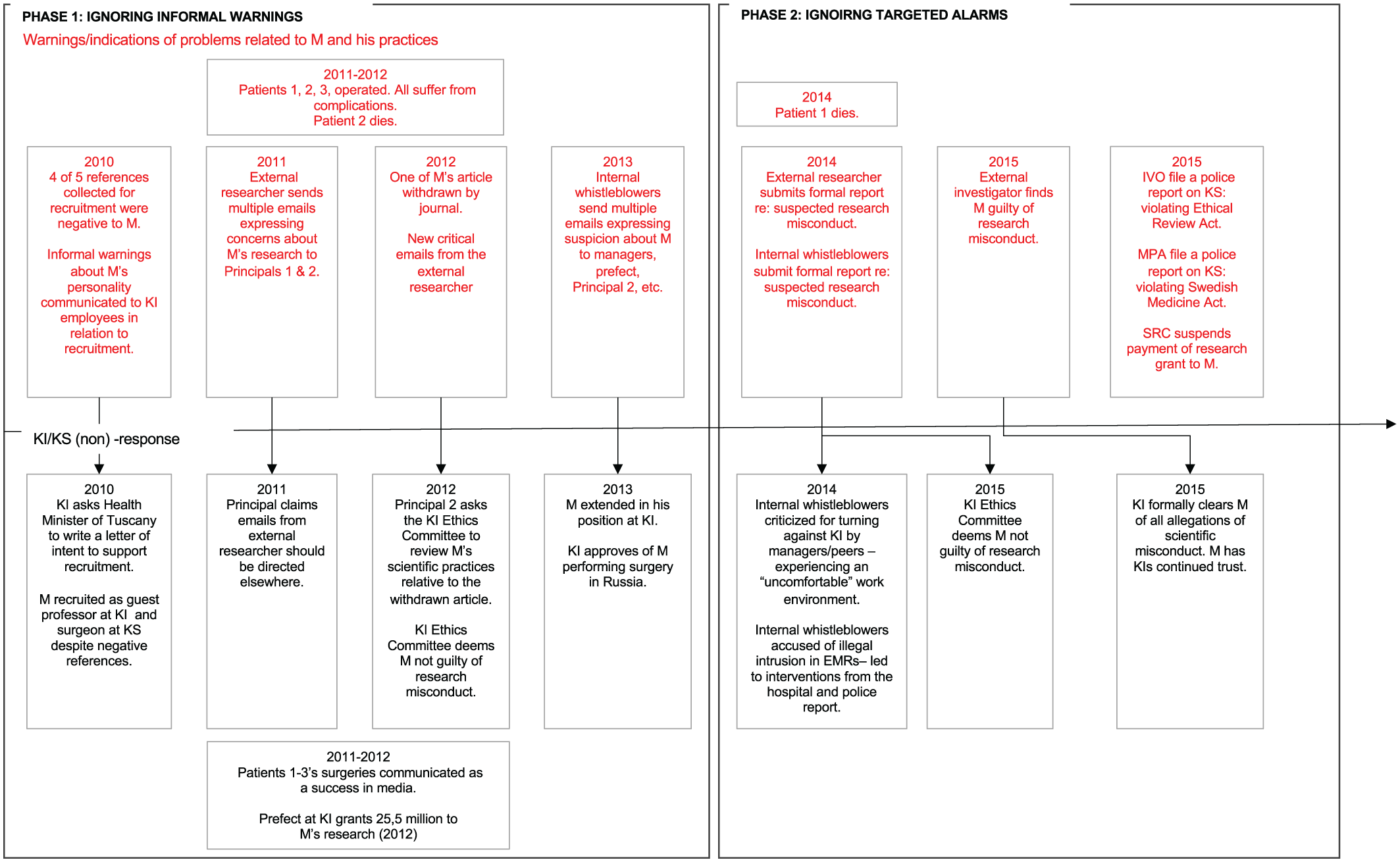
Chronological outline of warnings (red) and indications of (non-)responses (black), 2010–2016 (detailed timeline in supplemental files Part One). (IVO = Health and Social Care Inspectorate, MPA = Swedish Medical Product Agency).
Data generation and analysis
As summarized in Table 1 we combined extensive secondary data sources with new primary data (interviews). Our analytical approach can be referred to as abductive and hermeneutic (Alvesson & Sköldberg, 2017), involving an iteration between existing and inductively developed theory. As data analysis began during the data-generation phase, we describe our approach as a single four-stage process.
Data sources.
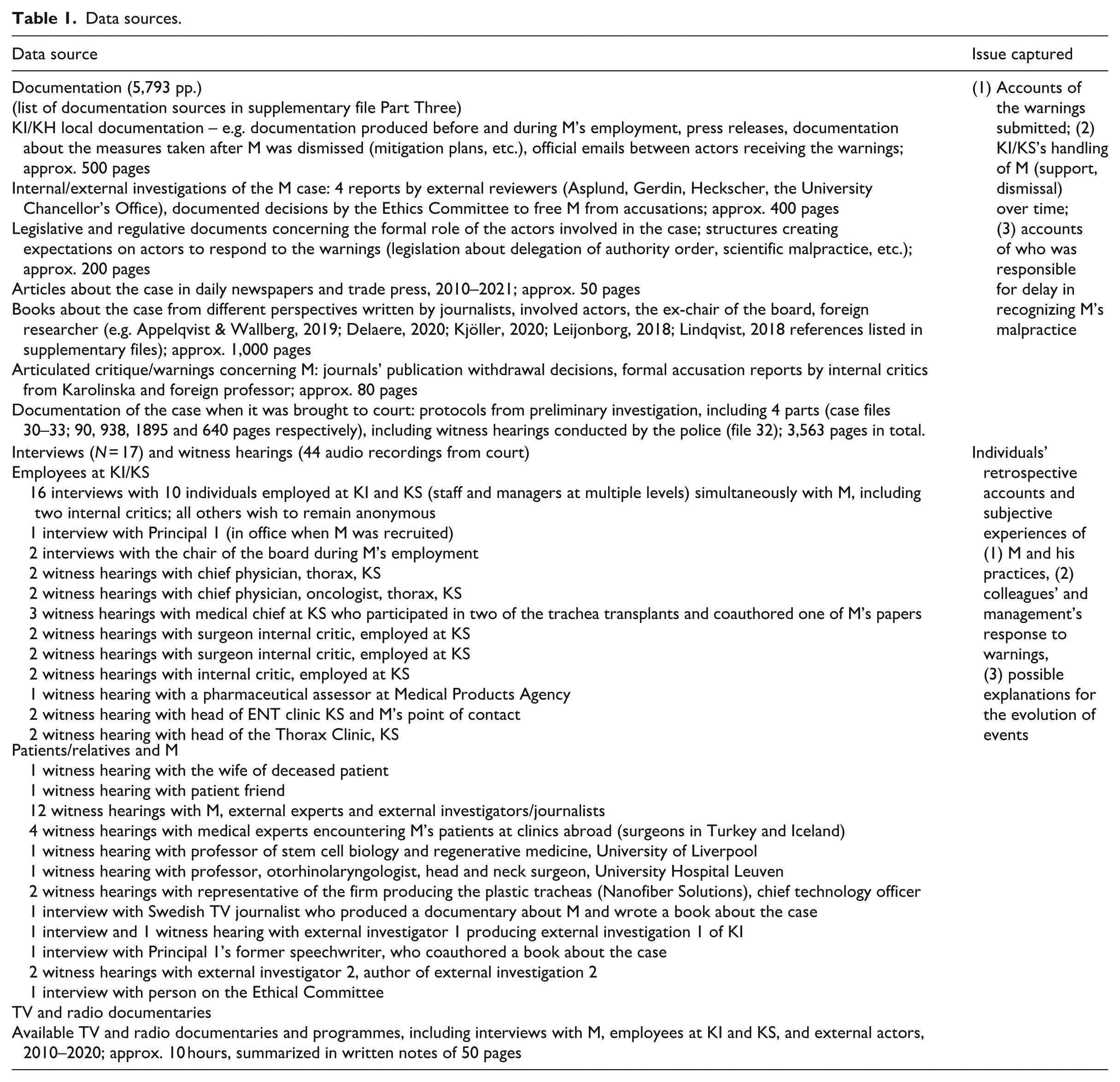
Stage 1: Collecting documentation and making sense of the evolution of events
We initially compiled and triangulated the extensive available documentation (5,793 pages) about the M case (searching in the two major daily newspapers, the trade press, open online searches and acquiring books written about the case) and created timelines depicting the warnings raised and organizational (non-)responses between 2009 and 2021. We worked with a narrative timeline (about 30 pages) and parallel visualizations to facilitate our sensemaking of the process (Langley, 1999). The documentation confirmed that warnings had been persistently raised over a long period. The documentation however did not explain how responsible managers could, over several years, make sense of things in a way that enabled them to avoid thorough scrutiny of the potential malpractice that the warnings pointed at. Based on the assumption that this non-response was the result of ‘work’ that might be observed or inferred (Knudsen, 2011), we engaged in a second round of data collection and analysis, including interviews.
Stage 2: Conducting and analysing interviews
We constructed multiple versions of a semi-structured interview guide based on our pre-understanding reached in Stage 1. Open-ended questions (adjusted to different individuals) concerned how they and/or others gradually realized that M was engaged in scientific and clinical malpractice and how they and/or others responded to this fact or found reasons not to. In 2021, we (the first author and a research assistant) interviewed (1) ‘critics’ (an external reviewer and certain Karolinska employees) who had expressed concern about M or submitted warnings, (2) managers (who wish to remain anonymous) at five different levels who, according to documents, received warnings (in)directly in the first and/or second phase and had a formal responsibility to act (see supplemental files: Part Two), (3) other Karolinska employees who were present and aware of the evolution of events (and sooner or later were exposed to the warnings) and (4) external experts with unique insight into the case (e.g. journalists who followed the case closely). We conducted 23 interviews with 17 respondents, each lasting 60–120 minutes (including a few follow-up interviews in 2023–25). Some respondents seemed eager for an opportunity to reflect on the experience and turn it into lessons that could prevent the same thing from happening again; others were afraid of becoming scapegoats. We made great efforts to adapt to the requests of the respondents (regarding where, how and when interviews took place) to reduce their anxiety. Many still declined, referring us to documentation instead.
Interviews aimed to capture the interviewees’ sensemaking of the process (Langley & Meziani, 2020). Extensive pre-interview preparation was essential given the complexity of the studied process (numerous related events) and the sensitive nature of the issue. For instance, we prepared for potential ‘defences’ and attempts to manage impressions (e.g. ‘I had no idea’) by referring to timelines that depicted submitted warnings at certain points in time. Communicating that our intention was to understand the unfolding of events rather than blame interviewees was also important, as was ensuring anonymity as far as possible. To reduce pressure, we often started by reaching agreement about the overall timeline of the process and speaking about collective behaviours and what ‘most of the employees’ or ‘others’ did rather than what the specific interviewee had (not) done. This allowed us to gradually delve into more sensitive individual experiences and acts of avoidance that the interviewees now sometimes regretted or themselves still struggled to understand. All interviews except one were recorded and transcribed. Our evolving understanding sometimes resulted in follow-up interviews to elaborate or revise our understanding and/or delve further into alternative explanations for specific issues. (We interviewed some respondents two or three times.)
In parallel, we worked continuously with initial inductive, first-order categorizations of the material that provided cues about why and how the managers might have avoided engaging with the warnings. Data and categories were considered as uncertain cues rather than definitive meanings, calling for consideration in terms of the larger picture, in line with hermeneutic principles (Alvesson & Sköldberg, 2017). We compared the interviewees’ retrospective accounts with managerial arguments in the documentation published during the focal period, resulting in gradually developed interpretations and a growing list of (partly conflicting) examples and explanations.
Stage 3: Using ambiguity management to understand how managers did ignoring work
As we began to perceive saturation (few new event types or explanations seemed to be emerging from interviews), we paused data generation and switched to data analysis (Alvesson & Sköldberg, 2017). We considered numerous different ways to account for managers ignoring the warnings (e.g. they lacked time to engage, genuinely did not understand, or were trapped in an inertial institution). However, several data sources contested such interpretations. Instead, our analysis suggested that the managers actively refrained from engaging with the warnings by interpreting issues in certain ways. In particular, the managers’ way of selectively backgrounding and foregrounding the complexity and opacity – ambiguity – of a number of situational dimensions around M allowed them not to engage with the warnings in a substantive manner, by legitimating such non-knowledge-seeking. We found that previous studies on ambiguity management (Cappellaro et al., 2021; Eisenberg, 1984; Sillince et al., 2012) could help us further explore of the role of ambiguity, and in particular managerial constructions of ambiguity. We treated the ambiguity that was ‘intrinsic’ to the case studied (in terms of the complex and conflicting signals about M’s practices and the complexity of his work 4 ) as analytically distinct from the ambiguity that was constructed and exploited by actors in specific situations (Eisenberg, 1984; Sillince et al., 2012). The latter was our focus.
At this stage (spring 2022), we gained access to 44 interviews (audio files of witness hearings) from the court, including interviews with Karolinska managers who had previously declined our interview requests. These interviewees’ answers were likely geared – even more than in our first round of interviews – towards appearing trustworthy and innocent in court (Langley & Meziani, 2020). However, they still provided insight into the managers’ explanations for not engaging with the warnings. Using them in combination with our other empirical sources, we explored the relevance and variations in our tentative concept of ambiguity constructions as a form of ignoring work, writing analytical memos and forming interpretations of underlying meanings and indications.
This led us to identify different kinds of ambiguity constructions among the managers (although they used other words for this), each targeting different aspects of the situation. Some aspects (e.g. M’s practices and the validity of the warnings, which could be seen as at least partially knowable) were constructed (presented) by the managers as incredibly complex, unknowable, or ‘impossible’ to grasp (i.e. highly ambiguous). Other aspects, which – as the warnings suggested – could be seen as far from clear-cut (e.g. M being a genius; who was ‘responsible’ for investigating the situation), were constructed by the managers as very clear (i.e. not ambiguous at all). We identified two broad types of ambiguity constructions that were repeatedly and collectively performed by the managers, i.e. patterned at group level. First, disambiguating acts constructed things as being a certain way rather than any other way – thus backgrounding or cleansing the intrinsic ambiguity of the situation in terms of the existence of multiple, potentially valid yet conflicting views (Cappellaro et al., 2021). Second, ambiguating acts foregrounded ambiguity in terms of the uncertainty, opacity or complexity (Weick, 1995) of broader issues such as truth and the consequences of action.
We understood these constructions of ambiguity as occurring within both the speaker and the recipient (Sillince et al., 2012). More specifically, the constructions were self-directed, as managers reported to us that when they were making sense of the situation alone, they interpreted some things as ‘too complex or uncertain’ to even try to address (i.e. legitimizing their non-engagement with the warnings to themselves). At the same time, the managers’ references to issues as either highly ambiguous or not ambiguous were communicated to others, who partly shared and accepted them. Hence, we approached the ambiguity constructions as ignoring work directed towards self and others, allowing oneself and others to dismiss the warnings.
As further rounds of analysis suggested that the ambiguity constructions facilitated a partial form of knowledge avoidance (non-knowing), which interacted with knowledge-seeking (knowing) efforts, we came to understand ignoring work as ambiguity constructions enabling selective non-knowing and knowing. This was based on our material, which suggested that the managers’ ambiguity constructions happened before (and were a precondition to) their selective knowledge avoidance (although being reproduced later). By telling themselves and others that issues were more or less ambiguous, the managers could make choices about what (not) to know more about. This was evident, for instance, in the handling of negative references received during M’s recruitment in Phase one, and also when the more elaborate warnings were submitted in Phase two, where issues were described (e.g. in emails) as more or less ambiguous before decisions were made to dismiss the warnings. Overall, as the constructions were evident in media-reported statements made by the managers during the focal period and referred to and exemplified by other individuals, we interpreted the constructions as having taken place during the focal period, as opposed to merely post-rationalizations created at the time of our interviews.
While the ambiguity constructions represented active and patterned efforts, they were not an explicit or coordinated strategy performed by the managers. Quite expectedly, the managers did not refer to an intentional exploitation of ambiguity for the purpose of avoiding substantial knowledge-seeking about the warnings. Rather, they communicated to us a frustrating process of coping with a very complex and difficult situation, which they found themselves forced to reactively handle. ‘To be honest, I had no idea what to do, what was the right thing. . .’ as one manager confessed. Interpreting and referring to issues as either unclear or clear was a way of coping with this situation and deciding what knowledge to seek and what not to seek. Having said that, the material also pointed toward a shared unwillingness to engage with the warnings, which was largely driven by strategic interests to protect the potential breakthrough and Karolinska’s or managers’ own reputation. For instance, many referred to a deep antipathy towards engaging with the warnings, and many employees reported managers’ communicating a clear stance of ‘Let’s not go there, it’s not worth the trouble.’ Hence, we increasingly approached the observed ignoring work as both reactive and strategic.
Stage 4: Identifying phases and developing a synthesized conceptualization
We created several visual mappings depicting the chronological evolution of the warnings, the pressures to respond produced by the warnings, the managers’ shifting unwillingness to engage with them, and the related change in the disambiguating and ambiguating acts. This led us to identify two qualitatively distinct process phases (Langley, 1999), as the Figure 1 timeline shows. Each phase was characterized by patterned constructions of the ambiguity of issues as high and low, which we conceptualized as specific configurations of ambiguity-juggling. The transition between the two phases represents a shift in the type of warnings – caused by a lack of response to the warnings, i.e. a ‘setback’ in the process, from the critics’ perspective (Cloutier & Langley, 2020, p. 8). In each phase, ambiguity-juggling constituted a form of ignoring work (process) which justified the managers’ selective (non) knowledge-seeking, and in turn produced a state of accepted organized ignorance among the managers receiving the warnings and their inner circle (Phase 1) and also among the employees in the broader organization (Phase 2). We worked with several alternative visualizations of the process and asked for feedback on them, ultimately arriving at the linear chronological model of the process presented in Figure 3 (Cloutier & Langley, 2020). Finally, we revisited and finalized our data structure (Figure 2) (inspired by Gioia et al., 2012) 5 to provide traceability in condensed form in relation to Figure 3.
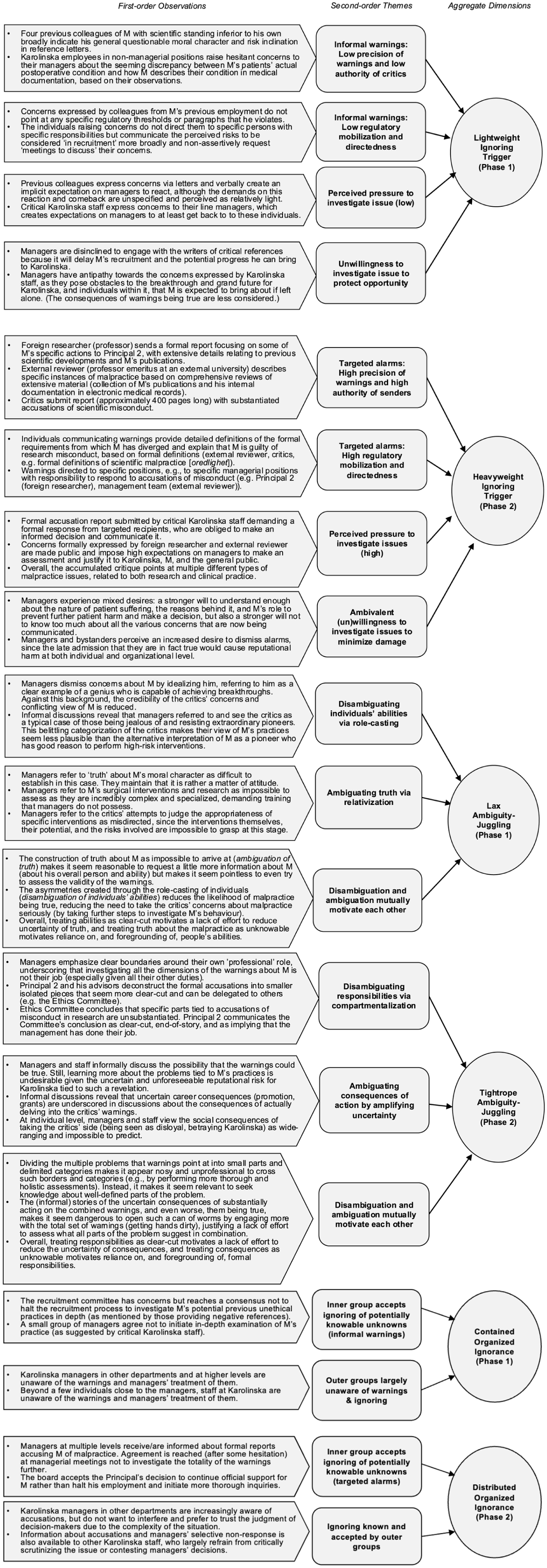
Data structure.
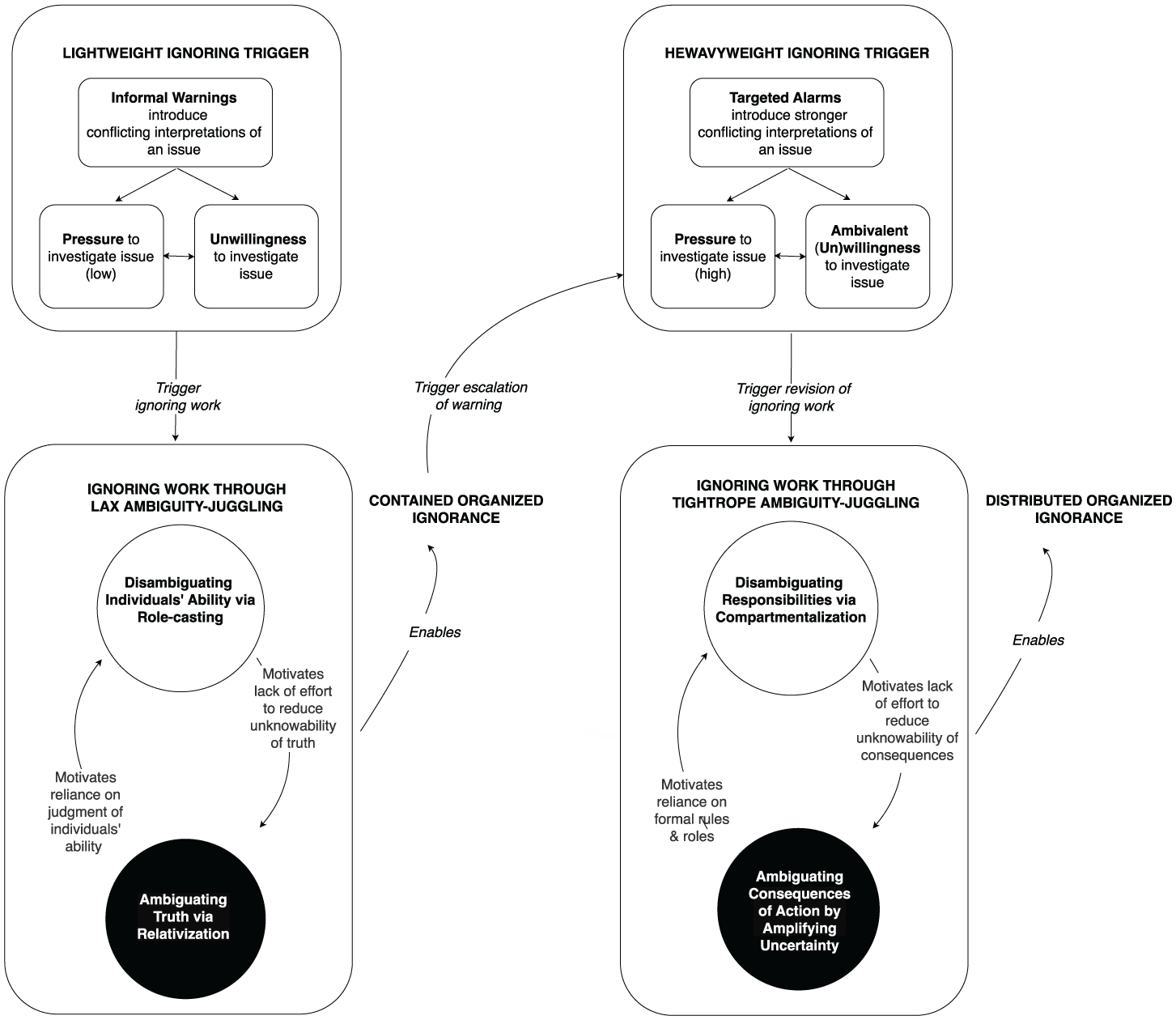
Visual summary of how sustained ignoring work involving shifting ignoring triggers, adaptive ignoring work, and evolving states of organized ignorance manifested in our case.
How Managers Selectively Ignored Shifting Warnings Through Adaptive Acts of Ambiguity-Juggling: The Macchiarini case
In this section, we outline how managers sustained ignoring work in the face of evolving warnings about M at Karolinska. We structure our account into two phases, characterized by specific ignoring-work triggers, ignoring-work processes (configurations of ambiguity-juggling) and ignoring-work outcomes (states of organized ignorance). Secondary references in square brackets are listed in Part Three of the supplemental files, while additional empirical illustrations are provided in Part 4.
Phase 1: Ignoring informal warnings through lax ambiguity-juggling
As we shall illustrate below, ‘weak’ warnings about M triggered the ignoring work performed by Karolinska managers in Phase 1. The low directedness, regulatory mobilization, and precision of the warnings, along with the weak authority of the critics themselves, made the warnings ignorable through what we refer to as ‘lax’ ambiguity-juggling, in which constructions of ambiguity as high and low were loose, relatively unsubstantiated with evidence, and unanchored in formal rules. Instead, managers’ constructions were anchored in the stereotypical roles of the ‘breakthrough’ narrative, based on the myth of the great genius eternally beset by nay-sayers and backstabbers. Lax ambiguity-juggling still mobilized sufficient motives to make minimal knowledge-seeking (about M’s person) acceptable and substantial knowledge-seeking about his potential malpractice irrelevant and futile.
Ignoring-work trigger
Informal warnings and unwillingness to engage with them to protect the opportunity. The initial period of M’s appointment was characterized by grand hopes tied to his extraordinary clinical and research-related abilities. Many employees described a ‘fairytale feeling’ of being part of his story. Karolinska was struggling to uphold its reputation as one of the world’s leading medical universities and needed a breakthrough, so employees placed great anticipation on M. ‘Finally, someone who could save us,’ one manager said, explaining: This [M’s practice] was not about incremental advances [. . .] It would undoubtedly lead to something radical, in the history books. The regenerative research would be spread to other areas of transplantation. . . Of course, everyone had different dreams of how [M] would elevate them to glory and fame as individuals. The top managers imagined bringing the next Nobel Prize to Karolinska, more donations and reputation, and the employees expected benefits from having worked with one of the most extraordinary geniuses alive [. . .]. (Manager, interview, referring to recruitment period in 2010)
During this phase, informal warnings about M’s potentially questionable character and practices introduced conflicting interpretations about him. For instance, during the recruitment of M, four of his five referees (former colleagues) noted that while he was a technically outstanding surgeon, he also had a ‘questionable moral compass’ and an inclination to ‘take excessively large risks’ [Asplund, 2016]. Later, four Karolinska employees in non-managerial/professor positions (internal critics) further began voicing concerns about the extreme medical complications that M’s surgical patients suffered during his early employment at Karolinska. His patients never seemed to recover, as the plastic tracheas he implanted failed to integrate with their surrounding tissue, thus continually causing new problems. The internal critics formulated their concerns to their line managers in an open-ended manner: ‘We were careful and communicated the possibility that things seemed unusually problematic and potentially caused by overly immature and risky procedures’ (critic 1, interview).
Although open-ended and communicated from persons with relatively low status, the concerns did pressure the managers to respond somehow. ‘The managers had to at least let the critics know that the information was received. . .’ (employee, interview). At the same time, acknowledging the warnings and the potential problem they indicated risked reducing the potential for a breakthrough or the speed at which it might be achieved, which contributed to a willingness among managers to at least temporarily avoid significant engagement with the warnings. The desire to ‘protect the opportunity’ and see what M could do was strong. As noted by a manager: ‘There was a clear disinclination [. . .] “Oh no, why this, why now?. . . It disturbs this great opportunity. . . Let’s wait with this. . ..”’
As illustrated below, the managers coped with these opposing impetuses – to know and not know – by juggling two complementary constructions of ambiguity: one making (some) things appear very clear and straightforward (disambiguation) and the other making (other) things seem very complex (ambiguation).
Disambiguating individuals’ abilities through role-casting
One clear pattern in the managers’ response to the warnings was their casting of M and the critics into stereotypical roles in the story of a breakthrough attracting jealousy and critique. For instance, faced with the views contradicting or at least muddying the ‘genius’ view of M during his recruitment in 2010, the managers in the recruitment team were initially concerned: ‘We had discussions, of course, and we were surprised [to receive the negative references]’ (manager, interview). However, a shared way of interpreting the critique gradually emerged, in which the concerns were interpreted against what the managers presented as M’s unusual abilities: Surgeons who have no qualms about excising diseased tracheas from people and replacing them with decellularized necro grafts [. . .] are rare. I do recognize the phenomenon well, having experience with similar people in our business. Sweden’s first kidney and liver transplants were made [with interesting methods], [. . .] contributing greatly to humanity and patients (even if some died in surgery). A specific kind of personality is required to eviscerate people in vivo. The border between success and fiasco is thin, and success is contingent on several conditions and other people who can balance it all. (extract, email from the head of the department to Principal 1 during M’s recruitment, 2010; translated by the authors)
The managers hence dealt with the concerns initially created by the referees’ input by casting M in the mould of trailblazers who achieved significant medical breakthroughs despite initial setbacks. The argument was that high initial mortality was an inevitable corollary of these leaps forward in medicine, which required a certain type of individual: a genius willing to take risks [Asplund, 2016]. Moreover, taking all potential risks seriously in such contexts might prevent anything risky or unconventional from ever being attempted at all. The clear-cut characterization of M as extraordinary implied that he should not be judged by the same criteria as others, and hence the critics’ concerns were not valid, motivating managers to avoid seeking further knowledge about the details. Notably, the recruitment team asked for additional information about M:s character from the Mayor of Tuscany, who was known to be a big admirer of M, thus engaging in a minimal form of knowledge-seeking focused on M’s own person. This letter was very positive towards M. As a result, M was later recruited over critics’ objections: There obviously will be noise around a great scientist: lingering too long on people having not perceived him as nice [. . .] and other nonconcrete ideas [. . .] is not possible. [. . .] Great breakthrough innovations always generate those kinds of things. [. . .] I think we [involved in the recruitment] needed to reduce the noise and see the overarching question: ‘Could this man be a one-of-a-kind scientist – yes or no?’ The answer was rather straightforward and actionable: ‘yes’. (manager, interview, referring to the recruitment period in 2010)
In the quote above, the narrative of the breakthrough innovation as (‘always’) generating resistance provides an illustrative account of the increasingly agreed-on narrative, with M as its ‘clear’ hero and his critics cast as evil adversaries who cannot possibly understand him.
The construction of M as an extraordinary, unfathomable genius was also reflected in the managers’ response to the four Karolinska employees (internal critics) who later voiced concerns about M’s malpractice early in his employment in 2011. As one critic noted, recalling one of the meetings that were finally arranged (after many fruitless attempts and long silences): When we first mentioned our concerns about the extreme complications [from M’s surgeries] at an informal meeting with the head, we were met with sad eyes saying, ‘Why don’t you try to really understand what M wants to achieve? Why don’t you take a nuanced view of M? Why are you being so regressive?’ But perhaps above all, ‘How dare you question the skills of this fantastic mind?’ (employee, conversation, referring to the period in 2011)
In retrospect, the managers did admit to feelings of uncertainty in relation to the early warnings. (As one noted, ‘I was shocked. What is this? Surely it can’t be true? At least it’s too early to say?’) However, the above quote and numerous others illustrate how the managers coped with this uncertainty by communicating with each other and the critics in a way that constructed the critics as typical examples of regressive, unimaginative, overly cautious personas. This served to undermine both the credibility and power of the critics’ arguments.
Thus, managers handled their hesitation and concern by making sense of the situation in a way that idealized M (as highly skilled, bold, visionary) and – more reactively than strategically – denigrated the critics (as poorly understanding, cautious, conservative). This made the situation appear relatively unambiguous and made the case for ignoring the warning signals seem fairly unproblematic – i.e. accomplished through ‘ignoring-supportive’ constructions of the situation and people involved. The alternative possibility and storyline – that the critics could be right, and that their warnings in fact suggested that they were able to identify problems tied to M’s risk inclination and practices – could therefore, at least temporarily, be dismissed.
Ambiguating truth through relativization
While the role-casting constructions backgrounded ambiguity by making certain interpretations of M less credible and thus ‘ignorable’, the managers also engaged in parallel sensemaking behaviours that foregrounded the ambiguity of other dimensions of the situation as a response to the warnings. In particular, a salient reasoning among managers was that it was in fact impossible to arrive at a final, ‘complete’ description of M’s accomplishment. The complexity of the situation made it impossible to define the ‘appropriate’ level of risk in relation to the potential. This depended on, and was always relative to, the perspective taken. For instance, in 2013, two of the internal critics articulated their concerns about M in a meeting with the professor who led the ENT unit and the professor who was secretary of the Nobel Assembly, only to be told that the situation was too complex and therefore impossible for the professors to judge: ‘This is too advanced for us to understand’ [Lindqvist, 2018]. Although the critics’ concerns were fairly straightforward – referring to medical consequences among patients, derived from firsthand observations – they were treated as impossible to interpret and act upon because there were likely other sides to the complex story. The managers hence engaged in ambiguation by moving the subject matter beyond the scope of judgment and knowability. This made any thorough attempt to assess the validity of the warnings seem futile: It’s funny: we are so concerned with evidence and quantitative proof of every little detail when introducing new interventions. But when we’re allowing a new surgeon to operate on patients in real life, it suddenly becomes meaningless and impossible to delve into details about results, to distinguish right from wrong. [. . .] I mean, even the most qualified professors, some of whom were on the Nobel Committee, claimed not to understand the issue [. . .] and suggested that ‘there were probably different ways of looking at this’. This was a reason for not even trying to understand the risks we pointed out. (critic 2, interview, referring to period between 2011–14)
The acts of disambiguation and ambiguation in Phase 1 reinforced each other. The combination of constructed person-ability certainty (ambiguity-cleansed ‘creative genius versus small-minded detractors’ narrative) and epistemological ambiguity – ‘We can’t know’ – made any substantial exploration of the warnings (and thorough attempts to reduce the ambiguity of what was ‘true’ about the situation) seem irrelevant. This legitimized the move from knowledge-seeking about the issue that the warnings pointed at, to a selective, person-centred knowledge-seeking. Worded differently, it enabled a shift from a factual knowledge-seeking logic to a matter of character assessment – moving from ‘what’ to ‘who’: We were all totally impressed by [M]. . . It was not difficult to dismiss the warnings at this stage. There were many reasons not to stir up a fuss, if I am to be honest. It seemed unlikely that the concerns that were vaguely posed by some individuals on the periphery were worth exploring, given that [M’s] practices were very difficult to understand, and would probably never be fully understood by us even if we tried. [. . .] In combination, it all appeared both meaningless and incredibly tough to even start stepping uphill into the potential mess that the critics pointed at. A mountain to climb that would potentially prove useless in the end. (manager, interview, referring to the period 2011–14)
Enabling a state of contained organized ignorance
Lax ambiguity-juggling worked, in the sense that no-one other than critics questioned managers’ non-action at the end of Phase 2 (end of 2013). Indeed, in addition to justifying the non-engagement with the warnings to themselves, the managers’ reasoning was also communicated at meetings and coffee breaks and accepted by their inner circle of Karolinska colleagues, contributing to a collective view on the subject matter and an accepted passivity in relation to it within this small group (a state of contained organized ignorance). The outer groups of the larger Karolinska organization were however at this time largely unaware of the warnings and the managers’ non-response to them. In parallel, M’s patients continued to experience severe complications.
Phase 2: Ignoring targeted alarms through tightrope ambiguity-juggling
Faced with Karolinska’s continued backing and praise of M (officially and internally), in combination with silence or silencing attempts by their immediate and higher-level managers and colleagues, the critics raised their misgivings and highlighted more issues about M in Phase 2. These alarms, which were now targeted (with high levels of directedness, regulatory mobilization, precision, and authority of the (old and new) critics), eroded the potential to rely on the myth of the beleaguered genius and the unknowability of truth as reasons not to know. Instead, the managers’ ignoring work became more demanding and involved new combinations of knowledge-seeking and knowledge avoidance that had to be legitimated. As we shall illustrate below, managers shifted to a ‘tightrope’ form of ambiguity-juggling, characterized by constructions clinging to ‘safe’ ropes in terms of established roles, categories and rules (that are, in hindsight, unfit for the problem) and constructing the uncertainty and risks tied to falling from the tightrope as very high. The managers constructed their (non-) responsibility in relation to narrow problem categories as unquestionable and clear and ambiguated consequences. This configuration of ambiguity-juggling implied and legitimated knowledge-seeking about isolated parts but made broader and more thorough knowledge-seeking of the combined warnings clearly beyond one’s responsibility, and potentially dangerous. Overall, the shared aim of minimizing damage primarily guided action in Phase 2, whereas protecting the opportunity had been the main guide in Phase 1.
Ignoring trigger: Targeted alarms and an ambivalent willingness to both know and ignore to minimize damage
In Phase 2, the old and new critics communicated their old and new concerns in an increasingly explicit and formal manner, submitting reports with more evidence, making direct accusations of several forms of severe malpractice, and approaching those formally responsible for dealing with suspicions about clinical and scientific malpractice. The warnings were now delivered not only by M’s previous colleagues and the internal critics but also by external critics with more authority, making it harder to rely on loose references to M as an unquestionable genius in combination with epistemological uncertainty over his practices (as in Phase 1). For instance, from 2014 onwards, several formal reports accusing M of scientific malpractice were submitted to KI’s Principal 2 (who had replaced Principal 1 in 2013). The internal critics submitted a 400-page report describing indications of M’s research malpractice. Further, a foreign researcher submitted an official report of suspected scientific malpractice, arguing that M’s claims of plastic-trachea surgery success were exaggerated in several papers published in The Lancet. The reports called for an investigation into whether M had preceded his human interventions with animal experiments and ethical approval, as required by regulations on medical research, and whether he had followed basic documentation requirements. These requests were combined with reports of M’s patients’ suffering and death, based on reviews of their medical records.
Stronger critical signals thus now collided with the equally strong established view of M as a genius and saviour. This triggered more ambitious ignoring work. Indeed, while the fortified alarms created a stronger pressure to respond, managers’ unwillingness to acknowledge that the warnings might point at a ‘real’ problem also grew stronger, as ‘the more time that passed, the worse it would be to be forced to realize that we had neglected a genuine risk for so long’ (employee, interview, referring to the situation in 2014–15). Interestingly, our material also points towards an increasing willingness to know more about the warnings at this stage. ‘There was more effort to know just enough to be able to dismiss the warnings,’ as one employee put it. Managers also referred to a mix of desires: to understand what had really happened, but without getting lost ‘down the rabbit hole’. If anything, the will to (not) know was multidimensional and ambivalent. Driven by these multiple, conflicting motives, and faced with simultaneous pressures to respond, the managers coped, once again by constructing the ambiguity of some issues around M as very low and around others as very high.
Disambiguating roles through compartmentalization
The warnings delivered in Phase 2 suggested a complicated, problematic situation tied to several dimensions of M’s practice. In particular, the combination of so many question marks was seen in post hoc reviews as unquestionably warranting a comprehensive analysis of the problems suggested by the reports and a step back to look at the totality of the indications that had emerged so far. One unit at Karolinska called a halt to M’s surgical activity. However, the managers at this unit – and, more importantly, Principal 2 and his advisors – located themselves, and smaller parts of the warnings’ subject matter, in formal categories in a way that absolved them of any responsibility to thoroughly investigate the totality and validity of the warnings. This involved compartmentalization by treating parts of the warnings in isolation and tying those parts to ‘formal’, partitioned occupational jurisdictions and categories.
As an example, in response to the report submitted by the foreign researcher in 2014, Principal 2 and his advisors identified functions (other than their own) responsible for investigating certain aspects of the suggested signs of malpractice, subsequently requesting a statement from the KI Ethics Committee. The committee concluded that the research malpractice accusations made by the foreign researcher were unsubstantiated (Svärd Huss, 2022) and referred to the issues raised as matters of ‘philosophy of science’ rather than ‘research ethics’ (Braunerhielm, 2017; Stokstad, 2015). Having accepted that the issues belonged in the ‘philosophy of science’ category, Principal 2 made no attempt to thoroughly scrutinize the warnings or form any judgement on them. Instead, this categorization turned certain parts of the warnings into an issue of scientific debate for the research community to deal with rather than a matter for external investigation. Recalling this announcement, a KI manager reflected that: There was no hesitation [in the official communication by the top management]: everything was in order. No question marks. It was important to make things [potential malpractice] appear certain, to us and others – although they were, I now of course realize, very grey. (manager, interview, referring to period 2014)
This quote illustrates the backgrounding of ambiguity around M’s practices. In another example in 2015, fragments from M’s patients’ medical records leaked to international websites, prompting a New York Times piece about the accusations. That article, combined with the formal accusation reports, finally prompted Principal 2 to initiate an external review of M’s practices. The external review (Gerdin, 2015a, 2015b), which ran to approximately 1,500 pages, found M guilty of research malpractice. Shortly afterwards, however, Principal 2 announced that KI had cleared M of all allegations of scientific malpractice and did not intend to investigate the issue any further. Justifying this decision, Principal 2 and his advisors referred to M as having acted on conditions belonging to a certain medical category: ‘vital indication’ – that is, life-threatening conditions for which no better treatment alternatives are available, as noted in the so-called Helsinki Declaration: The surgeries were performed in accordance with §32 of the Declaration of Helsinki at the time: ‘§32. In treating patients where evidence-based preventive, diagnostic, and therapeutic methods are non-existent or have proven ineffective, the physician is free to use informed consent by patients to use untested or novel preventive, diagnostic, or therapeutic methods.’ (extract, author’s translation, Daily Medicine, 2015, https://www.dagensmedicin.se/opinion/debatt/vart-beslut-vilar-pa-saklig-grund/)
The extract illustrates how the Principal referred to the issue as a clear case of vital indication. The critics (e.g. the external reviewers, Karolinska employees, and journalists who had begun following the case by now) questioned this categorization (Asplund, 2016; Braunerhielm, 2017), as did several medical specialists in witness hearings held when the case was brought to court. They claimed that although M’s patients had suffered before his treatment, their conditions could be seen as chronic and/or treatable with alternative methods, at least partly. However, the managers repeated the ‘vital indication’ argument in the press and at subsequent meetings, underlining that they were ‘certain about this, and that there was no need to worry or to act, this was taken care of’ (board member, interview). Once again, any ambiguity around the appropriateness of M’s practices, and whose role it was to actually investigate the problem that the warnings pointed at, was backgrounded – officially, at least – through the focus on small parts of the warnings and categorizing the problems they pointed at in ways that absolved the managers of any responsibility to investigate the totality of the warnings further.
In summary, the managers’ disambiguation of the situation in Phase 2 did not imply a complete disconnect from or avoidance of the targeted alarms; they did initiate investigations that yielded lengthy reports. However, the managers subsequently dismissed the signs of serious problems that these reports confirmed. This partial, initial non-ignoring/knowledge-seeking and subsequent ignoring formed a combination of process-knowing and outcome-ignoring. Boundary-drawing around the problem and procedures here turned issues that could be seen as highly ambiguous (M’s practices, as well as who was responsible for seeking knowledge about them) into something more clear-cut. Paradoxically, this disambiguation of responsibilities through compartmentalization – and the avoidance of engaging in ways that perhaps lay beyond one’s formal or at least everyday tasks – was motivated by the fear that the warnings could, in fact, be partly true. As we illustrate next, this uncomfortable suspicion was followed by compensatory ignoring work constructing the ambiguity around the consequences of acting on the warnings as very high.
Ambiguating consequences of action by amplifying uncertainty
Officially, Karolinska managers continued to support M and insisted that there was no reason to scrutinize him any further. Informally, however, they also expressed views foregrounding uncertainty regarding what might happen if they were to investigate the warnings and thus go beyond their ‘ordinary’ tasks. Behind closed doors, the managers and employees sometimes admitted that the mounting warnings were potentially relevant, albeit perhaps coloured by personal conflicts. Yet the managers still deemed it very risky to delve into the warnings, on the grounds that doing so might lead to ongoing and escalated conflictual views and far-reaching consequences over time. As one manager noted, this raised the question: ‘Why did you not speak up earlier – you are a manager!’ or various other accusations that no one could even imagine. [. . .] You know, people often behave in unexpected ways when crises emerge, and one should not think one can predict this. (manager, interview, referring to the period in 2015)
Some employees perceived this when informally asking managers about the status of the ‘M case’ in this period: The message was: ‘Put a lid on it. We are not going there. You do not distrust your colleagues. You do not interfere. You are loyal. Full stop.’ [. . .] No explanation, but indirectly saying, ‘This is too dangerous.’ [. . .] This was clearly a no-go zone, as too much was at stake [. . .] the risks [were] too high to Karolinska, its reputation [. . .] in particular, the uncertainty. Perhaps even exaggerated, I would say. It was like: ‘No one can even foresee what will happen if we start investigating this in depth [. . .] [it] might create ripple effects that no one could foresee.’ (employee, interview, referring to the period in 2015)
Hence, the response to questions was a full range of ignoring work constructing the risks tied to distrust, interference and disloyalty as unforeseeable. Faced with such ignorance-supporting engineering of uncertainty regarding the consequences of speaking up and acknowledging potential problems, people tend to respond with passivity and refrain from knowing work. Bystanding managers from more remote departments, who were also aware of the critics’ formal accusations by this time, similarly emphasized the uncertainty and jeopardy communicated informally by managers, suggesting that it was ‘impossible to predict what would happen if we were to start investigating such an extraordinary thing’ (employee, interview). It was impossible to foresee the consequences of trying to seek knowledge about the details of the warnings and thus (dis-)confirming them. More remote managers and colleagues now often complimented the internal critics – ‘I applaud you for explicating these issues’ – but still ended by saying, ‘Personally, I would not take this further’ (employee, interview). This contributed to a perceived uncertainty regarding the degree and nature of the danger involved in discovering more about the M case, and again, a reluctance among both managers and their inner circles, and a growing number of employees in the broader Karolinska organization, to invest time in truly grasping the content of the warnings beyond a very superficial level: It was more like the diffuse, terrible, uncertain career future that was driving this fear. [. . .] This uncertainty was often mentioned in informal conversation. . . [that]. . . this could be devastating for Karolinska’s possibilities of acquiring donations again, for its reputation, in many unexpected ways. [. . .] Many people worried about exponential effects, if the ball starts rolling [. . .] etcetera [. . .]. Even trying to predict and ‘calculate’ the effects was seen as futile; no one could ever know exactly what would happen if we were to start investigating M’s practices, and God forbid, find that [the critics] were right. [. . .] They did not want to know more; they did not want to understand the details [. . .]. (employee, interview, referring to the situation in 2015)
Statements such as ‘What would happen if. . .’ and ‘No one could ever know exactly what would happen’ signal the foregrounding of a high level of ambiguity tied to the consequences of knowing more about the warnings. Initiating further investigations that could, maybe, go against important stakeholders was perceived as career suicide, although exactly how this would unfold was impossible to foresee. As one internal critic noted: Who knows what would happen to someone aligning with a troublemaker, or a manager who dared to criticize and scrutinize a star surgeon? [. . .] I think these vague ideas made people simply not want to even get acquainted with the details of the risks. The more you know, the harder it is to extricate yourself from them [. . .]. (critic, interview, referring to period 2014–15)
The acts of ambiguation and disambiguation combined in the tightrope ambiguity-juggling performed in Phase 2 reinforced each other, as the managers’ ramping-up of uncertainty regarding the consequences of action (ambiguation) partly encouraged them to simplify issues by dividing the warnings into smaller parts and assigning them to established procedures tied to someone else’s role (i.e. disambiguation). Since the consequences of responding to warnings were uncertain, sticking to the letter of one’s formal responsibilities seemed the most attractive option. Similarly, the direction of non-action suggested by seemingly clear roles made it easier to accept the ambiguity around the consequences of action and thereby legitimized the very selective, part-focused knowledge-seeking, and the absence of effort to find out what would actually happen should one take steps to further investigate the totality of issues that warnings pointed at.
Enabling a state of distributed organized ignorance
The tight-rope ambiguity constructions legitimized non-action not only among the managers and their inner circle, but also among outer groups of bystanding employees at Karolinska overall, who were at least peripherally encountering and observing the warnings and managerial (non‑)actions. As noted by an employee in an opinion piece published after the fact: I know that no major clinical decision is taken by one person alone. I know who was at the meeting where they agreed to start operating on plastic tracheas; it is all public. I know who contributed names and titles to the Macchiarini manuscript. I know how many senior managers, board members, and professors knew, appreciated, approved, and encouraged. I know there were hundreds like myself, who knew and perhaps disapproved but chose to remain silent, out of cowardice or laziness or both. (Grönlund, 2021)
We refer to the organized state of ignorance accomplished at the end of Phase 2 as ‘distributed organized ignorance’. At this stage, the dismissal of the warnings was known and accepted, not only by the managers and their inner circle, but also by the wider organization. As noted by an employee, ‘Everyone [top management, heads of clinics, clinical and research groups] knew about the concerning signs,’ but ‘No one wanted to know more about them.’ At the end of the study period, M was still operating for research purposes with full support from Karolinska. (See supplemental files for further details about what happened when the media intervened.)
Discussion
Our study contributes to the scholarly understanding of wilful or strategic ignorance by theorizing how organizational ignoring is sustained in the face of evolving warnings. Figure 3 provides a visual summary of our conceptualization. It depicts sustained ignoring as a process involving shifting ignoring triggers, adaptive ignoring work and resulting states of organized ignorance. Figure 3 also illustrates how these interacting processes manifested in our case.
As Figure 3 depicts, ignoring work can be sparked by neglecting or explaining away triggers that encompass warnings or other signals about a potentially problematic issue, which create a certain level of perceived pressure as well as un/willingness to investigate the issue. Depending on the nature of and interaction between these elements, they will form lightweight or heavyweight triggers of ignoring work. In our case, the process began with informal warnings (weak in their directedness, regulatory mobilization, precision and authority of senders, i.e. implying low position and power of critics (Delmestri & Goodrick, 2016)), which produced a low pressure but a parallel unwillingness to respond by the managers receiving the warnings. This triggered ignoring work through ‘lax’ ambiguity-juggling, in which constructions of ambiguity as high and low were loose, relatively unsubstantiated with evidence and unanchored in formal rules. Lax ambiguity-juggling involved mutually motivating acts of disambiguation (of individuals’ ability) and ambiguation (of truth). In combination, they legitimized a non-knowing of the issue that warnings pointed at (which was combined with a more minimal, person-focused knowing). Lax ambiguity-juggling produced a state of contained organized ignorance at the end of Phase 1. Here, the ignoring of potentially knowable unknowns (Roberts, 2012, p. 216) was collectively accepted and performed by the managers and their inner groups, while outer groups of the organization were largely unaware of the warnings and the managerial ignoring of them (representing unknowable unknowns (Roberts, 2012)). We refer to this state as organized given that it was agreed on by and reproduced in daily interactions between multiple actors (Knudsen et al., 2023).
States of organized ignorance may also be performative, do things (McGoey, 2019). In our case, the contained organized ignorance in Phase 1 made the critics more eager to get a response, resulting in them escalating warnings. In Phase 2, the managers received targeted alarms (with high levels of directedness, regulatory mobilization and precision), and from additional critics with higher authority (i.e. implying high position and power of critics (Delmestri & Goodrick, 2016)), which fed into a new, reconfigured ignoring trigger. In our case, a heavyweight ignoring trigger producing higher pressures to respond, which interacted with a now more ambivalent (un)willingness to investigate the issue that warnings pointed to. As a result, receiving managers were forced to revise their ignoring work. They shifted to a tightrope ambiguity-juggling characterized by strict constructions complying with narrow roles, categories and rules and constructing the uncertainty and risks tied to knowledge-seeking as very high. In particular, tightrope ambiguity-juggling involved the disambiguation of responsibilities and the ambiguation of consequences, which mutually motivated each other and in combination legitimized part-focused knowing and non-knowing of the totality of issues. This enabled a new state of distributed organized ignorance, where the ignoring of potentially knowable unknowns (targeted alarms) (Roberts, 2012) was not only accepted and performed by the managers and their inner circles but also at least partially known and accepted by bystanding outer groups.
Although beyond the scope of our study, it is worth noting that new rounds of escalated warnings led to the dismissal of M and a (still ongoing) blame game after the study period. This could be seen as the breakdown of sustained ignoring, caused by heightened ignoring threats (involving media attention), a shrinking acceptance of the ignoring work and a resulting state of organized knowledge-seeking (rather than ignorance). In contexts failing to attract such media interest, and where critics may lose motivation to keep on speaking up about the issue, ignoring may instead simply go on, perhaps increasingly effortlessly, as acceptance of the non-knowing becomes institutionalized. However, another way of looking at the aftermath of our and other cases is that they offer opportunities to study new ignoring triggers, new forms of adaptive ignoring work and new states of organized ignorance in which the non-knowing of certain issues and knowing of others is accepted. Although the content may vary, every organization has its problematic issues, which over time may lead to persistent but evolving warnings and an ongoing struggle between ignoring, trying to find out (knowing) and selectively combining the two. All these perspectives warrant future research.
Our conceptualization contributes to the ignoring literature by extending current accounts of the ‘why’, ‘how’, ‘how much’ and ‘who’ of ignoring, as well as its outcomes. We unpack these contributions below.
Contributions to the ignoring literature
The ‘why’ of ignoring
Previous work has identified numerous reasons why actors ignore uncomfortable information (Ebbevi et al., 2024; Essén et al., 2022; Heimer, 2012; Klintman, 2019; Knudsen, 2011) but has not explored the nuances of actors’ unwillingness to know and how they may interact with expectations to attend to information. We contribute by conceptualizing the combination of changing warnings, associated perceived pressures to act on them and motives for ignoring them as dynamic triggering mechanisms (shifting ignoring triggers). Our work confirms that periods of ignoring can trigger escalations of warnings (Anvari et al., 2019; Delmestri & Goodrick, 2016; Kenny, 2019), creating heightened pressures to respond. However, depending on how such heightened pressures interact with actors’ unwillingness to engage with the warnings, this may or may not lead to knowledge-seeking responses (Alvesson et al., 2022). As we show, heightened pressures combined with a sustained unwillingness to engage with the warnings may rather trigger new rounds of revised, and rather sophisticated, ignoring work.
In our case, the unwillingness to engage with the uncomfortable information in question became increasingly multifaceted, involving motives such as simply getting on with an issue and accepting a level of uncertainty, but also protecting a specific trajectory and avoiding facing critique and blame. The unwillingness to engage was also increasingly accompanied by a willingness to know (some things). This suggests that motives behind ignoring work can be both coping-oriented and strategic, characterized by ambivalence, and include a will both to ignore and to know. This extends previous portrayals of the motives behind ignoring as relatively stable, unified and one-dimensional (e.g. escaping liability, maximizing profits, preventing disruption, protecting autonomy (Essén et al., 2022; McGoey, 2012; Proctor & Schiebinger, 2008).
The ‘how’ of ignoring
As we show, shifting ignoring triggers exert a distinct influence on the work of ignoring, which often thus becomes more complicated than simple neglect of known or knowable unknowns (Schaefer, 2019). The ignored issue may rather be a moving target, only partially knowable and characterized by conflicting interpretations, i.e. ambiguous. Drawing on previous work suggesting the role of ambiguity and actors’ need to cope with it in contexts of ignoring (Alvesson et al., 2022; Maitlis & Sonenshein, 2010), we here introduce the notion of adaptive acts of ambiguity-juggling as a way for individuals and groups to carry out ignoring work in the face of complex, disturbing and shifting signals or issues.
Acts of ambiguity-juggling are reactive, triggered by the emergence of uncomfortable issues, but also purposeful, driven by actors’ unwillingness to engage with the issues. Hence, the juggling metaphor refers to how uncomfortable issues are encountered, (e.g. warnings received), only to be thrown up ‘in the air’ – again, thus at least temporarily released from one’s responsibility (but returning in adapted form as new warnings – requiring new rounds (configurations) of juggling).
The notion of ambiguity-juggling particularly underscores the role of dynamic constructions in this context, making the ambiguity of issues too great to confront (‘We will never know’ or ‘It is too difficult to try to know’) or non-existent (‘We already know’) and thereby not worth exploring fully. Here, the construction of certain issues as being virtually unknowable (ambiguation), and the resulting uncertainty and open-endedness of action, call for compensatory disambiguation to stabilize and create a sense of social order, motivating pragmatic action. By clear-cutting and truth-doing certain issues, disambiguation in turn contributes to a continued acceptance of letting other issues remain unknowable, thus legitimizing ambiguation. Since actors feel they know enough, and can demonstrate to others that they have done enough to credibly drop or park the issue, they can let other issues (outside the scope of perceived certainty) be. Hence, in combination, these constructions of things as high and low in ambiguity provide self-reinforcing legitimators of ignoring.
These insights confirm the importance of previously outlined ignoring work such as hiding/disconnecting (Heimer, 2012; Kenny, 2023; Kronblad et al., 2024; van Krieken, 2024), redirecting (Knudsen, 2011; Schaefer, 2019) and the justification of non-efforts to know (more) (Ebbevi et al., 2024; Essén et al., 2022), but supplement previous accounts by foregrounding interacting ambiguity constructions as a novel handling and justification mechanism. Indeed, while previous work shows that justifications such as ‘not my job’, ‘it wouldn’t be right’ and ‘compartmentalization’ of issues legitimizes knowledge avoidance, we introduce an ambiguity perspective that shed new light on previous studies. From this perspective, the active construction, combination and playing out of the view that ‘we know enough’ (to act pragmatically) respectively can’t really know means a ‘clarification/ambiguity cocktail’ that facilitates muddling through, at least for some time and with some luck. Further, our emphasis on the adaptive nature of these acts extends previous accounts of stable justifications for ignoring relatively constant sets of information or a consistent narrative (Ebbevi et al., 2024; Essén et al., 2022). As we show, original justifications may lose their legitimizing power over time and call for updates.
The ‘how much’ of ignoring
Our work shows that acts of ambiguity-juggling legitimize selective ignoring work including both knowledge-seeking and knowledge avoidance. Actors may have to do some knowing work to find out what they could or should ignore, and how to communicate ‘credible ignoring’, i.e. use knowledge-seeking to justify further non-knowledge work (Gross, 2007). For instance, in our case, knowledge-seeking about individuals’ ability (minimal, person-centred knowing), enabled the knowledge avoidance regarding the content of the warnings in Phase 1. In Phase 2, knowledge-seeking focused narrowly on those parts of the warnings that lay within an actor’s comfort zone of responsibility (part-focused knowing), enabled knowledge avoidance regarding the totality of warnings. These insights contribute to the literature, which has hinted at combinations of knowledge-seeking and knowledge avoidance in ignoring work (e.g. Gross, 2007; Heimer, 2012; Knudsen, 2011) without providing empirically substantiated illustrations and theorizations of how they may unfold over time. As we show, sustained ignoring work can involve mutually supporting acts of knowledge-seeking (non-ignoring) and avoidance (ignoring), which shift in nature along with changes in external pressures and actors’ willingness to know.
The ‘who’ (and outcome) of ignoring
The ignoring literature generally treats the outcome of ignoring work as the keeping of a secret (or dismissal) by one actor (or a coherent collective actor) – for instance, the pharma industry (Proctor & Schiebinger, 2008), public organizations (Kronblad et al., 2024; Maor et al., 2012), a manager (Schaefer, 2019) or a collective of organizations maintaining unused data systems (Essén et al., 2022). In these works, ignoring is regarded as a stable, enduring act or a unitary state. In contrast, we point out that the outcome of ignoring work is ongoing and takes the form of evolving states of organized ignorance (Knudsen et al., 2023) that vary in terms of the actors involved in keeping the secret (non-acknowledged issue) and in relation to whom they need to legitimate it to. In our case, top management, heads of clinics and clinical and research groups more or less directly involved in making influential decisions come together to form a more complex backdrop than a top manager simply knowing/ignoring or a management team acting in isolation. We show how the ignoring work shifted from a contained version of organized ignorance to a distributed one as more and more people became at least partly aware of the problems, although they refrained from intervening (Thiel & Grabher, 2024). This suggests various degrees of ignoring by multiple actors, contributing to states of organized ignorance in which it is difficult to point to a single actor or group being accountable. In our case, this allowed several factions within the organization to at least tentatively and temporarily protect their interests (to pursue the innovation and, later, minimize damage).
Taken together, our work highlights a type of ignoring work that is persistent but adaptive (there is awareness and some acting/knowledge-seeking) and provides new perspectives on a crucial set of dynamics for understanding ignoring: the ‘why’, ‘how’, ‘how much’ and ‘who’ of ignoring work, and its outcomes. Considering these elements further in research should enrich theory on strategic or wilful ignorance by advancing our theoretical understanding of how sustained forms of ignoring, both inwardly and outwardly directed, are enabled and maintained in organizations.
Contributions to research on ambiguity management
Our conceptualization of ambiguity-juggling also contributes to the literature on ambiguity management, where we know from previous research that actors can construct ambiguity to serve their own interests. Strategic ambiguity studies, however, primarily focus on actors’ maintenance and amplification of ambiguity (ambiguation) (Cappellaro et al., 2021; Eisenberg, 1984; Sillince et al., 2012; Ulmer & Sellnow, 1997; Vaccaro & Palazzo, 2015). Studies have noted that the initial positive (e.g. mobilizing, facilitating) effects of strategic ambiguity can lead to ‘internal contradiction’, ‘overextension’ and confusion over time (Abdallah & Langley, 2014; Sonenshein, 2010), resistance and lack of control (Davenport & Leitch, 2005; McCabe, 2010), and cycles of indecision (Denis et al., 2011). Lingo and O’Mahony (2010) further illustrate parallel efforts to reduce and maintain ambiguity. Yet, previous theorizations have not addressed how acts of ambiguation and disambiguation can work in tandem to serve a single course of action (in our case, non-action), nor how the work of knowing and ignoring may be a part of the dynamics. Previous studies rather assume that efforts to increase and decrease ambiguity are performed by and serve different interests and actors – those wanting to hide (e.g. the mafia, the tobacco industry) and those wanting to know (e.g. scrutinizing authorities, interest groups) – implying a conflict between ambiguation and disambiguation groups and a struggle involved in their coexistence (Cappellaro et al., 2021). Our work hence contributes by conceptualizing how a group of actors uses ambiguation in tandem with disambiguation in ambiguity-juggling to serve their own interest. The risk of ‘too much’ or one-sided ambiguation here explains and supports the use of disambiguation to offset such risks and maintain focus and cohesion. Thus, accepting and ignoring the unknowable does not appear too problematic or paralysing, as there are counterforces sufficiently anchoring decisions in knowing. This perspective on ambiguity as needing a balance with its opposite – the signalling of clarity – echoes the more general understanding of managerial work as involving the management, production, and use of both uncertainty and certainty (Cohen & March, 1974; McCaskey, 1982) and offers a fruitful path for future research on managers’ ways of coping with uncomfortable information.
Generalizability and future research
The case we studied was in some ways extreme (Hällgren et al., 2018), involving repeated warnings and their stubborn dismissal in a context of complex, high-stakes medical innovation where failure could be fatal. The context of a prestigious university hospital and research institution with high reputational risk should also be acknowledged. Organizations are highly diverse in terms of their professional cultures and the nature and degree of the specific issues and ambiguities they embody. Therefore, we are cautious about empirical generalizations of the sequence and specific nature of events in our case. However, although using an extreme case allows us to ‘get a point across in an especially dramatic way’ (Flyvbjerg, 2006, p. 229), the understanding of sustained ignoring work as the interaction between shifting ignoring triggers, adaptive ignoring work (ambiguity-juggling) and resulting states of organized ignorance as an abstract and analytical perspective (see Figure 3) has broader applicability and may play out in other contexts.
For instance, the shift from informal warnings to targeted alarms when no one listens finds support in the literature on whistleblowing (Anvari et al., 2019; Delmestri & Goodrick, 2016; Kenny, 2019) and may produce increased pressures to respond also in other settings. However, the un/willingness to respond is less difficult to predict, as it can depend on many things unrelated to the warnings themselves (Alvesson et al., 2022). In our case, un/willingness to respond was linked to the will to protect innovation versus minimize risk, but there may be numerous other things to protect or avoid.
In our case, the specific nature of the ignoring triggers sparked different configurations of ambiguity-juggling. It is likely that more informal, lightweight triggers spark lax ambiguity constructions with ‘wide’ arguments also in other settings, more related to loose claims about persons’ nature, whom to trust, things that may seem easier to judge than the potential problems themselves, and thus convenient to use to dismiss arguments. When alarms get more precise and targeted, recipients will need to shift to risk-minimizing approaches involving constructions of their own role, (non) responsibility and the (negative) consequences of acting.
Further, it is likely that a shift from contained to distributed organized ignorance will occur in other settings. Ignoring may initially be a well-kept secret and largely unknown (i.e. representing unknowable unknowns (Roberts, 2012) to large parts of the organization) in early stages, but, as warnings seep out across the organization, the warnings and the ignoring of them becomes, at least partially, known unknowns (Roberts, 2012), to other staff levels and categories. Faced with ignorance-supporting engineering of uncertainty regarding the consequences of speaking up and acknowledging potential problems, people tend to respond with passivity (Kenny, 2019, 2023; Kish-Gephart et al., 2009) and, in our case, this dynamic increased over time, making many organizational facets part of the organizational ignoring and the non-response to it, i.e. collectively ignoring the ignoring (Essén et al., 2022).
More generally, we expect that ambiguity-juggling allows managers and employees beyond the studied case to amplify and reduce (or simply acknowledge and accept) ambiguity to cope with cognitive overload and dissonance as well as decision anxiety, to disarm opponents and gather people around a favourable view – or, as in our case, to avoid knowing more about uncomfortable issues. This may be the case in settings where radical innovation initiatives, star employees (Kehoe et al., 2018), charismatic leaders (House, 1977) or conformist organizational cultures (Jackall, 1988) contribute to the neglect of alarms. In such situations, the denial of ambiguity around ‘sacred’ issues – such as hero characters, hope for great success, and organizational identity – may trigger complementary constructions of truth as highly uncertain and therefore best left unjudged, not least to protect identities, resources and prestige. Ambiguity-juggling may also have particular relevance in open or fairly transparent contexts (e.g. public service, as distinct from top-secret warfare, commercial innovation work, and so on), where (non-)actions and decisions must be publicly justified more often. However, managers and others may also face dilemmas around knowing or ignoring under more ordinary circumstances – for instance, moderate ethical issues over minor abuse, corruption, pollution problems or quality issues – and use ambiguity-juggling to handle them. This suggests multiple opportunities for future research combining theories of ambiguity management (Cappellaro et al., 2021; Sillince et al., 2012) and ignoring (Gross, 2007; Knudsen et al., 2023; McGoey, 2019; Schaefer, 2019) to advance our understanding of how uncomfortable information and emerging ambiguities of organizational life more generally are continuously dealt with by organizations, and with what consequences.
Our study has limitations. We base our account on documentation and interviews (mostly retrospective), so we can only base our claims on articulated and often post-hoc reasoning. We corroborated retrospective data sources with documents created during the study period, allowing us to show how the warnings could be ignored, and to some extent why. Yet we did not capture the full range of psychological processes and individual-level reasoning explaining why managers acted as they did. These are areas for future research, although the required access and depth is difficult to achieve.
Conclusion
Our study explores sustained ignoring work as the effort to disregard issues that potentially call for attention and action over time. As we show, such work is complex and is dynamically performed in relation to oneself, the immediate environment and the outside world. Our conceptualization of ignoring work as involving shifting ignoring triggers, adaptive work and continuously and collectively performed outcomes can pave the way for future research expanding our understanding of the ‘why’, ‘how’, ‘how much’ and ‘who’ of ignoring, as well as its outcomes. Ambiguity around these aspects also includes the extent to which ignoring is taking place, which is seldom categorical and clear-cut.
Regarding practical implications, it is easy in hindsight to point out how managers should have acted more quickly and decisively to investigate potential problems that later turned out to be severe. At the same time, strong emphasis on knowing and minimizing ambiguity may lead to decision anxiety and obstruct both innovation and everyday work. It is however important for organizations to prevent the overdoing of ignoring and the mismanagement of ambiguity. Apart from purely qualitative problems in the form of judgement errors, both the under- and overdoing of ambiguity turn it into a reason not to try to find out. In our case, it led to many of the critics being silenced and to the continuation of wrongdoings, incurring high costs in terms of patient suffering and death. We hope that our study offers some vocabulary, including ambiguity-juggling and ignoring work, that will be relevant for researchers and practitioners to better approach these complicated issues.
Supplemental Material
sj-docx-1-oss-10.1177_01708406261432805 – Supplemental material for Juggling Ambiguity in Sustained Ignoring Work: The persistent dismissal of warnings at a university hospital
Supplemental material, sj-docx-1-oss-10.1177_01708406261432805 for Juggling Ambiguity in Sustained Ignoring Work: The persistent dismissal of warnings at a university hospital by Anna Essén and Mats Alvesson in Organization Studies
Footnotes
Acknowledgements
We want to thank the critics and anonymous individuals from Karolinska who generously shared their experiences of the process. The editorial panel provided invaluable advice in how to improve the manuscript. Jacob Sjöberg, August Hägerdal and Arav Petkar contributed to the manuscript by collecting, summarizing and editing data and text.

Ethical Considerations
Ethical approval was not not sought.
Consent to Participate
Respondents were informed about the research project and consented verbally to particpation.
Funding
The authors disclosed receipt of the following financial support for the research, authorship, and/or publication of this article. Funding was provided by the Swedish Research Council for Health, Working Life and Welfare (project no 2021-00582) and Handelsbanken’s research foundations (project no P21-0067).
Declaration of conflicting interests
The authors declared no potential conflicts of interest with respect to the research, authorship, and/or publication of this article.
Data availability statement
Additional data available at request.
Supplemental material
Supplemental material for this article is available online.
Notes
Author biographies
References
Supplementary Material
Please find the following supplemental material available below.
For Open Access articles published under a Creative Commons License, all supplemental material carries the same license as the article it is associated with.
For non-Open Access articles published, all supplemental material carries a non-exclusive license, and permission requests for re-use of supplemental material or any part of supplemental material shall be sent directly to the copyright owner as specified in the copyright notice associated with the article.
