




Abstract
Art and entrepreneurship both demonstrate a particular power to experiment with how the social is apprehended, organized and inhabited. How can we then understand and theorize the particular power of art understood as entrepreneurial organizing? In this paper, we develop the concept of artistic entrepreneuring. It is based on contemporary art’s wide-ranging ‘organizational turn’, where art becomes organization by experimenting with forms and processes of emancipatory organizing. Interweaving art theory, examples of art’s organizational turn and a processual understanding of public entrepreneurship, we conceptualize artistic entrepreneuring as fundamentally aesthetic, necessarily sited and invariably political, and we discuss the implications for entrepreneurship studies and research on the aesthetics and politics of organizing.
Keywords
Introduction
Art and entrepreneurship both experiment with how the social is apprehended, organized and inhabited. Broadly put, there is a homology, or shared characteristic, of art and entrepreneuring: both have the potential to challenge conventional or dominant ways of doing and making, and intervene in customary and habitual patterns of perception and experience (Hjorth, 2013). In this sense, thematizing the nexus of art and social change is far from new. Ever since the rise of modern art unshackled art’s dependence on codified norms and rules of artistic representation, works of art have demonstrated a particular power to affect social organizing (Rancière, 2013). Yet recent artistic practices have updated and perhaps radicalized this relation by foregrounding and experimenting with organizational concerns. In these cases, organization is not merely something that is required to produce and present any kind of artwork. Rather, art becomes organization itself (Holm, 2020).
Consider the upcoming, fifteenth version of documenta, often regarded as the most important exhibition of contemporary art. It will take place in 2022 under the guiding theme of the Indonesian notion ‘lumbung’ (‘rice barn’), a community storage for crops to be commonly distributed. For documenta ‘lumbung’ denotes emancipatory organizational principles of collectivity, resource building, mutual care and equal sharing. The term is therefore meant to represent the aspirations and capacities of current artistic practices to interweave art and organization. documenta fifteen promises to gather such ‘new artistic and economic models’ that artists are currently developing around the world in response to local concerns and crises. 1
As scholars of art and organization, we believe that such practices are both intriguing and relevant, not only for understanding and theorizing how art works, but also for making us reimagine how entrepreneurial organizing takes place. Yet how can we more precisely understand and theorize art’s particular ‘entrepreneurial’ power? And what implications does it have for theorizing and exploring entrepreneuring? To respond to these guiding questions, we develop the concept of ‘artistic entrepreneuring’. To do so, we base our study on the field of contemporary art and its ‘organizational turn’: its manifold practices of intervening in and seeking to reshape social forms and processes. While there are pioneering studies on art and artistic practices in the context of entrepreneurship theory and the study of organization, usually based on specific empirical cases, to our knowledge ours is the first systematic analysis and conceptualization of art as offering a specific set of entrepreneurial practices.
We think that such practices are particularly conducive to a rethinking of entrepreneurship as ‘breaching or moving beyond presently dominant (. . .) institutional arrangements, organizations and practices’ (Hjorth & Reay, 2019, n.p.). In particular, that is, if such entrepreneurial organizing is envisioned as challenging or simply disregarding market-based models of entrepreneurship by introducing new practices of ‘organization-creation’ (Hjorth, 2014). In this article, we connect the organizational turn in art to this ‘Copernican revolution’ in entrepreneurship studies (Dey & Mason, 2018, p. 85), which has moved the study of entrepreneurship from an emphasis on the establishment and operations of business ventures to processes of instigating societal transformation.
Situating our undertaking at the interstices of art theory and an understanding of entrepreneuring as social change, we develop a notion of artistic entrepreneuring that is based on art’s own practice of, and reflections on, doing the work of organizing. Relating art’s organizational turn to main threads of reconsidering entrepreneurship, and especially the new processual understanding of public entrepreneurship, we conceptualize artistic entrepreneuring as aesthetic, sited and political. Artistic entrepreneuring foregrounds the aesthetics of social transformation through a variety of aesthetic forms and events that generate new imaginaries and experiences of organizing. It emphasizes a fluid notion of entrepreneurial sites and entrepreneuring as a spatial practice. And it captures a distinct politics of entrepreneurship as aesthetically transforming or inventing collective processes of organization. In its emphasis on the fundamentally aesthetic, necessarily sited and invariably political features of entrepreneuring, the concept of artistic entrepreneuring offers a distinct contribution to entrepreneurship studies and, more broadly, to research on the aesthetics and politics of organizing.
We proceed as follows. First, we contextualize and position our endeavour with regard to the main threads of studying entrepreneuring as social change. Second, we both genealogically and systematically map, illustrate and discuss the organizational turn in art, and how and to what ends artistic endeavours engage with the organized world. On this basis and third, we develop and present an understanding of artistic entrepreneuring as aesthetic, sited and political, and we reflect on the implications for researching entrepreneurship and organization. Fourth and in conclusion, we briefly summarize our findings, reflect on their limits and point to next steps.
Entrepreneurship unbound
The notion of artistic entrepreneuring that we develop in this paper is based on two interrelated movements in entrepreneurship studies. One is the aforementioned ‘Copernican revolution’, which posits entrepreneurship as a practice of social change beyond the doxa of delimiting entrepreneurial activity to economic ends and opportunities for wealth creation via business ventures. This movement opens up the study of entrepreneurship to all kinds of cultural, institutional and everyday contexts (Dey & Mason, 2018; Rindova, Barry, & Ketchen, 2009). 2 The other movement, related to and partly intertwined with the expanded field of entrepreneurship studies as social change, advocates and enacts a processual approach to entrepreneuring. Closely connected to the wider turn towards processual thinking in the study of organization (Helin, Hernes, Hjorth, & Holt, 2014), the focus here falls on an understanding of the happening of the entrepreneurial as embedded in an ‘ontology of relatedness’ (Steyaert, 2007, p. 472). Such process thinking seeks to displace methodological individualism, the well-worn focus on ‘the entrepreneur’ as (usually male, heroic) agent of change and ascribing primacy to cognitivism and intentionality with an attunement to the relational, fleeting, messy, to some degree indeterminate and invariably situated processes of entrepreneuring. While an extensive review of these movements is beyond the scope of this paper, we can identify a number of concepts and theoretical and methodological sensibilities that pave the way for developing the notion of artistic entrepreneuring.
Entrepreneurship as social change
How can entrepreneurship be reframed into a practice to bring about, and a concept to study, social transformation in more general terms (Calás, Smircich, & Bourne, 2009)? The perhaps dominant response to this question is grouped under the rubric of social entrepreneurship, an itself heterogeneous ‘cluster concept’ (Choi & Majumdar, 2014) that relates entrepreneurial thinking to the solving of social problems through market-oriented practices of social innovation and a focus on outcomes and ‘social values’ (Dacin, Dacin, & Tracey, 2011). Social entrepreneurship research has established social transformation as goal and outcome of entrepreneurial practice, identifying contexts such as disability, poverty, natural disasters, exclusion, environmental degradation and women’s empowerment as sites of social change that call for different entrepreneurial practices and processes (Drencheva et al., 2018; Haug & Talwar, 2016). Moreover, there seems to be an awareness of the collective and distributed nature of entrepreneurial activity, modifying the grand narrative of heroic individualism (Spear, 2006). Yet the notion of social entrepreneurship is indebted to the economic and managerialist approach to entrepreneurial activities (Calás et al., 2009; Dey & Mason, 2018); it is perhaps ‘closer ideologically to for-profit enterprises than to non-profits’ (Sud, VanSandt, & Baugous, 2009, p. 203). The solving of social problems, framed as opportunity exploitation, is presented as requiring the employment of market principles and the realization of business models for the creation of what can be translated into ‘social value’, or even ‘social wealth’, which in conjunction with the quest for economic value implies, rather frighteningly, ‘the pursuit of total wealth maximization’ (Zahra, Gedajlovic, Neubaum, & Shulman, 2009, p. 522). Such principles, pursuits and vocabularies simply do not apply to some of the fields and practices that have come to shape entrepreneurship research’s turn to social transformation, and certainly not to the practices of artistic entrepreneuring that we will discuss below. This kind of approach therefore severely limits what falls under the purview of an expanded notion of entrepreneurship in general and of artistic entrepreneuring in particular, not least because assuming that market principles and values would constitute a ‘neutral’ and generalizable framework contradicts political and emancipatory agendas of entrepreneurship as social change (Steyaert & Dey, 2010).
The concept of institutional entrepreneurship goes some way to redress these limitations. Entrepreneurial activities are seen as embedded in institutional structures and as attempting to intervene in, and change, these structures or even invent new ones. These interventions are not limited to the economic realm but can take place in any institutional field. Moreover, institutional entrepreneurship entails breaching existing rules and ways of doing and (sense-)making, and thus struggles over institutional arrangements (Garud, Hardy, & Maguire, 2007). However, the interest to reclaim the potential of agency in institutional settings risks ushering back in individualistic images of ‘heroic entrepreneurs’ who successfully change the constraints of given institutional logics (Hardy & Maguire, 2017). In addition, most studies assume state and market logics as institutional strictures (Su, Zhai, & Karlsson, 2017) to the exclusion of what cannot be labelled ‘institutional’ (Alvesson & Spicer, 2019), and thus in lieu of processually and situationally attuned explorations of, for instance, artistic world-making. While the notion of social entrepreneurship allows for an expanded understanding of entrepreneurship aimed at social change (even if framed as economistic endeavour), research on institutional entrepreneurship helps locate entrepreneurial practices in, and as directed against, institutional modes of ordering (to the exclusion of what cannot be grasped ‘institutionally’).
Offering a more politicized notion of social change that refrains from presupposing institutional logics, the notion of public entrepreneurship has recently been reconsidered in a way that is amenable to our endeavour, namely as practices of creating forms of sociality that become public in that they experiment with, and intensify, new ways of belonging and inhabiting (Hjorth, 2013). Beyond pre-set distinctions of ‘private’ and ‘public-sector’ entrepreneurship, their differences and similarities (Klein, Mahoney, McGahan, & Pitelis, 2010), the public here is understood as a bottom-up phenomenon that is situationally and relationally brought into being and cannot be presupposed through institutional or spatial forms. Not limited to rational or economistic evaluation and the calculation of available ‘opportunities’, public entrepreneurship is a creative, generative and collective force of social change. This entails a focus on the political struggles around the invention of alternative ways of organizing, and it explicitly emphasizes the potential of art and artistic experiments as a central force in recent social transformation (Daskalaki, Hjorth, & Mair, 2015), from which scholars of organization and entrepreneurship ‘can learn something’ (Hjorth, Strati, Drakopoulou Dodd, & Weik, 2018, p. 159). As regards the turn to an expanded understanding of entrepreneurship as social change, then, the interest in public entrepreneurship’s ‘embedded transformative entrepreneuring’ (Daskalaki et al., 2015, p. 421) convincingly indicates the need for situated and politically attuned accounts of how entrepreneurial activities take place. It also calls for exploring the contemporary field of art and its organizational practices.
Towards aesthetic entrepreneuring
Public entrepreneurship’s emphasis on organizing as a generative and contested force endorses and enacts a process-theoretical view on entrepreneurship and thus overlaps with the second movement in entrepreneurship studies. Rather than identifying and taking as given specific entities (e.g. the subject of the entrepreneur, markets, the firm or institutions) and placing them in stable and causal relations to one another, the focus falls on (and seeks to stay with) situations, practices and events that cohere and take on a certain, fragile directionality, and that are relationally made up of actions, material things, affects and discourses (Hjorth, Holt, & Steyaert, 2015). Especially by working with what Steyaert (2007) identified as ‘practice-based’ and ‘relational-materialist’ perspectives on entrepreneuring, the field of entrepreneurship studies has begun to loosen its methodological individualism and move closer to ‘a social ontology of relatedness’ and its transindividual practices (Steyaert, 2007, p. 456). This shift to a processual approach locates entrepreneuring in the ‘texture of cultural, political and social forces’ (p. 471) that come together in entrepreneurial phenomena, and that are then worked upon in these situations. Situated within this process ontology, practices are apprehended as embodied, partly unreflexive or socially routinized and affectively charged phenomena that are interwoven with (and to some degree depend on) materiality and technologies (Gherardi, 2017). Through the focus on the body, materiality and affect, then, we can discern the outlines of a processual aesthetics of entrepreneurship that privileges questions of embodiment, atmosphere and sense experience in tracing processes of social change.
Along these processual lines a number of ‘composite gerunds’ have been proposed in order to push entrepreneurship research further towards a processual agenda. Such work has conceptualized emancipatory entrepreneuring as ‘breaking free from authority and breaking up perceived constraints’ rather than as the pursuit of opportunities (Rindova et al., 2009, p. 479), and it has foregrounded emotions as key variables of such emancipatory processes (Goss, Jones, Betta, & Latham, 2011). It has rendered liminal entrepreneuring as processes of coping with precarious conditions of life and labour (Garcia-Lorenzo, Donnelly, Sell-Trujillo, & Imas, 2018). It has suggested activist entrepreneuring as a notion that conceptualizes the removal of ‘constraints of imagination’ as key entrepreneurial practice (Dey & Mason, 2018, p. 84). In more spatially minded forms of analysis, entrepreneuring can be reframed as a form of intervening into the rhythms of everyday life (Pallesen, 2018; Verduyn, 2015), as practices of ‘tinkering’ with everyday spatial conditions (Barinaga, 2017) and as the spatializing of emergent creative hubs (Cnossen & Bencherki, 2019).
As the vocabulary of space, imagination and texture, rupture and rhythm, emotion and liminality again indicates, entrepreneuring here becomes an aesthetic phenomenon (Hjorth & Steyaert, 2009). In aesthetic terms, entrepreneuring takes the form of a redistribution of the sensible, understood as a transformation of what can be experienced, perceived and expressed (Beyes, 2009; Rancière, 2004). Such aesthetic interventions have been framed as moments of organization-creation (Hjorth, 2014). From here, it is but a step to apprehend art and artistic practices as a particularly fruitful realm of entrepreneuring, and a few studies have taken this path. As Elias, Chiles, Duncan and Vultee (2018) have shown in their study of ‘arts entrepreneurs’, the processes of creation involved in the making of artworks open up the study of entrepreneuring to its aesthetic and embodied dimension. Beyes (2009, 2015a) has enlisted specific urban art interventions to rethink public entrepreneurship as a redistributing of the sensible, as predicated on the aesthetic reconfiguration of what can be perceived, experienced and expressed. Based on the work of the art collective Yes Men, Dey and Mason (2018) have theorized ‘disruptive truth-telling’ (p. 97) as a generative mode of an activist entrepreneuring that disrupts dominant social imaginaries and enables ‘fictions of the possible’ (Beyes, 2015a). 3
In summary, our endeavour to develop and theorize the notion of artistic entrepreneuring is aligned with, and seeks to contribute to, the expanded field of entrepreneurship research encapsulated by the two movements we have discussed above. Specifically, extant research points to the processual and, to a lesser degree, political and aesthetic dimensions of entrepreneuring – aspects that are to be reconsidered in light of art’s organizational turn that we discuss in the next section. What is lacking so far is a sustained and systematic inquiry into art practice and discourse as a field of entrepreneuring in its own right. To conduct this investigation seems all the more urgent since the art world itself is increasingly concerned with questions of organizing. In fact, the movement within entrepreneurship studies from codified and institutional forms of entrepreneurship to practices and processes of entrepreneuring bears similarities to movements within the art discourse that is reconceptualizing art from codified aesthetic forms towards process-based practices. We thus believe that it is high time to engage with art’s organizational turn.
Art’s organizational turn
In this section, we review a particular field of contemporary art practice and theory that helps us understand and theorize art as a practice of entrepreneuring. More specifically, we genealogically and systematically engage with art’s own understanding of how it can challenge, alter and invent forms of social organizing. It should be noted of course that thematizing the relation of art and social change is far from new (Bradley & Esche, 2007; Raunig, 2007). Parts of the art world have been engaged in issues of social change ever since modernism, notably as avant-garde practices. Examples include Dada, Surrealist and Futurist events and performances aimed at challenging bourgeois life, Beuys’ notion of ‘social sculpture’ and the Situationists’ involvement in the May 1968 protests, all of which have been reconceptualized as precursors to today’s politically attuned artistic practices (Bishop, 2012). But we draw attention to the particular way in which this engagement happens today, which is centrally concerned with issues of organizing. As philosopher of art Peter Osborne writes, contemporary art is characterized by ‘taking cultural forms of an evermore extensive character as the objects of a new constructive – that is organizational – intent’ (Osborne, 2013, p. 160, emphasis added). We propose to speak of an organizational turn in art to capture this emphasis on questions of organizing (Holm, 2020). In the following, we map this organizational turn by identifying its main strands, delineating art theory’s key terms and discussion foci and offering illustrations of exemplary cases. The purpose of this mapping is to underline the many ways in which contemporary art seeks to intervene in and modify the organized world by experimenting with organizational forms and processes. While relating to the processual understanding of public entrepreneurship outlined above, these experiments share specific characteristics that suggest their further theorization as artistic entrepreneuring.
From the start, we need to clarify that we are engaging with an art that expands beyond codified forms of artistic practice. The visual arts are recognizable through established genres such as painting, sculpture and, more recently, video art and installation art, or alternatively – through an institutional lens – as what is on display within art galleries. Today, however, the question of what constitutes a work of art is (again) being renegotiated as artists respond to broader contextual changes to art-making and to the site-specific situations which they are engaging (Doherty, 2009). Terms such as ‘social practice’, ‘urban interventions’ and ‘practices of commoning’ have been introduced not to delineate genres, but to frame artistic practices that pursue an organizational intent (Dockx & Gielen, 2018; Jackson, 2011; Kester, 2015). Here, art is not primarily defined as a product but, for instance, ‘as a process of value finding, a set of philosophies, an ethical action, and an aspect of a larger sociocultural agenda’ (Lacy, 1995, p. 46). This involves a reinterpretation of the role of the artist, the nature of the work of art and the role of the audience. In the words of Bishop, ‘the artist is conceived less as an individual producer of discrete objects than as a collaborator and producer of situations; the work of art as a finite, portable, commodifiable product is reconceived as an ongoing or long-term project with an unclear beginning and end; while the audience, previously conceived as “viewer” or “beholder”, is now repositioned as a co-producer or participant’ (Bishop, 2012, p. 2, original emphasis).
A brief genealogy of art’s organizational turn
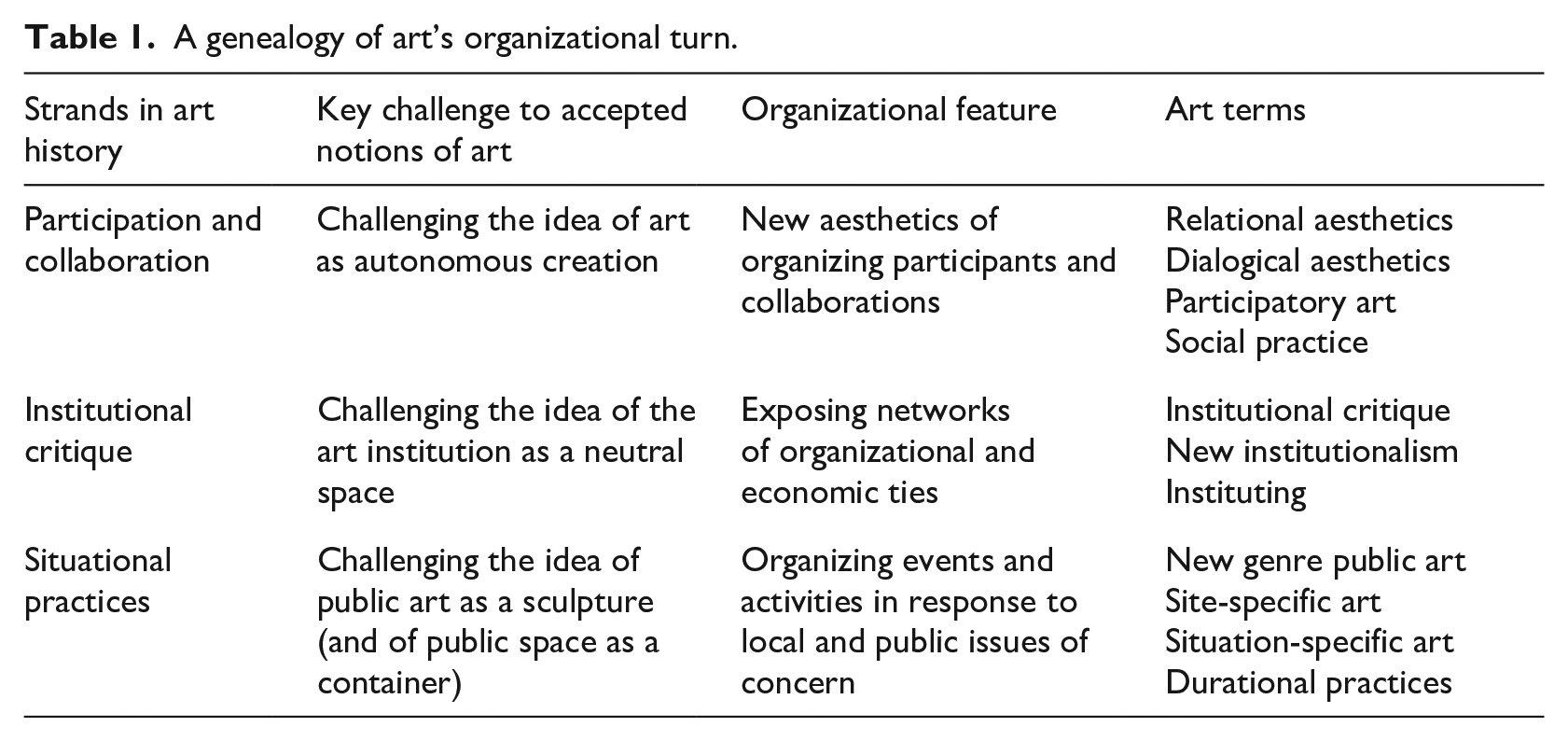
In respect to the history of art, art’s organizational turn emerges from developments that have gained increasing traction. One strand is the opening up of creative practices to involve participants and collaborators, variously termed ‘relational aesthetics’ (Bourriaud, 2002), ‘dialogical aesthetics’ (Kester, 2004) or ‘participatory art’ (Bishop, 2012). In other words, these artistic practices are distinguished by a new type of involvement of audiences as participants, not only in creative processes, but also as partaking in pedagogical programmes or performing roles in so-called ‘delegated performances’ (Bishop, 2012). An early example is Rirkrit Tiravanija’s transformation of a Soho Gallery into a street-style kitchen in which he served pad thai to visitors, thus offering a space of social interaction as an aesthetic experience. 4 Differently, but also involving participants in key roles, Jeremy Deller’s Battle of Orgreave (2001) 5 restaged a violent 1984 conflict between British miners and police with old strikers taking part alongside historical re-enactment societies, emphasizing the historical importance of the conflict and its continued emotional effects on participants.
Another strand of development that has contributed to art’s organizational turn is the critical interrogation of art institutions’ infiltration in social power-relations, broadly referred to as ‘institutional critique’ (O’Neill, Wilson, & Steeds, 2017; Raunig & Ray, 2009). A prominent early example is Hans Haacke’s 1971 exposure of the slum housing conditions in Manhattan offered by real estate owner Harry S. Shapolsky; a work prepared for his solo show at Guggenheim that its director eventually cancelled out of concern for the consequences of upsetting financial ties. 6 Today, art theory speaks of waves of institutional critique, where Haacke’s installation exemplifies the first strategy of exposing the economic relations sustaining art institutions and their supposedly neutral spaces. The second wave targets the figure of the artist in substantiating this institutional system, while the third wave denotes the ways in which art institutions have come to serve as artists’ critical partners in questioning social organizing (Kolb & Flückiger, 2014; Paper Monument, 2018; Raunig & Ray, 2009).
The third strand of art’s organizational turn is the reconceptualization of public art from being largely a sculptural tradition towards so-called situation-specific engagements with issues of public or local concern, also referred to as ‘new genre public art’ (Lacy, 1995) or ‘situational’ practices (Doherty, 2009). In this understanding, art often borders on community engagement and activism, seeking to address political questions of invisibilities, inequalities and injustice. For instance, Suzanne Lacy created the performative event The Roof is on Fire 7 (1993–94) that featured radio broadcasted conversations with Oakland teenagers, highlighting their experiences with racial stereotyping, eventually leading to dialogical processes between teenagers and the police (now collectively known as the Oakland Projects, 1991–2001). Another example is Park Fiction’s intervention (initiated in 1994) into the urban planning of Hamburg’s harbour-side by way of collaboratively creating a playful garden as counter-proposal to further constructions of high-rise buildings. 8 Such situational engagements might also expand the notion of a public site to embrace different locations and assemble a diversified public around issues of common concern such as the climate crisis. Thus Alex Hartley’s Nowhereisland (2012) 9 created the aesthetic event of an Arctic island travelling to the UK to form a ‘nation’, engaging more than 23,000 new citizens in drafting its constitution.
The brief genealogy of art’s organizational turn – summarized in Table 1 – through the three strands of participatory art, institutional critique and situational practices highlights the development of artistic work from object-centred work to activities that involve and engage the organizational contexts in which artists work. It emphasizes the turn to a heterogeneous set of organizational practices and strategies, from organizing participants to exposing networks of organizational ties and developing alternative forms of organizing. These strands are not sharply separated, but indicate trajectories that increasingly blend together in contemporary art. Theoretically, moreover, these developments have been accompanied by discussions that can be systematized and analysed in respect to three central conceptual concerns: the question of aesthetics, the question of politics and the question of site-specificity. These three concerns relate intimately to the question of how art entrepreneurially partakes in challenging and modulating social organizing and thus in instigating social change. To understand and theorize the particular power of art understood as a practice of entrepreneuring, it is thus important to engage in more detail with how recent art theory itself has reflected upon these issues.
A genealogy of art’s organizational turn.
Theorizing art’s organizational turn: Aesthetics, politics, site-specificity
In what follows we discuss, in sequence, the aesthetics, politics and site-specificity involved in art’s organizational turn in order to further prepare the ground for the concept of artistic entrepreneuring. As we are engaging with the field of art, it seems reasonable to start with the issue of aesthetics. Yet this is perhaps the issue that is most difficult to clearly specify, since the organizational turn in art involves a particular defamiliarization of aesthetics from the codified field of art and its established genres. Participatory art, critical institutional practices and new genre public art have been accused, also by art critics, of turning art into politics and sacrificing the realm of art and aesthetics altogether on the altar of either doing good or practising critical social commentary (Bishop, 2006; Jackson, 2011). Were it not for the fact that artists figured as creators or initiators, and that the art world embraced this type of work as art, we might call it something else entirely, like activism, community work or critical journalism.
However, artists that are engaging communities and intervening into specific situations use a variety of aesthetic forms and strategies, including visual documentation and modelling with which to analyse situations, and playful workshops that engage the creative skills of collaborators in reimagining sites. The aesthetics of art’s organizational turn thus foregrounds artists’ ability to assemble and engage a public in bodily-aesthetic encounters of dialogue, disagreement and collaborative modelling. This was, for instance, an essential aspect of the aesthetic dynamic of Kerstin Bergendal’s project Park Lek (2011–14) in the Stockholm suburb Sundbyberg (Wilson, 2018), where Bergendal intervened into the official plans for densifying and further segregating the area by generating a parallel planning process and eventually succeeding in changing the direction of the urban development.
Artists might also stage performative events that intervene into sites, generating attention, challenging conventional assumptions, advancing surprises and allowing different perspectives to come to life and be heard and seen (Bishop, 2012). Such events might be spectacular performances involving hundreds of participants as in Deller’s Battle of Orgreave discussed above, or it might be the simple act of renovating a block of houses that bears historical significance and testimony for the local black community. This was how artist Rick Lowe and his collaborators initiated the acclaimed Project Row Houses 10 in Houston, Texas (since 1993) that has evolved to form an entire neighbourhood bringing together artist-residencies, workshops, educational programmes and community development (Finkelpearl, 2013).
Second, the question of politics points to the profound aspirations for social change that drive these practices. In general terms, art’s organizational turn is critical of contemporary society’s organization, as it is seen as dominated by capitalist exploitation, neoliberal ideology, increasing inequality and the gradual deterioration of public services, as well as, increasingly, forms of nationalist, populist and xenophobic politics (Burton, Jackson, & Willsdon, 2016; Jackson, 2011; Sholette, 2017; Thompson, 2012). Interventions into urban planning, examples of which we have described above, show a particular interest in introducing politically marginal subjects into development plans, while other artistic work addresses the life conditions of minorities, aiming specifically to change these conditions. For instance, Trampoline House (2010–2020) was an artist-initiated community house for immigrants, refugees and other citizens in Copenhagen that featured art exhibitions and promoted artistic collaborations, but it also mobilized 50,000 citizens to sign a partition for the Danish parliament to vote on improving the conditions for children in refugee centres. 11 Differently, Renzo Martens organized The Institute for Human Activities (since 2014) 12 in Congo for a community of plantation workers exploited for chocolate production – incidentally, the responsible corporation is a sponsor of major art institutions –, in this way explicitly using the production of critical art as a source of income for supporting the local community, making it ‘profitable for the poor’.
As these examples show, art’s organizational turn advances beyond critique to very practically ponder the question of art’s political efficacy. As key scholars involved in these discussions tend to rely on different political theories to support their interpretations, however, the analyses of art’s political operations and effects differ greatly. Some scholars argue that the relative autonomy of the field of art and its institutions creates a basis for political critique (Bishop, 2012), while others argue that political efficacy requires a site-specific – and preferably long-term – engagement with local communities (Kester, 2011). Still others argue that political concerns require artists to transform artistic practices into direct political actions (McKee, 2017).
Such political ambitions are expressed in the conjunction of art and social protest movements such as Occupy Wall Street and its prefigurational potential, where utopia is not a future to come but tied to organizational practices of the here and now (McKee, 2017; Yates, 2015). Prominently, art’s organizational turn expands towards practices of commoning with ecological perspectives (Dockx & Gielen, 2018), embracing Hardt and Negri’s recuperation of entrepreneurship into collective forms of entrepreneuring (Gielen & Lavaert, 2018; Hardt & Negri, 2017). The notion of commoning denotes a reframing of the commons from being a resource into being an issue of collective relations (McKee, 2017; Velicu & García-Lopéz, 2018). In this sense, ‘through the commons concept the very concept of the public is being reinvented’ (Berlant, 2016, p. 408): Experiments in collective organizing are intended to replace deliberation between individual self-interests with practices aimed at egalitarian, collective survival (McKee, 2017). Examples include Future Farmers’ Flatbread Society (since 2012) 13 on Oslo’s waterfront that has cultivated a grain field and the formation of an urban gardening community to address the issue of shared resources and ‘the preservations of the common’, and Rirkrit Tiravanija and Kamin Lerdchaiprasert’s The Land Foundation 14 (since 1998) in rural Thailand, where abandoned rice fields operate as grounds for experimental, artistic projects with a social and ecological aspiration.
Third, the question of site-specificity is the issue that most clearly differentiates art’s organizational turn from the history of political art and avant-garde practices, because it points to the specific way in which contemporary art engages organizationally in sites and situations. As waves of institutional critique have politicized art institutions and exposed their role within a politics of inequality, so art in public spaces has broadened its perspective from the material conditions of a site to its processual and political becoming (Deutsche, 1996; Doherty, 2009). In the words of Kwon (2002), summarizing the development of public art from classical sculpture until today, contemporary public art has become site-specific, issue-specific and community-specific, taking its cue from the site in which it engages.
Echoing the debates on art’s political efficacy, discussions of site-specific practices have been divided by different notions of how to instigate social change. For some, the key issue is to expand artistic practice towards facilitative processes of citizen involvement that engages local communities in issues of local concern (Kester, 2011). Such pragmatist approaches lean on aspirations of art being able to – momentarily at least – create an inclusive, diversified public sphere. In contrast, others point to the democratic quality of hosting disagreement, arguing that art is not meant to generate consensus, but enable the expression of voices of dissent (Beyes, 2010; Bishop, 2004). Furthermore, site-specific art has advanced towards increasingly long-term and complex organizational practices in order to respond to local conditions (O’Neill & Doherty, 2011). A number of the examples we have highlighted indicate this long-term engagement, expanding over years and even decades from an initial event. These practices involve utilizing and building new infrastructures of relations and experiments in commoning that address the question of how we might organize collectively to sustain common resources and values. Such artistic practices thus connect experimental ways of eventful organizing to the cultivation of spaces and social assemblies that enable a durational reach of alternative ways of organizing. The problem that looms large in art’s organizational turn is the difficulty of instituting lasting changes to the dominating institutional forms of organizing society, leading art to seek organizational strategies, engaging in what has been termed ‘instituting practices’ (Raunig, 2009; Wilson, 2017), and establishing alternative infrastructures of support to connect local site-specific initiatives. In other words, the intermingling of aesthetic and organizational practices, developed in a processual dialogue with the site at hand and its infrastructures of relations, forms a new complex organizational practice within contemporary art.
A case in point is Theaster Gates’ Dorchester Project (since 2006) on Chicago’s south side, now known as the Rebuild Foundation, 15 which started as an artist-initiated attempt at revitalizing his decaying neighbourhood by buying abandoned houses and restoring them with reused materials (Beyes, 2015b). The project subsequently expanded by leaning on an international infrastructure of art venues, interested in showcasing and learning about his work, and a local network of collaborators in Chicago that supported the expansion of buildings and projects on its south side. Again, this is a case of an artist-initiated intervention that expands from an aesthetic event to form an organization that includes artistic as well as community practices.
To recapitulate, art’s organizational turn refers to the ways in which artistic practices interrogate and intervene in the organized world, not only to propose, but also to perform new ways of organizing. This is not artistic creation happening inside the enclosures of the studio, nor art objects being exhibited inside a supposedly neutral art gallery – although artists do use exhibition sites as platforms for promoting their ideas and practices. As we have shown, these practices range from temporary interventions to prolonged processes of reorganizing neighbourhoods. They enact practices of commoning and public assembling, are deeply invested in site-specific concerns and form part of global protest movements, morphing the development of new aesthetic forms with socio-organizational concerns. For this very reason, they call for the theorization of artistic entrepreneuring.
Conceptualizing artistic entrepreneuring
Returning to the understanding of entrepreneurship as that which ‘makes new ways of organizing and new organizations come into being’ (Hjorth & Reay, 2019, n.p.), and in particular to a processual perspective on entrepreneuring as social change, we can now theorize the notion of artistic entrepreneuring and discuss its wider implications. While the notion of art’s organizational turn foregrounds the art world’s own emphasis on diverse practices of organizing that become the ‘work’ of art, the notion of artistic entrepreneuring relates this development to a vocabulary of entrepreneurial theorizing. Conceptualizing how art engenders new ways and forms of organizing thus means translating the theoretical debates around art’s organizational turn into three core dimensions of artistic entrepreneuring: an aesthetics of social transformation; a fluid, processual notion of entrepreneurial sites; and a collective politics of reorganizing the sensible.
First, the discourse and practices of contemporary art outlined above throw the aesthetic configuration of entrepreneurship into sharper relief. The aesthetic here needs to be understood as a distribution of the sensible that enables modes of articulation – an ordering of what is given to sense perception, of what is visible and sayable (Rancière, 2004). Any kind of social ordering relies on and perpetuates such a distribution. In Rancière’s words, ‘Artistic practices are “ways of doing and making” that intervene in the general distribution of ways of doing and making as well as in the relationships they maintain to modes of being and forms of visibility’ (Rancière, 2004, p. 13). What Rancière calls ‘the aesthetic regime of art’ denotes a way of identifying and reflecting upon art in which the rules and regulations that allowed for a clear distinction between art and non-art (between ‘art and life’) have been abolished. This is how people, things and events once deemed unworthy of artistic treatment – and indeed the question of organization itself – come to fall under the purview of art. 16
Art’s organizational turn demonstrates a specific power of inventing and experimenting with such forms and styles of expression and experience. How extant organizational contexts are infiltrated and new organizational processes invented through different and collaborative aesthetic means and sensations becomes the prime mover of artistic practice, dissolving the classic distinction of aesthetic production and aesthetic reception, turning the processes of organizing towards art works into the work of art itself. Using aesthetic tools and the ability to reconfigure existing ‘energies and desires’ for social transformation, ‘the role of the artist is that of a catalyst, an “intensifier” of whatever local energies might be slumbering just below the surface of official reality’ (Kluitenberg, 2018, p. 413), and that of a facilitator of processes of excavating and connecting these energies to aesthetic means of organizing.
In general terms, then, the notion of artistic entrepreneuring opens the study of entrepreneurship to the fundamentally aesthetic constitution of entrepreneurship as social change: It is predicated on redistributions of the sensible. In intervening into a site and reconfiguring what can be perceived and expressed, art’s organizational turn highlights the fundamentally aesthetic nature of social transformation. Studying artistic practices and their effects therefore empirically and conceptually expands the notion of public entrepreneurship, embedding its emphasis on experimental forms of relating and its aesthetic vocabulary of assemblage, desire, force and rupture (Hjorth, 2013) in a generalized aesthetics of sensory ordering and disordering.
Second, the notion of artistic entrepreneuring is marked by a spatial sensibility and a fluid understanding of entrepreneurial sites and of entrepreneurial practices. The invariably situated and sited dimension of art’s organizational turn indicates its reliance upon particular spatial settings and their infrastructures of relations, often redeveloped as part of a project. Such sites are to a large degree in urban settings. In fact, art’s organizational turn predominantly engages with contemporary urban development (Miles, 2015), reminding the study of entrepreneurship to approach city-space as the quintessential site of organization and innovation, and modes of organizing urban life as key institutional and everyday contexts of organization-creation. In recent years, many artistic-organizational endeavours have targeted the nexus of art, aesthetics and entrepreneurship in what has been referred to as the ‘entrepreneurial city’ (Harvey, 1989) or the ‘creative city’ (Landry, 2000) and its consequences for social organizing (Deutsche, 1996; Miles, 2015). In fact, contemporary processes of urban development with their tropes of place branding, creative classes and aestheticized neighbourhoods often summon art and artists to contribute to the experiential and affective organization of urban life (Beyes, 2015b), and have provoked artists to thematize and intervene in the correlation of art, aesthetics and urban innovation (Miles, 2015; Sholette, 2017; Thompson, 2012).
As our examples show, beyond assuming the city and urban development as institutional contexts of entrepreneurship, the concept of artistic entrepreneuring introduces a processual notion of space and fluid sites to the study of entrepreneurship (Beyes & Holt, 2020). The ‘texture of cultural, political and social forces’ (Steyaert, 2007, p. 471), in which entrepreneurial practices are embedded, is to be approached as an invariably spatial and specifically sited constellation of forces. Echoing the notion of public entrepreneurship, entrepreneurial sites are to be understood as more than ‘just’ physical arenas. They are constituted by a knot of social, economic, political, material and affective processes, which are then worked upon, ‘unsited’ (Kwon, 2002, p. 155) and reorganized through entrepreneurial interventions. Such ‘unsiting’ is an organizational practice, mobilizing traces of a site’s past and present in order to recombine them and open up new experiences and, potentially, ways of acting (Beyes & Steyaert, 2013).
Third, the notion of artistic entrepreneuring not only emphasizes the political dimension of entrepreneurship; it entails a reconsideration of the nature of this politics. As we have shown, art’s organizational turn is political in its aspirations to instigate social change and to intervene in organized life. Such political aspirations differ in their specificity, related to the site or issue that artists are engaging, but they can be broadly conceptualized as critical, collective and progressive in addressing inequalities and injustices, working to further more inclusive, collective and sustainable sites and relations. In conceptualizing the politics of artistic entrepreneuring, we again refer to Rancière’s theorization of the connection between aesthetics and politics, suggesting that the ability to instigate social change relies on the possibility of redistributing the sensible: of altering perceptions of the specific constitution of a site or issue, and of what can be said and done in this context. In art theory, Bishop (2012) has mobilized Rancière’s philosophy to substantiate her argument for the political potentials of aesthetic disruptions in the tradition of avant-garde shock. Yet our examples indicate that aesthetic events might generate initial sparks towards challenging social orders, but not enough heat to reorganize a site, unless it is supported by additional aesthetic-organizational practices. Such aesthetic and organizational work perhaps most promisingly takes the form of practices of commoning that perform new social relations in order to bring about social change. Beyond an artwork’s capacity to foster new sense experience, its political efficacy is thus predicated on a prolonged process, and this is precisely why organizational practices and the question of new organizational forms becomes the material of art. In relation to activist entrepreneuring (Dey & Mason, 2018), art’s organizational turn then offers more than ‘just’ truth-telling and progressive imaginaries. It forefronts other ways of being together and alternative forms of inhabiting a site.
The aesthetic politics of reorganizing the sensible is not exclusively reserved for the field of art, but is a foundational aspect of any act of entrepreneuring. The notion of artistic entrepreneuring therefore helps us rethink the notion of emancipatory entrepreneuring beyond the quest for autonomy and ‘organizing resource exchanges and managing stakeholder interpretations’ (Rindova et al., 2009, p. 479). It is to be framed as a collective endeavour that critically investigates and reroutes the flow of resources, and problematizes who has the right to speak and be heard (and become a stakeholder). The politics of artistic entrepreneuring is in this sense unshackled from the institutional field of politics and becomes an aesthetic one: It experiments with new forms and styles of collective expression and experience that alter the ways social organizing is perceived and can be enacted. As such the notion of artistic entrepreneuring departs from conceptualizations of artists as entrepreneurs or notions of the artist as manager, since the emphasis is on collective processes rather than any individual creative figure. In Table 2, we tentatively unpack the main elements of artistic entrepreneuring as they are enacted (and variously interwoven) in art’s organizational turn. The list of practices is indicative and does not exhaust the actual or possible ways in which aesthetics, politics and site-specificity are or might be enacted.
Elements of artistic entrepreneuring.
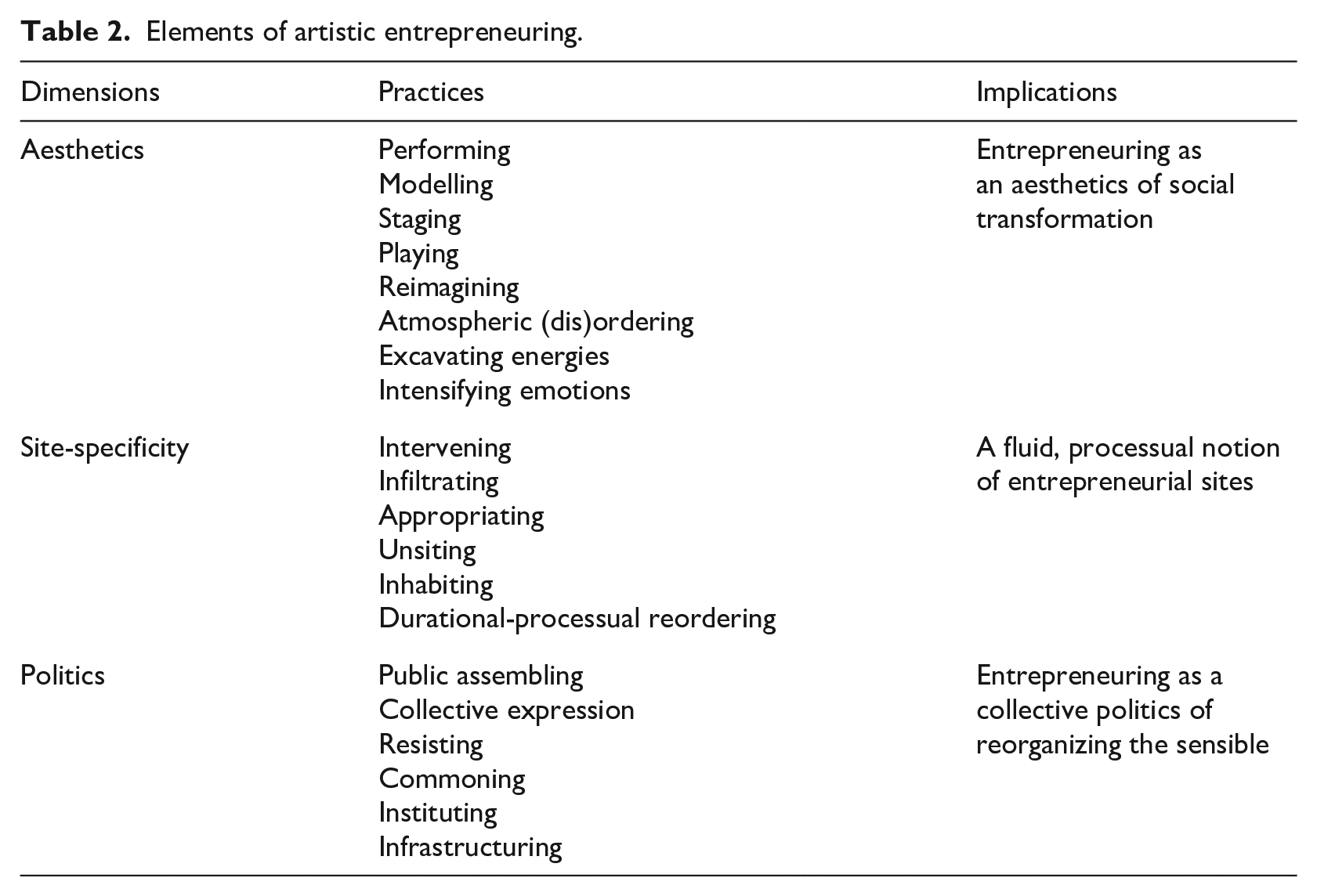
In sum, the notion of artistic entrepreneuring not only opens up the study of entrepreneurship to art’s organizational turn and its wide range of practices geared towards social change. As a composite gerund of entrepreneurship research in its own right, it offers a distinct heuristic to study entrepreneuring as fundamentally aesthetic, necessarily sited and invariably political. Taken together, the three elements of artistic entrepreneuring offer a new perspective on how to understand and explore processes of entrepreneuring. This perspective draws upon and helps expand and deepen existing concepts of entrepreneurship research in three main ways: it reconceptualizes the first attempts at exploring the aesthetic constitution of entrepreneurship by approaching entrepreneuring as redistributing the sensible; it contributes to the recent interest in public entrepreneurship as experimenting with new ways of belonging and inhabiting, and spatially producing, the public; and it both substantiates and reframes processual approaches to emancipatory and activist entrepreneuring and their interest in breaching and moving beyond constraints of progressive imagination and practice.
Beyond the study of entrepreneurship, the concept of artistic entrepreneuring feeds back into broader organizational-theoretical concerns with the aesthetics and politics of organizing, which we can only allude to here. The study of organizational aesthetics (Strati, 2010), itself attuned to the field and potential of art (Guillet de Monthoux, 2004) as well as the aestheticization of organizational space (Beyes & Steyaert, 2013; De Molli, Mengis, & van Marrewijk, 2020), gains a distinct perspective on how organization can be understood as a distribution of the sensible. Organizational sensemaking is literally predicated on what makes sense, on the ordering of what can be perceived and expressed, and it is prone to the aesthetic breaching and redistribution of what is visible and sayable, which is not confined to artistic interventions (O’Doherty, De Cock, Rehn, & Lee Ashcraft, 2013). Adopting a currently popular aesthetic term, we might call this kind of aesthetic breaching and reordering a ‘critical performativity’ of organizing (Cabantous, Gond, Harding, & Learmonth, 2016). Yet this kind of critical performativity is not confined to critical scholarship; on the contrary, any kind of disruption and transformation of organized life is predicated on it. There thus is a long history and broad present of critical performativity that would significantly enrich its organization-theoretical understanding. In this sense, our attempt to delineate the concept of artistic entrepreneuring is related to a politics of organizational aesthetics that has yet to make its full appearance in the study of organization.
Finally, art’s organizational turn’s focus on organizing as key component of the artwork also reposes the art-sociological and organization-theoretical question of how the art world is organized (van Maanen, 2009). Rather than approaching the field of art as a more or less self-enclosed organizational complex, which can then be analysed with regard to its actors (such as the artist or the curator), institutions and power relations, developing and staging a work of art is here to some degree displaced from established processes of art-making and art-displaying. This is precisely how art becomes organization, and why the study of art organizations should open up to artistic entrepreneuring.
Conclusion
The paradigmatic status of art and artistic practices for contemporary social transformation in general, and for the context of creating the new in an organized world in particular, has begun to be investigated and theorized in the study of entrepreneurial organizing. Moreover, it has become an erstwhile matter of concern within the discourse of art. Reviewing and putting into dialogue both approaches – the bourgeoning interest in entrepreneurship as social change, and art’s manifold organizational turn –, we have placed an emphasis on contemporary art’s (and art theory’s) remarkable and wide-ranging engagement with practices of organizing as material of art, which has so far only sporadically found its way into studies of organizing and entrepreneuring. These are artistic endeavours that interweave site-specific, aesthetic and political practices of organizing. They thus not only propose, but also perform new ways of organization-creation.
Systematically analysing and illustrating this discourse, and discussing it in relation to the study of entrepreneuring, enabled us to theorize artistic entrepreneuring as a distinct approach to the question of entrepreneurship as social change. An aesthetics of social transformation, a processual notion of entrepreneurial sites and a collective politics of reorganizing the sensible – these are the fundamental features of artistic entrepreneuring. They offer a new heuristic for studying processes of entrepreneuring as fundamentally aesthetic, necessarily sited and invariably political. Moreover, this approach has reverberations for the study of the aesthetics and politics of organization understood as contested, site-specific constellations of ordering and reordering the sensible, as an aesthetics of critical performativity in action and in situ, so to speak. We believe that the juxtaposing of artistic and entrepreneurial forces into a single concept, artistic entrepreneuring, offers considerable promise for not only understanding art’s particular power to reconfigure what can be perceived and expressed, but also for the study of entrepreneurship, organization and the field of art in more general terms.
To frame this as a promise points to the limits of our approach, and to next steps. Ours has been a conceptual undertaking. While we illustrated art’s organizational turn by way of a range of examples, empirically investigating specific cases was beyond the scope of this paper. Such investigations into the situated and sited nature of artistic entrepreneuring are needed in order to exemplarily and comparatively coax out the potential and pitfalls of our approach. Moreover, this kind of empirical work calls for an aesthetic sensibility, for ethnographic accounts attuned to how redistributions of the sensible take place, to their material, affective and atmospheric constitution and to how artistic entrepreneuring potentially transforms given ways of ordering the social.
Finally, in suggesting a capacity of such redistributions of the sensible to foster social change, and to inscribe them into a vocabulary of entrepreneurship, no matter how ‘progressive’, we risk reproducing a stance that politically attuned artists are rightfully cautious about. It threatens to inscribe their work into the organized settings of an aesthetic capitalism or an experience economy they wish to oppose. And of course, the aspirations of such projects may fail. They might stick to a short-termism often levelled against this kind of artistic practice, where the emphasis is said to be on a moment or situation of spectacle, after which the artists would move on to the next site. They might be co-opted by the economistic scripts of urban entrepreneurialism and the creative city. Yet failures, a lack of sustainable engagement and the threat of co-optation should not come as a surprise to scholars of entrepreneurship. In other words, they should not deter us from exploring how art’s organizational turn harbors manifold experiments of organization-creation.
Footnotes
Funding
This research received no specific grant from any funding agency in the public, commercial, or not-for-profit sectors.