



Abstract
Entrepreneurial initiatives aiming to transform organizations from the bottom up are often complicit with the power structures they seek to change, reproducing the old while trying to cultivate the new. To unleash the transformative potential of these initiatives, it is crucial to better understand how workers can productively reckon with complicity and how this reckoning drives the entrepreneurial process. We address these questions through a longitudinal, qualitative, single-case study in a private contemporary art museum in Russia, where museum workers strive to create a more inclusive and politicized organization. Drawing on research by social justice education scholars, we unfold how vulnerability and critical hope—here as affective orientations—enable workers to sense and address complicity in their entrepreneurial activities. We develop a process model that theorizes the interplay between these affective orientations and links them to the expansion or contraction of entrepreneurial activities and their reckoning with complicity. The study contributes to the surging interest in vulnerability and hope within entrepreneurship studies while providing new insights into how entrepreneurs remain affected by the contrary effects of their own efforts, channeling these experiences into imaginative actions toward different futures.
Keywords
Introduction
Working toward “better futures” is at the heart of many entrepreneurial initiatives aiming for more socially just, inclusive, and progressive societies (Daskalaki et al., 2015; Hjorth, 2013; Hjorth and Holt, 2022). However, despite their intention to transform the status quo, these entrepreneurial efforts are often complicit—that is, implicated in and strengthening the practices and power structures that they seek to overcome; for example, by re-enacting unsustainable business practices or reproducing regimes of marginalization and exploitation (Barinaga, 2017; Dey and Steyaert, 2012; Kenny and Scriver, 2012; Kenny et al., 2020; Tedmanson et al., 2015; Verduijn et al., 2014).
Although several studies problematize these contrary effects (e.g. Daskalaki et al., 2015; Dey et al., 2016; Jones and Spicer, 2009; Verduijn et al., 2014), surprisingly little is known about how entrepreneurs can overcome or reckon with complicity. The few studies that do exist suggest that entrepreneurs are either “blind” to their complicity or “trapped” in it. On the one hand, scholars have shown that prosocial fantasies of “doing good” create affective attachments that shield entrepreneurs from recognizing tensions, dilemmas, and their own shortcomings (e.g. Dey et al., 2016; Kenny and Scriver, 2012; Kenny et al., 2020; Rindova et al., 2009; Wettermark and Berglund, 2022). On the other hand, research suggests that awareness of one’s complicity does not always lead to adaptive actions but rather to a kind of trap (Barinaga, 2017) that can undermine entrepreneurs’ commitment to their entrepreneurial endeavors (Dey et al., 2016). Thus, how entrepreneurial initiatives can productively deal with complicity and reduce the detrimental effects of their entrepreneurial work leaves room for further exploration.
To address this research opportunity, we turn to vulnerability (Ashcraft, 2018; Gilson, 2011, 2014) and critical hope (Boler, 1999, 2014; see also Applebaum, 2017) as nascent theoretical concepts and affective orientations. While research on vulnerability and hope in entrepreneurship research is still in its infancy (Alacovska, 2019; Arend, 2020; Dimov, 2018; Wettermark et al., 2018), social justice education scholars (Applebaum, 2017; Boler, 2014; Bozalek et al., 2014; Zembylas, 2014, 2020) have made compelling arguments that vulnerability, understood here as an affective openness to facing uncomfortable truths, and critical hope, which is defined here as an affirmative affective orientation that sustains engagement in the face of challenging circumstances, are crucial for addressing one’s implication in structures deemed unjust. Exploring how these affective orientations inform the ways entrepreneurs deal with complicity in their activities, we ask the following: how do vulnerability and critical hope allow workers to reckon with complicity in their entrepreneurial activities? How does the reckoning drive the entrepreneurial process?
Our research interest is rooted in a processual understanding of entrepreneurship (Hjorth et al., 2015; McMullen and Dimov, 2013; Steyaert, 2007), which draws attention to the ongoing micro-level activities that shape entrepreneurial processes through everyday work (Barinaga, 2017; Hjorth, 2014; Hjorth and Reay, 2022). We empirically implemented this understanding by conducting a longitudinal qualitative case study in a private contemporary art museum in Russia. Set in an autocratic context with resurging repressive cultural and nationalistic policies (Romashko, 2020), private museums have been discussed as rare organizational spaces where museum workers can engage in entrepreneurial activities aimed at fostering social change and progressive futures (e.g. Adam, 2021; Bechtler and Imhof, 2018). At the same time, private museums and museums, in general, have been criticized as conservative cultural authorities and elitist institutions that perpetuate marginalization (Janes and Sandell, 2019) while offering consumerist entertainment (Michels et al., 2014) rather than critical reflection and the exploration of alternative futures (Bishop, 2014). Against this backdrop, the private contemporary art museum at the center of our study has been significantly shaped by the entrepreneurial efforts of its workers to transform the museum into a more inclusive and politicized space. Thus, it provides a compelling case and a fruitful empirical setting to explore how the meanings and experiences ascribed to entrepreneurial work might enable workers to reckon with complicity. Drawing from two rounds of semi-structured interviews and complementary archival material, we trace the entrepreneurial processes in four different departments and show that a reinforcing interplay between vulnerability and critical hope enables museum workers to sense and address complicity in a productive way, driving their entrepreneurial actions toward expansion. The Russian invasion of Ukraine as an extreme event during our data collection triggered a change in the dynamic interplay, which led to a contraction of entrepreneurial activities.
Our study makes several important contributions. First, developing a process model of reckoning with complicity in entrepreneurial processes, we shed new light on how entrepreneurs can deal with their implications in contested structures (Barinaga, 2017). Our model informs process studies of entrepreneurship (Hjorth et al., 2015; McMullen and Dimov, 2013; Steyaert, 2007) by theorizing how complicity can drive rather than trap the entrepreneurial process. Second, our model emphasizes how the affective interplay between vulnerability and critical hope makes reckoning with complicity productive. The model highlights that vulnerability and critical hope instigate entrepreneurs to continuously sense and address complicity. This enables them to stay affected by the contrary effects of their entrepreneurial efforts and channel these experiences into imaginative actions toward different futures. When the interplay is reinforcing, it propels the entrepreneurial process toward reckoning with complicity in more expansive ways. However, the nature of the interplay is precarious and can be impeded or collapse not only through external events or organizational conditions but also because of its own affective dynamic (McCarthy and Glozer, 2022; Resch and Rozas, 2024). Eventually, our study also contributes to the emerging stream of research on vulnerability and hope in entrepreneurship studies, calling for greater attention to how entrepreneurs relate to their own vulnerability and how different forms of hope are cultivated and affect entrepreneurial processes.
Theoretical background
Complicity in entrepreneurial processes
In the past two decades, research has highlighted that, rather than being predominantly economically motivated, entrepreneurship can be a vehicle for social change (e.g. Daskalaki et al., 2015; Mair and Marti, 2006; Rindova et al., 2009). In challenging institutional arrangements, sparking the emergence of new organizational practices, and promoting various forms of social values, entrepreneurs strive to make a difference and organize for more sustainable, democratic, and equitable futures (Daskalaki et al., 2015; Dey et al., 2016; Hjorth, 2013; Hjorth and Reay, 2022; Rindova et al., 2009). These initiatives are not only reserved for start-ups and social ventures but also take place within organizations as part of everyday work, which can be referred to as organizational entrepreneurship (Hjorth and Reay, 2022) or organization-creation (Hjorth, 2014). Driven by a desire to create something new and confront “established structures, practices and strategies” (Courpasson et al., 2016: 151, 132) in and through work, the potentiality of bottom–up social transformation nurtures the emergence of collective entrepreneurial endeavors “in an already organized world” (Dey and Mason, 2018; Hjorth and Reay, 2022: 160).
The literature tends to narrate such entrepreneurial initiatives as virtuous undertakings and harmonious movements toward social transformation (Dey and Steyaert, 2010). From this vantage point, social entrepreneurship is a heroic achievement of modern progress that entrepreneurs can control and “delight in” (Mair and Marti, 2006: 37). However, such optimistic depictions disregard that ethical quandaries, power struggles, and relations of domination creep into and are constitutive of any entrepreneurial endeavor (e.g. Dey and Mason, 2018; Jones and Spicer, 2009; Verduijn et al., 2014). Research has documented how entrepreneurship motivated by ideals of doing good tends to create contrary effects—reproducing, for example, unsustainable practices or inequalities rather than transforming them often with detrimental effects for society and already marginalized communities that are supposed to benefit from them (Barinaga, 2017; Daskalaki et al., 2015; Dey and Steyaert, 2012; Jones and Spicer, 2009; Kenny and Scriver, 2012; Tedmanson et al., 2015; Verduijn et al., 2014). Yet, surprisingly little is known about how entrepreneurs can address the fact that their initiatives are not only vehicles for positive change but also complicit with existing realities.
The small number of studies dealing with this challenge have pointed out how strong ideals and prosocial fantasies might hinder and blind entrepreneurs to face the contradictory effects of their ventures. Taking cues from psychoanalysis, scholars have argued that fantasies about prosocial intentions can induce strong affective attachments. These attachments protect entrepreneurs against uncertainties by offering a sense of control, stable identification, and existential security. This sustains entrepreneurs’ commitment to their endeavors while preventing them from seeing the tensions and dilemmas that surround their work, such as the struggle to reconcile the social mission with business demands (e.g. Dey et al., 2016; Kenny et al., 2020). Attuning to such dissonance would hamper the “affective thrust” of the fantasy as a driver for entrepreneurial work (Dey et al., 2016: 1458). Wettermark and Berglund (2022) show that the image of the benevolent, compassionate, and knowing entrepreneur who is dedicated to empowering marginalized others induces little interest among the entrepreneurs to learn from those they entrepreneur for. Studying two entrepreneurial initiatives in the cultural sector that work with (migrant) workers from the Global South, the authors problematize how these images create desirability that attracts support for the initiative while also reproducing colonial relations of power and superiority rather than challenging them.
Empirical studies documenting how entrepreneurs acknowledge and might productively respond to their complicity are even more scarce. In her interventionist study of the organization-creation process of an artistic social venture, Barinaga (2017) conceptualizes the fluid and piecemeal nature of entrepreneurial work for social change as constant “tinkering” with networks, meanings, and materialities that requalify reality in ambiguous, small, and not necessarily straightforward or progressive ways. The entrepreneurs in her study managed to acknowledge their own complicity, noting how their initiative “performed violence on those whose voices [it] aimed to empower” and was entangled with networks that reproduced the stigmatizing practices it sought to challenge (Barinaga, 2017: 950). However, rather than mobilizing this insight to fuel and sustain their entrepreneurial work, complicity appears as an inescapable trap that the entrepreneurial initiative cannot escape or meaningfully overcome, eventually limiting the transformative potential of the venture. Thus, the present body of research warrants further exploration of how organization-creation processes can “contribute to and learn from progressive struggles” without reinforcing privilege and the silencing and marginalization of others (Blomley, 1994: 385; see also Barinaga, 2017: 954).
Complicity, vulnerability, and hope
The challenge of productively dealing with complicity in a way that sustains and intensifies the desire for a better future (Hjorth, 2014) remains a pressing issue for scholars across various disciplines (e.g. Ashcraft, 2018; Blomley, 1994; Gilson, 2014). From the perspective of management studies, Ashcraft (2018) argues that confronting complicity requires an embodied and affective openness to vigilantly recognize one’s participation in unjust structures. Her call resonates with emerging scholarship on affect in everyday work (Gherardi, 2019), suggesting that our capacity to affect and be affected is crucial in understanding what drives or stalls creative action aimed at reorganizing power within and outside organizations (e.g. Lüthy, 2024; McCarthy and Glozer, 2022; Marsh and Śliwa, 2022; Martin de Holan et al., 2019; Vachhani and Pullen, 2019). Ashcraft (2018: 618) specifies those affects, noting that dealing with complicity relies on a certain form of vulnerability to experience discomfort and anxiety but also on nurturing “glimmers of hope” as a prospect that things can become otherwise. Her arguments echo the tenets of social justice education scholars. Discussing how educational institutions can—but often fail—to contribute to emancipatory societal projects, this scholarship focuses on how to unsettle dominant beliefs and practices in racial classrooms and harness the discomfort that stems from such unsettling as a catalyst for growth and learning (Applebaum, 2017; Boler, 2014; Bozalek et al., 2014; Zembylas, 2014, 2020). It underscores vulnerability and critical hope as affective orientations that enable individuals to engage constructively with their complicity in the existing power structures.
Entrepreneurship research to date tends to ascribe vulnerability to those for whom organization-creation seeks to create social change, including individuals or communities that are particularly susceptible to experiences of harm, disadvantage, and disempowerment (Vorobeva, 2022). However, recent scholarship suggests that vulnerability might be inherent in entrepreneurship and entrepreneurial identities. Exploring the link between vulnerability and uncertainty, Dimov (2018) underscores entrepreneurs’ attachments and commitment to aspirational but uncertain futures. The threat or loss of control over these futures and purposes to which entrepreneurs are committed brings out their vulnerability, that is, the realization of the possibility of being harmed emotionally, socially, or materially. Wettermark et al. (2018) explore how vulnerabilities surface, are dealt and “done away with” in entrepreneurial classroom settings. Understanding vulnerability not just as a threat to be harmed but also as an exposure to others, they critically note how vulnerability entails opening oneself up to doubt, confusion, and skepticism.
Social justice education scholars add to this debate by pointing to the natural inclination to close oneself and remain invulnerable. Invulnerability allows actors to uphold the idea of the self as in control, certain, and good and “to ignore those aspects of existence that are inconvenient, disadvantageous, or uncomfortable for us” (Gilson, 2011, 2014: 76; also Applebaum, 2017). The affective stance of invulnerability tends to be implicated in maintaining the status quo of privilege and inequality by denying ambivalence and tension.
In contrast to the negative connotation of a weakness that vulnerability commonly carries in western thinking, Gilson (2014) conceptualizes it as a shared human capacity to affect and be affected that brings about both positive and negative experiences and critically informs our efforts to learn and transform. Building on these insights, vulnerability becomes central to grappling with complicity in organizational environments because it opens people up to face the discomfort and unsettling loss of certainty triggered by acknowledging that their own actions can create “trouble” rather than resolving it (Applebaum, 2017; Ashcraft, 2018). To support students to endure and “stay with” rather than “flee from” such trouble (Applebaum, 2017: 864) and take ownership of their discomfort rather than become defensive, social justice education scholars mobilize the notion of critical hope (Boler, 1999).
Hope as an affective orientation toward the future is also gaining traction in entrepreneurship studies (Arend, 2020; Dimov, 2018; Martin de Holan et al., 2019). Unlike aspiration, hope encompasses a futurity that is pregnant with a certain indeterminacy and unknown potentiality (Alacovska, 2019; Dimov, 2018). It enables humans to keep going and persevere under conditions of uncertainty and despair (Alacovska, 2019; Miyazaki and Swedberg, 2017; Zigon, 2009: 258). Studying the hope work of entrepreneurs in the creative industries in East Europe (Alacovska, 2019) and Ghana (Alacovska et al., 2021) Alacovska and colleauges note how mundane hope work not only entails a commitment to live sanely and acceptably in precarious situations but is also mobilized and cultivated as a moral project and determination to engage and approach the world as fluid and changeable by one’s agency and imagination (Miyazaki and Swedberg, 2017). In a similar vein, Martin de Holan et al. (2019) document how entrepreneurs from marginalized communities can develop a projective entrepreneurial self and future-oriented agency when they break the vicious cycle of poverty and hopelessness. Hope is critical because it helps entrepreneurs navigate uncertainty and remain focused on their purpose (Dimov, 2018).
Social justice education scholars provide further insights by assigning hope an important role in reckoning with complicity. Hope ensures that individuals stay engaged and affirmative while providing an antidote to denial, helplessness, despair, or detached cynicism, which are frequently triggered by acknowledging the vast and entrenched deficiencies of the present and our participation in it (Applebaum, 2017; Boler, 2014; Zaliwska and Boler, 2019; Zembylas, 2020). Distinguishing between different forms of hope, Boler (1999, 2014) problematizes how “naive hope” fails to bring about change. Espousing an optimistic rhetoric of progress that obscures systemic inequalities, naive hope works to maintain the status quo. In response, Boler (1999, 2014) brings attention to cultivating “critical hope” as an affective orientation that helps address those “habits of emotional inattention” that support systemic inequalities (Boler, 2014: 30). As an action-oriented response to experiencing complicity, critical hope does not release organizational actors from grappling with ambiguity (Applebaum, 2017) but calls on their responsibility to channel their discomfort into a continued engagement “to construct, [. . .] a different lifeworld” (Zembylas, 2014: 13).
Taken together, scholarship from the field of social justice education provides compelling arguments that vulnerability and critical hope are key to productively dealing with complicity. However, how these affective orientations unfold their meaning for entrepreneurial activities and how reckoning with complicitly affects the process of organization-creation begs further exploration.
Methodology
To study and theorize how vulnerability and critical hope as affective orientations enable workers to reckon with complicity and drive entrepreneurial processes, we employed a longitudinal, qualitative, single-case study design (e.g. Gioia et al., 2013; Langley and Abdallah, 2011; Siggelkow, 2007). The design is informed by a processual understanding of organization-creation (Hjorth et al., 2015; McMullen and Dimov, 2013; Steyaert, 2007), which focuses on the continuous process of becoming “other” and understands organization-creation as an unfinalized, open-ended entrepreneurial endeavor and search for actualizing new value potentials. The processual understanding attunes our study to the micro-level dynamics and subjective experiences in the unfolding entrepreneurial process.
Research context and case selection
We focus on a Moscow-based, “privately funded, publicly minded” contemporary art museum founded in the late 2000s (Flash Art, 2015). The case was chosen for its revelatory potential and richness (Langley and Abdallah, 2011: 109). Since its inception, the museum has been committed to a liberal, progressive agenda with the explicit aim of social change amid an increasingly conservative and repressive cultural climate. The organization has evolved through a series of entrepreneurial initiatives that have been ventured by the museum workers, engaging diverse publics and marginalized communities around complex, sensitive, and controversial topics, such as the ecological crisis or Russia’s queer and colonial history, building cultural bridges within and beyond Russia and a wider public. These initiatives not only reconfigured the museum but also catalyzed the development of innovative infrastructures and projects in the broader cultural landscape in Russia.
A considerable amount of trust, voice, and freedom on the part of the founders as well as sufficient funding and horizontal structures for exchange and collaboration across the museum support workers in their entrepreneurial quest to turn the organization into an enabler of social change. At the same time, their entrepreneurial work is inherently confronted with questions of complicity (Dey and Steyaert, 2012; Verduijn et al., 2014). This entails, for example, coming to terms with the elitism and history of marginalization inscribed into museums as institutions and cultural authorities (Bishop, 2014). Reckoning with contrary effects of one’s initiatives and their implications in existing power structures might be even more pronounced in Russia, where museums have often been used as vehicles for reinforcing—rather than challenging—nationalistic agendas (Jonson and Erofeev, 2017), rendering the case particularly fruitful for our research topic.
Data collection
We observed the case over a period of two years, hence allowing us to trace the evolution of the organization-creation, the meanings and affective experiences attached to it by the workers who were involved, and the context in which the case was embedded. This proved central to theorizing the processual dynamic of our case (e.g. Langley and Abdallah, 2011; Siggelkow, 2007). Data collection began in 2021 with an initial screening of the museum’s context and evolution. We consulted academic texts discussing the role and rise of private contemporary art museums in Russia, popular media articles on the museum, and documents recording the institutional history of the organization available on its extensive public online archive repository and social media. Based on this preliminary research, we set out to conduct a series of interviews from the beginning of 2022 onwards to understand how workers made sense of and reckoned with complicity in the development of various entrepreneurial initiatives. The Russian invasion of Ukraine on 24 February of that year created both a challenge and opportunity for our research. With the invasion disrupting the organization, conducting interviews became considerably more complex and ethically sensitive. Exhibitions were closed, multiple employees were exiled, making conversations about the complicit dimensions of workers’ entrepreneurial efforts emotionally and politically more difficult. On the other hand, giving a voice to and documenting how museum workers continued to entrepreneurially shape the museum as a progressive space became even more timely and relevant. Against the backdrop of this challenging situation, we conducted 14 interviews. To safeguard and enhance the anonymity of our interview partners, we used pseudonyms and, in some cases, altered the gender implied by their names. The sample is theoretical and not representative, but it does provide variation (Patton, 2002), including multiple perspectives from various departments, such as the archive and publishing, inclusion, and exhibition departments. At the same time, we are aware that self-selection bias among those who agreed to talk to us is likely to define the sample.
After a first round of interviews with 10 workers in 2022, we conducted a second round of interviews in 2023 to understand in more depth how the museum and its initiatives further evolved. We reinterviewed workers from the publishing and curation departments and added two new voices from former workers of the inclusion department, who had left the organization following the Russian invasion of Ukraine. All interviews were conducted in online video settings, electronically recorded, automatically transcribed with the MS Teams or Zoom transcription function, and later proofread by us. The interviews lasted between 40 and 127 minutes and covered questions about how the workers related to and envisioned the museum as an inclusive and politicized space and how different activities and initiatives developed through their own work. Narratives around tensions and struggles regarding the complicit dimensions of their work often emerged unprompted in the interviews.
The second round of interviews was informed by an initial data interpretation in which a comparison between emerging themes and existing literature had pointed us to the affective orientations of vulnerability and critical hope as the potential keys to reckon with complicity. We used the interviews to explore in more depth how affective orientations toward the future and unsettling dimensions of their work shaped workers’ entrepreneurial activities. For example, the questions addressed their feelings, motivation, and energy to keep going and transform their initiatives, as well as the factors that led to their decision to cease their work.
Data analysis
The analysis of our qualitative case data followed recent guidelines in the tradition of grounded theory (Charmaz, 2006; Gioia et al., 2013; Langley and Abdallah, 2011; Locke et al., 2022). We aimed to systematically move from raw data to theoretical interpretation, with the goal of developing a conceptual model (Gioia et al., 2013: 22). Below, we explicate the analytic process by structuring it in three steps. The notion of steps suggests linearity, yet our approach was iterative, continually revising our insights and empirical artifacts (narratives, figures, data structure) as our understanding of the phenomenon progressed (Gioia et al., 2013; Locke et al., 2022).
Step I: Following complicity in the process narratives of the entrepreneurial initiatives
In line with our processual conception of organization-creation as ongoing and becoming (Hjorth et al., 2015; McMullen and Dimov, 2013; Steyaert, 2007), our first step involved the write-up of thick narratives depicting how the entrepreneurial process was shaped through different activities in the exhibition, archive, publishing, and inclusion department (Langley, 1999). The narratives reconstruct how the respondents individually and collectively remembered, made sense of, and experienced the process, for example, around shifting curatorial practices in the exhibition team, the inception of the archive department and network, or the development of the publishing program and different publishing initiatives. We juxtaposed the different interviewees’ perspectives to map the process over the past 10 years and consulted documents, internet sites, and social media posts to contextualize and gain a deeper understanding of the initiatives and events that the respondents were talking about.
We then engaged in a first round of interview coding to trace whether and how complicity surfaced and informed the development of the entrepreneurial initiatives. We noticed how workers—rather than telling heroic stories of entrepreneurial success—kept problematizing and critiquing their own entrepreneurial efforts by highlighting how they fall short of producing the social change they aim for and are complicit with problematic power structures. For example, members of the publishing department questioned how their initial focus on translating and privileging western thinkers re-enacted the museum as an imperial institution. We also sensed renewed energy in interviewees’ voices when they moved from these moments of scrutiny toward talking about their commitment and willingness to explore ever new and “better” ways of addressing the challenges they had identified, for example, by setting up grants for publishing critical theory from the East. Alternations between pausing, reflecting, and questioning oneself—which we labeled sensing complicity—as well as probing and experimenting with new responses—which we labeled addressing complicity—constitutes a pattern that we found across all four departments. Figure 1 provides an overview of selected examples that illustrate the movement between sensing and addressing complicity across the four departments.
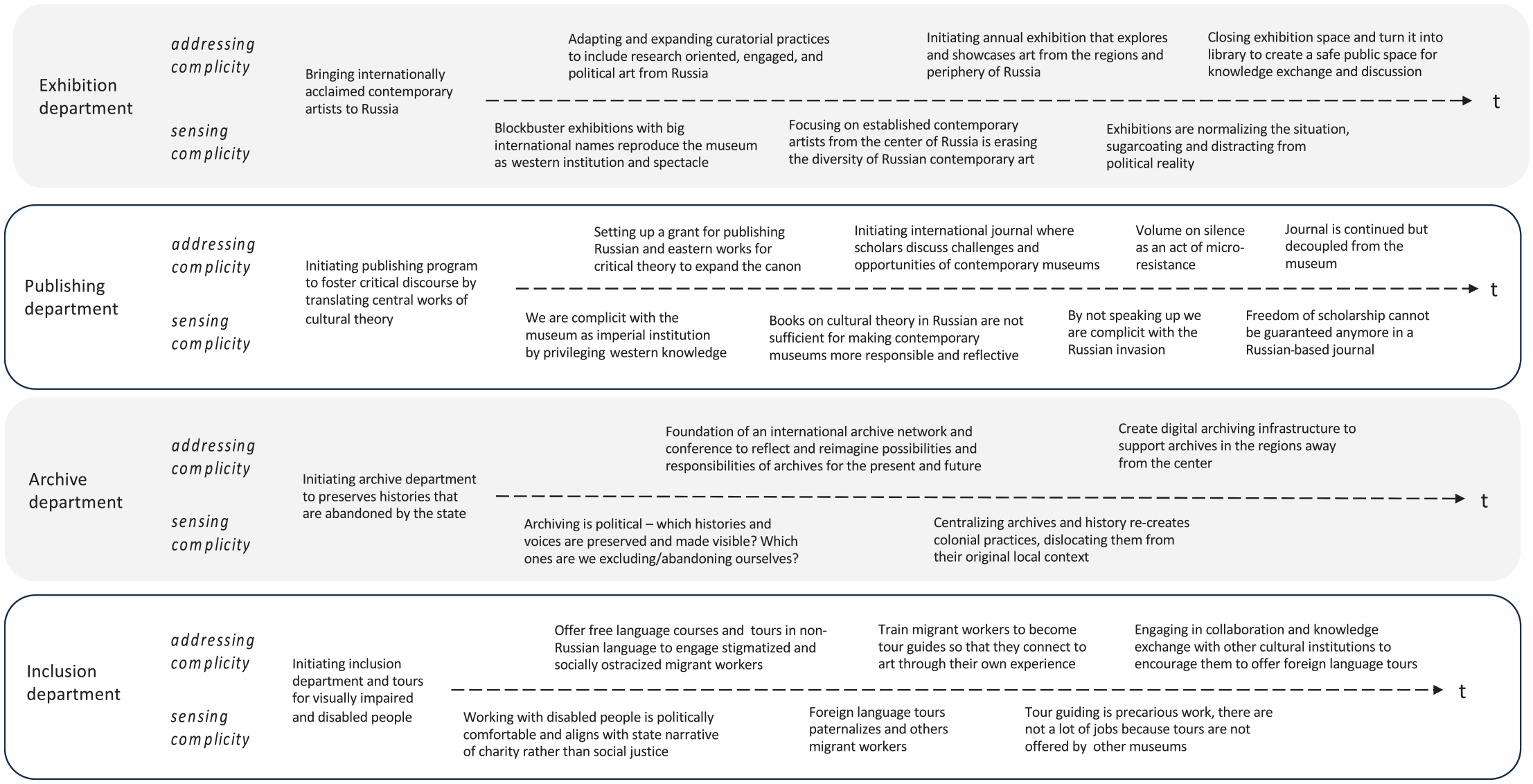
Overview of process narratives in different departments.
Step II: Interpreting the data with the help of sensitizing concepts
To better understand what enabled workers to sense and address complicity in the entrepreneurial processes, we engaged in another round of systematic coding of all interview transcripts, this time focusing in more detail on how the reckoning with complicity was described and what kind of concerns, feelings, and meanings were attached to it. This coding step produced first-order codes that were derived from direct engagement with the data, reflecting our interviewees’ perspective. The codes include, among others, “questioning themselves” or “admitting blind spots”. They describe, for example, how a member of the archive was questioning to what extent the museum contributes to normalizing and sugarcoating what was happening in Russia or how members of the inclusion department admitted that they did not see how their practices excluded certain groups of people. These codes are accompanied by affects such as hesitation and discomfort. On the other hand, first-order codes such as “stressing the need to take action and keep going” or “taking on more responsibility and striving to improve things” reflect action-oriented ways to address complicity, conveying a sense of urgency but also curiosity and inspiration.
To move our inductive insights toward greater theorization, we interpreted and clustered the first-order codes into meaningful second-order themes by engaging with the literature (Charmaz, 2006; Gioia et al., 2013; Locke et al., 2022). We were particularly inspired by texts from social justice education scholars and their understanding of vulnerability and hope as affective orientations for reckoning with complicity in everyday work. We employed these notions as “sensitizing concepts” (Blumer, 1954), which provided us with helpful “directions along which to look” in the data (Blumer, 1954: 7). We moved back and forth between our inductive first-order codes and the literature, probing the possibility of qualifying our insights “in theoretical terms” (Gioia et al., 2013: 22). We noted that the ways in which museum workers sensed complicity revolved around a willingness to “unsettle themselves and embrace critical voices nondefensively” and an “openness to uncertainty and not knowing”. Both aspects are reflected in the literature on vulnerability (e.g. Applebaum, 2017; Gilson, 2011), which motivated us to cluster these second-order themes and label the dimension “vulnerability enables sensing complicity”. The other group of first-order codes reflects themes from the literature on critical hope (e.g. Applebaum, 2017; Boler, 1999). We identified an “affirmative focus that ignites and sustains future-oriented actions” and a “vigilant strive toward greater responsibility”, which find its equivalent in the literature. We clustered these second-order themes and labeled the dimension “critical hope enables addressing complicity”. Figure 2 depicts the final data structure.
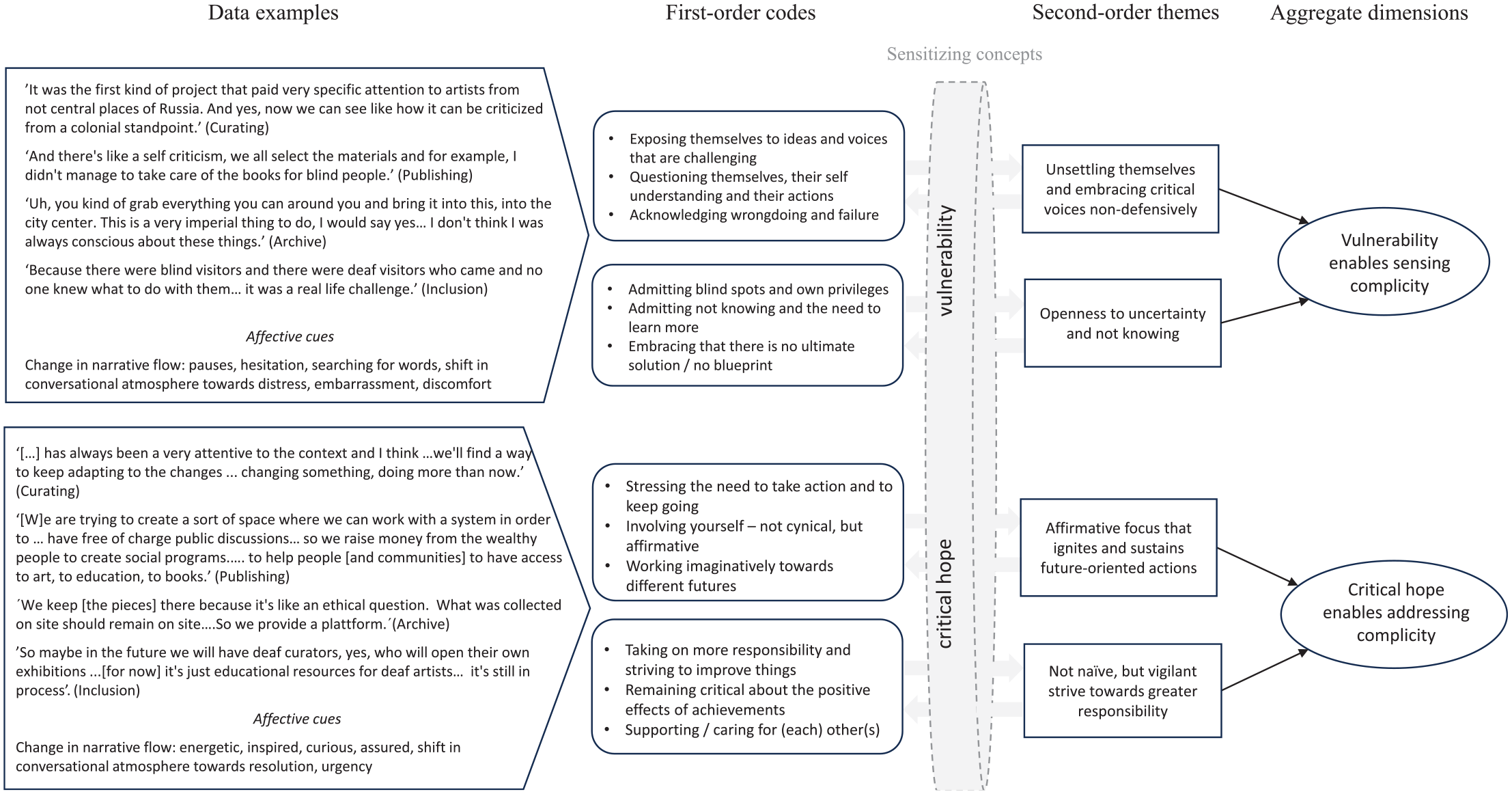
Data structure.
Step III: Clarifying relationships and the process dynamics
To develop a deeper processual understanding of how reckoning with complicity might affect and drive the organization-creation process in the museum, we focused on exploring the “dynamic interrelationship” between our key theoretical concepts (Gioia et al., 2013: 22). We returned to our initial process narratives (see Figure 1) and decided to focus on the inclusion department because it provided a particular data-rich example of how the entrepreneurial process developed over time.
We employed temporal bracketing (Langley, 1999) to identify three key phases of the organization-creation processes (see Figure 3).
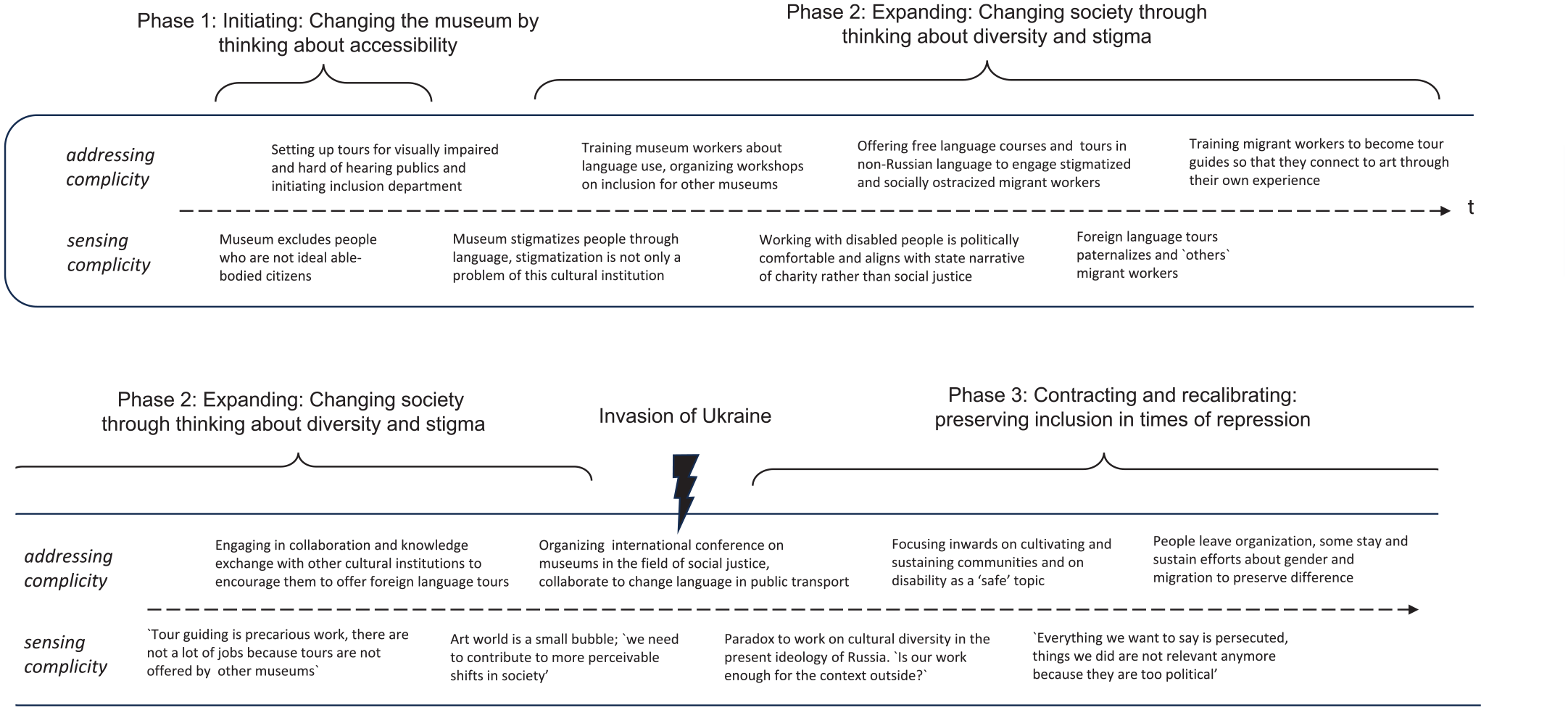
The organization-creation process of the inclusion department.
Phase I includes the slow initiation of entrepreneurial activities triggered by concerns about accessibility up to the official formation of the inclusion department. Phase II encompasses the growing scope and intensity of entrepreneurial activities that follows the institutionalization of the inclusion department until right before the Russian invasion of Ukraine. Phase III covers the contraction and recalibration of entrepreneurial activities in the aftermath of the invasion.
We scanned the data from all three phases for cues on how vulnerability and critical hope relate to each other. We noticed that, across the first two phases, vulnerability and critical hope fed into and enhanced each other in a reinforcing interplay. For example, vulnerability enabled members of the inclusion department to be receptive to how their attempts at empowering migrant workers might fall short, while critical hope encouraged them to take responsibility and probe into more appropriate ways to overcome their marginalization, which, in turn, made them even more receptive of their way of addressing existing marginalizations. We also noted different factors and conditions inside and outside the organization that nurtured the interplay between vulnerability and critical hope. For example, growing institutional support and legitimacy by strengthening the presence of critical hope positively reinforced the interplay in Phase II, instigating the entrepreneurial process to reckon with complicity in increasingly expansive ways. By weakening the presence of critical hope, the invasion of Ukraine negatively impacted their interplay, leading to a drastic contraction of the scope of the organization-creation process and its reckoning with complicity in Phase III.
Findings
We show how vulnerability and critical hope enable museum workers to sense and address complicity in their entrepreneurial work (research question 1) before zooming in on the inclusion department to explicate how the interplay of vulnerability and critical hope drives the organization-creation process over time (research question 2).
Reckoning with complicity: The role of vulnerability and critical hope
“Were we just making a facade?”: Vulnerability and the sensing of complicity
Across the various departments, workers strongly identified with “build[ing] a new type of institution that would be progressive in terms of what an exhibition venue can be” (Warawara) and were excited and proud of the “important work” (Konstatin) that different initiatives and projects pursued. At the same time, these aspirations did not render workers unreceptive to the aspects of their own organizing that complicated the idea of their work as contributing to a more progressive cultural landscape in Russia. The interview accounts were continuously punctuated by pauses and insertions that elicited moments of doubt, concession, uncertainty, and frustration. In these moments of affective tension, the workers acknowledged that their entrepreneurial work frequently failed to deliver its emancipatory promise and was complicit with the realities they were trying to challenge.
Unsettling themselves and embracing critical voices nondefensively
The sensing of complicity was enabled by an affective orientation of vulnerability coming with an openness “to expose” themselves to experiences, voices, and knowledge that “disturb” their own understanding of their entrepreneurial work (Gilson, 2011: 319). For example, across the organization, the workers were proud of the launch of the archival department, highlighting how the initiative reconfigured the museum into a more political actor that took responsibility for performing a different history by conserving material that was abandoned by the “official narrative” of the state. At the same time, members of the department were willing to be affected by discussions around decolonizing the museum that challenged the coherence of this self-understanding. With a sense of surprise and confession, they shared how this made them aware that their work of “grabbing” local archives and centralizing them in Moscow (Konstatin) was reproducing an imperial logic. Museum workers across the organization were willing to engage with and confront critical voices and ideas without being defensive. Instead, they described themselves as “very responsive to this kind of publicly engaged critique” (Anna). Among several respondents, we noticed an uncompromising willingness to scrutinize their own actions, questioning, for example, to what extent their work might gloss over, normalize, and “decorate” rather than challenge the difficult political situation in their country: [B]efore [the museum] got the archive, it was more this facade thing, which we were discussing in my opinion, yeah, before as a kind of nice decoration. Which I mean, if we take some leftist critics who would criticize the institution as facade, for example. They would say that our exhibitions are very fascinating, but that doing them normalizes the situation in Russia . . . and then you think that is a country that more or less works the same as any other country. Yeah, and this is very much increased right now because, of course, when this situation is so bad, you have to ask yourself: what did you do all this time? Were we just making a facade? Because we were taking part in this. (Konstatin)
The statement “we were taking part in this” in the above quote epitomizes vulnerability and the sensing of complicity in a particular pronounced way. Being open to confronting rather than “avoid[ing] what might unsettle” them (Gilson, 2011: 319), the museum workers could attune to their “wrongdoing”—that is, their complicity in reproducing structures of power and “normalizing” violence.
Openness to uncertainty and not knowing
The sensing of complicity was further supported through vulnerability as openness to uncertainty and “not knowing” (Gilson, 2011: 325). A sense of discomfort surfaced as workers from various departments admitted mistakes and highlighted the need to learn more. Wrestling with how to achieve their progressive aspirations, they acknowledged that “there are a lot of blind spots that the museum does not see because of its conservative structure” (Konstatin). For example, people in the publishing department who translated and published critical theory to promote dialogue on contentious social issues such as gender or colonialism started noticing how inaccessible these resources were to people outside of the urban cultural milieu: Yeah, because, you know, we realized the problem is that we don’t speak the same language . . . I mean, like we don’t know how to speak about [our work, contemporary art] to the Babushkas from the villages . . . We don’t know how to speak to these people because we are overeducated here . . . We can talk about gender equality and so on and so forth, but we don’t know how to explain this to the average Russian citizens. (Lev)
The museum workers were vulnerable when they admitted that they were unable to communicate their concerns to less-educated communities. Their openness to the possibility that their knowledge was not necessarily adequate or superior to that of others allowed them to sense their own privilege and complicity with the museum as an elite institution.
Openness to not knowing also surfaced in moments marked by high uncertainty and “uncontrolled modes of change” (Gilson, 2011: 323). With a searching voice, a member of the curatorial department pondered the complexity of finding adequate curatorial practice as she admitted that “now we can see” how launching a festival that represented art from underexplored parts and cultural minorities in Russia was problematic from a colonial perspective, even if it challenged the focus on “superstar artists” (Warawara). This became even more pronounced in the aftermath of the Russian invasion of Ukraine, when the museum’s decision to cease all exhibition activities opened both the organization and workers to the unknown.
“Working like internal activists”: Critical hope and the addressing of complicity
Vulnerability enabled workers to sense complicity in their entrepreneurial work, bringing to the fore feelings of frustration, confusion, uncertainty, and discomfort in their own understanding of the entrepreneurial initiatives. For the most part, however, these feelings did not translate into defensiveness or cynicism and did not produce resignation or detachment from the entrepreneurial process in the museum. Instead, we noticed how museum workers responded with a sense of curiosity and assertiveness that “we need to do something” (Lev), shifting the conversation toward a purposeful and energetic engagement with how the museum could contribute to a different society. It marked moments in which museum workers moved from sensing to addressing complicity.
Affirmative focus ignites and sustains future-oriented action
Addressing complicity was enabled by museum workers’ embodiment of critical hope as an affirmative, affective orientation that enabled them to sustain their entrepreneurial activities in their quest to construct a different future “imaginatively and materially” (Zembylas, 2014: 13). The atmosphere during these accounts conveyed a conviction and urgency to act, as can be seen in the following quote: “I just perceive some things like very emotionally and sharply [. . .] we have to react in a way, to start a conversation, to change something” (Jekaterina).
The museum workers addressed their complicity by focusing on their agency and ability to “think productively and [to] continue to do something” (Warawara). For example, transforming the exhibition space into a library as a safe and contemplative public space for sharing knowledge “where [the public] can come . . . and can still ask questions” (Maxim) illustrates museum workers’ continued ability to affect through their everyday work in the direct aftermath of the Russian invasion of Ukraine. In a similar vein, members of the publishing department noted that, although “critical research cannot be published right now”, they created new research grants to document this period of unrest, so it was available as an infrastructure “for people in the future” (Lev). These critical and creative acts provided workers with a collectively shared sense that a different future was still possible. It sustained their commitment to “keep going” (Warawara) in increasingly repressive times and continue their commitment to change in a meaningful way: [M]aybe at some point we can play this role of cultural diplomacy in the future, if it’s possible . . . Or because we preserve these archives, it’s a local heritage. Maybe that can lay the foundation for the future resurrection of the artistic scene. (Vasilia)
Not naive but vigilant strive toward greater responsibility
Although the museum workers’ activities were imbued with hope for a better future, the affective orientation that enabled them to address complicity was not naive but invited a critical assessment of their actions. It instigated museum works toward “continued struggles for greater ethical and political responsibility” (Applebaum, 2017: 872; Boler, 2014). Noting that their “institution is not ideal”, the museum workers spoke of themselves as “internal activists” (Sofia) who vigilantly and resolutely aimed to improve their entrepreneurial activities and organization. This was evident, for example, when the museum workers wrestled with the idea that they work for an institution “[. . .] that is founded by . . . very rich people. . . . they get their money from somewhere, and you cannot change it” (Warawara). Their affirmative, hopeful stance enabled them to acknowledge this entrenched complicity while directing their attention toward the space of opportunity and the difference they made through their initiatives, turning the museum into an actor “that is responsible to the public” (Anna). In the archive department, for example, the workers not only highlighted how archiving “brings support and attention” to invisible histories but also discussed how they felt responsible for the “politics” of archiving: When we were thinking about the archive and gathering the materials, for example, we thought about this, the politics, how we do this . . . we were concerned about this [practice of recreating an imperial structure] and that was very important as well . . . Or in this term of how the museum gathers the collection it also reflects this past, this 19th-century logic. (Konstantin)
In response, the workers initiated an archive network that cultivated discussions on the ethical and political responsibility of archiving the recent past. Later, they also provided decentral infrastructures that promoted archiving in local contexts. These examples illustrate how complicity becomes an opportunity that can be productively used to transform the museum into an organization that seeds the potential for a more just future.
Moving the entrepreneurial process: The interplay of vulnerability and critical hope
Phase I: Initiating
Members from different parts of the organization highlighted how the organization-creation process of the inclusion department grew “organically” (Jekaterina) and from the bottom up. It was not triggered by strategic insights but rather by workers noticing how their attempts to do good were insufficient. When a deaf visitor directly confronted the museum workers with the question of why they were not offering any translation into Russian sign language, they were stunned and realized that, even though they wanted to be an inclusive space that engaged with and represented all strata of society, in an unaware way, they were complicit with excluding or discriminating against disabled people. This catalyzing moment of vulnerability and disruption was channeled through the critically hopeful affective orientation of museum workers toward curiously addressing their inattention to how exclusion happened in the museum while taking responsibility for their complicity with regimes of exclusion: It incited us to think about the environment around us and to just to pay more attention to social problems inside this environment. About people who are there: Who we see or whom we cannot see, and why we cannot see them. . . So I think we really had this beautiful community of people who just think and try to reflect on the world around them and to change it a little bit. (Jekaterina)
This supported them in viewing the discomfort of critique as an opportunity to launch in an entrepreneurial way “small activities” (Mila) to address the existing lack of inclusivity in the everyday life of the museum, collaborating, for example, with a studio to produce Braille inscriptions or setting up guided tours for deaf visitors.
At the same time, their critical hopeful orientation also invited workers to stay vigilant in challenging their blind spots and framed uncertainty and not knowing as productive in finding imaginative ways to address their complicity, thus supporting continued vulnerability in the entrepreneurial process. Embracing the premise that there was “no blueprint” (Maxim) for inclusion, the initial phase of the organization-creation process was slow, prioritizing taking “time to understand what it was all about” (Mila). As a result, the group exposed themselves to people who unsettled their understanding of inclusion. For example, conversations with different experts from disabled communities made the group aware that inclusivity is not just about making the space and content more accessible but also about using language in a way that does not equate handicapped people to a “medical condition” (Mila). This awareness, which was channeled by the critically hopeful focus to “keep going”, fueled the groups’ energetic entrepreneurial efforts in setting up training workshops for people in the museum to use language that does not discriminate.
In this first phase, vulnerability and critical hope as affective orientations reinforced each other, making it possible for the museum workers to sense and address complicity in and through their entrepreneurial activities. Vulnerability enabled our respondents to sense how they were implicated in the injustices that persisted in their own context and opened them up to being wrong and unsettled in their own understanding of the world. The promise of critical hope instigated them to use this discomfort as a signal to tackle the injustices through their entrepreneurial efforts. At the same time, their desire for a better future kept them committed to sensing complicity through vulnerability. Despite the uncertainty and new requirements that the museum workers brought into the organization, their endeavor to make the museum more inclusive was supported by the organization. For example, the director was said to be “inspired” by the group’s entrepreneurial efforts and encouraged them to seek out knowledge and to act. He also demonstrated critical hope by doubling down that “we must be accessible for different people” (Maxim). The entrepreneurial activities eventually led to the formation of an official inclusion department.
Phase II: Expanding
This encouragement and institutional legitimacy fostered an increased sense of agency among the workers, feeding their critical hope in the struggle for greater ethical and political responsibility. As a result, the museum workers’ efforts to address their complicity with processes of exclusion became more ambitious and expansive, “infiltrat[ing]” the museum “in a good way” (Warawara) while also starting to target museum professionals outside of the organization. People with physical or mental disabilities were not only considered in the curation and public programs but also given more visibility and a voice in the museum by working as tour guides or cocurators. The deaf visitor who shed initial light on the lack of inclusion moved from being an advisor to becoming a team member. Moreover, people in the department began making their experiences available to other cultural institutions to widen the emancipatory reach of their activities by publishing guidelines for working with disabilities and organizing international professional conferences to discuss the topic, sparking the establishment of inclusion departments in several other museums in Russia.
This increase in critical hope as an affective orientation also increased their vulnerability, attuning them to sense complicity around more politicized aspects of inclusion that they had previously ignored. For example, the inclusion group established a reading group exploring difficult topics, such as decolonialization, which made them notice that there were “all these problems inside the museum” (Jekaterina), especially around ethnic diversity and migrants who are treated like “second class people with no rights and no needs” in Russian society (Maria). Members of the inclusion department shared how they became very unsettled upon realizing that they hardly communicated with their own migrant workers and that those workers were neither represented nor did they participate in the museum space. The sensing of their complicity spurred a new line of action-oriented efforts toward greater ethical and political responsibility: “And it was also our own question: how should we shape our structure, be more progressive, and be more open and also to include these people in [our] everyday activities?” (Maria).
First, the workers in the inclusion department started offering free Russian language courses as well as free museum tours in the migrant’s native tongue. However, as Jekaterina admitted—and searching for words as she did so—it was a “failed attempt . . . an allure” that reinforced experiences of otherness, driving the inclusion department to search for better, even if still not perfect, solutions. We can see that this growing vulnerability fueled museum workers to intensify their hopeful entrepreneurial efforts and allowed them to see the importance of their actions not from a position of naive idealism but from a willingness to feel and confront the pervasiveness of systemic inequality. Noting that they did not wear “rose-tinted glasses”, the following quote illustrates how their hopeful affective orientation is both affirmative and critical, enabling heightened vulnerability and critical reflection around their complicity: Yes, but now we have . . . a course that trains people with migrant backgrounds as tour guides. We want to not just translate these tours but also have people with migrant backgrounds speak about art in their own language and for people with migrant backgrounds. . . . It’s a logical development. . . and it’s a support for migrant labor, because it’s like an opportunity to have a new job, for example, and one of them [a cleaning lady] is working [now as a tour guide]. Yeah, it’s a very beautiful story, like we can make a movie about it. . . . But at the same time, I don’t wear rose-tinted glasses, and I don’t idealize this story either because any work in the cultural sector is very precarious. . . . It’s not high paid and it’s not regular. . . . But it is very symbolic. . . . In this very symbolic way, it is very important. (Jekaterina)
In this second phase of the development of the organization-creation process, we can see how, encouraged by the institutional support of the organization, critical hope increased, in turn strengthening the presence of vulnerability, leading to a reinforced interplay between them that intensified the organization-creation process, instigating museum workers to go “further and further” all the while “questioning themselves” in more profound ways (Jekaterina). As a result, the organization-creation process developed into an expansive movement alternating sensing and addressing complicity, affecting not only their own organization but also a broader field of cultural and social actors to create “more perceivable shifts in society” (Jekaterina). By the end of 2021, the inclusion department was one of the museum’s most vibrant initiatives. The scope and speed along which their entrepreneurial activities developed had grown significantly. Collaborating with non-governmental organizations (NGOs) and other cultural institutions to expand their tour guide training program for migrant workers to other institutions as well as changing the word “invalid” to “disabled” on public transport systems (Mila), the department, together with the entire organization, was working toward “greater engagement in the region . . . and becoming a more responsible and ethical institution” (Anna) that was able to “affect the norms in society” (Maxim).
Phase III: Contracting and recalibrating
The Russian invasion of Ukraine in February 2022 had a significant impact on the interplay between vulnerability and critical hope and the overall organization-creation process. Initially, the vulnerable confrontation with the invasion as an external, extreme event that disrupted museum workers’ own understanding of their country and work induced an overwhelming sense of being “confused” and “at loss” (Warwara) in how to respond to this crisis. It heightened a sense of uncertainty that everything was altered, even if workers were not affected personally—“my house isn’t bombed” (Mila)—and instigated them to sense their own implication and responsibility in the situation: It was a paradox, like a strange absurd thing to work on cultural diversity when the whole like . . . present ideology is against this cultural diversity and like praising this Russian world. . . . And the question for me, when I think about my work in the museum, like is this work enough for the context that is outside the museum? (Jekaterina)
At the same time, critical hope as an action-oriented response that provides meaning to the discomfort and uncertainty of vulnerability by channeling it into imaginative entrepreneurial action became less available because of the Russian invasion. Being part of the perpetrator state, the museum and inclusion department lost funding and international support. Moreover, tightening legal frameworks and growing state surveillance accompanied the new situation, which made it more difficult and potentially harmful for museum workers to organize activities around certain topics. Although working with disabled people was still a “safe zone” (Sofia), areas with greater political weight became increasingly a target of censorship. One worker bemoaned: “All the things that we did [around migration] are not relevant for Russian museums nowadays because they cannot do it because it’s too political” (Jekaterina). We noticed how a decline in workers’ ability to act and address complicity made critically hopeful work toward a better future less conceivable and possible as time wore on.
The decreased promise of critical hope, in turn, made it more difficult to remain open and exposed to the uncomfortable feelings of reckoning how their work participated in and was complicit with the injustices they saw being reinforced through the Russian state. Several members of the inclusion department started to reduce their vulnerability by choosing to pay less attention to complicit dimensions of their work environment or by exiting the entrepreneurial effort altogether. Struggling to find words for their experience, they noted how they eventually closed themselves off: “Like last year, I just blocked all my thoughts and feelings about the museum. I just [needed] distance from it” (Jekaterina). Others noted that, in the current context, working on values such as respect for others was still possible, but this meant “unseeing”, that is, shielding off and ignoring some of their own complicity, as Mila suggested: But you need to close your eyes. [A couple of years ago] you could have your eyes open, and now you can [still] think that those values are great . . . but you need to close your eyes and your mouth like this [gesturing closing eyes and mouth with her hands]. (Mila)
This reduced vulnerability coupled with the diminished critically hopeful orientation toward the future induced a contraction of the previously “thriving” (Anna) organization-creation process of the inclusion department.
However, the invasion did not completely eradicate critical hope. Some members of the inclusion department continued their entrepreneurial work, assertively expressing the meaningfulness and impact of their work for the future, even if its reach was receding: I stayed because I really felt that the museum has changed something, and I feel a responsibility for how we influence this context and that I am needed here. I don’t have any intention to change the country and the law because it’s not what I can influence, but I can change something with the people who are coming to the museum. . . . It is also my personal statement that . . . inclusive programs are needed much more and we will deal with trauma and new disabilities [as a consequence of the invasion of Ukraine]. (Nikolai)
This lingering sense of critical hope fed into workers’ attempts to continue speaking about justice, decolonization, and feminism and work with migration and minorities in collaboration with members who left the country in more intimate and less public ways because “these themes are important, and they are really problematic in contemporary Russia and we should not forget about them” (Maxim). This was underpinned by an understanding that, even if these efforts can only be “superficial”, they serve as small acts of hopeful perseverance to uphold “any difference and freedom in this contemporary context” (Jekaterina). Meanwhile, members of the inclusion department also shifted their focus more strongly “inwards” (Sofia) toward community initiatives and finding ways to “care” and “be closer to each other” within the organization, “pouring our hopes, and interests . . . into the museum” (Maxim). For some, this form of care and reorientation provided the necessary support to sustain a degree of vulnerability amid a highly uncertain future: It is like therapy . . . just because I can discuss my feelings with my colleagues and visitors, and we understand we believe in the same reality. And this reality is really scary and not sustainable, and sometimes, it’s absolutely impossible to discuss the future . . . but my work and the programs really help me to live this reality. (Maxim)
We can see how the Russian invasion of Ukraine had a significant impact on the organization-creation process by disrupting the self-reinforcing interplay between vulnerability and critical hope. On the one hand, the invasion opened museum workers to overwhelming feelings of discomfort, despair, and uncertainty as they vulnerably confronted how they were unwillingly participating in and complicit with a nationalist and imperial Russia they had worked against these past years. On the other hand, the reality of the invasion and the ensuing isolation from international networks, increased censorship, and an overall reduced sense of agency also decreased critical hope as an affective orientation that could contain these feelings of complicity and direct them toward future-oriented entrepreneurial action. The decreased critical hope, thus, prompted museum workers to reduce their vulnerability as a coping strategy to protect themselves from overpowering emotions. As a result, the movement between sensing and addressing complicity in entrepreneurial actions was contracted. Vulnerability and critical hope remained and still informed entrepreneurial efforts of transformation in the inclusion department. However, in their diminished form, their interplay was directed at deliberately humble acts of sustaining and working for ideas of social justice amid unforeseen and uncontrollable change rather than addressing complicity in ever expansive ways.
Discussion
Our research was sparked by the observation that entrepreneurial initiatives, although often born in search of creating new and more just futures, tend to be caught up and complicit, reproducing the very systems they strive to overcome (e.g. Barinaga, 2017; Courpasson et al., 2016; Daskalaki et al., 2015; Jones and Spicer, 2009; Verduijn et al., 2014). We have taken this as an opportunity to problematize both the fantasy of entrepreneurship as harmonious “doing good” that tends to shield entrepreneurs from acknowledging the contrary effects of their efforts (Dey et al., 2016) as well as dystopian framings that view entrepreneurship as necessarily trapped, foreclosing the opportunity to productively deal with complicity (Barinaga, 2017; Dey and Steyaert, 2010). Focusing on the micro-level of entrepreneurial work, we explored the room for maneuver between being “blinded” and “trapped” by examining entrepreneurial initiatives in a contemporary art museum in Russia. Now, we theorize the interplay between vulnerability and critical hope by developing a process model of reckoning with complicity before discussing its contributions and implications for existing fields of research.
A process model of reckoning with complicity
Drawing from the process data of the inclusion department, we show how an interplay between vulnerability and critical hope instigated museum workers to keep reckoning with complicity throughout the entrepreneurial process. Vulnerability and critical hope reinforce each other in this interplay, leading to more expansive efforts in entrepreneurial activities. However, the interplay can also be impeded, contracting the reckoning with complicity in the organization-creation process.
Reinforced interplay driving the expansion of entrepreneurial activities
During the first two phases of the entrepreneurial process (initiating and expanding), the scope of entrepreneurial activities was growing, targeting complicity in increasingly more expansive ways inside and outside of the organization (left side of Figure 4(a)).
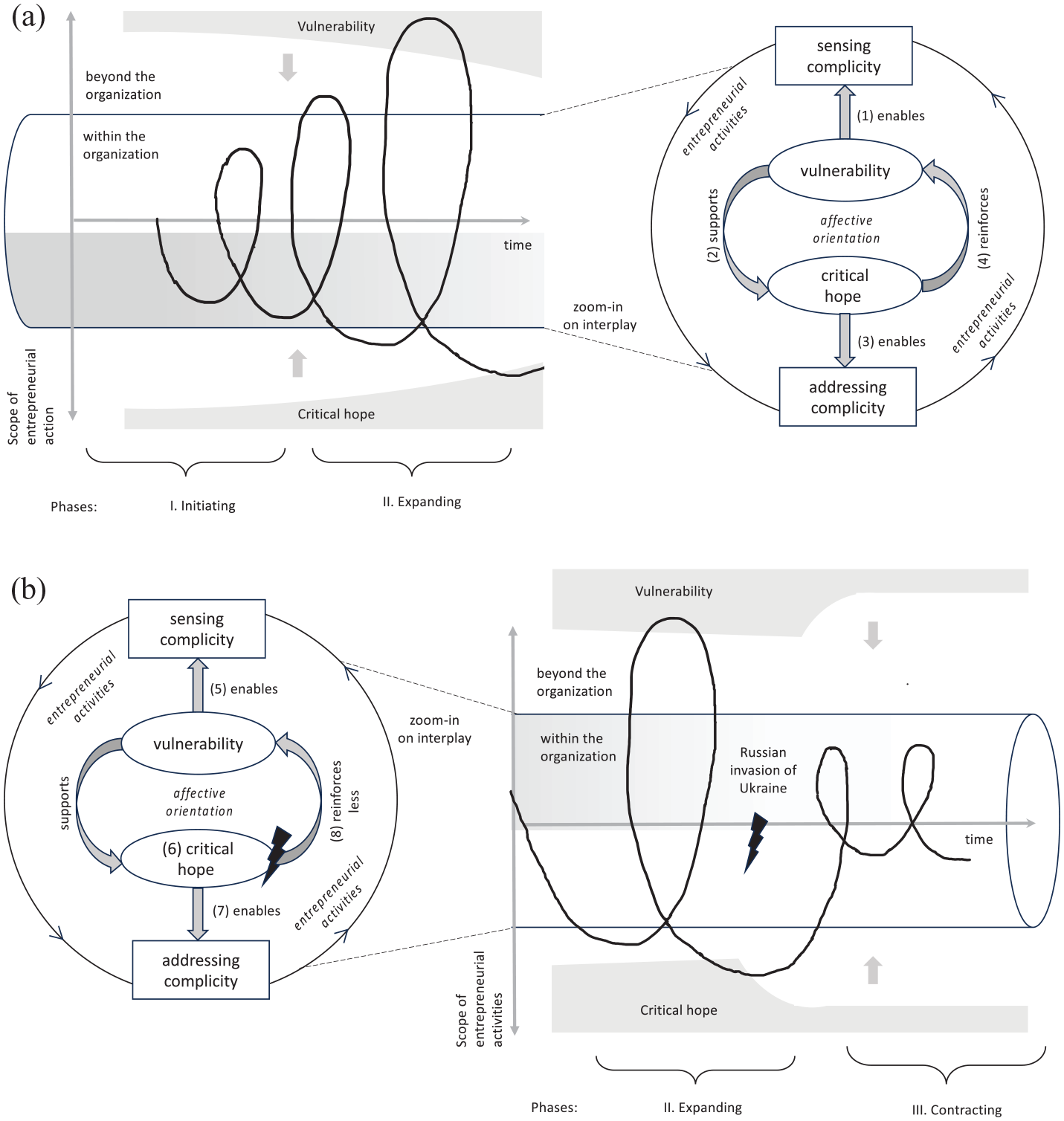
A process model of reckoning with complicity— (a) reinforced interplay— (b) impeded interplay.
Zooming in on what mechanisms are driving this development (right side of Figure 4(a)), the model suggests that vulnerability as an affective orientation not only enables workers to sense complicity in their entrepreneurial actions (1) but also fosters critical hope (2) as a complementary affective orientation. It encourages workers to remain vigilant and fully engaged in their struggle to challenge “inscribed habits of inattention” (Boler, 2014: 30; see also Applebaum, 2017) and supports an openness to being wrong while “venturing one’s ideas and beliefs [. . .] nonetheless” (Gilson, 2011: 325). The presence of critical hope not only enables workers to address complicity (3) but also reinforces vulnerability (4), as critical hope, seen as an “action-oriented response” (Bozalek et al., 2014: 1) and a promise for transformation, can give meaning to unsettling experiences while highlighting “what might be gained” through the loss of certainty (Boler, 2014: 30).
Through this reinforcing interplay, vulnerability and critical hope increase, driving the entrepreneurial activities in a spiral-like movement between sensing and addressing complicity toward expansion.
Impeded interplay driving the contraction of entrepreneurial activities
Figure 4(b) illustrates a case in which the interplay between vulnerability and critical hope is not reinforced but impeded.
Instigated by internal or external factors (in our case, the extreme event of Russia’s invasion of Ukraine), the expansive development of the entrepreneurial activities significantly contracts, reducing the scope of entrepreneurial activities and their reckoning with complicity (right side of Figure 4(b)).
Zooming in again on the interplay of vulnerability and critical hope during this phase (left side of Figure 4(b)), vulnerability as an affective orientation is still present and instigates workers to sense complicity (5). However, the invasion and the ensuing change in legal frameworks, growing repression, and loss of international support make the affective orientation of critical hope (6) less available to the museum workers. This renders it more difficult to channel the sensing of complicity into hopeful, future-oriented action (7) and give meaning to the overwhelming experience of discomfort and uncertainty. In turn, the positive feedback loop between critical hope and vulnerability is impeded (8). In our empirical case, the museum workers responded by reducing their vulnerability, adopting what Gilson (2011: 323) describes as a strategically motivated form of invulnerability, whereby “closing oneself to certain kinds of relations and situations” allows for shielding oneself under conditions of increased repression and becomes a necessary condition to sustain and resist in other ways. The entrepreneurial process still keeps becoming other (Hjorth, 2014) in a movement between sensing and addressing complicity, but rather than driving entrepreneurial activities toward expansion, the process is contracting, focusing on humble activities of sustaining and reckoning with complicity by pursuing a “certain form of closure” (Gilson, 2011: 323).
Processual and affective: Moving with the trouble in organization-creation
Our model makes two important contributions to process studies of entrepreneurship (e.g. Hjorth et al., 2015; McMullen and Dimov, 2013; Steyaert, 2007). First, it offers a detailed conceptualization of how entrepreneurial work of organization-creation can productively deal with complicity. Rather than following a grand plan, our model suggests that organization-creation is constituted through “localized, everyday struggles” (Verduijn et al., 2014: 101). It corroborates Barinaga’s (2017: 952) observation that entrepreneurial efforts toward social change unfold through “ongoing and piecemeal work”, showing how this “tinkering” translates into iterative movements of sensing and addressing complicity in the process of venturing and adapting entrepreneurial activities. In contrast to her study, our model suggests that, although entrepreneurial initiatives driven by aspirations of doing good can never fully escape their own complicity (Daskalaki et al., 2015), this does not necessarily trap the entrepreneurial process (Barinaga, 2017: 954). The model shows that complicity can also drive and transform it if entrepreneurs come to understand their entrepreneurial efforts as what Contu (2018: 287) labels “demiurgic”, that is, messy, impure, creative, sometimes also “evil”—never fully in control of themselves and their consequences but always responsible for how they involve and shape power.
Second, our model calls attention to how affective orientations render reckoning with complicity productive (Ashcraft, 2018), permitting the entrepreneurial process to not just stay but actually move “with the trouble” of its own entrepreneurial efforts (Haraway, 2016; see also Zaliwska and Boler, 2019). This means that the answer to Blomley’s (1994: 385) question, “How can we contribute to and learn from progressive struggles without reinforcing the hierarchies of privilege, silencing those with whom we work?” must necessarily be processual and affective. Rather than searching for ultimate solutions, reckoning with complicity entails continuously staying attentive to the inherent tensions of everyday entrepreneurial work and using this insight to spur new and adapted entrepreneurial activities that are made possible through the affective orientations of vulnerability and critical hope. Similar to McCarthy and Glozer’s (2022: 372) study on affect in institutional change, the interplay between vulnerability and critical hope produces a dynamic movement between affective “lows” (discomfort, uncertainty) and affective “highs” (assertion, inspiration) that informs, energizes, and propels entrepreneurial activities. Moreover, our findings show that the interplay between “being affected and affecting in turn” (Gilson, 2011: 310) is self-reinforcing and takes on the character of an affective engine that strengthens workers’ “affective investment in a wanted future” (Hjorth, 2014: 103), moving the entrepreneurial process in more expansive ways. In doing so, our model purports what also transpires from Dey and Mason’s (2018) theorization of activist entrepreneurship: critique and problematization of power relations and a positive expectation toward future-oriented change need to be balanced to unleash the entrepreneurial potential.
This balance is, however, precarious. External and internal factors can support but also significantly impede the interplay so that the affective orientations might become less productive. Our empirical case exemplifies how the Russian invasion of Ukraine disrupts the relationship. At the same time, the findings also point to the importance of organizational and field conditions that help to sustain the interplay. For example, the leadership team in the museum seems to have nurtured it significantly by embodying a critical hopeful orientation and by tolerating the uncertainty that accompanied the questioning and reinventing of museum practices. Moreover, the professional field in which cultural workers are socialized is characterized by a high level of reflexivity and an ethics of care approach (Alacovska and Bissonnette, 2021), arguably contributing to museum workers’ willingness to question themselves and their work as part of their professional ethos. Other organizations and professional fields might make such a display of vulnerability more difficult. The findings also indicate that individual thresholds for vulnerability (Dimov, 2018) and collective processes of affective solidarity (e.g. McCarthy and Glozer, 2022; Martin de Holan et al., 2019; Vachhani and Pullen, 2019) shape the propensity to keep embodying these affective orientations.
Ultimately, the reinforcing nature of the interplay also presents a challenge to sustaining it, calling into question the long-term durability of affective dynamics. Several museum workers alluded to how the increasing speed and scope of entrepreneurial activities was taking its toll on them, expressing a sense of relief at the break caused by the contraction of the process in the aftermath of the Russian invasion of Ukraine. A recent study by Resch and Rozas (2024) highlights that organizing processes charged with affective intensities can reach expansive peaks but also risk burnout. Their findings resonate with a dilemma that scholars interested in the role of affect in organizing have noted: affective processes can gather an overpowering momentum yet are also prone to collapse, making it difficult to contain and sustain them (Endrissat and Islam, 2022; Vidolov et al., 2023). We call for future research to explore in greater depth how various factors at the macro, meso, and micro levels influence the interplay between vulnerability and critical hope, as well as the conditions that impede or support affective processes in entrepreneurial activities over time.
Vulnerability and hope: Affective orientations in entrepreneurship studies
We also contribute to the emerging research stream on vulnerability and hope in entrepreneurship studies (e.g. Dimov, 2018; Wettermark et al., 2018). Calling for greater attention to these concepts, our study casts a new light on vulnerability in entrepreneurship by illustrating how it enables entrepreneurs to unsettle themselves and embrace not knowing and uncertainty. Currently, little entrepreneurship research explicitly discusses vulnerability. However, various studies highlight that entrepreneurs tend to cast themselves as knowing and in control (Dey and Steyaert, 2010, 2012), eschew learning from the beneficiaries of their entrepreneurial efforts (Wettermark and Berglund, 2022; Wettermark et al., 2018), and shield themselves from uncertainty and failure through their attachment to prosocial fantasies (Dey et al., 2016; Kenny et al., 2020). In other words, the research so far suggests that entrepreneurship embodies the ideal of “invulnerability” (Gilson, 2014) rather than vulnerability.
Our research shows that, against its negative conceptions, vulnerability as an affective orientation is critical for sensing complicity and tuning in to the ambivalent consequences of entrepreneurial activities. Such a nuanced and more complex understanding of vulnerability provides a much-needed corrective to the heroic imaginary often implied in social entrepreneurship (Dey and Steyaert, 2010; Dimov, 2018; Mair and Marti, 2006; Verduijn et al., 2014). It also invites research to look beyond how entrepreneurs relate to the vulnerability of others and better understand how entrepreneurs’ willingness to embrace or avoid their own vulnerability shapes their entrepreneurial engagements and self (Dimov, 2018; Martin de Holan et al., 2019). Deconstructing the masculine image that dominates the field in management and entrepreneurship alike (Hamilton, 2013), vulnerability also provides a link between entrepreneurship studies and the surging interest in a feminist ethics of care (Alacovska and Bissonnette, 2021; Johansson and Wickström, 2023; Kivijärvi et al., 2024; Vacchani and Pullen, 2019). Greater recognition of vulnerability would imply a shift to how entrepreneurial work can thrive through care for the self and with others in affective solidarity (e.g. Vacchani and Pullen, 2019).
Furthermore, our research suggests that being vulnerable entails both affective strength and threat. We argue that harnessing one’s own vulnerability in entrepreneurial activities also entails a necessity to strategically manage it (Gilson, 2011: 321), especially in circumstances where exposure threatens to affectively overwhelm or existentially harm individuals. In our case, this can be observed when museum workers adopt situational invulnerability as a protective stance to cope with the repercussions of the invasion. Our research resonates with the work of McCarthy and Glozer (2022: 385), who show that retreat as a form of self-care in response to overwhelming exposure in institutional change works as a form of “protective agency” that allows workers to recover and at times also refocus their efforts to find new ways of persevering.
Our study also has several implications for a refined understanding of hope in entrepreneurship studies. We emphasize that critical hope (Boler, 1999, 2014) as an affective orientation enables entrepreneurs to “keep going” and prevents them from being weighed down by despair or the failure of “doing good”. Accepting that entrepreneurship exists within ambiguity and uncertainty, critical hope motivates a continued struggle toward greater responsibility (Applebaum, 2017; Boler, 2014). This notion is particularly fruitful in the context of prosocial forms of entrepreneurship, in which complicity is likely to surface (e.g. Daskalaki et al., 2015).
Despite the growing acknowledgment of the importance of hope for producing entrepreneurial, moral, and imaginative agency in conditions of uncertainty and adversity (Alacovska, 2018; Dimov, 2018), the concept carries an ambivalent connotation. Scholars have problematized utopian hope as a fatalistic force that sustains entrepreneurial workers’ investments in precarious conditions and as a form of cruel optimism (Berlant, 2011) that motivates unreflective modes of being-in-the-world and purports a passive complicity with the status quo (Alacovska, 2019; Zigon, 2009). Critical hope, on the other hand, taps into the promise of hope while staying attentive to its deceit or naivete by integrating the affirmative with the critical. It is this coupling that enables entrepreneurs to grapple with complicity by igniting imaginative action that remains reflective about its own limitations.
If the embodiment of critical hope as affective orientation emerges as a crucial resource for propelling transformative entrepreneurial change and developing an entrepreneurial self (e.g. Barinaga, 2017; Martin de Holan et al., 2019), we encourage scholars to attend to the ways that affect the availability and preservation of critical hope. Research on organizational and social entrepreneurship has started to acknowledge how spaces of “friendship and camaraderie” (Courpasson et al., 2016) or even support by “known strangers” (Martin de Holan et al., 2019) can nurture forms of hope and help entrepreneurs project themselves and imaginatively challenge existing societal and organizational structures. Our study invites future research to explore the various forms of “hope work” that entrepreneurs and the communities they are embedded in deploy to keep going and keep nurturing a better future to come (e.g. Alacovska, 2019; Fernández et al., 2017).
To conclude, our model casts organization-creation as humble and relational struggles of “becoming other” that are continuously being “undone” by the circumstances and power relations they are trying to change. Attention to the affective orientations of vulnerability and critical hope makes these struggles productive, allowing entrepreneurs to not just stay with the trouble and grapple with the uncomfortable truth of their complicity but to move forward. When fostering social transformation seems to be more pressing than ever, researching ways to sustain affirmative entrepreneurial actions that imagine better futures without ignoring the shortcomings of their own efforts seems particularly promising.
Footnotes
Acknowledgements
We extend our profound gratitude to the museum workers who shared their experiences with us during times of great uncertainty and crisis. The research would not have been possible without the help of a colleague who made access to the research site and data collection possible. Earlier versions of this article were presented at the Imagine Festival at CBS, the MOTI Workshop at Grenoble Management School, the Graduate School of Management at Kyoto University, JSBE at Jyväskylä University, and the 2024 Academy of Management Conference. We are thankful to the participants of these workshops and conferences, as well as to our guest editors and the three anonymous reviewers, for their thoughtful and constructive feedback, which has greatly contributed to the further development of this article
Funding
The authors received no financial support for the research, authorship, and/or publication of this article.
