



Abstract
This article examines art collectives in Venice that use their artistic and cultural projects to act as public entrepreneurs seeking to improve urban welfare and elicit social change for reasons of societal betterment. These ventures are developed against a backdrop of ongoing socio-economic challenges arising from exploitative tourism in the city. Interviews with some art collective members revealed that: (1) their local rootedness is shaped by issues of gentrification and a search for a city that benefits all; (2) their core values are translated into artistic propositions addressing local demands and institutional voids and (3) their private goals have a public-service background. Our study unveils a unique type of entrepreneur that mediates local demands but has no significant impact at the policy level, thus only scratching the surface of institutional change. This insight contributes to our understanding of artists as public entrepreneurs who, despite their use of activist language channelling public demands, are constrained by the very institutional voids they seek to close.
Introduction
Public entrepreneurship at the city level tends to be dominated by established public institutions and private organisations. Artists are often overlooked, despite their significant potential to elicit change through symbolic and ephemeral ventures (Beyes, 2015b; Hjorth, 2013). Moreover, the citizens on a city’s margins often disagree about how best to make their voices heard via the means available to them. Additionally, cities that rely heavily on tourism face socio-economic challenges that lead to depopulation and the privatisation of services (Salerno, 2018). Within this context, Venice has seen the emergence of grassroots art collectives that seek to create socially engaged art and confront traditional views of urban development. The relationship between art and the city is explored extensively in the literature (Benincasa et al., 2019), revealing that art is now not only increasingly engaged with a city’s ways of life but also takes various organisational forms. This includes ventures initiated by public entrepreneurs (Beyes, 2015a) who seek to achieve societal change. In doing so, they go beyond the usual logic behind ‘social entrepreneurship’, wherein consumerism or private reasoning often prevails (Hjorth, 2013).
Our study explores how artists become public entrepreneurs by engaging with a city and mediating local demands. To this end, we conducted semi-structured interviews with 20 members of 11 art collectives in Venice. The aim was to investigate the intended outcomes of their initiatives, in the process revealing how they act as public entrepreneurs seeking change in a goal-oriented manner. We expand on the notion of public entrepreneurship, examining how artistic initiatives can manipulate civic agendas, public demands and social challenges to promote societal change within the life of a city. Although our analysis highlights that not all public entrepreneurship by art collectives has a systematic impact, it can nonetheless be observed even in cases where the outcomes and effects are uncertain. Public entrepreneurship can also involve getting closer to achieving actual change via the employment of modest collective acts that increase the awareness of established institutions and offer tangible, yet small-scale, alternatives in the local scene. Urban appropriation, gentrification and the socio-economic changes originating from excessive tourism drive the public entrepreneurial work of the art communities we examined in Venice, but these efforts do not have any fundamental effect on the challenges that shape their activities. Ultimately, the collective action observed herein is both avant-garde and isolated: it presents as an artistic medium conveying a message of urban change, but is missing the concrete, less symbolic and less ethereal efforts required to alter urban policymaking and provoke institutional change. In this sense, this article highlights the mechanisms and value-driven propositions used in their attempts to achieve public common good, but is critical of the limited repertoire employed to this end.
The article is organised as follows: the first section, ‘From solo innovation to social impact: An overview of entrepreneurship studies’ reviews pertinent entrepreneurship studies, whereas sections ‘The notion of public entrepreneurship: Tapping into institutional voids and values and ‘Public entrepreneurship in the establishment of artist collectives explore public entrepreneurship and entrepreneurship in the arts, respectively. The section ‘Methodology’ then outlines our research methodology and the section ‘The context of the case study: Venetian art collectives provides an overview of the case-study’s context. The main findings are presented in section ‘Findings: Bridging internal practices towards the public sphere’ and discussed in section ‘Discussion’. Finally, section ‘Conclusion’ concludes with our reflections on the study and its limitations and makes suggestions for future research.
From solo innovation to social impact: An overview of entrepreneurship studies
Entrepreneurship studies have traditionally focused on individual decision-making processes and solo disrupters. Schumpeter (1934) is regarded as one of the initiators of entrepreneurship and innovation research, but his findings are now largely rejected because a focus on the individual entrepreneur does not take sufficient account of the collective nature of public entrepreneurship. This can be observed in studies where a group of individuals controls assets within hierarchies (Williamson, 1973), when bottom-up collectives act by self-organising to form alternative institutions with systems of diffuse ownership (Ostrom, 2010; Rothschild-Whitt, 1979), or even when networks of firms or individuals collaborate to explore underutilised resources or knowledge (Miles et al., 2005).
These recent shifts in research have acknowledged the importance of the collective features of entrepreneurial activity (Potts, 2019; Potts and Hartley, 2015), as well as the embeddedness of creativity within social networks. The term collective entrepreneurship has been used to describe settings where leaders and employees work together towards common goals, but primarily relates to efforts within organisations (Ribeiro-Soriano and Urbano, 2010). From this point of view, the tag ‘collective’ is often used to identify a group of individuals rather than being a reference to the development of societal, impact-driven activities (Ben-Hafaïedh, 2017; Piva and Rossi-Lamastra, 2017). Other forms of collective action also occur in the entrepreneurial setting, for example, when entrepreneurs team up to bridge the gaps between distant social networks. In this case, collaborative entrepreneurship perhaps better represents the cooperation between entrepreneurs, stakeholders or other organisations (Bhatt and Altinay, 2013). Some of these ventures are also described as hybrid (Dufays and Huybrechts, 2016), especially when they embrace different institutional logics within heterogeneous organisations (e.g. various norms, socialisation patterns, education, public or private institutions). In this sense, entrepreneurship arises from collective action embedded in networks wherein entrepreneurs act as bridge-builders (Dufays and Huybrechts, 2014). Typically, the theory behind these heterogeneous logics arises as part of the symbolic, informal and formal rules relating to the configuration of collective action. In these cases, however, a setting beyond organisations and any broader societal implications are absent. Social entrepreneurship (sometimes also referred to as community entrepreneurship) in these circumstances conveys the notion that nascent collective actions are grounded in attempts to improve social environments (see Chatterjee et al., 2021; Markman et al., 2019; Kimmitt and Muñoz, 2018). Under this banner, 1 studies have been conducted on a myriad of examples where entrepreneurs dedicate their work to resolving pressing socio-economic challenges like poverty and access to healthcare, education and other basic needs (Gupta et al., 2020; Phillips et al., 2015). Social entrepreneurs thus, strive to build social capital and resolve socio-economic constraints through profitable or non-profitable projects. Although social ventures can thrive within the structure of profitable companies (thereby, social enterprise – Chell, 2007), social-entrepreneurial opportunities develop better via collective action (Bhatt and Altinay, 2013). This is particularly the case if there is agreement that social concerns pertain to a collective, not an individual, dimension (Sen, 1999). When theorised within artistic and cultural environments, entrepreneurial action aimed at societal change has often been termed public entrepreneurship, which is adopted in this article due to its relevance to our empirical setting of Venice.
The notion of public entrepreneurship: Tapping into institutional voids and values
A prime example of public entrepreneurship can be observed in the emphasis participants place on the utilisation of the public space, the public agenda and the far-reaching effects of over-tourism on civil society. In the following section, we explore the distinctive aspects of the public entrepreneurship concept and its common associations with existing institutional voids and value-driven objectives that underpin the collective efforts made towards achieving transformative practices. The term ‘public entrepreneurship’ encompasses a myriad of collective entrepreneurial activities directed at public agendas, civil society and urban spheres, often through art and cultural interventions (Aligica, 2019; Beyes, 2015b; Hjorth, 2013). Cultural change is promoted via non-profit organisations, community groups and socially driven initiatives based on formalised structures infused with a strong sense of flat hierarchies and creative freedom ( Colombo and Rossi-Lamastra, 2013; Parker, 2012). These actions can occur anywhere, but local communities and urban landscapes are seen as privileged, archetypal settings where this type of collective activity occurs (Murphy et al., 2020; Seyb et al., 2019). In the context of entrepreneurship studies, this means that social problems can be targets for entrepreneurs embedded within the local social framework (Steyaert and Katz, 2004; Mair, 2010), while the social aspect is a force behind entrepreneurial initiatives in the public sphere (Hjort, 2013). Another way of identifying how urban actors focus on the local context to actively encourage change-making behaviour arises from the reality that limited resources create relatively stable institutional voids (Dacin et al., 2010; Estrin et al., 2013). It is this actuality that has led to the emergence of public entrepreneurship (Stephan et al., 2015). In the social entrepreneurship literature, institutional voids refer not to an absence of regulations, but to a lack of governmental or institutional support for overcoming social challenges (Stephan et al., 2015). As a result, activism is seen to emerge as a way to address unheeded issues or direct the public agenda towards a particular desired outcome. The act of conducting activist entrepreneuring (Dey and Mason, 2018) encompasses a collective endeavour to fill identified gaps in the public agenda (public policy, urban planning and tourism strategies). These initiatives are less concerned with closing an entrepreneurial void in the economic sense, for example, resolving a failure in supply or demand, but are instead focused on provoking change, often using diverse tools like art to do so (Hjorth, 2010; Steyaert and Hjorth, 2008). The social force driving change is thus, articulated by people organised in groups with a clear collective agenda for the betterment of society (Aligica, 2019). Public entrepreneurs who focus on existing institutional voids typically thrive when it comes to resolving societal tensions and controversies (Boltanski and Thevenot, 1991). This is achieved by articulating narratives with a strong moral purpose, but particularly in relation to a product or service that is currently unavailable. In our case-study of art collectives in Venice, these tensions arise as a result of conflicting views about what a city should provide and to whom. The moralities of an urban environment built for locals and not tourists are a powerful guide in this type of public entrepreneurship, which seeks to direct change at the city level. In so doing, citizens are portrayed as having different orders of worth, with some preferring a tourism-led urban ecosystem, while others want a city focused on locals.
Public entrepreneurs seek to upset extant institutional arrangements and confront urban tensions concerning public controversies like gentrification, and in doing so commit to taking on the herculean role of giving voice to societal demands (Aligica, 2019). This is particularly important in urban policymaking, given that local narratives of social change are deeply rooted in value-based frames and normative views on the public sphere (Boltanski and Thevenot, 1991). Distributed decision-making in this domain enables citizens to put pressure on local governments and co-create public goods and services in which public entrepreneurs are able to operate. Accordingly, public entrepreneurship is, at its heart, grounded in values worthy of the attention of, if not all, at least part of local civil society. Moreover, this type of entrepreneurship tends to emerge when there are limited resources, institutional voids and an absence of any governmental focus on what is expected of the public sphere (Dacin et al., 2010; Estrin et al., 2013; Stephan et al., 2015). The public entrepreneur in this sense is an ideal-typical notion depicting individuals or groups that articulate demands and engage the critical mass necessary for achieving social welfare. Its connection to the public agenda means that public entrepreneurship often occurs within the so-called third sector (i.e. not markets or the state). This is especially the case when niche grassroots communities evolve to become more organised collectives that are typical of boundary spanners that exist for social purposes (Mens et al., 2021). Nevertheless, in our setting of Venice, actors behave less systematically and more ephemerally, and often without the employment of any formalised activities. They cannot, therefore, be regarded as institutional entrepreneurs. Public entrepreneurs can both contribute to and detract from the common good, since those who typically ‘work closely with citizens frequently do find new ways of putting services together, using a mixture of local talent and resources’ (Ostrom, 2005: 2). Societies require such ideologically motivated entrepreneurs who want to work to improve their community (Aligica, 2019). The more that individuals participate, ‘the better able they become to do so’ (Pateman, 1970: 42–43). This has a potential effect of changing the institutional logic, thereby enabling voluntary associations and the general population to get involved in policy decision-making (Acemoglu and Robinson, 2019).
Collective, social, public and institutional entrepreneurship are interconnected concepts. Table 1 summarises their main differences and highlights this interrelatedness. The notion of public entrepreneurship, with its public-leaning agendas, is particularly pertinent to the setting of Venice examined in this article. In discussing public entrepreneurship in terms of its societal impact, we are distancing ourselves from the notion of the type of entrepreneurship that forms part of state-governmental initiatives. 2 Different kinds of entrepreneurs often employ diverse ways of closing institutional voids, including in relation to governmental support and private activities. Some actors concentrate their efforts within established institutions, understood here as organisations or institutional fields (following Powell and DiMaggio, 2012). Alternatively, others upset existing institutional arrangements by proposing novel ways of doing things, whether formally or informally. All these categorisations share the common purpose of seeking to close existing voids and rectify imbalances. This is driven by the desire to upend prevailing arrangements, with a potential effect of causing new ones to emerge. In our conceptualisation, public entrepreneurship serves as an analytical lens focusing on the goal of influencing the public sphere, wherein individuals are generally disregarded and act ephemerally in a manner similar to that observed in artistic domains (Becker, 2012).
Summary of the different conceptualisations of socially engaged entrepreneurship.
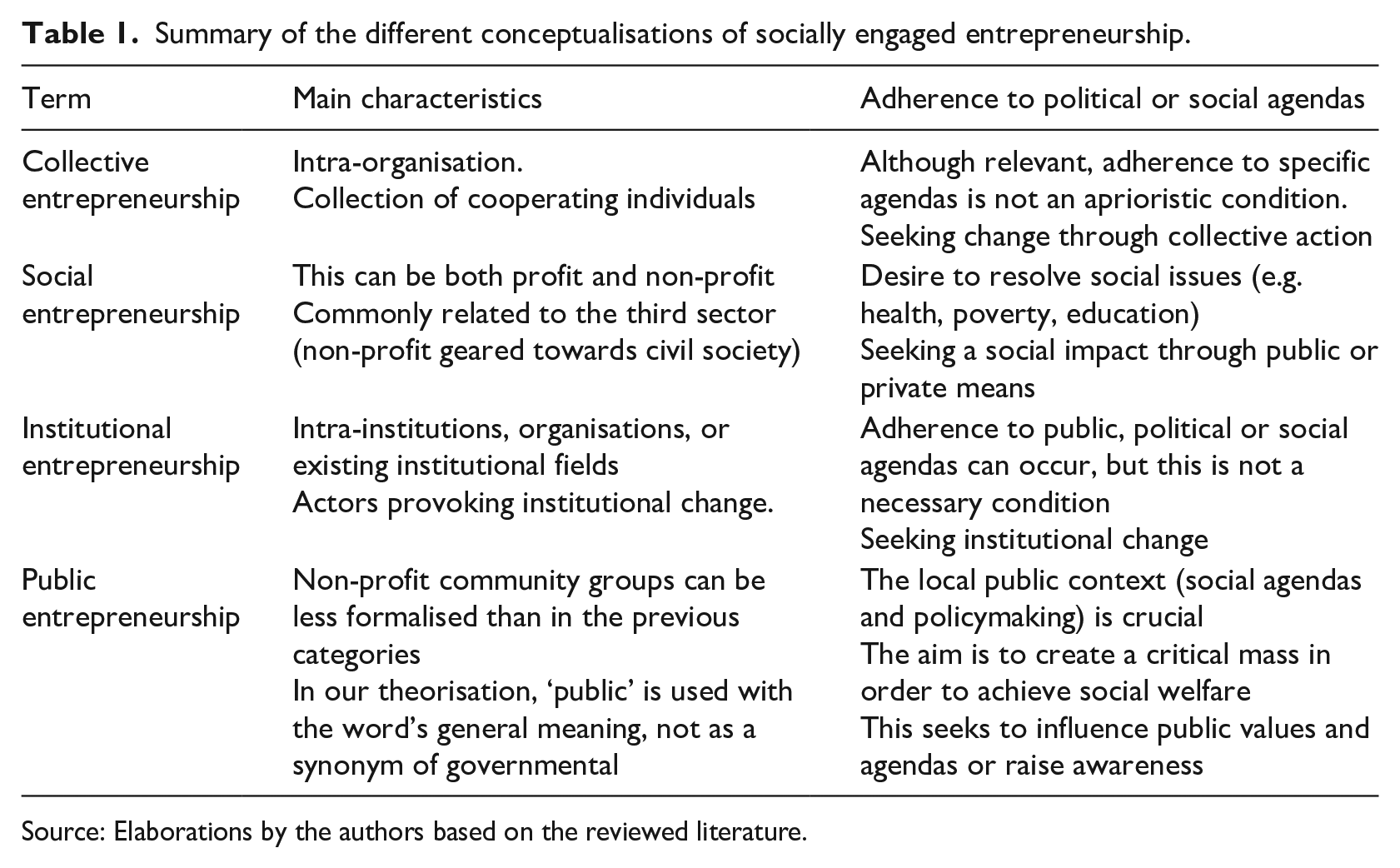
Source: Elaborations by the authors based on the reviewed literature.
Public entrepreneurship in the establishment of artist collectives
In this section, we link public entrepreneurship to the arts and culture, since this is the language used by our participants to convey their social demands and engage with the public. Art and culture are understood here as a unique language. The ephemeral, symbolic and aesthetic qualities of art and cultural creations (Caves, 2000; Throsby, 2013) mean that any social transformation communicated in this way tends to be both ephemeral and symbolic. Consequently, it seeks to attract attention and encourage reflexivity, as well as achieve less concrete policymaking outcomes. Societal cultivation finds a fruitful space within artistic and cultural domains, particularly when artists perfect their craft to portray social transformation in their work (Beyes, 2015a, 2009). The shaping of cities and urban landscapes via artistic and cultural projects is not a new concept, and some scholars have addressed their impact on urban policies, tourism and local economies (Cerisola, 2019; Markusen and Gadwa, 2010; Miles and Paddison, 2005; Sacco and Segre, 2009; Throsby, 2013).
Beyond the paradigm of the so-called creative cities, whose connection with gentrification is self-evident (Ley, 2003), arts and culture offer a privileged scope of action in the public arena (Beyes, 2015a). As such, when the arts meet public entrepreneurship, citizens can better reflect upon their social struggles and potentially channel art towards achieving compelling societal change (Courage and McKeown, 2020; Raunig, 2007; Thompson, 2012). It is acknowledged in the literature that culture produces social change (Bradley and Esche, 2007). Accordingly, if public entrepreneurship represents a form of strategic action for achieving such transformation, scholars are able empirically to observe artistic and cultural projects that have socio-political effects within the public arena. The artists who act as public entrepreneurs can incorporate a critical component of this in their craft, in doing so making public entrepreneurship a phenomenon rooted in the desire for institutional change. This has become even more evident with the criticisms directed at the so-called creative class (Florida, 2003), where artists are seen as being ‘instrumental for boosting a city’s image, attracting the so-called “creative class,” staging spectacles, upgrading deteriorated neighbourhoods, and even mending the social bond’ (Beyes, 2015a: 446).
Artist communities are essential for provoking or raising awareness of urban and social change (Murzyn-Kuppisz and Działek, 2017). They have recently become even more prominent, especially when they refuse to adopt the role of complicit gentrifiers that is often attributed to them by politicians and policymakers (Zilberstein, 2019). Naturally context-specific, artists have put themselves and their activities at the heart of local public debates. Such endeavours have been termed as artivism (Lee and Han, 2020; Zebracki, 2020), and grassroots art organisations develop ‘alliances and infrastructure to sustain their alternative meanings of urbanism that connected them to the broader neighbourhood and political economy’ (Zilberstein, 2019: 1155). Kaddar et al. (2020) have investigated the relationship between artists and urban politics and identified five types of urban artists based on their degree of civic participation, political contestation and efficacy: autonomous, social activists, political artists, political activists and high-status artists. Except for the first category, which accounted for only a small part of the sample in their study, the artists tended to perceive themselves as either socially or politically engaged and set their goals accordingly. Our research for this article draws on this framework and attempts to demonstrate how art collectives play a public role in the local environment via their artistic practices.
Methodology
This article addresses the research question: How do artists become public entrepreneurs? To this end, we employed a single case study centred on the cultural milieu of Venice, Italy. This methodology was adopted due to its capacity to enable a deep examination of a specific phenomenon (Farquhar, 2012). This aligns with our goal of acquiring novel insights into art communities in our chosen setting, which is recognised in the literature as a hyper-touristic city experiencing ever-increasing depopulation, the privatisation of services and an exploitative local economy (Russo and Sans, 2009; Salerno, 2020). Our study utilised a qualitative strategy in the form of in-depth interviews. This enabled us to embrace an interpretive approach through which it was possible to explore the participants’ understandings, goals and perceptions concerning the focal phenomenon (Given, 2008).
The case study is based on a mapping and thematic examination of the art collectives in Venice dedicated to designing urban interventions with a local impact (Morea and Sabatini, 2023). This mirrors Beyes’ (2015a; 2015b) depiction of public-entrepreneurship initiatives. This first part of our fieldwork took place between September 2020 and February 2021 and comprised of direct observations, snowball-sampling interviews and thematic analyses (Saldaña, 2016). This work provided us with an up-to-date, annotated map of 28 socially engaged art collectives that are currently active in Venice’s cultural and artistic domains. We defined a collective as being one of a variety of initiatives in which artists and cultural practitioners join forces in collective action to pursue a common objective independent of their legal entity (see Table 2). These participants are mostly third-sector organisations and, in a few cases, informal community groups linked to grassroots social movements (cf. Castells, 1983). Even though this collection of organisations was heterogeneous, they were nonetheless linked via a unifying thread in relation to the arts and cultural events. In particular, they comprised groups of visual and performing artists, independent cultural spaces, artist networks, cultural circuits, artisans, activists and centri sociali. 3 Most interact within a close association of cultural initiatives that are often characterised as informal, grassroots and grounded in Venice’s most pressing challenges. We identified and contacted 28 organisations via email, phone calls or online social networks based on information available publicly. Eleven of these organisations agreed to make at least one individual available for interview, representing 39% of the mapped population.
List of the art collectives making members available for interview, their location and main activities.
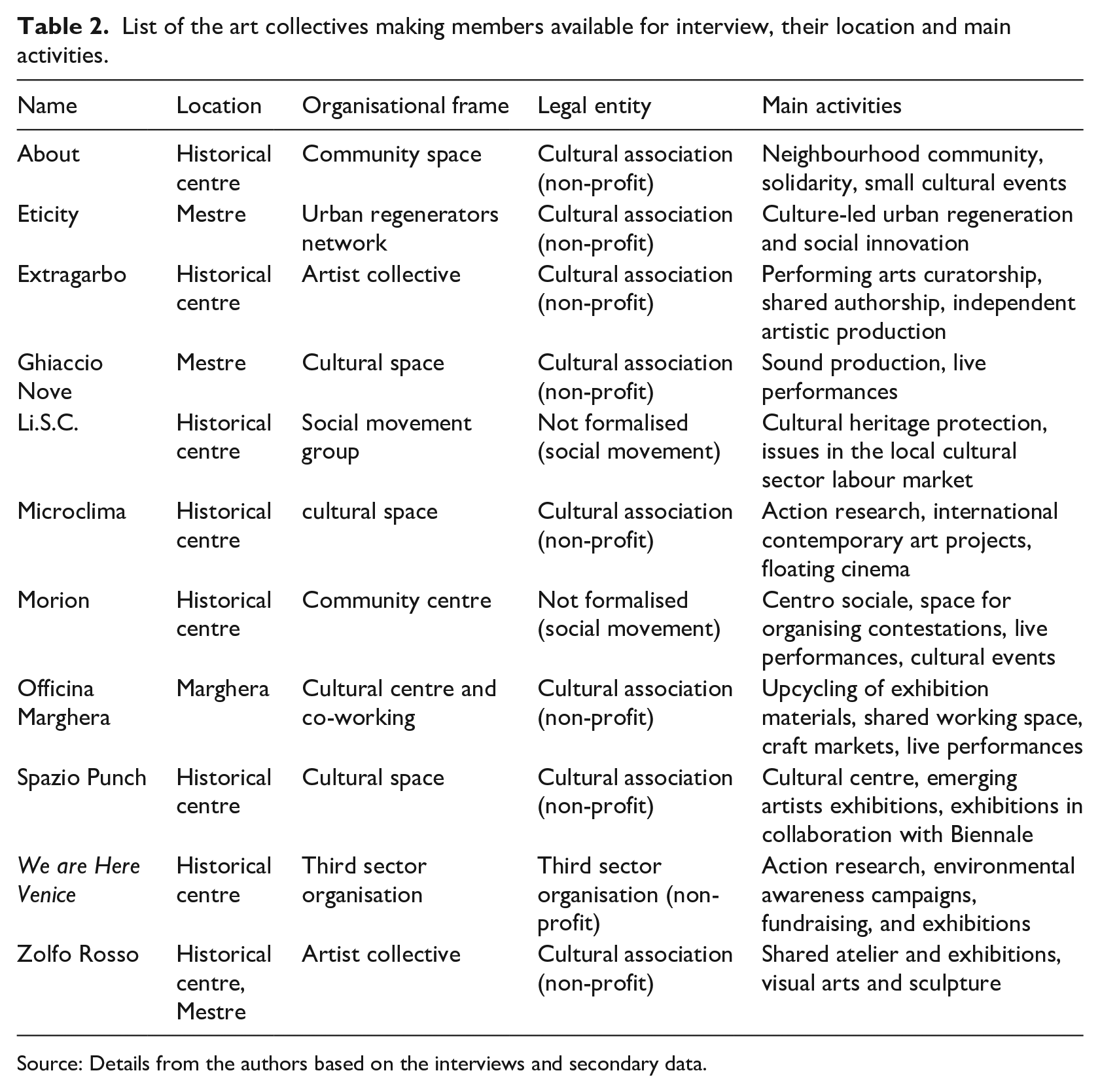
Source: Details from the authors based on the interviews and secondary data.
The collective members interviewed are representative of the actors in the larger ecology of the 28 organisations initially mapped. In particular, they encompass: performing and visual artists (Extra Garbo, Zolfo Rosso), sound artists (Ghiaccio Nove), craftsmen (Officina Marghera), contemporary art spaces (Spazio Punch, Microclima), centri sociali and movements (Lisc, Morion), community centres (About) and urban regeneration practitioners (Eticity). Many of these organisations work in collaboration with established institutions like the Biennale, Fondazione Bevilacqua La Masa, 4 Fondazione Pinault, 5 local universities and the municipality, as well as with other middle ground (Cohendet et al., 2011) activist groups and associations. Most of those interviewed are based in historical or industrial archaeology buildings, for example, Spazio Punch is located in an old liquor factory on Giudecca Island, Microclima operates in the formerly neglected historical building Serra dei Giardini and Officina Marghera and Ghiaccio Nove work from the industrial site of Marghera, where they perceive and contrast neglect and incipient gentrification.
Our interviews were conducted via Microsoft Teams or in person, depending on the preferences of the participants. In most cases, these sessions involved more than one individual, which encouraged a participatory dialogue whereby the interviewees discussed their local realities and meaning-making experiences (Geertz, 1973). In order to respect the characteristics of the art collectives and the interviewees’ preferences, they are treated as collective organisations, 6 meaning that all the quotations in this article are reflective of the organisations rather than their representatives. The average length of the interviews was 60 minutes and they touched on the following topics: (1) the reasons behind their activities, (2) their relationship with Venice, (3) the contribution they make to the city as artists preoccupied with social challenges, (4) their views on how Venice should change and how they aim to realise such goals, (5) possible tensions between public entrepreneurship and institutional blockages, as well as their relationships with other institutions, (6) the meaning-making of working towards a common good in Venice and (7) the provenance of the members. The quotes below are unchanged from the original wording used by the interviewees, but we have translated them from Italian into English. We have included the most representative of these comments to illustrate the meaning-making perspective of public entrepreneurship and how the collectives articulate their goals of improving the urban environment.
Our methodology was particularly suited to studying informal collectives in Venice for two reasons. First, the interview sessions enabled us to both obtain wide-ranging information concerning the visions and practices of the interviewees’ organisations and approach these topics constructively. Second, the interviews were valued by the participants as an opportunity for them to reflect on their practices and gave them a short-term reward. The transcripts of each interview were processed through Atlas.TI 9.1.3 for mac, with 480 codes obtained in the first coding phase. The second phase then involved grouping these codes into six high-level categories (Saldaña, 2016) that reflected the various issues raised during the interviews: (1) motivations, (2) modus operandi, (3) organisational aspects, (4) the ideal of a better Venice, (5) the city’s problems and (6) the relationship with peers and established institutions. Finally, these categories were synthesised to develop three main thematic strands that trace how the Venetian art collectives became public entrepreneurs. After an overview of the context of the case study, the following three themes are discussed: (1) local rootedness is shaped by gentrification challenges and the search for a city for everyone, (2) core values are translated into artistic proposals that address local demands and institutional voids and (3) the alignment of their private goals with a public service ethos.
The context of the case study: Venetian art collectives
Venice is a large city in northeast Italy, 7 with its unique morphology making it one of the world’s most famous and replicated landscapes. Its city centre is built on a lagoon and is classified as an island or, more precisely, an archipelago. The much more modern and less picturesque suburb of Mestre and the industrial area of Marghera are located on the mainland. Although geographically and demographically heterogeneous, the islands and the mainland form a single municipality. Venice and its lagoon have been on the UNESCO world heritage list since 1987, but tourism there has a much longer history, dating from the 18th century onwards. Visitor numbers throughout this period have increasingly become very high. The city is now an over-tourism icon (Visentin and Bertocchi, 2019) that only experienced a reduction in these levels because of the closures imposed during the COVID-19 pandemic (Rosin and Gombault, 2021). There were around two million visitors to the historical city centre in the 1970s, rising to an estimated 25 million in 2019 (Città di Venezia, 2020). This touristification process has been associated not only with a steady decrease in the local population but has also had social and economic consequences arising from a reduced demand for anything but related touristic services. This has caused tensions because of the overexploitation of the city. In the period between 2000 and 2019, the number of residents in the historical centre fell from 76,007 to 59,570, whereas the accommodation available for tourists rose from 14,248 to 53,373 (Rosin and Gombault, 2021). Touristic development has recently been extended to Mestre and the small island in the lagoon, which is being sold to private investors and turned into luxury resorts. In line with the typical main characteristics and consequences of gentrification (Mitchell, 2018), Venice is experiencing consistent issues with policymaking and attempting to balance local demands with an influx of international tourists. In an effort to regulate these tourist flows, it is likely that a highly contested toll will be imposed on visitors to gain access to the historical centre. The city’s unsustainable circumstances, experienced predominantly in this historical centre, are not taken seriously by local administrators, with residents often holding public demonstrations to convey their dissatisfaction. The representatives of the art collectives interviewed for this article are experiencing the same problems of urban exploitation as cities like Amsterdam, Barcelona, Prague, Dubrovnik and London (Capocchi et al., 2019). Our participants have, however, chosen to take a positive step forward by turning these challenges into inspiration for their creative work, their collectives and their public-entrepreneurship activities.
As well as being a heritage city, Venice is also an icon for contemporary art. The historical centre has been the host since 1895 of the extremely popular Biennale of Art and Architecture, which has held prestigious exhibitions and events in the fields of contemporary visual art, architecture, cinema, theatre, dance and music. Beyond its cultural institutions, private philanthropists also find a home in the city for their projects and private collections, with examples including the Peggy Guggenheim Collection and the Pinault, VAC and Anish Kapoor foundations. Venice thus, has a distinctive artistic landscape that is also enriched by its hosting of both one university, Iuav, which is dedicated exclusively to providing an education on the arts and architecture, and an art academy and a music conservatory. 8 The scene described illustrates the great extent to which art is incorporated within the city’s landscape, which is to the benefit of citizens as they forge their own versions of art collectives. The collectives investigated herein operate outside the formal artistic system; instead, they consist of grassroots creatives working collectively, with a core mission of demonstrating that a grassroots perspective is crucial for urban sustainability.
Findings: Bridging internal practices towards the public sphere
The art collective interviewees in this article painted a comprehensive picture of their art practices within the local landscape. They positioned themselves at the intersection between political, economic and social transformation, being grounded on informality and activism. The so-called art worlds typically have high levels of informality in their labour structures and organisational forms. To some extent, these groups represent the age-old desire of artists to intervene in the social and political world using their own, albeit often limited, tools to provoke change. In engaging with social problems through their artistic work, collectives such as these are situated in a city in an attempt to improve its policymaking on building a better urban environment for residents. The pressing issues for our interviewees encompassed a variety of local challenges that range from safeguarding the historical parts of the city in order to prevent private encroachment into historical buildings and excessive touristification, to housing and the broader environmental defence of the Venetian lagoon. Table 2 provides a detailed overview of the activities, organisational framework and locations where the collectives herein are active. These groups represent how activist entrepreneurship in relation to a public agenda creates a new type of entrepreneur dedicated to having an impact in the public sphere via a specific craft, that is, the arts.
Our results revealed three themes that trace how our art collectives became public entrepreneurs. The first demonstrates that they are the result of collective action that establishes an entrepreneurial practice with a view to achieving social change. These collectives are deeply enmeshed in the local scene and simultaneously try to shape, and are shaped by, the city. The second theme relates to how the internal processes of the art collectives transitioned into a civic agenda, demonstrating the values, meanings and shared understandings employed to bridge the gap with the broader urban landscape. Their ultimate goal is to use their artistic activities to improve Venice. The third theme illustrates the unconventional ways adopted by some collectives to implement change that goes beyond their own activities; in particular, they apply their modus operandi and substantive rationality to established cultural institutions and, in doing so, have a broader impact that contributes to the realisation or, at the very least, the initiation of change.
A raison d’être Grounded in the local scene
The artists, practitioners and activists described in this article share a common essence: their deep roots in the local scene. Their motivations for forming collectives are shaped by the environment of Venice and are characterised by a robust artistic vocation, as well as by the rampant gentrification and depopulation being experienced. In fact, in most cases, the members of the collectives received a formal education in Venice, although most were not born in the city. Typically, they are art practitioners or activists seeking to protect the local heritage, but they are also residents in a city full of contradictions that they want to improve through their work. These organisations developed because working in a collective has an intrinsic value to artists and artisans
9
(Becker, 2012). In line with this, our participants described working together and exchanging ideas as crucial, as is providing a specific environment for local artists. Working together facilitates creativity and alleviates uncertainty, both of which are tackled, and even exploited (Stark, 2009), using entrepreneurial tools. In some cases, our artists formed a collective to share networks, reduce transaction costs and acquire a structure with which to gain external recognition, enable collaborations with local authorities or acquire funds. These reasons for their collective approach are characteristic of the cultural and creative industries in general (Caves, 2000). Nonetheless, there is more to it in our case of Venice: their raison d’être appears to have deep roots in the local tensions caused by mass tourism, the heritage city status, poor economic vitality and the consequent ‘chronic shortage of spaces for self-organised activities, from live music to meetings, from group meetings, to book presentations, to children’s workshops’ (About). These groups, thus, come together because of both standard entrepreneurial convenience and cultural production goals. However, their actions are shaped by the specific constraints of the local context. On the one hand, we see how the local scene shapes the identity of the artistic ventures. In this regard, an interviewee from a visual arts collective based in both the historical centre and Mestre stated: We are resilient in this city. (. . .) Due to living costs, it is tough to settle in Venice, and it is certainly not possible to take such a career step alone. Instead, in a group, it was possible to do it, and it is still possible for us to continue doing it’ (Zolfo Rosso).
On the other hand, they sometimes set their goals as art professionals in order to close what they regard as the gaps in the city’s cultural life: (The organisation) was conceived as a place different from the sterile pavilions that only exhibit ‘something;’ instead, we [the founders] wanted to create a place in which one could do all the things one normally could not in a traditional exhibition space, such as going there with no opening hours, not paying for a ticket, finding an ‘atmosphere’ (Microclima).
The collectives emerged in response to the local environment, pursuing projects aligned with pro-social purposes. Microclima, for example, is situated in a municipality-owned historical greenhouse with former links to Biennale exhibitions. Its outputs involve developing projects that reshape the cultural experience and innovate in relation to what the Biennale can offer. The groups whose activism is more prominent, such as We Are Here Venice, Lisc, Morion, About and Eticity, are especially local, since the reasoning for their creation arose from protecting the lagoon and its architectural and cultural heritage, as well as from a desire to safeguard the social fabric at the neighbourhood level. These collectives, whose members defined themselves as artists, curators or exhibition organisers, for example, Zolfo Rosso, Extragarbo, Ghiaccio Nove, Officina Marghera, Spazio Punch and Microclima, consistently locate their work in relation to the local artistic scene.
In all the cases, albeit to different extents, the collectives engage with and try to offer solutions to problems that not only pertain to the status of artists or cultural practitioners but also to the challenges facing the entire Venetian community. As a result, they come together and develop an entrepreneurial initiative for an opportunity they can exploit that goes beyond a gap in supply and demand. The cultural space About, for example, was established because a group of new graduates attempted to combine the prospect of working as urban planners in Venice with the social engagement they valued: ‘The idea [was] to find a space that could create an income for us, but also having a social part [to work with]’ (About). Such a prominent social drive led to a discussion regarding the values pursued by these artists and cultural practitioners that gave them the artivist epithet. As in a more typical entrepreneurial process, the collectives identify and seek to close gaps in the local cultural economy, public infrastructure and policy. However, instead of taking the opportunity to create a profitable social entrepreneurial venture, such collectives are public in their desire to improve the experience of being a citizen in Venice. This approach aligns with the established definitions of public entrepreneurship (Aligica, 2019; Hjorth, 2013), that is, improving the local community concerns the negotiation of individual and collective values at the same time (Aligica et al., 2019). The Venetian art collectives, nevertheless, take a pragmatic view when it comes to closing the identified gaps, given the exploitative urban environment.
Values and Goals for Societal Change
The first theme demonstrates a common feature of the collectives: a locally grounded raison d’être, with their strong local ties meaning that their goals and values are expressed within their city. They share a common vision of how to enhance Venice and their activities seek to achieve that goal. Their values derive from local tensions (see section ‘A raison d’être grounded in the local scene’), but what makes them entrepreneurial is the aspiration to extend them to the public domain, with artistic projects, exhibitions, cultural initiatives, fundraising campaigns and demonstrations conceived to shape their city according to their ideals. The art collectives in Venice share a moral drive ascribable to achieving a more sustainable life in the city. Simultaneously, they function within an inspired civic order of worth (Boltanski and Thevenot, 1991), which is justification for their position of operating in the public sphere. Often, the collectives’ activities can be described as niche and microscopic in scale, with examples being intimate exhibitions or book presentations. At other times, they have participated in the local public discourse by getting involved in more significant activities, including a one-week event called Venice Art Week or politicised acts like public protests. In all instances, the groups try to resolve the tensions in the city through contestation and counterculture.
The goal of organisations like About, Morion and Lisc is antagonistic, with their primary commitment to activism concerning societal and local challenges. These encompass issues such as housing and working conditions in Venice in the face of the intense touristification, environmental crisis, civic role of the city’s universities and engagement with cultural events and artistic production. This reflects other occupations of cultural institutions experienced in Italy (see Borchi, 2020). In Venice, such collectives are linked to local social movements and, as well as participating in demonstrations, their members manage social or community centres where concerts, book presentations, residencies and intellectual debates are held. We Are Here Venice and Eticity have a strong focus on environmental concerns and social innovation, which they tackle through urban and cultural practices: ‘The idea is precisely to find when something is missing that could make people live better in a certain area or city; we try to define what it is and find the means to ensure that this thing is restored’ (We Are Here Venice). This can be seen in an example from 2019, when the collective helped with the Korean Pavilion at the Biennale, the Tide Forecast and Warning Centre of Venice and raised funds to replace a tidal gauge in the Misericordia neighbourhood. 10 We Are Here Venice values the local embeddedness of its work, which promotes change while also being part of the social fabric. Its practices are defined based on clear ideas about a more liveable Venice: ‘I think that two phenomena, let us call them: that of residents and that of tourist turnout, inevitably influence each other; (. . .) and a city in which there are [a lot of] residents is much more sustainable’ (We Are Here Venice). For Eticity, contributing to the local landscape entails ‘knowing what it means to work in the city, to relate with the public space and to care about places and people, and the relations thereof’ (Eticity). In fact, Eticity members conceived the collective as an urban mediator, in line with the definition of a public entrepreneur as a facilitator of the relationships between grassroots organisations and the public agenda (Aligica, 2019; Hjorth, 2013). In 2018, Eticity became a focal point in local communities when it helped to bring a neglected movie theatre in Mestre back to life with a festival and a street art contest. By supporting otherwise unsupported projects (Eticity) and helping local communities in the neighbourhood (the elderly, young people and first- and second-generation immigrants), the collectives ensure that their challenges, as well as those of residents, are heard by local administrators in the context of regeneration projects.
Collectives that focus mainly on artistic and cultural production, for example, theatre, urban art, visual arts, sound design, craftsmanship and fashion, react primarily to the local art worlds. They project their poetics in order to make Venice a better place for both artists and audiences, thus going further than the tenet of art for art’s sake. They similarly strive to achieve a better urban environment, which would also be of benefit to their careers as artists. In doing so, they are attempting to close the voids in the cultural and social lives of the place where they live. In this regard, Zolfo Rosso maintains that Venice lacks a middlebrow
11
form of cultural production, which is what it therefore tries to provide: I want affordable liveability and opportunities for us [i.e., artists] and other citizens. Not just high culture, for example, that of the famous events Biennale, Palazzo Grassi and Venetian museums that only superstar artists can access. There is so much more to it in other cities like Turin, Milan and Bologna that in Venice is missing, that is middle culture, as in exhibits accessible to all those who like music, culture and arts (Zolfo Rosso).
Nonetheless, in the opinion of the Zolfo Rosso interviewees, this struggle is a call for action by local policymakers, which is beyond the scope of what they can achieve: ‘There should be more space and funds to let [middlebrow] cultural practices be born and thrive in Venice’ (Zolfo Rosso). This collective’s members are locally trained artists who regularly tailor their artistic practices, for example, arranging exhibitions, based on the environment they wish to create, often in collaboration with other collectives. A vibrant artistic buzz is a great way to attract aspiring and emerging actors and is a crucial factor in the gentrification process (see Currid-Halkett, 2020). Instead of replicating the typical artist dynamic of moving to neglected, cheaper locations (Rich, 2019), they take on the challenge of initiating the very change they want to see in Venice and, in doing so, try to provide the city with an underbrush artistic proposition. The quest for a more inclusive art scene reflects a shared vision. As the interviewee from the music and sound design collective Ghiaccio Nove explained: ‘We organise cultural events of a decent level [of artistic quality], but not necessarily priced at 40 Euros per ticket. We work with less to be able to keep a low, inclusive price’ (Ghiaccio Nove). The same organisation also has a desire to engage socially and more directly in the city: ‘Before the pandemic, we had planned an event of urban regeneration right in the area surrounding Ghiaccio Nove, because the neighbourhood is a bit neglected as it is now’ (Ghiaccio Nove). This sense of belonging is a reason for engaging in artistic and cultural activities. The importance of adding to the social and cultural inclusiveness of the local area is deeply understood and valued, especially by the collectives located on the mainland, for example, the maker space Officina Marghera: It is important to be here. The fact that there is a space like ours here that makes events and that can be crossed and is inclusive, and the fact that it is in a very marginal area (. . .), this is just extra important, and I honestly would not see Officina Marghera anywhere else (Officina Marghera).
To some extent, the actions of these collectives are tackling local public problems from all sides: they are willing to pursue a career in an unwelcoming city instead of moving away, as most people do; simultaneously, arising from their locally rooted internal logic, their working practices are adapted to a pro-social quest for a more sustainable lifestyle, that is, a city with less tourism and more opportunities for residents. Venetian artivists do not, however, simply get together because they are concerned about a local dimension. Indeed, while civic values emerge unambiguously from the collectives’ activities, with their business-as-usual approach necessarily being one that engages actively and collectively in the betterment of their art worlds and the liveability of their city, their modus operandi tends towards encompassing the contradictions they would prefer did not exist in Venice. We do not know if the sought after changes will become a widespread reality, but an entrepreneurial intent is the starting point. However, the success or failure of our collectives at changing the public agenda is beyond the scope of this article.
Private acting for public purposes: Tapping into the contradictions of the city
The art collectives in Venice find their purpose and vision for improving the city via the actions they undertake within the local context. This approach is more evident in some instances than others, especially when the collectives actively involve other institutions and organisations, which will be explored further in this third theme.
The arts are not an isolated practice. Indeed, even when there is a private purpose, art has a public benefit that permeates society in terms of education and knowledge (Abbing, 2008). In Venice, artistic activities and practices have a public purpose geared towards contributing to the public domain, as occurs in public entrepreneurship (see Table 1). The art collectives often interact with established local institutions and, in doing so, seek to realise a more sustainable urban life (see section ‘Values and goals for societal change’). Spazio Punch, Microclima and We are Here Venice, for example, have recurring collaborations with the Biennale and its national pavilions; Officina Marghera’s main activity is recycling the Biennale’s exhibition materials, producing more environmentally friendly contemporary art as a result; Extragarbo was first launched with the support of its alma mater 12 and has carried out projects in collaboration with local cultural institutions like the Pinault Foundation and the Goethe Institute; finally, in an attempt to provide a fertile environment for art and design students in the city, Spazio Punch regularly hosts design graduates’ exhibitions and shows.
What is peculiar is that these collectives use their relationships with the established institutions in ways that helps their transformative ideals but, simultaneously, conflict with the attitudes of these partner organisations. So, while institutions like the Biennale are the focus of their criticisms (e.g. Zolfo Rosso laments that the Biennale does not look at local emerging artists and Officina Marghera opposes the unsustainability of their production processes), these collectives nevertheless find ways to accommodate them. Our participants interpret this modus operandi as hacking, that is, a way to use private relationships for public purposes. Commenting on a recent workshop – ‘Tools for Future Artists in Emergency’ 13 – hosted at the premises of the Pinault Foundation, the interviewees from Extragarbo explained that collaborations with highbrow institutions can attract criticism from those in their circles. Nonetheless, such views are not supported, with attempts instead made to ‘go beyond the binary public/private [because] one cannot succeed if [one] only says ‘I am not talking with the private sector because they are “evil,” but I [also] do not talk to the public sector either because they have no money’. We try to trigger such “inside hacking” [by] operating with private and public operators [and] keeping our integrity’ (Extragarbo). The contradiction referred to concerns the private/public binaries, which are relevant to cultural production and cultural policy to the extent that private is generally associated with a market logic and public with the provision of public goods and, thus, support for artists. 14
Furthermore, beyond their private, intrinsic motivations for creating art and being an artist, our collectives also position themselves in relation to high-end art institutions as critic interlocutors. In response to the lack of opportunities for young artists in the city, Extragarbo, for example, has found that the Pinault Foundation ‘is very interested in creating the possibility of finding times and spaces of common production for the independent Venetian performing arts sector’ (Extragarbo). This demonstrates that grassroots art organisations are welcomed into established institutions and then hack them once inside, suggesting that there may be a fertile environment for change in Venice. However, the extent of the presence of public entrepreneurs like our interviewees who are able to initiate such change is possibly limited. Another example of hacking logic can be seen in the case of Spazio Punch, which has ongoing partnerships with the Biennale which grant the collective the financial independence to develop more cutting-edge projects: ‘The idea I aspire to is to be able to sustain the space, the project, through the rent, and having the most independent life possible, meaning that every time we could [the two co-founders] we did joint projects with Biennale that allowed us to support financially other projects’ (Spazio Punch). As an exhibition space for emerging artists, the members of Spazio Punch seem to have a clear understanding of the ways in which creativity develops. They are committed to providing young artists with a free space where they can create, since it is through openness that critical views and positive impacts emerge. Venice currently has no such space, and so this is one way for these collectives to move towards achieving a public entrepreneurial outcome. That Venice is a very artistic city makes Spazio Punch’s founder very critical of the traditional cultural policy instruments: There are individuals, the creatives in the city, who infuse the local institutions with a wealth of creativity. (. . .) As a space, our goal is to support this by first providing visibility, then offering the physical space, and third, communicating the projects without unnecessary interference. (. . .) Those who become part of Spazio Punch become an integral part of an organism. This is why we struggle to keep up with public calls and similar processes. These tools can be a nightmare: administrators often aim for green spaces or revived peripheries and end up funding very artificial projects, whose outcomes are challenging to realise. Instead, there should be intelligent individuals who, similar to biologists rather than mere cultural operators, are capable of detecting where the buzz is, understanding when something is happening and evaluating the situations (Spazio Punch).
The collectives examined in this article adopt a critical stance towards specific policymaking tools, for example, public calls, and instead suggest alternative ways to provide public support based on capturing emerging practices without causing them. Nevertheless, they also understand that this has some limitations. The art collectives in Venice are moving towards making their artistic work available to the city. They are becoming public entrepreneurs, tapping into local contradictions and trying to provide what they regard as missing from the local cultural and social scene. However, their work is isolated and some way from bringing about institutional transformation. Consequently, it is for policymakers to create sustainable change at the urban level.
Discussion
The public entrepreneurship collectives investigated for this article are committed to actively partaking in Venice’s cultural and social life. To this end, they contribute both discursively and materially, even if they do not achieve institutional change. In general terms, the key aim of artists is often to fill a gap in the approach of policymakers to meeting social challenges. This is well-documented in the literature on art and social innovation (Coenen, 2023), critical urban artists (Kaddar et al., 2020), grassroots artists and political imagination (Zilberstein, 2019), and art activism (Murzyn-Kupisz and Działek, 2017). In our case, however, this phenomenon appears to be associated with the contradictions of a city that simultaneously attracts and rebuffs local residents and emerging artists. Nonetheless, as is typical of entrepreneurship, there exists a desire to exploit an existing gap for their own ends. Through their artistic projects, Venice’s art collectives engage both with and against local institutions, for example, private art foundations. In material terms, these collectives have many tools in their arsenal to affect the local context: protesting, recycling, event-making, helping raise funds for local initiatives and lowering the cost of artistic programmes. In discursive terms, the collectives want to achieve a goal of making Venice a more open city with a middle-ground cultural scene, as well as a city where it is realistic for local people to reside. By definition, these goals represent local demands and the public’s desires, rather than seeking a systematic way to engage with policymaking and state-based agendas. We regard this modus operandi to be an intermediary role, since the collectives’ language, actions, initiatives and practices are not institutionalised enough or incorporated within the spheres where urban policy is made. In this sense, the public entrepreneurship modus operandi observed is limited – while our participants are public entrepreneurs, they lack the capacity to translate their demands into the language of a domain where policy is made. Nonetheless, the spontaneity, awareness and reflexivity employed by the collectives to mediate diverse demands for a more liveable city is slightly more coordinated than is typical of the ‘underground’ scene.
Although our data hint at institutional change, in reality they do not document that this actually occurs; instead, the collectives are really only scratching the surface and making proposals for interventions in the public sphere. Nonetheless, our results do point to an ongoing process. The act of becoming a public entrepreneur may ignite an actual change by mediating institutional voids. It is relevant to note that established institutions are not necessarily opposed to the initiatives described, as short-term collaborations often occur, from which community entrepreneurs can emerge. On the one hand, this demonstrates openness and an acknowledgement of differences by the established institutions, but on the other it shows that such actions may not be as disruptive or change-making as anticipated. Indeed, if these actors and their activities are particularly disruptive, greater resistance might be expected; alternatively, of course, upending existing institutional arrangements could be the outcome. Nonetheless, the impact of such an approach by our collectives is limited for reasons that include the artistic language employed rather than that of policy, lobbying and organised advocacy for the betterment of the local social context. Moreover, given the myriad of actions undertaken by the collectives, their initiatives can be viewed as less systematic than those initiated by institutional entrepreneurs acting within state-based domains to produce policy. These actions are also less systematic than the interplays of private actors in typical markets and, to some extent, more spontaneous than those of standard third sector organisations with clear strategic aims. It became clear from our interviewees that they can change the scope of their activities relatively quickly, demonstrating that the grassroots characteristics of their modus operandi are more important than the institutional change they seek. The act of becoming a public entrepreneur thus means that the collectives examined herein are in the process of turning their private agendas into public versions and acting locally through the language of arts and culture. We, therefore, contend that these Venetian art collectives constitute a spontaneous order of public entrepreneurs acting to improve welfare based on a heterarchy of values (Dekker and Kuchař, 2021). This is achieved with many small acts. The language they use to transmit such values (related to arts and aesthetics, but also political and social imagination) and grassroots demands (acting as mediators for local citizens) nevertheless means that the next step is unclear and often unattainable. In this sense, we argue that our case reflects a kind of intermediary public entrepreneur that conducts public acts for private reasons by negotiating local demands.
Figure 1 employs black continuous lines to depict these dynamics by showing the actions undertaken by public entrepreneurs with a focus on mediating grassroots demands. The dashed lines represent the types of activities that are normally unachievable for art collectives such as our participants, as they would require more systematic action than is possible with grassroots, ephemeral, art-based initiatives. Our entrepreneurs remain somewhat restricted to making a discursive contribution to the mediation of local demands. In doing so, they are seeking to fill specific institutional gaps (e.g. focusing on locals, rather than heritage-led touristic exploitation), but not by clearly and systematically reaching out to established policymaking actors, government institutions or changemakers in the upper sphere. Our actors are not institutional changemakers; they seek to upset institutional arrangements by mediating local demands and creating sporadic and unsystematic cultural projects. The next logical step (dashed lines) is not within their reach. In our cases, the public entrepreneurs organise private demands in a public manner (e.g. improving the local environment for residents and local artists, contrary to the current emphasis on tourists and high-end art) and mediate links between individuals and collectives. However, no significant institutional change comes about as a result. To channel such demands into upper policy spheres, that is, public or private established institutions, our public entrepreneurs would need to be more systematic in advocating for change and in a language that goes beyond only art or creative expressions. In other words, they would have to articulate the language of policy, lobbying, advocacy and organised institutional entrepreneurship. Without this, the void that exists in relation to unmet social demands will remain relatively untouched.
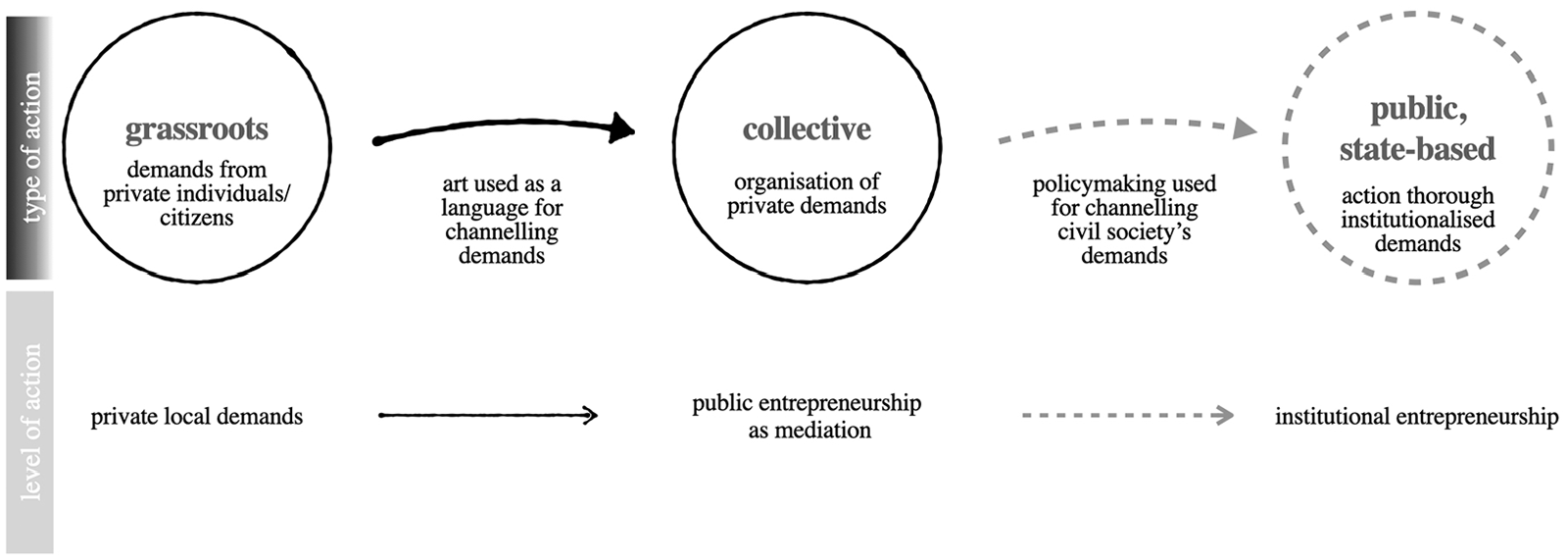
Public entrepreneurship as a collective mediation of private demands.
Venice’s collectives adopt a specific language, the arts, to generate an impact that is more discursive than material. Although Venice is a heritage city with a vibrant artistic scene and activities, accessibility to different societal strata is not a given. The expression of ephemeral, symbolic, spontaneous, and bricoleur (Hjorth, 2013) aspects of public entrepreneurship in the languages of the arts means that the contributions to institutional policymaking achieved may appear to be less relevant – and less anticipated – than the original goal of raising citizens’ awareness and reflexivity about access to the city’s infrastructures.
Conclusion
This research advances the debate in the literature on entrepreneurship. This is achieved using the empirical case of grassroots artists and cultural professionals who become public entrepreneurs when they turn private into public agendas and mediate local demands for a more sustainable urban life. The work also contributes to the literature on contemporary art and its relationship with society. As highlighted by Hjorth (2013), public entrepreneurs commit to improving social welfare and influencing the public agenda. This is especially true for artistic groups that act locally and seek to offer solutions to local tensions via collective action. This topic is overlooked by the entrepreneurship literature and lacks any varied empirical analysis. This is particularly the case for the city level, where local demands encompass both urban and cultural life. The extant literature is thus enriched by our empirical qualitative analysis of the underbrush artistic scene in the cultural city of Venice. Indeed, our findings make a valuable contribution to how best to understand the connection between (public) entrepreneurial activity and the changes anticipated in the institutional environment (understood here as the formal institutional organisations responsible for the top-down management of the urban milieu).
Interview data from 11 art collectives based in Venice enabled us to identify three major thematic strands that illustrate how artists and art practitioners become public entrepreneurs. These collectives form part of a spontaneous order of (mainly aspiring) professionals who resort to collective action to resist the rampant gentrification of an artistic city that is actually not particularly welcoming to artists. The first theme identified that these art collectives are shaped by the local environment and its institutional tensions. Secondly, given their local embeddedness in the needs of civil society, we found that their efforts to shape their city through their practices, artworks, events, protests and campaigns actually have little institutional impact. While their entrepreneurial intentions seek the betterment of Venice, their collective voices are not necessarily heard at the policy level, suggesting an institutional void (Dacin et al., 2010; Estrin et al., 2013) between art collectives and policymaking. Thirdly, the art collectives employ their private activities as creative professionals in the service of a public agenda. To this end, they seek to go beyond just having a presence in the underbrush of Venice’s cultural milieu – often, they collaborate with the established art institutions that are also the object of their socio-economic criticisms. In doing so, they are attempting to instigate institutional change from within. In this way, our subjects act as public entrepreneurs in tackling local dispersed demands by participating in semi-organised initiatives.
Future studies on both artists who act as public entrepreneurs and overlooked art collectives could go beyond the limitations of the present work. Firstly, our research was conducted during the COVID-19 pandemic, which constrained both the outreach capacity of the art collectives and the researchers’ ability to conduct interviews. This stressful period in Italy at the time of the study undoubtedly affected the number of interviewees as well as their extant initiatives. Secondly, the informal and unsystematic nature of art collectives made it challenging to engage with those that are more difficult to reach. Thirdly, more exploratory studies are required. In particular, researchers could actively engage in loco to conduct action studies or produce ethnographies of institutional change. This would extend this strand of research to encompass relatively informal ways of performing public entrepreneurship. Fourthly, future analyses could also consider the impact of art collectives from the perspective of established institutions or in other regions where this type of movement may have a more systematic presence at the policymaking level.
Finally, the study demonstrates how public entrepreneurs can be mediators of a variety of social demands by promoting an anti-gentrification agenda, albeit in the unsystematic ways typical of artmaking practices. Artist collectives are not policymakers and do not possess the knowledge required concerning the mechanisms of institutional change at this level. Nonetheless, this does not disqualify their work as public entrepreneurs. Instead, it opens up a possible avenue of research for another type of urban actor – one in the middle ground between grassroots artistic creation and impact-driven work within institutional contexts.
Footnotes
Funding
The author(s) received no financial support for the research, authorship, and/or publication of this article.
