



Abstract
In our Introduction to this Special Issue on Organizational and Institutional Entrepreneuring, we draw attention to the importance of recognizing how processes and practices of entrepreneuring take place in the context of an already organized world. We particularly draw attention to how such entrepreneuring processes, as imaginative-poetic extensions beyond the present, can occur in a variety of societal, institutional and organizational contexts. Overall we focus on entrepreneuring as the process of creating organization. As a result, we believe that important insights arise by drawing attention to ways of ‘starting’ and ‘actualizing’, rather than conceptualizing entrepreneurship as something that was already ‘started’ in the past. This Special Issue thus helps to provide much-needed scholarship that expands our knowledge base and provides a foundation for future research. We conclude our Introduction with a summary of the articles making up this Special Issue, noting the ways that each article helps to advance our knowledge base about the processes of entrepreneuring.
Introduction
In this Special Issue, we draw attention to the fact that the processes and practices of entrepreneuring take place in the context of an already organized world with its wrinkles, cracks and sediments of previous organization-creation processes. We are particularly interested in how processes of organizational and institutional entrepreneuring, as imaginative-poetic extensions beyond the present, can occur in a variety of societal, institutional and organizational contexts. By taking this focus, we believe that important insights arise by drawing attention to ways of ‘starting’ and ‘actualizing’, rather than conceptualizing entrepreneurship as something that was already ‘started’ in the past. As part of this approach, we see that there is a powerful tension revealed. Entrepreneuring is not only about dreaming of and planning for the future, it is also reliant on and embedded in the current and the past (Cole, 1959, pp. xii–xiii). This tension is critical to understanding processes and practices of both organizational and institutional entrepreneuring, and yet it has so far received insufficient attention. Our Special Issue helps to provide much-needed scholarship that expands our knowledge base and provides a foundation for future research.
We focus on entrepreneuring as the process of creating organization; it is thus constituted by the processes and practices that make new ways of organizing and new organizations come into being. Research to date has only partially engaged with processes of entrepreneuring. It is critical to investigate more deeply how new forms of organizing can be created in an already organized world that is characterized by established ways of doing and thinking. In addition, it is important to investigate how some forms of entrepreneuring may create new organizational and institutional arrangements, and new organized worlds. In this Special Issue we draw attention to where and when such an interesting mixing of entrepreneurial, organizational and societal dynamics can happen. We believe that the set of intriguing papers included here helps to reveal important dynamics associated with this processual view of entrepreneuring.
After an explosion of attention to the concept of entrepreneurship and its broader applicability in the development of organization theory (e.g. Bouchikhi, 1993; DiMaggio, 1988; Katz, 2003; Munir & Phillips, 2005; Shane & Venkataraman, 2000; Venkataraman, 1997), we see that there has been a consolidation into more focused areas. For example, there is research interest in startups or business formation (Aldrich, 1990; Gartner, 1985; Johannisson, 1988), incubators and supportive ecosystems (Isenberg, 2011), regional development (Johannisson & Lindholm Dahlstrand, 2009) and industrial districts (Audretsch, 1995), corporate entrepreneurship (Burgelman, 1983; Zahra, 1996) and strategic management approaches to entrepreneurship inside the organization (Hitt & Ireland, 2000), processual organizational entrepreneurship (Hjorth, 2014), institutional entrepreneurship (Battilana, Leca, & Boxenbaum, 2009; Greenwood & Suddaby, 2006; Garud, Hardy, & Maguire, 2007; Wijen & Ansari, 2007), and cultural entrepreneurship (Acheson, Maule, & Filleul, 1996; DiMaggio, 1982; Lounsbury & Glynn, 2019; Swedberg, 2006).
In particular, attention to organizational, institutional and cultural entrepreneurship has been fundamentally linked to organization studies (Garud et al., 2007; Katz & Gartner, 1988) as important aspects in understanding organizational life. While recognizing problematic relationships, such research has helped to develop theory about what is variably described as a bridge, intersection or overlap between management and entrepreneurship in the context of formal organizations (Baron, Hannan, & Burton, 1999; Stevenson & Gumpert, 1985). Process studies focusing on entrepreneurship at the organizational level (Hjorth, 2014; Hjorth, Holt, & Steyaert, 2015) have tended to downplay divisions between entrepreneurship and organization studies. By defining entrepreneurship as integral to organization-creation, these scholars point to the importance of conceptualizing entrepreneurship processes as being inherently about organizing people and things into loosely coupled systems that direct energy, focus and forces toward making the virtually new actual. Here and throughout this introduction, we draw on Deleuze (1988) in using the idea of ‘virtually’ as a potentiality that has not yet been actualized. For example, by bringing together theory regarding entrepreneurship and social networks, Obstfeld, Ventresca and Fisher (2020) conceptualized entrepreneurs as system-builders, thus drawing attention to how the virtual can become actual in their study of integrated processes and how they can unfold over time. Yet another and early example is Spinosa, Flores and Dreyfus’ (1997) phenomenological-cultural analysis of entrepreneurship as processes and practices of history-making, conceptualized as creating new ways of organizing ourselves, others and things.
In the institutional literature, the concept of entrepreneurship has been presented as a way of understanding purposeful actions of actors who seek to make changes in an already well-established environment (Hardy & Maguire, 2017). This line of research builds on early conceptualizations of institutionalization that provides foundational insights into processes of entrepreneuring in an already organized world. For example, Selznick (1957, p. 17) explained that institutionalization is ‘to infuse with value beyond the technical requirements of the task at hand’. As a result, ‘institutions, whether conceived as groups or practices, may be partly engineered, but they also have a “natural” dimension. They are products of interaction and adaptation; they become the receptacles of group idealism; they are less readily expendable’ (Selznick, 1957, pp. 21–22). Similarly, in developing the idea of institutional entrepreneurship, DiMaggio proposed that new institutions ‘arise when organized actors with sufficient resources see in them an opportunity to realize interests that they value highly’ (Di Maggio, 1988, p. 14). Institutional entrepreneurs, then, are organized actors – with sufficient resources – who identify possibilities for creating and transforming institutions (DiMaggio, 1988).
These early conceptualizations of institutional entrepreneurship hold potential for understanding processes of entrepreneuring in an already organized world at the individual, group, organizational and institutional levels. Building on DiMaggio’s (1988) ideas, further research became divided between more ‘actor-centric’ or ‘process-centric’ approaches (Hardy & Maguire, 2017). Actor-centric accounts tend to focus on an omnipotent or heroic entrepreneur who overcomes significant odds to achieve their goals. In contrast, process-centric accounts tend to emphasize ‘the struggles associated with institutional entrepreneurship activities’ (Hardy & Maguire, 2017, p. 273). Going forward, it is clearly important to bring back together the foci on actors and the processes of entrepreneuring. In focusing on how actors engage in processes and dynamics of change in an already organized world, we set out a way forward that highlights the inter-relationships between what is imagined, the nature of the world within which it is imagined, and how unexpected opportunities, jolts, crises, and characteristics of the world unfold over time.
To better grasp this process of organization-creation, or entrepreneuring, the process of actualizing the virtually new can be conceptualized as assembling. More specifically, an assemblage has been described as a proto-organizational composition or force-field where the parts are held together by desire. Assemblages are passional in this sense – affected by an image of a wanted future, and affecting through sharing this desire (Deleuze & Guattari, 1987). Organizations thus emerge from organization-creation processes that in turn emerge from assemblages. When assemblages are directed more by an interest than desire, we can describe the process as organization-creation, from which organizations entrepreneurially emerge (Hjorth, 2014). Assemblages are composites of parts that are not stable or fixed; these components can be displaced or rearranged with other parts in ways that are viewed as novel (Deleuze & Guattari, 1987). From an organization theory perspective, we can conceptualize assemblages as proto-organizational forms that are held together by the desire for actualizing – through creation and differentiation – thus building new value for stakeholders and the future society more broadly. By theorizing the process of entrepreneuring as one where actors engage in organization-creation in an already organized world, we draw on the concept of assembling as foundational for this Special Issue. As explained in our call for papers, we have brought together research articles on organizational and institutional entrepreneuring that help advance theory by exploring the tensions related to ‘starting up’ and actualizing in a world where many aspects of organizational and social life are already organized.
What then characterizes the ‘already organized’ world? There have been multiple approaches to studying, describing and analysing this concept in the broader field of organization studies. Classical approaches to organization theory have focused on principles of organizing, such as the ethos of the office, bureaucracy, structures, power and culture (Weber, 1922; Chandler, 1962; Williamson, 1975; Selznick, 1949; Schein, 1985) thus highlighting the existing organization and its place within society. Institutional theorists built on these concepts of stability, initially focusing on forces perpetuating the status quo, and later shifting attention to change as well as stability (Scott, 2014). Although most classical organization theorists gave little attention to understanding how organizations were created, Williamson (1975) developed theory to explain why organizations exist, and what function they have in the economy. In particular, he pointed to the importance of creative organization of resources, contracts and partnerships for the reduction of transaction costs. These concepts have subsequently become central to research on organizational entrepreneurship as effectuation (Sarasvathy, 2011) or as bricolage (Baker & Nelson, 2005). Both these conceptualizations focus on entrepreneurial organizing as creative ways of overcoming resource scarcity and transaction costs by building new ventures in lean ways.
These foundational approaches to organizing give glimpses into the nature of the organized world. However, in order to better understand organizational and institutional entrepreneuring, it is critical to focus on how processes and practices of organizing occur, and how actors take action to make them happen. This means that we must attend to practices as ‘embodied, materially mediated arrays of human activity centrally organized around shared practical understanding’ (Schatzki, 2001, p. 2). And we must also attend to process as ontogenesis, development from the earliest stages to maturity, that includes both qualitative transformation and emergence. From a processual perspective, the virtual is similar to the potential or the incipient in describing a differential multiplicity that shadows the actual (Deleuze, 1988). The actualized is the result of a creation process involving selection and delimiting among the multiplicities of the virtual to make one version happen; that is, one version materializes in the concrete context of everyday practices. Imagination is central to how opportunities are created and pursued in entrepreneurship (Sarasvathy, 2003). Thinking processually, imagination is then a process of seeing virtualities in relation to the actual, i.e. seeing how there is more (multiplicity) beyond what is actualized. In the case of entrepreneuring, the processes of becoming or emerging is then the creation of solutions for virtualities that an imaginative entrepreneurial vision desires (Helin, Hernes, Hjorth, & Holt, 2104; Massumi, 2002). Entrepreneurial images of what ‘could become’ make resources potentially useful for organization-creation. Qualitative transformation (change resulting in difference rather than creating more of the same) requires consideration of how processes of emerging occur; by focusing on organization-creation, we can give much-needed attention to the process of transitioning from the virtual (what could become) to the actual (what is). However, as is well explained in institutional accounts, processes of transformation must interconnect with established and taken-for-granted templates, norms for interaction, roles and logics (Dorado, 2005; Scott, 2014). It is these tensions, opportunities and affordances that are critical to the processes and practices of organizational and institutional entrepreneuring; we need to know more about how actors attempt to make them happen in already-organized worlds.
Organizational and Institutional Entrepreneuring
Organizational and institutional entrepreneuring are terms we use to describe a process concept for organization-creation at multiple levels of analysis (Hardy & Maguire, 2017; Hjorth, 2014). A process of entrepreneuring creates organizing for the purpose of offering potential new value to stakeholders. However, the organized world intervenes in many ways with such potential ‘becomings’. In accounts of individual or organizational entrepreneuring, existing norms, values, beliefs and taken-for-granted ways of doing have been portrayed as roadblocks or diversions that restrict, redirect, or even prevent entrepreneuring (Chiles, Bluedorn, & Gupta, 2007; Goss, Jones, Betta, & Latham, 2011; Hargadon & Douglas, 2001). In the institutional entrepreneurship literature, these same aspects of taken-for-grantedness have been viewed as integral to processes of purposeful change. For example, Maguire, Hardy and Lawrence (2004) showed how advocates for system-level change in the treatment of HIV/AIDS were able to act entrepreneurially by capitalizing on their knowledge of the existing norms, values and beliefs. Similarly, Zilber (2007) showed how actors engaged in constructing a shared story about the dot.com crash of 2000. By manipulating explicit and implicit meanings, these actors took advantage of their knowledge about the established institutional environment in order to achieve their own entrepreneurial goals. Such examples of entrepreneuring attempts being navigated within already organized worlds help to show potential strategies and navigation techniques – but more depth of understanding is needed.
We suggest that in both organizational and institutional approaches, more theoretical attention is needed to improve our conceptualizations of how actors can create course changes or diversions that are part of entrepreneuring. By focusing on processes and how actors attempt to manage such processes over time, researchers at the organizational level can give more attention to understanding how the comforts of convention or complacency with the status quo can be resisted. From an institutional perspective, we suggest that increased attention to process will help to reveal deeper insights into potential actions and reactions leading to (or preventing) institutional change (Reay, Zilber, Langley, & Tsoukas, 2019). In both organizational and institutional entrepreneuring, we see that a deeper engagement with process will help researchers to avoid focusing on established solutions based on ‘what is’ and instead give attention to what ‘could become’.
To more fully engage with a process approach, we see that a further shift to focus on ‘entrepreneuring’ and how it can happen over time, brings even further possibilities for understanding organization-creation in an already organized world. Thus, we can direct our attention to ways where passage has priority over position, and processual indeterminacy has priority over social determination. As Massumi (2002, p. 9) puts it, we can reveal how organization and resources are being created through ‘interactions-in-the making’, i.e. through relations. Incipient new value can be ‘watered down’ if the passage from a new idea to an actualized reality means being bogged down in the many templates and resources already in place.
At the organizational level, adaptation can seem like the most economically sound choice in an established world; it seems attractive in terms of keeping transaction costs low while continuing to make more with existing resources and structures. Adapting – gradually improving on what already exists – has been set out as key to homo oeconomicus behaviour because of the minimization of friction and transaction costs (Becker, 1962; Foucault, 2008; Williamson, 1975). In contrast, defending the more readily expendable is inherently difficult, but may provide advantageous vantage points in building up the previously unimagined, and preventing new incipient value from becoming ‘watered down’. In the institutional literature, adaptation has been shown to result in significant system-level change over lengthy periods of time. Whether they act quickly or slowly, institutional entrepreneurs have been conceptualized as those who use their social and political skills to purposefully drive processes of change (Fligstein, 1997). At both the organizational and institutional levels, the process of entrepreneuring is an organization-creation process aiming to offer new or significantly superior value to potential stakeholders that takes place in situations where already-valued ways of doing (by existing stakeholders) are in place. Thus, we see that the organization-creation process of entrepreneuring should be conceptualized as a process of arranging, configuring, or coupling people, resources and things in such ways that new value becomes incipient. However, much of the literature on institutional entrepreneurship has given little consideration to entrepreneuring as an organization-creation process. A deeper incorporation of process theory would help to explain opportunity-creation in entrepreneuring while focusing on how new value can be created by bringing ideas and resources into contexts where it would otherwise be highly unlikely (Garcia-Lorenzo, Donnelly, Sell-Trujillo, & Imas, 2018; Spinosa et al., 1997). This type of process can be developed in different ways – such as through stories (Aldrich & Fiol, 1994; Lounsbury & Glynn, 2019; Zilber, 2007) or images (Bjerke & Rämö, 2011; Colebrook, 2002; Cornelissen, 2013), and contains an intensity that encourages people or groups of people to change their behaviour. As part of such an entrepreneuring process, the creation of value for stakeholders is important. For example, in organizational entrepreneuring the focus is on users and customers; in processes of institutional entrepreneuring, the focus is on actors engaged in complex social processes.
By shifting attention away from ‘entrepreneurship’ toward a focus on ‘entrepreneuring’ we open up space to study how practices and processes unfold over time. A more temporally sensitive understanding of entrepreneurship not only takes us to entrepreneuring (as process) but also to understanding how opportunities are created (Goss & Sadler-Smith, 2014; Sarasvathy, 2001), how timing can be central to creation (Sternberg & Krauss, 2014), and how improvisation and ripeness can contribute to convincing and transformative intervention (de Certeau, 1984; Greenblatt, 1980). This approach brings advantages in facilitating in-depth attention to dynamics of change; however, it also brings challenges. Practices and processes are difficult to observe and describe. In addition, by focusing on practices and processes, there is potential to lose sight of the overall entrepreneurial process, thus putting our understanding at risk of being distorted (Massumi, 2016; Nicolini, 2012; Schatzki, 2001). When researchers look back at an emerging process and try to retrospectively make sense of what has happened, their understanding of ‘starting’ is inevitably skewed by actions and reactions along the way. Thus we see a real need to bring attention to time and temporality, and the incorporated aspects of immediacy and intensity. More emphasis on different conceptualizations of process and different experiences of process at different points (e.g. starting and actualizing) will help to bring greater clarity to both organizational and institutional entrepreneuring.
Building on classic theory, it is thus critical to give attention to the ways that organizational processes are nested into an organic whole of change over time (Perrow, 1986), and also of ‘sedimented’ or ossified traces of time in terms of investments in templates, routines, roles and habits that were previously developed to save time by incorporating knowledge into the usual practices (Berger & Luckmann, 1966). As processes of organization-creation (of the becoming organization) unfold and evolve in relation to larger-scale change, evaluations of incipient value in comparison to the already existing arrangements are likely to ebb and flow. Such evaluations are inherently affected by characterizations of the contextual dynamics and what could be conceptualized as the ‘esprit du temps’ or ‘zeitgeist’ in society more generally (Heidegger, 1977). In addition, these evaluations are also likely to vary depending on the position and context of the evaluators – whether they are integral to the organization, part of its board, stakeholder system, or the broader societal system.
More recent process-focused analyses of entrepreneuring have pointed out that added nuance and precision in conceptualizing and understanding entrepreneuring also requires attention to the role of embodied knowledge, and to affect (Grégoire, Cornelissen, Dimov, & van Burg, 2015; Weiskopf & Steyaert, 2009). The question of how a particular context becomes ripe for a qualitative transformation and therefore open to entrepreneuring is central to a processual understanding of creation in an organized world. With focused attention on affect, new insights can be revealed, such as how actors realize event-potential, how they sense when they are in-between what is ‘no longer’ and what is ‘not yet’, and how they recognize and take advantage of being between the unquestioned continuity of habits or templates and the virtual or incipient opening that allows introduction of the new (Massumi, 2011). It is critical to include focused attention on the previously neglected concept of affect, since the difference or novelty that new value offers must be intense enough to encourage stakeholders to participate. Thus, overall we propose that a more nuanced understanding of entrepreneuring can be realized by paying attention to differences in actors’ interpretations and affect, and through research that follows a contextual, more time-sensitive, and process-centric approach.
In the section below we expand on our arguments about entrepreneuring in an organized world, and introduce the concept of comfort zones to extend our process- and affect-based conceptual explanations. ‘Comfort zones’ is a concept that helps us understand why actors may not recognize opportunities for organization-creation or entrepreneuring, or may be deterred from engaging in the process. This is particularly important to our overall arguments that entrepreneuring requires not only the making of new relationships to people and things, but also the abandoning of some already established relationships.
Entrepreneuring, Institutions, Fields and Comfort Zones
Organizational scholars have considered entrepreneurship as a function that can be individually or collectively achieved (Cole, 1959; Schumpeter, 1947). Schumpeter (1947, p. 152) wrote that ‘setting up’ or ‘organising’ may not need to ‘be embodied in a physical person and in particular in a singular physical person’ (Schumpeter, 1949, p. 70). Building on these ideas, some studies of such entrepreneurial processes of change have focused primarily on the industry or sector as the site of action (e.g. Aldrich & Fiol, 1994). By shifting the focus to ‘entrepreneuring’, this process of organization-creation can be seen as one that generates new value by exploring new in-betweens and intersections in ways that bring practices together and make new connections possible (Garud, Jain, & Kumaraswamy, 2002). Thus, Schatzki’s (2001) view of practice, together with the conceptual siblings of discourse and figure (Gherardi, 2012) could help to provide a broader and more robust explanation of entrepreneuring. This view facilitates attention to practices as part of making the world, and also as a result of the world already made. Thus, we suggest that organizational and institutional entrepreneuring should more clearly include attention to the concepts of process and practice in order to be better described, studied, analysed and understood. This would help us to more precisely analyse how institutions and actors co-emerge through socially constructed and communicatively enacted processes and practices (Cornelissen, Durand, Fiss, Lammers & Vaara, 2018; Meyer & Vaara, 2020; Välikangas & Carlsen, 2020). The open-ended and fluid nature of process suggests that it carries more force and value when used in descriptions and analyses of the creative and future-seeking side of entrepreneuring. The concept of practices, on the other hand, carries more force and value as a way to describe and analyse human interaction and human activity in the context of the social. We particularly note how Schatzki’s concept of practice is resonant with the concept of process: ‘a temporally evolving, open-ended set of doings and sayings linked by practical understandings, rules, teleoaffective structure, and general understandings’ (Schatzki, 2002, p. 87). Similar to the concept of process, this concept of practice upgrades the importance of time, openness and affect. It is this understanding that has become generalized through history and through adaptations that have come to support what we refer to as ‘the social’.
Although institutional theory has reflexively developed accounts that include the resilience of institutions, agency and actorhood (Fligstein, 2013; Lawrence & Suddaby, 2006; Seo & Creed, 2002), there is still more to do for analyses at the level of organizational processes and practices. Here we suggest that the conceptual vocabulary regarding fields and institutions could be nuanced to include a more micro-sociological and relational concept that acknowledges the importance of affect. This brings us to proposing the concept of ‘comfort zones’ to better understand the organizational processes and practices of entrepreneuring. A ‘comfort zone’ captures the affect-based sense of being and doing what is expected and normal, while it also brings to the fore the political advantage of ‘being there’ when creating the new. ‘Comfort zones’ thus bring together the ambivalence of performing according to the sanctioned templates and promoted roles (Creed, Scully, & Austin, 2002; Höpfl, 2002), while simultaneously figuring out how to open up for organization-creation in ways that do not cause a mobilization of the organizational immune system and the subsequent repulsion of anything new (Courpasson & Vallas, 2016). This is a paradoxical position, one that can visualize and hold in tension a sense of ‘both-and’ in order to politically survive while (tactically) creating new ways of organizing that go beyond the limits of the present order.
Our conceptualization of ‘comfort zones’ is partly explained in institutional theory through the concept of an organizational field where the appropriateness of particular ways of doing becomes taken for granted. A field is defined as ‘those organizations that, in the aggregate, constitute a recognized area of institutional life: key suppliers, resource and product consumers, regulatory agencies, and other organizations that produce similar services or products’ (DiMaggio & Powell, 1983, p. 148). The concept of a field provides a critical foundation for analysing dynamics of interactions at an inter-organizational level; it facilitates attention to the relations between and among field-level actors – with particular focus on the ways in which actors frequently and fatefully interact (Scott, 2014). Within fields, there are significant pressures that usually lead to stability and a sense of normalcy. However, researchers have also pointed to the potential for power relations or disputes to destabilize a field (Pas, Wolters, & Lauche, 2021; Wijen & Ansari, 2007). Network relations that intertwine actors within fields can reinforce established patterns or disrupt them (Machado-da-Silva, Guarido Filho, & Rossoni, 2006; Reay & Hinings, 2005). Within fields, then, it is critical to consider the taken-for-granted ways of doing. These tend to be comfortable for those actors in positions of control (incumbents), and uncomfortable for those who are disadvantaged (challengers) (Fligstein & McAdam, 2012). Scholars have shown that processes of change in fields require disruption of what is, and disruption of what is acceptable. Going forward, institutional entrepreneuring must give attention to how disrupting can be accomplished, as well as how processes of reorganizing can occur (Dorado, 2005). And these institutional conceptualizations need to be brought together with the already developed understandings of individual and organizational entrepreneurship.
Tying disparate sets of ideas together is of course only one of the ways new value can be created through entrepreneuring (Garud et al., 2002; Spinosa et al., 1997; Svejenova, Mazza, & Planellas, 2007). Performing well in, and ‘elegantly’ escaping from, ‘comfort zones’ is another. Rather than imagining hitherto unexplored in-betweens of existing institutions, escaping ‘comfort zones’ is more about defending budding new processes from being inscribed into, or integrated in, existing templates or principles. We build on Hargrave and Van de Ven’s (2009) discussion of institutional work as the ‘creative embrace of contradiction’; they point out that challengers must also ‘attempt to preserve parts of existing institutions as well as suggest alternative arrangements’ (Hargrave & Van de Ven, 2009, p. 120). This highlights the role of power and politics involved in making organizations reluctant to change (Kacperczyk, 2012; Sørensen, 2007). Since ‘comfort zones’ are socially constructed, communicatively enacted, and relationally maintained (Bitektine, Haack, Bothello, & Mair, 2020; Hallett & Ventresca, 2006), they can be shields as much as launchpads. As such they are both emblematic in terms of comfort and can be tightly connected with performing well in the role. However, comfort zones can also be frustrating. The need for organization-creation can result in ‘alternative arrangements’ (Hargrave & Van de Ven, 2009) that escape attention while engaging in preparation for change that holds potential to breach the established templates of the dominant order (Miller & Wedell-Wedellsborg, 2013).
The comfort of a ‘comfort zone’ can be explained from several perspectives. Economically staying within a comfort zone means fewer transaction costs, less uncertainty, and thus better opportunity to predict the value of future investments. Socially, a comfort zone serves as a script in relationship to the ways that roles and positions are defined; this facilitates behaviour that follows established norms and relationally defined roles. Culturally, the comfort zone includes actors, symbols, routines and ceremonies that honour certain values and prioritize specific meanings, making joint understanding easier. In line with organizational entrepreneurship research, we emphasize that entrepreneuring emerges from ambiguous situations, the grey zones, or the vague where those that can embrace and explore this ambiguity as an openness to ‘free movement’ (Hjorth, 2014) can create the new. Hargrave and Van de Ven (2009, p. 121) talk about ‘comfort with uncertainty and practical imagination’ which, in a process language that acknowledges affect, would be described as sensing the incipient organization-creation potential as a creative tension between the virtually new and the actual arrangement. The tensions and difficulties of entrepreneuring are thus that such organization-creation processes have to tactically honour the existing while also creating alternatives. This distinguishes entrepreneuring in an organized world, that it operates in organizations and in fields, and the concept of comfort zones helps explain that the event of creation always has one side of appreciation of ‘what is’ and one side of intensification of ‘what could become’.
To simply adapt to the appreciation side of the comfort zone would perhaps be a sound short-term homo oeconomicus approach (Foucault, 2008). This would be a more managerial use of the comfort zone, resulting in mainly stabilizing institutions. However, imagining alternatives, desiring change necessitates an intensification of the launchpad for the creation side of the comfort zone, stressing ‘what might be’. While ‘Homo oeconomicus is someone who is eminently governable’ (Foucault 2008, p. 271) since their behaviour is predictable because it follows efficient adaptations, and is thus controllable, entrepreneuring cannot be pressed into such a mould. Organizational or institutional entrepreneuring acknowledges a more balanced – and perhaps paradoxical – view where the ‘comfort zone’ is a way to describe how actors can sense the limits of appreciating the institutional order, and also sense where incipient creation (fuelled by imagination) is possible to pursue. As we focus here on the process of entrepreneuring, we highlight the importance of understanding how actors can engage in imagining a new future with recognition and consideration of their already organized world.
The focus on how organization-creation can happen within institutionalized environments brings novel questions to the fore. Entrepreneurship studies have always been attuned to action and acting, rather than behaviour and behaving – distinguishing the two by emphasizing how acting is human deeds conducted outside the pale of routine (Schumpeter, 1949), the over-socialized, or the efficiency-oriented. What we learn from organizational research, institutional theory and practice studies is that action takes place in a world that is already organized. ‘Outside the pale of routine’, as Schumpeter put it, is thus traditionally either the process of leaving the organized in pursuit of temporary free movement, or leaving the organization in pursuit of independent startups. Here we have nuanced this, drawing on institutional theory and entrepreneurship research, and proposed a ‘both-and’ view that places emphasis on affect. The concept of comfort zone is meant to give attention to both appreciation of present arrangement and the pursuit of organization-creation together in a balancing act that requires astute political skills. This is a shield and a launchpad that makes it suitable for analysis of organizational and institutional entrepreneuring. Indeed, Schumpeter points out that entrepreneurship is not only about envisioning opportunities, it is also about breaking ‘down the resistance that the social environment offers to change’ (Schumpeter, 1947, p. 229). Organization-creation stands a chance when there is temporary free movement (space for play) since it takes time for the development of bridges to the new, or for new organizations to develop principles and practices that become entrenched over time – what Schumpeter described as how an organization ‘progressively bureaucratizes itself’ (p. 230). It also stands a chance, to the extent that it is framed in a ‘pedagogical’ story (Oakes, Townley, & Cooper, 1998) that legitimizes it and clarifies the value created.
As Svejenova and colleagues (2007) have shown, breaking away from institutions and the pressure for stasis that follows is a process that requires communicative skills and leadership. Not pursuing the goals that most others do in the organizational field means that entrepreneuring requires awareness of expectations and assumptions (Maguire et al., 2004) that facilitate actions to disrupt some of the institutional templates. The rule-like status of social practices that make up the actual can thus be threatened by entrepreneurial imagination and knowledge. Organizational entrepreneuring can appear upsetting and provocative when it disregards the taken-for-grantedness of how things have commonly been done. Institutional entrepreneuring must engage with established ways of doing in order to navigate and negotiate change in the longer term. Thus, imagining something different for the future is essential. Organization-creation is a collective change process; it takes excellent social skills, leadership and communication (Battilana et al., 2009; Wijen & Ansari, 2007). In addition, getting people on board for such changes takes ‘pedagogical’ skills (Svejenova et al., 2007) when new ideas come to challenge existing ideas (DiMaggio, 1988). It is with these underlying ideas about organizational and institutional entrepreneuring that we introduce our Special Issue.
The Special Issue Papers’ Contributions
We turn now to briefly introduce the set of papers that comprise this Special Issue. Each paper provides in-depth consideration of the concept of entrepreneuring – from either an organizational or an institutional perspective. In varying ways, the articles emphasize how processes and practices matter to organization-creation in an already organized world. The authors have engaged thoroughly with our call, and we are pleased to introduce six manuscripts – four developing theory about organizational entrepreneuring, and two generating theory related to institutional entrepreneuring. Below we provide short descriptions of each paper and explain how the authors have given attention to actors’ processes and practices, and how they advance theory about entrepreneuring in an already organized world. In addition, we show in Table 1 a comparison across papers of how the authors highlight particular processes of entrepreneuring, how they describe the organized world in which entrepreneuring occurs, and a summary of key contributions.
Articles comprising the Special Issue.
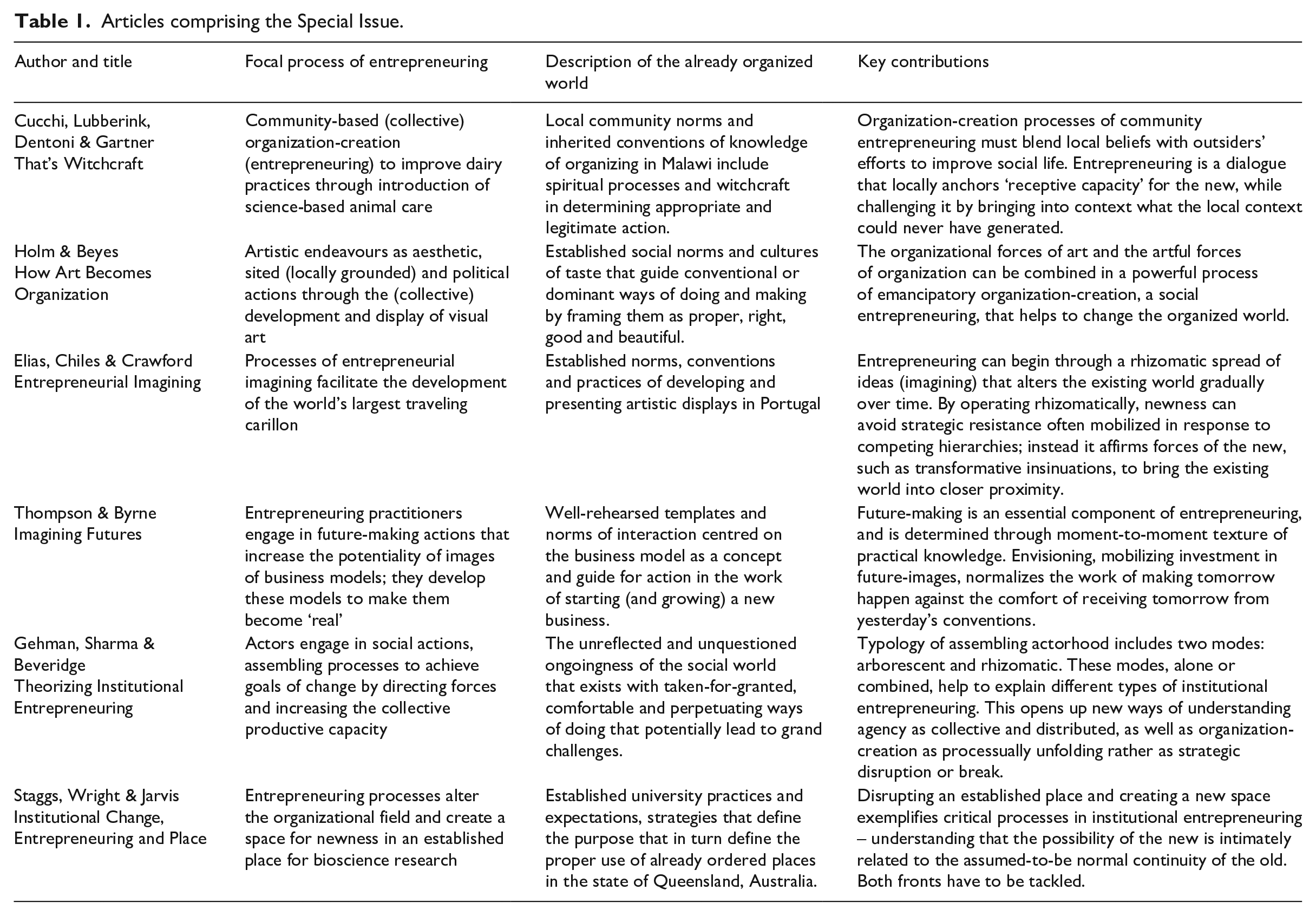
Cucchi, Lubberink, Dentoni and Gartner (2022, this issue) develop a theoretical contribution centred on community entrepreneuring (and collective entrepreneurship) based on an ethnographic study in rural Malawi. In this study, the tension between organization-creation and the already organized is examined through attention to ‘spiritual practices’, witchcraft in particular. The authors show how the tensions can be addressed through actions categorized as channelling, amplifying and taming. Using the concepts of community-based entrepreneurship, entrepreneuring and organizational spirituality, the analysis identifies how mystery and ambiguity are important for spiritual practices to navigate intra-community tensions and co-constitute and enact what the authors call community entrepreneuring. Thus, the study shows that the concept of entrepreneuring can extend to the context of communities, and that the concept of spiritual practices together with organization-creation helps explain the co-constitution of ‘community entrepreneuring’ in such contexts. The authors offer the concept of community entrepreneuring as a contribution to studies of inequality in other contexts.
Focusing on the shared characteristics of art and entrepreneurship, Holm and Beyes (2022, this issue) explore the novel territory between them as they develop the concept of artistic entrepreneuring, with implications for entrepreneurship studies as well as research on the aesthetics and politics of organizing. Their interest in art’s entrepreneurial power, in artistic practices as a realm of entrepreneuring, brings into analytical focus the societal transformation that art’s ‘organizational turn’ demonstrates. Using the concept of entrepreneuring as social change, and art theory’s organizational side, Holm and Beyes (2022) frame art’s organizational (aesthetic, sited and political) practice as artistic entrepreneuring. This is specified theoretically as an aesthetics of social transformation, a processual notion of entrepreneurial sites, and a collective politics of reorganizing the sensible. There is resonance between Holm and Beyes’ (2022) conceptualization of entrepreneurial organization of art and Cucchi and colleagues’ (2022) community-based entrepreneuring. Through their engagement with art theory and the development of the concept of artistic entrepreneuring, we are given a new perspective on entrepreneuring as social change, something that complements the above introduced study of community entrepreneuring. In addition, there are potential implications for research in social entrepreneurship as well as in social movement theory.
The concept of imagination makes surprisingly rare appearances in entrepreneurship literature. Elias, Chiles and Crawford (2022, this issue) remedy this scarcity by studying ‘entrepreneurial imagination’ using a processual framing that bridges entrepreneurship and organization studies. The study is situated in the world of carillon art, which is the world of music performance, and in the artistic process of creating a new version of the ‘instrument’ and thus a new set of possibilities following from this. Elias and colleagues develop an empirically grounded ‘rhizomatic process model’ of how entrepreneurial imagination unfolds (as deeply intertwined with various bodily and social activities), and how entrepreneurs generate novelty. Their focus on entrepreneurial imagination (embodied and socially grounded) enables a contribution to the study of and theorization on new ways of organizing, including multimodal research in organization studies. As with Holm and Beyes’ (2022) study of art’s organizational practices, Elias and colleagues show that the study of entrepreneurial imagining’s role in such practices allows organization studies to deepen its constructive dialogue with art.
Thompson and Byrne (2022, this issue) continue on the theme of imagination as they centre on imagined futures in context of organizing support for entrepreneuring (an accelerator programme). The concept of imagination is here further explored as a way to bridge organization and entrepreneurship studies centred on a processual approach to entrepreneuring in an already organized world. By ethnomethodologically studying video ethnographic data of future-making processually, as the actualization of the virtually real through actions, shared understandings and visual artefacts, Thompson and Byrne contribute to the study of organization-creation as sites where imagining the future and making the immaterial material happens. This happens through formulating conjectures about the future, visually representing them and by organizing (primarily via social interaction) their relationships to other conjectures and their part in a greater whole. By staying on the level of practices of formulating, visually representing and organizing conjectures they develop knowledge of how actualizing the virtual is done, as well as the importance of visual artefacts for the co-creation of the virtual. The relationships between text and template in Thompson and Byrne’s study can be related to the dynamic tension between organization-creation and the already organized as the central theme of this Special Issue.
In their article, Gehman, Sharma and Beveridge (2022, this issue) engage with the topic of institutional entrepreneuring in the context of grand challenges. Their key contribution is the development of a theoretical framework articulating two ideal types of actorhood – arborescent and rhizomatic assembling. In creating this typology, the authors draw on Deleuze and Guattari (1987) to articulate four principles that are constitutive of each ideal type: association, combination, division and population. Building on this framework, the authors explain similarities and differences of previous research, using this foundation to then explain how their view of assemblage advances our understanding of institutional entrepreneuring. Their approach emphasizes the processes through which actors are created and equipped for institutional action. We see that the authors’ attention to institutional entrepreneuring, and the associated processes and practices, holds excellent potential for rekindling institutional scholars’ interest in understanding actors’ ability to act within highly institutionalized contexts. Their theoretical work sets the stage for future investigations that focus more deeply on how (through what processes and practices) institutional entrepreneuring in an already made world can be accomplished.
Staggs, Wright and Jarvis (2022, this issue) introduce us to the field of scientific research production in Australia, with a particular focus on entrepreneuring processes associated with the creation of a new ‘Smart State’ in Brisbane, Queensland. Through their analysis of rich qualitative data, they reveal the importance of place creation as integrated with processes of entrepreneuring. They highlight the concept of place – with particular attention to the materiality and meaning of a specific geographic location. In doing so, they draw new insights about entrepreneuring in an already organized world by reminding us that place matters. The location of Queensland, Australia, with its geographic location, built environment, history and culture meant that processes and practices of entrepreneuring had to be tailored in ways that took account of that place. Overall, the authors develop a process model to explain how the field of scientific research production changed over time as processes of entrepreneuring (structural emancipation, dissociating and reimagining place meanings, ‘bricolaging’ of place forms, and co-evolving place identities) were interwoven with processes of place creation.
Conclusions and Future Research
Entrepreneuring, as organization-creation in an already organized world, has been studied in various contexts and through different theoretical framings in the papers contributing to this Special Issue. Concluding on the basis of these advances, we find that by placing emphasis on processes and practices in an already organized world, entrepreneuring is studied in these contributing papers with greater attention to the artful and craftlike nature of how it is done, to the affective, collective, imaginative, situated, and to the organizationally creative. Together this represents an important contribution to process- and practice-oriented research on organization-creation. With the conceptual contributions made by the papers in this Special Issue, we believe we are advancing scholarly capacity to study processes and practices of how organization-creation can happen. We learn to take organizations less for granted and are instead given nuanced insights into how they emerge and change through processes and practices of organization-creation.
As we developed the idea for this Special Issue, and imagined how it could be presented in the call for papers such that it would attract contributions, the sense that entrepreneurship is now generally normalized in organizational life was important. In addition, we were convinced that the relative maturity of the fields of institutional theory and entrepreneurship studies, of process- and practice-oriented organizational research present in both, together had made us curious to see whether we could renew our conceptual vocabulary. The call thus ventured into centring on entrepreneuring and tied it to the processes and practices of starting, creating and actualizing. We saw this ‘ongoingness’ as taking place in the context of the already organized, and that tension was central to what fuelled our curiosity. We used a language of imagination, art, craft, aesthetics, philosophy, play and the artificial, and of tension, friction and resistance. With this we wanted to challenge contributing authors to move into the in-between of entrepreneurship and organization studies and build bridges.
As a result of serving as editors in the process, we have concluded above that we need to contribute with a conceptual development of our own, since institutional theory would benefit from a richer conceptual capacity to include the embodied and affect. In addition, the development of entrepreneurship studies could benefit from a richer conceptual capacity to give attention to the already organized world when confronted with creating alternative arrangements. We see this as a stretch into the in-between of understanding organizational and institutional entrepreneuring. We need a more fine-grained conceptual vocabulary that is relational and includes the affective. Precisely when the idea of new value to-be-created starts to affect bodies through desiring change, this potentiality enacts, discloses and makes felt what we call the ‘comfort zones’ of the already organized. These are relational and affective – they can shield from attempts to impose normality by performing well according to templates, roles and principles in place, but they are also launchpads for affirmation of organization-creation, of entrepreneuring.
We believe this is a new step in research on organizational and institutional entrepreneuring and it is a promising contribution to broadening, solidifying and enriching the bridge or conversation between organization and entrepreneurship studies. From both organizational and institutional perspectives, we see even more opportunities ahead. First, by giving attention to the process of entrepreneuring at the beginning and throughout, it is clear that concepts associated with time and temporality take on critical importance. We encourage future research that delves into forward-thinking actions that impact on conceptions of clock time or event time (or duration). Event time, in particular, seems important for an understanding of affect-based time and its role in timing the efforts to initiate organization-creation. As imagination, the poetic and the artificial are bundled or rearranged, how do actors bring together the past, present and future? For this it seems especially relevant to ask what roles stories play in opening up possibilities for organization-creation? How can actors perform in their embeddedness while nurturing possibilities for entrepreneuring into ripeness? Second, we note that a number of articles in this Special Issue highlight the location or place where entrepreneuring occurs. Such attention to place as part of theory-building fits well with current research initiatives designed to understand the site-specificity and indeed aesthetics of meanings, practices and processes. Do entrepreneurial processes unfold similarly in different locations around the world? How are comfort zones shaped by geography and shaped by actors in order to enable and support breaches of dominant normalities in the pursuit of entrepreneuring? Different geographic locations bring different cultural sensemaking practices, different role performances, and the organizational together, and we question whether institutional openings for entrepreneuring may differ accordingly. Finally, we hope that researchers will build on ideas developed here about organizational and institutional entrepreneuring to consider how cross-level initiatives develop and gain traction. How does organizational entrepreneuring take advantage of knowledge and engagement with the institutional environment? And how can institutional entrepreneuring occur in light of organizational actions and processes? We propose that the concept of comfort zones, again, provides opportunity to address such questions in a new way. These are only a few examples of future research that we encourage. Overall, we see that by focusing on the process of entrepreneuring, the opportunities for theoretical advancement are plentiful.
In closing, we want to thank everyone associated with making this Special Issue a reality. We appreciate that the reviewers provided thoughtful and helpful feedback on all submitted articles, and helped us to shape and sharpen these manuscripts appearing in print. Sophia Tzagaraki provided superb editorial support, as always! And now speaking to our readers, we hope we have enticed you to read further – to learn from and enjoy the six thoughtful and intriguing papers included in this Special Issue.
Footnotes
Funding
The author(s) received no financial support for the research, authorship, and/or publication of this article.
