



Abstract
Previous work has demonstrated that structural forms of empowerment tend to enhance individual and team resilience. However, there is hardly any knowledge about how structural empowerment affects organizational resilience. Moreover, a widespread (though largely untested) assumption is that, in adverse times, power and authority need to be centralized at the top to enhance organizational resilience. This paper explores the effects of empowerment on organizational resilience in an in-depth case study of a Dutch home care organization, in which employees are structurally empowered. The findings from this case study suggest that structural empowerment positively affects organizational resilience, but that this effect is contingent upon a climate of psychological safety as well as top management’s sustained commitment to structural empowerment. We move beyond the extant conceptualization of psychological safety by demonstrating its inter-level nature in the context of structural empowerment, which operates across organizational levels when employees also engage in discussions on tactical and strategic issues. Overall, this study provides an in-depth understanding of how organizations can enhance their resilience by empowering their members, thus also challenging the common wisdom about centralizing power in adverse times.
Keywords
Introduction
Many organizations today are exposed to unexpected crises and other unprecedented changes, and the consequences can be dramatic for organizations that are unprepared (Beermann, 2011). That is, rapid change tends to quickly outdate organizational tools, systems and frameworks when these are not changing at the same pace as the environment of which they are part (Mack & Anshuman, 2016). This creates a so-called ‘resilience gap’, implying that the environment is becoming more turbulent at a higher rate than organizations are becoming resilient (Välikangas, 2010). Organizational resilience refers to ‘the ability of organizations to anticipate, avoid, and adjust to shocks in their environment’ (Ortiz-de-Mandojana & Bansal, 2016, p. 1615), thereby providing a ‘critical resource for individuals and organizations facing adversity’ (Powley, 2009, p. 1291). Previous work has shown that individuals and teams demonstrate resilience (Shin, Taylor, & Seo, 2012; Weick, 1993; West, Patera, & Carsten, 2009) through, for example, individual self-efficacy (Gardner & Schermerhorn, 2004; Luthans, Vogelgesang, & Lester, 2006) and trust and respectful interactions between individuals (Weick, 1993). Whereas individual and group resilience may positively affect organizational resilience, the latter cannot be equated with an aggregation of individual and team responses, because the interaction between (teams of) employees and (top) managers is also critical. In this respect, there is a growing interest in the role of employees, specifically in how their empowerment affects organizational resilience (Samba & Vera, 2013; Sheffi & Rice, 2005). Previous studies have shown that empowering employees to participate in decision-making makes the organization more resilient, as it enables a quick response to changes in the environment (e.g. van der Vegt, Essens, Wahlstrom, & George, 2015) and vice versa, because resilient organizations tend to have more resources available to support employees empowered to make decisions (Taylor, Dollard, Clark, Dormann, & Bakker, 2019).
Despite this body of knowledge, the common wisdom is that decision-making power needs to be centralized at the top in adverse times (Blenko, Mankins, & Rogers, 2010; Sherf, Tangirala, & Venkataramani, 2019). Accordingly, the vast majority of organizations hardly (or do not) empower their employees to help in identifying strategic and tactical problems and give input on possible solutions; indeed, the default response of many organizations in adverse times is to centralize power (Blenko et al., 2010; Sherf et al., 2019).
In this respect, few studies of organizational resilience explicitly acknowledge the active contributions of individual employees (Meyer, 1982; Powley, 2009; Reinmoeller & van Baardwijk, 2005). Traditional managerial hierarchies often prove to be ineffective under dynamic environmental conditions (Eisenhardt & Bourgeois, 1988; Haleblian & Finkelstein, 1993; Lee & Edmondson, 2017), in the sense that they inhibit employees and other staff members from responding to these conditions on the spot. Some organizations therefore complement their hierarchical structure with more distributive forms of power. One successful example involves a Dutch firm in which top management, in the face of a severe collapse of its sales and profits, did not lay off employees but listened to an alternative solution offered by an employee, to subsequently turn the situation around and avoid any layoffs (Romme, 1999, 2015). This case as well as other examples illustrates a form of structural empowerment in which employees obtain a substantial amount of influence, including regular opportunities to provide input on tactical and strategic issues (Maynard, Gilson, & Mathieu, 2012; Romme, 1999).
In organizational settings, structural empowerment goes beyond the conventional notion of psychological empowerment, which refers to the individual employee’s sense of self-efficacy and autonomy (e.g. Thomas & Velthouse, 1990). Instead, structural empowerment enables employees to represent their interests in a responsible and self-determined way (Lee & Edmondson, 2017), implying they can directly or indirectly affect decision-making at various levels (i.e. their formal power) as well as develop connections and interactions with other organizational members (i.e. informal power) (Laschinger, Finegan, Shamian, & Wilk, 2004). This suggests structural empowerment may have positive consequences for organizational resilience, by enabling the organization to effectively respond to its fast-changing environment. The main research question therefore is: How does structural employee empowerment influence organizational resilience?
We address this question in an in-depth case study of a Dutch home care provider. This company structurally empowers its employees by means of a governance system called ‘sociocracy’ (Romme, 1999; Romme & Endenburg, 2006). This company appears to be rather resilient, by performing and thriving in adverse times, in which many competitors went bankrupt or were taken over by competitors. As such, the Dutch home care industry provides a highly appropriate setting for studying the empowerment–resilience relationship, because it has been exposed to several severe pressures and changes (e.g. cuts in government funding and major regulatory changes). Overall, this case study provides an in-depth understanding of how organizations can enhance their resilience by empowering employees, thus also challenging the common wisdom about centralizing power in adverse times.
We first explore the concepts of organizational resilience and empowerment, followed by a method section that explains how data were collected and analysed. Subsequently, we present the main findings arising from the case study. The paper concludes with a discussion of these findings.
Background
Resilience as an organizational capacity
The concept of resilience first emerged in epidemiology, referring to how individuals successfully adapt to severe adversity at any point during their life cycle (Rutten et al., 2013). Conceptually, the organizational resilience literature draws on resource dependency theory, which seeks to understand an organization as part of its broader environment and dependent on the resources provided by the (social) networks in which it is embedded (Pfeffer & Salancik, 2003). More specifically, organizational resilience refers to ways to deal with fast, disruptive environmental change (McCann, Selsky, & Lee, 2009) and also to the disruptive accumulation of many small environmental changes (Rudolph & Repenning, 2002). These environmental changes may involve unexpected events or so-called acute stressors, and also stressors of a more chronic nature (Riolli & Savicki, 2003; Samba & Vera, 2013). In response to these stressors, organizational resilience may involve the handling of day-to-day problems and events (Mallak, 1999) and also major changes in organizational strategy and structure.
Notably, organizational resilience is distinct from related constructs such as adaptability: it is not only about being able to deal with change, but also about the ability to ‘learn how to do better through adversity’ (Wildavsky, 1988, p. 2). Organizational resilience can thus be understood as a latent organizational capability for internal and external alignment (Ortiz-de-Mandojana & Bansal, 2016; Powley, 2009; Samba & Vera, 2013). The latent nature of this capacity implies it needs to be in place before it can be actually used (Lengnick-Hall & Beck, 2005; Lengnick-Hall, Beck, & Lengnick-Hall, 2011). Moreover, organizational resilience goes beyond the capacity to bounce back from a crisis, also incorporating the ‘strategic’ capability to anticipate and/or possibly prevent (the need for drastic responses to) a major crisis or other setback (Hamel & Välikangas, 2008; Välikangas & Romme, 2013). As such, organizational resilience does not merely refer to operational responses in extreme contexts, such as those known from literature on high-reliability organizations (e.g. Weick, Sutcliffe, & Obstfeld, 1999) but also to organizational responses to more mundane dynamics at multiple organizational levels. Therefore, we define organizational resilience as the organizational capability to anticipate, (possibly) prevent, and respond to major crises and other kinds of adversity.
Notably, any organizational resilience capacity tends to evolve over time, for better or for worse (Lengnick-Hall et al., 2011; Ortiz-de-Mandojana & Bansal, 2016; Samba & Vera, 2013). This suggests it also is a dynamic organizational capability, which renews continually to keep up with changing environmental demands (Schreyögg & Kliesch-Eberl, 2007).
The role of decision-making in organizational resilience
Two related factors appear to affect organizational resilience: first, employees are assumed to influence resilience with their skills, cognitions and behaviours; and second, the extent to which the decision-making structure of the organization is decentralized influences its resilience (van der Vegt et al., 2015). In this respect, empowering employees and decentralizing decision-making have been identified as key mechanisms enabling organizational resilience (Mallak, 1999; Samba & Vera, 2013; Sheffi & Rice, 2005; van der Vegt et al., 2015). That is, decentralized decision-making allows people ‘close to the action’ to make the necessary decisions, without consulting (higher) management levels, thereby enabling the organization to respond more quickly and effectively to changes (Samba & Vera, 2013; Sheffi & Rice, 2005; van der Vegt et al., 2015). Studies of high-reliability organizing already point at the necessity of ascribing decision-making authority for operational tasks to frontline employees (Martínez-Córcoles & Vogus, 2020; Roberts, 1990; Weick et al., 1999). Consequently, the way employees are engaged in decision-making is also essential to organizational resilience (Gover & Duxbury, 2018).
In this respect, we adopt a well-known typology of decision-making issues in any organization: strategic, tactical and operational issues. Decisions made on each type of issue are substantially interdependent with decisions taken on the other types of issue. For one, many strategic decisions establish the scope of decisions made at the tactical and operational levels and ultimately impact the organization’s competitive advantage (Shivakumar, 2014). Indeed, the interaction between the three decision-making levels eventually determines the collective resilience of the organization as a whole (Kahn et al., 2018). Because a typical strategic decision needs to be implemented in tactical and operational terms, systematic consultation of people with tactical and operational expertise can thus help improve the quality of strategic decisions (Shivakumar, 2014). A similar interdependency exists between tactical and operational decisions.
The effects of power distribution on organizational resilience
We argue that, for an organization to become resilient, it has to move away from traditional ‘power over’ relationships (Clegg, Courpasson, & Phillips, 2006; van Baarle, Dolmans, Bobelyn, & Romme, 2021) in which employees are disempowered and often feel detached from the organization (Martin, 2010). Instead, ‘power to’ relationships should be fostered, in which every actor will have some power to act and decide. Fostering such relationships creates internal commitment from employees by empowering them to take charge of their own work (Argyris, 1998). Such a decentralized power distribution moves the power constellation away from a traditional top-down structure toward an organization with a more flexible type of governance.
Prominent examples of decentralized structures are holacracy and sociocracy. 1 Sociocracy, also known as circular management (CM), is an organizational form that seeks to enable collaboration and information exchange from bottom to top and vice versa (Halek & Strobl, 2016). Organizational members thus jointly decide on company policy in circle meetings, where decision-making is based on the rule of informed consent (Romme, 2016). In each circle, both the operational staff and functional leaders are heard and no-one can overturn the opinion of another (Halek & Strobl, 2016). CM appears to promote creativity and problem solving, facilitate adaptive behaviour and increase employee commitment (Buck & Endenburg, 2012). Inherent to CM is a climate of psychological safety in groups (circles), which motivates employees to take risks and speak up (Edmondson, 1999). Such a climate of psychological safety appears to be important for organizational resilience (Goodman et al., 2011; Lengnick-Hall et al., 2011), as it enables employees to signal and discuss issues.
Operationalizing structural empowerment
Structural empowerment aims at the trickling down of authority and responsibility 2 (Maynard et al., 2012). Structural empowerment thus refers to practices or initiatives that involve sharing power, decision-making and formal control over resources (Maynard et al., 2012), ensuring that all employees can contribute to decision-making processes (Romme, 2016). It involves two processes: formal and informal empowerment (Kanter, 1993; Laschinger et al., 2004). The formal empowerment process implies that employees have substantial discretion in how they perform their jobs and also demonstrate flexibility in how they handle things.
The informal empowerment process originates from positive social connections and communication channels between staff members throughout the organization (Laschinger et al., 2004). We assume that enabling employees to participate in decision-making is what (initially) formally empowers them, whereas the informal empowerment processes to a large extent determine whether the formal empowerment comes to life. In this respect, these two empowerment processes may be conceived as instigating a self-perpetuating process, initiated by the opportunity for employees to raise their voice and reinforced by colleagues connecting and interacting with each other.
Overall, we thus consider structural empowerment to arise from formal and informal empowerment processes (Ackoff, 1994; Kanter, 1993; Laschinger et al., 2004), which extends the framework of Laschinger and colleagues (2004) by broadening the notion of empowerment to include not only job execution but also engaging, directly or indirectly, in policy-making at various (other) levels. This serves to challenge the conventional idea that empowerment only pertains to the employee’s job and tasks. We thus posit that empowerment can also imply employee engagement at the tactical and strategic levels. Hence, formal empowerment of employees not only refers to people ‘owning’ and executing their jobs in a discretionary and flexible manner (Laschinger et al., 2004), but also includes elements of so-called ‘democratic hierarchies’ (Ackoff, 1994) and ‘circular hierarchies’ (Romme, 1999), in which employees can directly or (via representatives) indirectly participate in decision-making at various levels.
Methods
Case setting
The specific instantiation of the empowerment notion in the case studied is circular management (CM), a governance system that supports employee empowerment via a decentralized decision-making structure. The case is a Dutch home care organization that adopted CM in 2012.
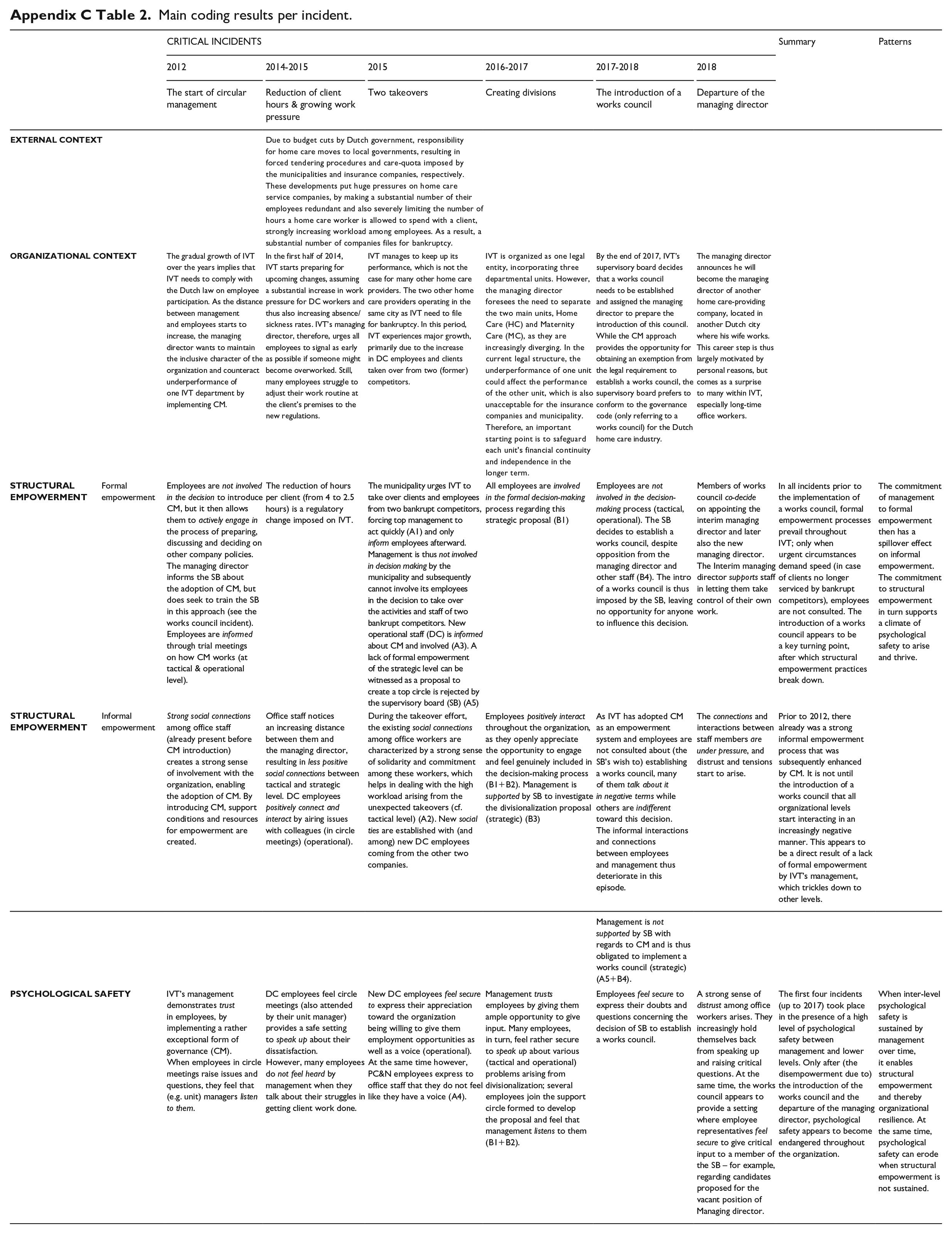
The Dutch home care industry has been exposed to severe pressures, as the proportion of Dutch citizens over the age of 65 is projected to increase from 3.6% to 6.8% (CBS, 2016); moreover, major changes in financial structures, including cuts in government funding, have led to substantial loss of income for home care providers (despite increasing numbers of clients) and an increase in the workload of nurses and caretakers, who have to do more in less time. 3 In coping with these dynamics, some companies appear to be more successful than others; in fact, several Dutch homecare service companies have gone bankrupt in the last few years. One of the more successful organizations is IVT Homecare, which makes it an interesting case for investigating organizational resilience (an overview of the financial data of this firm is available upon request). IVT started as a small family-owned business in the early 1990s, eventually growing to become a medium-sized company in 2015. It serves clients in several municipalities, offering home care services – including domestic care (DC) and personal care and nursing (PC&N). Since 2012, IVT’s hierarchical structure has been complemented with a CM decentralized decision-making structure, to secure the inclusive character of the organization. In 2014, IVT faced major challenges due to governmental regulations that substantially increased employees’ work pressure. In the subsequent year, IVT took over almost all employees and clients of two big competitors that filed for bankruptcy, more than doubling the size of the organization. Attempting to safeguard financial continuity in a fast-growing company, the managing director involved all employees in the decision to divisionalize the organization (in 2016). By the end of 2017, IVT’s supervisory board decided to implement a works council, the traditional method for employee participation in the Dutch context. Finally, the sudden departure of the managing director in 2018 was the last major incident studied in this case. Table 2 (Appendix C) describes these various incidents and events in more detail.
Research design
Organizations are inherently complex and dynamic in nature (Mintzberg, 1979). We therefore adopted Mintzberg’s ‘direct research’ strategy, implying an exploratory and inductive approach that assumes we are likely to identify and uncover unexpected phenomena and causal patterns. This inductive approach was, however, not entirely clear as we entered the field with theoretical concepts in mind (see the previous section). In this respect, we did not expect that existing theory would be able to fully explain the patterns arising from the data. Instead, we were open to uncovering new elements that would not necessarily align with the existing theory. This approach not only draws on induction but also on abduction, in which one attempts to provide a theoretical explanation for an unexpected finding, possibly leading to new theory or concepts (Piekkari & Welch, 2018), that is, one ‘works backward to invent a plausible world or a theory that would make surprise meaningful’ (van Maanen, Sørensen, & Mitchell, 2007, p. 1149).
We opted for a single case approach, given the lack of understanding about how key concepts in the area of structural empowerment and organizational resilience (outlined in the previous section) interact with each other and how the organizational context affects this interaction (cf. Dubois & Gadde, 2002). In terms of generalizability, the findings from this single case study serve to develop a theoretical framework that potentially provides a more widely applicable logic, hence providing a starting point for analytic generalization (Yin, 2012).
Data collection
As IVT implemented circular management as of 2012, it lends itself well to a longitudinal retrospective as well as real-time investigation of the influence of empowerment on organizational resilience. Therefore, retrospective data (interviews and documents) as well as real-time data (observations in meetings) were collected. The retrospective data involve both primary data collected via interviews and an extensive set of secondary data, in the form of meeting minutes covering a period of six years; these meeting minutes amount to 151 documents, including the minutes of all circle meetings as well as other relevant (e.g. works council and supervisory board) meetings.
The large number of detailed minutes of meetings, at all levels of IVT, are the main data source. Notably, this type of data is rather unique, because in many other organizations there are no written accounts of meetings, especially at the operational level. In IVT, these detailed minutes are produced in all circles, at all levels, as a result of the CM approach. From these meeting minutes, several critical incidents were distilled. The criticality of incidents was assessed based on how often they appeared in the meeting minutes as well as interviews with the managing director. From the meeting minutes, we obtained an initial overview of procedures followed and decisions taken, and the extent to which employees were actively involved or empowered in those decisions.
The critical incidents formed the focal point for the in-depth interviews. These interviews were held with employees and supervisors, to develop a deeper insight into the extent to which they (feel they) were structurally empowered, that is, whether they are provided with the opportunities, resources, information and support for empowerment. Notably, within the Dutch home care industry, the workforce inherently operates in these conditions, because they autonomously perform home care services at clients’ homes; as a result, we could focus in our study on whether these conditions also exist for home care workers’ structural empowerment. Interviews were held with four employees at the operational level, five at the tactical level (two planners, the team managers for each home care division and the overarching home care manager) and two managing directors (including the former managing director and the interim managing director who stepped in during the time of the research). Each interview took around 45–60 minutes and was supported by a semi-structured interview script.
Notably, interviews are ‘verbal reports’ and therefore subject to recall bias (Yin, 2012). A similar bias may arise from meeting minutes, as these texts are often more concise and less rich than the actual discussions taking place in a meeting. To triangulate the data, the meeting minutes and interviews were therefore complemented by direct observations (Dubois & Gadde, 2002). As the minutes provided unobtrusive data on how decisions and activities ‘circulate’ throughout the organization, direct observations generated additional data on how organizational members engage in structural empowerment. These observations therefore not only focused on spoken language, but also on non-verbal types of communication. The participant-observer thus attended eight circle meetings as well as the execution of work by two operational-level employees. While attending circle meetings, this researcher positioned herself as a ‘fly on the wall’, to influence the process as little as possible. The various observational data collected were enhanced by informal conversations before, or directly after, circle meetings or other activities. These observations served to generate additional insights into the extent to which behaviours (observed) reflect empowerment and/or affect organizational resilience. Finally, the lead researcher wrote down a number of other observations and reflections in a notebook, when she spent time at the headquarters of IVT.
Table 1 provides an overview of the database, including the number of meeting minutes collected, the number of interviews or conversations held, and observations made. Per data source, the total number of pages transcribed and analysed is listed as well as the total number of first-order codes (see also next subsection).
Properties of the database.
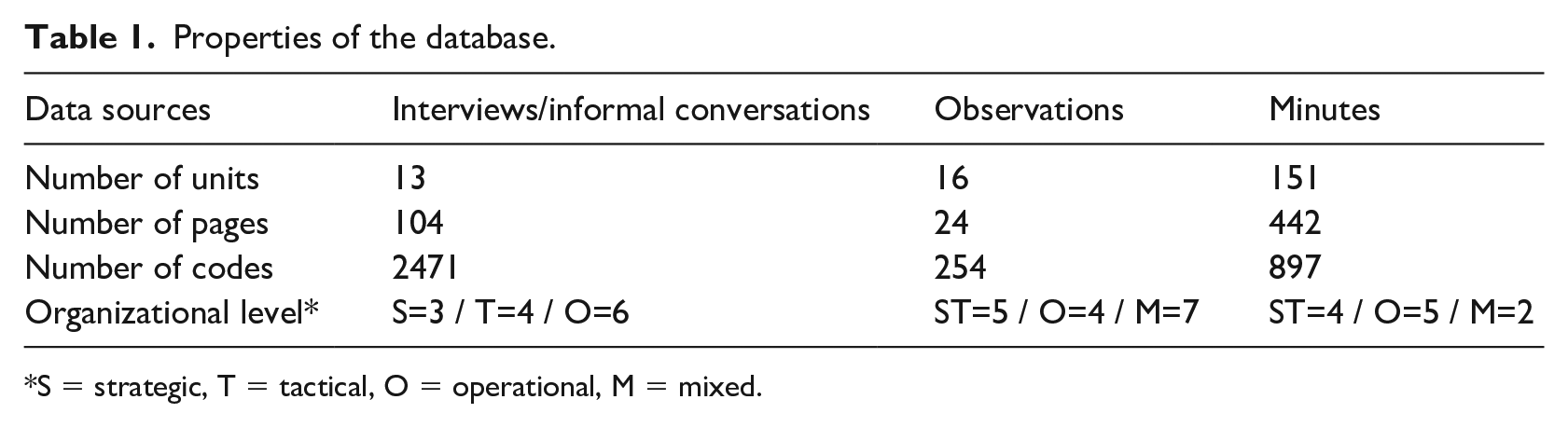
S = strategic, T = tactical, O = operational, M = mixed.
Data analysis
The data analysis focuses on key intra- and extra-organizational events, or critical incidents, that occurred in the period 2012–2018; these incidents represent changes with a relatively high strategic impact during this period. Each critical incident was written up in the form of a narrative, to do justice to the richness of the data and to ‘set the scene’ for further data analysis. The narrative included detailed information on each incident regarding the micro-incidents it comprises and how it unfolds (chronologically) over time. We thus used a narrative strategy in making sense of the data in terms of the story regarding each incident (Langley, 1999). This was a good starting point, as we encountered ambiguous boundaries around these incidents. That is, the various micro-incidents included within each critical incident were connected in multiple ways, while simultaneously connections appeared to exist between the critical incidents themselves.
We subsequently used a visual mapping strategy, by constructing timelines of the critical incidents (Langley, 1999). These timelines were instrumental in obtaining an understanding of the time dimension and the interaction between micro-incidents (Appendices A and B depict two of these timelines). These timelines include the same level of detail as the narrative, but serve to make the time component, the level of occurrence (i.e. intra- or extra-organizational, strategic, tactical or operational), and the relationships between micro-incidents more explicit. The narrative, in this respect, was a necessary starting point without which the timelines could not have been constructed. By adopting the narrative and visual mapping strategy, the data representation obtained a clear processual dimension. Though the timelines already offered an abstraction in the data representation with regard to the rich narrative, they were still initially ambiguous in terms of how the findings connected to our theoretical concepts.
We therefore embarked on a final abstraction effort in which we highlighted the most important findings per critical incident per theoretical concept in a table (all data had been previously coded according to the theoretical concepts outlined the Background section). From the table we inferred two patterns. In order to substantiate these patterns, we further scrutinized two of the timelines to explore how and where these patterns could be visualized. This going back and forth between different data representations informed the development of the theoretical framework. Thus, this final phase combined deductive analysis – building on concepts outlined in the Background section (i.e. psychological safety, structural empowerment, including informal and formal empowerment) – and inductive analysis that served to identify the role of management commitment and the inter-level nature of psychological safety. In this respect, the various (unanticipated) theoretical insights constitute a major modification of extant theorizing (Dubois & Gadde, 2002), also involving ‘creative leaps’ (Mintzberg, 1979).
Findings
In this section, we describe the main findings. These include a narrative of the most important developments in the Dutch home care industry, IVT and its response to each critical incident (the full narrative is available upon request from the authors). To obtain a deeper understanding of how structural empowerment influences organizational resilience in IVT, we developed and visualized the timeline of each incident: Appendices A and B provide two examples. The main patterns arising from this narrative are summarized in Table 2 (Appendix C), which serves to identify the most important findings per construct and incident. This table provides an overview of the main coding results, with six critical incidents at the horizontal axis and the key theoretical constructs listed on the vertical axis.
Two main patterns were inferred from the table and the timelines. First, structural empowerment appears to positively influence organizational resilience, but this effect only materializes when a substantial level of so-called ‘inter-level psychological safety’ exists and is sustained by management. Second, a permanent managerial commitment to structural empowerment appears to be a necessary condition for consolidating this positive effect of psychological safety. Table 2 shows that a climate of psychological safety is present in the organization throughout the first few years, but when the managing director leaves, this climate starts to crumble. In tandem, employees appear to be structurally empowered in the first few years, but this empowerment practice starts breaking down when a works council is imposed on the organization (already alluded to during the takeovers incident). Notably, the deterioration of structural empowerment appears to coincide with the crumbling of psychological safety, both of which take place when management is either changing or not empowered itself. In the remainder of this section, these patterns are discussed in more detail.
Psychological safety supports structural empowerment’s effect on organizational resilience
Due to the introduction of CM, a climate of psychological safety emerged in IVT. Various other incidents in the case narrative suggest that a safe climate, in which anyone in the organization can think aloud and voice opinions, is critical to the positive effect of structural empowerment on organizational resilience. For example, when two other home care providers were taken over by IVT (Appendix A), there was a clear top-down decision-making process in which employees were not included (A1). However, there was an informal empowerment process, in the sense that IVT’s office staff was highly committed to IVT taking over the clients and employees of two other companies, and thus worked hard to get it done (A2). The new employees joining IVT also felt highly empowered, as they engaged in circle and other meetings (A3). While other IVT employees did not critically question the takeover of clients and staff of two competitors, it did result in some friction at the operational levels, especially between DC and PC&N, as the takeovers doubled the size of the DC division (A4). Some long-time IVT employees raised questions and doubts: I do remember that we were grumbling a bit like yes . . . what are they doing, is that going okay and is it going okay with us, is the domestic care going to be more important than personal care and nursing? And we did hear at a certain point ‘no, Bram [the managing director] really wants to keep all divisions, one needs the other’ and that we did not need to worry about that. (employee 1 PC&N)
Another example of psychological safety is how new DC employees (coming from a former competitor) talked about their integration within IVT (A4): Well, I was really supported, yes. (. . .) I’ve been offered a warm blanket. And have been welcomed with open arms. Yes. And that’s what it feels like. And if there was anything, you could always call. (employee 2 DC)
These two statements point at informal empowerment, as employees perceived the transparent communication about this sensitive topic in a rather positive manner, while many of them also felt listened to, supported and taken seriously. The above statements also illustrate psychological safety, as employees felt that they could express themselves. The data regarding the takeovers incident thus signals a strong informal empowerment process, supported by a climate of psychological safety. The psychologically safe climate arose from CM, but also from the organizational culture already prevailing in IVT prior to the introduction of CM. This climate also appears to affect decision-making processes (cf. formal empowerment) in which staff members speak up and take interpersonal risks, by raising questions and reflecting on (proposed) decisions. The creation of the divisional structure (Appendix B) illustrates the formal aspect of empowerment, as the process was designed to get all organizational members on board: There was a general meeting where Bram explained what was going to happen and how, and after that [. . .] there was a circle meeting and we were asked if we had thought about the proposed division [. . .] So, it was indeed entirely taken from top to bottom [. . .]. We gave positive advice [. . .] and then it went back to the management team where the final decision was taken. Our circle was done with it quite rapidly, because it was explained very clearly. (employee 1 DC)
Here, the managing director initially developed a proposal for forming divisions and then included all organizational levels in the decision-making process, in which employees raised questions, made suggestions and, finally, gave their consent (B1). The above quote shows that it was clear to this employee what the decision was about and that she actively participated with her co-workers, to provide input to the managing director. The later episode in which the director leaves the company suggests that IVT’s climate of psychological safety also depended on a strong managerial commitment. That is, after the managing director had left, psychological safety started to decrease and people began pointing fingers and accusing each other (Appendix A, A6): We have fallen between two stools now [. . .] I want especially that we, as an organization, acknowledge that we should continue to interact respectfully and not play the blame game and act as if everything is negative and everything is wrong. (team manager PC&N)
While this team manager here explicitly advocated how one should interact within the organization, she implicitly said that the opposite is the case. That is, informal empowerment appears to be weakened, as people start to communicate and interact negatively with one another, also because the climate of psychological safety breaks down when participants in meetings increasingly talk to each other in a disrespectful way.
Overall, the IVT case appears to demonstrate a substantial level of both formal and informal empowerment, with the former very likely being vital in creating or sustaining the latter. Both forms of empowerment appeared to positively affect the climate of psychological safety, and vice versa. Being structurally empowered in this climate of psychological safety appears to enable employees to contribute directly to how IVT responded to major challenges (especially the two takeovers). As such, structural empowerment has positively affected IVT’s organizational resilience, with psychological safety supporting the structural empowerment practice. Moreover, the data collected on most critical incidents (exceptions are the client hours reduction and departure of the managing director) underline that psychological safety in IVT appeared to exist not only within groups and teams, but also across different hierarchical levels. For example, in the divisionalization incident the managing director explicitly invited and motivated operational employees to speak up in circle meetings, which they did (B2). Another example is how, in a meeting of the home care circle, a DC worker openly questioned the HC manager: E confronts the Home Care manager with feedback that the DC circles were supposed to receive, but did not. [So, this employee does not shy away from speaking up.] The PC&N manager then summarizes E’s criticism. E subsequently points out that she thinks the Home Care manager makes it seem easier than it in reality is. (observation HC division circle meeting, 12 June 2018)
4
In this circle meeting, both division managers and operational staff were present. In this particular situation, an operational staff member enacted her sense of psychological safety and empowerment by not only speaking up to a manager (responsible at a tactical level), but also openly criticizing her actions and promises. The low perceived risk arising from speaking up about issues both within and across the operational, tactical and strategic levels can be conceived as inter-level psychological safety. This is the psychological safety that exists when operational workers feel sufficiently secure to speak up about any issue in the organization, including tactical and strategic issues, not only within a group of co-workers but also in settings including superiors from higher levels. We will further develop this theoretical construct in the Discussion section.
Top management’s commitment as a consolidator of the positive effect of psychological safety
The second pattern involves the key role of sustained commitment to structural empowerment at the top management level. For example, in the divisionalization incident the managing director and supervisory board decided to use the CM circle meetings to consult all staff members (B1). The supervisory board thus formally agreed ‘to investigate a possible division of activities’ (minutes, 26 January 2016) which led the managing director, supported by external consultants, to develop a detailed proposal (B3) that was subsequently discussed in all circles (B1). Moreover, a special support circle was set up, to allow delegates and heads of all circles to scrutinize the intended divisional structure of IVT in more detail (B1). Eleven months after the process started, the supervisory board authorized the final proposal (minutes, 6 December 016) (B1).
However, already during the takeovers episode (Appendix A), the supervisory board started to show a decreasing commitment to structural empowerment, as the (CM-based) request to exempt IVT from the legal requirement to set up a works council was being prepared (June 2015): this request was strangled at birth when the supervisory board opposed to reshaping itself into a top circle (in line with CM principles), claiming it would give rise to an unacceptable level of employee participation in strategic and other issues addressed at the top level (September 2015) (A5). In a special meeting, set up to discuss how CM and a works council could co-exist, the interim managing director inquired: . . .why it was decided to implement a works council after all. P [an external CM consultant] replies that the supervisory board had to justify itself. The interim managing director then asks why the supervisory board wants a works council if all employees are perfectly satisfied with CM: the supervisory board does apparently not support the philosophy of CM. Bram [the former managing director] had to accept that. (observation of CM educational trajectory meeting, 25 April 2018)
Here, we get an initial insight into the reasons why the supervisory board is dismissive toward CM and the lack of discretion the managing director apparently had in the matter. In the divisionalization incident, the intention to create circular management structures in both divisions (September 2016) was not implemented when the supervisory board decided to create a single works council for both divisions (February 2017) (B4). The lack of commitment to structural empowerment via CM thus became evident when the supervisory board decided to establish a works council, which is not required by Dutch law when CM is fully implemented. Board members were (acting as if they were) oblivious of this fact, when the interim managing director raised the issue in a meeting of the supervisory board: Interim managing director: ‘Two office employees are concerned about CM and how to sustain it. One of them wonders what the works council can do that CM can’t.’ [The interim managing director is talking here, while the members of the supervisory board listen and nod]. One of the SB members replies: ‘CM is the overlying concept, but the works council is needed due to legislative obligations.’ [The other members do not comment on this]. (observation of supervisory board meeting, 29 May 2018)
This conversation shows that the supervisory board members were either not aware of the functionality and benefits of CM as a structural empowerment approach (including the legal exemption from the requirement to install a works council) or acted as if they were not aware because their sense of control is jeopardized. The interim managing director appeared to draw on both explanations, when he reflected upon the lack of commitment at the supervisory board level: . . . but I think that something happened there recently, why they [supervisory board] have fallen back on the fear that if you do not introduce a works council, you’re seen as not complying with external regulations. (interim managing director)
Overall, we conclude that IVT’s practice of structural empowerment requires a sustained commitment by top management. While this top management commitment to structural empowerment was present during the first two incidents in IVT’s narrative, the later incidents (starting from the takeovers) appear to involve a decreasing commitment at the top level. Especially during and after the introduction of a works council and the departure of the director, a shrinking commitment to structural empowerment by IVT’s top management undermined the interactions and communications between staff members, thereby also directly affecting the informal empowerment process.
Theoretical framework
The findings previously outlined suggest that structural empowerment positively influences organizational resilience, when a substantial level of ‘inter-level’ psychological safety is present and management sustains its commitment to structural empowerment and psychological safety over time. Figure 1 provides a visual overview of these causal patterns, in terms of a so-called causal loop diagram (Sterman, 2000). A causal link marked as positive (+) indicates a positive relation, meaning the two factors change in the same direction; in a cause–effect marked negative (–), a change in the cause gives rise to an opposite change in the effect variable. For example, top management commitment positively affects structural empowerment as well as inter-level psychological safety. The two short lines across the empowerment–resilience causal link refer to a major time delay; this delay involves the time that passes when structurally empowered employees regularly raise questions and share ideas in circle meetings, managers absorb and integrate these inputs at the tactical and strategic levels into decisions, implement these decisions, and so forth. In addition to the key causal patterns identified earlier in this section, Figure 1 also incorporates the (rather self-evident) reciprocal relationship between structural empowerment and inter-level psychological safety (cf. Simonet, Narayan, & Nelson, 2015; Valadares, 2004) and the positive impact of organizational resilience on psychological safety (cf. Lengnick-Hall et al., 2011; Valadares, 2004). The textbox in Figure 1 describes the six causal propositions (with short explanations), which together constitute the causal loops visualized in the figure.
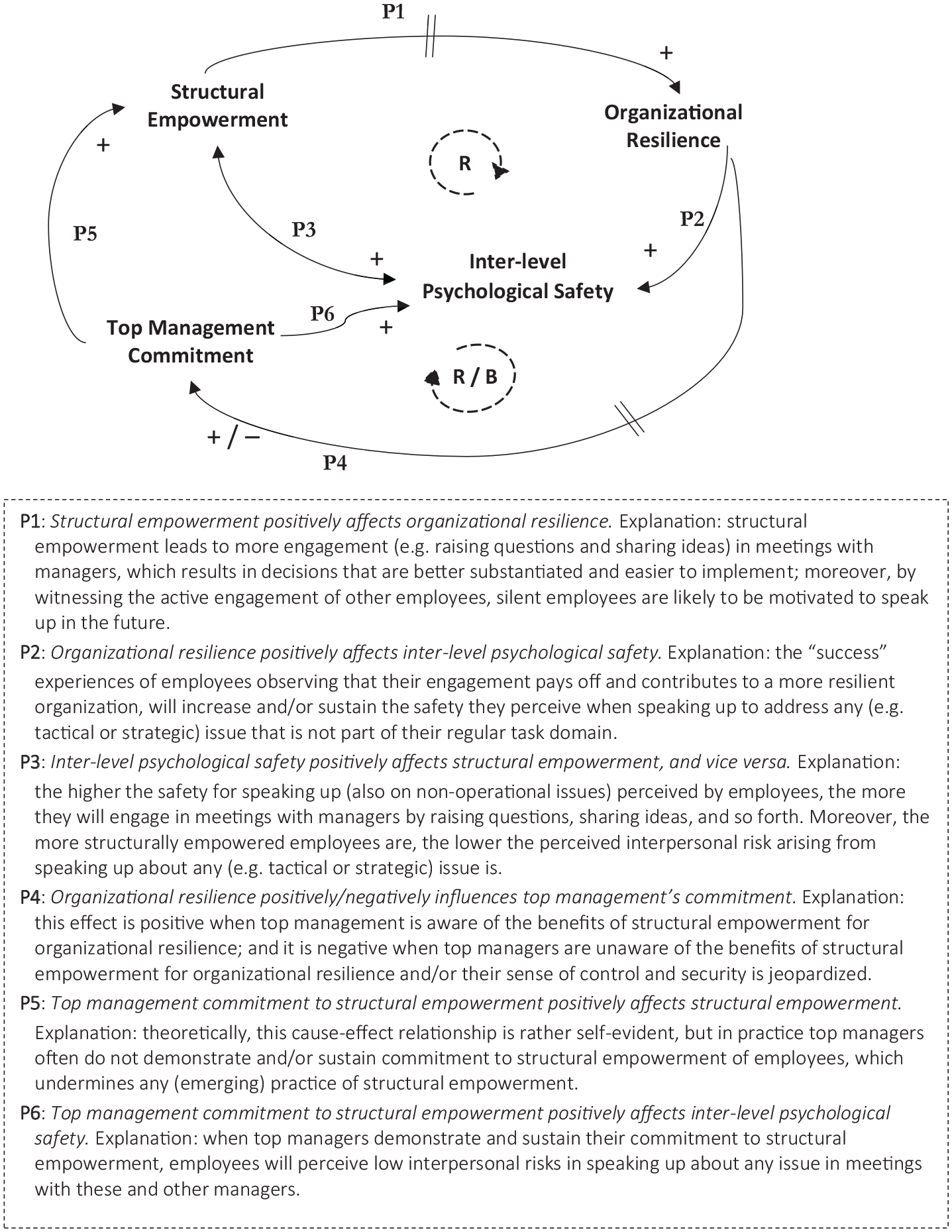
Causal loop diagram of the main findings.
A pivotal proposition is the delayed cause–effect relationship (P4) between organizational resilience and top management commitment. In the IVT case, we observed that top management’s commitment to structural empowerment was present in the first half of the case narrative, but started breaking down in the second half. In Figure 1, we capture this in the dual nature of the causal effect of organizational resilience on top management commitment; we thus hypothesize that:
(a) this effect is positive (+) if top managers are aware of the benefits of structural empowerment for organizational resilience; this was apparently the case in the first part of the narrative;
(b) this effect is negative (–) if top managers are unaware of the benefits of structural empowerment for organizational resilience and/or their sense of control and security is jeopardized; the second part of the case narrative illustrates this.
Given that this causal link between resilience and commitment is about building awareness and knowledge (at the top level), we also assume it involves a major time delay. While there are more than two causal loops in Figure 1, we focus here on the two main (overlapping) loops. First, the reinforcing loop in the upper half of the figure (R) depicts how structural empowerment, organizational resilience and psychological safety reinforce each other – in a virtuous or vicious process enfolding over time. The other causal loop (R/B) depicts the causal chain from top management commitment, structural empowerment, organizational resilience and back to top management commitment. Here, the dual nature of the causal link between resilience and top management commitment highly affects the organizational patterns occurring over time. If top management sustains its commitment to structural empowerment as well as deliberately supporting a climate of psychological safety, employees and middle managers will take interpersonal risks and speak up whenever they feel the need to do so, which over time helps to grow organizational resilience, and so forth. But when (a key part of) top management is unaware of the benefits of structural empowerment and/or its sense of control and security is jeopardized, its commitment to empowerment will start decreasing, which will undermine the empowerment practice; this causal loop then changes from a reinforcing (R) into a balancing (B) loop (Sterman, 2000). In turn, the upper reinforcing loop will transform from a virtuous loop into a vicious one; that is, decreasing structural empowerment implies lower levels of psychological safety and organizational resilience, and so forth.
Discussion
The IVT case study suggests that a prerequisite for the beneficial effect of structural empowerment on organizational resilience is the presence of a climate of psychological safety across organizational levels. Moreover, structurally empowered employees are likely to enhance organizational resilience, but only if the top echelon of the organization sustains its commitment to structural empowerment over time.
Extending the construct of psychological safety
Only those managers who are open to change and willing to actually do something with the input received, will effectively invite employees to raise their voice (Detert & Burris, 2007; Roberts, 1990) and prevent empowerment from entering ‘the realm of political correctness’ in which no-one dares to speak up (Argyris, 1998, p. 9). Thus, the co-existence of managerial commitment and psychological safety provide two critical conditions for structural empowerment to come alive and fuel organizational resilience (as outlined in Figure 1).
Edmondson (1999) pioneered the concept of psychological safety within groups or teams. Other authors have advocated the application of this construct at the organizational level (Baer & Frese, 2003; Fulmer & Gelfand, 2012), but previous work has hardly or not engaged with psychological safety beyond the team level and across multiple hierarchical levels. Our study suggests that a climate of psychological safety may need to extend beyond the team level, to affect how employees and managers at different organizational levels interact with each other by speaking up and taking interpersonal risks. Especially during instances of major change, direct interactions and consultations between management and employees appear to be vital (cf. Morgan & Zeffane, 2003). The divisionalization incident illustrates how such consultations between management and employees, within a climate of psychological safety, can increase organizational resilience.
However, an organizational climate in which employees easily speak up can give rise to the paradoxical situation in which managers invite employees to speak up about ideas for improving organizational performance, but at the same time stimulate ‘unwanted’ behaviour, for example, in the form of criticizing a particular manager (Cunha, Simpson, Clegg, & Rego, 2019). This may evoke a ceremonial process in which employees are initially invited to speak up and ask questions, but their opinions and input are subsequently ignored or bypassed in making decisions. Such ceremonial behavioural patterns may mask a major incongruity between what the organization claims to stand for (in this case: structural empowerment of employees) and what it actually practises, based on ingrained ways of thinking about leadership and management (Argyris, 1977). Here, managers might publicly espouse the notion of empowerment, but then not actually ‘walk the talk of empowerment’ (Argyris, 1998, p. 8), especially when they revert to the familiar command-and-control approach because structural empowerment proves difficult and intrinsic commitment to it is lacking (Bowen & Lawler, 1995).
These behavioural patterns are also known as the ‘paradox of empowerment’ (Berti & Simpson, 2019) implying that employees feel increasingly disempowered because their agency is quite limited, while the jargon of empowerment espoused by managers is often masking these limitations. To counteract this paradoxical situation, managers can create the opportunity for ‘emancipatory dialogue’ (Raelin, 2013), in which organizational members open up to each other’s critical scrutiny, while simultaneously voicing their own opinions. More importantly, any emancipatory dialogue would imply that people open up to hostile information, that is, information that makes them uncomfortable (Gouldner, 1970; Raelin, 2013). The structural empowerment practice observed in (the first part of) the IVT narrative appears to offer employees ample opportunities to engage in such emancipatory dialogue.
Managerial commitment to structural empowerment
It is commonly assumed that employees have substantial discretion to decide how to respond to ambiguous demands, but often feel they do not have the power to do so (Berti & Simpson, 2019). Thus, managers simultaneously need to relinquish some of their formal power, by giving employees substantial discretion in (giving input to) decision-making, to grow the power of the collective organization and create an empowered workforce. This requires that managers change their mindset from viewing employees as ‘hierarchical unequals’ to considering them as individuals with different kinds of knowledge and expertise that are relevant to decision-making (Labianca, Gray, & Brass, 2000), thus acknowledging that power is not a zero-sum game (Lincoln, Travers, Ackers, & Wilkinson, 2002). Here, IVT had the advantage that the mindset of its management was already focused on engaging employees in decision processes (prior to 2012).
Some prior studies of decision-making have touched upon the benefits of looking beyond the strategic level of executive and supervisory boardrooms (Korsgaard, Schweiger, & Sapienza, 1995; Raes, Heijltjes, Glunk, & Roe, 2011). However, where these studies focused on the interface between the strategic and tactical level, our study underlines the necessity to also include the interaction between tactical and operational decision-making levels. The more individual employees can contribute to (strategic and tactical) decision-making and reflection, the larger and the more varied the palette of ideas is on which the organization can build (Alexiou, Khanagha, & Schippers, 2019). Simultaneously, structural empowerment at all organizational levels can help overcome the blind spots of management arising from their selective cognitive focus (Ocasio, 1997). Thus, there is clear organizational value in structurally empowering employees to participate in decision-making. However, the findings from the IVT case suggest that this value is not always recognized by management.
That is, efforts to change the conventional structure at the supervisory board level (to comply with the guidelines of CM) met with huge resistance within the board of IVT. In this respect, efforts to change a deeply embedded structure perceived as highly legitimate are often met with resistance because such changes jeopardize key actors’ sense of control and security (Powell, 1991). IVT’s supervisory board members indeed may have felt threatened by the idea of including an employee representative in the board room, therefore purposefully halting the institutionalization process of structural empowerment.
At the same time, only these key agents can alter such an institutionalized structure. That is, institutional contradictions – as reflected in a (largely) redundant institution such as the works council in the case studied – may motivate organizational members to change their beliefs regarding (what would be) legitimate solutions as well as turn to other logics to justify their actions (Seo & Creed, 2002). Presumably, the fact that CM was initiated by the managing director and the supervisory board decided to implement a works council (regardless of CM), also signals a lack of shared vision at the top level of IVT. In this respect, the construct of organizational resilience remains ambiguous, and thus executive and supervisory board members may not (partly) attribute it to employee empowerment. The supervisory board at IVT proved unaware of the benefits of structural empowerment and, moreover, its sense of control was jeopardized.
Theoretical contributions
Our study serves to open up the black box of structural empowerment, by exploring how it generates patterns of organizational behaviour that promote organizational resilience. The IVT case study suggests that a sustained commitment by top management to structural empowerment is a necessary condition for consolidating the positive role of psychological safety as a key condition for (sustaining) empowerment. Figure 1 positions this insight in a theoretical framework that underlines the dynamic complexity of the relationships between structural empowerment, organizational resilience, inter-level psychological safety and top management commitment. Our study thus makes two main contributions to the literature.
First, we find that structural empowerment positively affects organizational resilience, but also that structural empowerment is contingent upon a climate of psychological safety. We move beyond the latter construct, as coined by Edmondson (1999), by showing that psychological safety is not only vital for team performance (Choo, Linderman, & Schroeder, 2004; Huang, Chu, & Jiang, 2008), but also organizational performance. Edmondson (1999, p. 354) defined psychological safety as ‘a shared belief that the team [emphasis added] is safe for interpersonal risk-taking’ and that it is ‘meant to suggest a sense of confidence that the team will not embarrass, reject, or punish someone for speaking up’. Our findings remain true to this initial definition, but broaden the ‘shared belief’ component of Edmondson’s definition to also include inter-group and multi-level interactions across the entire organization – and especially meetings between employees and managers in which non-operational issues are discussed. Baer and Frese (2003) already argued that psychological safety is an organizational rather than team-level construct, and we extend their argument by introducing the construct of inter-level psychological safety, referring to interpersonal risk-taking across different organizational levels.
Second, our study suggests that the positive effect of structural empowerment on resilience is also contingent on top management’s commitment to structural empowerment. The latter directly affects any (emerging) structural empowerment practice, but also indirectly via its effect on psychological safety (Figure 1). Thus, top management commitment that is sustained over time appears to be a key condition for consolidating any positive effects of structural empowerment. Within IVT, the lack of top management commitment to structural empowerment and psychological safety surfaced over time. Here, the pivotal role of top management’s commitment to structural empowerment, as a key driver of organizational resilience, extends previous studies that focus on workplace resilience at the level of individuals and teams (Goodman et al., 2011; King, Newman, & Luthans, 2016) without acknowledging the role of top management.
We also shed new light on structural empowerment by arguing that it needs to include employees as agents (potentially) affecting organizational decisions beyond the operational sphere. The extant literature typically assumes the decision-making influence of employees to be limited to ‘involving subordinates in making non-trivial work unit decisions’ (Scandura, Graen, & Novak, 1986, p. 579). Indeed, managers commonly define empowerment in such a way that it does not allow employees to contribute to strategic and tactical decisions (Wilkinson, 1998). This study highlights the value of engaging employees in non-trivial decisions that move beyond the work unit. This finding also justifies our extension of the framework of Laschinger and colleagues (2004) in the Background section, where we argued that employees should not only be empowered within their operational task domains, but also be able to influence tactical and strategic decisions.
Limitations and directions for future research
One clear limitation of this study is the single case approach adopted, which generated in-depth insights that cannot be readily generalized to other settings. Nevertheless, this case study generated novel insights that can fuel future research in other organizations and other contexts.
Our theoretical framework highlights four core constructs and their relationships, and therefore does not capture any other constructs and relationships. For example, top management commitment itself is not an isolated condition, but is likely to be affected by many other variables (e.g. Calabretta, Gemser, & Wijnberg, 2017; Detert & Burris, 2007) beyond the scope of this paper. Moreover, we conceived of organizational resilience as the main outcome of three other variables (Figure 1) and assumed that resilience, in turn, affects psychological safety and top management commitment, giving rise to dynamic feedback loops. In future work, this framework could be further developed and tested, including as a mathematical simulation model (Sterman, 2000).
Our findings suggest that structural empowerment can have beneficial consequences other than improving resilience, such as increasing employees’ commitment, engagement and performance (Buck & Endenburg, 2012; Sessions, Nahrgang, Vaulont, Williams, & Bartels, 2020). Future research can more systematically scrutinize the specific effects of structural empowerment on beneficial employee behaviour, such as citizenship behaviour (e.g. LePine, Erez, & Johnson, 2002).
This study also provides insights into the importance of top management sustaining its commitment over time. Using longitudinal research designs, future research could explore how managerial commitment to structural empowerment affects psychological safety and organizational resilience, and especially how changes in such commitment affect organizational resilience. As the initiation of psychological safety and structural empowerment so heavily depends on management, future research should dive deeper into the specific leadership behaviours enabling employee empowerment and psychological safety (e.g. Neeley & Reiche, 2020), which in turn are critical for organizational resilience. This also raises the question as to how an organization can actually maintain structural empowerment and psychological safety, in the absence of top management commitment: can empowerment initiatives be made less dependent on individual managers? In an ideal world, organizational resilience would be a capability that is deeply ingrained in the organization’s structure and culture, and not a house of cards that dissolves when the top echelon changes its mind.
Conclusion
This study opens up the black box of structural empowerment, by exploring how the latter generates patterns of organizational behaviour which promote organizational resilience. The IVT case study suggests that a sustained commitment by top management is a necessary condition for structural empowerment and is also critical in consolidating the positive role of psychological safety as another key condition for structural empowerment. With these findings, the main contribution to the literature is the grounded hypothesis that structural empowerment positively affects organizational resilience, and also that structural empowerment is contingent upon a climate of inter-level psychological safety. Here, we move beyond the extant conceptualization of psychological safety by demonstrating its inter-level nature in the context of structural empowerment, especially when employees engage in discussions on tactical and strategic issues.
Supplemental Material
sj-pdf-1-oss-10.1177_01708406211030659 – Supplemental material for How Structural Empowerment Boosts Organizational Resilience: A case study in the Dutch home care industry
Supplemental material, sj-pdf-1-oss-10.1177_01708406211030659 for How Structural Empowerment Boosts Organizational Resilience: A case study in the Dutch home care industry by Jennifer van den Berg, Alex Alblas, Pascale Le Blanc and A. Georges L. Romme in Organization Studies
Supplemental Material
sj-pptx-1-oss-10.1177_01708406211030659 – Supplemental material for How Structural Empowerment Boosts Organizational Resilience: A case study in the Dutch home care industry
Supplemental material, sj-pptx-1-oss-10.1177_01708406211030659 for How Structural Empowerment Boosts Organizational Resilience: A case study in the Dutch home care industry by Jennifer van den Berg, Alex Alblas, Pascale Le Blanc and A. Georges L. Romme in Organization Studies
Footnotes
Appendix
Main coding results per incident.
| CRITICAL INCIDENTS | Summary | Patterns | |||||||
|---|---|---|---|---|---|---|---|---|---|
| 2012 | 2014-2015 | 2015 | 2016-2017 | 2017-2018 | 2018 | ||||
| The start of circular management | Reduction of client hours & growing work pressure | Two takeovers | Creating divisions | The introduction of a works council | Departure of the managing director | ||||
|
|
Due to budget cuts by Dutch government, responsibility for home care moves to local governments, resulting in forced tendering procedures and care-quota imposed by the municipalities and insurance companies, respectively. These developments put huge pressures on home care service companies, by making a substantial number of their employees redundant and also severely limiting the number of hours a home care worker is allowed to spend with a client, strongly increasing workload among employees. As a result, a substantial number of companies files for bankruptcy. | ||||||||
|
|
The gradual growth of IVT over the years implies that IVT needs to comply with the Dutch law on employee participation. As the distance between management and employees starts to increase, the managing director wants to maintain the inclusive character of the organization and counteract underperformance of one IVT department by implementing CM. | In the first half of 2014, IVT starts preparing for upcoming changes, assuming a substantial increase in work pressure for DC workers and thus also increasing absence/sickness rates. IVT’s managing director, therefore, urges all employees to signal as early as possible if someone might become overworked. Still, many employees struggle to adjust their work routine at the client’s premises to the new regulations. | IVT manages to keep up its performance, which is not the case for many other home care providers. The two other home care providers operating in the same city as IVT need to file for bankruptcy. In this period, IVT experiences major growth, primarily due to the increase in DC employees and clients taken over from two (former) competitors. | IVT is organized as one legal entity, incorporating three departmental units. However, the managing director foresees the need to separate the two main units, Home Care (HC) and Maternity Care (MC), as they are increasingly diverging. In the current legal structure, the underperformance of one unit could affect the performance of the other unit, which is also unacceptable for the insurance companies and municipality. Therefore, an important starting point is to safeguard each unit's financial continuity and independence in the longer term. | By the end of 2017, IVT’s supervisory board decides that a works council needs to be established and assigned the managing director to prepare the introduction of this council. While the CM approach provides the opportunity for obtaining an exemption from the legal requirement to establish a works council, the supervisory board prefers to conform to the governance code (only referring to a works council) for the Dutch home care industry. | The managing director announces he will become the managing director of another home care-providing company, located in another Dutch city where his wife works. This career step is thus largely motivated by personal reasons, but comes as a surprise to many within IVT, especially long-time office workers. | |||
|
|
Formal empowerment | Employees are not involved in the decision to introduce CM, but it then allows them to actively engage in the process of preparing, discussing and deciding on other company policies. The managing director informs the SB about the adoption of CM, but does seek to train the SB in this approach (see the works council incident). Employees are informed through trial meetings on how CM works (at tactical & operational level). | The reduction of hours per client (from 4 to 2.5 hours) is a regulatory change imposed on IVT. | The municipality urges IVT to take over clients and employees from two bankrupt competitors, forcing top management to act quickly (A1) and only inform employees afterward. Management is thus not involved in decision making by the municipality and subsequently cannot involve its employees in the decision to take over the activities and staff of two bankrupt competitors. New operational staff (DC) is informed about CM and involved (A3). A lack of formal empowerment of the strategic level can be witnessed as a proposal to create a top circle is rejected by the supervisory board (SB) (A5) | All employees are involved in the formal decision-making process regarding this strategic proposal (B1) | Employees are not involved in the decision- making process (tactical, operational). The SB decides to establish a works council, despite opposition from the managing director and other staff (B4). The intro of a works council is thus imposed by the SB, leaving no opportunity for anyone to influence this decision. | Members of works council co-decide on appointing the interim managing director and later also the new managing director. |
In all incidents prior to the implementation of a works council, formal empowerment processes prevail throughout IVT; only when urgent circumstances demand speed (in case of clients no longer serviced by bankrupt competitors), employees are not consulted. The introduction of a works council appears to be a key turning point, after which structural empowerment practices break down. | The commitment of management to formal empowerment then has a spillover effect on informal empowerment. The commitment to structural empowerment in turn supports a climate of psychological safety to arise and thrive. |
|
|
Informal empowerment | Strong social connections among office staff (already present before CM introduction) creates a strong sense of involvement with the organization, enabling the adoption of CM. By introducing CM, support conditions and resources for empowerment are created. | Office staff notices an increasing distance between them and the managing director, resulting in less positive social connections between tactical and strategic level. DC employees positively connect and interact by airing issues with colleagues (in circle meetings) (operational). | During the takeover effort, the existing social connections among office workers are characterized by a strong sense of solidarity and commitment among these workers, which helps in dealing with the high workload arising from the unexpected takeovers (cf. tactical level) (A2). New social ties are established with (and among) new DC employees coming from the other two companies. | Employees positively interact throughout the organization, as they openly appreciate the opportunity to engage and feel genuinely included in the decision-making process (B1+B2). Management is supported by SB to investigate the divisionalization proposal (strategic) (B3) | As IVT has adopted CM as an empowerment system and employees are not consulted about (the SB’s wish to) establishing a works council, many of them talk about it in negative terms while others are indifferent toward this decision. The informal interactions and connections between employees and management thus deteriorate in this episode. |
The connections and interactions between staff members are under pressure, and distrust and tensions start to arise. | Prior to 2012, there already was a strong informal empowerment process that was subsequently enhanced by CM. It is not until the introduction of a works council that all organizational levels start interacting in an increasingly negative manner. This appears to be a direct result of a lack of formal empowerment by IVT’s management, which trickles down to other levels. | |
| Management is not supported by SB with regards to CM and is thus obligated to implement a works council (strategic) (A5+B4). | |||||||||
|
|
IVT’s management demonstrates trust in employees, by implementing a rather exceptional form of governance (CM). |
DC employees feel circle meetings (also attended by their unit manager) provides a safe setting to speak up about their dissatisfaction. |
New DC employees feel secure to express their appreciation toward the organization being willing to give them employment opportunities as well as a voice (operational). At the same time however, |
Management trusts employees by giving them ample opportunity to give input. Many employees, in turn, feel rather secure to speak up about various (tactical and operational) problems arising from divisionalization; several employees join the support circle formed to develop the proposal and feel that management listens to them (B1+B2). | Employees feel secure to express their doubts and questions concerning the decision of SB to establish a works council. | A strong sense of distrust among office workers arises. They increasingly hold themselves back from speaking up and raising critical questions. At the same time, the works council appears to provide a setting where employee representatives feel secure to give critical input to a member of the SB – for example, regarding candidates proposed for the vacant position of Managing director. | The first four incidents (up to 2017) took place in the presence of a high level of psychological safety between management and lower levels. Only after (the disempowerment due to) the introduction of the works council and the departure of the managing director, psychological safety appears to become endangered throughout the organization. | When inter-level psychological safety is sustained by management over time, it enables structural empowerment and thereby organizational resilience. At the same time, psychological safety can erode when structural empowerment is not sustained. | |
Funding
The author(s) received no financial support for the research, authorship, and/or publication of this article.

Notes
Author biographies
References
Supplementary Material
Please find the following supplemental material available below.
For Open Access articles published under a Creative Commons License, all supplemental material carries the same license as the article it is associated with.
For non-Open Access articles published, all supplemental material carries a non-exclusive license, and permission requests for re-use of supplemental material or any part of supplemental material shall be sent directly to the copyright owner as specified in the copyright notice associated with the article.
