



Abstract
How is it possible to gain a sense that you have a voice and that your life matters when you have lost everything and live your life as a ‘displaced person’ in extreme precarity? We explore this question by examining the mundane everyday organizing practices of Syrian refugees living in tented settlements in Lebanon. Contrasting traditional empirical settings within organization studies where an already placed and mattering subject can be assumed, our context provides an opportunity to reveal how relations of recognition and mattering become constituted, and how subjects in precarious settings become enacted as such. Specifically, drawing on theories on the relational enactment of self and other, we show how material-discursive boundary-making and invitational practices – organizing a home, cooking and eating, and organizing a digital ‘home’ – function to enact relational host/guest subject positions. We also disclose how these guest/host relationalities create the conditions of possibility for the enactment of a subject that matters, and for the despair enacted in everyday precarious life to transform into ‘undefeated despair’.
Keywords
Introduction
Research exploring the ongoing (re)production of subject positions in precarity can be found in a variety of related and overlapping research streams – for example, those focusing on resistance (Bristow, Robinson, & Ratle, 2017; Harding, Ford, & Lee, 2017), micropolitics (Courpasson, 2017; Fernández, Martí, & Farchi, 2017), social movements (Haug, 2013; Reedy, King, & Coupland, 2016), precarious work (Moisander, Groß, & Eräranta, 2018; Vallas & Christin, 2018), identity work (Cinque, Nyberg, & Starkey, 2020; Westwood & Johnston, 2012) and identity regulation (Gotsi, Andriopoulos, Lewis, & Ingram, 2010; Vallas & Cummins, 2015). These streams of research have accounted for the ongoing work by the precarious subject to position herself relative to other individuals, groups, organizational settings and discourses in order to produce the agentic possibilities necessary to enact change. We argue, however, that these studies have not yet accounted for the work that precedes the agentive strategies and practices of an already recognized and positioned subject. This is the work that needs to take place before social identity, political agency and collective action, necessary to transform precarity in everyday life and work, make sense and can become possible; it is the work necessary for the displaced person to experience belonging, dignity, that her life matters and that change is worth hoping and striving for.
Our study explores how subject positions become enacted and reconfigured in an extreme case of precarity: the everyday lives of Syrian refugees living in informal tented settlements in Lebanon. Having left their homes and belongings, their friends and families, their work and studies, the sites of their culture and traditions, and being granted only the temporary status of ‘displaced persons’ by their hosting state (thus restricting their legal rights and their access to the regular job market), these people struggle not only to secure the material means for survival, but also to find the relations of recognition necessary to develop and uphold a sense that they have a voice and that they matter (Butler, 2004, 2009a, 2009b). Grounded in this empirical case of extreme precarity, our study explores the following research question: How can the displaced subject in extreme precarity become placed and recognized as a subject that matters?
Theoretically, we build on and contribute to the literature on how subject positions, and their associated agentic possibilities, are enacted and reproduced in everyday practices (Harding et al., 2017; Gagnon & Collinson, 2017; Skovgaard-Smith, Soekijad, & Down, 2020; Westwood & Johnston, 2012). More specifically, we engage with literature studying how subjects work to reposition themselves in precarious conditions (Cinque et al., 2020; Dalton & Jung, 2019; Mackenzie & McKinlay, 2020; Petriglieri, Ashford, & Wrzesniewski, 2019; Van Laer & Janssens, 2017). In reviewing this literature, we identify three shortcomings that restrict our understanding of how the precarious subject gains a voice within the relational (re)positionings of the ‘I’ and the ‘other’. First, we find that the literature has predominantly studied subjects that are already placed, recognized and mattering (e.g. Bange, Järventie-Thesleff, & Tienari, 2020; van Laer & Janssens, 2017; Westwood & Johnston, 2012). Second, in line with previous critics (e.g. Harding et al., 2017; Knights & Clarke, 2017) we observe a tendency of prior studies to account for relational subject (re)positioning in ways that magnify and dramatize difference, or construct the ‘I’ as in some way superior in relation to the inferior and less desirable ‘other’ (Skovgaard-Smith et al., 2020; Ybema et al., 2009). Finally, we find that previous research has a tendency to focus on discursive and spatial practices in repositioning while backgrounding mundane material-discursive organizing practices of everyday life (Harding et al., 2017; Skovgaard-Smith et al., 2020).
We argue that it is important to develop a deeper understanding of how relations of recognition are enacted in the mundane everyday life in precarity, because these relations constitute proto-political sites of mattering (Butler, 2004, 2009a, 2009b). These are not sites from which social movements or political change necessarily emerge, but sites in which the precarious subject can render her feelings, intentions and actions visible and meaningful (Lepold, 2018), discover a voice and start exploring how it can be used to redraw the boundaries conditioning her possibilities to act and become (Butler, 2004). Without an adequate account of the specific practices through which relations of recognition and mattering emerge, we will not be able to make sense of how political agency and gestures such as making claims, demanding rights, resistance, or activism emerge from the mundane. As Krause and Schramm suggest, we need to study: how political subjectivity emerges in the first place, that is, how individuals or groups gain a position which makes them recognizable as such. It is only through these forms of recognition that they gain voice and are therefore able to address authorities, but it is through the same processes that they can in turn also be addressed as subjects. (Krause & Schramm, 2011, p. 127)
Drawing on the work of Butler (2004, 2009a, 2009b) on the relational enactment of subjectivity and of Derrida (1997) on the guest/host relations of hospitality, our study shows how the displaced subject becomes placed and recognized in everyday practices of organizing. Specifically, we show how co-constitutive boundary-making and invitational practices produce the conditions of possibility for the enactment of host/guest relations of recognition (Derrida 1997), and how these host/guest relationalities, in turn, constitute the conditions of possibility for the emergence of a subject that matters: a person with a sense of dignity, belonging, voice, and hope (Butler 2004, 2009a, 2009b).
In providing this relational account of becoming placed and recognized we contribute to the literature that challenges the pervasive conception that precarious subjects are either passive victims or active and creative individuals that use a variety of strategies to refuse to take up circumscribed subject positions. Specifically, we show how the ‘displaced subject’, through everyday hospitality practices, becomes placed and recognized in relation to an ‘other’ situatedly, conditionally and with fragility. Our analysis also shows that the precarious subjects are always implicated in a multiplicity of guest/host relations simultaneously and that this multiplicity and ambiguity opens up spaces where recognition can be negotiated, and where boundaries can be drawn or withdrawn contingently in order to create (or disperse) recognition and associated opportunities for agency. Not necessarily to engage in political action, but first and foremost in order to make life meaningful and tolerable – to transform despair into undefeated despair (Berger, 2006).
Finally, through our study we show why these mundane hospitality practices are indeed significant for all precarious subjects, wherever they find themselves, not only to make life meaningful and tolerable but also to produce the agentic possibilities to think, act and develop a voice that matters (Chen, 2016).
On the Possibility of Becoming a Subject That Matters in Precarity
The relational (re)production of subject positions and agentic possibilities
In assuming a relational view of the subject, emphasizing how it emerges and is continuously reconstructed as both the source of oppression and the site of emancipation (Foucault, 1980), the literature on subject positioning has considerably advanced our understanding of how possibilities to act, become, resist and change one’s life conditions are enacted and reproduced in discourse and practice. For example, it has explicated how subordinated groups of people, such as precarious workers (Cinque et al., 2020; Petriglieri et al., 2019), ethnic minorities (Van Laer & Janssens, 2017), migrant sex workers (Dalton & Jung, 2019), employees experiencing insecurity and anxiety because of their position within multiple and conflicting discourses (Bristow et al., 2017; Collinson, 2003), or activists protesting threats to their environments (Fotaki & Daskalaki, 2021), can work to manage the emotions stirred up by their precarious lives or work, mobilize their resources, resist managerially imposed demands and attempts at identity regulation, and bring about real and sustainable change in their lives. It has developed our understanding of the agentic strategies individuals use to refuse to take up subject positions within particular discourses (Nentwich & Hoyer, 2013; Thomas & Davies, 2005), dis-identify and distance themselves from an organization and its attempts at identity regulation (Anderson, 2008; Elidrissi & Courpasson, 2021; Fleming & Spicer 2003), or draw upon alternative subject positions or discursive resources to assert or rewrite the subject positions offered by dominant discourses (Clarke, Brown, & Hailey, 2009; Essers & Benschop, 2009; Van Laer & Janssens, 2017).
Although this broad stream of research has accounted for the processes and consequences of subject positioning in many different contexts and precarious conditions, it has, thus far, been positioned within empirical contexts where subjects are already recognized and acknowledged as having a voice and a ‘place at the table’. In other words, the subjects that organizational scholars typically study (managers, consultants and organizational members) are subjects already positioned and recognized in relation to an ‘other’ – that is, already included in a legitimate social category or institution (such as an organization or profession). They already believe they have a voice and that their lives matter. Even research studying people in precarious conditions focuses on subjects already positioned within and recognized by some form of legitimate social affiliation, cultural category, or organizational entity, such as a professional occupation (Cinque et al., 2020; Petriglieri et al., 2019), industrial sector (Mackenzie & McKinlay, 2020; Rizzo & Atzeni, 2020), alternative group (Reedy et al., 2016), cooperative (Fernández et al., 2017), online community (Bange et al., 2020; Juris, 2008, 2012), a recognized ethnic minority (Van Laer & Janssens, 2017) or asylum seekers (Hultin & Introna, 2019).
Correspondingly, research on refugees’ and migrants’ organizing practices tends to focus on the actions of such already recognized subjects, and how they work to organize themselves in support of immigration reform and inclusion (de Graauw, 2016; Voss & Bloemraad, 2011), secure access to education for undocumented students (Nicholls, 2013), or express themselves politically through civic participation and religious activities (Ramakrishnan & Bloemraad, 2011). Certainly, these studies on precarious workers and migrants or refugees contribute to our understanding of how such subjects can enact agency and transform their precarious conditions. However, by assuming as their starting points subjects that are already positioned as recognized, they do not account for the practices through which the utterly displaced subject becomes placed, recognizes her thoughts, actions and life as meaningful and mattering, and can begin to see resistance and transformational practices as relevant and meaningful.
Moreover, in focusing on already positioned and recognized subjects, studies tend to place analytical emphasis on how individual subjects work to position themselves by differentiating, distancing, excluding or degrading the ‘other’ (Skovgaard-Smith et al., 2020; Ybema et al., 2009; Ybema, Thomas, & Hardy, 2016). Mobilized to strengthen identification with an ‘us’, such differentiation often involves constructing the ‘I’ as superior and the ‘other’ as inferior and less desirable (Skovgaard-Smith et al., 2020; Ybema et al., 2009, 2016), with such binary oppositions magnifying and dramatizing differences between active and ‘smart’ resistors and passive and ‘poor’ victims (Ybema et al., 2009, 2016). Recent research within organization studies (Harding et al., 2017; Knights & Clarke, 2017; Skovgaard-Smith et al., 2020; Ybema et al., 2016) and on refugees and displaced people in extreme precarity (Kallio, Häkli, & Pascucci, 2019; Krause & Schramm, 2011; Staeheli, 2008) emphasizes that this tendency to separate and foreground the agentive work of the ‘I’ and the emphasis on boundaries drawn to exclude and degrade the ‘other’ constrain us from developing a more nuanced understanding of the co-constitutive relationality of the ‘I’ and the ‘other’. Here, we identify an opportunity to further develop relational approaches and vocabularies that allow us to foreground the ontologically entangled and interdependent relationships of the ‘I’ and the ‘other’, especially as co-constitutive relations of recognition and mattering (Butler, 2004, 2009a, 2009b).
Finally, research on how subject positions are reconfigured under precarious conditions has so far tended to focus mostly on discursive practices, such as interviewee accounts (Mackenzie & McKinlay, 2020; Van Laer & Janssens, 2017), narratives (Cinque et al., 2020; Gagnon & Collinson, 2017), and situated talk (Westwood & Johnston, 2012). While some studies have addressed nonverbal forms of subject (re)positioning (e.g. Harding et al., 2017; Kachtan & Wasserman, 2015; Thanem, 2012) and the contextual dimensions of such (re)positioning (Baikovich & Wasserman, 2020; Gagnon & Collinson, 2017), the ways in which mundane material-discursive organizing practices of everyday life and work become implicated in the relational positioning of subjects remains underexplored and under-conceptualized, especially under conditions of precarity. How might we respond to these three limitations outlined above? For this we turn to the work of Butler and Derrida on relationality and practices of hospitality.
Coming to matter through practices of hospitality
In accounting for how relations of recognition are enacted in the everyday precarious life and condition possibilities for the becoming of a subject that matters, we adopt a relational ontology, drawing on Butler’s (2004, 2009a, 2009b) view of precarity and precariousness, and Derrida’s notion of hospitality (Derrida & Dufourmantelle, 2000). In Butler’s (2004) understanding, precarity is a state experienced by the marginalized, poor and disenfranchised human subject, exposed to economic and social insecurity, physical and symbolic violence, injury and forced migration. Precariousness, on the other hand, is not a condition that can be spatially and/or temporally bracketed, or limited to a specific context or condition. Rather, it is an ontological and existential condition of our subjectivity – of being recognized as a valid and legitimate subject by others – and life, more generally (Butler, 2004).
Precariousness thus operates in the micro-spaces of everyday life – what Foucault (1980) would call the micro-politics of daily life – in which individuals think and feel and interact, and in the already-implied norms governing this thinking, feeling and interaction as they attempt to anchor their subjectivity as mattering. In this view, subjectivity is not original but rather relationally and performatively enacted (Butler, 2004, 2009a, 2009b). This relationality means that the conditions of possibility to be a particular subject is always already in the hands of others. As such, these conditions of possibility can disappear or be transformed contingently and arbitrarily, rendering our ongoing existence precarious. Butler writes: Precariousness implies living socially, that is, the fact that one’s life is always in some sense in the hands of the other. . . implies being impinged upon by the exposure and dependency of others, most of whom remain anonymous. These are not necessarily relations of love or even of care, but constitute obligations towards others, most of whom we cannot name and do not know, and who may or may not bear traits of familiarity to an established sense of who ‘we are’. (Butler, 2009b, p. 14)
As ongoing relational and performative enactments, subjects can never secure a position in which their relations of recognition stabilize and become unambiguous and in which their experiences of acceptance are guaranteed. Rather, what is recognized as normative behaviour (what is considered appropriate and legitimate), and meaningful categories (a refugee, a displaced person, a home, a host), become negotiated and (re)produced through the ways in which relational boundaries are continuously (re)drawn in everyday situated practices (Barad, 2007). These boundaries are not necessarily physical boundaries that spatially or materially separate to enact relations of power and legitimacy. Rather, they constitute the situated and iterative enactments of relational practices through which the ‘I’ and the ‘other’ become positioned and conditioned to recognize each other in specific ways (Barad, 2007; Butler, 2004). Thus, boundaries conditioning relations of recognition are never distinct, nor determining; rather, they are vague and always open to negotiation. It is this very instability of these boundaries that allows for the ongoing relational enactment of agentic possibilities.
How are these boundary-making practices and relations of recognition enacted specifically? And why are they significant in constructing subjects with a voice that matters? To help us understand this, we will draw on the notion of hospitality offered by Derrida (1997, 1999). Hospitality is a relationally enacted practice of the ‘welcoming of the other; the invitation to the stranger’ (Derrida, 1997, p. 110). It is the practice and the relations of recognition that emerge as one stranger crosses the threshold (or boundary) to another stranger’s home, as these individuals abandon their status of being two strangers and recognize each other in new positions (as host and guest) that enact a new set of norms of how, and how not, to act. In these relations of recognition, the boundary and the invitation are co-constitutive. The existence of some form of boundary renders the invitation possible – without it, no invitation makes sense.
However, the practice of an invitation participates in the enactment of a boundary: ‘This is mine, I am at home, you are welcome in my home’ (Derrida, 2000, p. 14). In crossing the boundary, the authority of the host (exactly as the ‘host’) in relation to the guest is enacted as legitimate. Importantly, an invitation can only be made, legitimately, if the boundary is already owned in some way. As such, the host is claiming: ‘please feel at home, act as if you were at home, but, remember, that is not true, this is not your home but mine, and you are expected to respect my property’ (Derrida, 1997, p. 111).
While Derrida’s notion of hospitality has received little attention in organization studies, recent studies (e.g. Farias, 2017) have highlighted that it allows us to account for the relational becoming of subjects without enacting the ‘other’ as an indifferent and interchangeable individual.
Methods and Data
Data collection
Our fieldwork was conducted in ten tented Syrian refugee settlements in Lebanon. We conducted two field trips, in May and September 2017 for data collection by the first and third author. The third author, with extensive experience from ethnographic fieldwork in challenging contexts, conducted 40 days of fieldwork, while the first author spent five days in the field. The first trip (nine days) was used to identify salient issues and potential lines of inquiry, understand the context, establish contacts and conduct interviews with Syrian refugees as well as with NGO workers, academics and social entrepreneurs. The second field trip (31 days) focused specifically on refugees living in tented settlements in the Akkar and Bekaa Valley districts, both with large numbers of refugees. Our focus was partly informed by concurrent literature studies, particularly by Butler’s ideas on the conditions of possibility for precarious subjects to gain a voice and become ‘subjects who are worth mourning’ (Butler, 2004, 2009a, 2009b).
We interviewed 58 people in ten different camps in the two districts. Four interviews were group discussions (three groups with three women each; one group with four women). Interviews were mostly conducted in participants’ own homes, usually accompanied by mate tea or coffee, seated in plastic chairs put forth in our honour, on mattresses, or directly on the floor. Interviews ranged from 30 minutes to two hours, averaging 60 minutes. All were recorded. The interviews were conversational in nature, but also guided by an interview protocol developed with the aim of capturing detailed accounts of everyday practices of being and living in the camps. At day’s end, we wrote field notes summarizing and reflecting on the day’s events.
We employed a total of three translators, all immersed in the local context. Our main translator in Akkar knew most of the people in the camps we visited and was instrumental in establishing rapport with interviewees. Local aid workers also facilitated access to the camps. Full transcripts of each interview were produced by people who spoke native Arabic and professional English and who both transcribed and translated the interviews into English. Unclear statements in the translations were followed up with the translators and corroborated with recorded direct translations. Transcripts varied between 4,447 and 14,654 words, averaging 9,114 words. Finally, our data set includes a large number of policy and media documents addressing the situation of Syrian refugees in Lebanon.
Data analysis
Informed by literature, ongoing scholarly debates and previous work conducted from a performative perspective (Butler, 2009a, 2009b; Hultin, Introna, & Mähring, 2021; Mandalaki & Fotaki, 2020), our primary concern in the early stages of data analysis was to understand how life in displacement was lived, made sense of, and coped with in mundane everyday practices of life in the camps. Transcripts and field notes were iteratively read and re-read, generating codes describing everyday practices in the camps (looking for a job, children, cooking, celebration, memories, loss, family, money, clothes, entertainment, smartphone, NGO, etc.). Already in this initial phase, we observed how the practice of inviting, such as inviting neighbours for food or mate (tea) and inviting people (including the field researchers) on Facebook and WhatsApp, were central to the everyday lives of the refugees. Interviewees also highlighted the opportunity to invite as a positive experience through which they could recall and regain a sense of autonomy and of self.
As we were considering these practices of invitation, we started to connect it to Derrida’s discussion of friendship and hospitality (Derrida, 1997), which highlighted that invitations imply boundaries, especially boundaries that can be claimed to be owned in some way. This realization made us look more carefully at boundaries and boundary-making practices. Practices such as taking care of the boundaries of the ‘home’ through plantings and other material to somehow demarcate the separation between the camp and ‘my home’. Also, the pride taken in inviting us as researchers to eat in their ‘home’, in spite of their precarious existence. More specifically, we became aware of how the invitation and the boundary created a host/guest relationality (Derrida, 1997) and the ways in which this relationality enacted certain agentic possibilities – especially for the host. At this point our prior research (Hultin & Introna, 2019; Hultin & Mähring, 2017), using the work of Butler (2004, 2009a, 2009b) and Foucault (1980), sensitized us to the fact that such relations of recognition are performative, but also contingent and fragile.
By analysing the practice of inviting as a practice of hospitality through which boundaries are continuously enacted and negotiated to define host/guest relationalities, we were able to understand the acts of inviting a neighbour for tea, or a distant relative to become a friend on Facebook, as part of a continuous redistribution of agency. It allowed us to see and account for how conditions of possibility for the refugees to experience themselves as subjects with a voice and the ability to act were relationally enacted in the mundane domestic practices of the settlements. Revisiting our coded data, we identified three bundles of practices through which host/guest relationalities were produced and enabled ‘the displaced subject’ to enact a voice and a sense of home, belonging, meaning and dignity: organizing a home, cooking and eating, and connecting digitally with friends and family. The main iterations of our analysis are summarized in Table 1. Before moving on to the field context and our account for the practices, we want to acknowledge that the Syrian refugee experience in Lebanon is varied, and that these practices are not uniformly available to all refugees in tented settlements.
The various main iterations of our data analysis.
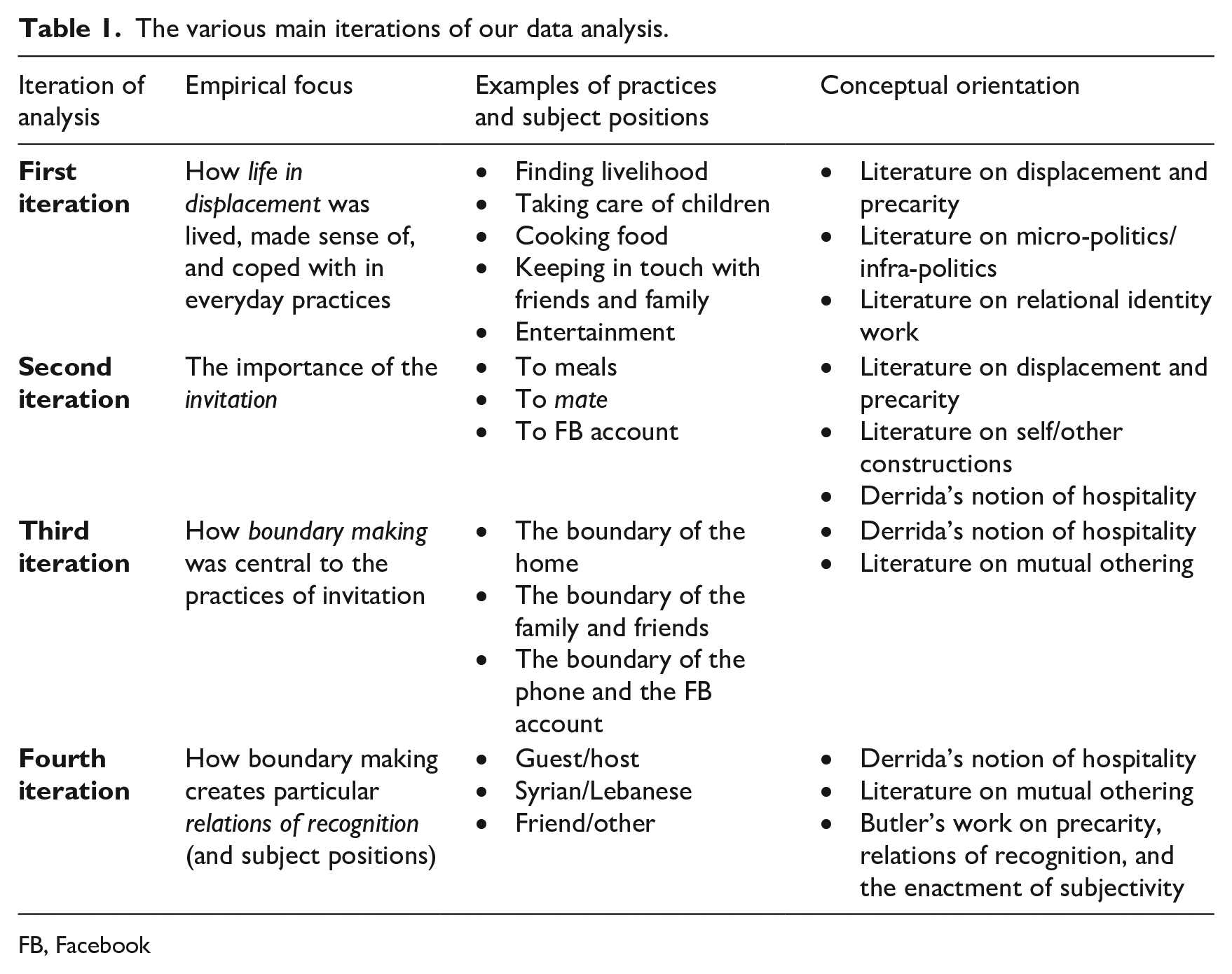
FB, Facebook
Becoming Displaced and the Production of Precarity: The Field Context
Almost one million Syrians have registered with the UN Refugee Agency, UNHCR, in Lebanon, with an additional 500,000 Syrians estimated to reside in Lebanon without UNHCR registration (UNHCR, 2016b, 2018a, 2018b). In relation to the four million Lebanese population, this huge influx constituted a heavy burden on an already fragile economy with limited state resources. As the International Crisis Group (2013) suggested early on: ‘A population influx of such magnitude would be a huge problem anywhere. In Lebanon – with fragile institutions and infrastructure; a delicate political and sectarian balance; tense social fabric; and declining economy, all of which the refugee crisis worsens – it is a nightmare.’
The Lebanese government has taken steps to deter Syrian refugees from establishing a permanent presence in Lebanon (Vohra, 2019). It has refused to set up formal refugee camps for Syrians, declined offers of assistance from UNHCR, and excluded Syrians from the rights normally accorded officially recognized refugees. It has imposed punishing fees for extending three-month residency permits, causing many refugees to lose their right to stay and risk being deported. According to international aid agencies, it has used the army to harass refugees, particularly in tented settlements, and has at times evicted entire camps in apparent attempts to sow fear and insecurity among settlers. Meanwhile, national political rhetoric functions to remind Syrians that their existence in Lebanon is temporary and contested (Oxfam International, 2015).
Since Syrian refugees in Lebanon are not classified as such, but as ‘displaced persons’, they are not allowed to work, though irregular, menial work in the informal sector can be found, for example in construction, agriculture and cleaning. Under Lebanese law, they can be sent back to Syria immediately if caught working without a permit, although this does not seem to happen in practice. Employers often abuse the refugees’ vulnerable position, paying minimal wages or refusing to pay at all. Because most refugees do not have the required identification documents to apply for visas, they cannot easily travel in search of jobs due to the risk of getting caught and harassed at checkpoints (Oxfam International, 2015).
Consequently, refugees are often dependent on UNHCR aid. In the past, this has included a monthly allowance of $27 per head to the two-thirds most vulnerable refugee families, which can be summarily suspended (Figure 1). The life of Syrian refugees as ‘displaced persons’ in tented settlements implies constant exposure to precariousness and poverty, physically and mentally. Besides suffering from trauma, loss of home and sense of belonging, and lack of social and economic networks of support, refugees are also exposed to injury, violence and death. The temporary, unstable structure and informal organization of the settlements and the arbitrary violence and other forms of aggression by authorities (as accounted for by our interviewees) reproduce the precarious position of being excluded, unnamed and disposable.
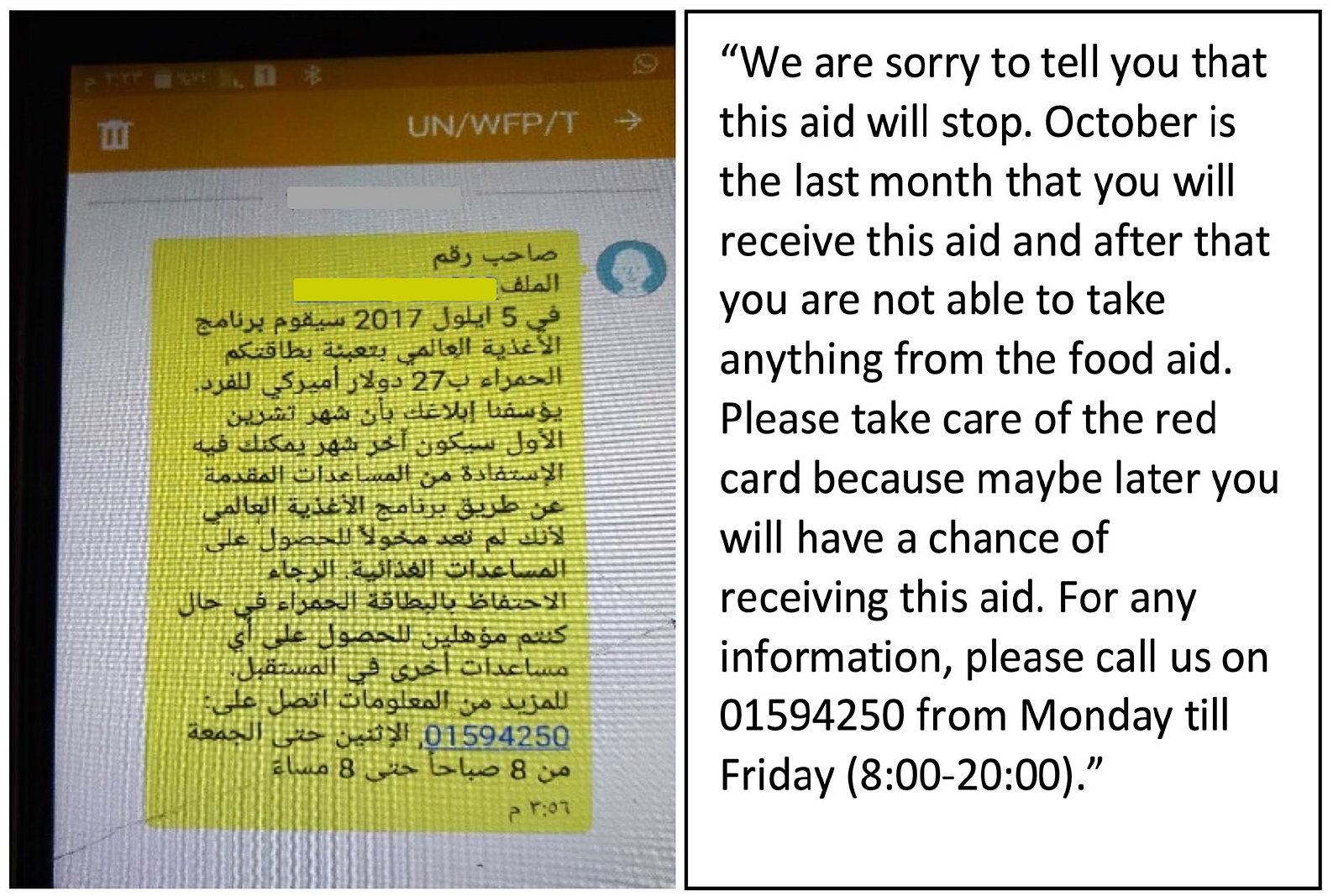
Text message from UNHCR on cancellation of monthly allowance (photo by the authors).
Such an all-encompassing reading of their precarity risks enrolling these subjects into their own subordination as being only powerless victims – removing from them all possibilities to enact themselves as subjects that matter (Butler, 2004, 2009a, 2009b). But our data suggest something different, revealing not utterly powerless subjects, but subjects that find ways to exercise agency and become enacted as subjects that matter, with lives that have meaning, even if precarious and vulnerable. How is this achieved? We suggest that it is achieved through mundane, relational, material-discursive boundary-making and invitational practices in which subjects enact themselves differently, situatedly and contingently. In the following, we account for these mundane material-discursive practices: organizing a home, cooking and eating, and enacting a digital ‘home’ by connecting with friends and family.
Boundary Making in Displacement: Organizing Domestic Everyday Life
Building and organizing a home
For many of the most vulnerable and impoverished Syrian refugee households, settling in informal tented settlements is the only affordable option. Most tented settlements have been constructed by private landowners who, responding to the large-scale migration, converted agricultural fields into settlements. Because settlements are illegal, landowners do not have to comply with the minimum standard required by the UNHCR (2006), or take local demographics into account (de Looijer, 2016). This has led to the creation of Syrian ghettos (de Looijer, 2016), in which minimal infrastructure allows for makeshift shelters while keeping inhabitants in a state of precarity, since shelters (and encampments) can be easily dismantled and destroyed.
Tents are typically temporary wooden structures covered with plastic, cardboard and old rugs. In many settlements, tents are organized in neat rows with a maximum of one metre between tents, but the configuration of the tents changes as refugees add new rooms, inner yards and small gardens. Mostly, but not always, a tent (which is divided into two or three rooms) houses one household. In some cases, up to 15 persons share a tent. In interviews with representatives from NGOs, they often use the term ‘housing unit’, as they are not permitted by the Lebanese government to use words such as ‘camp’, since this would hint at the dependency, legitimacy, or permanence of refugees. Refugees regularly referred to the settlement as ‘shithole’ or ‘prison’, reflecting their deep dissatisfaction with their situation. The tent and the settlement are described as the place where they live (or endure), but not really as ‘home’.
Despite this, we noticed during fieldwork that a sense of home was indeed enacted in the mundane day-to-day work of organizing, cleaning, reconstructing and mending living spaces. The tents were mostly well organized, improved when possible, and with boundaries clearly demarcated with stones or plants (Figure 2). Most tents have a vestibule were residents and guests take off their shoes and some have small forecourts constructed at the entrance, often decorated with flowers, herbs,or bushes. After an interview in one of the settlements near Halba, the man we interviewed plucked a sprig from the lemon tree outside his tent, presenting it as a gift. In the interview he says:
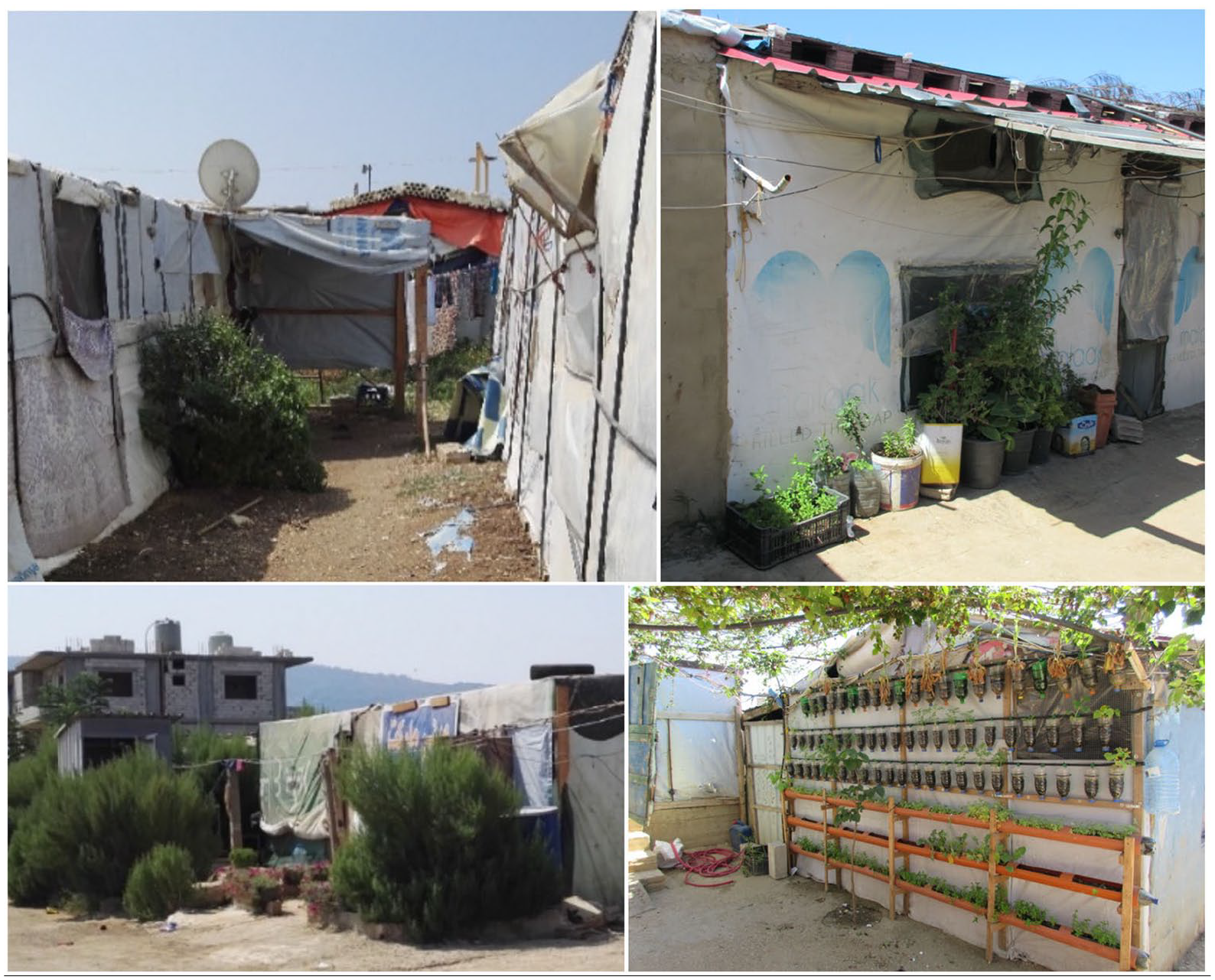
Upper left: a forecourt constructed at the entrance of a tent. Upper right and lower left: housing units demarcated with plants. Lower right: a communal herb garden with irrigation system (photos by the authors).
At home, in Syria, I used to have a big house and a garden. . . here I have nothing. . . but growing things reminds me of home.
From a relational perspective, we can understand these practices of homemaking as boundary-making practices that create the relational conditions under which the refugees can legitimately claim ownership of a boundary – one that positions ‘the displaced person’ as being ‘at home’ (in exile), in some sense. This boundary enacts a separation between the people, things and practices enacted inside ‘my tent’, ‘my garden’ and ‘my settlement’ and the people, things and practices enacted outside it. Between Syria (in here) and Lebanon (out there), between ‘us’ and ‘them’. Importantly, this enacted boundary is not merely physical, like a line in the sand, or a fence around a property. It is also iteratively enacted in and through a multiplicity of mundane practices (such as plucking a sprig from the lemon tree and presenting it as a gift), in which certain ways of being, acting and thinking become included as possible and appropriate (and others not).
Cooking and eating: Mujaddara, mate and memories
The refugees we interviewed love to talk about food. As soon as conversations shift to food – which they often do sooner or later in an interview – their body language and tone of voice become more energetic and they enthusiastically tell us about their favourite dishes and how to prepare them. They gladly show us the groceries and spices they use and let us take pictures (Figure 3). They emphasize that the Syrian cuisine is very rich and that they spend a lot of time and energy preparing traditional Syrian meals such as mujaddara (cooked beans, rice, bulgur, and noodles with yogurt) and molokhia with rice for their families in the camp. When we see women move around the camp, they are often holding herbs they have found on the edges of the camp. Meals often order the daily routine and structure the days into uniform time slots: breakfast at 8 am, lunch at 2 pm, and dinner at 7 pm.
The focus on food is present not only in interviews and in the daily practices in the settlements, but also in communication with distant friends and relatives. A woman explains that the continuously recurring question between close relatives, besides ‘How are you?’, is ‘What did you cook for lunch?’ This is exemplified in the following chat conversation between a young woman in the camp and her sister in Syria:
Sunday October 29, 2017.
If she comes tomorrow she will see Ali and have fun with him. They live with their husbands now.
Hahaha.
What did you cook today?
Borghol with potato yakhne.
Sahha w hana [bon appétit]. I made tabbouleh with some fries too.
Sahha w hana.
How is Mouhanad? [EM’s son; he went to live with her sister in Syria because he is sick.]
He is good. I am taking care of him. Look at his color now. [Sister sends picture of Mouhanad to EM.]
His face is not yellow anymore. He is better, alhamdullilah [Praise be to God].
I need to go.
Salamtek. [Take care of your health]
Often, our conversations about food evoke refugees’ memories of Syria, the food they used to make at home, the vegetables and fruits they used to grow in their gardens, how they made their own butter, the delicacies they could find or make in Syria. These memories and stories are often coloured by pride: [O]ur village’s soil was rich, and suitable for many crops. We grew many kinds of wheat, corn, lentils, barley. . . we export our village’s products even to Europe.
Cooking and talking about their cuisine seem to be a way to demarcate their own cultural heritage and distance themselves from the Lebanese that surround them. In interviews, Lebanese food is commonly criticized: it is said to have poor taste, to be artificial, industrial, full of impurities (pesticides), etc. Many interviewees also emphasize that they have no interest in learning to cook Lebanese dishes.
Besides the meals, another practice structuring the days in the settlement and enacting a sense of continuity is the daily tea drinking, called mate (the name of the tea, pronounced mah-té). Mate is described by many refugees as the highlight of the day. Originally from South America, the tea is popular in western Syria and can be served all times of the day, however traditionally after Azan Al-Asr until Azan Al-Maghreb (sunset’s call for prayer) around 6 pm. Often, people sit outside on plastic chairs or on the ground drinking their mate while talking or playing cards. Drinking mate in this way is a tradition brought from Syria, and not practised among Lebanese. According to our interviewees, mate is as much a habit as a drink and very closely associated with their Syrian heritage and traditions: We’re from the west side of Syria, and the main drink for us is mate . . . if we don’t drink mate. . . it’s like not drinking anything at all.
Conversations during mate often concern the daily life in the camp, the children, the housework, gossip about friends, family and neighbours. Often, conversations end up in memories of Syria. People show each other pictures they have saved on their mobile phones of their home villages or places they used to visit in Syria. They tell each other stories from famous places and discuss the history and architecture of buildings in their respective regions: We gather in the afternoon for mate with women and neighbours, and we talk, . . . we talk about our day-to-day lives but the conversation always ends talking about Syria. We remember the past, our old picnic to Alasi River, in village, we remember the old days!
The interviewees describe these moments as moments in which they are reminded of the existence of a different and better life, a life that used to be theirs and in which they were not just ‘displaced’ but owners of land, a house and a grill which they used host BBQ parties: This is my house, (showing a photo) and this is a part of the Orontes River. . . and this is the grill, we were grilling meat, and this is for making barbeque. . . The hope to go back is still with us.
As we move around the camp or sit somewhere outside waiting for our next interview, we are sometimes invited inside a tent. We are normally invited to sit down on cushions on the floor or on the few plastic chairs that are available while the family members sit down on the ground. When we object to this arrangement, we are met by protests:
We are used to sitting on the ground, don’t tell me you don’t sit, we always sit on the ground.
We can sit on the ground and you can sit on the. . .
No, no, wallah, guests come first, we are used to it, we give everything we have to guests.
To every interview we bring chocolate, nuts, water or soda, Swedish gingerbread cookies or some other snack. While the interviewees are appreciative and curious to try the ginger cookies, they often insist that we take the snack with us when we leave. Besides the mandatory tea or coffee with extreme amounts of sugar, we are invited for fruits, candy and homemade cookies. Sometimes we are invited for entire meals such as chicken and rice with roasted cashews or platters with tomatoes, aubergines, eggs and yoghurt. During our conversations, many respondents eagerly show us pictures on their smartphone, not only of family members and friends, but at least as often of their cars, their gardens, brightly coloured sofas in the living room or, in some cases, holiday excursions to beautiful waterfalls in the mountains of Latakia. They insist that if they return to Syria, we have to come and visit them, stay in one of their many guest rooms, enjoy their home-cooked food, and visit all the beautiful places in their home village.
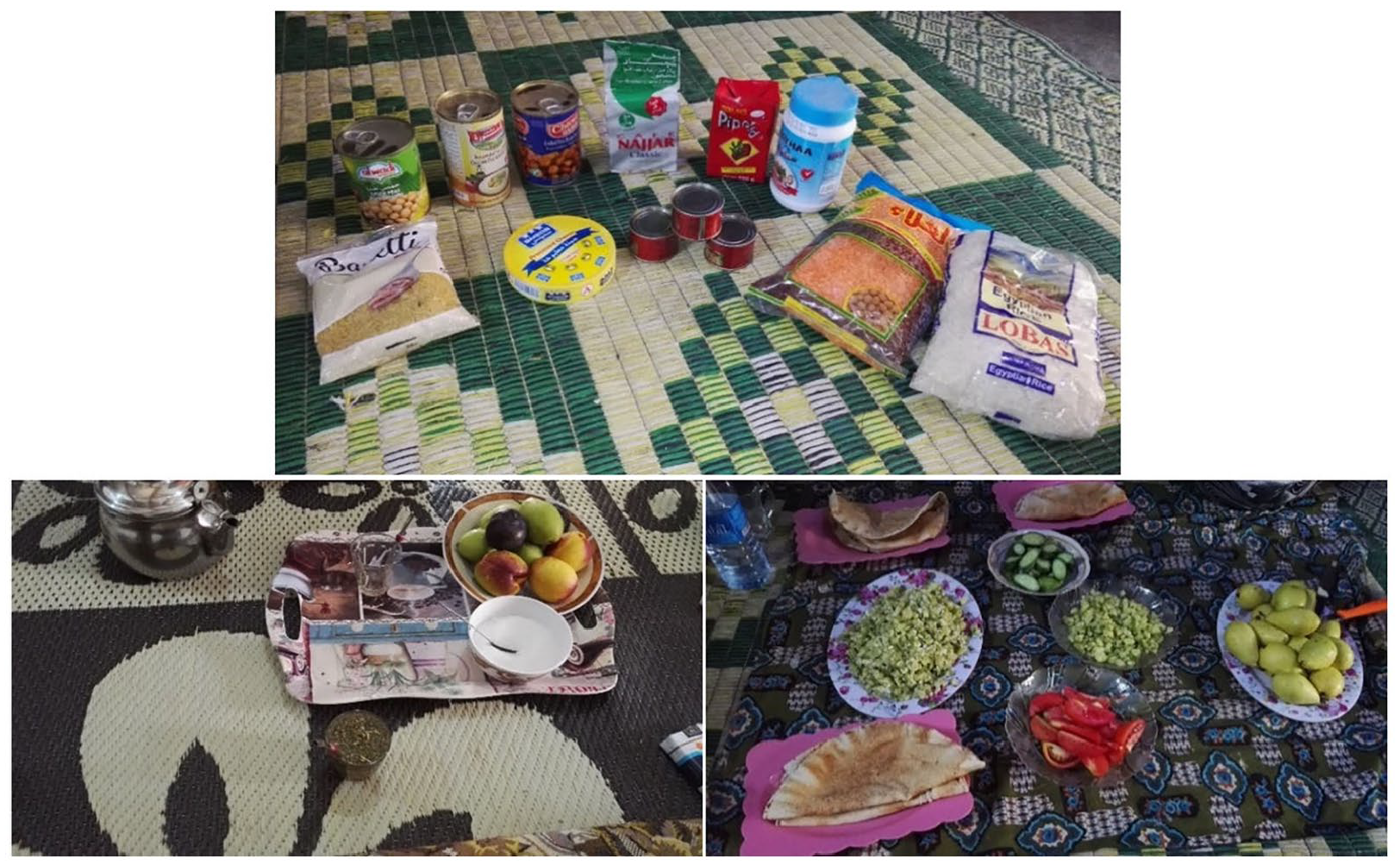
Upper: Cooking ingredients. Lower left: mate and fruits. Lower right: lunch prepared for us during an interview (photos by the authors).
How come so much time in our interviews is spent talking about food, and why do siblings who haven’t met in months or even years inquire about each other’s lunch menus? Why is it that, at other times of the day, friction, feelings of injustice and disagreement can pervade relations in the camp, while during mate, pictures are shared of better times and loved ones that were left behind? We suggest that what all these practices, of cooking and talking about traditional Syrian food, of drinking mate, of eating and sharing memories around the dinner table have in common, is that they function as sensory reminders of familial ties and a cultural legacy, and thus work to restore a sense of intimacy, safety and normality amid a hostile environment.
As such, they function to draw a boundary between us (as Syrians) and them (as Lebanese) – to say we are different to you, our food is different, our traditions are different, our culture is different. By enacting an ‘us’, the ‘temporary place’ becomes enacted as a situated home, and the ‘displaced person’ becomes enacted as fully formed subject with a voice; someone who can invite the ‘other’ into her own life story, social connections, traditions and cultural practices. Put differently, these practices assert a temporal line, a history, or more precisely, a biography. Such a biography invokes the idea that here this displaced person is a complete living person with their own personal life story – a historical line that only they can own. Thus, they are revealed as biographical story lines rather than displaced dots in limbo (Ingold, 2015, 2016).
Enacting a digital ‘home’: Connecting with friends and family
In their former lives, in Syria, precarious life conditions and poor infrastructures did not often facilitate the adoption of digital technologies. But there was also little need for it. Many people lived close to the people who mattered to them and were able to performatively (re)produce their identities locally, in relation to their families, friends, work, culture, hobbies and home. In the tented settlements in Lebanon, the refugees are largely deprived of these relations, and boundaries defining previously clear categories are dissolved. In this displaced life, owning a smartphone and having access to the Internet enacts conditions of possibility to redraw these boundaries, differently.
A survey of Syrian refugees in Lebanon showed that 92 percent had access to a mobile phone, up from 54 percent when they lived in Syria; mobile Internet access had climbed to 75 percent from 10 percent (UNHCR, 2016a). Usually, the men possess the phone, but the women are able to use it whenever they need or want to. Interviewees typically state that the main reason for owning a phone is to keep in touch with close relatives. If refugees have WiFi access, usually by borrowing or buying access from a neighbour who has set up a router, they may contact their relatives every day, most often through WhatsApp as this is the cheapest option. If the connection is adequate, they call each other on WhatsApp; if it is weak, they chat, and sometimes record and send voice messages. People mumbling messages into their smartphones is a common sight in the settlements.
Refugees also send each other so-called morning greetings (Figure 4). In Arabic countries, the morning greeting sob bekheyr (‘May your morning be blessed’) is the most popular time-of-day greeting. Interviewees explain that what matters is not so much the meaning of the image or greeting, but the act itself. It is the simple act of showing that ‘I think of you’, that ‘despite the distance you are still present in my mind’ that is important.
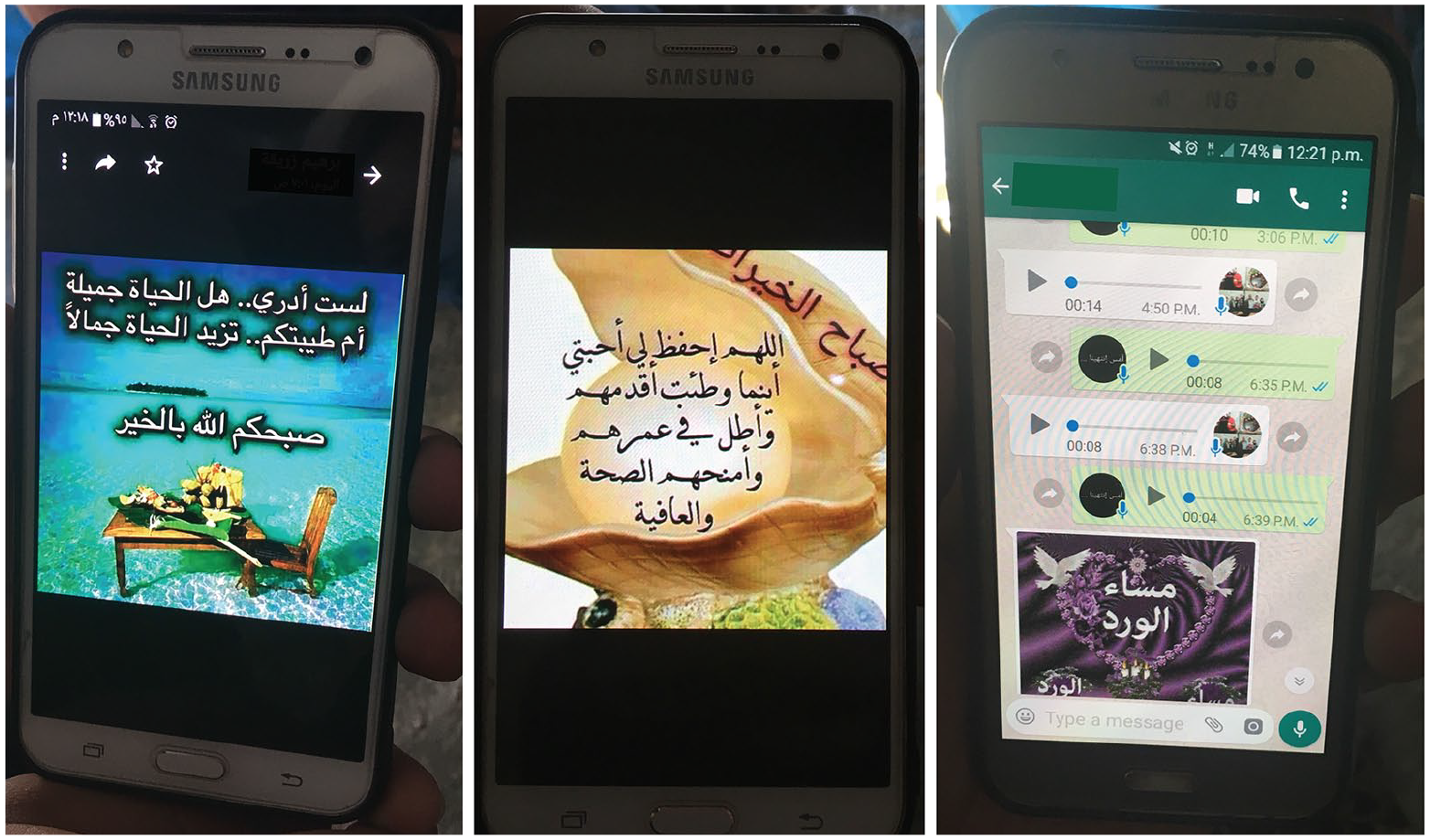
Examples of morning greetings in refugees’ WhatsApp feeds (photos by the authors).
Because most refugees did not plan their escape but often fled in hurry and confusion, they arrived in Lebanon without knowing where their relatives were or even whether they were alive. To find and contact relatives, refugees use Facebook. By checking the newsfeed on Facebook, refugees keep track of important events in the lives of their friends such as marriages, births and deaths. They also use Facebook to share photos of their families and their lives in displacement. Those who managed to bring analogue photos from Syria – including of their home village, cars they used to drive, food they used to eat, gardens they used to grow – sometimes take digital photos of these photos and share them with their Facebook friends.
Networks of friends on Facebook often grow quickly. A man in his 20s explains that he has received 40 to 50 friend requests a day since he created his profile a couple of weeks ago. He does not know all the people he accepts as friends. However, if he recognizes their names from his home village, and if the profile does not seem to be politically involved, he accepts the request: For example, my big family is called [withheld]. Anyone who adds me with this name I know that he is one of my relatives. If his profile is filled with problems and politics, I don’t accept him. If it is filled with things to do with family and friends, I accept him.
In addition to accepting friend requests from other Syrians, many of our interviewees are Facebook friends with European volunteers who work in or have visited their camp. During fieldwork we also receive several friend requests from the people we interview. Several people contact us via WhatsApp, using Google Translate to initiate conversations on WhatsApp, asking how we are doing and sending photos of their families. One young man whom we interview explains that he had made friends with a European woman who, together with a group of travellers, visited the camp during a journey in the Middle East. The European woman did not speak Arabic but our respondent uses Google Translate to chat with her in English (Figure 5). In the interview, the man explains:
I like to connect with people from all parts of the world, not just fellow Syrians. . . Maybe one day I will live in another country like Sweden or France.
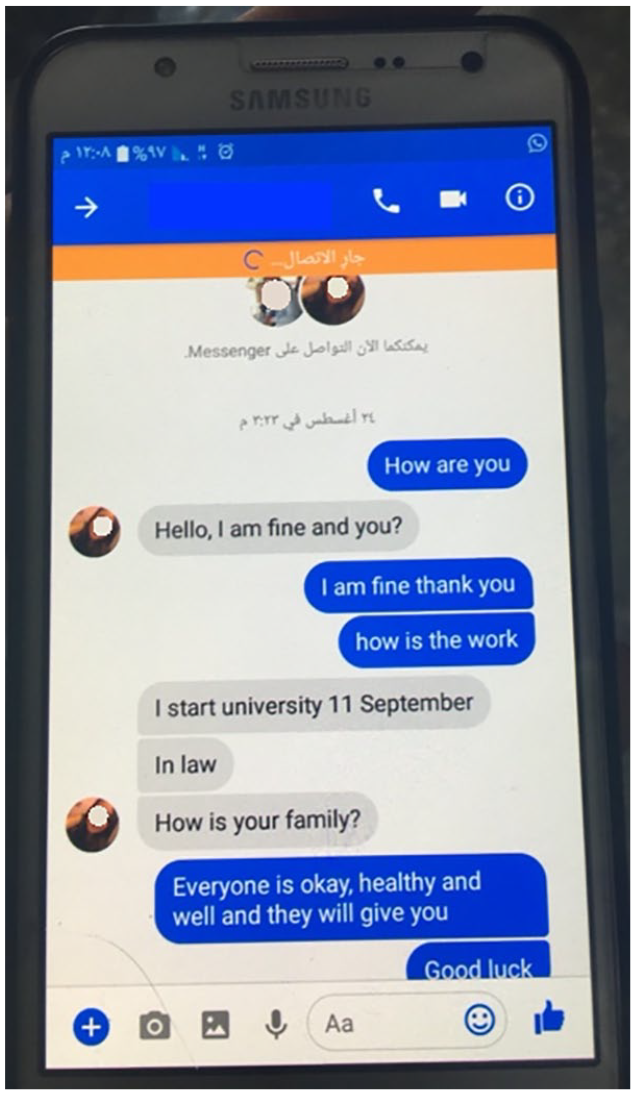
A chat conversation in English between a refugee and a European visitor (photo by the authors).
In summary, we can see how the smartphone is as an integral part of people going about their everyday activities. However, from a relational performative view – as we attend to the ways in which boundaries are enacted in situated practices – we also see how this reconfigures relationships and conditions possibilities to matter as a subject. For example, in reproducing both a traditional greeting ritual, and the connection between distant Syrian friends and relatives, the greeting practice enacts continuity and coherence across time and space, a way to experience intimacy at a distance, and a way to hold onto the family and the familiar. It is a practice and a boundary that confirms that, despite the distance, Syria, its people, and its traditions are still ‘home’.
Once again, just as the boundaries enacted in these practices are not physical boundaries, home is not enacted as a physical place. Through the practice of sending morning greetings on WhatsApp, or inviting and accepting friend requests from former Syrian neighbours, or in accessing news and sharing information in Facebook groups with other Syrians, home is not enacted as a geographical territory, a place with walls and doors, but as community sharing a culture, heritage, memories and experiences. Digitally enacted practices that enable ‘the precarious and displaced’ to draw boundaries, enact a voice, issue an invitation (make a friend request on Facebook), include and exclude other subjects into/from one’s circle of friends (accept or deny a friend request on Facebook). As someone who is able to say, ‘this is my life, this is my home, and you are welcome to be a part of it’, or alternatively, as someone who can say ‘no, I don’t accept you as a friend’. In other words, as a subject with the agency to articulate conditions for those who can (or not) cross the boundary of her ‘digital home’.
Analytical Summary: The Production of Agency/Voice Through Practices of Hospitality
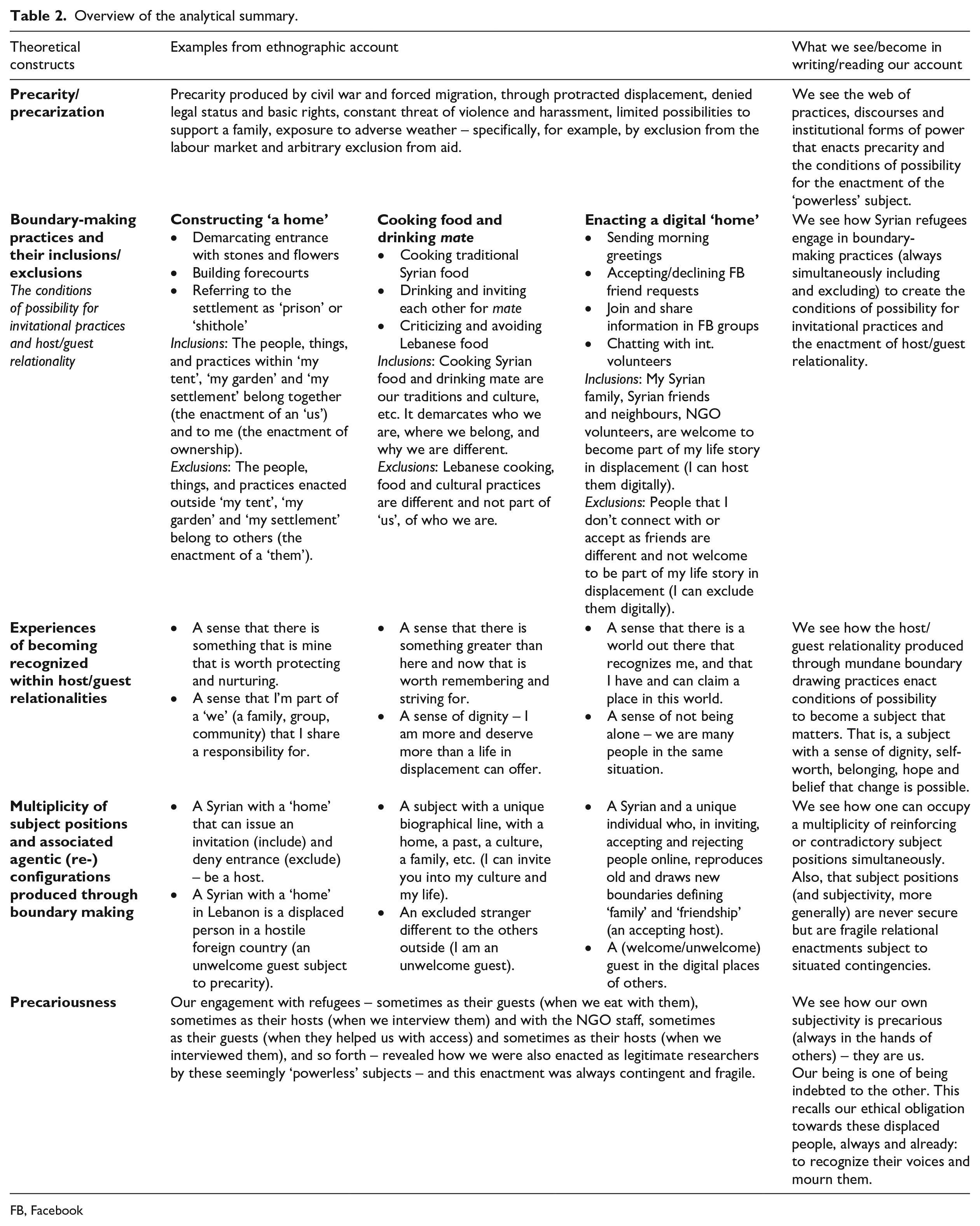
In the previous section, we accounted for how subjects engage in mundane everyday boundary-making practices in which they use their ongoing construction as ‘displaced people’ to enact themselves differently in a situated and contingent manner. Table 2 provides an analytical summary of our account, showing how three domestic organizing practices in the camps – organizing a home, cooking and eating, and enacting a digital ‘home’ – enact situated boundaries that condition refugees to act and become in specific ways.
Overview of the analytical summary.
FB, Facebook
As refugees go about their everyday business of organizing, mending and cleaning their tents, eating and sharing memories around the dinner table, and sending morning greetings on WhatsApp, they are not merely upholding routines of survival. From a relational perspective, they are engaged in practices that create the relational conditions under which they can legitimately claim ownership of a boundary – one that positions ‘the displaced person’ as being ‘at home’ (in exile), in some sense.
In our case, we saw the creation of physical boundaries (such as the forecourts) to separate the ‘home’ from the camp, and the roads and buildings that separate the camp from the city. However, we also saw how cultural practices are used to draw a boundary between Syrians and Lebanese, how ad hoc checkpoints are constructed to separate the legitimate from the illegitimate, how digital boundaries are produced through digital practices (of Facebook and WhatsApp), and so forth. Critical to these boundary-making practices is the enactment of a boundary as in some way owned (Derrida, 1997). For example, through the tending of the forecourts, the inside of the tent can be claimed as ‘my home’, through the cultural practices of mate and cooking, claims can be made about already belonging to the Syrian people, and through digital practices, claims can be made about one’s own digital place, ‘my account’.
The enactment of a boundary as in some way owned is important, because it creates the conditions of possibility for invitational practices. That is, for the practices of inviting the ‘other’ to my home for a meal, to mate for drinking tea and sharing stories, or to my WhatsApp account to allow us to ‘chat’ with each other. Grounded in mundane everyday boundary making, these invitational practices are fragile, temporary and subject to contestation. However, they are important as the acceptance of the invitation not only confirms (as in some way legitimate) the boundary and associated claims to ownership, it also enacts a host/guest relationality, a relational subject positioning in which the invitee is a ‘guest’ and the one issuing the invitation is the ‘host’.
Such relative subject positioning confers norm-governed agentic possibilities to those so enacted. For example, in accepting the refugees’ invitation to us – as Swedish field researchers – for sugared tea and homemade cookies, we acknowledge the legitimacy of the boundary being invoked, the refugees’ rights as hosts (for example, to determine the order of events) and consequently subject ourselves in relation to this position. Situated within such relationality we can understand the reluctance of the refugees to accept the cookies, chocolate and other snacks that we bring to the interviews. If they were to accept our assumed ‘gifts’, they might once again become positioned as dependent receivers of ‘handouts’. As such, they might be deprived of both their agentic possibilities and their sense of being already at home – which comes with being positioned as a host.
The refugees’ experiences of becoming recognized as subjects within host/guest relationalities are summarized in the third row of Table 2. Importantly, these experiences of becoming recognized as a subject with a sense of dignity, belonging, hope and the belief that a different life is possible and worth striving for, do not constitute a stable ground upon which the displaced and precarious subject can build a sense of faith in the future. Nor do our weeks of field studies include data on how these experiences result in concrete political actions. Rather, our account shows how mundane boundary-drawing practices of hospitality enact moments in which precarious subjects are able to restore a sense of dignity and belonging, moments in which they do not feel displaced and alone but are recognized as part of a community with other people sharing the same life conditions, moments in which they are reminded that they are more than displaced persons and deserve more than a life in a tented settlement, moments in which there is hope and a different life can be glimpsed, moments which makes it possible to endure the impossible (Badiou, 2008) and to become someone with a voice, who matters, and who is indeed worth mourning (Butler, 2004, 2009a, 2009b).
Finally, Table 2 shows how the enactment of the host/guest relationship is never simply a distribution of host/guest positions between different individuals, relationally. In our empirical material, the refugees are always enacted simultaneously in multiple host/guest subject positions that condition each other – that is, transforming impossibilities into possibilities, exclusions into inclusions, and so forth. For example, the boundaries drawn to exclude Syrian refugees from the legal job market, and the boundaries drawn to give refugees right to the UNHCR food allowance (and to suspend it) not only excludes and separates, it also simultaneously includes and gathers together what has become ‘othered’. The makeshift settlements (rather than ‘camps’) they are forced into create the conditions for the ‘other’ to become similar (that is not-Lebanese, but Syrian). As Syrian-made and managed settlements, they create the conditions under which an invitation can be made – to researchers, or to NGO workers.
In the invitation to the sharing of Syrian food, the Swedish researchers are positioned as guests, but as the researchers had already invited the refugees to participate in the research, they are already positioned as guests in the research practices. Moreover, as the refugees cook traditional Syrian food, they both confirm that Lebanon is not their home and, thus, they are guests in a foreign country, and simultaneously, enact a situated home to which they can invite guests and thus become positioned as autonomous and legitimate hosts. Similarly, as refugees use WhatsApp to communicate with distant friends and family members, and enact a ‘digital home’ on Facebook, they confirm that, despite the distance, they are still part of a Syrian community. This enactment of a sense of home and belonging simultaneously enacts a boundary, separating the refugees from the Lebanese community, confirming their status as guests.
In other words, there is always a multiplicity and simultaneity in the enactment of subject positions that creates a certain ambiguity and fluidity, which gives opportunity for negotiation and reconfiguration of power relations, contingently (Butler, 2004, 2009a, 2009b; Derrida, 1997, 2000; Foucault, 1980).
Discussion
How is it possible to gain a sense that you have a voice and that your life matters when you have lost everything and live your life as a ‘displaced person’ in extreme precarity? In this paper, we explored this question by examining everyday organizing practices of Syrian refugees living in tented settlements in Lebanon. In the first subsection below, we relate our findings about how material-discursive boundary-making practices condition possibilities for the becoming of a mattering subject to the literature on subject positioning. In the second subsection, we discuss the relational, contingent and material-discursive nature of the boundaries constituting host/guest relationalities and articulate how these conditions matter for the displaced and precarious subject to become a subject that matters.
Becoming placed in displacement: The politics of undefeated despair
Our first contribution emerges from our empirical setting, which allows us to see that which often goes unnoticed in organization studies. Prior studies show how precarious subjects (re)position themselves in discourse and practice, but have primarily accounted for this in contexts where subjects are already positioned and recognized in relation to an ‘other’ through inclusion in a legitimate social category (such as a member of an organization, profession, or social group) (Bange et al., 2020; Cinque et al., 2020; Mackenzie & McKinlay, 2020; Petriglieri et al., 2019; Van Laer & Janssens, 2017). In short, in most extant research, existing organizational settings already provide the referent and host for subject (re)positioning.
Consequently, existing research has tended to foreground the practices that these already placed and mattering subjects employ to enhance their capabilities, craft alternative and positive identities, create a united collective identity, and mobilize collective action to bring about change in their lives (Dalton & Jung, 2019; Fernández et al., 2017; Pio & Essers, 2014; Reedy et al., 2016; Van Laer & Janssens, 2017). In contrast, our study starts with a truly ‘displaced’ subject, bereft of such ready-made social and institutional settings, and shows how – through practices of hospitality – the precarious subject can become (re)positioned within relations of recognition to regain a sense that they have a voice and that their lives matter. Specifically, we show how this is done in everyday practices of hospitality, rooted in mundane, material-discursive boundary-making practices. Figure 6 summarizes our account, showing how the co-constitutive boundary-making and invitational practices produce conditions of possibility for the enactment of relations of recognition (Derrida, 1997). These host/guest relationalities, in turn, constitute the conditions of possibility for the emergence of a subject that matters; a person with a sense of dignity, belonging, voice and hope (Butler, 2004, 2009a, 2009b).
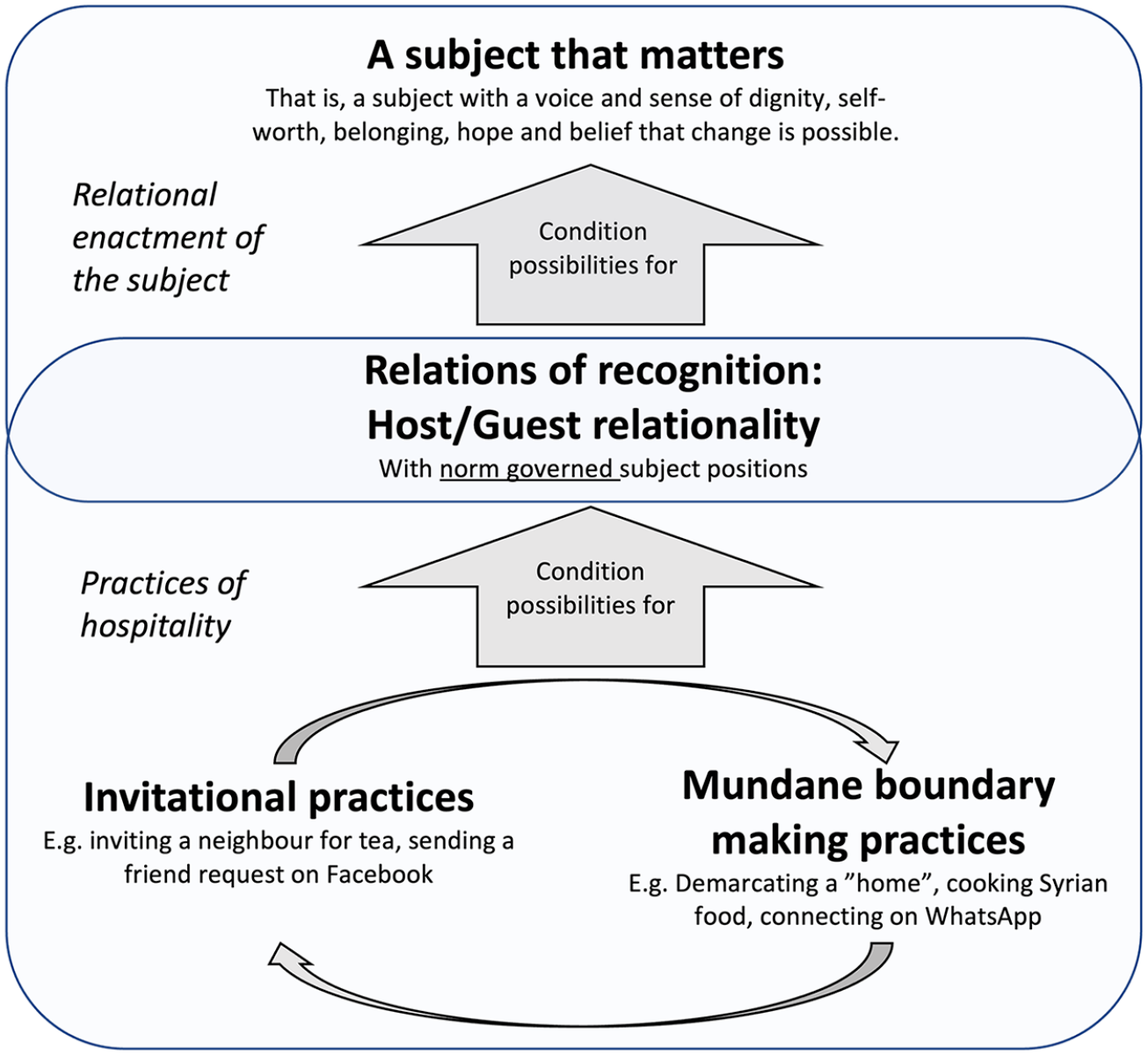
How the precarious subject becomes enacted as a subject that matters through practices of hospitality.
Previous research has shown how subjects can manage emotions stirred up by their precarious (working) lives and transform their precariousness into a generative predicament (Petriglieri et al., 2019) by creating narrative accounts or stories (Cinque et al., 2020; Dalton & Jung, 2019), adopting agentic strategies (Van Laer & Janssens, 2017), developing affective bonds of friendship (Farias, 2017), connecting in online communities (Bange et al., 2020) or creating holding environments (Petriglieri et al., 2019). Our study contributes to this research stream by further developing our understanding of how mundane, everyday material-discursive organizing practices can produce the possibilities for the precarious subject’s anxieties to be temporarily eased and for gaining a sense that her life matters in some important sense. Specifically, while previous research has focused on identifying the practices and experiences through which precarious work is made generative (Farias, 2017; Fernández et al., 2017), our account is more primordial. It deepens our understanding of the practices through which the precarious life is itself made tolerable – that is, the practices through which it is possible to endure the impossible (Badiou, 2008).
We argue that such an understanding is important, not because it constitutes the possibilities for politics with a big ‘P’, but because it constitutes politics as ‘undefeated despair’ (Berger, 2006) – that is, a politics of the mundane carrying on that has a ‘quality of a way of sharing which disarms the leading question of: why was one born into this life?’ (p. 30, emphasis added). Although this is a modest form of politics, we would suggest that studying the mundane specificities of precarious experiences reduces the risk of bringing together highly disparate groups under the same denominator and of reducing the precarious subject to an abstract matter (Bange et al., 2020; Dalton & Jung, 2019; Petriglieri et al., 2019). Indeed, we suggest that such mundane specificities of our research allow us to give these people a voice, not just as ‘displaced people’, but as friends, members of families and communities, as fellow human beings whose lives count. In line with recent research on affective relationships from a relational perspective (Bryan, 2009; Farias, 2017), we argue that such an account makes it difficult to stay indifferent to ‘the stranger’ and protects the self against massification and anonymity. In Butler’s words, our account contributes to make ‘suffering at a distance’ more ‘proximate’ (Butler, 2012, p. 137).
Finally, we argue that an enhanced understanding of the reciprocal relations of recognition as enacted in the world of the displaced subject (in and through host/guest relationality) is important as it allows for the acknowledgement that precariousness is not just a state reserved for the marginalized and oppressed, but is indeed a condition that all humanity shares (Butler, 2004, 2009a, 2009b): we are all dependent upon each other to become subjects that matter, politically and ethically. This understanding can help us see that the ‘displaced person’ is reproduced, relationally, as exactly a ‘displaced person’ because of (or through) us and thus make us aware of the obligations we have, not just to the known, but also unknown others on whom we always and already depend for our voice and our existence as mattering subjects (Butler, 2004, 2009a, 2009b; Lévinas, 1989).
The relational, contingent and material-discursive reconfiguring of subject positions
From a more theoretical perspective, our research contributes by answering calls to foreground the multiplicity, contingency and ambiguity of the boundaries enacting and reproducing subject positions and their agentic possibilities in everyday organizing practices (Harding et al., 2017; Knights & Clarke, 2017; Mumby, 2005; Ybema et al., 2009, 2016). Specifically, we build on recent research foregrounding the relational construction of ‘others’ as a key and routine aspect of how subjects constitute themselves (Cinque et al., 2020; Gagnon & Collinson, 2017; Harding et al., 2017; Skovgaard-Smith et al., 2020), and add to this research a conceptualization of subject positioning that even further emphasizes the entangled, interdependent and contingent nature of the ‘I’ and the ‘other’. Indeed, the ‘displaced subject’ becomes placed through practices of inviting the ‘other’, and through this becomes relationally positioned; her recognition and becoming as a subject is dependent on this ‘other’s’ continuous response. The boundary is conditional and fragile: in the moment the assumed guest declines the invitation, it could dissolve, turning hospitality into hostility, inclusion into exclusion, placement into displacement. Thus, our account of how subjects become repositioned within practices of hospitality moves us farther away from an understanding of the ‘other’ as someone or something distinct and bounded ‘out there’ – for example, representing a certain organization (Garcia & Hardy, 2007), professional role (Skovgaard-Smith et al., 2020), discourse (Anderson, 2008; Thomas & Davies, 2005), or cultural prescription (Fleming & Spicer, 2003). It does so by accounting for the ‘other’ as an emerging, contingent, material-discursive and fragile enactment always entangled with and dependent on the enactment of the ‘I’.
Moreover, whereas much of the literature on subject positioning emphasizes the ways individuals deploy discourses to construct a stable sense of self (Mumby, 2005), recent studies have accounted for how practices of subject positioning imply negotiating tensions between different discourses and social identities, with outcomes that are often unpredictable and contradictory (Bristow et al., 2017; Harding, Lee, & Ford, 2014; Mackenzie & McKinlay, 2020; Van Laer & Janssens, 2017). Our study contributes to this stream of research in two ways. First, by showing how the mundane, domestic organizing practices of the precarious subject function as practices of subject (re)positioning in which the ‘I’ and the ‘other’ are not only cast in oppositional roles (‘them’ and ‘us’) but are simultaneously (and unwittingly) enacted in a multiplicity of host/guest subject positions that condition each other.
For example, as the refugees draw a boundary enacting ‘their tent’, ‘their garden’ and ‘their settlement’ as belonging together (the enactment of an ‘us’ – a Syrian community), this very same boundary that places the precarious subject as being at home (in exile) and belonging to a (Syrian) community also enacts this subject as being displaced in a hostile country. This simultaneous multiplicity of guest/host positionings can transform these boundaries into negotiable demarcations that can be drawn or withdrawn contingently in order to create (or disperse) recognition and associated opportunities for agency. These insights differ from prior research acknowledging the multiplicity in the enactment of subject positions and foregrounding the ways in which an already positioned and mattering subject ‘draws on’, ‘works on’, to discursively (re)produce a particular subject in relation to a known or oppositional ‘other’ (Bristow et al., 2017; Harding et al., 2014; Mackenzie & McKinlay, 2020; Van Laer & Janssens, 2017). Instead, in our account we see the simultaneous multiplicity of guest/host positionings emerge and being reproduced through mundane organizing practices enacted first and foremost in order to make life meaningful and tolerable (Berger, 2006). In other words, this simultaneous multiplicity of guest/host positionings constitutes the fundamental conditions of possibility for both the ‘I’ and the ‘other’ to become recognized as subjects that matter, prior to any ‘identity work’, or acts of resistance.
Further, we contribute by showing that these positionings are not just ambiguous and fragile (Bristow et al., 2017; Harding et al., 2014; Van Laer & Janssens, 2017). Rather, they function to enact what one might call hyper-fragile subject positions whose sense of mattering can be swept away by an unknown or distant ‘other’, for example, with a single text message (excluding them from UNHCR’s monthly allowance). This raises the question as to how our mundane organizing practices implicate an unknown and distant precarious ‘other’, unknowingly.
Finally, and relatedly, our study answers calls to study the ways in which subjects become repositioned in situated material-discursive practices (Harding et al., 2017; Skovgaard-Smith et al., 2020). While much research has studied the relational construction of self and other discursively (Cinque et al., 2020; Gagnon & Collinson, 2017; Mackenzie & McKinlay, 2020; Van Laer & Janssens, 2017; Westwood & Johnston, 2012), or foregrounded the use of spatial and ritual means in positioning the ‘I’ vis-a-vis the ‘other’ (Baikovich & Wasserman, 2020; McCabe, 2018; Thanem, 2012), the ways in which boundaries are drawn in situated, mundane, material-discursive practices to enact relations of recognition have largely been ignored. This is in a sense understandable, since in accounting for the work and life of the precarious subject, we want to give this subject a voice; we want to listen to her experience, acknowledge her emotions and write down her words so that others can read them and (re)act. However, such an exclusively discursive account will miss something more primal: the necessary conditions for such a voice to become possible through the material-discursive organizing practices of daily life. Indeed, we argue that it is through these very practices that the precarious subject becomes placed. These are the practices that displaced people tend to prioritize when facing a potential or actual disaster (such as a tsunami, hurricane, etc.) – it is not just about ‘keeping life going’, it is more profound than that. It is about becoming placed. Thus, enabling such practices for the displaced precarious subject might be more important than we might have expected.
Conclusion
Our paper contributes to a growing body of work in organization studies that critically addresses precarity in non-traditional organizing settings (e.g. Cinque et al., 2020; Dalton & Jung, 2019; Mackenzie & McKinlay, 2020; Petriglieri et al., 2019; Van Laer & Janssens, 2017), shedding light in particular on the importance of mundane material-discursive relational practices for the becoming of a subject that matters. Not the least in an increasingly digital world, where private, domestic and traditional organized settings blend, it becomes important to understand the underlying conditions for micro-political activity and related embodied ethics (Elidrissi & Courpasson, 2021; Fotaki & Daskalaki, 2021). Our study shows how attending closely to hospitality (Derrida, 1997), enacted in mundane boundary-making relational practices, can help organizational scholars study subject positioning in precarious contexts, and specifically how boundaries are relationally enacted in situated practices to continuously (re)define relations between the ‘I’ and the ‘other’, guest and host, public and private, the familiar and the strange. This can help us recognize and account for the distributed, relational and contingent nature of agency at work in continuously (re)positioning the precarious subject.
In terms of limitations and further research, our study has not encompassed how a subject that matters becomes a political subject; we find the movement from a mattering subject towards a political subject an intriguing topic for future research. Furthermore, it is unlikely (and not intended) that our study has uncovered all relevant subject positioning practices; we would welcome further study, across contexts, of material-discursive relational practices underlying the becoming of mattering subjects.
In conclusion, the situated and contingent nature of the enactment of a subject that matters implies that mundane details are important. This is what we found in the settlements: people living lives that matter in spite of their precarity. People who could invite us and welcome us into their lives with dignity and self-respect. This does not at all make displacement acceptable. And it certainly does not suggest that refugees are somehow masters of their own destiny. But what these mundane boundary-making relational practices do is give hope where hope seems impossible (Badiou, 2008), and uncovering them shows us how lives can become enacted as lives that matter, albeit in a fragile and contingent manner.
Footnotes
Acknowledgements
We would like to express our sincere and heartfelt thanks to the people we met in the settlements in the Akkar and Bekaa Valley districts, Lebanon, and the people supporting our data collection efforts. We are also most grateful for extremely insightful and constructive guidance from the Editor Renate E. Meyer and three anonymous reviewers. Helpful feedback was also received from participants and organizers at the Organization Studies Summer Workshop 2018.
Funding
The author(s) disclosed receipt of the following financial support for the research, authorship, and/or publication of this article. Financial support from the Jan Wallander and Tom Hedelius Foundation, (P2016-0085, W17-0049), the Marianne and Marcus Wallenberg Foundation (MMW 2016.0078), and the Torsten Söderberg Foundation (E54-15) is gratefully acknowledged.
