



Abstract
This paper examines how forcibly displaced people cope with prolonged liminality through identity work. Our paper is based on a longitudinal multiple case study of women refugees who fled Syria and experienced liminality in Amman-Jordan, the Zaatari Refugee Camp in Jordan and the United Kingdom. We contribute to the liminality literature by demonstrating how forcibly displaced people respond to extreme structural constraints and maintain cognitive control over their sense of self during liminality with an end date that is unknown. We develop the concept of liminality by illustrating how the actors were pushed into a state of ‘indeterminate liminality’ and coped by co-constructing it through three forms of identity work – recomposing conflicting memories, reclaiming existence and repositioning tradition. This enabled them to stretch the boundaries of indeterminate liminality, symbolically restore their familiar past and narratively construct a meaningful future.
Introduction
Forcible displacement, defined as ‘the coerced movement of people and their families away from their homes escaping war, civil war, violence, ethnic cleansing and human-made and natural disasters’ (International Organization for Migration, 2019), has become all too prevalent in today’s world. The estimated number of refugees worldwide has reached 63 million (UNHCR, 2019), who face extreme uncertainty as a result of the collapse of formal social and institutional structures. Our study focuses on the displacement of the Syrian people from their homeland as a result of a war, which began in 2011 and is continuing until today. This has forced 5.6 million people to flee to neighbouring countries and the internal displacement of 6.6 million (UNHCR, 2019). We argue that this form of displacement forces people into liminality – a state of ‘betwixt and between’ (Turner, 1969), which leaves them depending on informal and temporary arrangements, such as refugee camps (De La Chaux, Haugh, & Greenwood, 2018; Turner, 2016) and seeking asylum to resettle in foreign countries (Griffiths, 2014).
Liminality is characterised by the process of ‘separation’ from the initial social structure into the ‘transition’ phase, followed by the ‘reaggregation’ into society (Turner, 1969). Previous studies have investigated liminality in different ways. Some research has focused on coping with the structurally ambiguous ‘transition’ phase, minimising the cognitive and emotional loss through identity work (Conroy & O’Leary-Kelly, 2014), while other research has demonstrated how actors intentionally craft liminality and use it to implement cultural change (Howard-Grenville, Golden-Biddle, Irwin, & Mao, 2011). However, so far, there has been little attention paid to how actors manage ongoing and potentially endless periods of liminality. Compared to transitional liminality, actors in perpetual liminality tend to have less control over the ambiguous social structure, leaving them to engage in identity work that remains unresolved (Beech, Gilmore, Hibbert, & Ybema, 2016; Daskalaki & Simosi, 2017). We argue that this pressure becomes even more exaggerated with forcibly displaced actors, making it harder for them to maintain cognitive control through identity work, as they are pushed into a seemingly never-ending state of liminality, and lack agency beyond normative agentic constraints to end it. Therefore, it is crucial to understand: How do forcibly displaced people cope with liminality through identity work?
Our paper is based on a longitudinal multiple case study (Eisenhardt, 1989) examining the Syrian refugee crisis as a critical case (Flyvbjerg, 2006). We studied forcibly displaced women between 2015 and 2019, in Jordan, the Zaatari Refugee Camp in Jordan (approx. 12 km from the Syrian border), and the United Kingdom. While the refugees fled to different geographical locations, the commonality across the contexts was that Syrian refugees fled a relentless war between 2011 and 2013, and sought protection in temporary settlements until the war ‘ended’. This has left them stuck in the seemingly never-ending ‘transition’ phase of liminality, as this process does not have an end date in sight for when they can safely return home, nor for when they would be able to permanently reside in their host countries. As part of living life as liminars, they were faced with the continuous task of managing ongoing and unprecedented uncertainty, making it difficult for them to integrate and settle in their temporary settings. However, while the actors were thrust into liminality, we witnessed them cope with the uncertainty by engaging in identity work and continuously reconstructing who they were.
Over the years, the concept of liminality has become more nuanced, being referred to as either ‘transitional liminality’, where the transitional state lasts for a specific period of time (Beech, 2011) or ‘perpetual liminality’, where the state of limbo becomes indefinite (Johnsen & Sørensen, 2015). Through problematising liminality as a structurally imposed condition (Howard-Grenville et al., 2011), our study extends the concept of liminality as we argue that the forcibly displaced are left in a state of ‘indeterminate liminality’ – understood as a liminal state into which actors are forcibly entered, and their agency is structurally constrained until an unknown end date, leaving them to experience seemingly never-ending uncertainty.
We contribute to the literature on liminality by explaining how forcibly displaced people respond to the structural constraints within indeterminate liminality and maintain cognitive control of their sense of self. We theorise how they can stretch the ‘transition’ phase of liminality through identity work. More specifically, we theorise three interrelated forms of identity work – recomposing conflicting memories, reclaiming existence and repositioning tradition. We argue that forcibly displaced actors can use even small amounts of agency available within existing structural constraints to gain some cognitive control over their position by co-constructing their indeterminate liminal state rather than submitting to its precarity; a key mechanism that can be achieved by symbolically restoring their familiar past and narratively constructing a meaningful future. Therefore, although they were pushed into liminality, they demonstrated resilience in co-constructing their identity. These findings advance earlier research on liminality (Beech, 2011; Conroy & O’Leary-Kelly, 2014; Turner, 1969) because, unlike previous studies that point to unresolved, ambiguous and fragmented identity work that the actors in perpetual liminality adopt to cope with a high level of structural ambiguity (Beech et al., 2016; Daskalaki & Simosi, 2017), we show how they can purposefully maintain their sense of self and normality while constructing a meaningful future.
Our findings also allow us to see the concept of displacement from a new angle as we show how the displaced actors simultaneously utilised their agony and their agency to construct a meaningful future, exemplifying their cognitive strength and resilience. Moreover, we show how the work to maintain their own culture is not just an ‘add on’ to the main focus of integration to the host society, but is crucial for them to maintain positive self-identification. Finally, our findings provide new insights into the identity work literature by showing how the forcibly displaced can maintain their sense of self and dignity (Ashforth & Kreiner, 1999; Snow & Anderson, 1987) by making themselves adaptable to the structural constraints during prolonged liminality.
Theory Background
Liminality and identity work
The notion of liminality was first introduced by van Gennep (1909/1960) to the field of anthropology as the stage of ‘transition’ following the ‘separation’ from the initial social context and followed by ‘reaggregation’ into society with enhanced social status. The concept was further developed in the 1960s and 1970s by Turner, whose work focused on girls’ puberty rites called Isoma in Central Africa. His observations suggested that in the separation phase, it was crucial for the candidates to leave their social group and engage in ‘forgetting’ (Turner, 1969, p. 16) of their previous identities. In the transition phase, the candidates were characterised by ‘submissiveness and silence’ (p. 103) towards the totalitarian authority – the village chief – who hosted the ritual. Finally, in the reaggregation phase, the candidates returned to the normal social structure, revitalised by their experience in the liminality, thus, achieving entry into a higher social status.
We argue that the concept of liminality is useful for understanding the uncertainty experienced by the forcibly displaced who are forced into the liminal space ‘at the boundary of two dominant spaces, which is not fully part of either . . . [like] the no man’s land’ (Dale & Burrell, 2008, p. 239), and therefore, a radical and alternative form of organisational life (Shortt, 2015; Thomassen, 2009) is thrust upon them. In extreme contexts of war and uncertainty, where the ‘actors cannot define the possible future states of the world, and therefore cannot forecast the consequences of their present actions’ (Ferraro, Etzion, & Gehman, 2015, p. 364), the forcibly displaced tend to depend on temporary arrangements, such as refugee camps (De La Chaux et al., 2018; Turner, 2006), and to seek asylum in foreign territories (Griffiths, 2014; Manchanda, 2004) in order to survive. Indeed, Turner (1982) suggests that liminality is often accompanied by physical or geographical separation from one place to another, crossing a threshold that separates two distinct areas, one associated with pre-liminal and the other with post-liminal status. Therefore, during the ‘transition’ phase, actors are in the temporarily undefined area, free from structural obligations, such as the usual economic and legal ties. Liminality thus significantly disrupts one’s sense of self and position within a social structure (defined as: ‘a more or less distinctive arrangement [. . .] of specialized and mutually dependent institutions’; Turner, 1969, p. 125). That is, the liminar is ‘socially if not physically invisible’ and/or ‘structurally “dead”’ (Beech, 2011, p. 3).
As liminality represents an ambiguous social structure, it can be both creative and destructive of the structural norm (Turner, 1982). To cope with the challenges posed by this ‘structural’ aspect of liminality, scholars suggest that the liminars need to engage in identity work, understood as ‘the ongoing mental activity that an individual undertakes in constructing an understanding of self’ (Alvesson, Ashcraft, & Thomas, 2008, p. 14). Traditionally, the concept of identity work has been well suited to study how individuals at the bottom of the status system create and sustain self-identity with worth and dignity (e.g. the seminal work of Snow and Anderson (1987) on homeless people). As such, Beech (2011) defines liminality from a cognitive perspective as ‘reconstruction of identity (in which the sense of self is significantly disrupted) in such a way that the new identity is meaningful for the individual and their community’ (pp. 296–297).
Identity work in organisations has been understood as a mutually co-constructive interaction between individuals and social structures (Ybema et al., 2009). The co-construction is enacted in the interplay between the individual’s ‘self-identity’ (i.e. their own notion of who they are) and their ‘social identity’ (i.e. the notion of that person in external discourses, institutions and culture; (Watson, 2009). Previous studies suggest that actors are in between two identity constructions during the ‘transition’ phase, experiencing a partial and incomplete transition from one identity to another, and therefore face multiple and competing identities (Söderlund & Borg, 2018). Actors cope with liminality through identity work of engaging in experimentation, recognition and reflection of a new identity (Beech, 2011), and cognitively and emotionally processing loss orientation and restoration orientation (Conroy & O’Leary-Kelly, 2014, p. 67). Therefore, the conceptualisation of liminality sees the self as situated in a dialogue that incorporates both the inner self and the outer social identity (Watson, 2009). In the following section, we turn to the concept of perpetual liminality to better understand how forcibly displaced people cope with a prolonged ‘transition’ phase of liminality.
Deepening the concept of liminality in the context of forcible displacement
While ‘transitional liminality’ (Bamber, Allen-Collinson, & McCormack, 2017, p. 1514) starts with a triggering event and lasts for a specific period (e.g. Ladge, Clair and Greenberg’s (2012) conceptualisation of pregnancy as a liminal period with a clear beginning and end), so far, there has been little attention on how actors manage ongoing and potentially endless periods of liminality. We argue that deepening this understanding is crucial to unpack how forcibly displaced actors cope with liminality, as the liminal spaces such as detention centres and refugee camps tend to force refugees to endure coping with liminality for long periods without a precise end date (Wimark, 2019). Perpetual liminality is conceptualised as a state in which the temporal and transitional periods have become institutionalised and where the state of social limbo has become indefinite (Johnsen & Sørensen, 2015) and the three sequenced phases of the rites of passage have become frozen (Szakolczai, 2000).
Past studies suggest that compared to transitional liminality, actors in perpetual liminality tend to have less control over the ambiguous social structure. Examples include professional consultants (Tempest & Starkey, 2004) and temporary workers (Garsten, 1999) who are ‘constantly placed in situations in which the regular structures of the organization are suspended’ (Czarniawska & Mazza, 2003, p. 322). The solution for the actors is to depend on actual artefacts, for example, by setting up a mobile office to seek the comfort of a place of their own (Czarniawska & Mazza, 2003), and constructing an extended organisational identity by using ideologically motivated themes to draw employees into an imagined community of the workplace where a sense of belonging is enhanced (Garsten, 1999). Other studies highlight the crucial role of ‘bricolage’ and ‘improvisation’ in how managers draw on varieties of boundary interpretive repertoires to simultaneously expand and contract circles of identification, thus, ‘continually shifting their identifications’ (Ellis & Ybema, 2010, p. 298). Garcia-Lorenzo, Donnelly, Sell-Trujillo and Imas (2018), for example, showed how chronically unemployed people ‘improvise in-between’ through interpreting, responding and performing anew, for instance, through using corners of garages to make a living. In sum, these studies highlight how actors in perpetual liminality adopt flexible identity positions and engage in unresolved identity work – or identity work that remains ambiguous – in which what comes next is highly unpredictable, making it difficult for actors to project a post-liminal self into the future (Beech et al., 2016; Daskalaki & Simosi, 2017).
We argue that forcibly displaced actors can exercise even less control over the ambiguous social structure than the examples presented above. First, typically, they are forced to enter the state of perpetual liminality, and their agency is institutionally constrained beyond normative agentic constraints, laws and rules that a citizen would face (Szkudlarek, Nardon, Osland, Adler, & Lee, 2019), making them unable to terminate the perpetual liminal state at will. The forcibly displaced tend to focus on the problematic present-day situations, as rational and procedural planning and decision-making become difficult, and instead, they typically try to cope with difficulties through improvised and reactive solutions (Lamberg & Pajunen, 2010; Manchanda, 2004). For example, Martí and Fernández (2013) explained that during the Holocaust period, the victims’ resistance encompassed individual and mundane acts such as ‘walking erect and washing one’s face’ (p. 19). This can, for example, be contrasted with socio-economic migrants or transmigrants who choose to relocate not because of a direct threat of persecution or death, but perhaps to improve poor work conditions in their home country, seek education or reunite with family, and therefore, can ‘end’ the perpetual liminality at will (Czarniawska & Mazza, 2003, p. 286).
Second, the state of uncertainty in forcibly displaced people’s current living conditions is more complicated than a typical state of perpetual liminality because refugee camps and international resettlement programmes are generally developed in an impromptu fashion to meet basic human needs for only a short time, and therefore are not intended to continue permanently. Therefore, the forcibly displaced are left with a feeling of indefinite liminality – somewhere between developing self-reliance activities in the camps and waiting to return home (Hampshire et al., 2008), rather than ‘accepting’ their perpetual liminal state (Ellis & Ybema, 2010). For these reasons, we argue that there is a need to deepen understanding of how forcibly displaced actors, who are pushed into liminality, cope through identity work.
Methodology
Research design
The Syrian refugee crisis represents a critical case for forcible displacement that provides ‘strategic importance in relation to the general problem’ (Flyvbjerg, 2006, p. 14). Engaging in empirical research in conflict and post-conflict settings with refugees offers distinct challenges (Ellis, Kia-Keating, Yusuf, Lincoln, & Nur, 2007; Ford, Mills, Zacharia, & Upshur, 2009); thus, there is no single ‘best practice’ for refugee research (Jacobsen & Landau, 2003). This type of scholarship typically involves getting a picture of the multiple geographical locations within which refugees have resettled in order to understand the differences in their entanglement, alienation and (non)integration into a host state and its relationship to proximity from their homes (Klimt & Lubkemann, 2002). Therefore, the research design in conflict settings is also argued to be best set according to the country in which the research is being undertaken (Szkudlarek et al., 2019) rather than according to a standard research design, which treats all forcibly displacement fields of study as homogenous and gender-blind (Alkhaled, 2019).
Most studies of Arab diaspora have focused on Palestinians who have been forcibly displaced since 1948 and expressed ‘a desire for return and restoration of the homeland, and maintaining ties to the homeland’ (Peteet, 2007, p. 630). Therefore, we drew upon studies on Palestinian displacement to shape our understanding of the Syrians refugees’ international (re)settlement in neighbouring Arab countries and around the world. For example, Rothenberg’s (1999) ethnographic research on Palestinian women who settled in two different countries – Jordan and Canada – provided nuances in refugees’ struggles across different contexts. In the Canadian context, it was found that community ties ease and relations to place shift to a more imaginary level, while the proximity of Jordan to Palestine facilitated periodic visits, allowing for a closer social relation and stronger sentiments of belonging.
The research contexts and data collection
Inspired by the previous ethnographic search on the Arab diaspora led us to focus our efforts on a multiple case study approach of how women refugees, who fled from Syria, coped with displacement in their new host communities across three geographical contexts. The lead author, who is bilingual (Arabic-English) and of Syrian heritage, interviewed women engaging in craftwork in the three contexts between 2015 and 2019. Women refugees are the sole providers for one in four families in Jordan and the refugee camps, and yet they continue to be severely understudied (UNHCR, 2014). She was drawn to craft making because insights from early interviews in the fields indicated that the women engaged in craftwork for reasons much deeper than economic purposes, as traditional craftwork was often the only remaining link between the displaced women’s past or lost tradition and the present displaced self with an uncertain future (Al-Dajani & Marlow, 2013).
Our first research context was Jordan, which hosts approximately 671,919 registered Syrian refugees (UNHCR, 2019). The huge influx of refugees along with the continued war in Syria meant the refugees’ temporary sanctuary in Jordan was prolonged indefinitely, which caused great strain on national resources. Therefore, Jordan opted to close its borders to all incoming Syrians in May 2014 (Human Rights Watch, 2015) and imposed tight restrictions on obtaining work permits on refugees residing there. As the war in Syria continued, UNHCR and unstructured refugee camps were erected on the Jordanian-Syrian border, as ‘short term solutions’ and to provide ‘temporary relief’ for civilians during the war (UNHCR, 2019). These are not intended to continue permanently and indefinitely, although over the years they have gradually evolved into a settlement for over 160,000 refugees. Thus, our second context is the Zaatari camp, which is the world’s largest camp for Syrian refugees and is the fourth biggest city in Jordan. Third, as the displacement of refugees transcended Syria’s neighbouring countries, we focused on the UK context, which agreed to resettle refugees by 2020 as part of the UNHCR’s international resettlement programme. Those given humanitarian protection are granted refugee status and can stay for five years, after which they can apply to settle in the UK (known as indefinite leave to remain). This, however, does not guarantee securing permanent residency (gov.uk, 2018). Therefore, the refugees are left in limbo for many years as they await the application process and verdict on whether they can remain.
Data collection in Jordan involved observing refugees engaged in making and selling craftwork in local markets and mosques, followed by interviews. The lead author was not permitted to enter the Zaatari camp to collect data, which meant she utilised other data collection principles such as a collaborative partnership (with the UNHCR) and community engagement (with local women’s NGOs) (Ford et al., 2009). The lead author shared the interview guide with a UNHCR field worker, who conducted the interviews and shared the data with the lead author, which were coded and analysed with the second author. Data collection in the UK began with the arrival of the first refugees to North East Scotland in February 2016 and North West England in July 2017. Similar to the Jordanian context, the lead author observed and interviewed refugees who were engaged in craftwork at workshops held by local councils, community groups and churches, and at fundraising events.
Overall, the researcher collected 30 craft objects with 50 face-to-face and follow-up interviews from Amman, Jordan (2015–2019); 20 craft objects and 40 interviews from the UK (2016–2019); and 15 craft objects and 15 interviews (conducted by the UNHCR agent, 2017–2018) from the Zaatari camp. In addition, she interviewed 10 policy makers, NGOs and local charity organisations in Jordan and the UK, and observed or collected from numerous social media archives to gain a deep understanding of how the refugees utilised craft for their continuous identity work during their liminal state (e.g. Zaatari Camp Twitter account, 2018).
The lead author was aware of the fragile state of the refugees. All consent forms were translated into Arabic, and were read out to those who were illiterate. Her heritage and language skills were an asset in seeking to listen to women and understand their journeys. The women expressed trust in her, as they believed she was an ‘insider’ who was ‘one of us’ rather than ‘one of them’ (Alkhaled, 2016, p. 111), and who was going to publish their ‘true’ story to the outside and Western world, unlike some local authorities or hostile journalists whom they had encountered in their host communities. Some of the women were interviewed in their husband’s presence. Unlike the women, who expressed comfort from being interviewed by a ‘fellow Syrian woman’, some male informants were occasionally uncomfortable and expressed feelings of ‘guilt’ and ‘shame’ in hearing their wives talk about their inability to work and provide for their families in the presence of a ‘fellow Syrian woman’ (Alkhaled, 2019). Gentle and sensitive discussions were had about the legal and health boundaries that limited the husbands from continuing their ‘provider’ role. The lead author reflected on these experiences with the second author and other academic colleagues who had conducted observations and interviews in contexts of war to decide how to deal with such distressing incidents when it came to writing with reflexivity, sensitivity and transparency (De Rond, 2017).
Data analysis
The lead author translated and transcribed the interviews into English to jointly analyse the data. As a first step, we open-coded transcripts, field notes and archive materials to understand what craftworks the Syrian women created and the intended or unintended motivations and outcomes. This confirmed earlier observations that craftwork was not only conducted for material purposes, but to maintain the Syrian tradition the women wished to preserve and transmit to their children, grandchildren and their host communities.
We then began to explore and contrast the three contexts within which the refugees were forcefully (re)settled. We believed that the within and cross-case analyses of different geographical distances from ‘home’ could be insightful (Peteet, 2007; Rothenberg, 1999). However, as the data was narrowed down to a choice of empirical examples that ‘strongly informed the development and conceptualisation of liminality’ (Beech, 2011, p. 7) we noticed that, unlike previous cross-country studies, the actors were all experiencing the same seemingly never-ending ‘transition’ phase of liminality, regardless of the physical differences of each context. Thus, while stuck in limbo, they were reflexively relating their past with their future, and co-constructing their liminal identity through craftwork.
This was when our analytical attention shifted from the initial focus on the craftwork itself to how they engaged in identity work through craft making. Following common prescriptions for grounded-theory building (Charmaz, 2014; Corbin & Strauss, 1990), we used sentences or paragraphs as coding units, and labelled them with simple descriptive phrases. We then grouped multiple textual expressions into first-order codes.
Having understood the similarities among the three contexts at a descriptive level (first-order interpretation), we grouped the first-order codes into more abstract, second-order analytical codes, and aggregated dimensions, which have more direct theoretical relevance (e.g. the second-order themes of ‘making sense of tragic memories’ and ‘remembering good memories’ were grouped into the aggregate dimension, ‘recomposing conflicting memories’). The final data structure (Gioia, Corley, & Hamilton, 2013) is illustrated in Figure 1, which summarises the three forms of identity work. Moreover, we coded the outcomes of the identity work, and how they influenced the way the forcibly displaced cognitively managed the liminality.
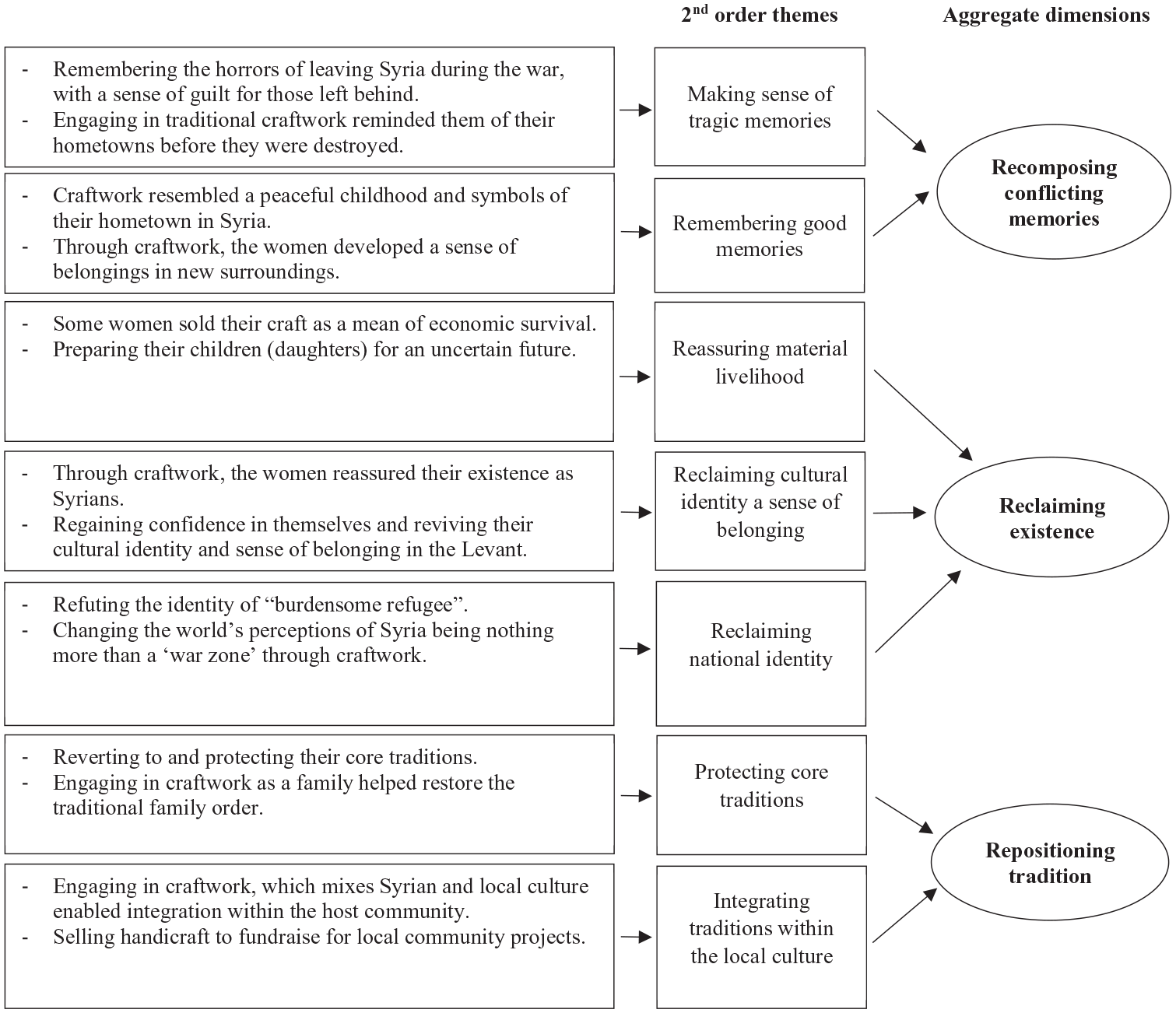
Data Structure of the Identity Work during Indeterminate Liminality.
Comparing the emergent insights with the liminality literature helped us articulate the uniqueness of the liminal condition that the forcibly displaced were thrust into and the types of identity work that we discovered. A conceptual framework eventually emerged from multiple rounds of iteration to theory building based on constant comparison (Corbin & Strauss, 1990).
Findings
Our findings are outlined in four sections, organised around the core elements of our emerging framework. First, we outline the structural aspects of indeterminate liminality. Second, we analyse the identity work that the refugee women engaged in to cope with indeterminate liminality. Third, we explain how this identity work leads them to relate to their familiar past and narrate a meaningful future, arguing that this helps them stretch the boundaries of indeterminate liminality, and therefore, cognitively cope with their uncertain conditions. Finally, we describe the nuanced variations of identity work across the contexts.
Structural aspect of indeterminate liminality
Our study demonstrates that while the refugee women faced varying levels of hostility in Jordan, the Zaatari camp and the UK (e.g. access to work, education, mobility and medical care), they all described being ‘stuck’ in a liminal state with similar structural characteristics and constraints. That is, they were experiencing the same variant form of liminality that had no known end date as ‘transitional liminality’ does, nor was it ‘perpetual liminality’, which was voluntarily entered while accepting the nature of its permanent uncertainty. Instead, the liminal state they were thrust into was ‘indeterminate’, characterised by three elements: a forced entry into liminality, an extended transition phase, and a lack of agency to terminate it at will. The women were all forced into the ‘separation’ phase when they fled Syria and entered into the ‘transition’ phase of liminality in their host community, imagining they would return ‘home’ shortly to ‘reaggregate’. As the transitional period was constantly extended beyond their control, it appeared that there was no end date in sight for when they could indeed return home. In the meantime, the liminal conditions in their settled place did not allow for full immersion into the community. The refugee women lacked the agency to terminate this prolonged and agonising transitional state, making it even harder to bear. The women in Jordan explained how the lack of work permits led their husbands to seek illegal employment, where they were exploited, underpaid and, at times, not paid by local business owners. This was extremely demoralising for them. Fadila stated: He felt emasculated. He has been working since he was 13 . . . I decided I had to work and get an income for rent, food and medical care for my family. I had never worked before, so I turned to what I knew, and that was sewing and handicraft . . . Otherwise we have to go to the camps and who knows how long we will be there for? And once you leave Jordan you cannot re-enter.
Fadila’s narrative captures the essence of the Syrians’ structural and cognitive struggles within the indeterminate liminal space, as they settled in Jordan under refugee status. The structural conditions of this liminal state legally constrained their ability to obtain a livelihood, yet they could not return to Syria and preferred to remain in Jordan rather than be forced into the camps indefinitely, a more dangerous space with less physical freedom and mobility. This then impacted their sense of self and dignity and, in particular, their traditional gender roles as ‘bread winner’ and ‘housewife’, which they had previously identified with before becoming ‘refugees’ dependent on dwindling UNHCR and charitable donations.
Samia was forced to flee Syria with her children and arrived in Zaatari in 2015 after her husband was killed. She explained: I arrived with my children and the clothes on my back . . . We were in a prison, cannot go into Jordan and cannot go back home to Syria. We were in no man’s land. It felt like life was over. Then I heard about the UN Women Cash for Work Programme. I joined their women’s Oases and learnt how to sew baby kits. It gave me a living, and a community. It gave me a new sense of purpose again . . . I was no longer alone.
The structural liminal conditions of the camp are physically evident in her describing the space as ‘a prison’ and ‘no man’s land’. Her cognitive struggles within these constraints led her to identify herself as ‘dead woman’, even though she entered the camp fighting for her life. She knew she could not tolerate living in the camp’s conditions indefinitely, but she also had no guarantees of when and if she would return home or get into Jordan. However, this indeterminate liminal state became more ‘tolerable’ as it changed her perception of who she was within this space from being a ‘dead woman’ or a ‘prisoner’ to becoming a ‘worker’ who is part of a community with other Syrian women just like her.
The Syrian women in the UK were surrounded by a new environment, culture and language. Of the sample interviewed, none of the women or their families had been to Europe before the war. The anxieties of arriving and integrating into a small village in North East Scotland were apparent across the women, and yet they could not fully commit to this new life, as they ultimately had no power in deciding whether they could leave or remain. Rahaf explained: I have to stop seeing this as temporary . . . But will it ever become home? I am living here taking it [the culture] all in, learning the language, but it will be for nothing if our residency application fails and we have to leave after living here for five years . . . we have no home or job to go back to in Syria . . . we may end up homeless again. It is all out of our hands. It is up to the UK government and God what our fate will be.
The structural liminal conditions faced by the women in the UK were not as harsh as those living in Jordan and the camp. However, like the women in Jordan and the Zaatari camp, the anxieties of living in this particular liminal state were the same, as the ‘indefinite leave to remain’ status had not been granted yet to any of the refugees, and this had a knock-on effect mentally. Furthermore, they were warned there was no guarantee the status would be granted, nor were they informed what would happen thereafter should they be rejected, leaving them in an indeterminate liminal state. It also left them perplexed as to how to integrate their Syrian identity within the new community and local culture and language when they may be deported in five years.
This section outlined the concept and characteristics of indeterminate liminality by highlighting the structural constraints faced by the forcibly displaced women, their lack of agency to end their liminal state and the subsequent impact this had on their sense of identity. Thus, the next section focuses on the cognitive aspects of how the refugee women coped with the structural and identity challenges of indeterminate liminality through craft and identity work.
Engaging in identity work during indeterminate liminality
Our findings mainly illustrate three similar interrelated forms of identity work across the cases: recomposing conflicting memories, reclaiming existence and repositioning tradition. We will illustrate them in turn.
Recomposing conflicting memories
As the women grappled with gaining an income and developing a sense of belonging in new surroundings, it became evident that deeper identity work was also taking place on a cognitive level, as the women were remembering both the peaceful past in Syria and the present pain of the war. The women engaged in craftwork, which connected them to Syria, as it resembled their childhood memories and reminded them of their hometowns. Najla, a resident in the Zaatari camp, explained: I make scarves because my grandmother and mother used to make them in Aleppo . . . we are known for our cotton and silk textile work . . . I lost my mother during our escape so it hurts my heart to make them but I make them for the young girls here, nice colourful ones.
Nuha also explained: ‘These remind me of the clothes I used to sew with the women in the village. We used to make different colours for our children’s Eid clothes.’
Najla and Nuha’s craftwork ignites conflicting happy and painful memories from their past in Syria with the women in their families. In addition, Najla carries pride in maintaining her identity as an Alepponian through the craftwork, as it symbolises continuing the legacy of her hometown’s famous textile industry specifically and Islamic Eid traditions more generally within the refugee camp. In addition, this traditional craft meets the current needs of young girls confined within the camp. Similarly in the UK, Ghina stated: I used to make these ribbon hearts with my mother and put them on the dining table for Eid as decoration next to the baklawa. I made them during Ramadan for our first Eid in the UK. We have never had Eid outside of Homs before, so we wanted to make it homely, but I suffer when I look at it as well – it makes me yearn to go back home.
Nostalgia through craft carried a remedial aspect in helping the women make sense of tragic memories of the war and replacing them happy ones from their past in Syria. On a more cognitive level, this helped them deal with the fear of losing their Syrian as well as Muslim identity and traditions around religious events. The craft objects offered them a familiarisation with who they were at ‘home’ within who they have become in the ‘new home’. In addition, some of the women in the UK discussed selling their craft at cultural exchange events held in village halls to engage with and integrate within the local community, illustrating their desire to stretch their liminal state, and thus liminal identity, in a way that integrated their past identity within their present one in the host community.
Reclaiming existence
The women engaged in craftwork to support their material livelihood, but the craftwork also reflected their desire to reclaim their sense of pride, their cultural as well as national identities during their indeterminate liminal state. In Jordan, Ola explained of her craftwork: ‘Simply, if I do not make craft and sell it, we cannot pay the rent and put food on the table.’
Zeinab stated: I want my children to see that, we Syrians, have a good work ethic, even if we are never allowed to work in Jordan, we will find a way to work for our livelihood and never beg.
Manar, however, reflected upon the (sub)conscious inspirations behind her paintings: This is a beautiful steady sailboat on the Mediterranean. The people in the boat are happy, not like the refugees, riding inflatable boats driven by thieves, fearing drowning . . . We were lucky we got into Jordan in 2011. We would have been forced to take boats like those poor souls . . . They drowned along with their relatives and memories. We are alive. We are here.
Through craftwork, the women collectively reasserted their existence in liminality and good fortune for their survival and continuity. It also resembled their engagement in co-constructing their indeterminate liminal space, where they felt a loss of the sense of identity, by reclaiming their identity as human beings, who were alive, which additionally provided them with a sense of belonging.
Ghazal stated, about a baby blanket she made for her newborn son: I wanted him to have one like his brothers did when they were born in Syria. He will probably grow up to always be seen as a refugee here. But at least as soon as he was born, he was wrapped with a hand-made Syrian-made blanket. He will know where he is from and belongs.
The cognitive tensions of living as with the identification of a ‘refugee’ in an indeterminate liminal state stressed the need to reclaim their identity and existence as Syrians, especially their newborns who would not hold a UK citizenship (or arguably a Syrian one) for an unknown period of time. Ghazal believes her baby will hold the contentious identity of ‘refugee’, and therefore, she reverts to the Syrian identity through the traditional Syrian baby blanket she made for her older sons, which can be passed down to future generations. This lack of affliction illustrated a negative aspect of liminality. However, it also demonstrated how the women (the liminar) developed an ability to project a post-liminal self in the future for their children. This was inevitably dependent on the constraints and affordances of each context and its liminal conditions.
Repositioning tradition
The women were not willing to compromise on their traditions, but rather reinterpreted them in their new environment to preserve them, which subsequently preserves their sense of self. That is, they remind themselves of who they were before the war while fighting an internal battle to keep their traditions alive in their current indeterminate liminal state. Each piece held its own story, which protected and promoted their cultural heritage and Syrian identity. The women engaging in craftwork were united in their mission, along with their family, to protect the core traditions from their past. They also coped with their present liminal period by partially adapting to their temporary setting as they prepare for their uncertain future ‘when it arrived’, as Bana explained: I design the craft, cut the materials and prepare them for when my husband returns from work and the kids from school. Then after dinner, we sit together and make them as a team. The children understand we all need to work to get through this.
Despite the war continuing, some women were preparing for their return to Syria, such as Nabila in the Zaatari camp, whose craftwork carried sentiments with a larger political focus which she planned to take back to Syria: Whilst we are sewing clothes for the women in the camp to use while here, we are engaging in something bigger than this. We are making a women’s union as a collective movement against current oppressive structures . . . Women are the origin of life and freedom. Without women’s engagement, there’s no democracy. Without democracy, there are no human rights. And without human rights, there can be no freedom.
In Jordan Hadia, a seamstress, explained: I make clothes to suit my Jordanian clients, but they always have a Syrian twist on it. Even if subtle. It is like the best of both worlds.
For national and traditional events in Scotland, Rawaa chose to also partially adapt to the local culture by making scarves using Scottish tartan patterned materials for her daughter and son to wear, as she explained, All the boys and girls were wearing traditional Scottish clothes with different tartan patterns representing their family heritage. So, I decided to make these tartan scarfs for my daughter and a keffiyeh for my son so they do not miss out but still maintain their modesty and our traditions.
The keffiyeh is a head garment worn in and around the Middle East, which is usually worn by traditional, rural (usually older) Arab males. Historically, it has also been worn as a symbol of Arab resistance and solidarity. Thus, in these examples, we see the Syrian women evolving their identity, based on their core traditions, and repositioning them through craftwork. This has two faces, one taking on the local tradition and the other moderating a Syrian tradition. While their agency to ‘re-create’ a new post-liminal self during the ‘reaggregation phase’ is limited, the women were able to maintain their sense of self during indeterminate liminality by looking back at who they were before the forced ‘separation’ phase and looking forward to who they (and their children) will become in the future when they can potentially begin to reaggregate into their ‘new’ selves.
Stretching the boundaries of indeterminate liminality
In this section, we illustrate how as a result of the three interrelated forms of identity work through craft, the women were able to cope with their present challenging circumstances. More specifically, we illustrate how the women manage to ‘stretch’ the boundaries of indeterminate liminality by cognitively establishing connections to their familiar past and a meaningful future. As such, they regain control over the indeterminate liminality at a cognitive level, even as their agency to terminate their liminal state continues to be constrained by external forces. Therefore, they no longer feel dominated by the structural liminal conditions. Instead, they engage in identity work while co-constructing their indeterminate liminal state in a more meaningful and purposeful way. This alleviates their difficult present-day reality that they face through carrying the identity enforced upon them as ‘the burdensome refugee’ and reaffirms their sense of identity as Syrian women during this limbo state.
Symbolic restoration of the familiar past
The three forms of identity work enabled the women to connect to their past and preserve their traditions as well as their pride as Syrians. Ghalya explained how a community of artists was making artworks on the caravans in the Zaatari camp. The aim was to aesthetically please those living in the camps, but also to send a message to the outside world about what it means to be a Syrian through their rich cultural heritage: The UN delegations that visit us in the camp, learn about our history and traditions through these works of art. The UNHCR also places photos on social media so everyone can see we are still here and Syria lives on.
Marah in Jordan explained of her paintings of Syrian cultural heritage sites: People around the world watch the news on TV and Youtube and think we are nothing but a war zone. We need to show them we are a civilised nation . . . [The painting] sends a message that whilst we are displaced and they continue to destroy our land, the history of Syrian’s civilisations, its art and culture will not be forgotten as these proudly hang in homes and places of work.
Fatin also explained a craft she made in a community centre in Scotland: I sewed and framed this in the community centre today. It says Home Sweet Home. I used to have one hanging in my house in Homs but had to leave it behind when we fled. But since this is my home now, I am going to hang this replica up in the entrance as I did in my old home.
These examples illustrate that as a result of the identity work through craftwork the women could re-establish a personal connection to their home, albeit a symbolic one. They were also able to dispel the tarnished image they believed the media had of the Syrian people, and cognitively reconstruct their refugee identity to the outside world by reviving their national identity as civilised Syrians.
Narrative construction of a meaningful future
Deeper probing into the women’s accounts revealed that engaging in craftwork provided them with a unique platform that allowed them to revert to some core traditions that they strongly identified with. That is, engaging in craftwork afforded them a sense of identity based on connecting their present indeterminate liminal period with their past, and also to their future, through envisioning an alternative, yet unknown future, as Sara stated: I was an artist and always had a talent for embroidery and jewellery making. I learned from my grandmother and mother, and now I am passing it down to my daughters. But today it is a case of needing to make – to sell – to live. It prepares us for the future, as in, what if my husband dies? I have no father or brother here to support the girls and I.
She added: The girls help me make the accessories and so developed a skill they can utilise to earn a living whether they continue living here or return home.
The craftwork was the vehicle through which they could create a meaningful future that they could identify with while living so far away from ‘home’. It also held a practical element, as it allows the future generations to earn a living, or socio-culturally integrate in their new setting, while simultaneously connecting to their Syrian heritage. Creating this sense of familiarity to their Syrian identity seemed all the more important in the UK due to the geographical distance and cultural difference from their homeland. Halima explained of some items she had seen in the community centre: This is a traditional Scottish print, called tartan. The men wear it for weddings and special occasions. Imagine, one day my son would wear such a skirt too as they grow up here [giggles]. But it is fine, I have made him a traditional Syrian red tarboush [fez] to wear with it. Anyway, who knows if we will be here or where we will be by then.
However, despite these efforts to shift away from the ‘refugee identity’ and to create an integrated ‘Syrian-UK identity’ for the future, the tensions remain as they await their residency applications. Halima explained that they will apply for their residency during 2020 and that the refugee coordinator believes their application will be successful, yet her concerns within the indeterminate liminal state continued: We hear stories, perhaps rumours, of people being rejected. So, in the meantime, I am not sat with one hand over the other. My husband says we will have to go back to Syria if we are rejected but I am researching to see if we can go to Germany on a family reunion visa to join our sons who are there.
The women explicitly expressed they were not sat ‘hand over hand’ (local idiom for ‘twiddling one’s thumbs’), passing time while waiting for something to happen. Indeed, during the analysis it became evident that the women took matters into their own hands – literally – through craftwork, which strongly identifies with their past selves and their families (with an emphasis on their daughters, who are the most vulnerable in the absence of a male family member) to psychologically, socio-culturally and economically survive both in the present and the future. That is, they were thrust into structurally constraining indeterminate liminal conditions, yet they utilised what little agency they had to co-construct their identity in this limiting space in a more meaningful and purposeful way through craftwork. Indeed, the women’s identity under the patriarchal traditions by which they were ‘taken care of’ in Syria has been destabilised under their current indeterminate liminal state. Therefore, their daughters must prepare to be financially independent in the future through making and selling traditional craftwork and their sons must prepare to integrate ‘once’ they become residents.
The nuanced variations of identity work between contexts
We acknowledge that women across the three settings experienced different levels of hostility – understood as the general social, financial and practical challenges they faced – which in turn seemed to partly affect the way that identity work manifested. Actors in the UK case experienced a relatively lower level of hostility in the sense that the structural conditions were favourable, as their day-to-day basic survival needs were stable and secure. Therefore, they viewed their engagement with craftwork primarily as a means of preserving their traditions through merging them with new local ones, thus integrating them within their host community in the UK, whether they sold it, gifted it or retained it in their new homes.
For example, while the identity work of recomposing conflicting memories was found in all three contexts, it was most prominent among interviewees in the UK. In this comparatively less hostile environment, women had the time and emotional capacity to be more reflexive. Our observations suggest that, because of the stress of survival and the need to pay the monthly rent, women in Jordan had less capacity to do so. This suggests that actors may need to feel a certain degree of security before they can deeply engage in this reflexive mechanism.
In Jordan and in the Zaatari camp, instead, the desire to preserve their traditions through craftwork was more strongly evident. This is down to the institutional constraints combined with the backlash of being branded as ‘burdensome refugees’ by some Jordanian officials and a few in the media and the community. Preserving their traditions through the craft they made (and sold) helped restore their pride as Syrians and their self-esteem as financially independent, rather than depending on dwindling international aid and local charities. Our analysis shows that this hostility fuelled their desire to preserve their traditions in a more authentic way in these two contexts in comparison to the UK.
While visible in all three contexts, reclaiming existence was more critical in contexts characterised by high hostility. Thus, this form of identity work was more prominent among respondents in Jordan, especially among refugees in the Zaatari camp. This observation suggests that this coping mechanism may serve as a peaceful response to a hostile environment, aimed at reclaiming identity and a sense of pride in the face of hardships.
Finally, our analysis highlights the key role of repositioning tradition. When actors go beyond recomposing memories and strongly engage in reclaiming their existence (as in Jordan and the Zaatari camp), our findings suggest they tend to maintain tradition more authentically, meaning their connection with their past was relatively stronger. On the contrary, when actors engaged more intensely in recomposing memories and less on reclaiming their existence (such was the case of refugees in the UK), they become more inclined to integrate within their host community.
Discussion
We started with the question of how do forcibly displaced actors manage an ongoing and potentially endless period of liminality. Our analysis suggests that, despite the geographical differences, all the refugees were in the seemingly never-ending ‘transition’ phase of liminality, regardless of when they fled Syria and in which context they were temporarily settled. We conceptualise this as indeterminate liminality, defined as a liminal state into which actors are forcibly entered, and their agency is structurally constrained until an unknown end date, leaving them to experience seemingly never-ending uncertainty.
Our analysis shows how they can stretch the boundaries of indeterminate liminality through three forms of identity work. Through the identity work, they can maintain cognitive control over their sense of self even when they are thrust into the indeterminate liminality and cannot exercise physical control over the structural constraints imposed. The process model emerging from our analysis is portrayed in Figure 2.
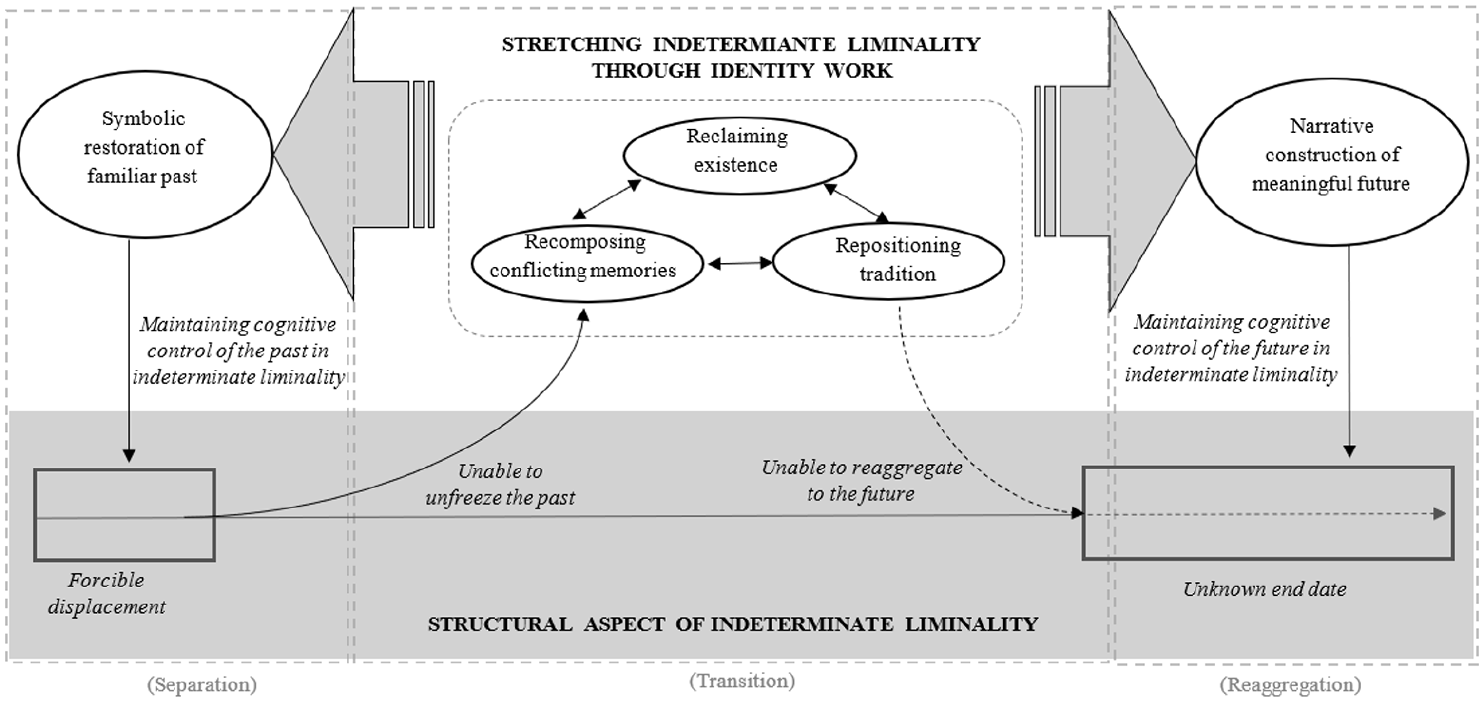
Process model of how the forcibly displaced actors cope with indeterminate liminality.
The first process, recomposing conflicting memories, involves actors making sense of both the tragic event of the war and recalling good memories of the past. Unlike actors in other types of liminalities, our analysis suggests that the forcibly displaced are unable to ‘unfreeze’ the past in the early stage of ‘separation’ (Turner, 1969). Therefore, while previous studies point to the importance of forgetting the old self at the beginning of liminality (Henfridsson & Yoo, 2013; Turner, 1969), our process highlights the crucial mechanism of holding on to the past, and being reflexive about it.
The second main process in our model, reclaiming existence, conceptualises how the actors fundamentally reaffirm their own existence by salvaging their cultural and national identities and material livelihood. We argue that this identity work is crucial to the forcibly displaced because, unlike in perpetual liminality, they do not have the agency to end the liminality, nor can they accept the institutionalised state of ambiguity (Ybema, Beech, & Ellis, 2011). Therefore, the work of reaffirming oneself becomes pivotal for the actors to reassert their values and regain their confidence and a sense of belonging.
Finally, the third process, repositioning tradition, explains how the forcibly displaced re-interpret the tradition within the indeterminate liminality in order to preserve it. This is distinct from what has been previously discussed in the liminality literature, which highlights the undoing of existing arrangements and the creation of new rituals (Powley, 2009). This process is essential because the actors in indeterminate liminality are unable to enter the ‘reaggregation’ phase of liminality, and are forced to stay in the prolonged ‘transition’ phase in which the creation of completely new rituals is unlikely.
Our analysis shows that these three forms of identity work enable the actors to stretch the boundaries of indeterminate liminality, enabling them to maintain cognitive control over their sense of self. More specifically, we theorise that as a result of the identity work, forcibly displaced actors can symbolically restore the past that they were familiar with (for instance, in the messages inscribed in craft objects), thus maintaining cognitive control of the past self. Restoration is symbolic of compensating for their inability to physically go back to their old world or fully rebuild the structural and practical elements of the traditions. At the same time, the actors may be able to escape the difficult circumstances by narratively constructing a meaningful future, which helps them maintain cognitive control of the future self through envisioning an end to an otherwise seemingly endless liminality.
Taken together, these processes suggest quite a different understanding of how actors manage ongoing and potentially endless periods of liminality, and through that, culturally survive and alleviate their difficult present-day reality and the troublesome identity as ‘a refugee’. In the next section, we explore these differences and examine the boundary conditions of our analysis and future research suggestions.
Theoretical contributions
In this section, we discuss our theoretical contributions primarily to the liminality literature, and secondly to identity work. First, we contribute to the literature of liminality, by drawing attention to the concept of indeterminate liminality, a state which has not been addressed previously. Contrary to transitional and perpetual liminality, indeterminate liminality is characterised by two structural constraints. This is because the traditional assumption of intentionally entering into the initial phase of ‘separation’ does not hold a place (due to the forced entry and lack of agency to renew oneself) and because the reaggregation phase cannot be foreseen in the near future (due to the extended transition phase and the lack of agency to terminate it). Therefore, while the concept of liminality has been treated primarily as a structurally imposed condition by virtue of profession or role (e.g. temporary workers and consultants) (Howard-Grenville et al., 2011), our study problematises what ‘structurally imposed’ really means. As such, our analysis adopted a less linear (Cappellini & Yen, 2016) and more dynamic view to understand indeterminate liminality and to unpack the processes through which actors can navigate it.
Second, we contribute to the liminality literature by showing how indeterminate liminality can be managed through identity work. Our study suggests that even when the forcibly displaced are thrust into indeterminate liminality – a form of liminality in which the structural constraints of perpetual liminality are increasingly pronounced – they can undertake identity work that stretches the boundaries of indeterminate liminality, which can lead to positive cognitive outcomes. Therefore, our findings challenge the core assumption in the liminality literature that actors experiencing high levels of structural constraints struggle to engage in meaningful identity work with positive outcomes.
More specifically, existing studies point to both positive and negative psychological processes and outcomes of identity work in liminality (Cappellini & Yen, 2016; Griffiths, 2014; Howard-Grenville et al., 2011). However, when it comes to perpetual liminality, the literature assumes that actors typically have less control over the ambiguous social structure, making it more challenging for them to engage in meaningful identity work (Beech et al., 2016; Daskalaki & Simosi, 2017), leading to negative psychological consequences, such as a lack of affiliation, power, or access to learning opportunities (Beech, 2011; Swan, Scarbrough, & Ziebro, 2016). Johnsen and Sørensen (2015) highlight that the ‘“positive side” of liminality depends on liminals’ ability to project a post-liminal self into the future’ (p. 1168), and the ability to gain positive outcomes becomes increasingly inhibited depending on the contextual affordances and constraints. This is why their findings propose that the actors in perpetual liminality adopt ‘flexible identity positions’ that construct their liminality in ‘both coherent and ambiguous ways’ (p. 1168), keeping the identity work ambiguous. Other studies corroborate this and call such identity works ‘unresolved’ (Beech et al., 2016), ‘fragmented’ (Johnsen & Sørensen, 2015) and being repetitive and routine-like (Ellis & Ybema, 2010; Wilhoit, 2017).
Our findings provide an alternative perspective to such arguments by illustrating how the three forms of identity work enable the actors to stretch the boundaries of indeterminate liminality in terms of cognitively keeping them closer to home – as they keep ties alive through their craftwork, while simultaneously evoking a forward-looking perspective. We foreground that within the everyday mundane engagement in craft making, the forcibly displaced may not just be able to retain their sense of self and normality but also narratively construct a meaningful future. Therefore, although they are pushed into liminality, our analysis shows their resilience in mobilising the micro amounts of agency available within existing structural constraints to co-construct their indeterminate liminal state in a more purposeful and meaningful way than what the current literature proposes. Therefore, our study explains how actors continue to reconstruct their identities in places where it is extremely hard to maintain a sense of subjectivity (Shortt, 2015).
These findings are important for forcibly displaced actors more broadly because their state of liminality tends to be prolonged (Wimark, 2019). We elucidate that the forcibly displaced are not just stuck in and engaging in improvised and reactive activities, but they try to construct a meaningful future for themselves and their families (Manchanda, 2004; Martí & Fernández, 2013). Nonetheless, importantly, we maintain that the forcibly displaced experience a strong sense of agony during indeterminate liminality. Therefore, identity work is conducted to cope with liminality rather than to thrive during it. Using the concept of liminality helps us understand both the agony (the negative aspects of liminality) and the agency in constructing a meaningful existence (the positive aspects of liminality), and exemplifies the cognitive strength and resilience of the forcibly displaced. Moreover, our process model explains how the forcibly displaced manage to symbolically re-establish a connection to their past selves. This point extends the current line of argument that forcibly displaced people work to maintain their own culture as merely an ‘add on’ to the main focus of their ‘integration’ into the host community (Rothenberg, 1999). Instead, our findings suggest that maintaining the connection to the past is crucial for them to maintain positive self-identification during indeterminate liminality and therefore, eventually, may lead to better outcomes of integration.
Finally, our findings provide new insights to the identity work literature by showing how the forcibly displaced can maintain their self-worth and dignity (Ashforth & Kreiner, 1999; Snow & Anderson, 1987) during prolonged liminality, a unique context that has received less attention. Organisational research has shown that self-identity construction is agentic, while also recognising that actors’ choices are both enabled and constrained by social structures (Beech, 2011). Social structures affect the way actors resolve the identity puzzle and seek change from a ‘current self’ and engage in continuous pursuit of a highly desirable ‘aspirational identity’ – an idealised self (Thornborrow & Brown, 2009). Our study adds to the identity work literature by illustrating how forcibly displaced actors who are structurally bound can sustain a positive self-identification. The key point is that, rather than transforming their identity, they make themselves adaptable to the structural constraints through the mechanism of stretching the boundaries of indeterminate liminality.
Conclusions
Our study provides a refined understanding of what the refugees experience while coping with prolonged uncertainty. While policy suggestions have been put forward for refugee resettlement, integration, supporting their mental health and wellbeing and improving locals’ attitudes towards hosting refugees (Strang & Ager, 2010), our analysis points out that, in practice, these policies reflect a decontexualised standpoint (Esses, Hamilton, & Gaucher, 2017). That is, these policies support refugees for a temporary period, until the war ‘ends’, after which they are expected to return home. We suggest that this does not account for the state of indeterminate liminality that the refugees go through during this ‘wait’. It also does not account for the realistic possibility that the refugees may never safely return or, paradoxically, the probability of being forced to return when it is still unsafe, and the impact these conditions have on their ability to integrate into their host communities and maintain a sense of identity. For example, in April 2021 Denmark became the first European nation to revoke or not extend residencies (beyond 2020) of Syrian refugees after they had settled and integrated there for years with their children and families (McKernan, 2021). The claim is that some parts of the war-torn country were safe to return to for women (on the supposition that women would not be ‘persecuted’ like men). However, due to the lack of diplomatic relations, Denmark cannot return the refugees to Syria, leaving them in ‘limbo’ as they are put into detention centres ‘indefinitely’.
Our findings highlight the necessity of policies specific to women refugees. While laws and policies on setting up businesses in Jordan for non-nationals were updated in 2016 (UNHCR Legal Unit, 2016) to support refugee entrepreneurship, we believe these policies should have a stronger emphasis on supporting women’s home-based enterprises, such as craft-making. The current ‘gender-neutral’ policy design is embedded in a masculinist worldview (Zuckerman & Greenberg, 2004) and ignores the socio-cultural and family constraints embedded with women’s entrepreneurship. We argue that providing the women refugees with appropriate access to networks and markets will help create a stable platform for economic empowerment and a legitimate identity as Syrian entrepreneurs during prolonged uncertainty. Similar programmes in the UK, designed beyond the remedial intention of craftwork, would enable the women to integrate both socially and economically, while fostering an integrated identity connected to both their past and future. Furthermore, UN agencies and UK integration programmes should also nuance their refugee policies and entrepreneurship courses to encourage the creation of craftwork for economic gain, and also as a way to manage the continuous identity work while they are on the self-development and cultural integration programmes.
We believe the concept of indeterminate liminality can be used to further our understanding of contexts other than forcible displacement that are also characterised by extreme unpredictability. For example, recovering cancer patients who fear and anxiously await recurrence, or people increasingly living with the uncertainty of precarious work or zero hours contracts. In the spirit of global challenges, the global Covid-19 lockdown may be considered a current example of indeterminate liminality that shares some commonalities with the displaced refugees. While the conditions of the ‘forcibly displaced’ searching for safety cannot be directly comparable to the situation of governments having to ‘forcibly place’ people in their homes for their safety, this state of being unable to obtain a livelihood or socialise until an unknown end date may trigger both similar and different types of coping strategies to our findings.
Footnotes
Acknowledgements
We are grateful to Trish Reay, the special issue editorial team and three anonymous reviewers for their thought-provoking and constructive comments throughout the review process. These have significantly helped us improve our work and provided us with a platform to share Syrian refugees’ stories of loss and resilience during what seems to be a never-ending period of uncertainty. Our deepest gratitude goes to the Syrian women who welcomed us into their homes, generously shared their stories and who – against all odds – continue to dream about going ‘back home’ to live in peace and dignity.
Funding
The author(s) received no financial support for the research, authorship, and/or publication of this article.
