




Abstract
In this paper we report on how middle managers in a Russian subsidiary translate empowerment, a ‘western’ management concept imposed by the Finnish headquarters. The analysis shows that in their discursive struggles these middle managers mobilised proverbs to address competing discourses that reflected imported and local ideals of good management. We advance organisational translation research by highlighting the value of proverbs as an understudied discursive resource in translation activities on the ground. The paper also examines the dual role of middle managers as both translators and implementers of an imported and imposed concept in a multinational corporation. Translation work carried out by middle managers in multinationals has received limited attention in previous research. Finally, by bringing together the discursive and the interlingual, we join recent efforts to broaden the definition of translation to encompass translation work undertaken in multilingual organisations.
Keywords
Introduction
This paper examines how Russian middle managers working for a multinational corporation (MNC) translate empowerment – an imported and imposed management concept. Translation of management concepts and practices across diverse organisational and geographical contexts is a recurrent theme in organisation studies (Filatotchev, Wei, Sarala, Dick, & Prescott, 2020; Wæraas & Nielsen, 2016). Extant research has examined how fashionable management concepts such as total quality management (TQM) (Özen & Berkman, 2007), lean management (Morris & Lancaster, 2006) or diversity management (Boxenbaum, 2006) travel across borders and how their meaning changes (Boxenbaum & Strandgaard Pedersen, 2009) or is even lost in translation (Boxenbaum, 2006). Such concepts are often introduced by consultants, business schools or management gurus in organisations that are keen to adopt them (Sahlin-Andersson & Engwall, 2002). Through their global reach, MNCs play a crucial role in introducing and translating management models across institutional and societal contexts.
While previous research has advanced the understanding of translators, translation processes and outcomes in important ways (Boxenbaum, 2006; Morris & Lancaster, 2006), we know far less about how translators as social actors do translation work on the ground (Mueller & Whittle, 2011; Teulier & Rouleau, 2013) and the challenges they face. Unlike much of the previous research, we are interested in organisational translators located in MNC subsidiaries who often find themselves in situations where new management concepts are imposed on them rather than sourced on a voluntary basis. This is an important distinction which characterises much of the translation work undertaken in MNC subsidiaries. Nevertheless, the translation approach has rarely been applied to the study of MNCs ( for exceptions, see Ciuk, James, & Śliwa, 2019; Gutierrez-Huerter, Moon, Gold, & Chapple, 2019).
The paper makes three contributions to the translation approach in organisation studies. Our main contribution lies in uncovering how local subsidiary managers mobilised proverbs to address competing discourses that reflected imported and local ideals of good management. Proverbs carry set meanings, which reflect dominant discourses and ideals in their social contexts and provide a useful but understudied resource for examining translation work in organisational settings. In so doing, we address calls for more discursive approaches to translation (Mueller & Whittle, 2011).
Second, we advance the translation literature by focusing on the dual role of middle managers as translators and implementers of an imported and imposed management concept in an MNC. Although middle managers hold a critical position between senior-level management and frontline employees, they have received limited attention in translation research (Teulier & Rouleau, 2013). However, it largely depends on the agency of middle managers whether new concepts such as empowerment – defined as a set of practices that gives power to someone in a subordinate position – are implemented, challenged or resisted in the local subsidiary. This applies particularly to contexts such as Russia, which are, normatively, characterised by authoritative leadership (Fey & Shekshnia, 2011) and where managers are therefore less expected to share power with their subordinates.
Third, we show that when translating a management concept, empowerment, into a context that lacks its requisite vocabulary, not only discursive but also interlingual translation work is needed. However, translation research in organisation studies has tended to distance itself from the interlingual meaning of translation (e.g, Czarniawska & Sevón, 1996), although language boundaries are often crossed as ideas and practices travel on a global scale. Thus, we join recent efforts to broaden the definition of translation to encompass the interlingual translation work commonly undertaken in multilingual organisations (Ciuk et al., 2019; Piekkari, Tietze, & Koskinen, 2019; Westney & Piekkari, 2020).
The rest of the paper is structured as follows. We first introduce the translation approach in organisation studies with particular focus on studies taking a discursive perspective. After describing the research methods, we present our findings, position them in the existing body of research, offer theoretical and managerial implications and make suggestions for future research.
The Translation Approach in Organisation Studies
In organisation studies the notion of translation is defined as ‘a process whereby an object changes from one state to another as it moves within and across organizational settings’ (Wæraas & Nielsen, 2016, p. 247). Translation means adapting the original concept to make it accessible to receiving audiences in local contexts. As a process, translation involves both retaining what is most valuable in the source and then transforming elements thereof to gain acceptance in the new context. Hence, management concepts are disembedded from their local context and transposed to other institutional contexts where they are re-embedded into local practices via the translation process (Czarniawska & Sevón, 2005). Translation draws attention to the receiving end of the transferred practice where the global meets the local. This approach – with its origins in Scandinavian institutionalism – highlights how local actors in the capacity of agentic translators make sense of introduced concepts and attach local meanings to them (Czarniawska & Joerges, 1996).
In this stream of research, middle managers have received scant attention as translators (Radaelli & Sitton-Kent, 2016), although they occupy a central position in organisational hierarchies as both recipients and implementers of senior management strategies (Balogun & Johnson, 2005; Harding, Lee, & Ford, 2014). Faure and Rouleau (2011, p. 180) note that ‘the strategic role of middle managers as translators between heterogeneous stakeholders is becoming more and more important in many industries and has so far been underexplored’ (see Teulier & Rouleau, 2013, for an exception). Thus, even though the agency of middle managers in the travel of ideas has been acknowledged, examination of their role from the perspective of translation theory has been neglected (Radaelli & Sitton-Kent, 2016). Such an examination is the focus of our study.
To a large extent, existing research has focused on the public sector and explored how organisations have picked up, adopted and incorporated fashionable management ideas to become more progressive (Boxenbaum & Strandgaard Pedersen, 2009). These studies have typically sought to explain the differences between an idea originating in Japan or the United States and its translated form in northern Europe (Erlingsdottir & Lindberg, 2005) or the process whereby these new ideas are translated (Boxenbaum, 2006; Morris & Lancaster, 2006). Translators of management concepts are often consultants or management gurus who operate at the interorganisational rather than at the intraorganisational level as in an MNC. While these studies have extended the understanding of how practices are transformed as they move from one cultural context to another, we still lack knowledge about the dynamics of translation work on the ground.
We believe a discursive approach to organisational translation provides a particularly fruitful path to follow because the notion of translation is ‘premised on the linguistic metaphor’ (Teulier & Rouleau, 2013, p. 314). However, to date the discursive perspective has attracted only limited attention in organisation translation research. The majority of discursive studies focus on interorganisational translation in the public sector, where the receiving organisations actively promote sourcing of fashionable management concepts. Most of these studies are set in a developed market context and few are concerned with intraorganisational translation in MNCs, which is the focus of our study. Table 1 provides an overview of translation studies using discursive approaches.
Translation studies using discursive approaches.
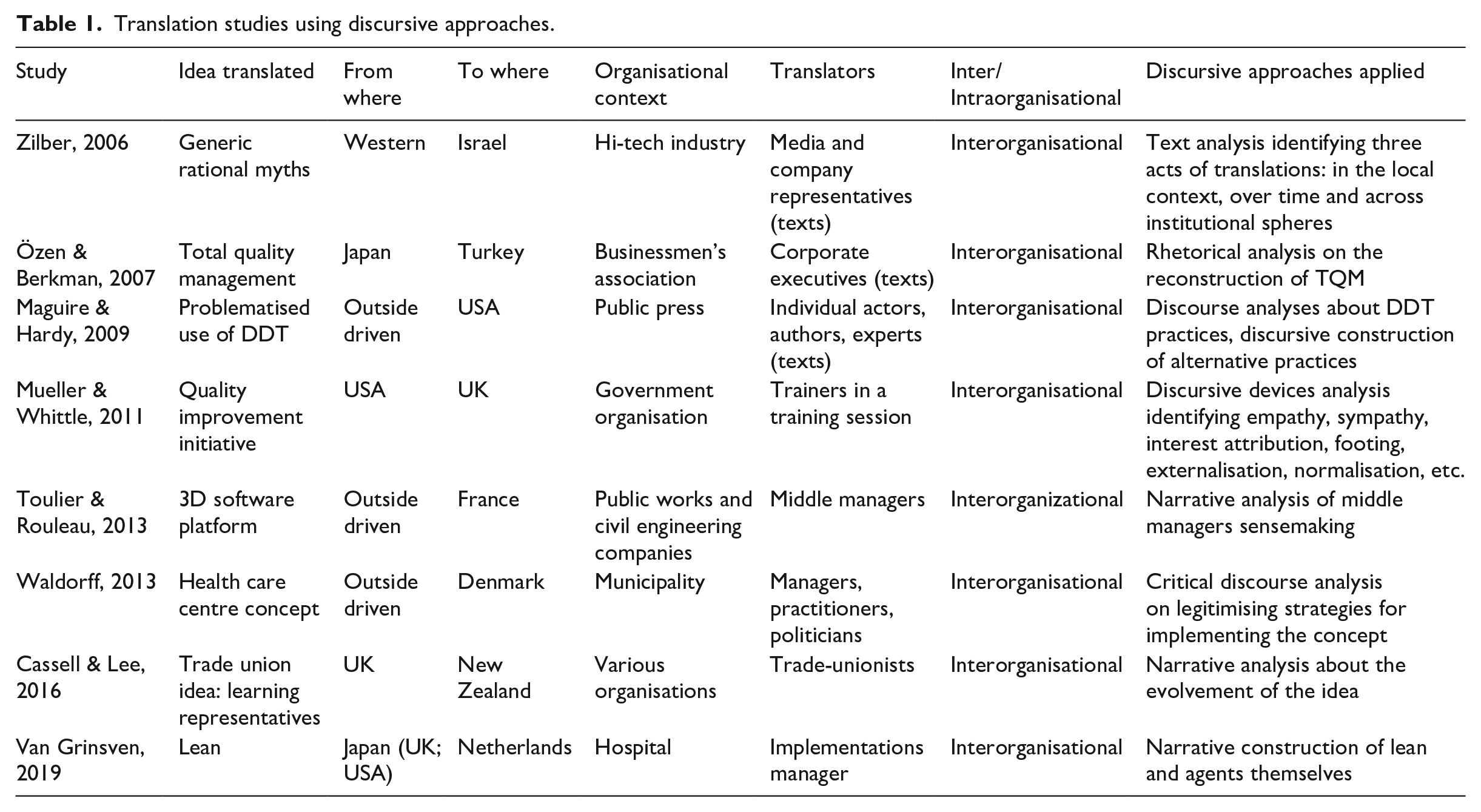
As Table 1 shows, many of the discursive studies have been conducted on the institutional level, such as Zilber’s (2006) study on rational myths in Israel’s hi-tech industry sector, Özen and Berkman’s (2007) study on total quality management in the Turkish business environment, and Maguire and Hardy’s (2009) research on the desinstitutionalisation of DDT in the US. More recent studies (Cassell & Lee, 2016; Mueller & Whittle, 2011; Teulier & Rouleau, 2013; Van Grinsven, Sturdy, & Heusinkveld, 2019; Waldorff, 2013) identify various discursive strategies pursued by local translators. Drawing on a study of a quality improvement initiative in a UK public-private partnership, Mueller and Whittle (2011) identify a variety of discursive devices such as footing, empathy/sympathy, externalisation and categorisation, which were skilfully employed by two trainers in a training event. For instance, Cassell and Lee (2016) emphasise the significance of the proprietorship and vigilance of translators in transferring the idea of trade unions from the UK to New Zealand. Also, in a recent study on lean management in hospitals, Van Grinsven et al. (2019) discovered different types of translation-as-identity-work through which the translators constructed both the concept of lean management and their own agency. Thus, our study follows more recent work focusing on discursive resources in translators’ talk.
Few studies have employed the translation approach to MNCs and the handful we identified are not discursive. Becker-Ritterspach, Saka-Helmout and Hotho (2010) studied the translation of new production procedures and systems from a Dutch multinational company to subsidiaries in Germany and the UK. Gutierrez-Huerter et al. (2019) investigated corporate social responsibility reporting in five subsidiaries (French, Danish, Dutch, Brazilian and American) of a UK-based MNC. Recently, Ciuk and James (2015) and Ciuk et al. (2019) examined the translation of corporate values in a Polish subsidiary of a US-based MNC. We join these authors in advancing the understanding of how HQ-imposed management concepts are translated locally by subsidiary managers. In contrast to these studies, we adopt a discursive approach to the translation work in order to emphasise sense-making processes on the ground and situate the study in a context that is institutionally and culturally very different from the source context.
A Case Study
Our study is focused on understanding the translation of empowerment in a setting of a Finnish MNC – a management concept that occupies a central position in Finnish leadership discourse and in Nordic countries more generally. It typically refers to a set of practices that gives power and autonomy to employees for performing their roles and making their own decisions (Psoinos & Smithson, 2002; Wilkinson, 1998). In the Nordic and many other ‘western’ 1 countries, empowerment is taken for granted as an ideal of good management. Since we were interested in gaining an in-depth understanding of the discursive construction of empowerment by the research participants in their natural context, we chose a single-case design (Piekkari, Welch, & Paavilainen, 2009). To assure confidentiality, we refer to the Finnish MNC and its subsidiaries in Russia as Genro Corporation. Genro operates in the construction sector and has been in the Russian market for over 50 years. Finland and Russia are neighbouring countries with a shared history as Finland was part of the Russian empire for some 100 years.
Like most management concepts, empowerment was coined in the US, and therefore reflects what are often seen as ‘western’ values of individualism and democracy (Wilkinson, 1998). The origins of empowerment discourse can be traced to the intellectual and political history of the ‘West’ and the ideals of liberal democracy (Spreitzer & Doneson, 2005). In organisation studies, empowerment is seen to have its roots in the human relations movement of the 1920s (Wilkinson, 1998). This movement has had an impact on MNCs that introduced and translated new people management practices from Japan to the US through transplants (for example Westney & Piekkari, 2020).
Data collection
The data for the study were collected from multiple sources: interviews, observation and written documents. Altogether 86 in-depth, semi-structured interviews were conducted with Russian managers and employees in different cities between May 2013 and April 2014; these served as the main data source. The interviews were conducted by the first author, who was employed at Genro as Head of HR for International Operations and responsible for Russia. She began the interviews while working in this position, but stepped down in 2013 due to an organisational change. The final interviews were conducted while she was on study leave.
In an interpretive study such as ours, the researcher is the research instrument, and her skills, experiences and capabilities shape the research process and findings of the study (Patton, 2002). We consider interviews spaces for co-construction between the researcher and the participants, which is why we have included some of the questions posed by the researcher when presenting the findings. Interviews are therefore performances for and with the researcher. This is particularly significant in a context such as ours where an abstract concept is negotiated and framed during the interview process. The familiarity of the first author with the interviewees and their trust in her made them feel comfortable and hence facilitated a sense of connection. While the insider status of the first author assured access to rich data, her position also influenced the narratives of the interviewees and called for sensitivity and reflexivity on her part (see Alvesson, 2009). The data produced by the first author were read systematically and alternative readings where considered by the team. This does not suggest that the reading of the data provided in the paper is the only one or the ‘correct’ one; it is, however, the one we found most plausible.
As there is no equivalent term for empowerment in Russian, the interviewer and interviewees reframed the concept in relation to other core notions such as decision-making, influence, goal-setting and trust between managers and employees. This, in itself, is already indicative of the nuances and complexities associated with bringing together local practice and new concepts. The interviews were conducted in Russian, the native language of the interviewees, as a majority of them did not speak English. The interviews lasted from 1 to 1.5 hours; all of them were recorded and transcribed in full with the exception of one where this procedure was not followed at the request of the interviewee.
Documents consisted of the company webpage, intranet, guidelines and instructions, agendas and memos of meetings, organisational charts, annual reports and company news. Many of these documents were translated into Russian by Genro’s in-house translators. These documents – which exist in several language versions – provided additional information about Genro’s values, leadership principles and empowerment practices, thereby facilitating interpretation of data gathered from other sources. The first author of this study also conducted participant observation during her employment at Genro. She frequently visited the Russian companies, attended and conducted meetings, organised training sessions and participated in various events. Her deep familiarity with Genro, the participants’ experiences and the Russian context enhanced the validity of the findings.
Data analysis
Our analytical approach was inspired by the tradition in critical sociolinguistics of bringing together the detail of interaction analysis with the positioning of texts in their broader socio-political context (Angouri, 2018; Angouri, Marra, & Holmes, 2017). This tradition pays attention to what is said but more importantly, how and when something is said. We did not conduct a detailed linguistic analysis, but broadly followed the principles of critical discourse analysis in analysing when our participants mobilised specific meaning resources, i.e. proverbs, during the interviews.
The first phase consisted of qualitative content analysis, which comprises identifying, coding and categorising of the raw data (Patton, 2002). Due to the large amount of data, we used Atlas.ti computer-assisted qualitative data analysis software. So that the original interviews could be readily checked whenever necessary, the transcribed versions were imported into the software in Russian. To ensure accuracy, a native Russian speaker was also involved in verbatim transcription of the interviews. Open coding was used and proceeded sentence by sentence or paragraph by paragraph (Charmaz, 2006). Although the interview guide provided the initial codes such as control, trust, decision-making and initiatives, new codes – such as a code for proverbs – were constructed from the data during the analysis process. The coding produced by the first author was scrutinised by the other team members. This iterative analysis is in line with the qualitative tradition that underpins our study.
In the second round of analysis, influenced by the sociolinguistic tradition, we sought the meanings of the proverbs and placed them in their interactional context according to how and when they were mobilised during the interviews. A detailed analysis of proverbs as cultural artefacts provided a path for theorising about the translation of empowerment. Linguistic translation of the proverbs into English required special attention and advice was also sought from two linguists and three Russian interpreters, two of whom were native Russian speakers. Table 2 displays the transliteral and idiomatic translations of the proverbs.
The proverbs used in the study.
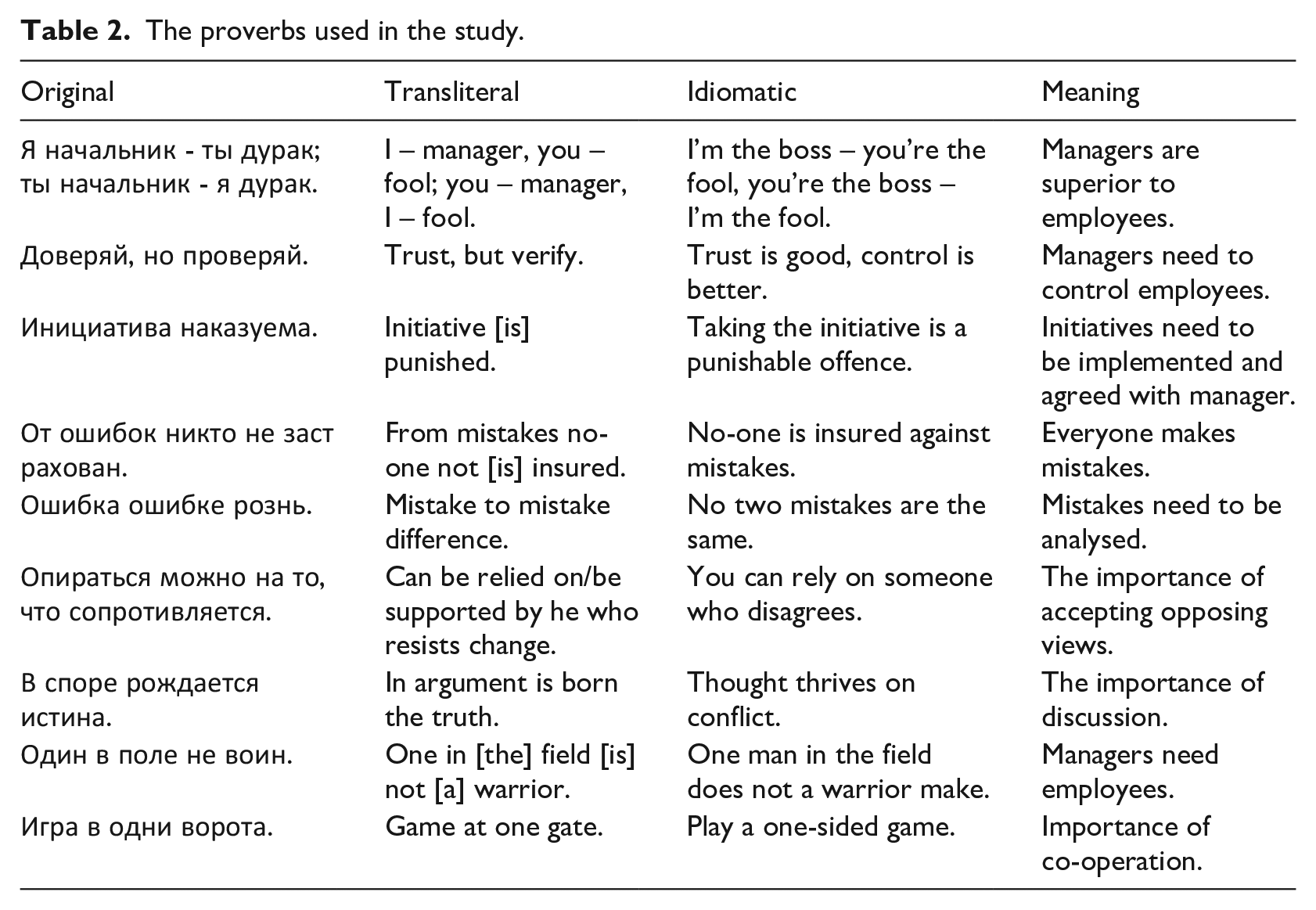
In the third phase of analysis, we selected those middle manager interviews where the interviewees actively used proverbs to enact empowerment. These interview transcripts contained one or more proverbs or explanations of a proverb. We used pseudonyms for the middle managers interviewed and also provided contextual data about them in order to show how the same discourse was repeated throughout the interviews regardless of the subsidiary in question or the gender of the interviewee. We, therefore, aggregated the middle managers’ responses to the level of a national subsidiary.
In the fourth phase of analysis, we looked at the meanings of proverbs as enacted in the interviews and how these meanings were discursively mobilised by the interviewees in relation to the overarching themes. This stage led to the core discourses we turn to next. The meanings embedded in proverbs stimulated generation of theoretical ideas from the empirical data and articulation of our contribution, i.e. conceptual leaping (Klag & Langley, 2013). The original data, coding and translations were discussed by the research team and the suggested translations were debated to assure accuracy of meaning. We consider this process important for enhancing the consistency of our inferences from the data.
Discursive Struggles of Middle Managers at Genro
At Genro the idea of empowering employees is aligned with company values, leadership and human resource (HR) principles. Genro’s values are articulated as responsibility, creativity, courage, trust and involvement of employees. The leadership and HR principles include giving and receiving feedback, setting clear targets and assigning responsibilities to employees, taking the initiative and engaging in open communication, all of which are core ingredients of the empowerment discourse. These values and principles were communicated to Genro’s personnel at workshops and management training sessions organised in all subsidiaries. To support the goals of training, headquarters also provided written material such as brochures, posters, PowerPoint presentations and a video in all Genro’s working languages (company documents, observations).
Performance and development discussions, which were routinely conducted in each Russian subsidiary, also represented an essential tool in empowering employees, as they provided employees with an opportunity to participate in setting their own goals, to determine their actions for the coming six-month period and to give and receive feedback. Genro’s principles and practices were also discussed thoroughly at management training sessions organised regularly for subsidiary managers; the managers interviewed for this study participated in them. As an example, a special program called ‘Generator’, which aimed at increasing innovativeness in the company, was launched to involve personnel in the development of operations (company documents).
Genro also used Finnish expatriates to transfer common practices and policies. Expatriates were sent to newly established subsidiaries to guide local management in ‘how things are done’ at Genro (observations). Expatriates worked in management positions in development, production and finance, and some of them also acted as members of the local management team. In many interviews, Russian middle managers emphasised that they had learned new ways of working such as information sharing, from their Finnish colleagues.
Despite these initiatives, Russian middle managers struggled discursively when trying to bridge the large perceived differences between the originating and receiving contexts. This does not suggest that Genro did not already have empowering practices in place; however the framing of the concept, as imported and imposed by the HQ, required a process of translation. Our research participants mobilised proverbs to address competing discourses and position themselves in relation to empowerment as a perceived ideal of good management defined by the HQ. We have organised these discourses under the following labels: managerial superiority, managerial control, discipline, participation and expertise. We will turn to them next.
The discourse of managerial superiority
The proverb ‘I’m the boss, you’re the fool; you’re the boss, I’m the fool’ encapsulates a common position taken by subsidiary managers across the data set. The superior status assumed by managers in their relationships with employees, often described as ‘the manager assigns tasks and the employee carries them out’, represents the Russian tradition for the interviewees. The proverb becomes a conduit for the interviewees to mobilise managerial superiority as justification for business practices. In the following quotation Sergey, a purchase manager from the Moscow area, uses this proverb in discussing the opportunities of Russian employees to have a say in their work, which is a core tenet of empowerment:
Can Russian employees manage their own work?
In Russia there is a principle, I’m the boss, you’re the fool; you’re the boss, I’m the fool. This principle always works everywhere in Russia; it is as obvious as the fact that we are now speaking Russian. There are such archetypes; [they are like] national wisdom. We cannot achieve democracy and friendly relations like in the Scandinavian countries. It’s not our mentality.
Does this kind of mentality [the Russian principle] exist here [in the subsidiary]?
We have this mentality, we get it from our mother’s milk; it’s like breathing the air, we cannot breathe the air of Helsinki here or drink Finnish water from the tap here. It’s this mentality that separates us from other nations.
By using the proverb ‘I’m the boss, you’re the fool’, Sergey argues that empowerment, which entails giving employees an opportunity to impact their work, is against Russian principles. The proverb highlights the discursive struggle Sergey experiences, the juxtaposition of the manager and the employee in the Russian context; the manager is superior, whereas the employee is meant to be subordinate, and therefore should not be empowered. Emphasising that this is a ‘Russian’ rather than a personal attribute allows him to distance himself from responsibility for the power imbalance; by so doing, he draws on the authority of the ‘people’ and the national psyche.
The proverb becomes a medium to contrast Russian and Finnish cultures, both abstract signifiers, and assert the incompatibility between ‘Nordic’ and ‘Russian’ values. By using the proverb Sergey points to the tensions caused by empowerment in Russia and justifies his position; despite all his good intentions and management training, the deeply rooted cultural assumptions will not go away. The force of his argumentation is evidenced by words such as ‘always’, ‘everywhere’ and ‘obvious’, which further highlight what he presents as specific Russian behaviours in his narrative. Sergey sees no need to change such Russian values, which differentiate Russia from ‘democratic’ nations where ‘friendly relations’ prevail. By emphasising Russian ‘national wisdom’, traditions and mentality, Sergey claims a strong Russian identity conflated with professional practice. He strengthens his argumentation and legitimises his position by comparing Russian authoritative leadership to basic necessities of life such as ‘mother’s milk’, ‘air’ and ‘water’. This suggests that without this management principle Russia could not even exist. Through pride in Russian particularities, Sergey contests the direct application of empowering practices in Russia and claims authority through mobilisation of national attributes.
The proverb ‘I’m the boss, you’re the fool; you’re the boss, I’m the fool’ illustrates traditional thinking about a strong, autocratic leader who makes all the decisions and possesses the power. Nachal’nik, the Russian word for boss in the proverb, was initially used in the army to mean a leader (Izbarekov, 2011). It has since spread throughout society and to Russian management in general. The proverb includes the views of both the manager and the employee; the employee accepts the superior position of the manager. Researchers such as Kets de Vries (2001) and McCarthy, Mary, Puffer, Ledgerwood and Steward Jr (2008) go so far as to argue that Russians ‘have a need’ for powerful leaders who always make the decisions. These ideals of autocratic leadership still seem to occupy a hegemonic position in the discourse of our Russian middle managers when translating empowerment, although challenging and opposing views were also present in our findings, as we will show later.
The discourse of managerial control
Empowerment entails granting employees an increased level of autonomy over their own work; this supposedly reduces managerial control and thus calls for an increased level of trust on the part of managers. Our data show that the participating managers constantly sought to verify and control the performance of their employees, which contradicts the tenets of empowerment. This discourse of managerial control was employed in particular when discussing the role of trust. The proverb ‘trust but verify’ was used by the managers in our data to indicate control over what employees have actually accomplished. The function of the proverb is obvious from the following remark by Pavel, a finance manager from St. Petersburg:
Even if you trust [employee], you have to verify periodically.
Why?
Because everyone makes mistakes. I once had an employee, [whose work] I did not verify, but he worked like a robot, he never made any mistakes. But others, depending on the situation, I verify periodically for educational purposes. Trust but verify!
When translating empowerment, Pavel uses the proverb to justify his views and reported behaviour; the data seem to suggest that control is commonly accepted in Russia even when the employee is trusted. By using the word ‘even’ in connection with trust, Pavel gives the impression that trust is not automatic and does not alter asymmetry in manager–employee relationships. He indicates the necessity of control by using the modal ‘have to’ in connection with control. His overall assumption is that the work of employees should be verified unless there is a special reason not to. After all, he thinks that making mistakes is human, as his reference to robots indicates. Pavel’s comment about verification ‘for educational purposes’ also reflects asymmetrical behaviour towards employees and emphasises the presumed superiority of the manager. The quotation reveals the importance of avoiding mistakes, a topic that was brought up by most of the interviewees, as will be discussed later in this section. Hence Pavel is unwilling to grant full autonomy to employees, because if he – as the manager – does not verify and control, he cannot spot and correct mistakes. He would therefore prevent employees from learning and improving.
Overall ‘trust but verify’ illustrates the claimed coexistence of control and trust in the Russian workplace; the concepts are not mutually exclusive but exist simultaneously. This was emphasised extensively during the interviews, as described by Irina, a chief accountant from Yekaterinburg:
Control of all processes is constant. . . I have to know the problem from the inside; I need to know all problems. It’s important to control. It doesn’t mean that you don’t trust. Managers are responsible for all the work, and when employees understand this, they sense support. Employees know that everything is under control. I don’t make spot checks; it’s a constant process.
This quotation reveals another important point related to control, providing support. By controlling their employees, managers feel that they simultaneously provide support and assistance. This evidently applies to any workplace. An empowering culture is not a control-free culture; our participants however struggle to align this with the ‘new’ empowerment discourse. Irina also relates control to managers’ sense of responsibility; managers are after all accountable for the work and mistakes of their employees. This justifies constant and detailed verification of implementation. When managers take responsibility for a task, they are also supporting their employees, while seemingly disempowering them at the same time.
The proverb ‘trust but verify’ is widely used in everyday Russian talk. The proverb has often been attributed to Lenin, and it is possible that it stems from Lenin’s statements such as ‘Don’t believe in words. Verify strictly – this is the slogan of Marxist workers’ or ‘check up on people and verify the actual implementation of things. . . This is now the main feature of all work’ (Dushenko, 2005). Irrespective of its origins, our research findings show that managerial control of employee work is perceived as necessary and is practised in order to provide support as well as to prevent mistakes, which again contests the ‘western’ view of empowerment, which entails reducing managerial authority (Spreitzer & Mishra, 1999).
The discourse of discipline
A recurrent discourse of discipline in the form of mistakes and punishments in the daily work of the Russian subsidiaries was also evident in the data. Traditionally, individuals have been punished for mistakes in the Russian workplace (McCarthy et al., 2008). By extension, fear of making mistakes and the possibility of being punished decreases willingness to take responsibility for one’s own work and accept empowerment. As managers are responsible for the work of their employees, they are also accountable for their mistakes; this re-enforces the need to maintain power and control over employees. Indeed, understanding ‘mistakes’ as ‘failures’ is often associated with rigid vertical organisational structures. Yuri, a finance manager from the Moscow area, translates empowerment by emphasing the seriousness of mistakes in the Russian workplace. The use of proverbs provides an insight into his thinking:
No one is insured against mistakes. You have to understand the nature of the mistakes. Each mistake tells you many things, and each mistake needs to be analysed. Either it’s a spelling mistake, or the person wasn’t sufficiently qualified or lacked knowledge. The third reason is that the person has too much work and quality suffers as a result. The fourth reason is that at the time he was busy with something else and didn’t realise the importance of the task. Each mistake is a reason for changing and improving something. No two mistakes are the same, of course. There are mistakes that lead to serious consequences. . . That’s why it’s important to analyse each mistake and not to make a tragedy out of it. The main thing is that the person himself understands everything. . . Least of all people should feel fear and be afraid of making mistakes because they would be subjected to punishment [or] dismissal.
The proverb ‘no one is insured against mistakes’ is a well-known one echoing the Latin errāre hūmānum est and the Greek το σφάλλειν ανθρώπινον. This proverb contains the idea that everyone makes mistakes and hence it reflects a positive attitude towards them. By using this proverb Yuri may intend to show his acceptance of mistakes and their role in reinforcing improvement and learning; this reflects an inclination to increase employee empowerment. However, by starting to analyse the possible reasons for mistakes the same authoritative managerial disposition emerges again. The other proverb used by Yuri, ‘no two mistakes are the same’, emphasises the importance of analysing mistakes thoroughly, as the consequences vary depending on the seriousness of the mistake and can even lead to dismissal of the employee. His use of strongly negative terms such as ‘tragedy’, ‘fear’ and ‘punishment’ highlight the attitude towards mistakes and their consequences. This proverb again reflects the dominance of managerial superiority and authority in the Russian context and illustrates the struggle waged by Yuri in translating empowerment.
In the same vein, Anatoly, a sales manager from St. Petersburg, explained the proverb ‘no two mistakes are the same’ and the importance of punishment for mistakes as a means of teaching correct behaviour:
No two mistakes are the same. There are different approaches to mistakes. You have to give feedback about mistakes. If the manager doesn’t punish [employees] for mistakes, then they may think that no mistakes were made and that such behaviour is acceptable.
This quotation captures the central issue in attitudes towards mistakes and punishment and represents the key position expressed by the participants: learning from mistakes takes place through punishment and without punishment employees do not learn to avoid mistakes. Accordingly, giving direct feedback about mistakes and punishing employees puts managers in a position of authority and allows them to exert power over their subordinates.
In addition to the control-prone attitude towards mistakes, attitudes towards initiatives also reflected the discourse of discipline in the Russian subsidiary. Empowered employees are inclined to show initiative, but in our case study, taking the initiative is not regarded as tradition. The proverb ‘taking the initiative is a punishable offence’, which was popular in the Soviet era, is a clear indication of this. The analysis suggests that some of the interviewees use this proverb literally, referring to unwillingness on the part of management to listen to the suggestions of employees. Consider the following comment by Yuri, the finance manager from the Moscow area:
How could personnel have a bigger impact [on their work]?
There should be trust in management, so that initiatives are accepted. The Russian proverb taking the initiative is a punishable offence should not prevail; if it does, people will sit in isolation in their rooms and be afraid to attract attention. In authoritarian leadership the personnel turns into a grey crowd, where individuals are not even cogs. The company becomes a conglomerate that serves management.
Yuri associates the proverb with authoritarian leadership that does not take suggestions from employees; he rejects the precept of this proverb. The excerpt describes isolated and frightened employees who would not like to ‘attract attention’ to themselves. Yuri also highlights the importance of the trust that must exist before employees have the courage to take the initiative and make suggestions. A common positioning in the dataset is the expectation that managers are gatekeepers in the decision-making process and hence ratify the ‘initiatives’ of their subordinates, as explained by Nikolay, a production manager from Rostov:
Initiative is welcomed, but depending on what kind of task was assigned. Initiatives need to be agreed with me because they can be something extra and lead to bad results.
The oxymoron in the excerpt highlights the tendency towards control; the fact that managers must be aware of all initiatives, reflecting the discourse of managerial control over employees and strong manager identity. Managers also described their concern about the possible harmful consequences of initiatives, which may be related to their feeling of accountability for the work of their employees. At the same time, conflicting discourses also surfaced in the data, particularly in relation to the importance of implementing initiatives. In discussing the proverb ‘taking the initiative is a punishable offence’, Tatyana, a service manager from Yekaterinburg, explained the meaning of the proverb by referring to the Soviet legacy. It is not enough to make suggestions; the employee should also be ready to implement them:
It’s a principle of the [Soviet] pioneer organisations; if you don’t like [something], criticise, if you criticise then suggest, if you suggest, then implement. This is very good. We were all pioneers. If you don’t like something, don’t be silent, talk. Someone criticised a document that had been written incorrectly. I returned it immediately with a question about how to correct it.
As the above quotation points out, if someone shows initiative they are expected to follow it through; this may lead automatically to fewer initiatives as it means extra work for the person making the suggestion. Consequently, employees may become wary of taking the initiative because by so doing they assume responsibility for successful implementation. Tatyana’s quotation also reveals nostalgic feelings about the Soviet past, which could be read as familiarity with the values she was brought up with. Hegemonic ideologies enacted and perpetuated through political systems are significant resources for positioning the ‘self’ and ‘other’. The US-driven discourses of empowerment perpetuate ideologies that do not not conform with what managers in different parts of the world, including Russia, have experienced. This does not mean that managers do not ‘do’ empowerment, or anything else for that matter. Neverthless, the way management concepts are translated reflects the local context, as is the case here.
The discourse of participation
The managers interviewed emphasised the participation of employees and their valuable role in providing managers with support and expertise, which reflects positive attitudes towards empowerment. Our data show that by engaging with the concept of participation our managers draw on a range of competing discourses highlighting their discursive struggles. The middle managers used proverbs to signal their willingness to increase employee power, such as ‘one man in the field does not a warrior make’. This proverb was used to emphasise the importance of employees and their role in the implementation of tasks, as explained by Natalya, a controller from the Moscow area:
Leaders should remember who implements the tasks; they [employees] cannot be left alone. In order to implement everything that has been planned, respect and concern about those who do it must be shown. One man in the field does not a warrior make. One leader doesn’t do anything, even if he is civilised, clever, and creative. Without the team you cannot be a leader – you have to think about your team.
The proverb reflects the discourse of participation and highlights the precedence of the group over the individual. It elucidates the notion that one can do nothing alone; other people are required. Natalya wants to emphasise that after all it is the employees who implement the tasks; managers – no matter how ‘civilised’, ‘clever’ or ‘creative’ – need employees; here she also hints at the assumed superiority of the manager. Hence, she uses the proverb to indicate the power and competence that resides with employees, which is in line with the underlying assumptions of empowerment. She also highlights how employees should not be left alone; ‘respect’ and ‘concern’ should be shown for them. In the beginning of her quotation Natalya seems to distance herself from the position of manager and speaks about ‘leaders’ from the viewpoint of an employee. At the end of the quotation she switches and places herself in the manager’s position, which indicates her delicate position as a middle manager between senior-level managers and employees.
The participation of employees is a constant pattern in the data; for instance Oksana, a sales manager from the Moscow area, expresses the same view with another proverb:
It is important to listen to what employees expect from you. We don’t play a one-sided game. It’s not [merely] what we do for the manager, but also how the manager contributes to our welfare.
Oksana uses the proverb ‘play a one-sided game’ to describe a situation where both parties, managers and employees, should be satisfied with the outcomes of the ‘game’, i.e. the work process. The proverb originates from the language of sportsmen (Mokienko, 2003) and is a common metaphor in teamwork literature emphasising that the tasks of workplace teams go well beyond the skills, knowledge and attributes of any one person (Salas, Cooke, & Rosen, 2008). Oksana seems to use the proverb to underscore the balance in relationships between managers and employees. Managers should not only pay attention to the results of work; employees’ welfare and happiness should also concern them. Listening to the views of employees reflects participation and co-operation between the manager and employee and endorses the dominant empowerment discourse. Previous research on Russian leadership has suggested that Russians seem to expect their leaders to take care of them and seek security in the paternalistic approach of the leader (Kets de Vries, 2001). Caring and protecting are roles associated with those in power and highlight asymmetrical relationships; our data also reveal that managers play multiple roles, juxtaposing the identities of a parent and a colleague.
The discourse of expertise
The discourse of expertise was reflected in the proverb ‘you can rely on someone who disagrees’, which Piotr, an operations manager from Rostov, used when describing employee characteristics:
What kinds of characteristics are important in an employee?
They should be qualified so that they can defend their point of view as a specialist. Managers cannot know everything; that is why specialists need to be able to express their point of view. You can rely on someone who disagrees.
The proverb ‘you can rely on someone who disagrees’ suggests that strong disagreement is an indication of integrity, reliability and trustworthiness and of professional confidence on the part of employees demonstrated by sticking to their views during interaction with managers. By mobilising the discourse of expertise, Piotr and others in the data show how they value employees who have the courage to disagree when confident of the correctness of their own points of view. This arguably suggests readiness for discussion and collaboration with employees and positive reception of empowerment more generally. Piotr’s view that there are things managers do not know is also an atypical opinion for a stereotypical Russian manager and illustrates the position we are taking; empowerment, or any other abstract concept, involves a range of practices and takes different forms in different contexts.
When discussing employee involvement in decision-making, the proverb ‘thought thrives on conflict’ was introduced. Like the previous proverb, it also reflects the value of employee expertise for managers if the employees are able to argue their case. This was conveyed in the views of a few middle managers such as Oksana, the sales manager from the Moscow area:
Everything depends on the type of decisions to be made. If these decisions concern employees, then at minimum their opinion should be listened to. There is a saying thought thrives on conflict, but here it is probably not on conflict but on discussion.
Oksana uses the proverb to show a contrast; ‘truth’ does not arise from arguments but from constructive discussions in which employees are asked to express their opinions and share their expertise. However, Oksana restricts the decisions where employees can have a say to those concerning them directly. This position on employee participation was shared in the dataset more broadly, with a variety of practices ranging from routine decision-making to listening to the opinions of employees in weekly meetings (observations), as illustrated by the quotation of Pavel, the production manager from the Moscow area: ‘Of course I make the final decision but it is based on their [employees’] suggestions and understanding.’ However, the power of the manager as a decision-maker is again foregrounded in his comment. As Anatoly put it, ‘the one who takes full responsibility makes the decision, in other words the manager’. Here we see another contradiction; although the managers interviewed seem to value employees who can help them in decision-making and hence seem willing to enhance employee empowerment, they do not express equal readiness to restrict their own authority. This echoes a traditional view, namely that managers should always know more than their employees (McCarthy et al., 2008). This is also reflected in the simultaneous mobilisation of competing discourses and the discursive struggles experienced by the middle managers. We will elaborate on these themes next.
Discussion
In this paper, we studied how Russian middle managers of a Finnish-owned MNC translated empowerment as an imported management concept. Our study makes three key contributions to the translation approach in organisation studies.
Theoretical contributions
The main contribution of our study lies in uncovering how the local subsidiary managers mobilised proverbs to address competing discourses that reflected imported and local ideals of good management. Proverbs represent an understudied discursive resource in translation research and in organisation studies more generally compared with, e.g., metaphors, which are used more frequently to introduce new insights into organisational life (Cornelissen, Oswick, Christensen, & Phillips, 2008; Morgan, 1980). The proverbs revealed the discourses of managerial superiority, managerial control and discipline that drew on the assumed local Russian tradition of hierarchical relationships between managers and their employees. The discourses of participation and expertise in turn represented competing ideals that also constituted part of the complex semantic domain. Hence, proverbs became a way for middle managers to respond to and cope with tensions and contradictions related to the ideals of good management associated with empowerment. These competing discourses are particularly pertinent in the MNC context, where new management models and practices are imposed on translators in foreign subsidiaries (Gutierrez-Huerter et al., 2019).
Proverbs are found in all languages and they occupy a special place in folklore as they provide resources to study membership of a particular community and converge (or not) with dominant values and ideals. They are ‘traditional, pithy, often formulaic and/or figurative, fairly stable and generally recognizable linguistic units’ (Norrick, 2014, p. 7). As other cultural and linguistic artefacts, proverbs are inherited from generation to generation (Hrisztova-Gotthardt & Varga, 2014) and hence preserve ideals that reflect the historical, institutional and cultural features of the nation.
We did not distinguish here between proverbs, phraseological expressions, memes or set phrases as typological and lexicographical issues go beyond the scope of our paper. Similarly, the relationship between proverbs and metaphors is not addressed. Proverbs and their relationship with metaphoric language have preoccupied linguists (Lakoff, 1992) and the debate on whether proverbs count as metaphors continues (e.g. Sullivan & Sweetser, 2010). Although theoretical examination of the proverbs themselves goes beyond the scope of this paper, we believe that the study of proverbs in organisational contexts can provide a fruitful arena for future research between organisational scholars and linguists.
We also uncovered the dual role of middle managers as translators and implementers of an imported and imposed management concept in MNCs, which constitutes our second contribution. As a group in between senior management and employees, middle managers play a pivotal role in translation processes and the strategic and operational outcomes thereof. Neverthelesss, recent research is only starting to account for their dual roles in multilingual organisations (e.g. Ciuk et al., 2019; Piekkari et al., 2019) and empirical research on translation work in MNCs is still scarce.
In our study, the middle managers used proverbs to reproduce and negotiate their position of power in the interview space (Ezzamel & Willmott, 2008). They expressed the need to retain their power as they themselves felt accountable for the ultimate results of their employees. At the same time, they claimed to have enhanced the power of their employees by supporting and caring for them, which may have had a positive effect on their own performance. Instead of openly accepting or rejecting empowerment, these Russian middle managers contested, deconstructed and modified the meaning of this imported management concept and the language associated with it. It is through their very agency that empowerment and the supporting practices were implemented, challenged or resisted in the local subsidiary. During the research interviews, these middle managers possibly manipulated discourses to advance their own agendas in the MNC. Our study responds to calls for research on how middle managers do translation in practice and in particular how they adapt an imported concept while it is in transition (Radaelli & Sitton-Kent, 2016). We also enrich existing research that has emphasised the role of rhetoric in middle managers’ translation work (Rouleau & Balogun, 2011).
Finally, because the middle managers in our study did not have a vocabulary for empowerment in the Russian language, interlingual translation work was required. Russia represents an extreme context as the imported concept, empowerment, came with presuppositions contradictory to the so-called Russia’s authoritative cultural context, which was assumed to be the local norm (McCarthy et al., 2008). Previous translation research has distanced itself from the interlingual meaning of translation (e.g. Czarniawska & Sevón, 1996), although ideas and practices increasingly cross not only institutional and societal boundaries but also language boundaries. In this study, we brought together the interlingual with the discursive elements of translation to emphasise the interlingual transformation of an imported management concept as it travelled across languages. In so doing, we join recent research in organisation studies that has argued for expanding the definition of translation to encompass translation work undertaken in multilingual organisations (Ciuk et al., 2019; Piekkari et al., 2019; Westney & Piekkari, 2020).
To sum up, Figure 1 provides a visualisation of our findings. The contact between two work contexts – the HQ and the Russian subsidiary – signifies a translation space (Teulier & Rouleau, 2013) where two dominant ideologies and ‘ways of doing’ meet. In the interview situation, the researcher was seen to represent ‘Nordic culture’ and the HQ’s country of origin, where empowerment is moralised as something ‘good’ and ‘expected’. This evidently played a role in legitimising the concept. In asymmetrical HQ–subsidiary relationships, the contact poses the need for local translators to redefine and reposition themselves in relation to local ideals of good management, as illustrated by the discursive struggles.
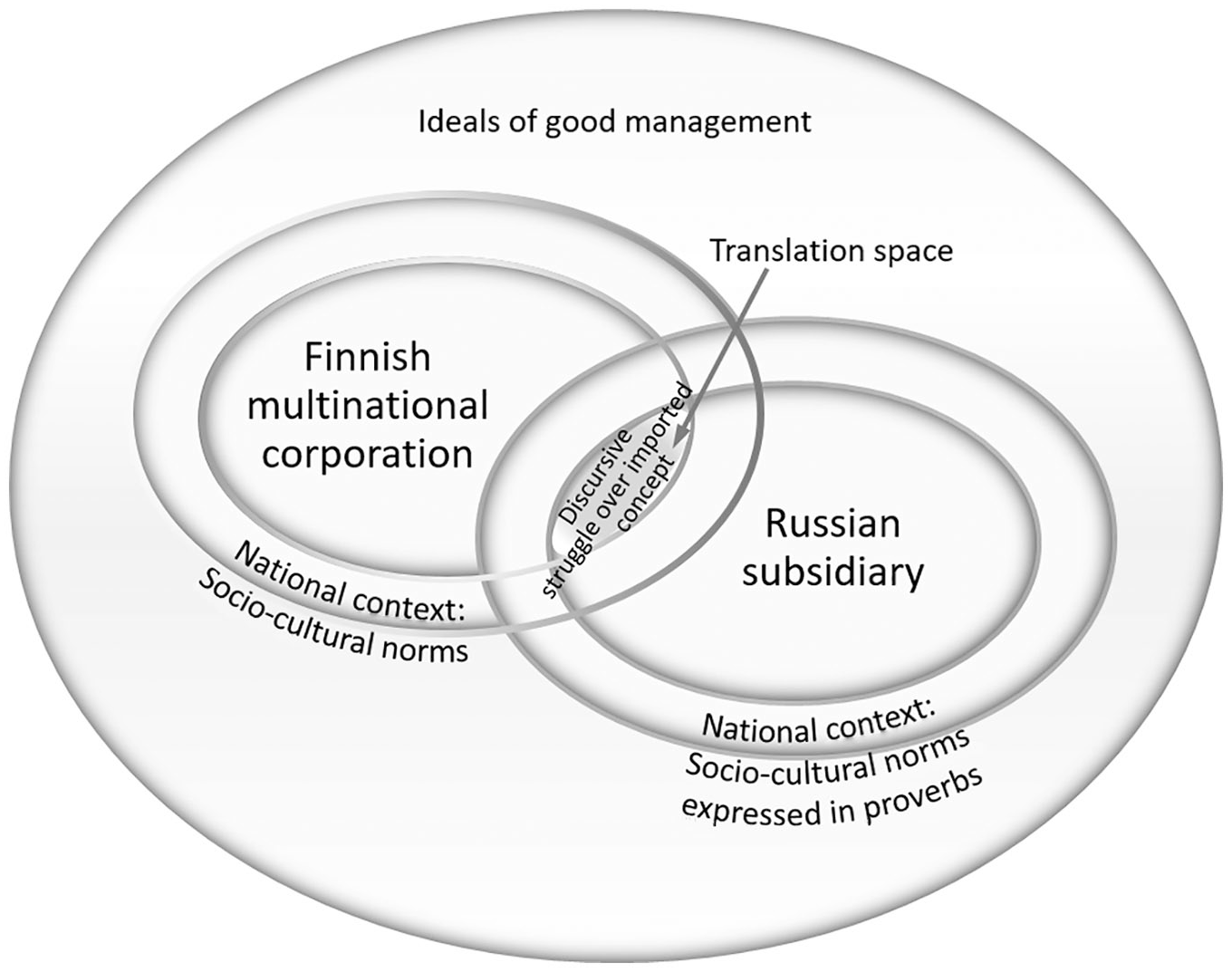
Discursive struggle over imported management concept.
A lack of requisite vocabulary does not signify a lack of relevant practices in the local subsidiary; on the contrary, the Russian middle managers mentioned a number of existing empowering practices that were meaningful to them in their local context. During a period of transition, the middle managers modified and redefined both the old and the new concepts as they sought to apply the latter in their context. They struggled with the meaning of empowerment in a space where traditional language and the new language of empowerment were juxtaposed. In Figure 1, the translation space is discursive because the imported concept is negotiated and enacted linguistically, and material because it is situated in an organisational context.
In the following, we will turn to the managerial implications of our findings.
Managerial implications
The findings emphasise the importance of cultural ideologies and institutional differences when new ideals imported from elsewhere are implemented. Introducing a management concept such as empowerment across subsidiaries of an MNC is by no means a straightforward endeavour and calls for careful negotiation of its situated meaning. As an ideal of good management, empowerment is often taken for granted, particularly in the Nordic countries, where employee autonomy and a lack of hierarchy are presented as the norm. This is not to suggest that power asymmetries of the kind we found in the data do not exist in Nordic organisations; they merely appear in different guises in different contexts.
We suggest that expatriates and HQ managers should work closely with subsidiary employees and serve as skilled and sensitive translators who possess the necessary knowledge about local cultural and institutional characteristics. But translation competence is not limited to key individuals. It can also be a dynamic organisational-level capability (Filatotchev et al., 2020, p. 10) that lays the foundation for learning across borders. In a company with a high degree of translation capability, top management is open to local translations of management concepts and practices. Instead of policing these ‘imperfect’ translations they accept that movement of practices across borders will always involve interpretation and hence shifts in meaning. When seen from this perspective, translation becomes a source of fresh ideas and novel viewpoints rather than a nuisance or a mere cost factor. These are areas that future studies can usefully address.
Limitations
We undertook a multilayered thematic analysis broadly following the principles of discursive analysis; it provided us with one possible reading of the data. Conversational or narrative analysis would have produced a different set of results. The interviews that we analysed were conducted with middle managers only. Their subordinates or supervisors would have provided a more holistic view of translation in practice. Furthermore, we acknowledge that we provided a partial understanding of the application of empowerment at Genro by focusing on the receiving end, the Russian middle managers. More emphasis on the HQ perspective in the sending country could be an avenue for future research to complete the full cycle of concepts travelling from one context to another. We also point out that the Russian middle managers we interviewed were employees of an MNC. They were socialised in the leadership discourse and organisation culture of the MNC (Caprar, 2011, p. 609) and can hence be considered ‘foreign locals’ rather than representatives of hegemonic ideologies in the Russian national work context (Caprar, 2011, p. 621). However, we note that the MNC is a particularly useful research context because it renders employees more aware of their own underlying assumptions and views than a fully domestic organisation (see also Roth & Kostova, 2003).
Conclusion
This study identified proverbs as a powerful resource in the translation work of middle managers. Proverbs are often associated with national myths and points of reference mobilised by translators to position themselves and others as well as to create boundaries between in-groups and out-groups. As discursive resources, proverbs afford a whole range of different meanings depending on how locally situated translators mobilise them. Each organisational context – whether ‘Russia’, the ‘Nordic countries’ or the ‘West’ – draws on the dominant discourses available in its socio-political environment. Hence proverbs are reflective of nationalistic sentiments emphasising local specificity and uniqueness, in our case Russian. Such sentiments have become increasingly prevalent in current discourse not only in Russia but also globally. In this regard, proverbs are not neutral instruments of communication but constructors of power relationships. We hope that our findings will inspire future research and reveal new perspectives on global and local meanings.
Footnotes
Acknowledgements
We are grateful for the helpful comments on earlier versions of our manuscript received at the annual meetings of European International Business Academy in 2015 and 2016, Academy of International Business in 2017, European Academy of Management in 2018, as well as GEM&L International Conference on Management and Language in 2019. We would also like to thank Senior Editor Graham Sewell and the two anonymous reviewers for their constructive feedback.
Funding
This research received funding from HSE Foundation, Foundation for Economic Education, Marcus Wallenberg Foundation and the Paulo Foundation.
