




Abstract
Category research has flourished over the last decade. While this body of work has prioritized the behavioral and economic consequences of stable classification systems, the papers in this special issue challenge this orientation by highlighting the importance of category dynamics for improving our understanding of markets and fields. We show how these papers support the emergence of category maintenance, the recategorization of mature categories, and the consolidation of new categories as understudied phenomena and as the next research challenges to pursue. After connecting the main findings of the papers in this special issue into a unified process model, we discuss various alternative pathways to further explore those challenges. We also point to how this theoretical endeavor runs on slippery slopes and might lead to cul-de-sacs such as terminological balkanization. We conclude by highlighting the need for developing a more comprehensive understanding of category dynamics.
Nomina sunt consequentia rerum
Starting the Hike
This special issue was for us an intellectual expedition in underexplored territories of organization and management research in which we noticed new mountaintops and several uncharted paths. We use the metaphor of the climbing expedition to evoke an idea of research as a cooperative endeavor instead of a race among competing parties. The aim of this metaphorical expedition was the study of categories and their role in market settings and, more broadly, in society. In particular, as stated in the call for papers, we wished to develop “a dynamic view on how categories emerge, change, dissolve, are combined, or contested.” Categories, together with their material emanations in artifacts and practices, constitute the fabric of social life from which garments of institutions are cut; they represent the taken-for-granted infrastructure of everyday life (Berger & Luckmann, 1966). Not surprisingly, the special issue has sparked interest from a variety of scholars studying topics as diverse as psychiatric hospitals, movies, spirits, art, food, and gender, to name a few. A key insight achieved from the exposure to such wide array of work is that things are more complicated than the initial epigraph: nomina—names or labels—in fact are not just consequentia rerum—the consequence of reality. The relationship between labels, their meanings, and the actual physical and institutional reality is rather complex, coevolutionary, and performative. We will provide an antithetic view to Dante in the final epigraph.
The five papers allow introducing three peaks that we argue category research needs to climb: (i) maintenance of existing categories, (ii) recategorization of mature categories, and (iii) consolidation of emerging categories. The papers draw exemplary maps of the routes to reach these three peaks. In this introduction we offer you a bird’s eye view of the whole mountain group, so that you can prefigure your own route to each peak, or even envision new peaks. Before digging deeper into the details of each work, allow us to disclose the conceptual gears we employed in approaching this theoretical terrain.
We see categories and the act of categorizing as anchored in language, visual symbols, and artifacts, so as to allow society in its different domains to exist, operate, and change. For instance, market categories permit producers and consumers to interact with each other. Professional categories permit the distribution of substantive knowledge and associated practices across different jurisdictions. Organizational categories allow for the legitimate orchestration of resources. Societies themselves are constituted along different categorical dimensions depending on how corporate and statist the polity historically developed (Jepperson, 2002)—e.g., in statist and corporatist polities “community pharmacies” are constituted as local strongholds of the professions or the state, and not as firms (Nicolini et al., 2016). When approached from this perspective, social, organizational, and market categories are shared cultural concepts not changeable at will. They are both the product and the context of discursive and material interactions that define the meaning, legitimacy, and moral order of our society (Douglas, 1986; Lamont & Molnar, 2002). Similar to words in language, categories exhibit their strongest potency when the labels that signify their meaning attain cognitive legitimacy: a wide inter-subjective agreement on their meanings sets taken-for-granted expectations among audiences that are hard to bypass (Hannan et al., 2019; Rosa, Porac, Runser-Spanjol, & Saxon, 1999; Zuckerman, 1999). Legitimizing new labels, modifying existing ones, or changing their meaning, connected practices or social standing are, therefore, acts of institutional change (Delmestri & Greenwood, 2016; Kennedy, Lo, & Lounsbury, 2010).
Scholarly work on categories has been located primarily in the organizational ecology (OE) and organizational institutionalism (OI) intellectual homes. Little attention in these literatures however has been dedicated to the study of category change. In OE most of the attention has been dedicated to category membership as requiring dedicated investments from organizations and their vetting by audience members in relation to normative expectations (Hannan, Pólos, & Carroll, 2007; Hsu & Hannan, 2005). In OI, often under the banner of institutional entrepreneurship (DiMaggio, 1988), several studies have documented the emergence of institutions as diverse as personnel practices and organizational structures (Greenwood, Oliver, Lawrence, & Meyer, 2017), but have not always embarked on systematic theoretical development on categories and categorization. Much of the research on category emergence is located at the intersection of these two literatures (for a review see Durand & Khaire, 2017). For instance, Navis and Glynn’s (2010) foundational study of the US satellite radio market category revealed that initial efforts at legitimation led producers to cooperate while, in a second stage, differentiation and competition prevailed—a finding analogically consistent with ecologists’ density-dependent legitimation theory. Jones, Maoret, Massa, and Svejenova (2012) found that the clientele of architects proposing the new category “modern architecture” were culturally and socially heterogeneous. The variety of buildings created, in turn, allowed for the category boundaries to expand and be adaptable to changing architectural trends for over 70 years. Studying molecular gastronomy, Slavich, Svejenova, Opazo, and Patriotta (2020) analyzed how category emergence was characterized by contestation over meaning and labels but that such political processes can lead to the deepening of category meaning and its eventual legitimation—a finding consistent with Delmestri and Wezel’s (2011) examination of the contested diffusion of the organizational category “multiplex cinema.” The importance of emergence as a process that leads from novelty to growth and formation of templates and prototypes has urged Seidel and Greve (2017) even to propose “emergence” as a field of its own.
While there is a developing literature on category emergence, even less is known about how categories are defined, persist, or change via attempts at reevaluation, recombination, or recategorization. The few available examples once again straddle OE and IO. For instance, Khaire and Wadhwani (2010) depict the reevaluation of twentieth-century Indian paintings which had been until then lumped into the provincial category of “Indian and Southeast Asian art” used to decorate hotel rooms, into the prestigious category of “modern Indian art.” Kennedy, Lo, and Lounsbury (2010) theorize on how systems of categories may change due to the redefinition of the meaning of single or multiple categories, or their recombination. Delmestri and Greenwood (2016) studying the Italian spirit market find that status differentials among market categories can be altered by the culturally appropriate theorization of status aspirations.
The five papers included in this special issue continue the study of category reevaluation, recombination, and recategorization by extensively borrowing from OE and OI. Such papers do not identify a single dependent variable but engage in processual and historical studies of categorization as deriving from agentic or emergent challenges to category stability in fields as diverse as online advertisement, art, gin, organic agriculture, and social entrepreneurship. In order to make sense of the richness of these studies, we attempt to connect the main themes and concepts into a unified process model that emerges from our inductive reading of these papers. From our reading, the starting point of each paper is always a challenge to the stability of the system of categories under scrutiny while the end points of the processes studied are represented variously by the maintenance of existing categories, the recategorization of mature categories, and the consolidation of a new category (i.e., the three mountaintops depicted in Figure 1). In our view, the processes that connect start and end points are equally fascinating as they include critical considerations about the difference between labels and categories, stigmatization, stigma diversion, label convergence, and inclusive reframing.
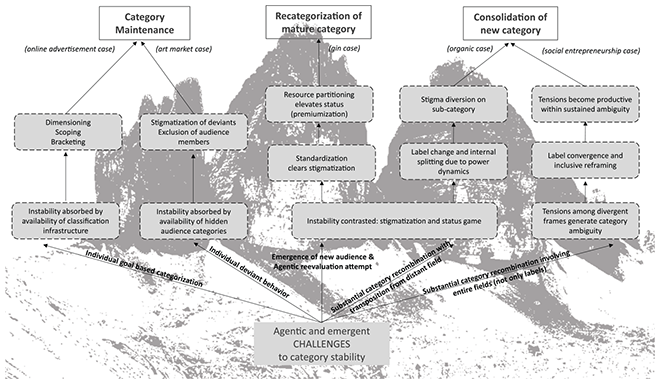
A unified process model of the main findings in the special issue.
In the next section we summarize the main findings of the papers with the help of our unified process model. Metaphorically, this will be the beginning of our expedition, the base camp. We then venture higher in abstraction and suggest several further climbing paths that researchers in the future may want to consider pursuing in their study of category consolidation, maintenance, and recategorization. Because we are aware that the paths we indicate are risky and potentially hold unintended consequences, we also warn the researchers of the slippery slopes they may encounter.
Roping the Party: The Unified Process Model
At the base camp of our expedition, we wish to rope the party and make an attempt at unifying the papers appearing in this special issue. We arrived at our final process model through successive rounds of visual abstraction in box-and-arrow figures of the main findings of each paper till an agreement was reached on how to combine them. To start with, each paper describes a challenge to the stability of a specific category or to the classification system as a whole (see Figure 1). Those challenges manifest themselves via the actions of audience members or producers. Either way, disequilibrium emerges in the functioning of markets, the established values of a field get threatened, and the diffusion of societal innovations halted. The papers deal with how these challenges emerge or (sometimes) are averted, and how a novel institutional order may be provisionally reestablished.
Our first peak of how categories are maintained is represented by the studies by Glaser, Krikorian Atkinson, and Fiss (2020) on the online advertisement industry and by Coslor, Crawford, and Leyshon (2020) on the high-value art market. In particular, Glaser and colleagues ask how a stable product market system can be maintained in the presence of idiosyncratic meanings and goals attributed by buyers. They find that idiosyncratic goal-based categories may be compatible with stable market exchanges when a stable classification infrastructure is available. The meaning of the category online display advertising is dimensioned by “a possibility space in which valuation can occur through the identification, addition, and/or deletion of product features”. Given this relatively stable frame, two mechanisms contribute to combine goal-based individual categorization and the stability of the category “online display advertising”: scoping helps narrow the selection of features in the prototypical space, while bracketing leads to the exclusion of certain actors from the market. Bracketing, which also can occur via “blacklists,” makes possible the reciprocal typification of buyers and sellers as appropriate transaction partners, therefore reducing the risk of “contamination” from inappropriate and stigmatizing associations (e.g., porn sites).
Not dissimilar to bracketing, a morally laden process of exclusion of selected categories of buyers is advanced by Coslor and colleagues. The challenge to category stability in the high-end art market is posed by the speculation of “problem buyers” who violate unwritten norms of conduct. Galleries act not only as gatekeepers, but also as agents of socialization centered on an undisclosed categorization of buyers. Through monitoring and enforcement, art galleries maintain the fragile long-term orientation that the art market requires to finance artists’ careers and to remain economically viable.
Traveling to the second peak of recategorization of mature categories, we find Pedeliento, Andreini, and Dalli (2020)’s historical study of gin in which they describe the dynamics of emergence and change of a market category over an extended period of time. Thanks to the long timeframe, the authors offer a bird’s eye view of the processes of category emergence, settlement, and resettlement that were conducive to the status recategorization of “mature gin” as a trendy premium spirit. The challenges to category stability came in waves and originated both from endogenous attempts at recategorization and by exogenous processes like the emergence of the middle-class demand for middle-brow products. The authors, coming from a marketing background, bring to the table new concepts such as “premiumization” and “taste regime” that are promising for future category research.
The third peak of consolidation of new categories, represented by the papers by Siltaoja and colleagues’ (2020) on organic farming in Finland and by Chliova, Mair, and Vernis (2020) on “social entrepreneurship,” illustrate another possible climbing path to study how new or recombined categories progress into maturity. Siltaoja and colleagues’ base camp lies in the challenge posed by organic farmers to conventional farming. At its origin in the 1940s, organic farming represented a substantial departure from the status quo. That was because it recombined and transposed into farming various concepts originating from the anthroposophist philosophy of Rudolf Steiner. Steiner’s ideas on biodynamic farming included a conception of animals as subjects worthy of respect and soil preparation methods connected to phases of the moon. This worldview and its associated practices were perceived as esoteric, challenging the scientification of farming as a central institution as well as the objectification of animals. Not surprisingly, it encountered stigmatization. Organic farming, however, managed to emerge as a new category by means of relabeling and by diverting the stigma towards biodynamic farming that acted as a lightning rod. Two elements of Siltaoja and colleagues’ paper are worth highlighting for theoretical purposes: (i) the internal and external power struggles encountered by organic farmers as well as (ii) notoriety as the “individuating phenomenon” that spurred identity work among category members.
Rather than the transposition of labels or practices, the case of social entrepreneurship involves the recombination of unconnected fields, namely business, nonprofit, and development aid. Chliova and colleagues show that a new category can mature and reach consolidation even when divergent frames on the meaning of the category persist throughout its existence. In their climb the authors show us beautiful yet unseen views for existing category research: how the tension among divergent frames generates category ambiguity but that such ambiguity can become productive when label convergence and inclusive reframing occur. In the absence of an unambiguous denotation, the multiplicity of meanings that are associated with a label expands the appeal of the category to a broader audience.
Alternative Climbing Paths
While feeling some vertigo, it was exciting to be escorted by our authors along the climbing trails of this special issue. After reaching such heights now we feel oxygenated enough to look back at other potential climbing routes that may lead to the mountaintops of Figure 1.
The ascents proposed by Glaser and colleagues (2020) and Coslor and colleagues (2020) concerned new ways of categorizing. Other than those proposed by these authors, we wonder what other forms of categorization we may have overlooked. Categorizing by emotion may be one of such new ways to explore. Categorization systems, such as movie genres, in which the role of audiences’ perceptions in evaluation has been firmly established (Hsu, 2006), implicitly rest on an emotional foundation. For instance, comedy, drama, and horror genres can be expected to each evoke different emotions in the movie audience. How do perceptions and emotions interact in classification? Categorization in online apps by means of moods (such as in music streaming apps) or of evaluation in social media by the means of emojis, could also extend the discussion of emotions to the understudied phenomenon of categorization based on visuals or artifacts. For instance, Drori, Delmestri, and Oberg (2013, 2015, 2017) have explored visual categorization as anchored to the dominant narratives and logics of world polity and of specific national fields. How do visuals, emotions, artifacts, and rational justifications interact in evaluation and classification?
Another unexplored route of categorizing involves the relationship between the labels and meanings of categories, so far mostly approached in terms of denotation; for example, with labels pointing to the literal meanings such as “minivan” being a kind of car that can seat at least seven occupants. But what about the distinction between meanings denoted and meanings connoted? Connotation is the process by which associations, emotions, and allusions are linked with a label beyond its literal meaning. Take for instance “electric SUVs,” a label that denotes a sport utility vehicle powered by an electric motor. How do the opposite connotations of the words electric and SUV, namely “sustainable” and “unsustainable,” affect the destiny of this new label and recombination? The study by Chliova and colleagues (2020) discussing the role of category ambiguity implicitly considers connotation (see also Pedeliento et al., 2020). Nonetheless, we believe that much more can be done to further investigate this topic.
A further path, initiated by Quinn and Munir (2017), and safeguarded in this special issue by Siltaoja and colleagues, regards the role of politics, agency, and power in categorization. The relationship between categorization and power is central to gender and diversity studies. An example of how power operates through categories is provided by the normalization of “Term A,” the male, the “primary organizer of the structure of subjectivity,” against the “Term non-A,” the female, the weak and disposable (Cixous & Kuhn, 1981, p. 46; Bendl, Bleijenbergh, Henttonen, & Mills 2015). In management and organization theory, however, categories are mostly seen as serving the purpose of simplifying a reality that is too complex for us as bounded rational agents to comprehend. Theorizing about the power and interest-based dimensions of categorization, we believe, represents a promising avenue of development of category research. Research in psychology and ethics have already highlighted the role of individual interests in the classification of meat as food or of zoos as entertainment. For instance Bratanova, Loughnan, and Bastian (2011) have studied how categorizing a given animal (say a horse, a cat, or a pangolin) as food as opposed to a pet or wild animal holds important implications on its perceived moral standing (and for human beings too, given the probable origin of the Covid-19 pandemic in a Chinese wet market; Huang et al., 2020). For a moral philosophical discussion on the treatment of animals and the competing categorization of zoos see, e.g., Cohen and Fennell (2016). Such normative considerations could open up new paths of theoretical climbing. What are the values sustaining specific categories? And what are the normative implications of our own studies of categorization processes? These are exemplary questions that scholars can pursue in future research.
A final and admittedly more abstract climbing path relates to the potential connections among the three outcomes highlighted in this special issue. To stay within our metaphorical language: do Tibetan bridges exist between the three mountain tops represented in Figure 1? The long-term historical study by Pedeliento and colleagues (2020) points to category maintenance, consolidation, and recategorization as sequentially interrelated and as stages of a broader process. More complex interdependencies among these outcomes may exist, however. Needless to say, the study of the multifold interdependencies that exist among these highlighted outcomes will help develop a more comprehensive understanding of category dynamics.
Slippery Slopes
In our climbing of these three peaks, we highlight at least two slippery slopes whose common problem is the risk of turning a joint research endeavor from a refreshing excursion into the ascent of a cacophonic tower of Babel. An obvious slippery slope lies in the inconsistent use of conceptual labels and their meanings. OI and OE are developing their conceptualizations in partially divergent directions. Labels such as “prototype,” “category,” “concept,” “exemplar”, or “goal-based category” denote different meanings. We offer here a semiotic comparison of the different labels and of their meanings in the hope of stimulating more convergence.
With the aim of improving conceptual clarity and unifying different streams of category research, Hannan and his collaborators (2019) have introduced “concepts” as fundamental enablers of communication and coordination between people and as building blocks of social order. According to this view, “a concept is an abstract object, what logicians call an intensional object. A category is concrete, an extensional object, one that demarcates a set of objects that are alike in that they have been associated with a concept” (Hannan et al., 2019, p. 198). Categories are thus the set of objects that an agent categorizes as instances of a concept. Categorization is understood as a probabilistic process of Bayesian inference affected by individual experiences (i.e., audience members with different repertoire of concepts may engage in different categorization) and by the social context within which the categorization task occurs (i.e., certain contexts make some concepts more or less cognitively available). Hannan and colleagues’ (2019) new theorization is a double-edged sword. On the one hand it holds the potential of reconciling various strands of the literature, encompassing the one on exemplars and that of goal-based categorization often depicted as an alternative to the prototype view (Durand & Paolella, 2012). On the other, it introduces a new concept without elaborating much on its relations to other terms used in cognate literatures. The slippery slope therefore is that OI and OE will continue to develop apart unless they engage in reciprocal translation.
Admittedly, a different use of the terms “concepts” and “categories” to refer to either shared classification systems or the outcomes of acts of categorization is common in philosophy, as a perusal of the corresponding entries in The Stanford Encyclopedia of Philosophy reveals (Margolis & Laurence, 2019; Thomasson, 2019). Sometimes concepts are called categories, at other times the reverse holds true. We decided to not add further confusion by offering new labels or cheering one tradition over the other. Instead, we propose to revert back to a foundational piece for both traditions: Berger and Luckmann’s The social construction of reality published in 1966, and hope that this will facilitate a convergence.
For Berger and Luckmann typification is at the basis of the construction of shared social worlds in language. For them institutions themselves are objectified categories:
The habitualizations and typifications undertaken in the common life of A and B, formations that until this point still had the quality of ad hoc conceptions of two individuals, now become historical institutions. With the acquisition of historicity, these formations also acquire another crucial quality, or, more accurately, perfect a quality that was incipient as soon as A and B began the reciprocal typification of their conduct: this quality is objectivity. This means that the institutions that have now been crystallized (for instance, the institution of paternity as it is encountered by the children) are experienced as existing over and beyond the individuals who ‘happen to’ embody them at the moment. In other words, the institutions are now experienced as possessing a reality of their own, a reality that confronts the individual as an external and coercive fact (Berger & Luckmann, 1966, p. 76).
Two types of categories and of categorization processes seem to emerge from this short excerpt. In the spirit of improving our understanding of category change in terms of consolidation, maintenance, and recategorization, we find it important to elaborate on them.
Category1s are shared typifications or typificatory schemes of actors and patterns of interaction which have prototypical structural properties and are experienced by actors as given, binding and ‘objective’ facts. Category2s, in contrast, are ad hoc typifications used by individuals to deal with everyday life according to their situations and goals. Category1 is the meaning that OI assigns to categories, as they underpin social institutions, stabilize everyday life, and are shaped by societal sectors and their logics (Jones et al., 2012; Thornton, Ocasio, & Lounsbury, 2012). Category1 is also the meaning that OE nowadays would assign to shared concepts, mental representations that “enable communication and coordination between people . . . fundamental for creating and maintaining a social order” (Hannan et al., 2019, p. 2). Category2 is rarely considered in either OI or OE because, as structural theories, they do not conceptualize much agency operating at the individual level. An exception is the concept of “goal-based categories” proposed by Durand and Paolella (2012).
Berger and Luckmann (1966) also hint at “typification” as the assignment of social objects or entities into preexisting categories. We label this meaning Categorization1 as it denotes what OI calls the enactment of an institution, while OE calls it categorization. Berger and Luckmann (1966) also theorize about another kind of “typification” that we label Categorization2, i.e., a “process of formation [of] reciprocal typifications of conduct . . ., a process that . . . is endemic to social interaction and prior to institutionalization proper” (p. 92). Categorization2 hence can be conceived as the successful or unsuccessful attempts to introduce a new Category1 or change its meaning and/or social standing in a market, field, or society. Categorization2 is mentioned in OE when it recognizes the role of “relevant agents . . . such as investors, employees or customers,” or social movements, in maintaining or defining a concept (i.e., Category1) by evaluating the organizations that belong to it (Hannan et al., 2019, p. 4). Categorization2 seems to have a more prominent role in OI than OE and is reflected in the existing work on theorization (Greenwood, Suddaby, & Hinings, 2002; Strang & Meyer, 1993), framing (Weber, Heinze, & DeSoucey, 2008), status recategorization (Delmestri & Greenwood, 2016), and category work (Ozcan & Gurses, 2018). Given these premises, we believe that it is not by chance that Category2 and Categorization2 types are widely represented in the papers in our special issue on category dynamics.
A second potential slippery slope is the existence of some ambiguity about the appropriate level of analysis that holds non-trivial implications for theorizing. Management scholars are naturally concerned with categories and categorization problems that revolve around organizations. However, increasingly more management research involves either the individual or the product level of analysis. Product categories, however, have a long tradition of being studied in marketing while individual-level processes of categorization have been studied by cognitive and social psychologists. Similarly, the social impact of categories sits at the core of the work of sociologists and demographers. Claiming distinctiveness from these cognate fields is not easy. While there is nothing inherently wrong about borrowing from these fields, we would like to stress here the importance of benchmarking with the theories developed elsewhere and making an effort at translating the pertinent mechanisms to our research. While this is hardly a one to one exercise, we believe that it is exactly at these intersections that new organization theory can be developed. Categories moreover can be of any type ranging from mere labels to “sociologically real” ones (Hsu & Hannan, 2005). Avoiding the risk of reinventing the wheel implies focusing on those instances more relevant to organizational action. It is important to avoid misunderstandings here: we are not calling for disciplinary closure. Rather we are advocating for the strength of an OI-with-OE approach to categories that via an interdisciplinary attitude can enrich the understanding of product or market categories beyond pure design objects for marketers, consumer psychologists, or demographers. As organization theorists, we can contribute to the vast array of work on categories by highlighting the nested processes that account for the stability and change of categories in society, and eventually study their impact for the mobilization of resources by entrepreneurs or organizations.
An Epigraph as Afterword
One of the lessons we can learn from venturing into a few new peaks of category research comes from revisiting our initial epigraph. It is worth highlighting that Dante Alighieri’s Nomina sunt consequentia rerum (names are the consequence of things) reflects his belief not only that names reflect the inherent features of reality, but that these features are to be understood as of divine rather than material origins. It has been convincingly argued (Shankland, 1977) that Dante saw his own family name Alighieri (ali meaning “wings” in Italian) as prefiguring his unique destiny ordained by God and portrayed in the Divina Commedia, to undertake the soaring flight to paradise. The fact that names have their ideal correspondence in the metaphysical realm was not only a belief in Dante Alighieri’s medieval times but was central to Plato’s philosophy, according to which all pure ideas reside in the hyperuranion and become accessible only because our souls experienced them before birth.
After our hike to the various mountain tops, we would like to conclude this introduction by providing a flipped perspective to the initial epigraph which emphasized that our labels correspond to material reality. To do so, we rely on the help of the duck-billed platypus that has already engendered a lot of thinking since its discovery—see, for example, Eco (1997). The duck-billed platypus teaches us an interesting lesson: even in biology the definition of what should be grouped together may be uncertain and subject to cultural influences. Labels, including those associated to categories, not only reflect the reality that surrounds us but also represent our way of ordering it. As a result, as the papers in this issue so aptly show, the relationship between labels, their meanings, and the actual physical and institutional reality is rather complex, coevolutionary, and performative.
From the moment we accept the theory of evolution all our concepts of organic life correspond only approximately to reality. Otherwise there would be no change: on the day when concepts and reality completely coincide in the organic world development comes to an end. The concept fish includes a life in water and breathing through gills: how are you going to get from fish to amphibian without breaking through this concept? And it has been broken through and we know a whole series of fish which have developed their air bladders further into lungs and can breathe air. How, without bringing one or both concepts into conflict with reality are you going to get from the egg-laying reptile to the mammal, which gives birth to living young? And in reality we have in the monotremata a whole sub-class of egg-laying mammals – in 1843, I saw the eggs of the duck-bill in Manchester and with arrogant narrow-mindedness mocked at such stupidity – as if a mammal could lay eggs – and now it has been proved! So do not behave to the conceptions of value in the way I had later to beg the duck-bill’s pardon for!
Footnotes
Acknowledgements
The authors would like to thank previous Organization Studies editor Trish Reay for her strong belief in the project of this special issue and current Organization Studies editor Daniel Hjorth for his valuable editorial suggestions.
Funding
The author(s) received no financial support for the research, authorship, and/or publication of this article.