




Abstract
We investigate how and why competing organizations position their similar products in categories of varying status. We studied the paired longitudinal case of the highly publicized contest between ESSEC and HEC, two French business schools, as they sought to position their core Grande Ecole program in the evolving international business education categorical structure. We conceptualize categorization as a competitive, relational process involving multiple actors and producing various meanings and perceptions. Our study (a) highlights the role of anticipated category status spillovers versus anticipated relative status within a category in producers’ entry decisions; (b) contrasts product- and audience-centric categorization strategies; and (c) shows the role of intermediaries in adjudicating categorization contests.
Introduction
It is often assumed that categories are ‘imposed upon organizations by external audiences’ (Rhee, 2015, p. 1; Durand & Khaire, 2017; Vergne & Wry, 2014). Research has overemphasized the constricting nature of established categories and underemphasized the role of organizations in the categorization process (Durand, Granqvist, & Tyllström, 2017; Durand & Paolella, 2013; Rhee, 2015). Recently, however, scholars have found that organizations do not merely comply with categories but ‘often try to shape category systems and influence the choice of categories into which they are classified’ (Negro, Koçak, & Hsu, 2010, p. 4; Durand & Khaire, 2017; Granqvist, Grodal, & Woolley, 2013; Navis & Glynn, 2010). While these studies emphasize organizational agency in categorization (Durand & Khaire, 2017; Kennedy, Lo, & Lounsbury, 2010), they do not investigate why and how competing organizations position comparable products ‘in one category versus another’ (Vergne & Wry, 2014, p. 78; Suarez, Grodal, & Gotsopoulos, 2015). Further, we still know relatively little about how status at various levels (product, organization, category) influences category entry decisions (Delmestri & Greenwood, 2016; Montauti & Wezel, 2016; Sharkey, 2014; Zhao & Zhou, 2011). In fact, the categorization literature is only beginning to elucidate why and how organizations make different categorization choices (Durand et al., 2017) and links with the status literature need further elaboration (Delmestri & Greenwood, 2016; Montauti & Wezel, 2016).
We examine how two rival French business schools, HEC and ESSEC, positioned their core product (the Grande Ecole program, GE) in the increasingly international business education market. ESSEC sought to stretch the established high-status MBA category to include its Grande Ecole program. In contrast, HEC embraced an emerging, less prestigious category (the Master of Science in Management, MiM) for its GE program. We set out to investigate why the schools chose different international categories for their similar core product and the strategies they used to claim membership of these different international categories.
We extend understanding of categorization contests in evolving industries in three ways. First, we highlight the role of status, at different levels, in organizations’ category choices for their products. By choosing an established high-status category for its core product, ESSEC anticipated positive spillovers from affiliating with a high-status category. Conversely, by choosing an emerging lower-status category for its core product, HEC anticipated high relative status within the target category, and the ability to frame the category to its own advantage. Second, our findings improve understanding of ‘acts of categorization’ in times of high scrutiny (Durand et al., 2017). To stretch the established MBA category, ESSEC substantively altered its core product, hoping that the resulting quality would signal the appropriateness of its strategy to relevant audiences. HEC, instead, strategically mobilized high-status partners to advocate the emerging lower-status MiM category and fend off ESSEC’s initiative. We call these product-centric and audience-centric strategies, and emphasize how producers’ anticipations and choice of high- versus low-status categories led them to pursue one strategy rather than another. Third, we conceptualize categorization as a collective and relational process involving multiple actors that do not act in isolation, but in reaction to one another’s actions and strategies (Durand et al., 2017; Khaire & Wadhwani, 2010). We emphasize how intermediaries influence categorizing contests between producers, tipping the balance in favour of one or another categorization.
Theoretical Background
Strategic categorization and competitive dynamics in emerging and evolving industries
Recent studies have shifted attention away from the disciplining power of established categories to examine category emergence and evolution (Vergne & Wry, 2014; Durand & Khaire, 2017; Grodal, Gotsopoulos, & Suarez, 2015). Unlike established categories, nascent and evolving categories feature uncertain meaning, boundaries and salient features (Granqvist et al., 2013; Montauti & Wezel, 2016; Santos & Eisenhardt, 2009). They can ‘mean different things to different stakeholders’ (Suarez et al., 2015, p. 438) – creating opportunities for organizations to engage in strategic categorizations, manipulating their category membership and/or category structure to appeal to different audiences (Cattani, Porac, & Thomas, 2017, p. 86; Granqvist et al., 2013).
In emerging industries, studies of category lifecycle and market entry show how competitors react to each other’s categorization strategies, thereby influencing category definitions (Cattani et al., 2017). For example, Suarez et al. (2015) argue that when firms enter a nascent industry, they can either advocate a new category or position their product(s) in existing categories (also see Pontikes & Barnett, 2015), more or less proactively drawing ‘other stakeholders to their own perception of the industry’ (Suarez et al., 2015, p. 445; Lounsbury & Glynn, 2001). Proactively promoting a new category involves shaping stakeholder perceptions through symbolic management (Santos & Eisenhardt, 2009), or leveraging social status to promote the new category and reinforce the focal organization’s competitive position (Durand & Khaire, 2017; Montauti & Wezel, 2016). Though highly risky, this strategy can establish the focal organization as the market exemplar if its categorization gains traction (Suarez et al., 2015). An alternative, less proactive strategy involves anticipating rather than influencing the industry’s evolution (Suarez et al., 2015). Granqvist et al.’s (2013) study of how executives use the nanotechnology label illustrates this strategy. They found that in uncertain conditions, executives span multiple categories to ‘hedge their bets’. They avoid committing fully to a single category, retaining the option to change course if a category fails to gain traction.
Thus, multiple categorizations of similar products can coexist in emerging industries, reflecting different perceptions of the industry (Kennedy & Fiss, 2013; Grodal et al., 2015). Under such conditions, given that stakeholders are still negotiating category meanings and defining attributes (Granqvist et al., 2013; Hardagon & Douglas, 2001; Suarez et al., 2015), firms can position similar products in different categories, while ‘dissimilar products might claim membership to the same, still-fuzzy category’ (Suarez et al., 2015, p. 438).
These different categorizations can generate vehement contestation (Jones, Maoret, Massa, & Svejenova, 2012), debate and ‘struggles for supremacy’ as organizations compete to ‘win the battle’ (Grodal et al., 2015, p. 437) over which producer becomes the ‘categorical referent’ (Suarez et al., 2015, p. 445) or ‘which category becomes the evolving industry’s cognitive referent’ (Grodal et al., 2015, p. 437). Such debates often involve both producers and mediators (Pontikes & Barnett, 2015): industry critics, commentators and intermediaries, for example, can adjudicate ‘competing categorical claims’ (Grodal et al., 2015, p. 431) or influence ‘audiences’ perceptions of the validity and value’ of the promoted categories (Durand & Khaire, 2017, p. 97; Granqvist & Ritvala, 2015; Khaire, 2017).
These dynamics are not confined to emerging industries. Category recombination (Montauti & Wezel, 2016) and reinterpretation (Negro, Hannan, & Rao, 2011) can alter categorical boundaries and drive debate and competition within established industries. Recent studies in this stream show how producers respond differently to ambiguous and sharply defined categories. Carnabuci, Operti and Kovács’s (2015) study of market entry in the semi-conductor industry shows that while new organizations are more likely to enter high-contrast categories with clear-cut features and boundaries, expanding firms prefer low-contrast or ambiguous categories. Ambiguity enables them to frame category features to their own advantage (also see Pontikes, 2012; Montauti & Wezel, 2016; Perretti, Negro, & Lomi, 2008). Similarly, Pontikes and Barnett (2015) argue that organizations can benefit from claiming lenient categories in uncertain conditions. Such claims can drive accusations of inauthenticity from rival organizations, but these are difficult to substantiate if the category is not sharply defined.
Taken together, these studies suggest that nascent and evolving industries afford organizations opportunities to influence the industry’s boundaries and its potential convergence around a dominant category (Grodal et al., 2015; Santos & Eisenhardt, 2009; Suarez et al., 2015). They also indicate that the categorization literature is only beginning to shed light on competitive dynamics between producers vying for the dominance of their categorization approach (Cattani et al., 2017; Grodal et al., 2015; Suarez et al., 2015). To further explore how producers strategically pursue ‘membership in one category versus another’ (Vergne & Wry, 2014, p. 78), we turn our attention to the literature on status.
The role of status within categories and category-level status
Remarkably, the literature on competitive dynamics in emerging and evolving industries has not yet focused on the role of within-category and category-level status in producers’ entry choices and strategies. Studies connecting status to the category literature have mainly focused on how audiences rely on status as a ‘within-category quality signal’ in their perceptions and valuation efforts (Sharkey, 2014, p. 1381; Delmestri & Greenwood, 2016). The status of a product or an organization within a category denotes its position and audiences’ perceptions of its quality relative to other members of the social hierarchy (e.g. the status of an MBA program within an MBA ranking) (Podolny, 1993, 2005; Sharkey, 2014; Zhao & Zhou, 2011). A high relative status within a given category attenuates ambiguity, providing actors with more discretion to cross or recombine categories without being challenged (Phillips, Turco, & Zuckerman, 2013; Phillips & Zuckerman, 2001; Zhao & Zhou, 2011). Phillips and Zuckerman (2001), for example, show that while middle-status actors are more likely to conform to established categories, high- and low-status actors are inclined to deviate from them, given the former’s relative immunity and the latter’s lack of incentive to conform. Similarly, Sgourev and Althuisen (2014) show that high-status actors are rewarded for crossing categorical boundaries since status grants them the benefit of the doubt. The main inference is that status mediates audiences’ perception of organizational actions.
Another approach focuses on the status of the category itself – that is, its social standing relative to other categories (e.g. MBAs versus undergraduate or doctoral programs) (Delmestri & Greenwood, 2016; Zhao & Zhou, 2011). Category-level status matters because it ‘immediately and automatically affects whether the organization is viewed as worthy of deference. As a result, the same action can be interpreted as better or worse simply due to the status of the category to which an organization belongs’ (Sharkey, 2014, p. 1387). Studies have only recently begun to examine the impact of category status on the assessment and valuation of products or organizations within the category (Sharkey, 2014; Zhao & Zhou, 2011). Montauti and Wezel (2016) argue that high-status categories are more attractive to potential entrants with innovative products, because they reduce the ambiguity generated by reinterpretation and recombination of categories. The status of the category mitigates the consequences of deviant actions and acts as a ‘stabilizing force’ (Podolny, 2008, p. 255; Montauti & Wezel, 2016; Sharkey, 2014). In a study of wine prices in the Californian premium wine market, Zhao and Zhou (2011) show that inconsistent status indicators may negatively shape audiences’ assessments, undermining a product’s or an organization’s status claims. For example, a high-status winery’s entry into a low-status category (e.g. appellation) is likely to generate confusion in audiences and ultimately result in loss of status. Accordingly, high-status producers have incentives to position their products in high-status categories.
Taken together, the above studies cast light on how within-category and category-level status guides audiences’ assessment and valuation of products or firms, especially in uncertain conditions, but they pay little attention to the producer perspective, that is, how and why rival producers come to perceive high- or low-status categories as the most appropriate for their comparable products. We also know relatively little about how alternative categorization strategies are enacted. To improve understanding of these dynamics, we ask Why do competing organizations choose differently ranked categories to classify similar products in an evolving classification structure; and what strategies do they use to claim membership of these different categories?
Research Context
In the early 20th century, French business schools, or ‘Grandes Ecoles de Commerce’, adopted the engineering school recruitment system, and selected students based on their performance in a nation-wide competitive examination (‘concours’) after intensive preparatory classes (‘classes préparatoires’) following the Baccalaureate (high school graduation). Successful applicants followed a generalist, three-year Grande Ecole (GE) program with mandatory company internships and international experience as an integral part of the academic curriculum. The selective admissions policy and the combination of academic content and practice-oriented internships constitute defining features of the GE product category (Mottis, 2008).
For decades, French business schools’ main competitive focus was on the standing of their GE program in the national hierarchy (Kodeih & Greenwood, 2014). In the late 1990s, French business schools were faced with the internationalization of management education, which has been particularly noticeable in Europe with the proliferation of MBAs (Hedmo, Sahlin-Andersson, & Wedlin, 2006; Kumar & Usunier, 2001), the development of accreditation and ranking systems (Hedmo et al., 2006; Wedlin, 2006) and the endorsement of the Bologna framework in 1999 (Kieser, 2004). French business schools were thus increasingly exposed to a European and global market arena, in which the GE program had little meaning or appeal. Yet in France, the centrality of the GE program remained crucial to securing financial backing, regulatory approval and symbolic support from domestic constituencies. To promote their GE program internationally, French business schools had to decide whether the established MBA or the emerging European Master of Science (later MiM) category would be the most appropriate.
HEC’s Grande Ecole program is experiencing more fundamental difficulties and challenges, notably concerning its international positioning. Although HEC appears to be the natural leader amongst French business schools, the situation is markedly different abroad. (HEC archives, 2000)
The Master of Business Administration category
The MBA
1
corresponds to the ‘American model for the master’s level of education in management’ (Mottis, 2008, p. 95). It expanded hugely in Europe in the 1980s and 1990s, partly under the influence of rankings and accreditation bodies that promoted the program (Mazza, Sahlin-Andersson, & Strandgaard Pedersen, 2005; Wedlin, 2006). The Financial Times launched the first widely recognized international business school classification in 1998 - providing ‘the first ranking experience for most European business schools’ (Wedlin, 2011, p. 201; Hedmo, Sahlin-Andersson & Wedlin, 2007). European deans were convinced that their schools needed an MBA to compete in the international market (Mazza et al., 2005; Wedlin, 2007, 2011); and French business schools were no exception: The MBA is becoming a worldwide norm that must either be adopted or used to position oneself against. (Former HEC dean in La Tribune, March 1999)
The MBA was conventionally recognized as a post-experience degree (Dreher & Ryan, 2004). Yet, no official definition of its features existed – leaving the category’s boundaries susceptible to interpretation. As Mazza et al. (2005, p. 475) put it, ‘the label “MBA” is not protected, which means that in principle anyone could organize an educational program with whatever content and label it “Master of Business Administration”.’
The Master of Science in Management category
The MSc in Management (later referred to as MiM) is a European degree that gained prominence when the Bologna process kicked off in 1998. The process recommended that European universities split their five-year programs into Bachelors and Masters degrees (Kieser, 2004; Thietart, 2009). A Masters degree would be accessible immediately after the Bachelors degree, that is, it would require no professional experience (Mottis, 2008). At the time, an MSc was generally perceived by French business schools as less prestigious than an MBA. Therefore, French business schools were somewhat reluctant to position their flagship GE program as a ‘mere’ MSc in Management.
HEC and ESSEC, founded respectively in 1881 and 1907, were consistently ranked as the leading French business schools, the HEC GE program topping the national rankings with ESSEC usually placed second. Both HEC and ESSEC sought to extend their domestic prestige to the international arena, had to categorize the GE program therein, and lacked a clear-cut rule as to how to do so. Faced with this challenge, HEC and ESSEC adopted opposing strategies and engaged in a categorizing contest that lasted several years, as illustrated in the following quote: What should a Grande Ecole de Commerce degree be called to obtain recognition abroad? Not all actors have responded in the same way, leading to an epic battle. (Challenges, December 2005)
Methods
We conducted a longitudinal multi-level dyadic case study using an inductive theory-building approach (Eisenhardt, 1989; Yin, 2003). We observed the behaviour of HEC and ESSEC both independently and in relation to one another. Changes in the European business education sector in the late 1990s, and the need for French business schools to categorize their core GE product in that market, offered a particularly attractive opportunity to study a categorization contest where competitors claimed different international categories for a similar core product (Vergne & Wry, 2014).
Data collection
The data are drawn from an ‘opportunistic ethnography’ (Reimer, 1977) conducted by researchers who happened to be part of an interesting group (Tracey, Phillips, & Jarvis, 2011). The first author was a doctoral candidate at ESSEC and worked for the Dean of Graduate Programs for ten months. She attended meetings and seminars where key ESSEC stakeholders discussed the school’s program portfolio strategy. In 1999, the second author, an ESSEC faculty member, led the task force that redesigned the GE program as an MBA. He has a decade of first-hand experience of the challenges involved in implementing the new MBA. The third author was HEC Associate Dean for the MBA between 2002 and 2010, at the height of the categorizing contest, and had been a member of the faculty since 1989. All three researchers have been actors in and observers of the categorization contest at different times. This position gave them direct experience of the processes and access to otherwise inaccessible information.
Data sources
We collected retrospective data through an array of archival material, press coverage and interviews at HEC and ESSEC. The data set covers the period from the late 1990s to the publication, in 2005, of the first Financial Times Masters in Management ranking. This ranking sealed the categorization of GE programs as pre-experience graduate management degrees after the GMAC (Graduate Management Admission Council)2 task force had proposed an official definition of the MBA as a post-experience degree.
Documents and archives
We collected archival material from two key sources. First, we examined ESSEC and HEC documents for the period 1985 to 2010. These provided thick detailed descriptions of the internal dynamics, the challenge of positioning the GE program in the international landscape and the MBA strategy, at both schools. Each school’s documents contain systematic references to the other, and to other European and international competitors (e.g. INSEAD, Harvard). In all, we collected approximately 3000 pages.
Second, we mined influential national and international magazines covering French higher education, including Les Echos, L’Etudiant, Challenges, L’Express, Le Nouvel Observateur and the Financial Times. We searched for ‘MBA’, ‘Grande Ecole’, ‘HEC’, ‘ESSEC’, ‘accreditation’, ‘rankings’ and related terms between 1995 and 2005. The search yielded approximately 700 articles and 1000 pages.
Semi-structured interviews
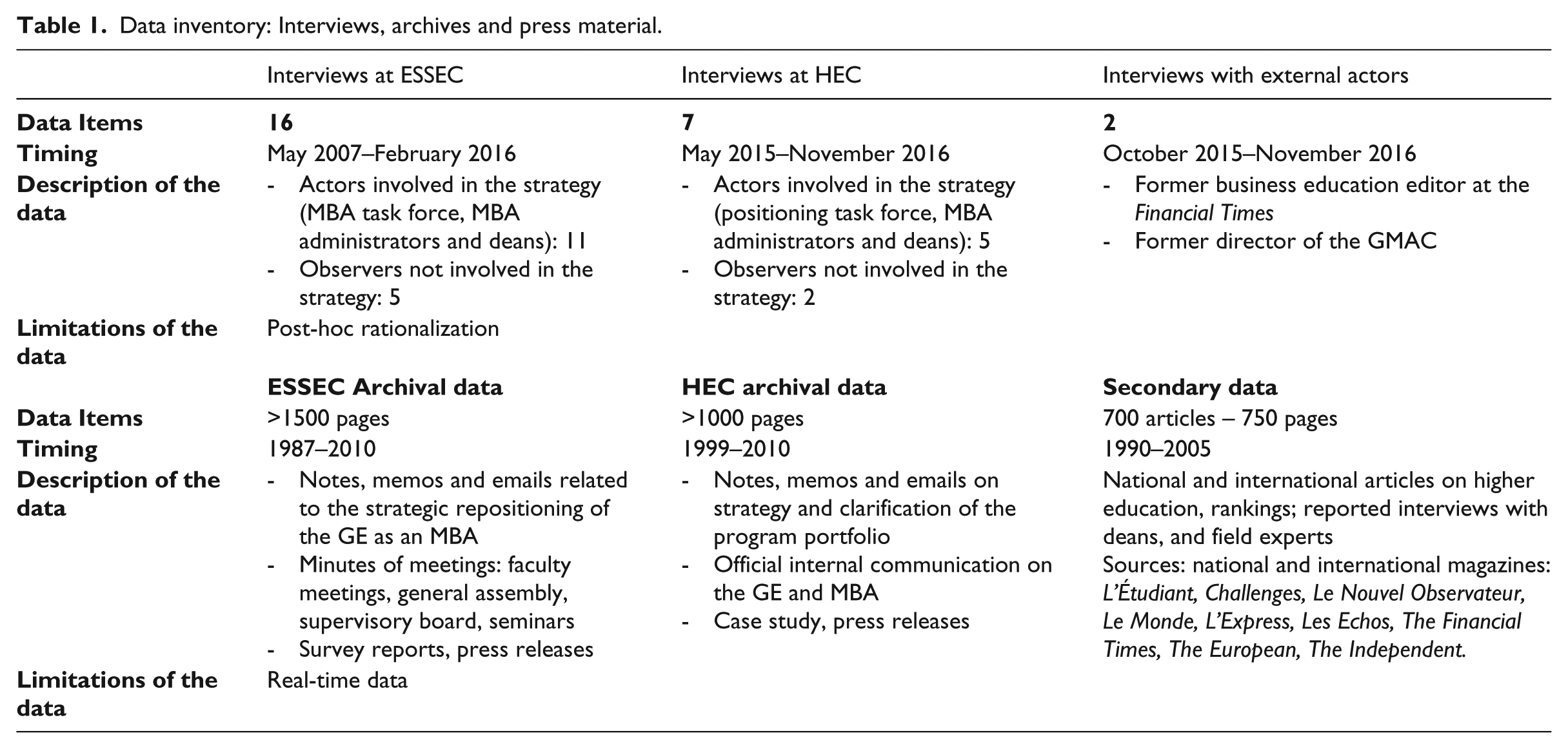
The first author conducted sixteen interviews at ESSEC and seven at HEC. These enabled her to dig deeper into key strategic events and gain a better perspective on secondary materials. Interviews included specific questions about why and how each school chose to position their GE program in different international categories, what they did to promote their choice, and their perception of each other’s strategies. Finally, the first author interviewed the Financial Times’ former business education editor and the former director of GMAC. Interviews were transcribed verbatim. Table 1 provides an inventory of the data used in this study.
Data inventory: Interviews, archives and press material.
Data analysis
We analysed the data in two stages. First, we moved back and forth between the data and the emerging theoretical arguments and constructs (Strauss & Corbin, 1998). We built a multi-level event history database, identifying critical events in the recent history of French business schools, and more specifically that of ESSEC and HEC, situating them in the broader institutional environment. Second, we dug deeper into key moments of internal debates at ESSEC and HEC, communication with key external stakeholders, and the schools’ competitive relationship. We analysed each school’s key actions, responses and interactions to build our emerging conceptual model.
Stage 1: Developing a multi-level event history database
This stage aimed to develop a multi-level ‘event history database’ (Garud & Rappa, 1994) chronicling changes in the French business school sector with particular emphasis on strategic changes within HEC and ESSEC. We relied primarily on archival data to gain insights into critical events, as they were perceived by actors at the time. We also used data from our interviews with key informants at ESSEC and HEC to corroborate and complement archival materials. This enabled us to create a detailed chronological display of key events, and identify major changes at various levels of analysis, as illustrated in Figure 1.
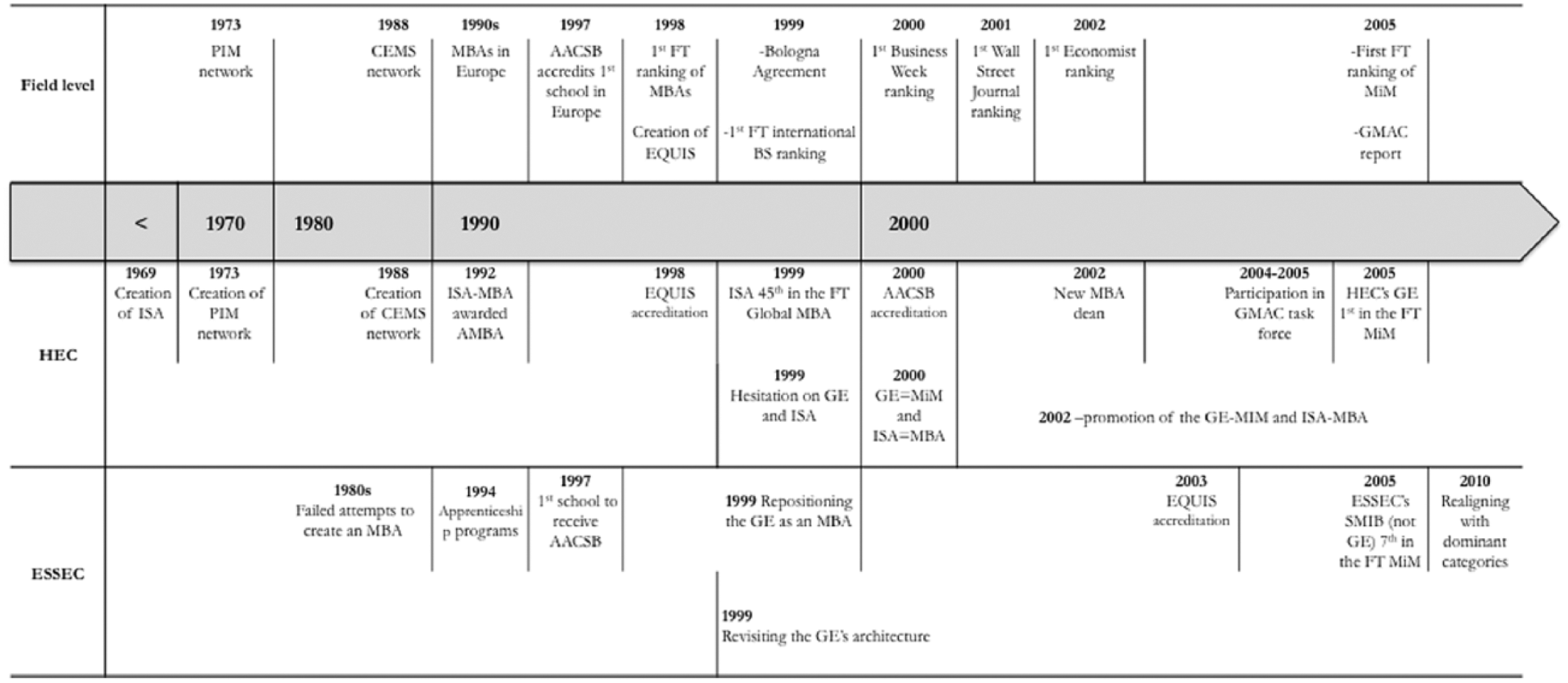
Chronological display of key events at the field and organizational levels.
Stage 2: Analysing each school’s actions, responses and interactions
This step involved tracing major categorizing acts by each school. We also focused on the schools’ interactions with major intermediaries (Durand & Khaire, 2017) such as ranking organizations (essentially the FT), accreditation bodies (EQUIS, AACSB and AMBA), and GMAC. Through category ‘assessments’, ‘comparison criteria’ and ‘endorsements’, intermediaries have extensively influenced audience perceptions in the business education sector (also see Espeland & Sauder, 2007; Wedlin, 2006, 2011), which makes them ‘market-makers’ (Pontikes, 2012).
We analysed the data inductively, using the naturalistic inquiry method (Lincoln & Guba, 1985) and the constant comparison technique (Glaser & Strauss, 1967) to generate first- and second-order concepts by examining and comparing key events (e.g. Nag, Corley, & Gioia, 2007). In the initial rounds, we coded data from each school separately. To reduce subjective interpretation, we drew primarily on archival material from each school and press articles. These were fundamental in providing internal and external interpretations of specific strategic choices by ESSEC and HEC as they unfolded. We mitigated potential inaccuracies by triangulating written data with interviewees’ accounts. Using the actors’ own language, we developed first-order codes (Van Maanen, 1979) in the form of descriptive labels for key changes in the broader environment and at each school. These labels were derived from phrases and vocabulary in our various data sources. A few examples of these labels are: ‘opportunities to disrupt the status hierarchy in the national market’, ‘opportunity to establish first-mover advantage’ and ‘fear of loss of leadership in the national market’. To improve and validate the emerging codes, we continually revisited the data and fine-tuned our codes where required.
Using axial coding, we developed links among and between first-order constructs to group them into second-order themes (Strauss & Corbin, 1998). As we identified relationships between constructs, we began grouping them into themes, on which we based our second-order interpretations (Langley & Abdallah, 2011). We systematically compared insights from each case to identify differences and similarities in their strategic choices, strategies and patterns of interaction. We also paid particular attention to their competitive dynamics, and specific instances in which informants from one school referred to the other. For example, ESSEC respondents referred to altering GE features to signal its fit with the MBA category – which we labelled Product-centric categorization strategy. However, HEC respondents referred to mobilizing different audiences to delineate the GE and MBA markets – which we labelled Audience-centric categorization strategy.
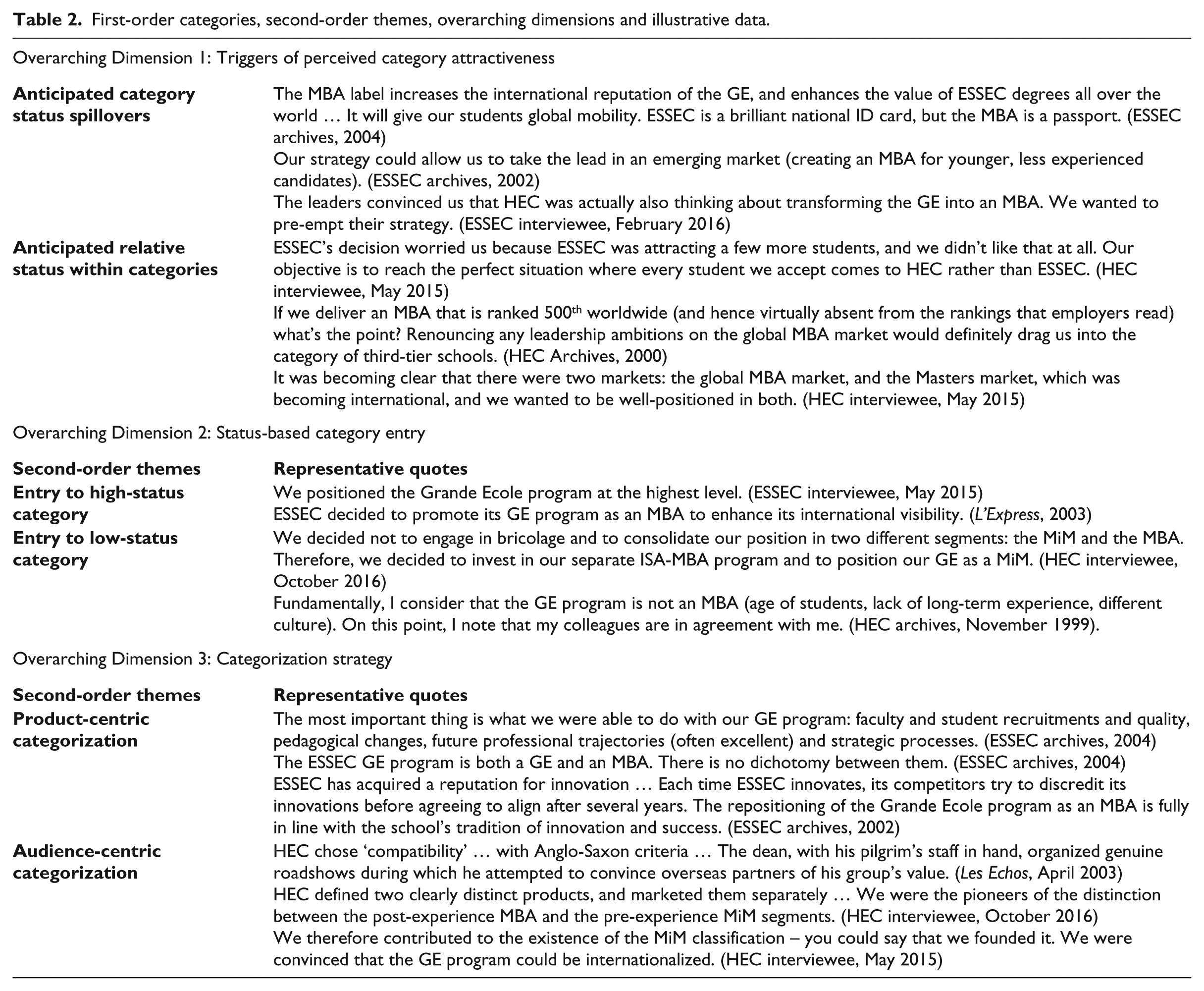
The researchers met regularly to compare coding systems and discuss refinements to the second-order themes. Disagreements over codes drew our attention to areas that required further data or alternative conceptualization. As constructs and relationships emerged, we enriched our data-driven conceptual framework with insights from the literature. Finally, we gathered similar themes into three overarching dimensions, which we labelled ‘Triggers of perceived category attractiveness’, ‘status-based category entry’ and ‘categorization strategy’. Figure 2 illustrates the data structure and Table 2 provides illustrative quotes underlying each of the second-order concepts. To minimize bias and test the plausibility of our findings, we presented our interpretations to ESSEC and HEC colleagues, and received highly constructive feedback and suggestions.
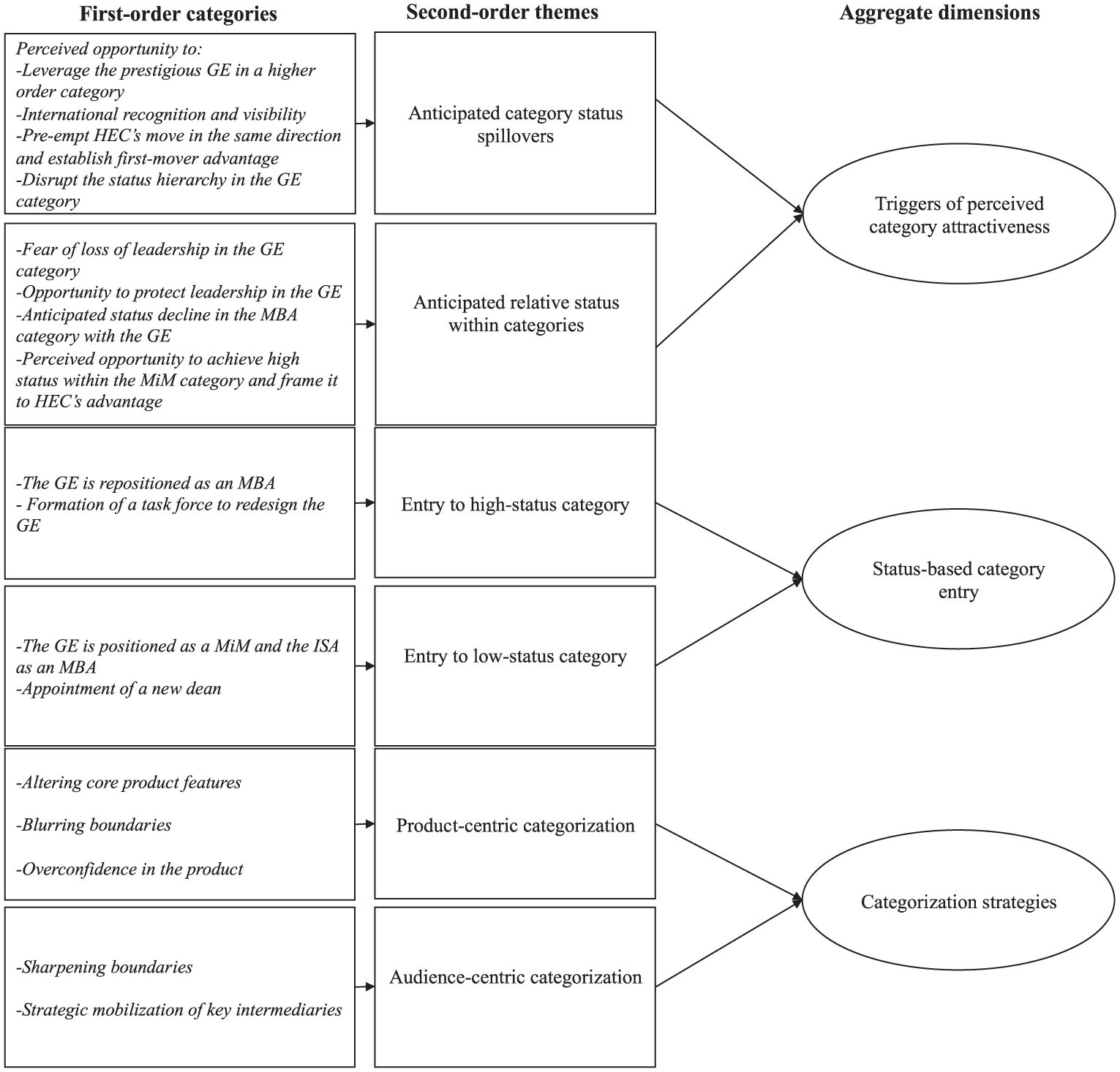
Data structure.
First-order categories, second-order themes, overarching dimensions and illustrative data.
Findings
Despite the similar perceptions of discrepancy between the GE’s high standing and the low status of the MiM category, ESSEC and HEC followed different approaches. To launch the GE on the global market, ESSEC chose the high-status MBA while HEC opted for the lower-status MiM. Below, we explain why HEC and ESSEC chose two differently ranked categories for their comparable GE program and how they claimed membership of these different categories.
Triggers of perceived category attractiveness
Our analysis revealed distinct triggers for each school’s perceptions of category attractiveness: (1) anticipated category status spillovers, and (2) anticipated relative status within categories.
Anticipated category status spillovers
ESSEC sought to use the high status of the MBA as a means to leverage its existing prestigious GE product, achieve international recognition, disrupt the status order in the GE category and pre-empt HEC’s suspected imminent entry into the emerging MBA market for less experienced students.
In 1999, ESSEC had a GE program but no conventional post-experience MBA to promote in the international business education market. Its management chose not to create a standalone post-experience MBA, on the grounds that it would dilute the flagship GE within a wider program portfolio.
Despite the attractiveness of this option (creating an MBA), it was discarded several times, because it could undermine the development of ESSEC’s GE program. Furthermore, there was no guarantee that such a program would be successful and become as selective and prestigious as the GE program. (ESSEC archives, 2002)
At the same time, the dominant opinion was that the GE, with its highly selective entrance examination and emphasis on the acquisition of professional skills and international experience, should not be confused with a mere Master of Science, deliverable by ‘any university’.
Positioning oneself as a Master in Management means risking a positioning that fails to reflect the richness of our model. Internationally, our model corresponds more to an MBA. (ESSEC archives, 2004)
For ESSEC, affiliation with a status-valued category like the MBA would better reflect its international identity and the standing of the GE program: ‘The greatest strength in the French system is the GE. The most important degree on the world stage is the MBA. … The most courageous decision was to combine the best of the system with the need to compete internationally’ (interview with ESSEC management in the Financial Times, October 2003). Thus, creating an MBA based on the GE program provided an opportunity to position the school’s ‘core identity marker’ (Wry, Lounsbury, & Jennings, 2014) in the highest-status category and benefit from ‘affiliation-related spillovers’ to the GE program (Montauti & Wezel, 2016, p. 958) – including international visibility and attractiveness.
We have started to think about ESSEC’s GE program, and how to make it more international. The MBA standard is the only way to gain international recognition and is a necessary condition for attracting international students. (ESSEC archives, January 1996)
By targeting the highest status category, ESSEC was hoping to disrupt HEC’s ‘uncontested leadership’ of the GE category and elevate its own status. As the challenger, in the late 1990s, ESSEC had accumulated a number of achievements that had made waves among its counterparts. It was the first to introduce an apprenticeship (work-study) scheme in 1994. It was also the first non-US school to obtain AACSB accreditation in 1997. The accreditation letter stated that the GE program was ‘equivalent to an MBA’, which encouraged ESSEC to make an official claim to MBA status. ESSEC’s leaders were certain that other French business schools would follow suit and were further emboldened by the belief that HEC was also working on a similar scenario. They decided to pre-empt this move: Our direct competitor is moving in the same direction. We thought that being late movers would incur significant costs. (ESSEC archives, February 1998)
They believed that a preemptive strategy offered them the opportunity to be first movers in an emerging MBA segment, targeting younger, less experienced students who were also targeted by leading US business schools, including Harvard and Stanford. Thus, ESSEC leaders framed their strategy as an opportunity to preemptively stretch the established but fuzzy MBA category at no risk – thereby ‘[establishing] itself as the referent for the Junior MBA if [they] succeed in building the maturity of (their) students and become more international’ (ESSEC dean memo, April 2002): There is no MBA norm today, apart from AACSB guidelines regarding the minimum required teaching hours. However, the market perceives a good MBA program as one that is post-experience … the most important criterion being that of the students’ maturity acquired through the professional experience … Our GE-MBA program will continue to recruit students via preparatory classes … But students will gain work experience while studying for their degree. (ESSEC archives, 1998)
In contrast to ESSEC, HEC did not expect category status spillovers to play a major role for their GE. Their approach was centred on the relative competitiveness within categories, as we show next.
Anticipated relative status within categories
HEC’s leaders spent considerable time reflecting on how to categorize the GE program internationally in response to ESSEC’s unexpected strategy. ESSEC’s entry to the MBA category with its GE program created uncertainty in the French and European market.
What ESSEC had done destabilized everyone. The subject was very controversial. (HEC interviewee, May 2015)
Like ESSEC, HEC considered the MiM as a lower-status category that would not reflect the standing of their flagship GE program.
We would of course like to be able to say that the GE program is an MBA, even if we know it isn’t … There is an apparent hierarchy of values. We don’t want to kill our GE graduates internationally by awarding them something less valued than an MBA. (HEC archives, November 1999)
However, unlike ESSEC, HEC had both a GE and a peripheral MBA program, hitherto known as the ISA MBA, launched in 1969 as an early internationalization effort, but not carrying the school’s name. Unsettled by ESSEC’s move, HEC leaders initially considered following suit and repositioning the GE program as an MBA for two reasons: first, their ISA-MBA was poorly positioned (45th) in the first Financial Times Global MBA ranking, published in 1999. The program was unable to attract elite international students, and was considered by HEC stakeholders as a second-class degree that did not deserve the MBA label: We have been working hard for 30 years to position the ISA program as one of the world’s leading MBA programs, but have failed. (HEC archives, January 2000)
Second, HEC was concerned that ESSEC’s strategy would appeal to preparatory class students who, with limited knowledge of the management education sector, would be lured by the possibility of obtaining both a GE and an MBA. They believed that ESSEC had communicated its strategy clearly and effectively to key national audiences. It had received the American accreditation AACSB, which was ‘a strong argument for poaching students’ (HEC archives, 1999). These fears escalated when fourteen applicants turned down HEC in favour of ESSEC in 2001. Until then, almost all candidates with an offer from HEC would have accepted it: In autumn 1999, HEC was concerned because for the past three years a certain number of successful applicants had preferred to accept a place at the rival school, ESSEC … What worried HEC was that this figure … had risen from 5 in 1997 to 8 in 1998 and 13 in 1999. HEC believed that this acceleration was due to the fact that since 1998 ESSEC claimed, controversially, to deliver an MBA – the most prestigious degree in the business world. (Le Nouvel Observateur, August 2005)
In other words, HEC feared ‘losing (its) leadership position’ in the GE category (HEC archives, 2000) should ESSEC’s strategy gain traction – and had achieved poor status within the MBA category with its ISA-MBA program. Thus, in 1999, the ‘positioning task force’ and influential faculty members consistently recommended that HEC should follow ESSEC’s strategy and promote its GE as an MBA. They believed that HEC needed a strong MBA that built on the school’s core identity marker – its GE program, that should be ‘the school’s vector for internationalization’ (HEC archives, November 1999). Evidence from press articles in the late 1990s illustrates HEC’s initial hesitation: The HEC Dean is considering a similar scheme [to ESSEC]. From this year, the best students on its first degree programme could be offered an MBA if they take a two-year break to work in a company. (Financial Times, June 1999)
Nevertheless, observing ESSEC’s new ‘MBA’, HEC’s leaders anticipated that its position in the MBA rankings would drop further should it enter the market with the GE program. They considered that adopting a strategy similar to the ESSEC-MBA would mean awarding the students ‘a very poor MBA degree that would be very badly positioned (if at all) in international rankings’ (HEC archives, 2000): If we follow ESSEC’s strategy, HEC – which is not well-ranked internationally – will completely disappear from international rankings. A Grande Ecole program reinvented as an MBA cannot obtain a good position in the MBA rankings, if only because of the starting salaries of our graduates, which is the very first criterion used. (HEC archives, 2000)
Meetings with recruiters and human resource managers confirmed their assessment that GE students would not be perceived as MBA graduates, and employers ‘would not pay them the same as MBA graduates’ (HEC interviewee, February, 2016), despite their professional experience acquired through internships.
At the same time, HEC perceived an opportunity to leverage discrepancies between the GE’s standing in France and the lower status of the MiM. HEC’s leaders expected their GE to achieve high relative status within the MiM category. As they stressed, ‘in Europe, the Top Five business schools (had) not yet fully emerged’ and there was an opportunity to ‘fill a spot in the European Top Five’ (HEC archives, 2000); on the other hand, by dominating the still emerging European MiM category, they perceived ‘an opportunity to increase the value of European pre-experience Master programs through association with European partners’ (HEC archives, 2000) – thereby framing the category to their own advantage and increasing its recognition. As such, ‘all (HEC) needed to do was to make the MiM known to the outside world’ (HEC interviewee, October 2016) as also illustrated below: Why don’t we work together with prestigious European partners in the CEMS network who have the same problem as we do …, to promote … an open standard that would unite European pre-experience management degrees? The standard could be a Master of Science in Management … Action needs to be taken here, in partnership with our European allies … The new standard would be clearly distinct from the MBA, and would act as the driver of a global strategy. (HEC archives, 2000)
For HEC, such a strategy would counter ESSEC’s categorization – protecting its leadership in the GE category and extending its GE’s international reach.
To summarize, while ESSEC sought preemptively to benefit from affiliating with a high-status category – a choice that they deemed consistent with the GE’s high standing – HEC considered the less prestigious MiM category as the most appropriate fit for the GE program – expecting to both dominate the category and frame it to its own advantage.
Status-based category entry
Entry to high-status category
ESSEC leaders decided against entering the MiM category – perceived as ‘much humbler than the “Grande Ecole” product’ (former ESSEC director in Challenges, December 2005). Instead, they decided to stretch the established, high-status MBA to include their GE program – considering that they should not ‘deny the GE the best international positioning, if it is the best program’ (ESSEC archives, 2004). The urge to increase international recognition while protecting the core GE program inspired the creation of a program that combined both MBA and GE categories.
It is important to note that we have reached a general consensus around the possibility of repositioning our Grande Ecole program as an MBA, thus building on our identity as a Grande Ecole. In other words, we believe that there is no incompatibility between our identity and the acquisition of international status and recognition. (ESSEC archives, 1998)
A faculty task force comprising several professors and the new MBA dean was set up to design and implement the revised program. When the school appointed a new dean in 2001, he supported the GE-MBA strategy.
Entry to low-status category
Following a highly charged internal debate, HEC positioned its GE program in the low-status MiM category – targeting the European market for pre-experience masters degrees. HEC also opted to transform its peripheral MBA, ISA, into a fully-fledged MBA, positioning it alongside post-experience MBAs offered by INSEAD and the London Business School, which it identified as its direct competitors (HEC archives, 2000). HEC faculty elected the third author as dean of the program in 2002, and gave her a clear mandate to align the MBA program with the prestigious HEC brand.
I had to turn things around very quickly, enhance the program’s ranking (we were 67th), and ease the tense climate … The program was rebranded as an MBA so that people would not call it ISA anymore … In 2003, the program was on track … This is when HEC decided to stick to its MBA program and rule out any possibility of combining the GE and MBA programs. (HEC interviewee and third author, January 2016)
To communicate the new strategy internally, a strategy professor wrote a case study on HEC’s program portfolio to explain the need for HEC to redefine its program offering. In particular, he highlighted why HEC chose the less prestigious MiM category for its core historical GE program, and to promote the undervalued ISA-MBA – which was often disparaged by GE students – in the status-valued MBA category.
GE students were condescending towards the ISA [at the time]; it took them a long time to understand the benefits of a separate ISA-MBA program, [that does not build on the GE]. (HEC interviewee, May 2015)
Below, we show how ESSEC and HEC’s differing anticipations and category choices yielded starkly dissimilar categorization strategies.
Categorization strategy
Having chosen different product categories for their GE programs, the schools engaged in ‘a true confrontation – communication versus pedagogy’ (Challenges, December 2004) to compete in their respective categories. ESSEC pursued a ‘product-centric categorization’: ESSEC … is emphasizing its teaching. The school is redesigning its entire curriculum to allow time for all its students to gain eighteen months to two years of mandatory professional experience in addition to their studies. ESSEC is also recruiting more 23 or 24-year-old students with five years of higher education. To help students find a job in keeping with their ambitions, the school has set up an American-style assessment center, with seven full-time staff responsible for developing close relationships with recruiters… (Challenges, December 2004)
HEC, in contrast, pursued a ‘audience-centric categorization’: Through an intense international communication strategy, HEC is putting everything into getting its ‘real’ MBA (inherited from ISA) into those so-coveted rankings. The dean of HEC regularly travels to New York to meet specialized journalists. In Paris, he has entrusted HEC’s image to … an agency … one that boasts the best corporate accounts in the market place (Pinault, EDF, Veolia…). All this interspersed with a massive advertising campaign. (Challenges, December 2004)
Product-centric categorization
Despite perceiving the MBA as amenable to interpretation, ESSEC sought to deliver a product that would fit as closely as possible with the conventional MBA – eschewing mere symbolic use of the MBA label. The MBA’s dean forcefully explained that ‘it would be ridiculous to claim that the GE diploma is an MBA without any major changes’. For that purpose, he insisted that ESSEC ‘should introduce measures enabling (the program) to gradually incorporate the main components of an MBA’ (ESSEC archives, February 1998).
The evolution of the GE’s positioning towards an MBA implies major changes to student recruitment, program structure, the conditions for gaining professional experience, and student behavior in class. (ESSEC archives, December 1998)
ESSEC leaders were convinced that a substantially revised GE program would signal the appropriateness of the categorization strategy under scrutiny. For them, ‘the solution (lay) in a strong, innovative pedagogical concept … (to) attract the attention and, perhaps respect, of (their) environment’ (ESSEC archives, October 1998). Therefore, ESSEC did two things: first, it focused on the product, altering its GE’s characteristics by importing features from the MBA category and reinterpreting others – most notably, the work experience requirement. Second, ESSEC management emphasized the compatibility of the GE and MBA categories – blurring the boundaries between them.
In particular, the program’s architecture was altered to distinguish sharply between the first year (‘période initiale’) and the ‘MBA period’. The MBA period was a self-contained curriculum modelled after a standard MBA, with core courses and electives.
We have to separate the PI (first year) and the MBA period more clearly, by changing what happens in the classroom (form and content, what the students contribute, other audiences) and by establishing a program closure. (ESSEC archives, May 2002)
While preparatory class students continued to pour into the first year in the usual way, ESSEC admitted more students from international and other backgrounds directly into the MBA period. The goal was to ‘depend less on the preparatory class system’ (ESSEC archives, 2004). All students were granted both the GE and an MBA. ESSEC also reinterpreted the conventional work experience requirement, to include 18 months of relevant professional experience alongside the academic studies, and significant international experience through an exchange program or internship.
The one or one-and-a-half-year internship period should enable students to acquire significant experience. It’s not as long as in an American MBA, but differs in two ways: first, students already have the basics of business management – unlike traditional MBA students – and second, the period spent in the company is supervised. (ESSEC archives, January 1996)
Further, ESSEC leaders sought to blur the boundaries between the GE and the MBA, particularly deconstructing the work experience requirement of conventional MBAs to consider it as the product of conventional wisdom, rather than an immutable rule. ESSEC’s GE-MBA dean considered that there were ‘[no] unacceptable incompatibilities between Grandes Ecoles and the best MBAs’ particularly in terms of the ‘student quality’ and ‘international outlook’. Most importantly, regarding ‘professional experience’, the dean considered that the ‘real difference’ lay more ‘in how this experience is acquired’ than in the actual content of the experience: In our model, students study for a long period of time, all the while gaining work experience – practically two years’ worth during the program, supported by a system of individual mentoring and skills evaluation. In terms of maturity and employability, initial results have been very encouraging. Many multinational recruiters recognize the quality of this integrated experience, both in terms of status and remuneration. Our graduates earn a post-experience MBA, yes, but the way this experience is acquired is based on our traditions and a key pedagogical process that maximizes the interaction between the business world and academia. (ESSEC GE-MBA dean in Le Figaro, November 2004, emphasis added)
ESSEC leaders also produced a significant number of documents to describe the new architecture of the product, justifying its compatibility with the MBA category. They argued that GE and MBA can be ‘convincingly combined’ in the product because ESSEC has ‘strengthened the mandatory professional experience for [its] students and mentor them effectively’ through regular discussions with faculty members; and because ‘students also enjoy international exposure on campus through interaction with foreign professors and students, and through their internships and exchange programs with overseas universities’ (ESSEC GE-MBA dean, conference minutes at the Ecole de Paris, January 2003).
An assessment of the resulting product indicated that, although they struggled to reduce their dependence on preparatory classes for recruitment, ESSEC’s leaders were satisfied with the changes implemented to bring the program closer to an MBA.
Compared with what the Grande Ecole was, we’ve taken a major step towards the ‘traditional MBA’, both in terms of age and – especially – our students’ professional maturity. (ESSEC archives, 2004)
The resulting program and other past achievements created overconfidence in their ability to garner the support of its peers and ranking organizations, leading to a staunch commitment to the product.
ESSEC Faculty believe other French schools are considering copying their lead and the requirement for students to be older before they study for an MBA is just ‘dogma’. (Financial Times, October 2003)
ESSEC’s leaders were confident that a good product would ultimately be recognized by outside audiences. Making a veiled reference to HEC’s audience-centric strategy, ESSEC’s MBA dean expressed his suspicion of a ‘strictly media-oriented strategy’ (in Le Figaro, January 2003), hoping that professionals and students would consider – beyond the label – ‘what actually happens in the “machine”: teaching quality, the selection process, teaching procedures’ (ESSEC MBA dean in Le Figaro, January 2003). At the same time, archives and recent interviews consistently indicate that ESSEC leaders underestimated the need to enroll audiences.
External assessments clearly show the weakness and lack of necessary communication skills to promote the program’s existence and features. And this weakness has been highlighted by AACSB and persists today. (ESSEC archives, 2006)
Unfortunately, despite its initiatives, ESSEC was unable to inspire other French business schools to follow its path. Yet, its leaders remained committed to their strategy, considering solitude as the price innovators have to pay: Of course, anyone that innovates has to put up with criticism from those that remain to be convinced as a new standard gradually establishes itself. This period of investment can be arid and solitary – we’re going through this now. (ESSEC archives, April 2002)
Audience-centric categorization
Having chosen a lower-status, emerging category for their GE program, HEC leaders sought to promote the category and develop its reputation among influential intermediaries. HEC promoted its own view of the sharp distinction between pre-experience and post-experience degrees – thereby sharpening the boundary between the MiM and MBA categories and attacking ESSEC’s blurring strategy. They drew upon and influenced European discussions on the difference between pre-experience and post-experience degrees. HEC promoted the GE-MiM and ISA-MBA as two different programs in two separate categories to different audiences: the GE-MiM in France and Europe alongside other European pre-experience programs; and the ISA-MBA (rebranded as HEC MBA) internationally, alongside post-experience MBAs.
HEC’s Dean is thinking like a strategy professor: on the French market, HEC should conserve its strengths as the leader … On the worldwide scene, [you have to] play by the rules of the game. (Les Echos, April 2003)
The bulk of HEC’s communication focused on emphasizing prior work experience as a defining feature of the MBA, differentiating it from the GE program or any other pre-experience master program. Reflecting on the relative importance of the work experience requirement, HEC’s director persisted ‘in the belief that a French business school’s Grande Ecole curriculum is not at the same level as an MBA, which requires real professional experience’ (HEC Dean in Les Echos, December 2000).
The conflict between ESSEC and HEC over what constitutes ‘professional experience’ (an internship does not include the essential dimensions of decision-making and risk-taking) and over when it is acquired, is relentless. (Challenges, December 2005)
To secure support for their strategy, HEC leaders leveraged their exclusive partnerships with European and international stakeholders. To promote their positioning of the GE in the MiM category, they relied upon their privileged ties with other schools in the CEMS 3 network – enhancing the MiM’s recognition by associating with high-status European partners. The Financial Times played a significant role in this process, particularly in 2005 when it published a ranking for European (now global) Master in Management programs which were ‘rapidly gaining ground thanks to the Bologna process’ (Challenges, 2005). The ranking allowed HEC and other French business schools to capitalize on their flagship GE program and top the emerging MiM category. HEC admittedly encouraged the Financial Times to launch this new ranking, and considered the fact that the MiM category has ‘gained traction and recognition’ as ‘an unmistakable sign’ (HEC archives, 2005).
We had lunch with the FT business education editor once or twice a year. These lunches were an opportunity to get our message across. We told her that it was high time to create a Master in Management ranking and that it had been 4 or 5 years since the launch of the first Global MBA ranking. (HEC interviewee, February 2016) I meet with the dean at HEC once a year for our usual debrief. Did he ask me to consider the MiM? I’m sure he did, amongst other things. (Interview with the FT’s Business Education Editor, in Le Point, 2009)
On the other hand, to promote the MBA as a post-experience degree, HEC primarily targeted AMBA,
4
EQUIS
5
and GMAC, all of whom envisioned a more sharply defined MBA. GMAC’s main concern was to ‘gain legitimacy with the European target base’ and ‘help put the luster back onto the MBA’ (GMAC report, June 2005). Along with other members of the exclusive PIM network,
6
HEC joined GMAC, forming what came to be recognized as the GMAC task force.
7
The task force raised concerns about the ‘dilution’ of MBAs, ‘demanding “greater regulation” in how they are managed’ (Les Echos, January 2005). They considered that the MBA category was becoming ‘too noisy’ (Montauti & Wezel, 2016, p. 968) and required a description of its ‘defining attributes and instances’ (Kennedy et al., 2010, p. 379). They therefore needed to counter ESSEC’s categorization of its GE as an MBA and resulting blurring tactic. As such, strategic mobilization went beyond securing support to undermine ESSEC’s initiative. HEC’s director of communication recognized that the school ‘has played (its) networks to discredit ESSEC’s initiative, and will keep doing this in total transparency’ (Les Echos, March 2004). Similarly, the GMAC task force published a widely shared report in 2005 that raised concerns regarding ESSEC’s strategy and highlighted HEC as a market exemplar of how to implement the Bologna framework: Debate is ongoing in France about the use of the MBA title. One FBS [authors’ note: a reference to ESSEC] has chosen to award the MBA to students with little or no work experience. Institutions that require MBA students to have significant work experience are understandably concerned … This could adversely affect institutions offering genuinely post-experience qualifications … We recommend that clear guidelines on what an MBA is are defined, adopted and integrated into national qualifications frameworks. (GMAC, 2005)
All players agreed that the Master of Science in Management category was the most appropriate fit for the GE and other European pre-experience programs. They also agreed upon the MBA’s defining features, eventually siding with HEC.
For ‘Camp HEC’, supported by accreditation organizations such as EFMD and AMBA, the game was set: the GE is a Master in Management, MiM or a Master of Science in Management (MSc), which, after five years of study, perfectly integrates the European Bologna
8
architecture. (Challenges, December 2005) With very few exceptions, the positioning of the Grande Ecole system is now clear: it will deliver a Master of Science in Management, while the MBA will focus on post-experience applicants. These approaches will coexist and strengthen the international recognition of their titles, as has been the case with HEC in recent years. (GMAC, 2005)
To summarize, by choosing a high-status, well-established, yet relatively ambiguous category for its GE, ESSEC sought to focus on the product side of the classification structure – substantially revising its GE program and blurring boundaries, hoping that the resulting quality would signal the appropriateness of the strategy and be perceived as a legitimate extension of the target category. Alternatively, by choosing an emerging low-status category, HEC focused on the audience side of the classification structure – effectively making the low-status category more visible and demarcating its boundaries.
Discussion
Our research aim was to understand why and how competitors position similar products in different status categories. Our first contribution was to highlight how actors assess the implications of investing in a high- versus low-status category. We found that while ESSEC mostly anticipated positive spillovers from affiliating with a high-status category, HEC attended to its own (status) achievements within a lower-status category. Our second contribution is the identification of two categorization strategies. ESSEC adopted a product-centric strategy to fit the high-status category – substantively altering the features of its GE and blurring boundaries to convey legitimate membership of the highly scrutinized MBA category. Meanwhile, HEC adopted an audience-centric strategy to leverage its high relative position in a low-status category – mobilizing relevant intermediaries to secure support for its categorization of the GE as a MiM and undermine ESSEC’s initiative. Taken together, these insights move beyond the traditional treatment of categories as static entities and elaborate the categorization process as social and relational, involving multiple actors and meanings. Figure 3 presents our theoretical model.
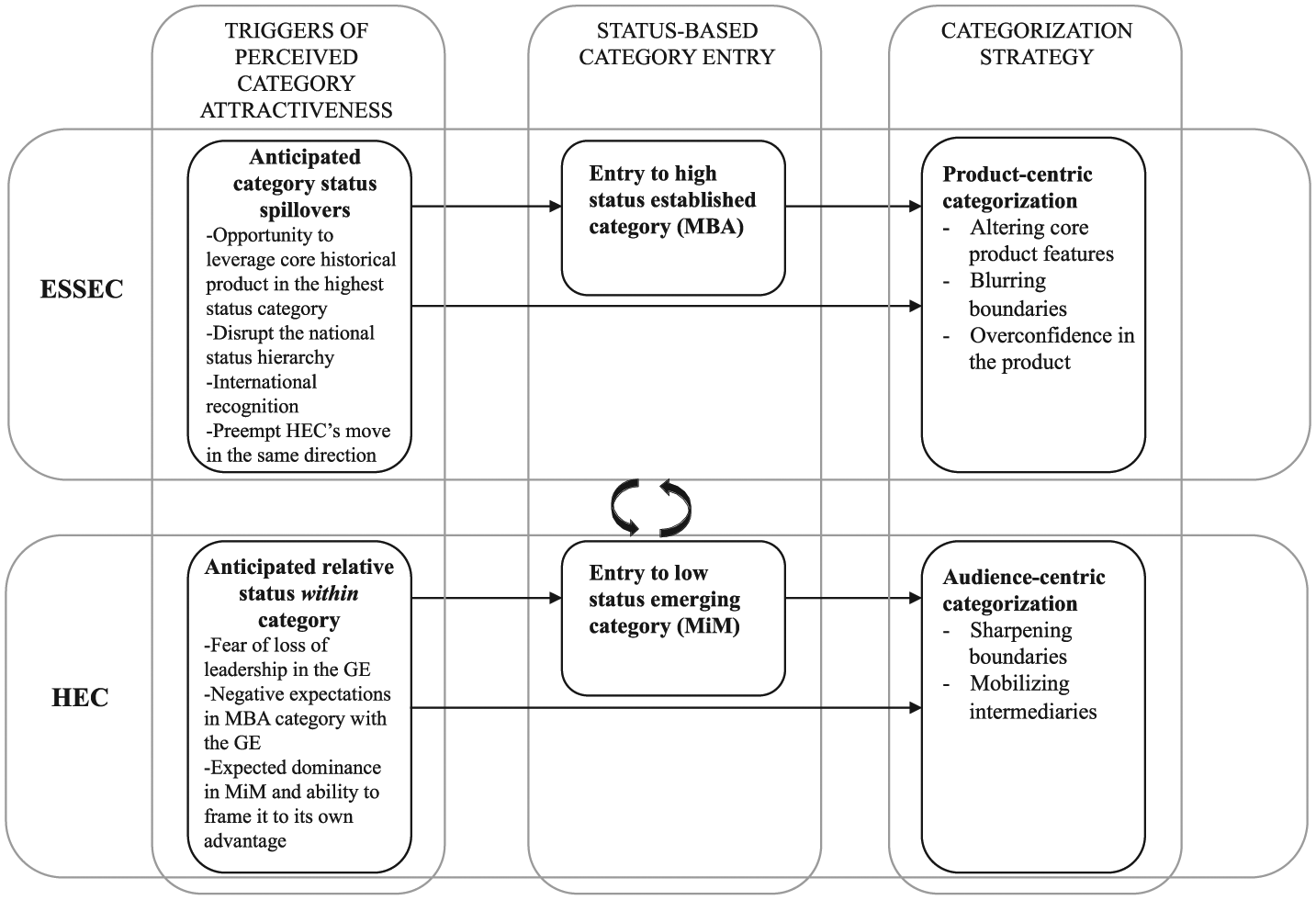
Categorizing contest in an evolving categorical structure.
Perceived category attractiveness and the role of status at different levels
Instead of attending to audiences’ perceptions of status within categories and category-level status in their valuation efforts (e.g. Sgourev & Althuisen, 2014; Sharkey, 2014), our study switches the focus to how producers themselves perceive status dynamics and the potential benefits of positioning their products in different status categories. The puzzle of categorizing the same high-status product in two different status categories can be understood when we consider producers’ anticipations and competitive dynamics.
For ESSEC, the status of the MBA played a critical signalling function in uncertain conditions (see also Montauti & Wezel, 2016). ESSEC hoped to benefit from positive spillovers by affiliating with the status-valued MBA and perceived the MBA as the most appropriate to host its historical core GE product. ESSEC’s emphasis upon the high status of the MBA and ‘affiliation-related spillovers’ confirms the prevailing imagery of attractive high-status categories in uncertain conditions (Montauti & Wezel, 2016; Sharkey, 2014).
HEC’s strategy to advocate a lower-status category for its nationally dominant GE product is more surprising. An important assumption in previous studies is that status indicators at different levels should be consistent to avoid confusing audiences and tarnishing the product or the firm’s identity (Zhao & Zhou, 2011); or that high-status firms are more likely to claim membership in high-tier market segments and avoid low-status categories that would highlight their ties with low-status actors (Podolny, 1993). Our case, however, contrasts with this prevailing imagery, and identifies conditions under which actors might benefit from positioning a high-status product in a lower ranked category: HEC targeted the less valued category because it anticipated a status loss for its GE program within the high-status MBA category, and perceived potential to achieve high relative status for the program within the lower-status MiM; further, HEC foresaw the possibility of ‘collectively lead[ing] to a more visible category’ (Montauti & Wezel, 2016, p. 958) through association with high-status actors.
Thus, our study shows that when producers are compelled to define an appropriate new category for their high-status products, they might opt for a lower ranked category if they fear a loss of relative product status within the high-status category. Moreover, by collaborating with prominent partners (Podolny & Phillips, 1996; Sharkey, 2014), actors may collectively bestow their prestige on the less valued category, which they dominate. As such, our study highlights a potential tradeoff between anticipating spillovers from the category’s status to the firm or the product; and achieving dominance within a lower ranked category – thereby anticipating ‘status leaks’ in the opposite direction, from the firm or the product to the category (Sauder, Lynn, & Podolny, 2012, p. 274). Figuratively speaking, categorization strategy may often involve choosing between being a small fish in a big pond or a big fish in a small pond.
Product- and audience-centric categorization strategies
We also open the black box of categorization by tracing longitudinally ‘what actors do exactly when they categorize their entities in markets’ (Durand et al., 2017). Previous studies have emphasized how organizations adopt a category label to signal their affiliation (e.g. Granqvist et al., 2013). Other studies have hinted at the importance of social strategies to convince relevant stakeholders of the credibility and plausibility of new category membership (Lounsbury & Glynn, 2001; Suarez et al., 2015). Our study adds to this literature by outlining product-centric and audience-centric strategies.
Product-centric strategies involve substantively altering a product’s features to draw it closer to the claimed category. Audience-centric strategies are social activities through which producers shape audience perceptions of category meanings (e.g. Carnabuci et al., 2015; Pontikes & Barnett, 2015); these activities hinge on coalition building and on convincing relevant audiences and intermediaries of the desirability of their categorization strategy. Logically, the strategies could be used in combination: organizations can develop their products to fit existing expectations and simultaneously shape audience perceptions of category. In our case, the organizations emphasized one strategy over another.
Affiliating with the high-status MBA category, and anticipating spillovers from the category’s high status to its product, ESSEC pursued a product-centric strategy. It imported and reinterpreted features of the MBA – substantively revising its GE program to signal product–category fit, hoping that the resulting quality would signal the appropriateness of the categorization strategy. ESSEC was particularly motivated to adopt this strategy due to the close scrutiny of the categorizing contest between ESSEC and HEC. This emphasis upon the product complements previous work in which actors typically leverage limited scrutiny to reinterpret categories or merely adopt a category’s label at little risk (Montauti & Wezel, 2016; Sharkey, 2014). In these studies, the ‘signaling function of status’ affords producers the benefit of the doubt and reduces the consequences of their deviant or merely symbolic actions (Montauti & Wezel, 2016, p. 967). In our case, close scrutiny eschewed mere symbolic strategies and required substantive action.
Conversely, anticipating a position atop the MiM category, and given the low status and uncertainty associated with the category, HEC was motivated to pursue an audience-centric strategy. Mobilizing and associating with prominent European partners enabled HEC to shape audiences’ views of the category and collectively make it more visible – effectively diffusing status from the product and affiliating organizations to the category. Thus, while our study confirms that audience-centric strategies are used to intentionally frame the features of an emerging category (Carnabuci et al., 2015; Suarez et al., 2015), it also draws attention to their role in elevating the status of a less valued category.
The key point is that producers who enter established high-status categories in times of high scrutiny – anticipating spillovers from the category to the product – are more likely to modify their product significantly to signal fit with the chosen category and reap the associated benefits, even if audience acquiescence is never guaranteed. Whereas, for producers entering an emerging, lower ranked category they can dominate, audience-centric strategy can prove more appealing to enhance the visibility of the undervalued category.
From categories as static entities to categorizing as a relational process
Our study counteracts the still dominant imagery of categorization as aligning with existing, static, constraining categories, and the overemphasis on one type of actors – consumers (Jones et al., 2012). Our findings support the conceptualization of categorization as a competitive, relational process involving multiple actors, meanings and perceptions (Durand et al., 2017; Jones et al., 2012; Pontikes & Barnett, 2015). We show that producers and intermediaries not only ascribe different meanings to categories at different times, but that such meanings can be shaped by coalitions mobilized by producers. Their interpretations of categories and categorizing are by no means homogeneous or static, and can only be understood and analysed in relation to one another (Durand et al., 2017).
Our findings indicate that producers partly base their beliefs about which category is the most appropriate for their products on each other’s actions. That is, one actor’s categorization strategy may alter a competitor’s perception of a category’s attractiveness, much in the way that HEC partly adjusted its perceived value of the MBA category for its GE product because of the threat that ESSEC’s strategy represented for them. In this way, competitive dynamics may provide influential cues that help producers anticipate the potential payback for investing in one category rather than another. Circular arrows in Figure 3 illustrate this interdependency of categorization strategies.
Furthermore, intermediaries not only constrain actors by maintaining existing categories, but can actively assert the features of emerging and ambiguous categories, altering the perceived values of undervalued categories (Durand & Khaire, 2017; Khaire, 2017; Pontikes & Barnett, 2015) and tipping the balance in favour of one producer’s categorization over another. HEC mobilized intermediaries not only to support its categorization of the GE as a MiM, but also to actively undermine ESSEC’s MBA strategy – accusing it of weakening the MBA with its ‘inauthentic’ categorization (Pontikes & Barnett, 2015; Montauti & Wezel, 2016). HEC called upon one set of intermediaries – the FT ranking body – to institutionalize the MiM category and give it the lustre that it initially lacked; and another set of intermediaries – the AMBA accreditation agency and GMAC task force – to help delineate the MBA as a post-experience program, and thus stave off ESSEC’s categorization strategy. These findings complement previous studies of intermediaries as objective, unbiased actors (e.g. Khaire, 2017) by suggesting that they may often promote one categorization over another, particularly when this can increase the demand for and credibility of their services (Durand et al., 2017; Pontikes & Barnett, 2015). Second, our study confirms that producers mobilize intermediaries and build coalitions not only to secure support for their categorization, but also to actively undermine competitors’ categorizing – indicating that categorizing is also an adversarial, competitive process.
Limitations and future research possibilities
Our study reveals how categorization strategies unfold in an evolving categorical structure through a longitudinal in-depth study of two organizations. By outlining categorization as a relational, social process, and underscoring the role of status at different levels, our purpose is to rebalance current research, which has overemphasized categorization as aligning with static categories.
One could argue that initial conditions (GE program alone at ESSEC versus both GE and MBA programs at HEC) weighed heavily in the schools’ categorical choices and strategies. However, we argue that these initial resources oriented and enabled categorization choices without predetermining them. HEC had the option of pulling the plug on the peripheral ISA program or of positioning it clearly for a French audience; and of positioning the GE program as an international MBA. However, HEC’s leaders concluded that a GE positioned as an MBA would achieve poor rankings and ultimately damage the school’s status. At the same time, they perceived an opportunity to achieve high status within the MiM category with the same product. This assessment of target categories, and of relative product status within the category, weighed heavily in their decision to leverage the existing ISA program to compete in the international MBA category.
Although our theoretical development emerged from the particular context of two French business schools, we believe that some of the underlying mechanisms can be found in other contexts, particularly the role status plays in categorization strategies. We recommend comparative and ethnographic case studies to improve understanding of the inter- and intra-organizational dynamics of competitive categorizing and, in particular, how status, conceptualized at different levels (e.g. Zhao & Zhou, 2011), influences actors’ categorization choices and strategies at various stages of the category lifecycle (e.g. Grodal et al., 2015; Suarez et al., 2015).
A further line of research could investigate the performance implications of product versus audience-centric categorization, and ways in which organizations may combine the two approaches. To enhance understanding of the performance implications of categorization strategies, it is important to explore how heterogeneous audiences perceive and evaluate these strategies. Such a research program could more broadly inform institutional theory, particularly relating to the (counterintuitive) performance implications of ceremonial and substantive categorization strategies.
Footnotes
Acknowledgements
The authors are grateful to Henri Schildt, Nina Granqvist, Elisa Operti, Mia Raynard, Natalia Vuori, Derin Kent and Jan Lepoutre, for insightful discussions and valuable comments that helped improve the paper. We also appreciate the great guidance of Editor Bernard Leca and three anonymous Organization Studies reviewers throughout the review process.
Funding
This research received no specific grant from any funding agency in the public, commercial, or not-for-profit sectors.