




Abstract
Recently, scholars increasingly emphasize the role of consumers as market-makers – going beyond mere purchasing decisions. However, amidst this newfound attention to consumer-driven market-shaping acts for established markets, little attention is given to how consumers and their practices can be utilised in the making of not-yet (established) markets. This paper contends that focussing on conceivable practices as a lens to examine nascent, future markets and tracking their trajectories, is crucial for unlocking their potential as market-making precursor. To address this gap, this article examines the market-making opportunities offered by conceivable practice trajectories. Using practice theory, the authors investigate the practice trajectories of 20 German motorists following a theories-in-use approach. To understand how practices unfold, a new interview-based research method, the Futures Practice Wheel, is developed. Thereby, highlighting how prospective accounts of practice dynamics provide market-shaping opportunities through trajectory arrangements, consumer trajectory evaluations, and the trajectory level in the unfolding of practices.
Keywords
Introduction
Of late, the market-making literature pays more attention to consumers as market-making actors and their part in the creation and alteration of markets (Diaz Ruiz and Makkar, 2021; Geiger et al., 2012). A consumer’s influence goes thereby beyond purchasing decisions and its economic effects on the market (Crane, 2010; Harrison and Kjellberg, 2016). The extant literature provides ample evidence of this: among others, consumers shape markets through new consumption practices (e.g. Ansari and Phillips, 2011; Dolbec and Fischer, 2015), generating physical market objects (e.g. Goulding and Saren, 2011; Kozinets, 2011), or rebellious acts against a prevailing market system (e.g. Hietanen and Rokka, 2015; Scaraboto and Fischer, 2013).
What stands out is: the literature now accounts for the active role of consumers in shaping established markets (see Harrison and Kjellberg, 2016; see also Pedeliento et al., 2023), but the role of consumers in the making of not-yet (established) markets remains underexplored. That is, in spite of the opportunities that not-yet markets offer for shaping the future (Brown and Michael, 2003) and the levers available to shape future market states (see Bajde et al., 2022; Geiger and Finch, 2016). In contrast to established markets that are shaped by changing or keeping the status quo (Flaig et al., 2021), not-yet markets require the construction and alignment of its components (see Storbacka and Nenonen, 2011) – thus, calling for different activities and roles to be played by market actors, including those of consumers. By leaving the consumer aside in the making of not-yet markets, we do not fully leverage the market-making potential they offer.
So far, we know that consumption practices (i.e. use as part of routine and embedded procedures of daily life [Warde, 2005]) can influence all market practice classes (from exchange, to representational and normalising practices [Harrison and Kjellberg, 2016]) and even induce macro-level changes (when supported by professional market actors [Ansari and Phillips, 2011; Azimi et al., 2017]), thus making it reasonable to assume that consumption practices can also support the making of not-yet markets. To our knowledge, however, this has not been explored; with literature focussing on the efforts of professional market actors to shape not-yet markets through market narratives and hyping (e.g. Bajde et al., 2022; Geiger and Gross, 2017) and insights on market-making opportunities through consumers, among several actors, being anchored in established markets (e.g. Keränen et al., 2023; Storbacka and Nenonen, 2021). Apart from Geiger and Finch’s (2016) work on the performativity of market-shaping on the future outlook of a market, which also provide insights into consumer market-shaping as part of their multi-actor perspective. Thereby, taking a necessary first step in examining future consumer market-making and underpinning the potential this may hold.
To account for an examination of not-yet future markets, we focus on conceivable practices – that is, not yet established practices that draw on today’s practices and practice elements to be formed – and how they can be leveraged as a precursor to market-making. Since practices exhibit a historical integrity (Shove et al., 2012), conceivable practices can be seen as successive extensions of present-day practices, hence referred to as conceivable practice trajectories. Beyond that, we are particularly interested in the role of the consumer as a supporter of market-shaping rather than as market-makers as such. The reasoning is that market changes due to consumption practices often require the support of market professionals (Ansari and Phillips, 2011), making consumption practices a lever for market-making. On top, market change is not only achieved via direct market-making activities, but also through supporting activities that lay the ground for subsequent direct market-making (Keränen et al., 2023); opening not-yet markets to other participants.
While consumption practices are known to have the potential to bring about market change (Harrison and Kjellberg, 2016; Martin and Schouten, 2014), it is unclear whether the opportunities they hold in not-yet markets are similar to those in established ones. Further, there is a lack of knowledge about how to strategically leverage these opportunities before a market is established and existing structures need to be torn up and reorganised, forming the rationale of this research – aiming to understand: What market-making opportunities do conceivable practice trajectories offer?
To answer this question, we need to trace conceivable practice trajectories, a novel venture considering practices have traditionally been looked at only in hindsight (e.g. Shove and Pantzar, 2005). This suggests that an exploratory qualitative approach is most appropriate. Having assessed current future-oriented approaches that do not completely align with our objectives, we are crafting a qualitative interpretive research method to track how practices conceivably unfold. More specifically, we trace how current manual driving practices of German motorists will unfold to autonomous driving in the Autonomous Vehicle (AV) market; a future market that is not yet in full swing and faces many challenges in its establishment (The Economist, 2021); providing fertile ground for market-making research and action.
To this end, we leverage and adapt the Futures Wheel method (Glenn, 2009) to outline conceivable practice trajectories by first mapping current driving practices, to then introduce the scenario on AVs, and lastly, identify its successive implications. We then analyse themes and patterns and contrast these with the extant literature to identify their opportunities for market-making.
We find that market-making opportunities arise from dissipative trajectory arrangements (consumption process and norms); consumer trajectory evaluations (current market restrictions and strains as well as undesirable future market implications); or the trajectory level in the unfolding of practices (from the consumption process, meaning sought by consumers, to market norms and linkages to other markets). In this way, we contribute to market-shaping research, delving into prospective consumption practices as market-making opportunities, and to the exploration of practice dynamics, offering insights into forthcoming depictions of practices and their unfolding.
The next section presents the theoretical background of market-making, consumption practice trajectories and how consumption practices can be leveraged in market-making. We then show our method choices, which include evaluating different methods and adapting the Futures Wheel. Afterward, we present our propositions on the market-making opportunities that conceivable consumption practice trajectories offer in view of the extant literature. We conclude by outlining the study’s implications, limitations, and future research opportunities.
Theoretical background: Scope and need for refinement
Conceptualising market-making
To meet our research objective of understanding conceivable consumption practice trajectories as market-making opportunities we first dive into market-making and the unfolding of consumption practice trajectories, before examining the opportunities that the latter may offer for the former.
Following a markets-as-practices perspective, markets are viewed as modifiable systems consisting of arranged and intertwined market practice classes on exchange, representations, and norms (Callon et al., 2002; Kjellberg and Helgesson, 2007); being performed through market actors’ routine activities and their competences, meaning, and material (Shove and Pantzar, 2005). In this sense, a system’s existing macro-level structures are a product of its micro-level practices (cf. Schatzki, 2005). Thereby, emphasizing how markets are construed and rendered by the unfolding and interplay of market activities (Mele and Pels, 2011). How these market systems are (intended to be) altered by market actors is known as market-making (Diaz Ruiz et al., 2020; Nenonen et al., 2014). In other words, actors such as companies, policy makers, consumer, and interest groups have the ability to change an existing market or erect a new one through market-making activities – either driving or hindering market emergence or transformation (Diaz Ruiz and Kowalkowski, 2014; Mason and Spring, 2011).
Which market-making actions are taken and how this comes about depends, among others, on a market’s maturity. A market’s maturity can be accessed along a continuum on how strongly prevailing market practices and elements are aligned. More specifically, whether exchange objects and processes are clearly established, a market infrastructure is in place, acknowledged market images exist and standardisation proceeded in a market. At one side of the continuum are nascent or early emergent markets that are characterized by recurring improvement procedures to foster market practice or element alignment, a lack of standards and efforts to build a coherent market image. The other end of the continuum describes established markets with well-established exchange processes and objects, clear standards/governing rules, as well as existing market images and representations (Storbacka and Nenonen, 2011). Both ends of the continuum have so far raised interest among market-making scholars [see also Geiger and Kjellberg, 2021; Hietanen and Rokka, 2015 (for emerging markets) as well as Azimont and Araujo, 2010; Mason and Spring, 2011 (for established markets)], the same goes for a market’s evolution from its emergence to its establishment (see also Schouten et al., 2015; Weber et al., 2008). The varying degrees of market alignment and manifestations steer market-making actions, ranging from modifications, stabilisations, or disruptions, among others (Flaig et al., 2021). What is not fully captured by this classification and less often by market-making scholars are not-yet-markets (see Bajde et al., 2022), in other words, the preliminary stage of market formation.
Not-yet markets are herein defined as fragmented market practices or elements that seemingly belong to an intended market but do not yet constitute an overall market structure or are embedded in one. In contrast to markets that are already in place, a preliminary stage of market formation requires different market-making actions and thus, offers different market-making opportunities. Instead of tearing apart market elements in place, widening the market, or stabilising the status quo (see Flaig et al., 2021), new market structures, elements and objectives need to be formed, coordinated, and established. For instance, Martin and Schouten (2014) traced how consumer practices and their translations formed a new pre-market structure that later coalesced into a fully functioning market through coordinated efforts to set-up infrastructures and communities. Kjellberg and Olson (2017) outlined how the market formation for legal cannabis was preceded by extensive regulatory work, the establishment of monitoring devices, and a weighing up of normative objectives in relation to its adjacent markets.
For not-yet markets to manifest, prior action needs to be taken; preferably as early as of now. As Chatterton and Newmarch (2017) elaborate, conceivable versions of the future build on the elements of the present – making the present an action space to shape the future, in our case the not-yet market for AVs. As Brown and Michael (2003) outline, contemplating conceivable futures is an opportunity to steer action and attract resources. Geiger and Gross (2017) exemplify this with their work on market hyping, showing its effects on early market forming investments in terms of finances and materiality. Further evidence on how current market-making actions translate to not-yet markets shows how prevailing visions or narratives of future markets can be performative (Bajde et al., 2022; Geiger and Finch, 2016; Jasanoff and Kim, 2009). Another example is Werner et al.’s (2022) work which depicts how firms engage in market-making efforts in the present to foster the firm’s future market legitimacy. Despite these insights it remains unknown how consumption practices can be translated into future markets. Before we discuss how this can be leveraged within market-making, we first lay the ground to understand consumption practice trajectories.
Consumption practice trajectories
Turning to practice theory as a sensible approach to capture practice change (Nettleton and Green, 2014), allowing us to fathom consumption practices and how they conceivably unfold. ‘Practice theory’ is an umbrella term for theories in the social sciences that recognise practices as the fundamental concept in the study of social phenomena. This school of thought aims to understand the elements that constitute social phenomena and their linkages as opposed to investigating their causes as such (Fuentes et al., 2019; Reckwitz, 2002). In marketing research, practice theories have found application in various literature streams, such as market-making (e.g. Fernandes et al., 2019; Ottosson et al., 2020), value creation (e.g. Echeverri and Skålén, 2011; Korkman et al., 2010), and everyday life (e.g. Shove, 2003; Stigzelius, 2017).
Several theories of practice exist (e.g. Bourdieu, Latour, and Giddens), as do various definitions. In essence, ‘practices’ can be defined as regularly performed embodied and mental activities enabled by the use of material. This definition encompasses what actors do and know, their understanding and skills, and how they use objects and materials to carry them out. Practices are thus formed by several interconnected elements, known as ‘practices-as-entities’. Their conduct is governed by conventions, normative objectives, and values (Reckwitz, 2002; Schatzki, 2001). Taking a practices-as-entities perspective means examining the connections between practice elements and how their arrays form practice arrangements (Shove and Pantzar, 2005). This view presumes that practices must be carried out repeatedly for their connections to form (Fuentes et al., 2019). Researcher distinct between different types of practices. In this case, our focus lies on consumption practices and the mental and bodily activities of consumers as part of their use process of an object (Storbacka and Nenonen, 2021; Warde, 2005). This means that the use of an object (a product or service) is not seen as a stand-alone process, but as something embedded in practices which guide and determine daily life. In this sense, practices govern how products or services are used, which materials are utilised and how this is done. The anchoring of consumption in the daily routines and activities of consumers thus constitutes consumption practice, such as cooking, driving, or exercising. We, thus, follow social science conventions that view consumption as usage following the acquisition of a good/service. While we also acknowledge that the acquisition (as in economic or classical marketing) of goods/services may also be part of consumption practices, this has not been specifically covered as part of this research (Warde, 2005; see Stigzelius et al., 2018).
To fathom how consumption practices conceivably unfold we look into the literature on practice dynamics or practice trajectories. Practice trajectories are concerned with the movement of practices or practice elements across time and space, outlining their pathways and interdependencies. In accordance to Schatzki (1996), practice change can either take place on a structural level covering how practice elements are configured or on a performance level describing a practice’s conduct. The structural level serves to discern practices and their procedures (Shove and Pantzar, 2005). The performative level helps to recompose existing practice links through their iterative performance and establish the status quo on how things are typically done (Shove, 2010). The performing of a practice thus defines whether practices sustain their current state or whether this state transforms through adjusted codes of conduct (Warde, 2005) – linking practice structures and performance reciprocally (Cetina et al., 2005).
Individual practice elements are easily shaped, transferred, or even left behind if they are no longer needed (Watson, 2012). While scholars widely acknowledge the mobility of individual practice elements, there is no consensus as to whether this is also the case for practice entities, which refer to combinations of various practice elements. Practices are tied to temporal and spatial settings (Schatzki, 2010), so is their subsequent reproduction (Liedtke et al., 2013; Spaargaren et al., 2006). Shove et al. (2012: 44) note that whole practice entities are often locally embedded, which impedes their mobility. The authors further argue that practice entities are in a constant ‘process of formation, re-formation and de-formation’, making it difficult to maintain them or transfer them in their entirety. In contrast, other authors (e.g. Maller and Strengers, 2013) suggest that practice entities can also be mobile because of their repetitive performance across time and space. Their embodiment by actors enables practice entities to shift and transfer to other local and temporal contexts. As such, practice manifestations at different points in time are linked in complex relationships that warrant consideration; in particular, there is a need for a detailed understanding of their temporal connections and pathways (Nicolini, 2012; Shove et al., 2012).
As Watson (2012) outlines, reconfigurations, or new arrangements of practices and their elements, can affect all subsequent practice assemblies with varying degrees of impact. This necessitates an exploration of the ‘interspace’ of practices in terms of their links (connecting and arranging practice elements) and the varying states of activation that practice elements can undergo (i.e. newly added, actively performed, dormant, and ceasing). The literature distinguishes between tight or loose links between practice elements. These determine how strongly subsequent or linked practice elements are affected by alterations within practice-entities or arrangements. Tight practice links indicate a strong dependency among practice elements, so adding a new practice element or altering existing practice elements requires subsequent changes within those elements tightly linked to it. When practice links are rather loose, alterations may be limited to the element in question and do not require further adaptions of its connecting elements (Mylan, 2015). These alterations can come about due to a practice element’s states of activation which are distinguished between: active practice elements as being performed, dormant practice elements as durably inactive, reactivated practice elements as being re-initiated under the right conditions and ceased or so-called dead practices as being no longer performed and potentially fossilized (Maller and Strengers, 2013; Shove et al., 2012; Shove and Pantzar, 2005).
Social practices thus unfold by (de)activating or adding practice elements through which existing links are broken off or newly created. Their unfolding typically follows pathways or trajectories, occurring in a sequential manner (Shove et al., 2012; Spaargaren et al., 2006). Meaning that practice-entities do not change in their entirety over night or emerge out of the blue – rather they exhibit a historical integrity that is more or less kept intact depending on how profound practice elements or links are changed (Shove et al., 2012). As Shove and Walker (2010) have shown, the handling of London’s newly introduced congestion zone by drivers was strongly reliant on their extant practices – people still drove through central London to pursue their everyday life as they have done before. Diaz Ruiz and Makkar (2021) also traced how board sports practices morphed into several variations ranging from surfing, kite- and windsurfing, to stand-up-paddling. This is also supported by Huber (2017) who outlines that the migration of practice elements from one life’s sphere to another may function as a breath of fresh air to practice-entities in place (either by changing the practice’s performance, its rules, ordering or needed skills set), but does not overhaul the practice-entity in its totality. We, thus, expect this historical integrity to also apply to conceivable practices – which are not yet in place but are rooted in today’s practices and practice elements to be established. Which practice elements remain or keep the historical integrity of the practice-entity intact depends on their embeddedness – the more embedded a practice element is, the more likely it is to persist. Once changes within practice-entities occur, new and persisting elements require alignment for a practice to be stable again. Failing to do so, results in a state of consumer insecurity or even in resistance (Gonzalez-Arcos et al., 2021; Phipps and Ozone, 2017).
When conducting empirical practice research, a common approach is to distinguish between three categories a proposed by Shove et al. (2012): ‘materials’ include all physical objects or things, technologies, and what they are made of; ‘meaning’ refers to the commitment to a practice, its associated ideas, and its intended goals; and ‘competences’ describe skills, background knowledge, and techniques deemed necessary in the undertaking of a practice (cf. Warde, 2005). While this overarching classification has found favour in empirical research (e.g. Mylan, 2015; Spurling, 2022), we also take herein the performance of the practice into consideration. Consistent with the literature, performance, or the active doing of a practice, enables the arrangement of practice elements and serves as a window for practice change (Watson, 2012). The term ‘performance’, thereby, describes the conduct of a practice and its appropriation. As Reckwitz (2002) and Warde (2005) outline, practices are regularly performed physical and mental activities; they are thus ‘practiced’. By tracing how current practices conceivably unfold within their pathways or trajectories we focus on materials, meaning, competences, and performance.
Creating market-making opportunities through conceivable consumption practices
For market-making to put into action, market actors need opportunities to do so – requiring an understanding of a market’s constituting elements and how they can be leveraged (Storbacka and Nenonen, 2021). This is not as straightforward as one would hope, since a granular understanding of one’s operating environment is hard to come by. As Nenonen and Storbacka (2020:268) put it: ‘there is the firm, its immediate customers and suppliers – and then the elusive (cue your favorite term) industry / market / operating environment / landscape’. On these grounds, there is a rather nascent body of literature on how certain market conditions and its constituting elements lay the ground for market-makers to act on their market vision.
For instance, Peters et al. (2020) focus on four viability mechanisms in a market that foster market emergence. These pertain to: (1) dissipative market structures that enable a market’s ongoing reordering towards a market’s optimal operation; (2 + 3) market element consonance and resonance referring to a market’s internal alignment but also alignment with an external environment; and (4) feedback mechanisms on market (in)stabilities. Another approach, proposed by Storbacka and Nenonen (2021:340), introduces four interconnected market-making themes covering: reworking exchange (in terms of products, pricing, and matching methods that connect suppliers and consumers), reshaping network (covering suppliers, customer specifics, and the competitive landscape), revising representations (pertaining to terminology, market research/media and associations), and reforming norms (describing rules, standards, and norms) – by moving from exchange to norms, a market actor’s influence over the market increases while their managerial control decreases. Specifically, consumer levers for market-making pertain to a consumer’s competences for product or service use as well as the meaning behind their consumption. Other opportunities may arise through new consumer groupings, adaptions to consumer utilised material or infrastructures and how consumption activities are divided among consumers and providers. A different approach, which focuses less on the market’s inherent elements or processes, is proposed by Keränen et al. (2023), who outline activities that foster market transformations. They differentiate between supporting versus stagnating, individual versus collective and present versus future activities. Similar to Storbacka and Nenonen’s (2021) approach, consumers constitute one mosaic piece in Keränen et al.’s (2023) framework in which consumer pressures may provide indirect but offensive support for sustainable market change. Following this, Keränen et al. (2023) acknowledge consumers as supporters of market-shaping who, although not directly involved, lay the ground for professional market-actors to change a market more directly. This perspective thereby tackles extant approaches in the literature that either see consumer as the main agent of market change or as a passive player exposed to a market and its conditions (Pedeliento et al., 2023). It also substantiates that market-making by consumers often needs supporting through professional market actors (Ansari and Phillips, 2011; Azimi et al., 2017), making it all the more interesting to examine consumers (and their practices) as market-making supporters. In sum, we believe that the extant frameworks are helpful in dissecting the overall market landscape to identify suitable market-making levers from a multi-actor perspective. Yet, we see a need to go a step further in understanding how consumption practices and their dynamic unfolding can be leveraged in market-making.
As several authors have noted, the boundary or connection between consumption practices and markets is yet to be fully explored (Ansari and Phillips, 2011; Diaz Ruiz and Makkar, 2021; Stigzelius et al., 2018). So far, empirical studies have shown how spaces, such as kitchens, operate as a sphere where markets and consumption practices cross (Stigzelius et al., 2018) or how consumers and their actions may affect a market directly through several sub-processes ranging from the qualification of goods, exchange mode design, actor configuration, market norm establishment, and the development of market representations (Harrison and Kjellberg, 2016:451).
Studies with a focus on consumption practices as market-making initiator have shown how innovative consumption practices fostered market emergence; for instance, by tinkering with mini motos consumers established pre-market translations on which a market was built upon (Martin and Schouten, 2014) or how board sport consumption alterations led to a market’s bifurcations into several interrelated markets (Diaz Ruiz and Makkar, 2021). While these studies further substantiate the role of consumers in market-making, we believe that consumption practices offer not leveraged potential for market-making actors. Our reasoning relies on two observations: for one, the majority of literature refers to consumption practices without taking their dynamics into account. Therefore, we lack an understanding how market-making opportunities may differ along a practice’s trajectory, when it unfolds. For another, existing frameworks emphasize market-making opportunities in existing markets, where a market’s structure and elements are more or less in place – how market-making opportunities on the grounds of consumption practices occur for not-yet-markets remains unclear. Even though, their emergence relies on pre-market actions to take place.
To identify market-making opportunities for not-yet-markets, we rely on conceivable practice trajectories – tracing how consumption practices unfold from the present to a conceivable future. While practice dynamics are typically examined retrospectively (e.g. Shove and Pantzar, 2005), research fields as the sociology of expectations underscore the performativity of prospective accounts of the future. These future accounts are, on the one hand, necessary in today’s competitive landscape that requires market actors to always be a step ahead of the competition. On the other hand, they are often a useful tool to create the initial impetus that is needed for markets to form (Borup et al., 2006), thus making prospective accounts useful in the making of not-yet markets (Jasanoff and Kim, 2009). Looking at consumers in the shaping of future markets, Geiger and Finch (2016), for example, outline how multi-actor narratives can be performative by envisioning a market’s future. They demonstrate how existing (and possible future) market practices are evaluated and judged by consumers and professional market actors representing consumer interests, as a market-shaping act towards a fairer and more favourable consumer market. Thereby, showing, in passing, the role consumption practices play in assessing market practices and how these feed into market-shaping, but also how consumer market-making relies on professional actors to advocate their stance (Geiger and Finch, 2016). Thereby, substantiating that considerations of the future offer an opportunity to shape it in the present (Chatterton and Newmarch, 2017). We intend to utilize this premise to meet our study’s objective of understanding how conceivable consumption practices can be leveraged as a precursor to market-making, thereby contributing to the extant market-making literature on the boundary of consumers and (not-yet)-markets.
Method
Research design and sampling
Considering that the study of conceivable consumption practice trajectories as market-making opportunities is uncharted territory, we deemed an exploratory qualitative research design most appropriate. More precisely, we apply a theories-in-use approach as it is suitable for expanding extant perspectives (Zeithaml et al., 2020) – in this case, by examining market-making opportunities for not-yet markets, deviating from more common retrospective or contemporary market accounts. Further, by identifying market-making opportunities on the grounds of practice dynamics in contrast to momentary snapshots of consumption activities.
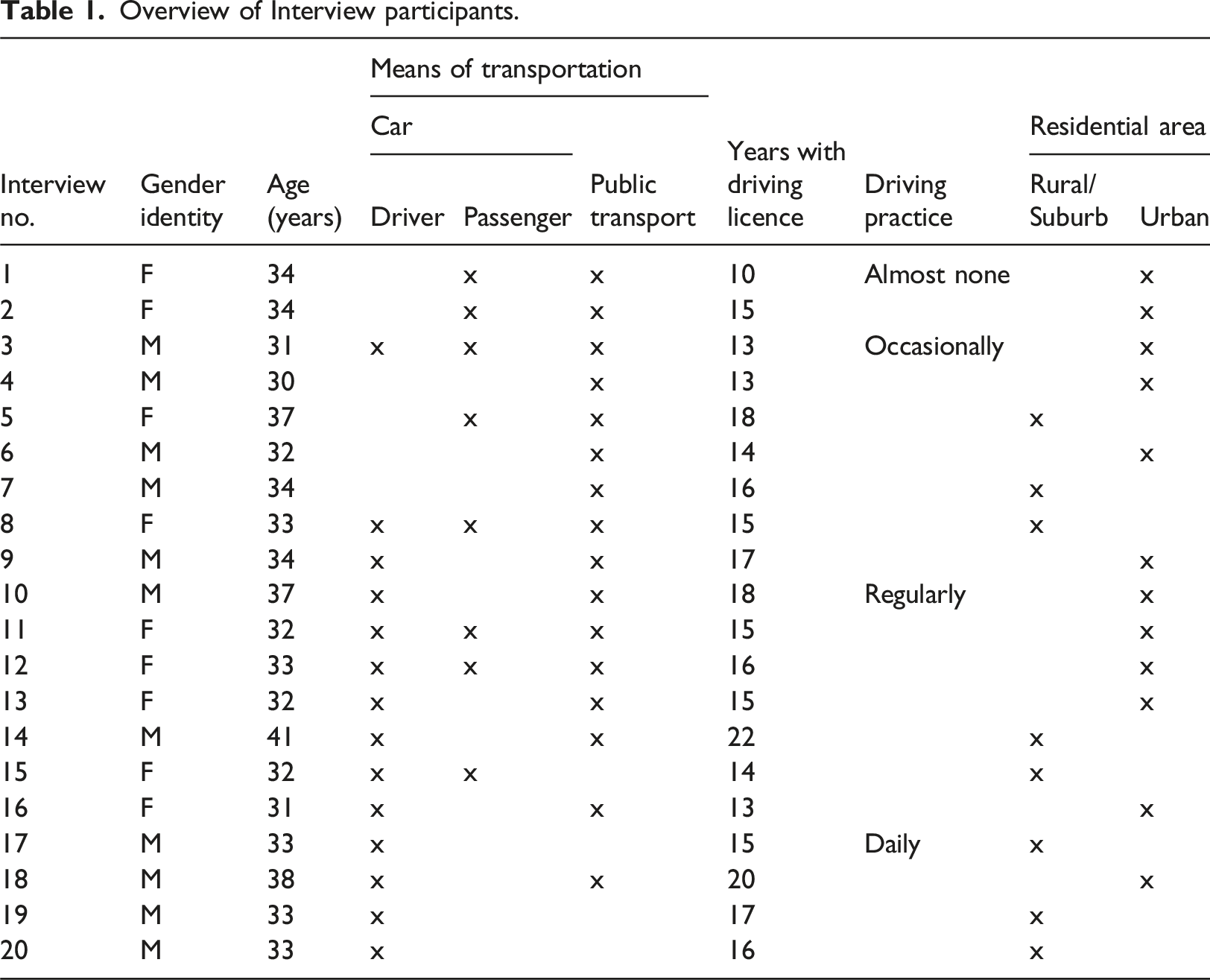
To identify market-making opportunities on the grounds of conceivable consumption practice trajectories, we trace how current manual driving practices of German motorists will unfold to autonomous driving in the future AV market.
Hopes for the AV market are high: being expected to fundamentally change mobility on a global scale (Koul and Eydgahi, 2018); to exert social, economic, and regulatory change (Bansal et al., 2016); to improve traffic safety, traffic flow, and personal mobility (Fagnant and Kockelman, 2015; Zhang et al., 2019); and to account for more than US$19 billion globally by 2029 (Fortune Business Insights, 2023). These and other expectations are part of the initial AV hype that took place to gain momentum and attract sufficient interest and investments (see Geels and Smit, 2000). However, expectations had been readjusted as the market has not materialized (Metz, 2021). Especially in Europe, where regulation and standardization are at the forefront, but where technological development, testing, and most usage scenarios (e.g. robotaxis and truck-AVs) are less advanced in comparison to the US or China (Juliussen, 2022). As such, the not-yet-market for AVs is still facing many technical, economical, and regulatory challenges (Metz, 2021), providing ample opportunities for market-making actions and research.
The choice to focus on German motorists was based on several factors: Germany is the first country to officially pass AV regulations, allowing level 4 AVs on German roads [second highest AV level with high driving automation (SAE, 2021)] as part of Mobility-as-a-Service use cases – which is not to say that AVs will be on German streets any time soon (Juliussen, 2021). Further, the automotive industry in Germany is key. From an economic point of view, the car industry accounts for more than 20% of the total domestic industry revenue (Germany Trade and Invest, 2022). Also culturally is Germany known to be a ‘car country’ with a strong heritage in car manufacturing clinging to a more traditional and unsustainable mobility culture (Mögele and Rau, 2020). On this front, public concerns have been raised about whether Germany will be able to keep pace with future AV developments (The Economist, 2021). The strong car culture with a penchant for tradition and the difficulties in shaping this future market, which is a pillar of the German economy, make it an interesting case for our study.
From a practice theoretical view, the transition from manual to autonomous driving provides a sound foundation for investigating the unfolding of conceivable practice trajectories. Following Araujo et al. (2014), autonomous vehicles are a continuation of the traditional manually driven car which has been equipped with more and more electronics over time, ranging from in-car-entertainment, Sat Navs, engine management systems to driving assistant functions, such as adaptive cruise control, park assist, and lane departure warning systems. This has led to an ever-closer interweaving of human and technical acts as part of driving, making it more difficult to draw a line between them (Thrift, 2004). In a sense, manual driving is no longer ‘so manual’, which makes a switch to autonomous driving more conceivable from the driver’s perspective than it was before.
Overview of Interview participants.
Method selection
To adequately map the unfolding of mobility trajectories with the introduction of AVs, we evaluated several futurist research methods. Commonly, futurist research methods are distinguished among four main approaches: projections, critical analysis, participatory action research, and interpretation. Projections are intended to provide quantifiable and accurate forecasts, which are developed using quantitative futurist methods. These are typically aimed at predicting the future as accurately as possible (Inayatullah, 1990; Stevensen, 2002). Since this study does not aim at looking ‘into the future’ in terms of predicting it but rather looking ‘at the future’ (see Borup et al., 2006) and how this prospective outlook on consumption practices may be leveraged by market-makers in the present, we have excluded forecasts as a potential data collection method. In contrast, critical analysis in futures research stems from post-structural thinking and examines the beneficiaries of alternative futures and how methodology decisions elevate versions of the truth. These methods thus aim at understanding how research method choices affect how the future gets depicted or who benefits in this future (Riedy, 2021) – which is not the aim of our study. Consequently, critical analysis was also excluded as a possible method type for data collection. Thirdly, participatory action research generates pre-defined desirable or avoidable future scenarios and cooperatively devises appropriate actions to realize or avoid these scenarios. At first, this method would seem suitable as it focuses on the activities needed to change a market or reach/circumvent a future market state (Stevensen, 2002). However, these activities are completely detached from existing practices, so instead of identifying market-making opportunities on conceivable practices, participatory action research would reveal potential market-making activities for a given scenario, not doing justice to this study’s research objective. Leaving us with interpretative futurist research methods aiming at envisioning differing versions of the future and drawing insights thereof (Inayatullah, 1990). Accordingly, interpretative futurist research methods do not dictate an outcome, in this case, how conceivable mobility practices will unfold or arrange, but allow tracing alternative trajectories.
Within qualitative interpretive futurist studies, researchers have used a variety of methods. Considering our study criteria (i.e. focussing on the market-making opportunities consumption practice trajectories hold), we deemed some common interpretive methods inappropriate; for example, we excluded methods aimed at expert audiences, such as the Delphi method, or methods that are aimed at discerning group orientations, such as, workshops (Gordon, 2009; Jungk and Müllert, 1987). Furthermore, visioning also does not seem appropriate as the emphasis is on desirable or optimal visions of the future rather than how future practices are conceived. Another method, futures biographies, would have allowed uncovering conceivable consumption practices by using narrations. Yet, these narrations would provide a static view on conceivable consumption practices instead of tracing practice dynamics, making it difficult to conceive how practices conceivably unfold. A further disadvantage of this method is that the unstructured nature of the narratives impedes their analysis (Puglisi, 2001). Moreover, we considered future scenarios – more specifically ‘initial’ scenarios that demonstrate how the future might unfold in a hypothetical baseline situation. These scenarios are particularly helpful in exploring the vastness and variations the future may hold. However, while this method provides a good starting point to explore our research question, it offers limited guidance on how to map practice trajectories in a step-by-step manner (Puglisi, 2001). Therefore, we opted for the Futures Wheel method instead. The Futures Wheel makes use of scenarios as a starting point but then guides participants consecutively through the implications of this baseline scenario, thus overcoming the shortcomings of a purely scenario-based method (Glenn, 2009). The Futures Wheel has found wide application in business settings and has become increasingly popular to fathom futures thinking in various research settings (e.g. real estate, tourism, and social ecological change; Benckendorff et al., 2009; Bengston, 2016; Toivonen, 2021). This method was originally designed to capture implications of change. While this method appears suitable for our purposes, we have made some changes to the original method to capture how conceivable practices unfold as proposed in the practice dynamics literature (see Shove et al., 2012). Practically speaking, we must first capture current practices and their elements before capturing their conceivable trajectories – doing justice to their sequential unfolding. Simultaneously, the new method allows to understand practice elements in terms of materials, meaning, competences, and performance, following common practice in practice dynamics research (e.g. Mylan, 2015; Spurling, 2022). The new practice-based method has been renamed to Futures Practice Wheel, as we detail next.
Adaptation of the Futures Wheel method
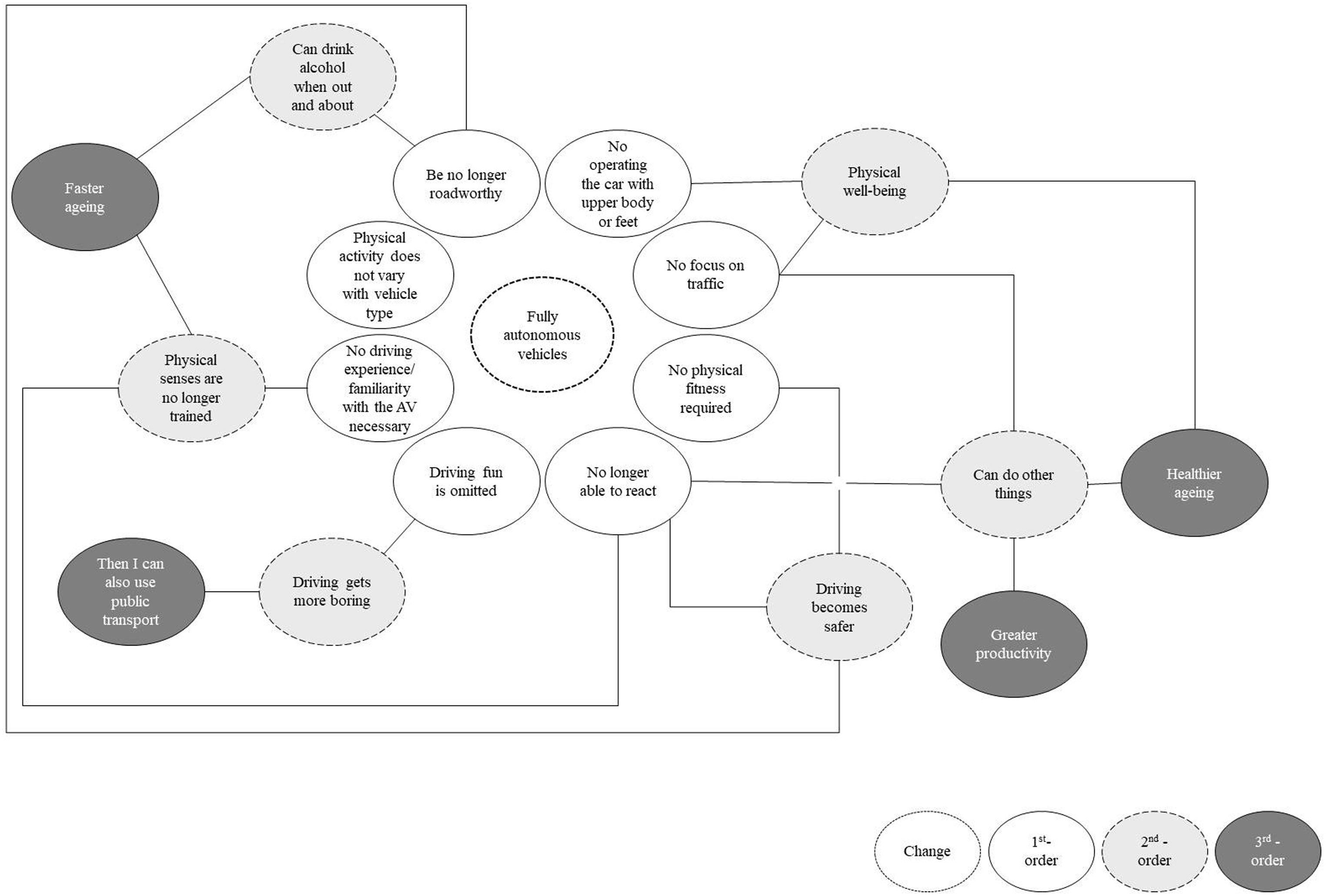
The Futures Wheel is a method designed to structure future thinking, which can be done individually or in group settings. It is particularly helpful in visualizing the multiplicity of implications, showing complex interrelations, and pointing out unforeseen consequences (Benckendorff, 2008). To capture both the short- and long-term implications of change, the Futures Wheel method begins by presenting a scenario describing a change of interest, such as trends or technical innovations. This scenario should be detailed enough to be easily comprehensible for non-experts. After the participants are briefed on the method’s ground rules, they are asked to elicit direct implications of the presented change, also known as first-order implications. These events should result directly from the scenario without any intermediaries and can be negative, positive, or mutually contradictory (Bengston, 2016). After the first-order implications are identified, participants then outline further implications over successive rounds, revealing second- and third-order implications. Eventually, the initial scenario should be surrounded by several levels of implications in a wheel-like manner (Glenn, 2009).
While the Futures Wheel has found application in various practitioner settings and is becoming popular among researchers (Bengston, 2016), to the best of our knowledge, the method has not yet been applied in practice research. To map conceivable consumption trajectories, we adapt the Futures Wheel method and henceforth refer to the Futures Practice Wheel. In the following, we describe each step of the method. - Implications should arise directly from the scenario. - Implications should be conceivable and realistic. - A practice element can be affected by several implications. - Implications do not result for all practice elements. - Implications can be contradictory.
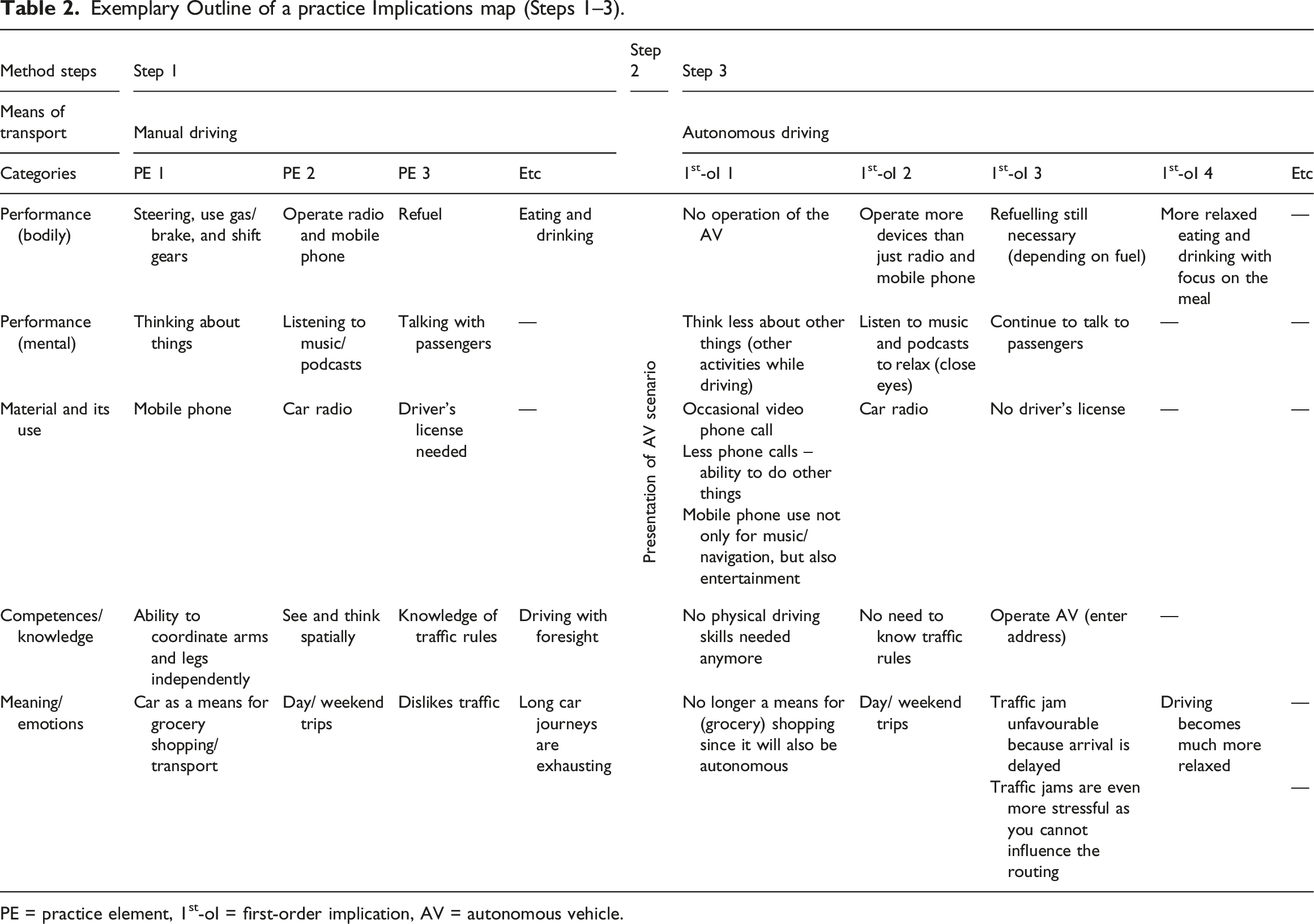
In contrast to the original method, which starts with a few implications that increase in number with each round, we started with many implications that decreased in number with each round. That is also the reasoning for capturing current practice elements and their first-order implications in a table first (step 1 and 3 of the Futures Practice Wheel), before transferring the implications to a mind map format. The mind map would quickly become disproportionately large and convoluted. Table 2 presents an exemplary outline of a practice implications map outlining steps 1–3 of the Futures Practice Wheel. When all first-order implications were identified, interviewers transferred the implications into a mind map format, preparing step four of the Futures Practice Wheel. Exemplary Outline of a practice Implications map (Steps 1–3). PE = practice element, 1st-oI = first-order implication, AV = autonomous vehicle. Exemplary futures practice wheel.
We conducted two pre-tests to validate the Futures Practice Wheel. These tests led to some specifications of the instructions and the scenario (e.g. focus should be on direct use practice implications and not wider societal implications and scenario coverage of private and shared-service AVs). The pre-test also served to test the procedure and the applied online brainstorming tool.
Data analysis
In accordance with the exploratory study approach, the research team analysed all Futures Practice Wheels using Krippendorff’s (1989, 2018) qualitative content analysis. Given the data complexity and volume generated by Futures Practice Wheels, it makes good sense to take a systematic data analysis approach that is also suitable for analysing visual data. For this purpose, we transferred all Futures Practice Wheel trajectories into a table and analysed their progression in a stepwise manner. Following this inductive approach, we carried out four steps. First, we got a sense for the data by going through all Futures Practice Wheels one by one. Second, we developed a thematic overview of the data. As part of this, we analysed themes that emerged in the data and identified at which level they appeared (whether they are mentioned as part of current practice, first-, second-, third-, or fourth-order implications). Similar to the Futures Wheel procedure, it is common to identify a large number of themes (Benckendorff, 2008). Third, we examined the progression of trajectories to identify patterns. This took place regarding the trajectory’s sequence, the activation state of practice elements (e.g. actively performed, omitted, and being replaced), and their connections. Fourth, these insights (themes, levels, sequence, and activation states) were evaluated in terms of their market-making potential, aimed at identifying the market-making opportunities they present by contrasting them with the extant literature on consumer market-making levers. This approach helps us move beyond broader thematic analysis or category formation to identify how conceivable mobility practice trajectories offer market-making opportunities for not-yet markets.
Results and discussion
Following the analysis, we identified propositions about the market-making opportunities offered by conceivable consumption practice trajectories using the shift from manual to autonomous driving. The propositions span market-making opportunities on the grounds of dissipative trajectory arrangements, trajectory evaluations, and trajectory levels. An overview of all market-making opportunities arising from conceivable consumption practice trajectories can be found in Figure 2. Here, consumption practice trajectories are presented as arrangements and connected practice elements (PE) that underlie the market and its market practices. By moving from the existing to the not-yet (established) market, current practices become conceivable practices that offer market-making opportunities for both, the not-yet-established and the existing market (shown as grey arrows). The market-making opportunities stemming from conceivable practices are indicated under each market practice class, for example, market-making opportunities in not-yet (established) markets for normalising practices arise for consumption norms. Market-making opportunities arising from conceivable consumption practice trajectories PE = practice element; pos. = positive, neg. = negative.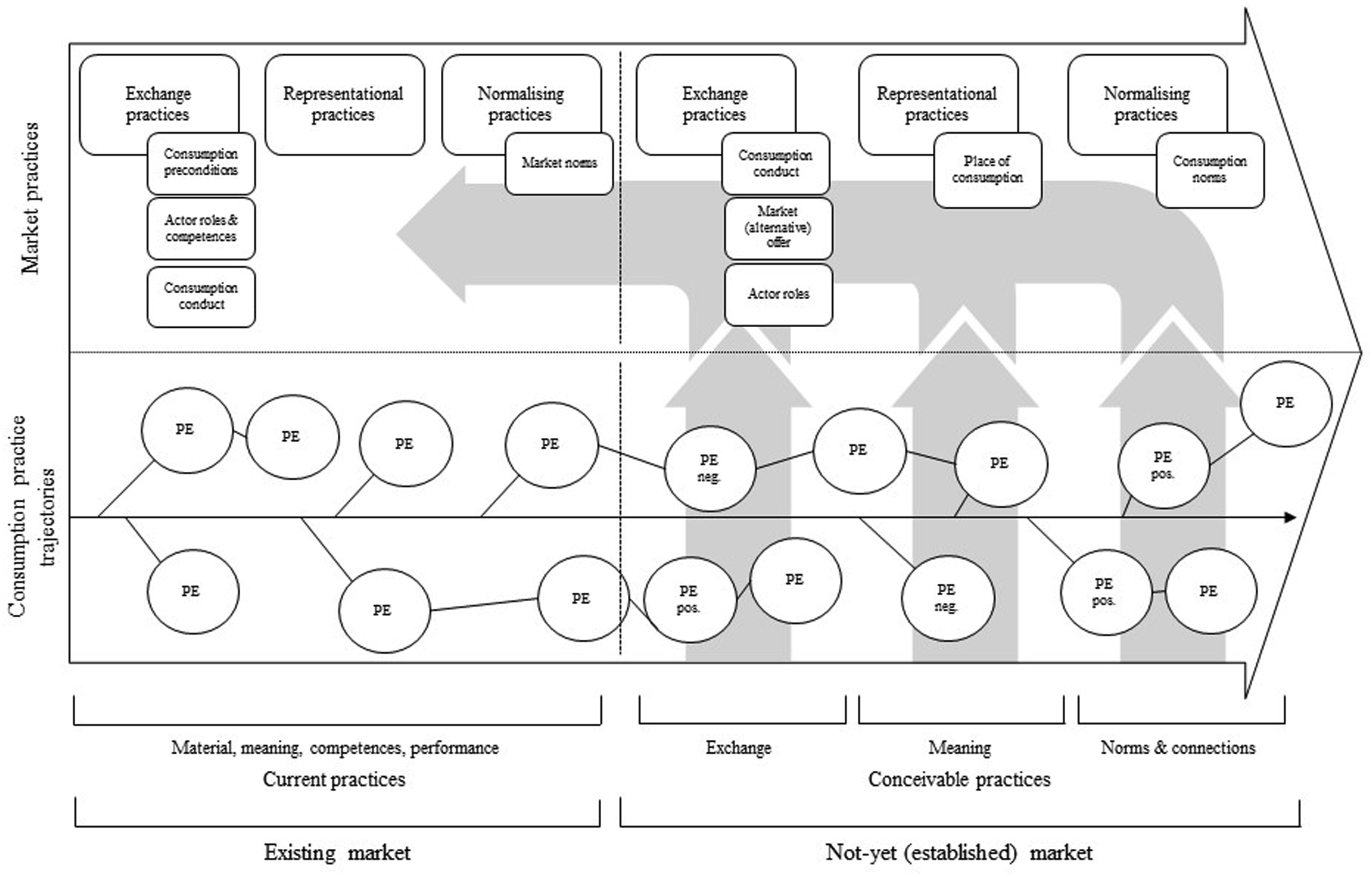
Below we set out our findings in detail and illustrate them with Future Practice Wheel interview excerpts (I). To substantiate our results, we compare them with the extant literature.
Market-making opportunities through dissipative trajectory arrangements
When considering how practices conceivably unfold from manual to autonomous driving, different practice dynamics become apparent – both in terms of the activation states of the practice elements, their connections and their overall practice arrangement. In detail, certain practice elements cease to be, such as all physical and mental activities that are needed to operate a traditional car ranging from obeying traffic rules, and route planning, among others (e.g. I1, I3, and I7). In this vein, driving competences in terms of skills, expertise, and background knowledge are expected to lay dormant since drivers no longer utilize them (I4, I9, and I16). Following this, material objects lose their purpose – and cease to be – for example, the driver’s license, the steering wheel and pedals (e.g. I11, I12, and I17). The elimination of practice elements (driving performance), no longer accessing other practice elements (competences), and adaptations in material aspects (alterations of AV) speak in favour of a new practice arrangement composition of autonomous driving. This reorganization of the practice opens up several opportunities for market-making regarding the consumption process and norms.
For one, some practice elements are not simply eliminated, but rather transferred to the autonomous vehicle – this transfer of practice elements alters the conduct of consumption. This occurs in terms of the driving procedure, moving from constant driver input and an ongoing interplay of driver and car to a more limited interaction process where driver input is mainly required at the beginning and end of the process, but less so mid-operation. At the same time, agent roles can be redefined. So far, cars mainly function as an extension to human action and operate only to a limited extend autonomously, the autonomy of the vehicle now turns the consumer into a much more passive user. A modification in agent roles may also impact adjacent markets. With driving competences no longer necessary – supporting market offers as driving schools or various services from driving license authorities, such as examinations or driving licence revocation are no longer needed (at least not in their current form). Beyond that, the new norm is to no longer have the ability to drive. Lastly, the shift of driving tasks from the driver to the AV indicates market object modifications – many operational elements are no longer necessary, especially for driving. Entertainment functions, in contrast, can be made more prominent as they no longer compete with driving. These results overlap with the conceptual findings of Harrison and Kjellberg (2016) on consumer-led market-shaping. Our results suggest that conceivable consumer practices can also act as market-making levers for the conduct of consumption, market objects, agents roles, and market norms when they are reallocated from one carrier of practices to another; in this case, from a human carrier of practices to a non-human one. We thus provide further empirical evidence for the link between consumption practices and market-making interventions whilst defining new conditions in which these mechanisms take effect. We thus conclude:
Discontinuing or reallocating practices creates voids that can be filled with alternative practices that align with the passenger’s new role as non-driver. Practices typically conducted as passenger can be intensified: such as, ‘more in-depth conversations with passengers’ (I15) or a more ‘elaborate music selection’ (I18). Beyond that, practices from other life domains are introduced, resituating them to the autonomous driving setting. Examples mentioned are watching TV, working on a laptop, or consuming alcoholic beverages. Lastly, new practices suitable for autonomous driving, such as hobbies that can be easily performed during rides, are introduced. The recomposition of routine practices in a specific life sphere, such as autonomous driving, opens opportunities to redefine the AV as place of consumption.
The rearrangement of practices (through the combination of intensified, new and transferred practice elements) during the consumption process – in this case driving – alters the role and meaning of the place of consumption. In this sense, the practice elements for operating the vehicle are omitted and more prominence is given to those practice elements typically associated with passengers – no longer making the AV a place of driving, but instead a place of transit with leisurely or work-related pursuits. Here, we do not just refer to the place of consumption as material manifestation, which can also be actively shaped through the reallocation of practices (see P1a), but what this place stands for or is associated with as a market representation. The image of AVs as a place of consumption can be an extension of the home, the office or a place of relaxation, amongst other things, depending on how the voids of omitted practice elements are filled; offering an opportunity for market-makers to play a part in shaping it. We, thus, draw on practice theoretical insights suggesting that gaps in practices are recognized as opportunities for change – either for practices in place or new ones (Shove et al., 2012). According to our findings, these practice gaps or voids and how they are filled also offer opportunities for change in market elements, such as the place of consumption. In this sense, the AV can be conceptualised as a market-consumption junction, where market and consumer practices are linked by practice elements that are rearranged and (de)activated (Stigzelius et al., 2018).
Market-making opportunities through trajectory evaluations
Our data indicates that practice elements can be discerned as desirable, undesirable, or neutral. Some conceivable trajectories display practice entities that belong to one classification only, indicating that these curves are then, for instance, purely undesirable. An example comes from I4, who outlined that there would be ‘no more need for local knowledge’ (first order) in autonomous driving, which means one’s ‘local orientation gets worse’ (second order). Going further, this can lead to a ‘lower identification with the extended residential area’ (third order) and ultimately to an ‘island existence where destination and departure points are known, but paths are no longer’ (fourth order). Other trajectories demonstrate a combination of practice element evaluations, such that one practice entity may lead to both desirable and undesirable aspects. By ‘no longer operating the car’ (first order – neutral), riders experience an ‘increased freedom and individuality of the driving experience’ (second order – desirable), which has desirable implications, such as a ‘highly personalized design of the driving experience’ but also negative ones like an ‘increasing indifference for other road users and an increasing selfishness’ (I11). These evaluation processes provide indications of market-making opportunities in the not-yet as well as the existing original market.
When focussing specifically on positive or desirable practice elements of autonomous driving, we note that they can be tracked back to the restrictiveness and strenuousness of current manual driving practice – providing insights on market-making opportunities for the automobile market that is currently in place. Restrictions pertain, for instance, to the performance of activities while driving manually, such as activities that require significant use of the body or overly occupy the mind. These activities would distract the driver from operating the vehicle or engaging in road traffic and can therefore not be performed. Another limitation relates to the motorist’s driving ability in terms of skills and physical and mental states. Manual driving requires many prerequisites, such as the ability to drive, a positive emotional state, adequate physical condition and sobriety. While these particular restrictions are difficult to render as they serve the purpose of road safety (given the research context of driving), restrictive practices in other contexts may provide valuable indications for practices in need of improvement, such as barrier reduction and eligibility adjustments. At the same time, manual driving is considered to be a strenuous practice, as indicated by desirable practice implications that refer to the emotional and physical relaxation of autonomous driving. Similar observations on practice evaluations were made by Geiger and Finch (2016) who noted that existing practices are assessed by market players to discern which practices to continue or not as part of their future-led market-shaping acts. Further, these results also extend Baker et al.’s (2019) work on the recognition of existing market limitations. In line with their findings, new market practices provide indications for market limitations. According to our results, this also applies to conceivable desirable practices, which outline existing discontenting practices – in this case, strenuous or restrictive practice elements. Restrictive practices here refer to competencies and roles that consumers use during the exchange process, but also consumption preconditions or market norms. Strenuous practice elements relate to the conduct of consumption. We thereby broaden the market practice mechanism identified by Baker et al. (2019) to include conceivable practice trajectories; making them a market-making tool not just for not-yet but also for existing markets. In summary:
In addition, participants mentioned some undesirable implications with the introduction of AVs arising from increased convenience, reduced effort, and subsequent usage increase, among others. Examples include ‘even more exposure to entertainment electronics’ (I9) or being ‘more detached and having less access to “real life”’ (I6). These unwanted implications point to several practice dynamics. On the one hand, their performance is weighed against their implications or that of other practice elements. For instance, participants weigh an increasing use of AVs against incurring costs and environmental damage (I3, I13). Thus, practice elements with undesired implications may be performed less often or only in a weakened form. On the other hand, compensatory practices are introduced and appended to the trajectory to compensate negative implications of other practice elements. Examples pertain to compensating environmental impacts of driving with a preferential use of shared AV services or by getting involved in other environmentally positive endeavours. Further, less movement is offset by making additional time to exercise (I3, I6, and I18).
These undesirable implications offer opportunities to shape the not-yet-market before it is established, that is, in the now. In the best case, potential negative effects are avoided by addressing them in the development or pre-market stage so that they do not hinder market development or affect consumption. This applies particularly to negative impacts that arise from consumption, such as environmental impacts. Negative implications, such as negative health effects, environmental impact or increased electronics consumption, can be addressed either in the market through market object properties or through offerings designed to offset them in adjacent/other markets. Discontent in markets is a well-known lever for market-making actions (e.g. Goulding and Saren, 2011; Sandikci and Ger, 2010) – whereby it is not enough to be dissatisfied, action must be taken (Nenonen and Storbacka, 2020). Geiger and Finch (2016), for example, outline that recognising, questioning and critiquing existing practices has the potential to shape future market visions and materialities. According to our findings, we can confirm this for market materialities that are involved in the use of the product. Overall, we suggest leveraging this prior to market establishment to counter these negative implications before they actually manifest in a not-yet market. Addressing these implications upfront may circumvent barriers to a market’s development. We thus suggest:
Market-making opportunities through trajectory levels
By discerning conceivable practice trajectories, practice elements become more disengaged from the practice at hand with each successive move from the start. By considering the successive trajectory stages, we conclude that first-order implications predominantly function as a demarcation between current and conceivable practice. They refer to aspects such as ‘no more checking where I have to go’ (I8) or having ‘more relaxed trips with child’ At the next level, describing second-order implications, we observe a stronger detachment from current practice, in this case manual driving. Here, driving in itself is no longer discussed but how autonomous driving affects mobility and everyday life (e.g. ‘getting to poorly connected places’ [I8], ‘no more getting lost while driving’ [I10], ‘more independence from public services’ [I4]). When moving towards third- or fourth-level implications, we see a shift towards more abstract implications that relate to a consumer’s social environment beyond mobility, such as ‘the risk to become decadent’ (I6), ‘more options to live elsewhere even at an old age’ (I9), and ‘a more accessible social environment’ (I12). Each trajectory level, thus, provides insights on a specific realm of market-making opportunities.
First-level implications are particularly meaningful to detect market-making levers on the market object, conduct of consumption, actor competences, place of consumption, and social consumption norms. Making this lever particularly useful for market-makers seeking insights on future product or service developments and how these may be leveraged; thus, covering market-making levers in closer proximity to a firm and its managerial control. Second-level implications are mainly useful to fathom market-making opportunities in terms of the meaning sought by the consumer. This may also be referred to the value consumers are seeking in a product or service – a market-making lever that is more distant to the firm in comparison to the former, meaning that firms have less control over it. Lastly, third-level implications are most insightful in terms of social norms, market objectives, and linkages to other or adjacent markets. Hereby, insights can be gained on social norms and objectives in terms of what consumers aspire or try to circumvent; providing market-makers with a broader picture on how a market and its links to other markets are envisioned by consumers; on these grounds, suitable actions may be identified on how to reach these market states. Thereby, referring more strongly to the market system itself and its connections to other markets, a realm that is the most difficult to change from a firm’s perspective since it is not directly connected to a firm’s operational field. Our empirical results thus show which levers from established market-making frameworks (e.g., Nenonen and Storbacka, 2020; Storbacka and Nenonen, 2021) can be utilized on the grounds of conceivable consumer practices. Further, these insights offer guidance for market-makers on how to use the Futures Practice Wheel in accordance with their market aspirations, whether it is for shaping the consumption process and aspects related to that (stronger focus on 1st-level implications), for altering the meaning that consumers seek (2nd-level implications), or to establish a market’s normative structures (3rd-level implications and higher). By taking a prospective perspective and a practice dynamics view, our findings extend previous work on consumer-driven market-making which laid the ground by identifying overarching consumer market-making processes (see Harrison and Kjellberg, 2016) or by tracing how consumers provided the impetus for the emergence of markets that exist today (e.g. Diaz Ruiz and Makkar, 2021; Martin and Schouten, 2014). By empirically breaking down conceivable practice trajectories into their elements, connections and levels this study provides a more granular picture on how consumer practice dynamics lay the ground for future market-making actions. In summary:
Conclusion and implications
Theoretical implications
This study aims to extend current thinking on how conceivable consumer practices can be used as market-making opportunities in the preliminary stages of market formation. Compared to the extant literature on market-making opportunities, which identifies market-making levers by looking at the overall market structure or specific market conditions (e.g., Pedersen and Ritter, 2022; Peters et al., 2020; Storbacka and Nenonen, 2021), we empirically investigate routine consumption practices and their prospective unfolding as market-making opportunities to be leveraged. In so doing, we examine not only the opportunities that consumption practices can offer for market-making, but also how their dynamic unfolding is useful for creating or shaping the markets of the future. Identified market-making opportunities on the grounds of conceivable consumption practices result either from (1) dissipative trajectory arrangements (consumption process and norms), (2) consumer trajectory evaluations (current market restrictions and strains: consumer competences/roles, consumption preconditions, consumption process and market norms; undesirable future market implications: market objects and alternative offerings), or (3) trajectory levels (from the consumption process, to the meaning sought through offerings, to market norms and links to other markets).
We also contribute empirically to the body of literature of consumer market-making, an area of research where the role of consumers in the making of markets is often under- or overestimated (Harrison and Kjellberg, 2016; Pedeliento et al., 2023) and where further research on the coaction of consumption and markets is needed (Diaz Ruiz and Makkar, 2021; Stigzelius et al., 2018). Unlike most dedicated consumer market-making studies (e.g. Dolbec and Fischer, 2015; Hietanen and Rokka, 2015), we examine the consumer as a supporter of market-making and show how conceivable practices are not only a precursor for the shaping of future markets, but also extend current insights on improvable contemporary market practice (see Baker et al., 2019; see also, Geiger and Finch, 2016). As Chatterton and Newmarch (2017) outline, a look at the future opens ways to change it in the present – according to our findings, this applies not only to future markets but also to present ones. In this sense, eliciting conceivable consumption trajectories offers an opportunity to shape the present and future – of markets – as of now.
By developing the Futures Practice Wheel, we also contribute to the further advancement of existing interpretative research methods for capturing practices and their trajectories. Our results thus foster research using practice theory and, particularly, research on practice dynamics. To this end, we provide detailed records of all modifications, the research method process, and its empirical testing – also intended to ensure its usability by other researchers, as suggested by Offermann et al. (2010).
Lastly, our study provides a new angle to discern practice trajectories by adopting a forward-looking perspective on a subject that have thus far been researched only quantitatively (Greene and Rau, 2018) or retrospectively (e.g. Shove and Pantzar, 2005). As noted among scholars, many mechanisms and processes in the unfolding of practices are unknown (Jones et al., 2014; Müggenburg et al., 2015). We bridge this gap by offering empirical insights on the unfolding of conceivable practice trajectories by outlining how practice elements undergo different states of activation and how the links between those practice elements are maintained, broken and re-formed. In so doing, we respond to a call for more research on the temporal connections and pathways of practices and expand current practice temporality thinking (Nicolini, 2012; Shove et al., 2012) – demonstrating its use and benefits for market-making.
Managerial implications
Our findings encourage market-makers to go beyond existing consumption practices to leverage conceivable practices and their trajectories as valuable clues for the making of new markets. This can be achieved by utilizing different levers of conceivable practice trajectories ranging from their arrangement to their evaluations, up to their levels. By examining the first lever on how conceivable practices are rearranged, practitioners can draw conclusions about future service/product offerings, the roles that users may adopt and how new use norms look like. In practical terms, these practice arrangements provide the action space to reconfigure services/products to come and to establish what they stand for or are associated with. Beyond that, this lever provides hints on how roles and tasks of users may be redefined (for instance, how active or passive users should be, or which use aspects are now performed by the service/product). In addition, conceivable practice arrangements also provide the opportunity to establish a new consumption norm in the market serving as a reference point for other market actors.
Market-making opportunities from the second lever, conceivable practice evaluations, cover current market restrictions and strains in relation to consumption and consumption prerequisites, agent roles, and prevailing regulations; as well as undesirable future market implications in terms of the product/service itself or alternative offerings. In detail, conceivable desirable practices provide an opportunity to improve the existing market by easing barriers/restrictions or by increasing the convenience and reducing the effort required when using the market offer. In contrast, conceivable undesirable practices provide an opportunity to improve future markets. This can be done by endeavouring to contain or avoid negative effects of the market offer (for instance, by making a product/service more sustainable) or by providing alternative service/product offers that do not carry these negative implications.
Lastly, the third lever, consumer practice trajectory levels, offers opportunities to shape future consumption processes, the meaning of service/product offers, user aspirations, and lastly, market objectives and links to other markets. In total, market-makers have three levels at their disposal to make future markets, whereby managerial control decreases with each level – so level one has the strongest sphere of influence, while level three has the least. The first level offers insights into future product or service developments and to what extent they differ from products and services in place. The second level provides opportunities for catering to consumer aspirations, values, and the intended meaning of products/services for the consumer’s future everyday life. Finally, the third level offers the opportunity to harmonise future markets with consumer visions and to identify adjacent markets or market connections to make this a reality.
Limitations and future research opportunities
This research sheds light on the market-making opportunities arising from conceivable practice trajectories for not-yet markets. By focussing on one context, such as AVs, identified market-making opportunities are context-specific only. To fully understand the potential of conceivable practice trajectories as a market-making lever for future markets, a multi-market study would be beneficial for future research. This would also facilitate the further testing and establishing of the Futures Practice Wheel as a new research method to capture practice trajectories. While thinking about the future (of markets) can demonstrably influence it (e.g. Bajde et al., 2022; Geiger and Finch, 2016), the future is predominantly not deterministic (Kuosa, 2011). So, for instance, how not-yet markets may be impacted in the future by market-making opportunities stemming from conceivable practice trajectories may diverge from our results. Consequently, longitudinal studies spanning multiple points in time can provide additional insights into the role of consumer practices in the emergence of not-yet-markets and how they are leveraged by market actors. We hope this study encourages others to explore how the present can inform the making of tomorrow’s markets.
Footnotes
Declaration of conflicting interests
The author(s) declared no potential conflicts of interest with respect to the research, authorship, and/or publication of this article.
Funding
The author(s) disclosed receipt of the following financial support for the research, authorship, and/or publication of this article: This work was supported by the ESCP Business School (2023-19).
