




Abstract
Literature on categories recognizes that in the early stages of a category, ambiguity can arise from divergent frames used to define the category. Yet it also largely expects this ambiguity to be either temporary, or else detrimental to the survival and evolution of the category. In this study, we demonstrate and explain how, alternatively, category ambiguity can persist when multiple frames continue to be applied to a category as it progresses into maturity. Drawing on an in-depth qualitative study of the case of social entrepreneurship, we examine how and under what conditions this outcome occurs. We specify two co-occurring conditions that prompt category stakeholders to shift their framing from exclusive to inclusive, enabling category ambiguity to persist. We furthermore show how the use of category frames that draw from pre-existing resonant categories supports the persistence of category ambiguity. We contribute to literature on categories by clarifying the antecedents of category evolution towards a trajectory of persistent ambiguity.
Introduction
Categories are vital for understanding how organizations and fields develop. In recent decades, scholarship in organizational theory has made significant theoretical and empirical progress in our understanding of category dynamics: the processes through which categories emerge and change, and the respective consequences for organizations, fields and markets (Durand & Paolella, 2013; Hannan, Pólos, & Carroll, 2007). Several studies have shown that during early stages of category emergence, various stakeholders construct and promote multiple (and often divergent) frames to define the label and meaning of a category (McKendrick & Carroll, 2001; Santos & Eisenhardt, 2009). Typically, the ambiguity associated with divergent frames and multiple meanings will subside once the contestation over frames results in one frame becoming dominant and providing clarity on the meaning of the category. In cases where a category continues to be associated with divergent frames and multiple meanings, it is expected to be gradually abandoned by stakeholders (Grodal, Gotsopoulos, & Suarez, 2015).
However, in parallel, an emerging body of work has drawn attention to cases of categories that survive and prosper even though no dominant frame emerges as they mature (Pontikes, 2012). In these cases, stakeholders continue to use multiple frames, imbuing the category with multiple meanings. Examples of ambiguous categories are numerous and include ‘sustainable development’, ‘nanotechnology’ and ‘modern architecture’ (Granqvist, Grodal, & Woolley, 2013; Jones, Maoret, Massa, & Svejenova, 2012; Moore, 2011). Ambiguity of a category can result in undesirable outcomes, such as a lack of common standards, stunted growth and diminished value for the category’s products, dilution of meaning and lack of credibility (Kennedy, Lo, & Lounsbury, 2010; Khaire & Wadhwani, 2010). Others have suggested that there might be benefits associated with a category that remains ambiguous such as opening up spaces for creativity (Fleischer, 2009; Jones et al., 2012; Santos & Eisenhardt, 2009). Yet we still lack a comprehensive understanding of when and how category ambiguity emerges in the first place and, more importantly, how it persists. Recent scholarship on categories has suggested that explicit attention to interests, resources and framing strategies of stakeholders would benefit our understanding of the trajectory of categories (Durand, Granqvist, & Tyllström, 2017; Hiatt & Carlos, 2018). We integrate these suggestions in our approach to uncovering the field-level conditions and stakeholder strategies that enable sustained category ambiguity. We ask: How and under what conditions can a category sustain plural frames as it progresses into maturity?
We draw on the case of social entrepreneurship to understand how category ambiguity persists over time as the focal category matures. The case of social entrepreneurship is theoretically relevant, as it encompasses a multitude of stakeholders supportive of persistently divergent frames within a category of growing appeal (Galaskiewicz & Barringer, 2012). In line with our theoretical interest, we collected interview data from key stakeholders across the globe who were involved in shaping divergent frames that continue to coexist and are still in use to denote the category. We also collected secondary data to corroborate the accounts of our informants and to triangulate our findings.
This study complements and extends existing organizational research on categories that has alluded to category ambiguity (Granqvist et al., 2013; Pontikes, 2012) by unpacking when and how ambiguity persists beyond the stage of category emergence. We find that two co-occurring conditions increase the likelihood of category ambiguity to persist. First, increasing interaction between previously unconnected fields spurs the emergence of divergent frames; and second, the interest of resource providers in divergent frames results in the continuous mobilization and distribution of resources in support of these frames. We also deepen understanding of stakeholders’ use of framing strategies in their efforts to dominate a category (Hiatt & Carlos, 2018), showing how the choice to transition from exclusive to inclusive frames can result in persistent ambiguity. Finally, we underscore how characteristics of pre-existing categories, such as their resonance to a broad audience, can encourage stakeholders to partake in a shared label that remains associated with divergent frames and therefore enhances the likelihood of category ambiguity. Overall, this paper contributes to efforts to develop dynamic and relational perspectives in research on categories and organizations (Delmestri & Greenwood, 2016; Durand et al., 2017) by explaining how and why an ambiguous category can escape the destiny of decline and stakeholder withdrawal (Grodal et al., 2015).
Theoretical Background
We refer to categories as ‘socially constructed partitions or taxonomies that divide the social space into groupings of objects that are perceived to be similar’ (Suarez, Grodal, & Gotsopoulos, 2015, p. 438). Category labels, in turn, are the symbols and words that are ‘used to invoke these partitions’ across space and time (Granqvist et al., 2013; Zunino, Suarez, & Grodal, 2019, p. 169). The process whereby a category’s legitimate boundaries and inclusion criteria are defined typically involves various stakeholders, alternatively also termed audiences (Durand et al., 2017). Producers, also termed entrepreneurs or professionals (Grodal et al., 2015; Jones et al., 2012), usually engage actively in the category’s theorization and promotion (Santos & Eisenhardt, 2009). Consumers, also referred to as customers or users, are assumed to be somewhat more passive in their contributions to category definition, yet they can influence the selection of frames proposed by producers (Grodal & O’Mahony, 2017). Intermediaries, such as industry commentators or critics, can also affect the theorization and framing of categories through their endorsements (Hsu, 2006). Beyond these frequently cited groups, pioneers (alternatively termed core communities, institutional entrepreneurs or activists) can also guide the framing and trajectory of categories in important ways (Grodal, 2018; Hiatt, Sine, & Tolbert, 2009; Lounsbury, Ventresca, & Hirsch, 2003; Rao, 1998). Resource providers such as investors often have a stake in seeing a category flourish and, hence, may exercise influence through their financing choices (Pontikes, 2012). Finally, regulators (Suarez et al., 2015) or the media (Kennedy, 2008) can contribute to the framing and theorization of a category.
Category spanning versus category ambiguity
Existing research on categories has paid considerable attention to understanding the relationships between multiple categories. A prominent focus has been on organizations spanning categories, namely claiming more than one category concurrently, as well as on the fuzziness that these categories experience as a result 1 (Durand & Paolella, 2013; Hannan et al., 2007; Vergne, 2012; Zuckerman, 1999). Studies that focus on category spanning or fuzziness have been primarily interested in understanding the penalties as well as benefits that this practice can entail (e.g. Durand & Paolella, 2013; Phillips & Zuckerman, 2001; Vergne, 2012; Zuckerman, 999).
In contrast, in this paper we concentrate on ambiguity at the level of a single category as our focal phenomenon and main explanandum. Studies have documented that in newly formed categories, frames are at the centre of negotiations among stakeholders with divergent interests and different types of resources (Grodal et al., 2015; Khaire & Wadhwani, 2010). Frames refer to socially constructed ‘schemata of interpretation’ (Goffman, 1974, p. 21), which ‘organize experience and guide action’ (Benford & Snow, 2000, p. 614). Scholars have referred to the presence of multiple frames that involve different interpretations and meanings for the same category as ambiguity (Granqvist et al., 2013; Santos & Eisenhardt, 2009; Sgourev, 2013). We build on this work and define category ambiguity: the existence of multiple divergent frames for the same category.
Studies have only recently begun to explore the conditions and processes that can result in category ambiguity and especially in how this ambiguity is sustained. Examining ambiguity within a focal category over time and studying how frames are promoted, negotiated and eventually maintained through efforts of heterogeneous stakeholders ‘to influence the defining attributes, boundaries and membership of a category’ (Ozcan & Gurses, 2018, p. 37) is important to generate new insights. Previous literature has considered plural frames as a characteristic of category emergence (Hannan et al., 2007) and expects ambiguity to decrease as a category matures, as convergence around a single frame enables a category to prosper (Durand & Paolella, 2013; Rao, 1998). In the absence of a dominant frame, a category is expected to succumb to the adverse effects of ambiguity that can stunt its growth (McKendrick & Carroll, 2001); according to this view it will likely ‘lose favor and gradually disappear’ (Grodal et al., 2015, p. 432).
Convergence on frames results from a process of negotiation involving producers, consumers and intermediaries (Khaire & Wadhwani, 2010; Rosa, Porac, Runser-Spanjol, & Saxon, 1999). Storytelling and the celebration of role models and heroes is often used to effect convergence through cultivating collective identification and emotional motivation across stakeholders (Weber, Heinze, & DeSoucey, 2008). In addition, the development of common metrics and exchange relationships have been identified as factors facilitating convergence (Khaire & Wadhwani, 2010). Power also plays an important role. For instance, Lounsbury et al. (2003) highlighted how powerful stakeholders can co-opt a category for their preferred frame through lobbying and providing it with resources. Furthermore, the existence of a radical frame, which champions a substantial departure from the status quo, makes convergence around a reformist frame, which proposes incremental changes to the status quo, more likely (Lounsbury et al., 2003; Rao, 1998).
Nevertheless, categories that encompass plural frames sometimes do not converge towards a single frame; instead, they can sustain plural frames beyond the point of emergence and early framing contestation. An often-cited example is ‘nanotechnology’, 2 an ambiguous category with which various stakeholders and audiences opportunistically pursue affiliation (Granqvist et al., 2013; Grodal, 2018). However, few studies have explicitly explained the persistence of plural frames within a single category beyond the stage of its emergence (see Jones et al., 2012 for an exception). With this study we aim to strengthen our understanding of category ambiguity and ask: How and under what conditions can a category sustain plural frames as it progresses into maturity?
Methods
In line with prior work on the emergence and evolution of categories, we opted for a qualitative, interpretative research design (Grodal & O’Mahony, 2017; Jones et al., 2012). This choice was helpful in uncovering and understanding the relational dynamics between stakeholders and the situational conditions that can enable an ambiguous category to emerge and persist.
Research setting
The case of the category ‘social entrepreneurship’ is particularly relevant for answering our research question because it exhibits divergent frames that have persisted over the roughly 40 years since the inception of the category, without progression towards a single, dominant frame (Dart, 2004; Galaskiewicz & Barringer, 2012). Indeed, scholars have commented on the ‘lack of a unifying paradigm’ (Bacq & Janssen, 2011, p. 373) and the ‘bewildering array of definitions and explanations’ (Teasdale, 2012, p. 1) for the category. The case is also appropriate because it is both recent enough to allow the collection of primary data from individuals who have witnessed its emergence first hand, and mature enough to allow us to observe its evolution and settlement over time. Furthermore, it provides an ideal example of a category where ambiguity persists and which nevertheless enjoys broad appeal (Smith Milway & Driscoll Goulay, 2013).
Data sources and sampling
The core of our data was collected through open, semi-structured interviews with informants who had either witnessed first hand or been instrumental in the emergence and evolution of the category. Using theoretical sampling (Eisenhardt, 1989), we focused on informants who were highly influential and recognized at a global level as: (a) founders or leaders of pioneer organizations (30% of our sample); (b) top management and high-level staff of resource-provider organizations (including United States business schools, US philanthropic foundations established by entrepreneurs, and United Kingdom government organizations, which together amounted to 30% of our sample); (c) producers (i.e. ‘social entrepreneurs’, 27% of sample); and, to a lesser extent, (d) intermediaries and experts.
We strove to talk to informants from across geographical boundaries so as to represent different frames of the category, as understood by different stakeholders. Our early interviews indicated that the social construction of ‘social entrepreneurship’ as a distinct category largely originated with stakeholders in the US and only subsequently in the UK (supportive evidence is available upon request). As a result, we focused on these areas as our data collection progressed, with informants originating from these two countries comprising 83% of our final sample – of whom, nevertheless, 42% were engaged, exclusively or partially, in operations in developing countries in Asia, Africa and Latin America. The rest of our informants, who spanned other continents and sub-regions (South America, Western and Eastern Europe, Eastern and Southern Africa, Asia, Oceania), were useful in conveying the later appropriation of the category by stakeholders even though they were less instrumental and central as actors driving the process of category emergence.
We collected primary data between January 2012 and April 2015 in the form of 46 interviews. We stopped adding new informants to the sample when theoretical saturation occurred (Strauss & Corbin, 1990). The first author of this article conducted the majority of the interviews; in some cases, two of the authors conducted interviews jointly. Due to the geographical dispersion of the sample and the difficulty of physically accessing informants, interviews were conducted mostly by teleconference call (80%), although some were conducted in person at a major conference on the topic and in other locations (20%). The interviews lasted 53 minutes on average, ranging from 20 to 85 minutes, and were recorded and transcribed verbatim by an independent professional transcription service. We refer to each interviewed informant with an assigned number in order to preserve his or her anonymity. Following accepted practice in qualitative research, we supplemented and triangulated our interview data with archival data. These included, among other types, materials produced by our informants or mentioned by them, materials from websites of organizations promoting social entrepreneurship, and database search results for news and academic articles.
Data analysis
We analysed interview data according to the precepts of grounded theory (Strauss & Corbin, 1990), with the aim of building or extending theory (Eisenhardt, 1989; Lee, Mitchell, & Sablynski, 1999). During data collection we began creating summaries of interviews and noted surprising passages and broad themes emerging from the data. As data collection progressed, we began a more systematic analysis of the data collected, coding the interviews’ content with the help of computer software NVivo 10. Our coding followed an inductive approach, whereby raw data provided by respondents were coded into progressively more abstract constructs. The first author open-coded the data using first-order codes that were close to the raw data (Strauss & Corbin, 1990). Coding was oriented towards identifying conditions and processes of the category label’s emergence, stakeholders and their strategies and tactics, responses to those strategies and tactics, and the consequences of such actions (Saldaña, 2012), as well as events mentioned by our informants.
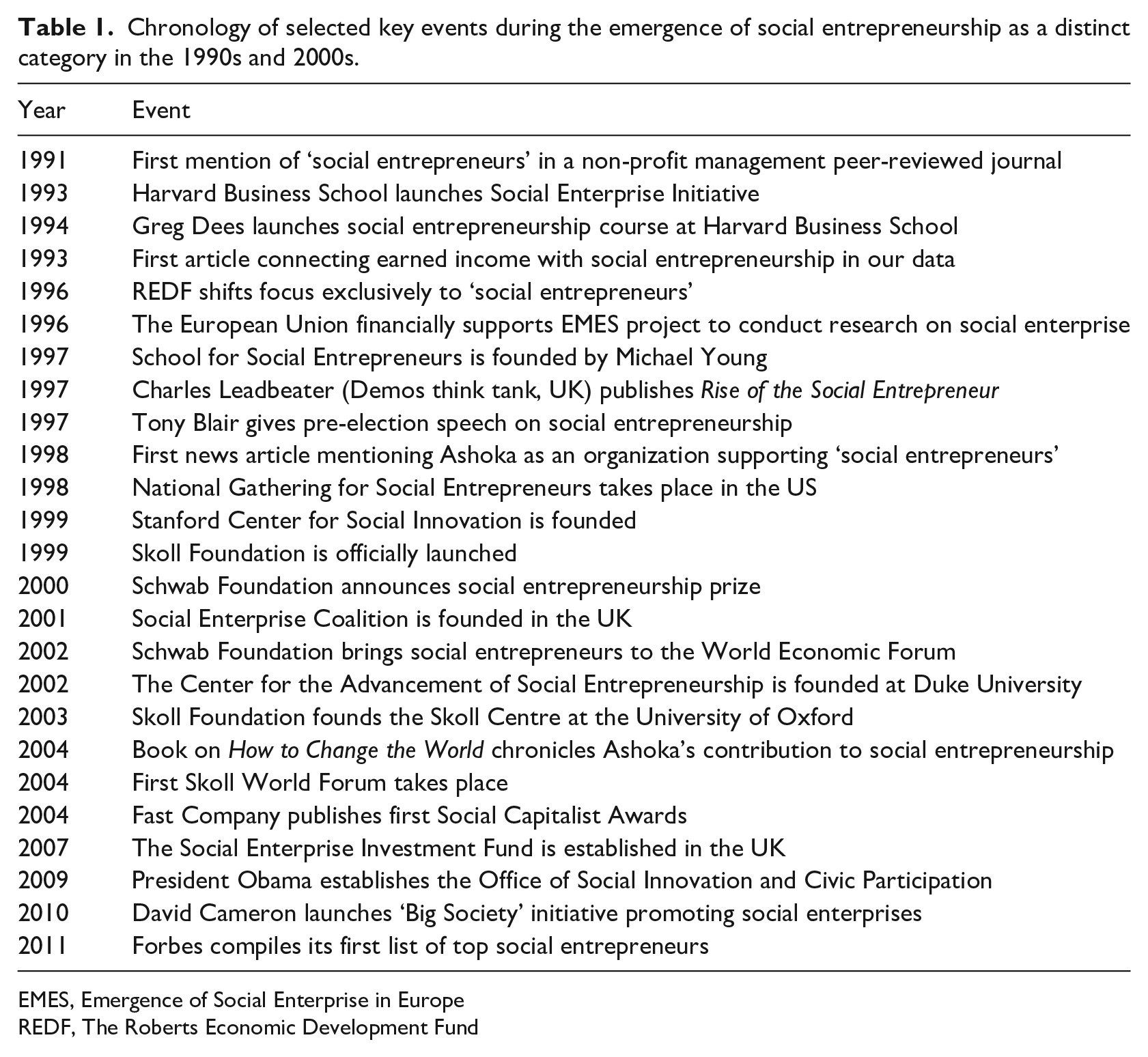
We constructed a chronology of events from both interview and archival data. The chronology (Table 1) helped us to anchor our narrative of the trajectory of social entrepreneurship over time and relate it to the key stakeholders who influenced it. In the next stage we sought to identify patterns and similarities in the data and abstract them progressively towards representative higher-order constructs (Strauss & Corbin, 1990). We increasingly iterated between our emergent theory, our data and extant literature, in our efforts to form an explanatory framework. We used archival data to triangulate events or facts mentioned by our informants, as well as to confirm, refute or illustrate our interpretations of the primary data. Furthermore, the ‘insider’ status of two of the three authors as academic experts with an active connection to the category allowed for further triangulation of findings. A more detailed description of data sources and usage is available upon request.
Chronology of selected key events during the emergence of social entrepreneurship as a distinct category in the 1990s and 2000s.
EMES, Emergence of Social Enterprise in Europe
REDF, The Roberts Economic Development Fund
The Emergence and Persistence of Category Ambiguity
In this section we detail the emergence and persistence of ambiguity within the social entrepreneurship category, using illustrative examples from our data. Complementary supporting evidence sourced from both interview and archival data is available upon request.
Interaction increases between previously unconnected fields
Organizational practices to address social problems while leveraging innovation-based or market-based activities currently associated with the category of ‘social entrepreneurship’ have existed for decades, if not centuries. Examples can be found in the social reform activities of education pioneer Maria Montessori and industrialist Robert Owen, and even in more mundane activities such as shops operated by the international nonprofit organization Oxfam. Yet, the emergence of ‘social entrepreneurship’ as a distinct category embracing disparate activities has its roots in the 1970s and 1980s, when business, nonprofits and development aid were seen as separate fields (Powell & Steinberg, 2006). In contexts where nonprofits had been established, these constituted autonomous and clearly demarcated spheres of activities as compared to businesses: [Mixing business and social goals] was a little risky . . . There were times when mixing in social missions had that socialism quality to it that . . . didn’t fit neatly into the world that people had been constructing in the late part of the 20th century . . . People thought money is money and go to church on Sunday and do whatever you want the rest of the week . . . the idea that a business would talk about something more than profits was radical enough in the late 80s, early 90s. (#41)
Additionally, international development aid agencies from developed countries focused primarily on large-scale projects that involved the governments of developing countries. Small-scale, innovative initiatives by local NGOs in developing countries remained largely unnoticed. Very few nonprofit foundations or philanthropists in developed countries engaged in international development at the time. Activities that did not fit neatly into the fields of business, nonprofit or development remained largely invisible because they lacked a specific label. One informant (a self-identified ‘social entrepreneur’) marvelled at the absence of a label in that earlier period: ‘Imagine, you’re in a discipline where there is no book. You were doing it for 10 years before you knew there was even a label’ (#24).
Nevertheless, in the 1980s and 1990s interaction between these fields became much more common and the previously sharp boundaries began to blur. Respondents credited the ignition of these changes to broader societal developments, such as increased career mobility, the greater speed and availability of information technologies and globalization. Increased career mobility, for instance, fostered the involvement of professionals with a business background as board members and, gradually, as managers of nonprofits. This in turn increased interaction between the fields of business and nonprofit. Globalization and the increased information that came with the adoption of the internet, on the other hand, improved awareness of societal problems across geographic locations: We are much closer interconnected . . . much more aware of where suffering is occurring and where inequities are growing . . . and where governments are not able to solve problems and where companies are not responding . . . and there’s a tremendous sharing of knowledge, through . . . cyberspace, I think those have all, certainly, accelerated this. (#2)
As a result, nonprofit foundations in developed countries began to take a greater interest in international development work.
Pioneers introduce divergent frames in parallel
Increasing interaction between the fields of business, nonprofits and international development afforded pioneers multiple opportunities to claim this previously uncategorized space. Initial isolation of the three fields allowed early efforts to originate in various locations and gain strength independently for some time, without mutual awareness or interaction. Heightened interaction among the three fields, however, ensured that eventually these localized efforts would come into contact. The earliest efforts to claim this uncategorized space are most frequently attributed to Bill Drayton, whose organization, Ashoka, was founded with the explicit aim of identifying and supporting innovators across the developing world in the late 1970s. Ashoka’s founding team had expertise and networks that spanned leading corporate, governmental and academic organizations in the US. They began operations in India, Brazil and Indonesia in the early 1980s and for many years operated exclusively in the developing world. Ashoka had been founded with a very clear vision and frame before it discovered a label for its work. That frame was based on the concept of ‘systemic innovation’, that is, innovation that would produce benefits for society at a systemic level, brought about by individuals with the highest ambitions and ethical standards. The frame was – and remains – ’entirely agnostic as to whether you are using the market mechanism [i.e. earning profits out of such activities] or not’ (#16). The ‘systemic innovation’ conceptualization, according to Ashoka, distinguished these individuals and their organizations from the majority of nonprofits, which aimed to alleviate social problems but did not affect the systems that were at the root of these problems. It also distinguished them from businesses, which were driven by different motivations.
Simultaneously, during the early 1980s, the ‘earned income’ frame was emerging at the intersection of the business and nonprofit fields within the US. Originating in the field of business, the CEO and top managers of technology company Control Data Corporation experimented with the use of business practices for effecting social change. They did this, first, by recruiting workers from impoverished areas and subsequently providing social services and goods, while advocating the superior efficiency of businesses in comparison to nonprofits. At the same time, several consultants from the nonprofit field conceived of the idea of nonprofits ‘earning income’ in the market to complement their donation income. Ed Skloot and his New Ventures organization was one of the pioneers behind this work. There had been some instances of nonprofits across the US that had used the market to generate income, but these efforts remained mostly unconnected at the time. Through conferences and public advocacy, earned income pioneers, including Jerr Boschee (affiliated with Control Data Corporation), began to bring together leaders of nonprofits that engaged or were interested in earning income through markets. As one informant affiliated with this group of pioneers noted, ‘there’s a broader definition of that [i.e. social entrepreneurship and social enterprise] now . . . but back in the day, that was not the term and people were talking about earned income, generating income’ (#7). In contrast to Ashoka’s frame, these pioneers saw income earned through market activities as the centrepiece of their frame, and they considered established nonprofits or for-profits in the US as their target audience. Due to these divergent choices, the two frames had little overlap and developed for some time without full awareness of each other. As one informant recalls, ‘I was not aware of that work and he was not aware of my work and so . . . I don’t think people were talking to each other – they weren’t connected, they didn’t view themselves as part of [a] shared community’ (#5).
Pioneers appropriate label for promotion of divergent frames
Despite their differences in terms of origins and the frames they espoused, the two main groups of pioneers eventually appropriated the same label to promote their respective frames. Our informants consistently referred to Ashoka as the pioneer responsible for coining the ‘social entrepreneurship’ label, even if they did not ascribe themselves to the frame promoted by Ashoka. However, Ashoka insiders revealed that they had experimented with numerous alternative labels, including ‘social innovators’, ‘innovators for the public’, ‘public entrepreneurs’, ‘public innovators’, ‘public service entrepreneurs’ as well as ‘social entrepreneurs’. Through experimentation, Ashoka gradually discovered that ‘social entrepreneurship’ was the most appealing label when promoting their activities, as compared to those other terms: For a while we thought it was going to be public service entrepreneurs, but . . . some people thought it was too government-sounding and was too complicated. So we tried a couple of other things and social entrepreneur seemed to be the best. People picked it up more readily. (#25)
Over the course of the 1980s, Ashoka gradually grew its base of elected fellows and aspired to build a ‘professional field’ for ‘social entrepreneurs’.
Our findings also indicate that the ‘earned income’ frame encountered strong resistance and very little resonance at the time of its inception because only a small number of nonprofit organizations had managed to implement the proposed practice: ‘Enterprise rarely comprises the majority of an organization’s total income; in fact, only 22% of the groups in our sample earned more than 10% of their income through enterprise activities’ (Crimmins & Keil, 1990, p. 3). US nonprofits were desperate to attract additional resources, due to increasing competition for donation dollars within their maturing field as well as the withdrawal of government funding during the Ronald Reagan administration. Nevertheless, they remained opposed to the idea of earned income: It was very hard. The single greatest obstacle for any nonprofit trying to do this kind of thing is the embedded organizational culture. . . . I started working on this in 1978 and for the first 15–20 years I was lucky if people were polite to me . . . The nonprofit sector . . . they did not want to hear about mixing mission with money. (#3)
‘Earned income’ pioneers soon realized that, while business was anathema to most nonprofits, a label based on entrepreneurship, such as the one promoted by Ashoka, evoked generally positive connotations. In the early to mid-1990s they gradually re-labelled their activities as ‘social entrepreneurship’ and their clients as ‘social enterprises’; by 1998 their conferences had been renamed as ‘Gatherings for Social Entrepreneurs’ and enjoyed somewhat greater popularity. An informant details this evolution of labelling over time: [Originally] they had the idea that for-profits could deliver all kinds of services better than nonprofits because they would be more efficient, . . . they created this center but it continued to evolve. And [Name] took it over and eventually stopped being focused on [that and started] working with nonprofits to kind of become more businesslike or ‘social enterprises’. So that became the shift . . . the social enterprise folks jumped on the bandwagon of using that term in the 90s. . . . [They] grabbed it. . . . I think they sensed it had sellability . . . it had potential to become a kind of a marketable term. . . . ‘this is something we could sell. . . . It seems like it’s starting to get some momentum’. (#22)
Availability of broader category of increasing resonance
Pioneers championing divergent frames thus eventually settled on the same label that drew on the broader and increasingly resonant category of ‘entrepreneurship’ itself. Entrepreneurship evoked positive and neutral connotations untainted by association with big government, aid, or corporate interests: ‘Many thinkers and many people got discouraged with large organized endeavors whether it was the big state or the big corporation’ (#30). Indeed, since the 1980s, at least in the US and UK and also to a considerable extent beyond these locations, the legitimacy of both the state and development aid had been decreasing while the resonance of entrepreneurship had steadily grown: Many more people (a) are unwilling to wait for aid and big companies to solve problems and (b) see that the lessons of Silicon Valley in entrepreneurship apply to social problems too. . . . And so people accept . . . that many of the older approaches, giving grants or doing small projects, simply hasn’t worked, so people are looking for what does work. (#11)
Entrepreneurship was not only a resonant category at the time, but importantly it was also a ‘reformist’ category (Rao, 1998). It did not directly threaten any pre-existing field, as it was broadly understood to be compatible with business and did not constitute a challenge to either the nonprofit or development fields. It translated well across geographies, since it was common in developed countries but also a prevalent necessity-driven activity in developing countries. Finally, it was able to transcend the political spectrum: with its emphasis on both accessibility to all classes and advancement through self-reliance, it appealed to both the political left and right. One informant summed this up as follows: This is ideologically very complex because . . . it was part of an effort . . . on the one hand to get companies to be more socially responsible, but on the companies’ part it was a way of kind of depoliticizing certain social activities by stressing entrepreneurship and innovation because everybody loves those two things on the political left and right. So it’s a maneuver, which creates consensus. . . . All the big political parties agree about this and that’s quite unusual. (#34)
The availability of the broader category of entrepreneurship, which was enjoying increasing resonance, was therefore a key determinant in pioneers’ coining and appropriating the ‘social entrepreneurship’ label.
Exclusive category framing
The appropriation of the label of social entrepreneurship (and derivative terms such as ‘social entrepreneur’ and ‘social enterprise’) to promote divergent frames brought with it contestation typical in cases of newly introduced categories. To frame their activities in a broadly resonant manner, pioneer groups resisted conceding the label to other groups. Heated debate ensued over the frame most suited to refer to the category and the label associated with it. Pioneers originally pursued an exclusive framing strategy, which assumed a lack of compatibility between the two frames. Furthermore, they each attempted to dominate intellectual debates with their own frame. As informants explained, ‘in the early days there were these intense debates about the definition of social entrepreneurship’ (#24), which centred mainly around the ‘so-called split in the field between the innovation versus the enterprise’ (#40), that is, between the Ashoka frame of entrepreneurship as individually driven systemic innovation that did not necessitate market activity, versus the frame that required earned income generation and targeted established nonprofit organizations, which were conceptualized as ‘enterprises’. Pioneers were forceful in the conceptual and academic justification for their respective frames, which they termed ‘schools of thought’. In particular, pioneers of the ‘earned income’ frame lamented the use of the social entrepreneurship category to denote any activity that did not include earned income. For instance, in one publication, Boschee and McClurg (2003) claimed the category exclusively for the ‘earned income’ frame while protesting the alternative frame: Here is the gist of the problem: Unless a nonprofit organization is generating earned revenue from its activities, it is not acting in an entrepreneurial manner. . . . It has reached the point where almost everything new in the sector is called ‘entrepreneurial’ and the people who create these new approaches (not to mention the people who write about them and underwrite them) walk away satisfied that they’ve changed the fundamental equation. They have not. (pp. 1–2)
Pioneers of the Ashoka frame, similarly, continued to promote their own frame while deploring its appropriation by ‘earned income’ pioneers: ‘People take over terms and they get definitions and so I think it’s a problem. . . . Certainly I felt that and there’s nothing we can do about it. It was captured by something else’ (#16). These early contests may have arisen partly from the need to derive benefits from a resonant label and to enforce one’s own framing, values and beliefs: The conflicts . . . in a primary sense . . . are efforts to try to make the field more comprehensive. It wasn’t so much internecine warfare. It is just as much an effort by people, as they always do, to try to carve out their point of view that is different from how others see it. . . . It ultimately becomes a bit of a contest; whose definition comes first. (#12)
Resource providers appropriate label to promote divergent frames and mobilize resources in support of divergent frames
In the mid- to late 1990s, interest and resources behind the social entrepreneurship category began to increase, marking a new era. Despite previous developments, the category had represented a largely unknown activity. One informant pondered on the apparent inexplicability of this shift: There’s a certain amount of time it takes from the formulation of the idea to the widespread adoption of that idea. . . . Funding really helped [Ashoka] grow quite well. And you never know what . . . set of things took him [the founder] from being sort of a lone prophet in an empty field to actually being at the centre of a movement. (#42)
In our data we traced the answer to that question back to the active engagement of a new set of stakeholders that adopted the category and its label in this period. Specifically, stakeholders who feature as most salient in our data are resource providers with origins in the following four groups: (a) US academic institutions; (b) multinational corporations; (c) US entrepreneurs; and (d) the UK government. Their efforts were distributed across locations and entailed not only the appropriation of the label but also the provision of valuable resources – material, symbolic or both – to divergent frames of the category. Importantly, each of the aforementioned stakeholders tended to support either one of the pre-existing frames within the category, or a variation of these.
US academic institutions, beginning with the Harvard Business School (hereafter HBS), were among the first resource providers to recognize potential in endorsing the emergent ‘social entrepreneurship’ category. In 1993 a prominent alumnus decided to fund the establishment of a new centre for nonprofits within HBS, conceptualized as the Social Enterprise Initiative, dedicated to the study of a range of organizations spanning the continuum from for-profit to nonprofit. The professors working to establish the new centre had been aware of both Ashoka’s work and that of several US nonprofits already crossing the boundaries between the business and nonprofit fields, and they wanted to include these in their conceptualization of the new centre. Adding the term ‘social’ before ‘enterprise’ was a controversial decision within the context of a US institution at the time, according to our informants. Initial resistance was overcome by probing into the preferences of HBS alumni and students, thereby revealing a strong interest in organizations that spanned the business and nonprofit fields. An informant involved in the process explains this as follows: We did a survey to ascertain whether . . . engagement with nonprofits . . . was relevant to [our alumni]. . . . What turned out to be surprising almost to everybody was that 81% of our alumni . . . were involved in some significant way with nonprofits and . . . 57% were involved as board members of nonprofits. So all of a sudden, for faculty members and many others it was like revealing the invisible side of business leadership that in fact they exercised . . . in the social sector as volunteers, donors, board members. And so the issue of relevancy to our students . . . all of a sudden just disappeared. That became a very powerful piece of data in the process of then [establishing] this as an area of relevance within the business school. (#1)
The resulting frame of social entrepreneurship promoted by HBS combined the element of innovation of the Ashoka frame and the focus on established, larger organizations championed by the earned income frame. HBS dedicated personnel and resources exclusively to the new centre and, crucially, actively worked towards propagating ‘social entrepreneurship’ in academic forums, thereby facilitating knowledge exchange with other universities. The aim was to establish the category as a credible, cutting-edge endeavour across US academia instead of a controversial fringe activity. Indeed, rather than doing this undertaking in sort of a competitive mindset, we approached it in a collaborative way because we all knew that the stronger programs got in each of our schools . . . the bigger would be the possibilities of legitimizing this as an area of study within the larger academic [community]. (#1)
Related to this, Greg Dees, professor at HBS and later at other leading US business schools, developed the theoretical underpinnings of ‘social entrepreneurship’, with an emphasis on the Ashoka and HBS frames. Over the years, Dees acted as a ‘Johnny Appleseed’ (#5) by disseminating the category, moving from one prominent US business school to another and founding a dedicated centre at each of these. The appropriation of the label by US business academia and its customer base thus conferred substantial symbolic resources to the category: Certainly. . . all the major business schools, including obviously Duke and all of Greg’s wonderful work, have helped put thought leadership out there and also thousands of kids have come through these schools; Stanford, Duke, Harvard, Northwestern . . . there is a social entrepreneurship, social enterprise curriculum in every one of them now. (#37)
Multinational corporations also expressed interest and provided resources to the ‘social entrepreneurship’ category, primarily through the Schwab Foundation. Initiated by the founder of the World Economic Forum (hereafter WEF), in 1998 the Schwab Foundation began to actively address the protests organized during the Forum’s conferences in a way that appealed both to the business field and the broader public – specifically by selecting exemplary ‘social entrepreneurs’ and including them in WEF events. The Schwab Foundation’s frame was modelled on Ashoka’s frame of social entrepreneurship, yet it differed by selecting fellows at later stages of their organizations’ development. The Foundation did not itself offer substantial financial support to selected fellows, but provided them with valuable symbolic resources, such as access to a network of powerful corporate leaders and investors in the WEF Davos meetings. Enthusiasm about the potential of ‘social entrepreneurship’ within this network became tangible. Informants accredited corporate interest to the new business opportunities that multinational corporations saw in poverty contexts, as well as the socially responsible image they wanted to project towards their employees. Through WEF exposure and connections, several of the individuals labelled as ‘social entrepreneurs’ were able to secure financing and promotional support from corporations, as well as enjoying considerable exposure in global media. According to an informant: The platform of the World Economic Forum propelled these types of entrepreneurs into the stratosphere. Because all of a sudden, CEOs of companies just became completely enamoured of this idea, the approach . . . there’s one thing that Schwab is a genius at, it is using the media to promote a concept or an idea. It’s amazing to me when you go to the Annual Meeting at Davos, it is filled with the media and the World Economic Forum is a media event. And so to him, the media is always and correctly so, a huge power for getting a message out. (#2)
US entrepreneurs were the third influential group of resource providers, especially those who made their fortunes in Silicon Valley from the 1990s onward. Since entrepreneurship was the means by which they had achieved success and wealth, by analogy they considered it to be a more appropriate method than traditional philanthropy for addressing social problems. By the late 1990s, and particularly by the early 2000s, excitement for ‘social entrepreneurship’ flooded the Bay area. The bursting of the tech bubble in 2000 reduced fortunes but also shifted attitudes in Silicon Valley towards a greater receptivity for social endeavours. ‘Social entrepreneurship’ resonated highly with these emerging philanthropists because it presented them with valued principles: They saw what entrepreneurs could do in the business side and . . . felt; okay we need the same sort of energy, persistence, creativity, innovation, to solve social problems. And I think they were excited . . . I think there was something that captured the imagination of that community’ (#22).
US tech entrepreneurs were ambitious about transforming philanthropy and helping to solve global problems: You had . . . Skoll, Pierre Omidyar, eBay, . . . Quicken. You had some big philanthropists . . . eBay, they felt was a social enterprise. That it benefited people. That it wasn’t just in it for the money. That it was a community. Yet it made people a lot of money. . . . And so there were new philanthropists that came into the market and said, ‘Can’t we just adapt our business practices . . . through our philanthropy?’ . . . There are a number of articles around just Omidyar and how exciting it was to have this fresh, new perspective. That we’re really going to change philanthropy. And then Gates too. (#46)
Substantial material and symbolic resources followed, as ‘that group of donors included a lot of people with new money. . . and it really was a Silicon Valley starting point’ (#23). An early example of an entrepreneur-backed foundation was the Homeless Economic Development Fund (HEDF, later REDF) in San Francisco, which had come to exclusively focus on ‘social entrepreneurship’ by the mid-1990s. The trend accelerated with the substantial support and resources from highly successful tech entrepreneurs, most prominently the founders of eBay, Jeff Skoll and Pierre Omidyar, who established their respective foundations (Skoll Foundation and Omidyar Network) towards the end of the 1990s and early 2000s.
Right around that same time, 1995–96, when you’ve had this infusion of new money, that was controlled by people who had made their money themselves, who’re not afraid of losing their money, . . . and who really liked the idea of social entrepreneurship, . . . that really is what helped a lot of big innovations that came from 1995 to 2000 . . . . The Bay area was a hotbed for this stuff and part of it was the combination of funding and practice [that] gave us a platform to really promote these ideas from. (#5)
Foundations established by Silicon Valley tech entrepreneurs would go on to provide the majority of the $1.6 billion investments that flowed to self-identified ‘social entrepreneurship’ programmes between 2003 and 2016 (Spicer, Kay, & Ganz, 2019).
Importantly, Silicon Valley tech entrepreneurs found affinity with different frames of social entrepreneurship. The Skoll Foundation, an important funder, actively promoted a frame close to that of Ashoka, which prioritized innovative nonprofits without requiring that they earn income, yet supported as its fellows individuals whose organizations had a proven track record and were larger in size. In contrast, Omidyar’s philanthropic work hinged on the premise that ‘effective social models, while usually associated with nonprofits, could just as easily be for-profit’ (Chu & Hazell, 2007, p. 2) and focused to a larger extent on organizations with an income stream.
The Skoll Foundation – and to a lesser extent other foundations – also engaged in systematic work to build ‘a field’ around ‘social entrepreneurship’. The Foundation established the Skoll World Forum, an annual global conference in Oxford, which became ‘a critical convening space for this work’ (#43) where pioneers and later converts to the category from across the world could meet, interact and exchange best practices. In addition, the Skoll Foundation intentionally promoted ‘social entrepreneurs’ and ‘social entrepreneurship’ in mainstream US and international media outlets such as PBS, CNN, Wired Magazine and TED, thereby boosting the propagation of the category to broader audiences. Such media coverage had a catalytic effect. One informant, for instance, marvelled at how the PBS show Frontline prompted transformational recognition of his erstwhile fledgling initiative, even though he was not very enthusiastic about being labelled a social entrepreneur: It was like a miracle. . . . The whole world found out about it . . . it was a total tipping [point]. . . . Honestly I can say . . . I’m pretty, relatively certain [Organization] wouldn’t exist today. . . . I would have given up, if it weren’t for the Skoll Foundation. That’s the single most transformative thing. (#27)
A final crucial resource provider for the category has been the UK government. From 1997 onward, Tony Blair’s Labour government advocated social enterprises as a means to revolutionize the public sector through the outsourcing of public services to private organizations. Independently from the US, the UK prominent sociologist Michael Young had promoted ‘social entrepreneurship’ as an outlet for community grassroots activism. His work was rediscovered and a number of government bodies were set up to support the ‘social economy’. ‘Earned income’ consultants from the US were invited to advise Blair’s government, according to informants’ accounts; the frame proposed by the UK government was consistent with the notion that organizations need to earn income for the provision of social services – but, in contrast to the US frame of earned income, the government positioned itself as the supplier of such income. The Labour government’s interest was driven by their need to present to supporters an inspirational programme: ‘The Tony Blair government had a huge mandate at the beginning to do things afresh. So it felt like a really exciting time for values to be back on the table, social justice to be central’ (#45). Interestingly, when the Tories later came to power in the UK, support for the category label did not dwindle: [the Labour government] looked at large monolithic government institutions like health service and welfare benefits and social care and they thought: Well, if there were social enterprise models to allow us to break up these huge institutions, then we would achieve . . . better outcomes for people. . . . In the early years . . . innovation was the main idea because there was plenty of money around . . . and then certainly when the Conservative Coalition government came in, it then became about money-saving. And both have the flip side. So the innovation side were interested in cost and value as well and the cost-saving people were interested in innovation as a way of strategic cost saving. (#15)
The UK government nurtured the legitimacy, resources and permissive environment for social entrepreneurship on a top-down basis. Material resources endowed upon the category and its participants were substantial – in the words of one informant, ‘masses of public money going into this in the UK . . . not masses compared to everything else, but masses compared to other countries’ (#34). The importance of these resources in bringing the category into the spotlight is further emphasized by another informant, who explains how they were critical in the UK, in stark contrast to the US, where social entrepreneurship emerged as a response to the government’s withdrawal: New government money accounted for a 37% increase in income going into the third . . . sector. It’s important to understand that, because that’s a huge enabler. If that wasn’t there, this might be the nice idea that just sort of withered . . . the effort in the UK has been absolutely intentional. . . . [the government’s objective was to understand] what combination of incentives, regulation, procurements and the institutions, finance and so on, were missing and were needed to enable a market to mature. (#45)
The Labour government also contributed to the propagation of the category through forums, media and books, where social entrepreneurs were celebrated in an aspirational, heroic manner.
In sum, a multitude of stakeholders motivated by divergent interests appropriated divergent frames attached to a single category label. Furthermore, this appropriation was coupled with the mobilization of substantial material and symbolic resources by these resource providers, which pioneers had lacked. The mobilization of these resources in support of divergent frames, instead of behind a single frame, enabled these frames to thrive in spite of their divergence. Pioneers had enjoyed varying levels of success before this influx of resources. Some, like Ashoka, had managed to grow their operations substantially in the 1980s and 1990s, while others, such as ‘earned income’ pioneers, had been less successful in consolidating a sustainable business model in the same period. However, all early pioneers had lacked visibility and broad acceptance. According to our informants, it was the influx of material and symbolic resources into the social entrepreneurship category before and around the turn of the millennium which brought about its exponential ‘growth’, ‘momentum’, or ‘uprising’: This global tidal wave of social entrepreneurship as a movement, . . . it’s becoming much more of a global phenomenon. And I think we’re just part of that wave. . . . the movement started to pick up steam probably right around 2000 or so. I really have felt . . . an exploding of interest. . . . it has really escalated. (#43)
Stakeholders across the globe have emulated elements of the example set by the early influential resource providers. For instance, an increasing number of business schools around the world have emulated the ‘social entrepreneurship’ content offered by leading US business schools; several governments have to some extent followed the practices of the UK government; and a ‘huge influx of interest from young professionals’ (#43) has resulted from the dissemination of social entrepreneur role models through the media.
Inclusive category re-framing
This influx of resources prompted a shift in the previously exclusive framing that pioneers had used. In the context of the category’s high resonance among multiple stakeholder groups, intellectual debates over precise definitions came to be seen as secondary and yielded to a nascent inclusive framing around 2005. Pioneers were overwhelmed by the category’s positive reception and new resources, but also realized the futility of their attempts to control it for their particular purposes. They also began to interact more closely with each other during events convened by resource providers, such as the Skoll World Forum. A willingness to reconcile emerged: ‘We’ve had various meetings to try to get consensus around some of this stuff and it’s been funny as we’ve tried to do that’ (#22). In a 2006 article which appeared in a publication that brought together pioneers from the opposing ‘schools of thought’, organized by the Aspen Institute, Dees and Anderson (2006), supportive mainly of the Ashoka frame of ‘social entrepreneurship as systemic innovation’, proclaimed that the two ‘schools of thought . . . reflect different perspectives, priorities, and, to some extent, values’ (p. 40), but that the most fruitful discussions could result from the interaction between them. Jerr Boschee, the most vocal supporter of the ‘social entrepreneurship as earned income’ frame, responded positively (2007): Greg [Dees] and Beth [Anderson] emphasize that it’s ‘crucial to define the domain in a felicitous way’ and that ‘the best way of framing this new field lies at the intersection of the two dominant schools of practice and thought. . . . I couldn’t agree more. . . . it’s time we put aside our warring definitions of ‘social entrepreneurship’ and worked together. (pp. 1–2)
Over time Ashoka also displayed a greater acceptance and less insular attitude towards other frames. According to insiders, Ashoka was frequently considered elitist during its early history due to its exclusive criteria for defining ‘social entrepreneurs’. Yet, with the proliferation of other frames, in Ashoka itself, you get less resistance to cooperating with groups, less of what I call the secret sauce attitude that organizations develop out of self-defense when they’re born. ‘We have a secret recipe that makes us different and better than everybody else.’ And Ashoka had some of that, but now all we say is ‘Well, we’re part of a large global movement, we have our role and others have their role.’ (#30)
For instance, when Ashoka entered the UK market, at a time when the local government-driven frame had already taken root, they realized that challenging the existing frame was not a fruitful strategy – instead, they diplomatically opted for an inclusive framing. As one informant recounts: You come in from the outside starting to say that you are better . . . people ask . . . ‘Why do we need you? We already have . . . social entrepreneurs, there’s nothing new here for us.’ And then . . . initially . . . the mistake of saying, ‘we believe that social entrepreneurs is not what you guys understood’. And that’s a very bad start for the organization . . . And the other party is there, it exists, they have power, they have money, they have friends . . . [instead, you need] to play ball politically and say, ‘No, the reason we are here is that we are a global network of social entrepreneurs and that the UK is at the forefront of social entrepreneurship’. . . That was the way it worked out and . . . we finally succeeded. (#17)
On the whole, as outlined in a report by the Center for the Advancement of Social Entrepreneurship at Duke University, stakeholders had become aware that prolonged framing contests could endanger the category’s prospects of mainstream success and were turning towards an inclusive framing: While intellectual disagreements are healthy and natural for any newly developing field, definitional disputes about social entrepreneurship have taken a toll, according to those we interviewed. . . . Several suggested, ‘Definition is one of the biggest problems.’ . . . The challenge is to find definitional solutions that increase precision and clarity while . . . respecting different perspectives, and still including enough supporters to propel this field forward. . . . too narrow a definition could . . . result in a field that is ‘too special’ for mainstream attention. A community of practice is starting to emerge, including those who embrace all the different definitions . . . Respondents saw a significant opportunity lost if the field becomes too exclusive. (Developing the Field of Social Entrepreneurship, 2008, pp. 3, 5, 12)
Sustained category ambiguity
The shift from exclusive to inclusive framing did not bring about substantive convergence, in the conventional sense of the term that implies agreement on and conversion to a shared frame. Instead, an inclusive framing allowed stakeholders to maintain allegiance to their espoused frame while presenting it as part of a single, broader category label. All of our informants had a preferred frame and eagerly clarified to us what social entrepreneurship meant for them, while avoiding a direct refutation of other frames. Statements such as the following were common: ‘In terms of what particularly I’m interested in and the perspective that I can really offer to this, is a subset of that which is really the emergence of using commercial platforms to respond to social issues’ (#36).
This resulted in the inability of the category to substantively converge towards a shared frame. Our informants echoed accounts of the persistence of plural frames within the social entrepreneurship category (Dart, 2004; Galaskiewicz & Barringer, 2012; Teasdale, 2012). They observed how ‘social entrepreneurship . . . means so many different things to different people’ (#38), and pointed out the inevitability of a resolution: ‘I don’t see how it’s going to get resolved. I think . . . the term is going to be used . . . for both things’ (#16). Similarly, resource providers supported their preferred frame while conceding that other frames were persistently also being attached to the same category: The definition of social entrepreneurship varies quite a bit. I mean, some people see social entrepreneurship as primarily not-for-profit. Others see it as primarily for-profit. The first thing I always think about or talk to somebody about it, kind of what is their definition. (#42) You look across the landscape of social entrepreneurship funders, even [if] we all say that we support social entrepreneurs, our approach really is slightly different when you start to dig underneath. . . . But I still think it’s important to have many different voices trying to figure all of this stuff out. (#43)
While both pioneers and resource providers such as the centrally positioned Skoll Foundation had envisioned building a coherent ‘field’ around the category, their aspirations were not realized. Due to divergent stakeholders’ sustained interest in the category, ambiguity was accepted and sometimes prized: Language is protean and when you have something that people aspire to, a lot of people are going to appropriate . . . And I just don’t know . . . I’m happy they’re appropriating, I’m thrilled that they see this as a statement about where they want to go in life. . . . It . . . messes up the clarity of the language. If I had to, I’d prefer to have people aspiring for this. (#25) The term social entrepreneurship is helpful. Even if they lead to a fair amount of confusion, people use those terms very differently, . . . [it’s] still a term that people can recognize and get excited about. (#42) You could see that this group of people is holding this definition in their minds . . . and this other group is holding this other definition . . . yet they’re all together at the same event. And that it’s not really causing a problem. . . . There’s no structural need to define it. Meaning, you guys doing it over there in this way doesn’t really hurt me . . . unless we’re competing for the same money. (#27)
Informants also referred to flexibility, intellectual and educational richness as well as a vibrant and inclusive community as additional benefits of ambiguity. Nevertheless, they remained aware of the shortcomings of persistent ambiguity, which did not allow for the development of a highly coherent field of academic inquiry or practice. Furthermore, the proliferation of frames meant that the category suffered from the effects of dilution: It became ‘watered down and . . . splintered’ (#37) and, although it had never been premised on radical frames, it became even more conformist than originally envisioned: ‘This happens as social trends mature. Pretty soon the whole field looks a little bit like somewhat banal imitations of what the original revolutionary experiment looked like’ (#30). This dilution, in turn, perpetuated confusion over the meaning of the category among the public, as several informants remarked, because both nonprofit and for-profit organizations could claim the category opportunistically, according to their specific interests.
The model in Figure 1 provides a conceptual summary of our findings.
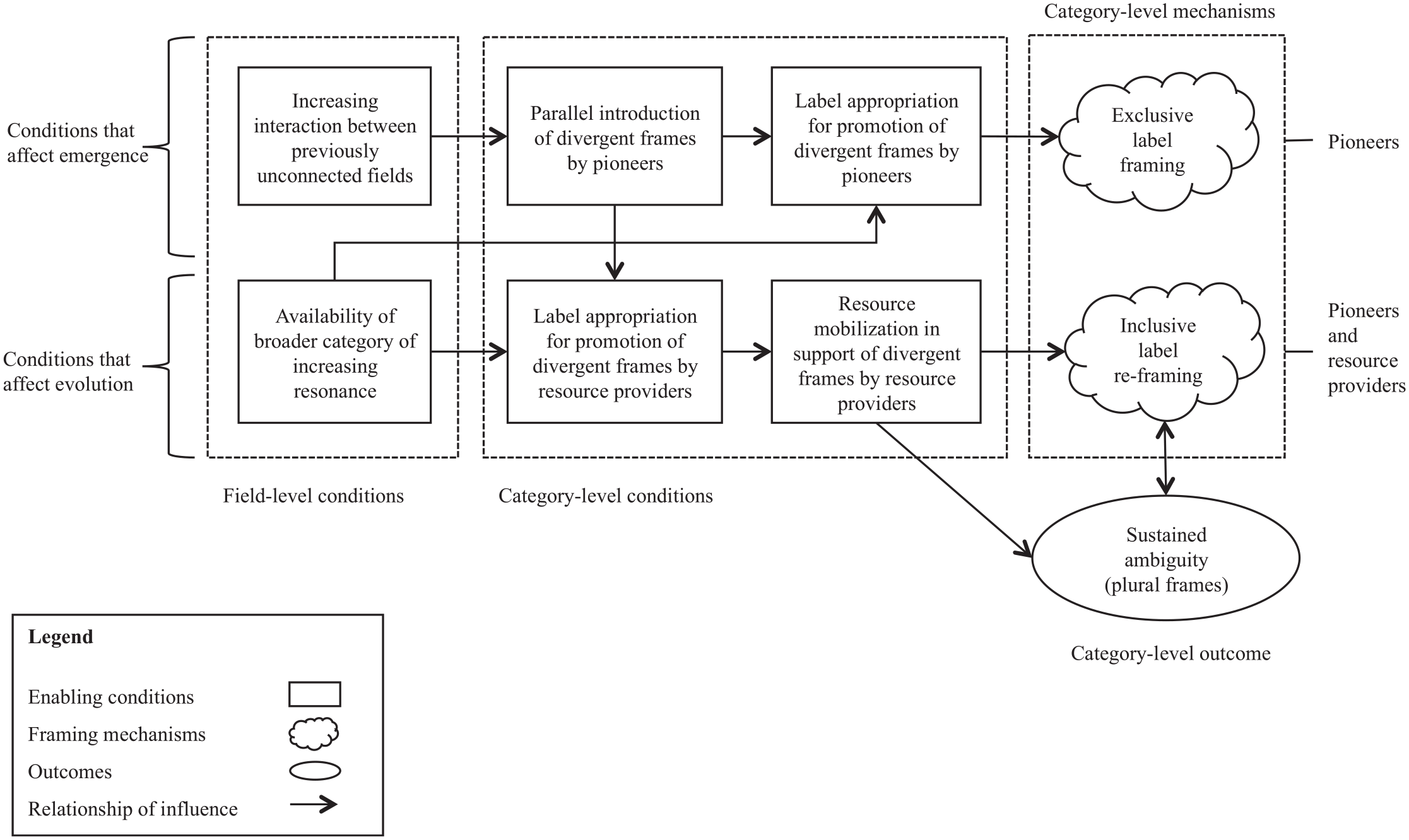
Theoretical model.
Discussion
In this paper, we identify conditions and mechanisms that explain how and why category ambiguity persists over time. In contrast to viewing ambiguity as either a temporary situation or as detrimental to the development of a category (Grodal et al., 2015; McKendrick & Carroll, 2001; Ozcan & Santos, 2014), we show that categories can survive and thrive while continuing to remain ambiguous and to be associated with multiple meanings. Our model suggests that initial isolation between existing fields provides fertile ground for pioneers to introduce divergent frames, whereas the later increasing interaction between these fields results in these frames eventually coming into contact with each other. We furthermore observe that a highly resonant pre-existing category (in our case ‘entrepreneurship’) prompts pioneers supportive of divergent frames to appropriate a shared category label. As would be predicted by prior literature, when pioneers supportive of divergent category frames vie for dominance, they will adopt an exclusive framing, whereby each will promote their frame as the only appropriate one (Lounsbury et al., 2003; Rao, 1998). However, the existence of divergent frames under a common category that draws from a highly resonant pre-existing category is likely to mobilize resource providers to contribute resources in support of multiple divergent frames. This in turn provides incentives for an emergent inclusive re-framing of the category on the part of pioneers as well as resource providers, which enables ambiguity to persist beyond category emergence and into category maturity. We now draw attention to the theoretical implications of the observed pathway.
Our findings highlight the importance of two co-occurring conditions that jointly explain sustained category ambiguity. The first condition is the increasing interaction between previously unconnected fields, which allows for the emergence of divergent frames in isolation early on and for their contact during later stages of the category’s development. When positioning a new category in between fields with few overlaps, pioneers can experience greater scope for divergence in their framing efforts. Fragmentation within a given field has been considered an antecedent of plural frames (Greenwood, Raynard, Kodeih, Micelotta, & Lounsbury, 2011). In addition, our findings suggest that increasing interaction between previously unconnected fields might be particularly relevant to the emergence of plural and divergent frames of a category. This finding sheds light on an alternative route to that of frame convergence, documented largely in prior literature. In contrast to our case, if there is no opportunity for divergent frames to develop in isolation initially and, subsequently, come into contact with each other, then category ambiguity might remain low or convergence might be forced early on in the category’s evolution. This may occur when a local set of stakeholders, such as a local community or professional association, defines and promotes a single, tighter frame at an early stage. In those cases initial frames tend to be less divergent, or contact between them occurs early on, prompting a negotiation and resolution of frame divergence (Grodal, 2018; Khaire & Wadhwani, 2010; Lee, Hiatt, & Lounsbury, 2017; Mair & Hehenberger, 2014; Weber et al., 2008). While the original frame might lose its focus once pioneers attempt to broaden it so as to attract additional stakeholders, these locally or professionally delimited pioneers might be able to retighten (Grodal, 2018) or hybridize (Mair & Hehenberger, 2014) the category. In contrast, we argue that widely fragmented frames that have been created by pioneers who are unconnected, or only loosely connected to each other, are less likely to converge and more likely to persist. This enabling condition is the first step in explaining the persistence of ambiguity as a category matures and becomes settled.
Our study identifies an additional important condition for sustained category ambiguity: the appropriation of divergent frames and the mobilization of valuable resources in support of these frames by resource providers of a category. We thus complement prior research that shows how resource mobilization typically follows a dominant frame and therefore eliminates category ambiguity. An example of this scenario is microcredit, where two divergent frames initially emerged in parallel but later received uneven levels of material and symbolic support from resource providers. Specifically, the support granted by an influential group of Western institutions to the ‘commercialization’ frame of microcredit far exceeded the support available to the alternative ‘pro-poor’ frame; this in turn resulted in the almost uniform conformance of the category at the global level to the prescriptions of the commercialization frame and in the marginalization of the pro-poor frame (see Roy, 2010; Weber, 2002 for a more detailed account). In contrast, our case shows that when material and symbolic resources are more evenly distributed among two or more divergent frames, these frames are more likely to thrive alongside each other. Taken together, these two conditions deepen understanding of how category ambiguity – a phenomenon heretofore examined mainly in passing or as a state that determines other outcomes (Granqvist et al., 2013; Pontikes, 2012) – can be expected to develop in the first place.
Our model portrays one possible pathway to persistent category ambiguity. While illustrating this route, we nevertheless refrain from suggesting that it is the only route possible. Our findings, considered vis-a-vis prior literature, illustrate that ambiguity can persist due to the efforts of different sets of stakeholders. Whereas ambiguity during category emergence is typically driven by pioneers, the later persistence of ambiguity can be attributed either to consumers (Jones et al., 2012) or, as in our case, to resource providers. These different stakeholder groups might be theoretically comparable in terms of resource provision. Specifically, it is more likely that resources will be mobilized in support of divergent frames if producers are endowed with plentiful resources either by consumers (Jones et al., 2012) or by resource providers with different interests (our case). In that sense, resource providers can fulfil a similar function as consumers; in effect, they can be conceived of as consumers of investment opportunities. Additionally, frames need not correspond to different labels on a one-to-one basis. Our case suggests that convergence of a category towards a preferred label (Zunino et al., 2019) is sometimes not enough to reduce the frames used to denote the category, and thus the ambiguity it experiences. We show, instead, that stakeholders might be able to retain their original frames while attaching them to a winning label, thus preserving ambiguity within a maturing category.
Our model also improves understanding of the framing mechanisms that allow a label to sustain plural frames over time. While recent literature has attributed an exclusive framing to a certain degree of substantive incompatibility of values and technologies between frames (Hiatt & Carlos, 2018), we find that an exclusive framing might be entirely socially constructed. In the event of an inability to dominate a valued label with an exclusive framing, stakeholders may strategically opt for an inclusive re-framing that allows them to use the label and thus partake of the category without changing their own frame. Thus, divergent frames can be maintained, as long as their relationship to each other is constituted as complementary rather than adversarial. This re-conceptualization, in turn, positions each of the frames as a subset of the category and affiliated stakeholders as co-inhabitants instead of leaders of the category. Our model thus illustrates the path from incompatibility to compatibility of frames within a category which may occur when stakeholders maintain interest in the category while being unable or unwilling to dominate it. This path elucidates how stakeholders’ framing strategies (Hiatt & Carlos, 2018) can have critical implications for a category’s progression towards convergence or, alternatively, ambiguity.
Finally, our study provides insights on how pre-existing categories can influence the evolution of a focal category towards persistent ambiguity. We observe that when stakeholders appropriate a label that draws from a broader category of ascending resonance, the appeal of the focal category can increase exponentially. At the same time, however, they risk losing control over the framing of the category and increase the chances that resources will be mobilized in support of divergent frames. Insights from prior literature suggest that a reformist frame, which proposes incremental changes to the status quo, is more likely to gain the support of resource providers, as compared to a frame that champions radical changes (Lounsbury et al., 2003; Rao, 1998). Extending this, we speculate that when two or more divergent frames are both reformist and draw from highly resonant broader categories, they may be more likely to mature into an ambiguous category, as in our case. This might occur because stakeholders, and in particular resource providers, can be disinclined to either concentrate resources behind a single frame or clash directly with other reformist frames.
Limitations and future research
Our study offers an account of the emergence and evolution of a single ambiguous category, thereby informing theory on this intriguing but scarcely studied phenomenon. However, similar to other case studies (Granqvist et al., 2013; Jones et al., 2012), the benefits of such a design in terms of internal validity bring a number of limitations in terms of external validity. Indeed, while individual cases can be particularly informative in terms of the mechanisms behind category emergence and evolution, they need to be synthesized with other, comparable cases. Future studies could comparatively analyse multiple cases that have reported either persisting ambiguity or convergence towards a dominant frame at the category level.
In addition, our study cannot make claims about the exact relationship between a category’s ambiguity and its propensity to be claimed alongside multiple other categories by producers. This limitation, however, presents a fruitful avenue for future research. While some scholars tend to examine category spanning taking place across categories (i.e. Durand & Kremp, 2016; Zuckerman, 1999), and others focus on the mechanisms taking place within them (i.e. Jones et al., 2012; Khaire & Wadhwani, 2010), we see an opportunity in directly studying the relationship between within-category ambiguity and category spanning and the factors that moderate it.
Finally, although several studies have touched briefly upon the benefits and drawbacks of persisting ambiguity, a detailed analysis of these is beyond the scope of this article. Ambiguity has been argued by Henry Kissinger and others to be ‘constructive’ as a political device, ensuring that divergent stakeholders can be incorporated under an inclusive framing; yet, it is not clear whether it can foster substantive action or, instead, ‘delay the tough political choices needed for a resolution’, such as pertains in the case of the ‘sustainable development’ category (Moore, 2011, p. 143). Therefore, an examination of the positive and negative outcomes of ambiguity, especially over longer time spans, constitutes an area of great theoretical and practical relevance for future work.
Footnotes
Acknowledgements
We would like to thank our informants for sharing their stories with us. We would also like to thank Guillermo Casasnovas, Panikos Georgallis, Aleksios Gotsopoulos, Jennifer Goodman, Matthew Hawkins, Suntae Kim, Delia Mannen, Pedro Parada, Miguel Rivera-Santos, Federicca Massa Saluzzo, Theresa Veer, Marc Ventresca, as well as participants in AoM, EGOS, ESADE Business School and Swissier seminars for their helpful comments on earlier versions of this paper. We are grateful to Editor Beth Goodrick and the three anonymous reviewers for their guidance during the review process.
Funding
The author(s) received no financial support for the research, authorship, and/or publication of this article.
