




Abstract
This study finds that it is possible for organizations in emerging categories to resist stigmatization through discursive reconstruction of the central and distinctive characteristics of the category in question. We examined the emerging market of organic farming in Finland and discovered how resistance to stigmatization was both an internal and an external power struggle in the organic farming community. Over time, the label of organic farming was manipulated and the practice of farming was associated with more conventional and familiar contexts, while the stigma was diverted at the same time to biodynamic farming. We develop a process model for removal of stigma from a nascent category through stigma diversion. We find that stigma diversion forces the core community to (re)define themselves in relation to the excluded community and the mainstream. We also discuss how notoriety can be an individuating phenomenon that helps categorical members conduct identity work and contributes to stigma removal.
Keywords
Introduction
Emerging categories often challenge established meanings, values and power constellations in markets while simultaneously seeking to persuade audiences about their core features and values (Rosa, Porac, Runser-Spanjol, & Saxon, 1999; Weber, Heinze, & DeSoucey, 2008). Accordingly, audiences may engage in the use of power to protect their value system, position and interests. Sometimes this may lead to stigmatization – a form of profound moral disapproval and social control – of new categories and their offerings (Goffman, 1963). New categories such as nanotechnology (Granqvist, Grodal, & Woolley, 2013), medical cannabis (Lashley & Pollock, 2019), rock music (Cohen, 2011) and modern art (Kosut, 2006) are but a few examples of categories that in some way challenged the moral order and encountered stigmatization in their early years.
While all emerging categories struggle with legitimacy and access to resources, stigmatization can result in detrimental consequences for category valuation. Stigma is regarded as a deeply discrediting attribute, a moral deviance that arises from the raison d’être of a category (Goffman, 1963; Hudson & Okhuysen, 2009; Vergne, 2012). As a result, stigmatized categories encounter stakeholder disengagement (Piazza & Perretti, 2015; Pontikes, Negro, & Rao, 2010), identity struggles (Tracey & Phillips, 2016) and employee devaluation (Sutton & Callahan, 1987). Because stigmatizing attributes are persistent, firms are more likely to engage in privacy and secrecy (Blithe & Lanterman, 2017; Vergne, 2012; Wolfe & Blithe, 2015) or disengage from a stigmatized category than seek to redefine it actively (Durand & Vergne, 2015; Piazza & Perretti, 2015).
However, the recent literature has emphasized that stigmatized actors can confront and challenge stigmatizing portrayals and seek to convert a previously disapproved organization or practice into a legitimate or even fashionable one (Hampel & Tracey, 2017; Sandikci & Ger, 2010). To eliminate stigma, organizations may ally with the stigmatizers and diminish the sense of moral threat (Hampel & Tracey, 2017) or routinize the stigmatized practice (Sandikci & Ger, 2010). Still, there is a lack of understanding of how stigma removal occurs in the context of an emerging category. Emerging categories are rich settings for exploring (de)stigmatization as they not only involve several organizations, but also feature ambiguous and often competing meanings and interests (Granqvist et al., 2013). Because core features are not yet established and persistent, we argue that it is possible for organizations in an emerging category to resist stigmatization by reconstructing the symbolic boundaries that define its central and distinctive characteristics (see Grodal, 2018; Weber et al., 2008). Nevertheless, we do not know how this happens in new categories, and how this process influences categorical memberships.
We focus on the stigma removal process (i.e. destigmatization) of the organic farming category in Finland during its emergence. The organic farming category is a particularly suitable context for studying stigma removal; although it has faced either low legitimacy or stigmatization in various countries, it has nevertheless succeeded in altering its social valuation (Haedicke, 2016; Lee, Hiatt, & Lounsbury, 2017; Padel, 2001; Press, Arnould, Murray, & Strand, 2014). In Finland during the late 1970s and early 1980s, the organic farming category was marginal and strongly contested; it went against the ethos of efficient and rational farming by incorporating organic and biodynamic farming principles. Our study was guided by the following research question: How can members of a nascent category confront and resist stigmatization through symbolic boundary construction? We gathered data from interviews, news articles, magazines and reports that captured development and change in the meanings of the organic category. We adopted a critical discursive perspective which acknowledges discourses as a strategic resource (Hardy, Palmer & Phillips, 2000) providing a fresh point of departure for examining how actors navigate changes in their moral (dis)approval over time (Grodal & Kahl, 2017). We discovered how resistance to stigmatization was both an internal and an external power struggle in the organic farming community. Over time, the label of organic farming was manipulated and the practice of farming was associated with more conventional and familiar contexts, thereby paving the way for legitimacy. Simultaneously, the stigma was diverted to biodynamic farming, thereby resulting in its symbolic exclusion from the category.
We develop a process model for stigma removal of a nascent category through stigma diversion. Our model depicts three phases during which a category’s symbolic boundaries are both contracted and extended over time through discursive means. Our first contribution is to show how the stigma diversion process shapes the identity and practices of the core community. Stigma diversion forces the core community to (re)define their raison d’être in relation to both the excluded community and the mainstream. Our second contribution extends the role of notoriety in stigmatized categories (see also Helms & Patterson, 2014; Paetzold, Dipboye, & Elsbach, 2008; Tracey & Phillips, 2016). We show how notoriety can be an individuating phenomenon that helps categorical members conduct identity work.
Nascent Market Categories and Stigmatization
Market categories are economic exchange structures constituted by shared meanings that define the identities of focal members and the offerings and practices (Navis & Glynn, 2010). Dominant categories refer to the ‘conceptual schema that most stakeholders adhere to when referring to products that address similar needs and compete for the same market space’ (Suarez, Grodal, & Gotsopoulos, 2015, p. 438). Dominant market categories have established meanings and clear boundaries that define how a category differs from other similar categories. In contrast, in emerging categories, that is, new market ‘environments in an early stage of formation’ (Santos & Eisenhardt, 2009, p. 644), meanings, core features and boundaries are ambiguous and in flux. A new market category is generally perceived to exist when two or more products or services are considered to be of the same type or close substitutes for each other in satisfying market demand, resulting in the perception that the producing organizations are members of the same market category (Navis & Glynn, 2010).
Judgements regarding the value and worth of new markets become a challenge for the category development if the member firms are devalued and stigmatized (Lashley & Pollock, 2019). Stigma is a socially, relationally and contextually constructed deviance from something perceived as ‘normal’ (Crocker, Major, & Steele, 1998). It is rooted in people’s identities and the perceived moral threat borne by them (Stangor & Crandall, 2000). Stigmatization is an effective means for stigmatizers to protect their own identity and diminish the moral status of the threatening actors (Sutton & Callahan, 1987). Accordingly, stigmatizers seek to establish how certain morally appropriate identity norms are violated. This happens through projection and exaggeration of stereotypical constructions of threatening ‘others’ and their failure to adhere to certain moral standards (Elias & Scotson, 1994; Phelan, Lucas, Ridgeway, & Taylor, 2014).
In the context of categories, stigmatization can arise from fear of economic disadvantage, loss of one’s status, or overall in situations where interests, norms, structures and values that work for the benefit of those in power are under attack (see Link & Phelan, 2001). Categorical stigma targets an entire group of organizations that are assimilated as a family of organizations with undesirable attributes (Piazza & Perretti, 2015). The stigma stems from the category’s core meanings and purpose (Durand & Vergne, 2015) resulting in negative moral evaluations by specific audiences who consider the category values as counter to theirs (Devers, Dewett, Mishina, & Belsito, 2009, p. 157). However, the intensity of moral disapproval depends upon audiences. Whereas stigma refers to profound moral disapproval (Goffman, 1963; Hudson, 2008), illegitimacy is considered a milder form of disapproval that does not primarily have a strong moral tone (Grodal, 2018; Rao, Monin, & Durand, 2003; Weber et al., 2008; Wry, Lounsbury, & Glynn, 2011). Accordingly, where some audiences perceive stigma, others may harbour milder forms of disapproval (Ashforth, 2019; Hampel & Tracey, 2017, 2019; Hudson, 2008).
Because nascent categories are under continuous transformation and are simultaneously evaluated by multiple audiences, we argue that their social evaluation is likely to feature both standpoints (see Ashforth, 2019; Granqvist & Laurila, 2011). More specifically, a nascent category may face audience-specific stigmatization or generally negative evaluations. Gaining moral approval depends upon what features of the category are considered stigmatizing. For example, core stigmatized organizational categories (Hudson, 2008) such as the arms industry and brothels are unlikely to reach social acceptance among the broader audience due to their routines, attributes, outputs, customers or purposes (Blithe & Lanterman, 2017).
Hence, the central issues revolve around the relevance – particularly of the stigmatizing audiences – for resource acquisition, and whether they exert particular power over moral approval in society. Previous research conducted in single organizations suggests that stigma resistance can offer possibilities for new organizations to engage with audiences. They can embrace the stigma and use it to persuade audiences (Helms & Patterson, 2014). Stigmatization and its resistance may also help redefine the core purpose of the organization (Tracey & Phillips, 2016). In addition, Hampel and Tracey (2017) showed how Thomas Cook’s travel agency, stigmatized by the elite as promoting a morally corrupt practice, resisted stigmatization and moved to legitimacy. To diminish the sense of moral threat, Cook sought to present group travel in a positive light by combining accepted practices, establishing the respectability of his customers, and emphasizing the value of the service for all parts of society. Over time, the audiences came to accept these new constructions and Cook’s trips were successfully destigmatized (Hampel & Tracey, 2017).
However, there has been limited attention to how stigmatization is contested in the context of a nascent category (see Lashley & Pollack, 2019, for an exception). To develop this approach, we draw on emerging discussions in the categorization literature and theorize how symbolic boundaries and discursive processes can alter the valuation of categories.
Contesting Negative Valuation Through Discursive Boundary Construction
Symbolic boundaries develop in interactions between producers and audiences who each aim to shape a category’s meaning to benefit their offering (Granqvist et al., 2013; Lamont & Molnár, 2002; Suarez et al., 2015). These boundaries also determine the repertoire of possible identities, giving rise to some collectively held identities that delineate the central and distinctive characteristics of a category (Glynn, 2008; Wry et al., 2011). The process of shaping what category actually means and signifies is contextual (Durand & Paolella, 2013; Granqvist et al., 2013). Accordingly, new categories may derive from reconstruction of existing knowledge; producers can manipulate a category’s meaning or boundaries according to their interests and those of the audiences (Durand & Paolella, 2013). For example, Weber et al. (2008) showed how the symbolic boundaries of the grass-fed cattle category were changed in order to make the category appear more legitimate. Categorical meaning may also result from ideological confrontations among the category members (Ashforth & Reingen, 2014; Haedicke, 2016). For example, Granqvist and Laurila (2011) showed how internal tensions in the nanotechnology category were manifested in marginalization of those subgroups whose features were not deemed favourable for development of the category. In addition, Delmestri and Greenwood (2016) showed how a denigrated mature market category succeeded in changing the status of the product mainly due to the acts of one producer, even though not all producers agreed on the efforts.
We approach categorization as a dynamic process of social construction. Such processes constitute social and organizational life, and are accessible through the study of discourse (Hardy, Palmer, & Phillips, 2000). Discourse analysis enables a focus on strategic use of discourse and creation of new meanings vital for any nascent category, and particularly for those that encounter stigmatization. According to Fairclough (1995), a change in discursive practices enables and contributes to societal transformation and to changes in social practices. More specifically, discursive activity represents the exercise of power; actors can strategically manipulate meanings (e.g. invent new meanings, or remain silent and exclude other meanings) and persuade audiences over time in order to bring about change (Hardy et al., 2000). Language use not only reflects the interests of actors, but also creates novel understandings and challenges existing meanings by (re)constructing categories and their boundaries (Grodal & Kahl, 2017; Khaire & Wadhwani, 2010). In other words, actors have the capacity to transform their settings and contest stigma through discursive activity. Category meanings can therefore be contested through symbolic boundary construction through discourse that seeks to define the core identity, membership and meanings of the category (Grodal, 2018; Navis & Glynn, 2010; Wry et al., 2011). How this helps to contest stigmatization and what implications the chosen acts may have is what we now examine empirically.
Methods
Research setting: Organic farming in Finland
The history of organic farming is characterized by various movements and farming techniques that emerged in Europe during the 20th century. One of the oldest movements, the biodynamic farming promoted by Rudolph Steiner, extends the principles of anthroposophist philosophy to farming. The philosophy suggests that crops and livestock are strongly subjected to cosmic influences. Thus, biological laws cannot be the only agents governing agricultural performance. Furthermore, the farm is conceived as an autonomous individuality, within which closed cycles of nutrients and organic matter are enabled (see Ponzio, Gangatharan, & Neri, 2013).
The biodynamic farming method uses preparations designed to enrich soil quality and stimulate plant growth combined with moon-phase planting (Kirchmann, 1994). The application of the lunar calendar is not obligatory, while the use of nine preparations made from herbs, manure and mineral substances turned into field sprays and compost is required. Steiner believed that the chemical elements contained in these preparations were carriers of terrestrial and cosmic forces and would impart these forces to crops and to the humans that consume them. The use of such preparations continues to be a matter of debate due to a lack of evidence that they have any clear and conclusive effects (Chalker-Scott, 2013).
Biodynamism had major influence on the early organic farmers in Finland. The initial expansion started with the founding of the Biodynamic Association in 1946 and the introduction in 1954 of the Demeter certification, a specific certification for biodynamic farming. At the same time, other methods of organic farming (often referred to as biological or natural farming at the time) attracted interest. Although organic farming largely used the same methods as biodynamic farming, it shunned anthroposophy and moon-phase planting. However, the categorical boundaries in organic farming were vague and the meanings associated with the category were ambiguous.
Despite the scale of organic farming being extremely small in the late 1970s, 1 the movement had visibility in the media when few of its central figures expressed explicit criticism of the country’s agricultural policy. However, not all the key people in the organic movement agreed upon the movement’s aims and means. In 1979, organic farmers began to establish a more distinct identity of their own, separate from that of biodynamic farming, by founding an organization called Eco-farmers.
In 1985, organic farming societies founded the Finnish Association for Organic Farming (FAOF) as their umbrella organization. FAOF introduced the first national organic farming standards and inspection system in 1986. At the time, approximately forty organic farms existed in Finland. Shortly thereafter, the government started to support advisory work, education, training and research in the organic farming sector. The government introduced a transition support scheme for organic farming in 1990 to subsidize conversion of conventional farmers to organic farming, with the number of organic farms reaching 671 that year (or 1% of the cultivated land). Since 2010, organic farming has been part of the country’s brand strategy, alongside ambitious plans to increase organic farming to 20% of the cultivated land by 2020. In 2018, 13% of cultivated land was farmed organically.
Research materials
The research draws on two main bodies of empirical materials: archival media texts and interviews (see Table 1 for a summary). We collected news stories from the two largest Finnish newspapers of the time: Maaseudun Tulevaisuus (‘Rural Future’, hereinafter MT, the tri-weekly newspaper of the Central Union of Agricultural Producers and Forest Owners), and Helsingin Sanomat (‘Helsinki News’, hereinafter HS, the main daily newspaper in Finland). Data collection covered the period 1978 to 1990 as this was the era of struggle and also of change (Mononen, 2008), offering the possibility to observe a variety of competing arguments and heated ideological debates. We conducted searches using the Finnish words commonly used to label organic farming: luonnonmukainen (natural i.e. organic), biodynaaminen (biodynamic), biologinen (biological), biologis-dynaaminen (biologic-dynamic), ekoviljely (eco-farming), luonnonomainen (nature-like), orgaaninen viljely (organic farming) and luomu (organic). We collected 442 stories from MT and 258 stories from HS. Other archival materials included the journal Demeter (1980–1990), which was devoted to biodynamic farming, blog posts written in the 21st century in which an organic farming activist recalled the 1980s, previous Finnish research, documents and statistics regarding organic farming, and newspaper articles provided by interviewees.
Research materials.
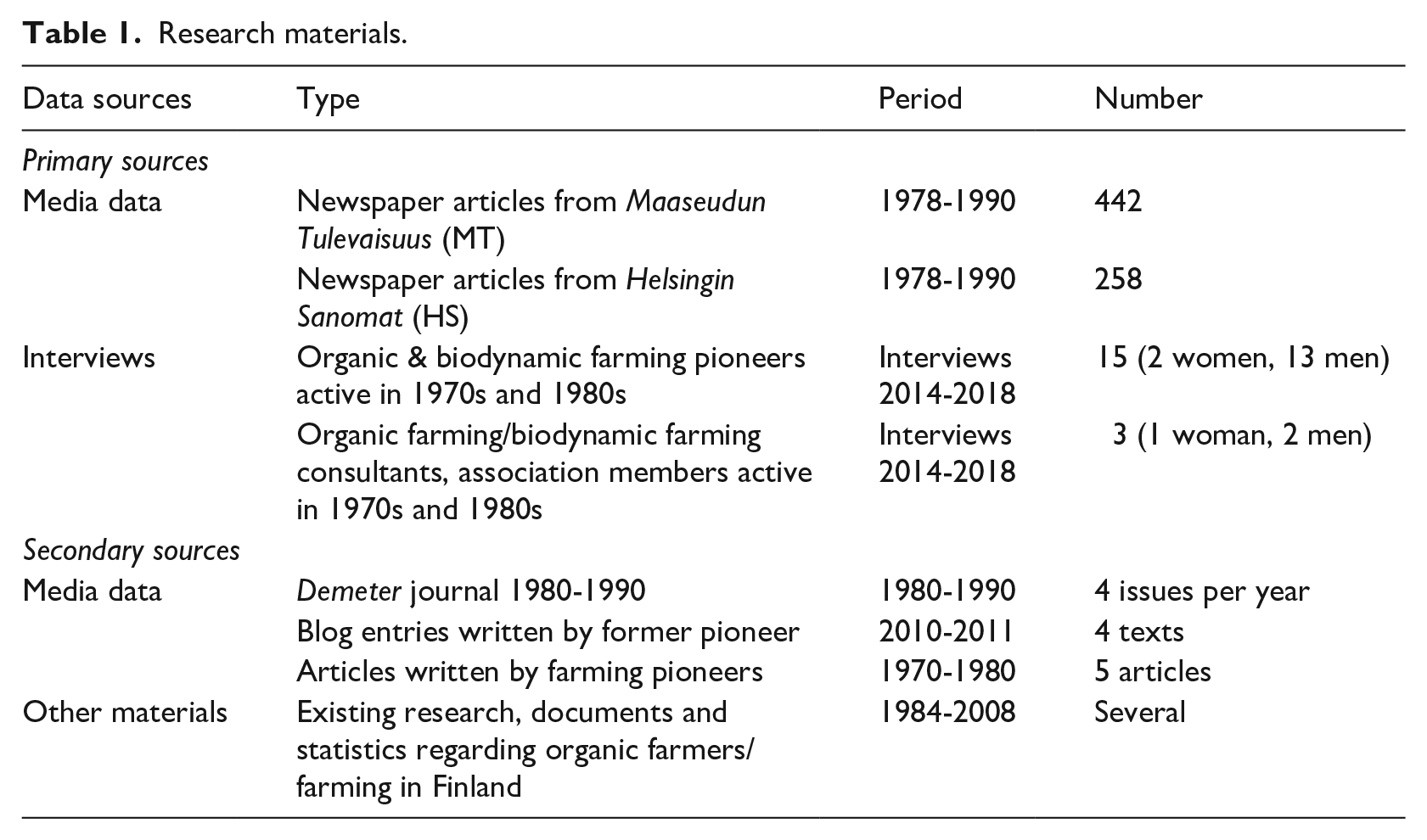
We interviewed 18 individuals who were organic/biologic or biodynamic focal actors in the early organic movement. We interviewed farmers who began farming organically in the 1970s or 1980s. We also interviewed farming advisors and former chairmen of organic associations, although the roles of association representative and farmer usually overlapped. The farmer interviews addressed five main themes: farming history, motivations for converting to organic methods (if they had previously farmed conventionally), experiences from converting, organic farming processes, and farmer identity (as an organic farmer). For those who did not have a prior farming background, the interviews followed a looser structure, focusing on the development of organic farming and the obstacles to it, turning points, and evolution of the movement. All the interviews were recorded and transcribed verbatim.
Analysis of the research materials
Determining how and why categories evolve requires a focus on the use of words and on communicative exchange among market participants over time (Grodal & Kahl, 2017). We first analysed how various discursive practices constructed the organic farming category meanings. We read the entire body of news media data and developed a coding structure for the data. We coded for conceptual choices and labels (e.g. natural, biodynamic) used to write about organic farming, because labels are vital for the meaning of the category (Granqvist et al., 2013). We further coded for arguments used for or against organic farming, because arguments are vital in building (dis)approval (Fairclough, 1995). Lastly, we traced the attributes attached to organic farming, because attributes constitute a core issue in stigma building or reversal (Goffman, 1963; Helms & Patterson, 2014).
After mapping all the terms used to describe organic farming from each article, we noticed that biodynamic and natural farming were initially the most common labels used. However, over time, use of the biodynamic label reduced significantly. We identified a clear marker for change in 1988, as illustrated in Figure 1. At this point luomu, an abbreviation for luonnonmukainen (organic), became a popular label. As shown in the figure, the appearance of luomu contracted the use of all other labels used to describe the category. The luomu label became a prototypical signifier for organic farming methods and, to date, it continues to be the term used in Finland for organic farming.
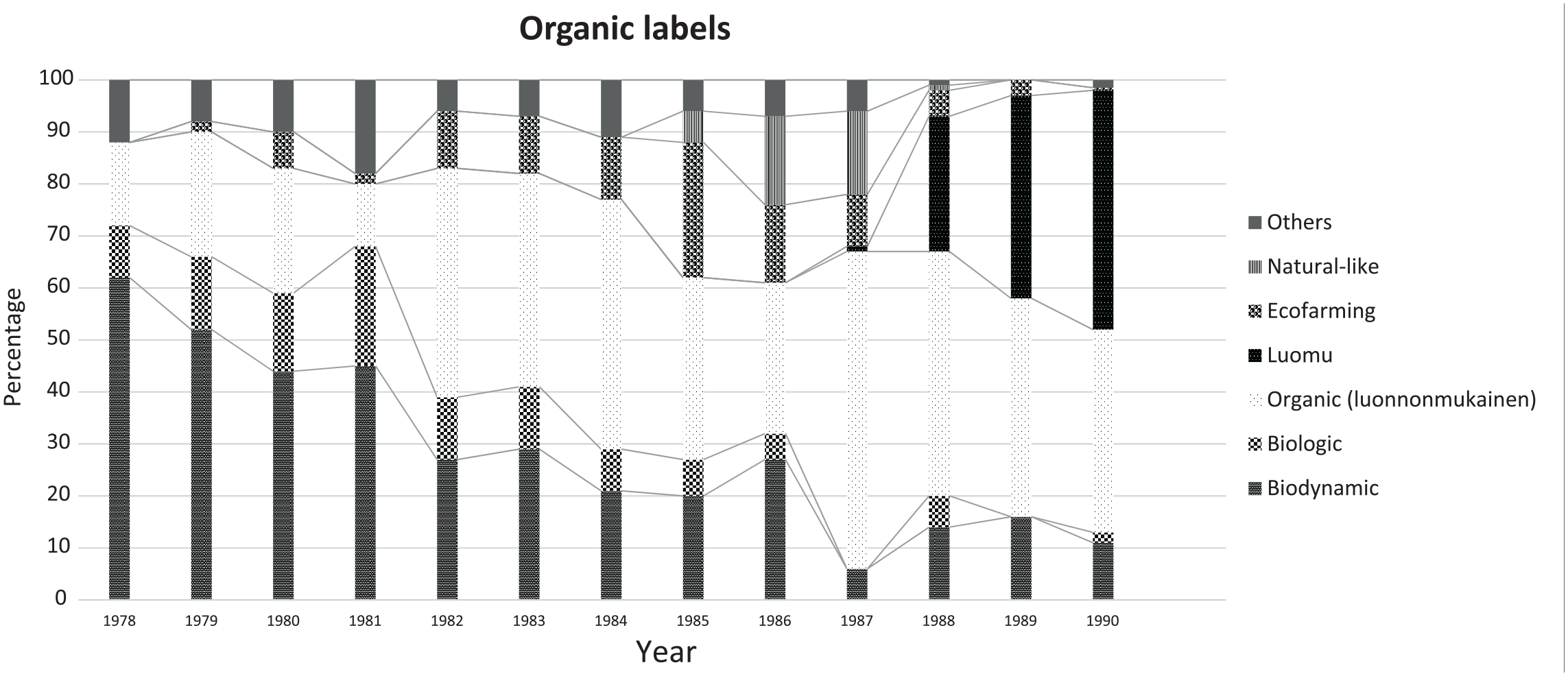
Organic labels used in the media.
Second, we analysed the mobilization of attributes, the vocabulary used and the argumentation style from the newspapers. The guiding questions were: How is the meaning of organic farming constructed in the text? What does it include or exclude, and how? Whose interests are furthered by the discourse, and whose are not? We further identified who spoke in these discursive instances. Although it is impossible to trace all the producers of the discourses as the news stories sometimes appeared without attribution, organic farmers commonly used their names in opinion pieces. We focused more on those articles in which the author, the person interviewed, or the journalist were identifiable, although we also analysed anonymous texts. We noticed that stigmatizing discourse most often originated from conventional farmers, journalists, scientists and representatives of the chemical industry. In contrast, destigmatizing discourse originated from organic farmers, consumers, journalists and scientists.
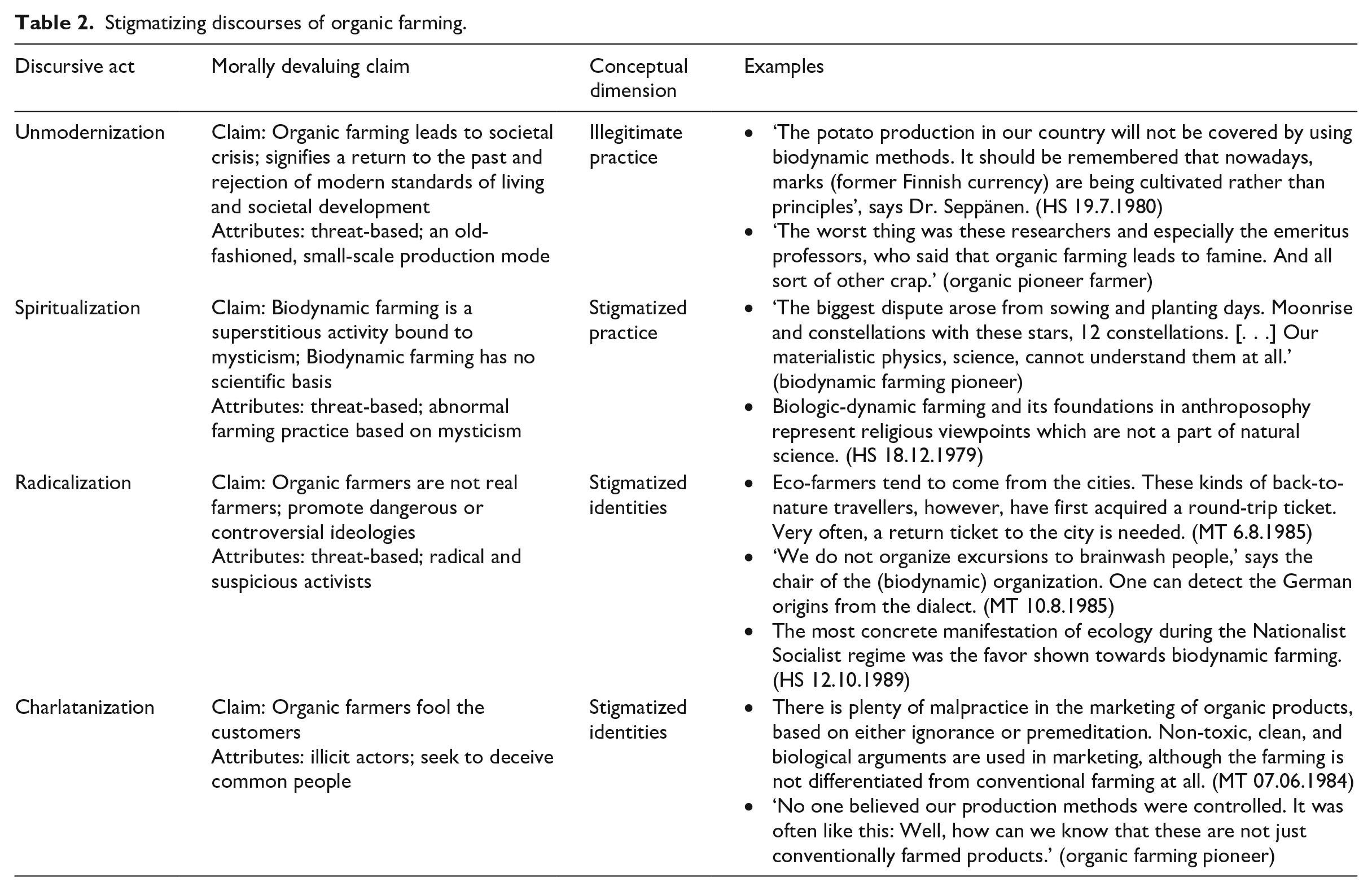
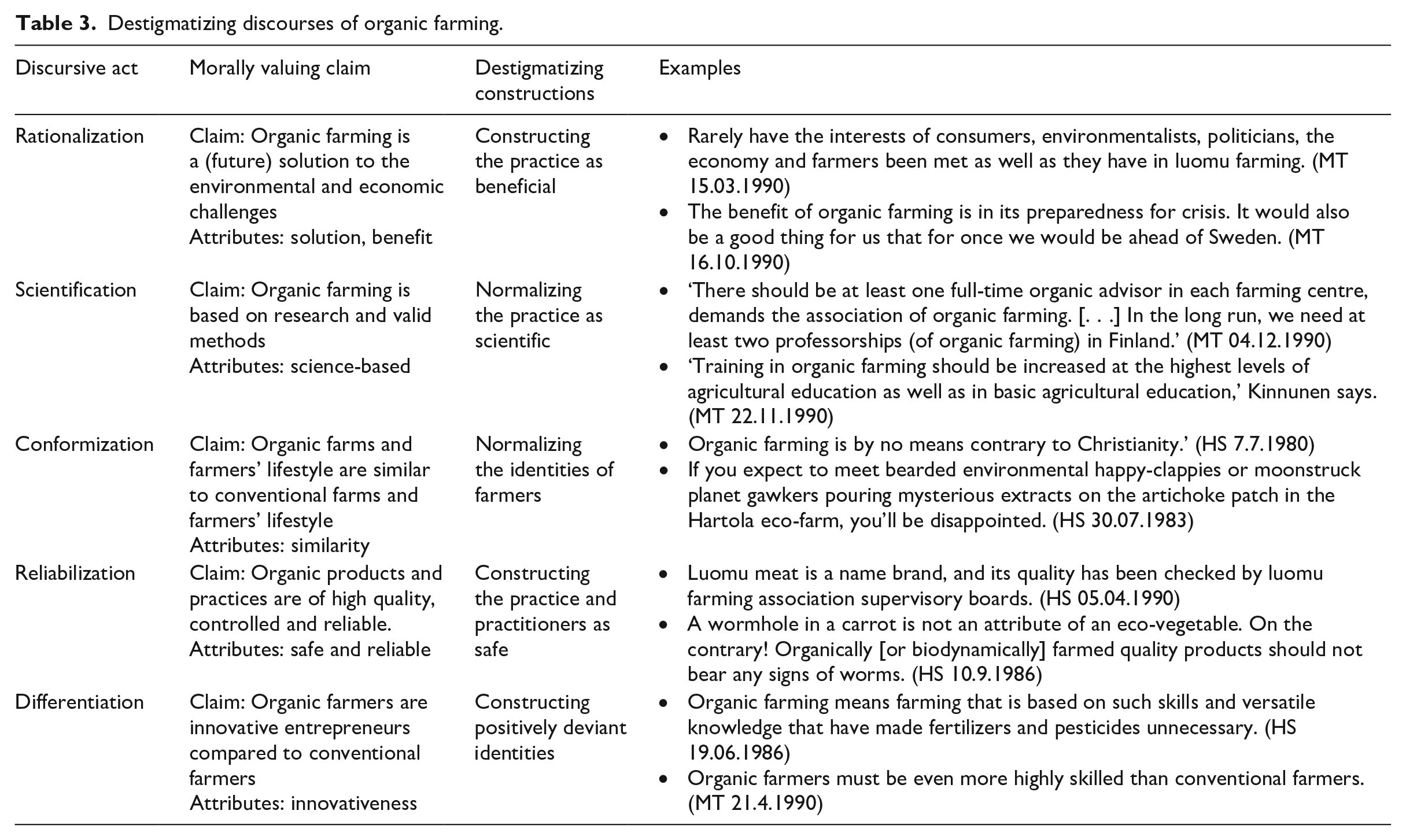
Drawing on the analysis, we reconstructed four stigmatizing discursive practices (according to their frequency of occurrence), namely unmodernization, charlatanization, spiritualization and radicalization. These discursive practices constructed organic farming both as illegitimate and stigmatized. 2 The discursive practices used to contest stigmatization, according to their frequency of occurrence, were rationalization, scientification, reliabilization, conformization and differentiation. The discursive practices are illustrated in Tables 2 and 3. In addition, the dynamics of stigmatizing and destigmatizing discursive practices are elaborated in Figure 2.
Stigmatizing discourses of organic farming.
Destigmatizing discourses of organic farming.
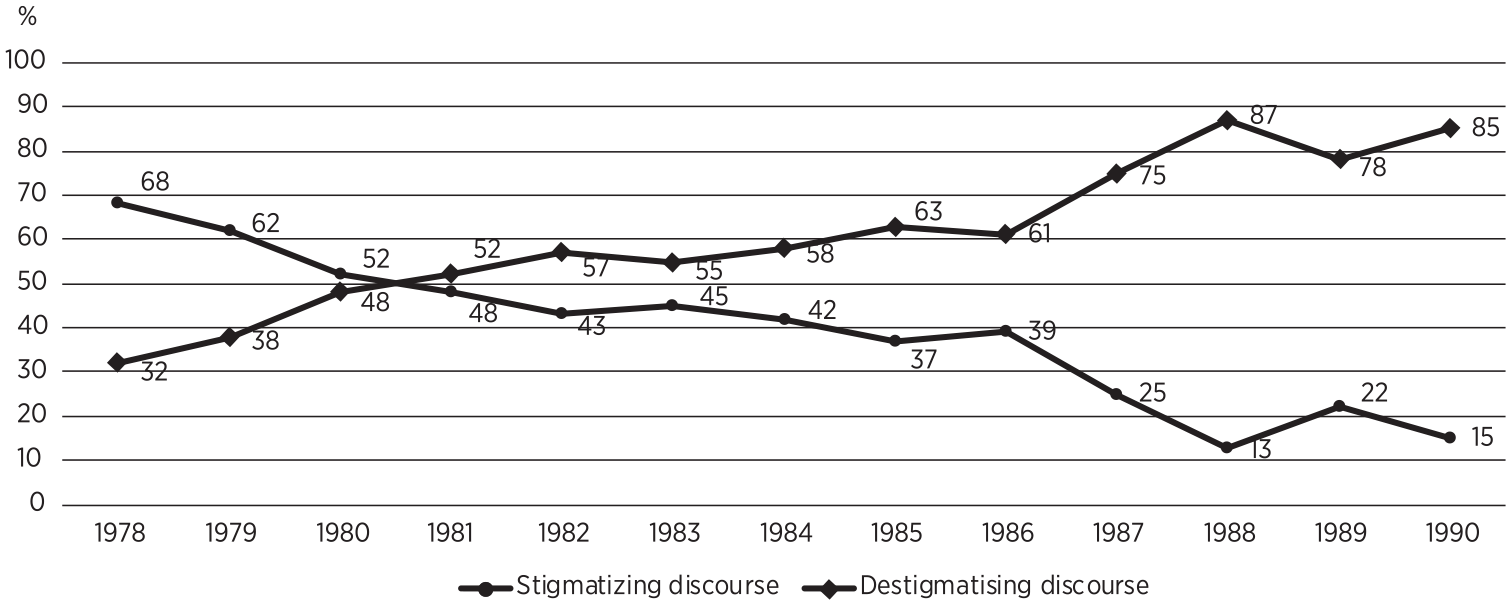
(De)stigmatization dynamics in the media data.
The frequency of various destigmatizing discursive practices varied over time in particular. Conformization was most observable in the early and mid-1980s. Rationalization and scientification were viable throughout the 1980s. Reliabilization and differentiation emerged particularly after organic farming was renamed luomu. Furthermore, we analysed the interview data in order to understand why the name change took place. We found that while the community rose to contest stigmatization coordinated by a few key players, manipulating the name of organic farming was driven by the organic farmers themselves. The group was quite clearly divided into biodynamic and organic farmers who struggled over shared meanings. We then traced how biodynamic farmers labelled themselves by analysing stories in the biodynamic farming association magazine Demeter, and found that they used biodynamic signifiers and not the discourse or label of organic farming.
Based on these analyses, we used temporal bracketing and organized our findings on a time line into adjacent periods (Langley, 1999). We paid specific attention to how the symbolic boundaries of organic farming were reconstructed through discursive means and how the boundaries of organic farming were associated with contextual changes in organic farming. We identified three phases of boundary construction; these structure our findings section.
To ensure that our interpretations were sound and our analyses robust, we iterated the interview materials, newspaper stories, Demeter articles, existing research, blog entries and other news materials. We compared the discursive practices in the media and those present in the interview materials, also juxtaposing our analysis with existing research on discourse (including linguistic and visual means) and changes in the social valuation of categories (e.g. Delmestri & Greenwood, 2016; Weber et al., 2008; Wry et al., 2011). To test our interpretations of the data, we also discussed the preliminary results with members of the organic farming association and pioneers at events and seminars.
Findings: From Stigmatization to a Legitimate Farming Category
In this section, we address how boundary construction enabled stigma removal. We first elaborate the discursive practices of stigmatization that addressed all types of organic farmers (including biodynamic farmers) as belonging to the same category. We then elaborate how organic farming pioneers experienced stigmatization and how they resisted it – and by so doing, reconstructed categorical boundaries.
Stigmatizing organic farming
The early representatives of the organic movement perceived that conventional farming was not sustainable and something had to be done about it. The pioneers criticized conventional farming practices, particularly the use of chemical fertilizers and pesticides, and regarded the latter as ‘toxic’. The farmers argued that land can and should be kept fertile using natural, organic means, which would also enable production of ‘pure food’. These arguments led to disputes between organic farmers and key audiences including academics, the farming community and chemical industry representatives who began to construe the organic farming method and farmers as a potential threat to society.
In the late 1970s and early 1980s, Finland’s economy was growing rapidly, which was also reflected in improvements in agriculture and related technologies. A discourse of unmodernization originated from industrial actors, politicians, conventional farmers and scientists who constructed organic farming as the antithesis of the general trend in agricultural development. The opponents of organic farming perceived conventional farming as the standard for profitable, competitive farming whereas organic farming was generally considered suitable for home gardeners, agricultural youth clubs, or developing countries. Thus, they did not regard it as a beneficial farming practice. A common claim was that organic farming features old-fashioned labour-intensive methods resulting in poor yields. Accordingly, they portrayed organic farming as a threat to national competitiveness and food security, particularly in the hands of ‘these people’, exemplified thus: ‘Biodynamic farming does not feed the people. Without chemical fertilizers and pesticides agriculture could not feed the world’s growing population. Biodynamic farmers do not take this into account at all’ (MT 14.9.1978). ‘Organic farming cannot feed the masses. Placing our food production in the hands of these people (organic farmers) will surely lead to doom’ (MT 15.3.1981).
Opponents attacked biodynamism and its core beliefs, which were embedded in anthroposophy. Scientists used spiritualization as a discursive practice to posit that whereas conventional farming is a practice based on science and validated experiments, the practices of biodynamic farming, for example lunar-cycle planting and the use of preparations to fertilize the soil, lacked any scientific basis and were more a form of quackery. In general, biodynamism was in stark contradiction with the scientists’ values and practices: Biodynamic farming is based on biological means and so-called dynamic means. Specific preparations are used to call upon cosmic forces to aid farming. The position of the stars and moon are taken into account in farming practices. Modern science does not regard these methods as even worthy of research. (HS 14.3.1983)
Although scientists understood the differences between organic farming and biodynamic farming methods, for a general audience the difference was quite complex to perceive. Therefore, all organic farmers encountered this form of stigmatization, regardless of the degree to which they had adopted biodynamic principles.
Radicalization of organic farmers addressed their identities directly. Organic farmers were portrayed as supporters of radical ideologies and as outsiders who threatened the valued identity of the farming community. The anthroposophist principles were perceived as a threat to the modern (and Christian) rural lifestyle and identities. For example, biodynamic farmers were accused of practising occultism. As people rely on visible social cues to assess similarity or memberships, organic farmers were labelled ‘bearded men’ and ‘city farmers’, whom journalists portrayed with ironic captions such as ‘they have made it – they have survived in the wilderness’ (HS 18.11.1981).
The pioneers of organic farming were not central actors in the Finnish agricultural community. Many of them moved from cities to rural areas and lacked agricultural education and proximate ties to the farming community (Mononen, 2008). This contradicted the practices of conventional farming, in which a farm is a legacy, passed down from father to son. A farmer would then form part of a chain of generations, consisting of inherited wisdom comprising agricultural skills and adherence to certain cultural, traditional and social norms. One front man of the organic movement described the feeling of being an outcast: ‘Frankly speaking, other farmers shied away from me and avoided my presence. It [biodynamic farming] was considered witchcraft because of the preparations used’ (organic farming pioneer).
The moral threat of organic farmers was amplified discursively through charlatanization, which depicted organic farmers and merchants as portrayers of deliberately fabricated falsehoods as truths. These discursive means personalized and concretized the risk for consumers. In the early 1980s, only limited standards and control existed for organic farming. In contrast, the biodynamic farming association controlled and monitored biodynamic production practices and awarded the Demeter label for certified biodynamic products. However, most farmers involved were not farming in a purely biodynamic fashion and could not use the label. Both organic and biodynamic farming methods were nevertheless perceived as ‘uncontrolled’ and were accused of seeking ‘to deceive the people’ (HS 1.12.1981), as a representative of the chemical industry claimed. The products produced through conventional and organic farming might look alike, and consumers were in danger of being overcharged for conventional products that were allegedly organic: ‘The markets for organic farming products are still completely wild; there is no official governance system and consumers need to trust what sellers or farmers say’ (MT 28.5.1983).
To sum up, because of the ambiguity of meanings in this early stage of category development, stigmatizers depicted both organic and biodynamic farming as harmful and illegitimate. Moreover, they produced stigmatized identities for both organic and biodynamic farmers.
Resisting Stigmatization Through Category Boundary Construction
We uncovered three phases crucial to the destigmatization of organic farming. The first phase comprised categorical contraction; the organic farming category was relabelled and the stigma was diverted to address biodynamism and anthroposophic ideology, which were then excluded from the organic farming category. The second phase comprised category assimilation, where organic farmers adopted a legitimate vocabulary for the practice and normalization of the identities of organic farmers through strong references to conventional farming. Dominant discursive practices were rationalization, conformization and scientification. The third phase consisted of categorical differentiation, emphasizing how certification and control of organic farming practices were different from conventional farming, and distinguishing the identities of organic farmers from those of conventional farmers. Dominant discursive practices were differentiation and reliabilization. We now elaborate these phases and their role in the destigmatization of organic farming. Table 4 sums them up.
Phases of boundary construction.
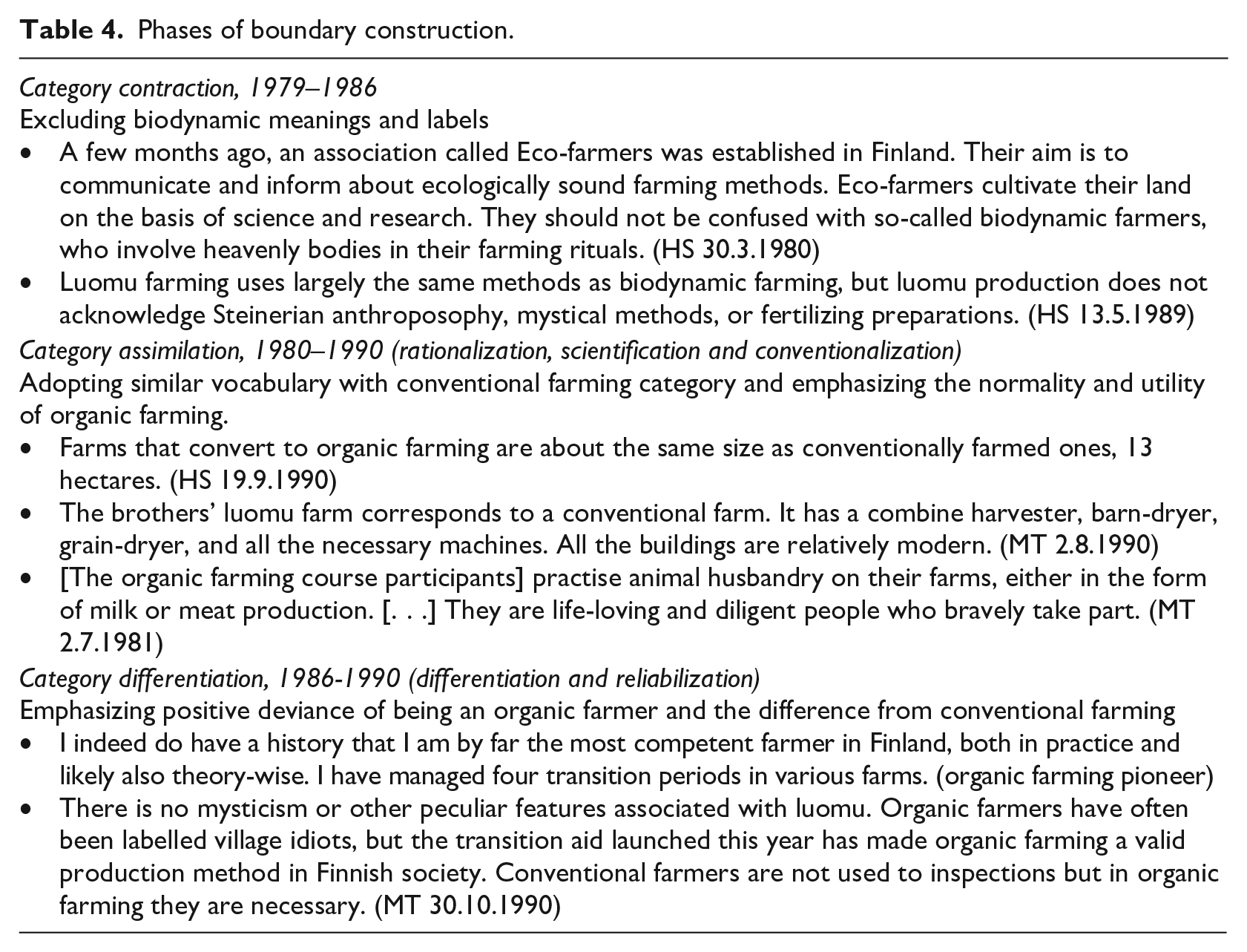
Category contraction by relabelling the organic farming category, 1979–1986
In the early stages, organic farming had several labels, as illustrated in Figure 1. Stigmatization had focused particularly on the symbolic features of biodynamic farming. As a result, a split occurred in the organic movement between those who labelled themselves biodynamic farmers and those who did not. This was concretized through establishment in 1979 of a new association, Eco-farmers. Eco-farmers sought to act as a gatekeeper for organic farming meanings. Accordingly, they began to exclude biodynamic farming from the prototypical definitions of the organic farming category. A member of a biodynamic farming association had the following to say about the establishment of the eco-farmers association: In the beginning, the situation was that everyone who farmed organically adopted biodynamic principles to a certain extent. The Eco-farmers organization was founded by those who shied away from preparations and anthroposophy. Certain pioneers of organic farming fanatically opposed biodynamic farming, many probably due to their [Christian] family backgrounds. (biodynamic farming representative)
With the founding of the new association and launching of a novel label, eco-farming, explicit boundary construction began within the community of organic farmers. The Eco-farmers association sought to separate their identities from anthroposophical connotations and methods and began at the same time to divert the stigmatizing attributes to biodynamic farmers. A central actor of the Eco-farming association discussed the relabelling as follows: [The relabelling] helped because then we were not confused so much . . . because for some, biodynamic farming was a confusing matter. Some of the things they said [referring to anthroposophy] were a problem for us, for being taken seriously. (organic farming pioneer)
Eco-farmers’ ideas gained favourable treatment among political decision-makers, enforcing the marginalization of biodynamic farming. For example, in 1984, the Organic Farming Commission, a committee set up by the Ministry of Agriculture and Forestry, proposed a new regulation that would restrict any references to organic farming methods in marketing from products other than those of ‘organic (luonnonmukainen) farming’. The Biodynamic Association intervened because they believed ‘the purpose was to prevent the mentioning of Biodynamic cultivation’ (MT 12.2.1984). One of the frontmen for biodynamic farming recalled the era of the early 1980s as follows: When they [referring to certain organic farmers] discussed organic farming in public they did not talk about biodynamic farming. They remained silent about it, even though many of the farmers were still farming biodynamically. And in academia, the professors were completely silent about it [biodynamic farming] to avoid accusations of heresy. (biodynamic farming counsellor)
The relabelling process was characterized by power struggles within the community rather than being a joint endeavour between eco-farmers and biodynamic farmers. Biodynamic farmers had no need for a new label, which on the contrary was in the interest of eco-farmers. However, eco-farming failed to become the principal label for the category in the media, which continued to employ multiple labels for the category. Because of these complexities, in 1985 the magazine of the Finnish Association of Academic Agronomists launched a readership competition to relabel organic farming. This resulted in 31 label suggestions. After a careful vetting of proposals, the judges selected the term natural-like farming (luonnonomainen) as the winner because they perceived it to best represent what organic farming is about – imitating nature, and taking into account the natural cycles of nutrition and plant growth (Mononen, 2008). The label was used for a year throughout the media but it vanished quickly as both organic farmers and industry actors argued that it confused the field even more, allegedly implying that ‘conventional farming was unnatural’ (organic farming pioneer).
In 1987, a further relabelling attempt took place. Eco-farmers promoted a new Finnish word for organic farming, luomu, an abbreviated and more functional form of the luonnonmukainen (natural) label. In 1988, the new luomu label already appeared alongside this most commonly used label, familiarizing the larger public with it. The word luomu was new to the Finnish language and was untainted by any previous connotations. Thanks to its resonance, it became the key signifier of this category. A pioneer organic farmer discussed these labelling attempts: There was also plenty of resistance towards the terms. Generally speaking, the concepts used for organic farming were complex. Then, ‘luomu’ was proposed by one key member and it sounded good [. . .]. We even tried to copyright it later, but the process took years and then the authorities said that the word had already become too conventional. (organic farming pioneer)
‘Luomufarmers’ – largely the same as ‘Eco-farmers’ – continued to construct an explicit difference between biodynamic and their own farming practices by using this new label. Biodynamic farming was not associated with luomu either in the mainstream media or in the media outlets of biodynamic farmers. Formal advertisements for aid to convert to organic farming (the transition support scheme, officially called Luomu-Aid) were the only exception. Even though organic and biodynamic farmers remained in contact, the relabelling process defined membership in the category by symbolically excluding biodynamic farming from the organic farming category.
Category assimilation by adopting a legitimate vocabulary for the practice and normalizing organic farmers, 1980–1990
The aim of the aforementioned category contraction and label changes was to exclude the biodynamic label from organic farming. However, as the general public had associated organic farmers with biodynamism, the stereotypes remained. The discourse surrounding organic farming thus needed to change. After the establishment of the Eco-farmers association, organic farmers began to use largely the same vocabulary as conventional farming, referring to farm size (hectares), exports, markets, machinery and research. The proponents produced a new discourse that portrayed organic farming as a programme for sustainable social change while at the same time offering business opportunities. In addition, their efforts were supported by a few important societal initiatives.
Rationalization was the most common legitimating discursive practice used in the media by organic farmers and journalists. In rationalization, organic farming offered a modern and economically viable solution to overproduction, reducing traces of pesticides in agricultural products, and addressing contemporary and future food and energy crises. The discourse constructed organic farming as a profitable and beneficial market category that served everyone’s interests, reversing perceptions of organic farming as an unmodern, harmful practice as the following quote exemplifies: Finland has all the potential to be the first country in the world to convert to organic farming. Today, organic farming by no means signifies a return to the past. Organic farming is a humane solution that has both economic and environmental benefits. (HS 16.11.1990)
Organic farmers further sought alliance with the stigmatizers. They attended farming conventions where they rationalized the benefits of organic farming even to representatives of the chemical industry. The ideological differences between conventional and organic farming were downplayed and the difference was presented as merely about the use of pesticides and chemical fertilizers. In the quote below, an organic pioneer gave a speech at a conventional farming exhibition, emphasizing the market potential for chemical companies: According to Schepel, Kemira (a state-owned chemical company) has also discovered that organic is not its enemy. Kemira can sell organic farms large amounts of biotite, crude phosphate, trace minerals, lime, slag, and other slow-release fertilizers. [. . .] at the end of his passionate speech, Schepel said that now you can start mocking me, but he got the loudest round of applause. (MT 16.10.1990)
Scientification was a discursive practice used by both organic farmers and researchers to persuade audiences that, in contrast to biodynamic farming, organic farming relies on scientific methods. It singled out the stigmatizing claims of pseudo-science to address biodynamism, and extended the boundaries of organic farming towards conventional farming. The scientification was supported by extensive university projects that sought to compare conventional and organic cropping systems and self-sufficient crop rotation in the 1980s. The establishment of the Partala Centre for Rural Development in 1985 was an important milestone for research on organic farming. The centre had a focal role in efforts to convince that modern organic farming sought to build its principles and methods on scientific foundations, similarly to conventional farming. In addition, universities established new programmes and courses and the organic farming association promoted initiatives to establish of organic farming professorships and training in different educational institutions.
As organic farming and particularly the luomu label grew in popularity, some biodynamic farmers also began to associate themselves with the luomu category in the media. However, there was a trade-off in such a portrayal. The vocabulary used by these biodynamic farmers for this purpose accentuated research, instead of anthroposophy.
He perceives himself as a biodynamic farmer but the difference is so small that one need not argue about it. [. . .] ‘Luomufarming requires hard work and keeping up-to-date with developments and research in the field,’ he emphasized – refuting at the same time the old understanding that organic farming is just harkening back to old and worn-out farming and production methods. (MT 3.4.1989)
Over time, the change in discursive practices also contributed to a change in the practice of organic farming. Organic farming methods needed to be beneficial and validated in order for the rest of the farming community to accept ‘organic folk’ as true farmers. This meant that certain methods gained acknowledgement as viable organic farming practices (e.g. crop rotation) while others vanished from the discussion and use (e.g. preparations). In the media, an organic farming teacher explained the work to change both beliefs and practices as follows: ‘When I meet farm owners, I don’t discuss astronomy with them. I prefer talking about the wise use of manure and peat as well as crop rotation. There is a need to break down the prejudices against organic production. This can be economically viable,’ Lumme says. In addition to teaching the eco-course, he runs a 10-hectare farm with students. ‘Potatoes are our cash crop. Our production is the same as conventional production.’ (MT 12.11.1988)
In the mid-1980s, a few rural communities were ahead of their time and branded themselves as eco-municipalities to build a new type of community spirit, tourism, production methods and lifestyle. Organic farming was suggested as a possibility for sustaining the livelihood of remote areas. These eco-projects and health-driven municipalities announced that only non-polluting industry fits with the area (HS 19.7.1983). The eco-municipalities gained widespread interest in the media, particularly in the form of farm and household visits. Conformization discourse, produced predominantly by journalists, sought to persuade audiences that organic farmers and their farms and families did not differ significantly from conventional farmers. Stories on visits to organic farms were an important feature in newspapers. Interestingly enough, these stories were not so much about farming as about who the people were. Organic farmers and their families were portrayed as behaving like normal families (they greet guests on their arrival) and they fit the idea of a nuclear family (husband, wife and children), instead of being a group of young urban bearded hippies living in a commune: The visit began the same way as elsewhere in Finland: when the bus stops, the host family, the farmer, his young wife, and their children of four and seven years, meet the guests. Everybody greets one another, even the children. Hence, the next generation also learns manners. (MT 2.7.1988)
By such means, the lifestyle of organic farmers was associated with socially acceptable rituals that adhered to the norms of mainstream Finnish farmers. This discursive move then related the group to broader, established categories of people in the farming community. In addition, organic farming began to attract attention among farmers planning to convert from conventional to organic farming. In these portrayals, it was common to mention stigmatizing attributes and then deny their truthfulness: ‘The farmer, like his thirteen course mates, has a realistic attitude towards luomufarming. For them, luomufarming is not occultism but a realistic production alternative that must be profitable, like conventional farming’ (MT 21.4.1990).
Without knowledge of both the previous and the ongoing stigmatization, these types of arguments would not have been newsworthy. However, they contributed to the normalization of organic farmers identities.
Category differentiation by standardizing the practice and distinguishing identities, 1986–1990
One of the key aspects in stigmatizing organic farming had centred on portraying the main actors as untrustworthy due to their lack of standardized farming practices. The first main task of FAOF was to develop a common label and guidelines for organic farming. The establishment of the luomu label and organic farming logo (ladybird logo, first established locally in 1987) guaranteed that producers were members of the organic farming association and their production methods were monitored through regular farm inspections. In addition, the establishment of standards differentiated organic and biodynamic farmers – the latter having the Demeter label. Standards clarified the boundaries of organic farming, and organic farmers began to embrace their difference from conventional farmers, turning their formerly peculiar features into respected identity markers.
Reliabilization was a counter-discourse to the stigmatizing charlatanization that had branded organic farming and farmers as risky and dangerous. In reliabilization, audiences were continuously informed that organic farming was disciplined, monitored and safe. ‘Farms using the ‘Ladybird’ logo are monitored, which guarantees that their products fulfil the requirements prescribed for organic (luomu) products’ (MT 11.10.1988). Newspapers ran stories of this type informing readers about the safety and reliability of organic products. The texts contributed to increasing the familiarity of the luomu label and knowledge of the regulations of organic farming among the broader population. The new standards for their part enforced luomu as the prototype label for the organic farming category. The luomu label and standards were enforced through establishment of the transition support scheme, which marked acknowledgement of organic farming by the government.
One of the most crucial tactics from the stigma removal perspective was that journalists and the organic farmers themselves reconstructed the identity of farmers in the media. Differentiation, countering radicalization, was a discursive practice that portrayed organic farmers as different from conventional farmers because of a unique quality – an innovative, knowledge-driven and entrepreneurial spirit. Whereas the earlier stigmatizing portrayals constructed organic farmers as unskilled hobby farmers practising witchcraft, differentiation resulted in individualizing stories of ‘heroic’ organic farmers emphasizing how they had, through trial and error, succeeded in applying luomu methods. Contrary to conventional farmers, they had not forsaken the art of decoding the subtle signs embedded in plants and the soil and portrayed themselves as the most skilful farmers. This image of the tenacious farmer constructed them as individuals with sisu (perseverance), a psychological attribute of mental toughness with significant cultural meaning and value in Finnish culture. Thanks to their perseverance, organic farmers had become strategic and knowledgeable actors who renewed the traditional skills of their farming ancestors, repurposing them for the modern era by displaying unique, extraordinary innovativeness: The farm has been practicing organic farming for twenty years. Enthusiasm and knowledge increased in biodynamic cultivation courses. He was also involved in seeking knowledge and experience from Sweden, where organic farming has been studied much more than in Finland. However, the best knowledge is gained by testing things on your own farm. A big pile of money has been sunk into the accumulation of information. He estimates that he has spent 1 million Finnish marks doing research and tests on his own farm. A balance has been struck on the farm through trial and error. Mistakes were made in the beginning when he thought the whole farm could operate in an organic fashion. ‘That’s how we almost went into bankruptcy. We found that only a part of the farm can be farmed organically. Another part of the farm should be cultivated in a conventional way.’ [. . .] He says, with satisfaction, that he has noticed a change in attitudes towards organic farming. ‘Initially, mistakes were made when biodynamic farming was promoted as a new religion. We now [operate] on more rational lines.’ (MT 1.4.1989)
As the previous quote shows, some organic farmers also farmed in conventional ways, which at the time was possible.
3
Hence, they were not fanatics, but had mastered and accepted both methods in their farming. In the interviews, organic farming pioneers actively construed their identities through differentiation. They engaged in self-regulation of what it means to be an organic farmer. Even though they perceived themselves as deviants at the time, deviance for them was a sign of uniqueness and of the knowledge and courage to do things differently and to confront their stigmatizers: People were always laughing at us. They made jokes and mocked us and things like that, but it never depressed me. It was not like that, nothing that would have made me quit organic farming. On the contrary, it merely gave me a boost. (organic farming pioneer)
Stigmatization then acted as a source of empowerment, and success in developing organic farming methods encouraged the farmers to confront stigmatization. Heroic farmers became exemplars of the emerging category, and produced culturally valued identities for the organic farmers.
Model for Stigma Diversion Through Symbolic Boundary Construction
Drawing on the extensive analyses, we developed a model of nascent category destigmatization through stigma diversion. The model is summarized in Figure 3 and is organized around three phases. According to our findings, phases one and two in particular are likely to overlap.
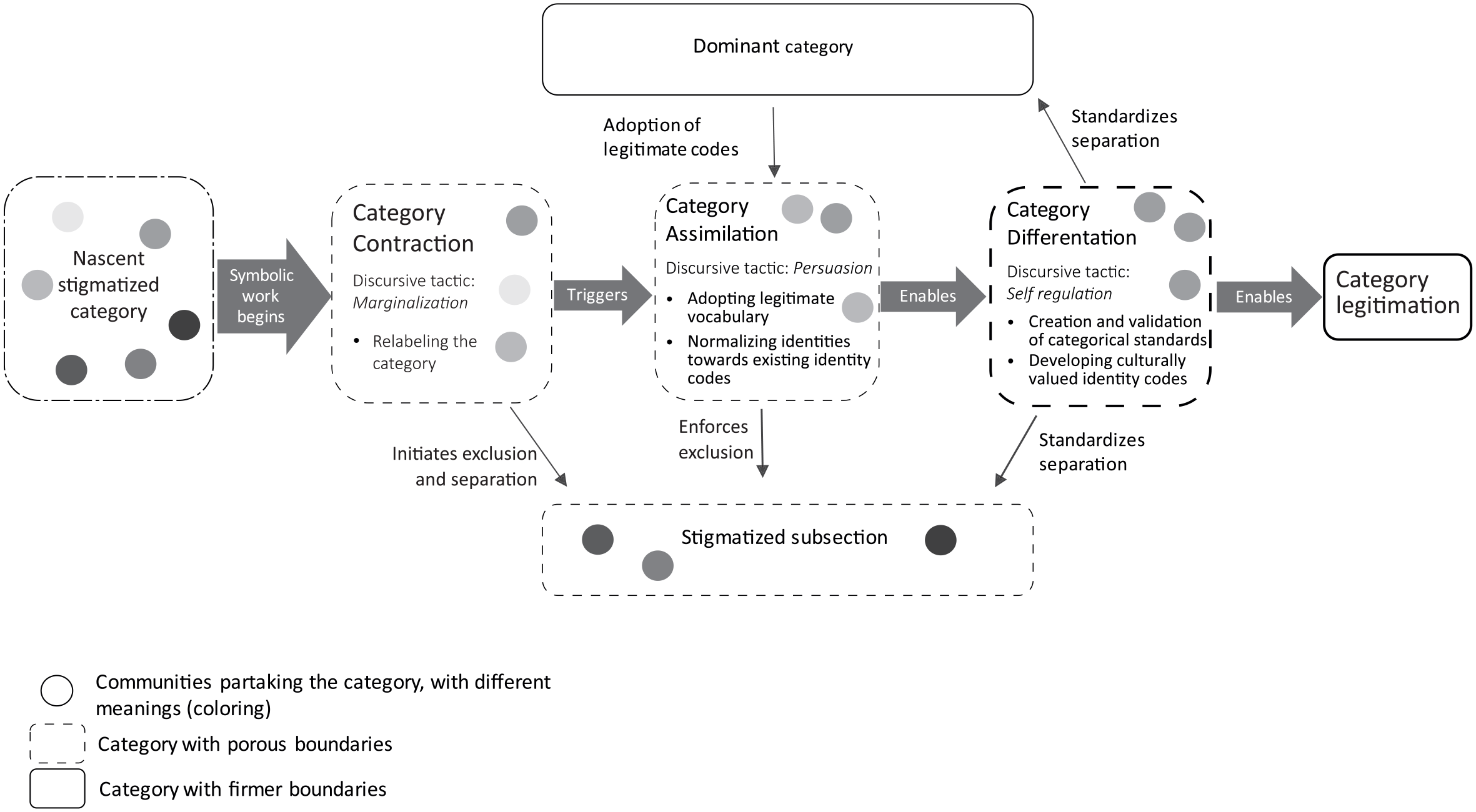
Destigmatization through stigma diversion.
Our model begins in a situation where a nascent category features multiple labels, dubious practices and tainted identities. The first phase, category contraction, diverts the stigma as a feature of particular community and practices. Stigmatizing attributes are constructed as a commonality of a subgroup and the main label is manipulated so that it no longer carries the previous core stigmatizing connotations. A relabelling process initiates the exclusion of the core stigmatized meanings (identities, labels and practices). The second phase is category assimilation. In this process, category boundaries are extended towards legitimate categories. The stigmatized community takes advantage of the notoriety it has received and persuades audiences by adopting legitimate vocabulary and normalizing identities. At the same time, an explicit difference from the community to whom the stigma has been diverted is reinforced. In the third phase, category differentiation, symbolic boundaries are once again narrowed. The difference from other similar types of categories is enforced through standardization and adoption of distinct identity codes that signal culturally valued qualities. Cumulatively, the three phases show how members of a nascent category resisted stigmatization and provided the foundation for organic farming to be considered a legitimate category of farming.
Discussion and Conclusions
We set out to examine how members of a nascent category can confront and resist stigmatization. Drawing on an in-depth study that used novel methodologies to category research, we explore the discursive processes by which actors engage in symbolic boundary construction. The outcome of our analysis is a process model depicting how nascent categories can move from stigma to legitimacy through stigma diversion. We now discuss our main contributions.
Stigma diversion and the construction of symbolic boundaries
Previous studies have mainly explored how organizations cope with stigma or seek to dilute it (Durand & Vergne, 2015; Helms & Patterson, 2014; Hudson & Okhuysen, 2009; Vergne, 2012; Wiesenfeld, Wurthmann, & Hambrick, 2008; Wolfe & Blithe, 2015). Only recently have studies begun to address how an organization can eradicate the stigma and move to legitimacy (Hampel & Tracey, 2017). Our main contribution to the latter discussion is to show how a nascent category with multiple organizations and communities may move from stigma to legitimacy through stigma diversion. Stigma diversion is a process of demarcating the core stigma as an attribute of a particular subgroup, and then actively excluding these meanings from the symbolic boundaries of the broader category. Actors simultaneously engage in discursive work including relabelling the category and reconstructing the core meanings and identity attributes that provides means to legitimate the category. Stigma diversion goes beyond being a mere impression management tactic (Sutton & Callahan, 1987) as it shapes core meanings and identities and has an impact on actual practices. Furthermore, stigma diversion is different from a singling out process – addressing scapegoating and producing a negative evaluation of an isolated person or an organization (Wiesenfeld et al., 2008) as singling out does not force the organization(s) to redefine their core meanings. Stigma diversion is thus a further key means to resist stigmatization.
Previous studies have shown how labelling plays a major role in category emergence, which is often a process of trial and error where various labels are tried out (Granqvist et al., 2013). Studies also show that relabelling is a crucial element in stigma removal (Duminy, 2014; Glynn & Marquis, 2004). We add to these understandings by showing how relabelling initiates stigma diversion within the category by constructing a boundary between the partaking communities. The relabelling of organic farming enforced separation within the different farming communities, but also provided initial means for disentangling attributes and stereotypes from the core meanings by adopting labels that were free of stigmatizing connotations.
However, label change is not simply a viable stand-alone mechanism but only one aspect of the work of defining what the category is, and is not, about. Our study shows the necessity of longitudinal discursive work in stigma removal. Even though stigma is a relationship between an attribute and a stereotype (Goffman, 1963), we find that mere exclusion of core stigmatizing attributes does not yet remove the negative stereotypes associated with the category. More specifically, while relabelling excluded the core tainted attributes (e.g. anthroposophy) from the category, it did not yet remove the stereotyping identities and practices (e.g. non-Christian and unskilled hobby farmers). For a nascent category to remove the negative stereotypes and to gain legitimacy, we find that stigma diversion requires discursive work sharpening the raison d’être of the entire category. Assimilating first with the conventions of the main stigmatizing audience can be helpful. This is because stigma targets subcultures whose values and ideologies run counter to what is considered normative in the broader culture (Kosut, 2006). It is therefore crucial to identify who the stigmatizing audiences are and evaluate their key principles, identity norms and practices.
The use of specific in-group language of the dominant community can communicate a sense of in-group belongingness as well as promote out-group differentiation (Elias & Scotson, 1994). For organic farmers, adopting a similar vocabulary with the mainstream farming community was not then only a means to portray the practice as familiar and legitimate; it was also a means to associate organic farmers as a part of the established farmers’ community and further enforce the disassociation of organic farmers from biodynamic farmers and the related negative stereotypes. Our results are in line with Hampel and Tracey (2017) in the sense that emerging stigmatized organizations seek to portray themselves as beneficial and persuade audiences by adopting legitimate codes embedded in more familiar organizations. However, beyond seeking associations with the legitimate community, we uncover that in nascent categories engaging in stigma diversion this discursive work needs to address the grievances of multiple organizations and communities simultaneously, while at the same time establishing separation from those who continue to embrace the stigmatizing attributes.
Category notoriety and identities of the actors
Research on stigma emphasizes its negative consequences, such as withdrawal of social support (Hudson, 2008) and tarnished identities that lead organizations to foreswear their connections with the category (Durand & Vergne, 2015; Piazza & Perretti, 2015). While this is without doubt true in many cases, our study posits that stigmatization may also have positive consequences, something that Goffman (1963) has also suggested (see also Helms & Patterson, 2014; Paetzold et al., 2008). We find that notoriety followed by stigmatization offers a public platform for nascent categories to conduct identity work that paves their way to legitimacy. This public platform is something that unfamiliar, emerging categories tend to lack (Khaire & Wadhwani, 2010; Wry et al., 2011). Organic farmers benefitted from media notoriety as it created curiosity towards the category; that is, an appetite for knowledge about who such people actually are and what organic farming is all about. Hence, although secrecy can be an asset for established categories in reducing their stigma (see Vergne, 2012; Wolfe & Blithe, 2015), for many nascent categories curiosity may also be a great asset. It generates interest and may allow people to reflect their own identities in contrast to the deviants and experience resonance, and thereby offers an opportunity to see that they pose no threat (Gino, 2018).
For example, several news stories addressed visits to organic farms in which journalists familiarized themselves and their readers with organic farming and farmer families. These stories often began with stereotypical, stigmatizing portrayals. However, in the course of the story, the identities of the farmers and their families were normalized. In addition, the heroic portrayals of individual organic farmers differentiated them from conventional farmers on the basis of their persistence and ability to reinvent and innovate traditional practices. This resembles what Kitsuse (1980) calls ‘tertiary deviation’, a situation in which deviants reject a negative identity and stigma, transforming their deviant identity into something that is valued and desirable. However, it is crucial to acknowledge what kind of deviance to embrace (cf. Helms & Patterson, 2014.) Organic farmers did not embrace the stigmatizing attributes (city-farmer, spiritualist, or practitioner of occultism) but culturally valued attributes that related to environmentalism, innovativeness and perseverance.
To conclude, we found that these stories effectively destigmatized organic farmers’ identities because they individuated the key actors, whereas stigmatization deindividuated them (Devers et al., 2009). Such news stories also effectively create and disseminate prototypical identities and replace the previous stigmatized identities. This is a key aspect in legitimating a nascent stigmatized category.
Limitations and future research
Our model of stigma diversion resulted from an inductive study. Although one or few cases are generally considered sufficient to produce useful insights, our model naturally may feature moderate generality, until tested with more data in various contexts (see Langley, 1999). In addition, the processes described in the model can feature certain limitations. For example, label change may not be an option in destigmatizing established categories with regulated labels. In such a situation, the aim is to enhance the valuation of the low-status label (Delmestri & Greenwood, 2016). Product labels that are a part of a low-status category can then be used to signal the label’s difference from the rest of the category (Delmestri & Greenwood, 2016). Stigmatized nascent categories, in turn, have more leeway to distance or detach themselves from previous stigmatizing labels and to manipulate the meanings attached to the category by such means.
Our findings raise questions about how marginalized subcategories may sustain and develop in the shadows of broader and legitimate categories. In our study, stigma diversion redefined the symbolic boundaries of the category, that is, its perceived central and distinct characteristics – but did not fully redefine the social boundaries guarding access to resources (see Grodal, 2018). For example, while their core practices were symbolically excluded, the biodynamic farmers were allowed to access the category’s resources through the Luomu-aid transition scheme. Luomufarmers and biodynamic farmers further maintained contacts and collaborated to increase knowledge about organic farming and products in general. A crucial difference was that biodynamic farmers often embraced the deviant attributes and wanted to separate themselves from the mainstream, whereas organic farmers sought societal change by remaining closer to the mainstream. A potential direction for future studies is to examine how and under what conditions excluded, stigmatized subgroups are able to benefit from social boundaries (see Grodal, 2018; Lamont & Molnár, 2002; Wry et al., 2011) – having access to the resources associated to the related, more legitimate category, even when excluded or silenced.
Our study calls for further research to explore how moral (dis)approval (stigma and illegitimacy) vary among audiences and how the main stigmatizing audience affects the category development (Hampel & Tracey, 2019). A related interesting perspective in our study was the minor role that elites had in the process. In previous studies, both status change (from low to high) and stigma removal have been acknowledged as phenomena requiring elite approval (Delmestri & Greenwood, 2016; Hampel & Tracey, 2017) – or that the destigmatization process itself gives rise to new elites (Sandikci and Ger, 2010). Changing the status and moral appropriateness of mature categories may be more dependent on elite actors. In contrast, we find that in emerging categories acceptance by other market participants such as peers can play an important role. There is a need for nuanced examinations about when stigma removal processes are a grass-roots versus elite phenomenon in contemporary societies, and what implications this might have for the types and nature of discursive work with audiences.
Footnotes
Acknowledgements
We are extremely grateful to the Special Issue editors and three anonymous reviewers for their support and insightful comments throughout the process. We would also like to thank INSEAD brownbag-seminar participants and ETHOS research group members at Cass Business School for their feedback in relation to presentations of this paper.
Funding
This research has been supported by the Academy of Finland, grant numbers 296699 and 296726.