




Abstract
Although organization and management scholars are beginning to research opposition and dissent emerging in response to the global financial crisis, there are few accounts or feminist analyses of social movements and women’s mobilizations as an important part of these movements. We address this gap by considering a case of women activists opposing extractivist mining in Chalkidiki, Greece, to demonstrate their crucial role in initiating and organizing resistance within their communities. Drawing theoretical inspiration from social reproduction theory and the literature on embodied protest as a form of political action, we argue that women use diverse means to promote the politics of visibility, erasing public and private distinctions as they defend their communities’ right to live in unpolluted environments. By way of contribution, we enhance understanding of the role of affective embodiment as a foundation for activist feminist practices; develop a theory of the protesting body altering spatial relations as a means to oppose the neoliberal assault on life and environment; and suggest how this might prefigure new political practices in the context of social movements. We identify the implications of this theorization and call for academics’ deeper sustained engagement in activism.
Keywords
Introduction
Early evidence from various disciplines indicates that the neoliberal capitalist crisis and austerity politics have exacerbated inequalities for women, the poor and marginalized groups in both developed and developing countries (Floro, Taş, & Törnqvist, 2010; Fotaki & Prasad, 2015; Lehndorff, 2012). Organization studies scholarship has begun to theorize spatial forms of resistance to neoliberal capitalism (Courpasson, Dany, & Delbridge, 2017; Daskalaki & Kokkinidis, 2017; Fernández, Martí, & Farchi, 2017; Mumby, Thomas, Martí, & Seidl, 2017; Reedy, King, & Coupland, 2016). However, there are few accounts of women’s contributions to these movements (Tyler, 2019; Vachhani & Pullen, 2019), and these rarely, if at all, address embodied opposition (or struggle) in the organization of resistance (Elidrissi & Courpasson, 2019). As a result, resistance spaces possessing ‘structure and orientation by virtue of the presence of the human body’ (Tuan, 1979, p. 389; see also Butler, 2015) remain largely unconceptualized in management and organization studies. Feminist struggles and activism are at the heart of contemporary social movements (Eschle & Maiguashca, 2010). Although the body is present, and in some cases ubiquitous, in collective mobilizations and public expressions of discontent (Sasson-Levy & Rapoport, 2003), analytical questions about the ‘protesting body’ have received limited attention. Feminist geographers theorize the relational nature of space and construction of the identity of place (Massey, 2004) as an embodied and emplaced identity constituted both discursively and materially, but this is rarely used to research embodied resistance. 1 Emotional geographies also see affect as important for understanding people’s values, identities and relationships with place, for instance in this study’s context of extractive mining (Ey, 2018; Ey, Sherval, & Hodge, 2017).
To address this gap, we draw on the example of an anti-mining movement in Skouries, Northern Greece, to explore how ordinary women become activists, crossing the private–public spatial division and putting their bodies on the line in protest activities. Turning to feminist theories, practices and methodologies, the article provides an account of the feminine resisting body as ‘both spatially constituted and a constituting spatial subject’ (Young, 1980, p. 150). This study of the neglected topic of emplaced protest takes inspiration from the ideas of Silvia Federici and Judith Butler to develop a feminist analysis of embodied affectivity in the organization of resistance. Our analysis begins by using Federici’s (2004, 2012) notion of reproductive labour to focus on the lived experiences of women and other marginalized groups (e.g. rural inhabitants) who have been disproportionately affected by the global financial crisis (GFC), to explain their resistance to mining as a means of protecting their communities’ survival. Focusing on the body is also key to opposing capitalist accumulation through unpaid, undervalued and invizibilized labour of women and people of colour (Federici, 2019). Federici’s idea of multiple productive and reproductive roles performed by women within the family and community as intrinsic to the capitalist mode of production is then linked to Judith Butler’s (2015) work on the performative role of bodies gathering in public spaces to oppose injustices. We bring their ideas together to examine (i) how resistance emerges from women’s lived and bodily experiences, (ii) the role of embodiment and affect in activist political action, and (iii) the organization of protesting bodies through the expansive politicization process.
We make a novel contribution to organization studies by developing the concept of embodied affectivity to understand the prefigurative political practices of new social movements (e.g. Kokkinidis, 2015; Reedy et al., 2016; Sutherland, Land, & Böhm, 2013), and alternative solidarity initiatives emerging from the GFC (Daskalaki, Fotaki, & Sotiropoulou, 2018; Daskalaki & Kokkinidis, 2017). We achieve this by focusing on how women’s bodies resist ‘bounded spatiality’ (Young, 2005) – that is, their embeddedness within the constraints of specific time–space configurations – to examine an instance of women’s pivotal role in opposing extractivist mining. Overall, we propose an alternative conceptualization of resistance centered on socio-spatialities emerging from embodied experience and affect, and demonstrate how this might prefigure new political practices in the organization of social protests.
Our primary contribution is to the literature on embodiment and how women’s ‘othered’ body plays out in and through public space, for example in feminized work (Pullen & Simpson, 2009) and academia (Tyler & Cohen, 2010), showing how women use it to reclaim public space in the context of gendered resistance. Our second, related contribution is to offer a feminist analysis to the literature on organizing alternative social movements (De Bakker, Den Hond, King, & Weber, 2013; Parker, Cheney, Fournier, & Land, 2014; Reedy et al., 2016; Reedy & Learmonth, 2009) through embodied affectivity as a way of accounting for emotional dimensions of resistance, to extractivism specifically (Ey, 2018; Ey et al., 2017) and social movements more generally. We thus extend Vachhani and Pullen’s (2019) work on feminist solidarity in contemporary social movements combating inequality, sexual harassment and violence against women in the workplace and beyond. We also identify practical implications emerging from this theorization for activism in diverse settings, including virtual forms of organizing, and call for academics’ sustained engagement in activism (Reedy & King, 2019).
In the remainder of this article, we present the context of the study before discussing our chosen feminist approaches and analytical framework. We then explore an anti-mining activism case in crisis-stricken Greece, and theorize women’s embodied affective struggles emerging from our findings. We conclude by identifying potential areas for future research and some practical implications for (academic) feminist activism and solidarity in transnational contexts.
Background
Unlike the small-scale extraction practised by humans since antiquity, extractivism refers to economic activities that remove large amounts of a nation’s natural commons, with little or no processing, for sale on the world market, maximizing the profits of privately- (and often foreign-) owned companies while causing environmental destruction and social disruption (Acosta, 2013). Extractivist states’ development model organizes political, socio-economic and cultural relations, including economic and class structures, gender relations, and state and public discourse (Brand, Dietz, & Lang, 2016). It is based on exploiting and marketing resources for export and provides little benefit to the communities involved, increasing the countries’ dependence on continuously providing raw resources at prices determined by global markets. In addition to destroying their natural habitats and local (sustainable) economies, this dependence helps create local rentier classes or oligarchs, and increases corruption (Gudynas, 2010).
Social movements have decried extractivism, which has been implemented extensively in poor but resource-rich Latin American and other developing countries (Horowitz, 2017; Jenkins, 2014; Jenkins & Rondón, 2015; Lahiri-Dutt, 2012). Yet new ‘cost-effective’ methods have enabled extractive industries to expand from the global South to the North, particularly to sparsely populated areas inhabited by indigenous populations (Sjöstedt-Landén & Fotaki, 2018; Willow, 2016), to poorer ex-communist members of the European Union (e.g. Romania; see Velicu, 2015) and to indebted Eurozone countries such as Greece, where attracting foreign investment is a priority (Tsavdaroglou, Petrakos, & Makrygianni, 2017). Expansion of these harmful mining operations (e.g. open-cast mining using environmentally damaging cyanide), often tied to neoliberal reforms, has led to increasing opposition from affected populations (Bebbington, 2012). Our case of extractivist mining enables us to study the intersection of the GFC as a ‘state of exception’ (Klein, 2007) that has expanded the scope for expulsions globally (Sassen, 2014), and to examine how they are being resisted.
A few management and organization researchers have grappled with the issue of extractivism, offering a postcolonial critique (; Banerjee, 2000; Böhm & Brei, 2008) that highlights relations of dependency between providers and users of resources (Misoczky, 2011) and the problematic nature of corporate social responsibility initiatives in the mining sector (Mutti, Yakovleva, & Vazquez-Brust, 2012). Yet these insights focus mainly on political and institutional processes (Maher, Valenzuela, & Böhm, 2019), paying relatively little attention to how modes of resistance are influenced by (women) activists embedded within these macro-processes (Chatterton, Hodkinson, & Pickerill, 2010), and how their experiences may impact on their chosen forms of activism. Feminist researchers and activists exposed the highly gendered nature of the global mining industry advocating the rights of local communities in relation to mining companies (Horowitz, 2017; Jenkins, 2015; Mahy, 2011; for a review, see Jenkins, 2014), but this important issue has not previously been addressed in organization studies.
Historically, women have played an important but relatively unrecognized role in opposing large-scale mining developments in rural Andean communities (Jenkins, 2014; Jenkins & Rondón, 2015), Asia and the Pacific (Horowitz, 2017; Nabulivou, 2006) and Australia (Ey, 2018; Ey et al., 2017), and in challenging the expansion of extractive industries (Jenkins, 2015). Although some studies have demonstrated women’s direct involvement in mining activities (Hinton, Veiga, & Beinhoff, 2003; Jenkins, 2014), women-based groups are often at the forefront of anti-extractivist struggles (for example, the Mothers of Ituzaingó; see Leguizamón, 2019), having to combat sexism and marginalization within anti-mining movements and facing threats from within and outside their communities (Velasquez, 2012, cited in Jenkins, 2014). In the next section, we draw on feminist theory to develop a fuller understanding of embodied resistance, often pioneered by women, to the destructive consequences of extractive mining on lives, communities and the natural environment.
Analytical Framework
The proposed theoretical framework emerged from ethnographic observations during our intermittent participation in anti-extractivist protest movements in Greece over a four-year period (2011–15), and from systematic research conducted in 2016–17. Our analysis of how embodied protest is initiated and carried out brought us to Silvia Federici’s theory of social reproduction, suggesting that women’s activism is often linked to their experiences and positioning within capitalist relations of production (Federici, 2004). We bring her theorization of women’s working bodies, sustaining such exploitative relations through unpaid work and the sexual division of labour, into conversation with Butler’s ideas on the performative power of bodies in the context of political assembly. These feminist theories depart from different standpoints, but complement each other in explaining complex links of anti-extractivist resistance with embodiment and lived experiences.
Federici built her ideas of reproductive labour on Marxist analysis, documenting how long hours of work and unregulated and dangerous working conditions produce tired and unhealthy bodies (see Federici, 2004). Her focus is on women’s unpaid labour (primarily in the form of domestic labour) and sexual and child-bearing work enabling capitalist accumulation and growth (Federici, 2012). In contrast to Marx’s logic of ‘unproductive labor’, describing any activity that does not produce direct surplus value, Federici calls such embodied, unpaid work ‘(re)productive’ and considers it central to sustaining capitalism (see, for example, Fortunati, 1995, cited in Federici, 2004). The feminist Marxist intervention shows that ‘the reproduction of labor-power involves a far broader range of activities than the consumption of commodities, as food must be cooked, clothes have to be washed, bodies have to be stroked and made love to’ (Federici, 2009). Such work has historically fallen mainly to women (and colonial others), showing the centuries-long attack of capital on women and the body.
These ideas accord with the recent work of poststructuralist philosopher Judith Butler on material aspects of political action, rooted in precarious lives under neoliberalism (Butler, 2004; Butler & Athanasiou, 2013). Butler (2015) interrogates how bodies suffering from neoliberal dispossession enact their expressive capacity to resist it. Human precarity, privation and dispossession, she argues, are often determined politically and economically by forces beyond our control (Butler, 2009), calling for ‘opposition to induced precarity and its accelerations’ (Butler, 2015, p. 16). One way of achieving this is to make these concerns visible as people gather to protest in public spaces. Linking the idea of precarity with the performative power of assembly, she demonstrates how such mobilization brings out the dual life of the corporeal body for survival and resistance to social dispossession (Velicu & Garcia-Lopez, 2018). Butler thus elucidates how the plurality of appearing bodies and interrelations between them alter and create possibilities for new politics. Such new politics, emerging from the material reality of the body and its ability to be affected, disrupt the existing discourse by creating new socio-spatialities.
In short, Butler’s notion of the discursive/material performativity of bodies mattering in social spaces, and Federici’s idea of women’s embodied experiences of reproductive labour allow us to theorize on resistance originating in the body. Both feminist writers are concerned with the body’s alienation under capitalism, although they approach this from different angles. For Federici, the alienation will only cease by ending the work discipline that defines it, whereas Butler shows how the alienated body, which is a product of power relations expressed through discourses, must also be changed from within these discourses. In other words, Federici stresses the pivotal role of women’s reproductive labour in building solidarities among themselves and with other dispossessed groups (Federici, 2010). Complementing this, Butler (2017) claims that our vulnerability and precarity ‘do not contain us but expose us to a world without which our living is not possible’. The shared precarity of the body causes us to depend on others for our literal survival, and on political institutions for our social existence (Fotaki, 2017). In our analysis, we build on these two authors’ eclectic insights to develop the concept of embodied affectivity in organizing protest, causing us to reflect on the implications of our participation in the research as academic subjects, as discussed in the final section.
Next, we contextualize women’s struggles in the recent capitalist crisis (the GFC) in Greece, to explain how they reorganized spaces of resistance within an anti-mining movement.
The Study Context: Neo-extractivism in Crisis-Stricken Greece
In 2012, Canadian gold mining company Eldorado Gold cleared an old forest to build Skouries mine in the Northern Greek peninsula of Chalkidiki (or Halkidiki). Independent scientific reports had already predicted that this mine would cause permanent environmental damage (Hatzisavvidou, 2017; Tsavdaroglou et al., 2017). Despite being close to a nature reserve and the pristine beaches on which the region’s tourist industry depends, this investment project, involving environmentally and socially destructive extractivist mining, was a proposition that no Greek government could refuse. The GFC facilitated this development by exposing the country’s indebtedness: having lost control of its internal policy, through a ‘bail out’ administered by the IMF, the European Commission and the European Central Bank, successive Greek governments were obliged to accept the dictates of this troika of lenders. With the company’s alleged willingness to invest a billion US dollars as part of a plan eventually to source up to 30 percent of its global gold production in Greece (Tsavdaroglou et al., 2017), local politicians accepted the lenders’ recommendations. The prospect of employing at least 1,000 people from inland villages during the economic depression was also important, despite the company’s tax dodging (Hartlief, McGauran, Van Os, & Römgens, 2015). This ‘development at any cost’ ideology is characteristic of neo-extractivism (Gudynas, 2010).
Methodology and Methods
As feminist activist researchers, we adopted methodologies that followed our ontological and political commitments. Accordingly, we joined the struggles of women resisting Eldorado’s activities across different spaces and times between 2013 and 2017. We felt we had to bear witness to this process about which we cared deeply, and document the unfolding resistance initiatives. Author 1 visited the mining sites in Chalkidiki to survey the company’s environmental impact, observed activist meetings and interviewed the movement’s participants and supporters. Author 2 had long been committed to alternative social movements in Greece and had followed the anti-extractivist mobilization online from its beginning, as well as participating in rallies and events in Athens and Thessaloniki. The relationships and contacts she had developed proved invaluable for our study. Although many people joined the movement over the years, the core membership comprised relatively few people (some of whom we interviewed).
Furthermore, given our loyalty to the feminist cause, we also needed to better understand how women in rural areas, with little prior history of activism, helped establish a strong anti-extractivist movement by making their concerns visible (Sjöstedt-Landén & Fotaki, 2018). Such research enables ‘a sharp refocusing of interest in activism as an explicit strategy and outcome of research and vice versa’ (Pain, 2003, p. 652). This is in line with the feminist epistemology, which challenges researchers’ status as dispassionate observers (Sprague & Kobrynowicz, 1999) and allows participant and researcher subjectivity (Skeggs, 2001). The other decision we took was to explicitly embrace emotional reflexivity (Gray, 2008) which, it is suggested, helps ‘to change the world by writing from the heart’ (Denzin, 2006, p. 422, cited in Reedy & King, 2019). However, this type of research challenges how we perform our academic and activist identities and relate to broader political events within and beyond the organizations we study (Chatterton et al., 2010). Moving constantly across the academic–activist continuum, implied adopting various identity positions and reflecting on ambivalence in our own embodied praxis, not only as ethnographers exploring political struggles against neoliberalism, but also as participants in various resistance and solidarity initiatives (see Daskalaki & Fotaki, 2017), including against extractivism at Skouries.
We drew on multiple theories and methodologies that would allow us to make use of existing material. We relied on visual methods to consider how women’s bodies appeared in online representations of the struggles at Skouries, and to explore how these were used as a means of political intervention, capturing the spatial dimensions of social actions (MacDougall, 2006) and highlighting the embodied and reflexive dimensions of (organizational) research (Hindmarsh & Pilnick, 2007; Kunter & Bell, 2006). Moreover, borrowing from ‘digital ethnography’ (Murthy, 2013; Pink, 2006; Postill & Pink, 2012), we studied spaces of resistance not as bounded localities, but as intertwined collections in the actual and virtual (digital) spheres.
Data collection
The qualitative data collection included participant observation, and textual and video analysis. In addition to participating in four protests in Athens and Thessaloniki in solidarity with the struggle at Skouries and recording our data in diary form (90 pages of ethnographic fieldnotes), we complemented our analysis through unstructured interviews with four members of the activist movement (two women and two men) who had visited the open-mining pits in Chalkidiki (May 2017). Our interviewees (names anonymized) were seasoned protest organizers in their communities, sustaining the movement throughout its different stages. We also collected ‘pre-existing visual material’ (Bell & Davison, 2013) and analysed women’s embodied encounters with the police during protests, demonstrations and police raids. Specifically, we analysed 10 YouTube videos (approximately 100 minutes) that portrayed women’s embodied struggles in several anti-extractivist events around Chalkidiki, and audio-transcribed material from the videos documenting women’s acts of resistance (20 pages). The jointly-performed analysis of the selected videos (for example, ‘Women in Front of Riot Police, Skouries’, 21 October 2012; ‘Detention of Women at Skouries’, 15 April 2012; ‘Women at Skouries’, 20 October 2012) focused on women’s embodied struggles during anti-mining protests. In order to contextualize and embed these struggles within wider resistance movements against Eldorado in Chalkidiki, and for data triangulation (Flick, 2004), we also collected and analysed other digital resources such as films and documentaries (approximately 140 minutes), newsletters and environmental reports on Eldorado’s proposed excavations, and articles from three active websites reporting exclusively on the struggle in Chalkidiki: SOS Halkidiki, Save Skouries and AntiGold Greece (30 pages; see Table 1). 2
Data Sources.
Analysis
We used digital video software tools (Video Converter, iMovie, ELAN) to analyse and organize the YouTube material and create a new visual narrative. To amplify recurring embodied messages, we used thumbnails of the video frames and rearranged similar sequences into blocks to facilitate visual analysis (Feng & O’Halloran, 2013). By slowing down and speeding up video recordings, we gained analytical distance (Lemke, 2009) and revealed the resources and practices through which participants’ voices, facial expressions, gazes, gestures and bodies became intertwined in acts of resistance. In this process, video frames emerged as most useful, particularly for capturing the affective dimensions of women’s resistance in the ten YouTube videos (see also Christianson, 2018; Knoblauch & Schnettler, 2012). Following Gylfe, Franck, Lebaron and Mantere’s (2016) work on using videos in organizational research, we first unveiled the embodied forms displayed by women participating in the protests (known as ‘detailing’): by selecting an ‘apex frame’ from the video data, we paid attention to how the women positioned themselves, in relation to other women, other participants and the riot police. We then proceeded with ‘sequencing’, which introduces ‘the element of movement, shifting the focus of analysis from the details found in a single frame to an analysis of a succession of frames’ (Gylfe et al., 2016, p. 137). Accordingly, we focused on multiple visual frames (Sequences 1 to 5), rather than photographs, to capture embodied aspects of participants’ organizing.
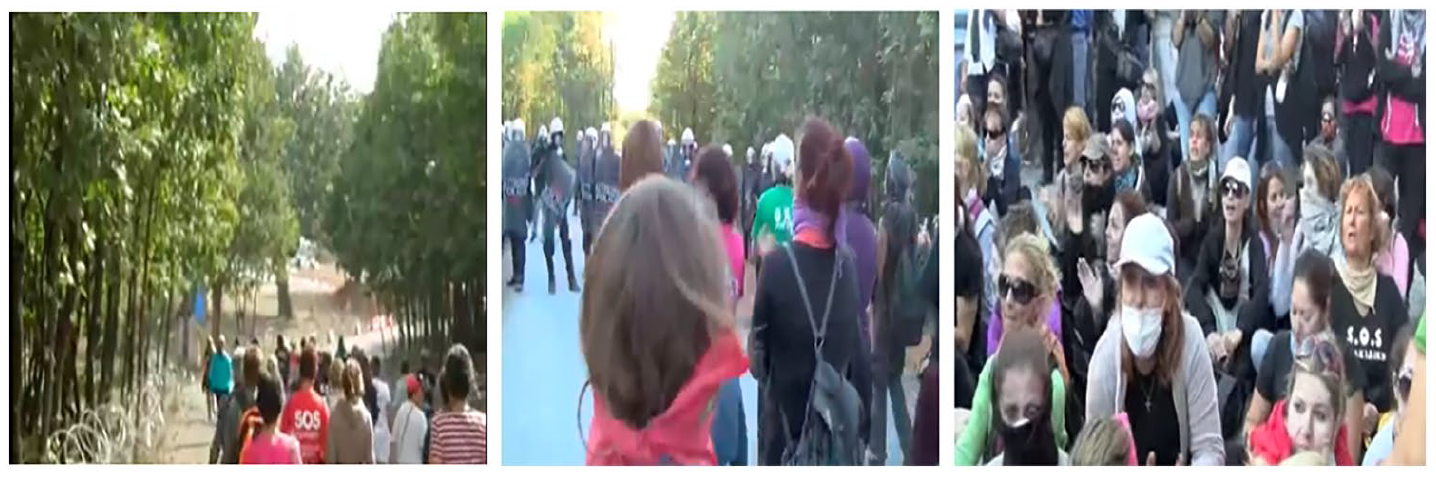
Women initiating protest against the mining.
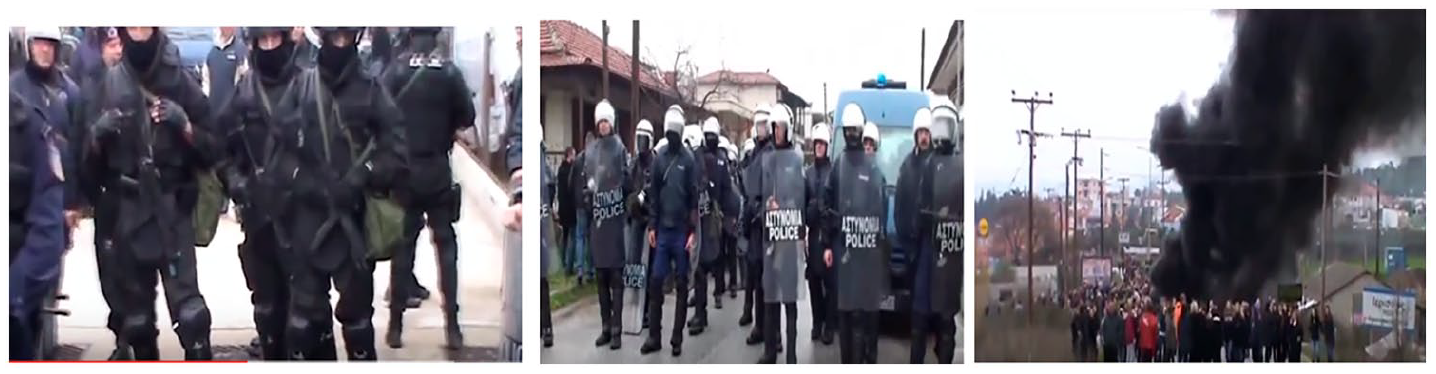
Riot police at Ierissos village.
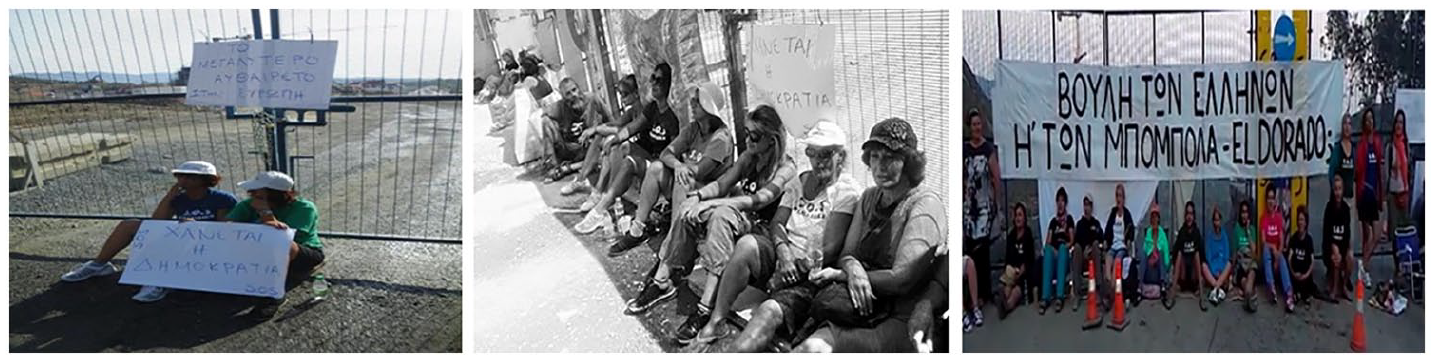
Women chain themselves to the entrance of the mining site.

Countering power, reclaiming space.

Women’s bodies on the line in the clashes with the police.
Finally, we moved to ‘patterning’: building on the previous two techniques, we discovered recurring patterns of embodied behaviour. This allowed different levels of analytical perspective that might have been missed in fieldwork observations. Reflecting on these embodied resistance acts, we tried to bring critical self-awareness to our own intersubjective experiences as activists and how these impacted on our analytical strategies (Cixous & Calle-Gruber, 1997). In so doing, we noted the emotions that the videos evoked in us as we watched them separately, before sharing our feelings during the analysis stage (see Gray, 2008, on emotion and reflexivity).
Female Bodies on the Line: Women at the forefront of activist resistance
Our analysis was informed by Charmaz’s (2006) approach to grounded theory, in which divergent but compatible theoretical perspectives are thoughtfully incorporated into a general outline of the original method (Glaser & Strauss, 2006). Continuous iteration between our various sources of data and theory described above (Charmaz, 2006) unveiled both the affective dimensions of women’s activities and the gendered practices through which their protesting female bodies constituted sites of resistance.
Creating spaces for affectivity
On 25 March 2012, around 2,000 people gathered in the streets of Ierissos, a village with a population of 4,000, to resist gold mining in Chalkidiki, but they were stopped by police in their peaceful march towards the newly acquired Eldorado site. Six months later, on 12 October 2012, 50 women from a nearby village assembled to raise concern about the mine’s impact on the environment and their communities, attempting to enter the Eldorado mining area (see Sequence 1). This was followed by a reconnaissance mission to map the impending destruction, with many more women and men. 3 The anti-mining campaigners formed committees with an online presence (e.g. SOS Halkidiki), held regular protests and monitored development of the Skouries site. A few dozen activists were consistently involved in challenging the mine’s establishment through protests, publicity events and online magazines, blogs, etc. Women were at the forefront of all these activities: for instance, in October 2015, all-women groups met with the prime minister, Alexis Tsipras, and organized a lively protest in front of the Canadian embassy in Athens.
When analysing our fieldnotes, interviews and intermittent participant observations (2015–17), we were struck by the women activists’ emotive references to Eldorado’s detrimental consequences for nature, expressed as ‘pain experienced on watching the trees being cut down’ (Lena, Chalkidiki), ‘loss of life’ (Maria, Thessaloniki), and vivid depictions such as ‘The open pit throws tons of sand into the air to extract a few grams of gold, leaving mountains of toxic mud behind which poison the underground water we use’ (Lena), stressing that forest and gold mine cannot coexist without disrupting the life within it (see also Hatzisavvidou, 2017). Maria, a doctor participating in the solidarity protest against the health consequences and environmental damage to families and children, spoke of the already concrete effects of these developments on people. Female activists often referred to the economic impact, but were particularly keen to stress its material consequences for their communities: ‘In Ierissos, the gold mine poses a serious threat for other activities such as beekeeping and forestry, all of which are important sources of income for most people in the local economy’ (Lena). Others (mostly men) cited ‘hard’ facts to support their case, pointing to ‘the involvement of global capital behind the Eldorado activities’ (Jason, Chalkidiki). References to nature and ‘the unique beauty of the ancient forest’ in brochures produced by the anti-mining movement (SOS Halkidiki, 2013), were first articulated by women, and then taken up and systematically deployed by the movement as ‘melodramatic’ rhetorical tropes, intended to evoke pathos in the viewer (Hatzisavvidou, 2017) and enhance the cause’s appeal to wider society. For instance, they used images in blogs showing the natural beauty of the area prior to the excavations, and contrasted this with the lunar-like site pictures of a deforested mountain afterwards (see Image 1).
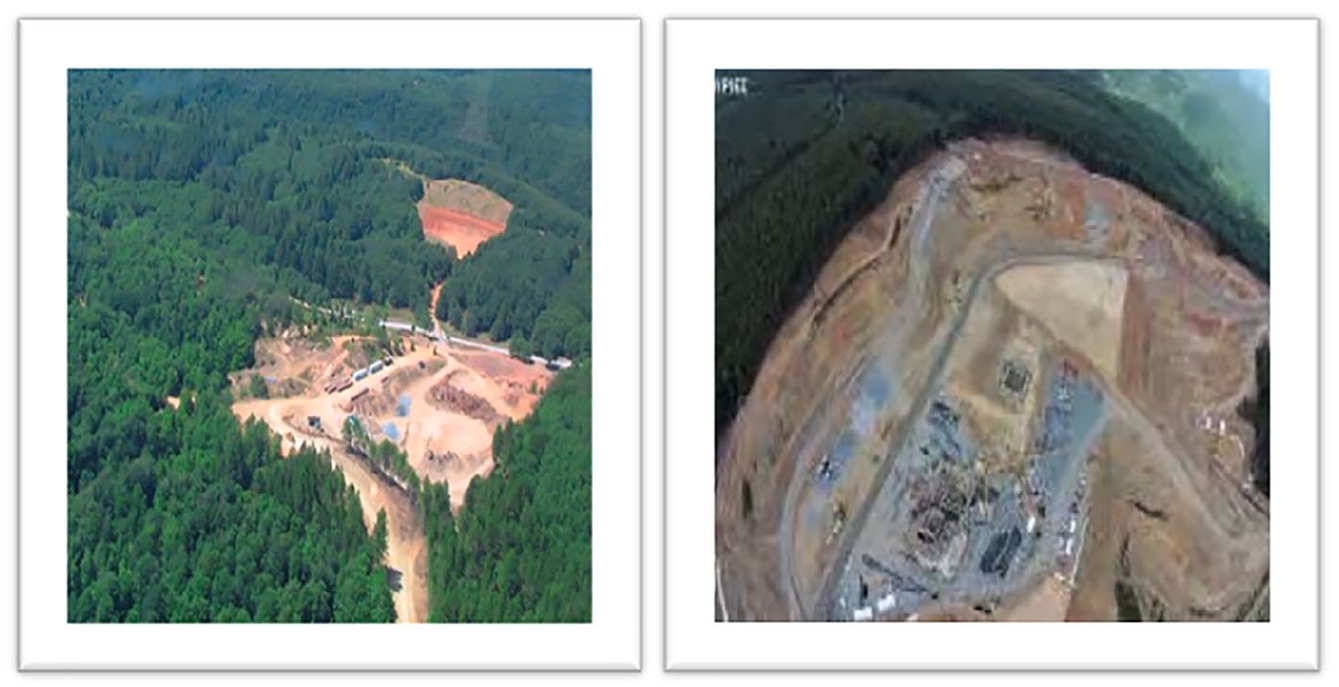
Before and After: Cutting the ancient forest to create an open-pit mining site.
Overall, the anti-gold-mining movement gradually drew on emotional discursive tropes rather than the dispassionate investment imperative, juxtaposing two different realities (Hatzisavvidou, 2017): one representing life and children’s future, and the other the lifeless gold, the death imagery of a grave and the Marxist ‘salto mortale’ of capitalism as a leap to death (see also Tsavdaroglou et al., 2017). Image 2 shows women’s hands covered in blood in front of the Canadian embassy, and a blog post was entitled ‘Εξόρυξη χρυσού με αίμα λαού’ (‘Extracting gold with people’s blood’). 4 This language was progressively adopted by the entire anti-extractivist movement as an argumentative resource in the anti-extractivist struggle, producing an alternative imaginary that brings together an embodied understanding of nature–society/culture with collective and affective dimensions of being in the world (which is captured by the sequential analysis of images in our visual methodology).
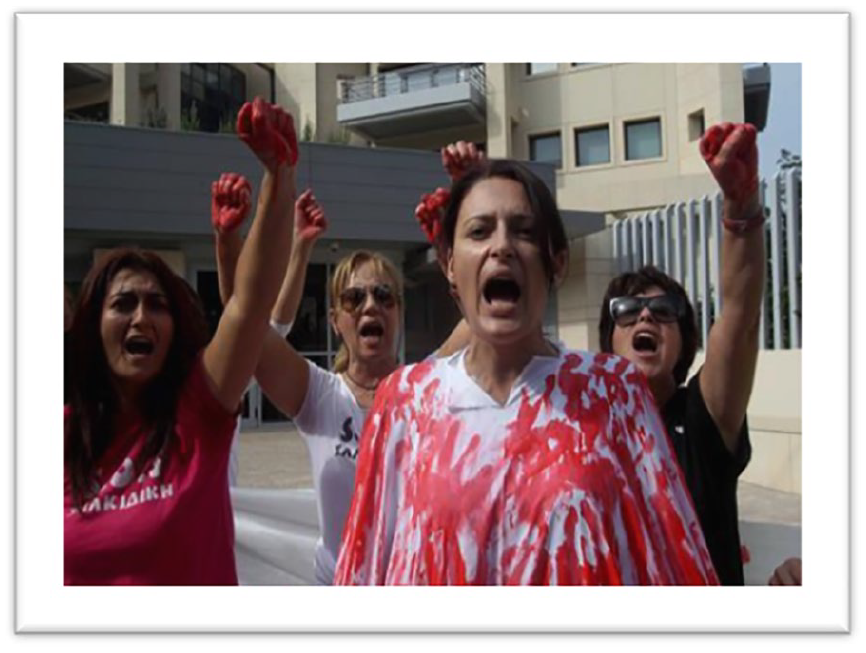
Women activists protesting in front of the Canadian Embassy, October 2015.
Other women’s organizations calling for solidarity with the women of Chalkidiki, such as online journal, Μωβ (Purple), made references to antiquity (e.g. the ‘homeland of Aristotle’) to garner support from audiences outside Greece. Evoking historical experiences that had contemporary resonance was not always a conscious strategy. For example, a communiqué issued by the women of Skouries tapped into past heroic resistance, to which many Greeks are able to relate, including collective memories of previous struggles in which Greek women of all classes played an active part (Anagnostopoulou-Poulos, 2001; Vervenioti, 2000):
We are the great-grandmothers who experienced the occupation during WWII and decided: ‘never again fascism’. We are the grandmothers who experienced civil war and declared: ‘never again war’. We are the mothers who saw our children becoming immigrants and declared: ‘never again racism’. We are the daughters who experienced the dictatorship and declared: ‘never again authoritarian regimes’. We are the granddaughters who have never experienced occupation, civil war, immigration or dictatorship and are now experiencing all of them simultaneously. We are the great granddaughters who dream, who hope, who demand a better future. (Women’s open letter, April 2013)
These historical references affected us deeply, given our own families’ personal connections with these events. 5 In a particularly moving scene, an octogenarian lady challenged the police and chanted a resistance song from World War II, refusing to be intimidated by violence even now. Overt expressions of such feelings draw on shared and reciprocal, though gendered, emotions (Jasper, 1998). Women took it upon themselves to articulate shared concerns through their own affective responses, but deploying affectivity helped mobilize support in the community and build alliances among protesters. These emotions were subsequently reinforced in collective action itself (Jasper, 1998), and were further strengthened by the state’s response.
Following the government’s favourable stance on the so-called ‘investment opportunity’ in Chalkidiki, the police were quickly ordered to step in to defend the private company’s interests against peaceful protests outside the mining site (see Sequences 1 and 2). While underscoring the escalation of state violence, involving the police (a public body) in protecting private property against protesting citizens violated people’s sense of justice and raised questions about democratic governance.
The armed police units entering Ierissos in March 2013 arrested local participants in the protests (see Sequence 2), holding some without warrant overnight, and beating and intimidating others. The police attacked the secondary school with tear gas to discourage teenage pupils from participating in the protest (interviews, May 2017). Women, who were actively involved throughout all stages of the protest, were also heavily penalized by being issued with arrest warrants and taken to court; many were still being prosecuted four years later on multiple charges, including destruction of private property and opposition to authority (one of our interviewees had 11 such charges pending or in progress in May 2017). It was painful to hear about women who were underemployed or earning low salaries having to face constant legal battles – at the time of one interview, morale was very low following another setback – although many had help from lawyers working pro bono on their cases. We felt personally vindicated when they were finally acquitted of all charges in October 2018.
Our passionate engagement and entanglement with the field is part of feminist ethnography and a unique source of knowledge, allowing us to unearth erased emotions in the extractive sector that facilitated dismissal of the distinctly emotional consequences of resource extraction for people and place (Ey, 2018). In related research in a contemporary anti-mining protest in Romania, emotions became both a contentious factor for the project’s opponents and a target of ‘rational’ accusation for the corporation (Velicu, 2015, p. 847). However, failing to acknowledge and validate the emotional and affective impacts of the extractive sector on people and place produces a distorted and partial view of potential impacts and concerns, with implications for policy and practice (Ey et al., 2017, p. 164). The deployment of emotions extends to other dramatic forms of protest, as female resisters use their bodies to mobilize affective relationalities at local and translocal levels, as discussed next.
The body as a site of resistance
Women’s dissent led to more violent clashes with police special units in areas near the Eldorado mining site, when 12 women attempted to block the entrance to Skouries by chaining their bodies to the site’s entrance gates (see Sequence 3). Police officers who were called to protect the fenced construction site warned them of impending arrests if company vehicles were obstructed.
Sequence 4 shows how space was claimed as the women attempted to enter the excavation sites, talking loudly, marching together with men, and singing and chanting various slogans in unison, such as ‘we want our forests, our soil and water, not a grave made of gold’. Clapping their hands and using loudspeakers, they walked along the barbed wire-fenced road (see Sequence 4, frame 2).
When the police forcefully stopped them from repeating their walk into the forest area allocated to the Canadian company (see Sequence 4, frame 3), the women consciously evoked their embodied gendered identity and essentialized characteristics of women as peaceful, caring and life-affirming as a weapon of subversion. Their ‘weakness’ was used as a weapon to protect the ‘stronger’ men. While walking towards the riot police blockades, they chanted: ‘All men [referring to fellow marchers] go to the back; follow behind us’ (see Sequence 5).
They consciously deployed cultural expectations (policemen should not attack unarmed women) while assuming leading roles in the march, placing their bodies to the fore:
Here is Halkidiki and this is a sacred place [. . .] we are women and we come unarmed . . . you talk about profits and losses, we talk about human lives [. . .]. We are mothers, we bring up soldiers and policemen . . . you are pushing your mother . . . don’t push us away; [and later] come with us, join us. (https://www.youtube.com/watch?v=_a3ApW1iuWg)
As can be seen from the above excerpt, women may draw on widely circulating gendered discourses in paradoxical ways, putting their own essentialized vulnerability (as mothers) on the line to produce affective responses in others and move other bodies to action. In these struggles, women were consciously and strategically deploying aspects of essentialized femininities, specifically their roles as mothers, carers and protectors of life with deeper connections to the environment (see Jenkins, 2015). In this instance, they evoked patriarchal stereotypes of women as defenceless creatures in need of protection by chivalrous males, to position their bodies as shields to protect (male) demonstrators. Using their own bodies, activists make public addresses through visual images in which the body becomes what DeLuca (1999) calls an ‘argumentative resource’. The deployment of one’s physical presence ‘against the oppressive and coercive elements of the state in protests, and as means to protect the community, turns the body into a site of resistance and pride’ (Motta, Flesher Fominaya, Eschle, & Cox, 2011, p. 24), even if associated with danger or threat to protesters’ lives, as when a civilian was deployed as a shield in the 2014 Gaza war (see Gordon & Perugini, 2016; see also Elidirssi & Courpasson, 2019 for an example of nonviolent protest against climate change in France).
In clashes with the police, the women’s bodies were sites of both empowerment and vulnerability, creating affective spaces for solidarity, while crossing gender binaries to create multiple relational ties to ‘other’ bodies (see Sequences 4 and 5). In this way, they challenged traditional stereotypes of women as physically weak and therefore ineffective in combat situations, and at the same time capitalized on the (unrealized) cultural expectation that the all-male riot police would not attack a group of peaceful women. Such expectations have been repeatedly disproved throughout the history of social movements. Yet, as we explored the role of women activists in anti-mining resistance, we realized that the emplaced body was key to their political practices. Women deliberately organized in ways that involved them interposing their bodies, but this was often performed in response to official threats of violence. When armed riot police prevented their march by creating a human shield around the company officials (Sequence 5, frames 2 and 3), blocking their entrance to the site, the women reacted:
You’re the guard dogs of your owners. It is about our children’s lives; think about your children; we need the oxygen. Whom are you protecting? Those who do not have the guts to show up. Why are you not letting us through? What are you afraid of? What is it that you won’t let us see? You are not acting like men. (https://www.youtube.com/watch?v=_a3ApW1iuWg)
In summary, the female protesters at Skouries engaged in embodied forms of struggle to oppose the guardians of powerful interests and those working in the mines. They actively deployed gendered stereotypes to question the ‘maleness’ of the police who were using their armed bodies to protect the private interests of the rich against unarmed women, or by shaming the young male policemen for attacking ‘their mothers’. In doing so, they used their gendered bodies as weapons against police violence in ways that both acknowledged and built on existing power differentials. Nevertheless, the protesters trying to break into the mining site were fighting for transparency and democratic governance, as the local population had been neither informed nor consulted by the authorities about the impending mining project. 6 The protest’s civic orientation helped garner support within Greek society and beyond, through widespread sharing of these images on social media. This became an important means for digital organizing, on which activist movements often rely, as analysed in our later discussion.
When bodies do not align in protest: Division within the community
However, the mining company’s arrival and the job prospects it brought became a source of discord in the community. Villagers employed in the mine (approximately 1,000, mostly men, fending off their own impending dispossession), were pitted against those who opposed the inexorable logic that the gold resources must be exploited for profit in exchange for jobs for locals, even at the cost of destroying the environment and communities. For instance, on 20 March 2012, a group of more than 400 men working in the mines travelled to Skouries on company orders, intimidating and beating up 30 unarmed protesters, half of them women (Antigold Greece, 2014). Almost five years later, the same barbed wire that women fought against privatizes the space around the pit and bars anyone without Eldorado authorization from entering:
‘Would you like to see the site?’, offer a pair of activists, our hosts who receive us at the village close to one of the pits. Of course we do. ‘Are we allowed to approach it?’, I ask. ‘You are, but the site is guarded’, the reply comes. We approach the pit through the forest road which did not exist until a few years ago, and which is made ever bigger and wider, we are told, with cleared logs almost two meters high stashed at the roadside. Although it is getting dark, the fenced gate and the barbed wire are clearly visible and we can hear dogs barking. (fieldnotes, 3 May 2017)
The sharp increase in male, and especially female, unemployment in post-crisis Greece has led to fragmentation and intercommunity divisions, as we observed. For instance, local women, like the male miners/employees of Eldorado, had decided to combat joblessness by becoming site guards. This can be seen in the ethnographic vignette below:
Someone approaches us and we can make out quickly the guard is a young woman. ‘Is it you, Toula?’ . . . ‘Are you also working here now?’ Our female host cannot hide her shock and dismay. I ask if I can take a photo. The guard inquires why we are here, before nodding, and then she adds unprompted, on hearing we are researchers: ‘you are doing your job and I am doing mine’. ‘She is here for 400 Euros a month probably’, my host explains. We walk back uphill through the forest to catch a glimpse of the pit from atop. (fieldnotes, 3 May 2017)
It felt unreal for Author 1 to be in the midst of the forest at dusk on a balmy Mediterranean evening with two women guarding the mining site from the opposite side of the fence. She could easily have changed places with either of them. Little separated us: we looked almost the same and spoke the same language; the affinity was uncanny. The strategy of reducing labour costs masks exploitation of women and dispossessed villagers, which is not dissimilar to the condition experienced by many colonial subjects and migrant workers in various other places around the world. In the case of the GFC, the production of exploitable and disposable bodies has been achieved through severe impoverishment, persistently high levels of unemployment and aggressive corporate strategies of intimidation that aim to fragment working-class ideologies (Federici, 2011), for instance by pitting Eldorado employees against other locals and incentivizing women to take low-paid work. Yet despite the setbacks, activists continue to oppose expansion of the mining through activities that assume collective responsibility for ‘overcoming conditions of induced precarity’ (Butler, 2015, p. 153). As we elaborate in our discussion, this is achieved by turning to the ‘social modality of the body’ (p. 153).
Discussion
This article examines the case of a protest movement dealing with the anti-extractivist struggle in crisis-stricken Greece. The focus is on women, who have collectively attempted to create conditions opposing the precarity forced by the GFC, making a unique contribution to this movement. We explore these issues in the context of women’s activist protest against a mining corporation’s activities in Chalkidiki in Northern Greece. Previous research on women’s resistance confirms that women are empowered agents with the ability to mobilize a variety of resources (Federici, 2019; Horowitz, 2017; Jenkins, 2015), but many of their strategies and achievements remain unexplored and unacknowledged. Our intention is to address a gap in research on the anti-extractivist resistance movement by elucidating how women draw strategically on a variety of resources to make their struggle effective. We develop the concept of embodied affectivity as a foundation for collective resistance and relational solidarity through a feminist analysis of protest activities, offering important insights into how such initiatives emerge and evolve into organized political struggles. We take inspiration from Federici’s work on the pivotal role of women’s reproductive labour in building solidarities among themselves and with other dispossessed groups (Federici, 2010), and from Butler’s (2017) claim that our vulnerability and precarity ‘do not contain us but expose us to a world without which our living is not possible’. We advance these ideas inductively through our feminist ethnography.
We examined both visual and textual data that support and substantiate our proposed feminist analysis of activism – as an embodied and affective act of resistance and solidarity – and reflected on our own affective responses and emotional entanglements at various stages of the fieldwork as a crucial aspect of the chosen ethnographic method (Gray, 2008). In addition to accounting for researchers’ subjectivity and passion (Sprague & Kobrynowicz, 1999), the feminist ethnography on which we rely also enables us to bring experiences, definitions, meanings and sometimes participants’ subjectivity into focus without losing sight of the context (Skeggs, 2001, p. 426). Through our proposed framework inspired by Federici’s and Butler’s insights, we develop a new theory of embodied forms of resistance, as disruptions of the gender binary separating productive and reproductive spheres, and as an enactment of the politics of visibility performed by bodies appearing in space to alter it. In building this theory, we consider how embodied resistance develops by making the protesting body visible and by appropriating discursive affectivity to mobilize the power of outrage. These insights help us to understand the expressive and affective capacities of the body to resist injustice and the neoliberal onslaught on life. This also allows us to build a framework to theorize women’s role and the discursive and extra-discursive resources they deploy in the anti-extractivist struggle, including the use of emotive language and evocative images in their social media, and embodied action altering spatial relations.
The study makes theoretical and practical contributions. The first is to the literature on women’s embodied presence in public spaces, which relates to the ‘missing body’ in conceptualizations of resistance socio-spatialities. Our core contribution to the idea of embodied affectivity is to explain how umbrage against injustice causes bodies to act, and how these acting bodies recreate and alter the socio-spatialities theorized by feminist geographers. We consider space as created through relational flows of affect, and identify how women’s bodies, when brought together in space to oppose rapacious ‘development’, create new relations, leaving material imprints on themselves and others. In focusing on use of the body as a resource for the gendered construction of space (Tyler, 2019; Tyler & Cohen, 2010), we demonstrate how space becomes a place for people’s histories and the meanings they attach to them (Massey, 2004; Tuan, 1979). Places are important for sustaining bodies and providing a sense of rootedness for people who refuse their erasure through mining (Ey, 2018) and oppose their place being turned into an extraction site. Attending to the embodied and emplaced ways in which people/place become and resist together in the everyday is of paramount importance for developing relational ontologies. The local Skouries movement emerged from concern about the mining activities’ environmental destruction, potential threat to water supplies in the villages and impact on villagers’ health. These resonate with previous narratives of women’s anti-mining struggles in other geographical locales reported in the literature, such as rural women in Peru and Ecuador, who stressed their intimate connection with the land as an important rationale for involvement (Jenkins, 2015). In introducing the issue of gendered spatiality, and the idea of women’s otherness playing out in and through space (Tyler & Cohen, 2010), we propose that acts of resistance to women’s ‘bounded spatiality’ (Young, 2005) emerge by redefining the role of the private reproductive female body in public space, where it becomes politicized and attached to universal struggles beyond gender issues that concern women directly. For instance, Sasson-Levy and Rapoport (2003) compare the body’s involvement in social action in a mixed-gender movement (The 21st Year) and an all-women movement (Women in Black) opposing settlement in the Occupied Territories of Israel. They conclude that embodied protest is much more effective when female participants’ bodies are used to expand political agency by shifting the gendered meaning of political action into the public sphere. As Sasson-Levy and Rapoport (see also Sutton, 2007, 2010) explain,
women can use their body for political protest when body politics is the main cause of social protest such as in various feminist causes. But it can also be used as the carrier for social and political protest, even when the body is not the subject matter of the protest. (Sasson-Levy & Rapoport, p. 398)
Embedding their discourse in announcements by the SOS Halkidiki movement (SOS Halkidiki, 2013) in terms of real harm to the community allowed the women to move beyond personal concerns, turning their activities into a ‘struggle for the common good, and part of a broader discussion about the nature and direction of “development” in their countries’ (Jenkins, 2015, p. 450).
We therefore argue that moving from passive subjugation to active participation enables women to challenge the meaning and structure of public/political space and gendered order (Sasson-Levy & Rapoport, 2003). By addressing the issue of an absent presence of the body in organizing and organizations (e.g. the female and/or maternal body in professional settings; see Gatrell, 2017; Trethewey, 1999), we show how women’s appearance in public spaces questions the axiom that ‘if there is a body in the public sphere, it is masculine and unsupported, presumptively free to create, but not itself created. And the body in the private sphere is female, ageing, foreign, or childish, and pre-political’ (Butler, 2015, p. 75). Butler (2011) argues that bodies insist on being noticed: when female bodies appear together, they reject the established (patriarchal) contention that separates male and female, equated with a public and private binary that ‘leaves the sphere of politics to men, and reproductive labor to women’ (Butler, 2011). Stressing the social character of the body provides ways of resisting the various forms of oppression increasingly imposed on us by neoliberal capitalism. This also brings women’s contributions to social movements to the fore.
Although the women used their bodies strategically in the anti-mining protest at Skouries, we do not consider women’s liberation as a ‘return to the body’ (Fotaki & Harding, 2017); nor do we aim to essentialize women or their feminine attributes. Focusing on the embodied dimension involved in women’s resistance and struggles allows us to consider gender and class, highlighting the intersectionality of multiple systems of domination, oppression and discrimination in which the mining industry is implicated (Horowitz, 2017; Jenkins, 2015; Tsavdaroglou et al., 2017). Furthermore, recognizing that women have always resisted, and that they continue to resist, corresponds with increasing acknowledgement of women’s contributions in spaces and practices of activism more broadly. However, we must not lose sight of the incongruence and multiplicity underlying such practices. Reedy and King (2019) stress the necessity to learn from activism. As feminist activist researchers ourselves, we gained firsthand experience of the women’s strategies to counteract the neoliberal attack on their communities. We understood that their responses to the crisis were radical, but that they did not identify themselves explicitly as feminists. We realized that the lived experiences of these rapidly marginalized women and entire communities resisted any single explanatory framing.
Our second contribution emerging from the foregoing discussion is on the role of embodied affectivity in prefiguring new political practices in the organization and organizing of resistance. Prefigurative organizing has begun to receive attention in organization studies (see Daskalaki et al., 2018; Reedy et al., 2016) as a way of constructing a positive sense of autonomous selfhood affirmed within a community of shared values (McDonald, 2006, cited in Reedy et al., 2016; see also Chatterton et al., 2010). Yet there has been no consideration of embodiment or emotion as motivating forces for action in these works, and little attention has been accorded to affect. This is despite emotions accompanying all social action, providing both motivation and goals (Jasper, 1998), as well as giving meaning and helping to sustain it when faced with external pressures. Our study addresses this gap by offering affective embodiment as a central idea emerging from our findings. In doing so, we stress the performative capacity of the body as a means to organize and build support for alternative social movements. We also adopt the notion of umbrage emerging from embodied experience, to theorize practices of resistance in public space (Butler, 2015) and beyond (see Komporozos-Athanasiou, Thompson, & Fotaki, 2018, for an application of this idea to the context of healthcare). Inspired by Butler’s (2015) contention of the performative power of the body in space, which constitutes and recreates it by altering relationships of power within it, we suggest that the body is never located in neutral space, but that space and the body within it exist in relation to others.
In putting their bodies on the line to appeal to a sociality that exceeded them, the women of Skouries initiated a ‘coming together’ of various groups within and outside their communities. As a result, the activist movement, SOS Halkidiki, originally formed to oppose the gold mine’s impact on the lives of small communities (18,000 inhabitants), became connected with the fight against the disastrous policies imposed by the troika of lenders and implemented by successive Greek governments. Tens of thousands of people in Athens and Thessaloniki attended rallies, with several prominent artists, both women and men, sporting T-shirts and other items with the ‘SOS Halkidiki’ logo at events in support of the movement. This suggests that, in their case, ‘occupying’ or reclaiming spaces (such as the barbed-wire fence around the mine or the forest) affected the enactment of relational solidarities as a means of political struggle (Vachhani & Pullen, 2019). Similarly to the poner el cuerpo (‘putting the body on the line’; Sutton, 2007) of Argentinian movements, the women of Skouries showed togetherness, engaging their own and others’ bodies in the project of creating social change and building power together from the bottom up, as ‘a collective, embodied process that sprouts solidarity and valuable knowledge’ (Sutton, 2010, p. 143).
We also demonstrate the double role of affect, which mobilizes women to act, and which they use as a strategic resource in their embodied struggle to prefigure new political praxis and alliances. Our findings show, for instance, how the protesting women challenged performances of femininity that marginalized and excluded them from the frontiers of political life by appropriating them as a strategic resource in their fight with the riot police (similar examples have been observed in protesting mothers’ movements around the world, most famously in Argentina). Moreover, women inserting their bodies between the police and other protesters, hoping they would not be attacked (because of their middle-aged motherly status) in order to shield the men, unveils the intersections of gender and images of the body in relation to socio-spatial conflicts. Such solidarities, we argue, are formed and lived in relation to conditions that, though outside, are still part of the body itself. Women’s activist participation in the movement not only enables new ways of being in public and private spheres, but also new patterns of relating with others (including men) in and through altering space, which may in turn allow new forms of community organization to emerge. This shows how resistance requires different bodies to come together to produce new relationalities and socio-spatialities, especially when performed in non-urban, sparsely populated areas (Sjöstedt-Landén & Fotaki, 2018). New potentialities emerge because ‘material and human agencies are mutually and emergently productive of one another’ (Pickering, 1993, p. 567) while embodying space.
The other aspect of prefiguration concerns the use of virtual space to bring about solidarity by using body images to draw support from close and distant others. Such images have the power ‘of affect, of outrage’ (Butler, 2009, p. 40), helping us to develop the material/discursive nexus in which the body is constituted. Indeed, DeLuca (1999) goes further to suggest that bodies and images of bodies have an argumentative power. Conflating bodies with images of bodies, as DeLuca (p. 10) argues, creates ‘nascent body rhetoric that deploys bodies as a pivotal resource for the crucial practice of public argumentation’. Producing and circulating images of bodies that affect us (Fotaki, Kenny, & Vachhani, 2017), we suggest, may become an important resource for building solidarity in assemblies and a different way of organizing in virtual space. We thus demonstrate that the power of images for digital (activist) organizing in the case of the anti-mining protest did not make their bodies less visible. In fact, the opposite was true: the images of the bodies and of the destroyed forest were used to mobilize outrage and garner support from afar for the anti-mining cause. For instance, following local mobilizations in the wider area of Skouries, various national and international activists visited the site (for example, Naomi Klein in 2014), and a Skouries solidarity initiative was established with members from all over Greece and elsewhere (Velegrakis, 2013). Thus, ‘local’ and ‘translocal’ struggles become key in the collective re-politicization of both men and women who, in solidarity, resist ‘disaster capitalism’ (Klein, 2007; see also Caruso, 2013; Voss & Williams, 2012).
The anti-extractivist movements demonstrate that women’s activism should be seen not only as a situated struggle against sovereign power and authority, but also as a transformative force which enacts different local and translocal bodily capacities that defy capitalist (binary) enclosures and create new socio-spatial arrangements, through and in which resistance is organized. For instance, the women from Skouries have also become active members in a wider landscape of resistance movements and struggles against water privatization in Greece (Daskalaki & Fotaki, 2017). In addition to daily protests, they have participated in other resistance movements, such as the ‘Caravan for Struggle and Solidarity’ (Daskalaki & Kokkinidis, 2017), and solidarity initiatives such as social kitchens (e.g. ‘The Other Human’). This, we suggest, also builds broader solidarity resistance by producing new affective relationalities within the communities concerned and beyond. We thus extend feminist analysis of activist movements relating to organizing collective resistance and its connections with solidarity among women (Daskalaki & Fotaki, 2017; Vachhani & Pullen, 2019).
Our research has important implications for activist practice and the role of researchers as activists. The findings make an important contribution to ‘activist ethnography’ (Reedy & King, 2019). This form of ethnographic activism is ‘a combination of procedural virtues with the working alongside of militant ethnography and the learning from of PAR [participatory action research]’ (Reedy & King, 2019, p. 571). While we cannot claim to have conducted true PAR, we decided at different stages to rely on methodologies and ethical principles that facilitated this. For us, this implies positioning feminist logics and ontologies at the centre of our work, while relying on the materiality of the body, affect and discourse, which as both Federici and Butler show, are not only deeply political issues but the very basis of politics. The focus on embodiment and affective engagement in activism is a source of knowledge and learning about others; allowing us to write differently about engagement with research, as a state of closeness that leads to a deeper appreciation of participants’ conditions, experiences and choices, while recognizing their similarities and differences from ourselves.
Concluding Remarks
The resistance to gold mining presented here has focused on how women working together with local communities and transnational collectives have challenged symbolic and material boundaries, performed transgressions and inversions, and collapsed gender binaries. As the example of the SOS Halkidiki movement in Skouries has shown, women’s activism has the capacity to influence how the movement organizes and enacts forms of resistance by transforming their position in private/public space. This has allowed us to reconceptualize spatial identities, specifically concerned with the different ways in which bodies materialize in the context of protest organizing. In developing a body–space–resistance nexus in the study of activism, we reject representational conceptualizations of the political, which marginalize the (female) body and exclude contemporary feminist resistance from political consideration. The proposed approach contributes to elucidating how individuals resist given power structures through discursive and affective mechanisms, which might prefigure new organizational politics. Moreover, drawing on embodied and affective activism, in both local and translocal settings, might unveil how power structures are distributed across gender, class, ethnicity and sexuality. Yet more importantly, at a time of mounting dissent against neoliberal capitalism, embodied feminist praxis might help us to respond effectively to disconcerting contemporary challenges such as inequality, social injustice and environmental destruction.
Footnotes
Acknowledgements
We would like to thank Didem Özdemir Kaya, Kate Kenny and Charalampos Tsavdaroglou for their useful comments on the previous versions of the article. We would also like to thank Senior Editor Mark Learmonth and the three anonymous referees for their support and guidance throughout the review process. But our heartfelt gratitude and admiration goes to activists in Chalkidiki and Thessaloniki for their generosity and time spent to help us understand their struggle.
Funding
This was work was supported by the British Academy of Management (BAM), Transitions 2 Grants Scheme: 2015-2017 (Grant Reference Number: BAMTRANS2_2015_14).
Notes
Author biographies
 ) pro bono (2014–2017). Marianna has published over 70 articles on gender, inequalities and the marketization of public services, appearing in leading international journals. Her recent books include Gender and the Organization: Women at Work in the 21st Century (Routledge, 2017 co-authored with Nancy Harding), Diversity, Affect and Embodiment in Organizing (Palgrave 2019, co-edited with Alison Pullen), The Whistleblowing Guide: Speak-up Arrangements, Challenges and Best Practices (Wiley Finance, 2019 coauthored with Kate Kenny and Wim Vandekerckhove) and Business Ethics, and Care in Organizations (Routledge 2020, co-edited with Gazi Islam and Anne Antoni). Marianna currently works on whistleblowing (funded by the ESRC and British Academy/Leverhulme Trust), solidarity responses to crisis and refugee arrivals in Greece.