




Abstract
In this introductory paper for the special issue “Government and the Governance of Business Conduct: Implications for Management and Organization”, we focus on government as an institution in the broader context of the governance of business conduct. We review the longevity and heterogeneity of governmental actors along with, and in relation to, the evolving role and place of business and civil society actors under the double challenge of privatization and globalization over the last three to four decades. In so doing we track the evolution of government’s primary governance roles. We suggest that part of the organization and management scholarship builds upon problematic assumptions when it comes to the role(s) of government in the governance of business conduct. We suggest that while governments might be losing some power, they are also acquiring and deploying it in other areas; that governments are taking on new governance roles in relation to business conduct; that government regulation may contribute positively to the governance of business conduct; and that government is an ever-important focus for management and organizational research. We show how the six contributing papers to the Special Issue both illustrate these arguments and reveal new roles for government in the contemporary governance of business conduct. We end by proposing a research agenda for the further exploration of government in governance.
Keywords
Introduction
In this introductory paper for the special issue “Government and the Governance of Business Conduct: Implications for Management and Organization”, we argue that the governance of business conduct involves important, and often under-problematized, assumptions. The increasing complexity of transnational governance has led to a prevalent and often implicit assumption that governments have lost power or even the capacity to act (Büthe, 2004). In the context of globalization, private authority has intensified and become ever more dense—with a particular role for multinational corporations (MNCs) as they have consolidated their power and transnational reach (Hall & Biersteker, 2002). The materialization of private authority has taken the form of a wide array of so-called “soft-law” products—white papers, standards, guidelines, codes. This has been a broad trend that is particularly well documented in corporate social responsibility (CSR) scholarship with a focus on the global governance of the social, ethical and environmental impacts of business (e.g., Mäkinen & Kourula, 2012; Matten & Crane 2005; Scherer & Palazzo, 2011; Wickert, 2016). While soft law has long been a tool for government (Hood, 1983; Moon & Richardson, 1984), it has grown in significance and co-evolved with the progress of private authority, to be more fully recognized as part of the broad governance toolbox of nation-states—as a complement to “hard laws” (Knudsen, Moon, & Slager, 2015). This broad “soft-lawization”, including in the traditional territories of governments and government action (Moon, 2002), can arguably be seen as another sign of the expansion of private authority into contemporary governance (Djelic, 2011).
The growth in such different forms of governance of business conduct has been evident at the local, national and transnational levels, whether voluntary or mandatory in type, whether public or private in nature. Transnational initiatives—including intergovernmental accords and agreements, networked multi-stakeholder negotiated rules, private and market-based standards, and self-governance processes—have received increasing attention within organization studies (see Brunsson, Rasche, & Seidl, 2012; Djelic & Sahlin-Andersson, 2006; Djelic & Quack, 2018; Moon, Crane, & Matten, 2011; Rasche, de Bakker, & Moon, 2013). These developments have brought to light a range of new dynamics and relationships that governments have with other actors, whether public or private. Our aim is to problematize the prevalent underlying assumptions of prior organizational scholarship on this theme, to explore the shifting and new roles of government in the contemporary governance of business conduct, and to examine implications for management and organizations.
As the contributions to this special issue demonstrate, the validity of the assumption of a “retreat of the state” (Strange, 1996) warrants scrutiny and even challenge, both in general terms, and in the light of recent developments. First, these contributions question the shrinking power base and lack of enforcement capacity of governments; second, they call for reconsideration of the commonly presumed inferiority of governmental vs. private regulatory mechanisms for achieving social and environmental outcomes; and third, they put governments back on the agenda of organizational research as theoretically important objects of study.
Thus, governments, and their interactions with other actors, warrant renewed attention from organizational scholars. In some cases, governments have arguably remained involved in the regulation of business conduct all along—we just had turned our analytic gaze elsewhere. In other cases, where they had indeed stepped back, or where their roles had been supplanted, there is evidence that they now seek to reassert some of this lost authority. However, this is happening in ways and forms that are quite different from what had characterized earlier forms of government intervention (see Knudsen & Moon, 2017; Peterman, Kourula, & Levitt, 2014; Wood & Wright, 2015).
These dynamics surface in a multiplicity of contexts such as: financial regulation in the aftermath of the economic crisis; taxation, as awareness of systematic tax evasion by large MNCs is rising; corruption in the wake of scandals involving highly respected MNCs; international trade, as some of the implications of trade agreements for national and state sovereignty are becoming clearer; regulation for social and environmental responsibility in globalized production networks and supply chains; the governance of information and communication technologies and their urgent re-orientation; and recent government responses to terrorism and security concerns with potentially wide-ranging effects on how businesses operate in the global marketplace. In this special issue, we give space to local, national and transnational mechanisms of business governance, aiming to explore the role and place of government in these mechanisms in novel and theoretically insightful ways.
Our introductory paper develops a number of insights intended to be useful for organization and management scholarship. First, we provide an overview of past (selected) research in organization studies and beyond, with an additional focus on relevant literature in political science and sociology. Second, we track the evolution of the dominant discourse on the primary roles that different social institutions—government, business, and civil society—have been playing and deploying. Third, we identify and problematize four key assumptions in current research on government and the governance of business conduct. Fourth, we describe how the papers of the special issue offer new insights when it comes to the roles of government in governance, and in challenging some of the assumptions we have identified. Finally, we propose a research agenda for the further exploration of government in governance, underscoring the implications for management and organizational research.
Government and governance of business conduct
It is important to clearly define and distinguish these key terms. By “government” we refer to those actors which have exclusive authority over legitimate force in a specific territory (Weber, 1949; see also Finer, 1997 1 ; Moon, 2002; Poggi, 1978). In our contemporary world, governments defined in this way are generally coextensive with nation-states. By virtue of this unique mode of authority, the “sine qua non” of state power (Rose, 1976, p. 249), governments have the capacity, within their jurisdictions, to impose legally binding constraints and sanctions over non-governmental actors, whether in politics, society, or markets. Our definition of government refers essentially to national governments but also to their extensions, the governmental bodies which they create, inherit or license. This includes all forms of regulatory agencies and governmental bodies at regional and local levels. Finally, our definition also extends to intergovernmental and supranational governmental organizations such as the European Commission or the United Nations. The focus is thus on a range of public actors including international and supranational, national, state and local governments, as well as their ministries, departments and agencies.
By “governance” we refer not to corporate governance, but to the wider concept of societal governance, that of the collective means to give “direction to society” (Peters, 1996) which we take to include direction to society’s politics and markets. Some authors have used the concept of governance in contradistinction to systems of directing society that rely only, or mainly, on government (as defined above). Hence, the term has been deployed, particularly since the 1980s, to refer to modes of direction where private actors weigh heavily on rule-making and enforcement or even impose their authority (e.g. Rhodes, 1996).
In contrast, we use governance in its generic sense (see Peters, 1996, above) and our definition embraces all systems of steering society. Thus, we see the nature and strength of governmental organizational roles in any system of governance as a variable. In this context, we understand an organizational role to be “a purposive, resource-based, and relational function exhibited through a specific activity or a set of activities” in regulatory governance (Kourula, Paukku, Peterman, & Koria, 2018, p. 4). So too, the roles of a multiplicity of non-governmental organizations vary in their contribution to governance and the direction of society. This includes the roles of MNCs and non-governmental organizations (NGOs) and other civil society organizations (Ahrne, Aspers, & Brunsson, 2015; Auld, 2014; Moon, 2002; Wittneben, Okereke, Banerjee, & Levy, 2012). The roles of these private and non-governmental actors can go from supplementing governmental responsibilities to a more radical taking over of (some of) those responsibilities and hence the assumption of a form of neo-governmental authority (Crane, Matten, & Moon, 2008; Scherer & Palazzo, 2011). On the basis of this analytical distinction between government and governance, we reformulate the objective of this introduction and special issue as being to identify, explore, explain, and assess the changing roles of government in evolving systems of governance of business conduct.
When we use the term “business conduct,” we understand it in a broad sense. We focus on the conduct of business in the context of the operation of markets, including in their interface with politics, society, and the natural environment. Of course, the contexts for business conduct can vary enormously reflecting different local, national, international, and even global systems of law, incentives, morality, and ethics according to which business is conducted and judged. We take it that the regulation of business conduct would ideally be intended to encourage “responsible business” that is typically discussed under the umbrella term of CSR and implies social and ecological sustainability, ethics, responsibility as well as fairness and inclusivity (e.g., Aguinis & Glavas, 2012; Carroll, 1999; Matten & Moon 2008; Margolis & Walsh, 2003; Pisani, Kourula, Kolk, & Meijer, 2017; Wickert, Scherer, & Spence, 2016).
Challenges to government in the governance of business conduct: Privatization and globalization
For much of the twentieth century - and particularly in the post-1945 period - government has been assumed to be central to governance, in general, and to the governance of business conduct in particular. This is from a western perspective but also well beyond. In the immediate postwar period, ideological critiques of this view were regarded as off-beat, whether from what would later become a powerful neoliberal perspective (e.g., Friedman, 1962) or from what remains as a fairly marginal perspective, the anarchist tradition (e.g., Goodman, 1960; Illich, 1971; Nozick, 1974). However, what were thought to be stable assumptions about the role of government in governance were unsettled by two phenomena (with co-evolving empirical and ideological features) emanating from the 1980s and 1990s, “privatization” and “globalization.”
Privatization is usually defined as the transfer of organizations or capacities that were once in the public sector to private ownership or management. This is illustrated in the sale of whole industries (e.g., the UK steel industry in the 1950s) or of public shares in companies (e.g., the West German government majority shares in Volkswagen in 1961, the UK shares in BP between 1977 and 1987). It has also referred to the “contracting out” of the delivery of nominally public services to the private sector (e.g., the provision of social services or specialist education), and to the liberalization of markets through deregulation. Privatization also includes more subtle and indirect mechanisms such as the managerialization of states and government agencies coupled with the diffusion of incentive schemes and practices that were originally devised in and for the private sector. The global spread of “new public management” has been one of the main carriers of such a form of indirect privatization (Christensen & Lægreid, 2007).
The main thrust of postwar privatization came initially from the UK’s Thatcher and Major Conservative governments (1979–1997) which extended privatization from companies that were in at least modestly competitive markets (e.g., car manufacturers) to public monopolies (e.g., British Telecom, British Rail, the water and energy industries). Perhaps even more radical—and ideologically counterintuitive—was the privatization programme of the New Zealand Labour government (1984–1990). But privatization was by no means only an English-speaking phenomenon. Large privatizations took place in much of Western Europe, Latin America, parts of Asia and, perhaps most dramatically, in the former USSR and its former Eastern Europe socialist allies. These privatizations were driven by different kinds of factors and actors—and the ideological dimension of that process has clearly been quite significant (Kogut & MacPherson, 2008). They have been justified in different ways in different places and at different times, but often references were made to freeing enterprise, reducing tax rates, improving the quality and efficiency of services, raising public revenue, decreasing debt, and spreading shareholder wealth. Perhaps the most colourful critique of the UK privatization policy was that it was like “selling the family silver” (attributed to former UK Conservative Prime Minister, Harold Macmillan).
Whereas from one perspective the task of government was simplified by privatization, enabling government to concentrate on “steering not rowing” (Osborne & Gaebler, 1992), this view was challenged by others who regarded this as a loss not only in capacity but also in the purity of governmental action (e.g., Self, 1990). And while the loss of capacity could be documented, it was also observed that along with privatization and freer markets often came “more rules” (Vogel, 1996), including in the form of competition, consumer and environmental law (Majone, 1997; Moon, 1999). Notwithstanding these new governmental roles as regulators and contractors (Hood, 1997), clearly privatization diminished government roles in the direct control of much “business” (or what might previously have been known as service provision) with respect to the choice of products and services; investment, production and sourcing policies; and employment and marketing practices. While cases of wholesale “re-nationalization” are rare (mainly confined to Latin America), talk of it never entirely disappears (e.g., the UK Labour Party 2017 Manifesto rather ambiguously promised to bring the railways back into public ownership). Certainly, over the last few years, many governments appear to be taking more active roles in the governance of business conduct with a view to addressing issues where markets and extant (private) regulation are ineffective, for instance regarding taxation of multinational corporations, accountability and corporate governance linked to corruption, labour rights and standards in global value chains, and social and environmental impacts more broadly.
The second main challenge to the role of governments in the governance of business conduct has come in the form of globalization—or often more accurately, internationalization. This is typically defined as “the transformation of the spatial organization of social relations and transactions, generating transcontinental or interregional networks of interaction and the exercise of power” (Held & McGrew, 2002, pp. 1–2). The basic corollary for governments is that the status of the nation-state as the “spatial organization of social relations and transactions” is being eroded. Globalization has thus been used to explain both why the authority of national governments has appeared less effective, and why governments have opted for more pro-business policies and sacrificed some of their own prerogatives. It has also been used to explain why there have emerged new forms of private, intergovernmental, or multi-stakeholder governance in issue areas such as labour standards, sustainable forestry, protection of marine life, and the sourcing of palm oil. Indeed, a wealth of literature has argued that the last decades have seen an impressive shift of regulatory authority over business conduct from governments towards multi-stakeholder arenas or the private sector alone (Büthe & Mattli, 2011; Djelic & Sahlin-Andersson, 2006; Scherer & Palazzo, 2011). This is particularly apparent in the contexts of healthcare, education, accounting, and human rights, which had traditionally been administered and directly ruled by governments. Additionally, in various areas such as financial regulation, taxation, information and communication technology, biotechnology, or, more broadly community development, consumer information, responsible investment, and labour standards, regulation has lagged behind and often taken the form of self-regulation and self-policing. Notwithstanding various economic and social benefits of globalization, this aspect of diminishing government roles in the “direction of society” has also been associated with the irresistible striving for power and control of business firms, most of all multinational corporations. It has also meant increasing pressures upon and a diminishing role for representative forms of democracy and citizen participation in effective policy-making, though there have also been new forms of participation by civil society organizations in some of these new multi-stakeholder arenas (de Bakker & den Hond, 2017).
However, in recent years we observe a trend where governments have re-entered areas of regulation that had appeared to have been taken over by private initiatives, such as CSR (Brammer, Jackson, & Matten, 2012), corporate citizenship (Crane et al., 2008) and non-state market-driven governance (Cashore, 2002). This, we argue, is in stark contrast to the predominant focus in extant research that attributed relatively powerful roles to private actors, while attributing decreasing influence to governmental actors—prominently emphasized for instance in the research thread associated with the notion of political CSR (e.g., Matten & Crane, 2005; Scherer & Palazzo, 2007, 2011). Management scholars, organization theorists, political scientists, sociologists, development studies experts, anthropologists, and civil society researchers, among others, have all pitched in to understand these renewed dynamics of governance at global, national, and local levels, acknowledging that while this evolution is seemingly a global trend, regional differences do exist (Gond, Kang, & Moon, 2011). However, we have only scratched the surface when it comes to understanding the implications for policy-making and business conduct of the major societal transitions associated with the contemporary evolution of governance and its complex interactions with a resilient but transformed government that have lately been witnessed.
Thus, we still know little about the changing roles of different actors in the contemporary dynamics of governance and, in particular, we need to understand better the ways in which governments are reorganizing their own imbrication into these evolving governance processes. The processes, power struggles, and dynamics arising as governments attempt to reclaim, the private sector strives to defend, and civil society actors learn to redefine their roles and territories, need more attention. In contemporary forms of governance, governments are rethinking and re-inventing their roles in the provision of public goods (Arellano-Gault, Demortain, Rouillard, & Thoenig, 2013; Knudsen & Moon, 2017; Peterman et al., 2014; Rhodes, 2007; Wood & Wright, 2015), and these transformations often have profound implications for the regulation of business. Recent evidence suggests that national governments show a renewed interest in areas that had been brought under the rule of private and multi-stakeholder governance (Albareda, Lozano, & Ysa, 2007; Knudsen et al., 2015; Steurer, 2010). National governments are also being provoked, to some extent, by the new wave of digital globalization. Companies such as Facebook, Airbnb, and Uber deploy innovative business models that seem to further undermine existing regulation and generate renewed calls, within state agencies and civil society, for government intervention.
Hence the question of the social, environmental, and ethical responsibilities of business is, if anything, becoming more acute and an increasingly contested terrain where each party struggles for influence and power. National governments collectively (e.g., through the OECD, the European Union, and the United Nations) and individually (e.g., the US and the UK) are taking initiatives to reclaim authority by introducing, for example, anti-corruption or CSR reporting regulations (Knudsen & Moon, 2017) or by moving towards a stricter control and regulation of labour relations in the platform economy. This co-evolves with—without being reducible to—a rise in national authoritarian regimes, populism, and the erosion of democratic values in Western societies—arguably part of a new wave of anti-globalization.
The ups and downs of government in the governance of business conduct
Having defined the key terms and presented two key challenges to government, we now review extant research on the role of government in the governance, generally and of business conduct in particular. While the political science and sociology literatures have been understandably more active in exploring governments and governance, the issue has received less attention within organization studies. So, we reflect on the particular contributions that such an organization studies focus could bring to our understanding of contemporary roles that states and governments play with respect to the governance of business conduct.
Governments have been around regulating, organizing, owning, taxing, using, corrupting, and being corrupted by business throughout. As Finer observes, “the state may have antedated writing… [and] at all events it is coeval with the first written documents” (Finer, 1997, p. 2). The variety of governmental forms since around 3200
Yet the status of governments has been far from settled even before the challenges brought by the contemporary period of globalization. In the period going from the end of World War II to the late 1970s, debates among political and social scientists were intense. Drawing on the biological sciences, some contributors developed the argument that politics should be understood as organic systems of inputs, conversion, outputs, and feedback loops (Easton, 1965), rather than as state-centred. Others proposed that the state and government were essentially epiphenomenal and that policies were better explained, variously by economic forces (Wilensky, 1975), electoral opinion (Schumpeter, 1942), policy inheritance (Rose, 1990), or the power of organized interests (Heclo, 1978; Richardson & Jordan, 1979). A flurry of rejoinders followed arguing, to the contrary, that more attention should be paid to the autonomy of the democratic state and that social scientists in general should “bring the state back in” (Evans, Rueschemeyer, & Skocpol, 1985; see also Skocpol, 1992).
But the dust had barely settled on this first generation of debates when the neoliberal watershed and concomitant trends of privatization and globalization brought forward the double idea that states and governments were the problem and/or that they were doomed or waning. A flurry of contributions announced the “end of the nation-state” either with a very upbeat and positive take (Friedman, 2005; Ohmae, 1995) or with a more complex and mixed assessment of this trend and its consequences (Strange, 1996). In parallel, the terms “governance” and “new governance” became established in the 1990s to refer, in its most extreme form, to “governing without government” (Rosenau & Czempiel, 1992) or at least governing with a “hollowed-out state” where the state is progressively losing many of its previous responsibilities (Peters, 1996; Rhodes, 1996). Theories of governance emerged in reaction to the perspective that social control was mobilized by and confined in states (Baldwin, 1993; Keohane, 1982). But they took an entirely new dimension in the context of a globalization of economic activity associated with strong privatization and an ideological mistrust of state intervention (Djelic & Sahlin-Andersson, 2006).
In that context, the move went towards an at least partial “privatization of authority” (Hall & Biersteker, 2002), with boundaries between government and private authorities becoming increasingly blurry in the transnational context. “Webs of influence” (Braithwaite & Drahos, 2000) and “spheres of authority” (Rosenau, 2009) became hybrid and overlapping. These emerging arenas of transnational governance were populated by multiple and heterogeneous groups of actors, ranging from multinational companies and other private corporate actors (Cutler, Haufler, & Porters, 1999; Strange, 1996), to a broad array of representatives from civil society (Boli & Thomas, 1999).
Altogether those actors mapped and constituted regulatory networks that crossed many different boundaries and in particular the private/public one (Schmidt, 2004). These arenas of transnational governance were also characterized by profoundly transformed regulatory processes with a rapid expansion of new regulatory modes and soft law instruments of different kinds (Mörth, 2004; Scott, 2004) that emerged to complement or even replace hard laws traditionally associated with nation-state power (Hood, Scott, James, Jones, & Travers, 1999) Some have pointed in that context to the rise of an “age of legalism” (Schmidt, 2004).
While those trends are clear and important to explore, there are more recent warnings against the tendency to overdo this idea of a privatization of governance. In the context of transnational governance, states and governments do not disappear. What is true, though, on the other hand, is that the role of states and governments in contemporary processes of governance should not be taken for granted (Moran, 2002; Rose & Miller, 1992). Rather, it should become the object of serious scholarly scrutiny. Governance spaces are formed as new issues arise and networks of actors mobilize to be involved, have a say, or gain control. These networks are open to, and inclusive of, state actors but they also challenge state control (Knill & Lehmkuhl, 2002). Hence, research on governance needs to document the changing role of states and governments in addition to focusing on the identity of new governance actors.
While the realization that states have never really disappeared in the context of transnational governance has been important in the political science and sociology literature, there remains the need for organizational researchers to go one step further and to give serious attention to the fact that governments and states may in fact be in the process of reasserting themselves when it comes to the regulation of business conduct, posing serious challenges to organizations and their management. The state is coming back again, and “yet again” (Jessop, 2001). It is important to explore the ways in which this return is in fact taking place, and the contributions to this special issue aim to make a step in that direction.
In order to link these broader societal trends and the related political science and sociology theorization to organization studies, we present in Figure 1 an idealized and deliberately simplified interpretation of the division of labor among societal sectors. Each temporal and societal context can be understood to have a dominant discourse for societal order, notwithstanding the traditional association of government with authority, business with markets, and civil society with networks (Moon, 2002). Here we link this broader institutional context to perceived roles that organizations in each societal sector are to adopt (Kourula et al., 2018; see also Abbott, Levi-Faur, & Snidal, 2017a, 2017b). While we have typically assigned the public, corporate and civil society sectors fairly static roles, it is interesting to explore these in their historical context. Governments have been regulators, facilitators, partners, and/or endorsers (Fox, Ward, & Howard, 2002; Gulbrandsen, 2014; Steurer, 2010). Corporations have been seen as targets, either leading in responsible conduct or lagging behind. Historically, civil society has played a wide range of roles when it comes to business and regulation (see Ahlström & Sjöström, 2005; Elkington & Fennell, 1998; van Tulder & van der Zwart, 2006). All in all, it is important to emphasize that we aim to provide an interpretation of dominant discourses. Obviously, organizations from each sector have adopted several roles simultaneously, but we aim to estimate only the most salient ones in societal discourses.
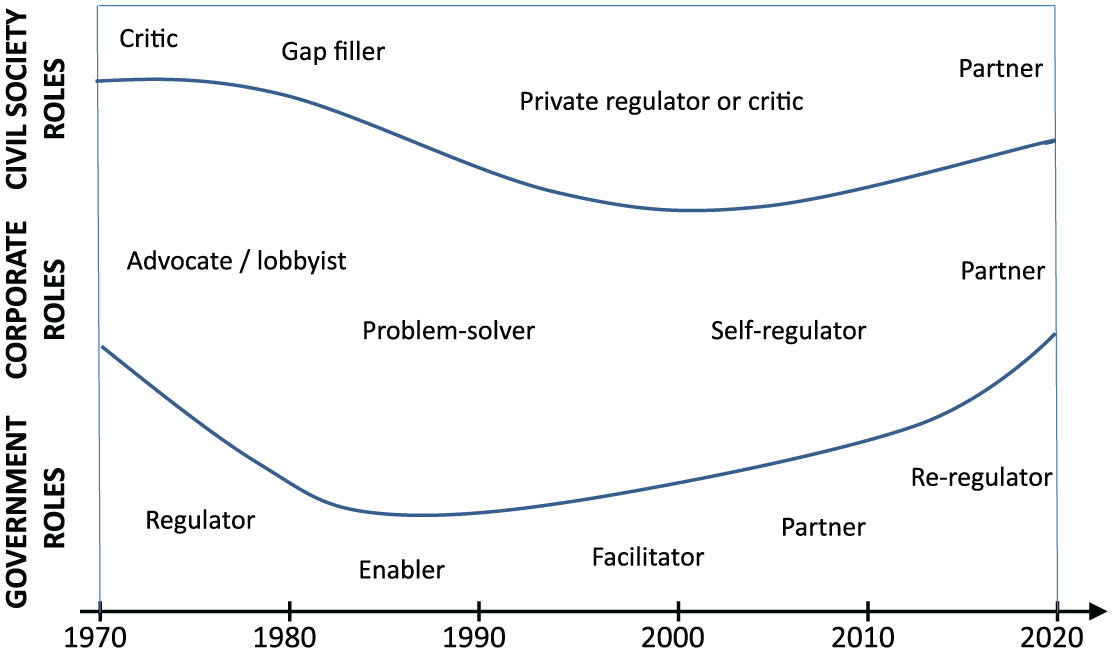
Stylized interpretation of dominant discourses about primary roles of societal sectors over time.
As Figure 1 shows, the historical trajectory of government roles cannot be understood in isolation, i.e., without an examination of the corresponding roles of business and civil society. As the figure suggests, the dominant discourses have changed significantly over time. Governments were traditionally seen primarily as regulators of business conduct, while corporations advocated for their own views and lobbied government to enact favorable regulation. Civil society in turn played the role of critics of powerful firms and governments. Most strongly during the 1980s but well into the 1990s, neoliberal discourses and their hallmarks of privatization, liberalization, and deregulation brought forth a decreasing emphasis on government responsibility, while companies (and markets) became the solution to societal problems and a powerful agent of transformation and modernization of, so the rhetoric went, an outmoded and anachronistic public sector. Civil society was perceived to be left to fill in the gaps that other sectors did not address. Towards the turn of the millennium, however, and fueled through the intensification of globalization, societal challenges have increasingly come to be interpreted as being global by nature. Growing private regulation often put civil society in the driver’s seat in “policing” business activities, while governments took on a supporting role. Companies could participate in private regulation or collaborate among themselves to develop self-regulatory tools and “soft law.” Recent years have seen a strong shift towards a partnership society, where all sectors increasingly work together to address local and global societal challenges, for instance in the context of multi-stakeholder initiatives and/or public-private partnerships. Alongside the rise of such partnerships, we also see governments re-establishing some of their traditional roles as regulators but in new ways—and some of those new dynamics are being explored by the papers of this special issue. In the light of these challenges to government, and the closer analysis of the changing roles of government, we pinpoint key assumptions that prevail specifically in organizational research about governments.
Assumptions about government in the governance of business conduct in organizational research
We now turn to critically reviewing assumptions about government and the governance of business conduct. Here we present those assumptions derived from the broad organizational research literature. We problematize four interrelated assumptions and briefly sketch, in each case, associated challenges. In so doing, we pave the ground for more detailed and substantive critiques that emerge, albeit in different and multifaceted ways, in the contributions to this special issue.
Assumption 1: Governments are losing power
Within organizational scholarship on the governance of business conduct, national (and sub-national) governments are seen to be losing influence, mostly at the expense of multi-stakeholder initiatives (MSI) and business-led initiatives, but also relative to international governmental organizations. A wide range of literature explores how these other actors are filling in the gaps that government is leaving behind (e.g., Ména & Palazzo, 2012; Waddock, 2008). For instance, in the context of CSR, Waddock (2008) illustrates an institutional infrastructure for CSR in which various players such as NGOs, accounting and advisory firms, MSIs, private-sector initiatives, and industry roundtables all play an important role in shaping CSR—decisively toning down the role of governments in this field. Likewise, in corporate governance research, scholars have emphasized the simultaneous contradictory developments of international corporate governance standardization (Aguilera & Cuervo-Cazurra, 2004) and local adaptation of governance practices by companies (Okhmatovskiy & David, 2012), thus leaving less space for governments to play an active role. More generally, Knudsen and Moon (2017) note that in the context of CSR a lot of the literature dichotomizes CSR and government, whether “expressly” or “implicitly,” indicating that the contributing authors do not see government as relevant to CSR.
However, Knudsen and Moon (2017) also note a relational literature on government and CSR, which presents CSR as either embedded by government (e.g., Campbell, 2007; Matten & Moon, 2008) or focuses on government agency for CSR (see Albareda et al., 2007; Bartley, 2007; Gond et al., 2011; Knudsen et al., 2015; Steurer, 2010). So while in some contexts, the general perception seems to be that governments are losing power or are not relevant to important aspects of the governance of business conduct, in other contexts, we see a return of government with regard to regulating business conduct in areas that have previously been led by private sector initiatives. Governments are for example increasingly intervening in soft law initiatives as the cases of Denmark, the Netherlands, and France seem to indicate. In these countries, a voluntary form of sustainability reporting has become mandatory reporting by law. Governments are also taking influential roles such as partners with the private sector in implementing, for example, larger infrastructure projects (e.g., Kivleniece & Quélin, 2012; Quélin, Kivleniece, & Lazzarini, 2017); as orchestrators of networks in areas such as energy, water management, and climate change mitigation (Peterman et al., 2014); or as investors in new technologies (Vasudeva, 2013). Even where we would not expect to find a role for government—the emergence of Silicon Valley and of an “entrepreneurship ecology”—we have significant evidence that the state played a huge part (e.g., Wonglimpiyarat, 2006). Similarly, governments, particularly within and through the European Union, are taking an increasingly stronger stance on companies’ use of tax havens.
Recent trends suggest that while other actors have received the bulk of attention, government has certainly not disappeared from the scene, quite the contrary. Instead of portraying this as a loss of power, we emphasize a shift towards new forms of engagement, and we underscore that this evolution is more complex than a simple zero-sum game. We call for further research on these new forms of engagement, including the inherent power struggle over authority. As we see clear signs of a return of governments, we nevertheless maintain that in many cases governments in fact never left and were always present. We argue that the important roles that governments have always played in seizing, maintaining, and distributing power have not been sufficiently explored due to the dominance of this underlying assumption of a loss of governmental power (Weiss, 1998).
Prospectively, it is conceivable that the role of governments in the governance of business conduct may yet further increase. This possibility is informed by the recent election of government leaders, populist and otherwise, who promise to challenge special illegitimate or corrupt interests which have usurped what is purported to be some sense of societal value or interest (e.g., Trump in the USA; Modi in India; Bolsonaro in Brazil; Caputova in Slovakia). Part of the resolution of this usurpation is seen by such leaders as the rearming of government in defense of that societal value or interest. Quite often these leaders have included corporations or business, more widely, in their rhetorical targets. Moreover, in some cases, corporations have openly resisted the challenges to their roles (e.g., regarding climate change in the USA). So the research question arises as to what impacts these efforts to reassert governmental authority will have on the governance of business conduct.
Assumption 2: Governments lack enforcement capacity to impact multinational companies
It is commonly assumed that multinational companies are mobile, willing, and able to move from one country to another in search of the most favorable regulatory context (see Mäkinen & Kourula, 2012). If corporate and other taxes are not at an appropriate level, companies move operations elsewhere or use tax havens. If environmental regulation becomes too cumbersome, corporations relocate industrial operations to pollution havens with more lax regulation. If supply chain wages and other production costs increase too dramatically, firms will purchase from other suppliers or move their own operations to less expensive institutional contexts in what is called a regulatory race to the bottom. Due to national-level institutional voids, there is a call for actors with a multinational reach—namely companies and civil society organizations—to complement, or in some cases replace, regulatory gaps left by governments (for a reflection on corporate power and authority, see Ruggie, 2017). This call has resonated particularly in the political CSR literature (Scherer & Palazzo, 2007, 2011).
Nonetheless, we should note that the role of government in regulating social, environmental, and other types of business conduct was always critical, particularly since the nineteenth century (Djelic & Etchanchu, 2017). Few major social or environmental improvements would have been achieved without government intervention or threat of regulation. Moreover, the very liberalization alluded to above has reflected government choices about the environments in which MNCs invest much as they make such choices about special regulatory conditions for selected regions or enterprise zones internally.
States already have played a key role in the context of existing transnational governance on two dimensions. First, the fear of stronger laws often motivates private actors to propose and deploy soft rules to keep harder laws at bay. Second, states also play a potentially large role at the compliance end of regulation, implementation and monitoring where soft rules tend to be quite weak. When states adopt soft rules generated by private regulation these rules suddenly have “teeth” and are able to “bite” where they were previously often weak and with limited impact (Cashore & Stone, 2012, 2014). Governments are needed to go beyond mere symbolic self-regulation (Short & Toffel, 2010). There is evidence that governments, notably the USA and the UK, are now prepared to champion a hardening of rules when it comes to the conduct of companies registered in their jurisdictions. Governments have supported and even initiated private regulation of corporations to address the problem of a lack of transparency in MNCs to government payments in the extractives sector (e.g., through the Extractive Industries Transparency Initiative), as well as using wider and harder regulation to address the same problem (Knudsen & Moon, 2017).
While we should remember that MNCs are not the only game in town and that a vast majority of (smaller) firms operate nationally mostly under clear government regulation, many small firms are also increasingly integrated into global production networks and supply chains and hence within soft transnational regulatory nets (e.g., Baumann-Pauly, Wickert, Spence, & Scherer, 2013; Wickert, 2016; Wickert et al., 2016).
Assumption 3: Private regulation is superior to government regulation
Management scholarship tends to have a negative bias towards government. Marens (2008) refers to this as the “government sucks” metaphor. We should note that there is a fairly broad literature, particularly in critical management studies, on the limits of market-based initiatives (e.g., Banerjee, 2012; Böhm, Misoczky, & Moog, 2012; Wittneben et al., 2012). Nonetheless, this literature is also rather critical of government capacity and often complicit behavior. Organizational scholars have explored extensively the neoliberal trend of emphasizing market-based instead of regulatory means to govern business conduct. This general trend of moving from hard law to soft law is combined with a view of market-driven initiatives as superior and generally more efficient from the perspective of business firms. Also, as challenges related to legitimacy are addressed through multi-stakeholder initiatives, governments are seen to become weaker as governors of business conduct.
Nonetheless, recent scholarship has increasingly emphasized the limits of private and self-regulation (Djelic & Quack, 2018), particularly their marginal impact. While the erosion of state power and the shift towards private regulation have dominated organization and management debates, specifically in CSR literature, the neoliberal watershed towards the presumed superior capacity of private or market-driven interventions seems not to have produced notable improvements for instance in the global provision of labor standards or voluntary measures to mitigate climate change (Locke, 2013).
However, we recognize that this does remain a rather unclear area. We argue that the impact of governments in their various roles deserves more systematic analysis, specifically when it comes to contrasting the effects of market-based versus regulation-based approaches to issues such as climate change or social standards. Particularly interesting are the dynamics and power struggles of government regulation in comparison to private and self-regulatory mechanisms, especially a comparative estimation of impact that would challenge the often-presumed superiority of market-based mechanisms.
Assumption 4: Governments are not relevant objects of analysis
The underlying assumption of governments not being relevant and thus not interesting for examining business conduct from an organization and management theory perspective involves two elements. First, governments are not perceived as attractive objects of analysis as many of the exciting interactions and fast-paced developments are seen to take place elsewhere, namely in powerful multinational corporations (e.g., Doh & Guay, 2006; den Hond, Rehbein, de Bakker, & Koijmans van Lankveld, 2014), dynamic social movements (Dubuisson-Quellier, 2013; Hiatt, Grandy, & Lee, 2015), new enterprises, for example ICT platforms (e.g., AirBNB, Uber) or other powerful stakeholders (e.g., farmers’ associations in the case of regulatory approval for genetically modified organisms (Hiatt & Park, 2013). The unthankful task of legislation and regulation is left to government, while experimentation, innovation, hybridity, and dynamism are characteristics of other stakeholder relationships. We argue that governments are much more flexible, adaptive, and open to experimentation than assumed in extant organizational scholarship. Second, in organization studies there is simply a lack of knowledge about dynamics of governments as much of their activity goes underexplored. In fact, very few studies use the empirical contexts of, for instance, municipalities or ministries. We argue that, as governments assume new roles in the governance of business conduct, they do this in a multilevel way. We call for more studies exploring the multilevel interrelation, coordination, and orchestration (local, regional, national, and international) of government activity and the resulting impact on the definition and regulation of appropriate business conduct.
Overall, these four central but problematic assumptions that frame much organizational research on governments and the governance of business conduct provide a fertile conceptual starting point. We do not argue that they are exhaustive; but they delineate the conceptual territory on which future research can build and expand to generate further insights on governance and governments and their complex interactions and dynamics when it comes to the governance of business conduct. Below, we briefly summarize the six constitutive papers of this special issue and outline how each scrutinizes and questions the assumptions identified above.
Problematizing the Governance of Business Conduct: The Contributions to the Special Issue
Our special issue brings together six contributions that all explore the roles of government in the governance of business conduct. The articles cover topics as diverse as international standardization, corporate (ir)responsibility, community relations, and even the license to exist of particular industries. In terms of theoretical grounding, the contributions are equally diverse, ranging for instance from Foucauldian governmentality in the context of the Chilean mining industry (Maher et al., 2019), to transnational institutionalism and regulation theory (Boghossian & Marques, 2019), and an in-depth conceptual analysis of political science theories (Eberlein, 2019). Methodologically, two conceptual studies (Eberlein, 2019; Schneider & Scherer, 2019) are complemented by four qualitative studies, some of the latter drawing on a longitudinal research design to explore how government–business dynamics evolve over time (Alon et al., 2019; Hamann, 2019).
Each of these articles questions some of the assumptions about government identified above and explores the contemporary evolution, transformation, and redefinition of the roles of governments in the governance of business conduct. Table 1 identifies which assumptions are more specifically challenged by each of those six papers and presents a summary of the redefined governmental roles that emerge from those studies. Below, we briefly summarize each contribution, starting with the two conceptual studies of Eberlein (2019) and Schneider and Scherer (2019), then turning to the remaining empirical contributions.
Assumptions about government and government roles presented in special issue papers.
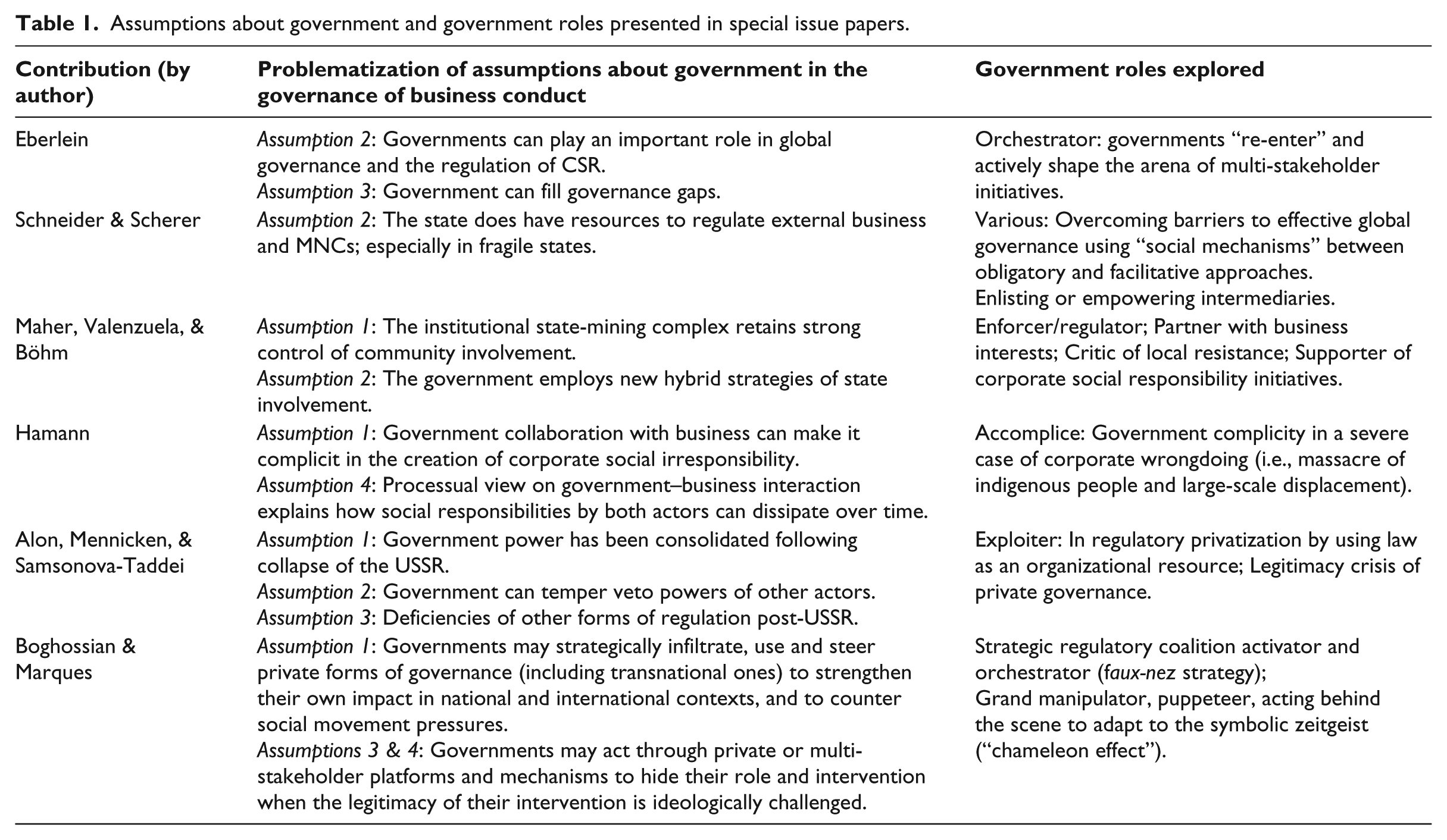
Eberlein (2019) provides a thought-provoking conceptual analysis of political CSR (PCSR) and the relationship between public and private regulation when addressing global governance gaps. He shows that the portrayal by political CSR scholarship of the shifting balance between business and government in the globalized economy rests on a central, yet largely untested, assumption: that of a zero-sum constellation where firms take on public responsibilities to fill governance gaps left by governments. The study deconstructs the problematic assumptions underlying the zero-sum notion of governance gaps filled by corporations and, as an alternative view to that prevailing in PCSR, offers a variable-sum mapping of how private and public authority interact in global governance where substitution is only one of four constellations, next to the modes of support, shadow of hierarchy, and soft steering. The author identifies “soft steering” as a prominent mode through which governments govern business conduct and theorizes “orchestration”, a soft steering tool discussed in the global governance literature, from an organizational, corporate perspective. The paper identifies the mechanisms through which orchestration may address the barriers to corporate engagement with the public good, and applies these mechanisms to the case of the Global Reporting Initiative. Eberlein thus attributes a much broader and more influential role to governments in the governance of business conduct than is typically granted by PCSR scholarship that mainly, explicitly or implicitly, refers to the mode of substitution of public governance with private governance.
In the context of the global governance literature which presents the challenges for national governments and the shortfalls in MNCs’ governance contributions, Schneider and Scherer (2019) consider the ways in which governments can make private governance more effective and legitimate through social mechanisms. They identify such mechanisms (e.g., re-regulation, empowering intermediaries), examine how these can make CSR work better (e.g., developing capacities, increasing legitimacy), and consider boundary conditions for these impacts at the firm and governmental levels. The article contributes by differentiating between social mechanisms that governments can deploy for CSR, locating these between voluntariness and obligation, and suggesting preconditions in which these policies might enhance effectiveness and legitimacy of CSR.
In their exploration of mining conflicts in Chilean local communities, Maher, Valenzuela and Böhm (2019) argue that the state is simultaneously seemingly materially absent while still having a strong influence on local outcomes. The study presents a hybrid theory combining elements of central steering and dispersed vouching. The authors argue that the government is not necessarily losing power, but the institutional state–mining complex retains strong control of community involvement. The state should not be seen to lack enforcement capacity, but a more fruitful way to examine the context is to understand the new hybrid strategies of state involvement. Public agencies adopted a range of more or less material tools and responsibilities simultaneously, ranging from direct prescription of activities to supporting the deployment by mining companies of corporate social responsibility programs. The study shows that governments may not only be important agents encouraging more intense forms of CSR involvement, but may also be complicit and play an important role in promoting forms of CSiR in conjunction with business. Thus, business–government interactions and their unfolding over time present a theoretically insightful object of further study to understand how irresponsible behaviour is deployed and sustained.
Hamann’s (2019) study of the Marikana Massacre in the Republic of South Africa illuminates the dark side of political CSR and the dialectic negotiation of responsibility between business and the state. He shows that political CSR is defined and enacted in a political governance context involving dynamic interactions between business and government. While research of such interactions has described different models of how social responsibilities are allocated in the form of oscillation between business and government, or mutual accommodation, Hamann suggests that little is still known about how business–government interactions may give rise to corporate social irresponsibility (CSiR). The study examines interactions between mining companies and government in RSA with a focus on processes of rule-making and the provision of public goods that contributed to the deterioration of living conditions around mines in the Marikana area, site of an infamous massacre in 2012. The analysis results in a process model of dynamic de-responsibilization, in which practices of government and business, premised upon assumptions of managerial discretion, build upon each other to progressively dissipate social responsibilities by both business and government.
In the context of privatization, globalization and liberalization in the wake of the collapse of the USSR, and the associated questioning of the power of government, Alon, Mennicken, & Samsonova-Taddei (2019) investigate the evolution of Russia’s audit oversight regime (the “audit of the auditors”). On the basis of their longitudinal study using a variety of qualitative data they conclude that there has been a shift from self-regulation (mainly through member peer reviews offered by new private accountancy associations) to increased public oversight. In so doing they also reveal the role of the state in the original privatization process as well as in the reinvigoration of public authority, and the conditions and mechanisms underlying public/private regulatory dynamics. In particular, they demonstrate how pursuing change through progressive legislative “layering” (Mahoney & Thelen 2009), the state was able to redeploy itself in the face of a rising market logic to ensure continuity in its regulatory objectives.
The contribution of Boghossian and Marques (2019) shows that states may have to infiltrate and manipulate private and multi-stakeholder platforms to both advance their regulatory purposes and to disguise or even hide their intervention in a context where resistance to state intervention is ideologically motivated. In that case, states have not disappeared. They are still strongly involved and they intervene sometimes powerfully in regulatory arenas, whether national or transnational. They have to do so, though, behind a veil—as master puppeteers their role and intervention should as much as possible remain out of sight to fit the zeitgeist or spirit of the time that tends to privilege private or self-regulation while disparaging the efficiency of state intervention.
Conclusion: A Research Agenda
After reviewing research on government and the governance of business conduct, providing an interpretation of the related historical discourses of the past half century, problematizing key underlying assumptions in the field, and presenting the special issue papers, we turn to a call for action for organizational scholars. We structure our suggestions for future research by examining how the problematic underlying assumptions of the field could be tackled and challenged further.
The first assumption, that governments are losing power, points in fact to a number of new issues that should be explored. First, we need to determine what kind of power is examined, e.g., instrumental, structural or discursive power (see Ruggie, 2017). Further research should move us towards both a conceptualization and an operationalization of what is meant by government power, allowing us to better measure and assess perceived and actual levels of power and when they might increase or decrease. Additionally, we know little about the outcomes and implications of governments reasserting power. Thus, it is yet to be investigated whether the return of the state is a cure or a curse (or something in between). Furthermore, it is unclear what kind of state we are really talking about. The regulatory states of today are very different from the welfare/industrialist states of the 1960s. We have had political scientists theorizing about regulatory and even post-regulatory states, but the return of authoritarian and non-democratic tendencies goes contrary to this development. In light of these political trends and national differences, we are in need of a contextualized understanding of government influence—a theme which we have certainly aimed to address through this special issue. In terms of context, research also needs to further explore variance between regulatory areas (e.g., digitalization, data privacy, GMO, climate change) or the issue-specific nature of government power. Finally, new forms of organizing and new governmental roles are emerging and scholars should analyze the dynamic interplay between these new forms and roles and their more traditional counterparts.
The second assumption was that governments lacked enforcement capacity. New forms of government participation in enforcement are particularly important to study further. Governments participate extensively in transnational regulation (Djelic & Quack, 2018). Political science and its insights on direct and indirect aspects of governance and the regulator–intermediary–target/rule-taker framework and the notion of regulatory intermediaries offer fruitful avenues for future research (Abbott et al., 2017a, 2017b; Brès, Ména & Salles-Djelic, 2019; Kourula et al., 2018). Thus, indirect government influence and participation is a central part of its enforcement capacity, as illustrated by Schneider and Scherer’s examination of government policies for CSR and Alon et al.’s analysis of the uses of legislative layering as an organizational resource for governments. Often governments outsource enforcement. What is more, several new mechanisms of enforcement, new legal instruments (e.g., requirements of supply chain due diligence), and new areas of enforcement (e.g., tax) are developing rapidly.
The third assumption perceives private regulation as superior to government regulation. Significant research efforts are being directed at evaluating the development and impact of private regulation, but it is possible that such a clear-cut distinction and oppositional positioning is misleading. Governments are reasserting their influence, but this is taking place in a more intertwined and complex manner. The “from hard law to soft law” trajectory is eroding, and increasingly we see hard-law initiatives by governments where soft law used to be. As Vogel states: the “distinction between public and private obscures more than it clarifies about the nature of power and authority” in transnational governance (Vogel, 2008, p. 265). Thus, a more nuanced understanding of the forms and benefits of state-led vs. market-led interventions is needed. A more systemic and comparative approach to regulatory programs can be a fruitful direction of inquiry. Critical perspectives are certainly needed to determine, for instance, whether private or self-regulatory approaches are crowding out mandatory elements. Ultimately, we argue that the post-national constellation—a key assumption of political CSR literature—is not really happening. Thus, it is time to think about new conceptualizations of the nation-state in the 21st century and what the organizational and managerial implications of this for the governance of business conduct are.
The fourth and final assumption sees that governments are not relevant objects of analysis for organizational theorists. We oppose this assumption strongly as we are experiencing a flourishing of local participation and new technologies for engagement. We need more studies exploring the interrelated local, regional, national, and international coordinated or orchestrated government activities in determining appropriate business conduct. Battle lines are being drawn between these levels of analysis, e.g., the nation-state and the European Union, the State of California vs. the Trump Administration, the increasingly statist warring over international trade. Further studies examining strong state contexts, instead of the usual Western countries, could yield valuable context-sensitive insights. All in all, open topics and questions include the sphere of interventions of government, its capacity, will, and legitimacy. Especially interesting are new regulatory areas and gaps such as digitalization, most recently attested to by Facebook CEO, Mark Zuckerberg’s (2019) plea for more regulation.
Last, inspired by the recent “micro-turn” in organizational analysis, we should examine how these macro-level dynamics between governments and business are experienced, shaped, resisted or promoted at the micro level (e.g., by actors operating within organizations) and what interpersonal interactions look like in that context. Ultimately, to truly understand the governance of business conduct (i.e., where it fails and where it works) we need a stronger and more nuanced understanding of the role of government therein. An orientation could be provided by recent research in CSR, where scholars have examined the roles, responsibilities, struggles, and tactics of CSR managers when strategizing and putting into practice broad goals and aspirations linked to responsible business conduct (e.g., Kok, de Bakker, & Groenewegen, 2017; Risi & Wickert, 2017; Wickert & de Bakker, 2018). In fact, all of those macro-level issues that we have described as the governance of business conduct influence and are influenced by activities at the micro level of analysis, which should be explored further in order to gain a more complete understanding of these dynamics.
We hope that this introduction to the special issue not only provides insights into some of the dynamic new roles that characterize the business–government nexus, but also stimulates organizational and management researchers to take up further inquiry into this exciting field.
Footnotes
Acknowledgements
The idea for the special issue came from the EGOS 2015 Conference Sub-Theme “Creating and Sustaining Transnational Multi-Actor Governance of Corporate Conduct”, within the EGOS “The Changing Role of Business in Global Society” Standing Working Group (2012–2017). Thank you to Elisah van Kempen for background research. We are grateful to the Velux Foundation for contributing to the costs of a Special Issue Workshop held at Copenhagen Business School (2016) and to the workshop participants. We are very grateful to OS joint Editor in Chief, Trish Reay, and OS Managing Editor, Sophia Tzagaraki, for their wonderful support. A very big thank you to the 50+ reviewers who were so supportive of the SI in their careful reviews of the papers.
Funding
This research received no specific grant from any funding agency in the public, commercial, or not-for-profit sectors.
