



Abstract
In the developing economy of Bangladesh, local factory owners in the garment industry have felt great pressure to improve factory safety, but the costs for those improvements are not shared by the global apparel firms that wield immense influence over them. Consequently, we examine whether multi-stakeholder initiatives (MSIs), as vehicles of corporate social responsibility (CSR), offer platforms for democratic oversight or merely serve as new arenas to exercise corporate power. Given their role in connecting global and local contexts and their history of safety incidents, local factory owners possess a unique perspective on the impact and contested nature of CSR in global supply chains. This article presents a qualitative study of MSIs in the Bangladesh garment industry, particularly after the Rana Plaza collapse. Through interviews with local factory owners and executive managers, we explore the reasons behind their opposition to CSR as exercised by global apparel firms, and the contestation of those practices by their local business association. Our findings lead us to conclude that garment industry MSIs are unlikely to be effective without labor procurement practices that harmonize global and local interests to mitigate the competitive pressures on local factory owners.
Keywords
Global supply chain 1 governance remains a broadly discussed issue for corporate social responsibility (CSR) because nation state regulation faces limitations (Boström et al., 2015; Matten and Crane, 2005; Scherer and Palazzo, 2007; Vogel, 2010). Consequently, an emergent institutional infrastructure of public and private authority has surfaced to coordinate transnational economic activity and the responsibilities of business (Levy and Kaplan, 2008; Waddock, 2008). In the aftermath of the Rana Plaza disaster in April 2013 that killed over 1100 workers, Bangladesh, a manufacturing hub of the global ready-made garment (RMG) industry, has become a focal point for discussions of responsible supply chain governance. A number of leading global apparel firms agreed to form the Bangladesh Accord for Worker and Fire Safety (hereafter, the Accord) and the Alliance for Worker Safety in Bangladesh (hereafter, the Alliance). These multi-stakeholder initiatives (MSIs) were formed to provide global standards and oversight for garment factory safety. Together, they were very successful in reducing safety hazards in garment factories (Accord, 2021; Morse, 2021), and the Accord was heralded as a “new paradigm” in global apparel industry governance (Anner et al., 2013).
However, MSIs tended to focus on interactions between the global buyers and local suppliers and their external constituencies (i.e. workers, consumers, non-governmental organizations (NGOs)) to the relative neglect of the relations between the supply chain buyers and suppliers themselves. Perhaps the assumption is that the interests of these two parties are closely aligned, but this may not always be the case. For example, local garment industry leaders opposed renewing the Accord and the Alliance, with their globally determined standards and external monitoring, at the end of their five-year terms in December of 2018. The Bangladesh Garment Manufacturers and Exporters Association (BGMEA), an employer association comprised of local factory owners, sought to reestablish local governance of the industry. The supply chain collaborators, global buyers and local suppliers, shared the objective of maintaining profitability while improving safety, but differed on how this objective would be achieved. During and after the Accord and the Alliance, the global apparel firms who sought global governance and the BGMEA members who sought local governance contested the content and manner of CSR in the Bangladesh garment industry.
Local factory owners serve as intermediaries between global apparel firms and local workers, making them subject to global and local governance systems. This unique position grants them valuable insights into the functioning and regulation of global supply chains. Global apparel firms’ emphasis on unannounced audits to improve safety compliance in their global supply chains, while clearly beneficial (e.g. Islam et al., 2018), can inadvertently leave the impression that local factory owners bear the sole responsibility for safety mishaps (e.g. Short and Toffel, 2021). However, we suggest that factory owners’ experiences are more nuanced and, viewed in context, their decision making mirrors the market-driven choices made by the global apparel firms that dominate the garment industry. While it is true that some factory owners are responsible for poor safety practices (i.e. Worker Rights Consortium, 2019), the challenges faced by Bangladesh garment workers and the actions of unions and NGOs in pressuring global apparel firms have been closely chronicled (Alamgir and Banerjee, 2019; Kabeer et al., 2020; Li et al., 2018; Reinecke and Donaghey, 2022; Selviaridis and Norrman, 2014). Focusing solely on the actions of apparel firms and other actors at the global level and workers at the local level, we overlook the vital mid-level perspective of local business owners concerning the social responsibility of businesses in the governance of global supply chains. To gain a comprehensive understanding of supply chain governance, it is essential to also consider the viewpoints of these local factory owners in the broader conversation.
The purpose of this article is to present the local factory owner viewpoint on why and how CSR is contested in the Bangladesh garment industry. Accordingly, we describe how politics operate at multiple levels in global supply chains and advance the understanding of CSR as contested governance by focusing on the largely overlooked local factory owner constituency. The article begins with an overview of MSIs and CSR, describes the local employer association as a critical actor in supply chains, and outlines the contested governance literature. Subsequently, we draw on a rich body of qualitative data, including numerous interviews with local factory owners and their executive-level managers, employer association officials and secondary source material, to detail how local factory owners experience global supply chain governance and their joint efforts to assert themselves in the governance structure. The article concludes by discussing the hybrid global–local mechanism developed through the conflict and the need to develop MSIs that can effectively meld global and local forms of corporate responsibility in supply chain governance, respect the priorities and standing of all participants, and improve protections for workers.
Multi-stakeholder initiatives, corporate social responsibility, and contested supply chain governance
As global business activity proliferates, CSR is often operationalized through MSIs that include participants with varied capabilities and interests, and whose interactions with one another (at global and local levels) regarding roles and obligations can be characterized in terms of contested governance. We will provide background on each of these key components.
Multi-stakeholder initiatives
The vehicles for realizing CSR are often MSIs that are established to monitor global supply chains and include global and local levels of governance. Gereffi (1994: 97) describes supply chain governance as “authority and power relationships that determine how financial, material and human resources are allocated and flow within a chain”. It is no longer the case that lead firms can simply dictate standards, pricing, and product delivery to other actors in far-flung supply chains (Ponte et al., 2019). Lead firms are subject to a global governance system comprised of a multi-layered and multi-actor web of international rules, norms, and institutions that includes not only national-level regulation and formal international agreements, but also private mechanisms such as codes of conduct and commonly accepted standards (Benedict, 2001; Kourula and Delalieux, 2016; Crane et al., 2019). At the domestic level, supply chain activity is governed through a patchwork of private and public guidelines, involving market-based and company-based mechanisms that are used to coordinate economic activity within national boundaries (Crane et al., 2019; van Veen-Dirks and Verdaasdonk, 2009).
As stated by Soundararajan et al. (2019: 385), “there is no universally accepted classification of MSIs and they can be initiated by a variety of actors for varied contexts”. Recognizing that there are many gradations of MSIs, we adopt Utting’s (2002, cited in Rasche, 2012: 679) broad definition as “self-regulatory governing arenas, which often operate on a transnational scale and are based on the voluntary contributions of participants”. The two MSIs discussed in this article, the Accord and the Alliance, were designed to improve safety in garment factories in Bangladesh, but differed substantively in how they were formed, their decision-making processes and governance of members, and the extent to which they are legally enforceable. The larger Accord was an agreement between two global labor organizations and over 200 global apparel firms (mostly European), and also entailed NGO observers, independent inspections, remediation oversight, and transparent reporting. Notably, disagreements between the global apparel firms and global labor organizations could be pursued to legally binding arbitration. Formed as a non-union and non-binding alternative to the Accord, the Alliance was a business-led initiative of primarily American companies that did not include NGOs and was not legally binding. The Alliance also included inspections and safety remediation efforts, and non-compliant members could lose their membership dues, but there was no labor union involvement (for a thorough treatment and comparison of these two programs as MSIs, see Ashwin, 2019; Donaghey and Reinecke, 2018; Leitheiser, 2021).
The participants
MSIs operationalize CSR through interactions between corporations and varied participants, such as NGOs, civil society organizations, localized collectives, and labor unions (Chowdhury, 2017; de Bakker et al., 2019; Donaghey and Reinecke, 2018; Egels-Zandén and Merk, 2014). These actors bring varied perspectives to the notion of CSR and its challenges. For example, labor unions argue that industrial democracy is preferable to CSR as a governance structure (Donaghey and Reinecke, 2018), and local civil society actors contest incommensurable notions of value (Banerjee et al., 2023; Ehrnström-Fuentes, 2016). Recognizing the differences that emerge between global and local actors, Rasche (2012) suggests that the effective coupling of local and global networks determines the extent to which MSIs can successfully manage global supply chains. Accordingly, local factory owners’ perspectives warrant close attention, particularly as they interpret global policies and translate them into action.
In view of their distinct interests, local factory owners often form collectives. However, employer associations, groups of proprietors from a particular business sector who affiliate to advance their common interests, are seldom the focus of scholarly inquiry (Barry and Wilkinson, 2011). Local business owners often look to employer associations in their attempts to countervail powerful corporations and labor unions and to lobby governments for favorable regulation. Employer associations also offer technical and informational support and enforce policies that prevent internecine conflict between members (Barry and Wilkinson, 2011; Schneider and Grote, 2006; Traxler, 2008). Contrary to depictions of employer associations as merely rent-seeking special interest groups, research in developing countries reveals a number of broadly favorable functions, such as facilitating vertical and horizontal coordination of production and improving the performance of economic markets (Doner and Schneider, 2000; Reveley and Ville, 2010).
It is expected that employer associations will play an important role in governing domestic markets, but they can also impact MSIs in global industries. For example, the RMG industry is highly competitive and involves numerous local factory owners who coordinate policy among themselves to bargain effectively with global apparel firms and to maintain their competitive posture relative to factories in other countries. At the national level, employer associations can align themselves with the country’s economic objectives, which helps them to attract members and maintain their standing in the marketplace. Nevertheless, given different levels of nation state regulation in global markets, employer associations must simultaneously address competitors in other countries and a bargaining power deficit with transnational corporations (TNCs). The stakes are high because the failure of one company to meet global standards can diminish the entire local industry. Although some scholars have argued that this type of economic vulnerability compels employer associations to improve standards and self-regulation (Bennett, 2000; Streeck and Kenworthy, 2005), it can also result in competitive menace, the pressure to cut corners and operate on the margins of workplace safety. Remaining competitive with peer firms in other countries is a driving factor in employer association policy (Reveley and Ville, 2010), but it is also possible—if not likely—that nebulous forms of global regulatory oversight exacerbate poor wage and safety practices.
Interactions and contested governance
As MSIs have become a focal point in the global landscape for CSR, some scholars view them as opportunities for more substantive democratic public involvement, while others argue that they constitute new arenas within which to contest corporate influence, power, and regulatory capture. In their notion of political CSR, Scherer and Palazzo (2011) draw from Habermasian deliberative democracy to propose that CSR should entail political processes of interaction that feature reasoned discourse and consensual decision making. Recognizing, however, that the potential of collaborative discourse can be exaggerated, they also emphasize accountability through rules and policies that duly consider the interests of all constituencies and present MSIs as prototypes of private governance in the global sphere (Scherer and Palazzo, 2007; Scherer et al., 2016). Whereas political CSR emphasizes the role of collaborative discourse between TNCs and civil society actors in creating voluntary governance structures, some scholars assert that it is too optimistic regarding the impacts of power asymmetries, and the likelihood of competing interests and values (Dawkins, 2015; Munir et al., 2018; Reinecke and Donaghey, 2022). Global supply chains operate at national and international levels, and the costs and benefits of economic activity are asymmetrically distributed, which naturally produces conflict (Ansell and Vogel, 2006; Zürn, 2018). These types of criticisms have prompted theoretical approaches that place CSR in the context of contested governance.
Arguably, all governance is contested to some degree because actors pursue different interests and advance opposing positions on policy, but contested governance is a more pervasive and fundamental form of conflict that also includes disagreement about who should make decisions and which decision-making criteria should be applied (Bair and Palpacuer, 2015; Ougaard, 2005). Levy et al. (2016) contend that the interactions between various actors in global supply chains will necessarily be contested. They use the case of local coffee growers and large coffee firms to describe contestation as the counterplay of disruptions and accommodations by opposing actors attempting to resolve their differences. Disruptions are efforts designed to alter the accepted authority and stability of a dominant actor, while accommodations are characterized by strategic concessions or stabilizing realignments of supply chain elements by dominant actors. This mode of contestation is necessary and unavoidable if the participants in collaborative governance are to fully pursue their varied interests (Brand et al., 2020; Dawkins, 2021). Lastly, contested governance has been described in terms of regimes, integrated configurations of economic activity, normative cultural values, and complementary authority structures (Levy et al., 2016). The notion of regimes underscores the civil and political arenas within which global supply chains operate and the resources that can be arrayed on behalf of business firms at the local or global level (e.g. Alamgir and Banerjee, 2019; Levy and Spicer, 2013).
Drawing from the work of Antonio Gramsci, the “neo-Gramscian” approach to global governance theorizes supply chain activity in terms of contested governance regimes. Dominant actors maintain their favored position by granting economic and social inducements to subordinated groups, employing normative tropes to justify themselves in the social order, and skillfully portraying inequitable structures as broadly beneficial (Laclau and Mouffe, 2001; Levy and Scully, 2007). However, in dominant structures external pressures and internal contradictions often trigger conflict over the division of tasks and the distribution of value among groups (Jessop, 2010; Levy and Egan, 2003). When challenged, the leading coalition attempts to maintain its advantage by “absorbing” opposing positions; accommodating varied interests through minor concessions while preserving the core features of its dominance (i.e. passive revolution) (Gramsci, 1971; Morton, 2010). From a contested governance perspective, the operationalization of CSR in an issue arena is likely to reflect the outcome of conflict between dominant and competing groups of actors.
Research question
Local business owners can benefit, on the one hand, through global economic integration and convergence, and be menaced, on the other hand, by uneven profit distribution and the social and political dominance of global firms. This dichotomy implies a conflict between local suppliers and local governance regimes and global buyers and global governance regimes, which are ostensibly on the same team. The extant scholarship lacks the local employer perspective on the issue of political contestation among the supply chain collaborators themselves. Therefore, we explore the two-part question: why and how do local suppliers contest CSR in global governance initiatives? To address the question, we turn to the Bangladesh RMG industry and its collaboration with global apparel firms.
Methodology
Context
Ready-made garments are mass produced apparel that includes a broad range of finished clothing, from sportswear to business wear. The revenue of the RMG industry was approximately US$1.5 trillion in 2021 and it was dominated by large TNCs, such as Louis Vuitton, Nike, H&M, and Zara (Coyne, 2020; Smith, 2022). By the early 2000s, RMG production was well established in emerging countries such as Bangladesh to take advantage of lower labor costs. Employing more than four million workers, the US$30 billion RMG industry in Bangladesh ranks only behind China and Vietnam and is critical to its national economy, accounting for roughly 84% of exports (Berg et al., 2021). The USA and Europe are the leading apparel importers (Smith, 2022). Since the Rana Plaza collapse, the Bangladesh RMG industry and the global apparel firms that purchase labor from local factory owners have focused heavily on improving health and safety in supply factories.
The BGMEA (2021)
2
is the dominant local actor in the Bangladesh RMG industry and represents approximately 4500 member factories. Its directors often sit on high-level government committees that develop labor and employment policy and have considerable political power. Approximately 10% of Bangladesh Parliament members directly own garment factories (Paton, 2020; Yardley, 2013). Current BGMEA office holders are primarily Managing Directors of large garment factories,
3
and we refer to the small percentage of politically connected owners as “BGMEA leadership” to distinguish them from the numerous “rank-and-file” factory owners in the association. Referring to the importance of size and political power disparities within the BGMEA, Factory Owner 31 states:
We have the BGMEA, our local association in Dhaka. But we do not always want to communicate with them. You know, in this industry, the big BGMEA factories tend to have political power. They [directors] use this power and it is often in their interest. They decide what to do with policies and know how to profit from them. But we in the smaller factories, we cannot do the same.
Research design
We employ a qualitative design of naturalistic and social constructivist inquiry to unearth the respondents’ diverse experiences rather than seeking statistically generalizable patterns (Eisenhardt et al., 2016; Patton, 2002). Qualitative inquiry also enables tracking of novel phenomena in reasonable proximity to their occurrence. Primary data were collected between 2014 and 2021 from open-ended and semi-structured interviews and factory visits. Secondary data were gathered from credible online and media outlets. To gain familiarity with the local setting and cultural nuances one of the authors studied the Bengali language for two years and resided in Dhaka intermittently during the fieldwork period.
Data collection and analysis
We gathered the factory owner perspective from interviews with them and their executive-level managers. The data, which are available from the authors by request, were compiled as follows: (a) interviews, 28 with owners and 58 with executive-level managers, at 86 separate RMG factories in Bangladesh; 4 (b) four interviews with BGMEA leaders; (c) six interviews with international brands; (d) four interviews with NGOs; and (e) one interview with a European Ambassador. 5 All owners and managers were affiliated with factories that were members of the BGMEA, which was required in order to obtain an export certificate. Each respondent was number coded in order to protect anonymity. Adopting a mix of purposive and snowball sampling (Patton, 2002), factories were identified using a supplier list provided by an international retailer and from the Accord’s public listing. The interviews lasted for an average of 75 minutes and were almost exclusively face-to-face. Questions posed to respondents can be separated into three categories. First, global governance, such as “how would you describe your interactions with the global brands and retailers”, and “how would you describe your compliance with the Accord and the Alliance?” Second, local governance, such as “how do you interact with the BGMEA”, and “how do you interact with neighboring suppliers?” Third, problems and challenges of operating in this structure, such as, “what are your primary market challenges and concerns?” In some cases, interviews were accompanied by brief factory tours or the opportunity to view health and safety upgrades. These field visits provided additional context for the data gathered in the personal interviews.
We reviewed 122 newspaper and magazine articles that covered the Bangladesh RMG sector—69 from Bangladeshi sources (e.g. The Daily Star, Dhaka Tribune) 6 and 53 from external sources (e.g. the The Guardian, The New York Times). The analysis also included 37 publicly available CSR and Sustainability reports, for the years 2018 through 2020, for 20 of the major European and US buyers who participated in the Accord or the Alliance. Finally, we reviewed numerous Twitter posts by the BGMEA or its president in 2019 and 2020—the years of indeterminacy regarding the future of the Accord and the Alliance. These data are available from the authors by request.
All interviews were conducted in English, fully recorded, and transcribed verbatim. The respondents’ data summed to 137.5 hours. As shown in Table 1, abductive analysis was employed in three steps: (a) selective coding, breaking textual data into discrete parts; (b) axial coding, drawing connections between discrete segments of data; and (c) open coding, establishing the central categories that capture the essence of the data (Dunne and Dougherty, 2016; Saldaña, 2021). We started the process by reviewing the interview passages iteratively to develop a common understanding. The empirical themes emerging from open coding were devised to mirror common incidents in the data: for instance, we created the empirical theme “the BGMEA leadership ensures uniform wage policies for its member factories”, because the vast majority of our respondents spoke about the role of the BGMEA leaders in maintaining wage consistency.
Abductive data analysis.
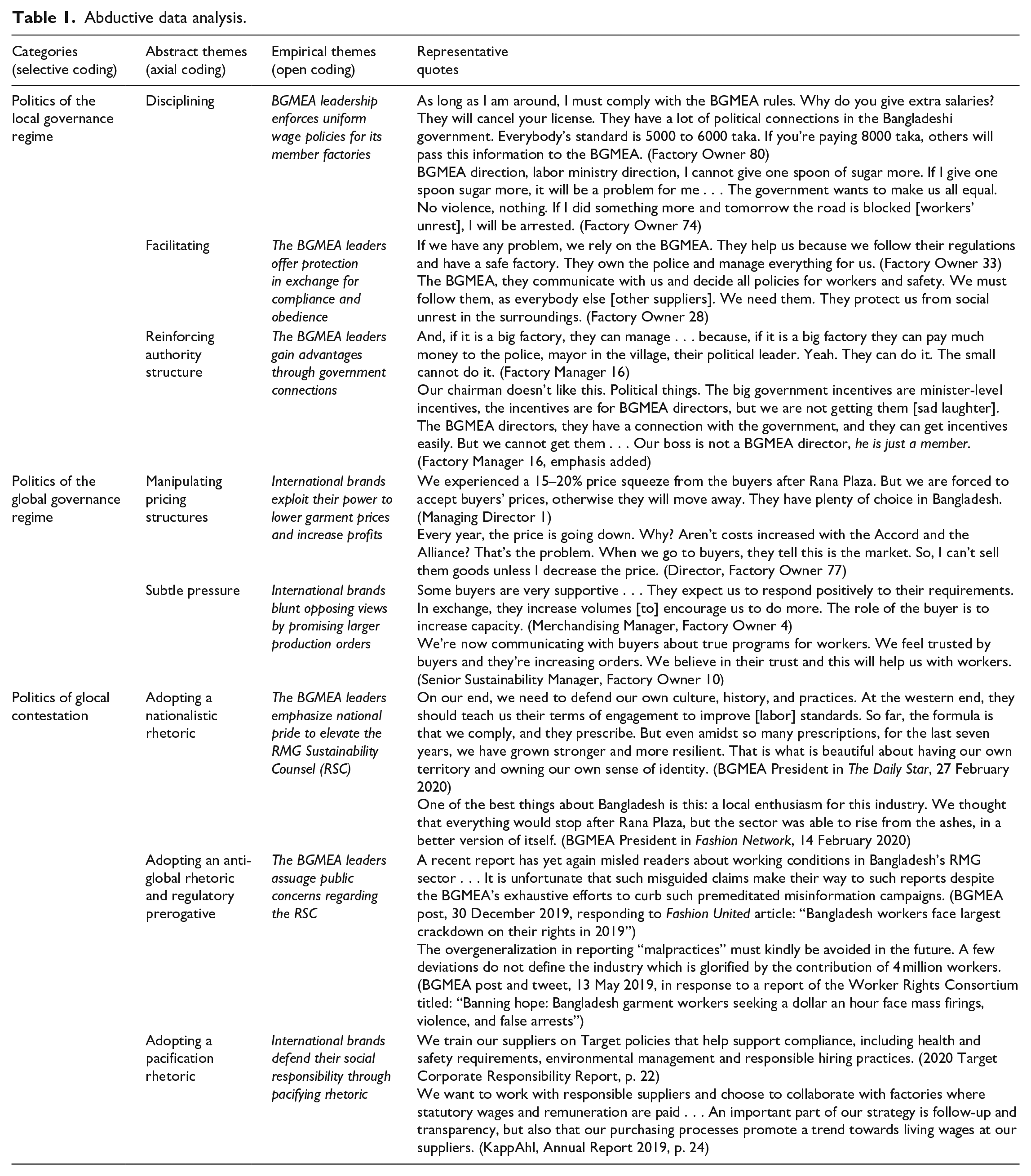
In the process of axial coding, we eliminated all but the most relevant data regarding factory owners’ experience with the BGMEA and global apparel firms in order to increase clarity. For instance, when reviewing the statements pertaining to the empirical theme “the BGMEA leaders gain advantages through government connections”, we observed that not only could BGMEA leaders win lucrative contracts with global apparel firms, but they also reinforced their role in local governance by capitalizing on their authority. We make this inference based on statements of respondents, such as Factory Owner 73: “they [BGMEA leaders] are becoming giants, but many factories are actually vanishing”. This led to the creation of the abstract theme “reinforcing authority structure”. After triangulating the interview data with secondary data, as part of the selective coding, we engaged in open coding to connect these abstract themes to the literature. The triangulated data helped us to identify core conceptual categories, such as “politics of the local governance regime”. The prominent themes that emerged from open coding of the data are elaborated in the discussion that follows.
Corporate social responsibility as contested governance in the Bangladesh readymade garment industry
There are two supply chain governance regimes operating in the Bangladesh RMG industry. At the local level, the BGMEA leadership maintains effective control of wage and labor practices, and at the global level large apparel firms interact with NGOs and other constituencies while managing relations with labor contractors in their supply chains. Additionally, each governance regime indicates its commitment to CSR, the BGMEA leadership through support of local programs and regulations, such as the National Tripartite Plan of Action on Fire Safety (NTPA),
7
and the global apparel firms through the Accord and the Alliance, but each regime also simultaneously clings to the current wage and product pricing structures, respectively. Both regimes are reticent regarding the terms of their future collaboration, but for different reasons; the BGMEA leaders seek to maintain profit levels amid safety improvements and competitive wage rates, and the global apparel firms strive to improve safety while maintaining the prices they pay to supplier factories. However, the prices global apparel firms pay for their products at garment factories directly impacts local wage rates, which are closely tied to health and safety. As stated in the World Development Report (World Bank, 1995: 77):
Reducing hazards in the workplace is costly, and typically the greater the reduction the more it costs. Moreover, the costs of compliance often fall largely on employees through lower worker wages or reduced employment . . . in many countries the determination of this level [of safety] involves consultations between government, employers, and workers.
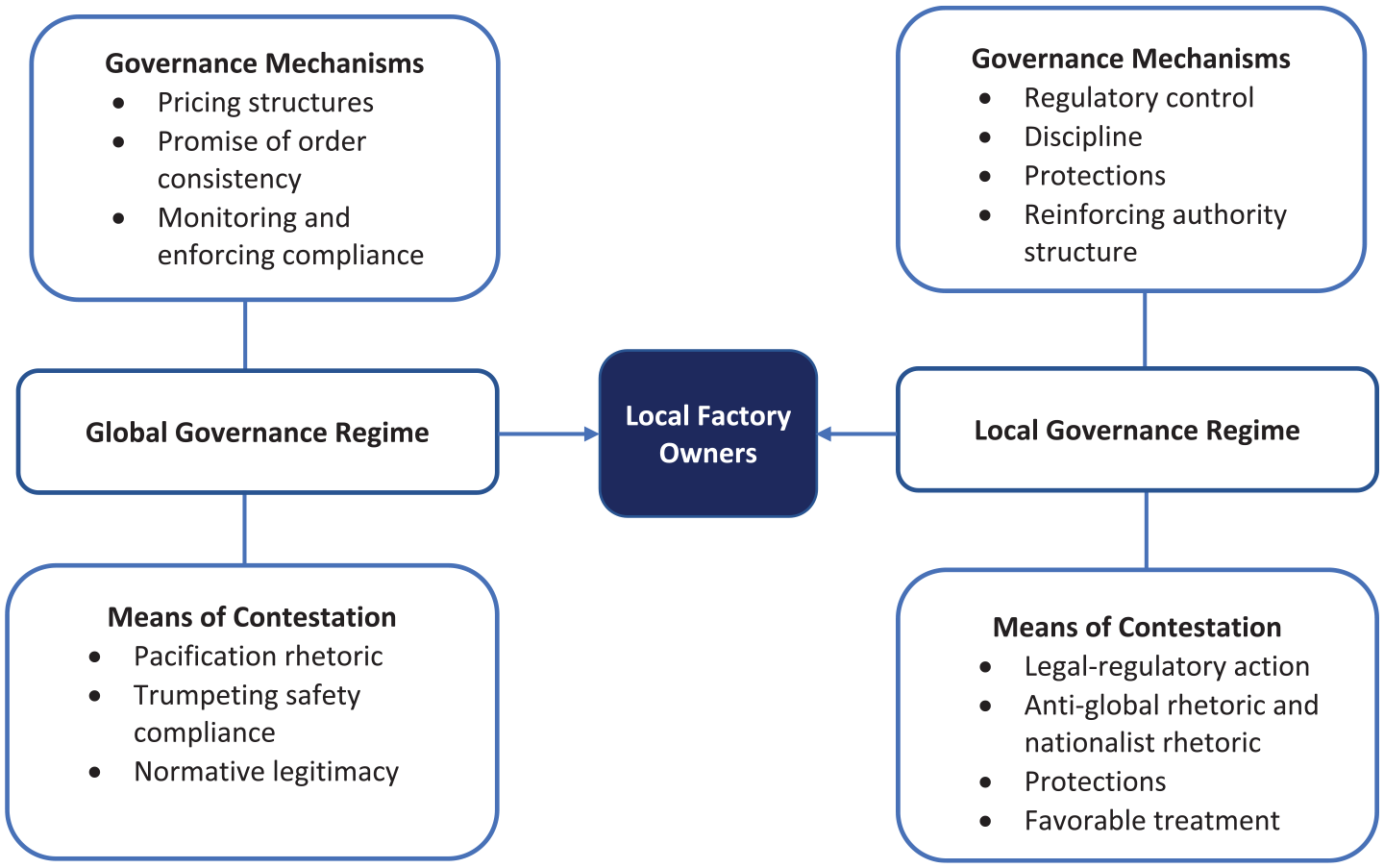
Glocal contestation of social responsibility in the Bangladesh RMG industry.
Local governance regimes and the BGMEA
Analysis of the interview data indicates that the BGMEA leadership maintains an accepted local governance regime through means of: (a) discipline, which prevents individual factory owners from undermining the competitive position of the domestic RMG industry; (b) facilitation, enabling the day-to-day operational tasks of factory owners; and (c) reinforcing the authority structure, through which the leaders entrench themselves and preserve their capacity to discipline and facilitate (see Table 1). First, the BGMEA leaders discipline and marshal factory owners on behalf of the collective. While the local regulatory mechanisms (e.g. the NTPA) and compliance with the Accord and the Alliance are consistent with improving CSR in the industry, the BGMEA leadership also requires factory owners to pay a uniform wage to workers. When asked about wages, factory owners and BGMEA leaders describe local governance similarly:
Under the BGMEA, all factory owners act in the same way. We are all aligned to the BGMEA rules. We just follow the minimum as demanded by the BGMEA. If we pay something extra, they will come to know, that is a problem. They will stop us because we can create unrest in the other factories. That is true. (Factory Manager 47) There is no law stopping employers from giving salaries above the law. However, it is mentioned in the law that once you provide benefits to workers, you can never stop them. That can create problems. We educate factory managers to protect them against the risks. (BGMEA Leader 3)
Unregulated wages among individual factory owners can create unrest among workers at other factories who will demand similar treatment and place upward pressure on wages, thereby eroding the “cheap labor” advantage that Bangladesh maintains over other countries (Bair et al., 2020; Berg et al., 2021). Given this level of BGMEA involvement and control, factory owners are left to grapple with the disconnect of motivating workers while adhering to a low-wage standard. For example, Factory Owner 55 states:
Minimum . . . every factory follows the minimum. The maximum cannot be followed. I pay the good workers under the table. I cannot pay them more on paper . . . [otherwise] they will call the BGMEA. It will be a problem.
Second, the BGMEA leaders encourage member factories to embrace the local governance regime by facilitating operational and political functions. For example, the BGMEA addresses factory owners’ concerns with labor unions, disgruntled workers, and even policing and security. Although Bangladesh’s labor unions are weak and sometimes corrupt, they can still enflame worker sentiment and factory owners depend on the political connections of BGMEA leaders to quell disturbances (Alamgir and Banerjee, 2019; Rahman and Langford, 2012). As Factory Owners 17 and 23 indicate:
Of course, there is no other way. We must follow the BGMEA rules. If I do not, you know, a lot of worker federations will be around me. The BGMEA directors, they are keeping their eyes to every factory. They are protecting us. So, I cannot go outside the BGMEA alone. No way. The BGMEA directors, they are controlling the business community and every month they sit together. They ensure us that there are no problems of worker unrest. In Gazipur, it can be very dangerous for the factory owners without proper control. That is why the BGMEA is working to avoid that.
Third, large and politically connected factories, such as those typically led by BGMEA leaders, do quite well in the current system and the owners reinforce the authority structure to more firmly cement their standing. For example, the garment factories of BGMEA leaders are often purpose-built in export processing zones and can readily make the improvements necessary to secure large contracts from global apparel firms (Reinhardt and Herman, 2014). These preferences are another example of local governance as a regime, rather than solely an integrating structure operating in the economic realm. Rank-and-file factory owners recognize the disparity between leaders and themselves, and some find it frustrating:
They [BGMEA leaders] focus on new [compliance] rules for their own political power in the parliament. They are becoming richer . . . The cost of production has increased after Rana Plaza and we are struggling. (Chairman, Factory 11) Whatever the BGMEA is doing through its policies is for its own benefits in the government. The directors are filling their pockets with money after Rana Plaza. (General Manager, Factory 48)
Global governance regimes and the apparel firms
Analysis of interview data is consistent with research indicating that the global governance regime helps the apparel firms maintain market dominance primarily by emphasizing safety, but also by minimizing the impact of procurement practices on factory operations (Anner, 2018; Anner et al., 2013). As exemplified by the statements in Table 1, the factory owners perceive global apparel firms as simultaneously emphasizing safety and restricting pricing in the supply contracts they offer. However, the primary message to factory owners is one of compliance, they must meet the remediation requirements to maintain contracts: “if a factory is not compliant with the Accord or Alliance, no order is placed. It will be blacklisted” and:
They always check for the minimum salary . . . They want to see our calculations over time . . . but they do not pay us more. (Factory Owner 11) Individual buyers send their social compliance team. They come to the factory, they visit, they find out their payroll, attendance. Compliance related. Never they ask to us or impose [on] us CSR. (Factory Manager 40)
While the structural mechanics of the global RMG supply chain remain largely unchanged, the global apparel firms exploit the normative standing of the Accord and the Alliance with consumers, which comports with the global governance structure focused on worker safety, but also results in transferring the economic burden of health and safety away from buyers and onto local factory owners:
Every year, they come and suck us. That is the only reality. If I am spending 20% more for the safety of workers, is the buyer going to pay me 5% more? If they give me a little more, we can do more. In fact, they are paying less price, every year. Whatever we are doing for workers, we are doing it as our own initiative. It is like buyers are pushing manufacturers to be ethical, but they are not ethical. (Factory Manager 58)
Procurement practices place price constraints on local factory owners because the power asymmetries between the parties enable global apparel firms to apply subtle pressure for compliance (see Table 1). MSIs, such as the Accord, have been an effective and socially responsible means of introducing needed workplace safety provisions, but these provisions can be implemented in a number of different ways. The global apparel firms appear to exploit this ambiguity by making concessions that potentially impact factory owners’ profitability without directly altering product pricing. For example, they emphasize placing orders with “mature” factories. These types of assurances result in factory owners accepting lower prices and hoping to recoup the shortfall through larger order volume. For example, Factory Owner 66 states:
We learn thanks to their compliance with the Accord guidelines . . . They tell us they have a commitment, that they are going to grow with us with certain products and amounts. [I]t’s a mutual relationship. In exchange for compliance, they will give us every month minimum 100,000 pieces. There are different types of buyers, but ours are trustable.
Making payments for orders more quickly can also result in less interest on factory owners’ operating loans. However, factory owners who implement such changes and increase profitability may find themselves at odds with the BGMEA if they decide to share the benefits of these efforts with workers in the form of higher wages—a demand put forth by workers and labor leaders. This disconnect between the CSR rhetoric and actual practice is reflected in the relationship between H&M and one of its local suppliers. H&M representatives state that procurement practices in its supply chain are “not a race to the bottom, it’s a race to the top” (Berg et al., 2019: 36). Conversely, Factory Manager 61 who contracts with H&M states: “Brands like H&M offer training . . . and guide us on investing in the business, which are all very good and important things. But then their buying teams still drive down order values and I feel such pressure.” Increased order volume and favorable payment schedules ultimately exemplify accommodations, limited concessions on wage-related policies coupled with a global governance discourse of health and safety mutuality. In neo-Gramscian terms, pacification occurs by making a peripheral accommodation while maintaining the broad outlines of the global governance regime relative to the price structure.
Global apparel firms also maintain advantage in subtle structural ways despite global governance provisions that suggest otherwise. For example, the Accord has an appeal process to obtain funding from global apparel firms for safety upgrades under certain conditions. On its face, this provision appears to be very favorable, but factory owners have been reluctant to use it because they fear the loss of additional orders in the future. The presence of power implies its potential use, such that power asymmetry alone is enough to influence behavior, even in the absence of overt action. In this case, the local factory owners recognize that by speaking up they might “win the battle but lose the war”. Factory Manager 38 describes the political pressure applied by global apparel firms:
There are, you know, common truths that people won’t tell you. I am telling you . . . Pressure is not direct pressure. It is a sort of request, but that sort of request cannot be avoided. To keep the area under control you have to give them something.
While the global apparel firms emphasize their desire to grow with good factory owners, they also appear to pacify factory owners through non-price concessions and latent forms of structural intimidation. Factory owners’ lack of leverage when negotiating with global apparel firms prevents them from contesting individually, but the BGMEA’s discipline and marshaling of forces are means of collectively contesting the MSIs under which its members operate. Without uniformity in wages and practices factory owners and their leaders believe that their businesses are vulnerable. Responding to the German Embassy, which had posted a tweet supporting agitating workers, the BGMEA President defended the factory owner perspective: “@GermanEmbassyBD wrote ‘workers dragged [from closing] factories, cyclically leading to protest.’ It [protests] is being incited. Manufacturers aren’t ‘hiding’ behind government, rather we are watching our businesses die” (The Daily Star, 2019). In response to what they perceive as a threat to their businesses, BGMEA members try to maintain local governance even to the extent of contesting their more powerful supply chain partners. Contestation has centered on CSR because the issue of worker safety has been framed in those terms by investors, NGOs, and consumers. Having explored why local factory owners are compelled to contest supply chain governance with their global business partners, we now turn to how this contestation occurs.
The politics of “glocal” contestation
To emphasize the point that much of the promotion of what is called local is in fact done from above or outside and to question the impact of the local dimension on globalization, Robertson (1995) introduced the term “glocal”. The glocal concept is important in describing the interplay of independence and interdependence between the BGMEA and the global apparel firms; local and global governance regimes needed to be mutually responsive and simultaneously retain separate identities to serve the disparate interests of local and global businesses. Glocal contestation occurred as these local and global governance regimes disputed the terms of their collaboration through disruptive actions, accommodation, negotiation, and power games. Notably, the BGMEA was not seeking transformative changes in workers’ wages and working conditions, but rather to obtain what it viewed as a fairer distribution of profits from its collaboration with apparel firms. Indeed, local suppliers and global buyers describe their collaboration in similar terms:
You have to come from the standpoint that Bangladesh is all about cheap labor. People come here for, you know, not for innovation. This is actually the bread and butter of the country. It is cheap labor. And everything is built on the assumption that a buyer comes here as a foreigner to buy cheap. (Factory Owner 46)
While the task of a local governance regime, such as the BGMEA, is ideally to contextualize CSR principles contained in a global governance regime, such as the Accord, factory owners doubted the suitability of the global standards and the sincerity of the apparel firms:
[T]hey are doing now all garment factories better than three-star hotels. Bangladesh, you see, all residents don’t have fire doors. My residence also has no fire doors, no fire facilities. But only in garment factories, we give all facilities. Customers give no price increase, only liabilities. Just they only pressure. (Factory Manager 81)
When the Accord and the Alliance expired in 2018, they were replaced by transition agreements, the Transition Accord and Nirapon 8 (the transition Alliance), during which time the BGMEA pursued local governance based on improved domestic regulatory institutions and the global apparel firms pursued an extension of global governance measures based on the normative legitimacy of the Accord and the Alliance. Drawing on their domestic regulatory authority, the BGMEA supported a lawsuit by Mostafizur Rahman, chairman of Smart Jeans, to remove the Accord. The lawsuit alleged that the Accord had wrongfully prevented its signatories from contracting with Smart Jeans, and combined with the subsequent decision by the Accord to prohibit orders to an additional 500 factories until remediation standards were met, it played a critical role in the Accord ultimately leaving Bangladesh (Preuss, 2018a). Following these developments, the Bangladesh Ministry of Labor and Employment stated that external oversight was no longer necessary and safety inspection programs would be conducted exclusively by the Remediation and Coordination Cell, under a newly proposed national program called Shonman, or “respect” (Connelly, 2017; Preuss, 2018b). A separate legal action against Nirapon was successful and the initiative subsequently withdrew from Bangladesh (Paton, 2020).
However, as global governance regimes also maintain political and social alignments related to corporate responsibility (Levy and Scully, 2007; Levy et al., 2016), the BGMEA member lawsuit to expel the Accord was strongly criticized by key international observers concerned about the potential impact on workers. In April 2019, the Clean Clothes Campaign, International Labor Rights Forum, Maquila Solidarity Network, and Worker Rights Consortium conducted a joint study of the Remediation and Coordination Cell, and found what they termed “a shocking level of unreadiness” to assume responsibility for factory safety from the Accord (Clean Clothes Campaign, 2019; Preuss, 2018a). The Investor Alliance for Human Rights and other institutional investors with trillions of dollars under management wrote a letter urging the Prime Minister of Bangladesh to keep the Accord in place (Business & Human Rights Research Centre, 2019). While sometimes critical of the apparel industry, the investors supported the global governance system (i.e. the Accord) that had operated effectively and were concerned about Bangladesh’s record of safety disasters. For example, NGOs and labor federations castigated apparel firms for seeking self-regulation rather than transparent external governance and questioned their motives for allowing the Accord to lapse with no binding agreement in its place (Business & Human Rights Research Centre, 2020; IndustriAll, 2019). Ineke Zeldenrust of the Clean Clothes Campaign rejected statements from global retailers regarding a “renewed commitment to safety” and stated:
The work is not done . . . but brands are now proposing a new type of agreement—actually an old type of agreement—one that is no longer legally binding and no longer has an independent secretariat to oversee the compliance. Under the guise of setting up a lean structure what is in fact happening is a return to self-monitoring. (Morse, 2021)
Despite global pressures, the BGMEA’s pursuit of local governance also emphasized the discursive and relational subtext of anti-global sentiment and national pride—that Bangladesh was, indeed, capable of overseeing its own RMG industry. Global governance initiatives can impact developing countries by elevating specific policy issues, altering local social norms and standards, and bringing about shifts in market behavior (Dingwerth, 2008; Fougére and Solitander, 2020). Moreover there can be lingering social and political tensions as global firms are saddled with the baggage of colonialist legacies (Delannon and Raufflet, 2017; Ougaard, 2005), and local business owners can draw upon these factors and enduring resentments in contesting global governance regimes. The aspect of national pride is clear in the statements of past-BGMEA President, Rubana Huq (2019, 2020):
Today is a time for the unicorns, the new gazelles, the startups that will further the pace of our land . . . In this journey, national monitoring already is the first critical step for Bangladesh having our own codes, own practices, own standard of sustainability, which would take us to a new level of authority and credibility. [T]he only way forward is to have the national context [of oversight] inserted into the journey, along with the determination to beat the bias and alter the negative narrative that we continue to fight every minute.
In the Bangladesh RMG industry, the content and practice of CSR as private governance was contested by supply chain participants at global and local levels. As demonstrated by Levy et al. (2016), contested governance is generally a co-evolutionary process during which the actors experience disruptions, and make “strategic concessions” and “stabilize re-alignments” of supply chain elements, and it occurs when neither has the power to simply impose its preferences. The material and discursive actions of the BGMEA, the normative legitimacy of the Accord, and pressure on the apparel firms to maintain some form of global governance resulted in a new MSI called the International Accord for Health and Safety in the Garment and Textile Industry (hereafter, the International Accord).
The outcome (so far. . .)
The International Accord was signed in September 2021, but it originated with the Bangladesh Accord in 2013. When the Accord expired in 2018 it was followed by the Transition Accord, which lasted approximately three years, and resulted in a commitment to transition the operation of Accord programs to the aforementioned RSC. At present, the International Accord supervises apparel firms that operate in Bangladesh (175 signatory firms) and Pakistan (45 signatory firms). It states:
Signatories [of the International Accord] continue their commitment to promoting safer garment and textile factories in Bangladesh through the RMG Sustainability Council (RSC) and remain committed to ensuring safe workplaces at over 1400 factories in Bangladesh . . . and [f]actories participate in Accord programs if they are supplying to any of the Accord company signatories. (International Accord, 2023)
Three key provisions of the International Accord and the RSC emerge from the disruptions, strategic accommodations, and stabilizing re-alignments that typify contested governance. First, there is greater involvement and recognition of local governance authority through provisions for the BGMEA-led RSC to oversee a health and safety program with global standards in Bangladesh factories. The International Accord assuages global concerns by maintaining the Accord (global) structure. Also, the agreement respects the RSC as the primary means of local oversight and helps the BGMEA build credibility as a viable safety monitor. The presence of the RSC lends support to local factory owners who dispute the implication that they are callous actors who must be managed by global firms in order to protect workers. As Manager 27 states:
We always have the intention of mixing up [CSR] with business. But CSR is a very questionable thing . . . It involves a lot of emotions, a lot of thinking, and you’ll find that there are good human beings, owners, that do things independently, from the heart. Ok, I am a rich guy, so let’s help them. But these are very few people. Yes, I do, but not everybody . . . many people are doing, but many people are not doing also.
Second, the International Accord retains the labor union–management joint oversight structure of the Accord, including a key role for independent global labor organizations, respect for freedom of association, and the close involvement of NGOs. Unexpectedly, corporate officers and IndustriALL union leaders found that their collaboration within the Accord improved mutual trust and cooperation (Ashwin et al., 2020). Some studies of MSIs warned of labor unions being “crowded out” of governance processes by NGOs, but Global Framework Agreements and other transnational collectively bargained agreements, such as the Accord and the International Accord, offer labor and management co-regulation of the workplace and promising new formulations of industrial democracy (Ashwin et al., 2020; Williams et al., 2015). In addition to UNI Global Union and IndustriAll, the Bangladesh Textile and Garment Workers League representative serves as an alternate on the International Accord Steering Committee.
The third key provision of the International Accord is the objective to expand to other countries. This provision has the potential to relieve some of the price pressure that local factory owners in Bangladesh (and Pakistan) face when making safety upgrades and reassure them that they are not subject to more restrictive oversight than their competitors. Being unfairly singled out is a concern of local factory owners:
The whole world is only talking about Bangladesh. There are hundreds of issues happening in China and India, but nobody talks about it. And the suppliers in China and India do not face our refurbishment cost so it is actually bad for us in the market. How can we lower the price? (Factory Manager 11)
In sum, the global and local governance regimes in Bangladesh’s RMG supply chain pursue the same corporate responsibility-related objective—improve worker safety while maintaining current profit margins—but do so in conflicting ways. The BGMEA focuses on preserving the local industry’s competitiveness by regulating wage and labor practices, supporting day-to-day operations of local factories, and reinforcing local authority structures. In contrast, global apparel firms subtly control garment contracts by manipulating the size and frequency of orders, but remaining stagnant on the price they pay for labor. These disparate approaches place the “partners” in conflict with one another. In the contestation that follows, the BGMEA uses nationalistic and anti-global rhetoric, while international brands adopt a pacification rhetoric focused on global safety standards and corporate responsibility. The result is the International Accord and the RSC, which emerge as a hybrid and glocal response to the supply chain governance challenges in the Bangladesh RMG industry.
Discussion
It is not unusual for small businesses to allege that large buyers exploit their market power to gain unfair advantage (Anner, 2022; Spence, 1999; Wyld et al., 2012), but this case centered on CSR as a justification for both buyers and suppliers, and the suppliers joined together to contest the global firms and forcefully make their case. Perhaps because of their poor record on worker rights and safety, garment factory owners in Bangladesh do not appear to elicit much sympathy (e.g. Alamgir and Banerjee, 2019). However, the actions of the BGMEA leaders in directing factory owners, can be viewed in terms of routine economic utility. Faced with consistently low prices from global apparel firms and costs for safety upgrades, the BGMEA places regulatory pressure on factory owners to combat low-cost competitor countries in underregulated global markets. Moreover, this study details the suppliers’ complaint that the global governance regime in the garment industry enables corporations to respond to consumer demands in ways that simultaneously espouse CSR and transfers its costs to them.
Implications for supply chain governance regimes
These findings have several implications for global supply chain governance. First, the opposition of the BGMEA challenges the hegemony of global governance and demonstrates that the coupling of global and local private governance regimes warrants greater care and scrutiny. While the global governance regime produced tangible safety improvements, the implication that the BGMEA-led RSC could not maintain the program insults the pride and identity of local leaders. Consider past-BGMEA President Rubana Huq’s statement at the Organization for Economic Co-operation and Development (OECD) Forum on the RMG industry in February 2022:
We live in different worlds. We live in one world where regulations are handed over to us, and the other world is of course the world that regulates. The point is that there’s a distinct disconnect . . . how are we ever going to be able to comply . . . apart from just ticking the boxes if we are not actually consulted in the process of assessment. So, if you really want a level playing field, then all the worlds, both the worlds need to converge, and be broadly inclusive. While a legislation is being framed it is imperative that the countries who are expected to comply must be taken into consideration.
11
Second, in geo-political terms, when factory repairs come at the expense of local factory owners who bargain with powerful TNCs, criticisms emerge regarding an unequal division of wealth in Global North–Global South partnerships. Bair and Palpacuer (2015) warn that hegemonic global governance can conceal social and political contention and discourage challenges to lead firms in global supply chains, and thus prevent transfers of value from dominant actors to weaker actors.
Third, it is important to note the prominent role and complicity of TNCs and price pressures in worker safety at the local level, 12 which is not only a problem in economically developing countries. Consider the US auto parts industry in Alabama that supplies labor for South Korean auto makers. Aggressive low-cost procurement practices and the minimal regulatory oversight that attracted buyers to Alabama resulted in the shadowy sub-contracting of labor, and worker injury rates 50% higher than in the more regulated and labor union-friendly northern states (Waldman, 2017). Hyundai, South Korea’s top auto maker, was subsequently implicated in child labor allegations in its US supply chain and pledged to sever ties with offending labor suppliers (White and Schneyer, 2022). Similar to global apparel firms, the auto manufacturers are sourcing low-cost labor and overlooking the impacts of their practices on worker safety.
Fourth, there is an international collective action problem among labor suppliers that poses a dilemma for leaders of local industry associations such as the BGMEA. If local suppliers do not contest the global governance structures favored by TNCs, they will be unable to operate in a manner that allows them to maintain competitive labor costs globally and—ironically—the very same TNCs with whom they contest governance, may discard them in favor of cheaper suppliers in other countries. Of course, if all labor supplier countries improve worker safety standards, then all factory owners in those countries can benefit. However, given the collective action problem, governance initiatives must prevent an unfair burden from being placed on the more safety-conscious local factory owners. Therefore, it becomes evident that MSIs are unlikely to effectively diminish labor exploitation unless they make substantial changes in global procurement practices and align them with the regulatory priorities of local governance regimes. The International Accord–RSC oversight structure is a potentially promising development in this area.
Future research and conclusion
As would be expected from a neo-Gramscian perspective, we conclude that the content and implementation of CSR was contested by the global and local governance regimes and the contest was precipitated by external pressures (i.e. investors, NGOs, labor unions) and internal clashes over the division of tasks and the distribution of value. Moreover, the governance structure that emerged in the issue arena (i.e. International Accord–RSC) reflected the outcome of that conflict. While this study focuses on the RMG industry in Bangladesh, our observations regarding the dynamics of CSR as contested governance have implications for scholars interested in the nexus of local and global governance more broadly. Scott (2012) sardonically bemoans the plight of smaller business enterprises, indicating that they languish while capitalists gather in business federations and at the World Economic Forum, and the working class congregates at trade union congresses. Indeed, attention to the specific role of localized businesses is lacking in critical analysis (see Johnston, 2013), particularly with respect to contested governance and they are precariously situated in terms of regulation. We agree with Castaldi et al. (2023), who suggest a glocal governance approach to CSR that connects global norms with locally accepted practices and regulatory patterns (perhaps a global federation of local business associations). Given that suppliers are locally embedded in the chain, international buyers will be challenged to contextualize their procurement practices in consideration of local priorities.
Future research should investigate how global and local actors, stemming from what may seem like “two separate worlds”, individually and collectively interpret rules and translate them into action. An essential aspect of this exploration involves monitoring the interactions between the International Accord and the RSC. Furthermore, analyzing and discussing the strength of glocal couplings in other MSIs through the lens of the International Accord and RSC framework will provide valuable insights. To understand corporate responsibility more fully in the context of global supply chains and MSIs, research should extend beyond merely assessing outcomes in isolation. It should also encompass an understanding of the underlying processes and contextual appropriateness of those outcomes.
The study has certain limitations. Primarily, its qualitative design introduces potential constraints related to the reactivity of the interviewed owners, executives, and other subjects, as well as the selective perceptions and biases of the researchers themselves. Adopting a social constructivist paradigm means that data interpretation inevitably reflects some degree of subjectivity. While employing data triangulation addresses these concerns to some extent, it cannot entirely eliminate them. We have endeavored to achieve an “emphatic neutrality” (Patton, 1999: 1204) that maintains a genuine concern for the subject under study while ensuring neutrality in the presentation of findings. Second, the uniqueness of Bangladesh as a setting should be acknowledged, and although we suggest opportunities for further exploration of supply chains and contested corporate responsibility, our findings cannot be generalized.
To conclude, worker safety in the Bangladesh garment industry has stimulated considerable research and debate, and while we understand that procurement pressures cause unsafe factories, the perspective of local actors provides necessary context and nuance. This article does not elevate local governance over global governance, or the reverse, but emphasizes that the intersection of these two regimes is an area of contestation, and the local factory owner perspective reflects greater plurality in global supply chain operations than is implied in predominantly global forms of governance. Thus, the point of emphasis in global supply chains would not only be global procurement practices, but also the reactions they elicit from local participants and governance regimes.
Footnotes
Acknowledgements
We would like to pay tribute to the people who have made this study possible through their support. We extend our sincere appreciation for the constructive feedback received during the review process, which significantly enriched the quality of our work. Our deep thanks go to Professor Jeremy Moon, the guest editorial team—comprising Laura J Spence, Lauren McCarthy, Premilla D’Cruz, Nolywé Delannon, and Arno Kourula—and Human Relations Associate Editor Jean-Pascal Gond, as well as the three expert reviewers. Beyond the review process, this study has greatly benefitted from enlightening discussions with different researchers during academic conferences (e.g. EGOS 2019, EGOS 2021, and the Paper Development Workshop at AOM 2021 titled: “Contesting Social Responsibilities: The Manager versus ‘the Rest of the World’?”) and the university workshops at Peter B Gustavson School of Business, Stockholm School of Economics, and Sasin School of Management. Special thanks to Mark Anner, Jimmy Donaghey, Nora Lohmeyer, Roy Suddaby, Monika Winn, and Hee Chan Song. Enrico Fontana is especially indebted to the friends and colleagues at Stockholm School of Economics, especially Lin Lerpold, Örjan Sjöberg, and Marie Söderberg, for the encouragement and invaluable advice over the years. Finally, we would like to thank the many research participants in and around Dhaka who generously volunteered to share their energy, time, and wisdom. Omissions and errors are our own.
Funding
The authors received no financial support for the research, authorship, and/or publication of this article.
