




Abstract
In this paper, we develop a framework that conceptualizes organizational creativity as an attributional process in which organizational creativity is constantly negotiated between an organization and its environment through ‘entre-relating activities’. Based on an empirical analysis of this process in the haute-cuisine restaurant Rutz in Berlin, we explore four entre-relating activities – surprising, satisfying, stimulating and savouring – through which ‘being creative’ and ‘being considered creative’ are set in relation to negotiate the attribution of organizational creativity. Our findings demonstrate how the sequential performance of these entre-relating activities is consequential for the gradual transition of external evaluations of an organization’s outcomes, from being considered ‘different’ to ‘one of a kind’, and thus the increasing attribution of organizational creativity over time. Our study contributes to the literature on organizational creativity by exploring the interplay between ‘being creative’ and ‘being considered creative’ through entre-relating activities, which is foundational for understanding organizational creativity. Furthermore, our findings put aesthetic responses at the centre of organizational creativity and demonstrate the playfulness of the process through which the attribution of organizational creativity is produced.
Keywords
Introduction
In recent years, creativity has become an essential part of organizational life. In light of the emergence and reproduction of creativity as a powerful dispositif (Reckwitz, 2017), ‘being creative’ is no longer an option but a deeply rooted desire and imperative at the same time: organizations want to be creative, and they have to be creative. This has become most evident in the so-called ‘creative industries’ (Godart, Maddux, Shipilov, & Galinsky, 2015; Jones, Svejenova, Pedersen, & Townley, 2016; Lampel, Lant, & Shamsie, 2000), where creativity is considered the most relevant competitive factor (Durand, Rao, & Monin, 2007).
Yet the accomplishment of organizational creativity has two sides to it: ‘being creative’ on one side always implies ‘being considered creative’ on the other (Amabile, 1996). That is, for organizations to have creative processes in place, the outcomes that these processes produce must also be evaluated by relevant stakeholders as creative. Despite a significant amount of research into the personal, structural and organizational antecedents through which creative processes are fostered (Anderson, Potočnik, & Zhou, 2014; George, 2007), the mainstream discourse on organizational creativity does not fully embrace this foundational interplay between ‘being creative’ and ‘being considered creative’ through which organizational creativity is constituted.
In this paper, we develop a framework that conceptualizes organizational creativity as an attributional process whereby it is constituted by relating both ‘being creative’, i.e. the (potentially) creative processes in place, and ‘being considered creative’, i.e. the evaluation of the outcomes of these processes as creative (or not). Specifically, we consider the ‘entre-’ of entrepreneurship as an ongoing activity (see also Hjorth, 2004, 2005; Weik, 2012) of relating both sides, which may or may not result in the attribution of organizational creativity. Based on these ideas, we explore the process through which organizational creativity is attributed.
This empirical paper is based on a qualitative longitudinal analysis of the process through which organizational creativity was increasingly attributed to the haute-cuisine restaurant Rutz in Berlin. Our analysis suggests that this attributional process unfolds through the enactment of four activities – surprising, satisfying, stimulating and savouring. Furthermore, we show how the sequential performance of these activities is consequential for a gradual shift of aesthetic responses (Hjorth & Steyaert, 2009; Strati, 1992, 1999; Strati & de Monthoux, 2002) to an organization’s outcomes, from the organization being seen as bizarrely different, to being considered ‘one of a kind’, resulting in the attribution of organizational creativity over time. Through this analysis, we demonstrate that the attribution of organizational creativity is itself a playful, creative process in which an organization – aiming to be recognized as creative – acts as if this recognition has already been attributed.
Towards an Attributional Understanding of Organizational Creativity
Creativity and organizational creativity
Creativity is an elusive concept. While research on creativity within organizations focuses on creativity at the level of individuals and groups (George, 2007), research on the creativity of organizations focuses on the ‘creation of a valuable, useful new product, service, idea, procedure, or process by individuals working together in a complex social system’ (Woodman, Sawyer, & Griffin, 1993, p. 293). Thus organizational creativity can be described as a collective accomplishment (Drazin, Glynn, & Kazanjian, 1999; Glynn, 1996; Hargadon & Bechky, 2006) that influences and is influenced by various contextual and structural factors in a complex social system (see also Luhmann, 1995). From an interactionist perspective, the organizational context in which intra-individual creative processes take place interacts with the personal context at the individual level (George, 2007). Therefore it is not surprising that studies on organizational creativity abound in the literature on creativity (Anderson et al., 2014).
To help develop a clearer understanding of creativity that unites these different perspectives, Amabile (1996) proposed a consensual definition. This definition draws attention to (1) the organizational processes of generating an outcome and (2) ‘agreement’ between ‘appropriate observers’ with regard to the evaluation of this outcome as creative: A product or response is creative to the extent that appropriate observers independently agree it is creative. Appropriate observers are those familiar with the domain in which the product was created or the response articulated. Thus, creativity can be regarded as the quality of products or responses judged to be creative by appropriate observers, and it can also be regarded as the process by which something so judged is produced. (Amabile, 1996, p. 33)
This definition highlights the perceptual character of creativity. The assessment of whether a process, action or product is creative or not depends on what people agree upon in a certain social context and situation. Therefore, to develop a theory of creativity, Amabile argues, it is necessary to examine ‘observers’ responses when they call something “creative”’ (Amabile, 1996, p. 35).
Studies on organizational creativity, however, are mainly interested in exploring the variables through which creativity both within and of organizations can be fostered (Anderson et al., 2014; George, 2007). For example, Oldham and Cummings (1996) showed the combinations of employees’ personal characteristics and features of the organizational context that lead to creativity. In turn, Ford and Gioia (2000) found that strategic context variables had a significant impact on creativity. Zhou and George (2001) showed under which conditions job dissatisfaction stimulates creativity, and Perry-Smith and Shalley (2003) conceptualized the features of social networks that promote creativity.
More recently, researchers on organizational creativity have begun to turn their attention to creative processes, i.e. the processes through which creative outcomes occur. For example, Hargadon and Bechky (2006) explored the practices through which creative ideas are collectively accomplished. In this vein, Harvey (2014) conceptualized how creative outcomes emerge through a ‘synthesis’ of perspectives by different actors. In turn, several studies showed how different kinds of constraints, such as resource endowments and routines, are dynamically enacted and, as a result, both enable and constrain the generation of creative outcomes over time (e.g. Goncalo, Chatman, Duguid, & Kennedy, 2015; Harrison & Rouse, 2014; Lombardo & Kvålshaugen, 2014; Rosso, 2014; Sonenshein, 2014, 2016); and Harrison and Rouse (2015) explored the dynamics through which actors make feedback generative for the development of creative solutions.
Taken together, these studies provide valuable insights into ‘being creative’, i.e. the process of producing creative outcomes. Few studies, however, examine ‘being considered creative’, i.e. the process of evaluating outcomes as creative (or not) (Elsbach & Kramer, 2003; Grant & Berry, 2011). Consequently, these studies miss an important point about creativity as it is consensually defined (Amabile, 1996): the identification of processes as ‘creative’ requires observers to evaluate the product or a response that these processes produce as being creative, i.e. organizational creativity can only be understood in relation to an outcome that organizational processes create. As George (2007, p. 466, emphasis added) explained, this oversight is embedded in the literature’s ideology, according to which ‘creativity is a universally desired outcome that should be promoted’, thus leaving the ‘condition for ideas to be considered creative […] uncontested’. Framing creativity in terms of ‘positive organizational outcomes [such as] success and survival’ (Blomberg, 2014, p. 943) essentially underplays the fact that striving for creativity may produce outcomes that are adversely evaluated by relevant stakeholders such as consumers, business partners and critics (Amabile, 1996; Elsbach & Kramer, 2003; Harrison & Rouse, 2015), thus turning these processes into a potentially failing endeavour.
To gain a more balanced understanding of organizational creativity that also includes the potentially problematic aspects of the phenomenon (Anderson et al., 2014; Blomberg, 2014; Unsworth & Clegg, 2010), we propose to focus on the interplay of both parts of Amabile’s (1996) consensual definition of creativity: ‘being creative’, i.e. the process of producing (potentially) creative outcomes, and ‘being considered creative’, i.e. the evaluation of these outcomes as creative (or not). In this paper, we explore the permanent struggle inherent in the unfolding of this relation through which an organization’s output is constituted as creative. For this, we suggest an attributional understanding of organizational creativity.
Organizational creativity: An attributional perspective
It is crucial to acknowledge that creativity is not an inherent property of ideas, processes and products, but the result of an attribution process through which an organization’s outcomes are classified as creative (Ford & Gioia, 2000). This suggests that evaluating whether an idea or product is creative is a process of social interaction. This social interaction occurs between an organization and its audience (Csíkszentmihályi, 1988, 1990; Ford & Gioia, 2000; Ward, 2004). The first task, then, is to identify this audience of ‘appropriate observers’ (Amabile, 1996) and how and why they classify something as creative.
Let us begin with identifying the ‘appropriate observers’. These can be divided into two groups: internal and external observers. Most studies focus almost exclusively on intra-organizational evaluations of organizational creativity by internal observers. These internal observers tend to be supervisors (e.g. Černe, Nerstad, Dysvik, & Škerlavaj, 2014; De Stobbeleir, Ashford, & Buyens, 2011; George & Zhou, 2007; Jia, Shaw, Tsui, & Park, 2014; Liu, Liao, & Loi, 2012), peers (e.g. Alge, Ballinger, Tangirala, & Oakley, 2006; Amabile, Barsade, Mueller, & Staw, 2005) or the organization’s overall ‘creative system’ (an individual, group or organization) (e.g. Baer, 2012; Hargadon & Bechky, 2006; Ng & Feldman, 2012; Shalley, Gilson, & Blum, 2009). These works share the understanding that the creative system, or a part of it, assesses its own outcomes as creative (or not) according to internal criteria that are linked to its established identity, shared values and preferences.
These intra-organizational assessments may also include external factors, such as expectations about customer needs or stakeholders’ evaluations of the organization’s creativity (Gilson, Mathieu, Shalley, & Ruddy, 2005; Rosso, 2014). However, there may be considerable differences between what the organization expects and how its environment attributes (or not) creativity to the organization’s outcomes (George, 2007). This is why, in order to understand organizational creativity, it is necessary to devote an equal amount of attention to evaluations by external observers (Elsbach & Kramer, 2003; Grant & Berry, 2011). Thus it is necessary to analyse how (creative) processes (‘being creative’) and the recognition of their outcomes as creative (or not) (‘being considered creative’) interact for an organization to be attributed as creative (or not). This implies that the attribution of organizational creativity has to be viewed as an ongoing interactive process.
Given this focus on the relationship between ‘being creative’ and ‘being considered creative’, entrepreneurship comes into play as an essential activity of relating or, as we will argue, ‘entre-relating’. Specifically, we refer to ‘entre-relating’ as the social interaction between an organization and its environment through which ‘being creative’ and ‘being considered creative’ are constantly negotiated and may or may not result in the attribution of an organization as ‘creative’. Thus, entre-relating constitutes and re-creates an entrepreneurial, in-between ‘space for play’ (Hjorth, 2004, 2005) between the two sides of organizational creativity in which ‘being creative’ and ‘being considered creative’ are related. Therefore entre-relating is an essential entrepreneurial activity and should be considered a vital part of constituting organizational creativity.
Although entre-relating is generally not well understood, Jackson and Messick (1965) provided a useful framework for a better understanding of this entrepreneurial activity. In this early paper, the authors referred to four response properties and four corresponding aesthetic responses to describe how creativity is elicited and assessed. Response properties relate to perceptions of the outcome in terms of its (1) unusualness, (2) appropriateness, (3) transformation (i.e. its potential to change established norms and values) and (4) condensation (i.e. the coalescence of meaning) of an outcome. In addition, Jackson and Messick referred to the aesthetic responses (see also Hjorth & Steyaert, 2009; Strati, 1992, 1999; Strati & de Monthoux, 2002) of an observer while judging an outcome: (1) surprise is elicited by unusualness, (2) satisfaction is elicited by appropriateness, (3) stimulation is elicited by transformation, i.e. the perception of an outcome as transforming the established context of conventional wisdom, and (4) savouring is elicited by condensation, i.e. the perception of an outcome ‘as having a handprint of necessity’ (Jackson & Messick, 1965, p. 315).
Although Jackson and Messick’s (1965) scheme is very useful, it remains a static description of how and why an organizational outcome is assessed as ‘being creative’ and, thus, how such assessments are elicited. Therefore it does not do justice to the processual nature of the interplay between ‘being creative’ and ‘being considered creative’ through which an organization is attributed as creative (or not). In keeping with Amabile (1996, p. 31) who built on this scheme to develop a conceptual understanding of creativity but noted that ‘Unfortunately, there has been little empirical work on Jackson and Messick’s scheme’, we include this scheme in our working model for the empirical part of our study (see Figure 1). In this model, we conceptualize organizational creativity as an attributional process in which organizations and their processes are ascribed as creative (or not) based on an evaluation of their outcomes as creative (or not). More specifically, we conceptualize this process as an effortful accomplishment that results from entre-relating ‘being creative’ and ‘being considered creative’ in ongoing interactions between an organization and its environment. To explore this attributional process, we draw on Jackson and Messick’s scheme to operationalize entre-relating in terms of four activities: surprising, satisfying, stimulating and savouring. Surprising refers to displaying and evaluating organizational outcomes as unusual, bizarre or odd. Satisfying relates displaying and evaluating organizational outcomes as either appropriate or inappropriate. Stimulating includes displaying and evaluating organizational outcomes as either transforming or non-transforming. And savouring refers to displaying and evaluating organizational outcomes as either having summary power or not. This conceptualization culminates in the following research question: How and why is an organization attributed as ‘creative’ through an ongoing interplay between ‘being creative’ and ‘being considered creative’?
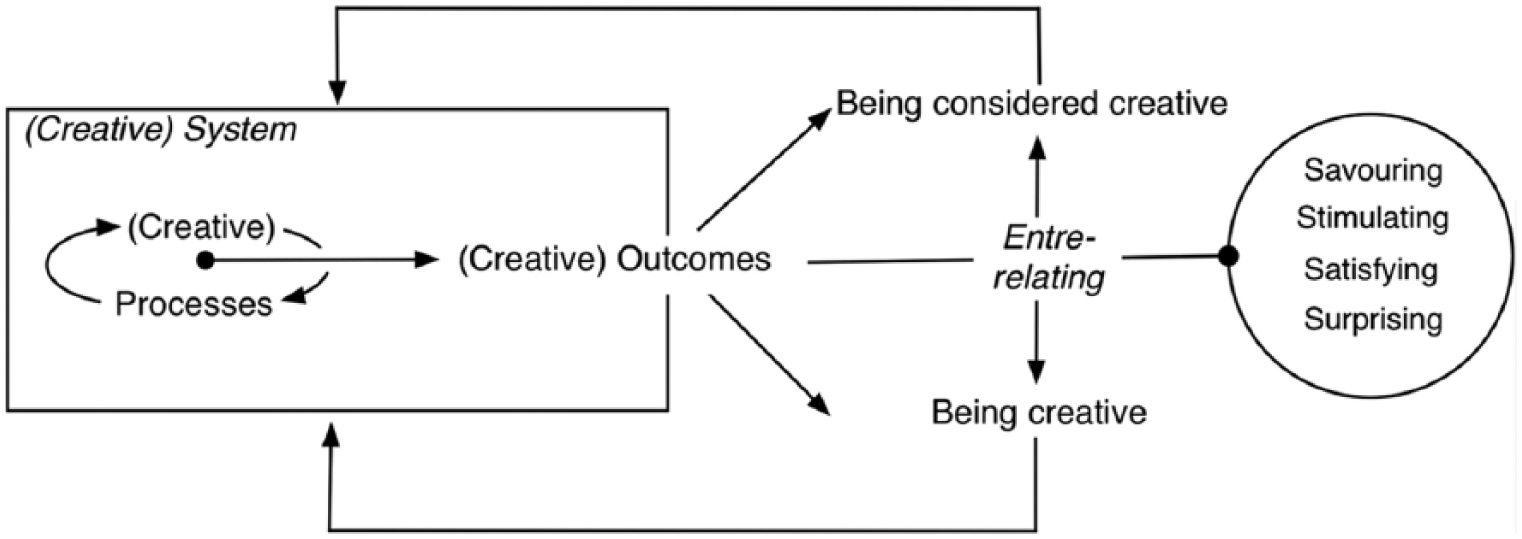
Working model.
Method
Context and case selection
To examine this research question, we conducted a longitudinal, qualitative case study (Langley, 1999; Yin, 2014) as part of a larger research project that involves haute cuisine. This approach allowed us to grasp the complexity of the focal phenomenon using rich evidence to study it over time (see Langley & Abdallah, 2011). Thus the longitudinal design that we chose for our case study is highly suited to exploring how and why (Yin, 2014) organizational creativity is attributed through an interactive process between an organization and its environment.
In the creative industry of haute cuisine (Jones et al., 2016; Lampel et al., 2000), the top criterion by which external evaluators such as gourmet guides, restaurant critics and guests assess restaurants and chefs is creativity (e.g. Bouty & Gomez, 2010; Durand et al., 2007; Fauchart & von Hippel, 2008; Ferguson, 1998; Gomez & Bouty, 2011; Stierand, Dörfler, & MacBride, 2014; Svejenova, Planellas, & Vives, 2010). Thus to be (considered) creative, gourmet restaurants need to act as entrepreneurial organizations that work constantly on new ideas and present their creative output to external evaluators by putting new dishes on the menu. Against this background, haute cuisine is an apt setting for studying organizational creativity as an attributional process from both an internal and external perspective. Internally, haute-cuisine restaurants are small entrepreneurial organizations that can be clearly observed. In these organizations, the head chef holds the leading role, and is largely responsible for creative decisions and their implementation (Rao, Monin, & Durand, 2003). At the same time, the head chef is embedded in the organization and it is the organization – the restaurant and the chef as well as the kitchen and service staff – that enacts, and thus performs, the creative outcomes that are evaluated by others. Externally, haute cuisine is one of the rare empirical fields in which researchers have access to a variety of different types of evaluation that directly assess outcomes with regard to organizational creativity (Slavich & Castellucci, 2016). Such evaluations include reviews by professional restaurant critics, semi-professional critics such as restaurant reviewers who publish regular columns in newspapers and magazines, and private reviewers, i.e. guests who post reviews and accounts of their experiences at a restaurant.
Taken together, the haute-cuisine context renders the interplay between ‘being creative’ and ‘being considered creative’, and thus the attributional process of organizational creativity, accessible to investigation particularly well. This is even more true in Berlin. After the fall of the Berlin Wall, haute-cuisine restaurants started to proliferate in this city. From sparse gastronomic offers in the 1990s, Berlin has become an entrepreneurial hotspot of haute cuisine where new gastronomic concepts are explored, tested and evaluated. This is why we chose this specific context for our study.
We originally considered twelve cases of haute-cuisine restaurants in Berlin that had been awarded at least one Michelin star, which is the most important criterion for differentiating between haute-cuisine and ‘regular’ restaurants (e.g. Di Stefano, King, & Verona, 2014, 2015; Gomez & Bouty, 2011; Slavich & Castellucci, 2016). Although all the restaurants in our sample offer insights into the processual attribution of organizational creativity, we decided to focus on one revelatory case (Yin, 2014) that would vividly illustrate our analysis: the Rutz. The restaurant under head chef Marco Müller strove to display extraordinary creativity by offering unusual dishes. The restaurant is currently considered to be highly creative, garnering high scores in leading restaurant guides. Yet for many years the Rutz was criticized for being too odd. By analysing the restaurant’s development in the light of the feedback it received from critics over time, we gained insights into the ongoing struggle it faced between ‘being creative’ and ‘being considered creative’.
Data collection
For this study, we collected our data over a period of two and a half years (2011–2013), gathering both real-time process data as well as retrospective data, which covered a total of ten years. In addition, we conducted a concluding interview with Marco Müller in October 2016 to discuss our preliminary findings with him.
To develop an increasingly detailed understanding of our case, we relied on multiple data sources. We began by interviewing the most relevant haute-cuisine restaurant critics and experts in Berlin. We identified these by scanning the most relevant newspapers, magazines and blogs. These interviews helped us to gain deeper insights into the context and the standard criteria for evaluating haute-cuisine restaurants and to identify the key players in this industry.
Then we interviewed almost every head chef working in Berlin’s haute-cuisine restaurants, and repeatedly spoke with six of them (including Marco Müller) in the course of the study. We talked to the head chefs because they were the ‘creative directors’ (Rao et al., 2003) who were responsible for developing creative outcomes with their teams and served as ‘spokespersons’ of these organizations. At that stage, we selected the Rutz for our case study, because it clearly stood out among the other restaurants with regard to the struggle between ‘being creative’ and ‘being considered creative’ that it faced. Yet, given the controversial nature of the focal case, we also talked about the Rutz with other head chefs and critics, who were well acquainted with its history. All interviews except two were jointly undertaken by two of the authors. The interviews were recorded, transcribed and imported into Atlas.ti for further analysis.
To verify and extend information we had gathered from the interviews, we observed team meetings in the restaurants. This helped us understand how staff and head chefs work together and what roles they play in the attributional process. We also dined repeatedly at the restaurants in our sample. This gave us the opportunity to reflect on the creative processes from the perspective of guests, which we then discussed with the chefs. In this process, we developed increasingly trusting relationships with some of the head chefs, resulting in dining together in other haute-cuisine restaurants, jointly slaughtering and butchering a pig and a wild boar, and joint cooking sessions, among others. 1 These informal, ‘off the record’ exchanges were especially helpful for gaining more detailed insights into the development of the Rutz’s attribution of organizational creativity which we would not have achieved otherwise.
Furthermore, we complemented our primary data with secondary data in the form of reviews, press reports and past menus. These documents not only provided access to the external evaluation of the Rutz’s creativity but also offered rich insights into its development, e.g. through self-reports in the press. We also included past menus because they can be considered a restaurant’s (creative) outcome that is evaluated by guests and critics. We also took the menu development as a point of reference in our interviews in order to discuss how and why certain dishes were put on and taken off the menu.
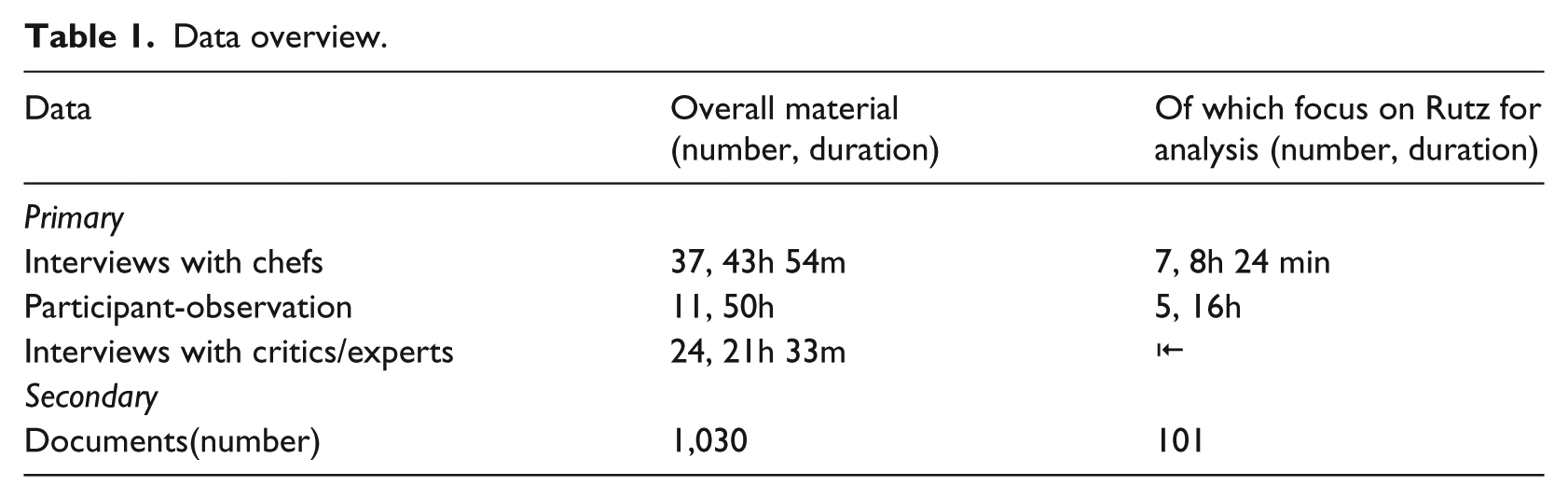
Overall, our database for the entire project consists of 61 in-depth interviews with head chefs as well as critics and experts with an average duration of 64 minutes each, 1,030 pages of secondary data in the form of restaurant reviews and menus, and 50 hours of observations of team meetings and visits to the dining areas and kitchens. Although parts of this database turned out to be more important than others for gaining insights into the focal case, we drew on the entire formal and informal database (see Table 1 for an overview) in order to gain insights into the focal case from multiple perspectives.
Data overview.
Data analysis
Our empirical analysis proceeded as an abductive movement back and forth between theory and data. Specifically, our analysis proceeded as follows.
We began by structuring the data chronologically through writing a narrative case description (Langley, 1999). Using all available sources and taking into account all perspectives helped us reconstruct the restaurant’s development in terms of its creative actions (Joas, 2005; MacLean, MacIntosh, & Seidl, 2015; Weik, 2012) and the external evaluation of the outcomes that these actions produced. On that basis, we identified turning points in the Rutz’s history with regard to the evolution of the restaurant’s (creative) processes and the outcomes that they produced (‘being creative’) and the evaluation of these outcomes by relevant audiences – especially critics and experts – as creative (‘being considered creative’). We used those turning points to identify four distinct phases. This helped us to focus on crucial points in this restaurant’s attribution of organizational creativity over time.
Then we used our theoretically informed working model (see Figure 1) to explain how and why the restaurant’s attribution of organizational creativity had developed as it had (see also Yin, 2014). For this purpose, we systematically coded our data based on the model’s central components: (1) ‘being creative’, i.e. the restaurant’s (creative) processes and the (creative) outcomes that they produced, (2) ‘being considered creative’, i.e. the evaluation of these outcomes by others as creative, and (3) the four entre-relating activities through which such evaluations were negotiated between the organization and its environment (see Figure 2). Specifically, we inductively coded the drivers of (creative) processes (‘being creative’) and the external evaluations of the outcomes that these processes produced (‘being considered creative’). Then we cross-referenced our emerging categories with Jackson and Messick’s (1965) scheme of aesthetic responses and their corresponding response properties to gain a theoretically abstracted understanding of these categories. This helped us to theoretically distil the four entre-relating activities through which the attribution of organizational creativity is negotiated between an organization and its environment.
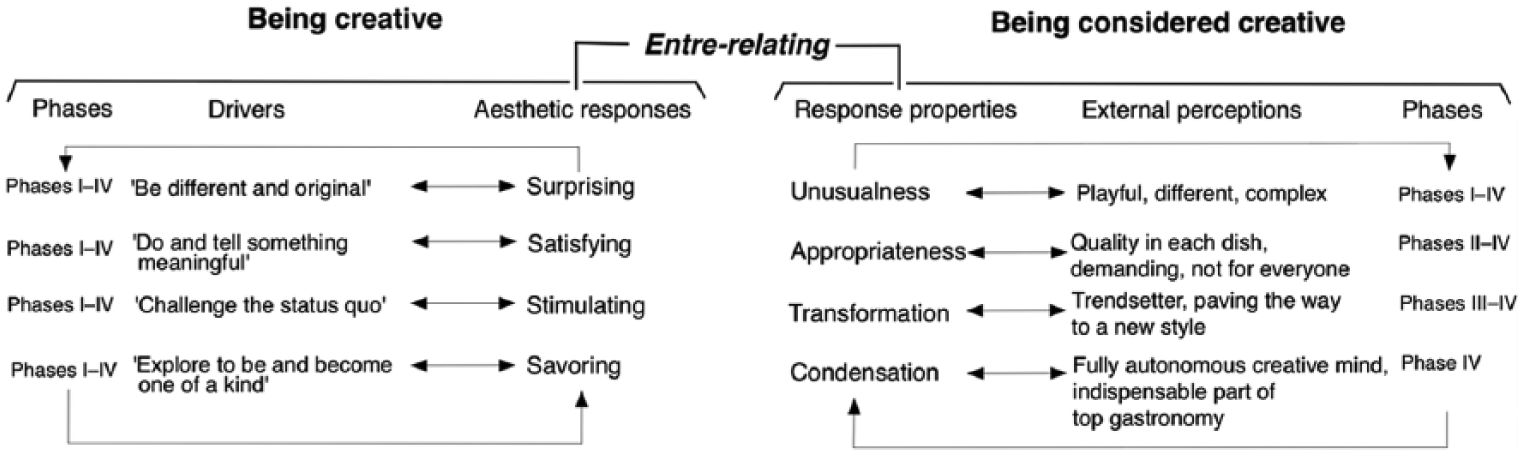
Analytical process: Relating ‘being creative’ and ‘being considered creative’.
Finally, we cross-referenced the coded data with the narrative to cluster them in terms of the identified stages (see also Figure 2). In doing so, we recognized a processual pattern of relating ‘being creative’ and ‘being considered creative’ though entre-relating activities, resulting in the evaluation of the organization’s outcomes and thus the attribution of the focal organization’s processes as creative over time. We translated this observation into a framework that conceptualizes organizational creativity as an attributional process.
Findings: Becoming a Creative Haute-Cuisine Restaurant
Phase I: 2004–2005
The Rutz was founded by sommelier Lars Rutz and wine distributor Carsten Schmidt as an 80-seat wine bar located in a two-storey building in the middle of Mitte, an up-and-coming urban district of Berlin. When the Rutz opened its doors in 2001, there was no explicit plan that one day it would become an haute-cuisine restaurant. Instead, the idea was to reinterpret the category of a ‘wine bar’ by combining excellent wine with good food in a stylish location. At the time, head chef Marco Müller, who had helped the two founders crystallize their original concept, was still working at Harlekin, a traditional restaurant at the Grand Hotel Esplanade in Berlin. Hoping to be en route to gaining a Michelin star, Müller did not immediately feel ready to abandon the Harlekin and join the Rutz as head chef. However, despite staying put, Müller did not see that star materialize. Increasingly, he grew tired of both the pressure to win a star, which he felt at the hotel, and the lack of flexibility and creative freedom that complying with the strict code of professional conduct that leading gourmet guides, such as Michelin and Gault Millau, implicitly dictated. He felt that both these factors inhibited him, and chefs in general, from pursuing certain potentially great ideas. As Marco Müller explained: The idea was to integrate a new cuisine, or, in other words, to get rid of the old dust, so to speak. There were ideas, and the decision I had to make was this: do I do this and risk being downgraded by the critics who don’t understand my ideas? Do I take the risk – also considering the positive resonance received by the guests and my environment – and believe in the idea? […] Or do I comply and just see to it that I become a good chef who, however, is never happy with what he does? (1:3; Müller)
As a result, instead of constantly aiming to be awarded a higher rating by the leading guides, he made the decision to turn his back on haute cuisine and join the Rutz in 2004. This, he felt, would give him the opportunity to forget about domain standards and think beyond boundaries, even though he risked poor evaluations from critics.
Joining the Rutz for the sake of creative freedom ‘to get rid of any superfluous ballast’ (5:4, Müller) meant avoiding a clear-cut label for the restaurant’s style of cooking. So Μüller did not design the menu in accordance with a single tradition or a current trend, but chose to offer a variety of different styles. Thus, instead of being associated with one school – e.g. the Mediterranean, French or German – the restaurant had to find its very own style. This emerging style included an ‘obsession with products’ (2:3, Müller) and a ‘perfectionism on many levels’ (2:3, Müller). It further entailed the idea of ‘being ahead of any trend’ (6:5, Müller), to start ‘where other chefs have ended’ (5:4, Müller), to do ‘flavour experiments’ (6:7, Müller), to aim for ‘flavour acrobatics’ (6:6, Müller), to display ‘creativity within the dishes’ (2:3, Müller) and to ‘disseminate creativity’ (6:4, Müller). Against this extensive background of doing things in a different way, the concept of ‘being creative’ also referred to aspects such as ‘hospitality’ (3:5, Müller) and offering a meaningful ‘menu with a soul’ (5:2, Müller). This entailed several gastronomic decisions; one such decision was to present the dishes in an unusual manner. For example, the restaurant offered a ‘pierced fish filet of gilthead on lemon grass skewers, which is indeed perforated by a tiny ring’ (Gault Millau, 2005). The restaurant increased the scope of variety even further by introducing a ‘surprise menu’ as well as the usual à-la-carte menu. This approach allowed the first gourmet restaurant in this part of Berlin to ‘show the world what a creative institution it was’ (2:9, Müller).
Interestingly, Müller also tried to shield the restaurant’s concept of being creative from economic concerns: It must make sense economically […] but if I were in it for the money, I would be in another firm. (3:25, 6:4, Müller)
Hence, economic prosperity is considered to be a side effect of creativity, but not one of the main drivers for ‘being creative’. Thus the concept of being creative at the Rutz referred basically to the idea of creating something new that goes beyond what we already know and explores the limits of ‘how many flavours we can grasp, how much we can capture and how much distraction we can bear’ (5:6, Müller). Therefore, although Müller had been involved in the development of the restaurant’s business plan right from the beginning, and despite being offered part ownership of the business later, he remained reluctant to accept this. Müller purposely interpreted his role as a creative director who is briefed from time to time by the owners about the general economic development of the restaurant: ‘He [one of the owners] is in charge of the economic backing, I am in charge of the restaurant together with the leading members of my team’ (1:43, Müller).
The critics soon recognized the restaurant for its aromatic dishes, but at the same time criticized its ‘unpredictable creations’ (Tagesspiegel, 2006): The Rutz is a recommendable restaurant if one can educate the cook to let the good products unfold in an unadulterated way. (Die Welt, 2004)
Thus, according to the critics, the restaurant’s ‘complicated, less distinctive, overly playful style’ (Gault Millau, 2005) occasionally obscured the purity of a dish’s taste. These ‘unpredictable creations’ (Tagesspiegel, 2006) earned the restaurant a reputation as being ‘young, wild and simply different. And that at all costs’ (Die Welt, 2012, referring back to 2004–2005).
Phase II: 2006–2010
Although the Rutz kept its all-encompassing and aromatic style, it had dropped the idea of overly provocative presentations by 2006. This change was also recognized by critics. For example: [The Rutz] has discarded some of [its] wildness and, in return, created room for the delicate. The former ‘new wild’ is on the star route. (Die Welt, 2006)
As a result, the Rutz eventually received one Michelin star in 2007. However, while most restaurants would have taken this award as a sign of recognition, Müller and the Rutz showed themselves unimpressed: Marco Müller from the Rutz is different. He received his first star and he directly said to me that he doesn’t want this. The Rutz is made for something totally different. (Int_013:10, Expert)
Based on this idea, the Rutz pursued its path of being different to established haute-cuisine conventions. As a result, the Rutz remained ‘young, wild and different’ (1:22 and passim, Müller) with ‘consistently complex and diversely combined dishes’ (Gault Millau, 2007) that are ‘the ideal alternative for all those who find traditional top restaurants too stiff’ (Gault Millau, 2008). Reducing a dish to its essential elements did not seem to be the restaurant’s style – a fact that the Gault Millau guide continued to criticize in 2008 and 2009 while still recognizing the restaurant’s ‘undeniable talent and quality in each single dish’ (Gault Millau, 2009). However, when the restaurant introduced an additional twelve-course menu that left more room for ‘filigree compositions’ (2:15, Müller) and allowed the head chef to encompass a wide range of tastes within a clear format, the Gault Millau put an ‘end [to] the debate on the chef’s creative style’ and awarded the Rutz and its ‘fantastic, playful and from time to time overloaded combinations [with a] well-deserved 17th point’ (Gault Millau, 2010).
Phase III: 2011–2012
These signs of recognition encouraged the restaurant to continue to break established rules. Specifically, at that time, Müller asked himself: What if we leave out à-la-carte completely and concentrate on what we can and, above all, want to do? Like, break with the German mentality of wanting to please everybody and instead build a concept that you’d wear like you wear a jacket. There are jackets that fit you, others that don’t. But this is what we want to do. This is what we can offer. This is us. (6:23; Müller)
What followed was a radical redefinition of the whole concept. Part of the renovation of the restaurant involved separating the two floors. The ground floor became a wine bar serving high-quality but more traditional, less complex à-la-carte dishes. The first floor was converted into a purely gourmet restaurant.
Even if Müller explains this strategic move as motivated by creative considerations (‘the processes and the concept were too complex, we could not communicate our utmost concern’; 6:19–20, Müller), it is all too clear that this move was also, or even primarily, motivated by business considerations: They have German cuisine downstairs and haute cuisine upstairs, which is what the hotels also have. This is a survival strategy. (6:74, Expert)
In Phase I, when Müller started, the restaurant suffered two consecutive years of diminishing returns, amounting each year to around 100,000 euros (7:11, Müller). This is a considerable sum if we take into account the fact that haute-cuisine restaurants in Berlin often strive for ‘a black zero’ with regard to net profits (1:28, Müller; 5:45, Müller). In this context, the concept separation was an important step towards economic prosperity.
However, it is paradigmatic for the Rutz that the restaurant needed a creative instead of an economic explanation for this strategic change. As the head chef explained: ‘Nobody can grasp the complexity of the haute cuisine every day’, ‘people have the right to high quality but nevertheless “normal” dishes’, ‘I need those dishes also for myself’ (7:25, Müller). Hence, in his view, the primary motivation for the separation of the restaurant’s concept was to get more creative latitude with regard to the haute-cuisine restaurant on the first floor.
In this gourmet section, the Rutz abandoned à-la-carte dishes altogether and offered only pre-set menus with complex combinations of ‘inspirations’ and ‘experiences’ that did not seem to follow an obvious structure and order. The ‘inspiration menu’, as the gourmet menu was labelled, consisted of six combinations termed ‘inspirations’ built up by twelve dishes labelled ‘experiences’, thus presenting two ‘experiences’ for every ‘inspiration’. For example, one combination on the menu was called ‘Golden Queen Tomato & Basil’ and the two different inspirations based on it were ‘Langostino & Avocado, Cucumber’ and ‘Foie Gras & Manjari, Green Almonds’, or another combination was called ‘Joselito Pork Chin’ and consisted of the two inspirations ‘Raviolo & Buna-Shimeji, Lemon Verbena’ and ‘Makarel & Pine Nuts, Bell Pepper Broth’. This menu was based on the idea that ‘there are multiple things you can do that are fantastic. But there are at least two that are absolutely magnificent’ (5:43, Müller).
Separating the restaurant into a wine bar and a gourmet restaurant was well received by guests and critics, as it allowed a much clearer distinction between the corresponding concepts of what each had to offer. However, the new menu received much criticism. As one critic put it, understanding such a complicated menu was an ‘intellectual achievement’ (006:7, Expert). Therefore, ‘one had to explain [the choice of dishes to guests] a great deal’ (3:13, Müller), which was essential from the perspective of critics: The service moderates this course, which is really in need of explanation. (Gault Millau, 2012, referring back to 2011)
The Rutz’s menu was still perceived as ‘too playful at times and, thus, not […] autonomous yet’ (048:26–26, Chef) because ‘purism is a foreign word’ (Gault Millau, 2013, referring back to 2012) for the restaurant. Therefore, the Rutz invoked the impression that ‘I can’t imagine that they, no, I don’t believe that they will receive two stars’ (017:4, Expert). However, the increasing effort to moderate the courses came along with recognitions of a ‘creative streak […] in every course!’ (Michelin, 2012, referring back to 2011) and the restaurant’s position as ‘a trendsetter, paving the way for a new haute-cuisine style’ (Die Welt, 2011). In this vein, Die Welt began to applaud the restaurant by highlighting that ‘the menu enchants with kitchen poetry’ (Die Welt, 2012).
Phase IV: 2013–present
Over time, the Rutz realized that their renewed approach to haute cuisine had two drawbacks. First, moderating the dishes to the guests ‘was very, very time consuming’ (3:13, Müller). Second, the variety that the restaurant aimed to achieve by presenting two ‘experiences’ per ‘inspiration’ made the creation of new dishes extremely challenging. As a result, many ideas had to be excluded from the menu because they could not be combined satisfactorily with an equally excellent second idea. This led to another reduction of the menu’s complexity in order to create more comprehensible menus, which culminated in the introduction of a ten-course ‘inspiration’ menu in 2013: We depart from the idea of presenting one product in different ways. There is more than one way to look at certain products. But we decided to let go of the variety and focus on the best result. (5:3; Müller)
By offering only one ‘experience’ per ‘inspiration’, the Rutz replaced its complicated menu structure with a clearer order. Furthermore, the restaurant focused on pure flavours and a harmonious overall experience across the whole menu, rather than a range of tastes within each dish. The new, simplified menu and dishes were easier for customers and critics to make sense of.
This ‘purist’ (Gault Millau, 2017) style was well received by the critics and guests. Instead of considering the Rutz’s cuisine as overly playful, Gault Millau speculated that the restaurant’s ‘“look-at-me-I’m-an-artist’s-plate” phase seems to be over. Or not?’ (Gault Millau, 2016) and acknowledged the emergence of the Rutz’s ‘fully autonomous creative mind’ (Gault Millau, 2017). Similarly, instead of considering the Rutz as being positioned in opposition to haute-cuisine restaurants, the Michelin Guide argued that ‘the profound, tasteful and contrasting Rutz cuisine has become an indispensable part of Berlin’s top gastronomy!’ (Michelin, 2017). Along with this evaluation, Michelin awarded the restaurant a second star in 2016.
Organizational Creativity as an Attributional Process
Overall, the development of the Rutz since 2004 may appear increasingly as a linear teleological narrative of organizational creativity that has always been on the right track to unfold as such. However, as the above reconstruction of that process indicates, there is an ongoing and reciprocally related interaction between the restaurant’s way of ‘being creative’ and how its focal environment evaluates its outcomes that is inherently playful and thus at risk of failure. The restaurant started (as Rutz Winebar) with the attempt to free itself as far as possible from all the constraints, expectations and assumptions that are traditionally associated with the haute-cuisine industry but nevertheless remained in constant relationship with the environment’s evaluations. Even if the restaurant’s concept of being creative was not very clear at the beginning, it was clear enough to explicate the attempt to offer something different from what already existed. However, this concept of ‘being creative’ was not a fast-selling idea with regard to its recognition as ‘being creative’ by the relevant environment. That is, the external assessments were not entirely affirmative of the restaurant’s outcomes in the early phases (especially in Phases I and II, and to some degree also in Phase III). As we have shown above, these external evaluations changed over time. Starting with the assessment of a ‘more complicated, less distinctive, overly playful’ style in Phase I, the restaurant gained a full appreciation by the end of 2016 as a ‘profound, tasteful and contrasting Rutz cuisine’. To understand this interactive transformational process and therefore the entre-relating between ‘being creative’ and ‘being considered creative’, we can now refer back to the framework displayed in Figure 1.
On a more abstract level, the concept of ‘being creative’ can be grasped by using four main drivers of ‘being creative’ that then relate to the four different entre-relating activities (see Figure 1). The first driver refers to the attempt to be different and original (e.g. ‘obsession with products’, ‘creativity within the dishes’, ‘aiming for aesthetic experiences’, etc.). This driver refers to the entre-relating activity of surprising. The second driver refers to the attempt to do something meaningful, which is basically constituted by elements such as ‘hospitality’, ‘menu with a soul’ and ‘getting rid of any superfluous ballast’. This driver refers to the entre-relating activity of satisfying. The third driver captures those elements of the concept of ‘being creative’ that refer to a challenge to the status quo, e.g. doing ‘flavour experiments’, aiming for ‘flavour acrobatics’ and ‘disseminat[ing] creativity’. This driver therefore refers to the entre-relating activity of stimulating. The fourth driver embraces all actions that aim to be ‘ahead of any trend’ and to ‘begin where other chefs have ended’. This driver then focuses on the exploration of a ‘handprint of necessity’ (Jackson & Messick, 1965, p. 315), i.e. to be and become ‘one of a kind’. Therefore, it is directed towards the entre-relating activity of savouring.
As Jackson and Messick (1965) suggested, each aesthetic response corresponds with a specific response property, which relates to different perceptions of the outcomes of Rutz over time. Similar to the concept of ‘being creative’, we can categorize the different external assessments of ‘being considered creative’ in relation to the different response properties and therefore the perception of unusualness, appropriateness, transformation and condensation. In this vein, the perception of the Rutz’s performance as unusual could be categorized by the attribute of being considered ‘complicated, less distinctive and overly playful’. The perception of the Rutz as appropriate could be categorized by the estimation of having ‘quality in each single dish’. The perception of the Rutz in terms of transformation is captured by categorizing attributes in terms of being a ‘trendsetter, and paving the way to a new haute-cuisine style’. Finally, the perception of the Rutz with regard to condensation could be captured by the attribute of being a ‘fully autonomous creative mind’, ‘an indispensable part of Berlin’s top gastronomy’ and ‘provocations that work in wonderful harmony’.
By juxtaposing and relating both perspectives (‘being creative’ and ‘being considered creative’), we are now able to better understand the attributional process of organizational creativity and its transformation over time. This transformation becomes evident when we relate the different categories of ‘being creative’ and ‘being considered creative’ to a time dimension, i.e. the four different phases by which we have structured the whole process. The concept of ‘being creative’ is time-indifferent because every category of ‘being creative’ was present and addressed by the Rutz in every single phase (see the left-hand column of Figure 2). In contrast, the evaluation of the organization’s outcomes as ‘being creative’ (or not) changes over time (see the right-hand column of Figure 2). Whereas the evaluation of ‘being creative’ starts with the perception of unusualness in Phase I, the perception of appropriateness, transformation and condensation increases and is constituted during the process.
Based on this analysis, we conceptualize the attributional process of organizational creativity as a trajectory, starting with merely being considered ‘different’ and ending with being considered ‘one of a kind’ (see Figure 3). From this perspective, the attribution of organizational creativity unfolds as a process in which the entre-relating activities are sequentially enacted, starting with surprising and ending with savouring. In this process, the sequential enactment of the entre-relating activities is consequential for the gradual attribution of organizational creativity, given that it elicits different aesthetic responses over time which increasingly result in the evaluation of an organization’s outcomes as ‘being creative’. Thus, the entre-relating activities are foundational for understanding organizational creativity as an attributional process.
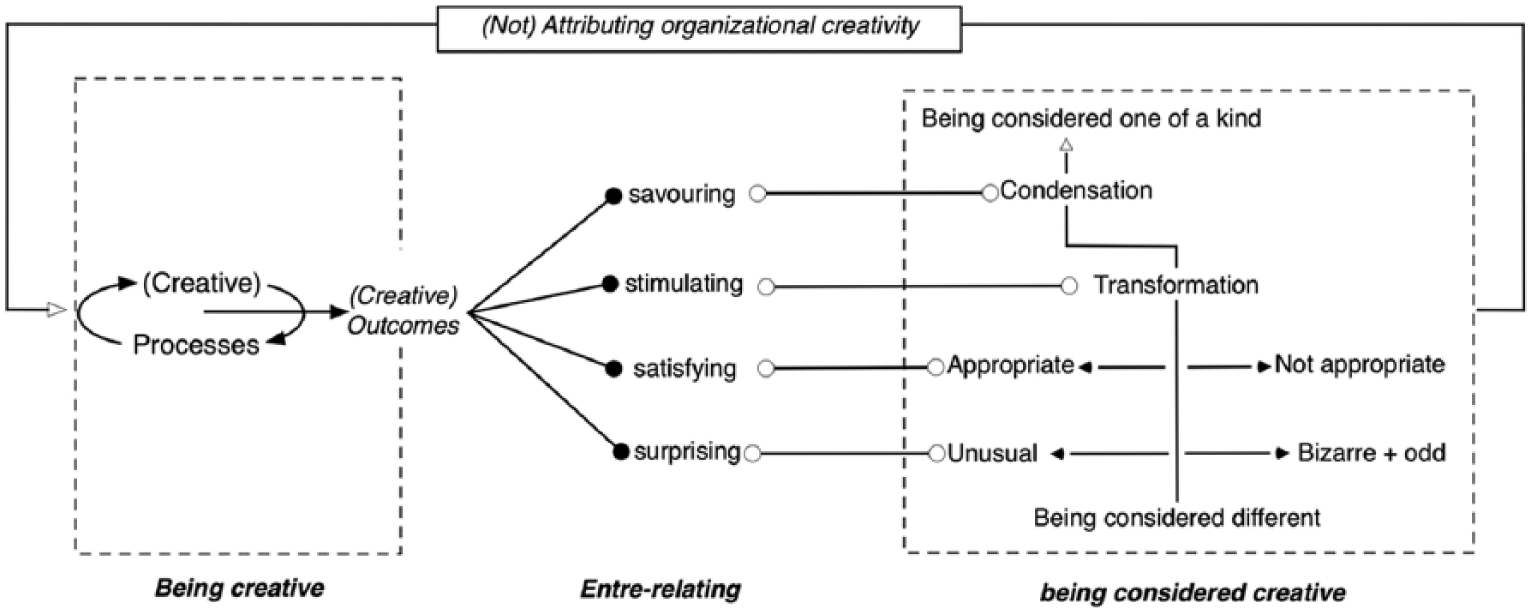
Organizational creativity as an attributional process: A conceptual framework.
Discussion
As shown in the previous analysis, an attributional-process understanding of organizational creativity reveals that the entre-relating of ‘being creative’ and ‘being considered creative’ unfolds sequentially over time. Such a perspective suggests that the attribution of organizational creativity is an ongoing, playful and risky interactive accomplishment between an organization and its environment. We synthesized these findings in a framework that conceptualizes organizational creativity as an attributional process. Our conceptual framework extends the literature on organizational creativity in several interrelated ways: it (1) explores the foundational interplay between ‘being creative’ and ‘being considered creative’, (2) puts aesthetic responses at the core of organizational creativity and (3) demonstrates the playfulness of the process through which the attribution of organizational creativity is produced. In this way, our study contributes to advancing an understanding of organizational creativity as an attributional process. In the following, we elaborate on these three aspects in more detail.
First, our conceptual framework sheds light on the interplay between ‘being creative’ and ‘being considered creative’, which is foundational for the constitution of organizational creativity (Amabile, 1996) but has remained under-researched. Specifically, we conceptualized this interplay as a process in and through which an organization is attributed by others as ‘being creative’. In doing so, our study builds on recent works that have begun to explore organizational creativity from a process perspective (e.g. Harrison & Rouse, 2014; Sonenshein, 2016). This emerging literature has mainly illuminated the ‘being creative’ side of organizational creativity by exploring the enablers and constraints of creative processes. Our study extends beyond this literature by putting the two-sidedness of organizational creativity centre stage: it shows how ‘being creative’ and ‘being considered creative’ are inextricably entwined through the performance of entre-relating activities. By including under-researched external evaluations (Elsbach & Kramer, 2003; Grant & Berry, 2011) in the attributional-process understanding of organizational creativity, our study deepens appreciation of the fact that, for organizational processes to be creative, their outcomes must be evaluated as creative. This perspective implies that organizational creativity is not only an intra-organizational question of using resources and enacting routines for the production of (potentially) creative outcomes (e.g. Sonenshein, 2014, 2016) but also a matter of being evaluated as creative on the basis of the outcomes that these processes produce. Such a perspective clarifies that organizational self-evaluations of ‘being creative’ (e.g. Hargadon & Bechky, 2006) may not be enough for organizations to be considered creative, as such attributions result from an ongoing negotiation of organizations with their environment through which evaluations of ‘being creative’ are elicited.
Second, related to the latter aspect of external evaluations, our conceptual framework suggests putting aesthetics and aesthetic experiences (e.g. Hjorth & Steyaert, 2009; Strati, 1992, 1999; Strati & de Monthoux, 2002) at the centre of organizational creativity. Specifically, we explored the entre-relating activities – surprising, satisfying, stimulating and savouring – as the core linking element between ‘being creative’ and ‘being considered creative’ through which aesthetic responses are elicited. This finding contributes to the requested empirical validation of Jackson and Messick’s (1965) scheme (Amabile, 1996). Yet our study goes further in that it conceptualizes the performance of these entre-relating activities as a process. In doing so, our study shows how the sequential performance of entre-relating activities is consequential for the attribution of organizational creativity through eliciting aesthetic responses with evolving response properties over time. This constitutes a revised perspective on organizational creativity that takes the aesthetic dimensions of organizational creativity more seriously. As our study shows, each of the entre-relating activities may evoke different aesthetic responses with potentially diverging effects. Therefore such a perspective draws attention to the ongoing entre-relating of organizations with their environment to elicit aesthetic responses that result in the attribution of organizational creativity.
Third, this leads us to the playful and, at times, even risky nature of the process through which organizations may or may not be attributed as creative. Specifically, our study points to an organization’s acting as if it is credited as ‘being creative’ as an important mechanism for explaining the evolution of aesthetic responses. It seems that the attribution of organizational creativity emerges through a staged play (Wenzel & Koch, forthcoming) of ‘being different’ that creates the fiction of an attribution of organizational creativity that is not given yet. By displaying difference to what exists, a creative system elicits unusualness and satisfaction by surprising and stimulating. In doing so, the creative system acts as if the transformational and the savouring power of the concept, as well as recognition for being ‘one of a kind’, are already attributed. Therefore, the entre-relating activity could be conceived of as a process that treats its possible prospective end (being considered ‘one of a kind’) as a given at the present time and therefore as a resource that the creative processes can build upon. This form of anticipation is a sort of fiction and hence it also refers to playing with a concept that does not yet exist but which only comes into being by acting as if it already exists.
This implies that not only the proposition of potentially creative outcomes but also the staging of these outcomes as ‘being creative’ (see Reckwitz, 2017) is essential for the attribution of organizational creativity. Thus, whereas the literature on organizational creativity has mainly focused on examining the factors that foster creativity (e.g. Anderson et al., 2014; George, 2007), our analysis suggests that those factors may be essentially fictional, and it shows how ‘spaces for play’ (Hjorth, 2004, 2005) in which such fictions are produced come into being through the performance of entre-relating activities. These findings also imply that organizations cannot fully ‘manage’ creativity by manipulating key factors, nor can they fully extort the attribution of organizational creativity from their environment. Instead, they show that the attributional process is itself a creative endeavour in which organizations constantly and playfully interact with their environment to negotiate such attributions. As shown in our analysis, there is a thin line between the evaluation of an organization’s outcomes as ‘provocations that work in wonderful harmony’ and ‘provocations that are only weird’. Therefore, given the range of potential aesthetic responses by the audience that such play elicits, our findings show that such play may also result in not ‘being considered creative’ at specific points in time. This opens up a perspective for understanding organizational creativity as a risky and potentially failing endeavour, which others (e.g. Anderson et al., 2014; Blomberg, 2014; Unsworth & Clegg, 2010) argue we need to take into account more explicitly. Such a perspective contributes to bringing back the ‘entrepreneurial’ into organizational creativity (see also Hjorth, 2003) by specifying the entre-relating activities through which the attribution of organizational creativity emerges in this playful process.
Concluding Remarks
In this paper, we set out to develop a framework that conceptualizes organizational creativity as an attributional process in which ‘being creative’ and ‘being considered creative’ are continuously set in relation to each other through entre-relating activities. Our empirical study of the Rutz in Berlin suggests that this entrepreneurial process occurs through the sequential performance of surprising, satisfying, stimulating and savouring, resulting in a gradual shift of aesthetic responses from being considered ‘different’ to ‘one of a kind’ and therefore the gradual attribution of ‘being creative’. In this way, our paper shows that organizational creativity can be understood as an ongoing and playful accomplishment by an organization and its environment.
We also acknowledge the limitations of our empirical study, which constitute fruitful starting points for future research. Most notably, our data helped us to develop a framework that conceptualizes organizational creativity as an attributional process by reconstructing the long-term development of this process for the Rutz. However, our data did not enable us to gain more fine-grained insights into the specific ways in which each of the entre-relating activities was enacted as social interaction between the focal organization and its environment. In this sense, our model may serve as an analytical scaffold for ethnographic research that ‘zooms into’ (Howard-Grenville, Rerup, Langley, & Tsoukas, 2016) the entre-relating activities through which organizational actors and their audiences jointly constitute organizational creativity. In this context, we consider more fine-grained explorations of how organizations perform staged plays (Wenzel & Koch, forthcoming) – by acting as if they are already considered ‘being creative’ – as particularly fruitful.
Overall, we argue that our findings are not just bound to the haute-cuisine context: given the imperative nature of creativity in contemporary societies (Reckwitz, 2017) and the foundational two-sidedness of organizational creativity as being constituted by both ‘being creative’ and ‘being considered creative’ (Amabile, 1996), all kinds of organizations – from artistic ensembles to high-tech corporations – must reconcile these two sides of organizational creativity and thus engage in entre-relating activities to be attributed as ‘being creative’. Our revelatory case’s entre-relating struggle rendered the focal process accessible to investigation. Yet, due to the complexity of this process, the idiosyncratic trajectories of different organizations’ entre-relating activities might deviate from the development of the Rutz’s attribution of organizational creativity. Thus future research may build on our study by empirically validating the attributional process of organizational creativity for organizations with different trajectories. Here, empirical insights into how and why other organizations may not manage or do not even aspire to be considered ‘one of a kind’ over time seem particularly promising.
Footnotes
Acknowledgements
The authors are indebted to the Editors of this special issue and three anonymous reviewers for their thoughtful comments and suggestions. Furthermore, the authors thank Robin Holt and the participants of the 10th Organization Studies Summer Workshop in May 2015 at Crete for insightful comments on earlier versions of the manuscript.
Funding
This research received no specific grant from any funding agency in the public, commercial, or not-for-profit sectors.