




Abstract
Elite craftspeople, as specialist producers with privileged access and resources, can elevate the perceived status of craft elements such as materials, traditions, and techniques regarded as lowbrow due to their association with marginalized groups. While elite craftspeople strive to emphasize cultural appreciation, they often face accusations of cultural appropriation which, if unaddressed, can undermine the perceptions of authenticity crucial for achieving higher cultural status. However, this tension between appreciation and appropriation overlooks the complex interplay of authenticity types that can structure the actions of elite craftspeople. Drawing on a qualitative study of new Peruvian cuisine, we examine how local elite chefs elevate marginalized craft elements through authenticity claims and develop a dual process model of cultural appreciation and appropriation. In doing so we identify how the elevation of marginalized craft elements involves, and even necessitates, aspects of appreciation and appropriation, especially when power dynamics are at play. We provide insights into the interplay between authenticity as connection and conformity, the agency in neo-craftwork, and claims of craftwashing.
Introduction
Imaginaries of craft are powerful markers of authenticity that offer specialist producers competitive differentiation in the face of mass production and standardization (Bell, Mangia, Taylor, & Toraldo, 2018; Ocejo, 2017). Claims of authenticity are often bolstered through indexical and stylized connections to craft traditions (Bell, Dacin, & Toraldo, 2021) such as production methods (Carroll & Wheaton, 2009), connections to place (Toraldo, Mangia, & Consiglio, 2018), the provenance of materials (Smith Maguire & Charters, 2020) and creative practices (Louisgrand & Islam, 2021; Rao, Monin, & Durand, 2005). By leveraging the authenticity inherent in their craft identities, specialist producers can elevate the perceived status of their products (Lehman, O’Connor, Kovács, & Newman, 2019; Woolley, Pozner, & DeSoucey, 2022), enabling them to potentially earn higher margins and remain distinct from generalists (Beverland, 2005; Woolley et al., 2022).
This is particularly important in the context of the ‘neo-craft’ work movement, where a new wave of specialist producers, predominantly White middle-class men, are redefining and elevating what were traditionally considered ‘lowbrow’ categories (Gandini & Gerosa, 2023). These are elite craftspeople since they enjoy privileged access and resources (Khan, 2012) such as knowledge, traditions, and materials considered marginalized due to their association with craftspeople from working classes or disadvantaged ethnic groups. When they elevate marginalized craft elements, they can receive either praise for cultural appreciation, which involves acknowledging and valuing cultural diversity to genuinely foster acceptance, or criticism for cultural appropriation, which is the non-consensual or inappropriate adoption of elements of a subordinate culture by members of a dominant culture (Cruz, Seo, & Scaraboto, 2024; Oluo, 2018).
However, while the literature often portrays cultural appreciation and cultural appropriation as oppositional, it frequently overlooks the intricate dynamics and intertwined mechanisms involved in elevating marginalized craft elements. This is particularly significant when elite craftspeople leverage authenticity claims for elevation since cultural gatekeepers, intermediaries, and audiences enforce various expectations of what is authentic craft (e.g. Beverland, 2005; Rao et al., 2005). In this process, authenticity claims often involve connections to craft traditions, such as ties to specific people, places, or times (Bell et al., 2021) and also conformity to norms and rules of a highbrow category (Lehman et al., 2019). Yet, the literature has paid little attention to how different forms of authenticity interact and influence the interplay between cultural appreciation and cultural appropriation.
Therefore, we pose the question: How do elite craftspeople elevate marginalized craft elements through authenticity claims? To address our question, we examine the contemporary Peruvian culinary landscape where local elite chefs have been spearheading the so-called new Peruvian cuisine, a novel cuisine that crafts a fine-dining culinary experience using ancestral Indigenous ingredients that have been staples among marginalized groups but have long been dismissed or scorned by the elite class (henceforth referred to as marginalized craft elements). The contrast between the urban location (i.e. Lima, the capital) where elite chefs operate, and the rural environments (such as the Andes mountains and the Amazon rainforest) which are home to Indigenous producers upholding craft traditions, reflects the internal class, ethnic, and racial divisions within Peru (Matta, 2021).
Drawing on qualitative data, our findings reveal that elite chefs elevate the status of marginalized craft elements through authenticity claims by engaging in three practices of cultural appreciation: rediscovery, recreation, and revaluation which foreground, transform, and reframe the use and meanings of marginalized craft elements. At the same time, however, elite chefs must conform to the requirements of authenticity within the category of fine-dining cuisine to elevate the status of the craft traditions from which they draw inspiration. This can trigger three practices of cultural appropriation: extraction, exclusion, and exploitation whereby the marginalized craftspeople and their practices become stylized, downplayed, and decentred from the emerging identity of new Peruvian cuisine.
In the next section, we discuss the interplay between craft-based authenticity claims, cultural appreciation and appropriation in the elevation of marginalized craft elements, which frames our study.
The Problematic Role of Craft Authenticity Claims
To create new value within existing niches, specialists can elevate the status of existing market elements through craft-based authenticity claims (Lehman et al., 2019; Woolley et al., 2022). For instance, grass-fed producers elevated the status of their products from low-quality to premium offerings based on the pastoral nature of their farms in contrast to modern intensive feed-lot processes used by large factory farms (Weber, Heinze, & DeSoucey, 2008). Entrepreneurial chefs have transformed humble food trucks into gourmet food trucks that highlight artisanal production methods, premium local ingredients, and creativity (Schifeling & Demetry, 2021). Producers, along with trade associations and wine writers, redefined grower champagne from an affordable option to a highly prized sub-category through references to fine-grained terroir (single vineyard or village), family/grower heritage, and small-scale production (Smith Maguire & Charters, 2020).
However, while indexical and stylized associations with craft fulfill marketplace requirements for authenticity (Grayson & Martinec, 2004), the current body of literature on the strategic use of craft-based authenticity claims is often silent on the role of power relations (Black & Burisch, 2020), especially between cultural groups. While this designation of power can be relative and context-dependent, dominant cultures showcase influential practices, values, and norms, often mirroring Western standards while subordinate cultures typically represent minority or marginalized groups. Thus, elite craftspeople, often situated within dominant cultural groups, can appropriate craft elements such as techniques, materials, and designs from marginalized communities, and elevate their status through claims and projections of authenticity based on stylized connections to craft for commercial purposes (Root, 2018; Zanette, Brito, Fontenelle, & de Camargo Heck, 2021). Elite craftspeople choose these craft elements for elevation because what is ethnically different ‘becomes spice, seasoning that can liven up the dull dish that is mainstream white culture’ (hooks, 1992, p. 21). However, during this process, the importance of the people, communities, and traditions that originally created these elements is downplayed.
This is a clear example of cultural appropriation, that is, when a dominant culture adopts elements from a less dominant (often marginalized) culture without permission and in an inappropriate way, often stripping these elements of their original meaning and significance (Cruz et al., 2024; Oluo, 2018). Although some scholars have also applied the term cultural appropriation to cases when a subordinate (or marginalized) group adopts elements of a dominant group, some scholars prefer to use ‘cultural assimilation’ to emphasize the imposition of dominant practices on subordinate groups, or ‘cultural resistance’ to highlight the agency of subordinate groups to challenge dominant practices by adopting them (Matthes, 2019; Rogers, 2006). These terms underscore different logics. Specifically, the logic of cultural appropriation emphasizes the often-exploitative nature of interactions where the dominant culture benefits at the expense of the marginalized culture. This frequently intersects with the historical and ongoing oppression of certain cultural groups, reinforcing asymmetrical power relations (Matthes, 2019; Oluo, 2018).
In the elevation of marginalized craft elements, cultural appropriation can occur when elite craftspeople project authenticity by conforming to the expectations of external audiences such as consumers and critics (Lehman et al., 2019). This often relies on stereotypes associated with marginalized cultures. For example, in the 1930s, Victor Bergeron and Ernest Gantt (or Donn Beach) invented tiki bars, using stylized cultural elements in the décor to create an exotic atmosphere while emphasizing the quality of its food and fruity rum cocktails despite rum not being traditional to Polynesian culture (Carroll & Wheaton, 2019). Similarly, Alida Boer, a Guatemalan non-Indigenous designer and founder of Maria’s Bags, faced accusations from Mayan weavers for using their designs in her luxury products, often without sharing profits with the original communities (Crisafulli, 2017). In these cases, projections of authenticity based on stylized connections to craft traditions are made by incorporating aesthetic elements from marginalized cultures while elites demonstrate their hands-on techniques to create more refined products.
Cultural appropriation can also occur when elite craftspeople, in their quest to project authenticity, commodify the stereotyped identities of marginalized groups from whom they appropriate. For example, during the colonial period, artisan French chocolatiers enhanced the authenticity of their products and the collective status of their craft by intensifying the exoticization of Indigenous African producers of cacao (Terrio, 2000). By connecting their chocolates to an exotic origin and positioning themselves as skilled craftsmen, these male chocolatiers increased the status of their products while simultaneously perpetuating harmful stereotypes. Likewise, companies selling shea products leverage visuals of African women manually processing shea butter by hand using simple tools made of stone and wood for their promotional materials (Chalfin, 2004). In both cases, projections of authenticity are based on stylized craft connections as marginalized groups are reduced to symbols fitting an exotic narrative while craftspeople distinguish themselves by their ability to transform these ingredients into high-quality products.
In the elevation of marginalized craft elements, the projection of authenticity based on cultural appropriation can also intersect with craftwashing, that is, ‘marketing that uses craft to perform political and social engagement while obscuring ethical, environmental and labour issues in the chain of production’ (Black & Burisch, 2020, p. 14). For example, a British fashion firm used images of Indian and Afghan craftswomen for marketing, projecting social responsibility, despite their actual practices (Gaugele, 2020). Here, projections of authenticity are based on a stylized connection to craft by selectively portraying craftswomen in specific roles and contexts, thereby reducing them to mere symbols that fit a narrative that satisfies consumers’ desire for ethically produced products. Similarly, despite marketing vicuña fiber sweaters at a premium, Italian luxury brand Loro Piana pays the Indigenous community a meager sum (Rochabrun, 2024). In this case, the allure of ‘authentic’ vicuña wool prioritizes the stylized narrative of the product over the well-being of the people who produce it. Therefore, the projection of authenticity in the elevation of marginalized craft elements also entails a moral stance.
However, cultural appropriation claims often overlook the nuanced benefits of elevating marginalized craft elements for marginalized groups. This has led to the rise of a counter-narrative of cultural appreciation, a perspective that sees the consumption of cultural difference as ‘an unproblematic process of cultural diffusion and blending’ (Cruz et al., 2024, p. 2). For example, although power imbalances continued to afford White musicians an advantage in terms of radio and television support, access to venues, and less exploitative record deals (Kenney, 2010), African-American jazz players did benefit from the ways in which Whites transformed jazz and blues into commercially dominant genres (Lawn, 2013).
In summary, although indexical and symbolic connections with craft are often central to claims of authenticity that elevate the status of marginalized craft elements, the interplay between cultural appreciation and cultural appropriation and the resulting outcomes has received little attention in the literature on organization and craft. We address this tension by examining the emergence of what we label new Peruvian cuisine, which we present next.
Setting: New Peruvian Cuisine
Around the turn of the 21st century, after working in prestigious restaurants abroad, Peruvian chefs returned home and began to create a new national cuisine (Matta, 2021). These chefs had achieved elite recognition and status in the culinary field due to their exceptional skills, and also social advantages allowing them to establish up-market restaurants in Lima, many of which appear in the list of global and Latin America’s 50 Best Restaurants. New Peruvian cuisine combines Western culinary knowledge with long-marginalized Indigenous foodways and has attracted the attention of affluent local and international diners (Matta, 2016). Due to its hybridized nature, that is, being both ‘local and cosmopolitan’ and ‘ancestral and contemporary’ (Sammells, 2014), the identity of new Peruvian cuisine remains fluid. This is reflected in various labels applied to it including ‘Peruvian fusion cuisine’ (Matta, 2010, 2013), ‘Peruvian-based fusion cuisine’ (Matta, 2016), ‘Peruvian haute cuisine’ (McDonell, 2019), and ‘Peru’s high-end cuisine’ (López-Canales, 2019).
For the craftspeople within the emergent category, the success of new Peruvian cuisine has had mixed outcomes. The national and international recognition of the country as a culinary mecca, as evidenced by the World's Leading Culinary Destination award bestowed to Peru between 2012 and 2019 and between 2021 and -2023, has generated economic benefits and feelings of pride (Matta, 2021). However, reports also suggest that the traditions of Indigenous cultures from the Andes and the Amazon have been appropriated (López-Canales, 2019; McDonell, 2019). This is a remnant from the colonial era whereby ‘[t]he “white” coastal areas of the country became integrated first into the capitalist economy, thus establishing their domination over the “Indian” Andean and jungle regions, which were branded as underdeveloped’ (Matta, 2021, p. 521).
This category, whereby elite chefs settled in the capital has created a new cuisine to carve out a niche in the fine-dining culinary landscape through the appreciation and appropriation of Indigenous craft elements, provides a fertile empirical site to address questions of authenticity dynamics in craft.
Methods
Data collection
Given the focus on the complex interplay within authenticity claims of cultural appreciation and appropriation of craft traditions, we draw on multiple sources of data including in-depth interviews, netnographic observations, and secondary sources. Since we focus on how elite chefs draw on the broad array of practices underpinning local craft traditions such as the use of materials, their production, recipes, and interactions with communities, all within their unique socio-economic and historical contexts, a qualitative methodological approach enables us to explore these elements and their interconnections (e.g. Louisgrand & Islam, 2021; Slavich, Svejenova, Opazo, & Patriotta, 2020).
The first author collected and analyzed the data as part of their doctoral studies while the co-authors, serving as her supervisors, provided their expertise and guidance throughout these stages. Thus, the subsequent sections are written from the first author’s perspective. Table 1 provides details of the data collected.
Data sources and use.
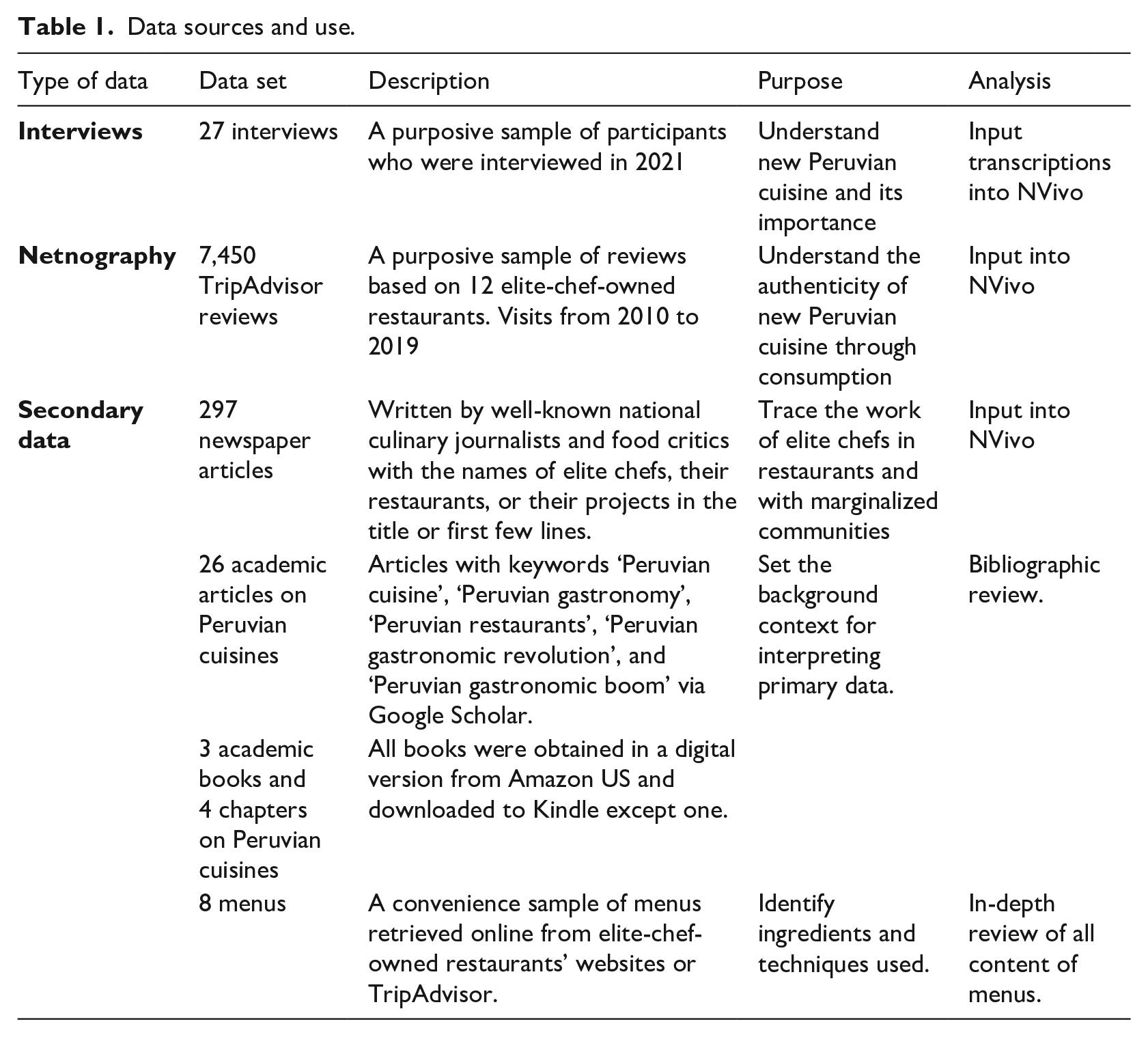
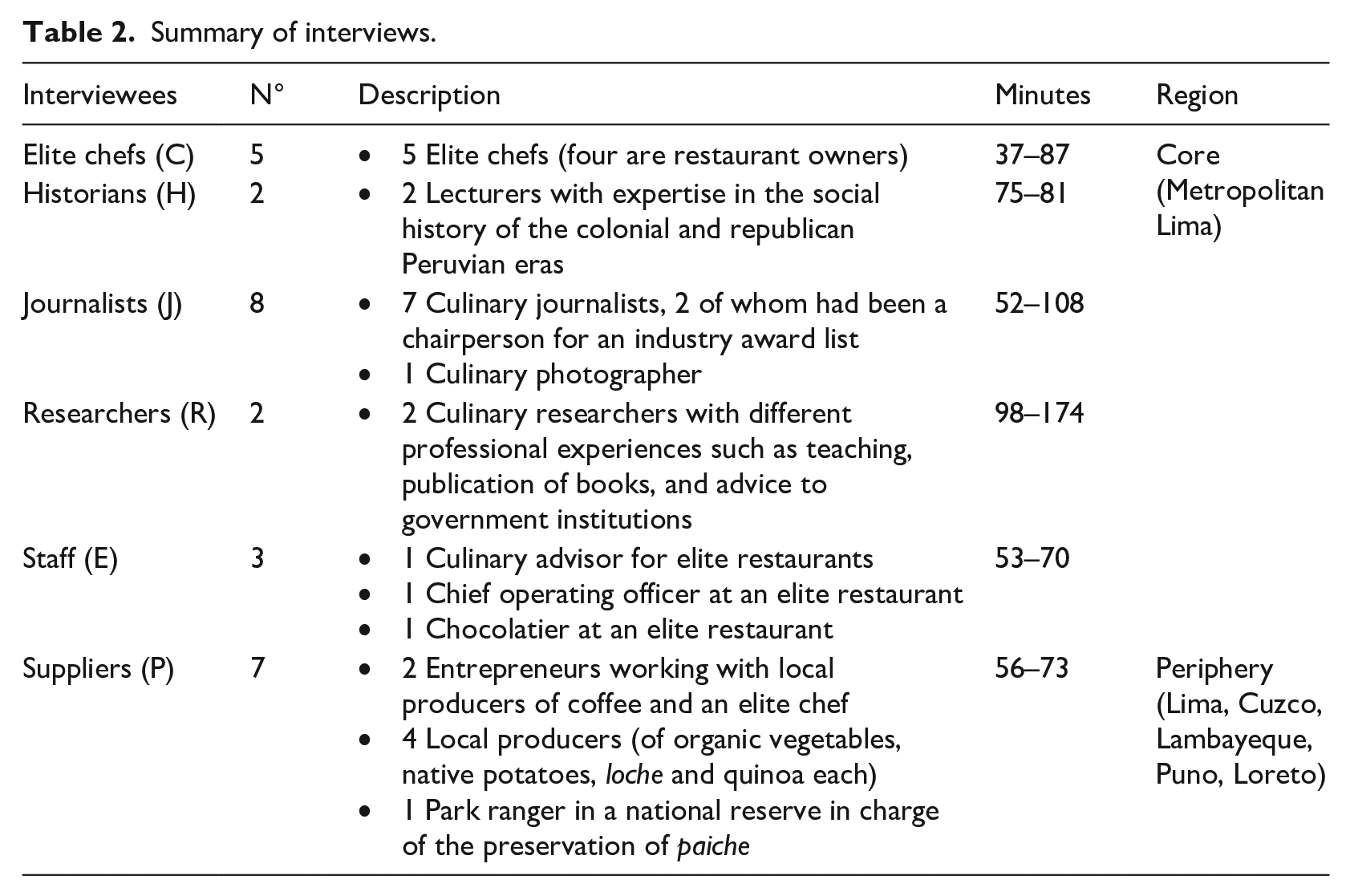
Primary data collection involved in-depth interviews and observations. The first author conducted 27 semi-structured interviews that were recorded and transcribed. Informants were purposefully sampled to include the range of actors involved in shaping the emergence of the category and included elite chefs, members of staff, culinary journalists, food researchers, historians, local farmers, and other peripheral actors with a close relationship with elite chefs. Details are provided in Table 2. On average, interviews lasted for 1.5 hours (range 37 to 174 minutes) and questions revolved around historical events about Peruvian cuisines, the restaurants owned by elite chefs, the practices of these chefs, changes in the industry, and key challenges and opportunities that chefs encounter.
Summary of interviews.
Interviews were complemented with observations from passive netnography (Kozinets, 2020) to gain a more in-depth understanding of the culinary offer of new Peruvian cuisine. This builds on previous work that emphasizes the role of consumers in co-constructing meanings of craft and authenticity in the culinary field (e.g. Carroll & Wheaton, 2009; Demetry, 2019). A total of 7,450 TripAdvisor reviews from 12 flagship restaurants owned by elite chefs covered herein were retrieved. Reviews of restaurant visits from 2020 onwards were excluded from the analysis due to the influence of the Covid-19 pandemic on the hospitality sector.
The first author also collected secondary data to gain broader insights into the context. As a Spanish-native speaker, she retrieved 297 online newspaper articles and food critiques based on the popularity of national culinary journalists and critics in three local newspapers and magazines – El Comercio (194), Somos (41), and Cosas (13) – and an international newspaper from Spain – El País (49). Articles were selected if they mentioned the names of elite chefs, their restaurants, or their projects in the title or the description. This aligns with prior studies arguing that journalists and critics, as cultural intermediaries, play a crucial gatekeeping role in mediating meanings of authenticity between organizers and consumers (e.g. Rao et al., 2005). Further insights were gained from three academic books, four book chapters, and 26 articles on Peruvian cuisines that provided the background context for interpreting primary data and the menus from eight restaurants run by elite chefs to provide insights into the presentation of materials and traditions.
Data analysis
To analyze the data, the first author imported the interview transcripts, TripAdvisor reviews, and newspaper articles to NVivo and followed a grounded theory approach, continually comparing data, theory, and emergent findings (Sætre & Van De Ven, 2021). This approach is useful as it combines inductive reasoning to draw out the theory from the raw data and deductive reasoning to test and refine the theory as it emerges from tacking to the relevant literature, allowing for a more comprehensive understanding of the elevation of marginalized craft elements.
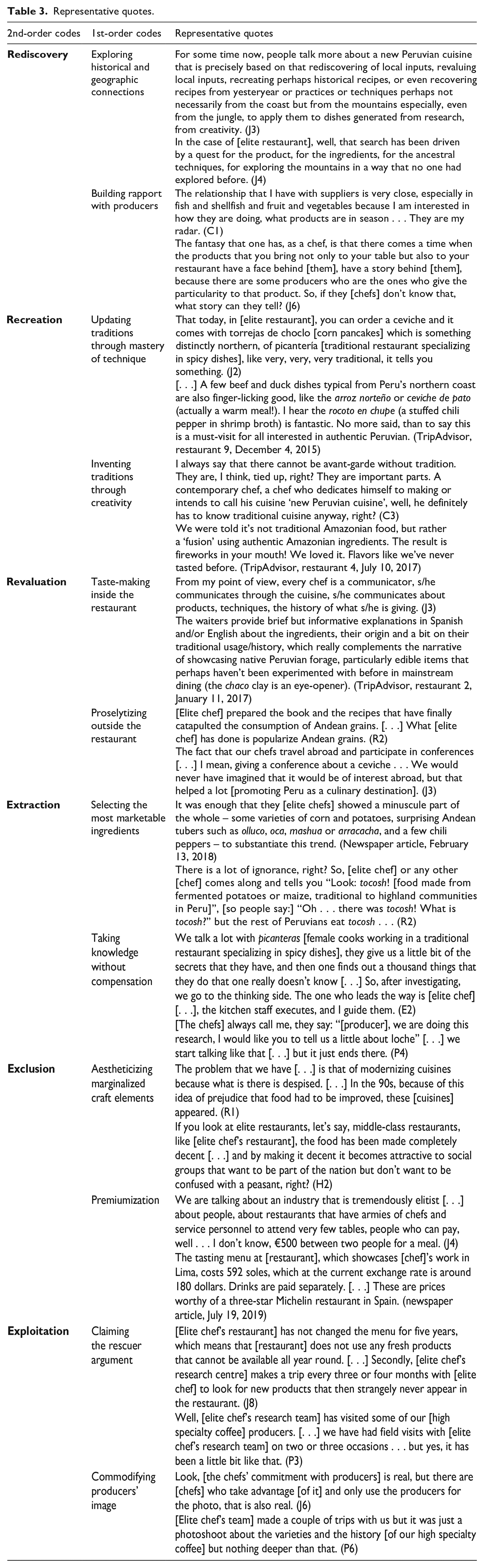
The first author began reading and coding newspaper articles as they set the background context for interpreting primary data. She proceeded to code some interviews and, as some categories were emerging, she used the emerging insights to select more informants and collect additional data for the redefinition and development of the emerging theory (i.e. theoretical sampling). She also coded TripAdvisor reviews to better understand new Peruvian cuisine. She gave an account of the emerging codes and theory to her co-authors to collectively interpret and theorize the empirical material. Following the format suggested by Gioia, Corley, and Hamilton (2013), we present our data structure in Figure 1. We also present representative quotes supporting our first-order codes in Table 3 (in the Appendix).
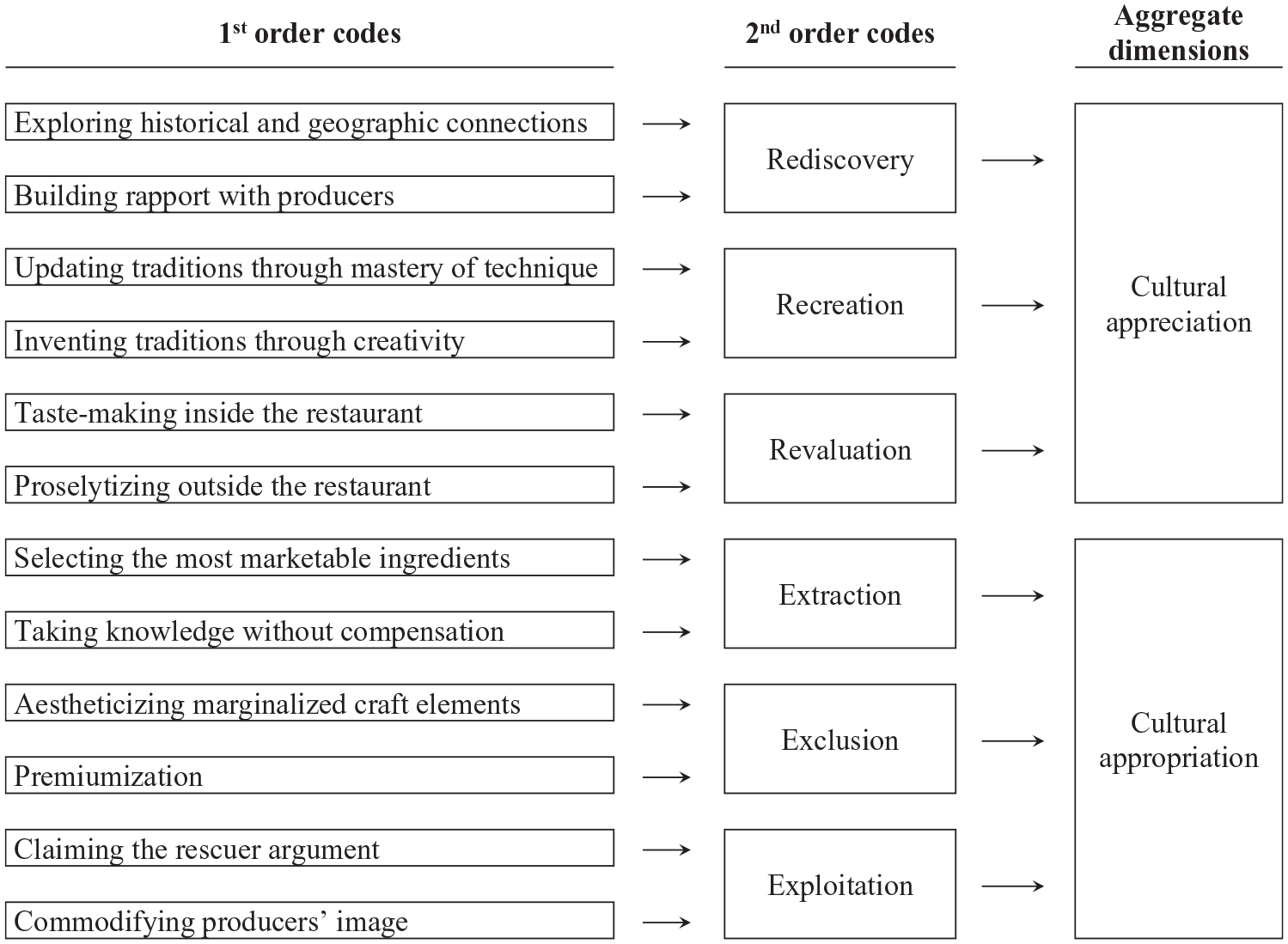
Data structure.
The analysis was carried out through open, axial, and selective coding (Corbin & Strauss, 1990). Open coding involved reading the transcripts and identifying common themes without referencing the literature. Initially, these first-order codes were descriptive and largely emic. Through constant comparison between the data, emerging codes, and memos, the first author realized that some codes were becoming saturated, while others could be combined. She identified and grouped similarities and tensions in the dimensions and properties of the codes to form first-order categories in which she used gerunds to emphasize the activities carried out by elite chefs (Saldaña, 2013).
After developing first-order categories, she identified similarities but also tensions between these activities. For instance, the first group of codes related to the process of finding marginalized craft elements. Some codes referred to activities around learning about marginalized craft elements by connecting with marginalized communities (i.e. rediscovery) while others revolved around activities that extracted tangible and intangible craft material for profit (i.e. extraction). Some codes shed light on the craft practices to transform found marginalized craft elements (i.e. recreation) while others centered on excluding marginalized people and aspects of found marginalized craft elements that do not align with the image of the new cuisine (i.e. exclusion). Other codes referred to activities that help render marginalized products valid and accepted (i.e. revaluation) while others focused on misusing claims of authenticity for self-serving promotional benefits (i.e. exploitation).
She engaged in axial coding by going back and forth between the literature and codes. She found that some second-order categories were consistent with the logic of appreciating craft tradition (i.e. rediscovery, recreation, revaluation) while others were consistent with the literature of appropriation (i.e. extraction, exclusion, exploitation). She therefore grouped each set into the aggregate dimensions of cultural appreciation and cultural appropriation. It was this coding process that formed the basis for the dual process model unpacked in the findings.
Several practices were employed to enhance the trustworthiness of the findings. Data were collected continuously over an extended three-year period with input on sampling, emphasis, and analysis by all three authors. Theoretical sampling ensured that multiple perspectives were represented while the use of grand tour questions enabled informants to reflect on multiple experiences, past and present, which help with control, fit, integrity, transferability, dependability, and confirmability. The large amount of data collected across different sources also enhanced confirmability and generality. A summary report was sent to informants for further feedback. The continued presentation of memos by the first author to their supervisors and emergent findings at departmental seminars and write clubs as well as academic conferences also enhanced trustworthiness.
Author positionality
At the time of submission, the first author was a PhD student. The first author, a culturally mixed female raised in Peru, was familiar with the Peruvian culinary field and the complex socio-cultural dynamics of Peru. The second and third authors, both male, were the supervisory team, providing an outsider’s viewpoint on the data and aiding in theorizing and editing. The second author, with settler roots in a country colonized by the United Kingdom, provided input based on their theoretical expertise in authenticity, food, and collective identity. The third author, from a large European country, provided insights shaped by his voluntary fieldwork in the Global South and his research on food and entrepreneurial storytelling.
Findings
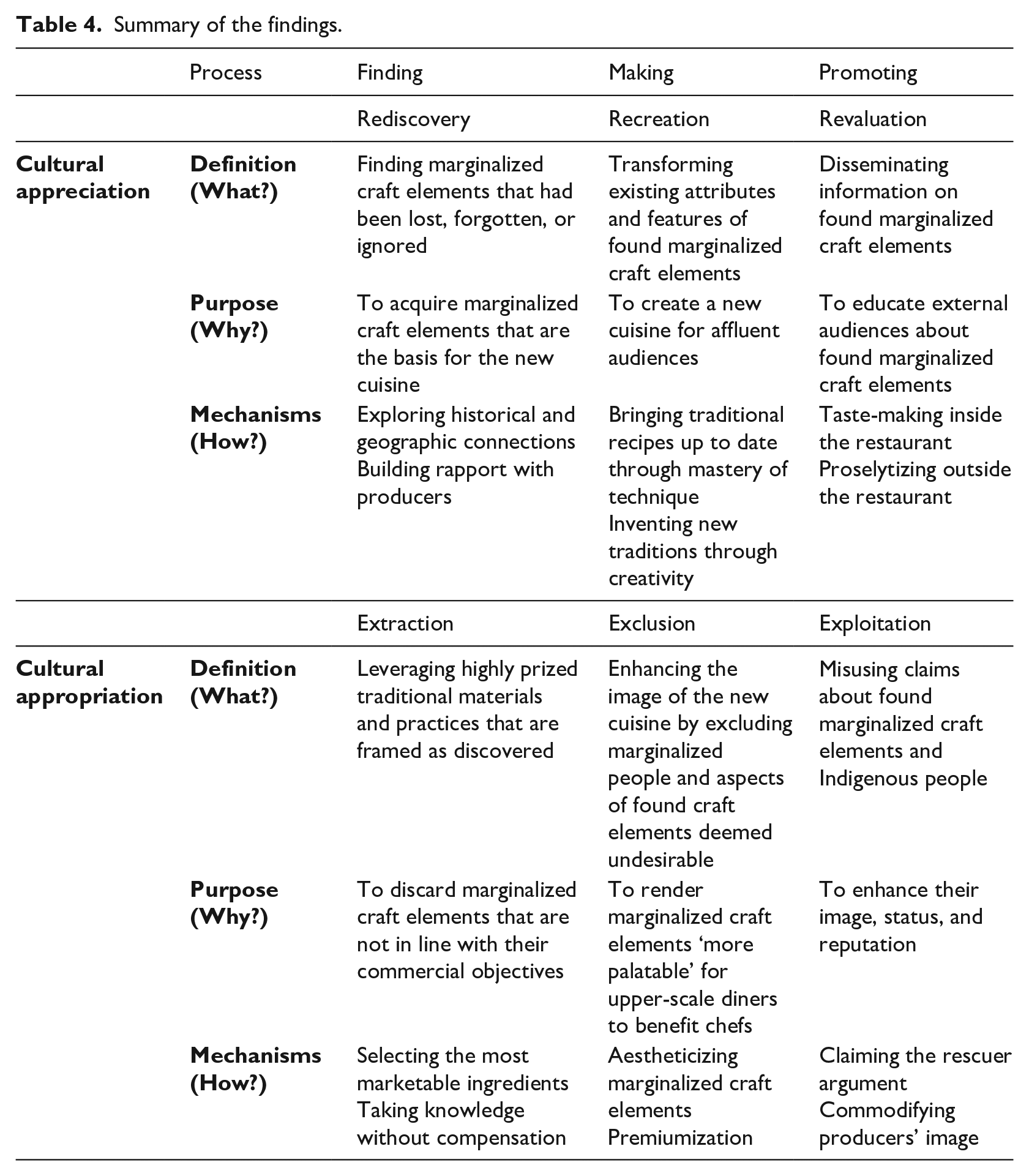
Our findings reveal that elite chefs elevate the status of marginalized craft elements through authenticity claims by engaging in a three-part dual process of cultural appreciation and appropriation which is summarized in Table 4. In finding marginalized craft elements, elite chefs rediscover them and their people but also extract these elements for value creation. In the making of a new cuisine, they recreate craft elements and make them exclusive. In promoting craft elements, they engage in their revaluation by educating external audiences on their significance and in their exploitation for marketing ends. Therefore, although practices of cultural appreciation and appropriation are oppositional, they collectively contribute to the elevation of marginalized craft elements. We expand upon each of these processes next and emphasize the voices of producers whose perspectives have been marginalized due to power structures.
Summary of the findings.
Finding marginalized craft elements: Rediscovery and extraction
Rediscovery
Rediscovery involves framing craft elements as forgotten or lost, even though these elements have been preserved by the communities despite their marginalization. Initially ‘discovered’ by Spanish conquistadors, these elements were marginalized during colonial times and have remained marginalized by the elites and people outside their communities of origin. Thus, local elite chefs are discovering these traditions ‘again’ as part of Peru’s national heritage. This is consistent with cultural appreciation as it brings to light the overlooked aspects of marginalized local cultures with the elite chefs hailed as saviours or discoverers.
The first appreciation mechanism underpinning rediscovery is exploring traditions in terms of historical and geographic connections by visiting the periphery. During their visits elite chefs look for ancestral culinary paraphernalia and learn about local foodways and biodiversity that they then draw on as creative inputs to new Peruvian cuisine. As a result, elite chefs can make authenticity claims based on connection to traditions and place as they can link ingredients to a specific place and time (Bell et al., 2021). In the following passage, an elite chef describes how he rescued craft traditions: The techniques that we can rescue from any Peruvian custom, from any regional food. [. . .] [For example] the best picanterías [traditional restaurants specializing in spicy dishes] are those in the south and the north [of Peru] [. . .] and have ancestral techniques such as the use of the batán, the air-drying of chili peppers, the char of chili peppers. All these techniques that suddenly appear in a [restaurant] kitchen here in Lima but as if forgotten, right? The use of chicha de jora, the use of chicha de guiñapo, the technique of using chichas, the technique of making them. (C1)
Chicha de jora, a fermented white maize beer, and chicha de guiñapo, a fermented black maize beer, were used in rituals and ceremonies in pre-Columbian Andean civilizations, and currently are a feature in festivities and celebrations in Andean cultures. Both have long been part of the cultural heritage of a southern region in Peru due to their unique preparation method and taste. Similarly, the menus we sampled frame elite chefs’ culinary creations by referring to rediscovered ingredients (e.g. tucupi, paiche, or oca) and techniques (e.g. huatia) as well as their terroir (e.g. Amazonian, Andean Forest, or Frozen Cordillera).
Producers are aware of the cultural meaning of the products they grow and sell and of the commercial value of these connections. For example, in the following passage, a producer of loche (a type of butternut squash with bluish-green skin) explains that for him and his community, loche represents not only history but also a source of income: The loche in our area, apart from being sold as a product itself, sells history. Why? Because loche is a very old product that was already cultivated by our pre-Incas there [region in Peru] [. . .] That is also very important because [community’s name] is characterized by it: it is characterized and known for [its] loche. (P4)
The second appreciation mechanism underpinning rediscovery involves building rapport with producers. Since the process of rediscovery involves visiting the geographic periphery, elite chefs establish rapport with farmers and communities by forming alianzas cocinero–campesino or chef–farmer alliances, which enables elite chefs to highlight the role of farmers in their authenticity claims while also ensuring the supply of desired materials (Kollenda, 2019). Such claims help with projecting authenticity claims to restaurant customers and other influencers as they enhance the sincerity of the elite chefs’ connections with the tradition of place (Carroll & Wheaton, 2009). These connections also provide economic benefits to rural communities in the partnership by enhancing the status of raw materials: [. . .] this chef–farmer alliance, has definitely been a historical milestone that marks how chefs – allying themselves with small [and] medium-sized farmers have managed to give a qualitative leap regarding what gastronomy means. [. . .] Many products that previously did not have a commercial value have acquired commercial value. (P1)
Some elite chefs also work directly with producers to help them improve the quality of their production, which may involve direct financial investment and imparting knowledge, which further reinforces perceptions of sincerity (Beverland, 2005). These deeper relationships allow elite chefs to draw on the moral aspects of craft (Bell et al., 2021) because they seek to transcend the commercial logic that underpins some alliances and connect their craft identities to broader values of social development. Other examples of these direct investments include the creation of a nonprofit organization to help rural communities market Amazonian products more widely. In the following passage, a native potato producer describes the benefits of working with the research center set up by an elite chef: We agreed to make a replica of growing native potatoes there in [archaeological site in the Andes], to see in the issue of adaptation, the issue of soil, pests, diseases . . . if this type of potato could be adapted to this type of altitude . . . Therefore, the benefit that we have helped us a lot to be able to preserve our products. (P2)
One outcome arising from this partnership is tucupí negro, a fermented yuca sauce produced by women of the Bora and Huitoto ethnic groups, which has generated positive outcomes for both the chef and the rural communities where it is produced: This is the work of [fellow elite chef] [. . .] has made these communities feel proud of what they do, right? [. . .] In addition, it generates an economic impact for them, right? Because they definitely see economic results as well, so that’s also important for them because it helps them grow [. . .] they want to empower themselves and grow as more formal, right? (C4)
Taken together, these rediscovery practices have catalyzed a significant elevation in the status of marginalized craft elements, with chefs now actively embracing Indigenous products and communities, thereby transforming and enriching contemporary cuisine with previously overlooked diversity: There is a recognition, there is a pride for those roots that for a long time were also denied in Peru. [Elite chefs] wanted to cook everything from abroad, to work with international products, and I’m talking about 30 years ago or 25 years ago which is not long ago. (J2)
In summary, rediscovery reflects the logic of appreciation because it involves building connections to rural areas that can involve partnerships that at the deepest level include investment in new craft practices that benefit both parties. Elite chefs can project sincere images of connective authenticity through their knowledge of local ingredients, practices, and their cultural significance. This, in turn, brings greater awareness of these traditions, resulting in greater resilience of them as well as economic gain. However, this also creates a flipside, which we label exclusion.
Extraction
Extraction reflects the logic of appropriation because it entails the leveraging only of highly prized traditional materials and practices that are framed as discovered by elite chefs without being attributed to the craftspeople who originated them.
The first appropriation mechanism underpinning extraction involves selecting the most marketable ingredients. Labeling these ingredients as ‘lost’ or ‘forgotten’ elevates the ingredients to a status of exotic appeal, continuing the colonial-era otherization of rural Peru by urban elites and fits in previous stylized projections of authenticity that center elites as discoverers (e.g. Zanette et al., 2021). In the following passage, a culinary researcher critiques an elite chef renowned for ‘rediscovering’ cushuro (Nostoc sphaericum), a bluish-green spherical alga: What he does is, to me, distort the information about Peruvian cuisine. And, to me, because of him, some people think that cushuro is rare because for him it is rare, but for the rest of Peruvians, it is normal! And then, the other things that he is ‘discovering’ [. . .] He doesn’t discover anything! But everything that he plays to discover, actually, on the one hand, is irrelevant for [Peruvian] cuisine because it does not affect [its] flavors. (R2)
The selection of the most marketable materials and practices leads to the exclusion of many other marginalized products and traditions. For example, the passage below describes how the sporadic visits of elite chefs (despite claims of rapport-based alliances) have limited the opportunity for producers to share their knowledge and practice more deeply. He describes how one Andean product, kispiño (a dessert made with quinoa flour), has not enjoyed elevation to the status of national cuisine as a result: They [elite chefs] have very important information about global gastronomy and we have the ancestral knowledge of our cuisine. This can be merged, a fusion that has not yet reached our [national] market [such as] our quinoa porridge, our kispiño. (P6)
The second appropriation mechanism underpinning extraction entails taking craft knowledge without attribution of ownership to the cultural source or originators. For instance, a quinoa producer describes how an elite chef published a book based on the knowledge that he shared with him: So, [elite chef] has come up with a television channel. We have shown all the qualities [of quinoa], right? How [it is that] we put the added value and the ecotypes and varieties of quinoa. So [elite chef], for the first time, I think, has been aware of the black quinoa ayara, right? [. . .] So there [elite chef] became quite interested, he investigated a little more, and the book that he has published has been titled Ayara, right? So, the title of that ayara quinoa came from the bosom of our family so that [elite chef] could research and publish this book at the end, right? (P6)
When asked about the compensation he received, the quinoa producer stated: ‘I did not receive anything, everything was a willingness to participate and [share] information about our Andean knowledge and culture’ (P6). Much like claims of terra nullius by Western explorers, since chefs see themselves as rescuers and discoverers, a lack of attribution undermines the sincerity of claims to authenticity as connection, which underpins cultural appreciation, and reflects subconscious power relations between elites and the marginalized.
In summary, extraction reflects cultural appropriation since it is motivated by a commercial logic that seeks to capitalize on the most marketable materials and capture as much of that economic value as possible. In adopting the role of discoverer, elite chefs become centered in authenticity narratives, which leads them to become associated with transforming marginalized craft elements and being able to economically exploit that knowledge without attribution to its originators.
Making a new cuisine based on found marginalized craft elements: Recreation and exclusion
Recreation
Recreation involves the transformation of traditions gained via rediscovery into a new reimagined, high-status category. This is driven primarily by appreciation as elite chefs focus on transforming traditional materials and practices through their craft skills to enable these elements to reach a larger audience.
The first appreciation mechanism underpinning recreation entails bringing traditional recipes up to date. Although the sampled menus identify that the rediscovered traditional dishes maintain their original names (or are adapted slightly to reflect modern expressions), in practice, they are not exact replicas. One elite chef describes how he changed the traditional Limeño dish of his childhood, seco con frijoles (beef stew with beans): If in my house my mother made seco con frijoles [. . .] perhaps, you suffered a little with the knife [to cut the meat], and you had to marinate it a lot. Maybe the meat was a cut that was a little tough, but the flavor was delicious. So, what have we done? We have changed the type of meat, we have given it a little more cooking, and now it is very tender. [. . .] We choose another type of meat, a little softer. (C3)
In another example of a recreated tradition, an elite chef from northern Peru but based in the capital, Lima, adapted a dish from his hometown that features salt-cured fish, which is then steamed and served with a hearty onion pickle to mask the pungent aroma. This dish is typically heavy or robust and has a spicy flavor that can be overwhelming for his customers. He explains how he has changed the way the mero murique fish (broomtail grouper) is cooked to appeal to affluent national and international diners: So instead of that fish, which is salt-cured for two or even three months, I take a [mero] murique that has arrived a day ago, cook it, cure it in salt, put it in the [fridge], don’t let it rot [. . .] and then I cook it medium well, juicy in the center, put a pickle with some onions [. . .] (C5)
The changes described in the two passages above reflect the elite chefs’ mastery of craft and the process of reimagining traditions, resulting in the elevation of lowbrow dishes to culinary status that can be served to cosmopolitan consumers. These reimagined traditions cater to customers’ desire for symbolic rather than exact historical replication (Grayson & Martinec, 2004) and align with high-status cuisine standards, such as skilled application, premium ingredients, and subtle dishes rather than overpowering ones, reflecting authenticity as conformity (Lehman et al., 2019). In so doing, elite chefs reinforce their identities both as masters of craft and as carriers of authentic Peruvian traditions.
The second appreciation mechanism underpinning recreation involves the invention of new traditions. By using their mastery of culinary craft to mix ingredients and practices from multiple communities, elite chefs plate unique culinary inventions reflective of a new cuisine. Despite the complexity for traditional artisans to associate these culinary reinterpretations with a specific place, they view them positively because of the increase in the status of their materials and the economic benefits such inventions bring.
What we [the producer and his community] have is the idea that our product has reached a modern cuisine, modern in the sense that it is no longer only used for dishes that we knew, right? [. . .] So, the only thing left for us is to adapt and take it well because if we are going to demand that a traditional cuisine keeps being maintained, our sales are going to be limited, and therefore we are going to be harmed. (P4) It’s delicious because the quinoa, the vegetables from the coast, some products from the jungle, and the peppers, especially the peppers are spectacular, right? So, the food combined with the inputs of the regions of Peru is delicious. [. . .] So, it seems extraordinary to us that the activities of chefs or cooks develop the economic activity of Peru. (P6)
Through these mechanisms of recreation, chefs have embraced and elevated these elements, securing top spots in the World’s 50 Best Restaurants and Latin America’s 50 Best Restaurants lists, with two restaurants achieving first place in each list in 2023.
In summary, recreation reflects cultural appreciation because it celebrates tradition while updating it. Elite chefs maintain some connections to the historical and cultural significance of their dishes and ingredients that were overlooked or underappreciated while updating them to appeal to new audiences in ways that elevate their status. Moreover, inventing new traditions through combinations helps celebrate the country’s cultural diversity, creating a felt connection to the nation among rural craftspeople and urban elites. However, it also creates a flipside, which we label exclusion.
Exclusion
Exclusion entails enhancing the image of the new cuisine by removing or diluting traditional materials and practices deemed undesirable to appeal to affluent consumers during the process of recreation. In this process, original attributes of marginalized elements as well as people are excluded from this cuisine, thus reflecting the logic of appropriation.
The first appropriation mechanism underpinning exclusion involves aestheticizing marginalized craft elements. This entails making food more symbolically palatable for affluent clientele by diluting or stripping away traditional materials from the listed ingredients. Matta (2021) states that Peruvian chefs (re)appropriate and reframe food that elites have long seen as backward by using haute cuisine practices and aesthetics. In doing so, the exoticism of the rediscovered craft elements is reframed as ‘somewhat familiar, recognizable, controllable’ (Heldke, 2003, p. 29) while still exciting and desirable to affluent diners.
The case of the guinea pig, a sacred animal for the Incas and present-day Andean communities, provides an example. The guinea pig is consumed during celebrations where it tends to be cooked and served whole (Matta, 2013). Conversely, in new Peruvian cuisine, elite chefs aestheticize the guinea pig by dismembering it or ‘hiding’ it as a filling in ravioli, dumplings, or tacos (García, 2013) so upscale diners are not put off by its appearance.
[The aim is] for it to be attractive to a group of consumers who are willing to try flavors from the mountains, but they don’t want to see the head of the guinea pig because you put [in the plate] little pieces of it . . . You know you’re eating guinea pig, but you don’t see the head [. . .] let’s say, eating the head of an animal is no longer civilized. (H1)
By transforming guinea pig into an international dish (e.g. inside ravioli), the stigma and negative associations related to primitiveness or savagery are erased (what the informant above refers to as uncivilized). This process of aestheticizing traditional elements reflects the structural demands that elite chefs must adhere to in high-status culinary circles (i.e. authenticity as conformity, Lehman et al., 2019) to ensure consumers will appreciate the new local cuisine. For example, the passage below (from an elite chef from a northern region of Peru) describes the challenge when seeking to present a dish featuring mero murique: Once a woman [from a northern town] called me on the phone and said: ‘Who has given you permission to change the recipe of the cuisine [of the northern town]?’ [. . .] I am [from the northern town], my father is [from the northern town] [. . .] But when I am in [a luxurious neighborhood in Lima], I have not come to feed the [northern town] [. . .] . . . I want to sell my cuisine to the world, but to sell it to the world I have to transform it, I have to evolve it. So here came this lady’s complaint, telling me that I was changing the recipe. (C5)
The second appropriation mechanism underpinning exclusion is inherent to the process of status raising: premiumization. Since dining at an elite restaurant is an expensive experience for most locals, the clientele of elite chefs are primarily foreigners who seek luxurious dining experiences that still appear authentic. Premiumization also excludes the rural producers of tradition that elite chefs seek to celebrate. For example, a producer states that the price of a 380 ml beer made from his loche is 20 soles (approx. five euros) in the restaurant of an elite chef, noting that it was lowered for him to 3.50 soles (approx. 0.87 euros) so he could afford to buy some: The manager tells me ‘[producer], to cover my expenses, I will sell it to you for 3.50 soles’. Then you just realize the difference between 3.50 soles which is the cost and 20 soles which is the selling price in the restaurant, right? (P4)
Other producers have also raised similar concerns: We need to be much more equitable in the distribution of the benefits generated by this activity throughout the value chain. In other words, we cannot repeat history in which, let’s say, the primary producer, the one who assumes the risks, the one who has had the responsibility, is the one who gets the smallest piece of the cake. (P1)
In summary, exclusion reflects cultural appropriation by marginalizing traditions and excluding producers from the experience of the new national cuisine. This reflects the need for stylized claims of authenticity among elite chefs’ clientele and the nature of the category of high cuisine that they seek to be part of. However, this also disconnects the new cuisine from its indexical traditions and people, reducing or even removing the original cultural meaning and essence of those ingredients.
Promoting found marginalized craft elements: Revaluation and exploitation
Revaluation
Revaluation entails the dissemination of information to educate external audiences about so-called ‘found’ marginalized craft elements. Revaluation flows from rediscovery, which provides elite chefs with knowledge, and recreation, which provides the material basis for communicating various craft elements. Thus, it reflects the logic of appreciation.
The first mechanism entails taste-making through centering restaurant staff as cultural experts. As an elite chef states: The constant struggle of finding and teaching, of sharing these products that are forgotten or that are not being used much, that has been our task and will continue to be a part of our to-do list at the restaurant level [. . .] and the cool thing is that we are teaching things that some Peruvians did not know! (C1)
Like ‘service teaching’ (Ocejo, 2017), elite chefs and their staff educate customers about the rediscovered ingredients and culinary traditions by providing information regarding their provenance, history, nutritional values, or connection to local communities. This facilitates the communication of ‘less-visible elements associated with craft authenticity’ (Carroll & Wheaton, 2009, p. 276). For example, the two passages below describe how chefs teach customers about local dishes and ingredients: People said: ‘Mero? Mero murique? What’s that?’ [. . .] We used to put murique and a fillet of lenguado [sole fish] on a plate, and we began to explain the differences, right? The differences, the quality of the fish, the firmness of the fish, and then when it comes to cooking it, the preparation. (C5) I have clients who [say]: ‘Hey, but don’t you have lenguado [sole fish]?’ and I say: ‘No, we have berrugata’, and they say: ‘What is that?’, and I say: ‘berrugata is a relative of chita [Peruvian grunt]’, [and they say:] ‘Oh, is it chita, then?’, I tell them ‘Well, it’s related to chita. It’s very similar. It eats the same crustaceans. It’s the same’ . . . and they try it, and they tell me ‘where can I get it?’ (C4)
Here, authenticity claims are tied to the identity of elite chefs as master craftspeople and in their newfound status as cultural tastemakers or ‘their explicit claims to professional expertise in taste and value’ within the culinary field (Smith Maguire & Matthews, 2012, p. 552).
Likewise, the passage below showcases how taste-making can popularize these ingredients and, in turn, significantly increase their commercial value: When we brought [mero murique] to [restaurant], we popularized it. It began to be bought in many restaurants, but then again, when there is a lot of demand the price goes up, and so now you can get it for 20, 25 dollars per kilo. (C5)
The second mechanism is proselytizing national cuisines and traditions to a wider audience through the publication of books and cookbooks that bring new cuisine to local and global audiences, hosting culinary TV shows, and participating in conferences (all of which reinforce the centrality of elite chefs’ role as carriers of tradition). These activities do benefit rural producers through awareness raising. For example, a producer recounts how an elite chef raised awareness of loche on his popular television program: [elite chef] who was with a television program, interviewed me [. . .] then he told me: ‘Now, [producer’s name], I want to go to the farm.’ They left with a camera. There are even some videos there of them with my dad on the farm. (P4)
In the video, the chef is seen on the farm talking with the producer’s father delving into the intricacies of the cultivation, collection, and harvest processes. Additionally, he is captured cutting a loche, inhaling its aroma, and passionately conveying the unique characteristics and significance of the product as the cornerstone of northern cuisine to the audience. The chef proceeds to instruct on how to prepare a familiar dish (which traditionally doesn’t include loche) incorporating this ingredient in an open-field kitchen setting. Another producer praises the endeavors of an elite chef aimed at creating awareness of native potatoes when he is at a conference: [elite chef] is like a spokesperson for us in any conference he participates in anywhere in the world, he always talks about revaluing . . . well, his job is to revalue the crops because he works with native ingredients [. . .] For us, it is very important that people know that we have precious Andean tubers, like a hidden Andean treasure, that many people are unaware of. [. . .] I saw that there were a lot of people [interested in my products], who asked me: ‘Where can I get this type of potato in Lima? In which market? How would you send [them to] me?’ I did see a lot of interest. (P2)
In summary, revaluation contributes to cultural appreciation by educating consumers inside the restaurant as it is a direct approach to help them learn about the cultural significance of ingredients, techniques, and the historical context behind certain dishes. Moreover, proselytizing externally helps raise public awareness about marginalized craft elements and appreciation for producers. However, it also creates a flipside, exploitation, when these elements are strategically capitalized on for personal gain.
Exploitation
Exploitation reflects the logic of appropriation as it entails misusing claims regarding craft elements and marginalized people to enhance the elite chef’s image, status, and reputation. This occurs during revaluation when elite chefs disseminate information about found marginalized craft elements but manipulate the narrative to enhance their authenticity claims.
The first appropriation mechanism underpinning exploitation flows from the rescuer narrative discussed in an earlier argument that centers on the role of elite chefs whereby they claim that they are working with producers to help them preserve their cultural heritage and improve their livelihoods. However, some producers question the sincerity of such appreciation, believing it to be rather shallow. For example, the proselytizing associated with appreciation centers the elite chef as an agent of cultural production while marginalizing the grower as a bit player and excluding any wider local cultural significance of products and practices. Producers expressed dissatisfaction with the fleeting and shallow nature of many field visits by elite chefs: [. . .] sporadic visits in passing sometimes, right? But it would be good to sit down and talk, and maybe welcome [elite chefs] in the community for a couple of days, something like that . . . and also do some practice of preparing a meal to share, right? (P6) In 2016, it was the only time I received a group of chefs in the fields. Since then, one or another has returned at least once more, and with one or two I maintain discontinuous communication. With the others, there is no contact. (P4)
Similarly, the practice of building relationships with producers, a process of rediscovery, which involves appreciating producers and their products through chef–farmer partnerships, can sometimes turn into a form of exploitation where the chef reaps greater benefits than the producers, even though it’s marketed as a win–win relationship. For example, a journalist reports on a collaboration between two communities in a region in the Andean highlands and an elite chef’s research center: ‘In addition to a daily wage, they receive chicha (a custom inherited from the ayni or community work) and 50% of the production at the end of the harvest’ (newspaper article, 2018-04-03). However, in an interview with a member of staff in charge of this project, García (2021, p. 82) revealed that although it is true ‘that 50 percent is divided among all families in both communities’, however, this means ‘that each family receives approximately three to four potatoes per harvest’. This suggests that the benefits advertised by the chef and his research center are not as substantial as they appear, raising questions about the sincerity and depth of the appreciation for the producers and their products.
The second appropriation mechanism underpinning exploitation entails commodifying producers’ images. This occurs when elite chefs extract and embellish racial/ethnic features from Indigenous craftspeople in their marketing. Journalists describe how elite chefs commodify the image of Indigenous individuals for promotional purposes: You can visit the [restaurant’s] website [. . .] and you will see that the photos and videos with producers – they are all dressed in regional costumes [. . .] you will see them harvesting, lying on the ground dressed in regional costumes, the ladies harvesting corn wearing skirts, with those skirts that are embroidered in gold and silver [. . .] the producer, on the one hand, feels proud of his roots, on the other hand, he feels a little manipulated. (J8) Although I believe that there are people who have a genuine interest in seeing that the producer does well, it is also true that most of the time this is used for promotional photos, but it has nothing to do with fair payment to the farmers, nor with improving their living conditions. (J1)
These passages highlight the issue of craftwashing as elite chefs project stylized depictions of authenticity that align with the target audience’s preconceived notions of ‘exotic’ representation (e.g. Chalfin, 2004; Terrio, 2000) while masking the harsh realities of the producers’ living conditions and compensation. Despite this, producers are not passive agents. They actively engage with these dynamics, sometimes leveraging their ‘exotic’ image to gain visibility and recognition for their work (Zanette et al., 2021). However, this does not negate the fact that they can feel manipulated and exploited.
In summary, exploitation adds market value to the practice of extraction by tightening the connections between the chef and the new tradition, which as covered above may displace other craft innovators who focused more heavily on appreciation. Chefs therefore come to be identified as instrumental to both the sustenance of cultural traditions through their appreciation and innovation, although the demands of their global audience for stylized authenticity means they often draw on stereotypes of rural identities that open them to charges of appropriation.
Discussion
Our findings highlight the interplay of cultural appreciation and cultural appropriation in the elevation of marginalized craft elements through craft-based authenticity claims in the case of new Peruvian cuisine. We illustrate this dynamic and complex interaction with a dual process model of cultural appreciation and appropriation, presented in Figure 2. While the processes are presented sequentially for ease of explanation, they can overlap and be iterative. For example, during the making process, chefs might return to the periphery to source additional elements for culinary innovation or to meet fine dining standards. Similarly, during the promotion process, they may reengage with Indigenous communities to gain deeper insights into marginalized elements, whether for proselytization or commercial gain. From this, we contribute to the authenticity literature by exploring how the interplay of different forms of authenticity shapes the agency–structure relationship in craftwork, and to the craft literature by providing a more intricate comprehension of craftwashing within neo-craft settings and how it can stimulate further craft imaginaries.
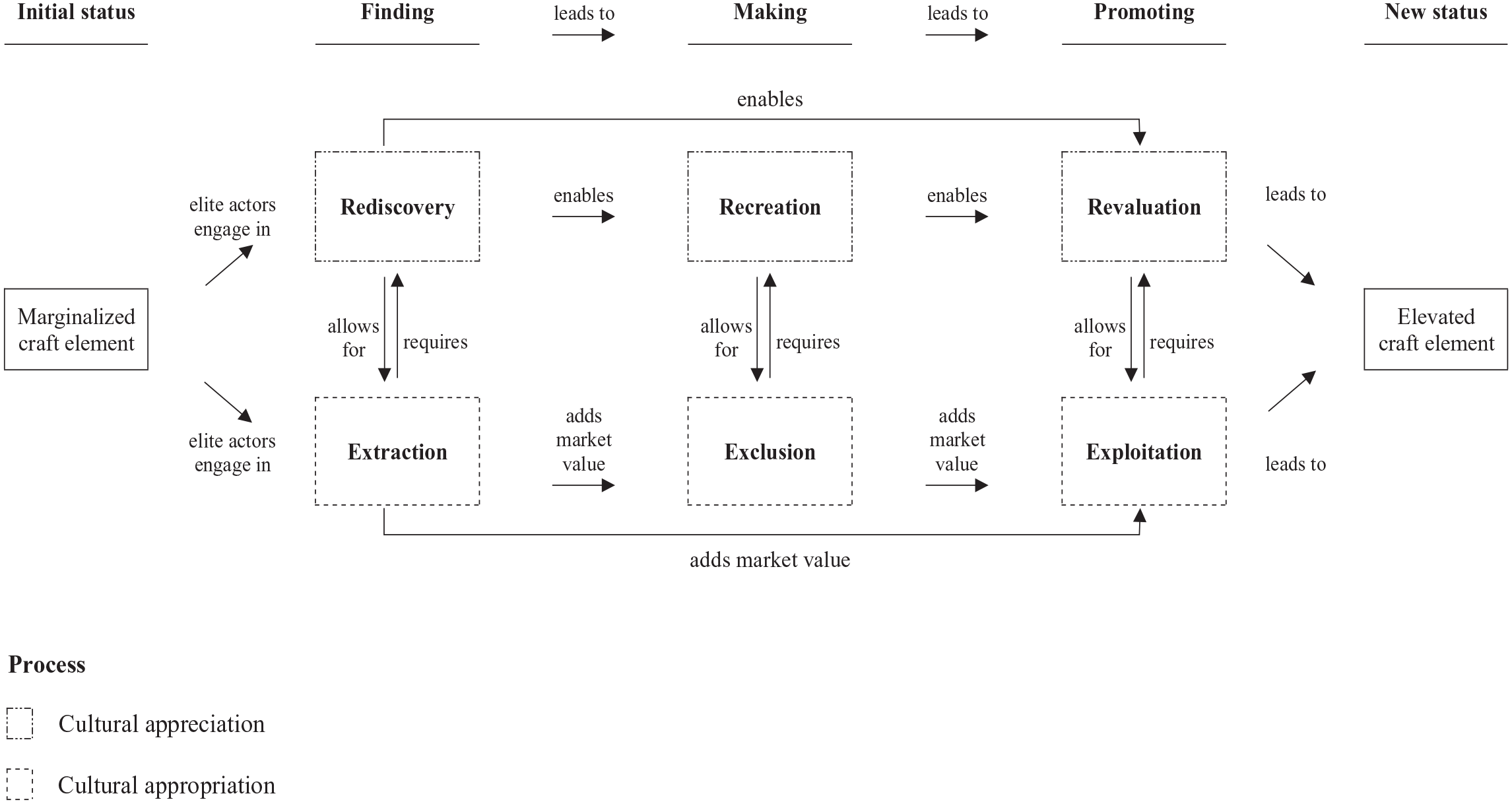
A dual process model of cultural appreciation and appropriation.
A dual process model of cultural appreciation and appropriation
Our dual process model illustrates the reciprocal interplay between practices of cultural appreciation (rediscovery, recreation, and revaluation) and practices of cultural appropriation (extraction, exclusion, and exploitation). Both sets of practices are interlinked, enabling and requiring each other in a dual process. While the former are motivated by the desire for authenticity as connection to craft traditions, the latter are driven by the demands for authenticity as conformity to the norms and rules of a category.
Across both sets of practices, we identified three sub-processes: finding, making, and promoting. First, finding marginalized craft elements occurs through the interplay between rediscovery and extraction. Elite chefs appreciate craft traditions, knowledge, and ingredients as they rediscover these marginalized elements, which allows them to project authenticity based on indexical connections to craft (Bell et al., 2021). This, however, also enables them to engage in appropriation practices by extracting the most marketable or ‘exotic’ elements for value creation and project stylized authenticity claims that position themselves as the discoverers. Yet, even if chefs extract these elements, they require a profound comprehension of these elements, which can only be attained through appreciation practices of rediscovery.
Second, making a new cuisine based on found marginalized craft elements occurs through the interaction of recreation and exclusion. Elite chefs appreciate marginalized elements as they use their masterful and creative craft to recreate them to captivate a broader audience, enabling them to project authenticity claims tied to their identity as skillful craftspeople (Schifeling & Demetry, 2021). However, this process also involves appropriation, as these dishes become exclusive to high-end consumers, conforming to the authenticity standards of fine-dining cuisine (Lehman et al., 2019).
Third, promoting cuisines and finding marginalized craft elements occurs through the interaction of revaluation and exploitation. Elite chefs appreciate marginalized elements as they revaluate them by communicating their value, significance, and unique aspects, enabling them to make authenticity based on indexical connections to craft but also claims tied to their identity as cultural tastemakers (Ocejo, 2017). This, in turn, enables appropriation as chefs can engage in a more exploitative side of promotion that allows them to grow their reputation.
Due to the intertwined and reciprocal nature of the practices involved in elevating marginalized craft elements, elite craftspeople may perceive the processes of finding, making, and promoting as a one seamless activity. This consolidation, which obscures the distinct aspects of appreciating and appropriating, along with the lack of full recognition of the different authenticity types behind these practices, reduces tensions, thereby facilitating their simultaneous occurrence without apparent conflict.
Our dual process of cultural appreciation and appropriation captures the interplay of craftsperson agency and the norms of a category (Lehman et al., 2019) that structure that agency, and the influence of power relations (Black & Burisch, 2020). On the one hand, practices of cultural appreciation demonstrate the agency of craftspeople to counter asymmetrical power relations by celebrating the culture of marginalized groups and providing the communities from which elements are drawn with benefits. On the other hand, Western expectations of authenticity, which prioritize individual creativity over collective traditions (Umbach & Humphrey, 2017), demand conformity by elites but also diminish the role of marginalized craftspeople in value creation. Therefore, elite craftspeople use the logic of craft as a problem-solving tool to reconcile two conflicting principles: embracing marginalized cultures and adhering to category norms to present these cultures to a broader audience. While others have noted that this tension between these competing logics frustrates urban craftspeople (Ocejo, 2017), we identify how embracing it is essential for the elevation of marginalized elements, even though cultural appropriation can be an unintended consequence.
Overall, our process model shows that the line between appropriation and appreciation might not be as clear-cut as it is often assumed to be: there is a level of appreciation in the process of appropriation in the sense that elite actors show interest in adopting craft elements from marginalized groups (Young, 2008); however, the ‘appreciation of another cultural tradition can still be framed within a hierarchical system of cultural value’ (Root, 2018, p. 54) due to market demands and asymmetrical power relations.
Theoretical contributions to authenticity and craft
The interplay of authenticity forms
Our findings contribute to the authenticity literature by highlighting how different forms of authenticity interact to produce unintended outcomes, which problematize the assumptions underpinning the agency and structure in neo-craft craftwork (Gandini & Gerosa, 2023). We demonstrate how authenticity as connection to craft traditions (Bell et al., 2021) is subject to the demands of authenticity as conformity to the norms that govern or flow from membership in categories (Lehman et al., 2019). The quest of elite chefs for a connection to craft traditions, as demonstrated through practices of cultural appreciation, is subject to the normative requirements that define the category of haute cuisine. These requirements emphasize individual creativity and stylized representations of craft traditions, which inadvertently lead to practices of cultural appropriation. In other words, while elite chefs might not intend to engage in practices of cultural appropriation, it is an inevitable outcome of the demands of the marketized category in which they seek to elevate marginalized elements.
This interplay of authenticity forms underscores the complex dynamics of power, representation, and authenticity in neo-craft (Gandini & Gerosa, 2023; Gerosa, 2024). Our study revealed that, despite the prevailing power dynamics in the country, a chef from a northern region of Peru managed to attain an elite status as a craftsman. This chef, much like his elite counterparts hailing from upper or upper-middle-class backgrounds within the capital, engages in practices of cultural appreciation but also cultural appropriation because he conforms to the standards of a highbrow category, thereby reinterpreting his heritage for a wealthy clientele. However, a notable difference lies in the fact that, unlike the other elite chefs who also hold a societal elite status, the elevation of marginalized craft elements facilitated his socio-economic ascent. Therefore, while the agency of chefs, manifested in their appreciation and connection to their craft, is subjected to the authenticity that conforms to the norms of highbrow cuisine, marginalized craftspeople can leverage these tensions to challenge the power structures that marginalize them.
Craftwashing
Our findings also extend our understanding of craftwashing. The concept of craftwashing has been applied when mass producers appropriate craft elements and techniques to project craft-based authenticity to purposefully present their goods as handcrafted products (Gerosa, 2024). In contrast, our study reveals how craftwashing can arise from the tension between connection to craft traditions and the demands for conformity. For example, in the case of luxury wines, maintaining status claims requires decoupling projected craft images, which are reflected in the emphasis on nuanced understandings of terroir and house style, from the reality of industrial operations due to conformity to more marketized and scientific winemaking (Beverland, 2005). Here, craftwashing is crucial in this industry as failing to balance these forms of authenticity could lead to status and skill loss. However, in our empirical setting, authenticity as connection, stemming from cultural appreciation, is influenced not only by the conformity to the norms of haute cuisine but also the perceived sincerity of intent (Fine, 2003). Therefore, if elite chefs’ practices are seen as overtly self-serving, it could trigger accusations of craftwashing.
However, claims of craftwashing that arise from cultural appropriation may also trigger a new round of appreciation or open opportunities for new craft specialists. While our study focuses on the emergence of a new fine-dining cuisine category, other sectors like specialty coffee have further evolved as a form of neo-craft (Gandini & Gerosa, 2023). In this market, the ‘third wave’ of coffee, characterized by craft specialists, emerged in response to the second wave’s criticisms of cultural appropriation (in the form of unfair prices paid to farmers and exoticization of culture), despite placing the skill of the barista at the heart of its authenticity claims. These specialists celebrate the diversity of coffee terroir, with their authenticity stemming from their deep knowledge, skill, and genuine relationships with growers in coffee-producing countries (Beverland, Cankurtaran, Micheli, & Wilner, 2024). This not only enables them to secure rare micro-lots of coffee but also to improve crop levels and quality while rewarding the superior results with a substantial premium.
Future research
Our process model is particularly relevant in the cultural and creative sectors where elite craftspeople are elevating craft elements from historically marginalized people, not only due to race or ethnicity as we have examined here, but also class or gender. In these contexts, the elevation might require an interplay of different types of authenticity, specifically authenticity as connection to marginalized craft traditions and authenticity as conformity to a highbrow category (Lehman et al., 2019). For example, middle-class Italians are elevating the traditional Neapolitan pizza a portafoglio by using high-quality ingredients and modern techniques, transforming this once working-class foldable pizza into a premium-priced delicacy (Gerosa, 2024). This prompts the question: What other mechanisms, if any, can be employed?
In contrast to existing literature that has emphasized the significant role consumers and gatekeepers play in shaping and legitimizing authenticity claims (Lehman et al., 2019), we have identified the agency of marginalized producers. These producers willingly engage in the elevation of their products by elite chefs, as the ensuing appreciation yields them vital economic, social, and symbolic benefits crucial for their livelihood, despite the potential for appropriation practices. However, we wonder: could marginalized producers build more genuine connections with craftspeople from their own cultural group who have risen to elite status? Moreover, in our empirical context, the agency of marginalized producers takes place in the initial and final processes of finding and promotion, as making is dependent on chefs. This prompts questions: what would happen if these marginalized producers were to actively participate in the making process? Would this change the dynamics of the process, and if so, how?
Footnotes
Appendix
Representative quotes.
| 2nd-order codes | 1st-order codes | Representative quotes |
|---|---|---|
|
|
Exploring historical and geographic connections | For some time now, people talk more about a new Peruvian cuisine that is precisely based on that rediscovering of local inputs, revaluing local inputs, recreating perhaps historical recipes, or even recovering recipes from yesteryear or practices or techniques perhaps not necessarily from the coast but from the mountains especially, even from the jungle, to apply them to dishes generated from research, from creativity. (J3) In the case of [elite restaurant], well, that search has been driven by a quest for the product, for the ingredients, for the ancestral techniques, for exploring the mountains in a way that no one had explored before. (J4) |
| Building rapport with producers | The relationship that I have with suppliers is very close, especially in fish and shellfish and fruit and vegetables because I am interested in how they are doing, what products are in season . . . They are my radar. (C1) |
|
|
|
Updating traditions through mastery of technique | That today, in [elite restaurant], you can order a ceviche and it comes with torrejas de choclo [corn pancakes] which is something distinctly northern, of picantería [traditional restaurant specializing in spicy dishes], like very, very, very traditional, it tells you something. (J2) |
| Inventing traditions through creativity | I always say that there cannot be avant-garde without tradition. They are, I think, tied up, right? They are important parts. A contemporary chef, a chef who dedicates himself to making or intends to call his cuisine ‘new Peruvian cuisine’, well, he definitely has to know traditional cuisine anyway, right? (C3) |
|
|
|
Taste-making inside the restaurant | From my point of view, every chef is a communicator, s/he communicates through the cuisine, s/he communicates about products, techniques, the history of what s/he is giving. (J3) |
| Proselytizing outside the restaurant | [Elite chef] prepared the book and the recipes that have finally catapulted the consumption of Andean grains. [. . .] What [elite chef] has done is popularize Andean grains. (R2) |
|
|
|
Selecting the most marketable ingredients | It was enough that they [elite chefs] showed a minuscule part of the whole – some varieties of corn and potatoes, surprising Andean tubers such as olluco, oca, mashua or arracacha, and a few chili peppers – to substantiate this trend. (Newspaper article, February 13, 2018) |
| Taking knowledge without compensation | We talk a lot with picanteras [female cooks working in a traditional restaurant specializing in spicy dishes], they give us a little bit of the secrets that they have, and then one finds out a thousand things that they do that one really doesn’t know [. . .] So, after investigating, we go to the thinking side. The one who leads the way is [elite chef] [. . .], the kitchen staff executes, and I guide them. (E2) |
|
|
|
Aestheticizing marginalized craft elements | The problem that we have [. . .] is that of modernizing cuisines because what is there is despised. [. . .] In the 90s, because of this idea of prejudice that food had to be improved, these [cuisines] appeared. (R1) |
| Premiumization | We are talking about an industry that is tremendously elitist [. . .] about people, about restaurants that have armies of chefs and service personnel to attend very few tables, people who can pay, well . . . I don’t know, €500 between two people for a meal. (J4) |
|
|
|
Claiming the rescuer argument | [Elite chef’s restaurant] has not changed the menu for five years, which means that [restaurant] does not use any fresh products that cannot be available all year round. [. . .] Secondly, [elite chef’s research centre] makes a trip every three or four months with [elite chef] to look for new products that then strangely never appear in the restaurant. (J8) |
| Commodifying producers’ image | Look, [the chefs’ commitment with producers] is real, but there are [chefs] who take advantage [of it] and only use the producers for the photo, that is also real. (J6) |
Acknowledgements
We extend our heartfelt gratitude to the editors of Organization Studies, guest editors, and reviewers for their invaluable and developmental feedback throughout the revision process. Additionally, we thank those who provided constructive feedback and suggestions on earlier versions of this work presented at the Imagine. . . Creative Industries Research Centre seminar series at Copenhagen Business School and the Interdisciplinary Authenticity ECR Workshop series. Finally, we thank all participants for their invaluable contribution to this study.
Funding
The author(s) received no financial support for the research, authorship, and/or publication of this article.
