




Abstract
Coordination theories are characterized primarily by a focus on integration, in which coordination is aimed at achieving a coherent and unified set of actions. However, in the extreme settings in which fast-response organizations operate, achieving integration is often challenging. In this study we employ a fragmentation perspective to show that dealing with ambiguity and discontinuity is not only inevitable for these organizations, it is a key characteristic of coordinating. We undertook an inductive, qualitative field study on how officers in command from the fire department, medical services, and police coordinate during emergency response operations. Our data are based on a four-year multi-site field study of 40 emergency management exercises in the Netherlands, combined with 56 retrospective interviews. Our inductive analysis of this data shows that officers use three coordination practices to deal with ambiguity and discontinuity: working around procedures, delegating tasks, and demarcating expertise. We theorize our findings by showing how these practices lead to conditions in which fragmentation can become an effective method of coordination. In doing so, we provide a more complete understanding of the process of coordinating in fast-response settings that will benefit both crisis management practice and organizational theory.
Introduction
Coordination is a key phenomenon in organization and management theory as it concerns how different areas of work can be performed in concert. The general consensus is that coordination is accomplished through integration, which refers to the process of bringing together a set of differentiated activities into a unified arrangement (Argote, 1982; Heath & Staudenmayer, 2000). Consequently, coordination is considered to be about ‘the integration of organizational work under conditions of task interdependence and uncertainty’ (Okhuysen & Bechky, 2009, p. 469). Recent research indicates that explaining coordination dynamics in situations where interdependencies become more complex and uncertain requires a shift in focus from why coordination mechanisms work to how coordination happens (Gkeredakis, 2014; Jarzabkowski, Lê, & Feldman, 2012; Kellogg, Orlikowski, & Yates, 2006; Okhuysen & Bechky, 2009). In this line of theorizing, coordination is treated as an emergent process, in which different interdependent action trajectories are synchronized (Bechky, 2003; Bechky, 2006; Faraj & Xiao, 2006; Majchrzak, Jarvenpaa, & Hollingshead, 2007; Majchrzak, More, & Faraj, 2012).
Achieving integration becomes challenging in turbulent situations when multiple action trajectories need to be synchronized simultaneously (Kellogg et al., 2006). This is particularly true for the extreme settings in which fast-response organizations operate (Bigley & Roberts, 2001; Faraj & Xiao, 2006; Majchrzak et al., 2007; Schakel, van Fenema, & Faraj, 2016). In these settings actors need to react swiftly and adapt on the run, which makes it difficult to integrate their activities in a unified arrangement. Despite these difficulties, studies of firefighters, medical trauma teams, and police SWAT teams have taught us that coordination is performed by adapting structures through role switching (Bigley & Roberts, 2001), plug-and-play teaming (Faraj & Xiao, 2006), and bricolage (Bechky & Okhuysen, 2011). Such adaptations are possible because, in these single organizational settings, actors can rely on structured role systems, common expectations of workflow, and shared task knowledge (Bechky & Okhuysen, 2011).
However, in fast-response situations where professionals from different emergency response organizations need to come together and devise immediate action, these shared social cognitive resources do not always exist, making it very difficult to manage the situation (Comfort & Kapucu, 2006; Majchrzak et al., 2007; Uhr, Johansson, & Fredholm, 2008). Recent studies of the multi-site terrorist attacks in Paris (Hirsch et al., 2015) and the Oslo bombing (Rimstad & Sollid, 2015) have shown us that these situations quickly become ambiguous, and it therefore becomes difficult for emergency managers to stay aware of their interdependencies. They are confronted with unexpected turns of events, a situation that is difficult to oversee, a variety of demands from multiple stakeholders, opposing interests, and acute time pressure (Comfort, 2007; Dearstyne, 2007). The result is that formal plans often break down in unexpected ways, challenging existing structures of authority and creating discontinuity (Majchrzak et al., 2007). Taken together, discontinuity and ambiguity make it difficult to predict which organizations will engage in which part of the response operation, and what tasks, people, and expertise are needed at different times (Comfort, 2007; Dynes & Aguirre, 1979; Rimstad & Sollid, 2015). On-scene coordination dynamics in emergency response can therefore teach us important lessons about how to coordinate in situations where integration is difficult to achieve.
In this paper we will examine coordination by officers in command 1 during emergency response operations, and explain the origin and consequences of ambiguity and discontinuity. In line with studies of fast-response coordination (Faraj & Xiao, 2006; Schakel et al., 2016), we adopt a practice approach, because this enables us to zoom in on how individuals perform their work in these challenging circumstances (Nicolini, 2012; Schatzki, 2001). This prompts the following research question: How is coordination practised in the fast-paced, inter-organizational environment of emergency management under conditions of ambiguity and discontinuity? To answer this question we conducted a four-year, multi-site, qualitative field study of 40 emergency management exercises in the Netherlands, combined with 56 retrospective interviews in which we asked emergency response officials about their coordination practices during both real-life response operations and exercises.
Our analysis suggests that emergency response officers coordinate in fast-response settings by regarding ambiguity and discontinuity as valuable means of devising novel articulations and distributed actions, as they engage in coordination practices of working around procedures, delegating tasks, and demarcating expertise. As a result, the coordination process is characterized by ad-hoc adaptations, separate pockets of control, and a multiplicity of interpretations. We contribute to the coordination literature by constituting these characteristics into a fragmentation perspective, which recognizes that incoherence and contradictions are not deviations, but expected and indispensable parts of regular coordination practices.
From Integration and Differentiation towards Fragmentation
The traditional idea of coordination is based on the relation between differentiation and integration. Differentiation consists of breaking down tasks into subtasks, and integration concerns bringing these tasks together into a cohesive whole (Heath & Staudenmayer, 2000; Lawrence, Lorsch, & Garrison, 1967). As such, coordination is about ‘the integration or linking together of different parts of an organization to accomplish a collective set of tasks’ (Van de Ven, Delbecq, & Koenig, 1976, p. 322). The notion of integration is rooted in the designability of coordination mechanisms. For several decades scholars assumed that organizations could be designed with enough precision to allow individuals to undertake their work in a coordinated fashion (Malone & Crowston, 1994; Okhuysen & Bechky, 2009). Scholars in the design school embraced a contingency view of coordination, arguing that certain coordination mechanisms had a higher information processing capacity than others (Galbraith, 1977; Thompson, 1967). As a result, theorists arranged coordination in dichotomies that portrayed the need to differentiate based on the fit between coordination mechanisms and the uncertainty rooted in either tasks or environment. This resulted in well-known dichotomies, such as personal versus impersonal (Van de Ven et al., 1976), programmed versus non-programmed (Argote, 1982), and formal versus informal coordination (Kraut & Streeter, 1995).
What has kept the coordination debate from advancing in a new direction for a long time is that integration and differentiation were still based upon the notion of designability (Faraj & Xiao, 2006). Designability reached its limits when organizations gradually turned away from manufacturing towards service provision, thereby relying less on the design of production processes and more on interpersonal communication and feedback (Okhuysen & Bechky, 2009). This notion is picked up in a comprehensive review of the coordination literature by Okhuysen and Bechky (2009), who identified coordination as being a combination of design and emergence, and based upon three different integrative conditions: accountability, predictability, and common understanding.
First, accountability is required for coordination because it aligns responsibilities, either through designed coordination based on the enactment of formal authority and organizational standards, or through emergent coordination in which other parties become accountable for their own contribution (Bechky, 2003; Bechky & Okhuysen, 2011; Reagans, Argote, & Brooks, 2005). Second, predictability enables actors to anticipate how subsequent tasks will be executed through their familiarity with the elements and timing of others’ task execution (Rico, Sanchez-Manzanares, Gil, & Gibson, 2008). Predictability can be designed by scheduling formal workflows in protocols and procedures (Reagans et al., 2005), or can emerge during the execution of tasks when individuals perceive their roles to fit with those of others (Rico et al., 2008). Third, common understanding is deemed necessary for coordination because a shared perspective on the objectives of actions is required for task performance (Bechky, 2003). When plans and schedules are prepared in advance, this common understanding may be derived by design, or it can emerge as an operation unfolds through discussions of how interdependencies need to be managed (Okhuysen & Bechky, 2009).
It is important to note that Okhuysen and Bechky (2009) not only show how these three integrative conditions contribute to coordination, but at the same time also introduce a new dichotomy between designed and emergent coordination. Contemporary studies of coordination can be positioned on one side of this dichotomy, as they explore emergent coordination through an emphasis on practice and process (Bechky, 2003, 2006; Faraj & Xiao, 2006; Kellogg et al., 2006; Majchrzak et al., 2007, 2012). Consequently, coordination is often defined as a ‘temporally unfolding and contextualized process of input regulation and interaction articulation to realize a collective performance’ (Faraj & Xiao, 2006, p. 1157). Studies of emergent coordination indicate that interdependencies among activities shift continuously as the coordination process unfolds, and are negotiated and reframed in the context of work (Kellogg et al., 2006). We adhere to this definition of coordination, because this contextualized and temporally unfolding process is especially important for organizations operating in fast-paced environments.
Insights from studies of fast-response organizations tell us that these organizations deal with unexpected situations by developing a capacity for bricolage (Bechky & Okhuysen, 2011; Bigley & Roberts, 2001). Organizational bricolage is seen as a way to respond to surprises through collectively held knowledge about how a task should be performed (Bechky & Okhuysen, 2011; Duymedjian & Rüling, 2010). Bricoleurs use this knowledge to experiment with alternative courses of action by using grounded imagination as they look for new combinations of resources both inside and outside the procedures (Baker & Nelson, 2005; Kroll-Smith, Jenkins, & Baxter, 2007; Levi-Strauss, 1966). Obstfeld (2012) describes this process of sequencing interdependent actions as a ‘trajectory’, involving multiple actors who (re)shape the course of action. Engaging in such a coordination trajectory requires common expectations of workflow and shared task knowledge (Bechky & Okhuysen, 2011). In other words, it requires the integrative conditions of predictability and common understanding.
In general, studies on emergent coordination theorize coordination processes as being based on the notion of integration. This notion is also visible in Okhuysen and Bechky’s (2009) review, through the emphasis on three integrative conditions of coordination: accountability, predictability, and common understanding. Their review suggests that in contemporary theories on emergent coordination, the underlying rationale is that, in order to coordinate, actors require structured role systems, common expectations of workflow, and shared task knowledge, all of which are rooted in conditions of integration.
Faraj and Xiao’s (2006) analysis of emergent coordination processes in a trauma center revealed that during routine treatment trajectories, trauma teams tended to draw upon expertise coordination practices that entail reliance on protocols, plug-and-play teaming, the structuring of communities of practice, and knowledge sharing. These coordination practices involve the previously discussed elements of integration, as they imply structured role systems, common expectations of workflow, and shared task knowledge. On some rarer occasions, trauma teams were confronted with a problematic patient treatment trajectory, and Faraj and Xiao (2006) observed that teams were forced to take alternative approaches and break protocols. In these situations, teams evolved the use of dialogic coordination practices, which involved epistemic contestation, on-the-spot sensemaking, cross-boundary intervention, and protocol-breaking. The study showed that, after they had deviated from expected workflows, trauma teams sought to regain common ground and tried to make sense of the situation by challenging each other’s standpoint and bridging epistemic boundaries (Faraj & Xiao, 2006).
The use of dialogic coordination practices indicates that coordination processes rooted in conditions of integration are not always suitable for dealing with unexpected events in complex situations. Kellogg et al. (2006) provide similar insights regarding coordination in dynamic project environments, and reveal that, unlike trauma teams, project teams cope by not immediately reconciling their interpretive differences. Instead, they make their work legible to each other and assemble products through a process of juxtaposition and dynamic alignment (Kellogg et al., 2006). By doing so these teams reach provisional settlements, and keep their work dynamically connected across different communities, on the mutual understanding that issues will be resolved further down the line.
These studies of emergent coordination indicate that actors engage in attempts to reconcile their differences directly in action, or over time. When something novel and unexpected happens, it becomes increasingly difficult to achieve integrated action, because there is increasing uncertainty as to how interdependencies will affect collective outcomes (Carlile, 2004). It is difficult for those involved to find a cohesive approach, because there are multiple sets of people responsible for organizing local courses of action (Jarzabkowski et al., 2012). The result is that incongruent perspectives are likely to emerge (Bechky, 2006), creating misunderstandings (Bechky, 2003) and equivocality (Brown, Colville, & Pye, 2015).
In response, actors attempt to reduce equivocality by extracting and interpreting environmental cues, and making sense of them by actively shaping what is going on (Brown et al., 2015). This is especially important for understanding the coordination challenge facing those working in the inter-organizational setting of emergency management. In many response operations ambiguity makes it difficult to bring divergent and disconnected elements together, due to time constraints and physical distance between the actors (Wolbers, Groenewegen, Molle, & Bim, 2013). Even though incident command systems and role structures are in place (Bigley & Roberts, 2001), it remains difficult for emergency managers to be fully aware of the complexities involved and the interdependencies of their actions (Rimstad & Sollid, 2015). For example, Dearstyne (2007) describes the difficulties of sensemaking under action ambiguity during the response operation in New York on 9/11, when the police and fire department had different views on the threat posed by the collapse of the World Trade Center towers. Similarly, during a chemical spill in Helsingborg, Swedish commanders found it difficult to make sense of the ad-hoc response operations that ‘did not follow fixed plans or procedures’ (Uhr et al., 2008, p. 83). These examples indicate that, during crisis situations, action ambiguity and discontinuity are an inescapable reality, rather than complications to be resolved.
Integration is not the answer in terms of clarifying the role that ambiguity and discontinuity play in coordination processes distributed among fast-response organizations, and adopting a different perspective is therefore essential. In her work on organizational culture, Martin (1992) describes fragmentation as a helpful perspective for explaining the origin and function of discontinuity and ambiguity. According to Martin (1992, p. 134), ambiguity is most pronounced in turbulent environments when ‘a lack of clarity, high complexity, or a paradox makes multiple, rather than single or dichotomous explanations plausible’. When a situation is ambiguous, it is difficult to know whether action is called for, what actions might be appropriate, and what their consequences might be (Martin, 1992). Action ambiguity of this kind occurs when decision-making based on causality is difficult, as the relationship between cause and effect can be intermittent, lagged, dampened, slow, or abrupt. This can result in the breakdown of collective sensemaking, with potentially lethal consequences, as we saw in Weick’s famous analyses of the 1949 Mann Gulch fire (Weick, 1993) and the KLM/Pan Am air crash at Los Rodeos airport in Tenerife in 1977 (Weick, 1990).
A fragmentation perspective provides more scope for describing how discontinuity and ambiguity arise and how they disturb coordination processes in turbulent environments. It recognizes that contradictions are not deviations, but expected and indispensable parts of regular coordination practices. The norm is the presence of contradictions and discontinuity, rather than harmony and continuation in how joint action is constructed in situ. In ambiguous situations the consequence of having different actors engaged in coordination processes is that a multiplicity of interpretations then arises. As possible interpretations multiply, a flux emerges, in which temporary issue-specific coalitions form around different interpretations of the situation. As new information becomes available, different issues come into focus, so that different task notions and action trajectories become salient (Martin, 1992). This leads us to explain how coordination is carried out in fast-response settings under conditions of ambiguity and discontinuity, accepting that the situation is in constant flux and that this allows action ambiguity and multiple perspectives to prevail.
Methodology
In this study we set out to learn how emergency management officers practise coordination. These officers from the police, fire department, and medical services are responsible for commanding their own operational units on-scene, and for taking care of inter-organizational coordination. This may involve a broad range of disciplines, from regular first response units to specialist units such as hazardous materials, SWAT, or trauma care. In order to learn about the coordination practices of the officers in situ, we conducted an inductive, qualitative field study, using a grounded theory approach (Corbin & Strauss, 2008). This approach is valuable for developing theories about dynamic processes, because it captures the full richness of the activities and the various interdependencies between those activities, the team, and the environment (Barley & Kunda, 2001; Langley, 1999). A grounded theory approach is characterized by an iterative process of moving continuously back and forth between the empirical phenomena and their theoretical reading (Alvesson & Kärreman, 2007). Through this process the grounded data is systematically abstracted into more general patterns and used for theorizing (Gioia, Corley, & Hamilton, 2012).
Data collection
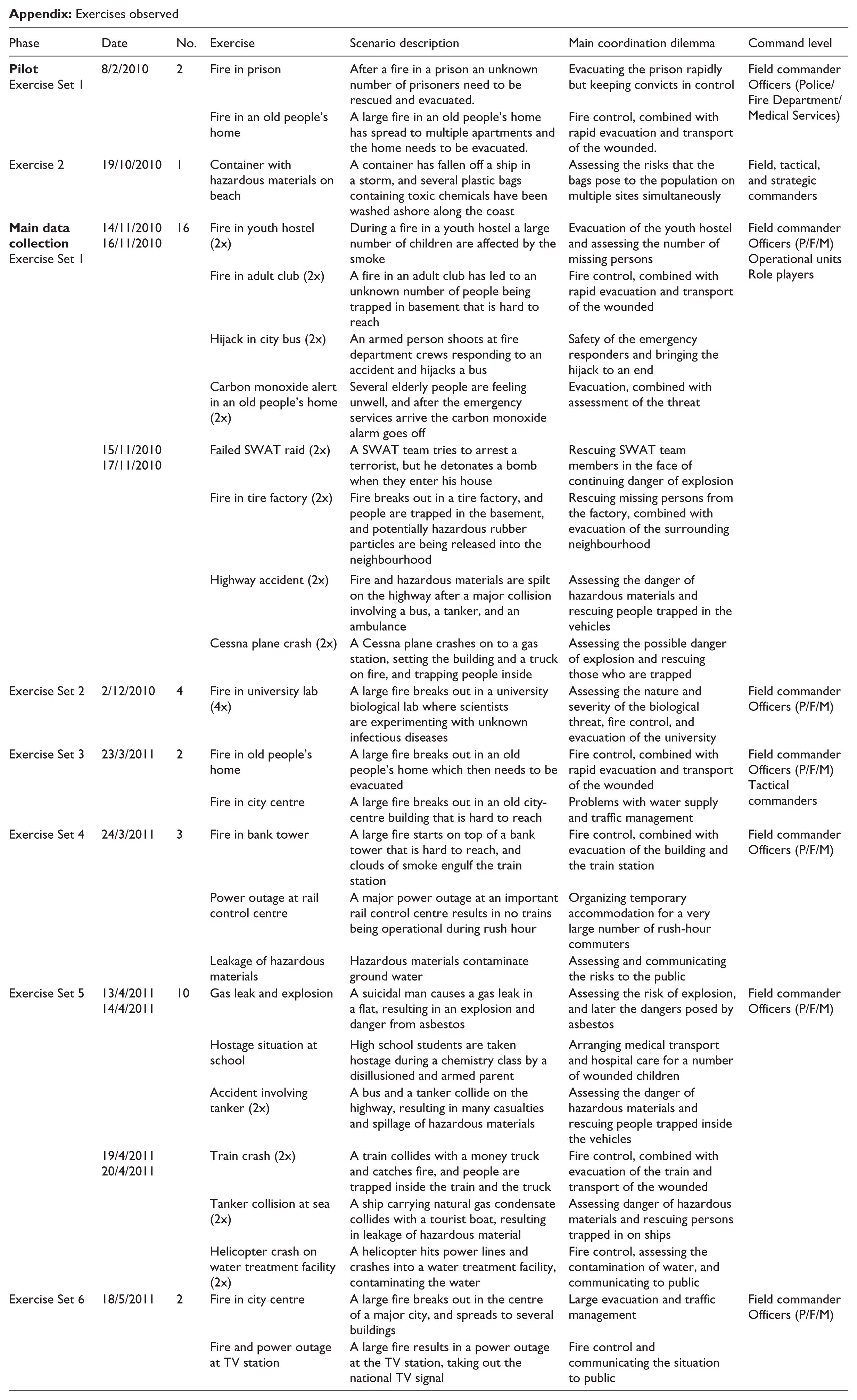
The qualitative data presented in this article were collected from the winter of 2010 to the winter of 2014, and focus on coordination processes in both emergency response field exercises and real-life incident response operations. Over this period, we observed 40 exercises and held 56 interviews with emergency officials, in which they reflected on their coordination experiences during these exercises and actual operations around the Netherlands (see Table 1). We went to official training grounds in the different regions where these exercises were conducted. Officers from different police units, medical teams, and fire departments were invited to these locations to carry out their annual exercises. At these locations we met the officers and contacted them for follow-up interviews. A detailed overview of our data collection can be found in the appendix.
Data collection.
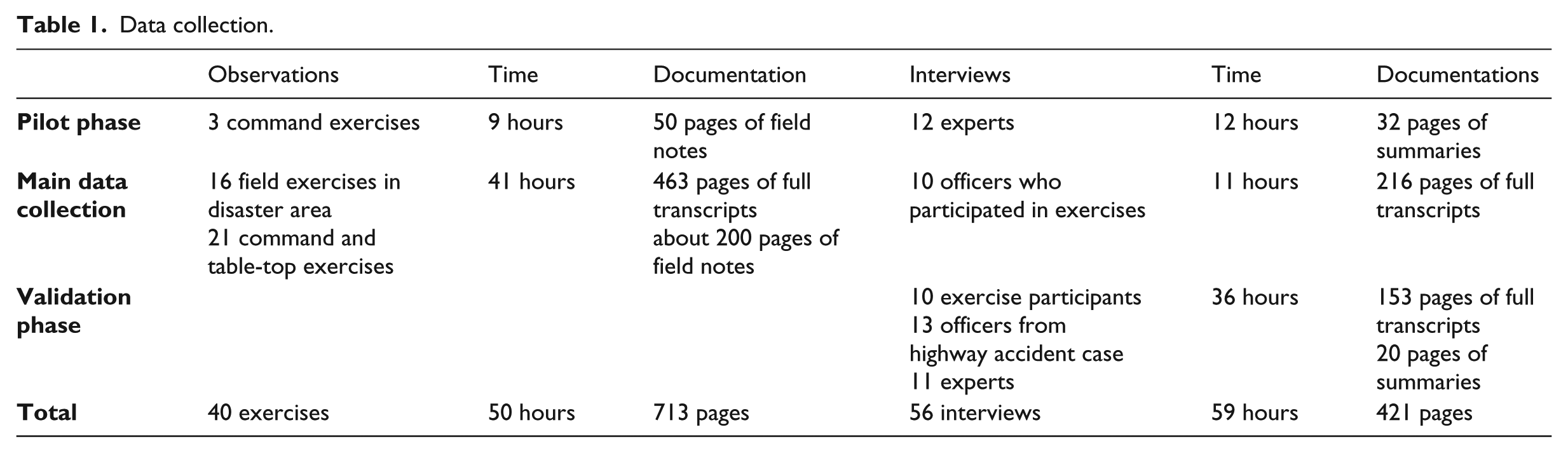
The data collection took place in three phases: pilot, main data collection, and validation. In the pilot phase we advanced our knowledge of how coordination is practised in fast-paced environments by conducting exploratory interviews with twelve experts. This made us aware of the difficulties of observing the work practices of officers in command during emergency response operations. Therefore, we explored the possibility of studying field exercises. We observed three exercises, and noted that this allowed us to engage more freely with the officers and study their behaviour and interactions, without the risk of jeopardizing the safety or quality of an actual response operation. It was important for us to observe coordination in action, since ‘most work practices are so contextualized that people often cannot articulate how they do what they do unless they are in the process of doing it’ (Barley & Kunda, 2001, p. 85). Exercises provide a good setting in which to study coordination, because the emergency management organization is similar to real events, and exercises are designed to force participants to act and make decisions (Latiers & Jacques, 2009). Despite these benefits, exercises may lack the same emotional aspects, decision impact, and in some cases recruitment delay (Latiers & Jacques, 2009).
The main data collection focuses on observations of 16 field exercises carried out in a disaster training ground on a former air force base in the winter of 2010. The exercises included the officers, their subordinates, and several actors brought in to engage in role play. We selected these exercises for our main analysis because the respondents described them as being particularly tense, as the exercises were very close to real life and felt quite similar to situations they had experienced during actual emergency operations. The exercises were staged in different locations on the training ground, which enhanced the realism and the feel of the situation. For example, an exercise simulating a highway traffic accident was carried out on a fully reconstructed highway with crashed vehicles and trucks. We were able to make detailed recordings of the conversations between the officers during the exercises and transcribed these in full detail. In addition to the observations, respondents who had taken part in the response exercises were interviewed for one or two hours in the spring of 2011 to get their views on the coordination challenges during the exercises. We also audio-recorded and transcribed these interviews as input for our inductive analysis.
In the validation phase we compared our analysis of the exercises with the real-life experience of the officers. First, we felt that we needed a member check (Schwartz-Shea & Yanow, 2009) to see whether our ideas were in line with the operational experiences of the officers. We conducted these interviews in the summers of 2011 and 2012, two years after the initial observations. In this stage, our acquaintance with the officers allowed us to reflect on how their actions during exercises compared to their real-life operational experience during the subsequent two years. This enabled us to confront and address one of the potential limitations of our approach, the fact that the observations are based on exercises, rather than real operations. In addition, we broadened our validation by interviewing eleven experts, and thirteen officers who had responded to a large highway traffic accident. As this real incident was similar to one of the scenarios in the field exercises, we were able to assess the relevance of our analysis. By taking this final step and checking the analysis and results with the officers, we feel confident that the results are reflective of actual practices during emergency response operations.
Data analysis
As our study involved a wide range of materials, the analysis was characterized by an iterative process that gradually deepened and interconnected the insights we were developing during the three phases of our data collection. The analysis was based on theoretical sampling (Corbin & Strauss, 2008), during which we used the analysis tool MaxQDA to assign codes to what we considered to be important events, aspects, and interactions during the coordination process.
In the first phase, we identified the main themes by reading through our field notes and discussing our preliminary ideas. We took a comprehensive approach to assessing coordination by looking at instances where actors explicitly discussed managing the interdependencies between their actions, but also at instances where interdependencies seemed to arise but were not explicated. We started our analytical process with open coding to break down the data so that we could understand the underlying dynamics (Strauss & Corbin, 1990). We identified themes and quotes that seemed to be important in shaping the coordination process, such as customized response, temporal solutions, putting tasks aside, safety boundaries, and ambiguity. This provided us with a first rough idea of the important aspects of coordinating.
In the second phase, we continued with axial coding to reveal the thematic relationships and contrasts between the codes. We undertook detailed analysis of the transcribed recordings from the 16 exercises and the transcribed interviews with exercise participants. This allowed us to develop an in-depth understanding of the pace and sequence of events, which enabled us to see how the interplay between integration and fragmentation occurred. This was a significant step in unravelling the process nature of coordination practices. We found that different coordination practices followed a specific sequence: a trigger that led to a need, which resulted in boundary work.
In the third phase, we compared the thematic relationships between the codes, and noticed that three specific triggers recurred in both the interviews and the observations: unexpected events, difficulty to oversee the situation, and uncertainty. After identifying these, we looked at the thematic relationships between the codes to develop the corresponding data structure (Gioia et al., 2012). When we analysed the responses from the officers to the triggers in our data structure (Figure 1), we noted that they belonged to three different practices: working around procedures, delegating tasks, and demarcating expertise. This final step allowed us to zoom in and out of the data so that we could critically assess, compare, and broaden our understanding of the dynamic relationships between the practices we observed in the training exercises (Nicolini, 2009).
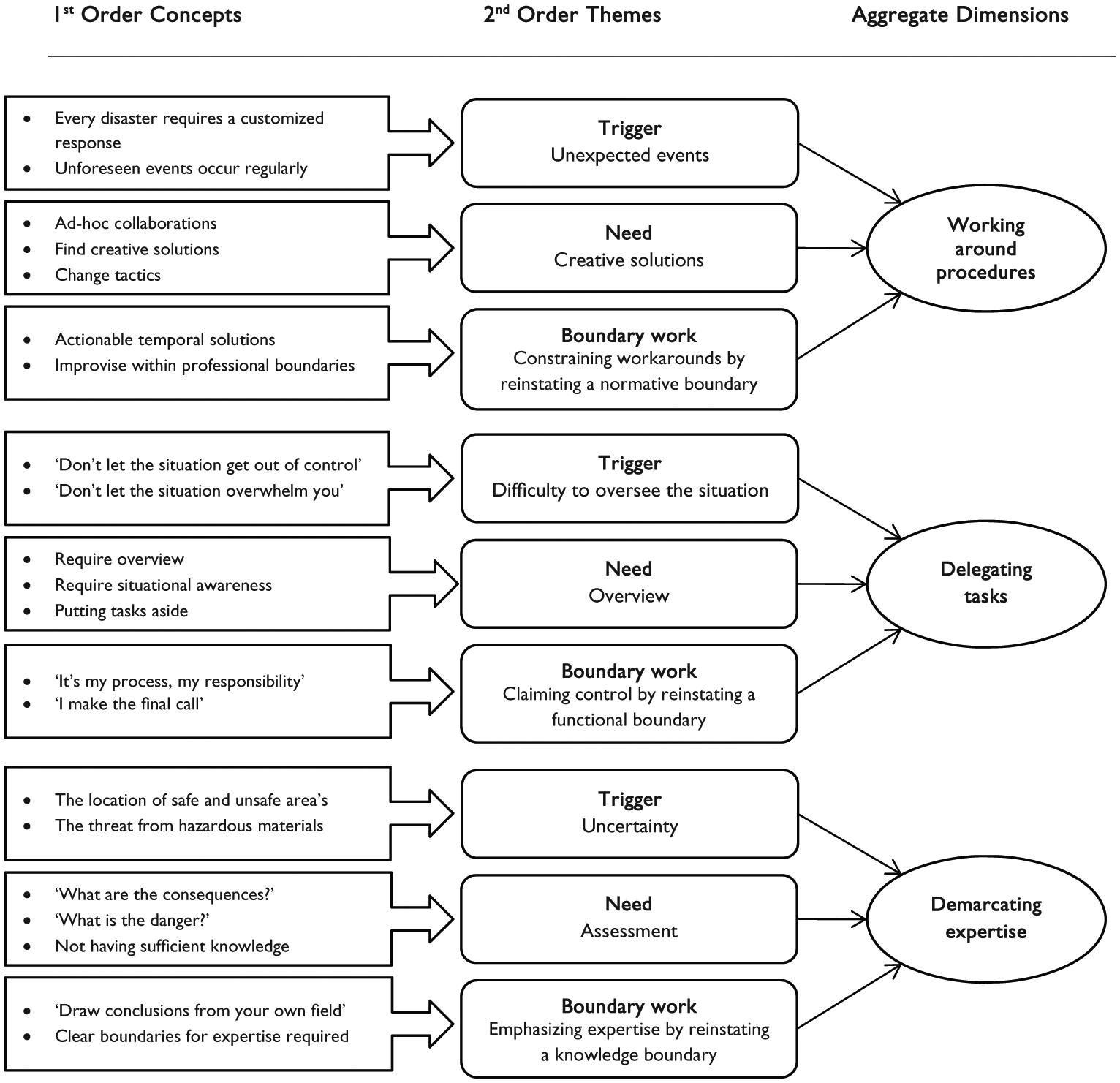
Data structure.
We validated our process model by consulting materials from other responses and exercises, such as evaluation reports, after-action reviews, and video excerpts. During this process we ‘sat with our data’ to assess alternative explanations, and avoid the pitfall of a deterministic use of coding logic during the construction of our process model. One of the main alternative explanations we considered was the failure of the officers to conform to principles of command and control (Boersma, Comfort, Groenendaal, & Wolbers, 2014; Wolbers, Ferguson, Groenewegen, Mulder, & Boersma, 2016). However, in our discussions we realized that such an explanation could not take into account the benefits of finding creative workarounds as a means to devise novel ways of adapting successfully to unexpected situations. In this way, the process model is the outcome of our ongoing reflexive discussions, in which we went back and forth between the data and its theoretical reading (Alvesson & Sköldberg, 2009; Yanow & Tsoukas, 2009).
Findings
Our analysis of coordination processes during emergency response operations revealed that, when responding to rapidly changing circumstances that made it difficult to realize integration, officers in command coordinated their actions across organizational boundaries by using three interrelated practices: working around procedures, delegating tasks, and demarcating expertise. These practices enabled the officers to adapt to unexpected events, keep an overview of events, and recognize and assess potentially dangerous situations. In the following sections, we discuss each practice in turn, and describe how the unintended effects of each coordination practice raise different kinds of boundaries that contribute to the fragmentation of the response efforts.
Working around procedures
Incident scenes are inherently dynamic, and unexpected events occur which do not conform to the scenarios anticipated and codified in official guidelines and procedures. Consequently, coordination based on integration is difficult. It requires the officers in command from the police, fire, and ambulance services to adapt to the unfolding situation and find creative solutions to emerging problems. They do this by working around procedures, a practice in which they seek to circumnavigate the strict action trajectories that are codified in protocols. Workarounds are informal and temporary practices for handling exceptions to normal workflow, and are a common technique for dealing with the uncertainty of dynamic working environments (Kobayashi, Fussell, Xiao, & Seagull, 2005). A police officer described this practice during an actual response operation:
There was a fire in an old people’s home, and we decided to evacuate the residents. Unfortunately, it was freezing outside. So where do you leave those people? There was a shelter in town, but we knew the key holder was very difficult to reach. So, a spark of creativity was triggered, and ad-hoc collaboration emerged between the fire department and police on the scene. I said, ‘Guys, listen up. We’ve got a gym here. I can get it operational within 30 minutes. Go for it.’ Another colleague stops a bus and gets it to drive to the gym. The registration process is a bit fuzzy then, but at least we got everybody warm inside.
In response operations, the municipality has procedures for arranging a temporary shelter and bus transportation for the community affected. However, the police officer knows that it often takes a long time before the municipality is operational. Therefore, he takes matters into his own hands and develops a workaround to arrange alternative transportation before the elderly people are affected by the cold weather, which could potentially make the situation worse.
This example illustrates how officers need to address emerging coordination issues that arise at different locations, and how they do so through ad-hoc collaborations. By finding a workaround they are able to prevent the unexpected situation from escalating, but – as in this case – they are altering the normal workflow of the victim registration process, making it less predictable. This indicates that an unintended consequence of working around procedures is that it has an adverse effect on predictability, one of the integrative conditions for coordination. When procedures are adapted, the usual workflow is interrupted: this creates different expectations, and equivocality increases as a result. In this way, the practice of working around procedures raises a normative boundary, because it alters the expectations of how normal workflow or trajectory should be organized (Faraj & Xiao, 2006; Obstfeld, 2012). Consequently, coordination processes in the response operation become more fragmented. We illustrate this dynamic in the following vignette.
Vignette 1. Working around procedures on scene to evacuate an old people’s home
The emergency response services are responding to a carbon monoxide threat in a nursing home. In this exercise scenario we witness how a fire department officer uses a workaround in the upscaling procedure so that he can get more units onto the scene to assist with the evacuation of the nursing home. However, this workaround goes against the norm and logic behind the upscaling procedures.
When the first fire engine arrives on the scene, the fire crew confirms that carbon monoxide is present. Evacuation is required, but the fire crew does not have enough units to carry out the evacuation. The fire department officer, who is still en route, requests that they should initiate the standard procedure ‘very large fire’, which will alert four fire engines, even though this is not actually a fire. The fire department officer later explains in an interview: ‘It’s the responsibility of the Fire Department to take care of the evacuation. I issued “very large fire” to get more people on the scene quickly.’ However, mentioning a ‘very large fire’ over the radio causes confusion among the other emergency services responding to the incident, because this protocol is normally only used when there is a fire. This is illustrated in the following dialogue among different emergency responders.
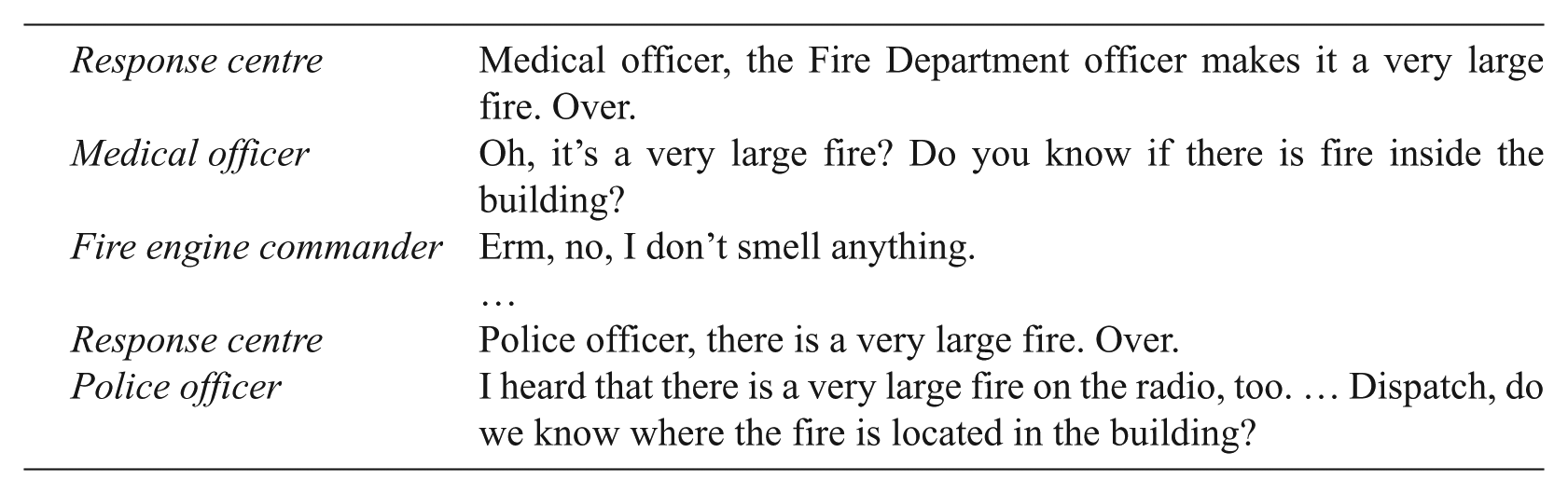
The misunderstanding spreads to different locations around the distributed response operation, and response organizations prepare to deal with a large number of victims with burn trauma. For the medical officer, this entails asking for capacity to be freed up in specialized burn trauma centres. For the police officer it means preparing for a traffic guidance operation to clear the road to the hospital for ambulances with police escorts. After 40 minutes, however, the misunderstanding comes full circle, as the fire department officer himself gets confused: ‘I heard there is a fire. Is there a fire? Have you located a fire?’ On hearing this, the medical officer begins to grasp the origin of the misunderstanding and questions the fire department officer: ‘Dispatch has told us that there was a very large fire. I now presume that you have done that to get more units on to the scene faster?’
In this vignette we witness coordination practices in response to unexpected events. By working around procedures, the fire department officer manages to activate a large-fire response capacity in order to evacuate the nursing home. By doing so, he makes a judgement call by focusing on performing the evacuation itself, rather than directly coordinating his activities with others. However, the workaround goes against the norms of the protocol, as it is normally used only in the event of a fire. This raises a normative boundary between the officers, leading to fragmentation of the coordination process. As a result, each officer reacts to this by engaging in his or her own ad-hoc adaptations, such as warning the trauma burn centres and arranging police motor units. While the officers were pleased with the outcome of a rapid evacuation of the nursing home, the ambiguity triggered them to activate unnecessary response resources. Once there is uncertainty as to whether there is indeed a fire, this leads to a fragmentation of actions as the officers are in different locations, making it difficult to for anyone to make sense of the whole situation. This is the trigger for another coordination practice: delegating tasks.
Delegating tasks
As each response organization adapts to the evolving situation in an ad-hoc manner, the officers have to try and gain an overview on what is going on. They do this by delegating tasks, which entails assigning tasks to subordinates so that they can detach themselves temporarily from the task complexities of the incident. This enables the officers to acquire an overview of the situation as it allows them time to reflect in action (Yanow & Tsoukas, 2009), and make sense of the situation before they coordinate with others. As one of the officers mentions, in order to be able to coordinate one needs to detach oneself from the hectic operation:
The sooner you are free the more overview you get, because if you lack overview you’re in trouble. Situational awareness is important when you arrive at the scene of the incident and you need to retain it. That’s the feeling, right? The feeling that you are in control. To get there, you have to let go. If you don’t delegate it starts to overwhelm you. You will lose situational awareness pretty quickly. If you think that this will be taken care of, that will be taken care of, you start to relax and acquire overview. That is the art, I think – putting your hands in your pockets halfway through, and thinking, ‘well, what’s next?’ That is when you’ve got it.
For officers like this police officer, ‘letting go’ is a prerequisite for preventing the situation from overwhelming them and for acquiring situational awareness. While the officers regard delegating as a way to free themselves so that they can gain an overview of the unfolding response operation, it also challenges them to give up part of their control. This indicates that an unintended consequence of delegating tasks is that, although the activities are then distributed, those who have delegated the tasks then lose control over how they are completed. As a fire department officer explains,
I only deal with a specific part and if you put something aside, somebody else will deal with it. But you’re right – the moment I put tasks aside so that I can deal with other problems, I lose my grip on everything else that is going on.
Because the tasks that are delegated are not stable, but are being continuously adapted, different information from various locations reaches the officer, who gains only a partial view of the unfolding response operation. When the officers lose sight of what their subordinates are doing at different times and locations, accountability – as an integrative condition of coordination – is adversely affected. We found that the common response of the officers was to seek control by reinstating the functional boundaries around their area of work. Enforcing such boundaries leads to separate pockets of control, and thus the coordination process becomes fragmented. We illustrate this coordination dynamic in the following vignette.
Vignette 2
The consequence of delegating tasks: distributed action leads to separate pockets of control.
In this vignette we see how the practice of delegating tasks unfolds in action. In this exercise, the emergency services respond to a fire alarm in a youth hostel. As the first units arrive on the scene, it becomes clear that a significant number of people are trapped inside the hostel, but it is not known exactly how many. The officers disperse their crews to perform rescue operations and try to develop an accurate estimate of the number of people trapped. During the response operation, discussions take place in different locations and at different times over the correct number of victims, which results in separate pockets of control, as illustrated in the following conversation.
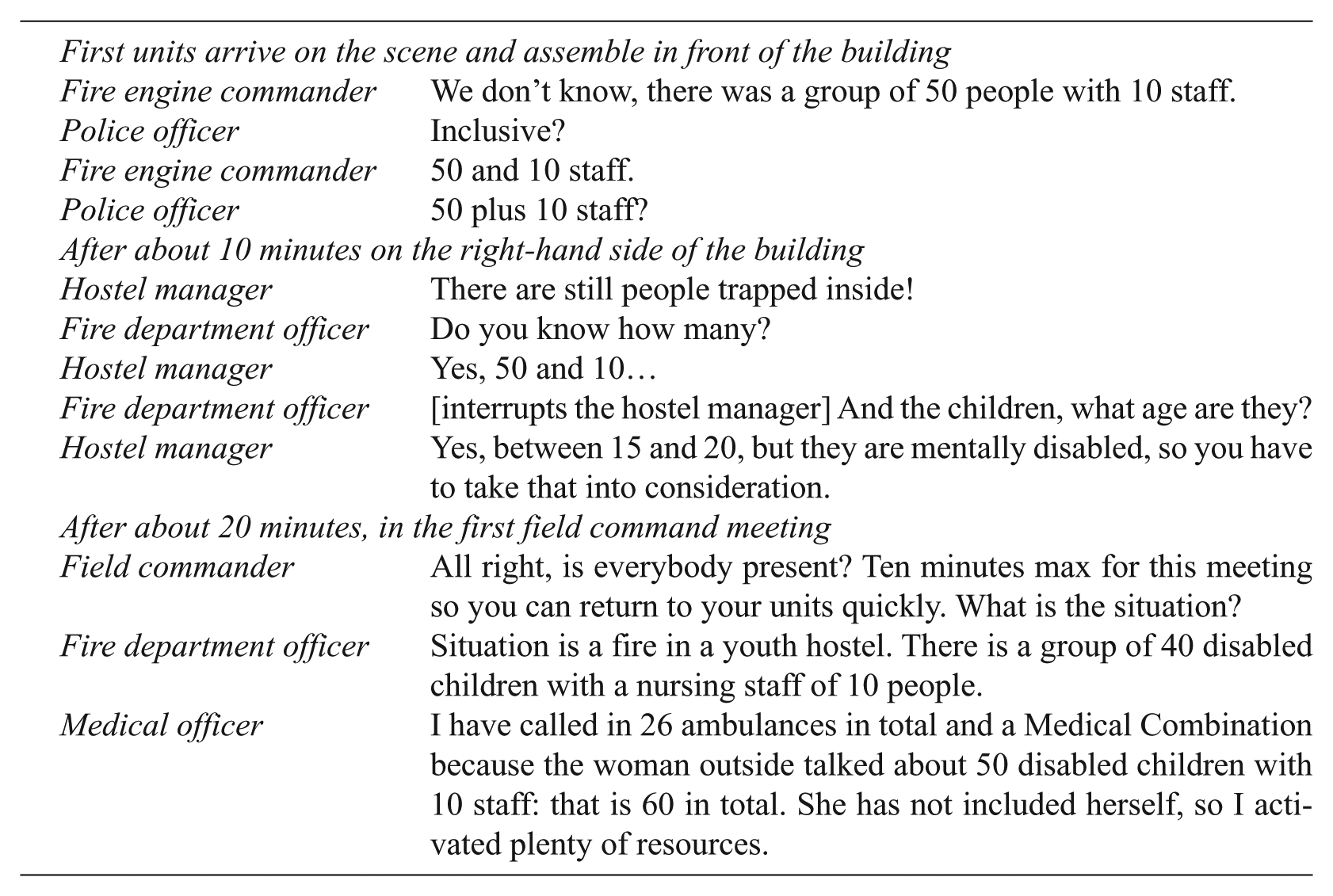
The consequence of delegating tasks is that units operating in different areas develop their own perspective on the incident. Divergent perspectives are difficult to prevent, as they are inherent to the swift action required to rescue victims from a blazing fire. The fire engine crews are busy evacuating the building, and act before taking time to coordinate with others. Consequently, a tension arises, because they have little time to discuss the correct number of persons inside. As a response, the medical officer asserts the authority invested in her role (Bechky, 2006) by reinforcing the functional boundary between the work areas of the officers. By doing so, she tries to gain control and an overview of the number of wounded:
I make the final call on the number of victims. It has to go through me. At a certain moment you as an officer must have the guts to claim, this is my responsibility, we’re not all going to say something about this. Of course, I need input from my own colleagues and from the police and fire department, but in the end I decide what we are dealing with in medical terms. If everybody starts to articulate the number of victims, well, I’m sure we’ll end up with the wrong number. I really try to take on that role, also because I can judge which victims should be transported in ambulances.
In this case delegating tasks leads to a role conflict between the officers because of uncertainty about the number of victims involved in the emergency. The officers have to coordinate in an environment that is distributed, which creates discontinuities in the flow of information. A well-known phenomenon in disasters, conceptualized by Turner (1976) as variable disjunction. This situation shows us that the person with the authority invested in his or her role does not always have the most up-to-date or correct information. The reason is that in the meantime other people also make sense of the situation and act accordingly. This might jeopardize collective sensemaking (Wolbers & Boersma, 2013). So, paradoxically, while officers use delegation to enable them to keep an overview of the situation, it in fact contributes to the very fragmentation that they are trying to avoid. As people develop different views of the incident, uncertainty increases, triggering the third practice we identified: demarcating expertise.
Demarcating expertise
Situations such as encountering an unknown hazardous material, a hostage situation, or a danger of explosion creates uncertainty and can literally bring the response operation to a halt. The motto of the emergency services in these situations is safety first. A field commander explains: ‘Safety is the number one priority one for me. It means that you need to be informed adequately about what is going on, and get assessments from each response organization.’ A medical officer affirms this: ‘Safety is everything for me. Yes, we have to provide aid, but safety first.’ When the precise nature of the threat is uncertain, the officers need to assess a situation to see how they should operate, and what they need to coordinate. This is difficult because the nature and degree of the threat can change, and often only limited information is available.
Officers deal with such uncertainty during coordination processes by demarcating expertise, whereby an officer with specific expertise will assume responsibility for handling a situation that is uncertain or potentially dangerous. The other officers order their units to stand down and have to rely on the expertise of the officer who has the lead. As a police officer explains:
When you are talking about a fire, the discussion soon starts to move in the direction of hazardous materials, smoke clouds, etc. My actions and communication depend on the information I receive from the fire department. Those are topics on which I have to trust the fire department officer for 100 percent: (a) I don’t have sufficient knowledge about that, and (b) I don’t feel any need to check that person. There is a lot of pressure to act on me at that time.
By demarcating expertise the officers compromise common understanding – as an integrative condition of coordination – as they rely on the expertise of others to deal with the situation. Making sense of these circumstances requires effort and a lot of time, two resources that are often in short supply during crisis situations (Weick, 1993). A field commander stresses this tension:
Now you’re getting at my point of view. You don’t have to know much about it, because if you do you will be drawing conclusions about another field of expertise. It might work out, but you can also get it all wrong.
When there is acute time pressure, the officers focus primarily on the location and nature of the threat so that they can keep their distance and trust the expert officer to handle the threat. A fire department officer explains that given time pressure, he cannot explain every detail so he just designates a safe and an unsafe area:
Safe and unsafe, you’ve heard that hundreds of times probably. The police and medical officers are explicitly trained on that point. It’s the first thing they ask – sometimes it drives you crazy! I don’t want to be busy with that. Just be clear, this is safe and this is unsafe. Good luck.
The consequence of demarcating expertise is that the officers create a knowledge boundary. Assessing what is safe and unsafe is down to the officer with the expertise, and the other officers become dependent on his assessment. However, as those officers are also responsible for the safety of their own units, they will also attempt to make their own assessment. Consequently, safety can become subject to diverse interpretations. We illustrate this coordination dynamic in the following vignette.
Vignette 3. Demarcating expertise in response to danger of explosion
In this exercise scenario, the emergency services respond to a Cessna plane crash near a gas station, after the pilot fails to perform an emergency landing on the highway. At the gas station a fuel truck is in the process of unloading its gas just moments before the crash. Debris from the plane hits one of the gas pumps and it catches fire. The emergency services try to extinguish the fire and rescue the pilot, the truck driver, and the people in the gas station. During the rescue operation the medical officer feels her units are at risk due to the explosion risk posed by the fuel truck. She consults the fire department officer about the safety of her units. However, he is under a lot of pressure to act. Consequently, he demarcates his expertise and starts negotiating with the medical officer.
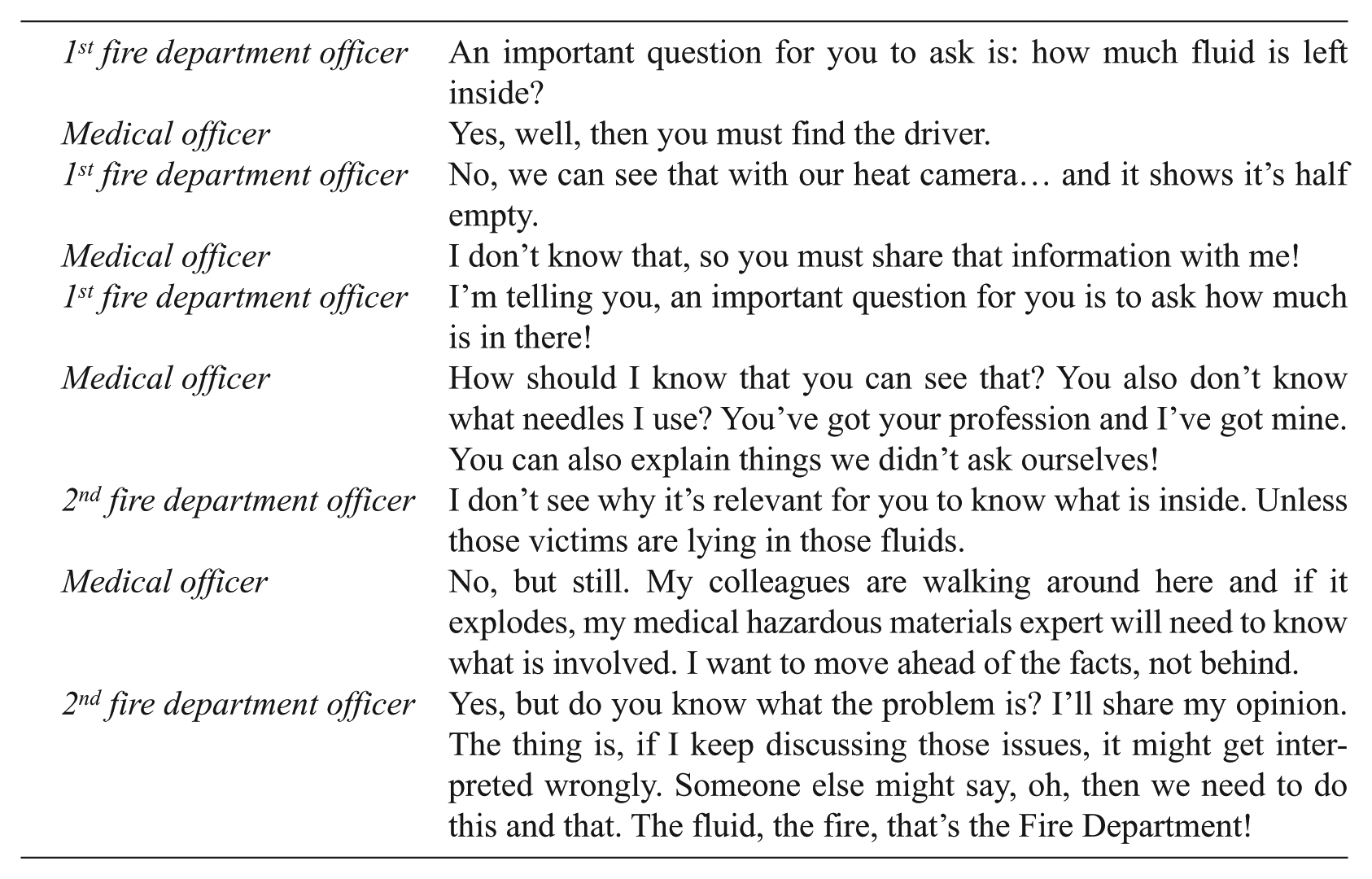
During the negotiation the fire department officer uses his expertise to retain control over dealing with the explosion risk. The negotiation between the two officers shows how knowledge boundaries are reinstated during the response operation (Faraj & Yan, 2009). Expertise becomes an instrument that is used to segment the operation. In this way, demarcating expertise enables officers to contain potentially dangerous situations quickly by reinstating the knowledge boundary; this leads to a multiplicity of interpretations and contributes to coordination processes that are rooted in fragmentation.
Figure 2 shows how this process of coordination unfolds and results in fragmentation, when we look at the coordination practices of emergency officers in command over the course of exercises and real-life operations. Our empirical study indicates that the integrative conditions of coordination become contested in action due to unexpected events, lack of overview, and uncertainty. The officers respond by engaging in coordination practices that lead them to actively reinforce normative, functional, and knowledge boundaries rather than bridge them, thereby limiting the number of interactions. This results in three characteristics of fragmentation: (1) ad-hoc adaptations are initiated based on the need to undertake rapid action, leading to (2) separate pockets of control that suspend collective sensemaking, and result in (3) a multiplicity of interpretations. In sum, Figure 2 shows that, paradoxically, the coordination practices of the officers in command result in the very fragmentation they are trying to avoid.
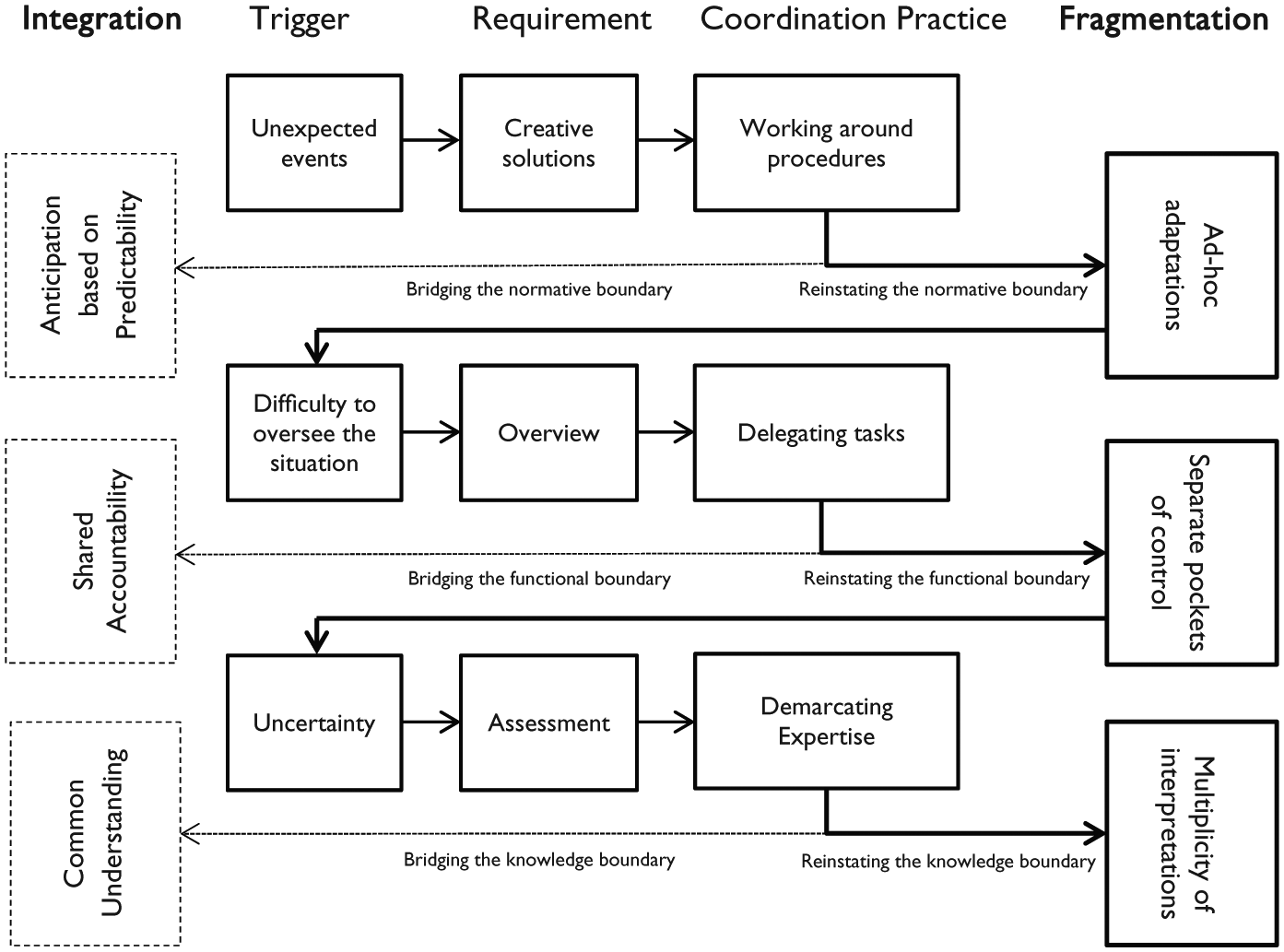
A process model of coordination practices during emergency response operations.
Discussion
In the introduction to this paper we asked how coordination is practised during emergencies. We found that in these situations the integrative conditions needed for coordination – accountability, predictability, and common understanding – were compromised at different times due to uncertainty, a lack of overview, and unexpected changes. Our findings indicate that while the officers still pursued integration as they worked together to realize a collective performance, their efforts to coordinate took the form of working around procedures, delegating tasks, and demarcating expertise – practices which lead to fragmentation. By engaging in these practices, officers treated ambiguity and discontinuity as a given, and as a valuable means of devising novel articulations and distributed actions.
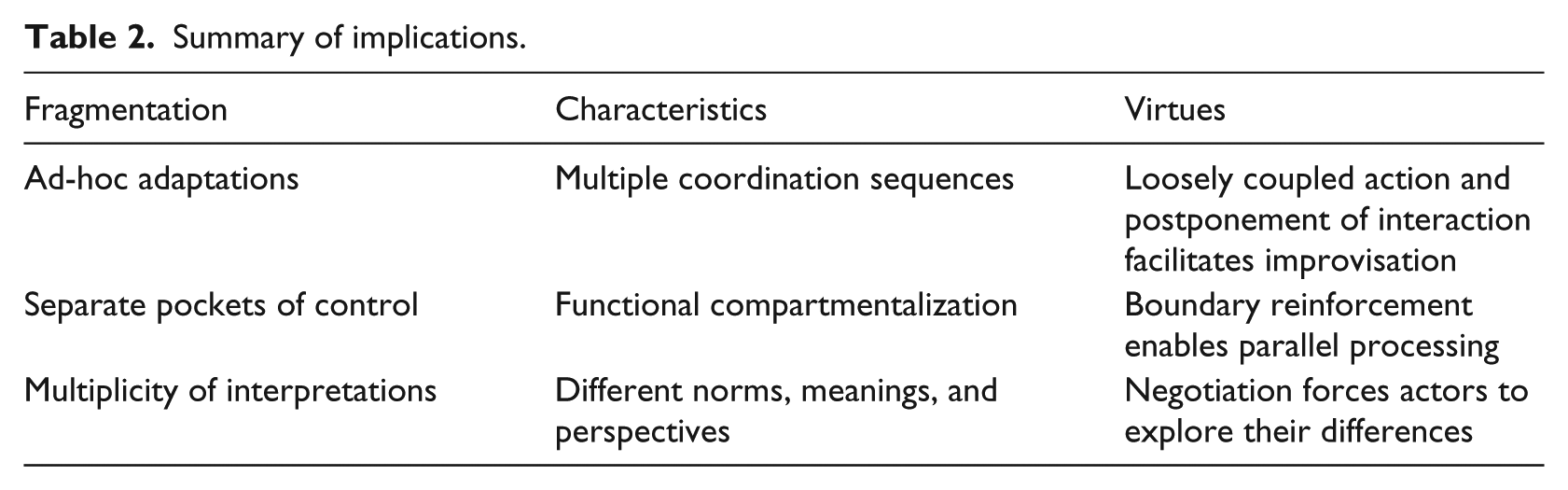
Our findings provide support for the notion that coordination is an emergent phenomenon in which practices for dealing with ambiguity and discontinuity lead to ad-hoc adaptations, separate pockets of control, and a multiplicity of interpretations. A fragmentation perspective provides an alternative take on the accomplishment of coordination under circumstances when achieving integration is difficult. In this discussion we extend the theoretical debate on coordination by specifying both the characteristics and virtues of fragmentation (see Table 2), and the implications for the literature on emergent coordination, boundaries, and sensemaking.
Summary of implications.
Fragmentation through ad-hoc adaptations
The first characteristic of coordination based on fragmentation is the presence of ad-hoc adaptations, which has outcomes that cannot be planned or prescribed, because the outcomes are very much dependent upon the situated activities of the various actors. Recent studies of temporary organizations have shown us that performing reliably in challenging environments requires adaptation of role structures (Bechky, 2006; Bigley & Roberts, 2001) and deployment of portable structures (Beck & Plowman, 2014). Our findings add to these insights the notion that, while role structures remain central in coordination, action ambiguity in fact arises because role execution is altered in the process, and this in turn leads to greater ambiguity over what actions to take. This adaptive nature of coordination has important benefits for operating in fast-paced environments, because it enables actors to find creative, unconventional solutions to emerging problems – solutions of a kind not found in standardized coordination mechanisms (Harrison & Rouse, 2014). It indicates that the virtue of fragmentation is that it stimulates creativity, doubt, discovery, and on-the-spot decision-making (Martin, 1992; Weick & Roberts, 1993; Weick & Sutcliffe, 2011).
We add to the debate on coordination through role structures (Bechky, 2006) by showing that ad-hoc adaptations to emerging problems can result in workable solutions, even though these adaptations may at the same time reduce predictability (Okhuysen & Bechky, 2009). In the disaster management literature authors have also turned their attention to role improvisation and creativity among first responders, and have shown there to be similar distortion of common workflow expectations (Kendra & Wachtendorf, 2003; Kroll-Smith et al., 2007). For instance, when many responders were cut off from the chain of command during Hurricane Katrina, they made autonomous decisions on the spot that increased uncertainty (Comfort, 2007). This suggests that anticipation and predictability, as described by Rico et al. (2008), have limited applicability for coordination in fragmented environments. In a fragmented environment, actors need to engage in a different type of coordination, in which they try to increase the amount of loosely coupled action, which facilitates improvisation, playfulness, and resilience by temporarily relaxing the institutional modus operandi (Rerup, 2001).
By framing our findings as ad-hoc adaptations, we point to a process in which emergent action creates multiple coordination sequences. As the environment requires people to act quickly, coordination starts by addressing the priority problem using the best available, even if not entirely suitable, option, leaving for later the solution of secondary problems – created in part by choosing this option. Such postponement of coordination issues also figures in Levi-Strauss’s (1966) notion of bricolage, when actors take the time to experiment with alternative courses of action and develop new combinations of resources both inside and outside the procedures. Our findings enrich this literature by showing that in a fragmented environment the outcome of bricolage is contested as it conflicts with multiple ongoing coordination processes. While our study addresses the relevance of creative workarounds, or non-conventional solutions in adaptive coordination processes, more insight is needed into the circumstances in which implementing creative solutions of this kind either strengthens or frustrates ongoing coordination processes. That would also require further insight into when postponement of coordination may be deemed necessary, and how this then influences the adaptive capacity of organizations operating in volatile environments.
Fragmentation through separate pockets of control
The second characteristic of coordination based on fragmentation is that separate pockets of control emerge and are subsequently guarded. This indicates the importance of demarcating work activity by keeping boundaries in place or reinstating them. The advantage of segmenting the response operation by reinstating boundaries is that decisions and actions can be taken quickly because interdependencies are temporarily put on hold. For the officers it is important to put interdependencies on hold by using boundaries as a distinction (Lamont & Molnár, 2002), because it reduces the number of actors that have to reach agreement (Genschel, 1997).
Our findings on how boundaries are temporarily reinforced during the coordination process enriches the growing literature on boundaries in organizing processes. Not only are boundaries demarcations that limit common understanding (Majchrzak et al., 2012), but they also enable rapid coordination by offering functional compartmentalization. This allows different actors to work simultaneously on the same problem without needing to develop a shared understanding of that problem, or requiring intervention from a superior. This builds on previous findings that action trajectories tend to become distributed as coordination processes unfold (Jarzabkowski et al., 2012).
Faraj and Yan (2009) also draw attention to the use of boundaries as distinctions, as they describe how a team internally sets and reclaims its boundaries by increasing team members’ awareness of boundaries and sharpening team identity. This claim contrasts with the central idea in the debate on boundaries, which is that boundaries need to be bridged in order to enable collaboration (Bechky, 2003; Carlile, 2004; Levina & Vaast, 2005). This idea is also reflected in Faraj and Xiao’s (2006) study of trauma teams, where during coordination of problematic patient treatment trajectories, ‘disciplinary boundaries suddenly melt away’ (Faraj & Xiao, 2006, p. 1165). Instead, our analysis shows that having clear (temporary) boundaries in place allows individuals to take responsibility for particular elements of a task, or to claim that they have the expertise required for a fast response.
We showed how individuals reinstated temporary boundaries in order to carry out coordination in the critical phases that occur when people are acting under pressure. For this reason, at such moments the need for common understanding is minimized, even though information-sharing can still take place. As reinforcing boundaries is an important aspect that contributes to fragmentation, greater clarity is needed with respect to when, and under what circumstances, reinforcing boundaries may be helpful or harmful to coordination. It would also be valuable to gain further insight into what motivates individuals either to bridge or to reinforce different types of boundaries in more stable environments, when there might be more time to engage in boundary bridging.
Fragmentation through multiplicity of interpretations
Our findings enrich the literature on sensemaking under action ambiguity. Recently, researchers have explored the complicated intertwining of sensemaking and decision-making processes in multiple contexts and situations, including the Piper Alpha disaster (Brown, 2004), the Columbia space shuttle disaster (Dunbar & Garud, 2009), and the Stockwell shooting (Cornelissen, Mantere, & Vaara, 2014). Our findings provide insight into how people engage in coordination through partially overlapping, or sometimes parallel, sensemaking processes in which they retrospectively make sense of events, resulting in a multiplicity of interpretations. This adheres to studies that suggest that shared sensemaking does not automatically lead to consensually constructed coordination, as storylines can be appropriated, modified, and embellished by individuals, resulting in discrepant sensemaking (Brown, Stacey, & Nandhakumar, 2008). Individuals may filter, edit, and re-sort their experiences in hindsight, which can result in disagreements. This is important for coordination in fragmented conditions, because it creates grounds for negotiating the relevance of the different perspectives that arise (Wolbers & Boersma, 2013). Thus, the fragmentation perspective adds to our understanding of sensemaking under action ambiguity by showing that sensemaking and decision-making processes are linked by a process of negotiation.
Negotiation is beneficial for coordination in dynamic environments, because it allows members of different issue-specific coalitions to coordinate their actions temporarily and locally, navigating their differences in norms, meanings, and interests only as required (Kellogg et al., 2006; Vaughan, 1999). As actors make sense of events through negotiation, coordination ‘doesn’t have to depend on shared ideas, interest, or norms, which are difficult to accomplish when time is short, meanings are divergent, and conditions are ambiguous’ (Kellogg et al., 2006, p. 39). Moreover, during the negotiation process, actors can make better sense of their own position, as the differences between different parties become clearer.
In contrast, when common understanding is seen as a prerequisite for coordination (Okhuysen & Bechky, 2009), incongruent perspectives are often regarded as a problematic interim phase in the coordination process. However, from a fragmentation perspective, there is value in having multiple perspectives precisely because this forces professionals to explore their differences. Regarding negotiation as a coordination mode thus leaves room for the idea that action ambiguity is not necessarily harmful for coordination. While we were not able to analyse systematically all aspects of how negotiation processes influenced sensemaking and decision-making, it was evident that such engagements sharpened members’ ongoing coordination efforts. Examining the nature, role, and consequences of negotiation thus represents an important area for future research.
In a broader sense, the fragmentation perspective on coordination might be fruitfully applied in other settings where integration is difficult to achieve. For example, studies of temporal organizing commonly describe discontinuity and ambiguity in coordination as team members are dispersed, which results in asynchronous information flows (Bechky, 2006; Montoya-Weiss, Massey, & Song, 2001). In addition, highly flexible and fluid organizational forms are increasingly constituted around distributed teams (Hinds & Bailey, 2003; Vlaar, van Fenema, & Tiwari, 2008) and virtual settings (Bailey, Leonardi, & Barley, 2012; DeSanctis & Monge, 1999), which are often associated with flexibility, quick improvisation, and ad-hoc responses (Schreyögg & Sydow, 2010). We also witness these elements in management studies much closer to our empirical context, such as managing risk and resilience (van der Vegt, Essens, Wahlström, & George, 2015), and humanitarian disaster relief (Williams & Shepherd, 2016). Using a fragmentation perspective in these settings might provide a different take on how managers encounter discontinuity and ambiguity, and how they use these characteristics to foster improvisation, boundary reinforcement, and negotiation.
Conclusion
We conclude that coordination practices in the fast-paced environment of emergency management create fragmentation, rather than integration. A fundamental difference between this study and previous studies on coordination is that in our work we do not treat fragmentation as a deficiency of integration, but instead recognize that it has important virtues that are necessary for coordination in rapidly changing environments. A crisis is likely to force multiple organizations to coordinate with one another in ambiguous situations, where ad-hoc adjustments and issue-specific coalitions make it inevitable that they will have to deal with both multiplicity and discontinuity. This also has important implications for practice. While the field of emergency management is still dominated by a command and control paradigm, our analysis shows that a lack of integration does not mean that crisis management will spiral into chaos. On the contrary, daring to let go of the aim of integration, and preparing instead for a coordination mode that is based on fragmentation, actually provides a way of achieving the very flexibility, sensitivity to operations, and improvisation that are claimed to be the hallmark of swift and effective crisis management.
Footnotes
Appendix
Exercises observed
| Phase | Date | No. | Exercise | Scenario description | Main coordination dilemma | Command level |
|---|---|---|---|---|---|---|
Exercise Set 1 |
8/2/2010 | 2 | Fire in prison | After a fire in a prison an unknown number of prisoners need to be rescued and evacuated. | Evacuating the prison rapidly but keeping convicts in control | Field commander Officers (Police/Fire Department/Medical Services) |
| Fire in an old people’s home | A large fire in an old people’s home has spread to multiple apartments and the home needs to be evacuated. | Fire control, combined with rapid evacuation and transport of the wounded. | ||||
| Exercise 2 | 19/10/2010 | 1 | Container with hazardous materials on beach | A container has fallen off a ship in a storm, and several plastic bags containing toxic chemicals have been washed ashore along the coast | Assessing the risks that the bags pose to the population on multiple sites simultaneously | Field, tactical, and strategic commanders |
Exercise Set 1 |
14/11/2010 16/11/2010 |
16 | Fire in youth hostel (2x) | During a fire in a youth hostel a large number of children are affected by the smoke | Evacuation of the youth hostel and assessing the number of missing persons | Field commander Officers (P/F/M) Operational units Role players |
| Fire in adult club (2x) | A fire in an adult club has led to an unknown number of people being trapped in basement that is hard to reach | Fire control, combined with rapid evacuation and transport of the wounded | ||||
| Hijack in city bus (2x) | An armed person shoots at fire department crews responding to an accident and hijacks a bus | Safety of the emergency responders and bringing the hijack to an end | ||||
| Carbon monoxide alert in an old people’s home (2x) | Several elderly people are feeling unwell, and after the emergency services arrive the carbon monoxide alarm goes off | Evacuation, combined with assessment of the threat | ||||
| 15/11/2010 |
Failed SWAT raid (2x) | A SWAT team tries to arrest a terrorist, but he detonates a bomb when they enter his house | Rescuing SWAT team members in the face of continuing danger of explosion | |||
| Fire in tire factory (2x) | Fire breaks out in a tire factory, and people are trapped in the basement, and potentially hazardous rubber particles are being released into the neighbourhood | Rescuing missing persons from the factory, combined with evacuation of the surrounding neighbourhood | ||||
| Highway accident (2x) | Fire and hazardous materials are spilt on the highway after a major collision involving a bus, a tanker, and an ambulance | Assessing the danger of hazardous materials and rescuing people trapped in the vehicles | ||||
| Cessna plane crash (2x) | A Cessna plane crashes on to a gas station, setting the building and a truck on fire, and trapping people inside | Assessing the possible danger of explosion and rescuing those who are trapped | ||||
| Exercise Set 2 | 2/12/2010 | 4 | Fire in university lab (4x) | A large fire breaks out in a university biological lab where scientists are experimenting with unknown infectious diseases | Assessing the nature and severity of the biological threat, fire control, and evacuation of the university | Field commander |
| Exercise Set 3 | 23/3/2011 | 2 | Fire in old people’s home | A large fire breaks out in an old people’s home which then needs to be evacuated | Fire control, combined with rapid evacuation and transport of the wounded | Field commander |
| Fire in city centre | A large fire breaks out in an old city-centre building that is hard to reach | Problems with water supply and traffic management | ||||
| Exercise Set 4 | 24/3/2011 | 3 | Fire in bank tower | A large fire starts on top of a bank tower that is hard to reach, and clouds of smoke engulf the train station | Fire control, combined with evacuation of the building and the train station | Field commander |
| Power outage at rail control centre | A major power outage at an important rail control centre results in no trains being operational during rush hour | Organizing temporary accommodation for a very large number of rush-hour commuters | ||||
| Leakage of hazardous materials | Hazardous materials contaminate ground water | Assessing and communicating the risks to the public | ||||
| Exercise Set 5 | 13/4/2011 |
10 | Gas leak and explosion | A suicidal man causes a gas leak in a flat, resulting in an explosion and danger from asbestos | Assessing the risk of explosion, and later the dangers posed by asbestos | Field commander |
| Hostage situation at school | High school students are taken hostage during a chemistry class by a disillusioned and armed parent | Arranging medical transport and hospital care for a number of wounded children | ||||
| Accident involving tanker (2x) | A bus and a tanker collide on the highway, resulting in many casualties and spillage of hazardous materials | Assessing the danger of hazardous materials and rescuing people trapped inside the vehicles | ||||
| 19/4/2011 |
Train crash (2x) | A train collides with a money truck and catches fire, and people are trapped inside the train and the truck | Fire control, combined with evacuation of the train and transport of the wounded | |||
| Tanker collision at sea (2x) | A ship carrying natural gas condensate collides with a tourist boat, resulting in leakage of hazardous material | Assessing danger of hazardous materials and rescuing persons trapped in on ships | ||||
| Helicopter crash on water treatment facility (2x) | A helicopter hits power lines and crashes into a water treatment facility, contaminating the water | Fire control, assessing the contamination of water, and communicating to public | ||||
| Exercise Set 6 | 18/5/2011 | 2 | Fire in city centre | A large fire breaks out in the centre of a major city, and spreads to several buildings | Large evacuation and traffic management | Field commander |
| Fire and power outage at TV station | A large fire results in a power outage at the TV station, taking out the national TV signal | Fire control and communicating the situation to public |
Acknowledgements
We would like to extend our appreciation to our three reviewers and Andrew Brown for their insightful and constructive comments. We are also grateful to our colleagues at the VU Amsterdam, and those present in the EGOS tracks on ‘Unsettling Boundaries (2014)’ and ‘Managing in Extreme Contexts (2017)’ for their ideas and suggestions. In specific, we would like to thank Scott Poole, John Lammers, Paul Carlile, and David Allen for their help and guidance during Jeroen’s PhD trajectory; and to Joep Cornelissen, Davide Nicolini, and Dvora Yanow for providing valuable courses on theory construction, practice theory, and writing qualitative interpretive research. Finally, we would like to appreciate the sheer professionalism and warm welcome by the Dutch emergency response community, who allowed us to closely observe their actions, and shared their deepest thoughts when reflecting on situations of life and death. This gave us a remarkable image of their work and distinctly contributed to the richness of our understanding.
Funding
The authors acknowledge funding from NWO (Nederlandse organisatie voor Wetenschappelijk Onderzoek) Grant Number: Smart Disaster Governance 409-14-003.
Notes
Author biographies
 ). He is an active member of EGOS, elected board member of the ISCRAM (Information Systems for Crisis Response and Management) association, and a member of the editorial boards of Organization Studies and the International Journal of Emergency Services.