



Abstract
Fast-response organizations excel in mounting swift and coordinated responses to unexpected events. There are a multitude of conflicting explanations why these organizations excel. These range from acknowledging the strengths of centralized command and control structures, towards stressing the importance of decentralized, improvised action. Though this dichotomy is derived from studies offering either structure or action-based explanations, we were able to reconcile these insights by looking into the process of how fast-responders organize themselves during an unfolding crisis. We analyzed 15 high-speed police pursuits crossing multiple administrative units and jurisdictions, and interviewed and observed officers at work in multiple operations centers, police cars, and helicopters. Our analysis uncovered that fast-responders regularly transition between designed, frontline, and partitioned modes of organizing, each characterized by practices that shape command, allocation, and information sharing. Success and failure are rooted in the ability of the responders to adapt their mode of organizing by tacking back and forth between these practices. Based on our findings, we constructed a process model that provides a deeper understanding of fast-response organizing that informs future studies on organizing in extreme contexts.
Keywords
Introduction
Fast-response organizations excel in mounting swift and coordinated responses to unexpected events by developing standardized responses to many different kinds of scenarios to minimize communication needs (Bechky and Okhuysen, 2011; Bigley and Roberts, 2001). Even then, however, events occasionally occur that develop so problematically that standard procedures no longer suffice (Faraj and Xiao, 2006). In such situations, fast-response organizations are required to adapt and operate outside their routines and standardized operating procedures.
Studies of how fast-response organizations adapt in action are predominantly practice-oriented (Nicolini, 2013; Schatzki, 2001), focusing on the work that responders perform in unexpected situations (Bechky and Okhuysen, 2011; Bigley and Roberts, 2001; Bouty et al., 2012; Faraj and Xiao, 2006; Lindberg and Rantatalo, 2015). For instance, Bigley and Roberts (2001) describe how fire departments maintain reliable performance by adapting elements of their scalable Incident Command System through structure elaborating and role switching. Similarly, Bechky and Okhuysen (2011) show how police SWAT teams are able to adapt in action by engaging in practices of role shifting and reorganizing routines. Moreover, Faraj and Xiao (2006) identify how hospital trauma teams engage in alternative patient treatment trajectories by identifying sets of expertise and dialogic practices.
The strength of these studies is that they zoom in on how operators adapt specific practices (Bechky and Okhuysen, 2011; Bigley and Roberts, 2001) or switch from one practice to another (Schakel et al., 2016), but less attention has been given to adaptations across sets of practices. This is important, because a crisis often involves a more continuous process of adaptation, forcing fast-response organizations to switch back and forth between coherent sets of practices that constitute different modes of organizing. For example, studies of the Breivik terror attack in Norway show how the police had difficulty aligning work practices at the command center with those of the various response units (Bye et al., 2019; Christensen et al., 2015; Rimstad and Sollid, 2015). Switching back and forth between centralized and more decentralized modes of organizing proved troublesome, prolonging the devastating attack for hours (Bye et al., 2019). Similar problematic shifts in modes of organizing are visible in the aftermath of 9/11 (Kendra and Wachtendorf, 2016) and the Stockwell shooting in London (Colville et al., 2013; Cornelissen et al., 2014).
To gain a better understanding of how fast-response organizations adapt their mode of organizing, we focused on police pursuits. Pursuits offer a suitable setting for studying different modes of organizing, as they are characterized by episodes of fast-paced action alternated with periods of relative stability. This presents multiple challenges in terms of how fast-responders, originating from different administrative units and jurisdictions, temporarily form one organization to coordinate action and retain situational awareness, while composition and leadership may change during the pursuit. Learning from such operations is crucial, as patterns engrained through daily operations are thought to influence action in more extreme operations (Bye et al., 2019).
We pose the following research question: How do responders adapt their mode of organizing to match the dynamics of an unfolding crisis? By answering this question, we provide a more complete understanding of the process of fast-response organizing that will be of value to future studies on organizing in extreme contexts in organization and management studies (Hällgren et al., 2018; van der Vegt et al., 2015; Williams et al., 2017).
Key practices in fast-response organizing
A fast-response organization is an ad-hoc and temporal formation of actors, who are capable of reacting rapidly to sudden-onset events, where decisions must be made rapidly and errors can potentially be fatal (Faraj and Xiao, 2006). A key characteristic of fast-response organizations is that they are able to gear up from dormant mode to full-scale response within minutes. Fostering this organizational capacity on a regular basis requires fast-response organizations to use scalable structures and draw on shared training and experience (Bigley and Roberts, 2001). Fast-response characteristics can be found in disaster and emergency response organizations (Wolbers et al., 2018), such as the police (Schakel et al., 2016), fire departments (Bigley and Roberts, 2001; Weick, 1993), medical trauma centers (Faraj and Xiao, 2006), and the military (Weick and Roberts, 1993).
Mounting a fast response requires these organizations to be ready to adapt, as the full extent of the situation is often not known and operating conditions are prone to change. In that respect, fast-response organizations need to be ready for the unexpected (Weick and Sutcliffe, 2011). To be able to adapt on the spot to an unfolding crisis, fast-response organizations engage in a number of key processes (Wolbers and Boersma, 2019): developing situational awareness to increase understanding of the crisis (Endsley, 1995, 2015); rapid decision making to set or alter the course of the response (Cohen-Hatton et al., 2015; Klein et al., 1985); coordinating between units to align action (Faraj and Xiao, 2006); and bounded improvising to adapt to new or unexpected events (Bechky and Okhuysen, 2011; Bigley and Roberts, 2001).
First, in order to gain sufficient understanding of how the crisis is unfolding, it is imperative that responders develop situational awareness (Endsley, 1995). Developing situational awareness is defined as a process involving the ‘perception of the elements in the environment within a volume of time and space, the comprehension of their meaning, and the projection of their status in the near future’ (Endsley, 1995: 36). Having insufficient situational awareness at any point in the operation is detrimental to its success, and can even prove fatal (Cornelissen et al., 2014; Elmes and Frame, 2008; Kayes, 2004; Snook, 2002; Stein, 2004; Tempest et al., 2007). Provided there is enough time to do so, responders can improve their level of situational awareness from a perception of the status, attributes, and dynamics of relevant elements in the operating environment to an understanding of the interrelationships among them (Endsley, 1995). This enables them to make future projections that can be used in choosing an appropriate course of action (Endsley, 1995). Situational awareness is achieved through a combination of practices, such as noticing, bracketing, and labelling to develop shared representations (Bigley and Roberts, 2001; Weick et al., 2005; Wolbers and Boersma, 2013), collective story building (Cornelissen et al., 2014), nesting of scope and detail (Bigley and Roberts, 2001), assessing situations and providing continuous updates (Barton and Sutcliffe, 2009; Comfort and Kapucu, 2006), referring to standard procedures (Jones and Hinds, 2002), and active diagnosis of the limitations and contestations of planned procedures (Faraj and Xiao, 2006; Majchrzak et al., 2012).
Second, as Klein et al.’s (1985; 2010) classic study of decision making on the fire ground showed, situational awareness also contributes to decision-making practices, which in fast-response settings are often recognition-primed. Recognition-primed decision making is not based on rational analytical steps but instead involves the reflexive use of heuristics, like cues and previous experience (Cohen-Hatton et al., 2015; Klein, 1993; Klein et al., 1985). ‘The way that experienced firefighters can identify effective options is to match the current situation to a prototype, thereby recognizing it as typical and amenable to typical procedures’ (Klein et al., 1985: 21). Current studies acknowledge that incident commanders rely on such established practices by engaging in situation recognition and mental simulation (Boehm, 2018; Rake and Njå, 2009). However, incident command is also seen as a relational endeavor that entails practices of information gathering, setting out courses of action, and monitoring what tasks are being carried out (Groenendaal and Helsloot, 2016; Rake and Njå, 2009).
Third, in addition to decision making, the actions of fast-response organizations need to be aligned through coordination practices to direct action towards a common goal (Comfort, 2007; Wolbers et al., 2018). Coordination in fast-response settings is best described as ‘a temporally unfolding and contextualized process of input regulation and interaction articulation to realize a collective performance’ (Faraj and Xiao, 2006: 1157). Achieving collective performance through coordination entails arranging accountability by aligning responsibilities (Bechky and Okhuysen, 2011), relies on predictability by anticipating how subsequent tasks will be executed through familiarity with regular workflows (Rico et al., 2008), and consists of developing a common understanding of shared objectives to mutually adjust action (Bechky, 2006). In fast-response settings, coordination is often role-based, with structured role systems being leveraged to arrive at common expectations of workflow and shared task knowledge (Bechky, 2006; Bechky and Okhuysen, 2011). Studies of firefighters, medical teams, and SWAT teams have shown that coordination is achieved through practices of role switching (Bigley and Roberts, 2001) and plug-and-play teaming, and that exceptions to standard procedures are being handled by dialogic practices (Faraj and Xiao, 2006).
Fourth, fast-response organizing regularly involves some elements of improvisation to handle unique situations (Bechky and Okhuysen, 2011; Bigley and Roberts, 2001). Even if role structures are in place through incident command systems (Bigley and Roberts, 2001), it remains difficult for responders to be fully aware of the complexities involved and the interdependencies of their actions (Rimstad and Sollid, 2015; Wolbers et al., 2013). A common way to respond to unexpected situations is through bricolage, where responders experiment with alternative courses of action based on collectively held knowledge about the way that tasks should be performed (Bechky and Okhuysen, 2011). In these situations, professionals make their work legible to each other through practices of juxtaposition and dynamic alignment (Kellogg et al., 2006). During the improvisation process, a scaffold, or a shared object such as a map, is often used to overcome knowledge differences and enable responders to engage in dialogue (Majchrzak et al., 2012) and voice concerns (Barton and Sutcliffe, 2009).
This overview shows that current research on fast-response organizing tends to focus on adaptations within or among smaller coherent sets of practices. In fast-response organizations, coherent aggregates of smaller sets of practices shape a mode of organizing, reflecting the division of work and overall coordination of these practices. Whereas problems at the practice level may be solved by adapting or switching practices to handle a new situation (Faraj and Xiao, 2006; Schakel et al., 2016), aggregates of practices are more difficult to adapt, because multiple practices have to be adapted concurrently.
The dilemma of fast-response organizing: Adapting modes of organizing
When mounting a response operation in a high-velocity environment, responders are confronted with a dilemma. Fast-response organizing relies on tight structuring, hierarchical decision making, and formal coordination to establish clear lines of authority, unilateral command, and rapid action. At the same time, such rapid action takes place in a context that often evokes unexpected turns of events, requiring flexible structures, on-the-spot decision making, and informal coordination (Faraj and Xiao, 2006). This dilemma often requires adaptation on multiple occasions during a crisis by transitioning between different modes of organizing (Bye et al., 2019). We identify three different modes of organizing in the (crisis) management literature: designed, frontline, and partitioned.
The first and most recognizable mode of organizing is the designed mode, in which predefined lines of command are used to mobilize scheduled resources and designated actors to discuss and decide upon an appropriate course of action to handle the crisis, which is thought likely to develop in a predictable manner (Moynihan, 2009). An example of this is the start of the Mann Gulch fire in the US state of Montana, which was judged to be a standard ‘10 o’clock fire’ before it got out of hand (Weick, 1993), or the set-up of a criminal surveillance in the Netherlands, which was anticipated to be a routine operation until the criminal was unexpectedly murdered by a hitman (Schakel et al., 2016).
Designed organizing involves sets of structuring practices that can be found within scalable Incident Command Systems (Bigley and Roberts, 2001). These include expertise coordination practices, such as relying on protocols and plug-and-play teaming (Faraj and Xiao, 2006), and cognition management practices, such as nesting scope and detail (Bigley and Roberts, 2001) and referring to standard procedures (Jones and Hinds, 2002). By engaging in these sets of practices, responders rely on their functional counterparts instead of personal attributes, and start collaborating swiftly and efficiently without necessarily knowing their colleagues intimately (Bechky, 2006; Schakel et al., 2016).
Second, in frontline organizing, command is delegated to the units closest to the action by making use of ad-hoc allocated personnel, who engage in bounded improvisation to handle the crisis, which is comprehended yet rapidly developing (Barton et al., 2015; Bye et al., 2019; Groenendaal and Helsloot, 2016). It is a crucial mode of fast-response organizing, as frontline officers have access to concrete situational details, which are essential for navigating ambiguity and dynamism (Barton et al., 2015). An example of frontline organizing is visible in wildland firefighting, where a fire can be ‘so complex, changing and flaring up in one area before dying down unexpectedly, that firefighters need to continually check their assumptions with others or find ways to update their information’ (Barton and Sutcliffe, 2009: 1343).
Frontline organizing involves sets of practices that are aimed at keeping up with a rapidly developing crisis by seeking out diverse perspectives and voicing concern (Barton and Sutcliffe, 2009; Barton et al., 2015), referring to standard procedures (Jones and Hinds, 2002), swift trust (Majchrzak et al., 2007), and engaging in a set of practices aimed at ad-hoc teaming, such as dynamic delegation (Rico et al., 2008), plug-and-play teaming (Faraj and Xiao, 2006), and role switching (Bigley and Roberts, 2001). In studies of high-reliability organizations, such sets of practices are said to involve deference to expertise and sensitivity to operations (Weick and Sutcliffe, 2011).
Third, in partitioned organizing, command is formed in separated pockets of control, making use of personnel who spontaneously engage with an element of the unfolding crisis, based on their own local perceptions. The separation of the organization into distinct pockets of control likely occurs when responders are confronted with a large-scale and distributed crisis situation, and perceive the need to act immediately. In this context, control means ‘the capacity to focus on the critical tasks that will bring the incident to a non-destructive, non-escalating state’ (Comfort, 2007: 195). Examples of partitioned organizing are visible in the Breivik terrorist attack (Bye et al., 2019; Christensen et al., 2015; Rimstad and Sollid, 2015) and the November 13 Paris terrorist attack (Hirsch et al., 2015), as multiple attacks occurred around the same time at different locations. During the 9/11 World Trade Center attacks, too, the devastation was so great that responders struggled to set up a functioning overarching command structure. Command posts were set up and removed before any substantial work could be done (Kendra and Wachtendorf, 2003).
Though fragmentation can be unintentional, as in the studies mentioned above, it may also be part of regular coordination processes in fast-response organizing (Wolbers et al., 2018). Partitioned organizing involves practices aimed at on-the-spot adaptation, such as working around procedures (Wolbers et al., 2018) and bounded improvisation (Kroll-Smith et al., 2007). It also involves sets of practices used to partition the operation, by demarcating expertise (Wolbers et al., 2018) or reclaiming boundaries (Faraj and Yan, 2009). As such, responders may deliberately use fragmentation to increase or keep momentum and autonomy by partitioning the operation, and subsequently protecting separate pockets of control as these enable parallel processing and functional compartmentalization (Wolbers et al., 2018).
In sum, as crises such as the Mann Gulch fire (Weick, 1993), the Breivik attacks (Bye et al., 2019), and the Stockwell shooting (Colville et al., 2013; Cornelissen et al., 2014) show, crises can suddenly escalate, urging responders to adapt their mode of organizing. What these studies also show is that transitioning between modes of organizing is often problematic. This provides the starting point for our research.
Methods
Description of research context
During incidents that involve malicious intent, such as robberies, the police have to ensure that the threat is ended and the suspect brought to justice. When the suspect attempts to escape, the police are forced to engage in a pursuit to apprehend the fugitive. Apprehending an on-the-run fugitive is done through a combination of searching, following, pursuing, intervening, and arresting, which requires the formation of a fast-response organization. The size of the organization quickly grows when the fugitive uses a vehicle and crosses multiple administrative police regions. As such, vehicle pursuits offer an interesting setting to study fast-response organizing, because it often entails crossing multiple boundaries, which results in ad-hoc involvement of police officers from different administrative units and jurisdictions, affecting composition and leadership of the fast-response organization during the pursuit. Especially when changes in pace, roles, and team composition occur, responders tend to have difficulty to maintain a clear overview of the crisis situation and the response operation itself (Bye et al., 2019; Cornelissen et al., 2014). Within this complex setting the responders have to engage in continuous risk assessment and collaborative decision making to weigh their own safety, and that of bystanders, against the ongoing threat of the fleeing suspect and the risk of losing them. These characteristics make vehicle pursuits an interesting research setting in which to study why and how responders adapt their mode of organizing.
Data collection
In this study, we set out to learn how police officers mount and adapt a fast-response organization to match the dynamics of a rapidly evolving situation. In order to learn about the work practices of the officers in situ (Nicolini, 2013), we conducted an inductive, qualitative study, using a grounded theory approach (Corbin and Strauss, 2008). This approach is valuable for theorizing about dynamic processes, because it captures the full richness of the activities and the various relations between those activities, the team, and the environment (Barley and Kunda, 2001; Langley, 1999). First-hand access to people, protocols, and data was possible owing to the first author’s role as a researcher and senior advisor at the Central Police Unit. 1
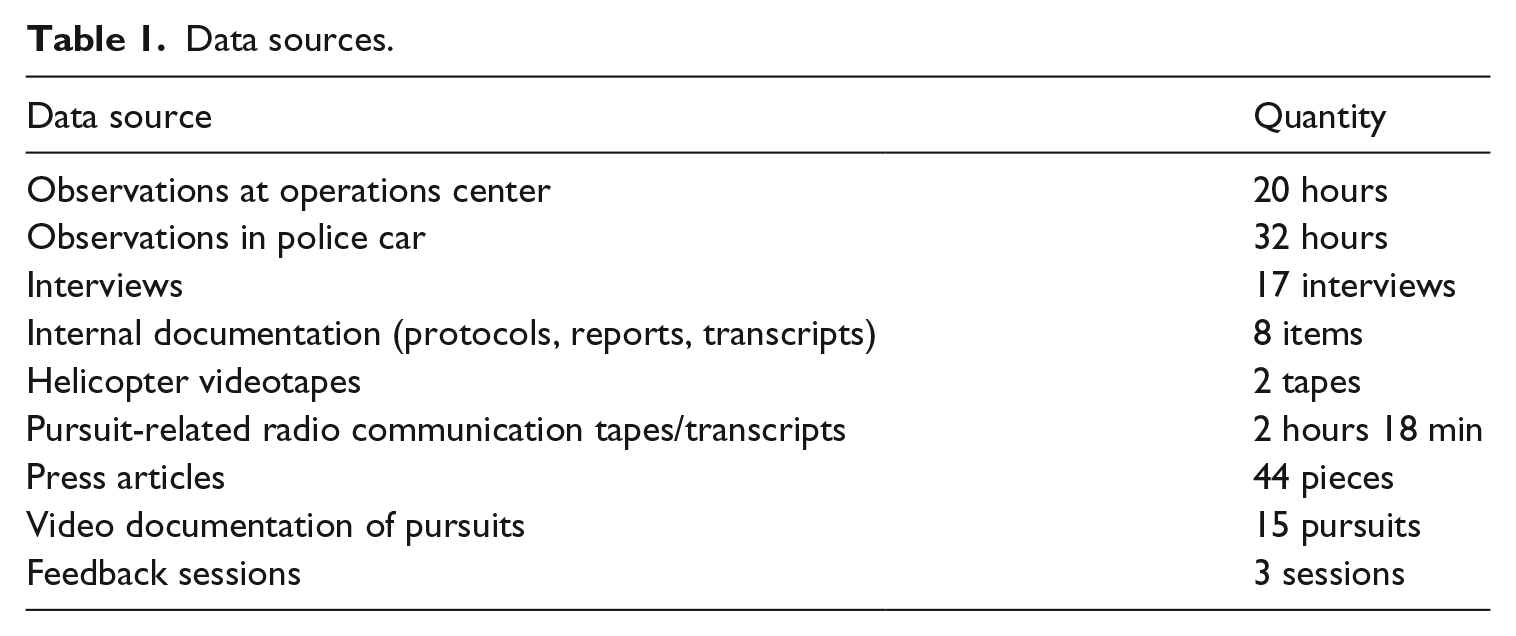
We observed the work practices of police officers involved in pursuits. We attended multiple shifts at the central operations center and joined various patrol units on duty. During these shifts, we observed and participated in a number of pursuits. We were able to study the roles, tasks, and actions of each of the various actors (see Table 1). During the observations, we independently took field notes, which we transcribed and compared directly after the observations. In addition, we carried out and audio-recorded semi-structured interviews with chiefs of operations, operational commanders, officers in patrol cars, helicopter tactical flight officers, and operators in the central and regional operations centers. The selection of respondents was based on their involvement in pursuits, and on their presence during our observations in the central operations center. We asked the respondents to explain their role, duties, and experiences of these pursuits. Later in the interviews, we zoomed out to other pursuits they had been involved in, thus broadening our understanding of the practices they described to other cases. In addition, we reviewed documentation such as formal protocols and guidelines to better understand how pursuits are mounted and coordinated. In order to broaden our understanding, we complemented our data collection with video footage from the police helicopter, transcripts of radio communication, press articles, a television documentary, and an official police YouTube channel (PRO247) covering multiple police operations, including our main pursuit case as presented in the findings. In the last phase of our data collection, we organized a number of feedback sessions based on our analysis, which gave practitioners the opportunity to complement or adjust our findings, and provided us with additional data and insights.
Data sources.
Data analysis
We systematically abstracted the grounded data into more general patterns that we could use for theorizing (Gioia et al., 2012). Specifically, we conducted three iterative rounds of analysis to combine and synchronize the insights from a wide range of materials, thereby gradually deepening and interconnecting the insights we were developing.
First, we used the MAXQDA analysis tool to assign codes to what we considered to be important events and interactions during the 15 pursuits (Corbin and Strauss, 2008). We broke down the data using open coding to understand the different aspects of organizing a pursuit (Corbin and Strauss, 2008). We identified themes and quotes that reflected what seemed to be important in fast-response organizing, such as positioning units, aborting the pursuit, spontaneous involvement of units, boxing a fugitive’s vehicle, and calling out positions.
Second, we used axial coding to reveal thematic relationships and differences between the codes. This was an iterative process of moving back and forth between empirical phenomena and our theoretical interpretation (Alvesson and Kärreman, 2007). In each pursuit, we identified turning points at which the mode of organizing was being adapted. Across the pursuits, we identified three organizing processes and three contextual factors affecting these transitions toward a specific mode of organizing.
Third, in the selective coding phase we systematically analyzed the differences between the modes of organizing and the practices that facilitate transitioning between modes of organizing. We developed a corresponding data structure describing the organizing processes and practices, which is depicted in Figure 1 (Gioia et al., 2012). The emerging concepts helped us to understand and formulate how responders shifted to a different mode of organizing. In this last step in our theory construction, we developed a process model (Langley, 1999) that explains why and how responders function in different modes of organizing.
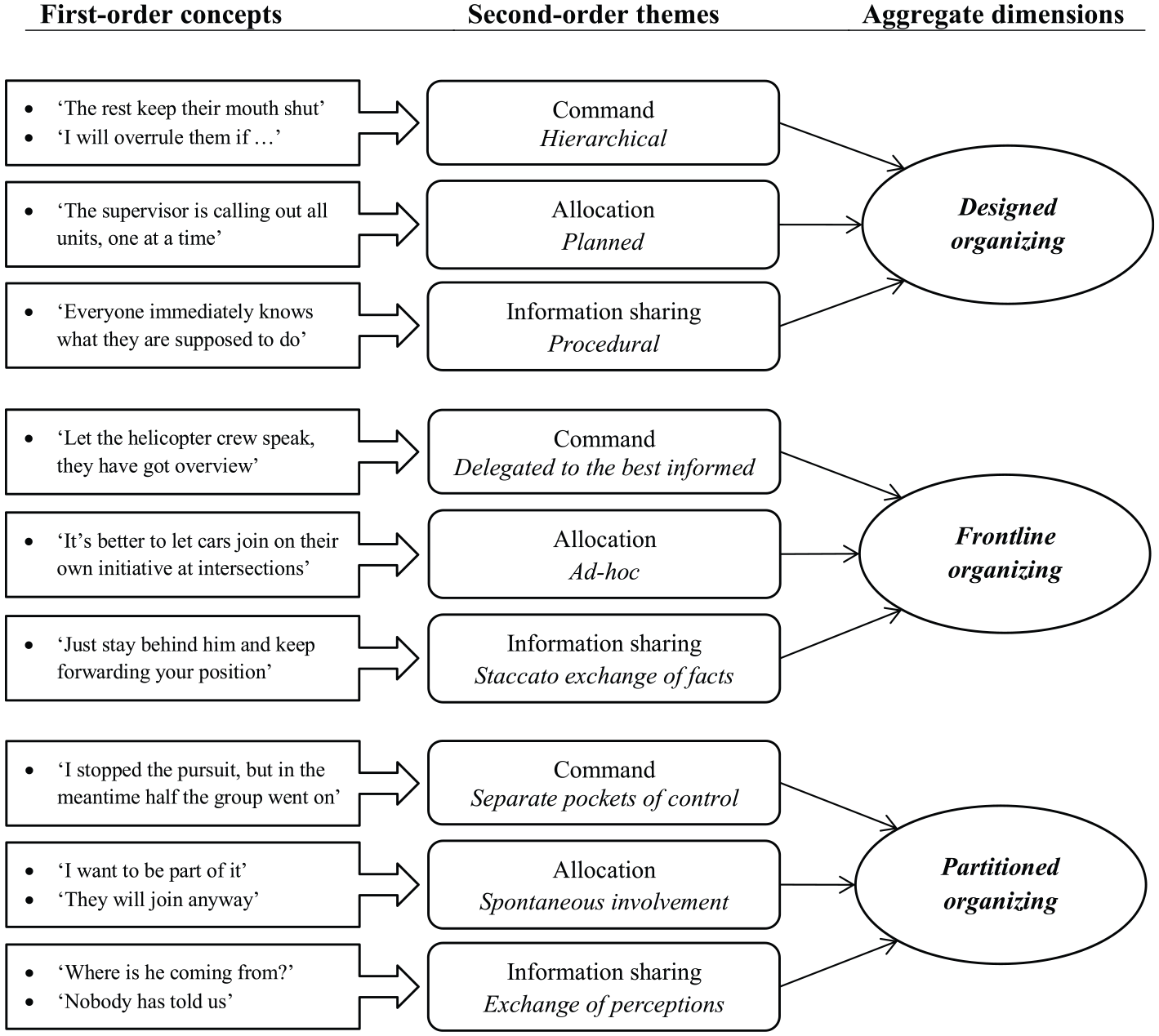
Modes of organizing, processes, and interrelated practices.
On multiple occasions, we validated our process model by soliciting feedback from police officers working at the operations center. During this process, we validated and fine-tuned our findings. By taking this final step, we feel confident that the findings in our study are reflective of processes and practices during police pursuits.
Findings
Our analysis of multiple pursuits reveals that, in order to coordinate action in erratically evolving crisis situations, responders frequently adapt their mode of organizing by adjusting three processes: command, allocation, and information sharing. Based on our inductive analysis, we regard command as the process of executing the lead within the response organization; allocation is the process of enrolling and positioning officers; and information sharing is a process aimed at updating involved officers about the evolving problem situation and the evolving response organization. We identified the velocity of developments, the number of actors involved, and the area covered as main factors affecting these processes. Owing to these factors, levels of situational awareness may vary from responder to responder.
To illustrate how adaptations take place within these processes, we first present a detailed single case of a police pursuit that took place in the Netherlands. We chose this case as it spanned several hours, exposing multiple transitions between the three modes of organizing, allowing us to develop a thick description of the chronology of events, organizing dynamics, and the role of various actors. After presenting this case, we discuss why and how transitions between modes of organizing occur, using evidence from all 15 pursuits that we investigated.
Pursuit #1 – Phase 1: Designed organizing
Friday 22 April 2016, 10:46 AM: The pursuit (see: pursuit #1) starts with a routine report of a man who has been violating an area restriction: he is not allowed to be near the house and office of his ex-wife. As there is no immediate threat, the commanders have sufficient time to mount a response to arrest the fugitive. A patrol car is dispatched by the operator in the regional operations center to visit the house, but by the time the officers arrive, the man has left. The officers attempt to call him to arrange a meeting, but he disconnects the call and seems confused.
1:00 PM: The police officers decide to call the man for a second time; he answers, and informs them that he is suicidal and does not want to be turned in. The officers estimate that he poses a serious threat, since he has removed his judicial electronic ankle bracelet and might attempt to hurt his relatives or bystanders. From that moment, there is growing pressure to locate him rapidly. As the situation develops into a search operation, street patrols and operators of neighboring regional operations centers start to listen in. At this point in time, there is still sufficient time to develop an ample understanding of the situation, enabling the operators to plan the allocation of units. The situation is clear: a convicted man is violating the terms of his conditional freedom and needs to be taken in as soon as possible because he is suicidal. Patrol units are sent out on a search: I was listening in. They were looking for someone who had escaped, who was suicidal. He had taken a car, and they feared for his life. They were searching for him. I heard that he was wearing an [judicial electronic] ankle bracelet and had taken it off. I quickly had the full picture. (Operations commander, region North)
Phase 2: Frontline organizing
At 4:34 PM, police officers on a highway overpass stakeout spot the fugitive. They ask the regional operator for permission to pursue the fugitive and switch on blue lights and sirens. As soon as the pursuit is under way, reports come in that the fugitive is driving ‘like an idiot’ (operator, region North) and is not responding to stop signs given by the police. From then on, there is little time to discuss what action to take, as very rapid responses are required, forcing the responders to switch from designed to frontline organizing. The officers involved still comprehend the situation, but can no longer plan ahead: In normal situations you may anticipate his actions. He is moving this way, or choosing that direction. In such situations I can position a car and try to catch him. But this pursuit reached such high speeds that the moment my vehicles were positioned he had already passed those locations. (Operator, region North)
The fugitive shows erratic driving behavior, driving through small towns at high speed, cutting across bike paths, and even driving the wrong way up the highway. The high speed of the pursuit causes several units to lose track of him. As one officer explains: ‘We lost him for a while. When we saw him again we had to study the map to reposition our units’ (Operator, region North).
Owing to the speed of the pursuit, command is delegated to the officers in the patrol car right behind the fugitive, while their communication with the regional operator and the other patrol cars is reduced to a staccato exchange of information. This informing includes referencing ongoing practices (e.g. searching, following, pursuing, blocking off traffic, boxing the car in, etc.) and the current location, direction, and speed of the fugitive. The officers in the first patrol car behind the fugitive take the lead, and other cars take their directions: If you direct a tightly coordinated pursuit there is only one car talking to you. That is the car directly behind the fugitive. The other cars are not even in there for you – they are only backup, or they might become intervention cars if you attempt to block the fugitive. Only the first car is talking to you. He will tell you where he is driving and what he sees. (Chief operations, central operations center) The commander is responsible, but the helicopter and the first car behind the fugitive have operational control: the unit with the best view. (Tactical flight officer)
The pursuit crosses multiple boundaries of Regional Police Units, thus evoking the involvement of the Central Police Unit. While the Central Police Unit dispatches patrol units with specialized high-speed pursuit training, operators from the regional operations centers are sending in their regular patrol units. As officers of the Central Police and the Regional Police are hierarchically independent, the ability of operators to plan ahead is restricted, especially when the problem is moving across regional boundaries: Just positioning units [at certain locations] is useless. You have to instruct the unit to start gaining speed three minutes in advance. It’s better to position your cars at different intersections, so they can join in or take position. That way the operation stays mobile and not static. (Supervisor, central operations center)
4:42 PM
Confronted with the new facts about the fugitive’s style of driving, the commanders of the various operations centers consult each other and decide to abort the pursuit: ‘The moment I heard he was driving at enormous speed on side roads, I called the operations commander from region North: “Eh, what shall we do?” Like me, he thought, “let’s call it off”. (Chief operations, central operations center).
Following the decision, it is reported that a number of unmarked police cars want to follow the fugitive at a distance. As the fugitive’s erratic driving still poses a serious threat to innocent bystanders, the regional commander decides to grant the request to continue the pursuit with two unmarked cars to avoid overstressing the fugitive: We learned that there were a few experienced unmarked cars behind him from a [covert] observation team and from the Traffic Police, who have been trained for high-speed driving. So we said, ‘everyone out; only these two cars will follow’ [the fugitive], so at least we will know where he is. (Operator, region North)
5:33 PM
The police helicopter is called in and upon arrival takes over the role of keeping the fugitive in sight. This increases the number of opportunities to de-escalate the situation, as ground units can keep a greater distance. In the meantime, the commanders discuss their options to stop the fugitive but find it difficult to come up with a suitable solution: We had a helicopter in the air, so the operations center said: we can let the fugitive drive away because the helicopter will keep a line of sight. What are your scenarios? I thought, shit, shit, scenarios? Hmm . . . track the fugitive, assess his driving behavior. But what to do exactly? (Operations commander, region North)
At this moment, the commanders try to develop scenarios to derive a projection of future developments. To do so, they take time for discussion of how to take back the lead and deploy explicitly allocated units only. However, they are not able to transition to a designed mode of organizing, as their attempts are frustrated by initiatives taken by other units.
Phase 3: Partitioned organizing
While the commanders and operators of the operations centers are trying to increase their understanding of the situation and take back the lead, their attempts are being undermined by officers listening in on the radio and spontaneously joining the pursuit. An operator recalls: ‘Hey guys, what was the decision?’ I called off the pursuit, but in the meantime, half the group went on. My colleague said, ‘there are two unmarked cars behind and they want to continue the pursuit’. Our senior operator said, ‘they are undercover, so they can do’. But then patrol officers hear that they are heading in a certain direction. They think, well, he is heading in my direction. The group grows as everyone thinks, this is my region, we should be on the lookout for this guy. (Operator, region North)
As the pursuit continues at high speed, the officers in the unmarked cars and the tactical flight officer in the helicopter keep updating each other about the movements of the fugitive. As the speed of developments is now outpacing attempts to align the responders, the fast-response organization starts to segment into different parts: I could not say to the boys [in the patrol cars]: Switch! [to this radio channel]. They were driving too fast. And so we ended up with two [radio channels]; one incident, but one part [of the patrol units] was communicating with my colleague, and I was connected with the others. (Operator, region North) The radio traffic was so busy that I had no time to merge the two channels in order to establish one communication group. For that you really need a few seconds of radio silence. That opportunity did not occur. (Operator, region North)
Communicating on different radio channels causes the officers involved to develop an incongruent understanding of the situation. Officers on the second channel are unaware of the decision to continue the pursuit with only two unmarked cars and the helicopter. Although communications can be overruled by operators, the high-speed chase leaves no time for the officers to be instructed, let alone for actions to be discussed. From this moment on concerted action is no longer assured. As the on-duty commander of the operations center explained: What you see happening during a pursuit is that it starts somewhere. A [regional patrol] unit goes after it, and after that the Central Police Unit calls in, because they are responsible for the highways. And then the party starts. Because every region you cross is sending in [patrol] units. And they start doing things that may not be very handy, as they do not correspond with the plan I had in mind. And then you lose it a little – yes, you kind of lose control. (Chief operations, central operations center)
In the meantime, with every district boundary the fugitive crosses, new officers spontaneously join the pursuit. These officers do not know the reason for the pursuit, there is insufficient time to share the plan of action, and there is a time lag in information: I heard [the OC] calling, ‘he stopped at the parking lot on the A7 [highway] near Heerenveen, at the gas station’. So, everyone is driving towards the A7. At the same moment a colleague is being approached [by a bystander] in Drachten: ‘He is driving like an imbecile!’ So he looks, and yes, it is that car. That much time had elapsed. He wasn’t in Heerenveen at all. He was in Drachten already. (Operator, region North)
As the pursuit is crossing various jurisdictions, the line of command is broken and separate pockets of control emerge. Though the commander at the central operations center is responsible for coordinating cross-regional pursuits, their regional counterparts are responsible for local safety and security, which may or may not be in accordance with the intent of the commander: ‘Other [police] regions had closed down highway exits. I had not asked for that. It was not under my direction’ (Chief operations, central operations center).
Officers take unsolicited actions, too, and have difficulty communicating their actions: You just do not get the opportunity to speak. Because Operations is speaking, the Zulu [helicopter] is speaking, and the car behind the fugitive is speaking. We cannot get in between to inform them that we are going the other way. (Patrol unit)
This situation continues for about 32 min, as new officers have no clear understanding of the problem situation, nor of who is involved and doing what, or who is in command. An officer in the unit behind the suspect described the situation as follows: Operations didn’t coordinate, so you start coordinating yourself. You get personal initiatives. People start to act themselves. But come on, two and a half hours! At some point you want to stop it, then you’re fed up with it. (Officer in unit behind fugitive)
6:05 PM: A patrol unit sees an opportunity to intervene and decides to go for it.
At some point you have to take a decision. I know this area reasonably well. So I said to my colleague [in the car]: ‘everybody is following the fugitive into the city. Let’s turn right here to get on the adjacent dike road to get ahead of him’. So we drove over there, and parked the car in the middle of the road. I wanted to get out, but we had no time left. (Patrol unit, region North)
At that moment, the fugitive crashes into the police car parked in the middle of the dike (see pursuit #1: 03:34 sec in Appendix I). Though the operator and the regional commander think they know which vehicles are involved, the ultimate intervention is executed by a colleague from the Central Police Unit. Their reaction clearly shows their lack of overview: Then I looked again, this time with my glasses on, at the closest monitor, and I thought, ‘What the heck, that’s a Volvo?’ We don’t have that type of car – only the Central Police Unit has those cars. The fugitive rammed him and we saw everybody getting out. That is no car of ours, so then we knew a unit of the Central Police Unit was involved. Before that, nobody had told me anything . . . (Operator, region North) When the fugitive was arrested, we in the [regional] operations center were like: where are all these [police] cars coming from? One hit the [car of the] fugitive, the other dragged him out. Wait a minute, weren’t there only unmarked cars behind the fugitive? That was a strange sensation. (Commander, region North)
The pursuit thus ends abruptly at a moment at which the commanders have a very poor understanding of the situation. The fact that the organization has been pushed to its limits is best illustrated by the remarks of the officers who risked their lives by forming the roadblock: When I found out later that the fugitive was suicidal, I thought, oh that was information I would have liked to have had beforehand. That information should have been shared with us. If they had told us that, we would not have parked our car as a block in front of the fugitive so readily. (Patrol unit) I talked to our commander afterwards. He said: ‘Good job, nice work!’ He was very happy that we had ended the pursuit. But of course, that is because it ended well, because nobody was hurt. If we had been injured and taken to the hospital they would have said: ‘Why on earth did you put your car in front of him?’ (Patrol unit)
Analysis
The case described above illustrates how responders adapt their mode of organizing. Before we include more evidence from the other pursuits to deepen our understanding of how adaptations are accomplished, we unveil three contingencies that explain why responders are urged to adjust their mode of organizing: the velocity of events; the number of actors that need to be managed; and the area covered by these actors. An increase in velocity, area, and the number of actors reduces the ability of the responders to swiftly establish and maintain a shared understanding of the situation, needed to organize action. Commanders routinely initiate interventions to reduce these factors. For example, they task patrol cars to block off escape routes, close-off lanes, instruct units to disengage or keep their distance, turn off their blue lights, follow in unobtrusive cars (see pursuit #7: 01:57 – 03:20 sec), or track the fugitive with the helicopter while the ground units remain at a distance (see pursuit #8: 00:53 – 01:35 sec).
Despite attempts of commanders to influence the context, adapting the mode of organizing from designed to frontline or even partitioned organizing may still be needed to heed the situation. Based on our observations, we developed a process model (Figure 2) that describes how these adaptations are being effectuated. We found that transitioning between modes of organizing is achieved by engaging in a combination of three types of processes—command, allocation, and information sharing—comprising nine specific practices.
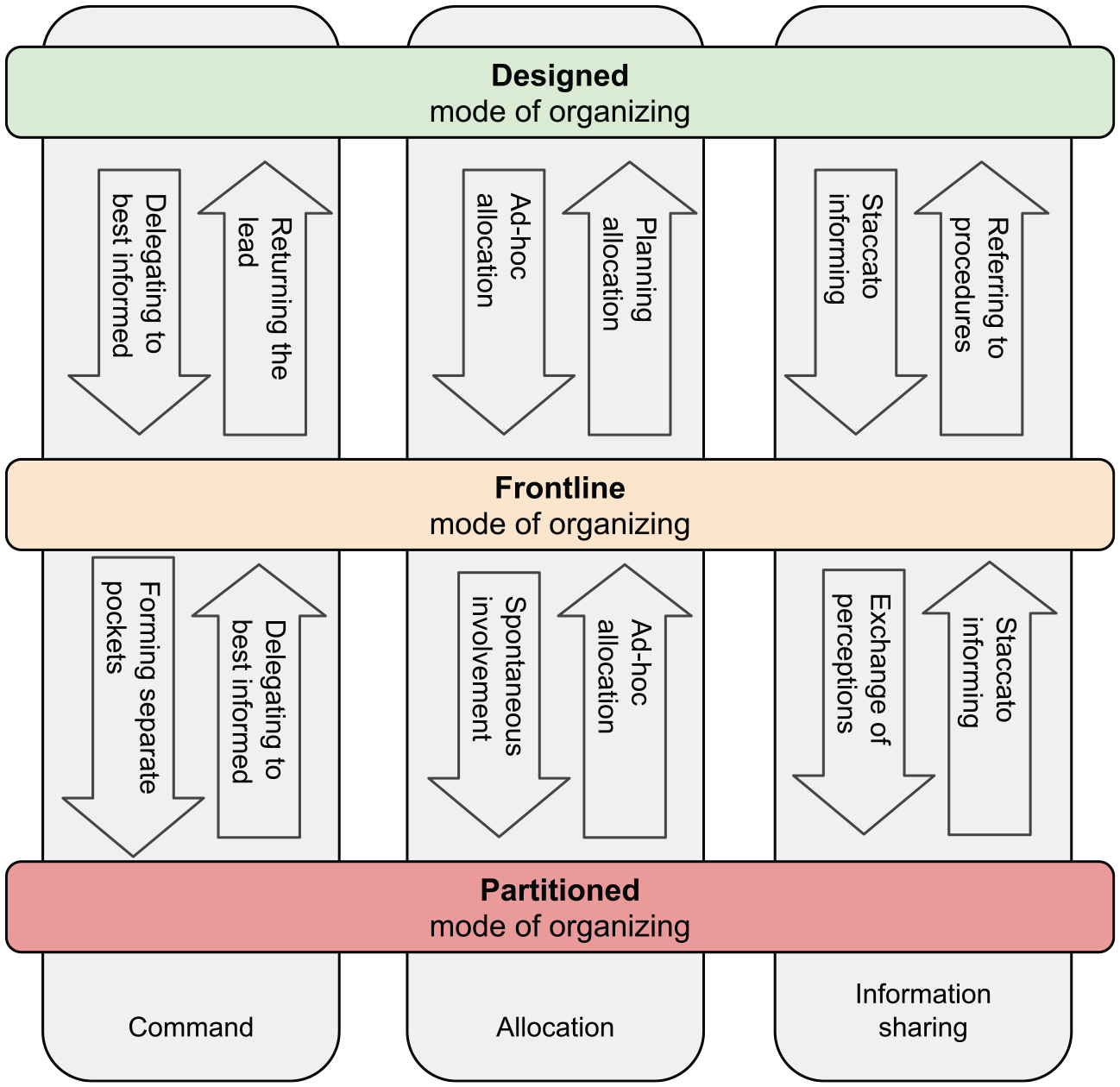
Process model: transitioning between modes of organizing.
Our analysis shows that transitioning is not a one-off decisive switch to handle a particular crisis situation, but involves continuous adaptations of command, allocation, and information-sharing processes to match the context of the evolving crisis situation. We illustrate these dynamics by zooming in on transition sequences uncovered in the studied pursuits. Figure 3 shows a sample of these transition sequences, which are discussed in the next section.
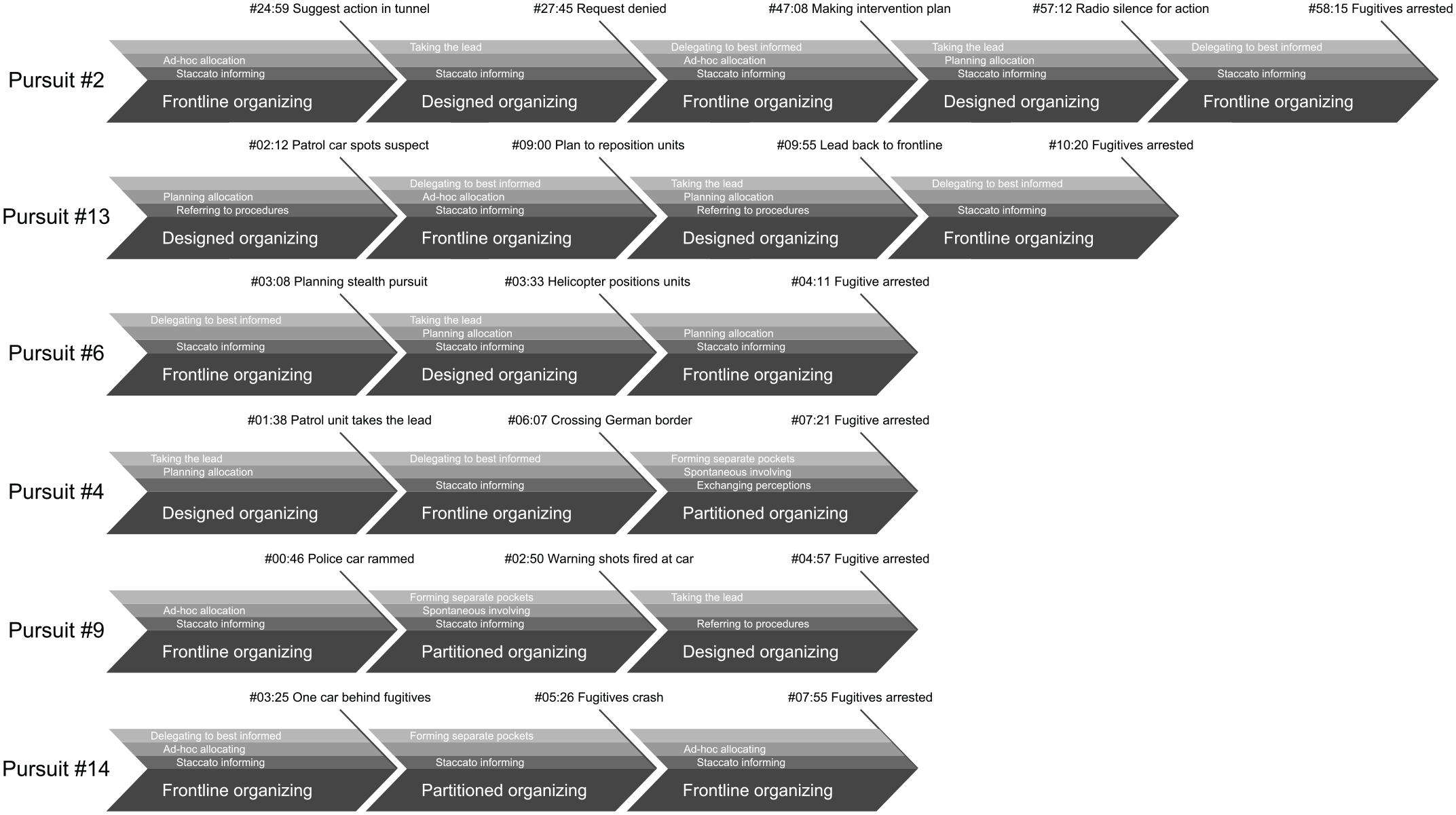
Transitions between modes of organizing.
Transitioning between designed and frontline organizing
In 8 of the 15 pursuits, we witnessed examples of how responders routinely transition between designed and frontline organizing, often at multiple occasions during the same pursuit. In these cases, the speed of events pushes responders to delegate command to those who have a direct sight on the fugitive. Meanwhile, commanders prepare for future action by, for example, allocating additional patrol units to block off side roads, or position the helicopter to keep an aerial overview. In order to effectuate these measures, commanders may need to take back the lead, thus shortly adopting a designed mode of organizing. After reorganizing resources, command is delegated to frontline officers. Our analysis reveals that tacking back and forth between a frontline and designed mode of organizing occurs frequently and often lies at the basis of a successful intervention.
Pursuit #2 offers the most pronounced transformations in this tacking process between designed and frontline organizing. The pursuit starts as officers spot a car fitted with fake license plates that has not paid for petrol. The pursuit lasts several hours and moves across the Netherlands from Amsterdam, to Utrecht, Dordrecht, Tilburg and finally ends on the highway near Breda in southern Netherlands. In the course of the pursuit multiple units join, while attempts to intervene fail. To break the impasse, the commander and frontline officers develop a plan to take action in a sharp turn along their route. The commander takes back the lead and plans the allocation of additional patrol cars towards this location, and orders regional patrol cars to back off and stop the upcoming traffic. He gives permission to the frontline officers to ram the suspects at a corner. As the responders are now reorganized and set to take action, command is delegated back to the frontline officers who can best assess when to initiate action. The commander asks for radio silence as the fugitives approach the turn. This time the intervention is successful as the officers ram the suspects off the road.
We witnessed similar transitions between designed and frontline organizing in a number of other pursuits, in attempts to interrupt the momentum of ongoing events by reorganizing the responders. In a case involving a high-speed pursuit of burglars on the highway (pursuit #13), attempts to stop the fugitives using a frontline mode of organizing fail repeatedly. Similar to pursuit #2, the commander decides to temporarily take back the lead, and plans the repositioning of the units involved. He reverts to designed organizing by assigning specialized highway patrol units to the front that will engage in the boxing procedure, and directs other units and motorbikes to the rear to hold off oncoming traffic. Once the organization has been redesigned, he delegates command back to the frontline, asking the first car behind the fugitives to take the lead in the boxing procedure. The officers engage in staccato informing and wait for a suitable location to initiate the boxing procedure, which results in the arrest of the fugitive.
Likewise, in pursuit #6, officers mount a frontline operation to close in on a fugitive, but have difficulty finding an opportunity to intervene. Different to the other cases, this time the lead is given to the tactical flight officer in the helicopter. The tactical flight officer initiates a plan to give the fugitive the idea that he has escaped, while keeping him in sight. To bring this plan into effect, the officers transition from a frontline to a designed mode of organizing. The tactical flight officer takes command, positions the patrol units, and orders the remaining officers to back off and stay out of sight. Quickly after the fugitive parks his car in a residential area, he is arrested.
These cases show that commanders of fast-response organizations regularly delegate authority to frontline officers to take the lead in command, allocation, and information sharing. Meanwhile, commanders try to plan ahead and position additional resources. To effectuate their interventions, they try to intermit short periods of designed organizing, after which they continue in a frontline mode of organizing. Opportunities to transition between these modes of organizing, however, are not always present, as is evident in the remaining 7 of the 15 pursuits.
Transitioning in and out of partitioned organizing
In seven pursuits, we witnessed examples of how responders operated in a partitioned mode of organizing. Though the previous cases showed operations in which command, allocation, and information-sharing processes were still widely shared and agreed upon, in the partitioned mode this is no longer so. In these cases, command lines are missing or no longer unilateral, officers operating at the frontline cannot communicate their actions to all other officers involved in the pursuit, and allocation of officers is no longer orchestrated. The result is that the operation continues in separate pockets of control, where responders continue to organize action in small groups, or of their own accord, in an attempt to contain the rapid escalation of the pursuit.
In pursuit #4, for example, police officers are dispatched to apprehend a suspect who has stolen a van. The operation starts in a designed mode of organizing where the operator at the regional operations center positions officers along the escape route and instructs them not to block the fugitive. Once the fugitive is in sight of the first patrol cars, the officers at the frontline take the lead and revert to staccato informing, thus transitioning to frontline organizing. The moment the pursuit heads in the direction of the German border, the operator notifies the German police and the Dutch border patrol. At a junction just across the border, several cars of the Dutch police, border police, and German police are waiting to spontaneously join the pursuit by attempting to ram and block the fugitive. As there are no shared communication and command structures in place, the operation continues in separate pockets of control. In a spontaneous joined attempt to block the fugitive, a civilian car is hit by a police car. The fugitive escapes across a parking lot, runs into a dead-end forest road, and is blocked by cars of the Dutch and German police. Meanwhile, other officers, unaware of this ending, are still blocking off escape routes (see pursuit #4: 06:07 – 07:21 sec). This pursuit illustrates a case of partitioning that emerges owing to the spontaneous involvement of officers and the inability to share information among Dutch and German officers on the road, thus resulting in assumptions and misunderstandings, accumulating in a collision. Despite the partitioned mode of organizing, the operation continues and results in the apprehension of the fugitive.
In pursuit #9, the speed of events, combined with several spontaneous actions, causes the organization to partition. Several police cars are chasing a stolen car in Rotterdam, all trying to find favorable positions to block the fugitive. One police car is rammed in the process. While many city police vehicles spontaneously join, the fugitive suddenly stops and reverses, trying to ram the police cars behind him. The officers fire several warning shots, forcing the fugitive to stop. At that moment the situation ‘freezes’ and the officers get the chance to transition to a designed mode of organizing by reverting to a standard procedure for arresting dangerous suspects (see pursuit #9: 03:00 – 05:00 sec).
In another case (pursuit #14), separate pockets of control emerged owing to the sheer speed of developments. In this case, officers are struggling to catch up with a car driving at more than 150 km per hour on small country roads. Though one patrol car is able to catch up, another lags behind, and the helicopter is still en route. The officers struggle to keep an overview, and a split second later they career into a scene of devastation when the fugitives hit a tree around a corner. The officers only just manage to avoid hitting the crashed car. As they are on their own, they give chase on foot to try to catch the suspects, who have abandoned their car. They are able to transition to frontline organizing by continuously providing short updates through staccato informing, letting the operator at the operations center reroute additional pursuit vehicles. While the officers operating at the frontline are deeply engaged with catching the fugitives, the commanders assume a facilitating role by allocating additional units, and by taking precautionary measures in the periphery of the operating area.
These cases illustrate that responders frequently transition back and forth into a mode of partitioned organizing. In an attempt to deal with the velocity of events, increasing numbers of actors, and a larger area that needs to be covered, we regularly see that responders can no longer oversee all aspects of the operation, thus reverting to separate pockets of control. When aborting the pursuit is not an option and time to consult is absent, officers regularly take self-initiated actions to stop the suspect. In all cases in which this occurred, the suspect was arrested.
Successes and failures of transitioning
Failures to adapt the mode of organizing to fit the dynamic context of the pursuit causes conflicting lines of command, delays in information sharing, and decreasing awareness of the evolving crisis situation. For example, in an attempt to take back control from the frontline officers, operators at the operations centers sometimes start repeating status updates given by the frontline. This leads to confusion about who is in the lead and causes delays in updating, because while operators talk communication opportunities are suppressed. We also witnessed officers at the frontline switching off radio channels to favor one line of command over another, thus impeding future transitions. Though issues like these are common, they become problematic when transition processes stall, because the involved officers remain unaware of the problems they are causing, and others are unable to correct them.
While stalling transitions is detrimental, we found that very brief or partial transitions contribute to success. For example, we witnessed responders momentarily transitioning back and forth to a designed mode to instantiate a new plan of action. In several cases, the fugitive was only arrested after several very short attempts of operators to adjust plans (e.g. pursuit #2; #6; #13). While multiple lines of command and allocation processes emerged, continued staccato informing enabled the responders to swiftly return to frontline (#14) and designed modes of organizing (#9) when opportunities to do so materialized.
Discussion and conclusion
In this study we presented an analysis guided by the question: How do responders adapt their mode of organizing to match the dynamics of an unfolding crisis? The findings suggest that responders may operate in three different modes of organizing: designed, frontline, and partitioned. Responders are urged to adapt their mode of organizing according to the velocity of the sequence of events, the number of actors that need to be managed, and the area covered by these actors. We identified three processes, that is, command, allocation, and information sharing, containing nine interrelated practices, which explain how responders are able to transition between different modes of organizing. While these modes are analytically distinct, we found that practices may overlap during the transition. These findings have important implications for debates on adaptation in extreme contexts (Hällgren et al., 2018; Williams et al., 2017), for our understanding of success or failure in these settings (van der Vegt et al., 2015), and for the ongoing debate on command and control (Drabek and McEntire, 2003; Jensen and Waugh, 2014; Quarantelli, 1988).
First, our analysis offers new insights into how responders are able to adapt their mode of organizing in the course of fast-response operations. Previous studies of organizational responses to unexpected events describe how organizations restructure their activities in action when they encounter a problem (Bechky and Okhuysen, 2011; Bigley and Roberts, 2001; Klein et al., 2006), or how specialized teams engage in different sets of practices associated with either habitual or problematic trajectories (Faraj and Xiao, 2006). These studies thus describe one-off adaptations or mutually exclusive trajectories, whereas our findings illustrate that adaptation processes during a fast-response operation occur more frequently and take the shape of tacking back and forth between modes of organizing. Moreover, whereas these studies describe fast-response organizations made up of members operating within a unity of command (Bigley and Roberts, 2001), our study illustrates how responders from different units of command temporarily form a fast-response organization, while composition and leadership may change during the operation.
We found that the transitioning process is often very provisional and temporal, requiring only a short period of centralization of command to reshape the organization and reposition responders, after which command is delegated back to the frontline. We suggest that a failure to tack between modes of organizing may explain the problems experienced in the Breivik attack (Bye et al., 2019), the Stockwell shooting (Cornelissen et al., 2014), and the events of 9/11 (Kendra and Wachtendorf, 2016). In these cases, the centralized commanders were unable to temporarily take back the lead in decentralized operations, to reposition frontline officers, or to share new information. When contextual factors are forcing officers towards frontline and ultimately towards partitioned organizing, the involved officers intentionally seek opportunities to switch back to frontline or designed organizing in order to increase the level of situational awareness and reposition fast-responders.
While such crisis settings have often been described as loosely coupled (Hällgren and Wilson, 2008; Weick, 1988), our case demonstrates that the fast-response organization may become decoupled, while still retaining some functionality. In fact, the three modes of organizing represent the back and forth transitioning between tight coupling, loose coupling, and decoupling. From a process perspective (Langley, 1999), our analysis demonstrates the importance of looking beyond a specific state, and zooming out to understand the importance of these transitions that enable organizations to retain operational functionality in extreme contexts (Hällgren et al., 2018). This warrants the need for renewing the research agenda with regard to the instantiation of transitioning in relation to command tactics, allocation, and information sharing, in both regular and more extreme settings.
Second, our study provides a better understanding of success and failure in fast-response organizing. Rather than juxtaposing successful and failed operations (Boin and Bynander, 2015; McConnell, 2011), or studying what can be learned from failed operations (Cornelissen et al., 2014; Schakel et al., 2016; Weick, 1993), we studied how people engage in different practices to sustain action and recover from setbacks (Williams et al., 2017). This relates to concern over hindsight bias in the field of crisis management, which occurs when retrospective studies focus predominantly on tracing back the causes of failure in a crisis (Dekker 2004; Heath, 1998; Hendriksen and Kaplan, 2003). Our study shows that to assess success and failure it is crucial to capture the complexities of organizing, and to explain why transitioning between modes of organizing made sense at the time. For example, in order to save lives, responders may choose not to abort an operation, even when this entails operating in a partitioned mode. As we have shown, operating in a partitioned mode of organizing does not necessarily mean that failure of the operation is imminent. Though failure is more likely to occur in this mode, failures in designed or frontline modes of organizing are also not uncommon (e.g. Rake and Njå, 2009; Snook, 2002). Hence, we need to reconsider the attribution of success and failure in studies of crisis management.
Third, though the command and control doctrine is still the leading philosophy of crisis management organizations around the world (College of Policing, 2019; Netherlands Ministry of Defence, 2012; United Nations, 2018), disaster scholars have persistently voiced their concern with this doctrine (Boersma et al., 2014; Drabek and McEntire, 2003; Jensen and Waugh, 2014; Neal and Phillips, 1995; Quarantelli, 1988; Tierney et al., 2001; Waugh and Streib, 2006). In their studies, response operations are characterized by decentralized, rather than centralized, decision making; by collaborative relationships among organizations, rather than hierarchical ones; by the rapid appearance of novel improvised activities, rather than planned ones; and by fast-paced decisions, rather than slow and deliberate command processes (National Research Council, 2006: 142). By mapping the actual work practices in fast-response organizations in a process model (Langley 1999), we found that both ends of these dichotomies play an important role in different modes of organizing that may occur within a single crisis response operation. Though command and control structures in designed organizing provide clarity in relatively stable and predictable situations, such centralized structures seem not fit for situations characterized by high velocity and a large number of actors operating in widespread areas. In these situations, actors tend to transition to frontline organizing to maintain situational awareness (Endsley, 1995) and sensitivity to operations (Barton and Sutcliffe, 2009; Weick and Sutcliffe, 2011), or decouple into separate pockets of control to sustain action beyond the capabilities of the larger collective.
Through these contributions, our study into the daily practice of police pursuits offers a detailed and nuanced understanding of fast-response organizations operating on the edge, which informs ongoing research into crisis management (Boin et al., 2016; Comfort, 2007), disaster studies (Dynes, 1994; Kendra and Wachtendorf, 2016), and organizing in extreme contexts (Hällgren et al., 2018; van der Vegt et al., 2015; Williams et al., 2017).
Footnotes
Appendix
Video material used for analysis.
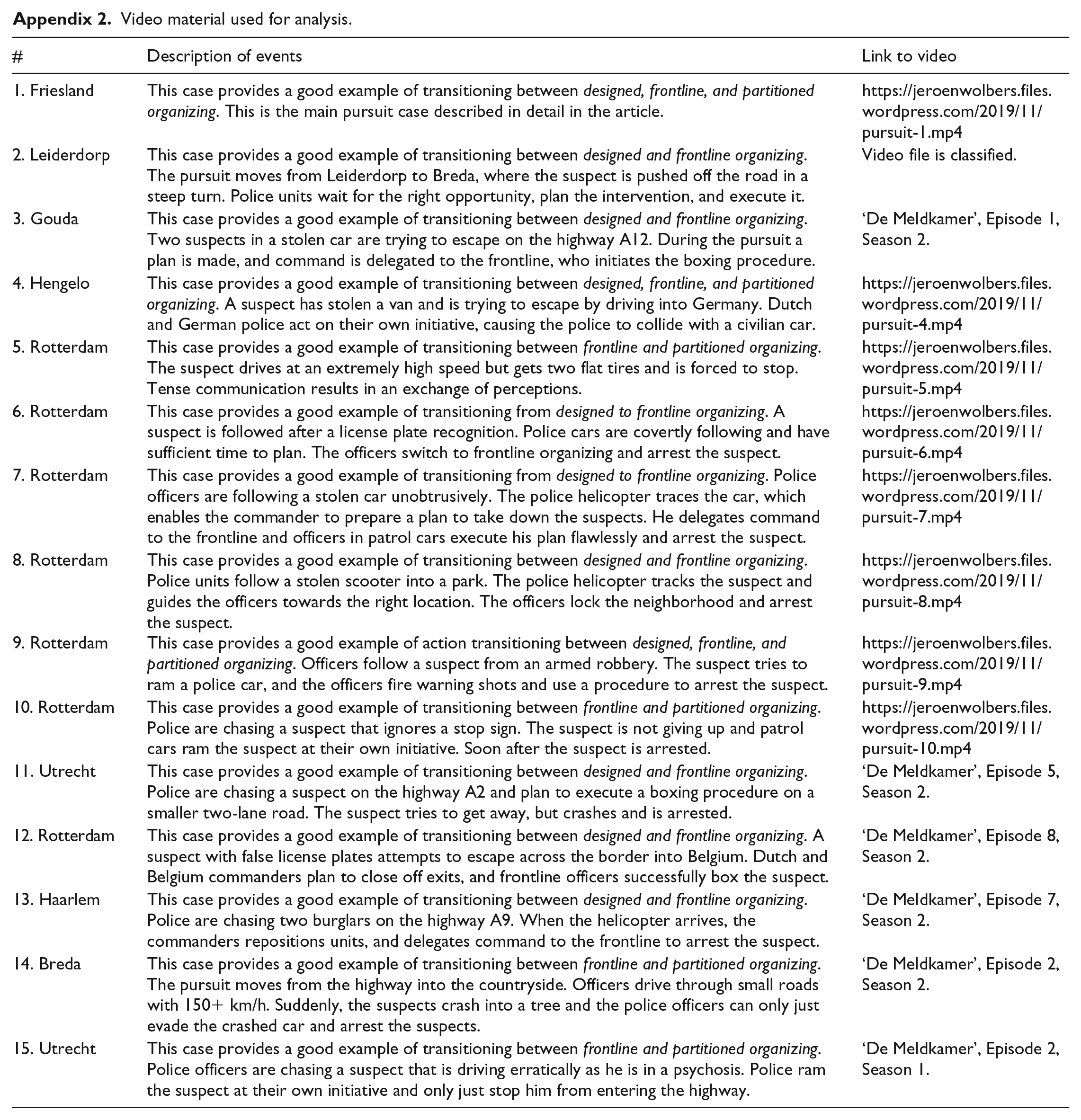
| # | Description of events | Link to video |
|---|---|---|
| 1. Friesland | This case provides a good example of transitioning between designed, frontline, and partitioned organizing. This is the main pursuit case described in detail in the article. | https://jeroenwolbers.files.wordpress.com/2019/11/pursuit-1.mp4 |
| 2. Leiderdorp | This case provides a good example of transitioning between designed and frontline organizing. The pursuit moves from Leiderdorp to Breda, where the suspect is pushed off the road in a steep turn. Police units wait for the right opportunity, plan the intervention, and execute it. | Video file is classified. |
| 3. Gouda | This case provides a good example of transitioning between designed and frontline organizing. Two suspects in a stolen car are trying to escape on the highway A12. During the pursuit a plan is made, and command is delegated to the frontline, who initiates the boxing procedure. | ‘De Meldkamer’, Episode 1, Season 2. |
| 4. Hengelo | This case provides a good example of transitioning between designed, frontline, and partitioned organizing. A suspect has stolen a van and is trying to escape by driving into Germany. Dutch and German police act on their own initiative, causing the police to collide with a civilian car. | https://jeroenwolbers.files.wordpress.com/2019/11/pursuit-4.mp4 |
| 5. Rotterdam | This case provides a good example of transitioning between frontline and partitioned organizing. The suspect drives at an extremely high speed but gets two flat tires and is forced to stop. Tense communication results in an exchange of perceptions. | https://jeroenwolbers.files.wordpress.com/2019/11/pursuit-5.mp4 |
| 6. Rotterdam | This case provides a good example of transitioning from designed to frontline organizing. A suspect is followed after a license plate recognition. Police cars are covertly following and have sufficient time to plan. The officers switch to frontline organizing and arrest the suspect. | https://jeroenwolbers.files.wordpress.com/2019/11/pursuit-6.mp4 |
| 7. Rotterdam | This case provides a good example of transitioning from designed to frontline organizing. Police officers are following a stolen car unobtrusively. The police helicopter traces the car, which enables the commander to prepare a plan to take down the suspects. He delegates command to the frontline and officers in patrol cars execute his plan flawlessly and arrest the suspect. | https://jeroenwolbers.files.wordpress.com/2019/11/pursuit-7.mp4 |
| 8. Rotterdam | This case provides a good example of transitioning between designed and frontline organizing. Police units follow a stolen scooter into a park. The police helicopter tracks the suspect and guides the officers towards the right location. The officers lock the neighborhood and arrest the suspect. | https://jeroenwolbers.files.wordpress.com/2019/11/pursuit-8.mp4 |
| 9. Rotterdam | This case provides a good example of action transitioning between designed, frontline, and partitioned organizing. Officers follow a suspect from an armed robbery. The suspect tries to ram a police car, and the officers fire warning shots and use a procedure to arrest the suspect. | https://jeroenwolbers.files.wordpress.com/2019/11/pursuit-9.mp4 |
| 10. Rotterdam | This case provides a good example of transitioning between frontline and partitioned organizing. Police are chasing a suspect that ignores a stop sign. The suspect is not giving up and patrol cars ram the suspect at their own initiative. Soon after the suspect is arrested. | https://jeroenwolbers.files.wordpress.com/2019/11/pursuit-10.mp4 |
| 11. Utrecht | This case provides a good example of transitioning between designed and frontline organizing. Police are chasing a suspect on the highway A2 and plan to execute a boxing procedure on a smaller two-lane road. The suspect tries to get away, but crashes and is arrested. | ‘De Meldkamer’, Episode 5, Season 2. |
| 12. Rotterdam | This case provides a good example of transitioning between designed and frontline organizing. A suspect with false license plates attempts to escape across the border into Belgium. Dutch and Belgium commanders plan to close off exits, and frontline officers successfully box the suspect. | ‘De Meldkamer’, Episode 8, Season 2. |
| 13. Haarlem | This case provides a good example of transitioning between designed and frontline organizing. Police are chasing two burglars on the highway A9. When the helicopter arrives, the commanders repositions units, and delegates command to the frontline to arrest the suspect. | ‘De Meldkamer’, Episode 7, Season 2. |
| 14. Breda | This case provides a good example of transitioning between frontline and partitioned organizing. The pursuit moves from the highway into the countryside. Officers drive through small roads with 150+ km/h. Suddenly, the suspects crash into a tree and the police officers can only just evade the crashed car and arrest the suspects. | ‘De Meldkamer’, Episode 2, Season 2. |
| 15. Utrecht | This case provides a good example of transitioning between frontline and partitioned organizing. Police officers are chasing a suspect that is driving erratically as he is in a psychosis. Police ram the suspect at their own initiative and only just stop him from entering the highway. | ‘De Meldkamer’, Episode 2, Season 1. |
Acknowledgements
We would like to thank our three anonymous reviewers for an inspiring and supportive review process. In addition, we are grateful to our respondents at the National Police for their openness and willingness to reflect upon the dilemmas they face in their important work.
Funding
The author(s) disclosed receipt of the following financial support for the research, authorship, and/or publication of this article: This work was supported by the Dutch Research Council (NWO) (Smart Disaster Governance 409-14-003, Veni Scheme 016.Veni.195.121).
