




Abstract
Current research on strategizing and organizing has explored how practitioners make sense of an uncertain future, but provides limited explanations of how they actually make a realizable course of action for the future. A focus on making rather than sensemaking brings into view the visual artefacts that practitioners use in giving form to what is ‘not yet’ – drawings, models and sketches. We explore how visual artefacts are used in making a realizable course of action, by analysing ethnographic data from an architectural studio designing a development strategy for their client. We document how visual artefacts become enrolled in practices of imagining, testing, stabilizing and reifying, through which abstract imaginings of the future are turned into a realizable course of action. We then elaborate on higher-order findings that are generalizable to a wide range of organizational settings, and discuss their implications for future research in strategizing and organizing. This paper contributes in two ways: first, it offers future making as an alternative perspective on how practitioners orient themselves towards the future (different from current perspectives such as foreseeing, future perfect thinking and wayfinding). Second, it advances our understanding of visual artefacts and their performativity in the making of organizational futures.
Introduction
The future is an important aspect of strategizing and organizing. Any strategic plan or project is designed with the future in mind (Costanzo & MacKay, 2008; Pitsis, Clegg, Marosszeky, & Rura-Polley, 2003; Tsoukas & Shepherd, 2004a). In theorizing time, most researchers have embraced a phenomenological rather than chronological view (Antonacopoulou & Tsoukas, 2002; Pedersen, 2009). Here, time cannot be conceived outside of human experience. The focus is on the temporal experience of practitioners as they live in the flow of time and construct the future. Temporal continuity is expressed not as a linear succession of ‘now-points’ but ‘as an ongoing flow of present actions that draw simultaneously on pasts and futures as epistemic resources, which themselves are subject to endless reconstruction’ (Hernes, Simpson, & Söderlund, 2013, p. 3).
The phenomenological view is taken up by practice- and process-based studies of strategizing and organizing, which explore how practitioners orient themselves towards the future (Langley, Smallman, Tsoukas, & Van de Ven, 2013; Orlikowski & Yates, 2002; Vesa & Franck, 2013). To a large extent, these studies assume that the experience of time is cognitive, and suggest that language creates a space in which prospective and retrospective sensemaking take place (Costas & Grey, 2014; Cunliffe, Luhman, & Boje, 2004; Pedersen, 2009). They address, for example, the narrative practices through which practitioners interweave interpretations of past, present and future (Kaplan & Orlikowski, 2013), or articulate an imagined future that directs action in the present (Pitsis et al., 2003).
These phenomenological studies have explained how practitioners make sense of an uncertain future, but have not yet articulated how they make a realizable course of action for the future (in spite of the uncertainties it poses). A focus on making (rather than sensemaking) brings into view the practical work of giving form to abstract imaginings of the future and crafting a realizable course of action. This has the potential to extend phenomenological research that emphasizes the lived experience of practitioners, and their entwinement with the tools that constitute everyday activities in organizations (Ericson, 2014; Tsoukas, 2005).
To analyse how a realizable course of action is ‘made into being’, we focus on engagement with visual artefacts – all the drawings, models and sketches that practitioners use in crafting what is ‘not yet’. Visual artefacts, we contend, are performative because they give form to abstract imaginings of the future. They bring an imagined future into the present and make it amenable to further work. Though visual artefacts are often treated as texts or talks (Vaara, Sorsa, & Pälli, 2010), we recognize that their visuality and materiality is central to making a realizable course of action. Our research question is: How do visual artefacts enable making the transition from abstract imaginings of the future to a realizable course of action?
To address this, we analyse ethnographic data from Cullinan Studio, an architectural studio leading the design of a development strategy for Kew Gardens, UK (a UNESCO World Heritage Site). Our analysis traces the unfolding of visual artefacts, and documents the future options that they make into being. It shows how visual artefacts become enrolled in recursive practices of imagining, testing, stabilizing and reifying, whereby they enable making the transition to a realizable course of action. This transition, we find, is performed as visual artefacts are assembled and evolved to envision an increasingly stable, holistic and persuasive view of the future.
This paper makes a twofold contribution: First, it extends research on strategizing and organizing, by offering future making as an alternative perspective on how practitioners orient themselves towards the future. Compared to current phenomenological perspectives, future making articulates the sensorial dimension of practitioners’ orientation towards the future. It adds to debates on agency and the future (Emirbayer & Mische, 1998) by showing how a realizable course of action is ‘made into being’, through a combination of purposeful and spontaneous actions lodged in visual artefacts.
Second, this paper contributes to research on visuality and materiality (Meyer, Höllerer, Jancsary, & van Leeuwen, 2013), by explicating the performativity of visual artefacts in the making of organizational futures. It extends current accounts, in which visual artefacts are analysed as texts/talks (Vaara et al., 2010) and/or are studied at any single point in time (Eppler & Platts, 2009). It further suggests that visual artefacts are not just ways of ‘knowing’ (Ewenstein & Whyte, 2009), but also ways of ‘dwelling’ – which enables a more sensorial orientation towards the future.
Theoretical Background
Strategizing and organizing for the future
The question of how practitioners orient themselves towards the future cuts across studies of strategizing and organizing. Answers to this question largely draw on a phenomenological view, but differ as to their emphasis on the present and past, and their conceptualization of agency in relation to the future (Emirbayer & Mische, 1998). In what follows, we review and compare current perspectives on the future – which can be labelled as foreseeing, future perfect thinking and wayfinding.
Foreseeing
This is an organizational capability of being perceptive to the present context, so as to detect discontinuities unfolding into the future (Costanzo & MacKay, 2008; Tsoukas & Shepherd, 2004a). This perspective develops in opposition to the planning approach to strategy (Wolf & Floyd, 2013), which emphasized the integration of systematic analysis and rational evaluation to predict future patterns. The object of foreseeing is not to predict the future, but rather to prepare the organization to deal with anything that might happen in the future. Foreseeing ‘marks the ability to see through the apparent confusion, to spot developments before they become trends, to see patterns before they fully emerge’ (Tsoukas & Shepherd, 2004b, p. 6). It sets out to develop subsidiary awareness of the past and future, while focally engaging in the present. This present-tensed focus brings into view the emergent process through which practitioners acquire knowledge, and orient themselves towards the future.
Drawing on the pragmatic philosophy of Dewey (2002 [1922]) and Whitehead (1967), scholars of foreseeing highlight the unknowability of future. Still, they emphasize ‘an active attitude towards the future’, suggesting that ‘[the future] may not be known ex-ante, but it is useful to remind ourselves that [it] is created by human beings’ (Tsoukas & Shepherd, 2004b, p. 2, emphasis in original). Such an active stance is realized by engaging in organizational learning (Berends & Antonacopoulou, 2014) and discursive practices that involve a combination of prospective and retrospective sensemaking (Weick, Sutcliffe, & Obstfeld, 2005). Relevant examples are the articulation of future scenarios (van der Heijden, 2004), the anticipation of disruptive events (Mendonça, Pina e Cunha, Ruff, & Kaivo-oja, 2009) and the construction of ‘projective narratives’ (Garud, Schildt, & Lant, 2014) or ‘strategic accounts’ (Kaplan & Orlikowski, 2013) that bring expectations and memories to bear on the present.
Future perfect thinking
Distancing themselves from foreseeing, other scholars suggest that a learning approach to strategy may be practically impossible in fast-paced work environments (Fuglsang & Mattsson, 2011; Pitsis et al., 2003; Winch, 2010). Future perfect thinking is proposed as an approach to realizing projects that, because of their uniqueness, cannot be planned in advance by any other means. Through using the future perfect, practitioners project the planned outcome as if it was already accomplished, and then reconstruct the paths that would have taken to such outcome. While being oriented towards the future, projections involve retrospection (Weick et al., 2005), in that they become changed into something similar to the past, and give backward temporality to the actions required for their realization.
Future perfect thinking draws on the early work of Schütz (1967) and Weick (1979), which suggests that purposeful action has the character of a projection, or a completed future state that gives meaning to that action. Scholars of future perfect thinking accept that we cannot have an objective knowledge of the future, and argue for reducing its open-endedness by imagining the future as a past event. While being unknowable, the future can be disciplined through purposeful action: ‘strategy does not merely provide the formal steps towards the future, but it helps to produce that future’ (Kornberger, 2013, p. 105). Verbal techniques such as ‘engaging in strange conversations’, ‘playing end games’ and ‘projecting feelings, concerns and issues’ (Pitsis et al., 2003) are used to enact strategy through the future perfect (Fuglsang & Mattsson, 2011).
Wayfinding
While rejecting a strictly rationalistic approach, foreseeing and future perfect thinking continue to emphasize cognition, deliberation and purposeful action as the primary (if not the only) ways of dealing with the future. Another perspective shifts attention towards spontaneous actions of strategizing and organizing, recasting practitioners’ orientation towards the future as a continuous and collective process of wayfinding (Chia & Holt, 2006, 2009; Ericson, 2014; Horst & Järventie-Thesleff, 2016; Hydle, 2015; Nayak & Chia, 2011; Sarpong, Maclean, & Alexander, 2013). By emphasizing that the past and future are integral to the present (Chia, 1999), wayfinding allows for a more experiential awareness of practitioners’ struggles with the uncertainties posed by the future. It involves not as much cognition as movement, in the sense of ‘feeling [one’s] way through a world that is itself in motion, continually coming into being through the combined action of human and non-human agencies’ (Ingold, 2000, p. 155). It entails an existential entwinement (Ericson, 2014) with the world, and the objects that constitute organizations: The future comes into being as practitioners dwell in the tools they use, and make such tools an extension of their bodies (Tsoukas, 2005, p. 149).
Wayfinding has its theoretical roots in the existentialist philosophy of Heidegger (1962), and has been taken up in studies informed by a ‘strong process view’ (Hernes et al., 2013) and theories of practice (Hydle, 2015). From an agential perspective, it assigns primacy to a dwelling rather than a building mode: the future is enacted not through purposeful action, but through habituated sensitivity that allows for detours, lingerings and directional changes (Chia & Holt, 2009, p. 173). It suggests that the present is an experience in which the links between cause and effect fall into un-decidedness; meaning that all calls for calculation, thought and learning lose value (Bakken, Holt, & Zundel, 2013). In a provocative way, wayfinding calls into question deliberate attempts at strategizing for the future, suggesting that organizational success: ‘may inadvertently emerge from the everyday coping actions of a multitude of individuals, none of whom intended to contribute to any preconceived design’ (Chia & Holt, 2009, p. i). It emphasizes the importance not of learning (as in foreseeing) but of playfulness – intended as staying ‘a-while’ with things and events, while resisting the urge to enlist them as means to an end (Bakken et al., 2013).
While drawing attention to an existential entwinement with the world, wayfinding does not articulate the dynamics through which human and non-human agencies entwine as they bring organizations into being. It does not characterize the visuality and materiality of the artefacts used in practices of strategizing and organizing for the future. Visual artefacts are often reduced to an uncharacterized ‘matter’ (Boxenbaum, Jones, Meyer, & Svejenova, 2015), and their performativity remains unexplained. We aim to shed light on this, by articulating how engagement with visual artefacts enables practitioners to make a realizable course of action for the future. To lay the foundations for our contribution, we now turn to consider the extant literature on the roles of visual artefacts.
Visual artefacts in strategizing and organizing
Following a ‘visual and material turn’ (Bell & Davison, 2013; Bell, Warren, & Schroeder, 2014; Boxenbaum et al., 2015), current research suggests that visual artefacts are central to practices of strategizing (Dameron, Lê, & LeBaron, 2015; Eppler & Platts, 2009; Vaara & Whittington, 2012) and organizing (Ewenstein & Whyte, 2009; Meyer et al., 2013; Nicolini, Mengis, & Swan, 2012; Stigliani & Ravasi, 2012). These include a range of artefacts such as strategy plans, PowerPoint slides, visual timelines; but also models, prototypes and sketches. Visual artefacts are produced and reproduced through different media (Lanzara, 2009) and take multiple forms ranging from digital to physical, and from two- to multi-dimensional.
Drawing on Elkins’ work on images, we conceive visual artefacts as being made up of pictures (e.g. map) notations (e.g. legend), and texts (e.g. labels) (Elkins, 2001; Ewenstein & Whyte, 2009). Research on strategizing and organizing has focused primarily on texts, to the point that the term is often used to indicate the artefact itself – as is the case, for example, of strategy plans (Vaara et al., 2010). Yet the visual component of artefacts is recognized as being central to their performativity, and worth of scholarly attention in its own right (Dameron et al., 2015; Meyer et al., 2013; Puyou, Quattrone, Mclean, & Thrift, 2013). As Meyer et al. note,
the visual mode of social reality construction – in particular through the manifest content of visual artifacts – implies greater facticity, eliminating predication and logical conjunction, disguising itself as information rather than argument, and as an accurate map of the world rather than a construction of reality, thus enhancing its coerciveness (even though such coerciveness is never made explicit). (Meyer et al., 2013, p. 491)
Although few studies touch on the interplay between visual artefacts and organizational futures, it is possible to identify three perspectives (i.e. instrumental, teleological and epistemic) within this stream of research, depending on the manner and extent to which scholars consider visual artefacts as being constitutive of organizational futures. Some scholars emphasize the centrality of human agency in the constitution of organizational futures; conceiving of visual artefacts as instruments in the hands of practitioners (e.g. Jarzabkowski, Spee, & Smets, 2013; Paroutis, Franco, & Papadopoulos, 2015). From this instrumental perspective, visual artefacts are endowed with affordances that enable or constrain a given (strategic) action, such as assisting mutual understanding, integrating different perspectives, or showing interdependencies (Eppler & Platts, 2009). The affordances of artefacts interact with the bounded rationality and agency of actors to shape the selection, application and outcomes of artefacts (Jarzabkowski & Kaplan, 2015). Such outcomes extend beyond risk assessment in an individual project to include broader considerations such as how to orient the organization in the face of an uncertain future (Sarpong & Amankwah-Amoah, 2015).
Other scholars contend that visual artefacts are not mere instruments, but rather they themselves are constitutive of practices of strategizing and organizing for the future. Yet they differ in theorizing how visual artefacts bring organizations and strategies into being. Some scholars embrace a teleological perspective, whereby visual artefacts do not merely provide the means to an end, but instead produce an end that prompts immediate action (Justesen & Mouritsen, 2009; Kornberger, 2013; Kornberger & Clegg, 2011). They do so by picturing a deliberately vague and maybe not even attainable future, which nevertheless will seduce audiences and mobilize commitment. Visual artefacts are teleological insofar as they materialize an ultimate end, or a ‘big picture’ towards which all strategizing and organizing efforts are channelled. As explained by Kornberger and Clegg (2011, p. 155), the ‘big picture’ is absolute and all-encompassing, therefore blinding practitioners to alternative perspectives: ‘while we are fully immersed in the big picture no space is left for alternative perception and we experience only a small glimpse of the many possible futures’. This resonates with future perfect thinking, in which a forward-looking projection of ends moulds action in the present – following the path of reversed causality (Pitsis et al., 2003). It also reminds us of Latour’s concept of visual artefacts as ‘immutable mobiles’ (Latour, 1986, p. 7), meaning that visual artefacts can travel in space and time, and yet stay immutable through all their displacements.
In emphasizing that visual artefacts are constitutive of practices of strategizing and organizing for the future, other scholars embrace an epistemic rather than teleological perspective (Ewenstein & Whyte, 2009; Miettinen & Virkkunen, 2005; Werle & Seidl, 2015). Here, visual artefacts do not represent a future perfect that will trigger strategic action, but rather they provide material instantiations of an object of inquiry, or an epistemic object that is still unknown. The epistemic object is ‘overarching and future tense (e.g. a building being designed) and only partly expressed in material instantiations (e.g. a specific floor plan or a perspective sketch)’ (Ewenstein & Whyte, 2009, p. 10). As material instantiations of an epistemic object, visual artefacts are not ‘immutable mobiles’ (Latour, 1986) but rather they are mutable. By unfolding continuously, raising questions and prompting answers, they enable practitioners to provisionally grasp their object of inquiry.
This theoretical background provides interesting insights, but has not yet explained how visual artefacts enable making the transition from abstract imaginings of the future to a realizable course of action. Research on the future has neglected the visuality and materiality of the artefacts in which practitioners dwell. Research on visual artefacts has not yet grasped their relationship with the future, and/or has focused on isolated instances. The instrumental perspective reduces visual artefacts to a set of ‘tools’ in the hands of practitioners, failing to fully appreciate the constitutive entanglement of human and non-human actors. In the teleological perspective, the ‘big picture’ is used as an ‘invisible hand’ to explain the power of strategy, but remains uncharacterized in its visuality and materiality. The epistemic perspective focuses on knowledge and deliberate action, but neglects the habituated and spontaneous actions of practitioners dwelling into visual artefacts. In the next section, we present the data and methods that we adopted to explore how visual artefacts enable making a realizable course of action for the future.
Data and Methods
Research setting
We explore future making within Cullinan Studio (CS), a London-based architectural studio with which we have an ongoing relationship. CS delivers design solutions for private and public housing, as well as urban planning and regeneration (www.cullinanstudio.com). Established in 1965 by Ted Cullinan, CS has gained considerable attention in England’s post-war architecture (Hale, 2005). CS architects are cited as an example of maturity within modern architecture, for their buildings: ‘displaying an admirable breadth of design concerns, responding to history and context, and being aptly inventive … in forms and techniques as well as in social and environmental strategies’ (Buchanan, 2012, p. 4).
After making contact with CS in the early 2000s, we collected data on different design projects. Carried out between 2004 and 2005, the Kew Gardens project consisted of designing a development strategy for the Royal Botanic Gardens at Kew (UK). This involved extending the existing Herbarium and Library buildings, through a building design which both respected and enhanced the setting of Kew as a UNESCO World Heritage Site. Though an important milestone, the design of a new building was not an end in itself: rather, the development strategy also included the realization of a carpark facing the River Thames, and consideration of further extensions.
The Kew Gardens project was deemed appropriate to explore how visual artefacts enable making the transition from abstract imaginings of the future to a realizable course of action. First, it involved extensive use of visual artefacts: hand-drawn sketches, digital drawings, cardboard models, Gantt charts and PowerPoint slides; and required assembling a stage report which outlined the development strategy. Second, its approval on the part of planning authorities was highly uncertain, given the sensitive nature of the site, the complexity of the project and the interests at stake. This required the architects to imagine future solutions that could compromise with present constraints (budgetary, environmental and regulatory) and accommodate the requirements of multiple stakeholders (e.g. planning authorities, English Heritage and future users).
While visual artefacts may be more prominent in architectural studios compared to other workplaces, this choice of setting can illuminate the role of visuality and materiality in many practices that involve making a realizable course of action for the future. These include project management, strategic planning and management practices in which practitioners use traditional artefacts, such as strategy plans (Giraudeau, 2008; Kornberger & Clegg, 2011; Wolf & Floyd, 2013), PowerPoint slides (Gabriel, 2008; Kaplan, 2011; Yakura, 2013) and visual timelines (Yakura, 2002) as well as newer artefacts that are inspired by the work of designers, such as models, prototypes and sketches (Boland & Collopy, 2004; Bürgi, Jacobs, & Roos, 2005; Ewenstein & Whyte, 2009).
Data collection
Both the authors conducted fieldwork at CS. The second author collected data on the Kew Gardens project in 2004 and 2005, together with another researcher. 1 This resulted in 130 hours of direct observations, producing about 600 photographs and 730 pages of transcripts. Direct observations focused on the visual artefacts produced and consulted during design work. Other data sources included documentary sources on the architectural studio and the project, and unstructured interviews with the project architects. The first author reanalysed this dataset before returning to CS in 2012 to 2014 to conduct fieldwork. She then gathered additional data on both the architectural studio and the Kew Gardens project. This follow-up stage of data collection enabled us (i) to understand the specificities of the Kew Gardens project in relation to the broader context of design work in the architectural studio and (ii) to clarify analysis and interpretations of the 2004-2005 dataset with the architects. Table 1 shows the extent and uses of our data.
Data sources and use.
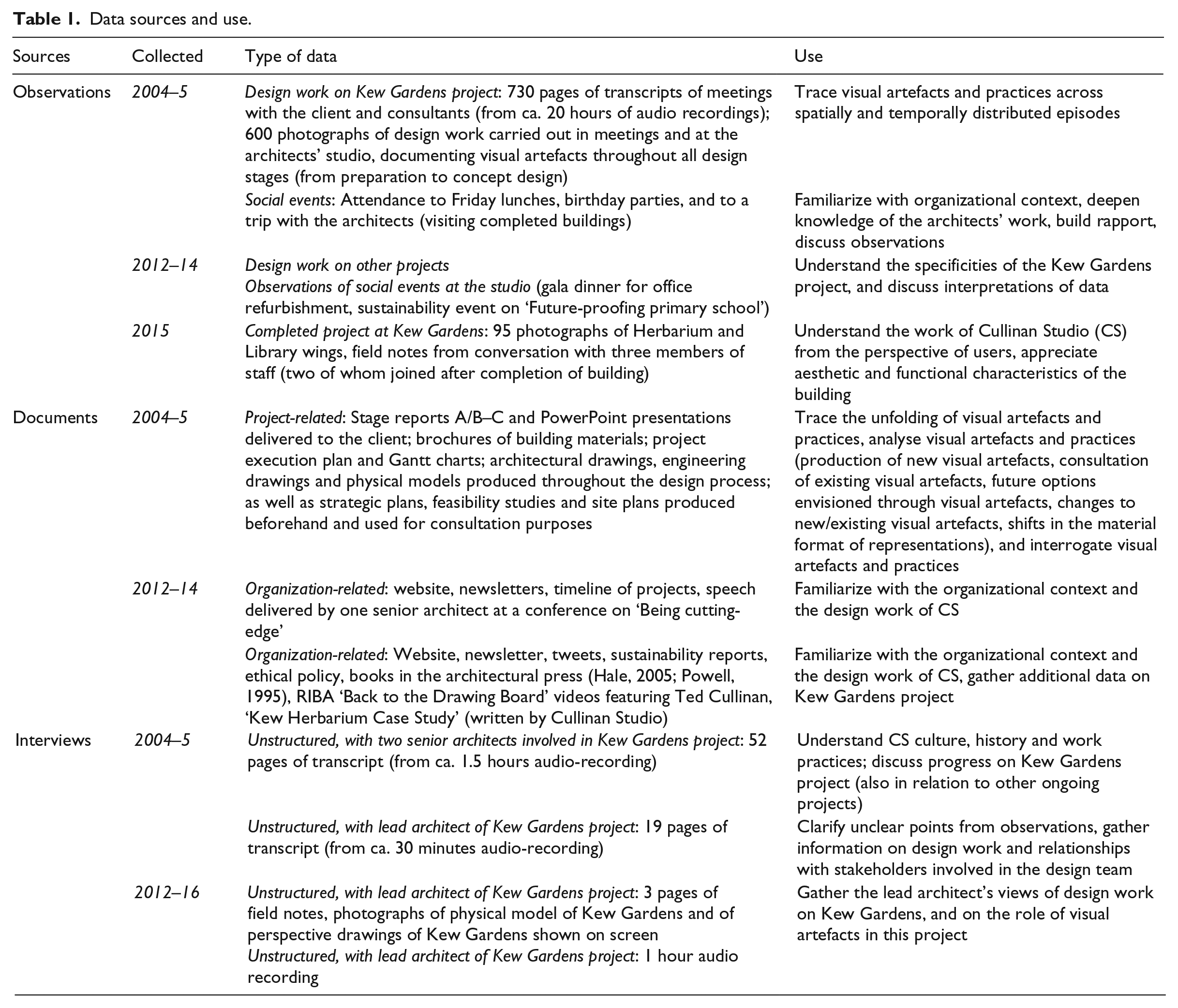
Our analyses focus on the core stages of the design process of Kew Gardens (June to November 2004), from preparation to concept design as described in the RIBA Plan of Work 2 followed by CS (RIBA, 2007). Stage A/B (preparation) involved understanding the strategic brief and other core project requirements; whereas Stage C (concept design) involved preparing outline plans for Kew Gardens. The two stages were linked by development of a procurement strategy, in which engineering consultants were appointed, and a project execution plan was used to allocate roles and responsibilities within the design team.
Data analysis
The first author took the lead in analysing data, refining interpretations through work with the second author and discussions with the architects. Observations were the primary source of data, while interviews and documents corroborated emerging interpretations. Informed by a phenomenological view of time, our analytical focus was directed to the present, as locus in which the future is continuously and collectively constructed (Hernes et al., 2013). We aimed to shed light on visual artefacts, and the practices in which they become mobilized to make the transition from abstract imaginings of the future to a realizable course of action.
Following the recommendations of strategy-as-practice and the ‘strong process view’ (Hernes et al., 2013; Vaara & Whittington, 2012), our analysis steered away from methodological reductionism. In particular, we strove to avoid reduction of visual data to verbal data (Boxenbaum et al., 2015) and reduction of organizational phenomena to isolated interactions – a problem known as ‘micro-isolationism’ (Seidl & Whittington, 2014). We followed an interpretive approach characterized by back-and-forth iterations between data and findings, and by intertwining of visual and verbal techniques. We shifted attention beyond the ‘here-and-now’ of single interactions, and instead traced artefacts across multiple episodes in which a realizable course of action was made. This approach consisted of five steps:
Developing multimodal views of episodes. For each episode observed in the field, 3 we organized data into tables that matched transcripts with photographs, and with documents produced or consulted by participants. This enabled us to see aspects that were not apparent from transcripts alone. For example, by matching transcripts of a design meeting with the drawings produced in the same meeting, we saw that architects had annotated some, but not all verbal requirements expressed by their users. We questioned whether such annotations had performative effects. As it triggered our curiosity, we considered this episode as a point of departure for drawing connections.
Drawing connections across episodes. Starting from the above episode, we drew connections to a network of related episodes. We did so by tracing visual artefacts (e.g. annotated drawings) as they evolved across episodes. We then produced a visual timeline, in which we mapped the participants and visual artefacts involved in each episode, and documented connections across episodes in terms of times and places of occurrence. Through further inspection of this timeline, we identified crucial episodes in which the future of Kew Gardens was crafted.
Analysing visual artefacts and practices. We analysed these episodes, with particular attention to visual artefacts and the practices in which they became enrolled to make a realizable course of action. For each episode, we noted (i) the production of new visual artefacts; (ii) consultation of existing visual artefacts; (iii) future options envisioned through new/existing visual artefacts, (iv) changes to new/existing visual artefacts (e.g. in the form of verbal/graphical annotations, marks and revisions); and (v) shifts in the material format of representation (e.g. from sketches on paper to drawings on file). This analysis was done manually by going through photographs taken across episodes, comparing different versions of drawings and plans, and using transcripts of interviews and meetings. We identified first-level codes of visual artefacts (e.g. ‘sketches on tracing paper’), practices (e.g. ‘translating verbal requirements into visual form’) and future options (e.g. ‘generation of new options’).
Interrogating visual artefacts and practices. We then questioned how visual artefacts and practices sustained the transition from abstract imaginings of the future to a realizable course of action. This involved uncovering relationships between codes, by interrogating how visual artefacts and practices were related to changes in future options. To this end, we used counterfactual questions (Durand & Vaara, 2009), for example: ‘what if the architects had not sketched on tracing paper in meetings with the users?’ We noted that the production and consultation of visual artefacts involved iterative expansions and reductions in the range of future options available at any point in time. We used interview transcripts to develop interpretations of such expansions and reductions; and the roles of visual artefacts. We then wrote accounts of how visual artefacts sustained future making.
Developing theoretical explanations of future making. We developed explanations of future making that are applicable to a wide range of organizational settings. Reflecting on our written accounts, we grouped practices within higher-level codes, which we labelled as imagining, testing, stabilizing and reifying the future. We also refined our first-order codes to characterize visual artefacts at a higher level: We captured the assembling and evolving of visual artefacts from more sketchy to more definite forms; and noted changes in the views of future that they envisioned (from more provisional and partial, to more stable and holistic), as well as in the acts that they performed (from more informative to more persuasive).
Findings
Future making in the Kew Gardens project
Our findings suggest that visual artefacts became constitutive of four practices: imagining, testing, stabilizing and reifying – through which practitioners envisioned future options. In the Kew Gardens project, future making did not unfold linearly but instead involved frequent iterations across practices, as already reified imaginings became adjusted to accommodate emerging requirements. In the words of a senior architect, this:
was fantastically complex, because there were dozens of different departments, and many different people, and all had competing demands … There were changes in the [strategic brief] all the way through, and [this occurred] at the same time as we were changing our ideas, and refining our ideas [in response] to the brief.
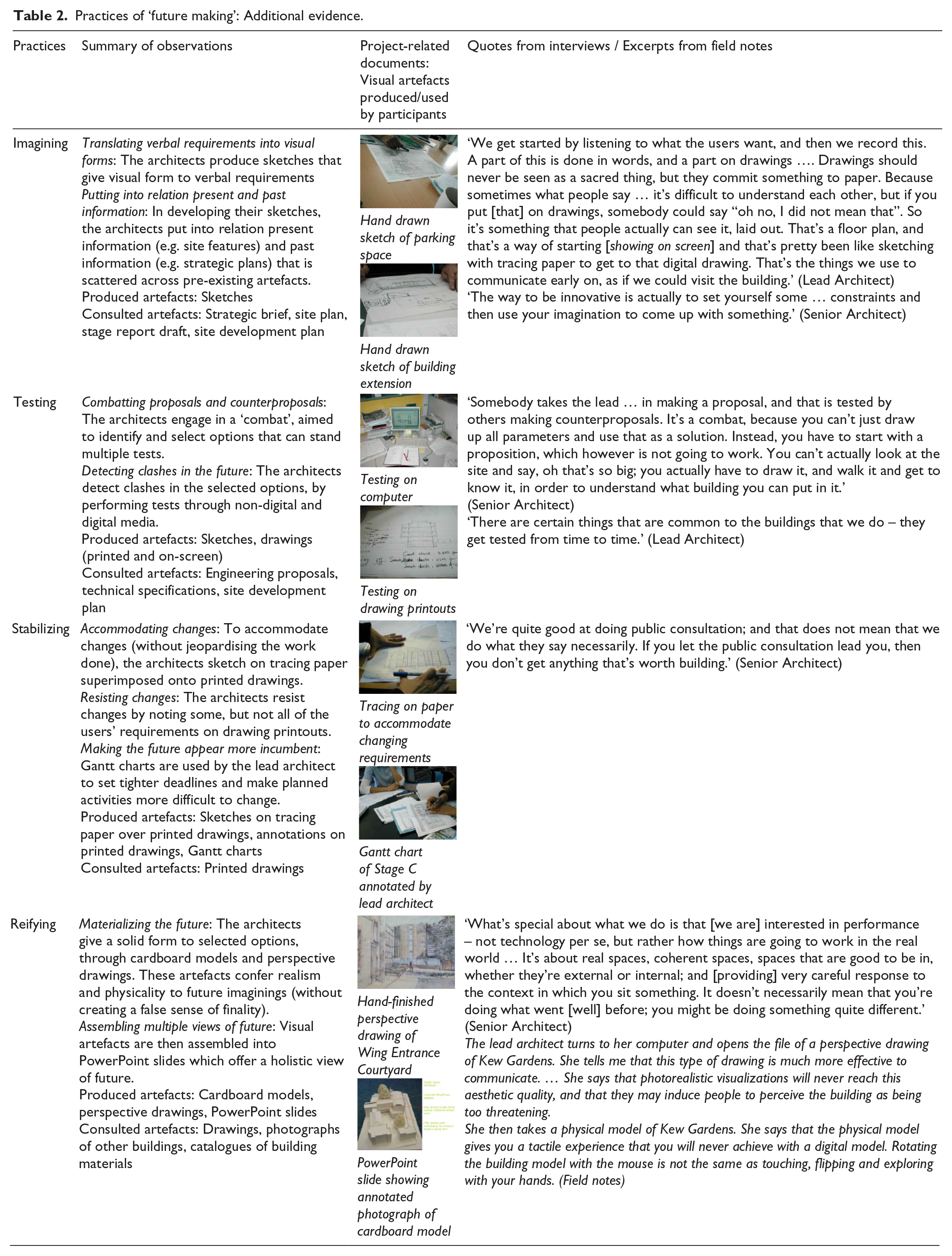
In the following, we present future making in the Kew Gardens project, through accounts of imagining, testing, stabilizing and reifying with visual artefacts. Table 2 supports and provides additional evidence for our findings.
Practices of ‘future making’: Additional evidence.
Practice 1. Imagining with sketches and pre-existing artefacts
Imagining involved the generation of future options for the development of Kew Gardens. This started with the architects listening to their clients, with a view to translating verbal requirements into visual forms. Here, the strategic brief played a central role, outlining the clients’ requirements as to the outcomes of the development strategy. Such outcomes included: a new building that could accommodate accessions of rare books and specimens for the next 30 to 50 years, (re-)organized office spaces across new and existing buildings, and a carpark that could enhance the setting of Kew.
In response to the strategic brief, the architects invited their engineering consultants at CS. A few days after the project kick-off, they held a design meeting to discuss future options for the carpark. This was attended by four participants: the lead architect, the founder architect (Ted Cullinan), a service engineer and a structural engineer. As they engaged in conversation around the strategic brief, the two architects captured their thoughts through a felt-tip pen sketch on tracing paper laid over a site plan.
The sketch of the carpark was produced through consultation of pre-existing artefacts: not just the site plan laid under the tracing paper, but also a draft of Stage A/B report (which included the architects’ response to the strategic brief). This report contained results of an environmental assessment of the site, and was consulted for information on existing features (e.g. listed trees). Another pre-existing artefact that gave shape to the architects’ sketch was a site development plan, which illustrated proposed extensions on the east and west sides of the existing Herbarium. It suggested relocating the carpark from the riverside to the rear of the existing Herbarium, and incorporating the existing staff carpark to provide 256 parking spaces. This document had been prepared two years earlier by another architectural studio, and was included in the strategic brief for consultation by CS architects.
While only a provisional representation of the future, the sketch of the carpark aspired to be realizable by putting into relation present and past information. This was achieved as the architects incorporated present constraints into the sketch (e.g. listed buildings, trees and walls) and considered suggestions from strategies formulated beforehand (site development plan). Yet, the site development plan became contested as the architects’ sketch revealed inconsistencies with existing features of the site. The lead architect explained that the vehicle access option suggested in the site development plan ignored significant trees and encroached onto a listed wall. Furthermore, the architects and engineers doubted that the carpark could fit 256 parking spaces, and noted a lack of information on the strategy underlying the site development plan.
The architects’ sketch embodied, instead of avoided, uncertainty about the past and future. It became reworked, retraced and annotated with calculations of capacity requirements for the carpark. As the option outlined in the site development plan was questioned, alternative options began to take shape as sketches on tracing paper. One alternative option depicted a chicane around an existing building, while another option consisted of a one-way circular flow for entering and leaving the carpark. As architects and engineers engaged with sketches, they took notes on their notepads: questions about as-yet-unknown information, or hunches about potentially viable options.
Yet uncertainty about capacity requirements and site features was high; so it was not possible to ascertain the feasibility of the different options. The architects, therefore, suspended design and made a note to request additional research on the part of traffic engineers. The future options for the carpark were temporarily left open. The conversation shifted towards other aspects of the development strategy, notably the intended use of existing and new buildings. The lead architect engaged in a free flow of thoughts, envisioning an ideal future in which offices were located within existing buildings facing the river; and a fully-fitted building was designed for Herbarium and Library storage. But she immediately rejected this as ‘pie in the sky’, an unrealistic imagining that overlooked interdependencies among departments. To make things realizable, architects and engineers resumed making sketches that put into relation figures gathered from pre-existing artefacts (the strategic brief, the Stage A/B report and the site development plan).
Practice 2. Testing with sketches and drawings on printouts and screen
As the project moved towards conceptual design, the architects became concerned with advancing future options that could stand multiple tests as to site constraints and client requirements. Instead of picturing a future perfect and seeking to realize it, they engaged in what they called ‘combatting’ proposals and counterproposals. As a senior architect explained (in an interview), this consists of a team member taking the lead in developing a proposal, which then is tested by others making counterproposals. Here, testing is described as a ‘combat’ because of the elusive nature of imaginings and the dialectical opposition of proposals and counterproposals.
Visual artefacts play an important role in this ‘combat’. A wide range of such artefacts were mobilized to test imaginings of the future. In one design meeting, the architects tested options for vehicle site access, which in the meantime had been formalized by traffic engineers into four technical proposals. The lead architect informed her colleagues in the meeting (Ted Cullinan, two senior and two junior architects) that the client had expressed a strong preference for the first option, outlined in the site development plan. Initially contested by the architects, this option was reassessed as feasible, since traffic engineers had made provisions for protecting listed trees and walls by using an existing route for in-and-out access.
The architects thus began testing the first option, while considering the three alternative options as back-ups to which they could resort in case the first option failed their test. The test involved drawing a more detailed proposal for inclusion in Stage C report (conceptual design), which proved that the carpark could actually accommodate 256 parking spaces. As the architects were striving to address the question of space, the proposal included in the site development plan became tested against multiple drawings, sketches and texts that acted as critical voices in the ‘combat’. By comparing verbal, visual and numerical information across such documents, the architects began realizing that the test of space was not satisfactorily passed.
A hand-drawn sketch by Ted raised a counterproposal to envision the carpark on two decks so as to meet the 256 parking spaces requirement. This would have made the first option viable, avoiding the need to fall back on non-preferred options. Yet Ted’s sketch became contested as access to the two-deck carpark involved going through a protected area and hence would have ‘start[ed] fiddling around with trees and stuff’ (lead architect). This ‘combat’ between the site development plan proposal (one-deck carpark) and Ted’s counterproposal (two-deck carpark) was orchestrated through a textbox on the ground-floor plan, which gave capacity requirements, while raising new questions as to cycle spaces: ‘230 spaces, 28 disabled spaces, 22 motorcycles spaces, and XX cycle spaces’.
As Ted’s counterproposal gradually emerged as the most feasible, the lead architect and the junior architects started detecting clashes in the future. This involved making the ‘winning’ option stronger, by addressing questions such as how to allocate spaces across car spaces, disabled spaces, motorcycle spaces and cycle spaces. Both digital and non-digital media were mobilized to fit such spaces within a relatively tight area, and show feasibility across plans (i.e. ground and lower-level plans). Multiple representations of the carpark were compared and contrasted across different media: sketches on paper, and drawings on printouts and screen.
These tests enabled the architects to cross-check their drawings, and hence to detect clashes in their imaginings of the future. By switching across media, they incorporated corrections into increasingly robust representations of the carpark (maintained simultaneously on paper and on screen). The digital medium reduced measurement errors, allowing data about the carpark and the wider plan to be coordinated. It enabled the architects to interrogate their imaginings by exploring how even small changes in the carpark brought consequences for the site plan. Yet the architects reverted frequently to non-digital media, printing out and annotating drawings with felt-tip pens. This allowed swiftness in adjusting drawings, before further changes were digitalized and subsequent tests were performed on computer.
Practice 3: Stabilizing with sketches on tracing paper, annotations on printed drawings and Gantt charts
After extensive testing, the architects became concerned with stabilizing their imaginings of the future into a report, which outlined the conceptual design of Kew Gardens (Stage C report). This involved getting approval from future users, by going through drawings of interior spaces with archivists, librarians and IT staff. While revisions of design proposals were anticipated, one architect was hoping that: ‘it’s just minor stuff and comments on text, and it’s not going to be new drawings’. Yet the users advanced multiple, ebbing and flowing requirements, which triggered changes in the building design. Here, the architects achieved stabilization by mobilizing different visual artefacts to accommodate or resist changes, and to make the future appear more incumbent.
The production of sketches on tracing paper was instrumental in accommodating changes (while preserving the work done to date). We observed a meeting with Information Services Department users in which the office space was redesigned. These users felt the office space did not meet a requirement to fit 75 users, and expressed concerns about the allocation of spaces across functions. The lead architect adjusted the office space by sketching on tracing paper over the first-floor plan, while listening to the users’ comments on the layout that was being refined (Figure 1, left). This reflected a willingness to adjust existing plans, without nevertheless jeopardizing the work that had been done to date (which was preserved in the existing plans, laid under the tracing paper). The users were participating actively by providing input on interdependencies between department functions, and the corresponding breakdown of spaces. Work continued at the architects’ studio, and involved iteration to testing: CAD was used to check that 75 users plus furniture and equipment could fit on the ground floor. The lead architect explained to users, ‘We can do a quick test on our CAD library to see if you can fit the workstations and people in that space, and then you may want to define who sits where’.
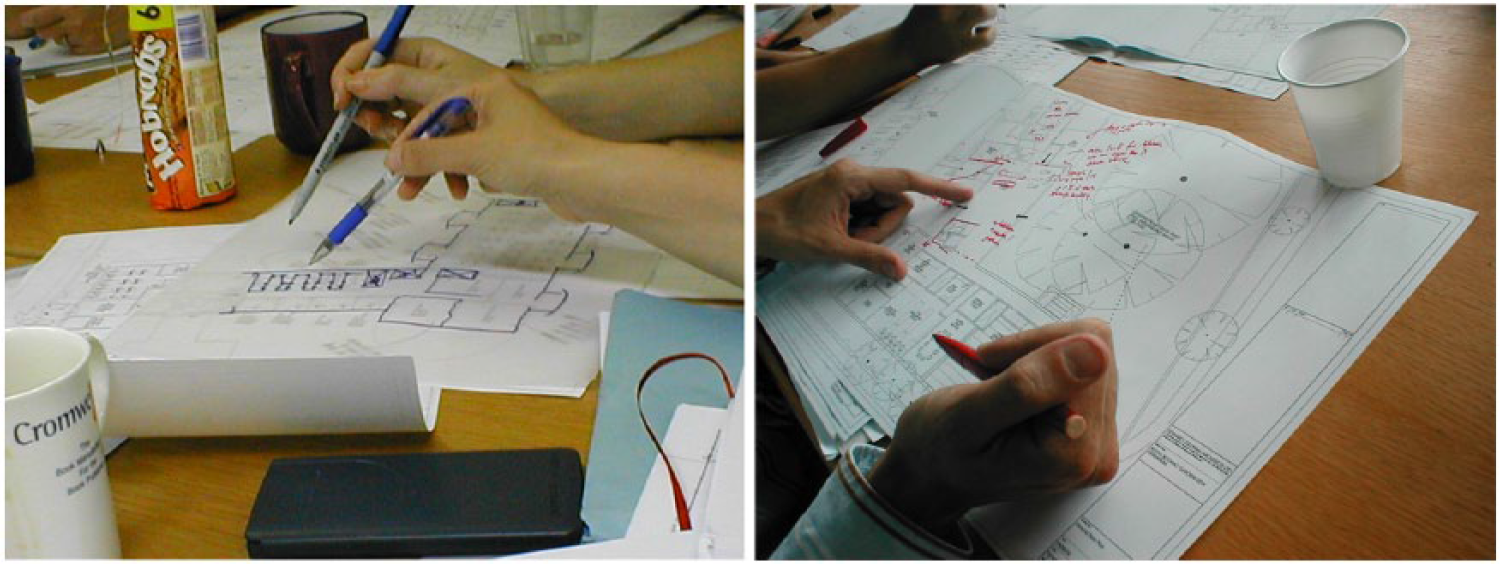
The architects sketching on tracing paper over existing plans (left) and annotating existing plans (right).
Annotations on printed drawings, on the other hand, were used to resist changes. In a meeting with librarians, it became apparent that the revised ground-floor plans had become inconsistent with space requirements for the Library. The addition of a reception area for deliveries of bulk orders to the Information Services Department had caused a loss of space to library storage. Instead of actively suggesting and sketching new solutions, one of the architects used a red felt-tip pen to annotate the printed drawings. He captured the librarians’ requirements in the form of verbal, visual and numeric notes (Figure 1, right). To quickly test the feasibility of the librarians’ requests (without iteration to the computer), the architects consulted figures included in the Stage A/B report – calculations of shelf requirements, and of areas to be vacated.
Annotating printed drawings was instrumental in reaching stabilization, but involved unspoken assumptions about what should (not) be taken for granted in making imaginings realizable. Here, the architects noted some, but not all, of the librarians’ requirements. For example, they verbally acknowledged the request to add a gents’ toilet on the first floor but did not annotate this on drawings. Therefore, this request was not realized. The architects resisted a request which would have triggered changes in occupancy figures (though the issue resurfaced at a later stage during a presentation to all users).
Stabilization was also achieved by making the future appear more incumbent through use of visual timelines such as Gantt charts (laid out on meeting tables and shared through the intranet). In a meeting with managers and users from different departments, the lead architect used deadlines on Gantt charts as instruments in ‘pushing’ for stabilization in the building design. For example, she noted it was crucial to anticipate the planning application, since a new regulation would have entered into force after the scheduled date. The revised deadlines thus made the future more incumbent and materialized the intention not to further postpone the planning application.
While accepting the need to anticipate the planning application, a manager expressed concerns about the schedule envisioned by the architects. In his words: ‘we want to make sure that the programme is realistic and achievable and not put down something which we can’t achieve’. He proposed that a consulting company should assess the programme through critical path analysis. The lead architect agreed to have consultants aboard, but she suggested ‘adding much more detail under every bar [of the Gantt chart] about what’s going on in each stage’. Detailed schedules of activities, such as meetings with Kew Gardens’ Board of Trustees, made milestones and deadlines hard to change, reducing the scope for further iterations.
Practice 4: Reifying with cardboard models, perspective drawings and PowerPoint slides
After stabilizing their imaginings of the future, the architects engaged in practices aimed at reifying such imaginings. This involved materializing the future by producing visual artefacts that conferred concreteness, realism and physicality to future imaginings (without nevertheless creating a false sense of finality). One such artefacts was a cardboard model of the future building, placed on a large board featuring Kew Gardens with existing buildings and site features. Figure 2 portrays model work at CS, with the architects working together to draw, cut and assemble the physical model out of recycled materials (e.g. cardboard, plasticine and wood).
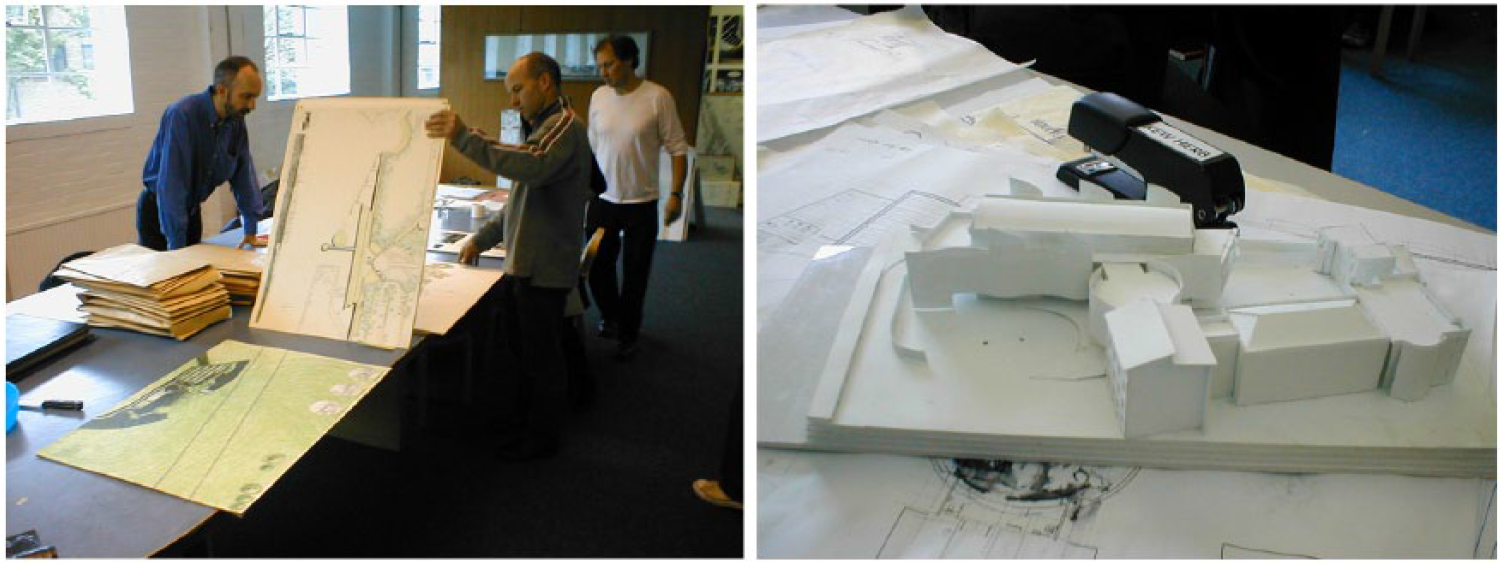
Model work at Cullinan Studio.
Through model work, imaginings of the future were given not just visual but also material form. Unlike conceptual drawings, the cardboard model gave a character of realism to the yet-to-be building. Yet, it focused on essential forms instead of conveying a detailed experience of the building. The use of recycled materials, in particular, conferred a raw appearance to the building. This reflected the architects’ concern with making a model that was reasonably sure of itself, without leading the users astray with a false sense of finality. The architects used the model not to pitch their development strategy, but to prompt further reflections. To this end, they produced and circulated to the client a PowerPoint slide with a photo of the model, annotated with questions that arose from inspection of the model itself.
Perspective drawings reflected a similar concern for reifying imaginings of the future, without conveying a false sense of finality (Figure 3). They made the building appear more realistic, offering a three-dimensional view as experienced in real life (instead of the conceptual views of plans, sections and elevations). They brought the building to life, using human figures to size objects in perspective, and to show use of interior spaces. Perspective drawings were realized with AutoCAD, then printed out and finished in watercolours. The lead architect argued that this mix of computer-generated and hand-drawn features enabled users to buy into the possibility of a building that was not yet there. In contrast, photo-realistic renderings in AutoCAD were not used as they were understood to be too pretentious in claiming that the building was real.
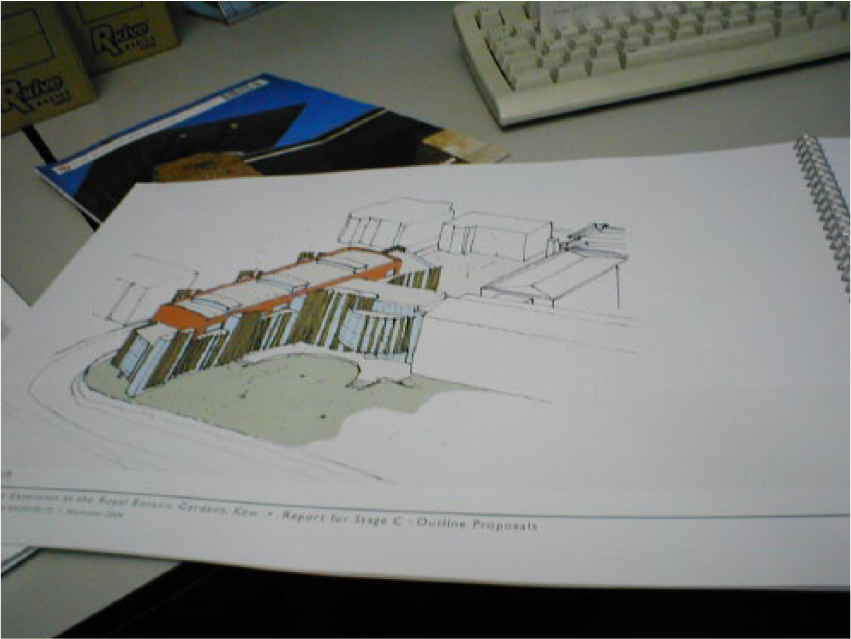
Perspective drawing included in Stage C report.
The delicate aesthetics of perspective drawings was also strategic in convincing important constituencies that the building extension would blend in nicely with the surrounding environment. Perspective drawings catered to the need of the client, who wanted the building to look subdued rather than prominent (client’s manager), so that it did not compromise approval of this and future projects. Indeed, perspective drawings succeeded in reassuring the planning authorities about the visual impact of the building, whereas photo-realistic renderings might have been perceived as being ‘too threatening’ (lead architect, interview). Concern to avoid such a perception influenced development of the Stage C report, in which hand-coloured perspective drawings were placed next to verbal statements acknowledging the sensitive nature of the site, and speaking of a ‘lightweight aesthetic’ of the new building (Cullinan Studio, 2004; p. 14).
Other visual artefacts used by the architects were PowerPoint presentations. Such artefacts enabled reification by assembling multiple views of the future. They collated the most important representations produced, including photos of the cardboard model and perspective drawings. In a review meeting with users from all departments (at the end of conceptual design), the architects showed a PowerPoint presentation that envisioned the yet-to-be building in its entirety. They took the users on an imaginary journey throughout the building, floor by floor, and from general to detailed views – starting with architectural drawings that showed the building plans, sections and elevations, and then going into technical drawings that showed details of the compactors, shelves and ducts.
Through PowerPoint slides, imaginings of the future were brought together. As they navigated the spaces laid out on slides, the architects envisioned future uses of the building, describing trajectories of visitors, cars and parcels coming in and out. The past was also persuasively mobilized throughout the slideshow. For example, when talking about the library fittings envisioned for the new wing, Ted made reference to a building he had designed for the Faculty of Divinity in Cambridge. This conferred robustness to future imaginings, suggesting they were backed by long-standing experience in architectural design. The building became even more ‘real’ as Ted talked about the materials of the facade, which he showcased by collating photographs of other buildings on slides, and circulating printed catalogues of building materials. Even if such artefacts did not illustrate the yet-to-be building, they created a sense of possible reality by giving a feeling of how the future might look. In Ted’s words:
What you are beginning to see is the idea of a building which is almost visibly an archive box … with lightweight additions, which are these little cantilevered offices. This drawing is showing how they might be; they might be made in copper. The next drawing shows how they would be if they were made of green materials, which is also what we used to make our School and Library in Greenwich…
Although used to reify the future, PowerPoint slides embedded uncertainties – in the form of textboxes summarizing design issues to be addressed. These uncertainties were brought to the fore by the lead architect, who engaged the users in conversation to tie up what she viewed as loose ends in the building design. Still other aspects that were taken for granted by the architects were pointed out as problematic by users. One librarian noted the absence of a gents’ toilet on the ground floor. The request to add a toilet had been raised by the librarians in an earlier meeting, but had been resisted by the architects. It was neither recorded as annotations on plans nor implemented as design change. Addressing this issue meant that the architects iterated back to testing, and re-imagined the layout of the ground floor. As the lead architect noted:
We need to go through a final occupancy check, look at the occupancy of the existing building and the new wing, and then do a final check on the total number of toilets between this building and the old one.
From abstract imaginings of the future to a realizable course of action
By reflecting on our accounts, we elaborated on future making as a perspective whereby practitioners orient themselves towards the future. We see this as applicable across a wide range of organizational settings (beyond the Kew Gardens project). In future making, practitioners engage with the artefacts at hand to give form to future options, in the face of present constraints. Visual artefacts are constitutive of four practices – imagining, testing, stabilizing and reifying. In imagining, future options are crafted by translating verbal requirements into visual forms, and putting into relation present and past information. In testing, some options are discarded in a ‘combat’ between proposals and counterproposals, while others are advanced and strengthened (e.g. through detection of clashes). In stabilizing, practitioners prevent what they deem to be an unnecessary expansion of future options, by using visual artefacts to accommodate or resist changes, and to make the future appear more incumbent. In reifying, stabilized options are assembled and materialized into more definitive artefacts, so as to envision a ‘big picture’ for the future (without nevertheless creating a false sense of finality). Future making does not unfold linearly but rather involves manifold iterations, as already reified options become adjusted or challenged (as in case of the architects’ PowerPoint presentation). Therefore, practices of imagining, testing, stabilizing and reifying should be conceived as recursive ways of doing with visual artefacts, through which the future is made into being.
Through further reflection on our accounts, we identified three higher-order findings about visual artefacts, which explain how they enable the transition from abstract imaginings of the future to a realizable course of action. These findings transcend specific types of visual artefacts (e.g. CAD drawings), and instead characterize visual artefacts based on the type of views of future that they envision, and the type of acts that they perform. As explained below, we found that the transition from abstract imaginings of the future to a realizable course of action is performed as visual artefacts are evolved and assembled to envision an increasingly stable and holistic view of the future; and become increasingly used for persuading rather than merely informing.
From provisional to stable views of future
As they are worked throughout future-making practices, visual artefacts envision an increasingly stable view of the future, appearing as realistic representations of a not-yet-existing state of things. Whereas the visual artefacts used in practices of imagining provide the means by which a not-yet-existing state of things is made available for further work, the visual artefacts produced in practices of reifying represent fully stable views of the future (without nevertheless conveying a false sense of finality). This shift is made possible through practices of testing visual artefacts across digital and non-digital media, and stabilizing such artefacts against attempts to return to a more provisional state. The architects, for example, sketched on tracing paper to keep the underlying drawings stable, made annotations as means to resist requested changes, and mobilized Gantt charts to make planned activities harder to change.
From partial to holistic views of future
In the transition to a realizable course of action, the view of future expressed by visual artefacts becomes not just increasingly stable, but also increasingly holistic. For example, the sketches produced in practices of imagining represented partial views of the future of Kew Gardens, such as the carpark, the reorganized interiors, or the new building. As visual artefacts are evolved, partial views are tested, stabilized and reified into more holistic views of the future, which show how plans for the future have been worked out in all their aspects. To tie up loose ends, holistic views can be re-fragmented into partial views, and then composed again (as in case of the architects’ PowerPoint presentation, which became reworked in some of its aspects).
From information to persuasion
As they are assembled and evolved throughout future-making practices, visual artefacts become increasingly used for persuading, rather than merely informing. In practices of imagining, visual artefacts carry information about present constraints and past strategies; and perform the work of translating information from verbal to visual. In testing, they become the cornerstone against which future options are evaluated, providing information about clashes between future imaginings and present constraints. In stabilizing, they are used to selectively accommodate requests from audiences and to make some information more difficult to change (as in the example of plans laid under the tracing paper). They also persuasively highlight temporal information so as to create a sense of urgency and need for closure around future options (as in the case of Gantt charts). In reifying, they strive to persuade about the feasibility of the future options they represent (without nevertheless deceiving with a false sense of finality).
Taken together, these findings indicate that the performativity of visual artefacts cannot be specified a priori based on their characteristics, but instead is the product of situated practices that unfold in time and space. Our accounts, in fact, suggest that visual artefacts play different roles in different practices of future making, and the same visual artefact can be enrolled in different practices of future making. For example, sketches on tracing paper sustained imagining when used to transfer information from an underlying artefact, but they also assisted stabilizing when used to accommodate changing requirements within existing plans.
Discussion
The future-making perspective that we articulate advances current theories of strategizing and organizing for the future. It offers a phenomenological understanding of how practitioners engage with visual artefacts to make a realizable course of action for the future. Viewing practitioners as operating in an ongoing present foregrounds the challenges that they experience in giving form to abstract imaginings of the future. The agency of practitioners transpires in making what they deem to be a realizable course of action, given the uncertainties that the future poses. Realizability is achieved not through retrospective sensemaking, but through present-tensed practices of imagining, testing, stabilizing and reifying with visual artefacts. This section discusses how future making relates to other perspectives on the future, and its implications for research on visuality and materiality in strategizing and organizing.
Extending current perspectives on strategizing and organizing the future
Future making differs from, and adds to, other phenomenological perspectives on the future, which we labelled as foreseeing, future perfect thinking and wayfinding (Table 3). These focused on the cognitive work whereby practitioners make sense of the future (foreseeing and future perfect thinking), or emphasized the habituated actions by which a spontaneous order emerges (wayfinding). Although an existential entwinement with the world is recognized (e.g. Ericson, 2014), little attention has been paid to the practical work of making a realizable course of action for the future.
Future making vis-a-vis current perspectives on strategizing and organizing for the future.
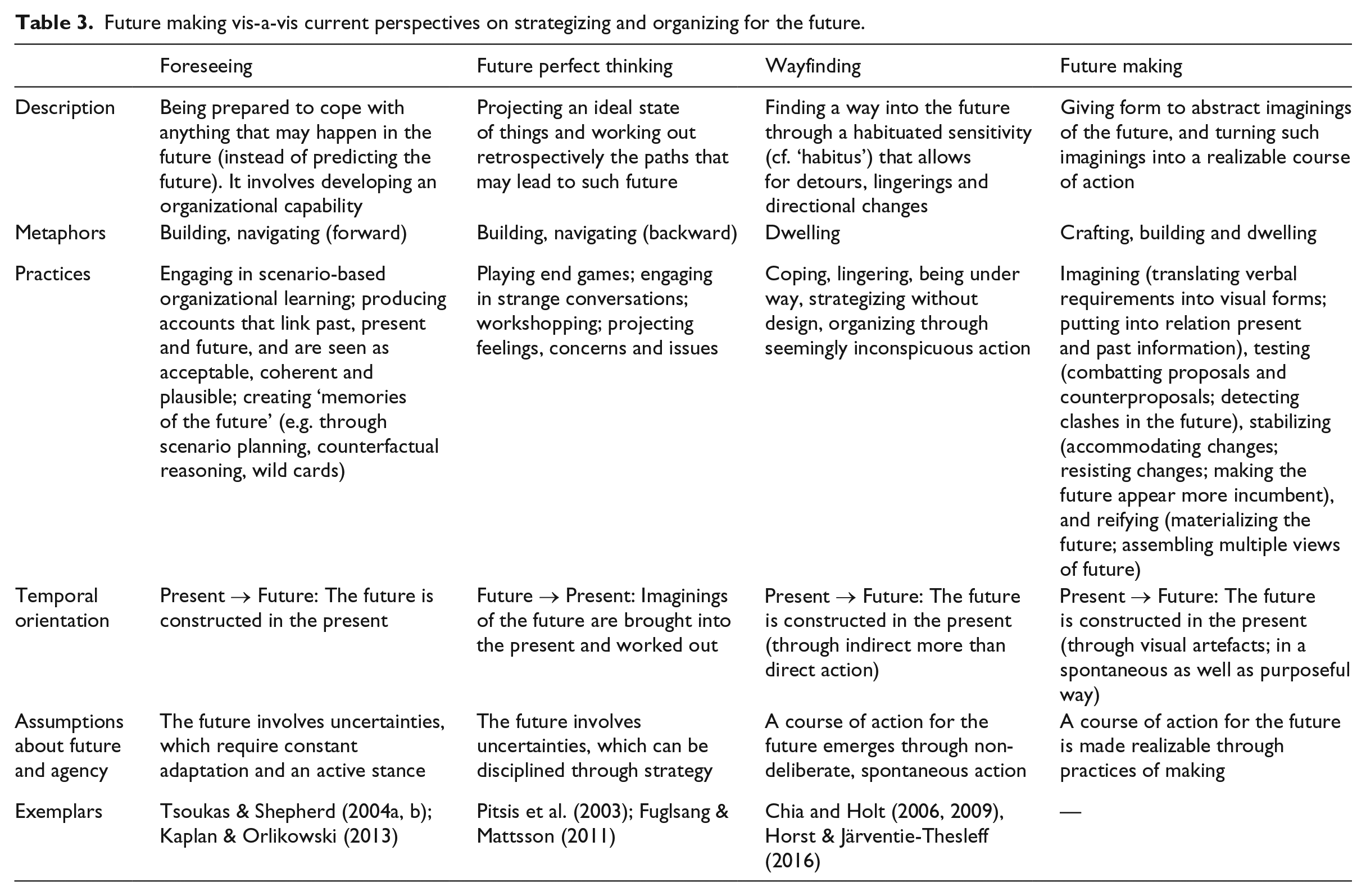
Future making brings into view the visual artefacts and practices by which abstract imaginings of the future are given form, and are turned into a realizable course of action. It foregrounds the sensorial dimension of practitioners’ orientation towards the future. This involves practitioners sensing the future through visual artefacts, and in so doing becoming aware of uncertainties of which they did not know. Here, thoughts and words do not precede action: instead, practitioners think and talk as they engage with visual artefacts to give shape to possible futures. Such futures are made not merely through production of talks/texts, but rather through recursive ways of doing – practices of imagining, testing, stabilizing and reifying.
Compared to foreseeing and future perfect thinking, future making shifts attention from the cognitive work by which practitioners make sense of the future, to the practical work that practitioners do to make a realizable course of action for the future. In future making, visual artefacts embody the work of practitioners crafting imaginings of the future, rather than an idealized projection (future perfect thinking) or a rationalized account of the future (foreseeing). This practical work is partly driven by a preconceived design or strategy for the future, and partly lodged into the habituated actions that practitioners deploy as they dwell into visual artefacts.
Future making draws on wayfinding, by taking aboard the suggestion that ‘human as well as non-human beings, such as tools and equipment are entwined in practice worlds’ (Ericson, 2014, p. 10; Sandberg & Dall’Alba, 2009, p. 1356). It begins to unpack the notion of ‘entwinement’ in relation to the lived experience of practitioners (Ericson, 2014, p. 12), which at present is only sketched in theories of wayfinding. In particular, it articulates how human actors and visual artefacts entwine to ‘make’ a realizable course of action for the future. It characterizes the visuality and materiality of the ‘tools and equipment’ (Ericson, 2014, p. 10) to which practitioners entwine, and explains their performativity in giving form to organizational futures.
While drawing on wayfinding’s concept of entwinement with the world, future making does not suggest that a course of action for the future emerges in a spontaneous way, as practitioners dwell in the world and tools they use. It also takes distance from more rationalistic perspectives such as future perfect thinking and foreseeing, which assume that the future can be ‘talked into being’ through deliberate planning or learning. These three perspectives (foreseeing, future perfect thinking, wayfinding) have juxtaposed building and dwelling as opposite modes of strategizing and organizing for the future. The building mode is exemplified by practitioners constructing mental representations of the world, whereas dwelling ‘precedes any subject–object distinction and hence any explicit reliance on mental content. It is not the agent him- or herself that gives meaning to his or her activities but the fact of each agent always being under way’ (Chia & Holt, 2009, p. 128).
Future making reconciles, instead of juxtaposing, building and dwelling: the future is made through the intertwining of these modes of strategizing and organizing. In future making, the future emerges under way as practitioners combine building and dwelling. This is done by allowing for detours, lingerings and directional changes, while at the same time striving to assemble a big picture that makes the transition to a realizable course of action. For example, in the design project that we observed, the architects allowed for constant adjustments in the face of ebbing-and-flowing requirements from the client. Yet they also steered future making by seeking to persuade the planning authorities, or striving for closure when they felt that further adjustments would only delay the project.
Future making adds to current debates on temporality and agency (Emirbayer & Mische, 1998). While sharing the assumption that the future is constructed in the present, current perspectives differ in their conceptualization of agency. Foreseeing encourages an active stance in strategizing and organizing, suggesting that the future is created by human beings linking interpretations of the past and present. Future perfect thinking goes as far as to argue that strategy can discipline the future, as its projections of ends reverse the arrow of time and mould actions in the present. Wayfinding, on the other hand, brings into view human beings and their motion in a world that is continuously becoming, but confers little intentionality to human beings finding way in the world.
Future making shares the sense of living in an unfolding present that is typical of wayfinding. However, its conceptualization of agency differs from that of wayfinding (and of the other phenomenological perspectives): Future making acknowledges deliberate attempts at strategizing and organizing, in addition to the coping actions that practitioners deploy in their everyday activities. It suggests that a realizable course of action can be made through engagement with the material world, without assigning primacy to human agency. The future is seen as the product of unfolding practices inscribed in visual artefacts (rather than the product of human agencies enlisting visual artefacts as instruments). Yet the course of action that emerges from practices of future making enables actors to make a difference to a world that is in continuous becoming. Here, visual artefacts set transformation in motion, in that they give form to abstract imaginings of the future, and in so doing contribute to make a future that would not otherwise be (or that would perhaps take a different form).
In establishing future making as a phenomenological perspective on the future, we note that its distinguishing traits are the intertwining of imagining, testing, stabilizing and reifying, as well as the back-and-forth movements across the four practices. We acknowledge that the practice of imagining, for example, is to be found also in other perspectives – such as future perfect thinking. However, the nature of imagining differs across the two perspectives, in terms of the agency of human actors, and the temporality of the perspectives (with future perfect thinking assuming high agency and backward temporality). Other practices, such as testing, are completely extraneous to perspectives that emphasize the emergence of order through spontaneous action (wayfinding), as well as to perspectives that assume that an unquestionable picture of the future will trigger immediate action in the present (future perfect thinking). We therefore suggest that these four practices, taken together rather than in isolation, lodged in visual artefacts rather than only in words, and considered in an iterative rather than linear movement, are constitutive of future making.
Advancing understanding of visual artefacts and their performativity
Our work contributes to research on visuality and materiality (Dameron et al., 2015; Meyer et al., 2013). It extends previous research, which explored the roles of artefacts such as Lego bricks (Roos, Victor, & Statler, 2004), strategic maps (Huff & Jenkins, 2002) or visual templates (Eppler & Platts, 2009) in strategizing and organizing. While this research has linked specific types of visual artefact to the (strategic) actions observed at any given point in time (e.g. in strategy workshops), we show how the same artefacts may perform different roles over time. Instead of bracketing visual artefacts in space and time, we traced how they unfold to constitute the practices whereby a realizable course of action for the future is ‘made into being’.
Future making shows that visual artefacts are necessary to making a realizable course of action for the future. This necessity lies in the relationship between the materiality (and the ‘now’) of visual artefacts and the immateriality (and ‘not-now’) of future. Visual artefacts are performative, because they give form to an immaterial future through lines, materials and shapes that can be interrogated in response to present and past constraints. By so doing, they bring an imagined future (not-now) into the present (now), and make it amenable to further work. Visual artefacts, therefore, perform temporal and formative work: through practices of imagining, testing, stabilizing and reifying, a course of action for the future is made realizable. Realizability is achieved, for example, by using visual artefacts to put into relation present and past information, to detect inconsistencies in imaginings of the future, and to accommodate changes that emerge in the present.
This conceptualization of performativity differs from that of a teleological perspective, whereby visual artefacts depict a deliberately vague (and maybe not even attainable) end that nevertheless mobilizes commitment (Kornberger & Clegg, 2011). It also takes distance from a more instrumental perspective, which suggests that visual artefacts are endowed with affordances (Jarzabkowski & Kaplan, 2015) that enable practitioners to plan for the future (Sarpong & Amankwah-Amoah, 2015). In future making, visual artefacts are not immutable mobiles (teleological perspective) or mere tools for mapping uncertainties about the future (instrumental perspective). Rather, they are unfolding representations, which materialize imaginings of the future that are yet to be made realizable (through practices of imagining, testing, stabilizing and reifying).
They sustain the transition to a realizable course of action, by enabling practitioners to not only produce knowledgeable representations of the future (as ‘epistemic objects’, Ewenstein & Whyte, 2009), but also to perform spontaneous actions. They are not just ways of building, but also ways of dwelling. A realizable course of action for the future emerges as visual artefacts invite dwelling into their lines, materials and shapes, and gradually come to embed a purposeful design for the future. In future making, visual artefacts are used to validate proposals, resist counterproposals and reach closure. Yet they also allow for unplanned detours, lingerings and directional changes. The use of visual artefacts in future making, therefore, involves an interplay of building and dwelling, and is sensorial rather than instrumental, teleological or epistemic.
Limitations and future research
Although our empirical work focuses on a design project, our insights are transferable to similar contexts in which practitioners engage with the artefacts at hand to make a realizable course of action for the future. These contexts include entrepreneurial venturing, strategy planning and even curriculum development in higher education – more generally, all contexts of strategizing and/or organizing for the future. In the case of entrepreneurial venturing, for example, the artefacts in use are business plans, business models and financial plans. We expect these to be evolved in practices of imagining, testing, stabilizing and reifying; through which a not-yet-existing business is ‘made into being’. A business plan, for example, might be evolved from more provisional to more stable forms (e.g. from a business model canvas to a fully-fledged document), and might be used to assemble other artefacts (diagrams, spreadsheets, photographs) into increasingly holistic views of the business – which can persuade investors about its viability.
Future making, therefore, offers a theoretical framework on how visual artefacts enable the making of organizational futures, across a wide range of settings. It should be noted, however, that the pictorial, textual and notational components of visual artefacts (Elkins, 2001) may differ across such settings – for example, the pictorial component of visual artefacts is particularly prominent in architectural design (compared to other contexts of strategizing and organizing for the future). While our choice of setting was instrumental to foreground such component, future research may explore how ‘less pictorial’ artefacts sustain the transition to a realizable course of action. Here, the pictorial component is not to be ignored, but rather its role is to be understood in relation to other, more prominent components. Future research may also explore how more ‘pictorial’ artefacts such as 3D models, drawings and sketches are used in contexts that are less ‘visually-oriented’ than architectural design (and yet are equally ‘future-oriented’). This is important, since such artefacts have become increasingly popular in management practice (along with the diffusion of the design-thinking paradigm). This research agenda will advance our understanding of how different types of visual artefacts contribute to reify a not-yet-existing state of things.
Future scholars may also build on our insights to further explore the entwinement of human and non-human agencies in future making, and their broader organizational and societal implications. They may ask, for example, how visual artefacts that are produced in the present bring along intended and unintended consequences in the future. As intended strategies often have unintended outcomes (Balogun & Johnson, 2005), a focus on visual artefacts and practices may expose unspoken dynamics by which such unintended outcomes are produced, reproduced and even amplified. This would have wide implications for critical management scholars and practitioners who are concerned with reforming practice to prevent potentially damaging consequences for organizations and societies.
Conclusions
Previous research has explored how practitioners make sense of (or cope with) an uncertain future, but has not explained how they make a realizable course of action for the future – in spite of the uncertainties it poses. By focusing on making rather than sensemaking (or coping), we explored the work of practitioners crafting imaginings of the future, through engagement with visual artefacts. We advanced future making as a phenomenological perspective that articulates how a realizable course of action is ‘made into being’ through practices of imagining, testing, stabilizing and reifying. This study makes a twofold contribution: first, it adds to current perspectives on strategizing and organizing for the future, by accounting for practitioners’ entwinement with visual artefacts. Second, it advances our understanding of visual artefacts, by explaining how their performativity lies in giving form and presence to future imaginings.
Footnotes
Acknowledgements
We gratefully acknowledge Cullinan Studio for their participation in this study, and Boris Ewenstein for his involvement in data collection. A special thanks to Meri Jalonen, Kathrin Sele and Hanna Timonen for their valuable comments on an earlier version of this article. This work benefited from conversations with Daniel Graff, Davide Nicolini, Ursula Ott, Davide Ravasi, Henri Schildt and Eero Vaara, and from the constructive suggestions of the senior editor and three anonymous reviewers.
Funding
The authors acknowledge funding from the Engineering and Physical Sciences Research Council (Grant/Award Number EP/H02204X/1) and the Swiss National Science Foundation (Grant/Award Number PBTIP1_140022).