




Abstract
Country ownership ostensibly gives aid-recipient countries more control over donor-funded programs. However, there is much debate both over the utility of the concept and its implementation. This article examines the operation of the Ghanaian Country Coordinating Mechanism (CCM) to determine to what extent the CCM enables country ownership. The CCM is a governance instrument designed to promote country ownership in relation to donor aid from the Global Fund, a key donor to the Ghanaian health sector. This case study shows that the operation of the Ghanaian CCM is reflective of conditional ownership, which limits recipient countries’ exercise of control over donor-funded programs.
Introduction
The Global Fund to Fight AIDS, Tuberculosis and Malaria (Global Fund) is a key actor in the provision of donor aid to the Ghanaian health sector. Rather than maintaining in-country offices, the Global Fund mandates Country Coordinating Mechanisms (CCMs) to take the lead in policy formulation and implementation in each country. This is in line with the Global Fund’s commitment to country ownership as a core principle of its practice in aid-recipient countries. The CCM is presented as the governance instrument through which country ownership can be realized. CCMs act as national secretariats to process country grant applications to the Global Fund and formulate and implement policies. They are envisioned to be multi-sectoral by encompassing a wide range of stakeholders from the public and private sectors (Global Fund, 2012, 2018). Country ownership is thus presented as a core component of the Global Fund’s practice with CCMs as the key enabler of such ownership.
This study examines how the Ghanaian CCM functions in practice to determine whether or not country ownership is indeed realized through the CCM. The study is based on interviews conducted with stakeholders related to the Ghanaian CCM. The article begins with a discussion of the concept of country ownership in development discourse. This is followed by a section providing a background on the Global Fund’s presence in Ghana. We then examine the workings of the CCM in Ghana to determine to what extent the CCM allows for the realization of country ownership on the ground in Ghana.
Examining the Concept of Country Ownership in Development Discourse
The term “country ownership” has become a key concept in discussions of international development cooperation (Hasselskog & Schierenbeck, 2017, p. 323). The popularity of the term ostensibly represents a shift away from the era of conditionality, whereby international financial institutions attempted to control governments through structural adjustment programs, to a new era where recipient countries have ownership over their development policies. Through country ownership, recipient countries are supposed to have more involvement and control over externally funded programs (Brown, 2017; Raffinot, 2010; Walker, 2012). The concept rose to prominence during a series of forums on aid effectiveness held by the Organisation for Economic Co-operation and Development (OECD). These forums resulted in the Paris Declaration on Aid Effectiveness (2005), the Accra Agenda for Action (2008), and the Busan Partnership for Effective Cooperation (2011), all of which foregrounded the idea of country ownership. According to the Paris Declaration, recipient governments are expected to take the lead in formulating policies and strategies, while donors are supposed to respect partner country leadership. While the Paris Declaration equates country ownership with ownership by national government, the Accra Agenda and Busan Partnership adopted a broader notion of country ownership by highlighting the need for a wider range of actors to be involved in determining national policies (Saliba-Couture, 2011).
As Black (2020, p. O112) and Carothers (2015, p. 249) note, the notion of country ownership has become ubiquitous in the policy documents of donor agencies. However, scholarly commentators show considerable skepticism about it. Brown (2017) notes that the meaning of the concept is dependent on the context in which it is used, and Esser (2014, p. 52) describes the term as a “functional tautology” devoid of meaning and substance. Numerous other commentators have commented on its ambiguity (Buffardi, 2011; Buiter, 2007; Carothers, 2015; Hasselskog, 2020; Raffinot, 2010). Indeed, Buiter (2007, p. 251) advocates that we “purge [the term] from our vocabulary” as it is “at best unhelpful and at worst misleading and obfuscating.” Other commentators point out that it is not clear who exactly is supposed to demonstrate ownership (Hasselskog & Schierenbeck, 2017, p. 325; Saliba-Couture, 2011, p. 182). Does country ownership mean ownership by national governments or ownership by a broader range of actors? An expanded interpretation of country ownership considers the involvement of citizens as part of country ownership (Booth, 2008; Foresti et al., 2006; Martinez-Alvarez, 2018). But, as Esser (2014, p. 47) points out, this kind of approach to country ownership assumes that recipient countries are capable of organizing popular participation each time they apply for donor financing. Whether one adopts a narrow or broad definition, Black (2020) points out that contemporary development partnerships make the realization of country ownership more complicated as they often involve multilateral and non-state actors, which make partnership and ownership more complicated than in bilateral development aid relationships.
There are also scholars who question the very idea that country ownership (at least as articulated in the Paris Declaration and its successors) is likely to be beneficial at all. Raffinot (2010, p. 92), for example, points out that just because externally imposed policies failed to yield the expected results does not mean that country-owned policies will necessarily be better. Booth (2012, p. 540), on the other hand, asserts that the idea that development requires country-owned policies is “one of the most solidly established propositions in the aid business,” but he suggests that this does not mean that any and all country-owned policies will result in development. Some aid-recipient governments, argues Booth (2012), are not at all interested in or equipped for the promotion of development. The orientation of the country’s political leadership is, therefore, according to Booth (2012, p. 552), a more important factor determining the success of development programs than technical devices, which supposedly lead to country ownership.
While some commentators, like Buiter (2007), argue that the shortcomings of the term “country ownership” are such that we should abandon the term altogether, others, like Brown (2017), are somewhat more positive, arguing that country ownership should be seen as an aspirational objective toward which recipient countries and donors should aim. Brown (2017, p. 340) acknowledges the shortcomings of the term but argues that it is useful in highlighting the idea that recipient, rather than donor countries, should be the ones to set development policy. Cairney (2016) and Hasselskog (2020) suggest that rather than either embracing or abandoning the term, we should tease out its meanings and implications in specific settings as it may take on very different meanings in different places. In agreement with the latter view, this article takes up this challenge by looking at how country ownership is (or is not) realized through the Global Fund’s Ghanaian CCM.
The Global Fund, Country Coordinating Mechanisms and Country Ownership
The Global Fund was established in 2002 as a public–private partnership organization targeted at funding initiatives addressing HIV/AIDS, malaria and tuberculosis. Unlike entities like the World Health Organization or World Bank, it is independent of the United Nations system and includes private sector actors. The Global Fund operates as a financing instrument rather than implementation agency and, in so doing, emphasizes the importance of country ownership (Global Fund, 2012). Rather than maintaining in-country offices to implement programs, the Global Fund mandates CCMs to take the lead in policy formulation and implementation at the national level (Global Fund, 2012, 2018). The CCMs act as national secretariats, which process country grant applications to the Global Fund and formulate and implement policies. They are envisioned to be multi-sectoral by encompassing a wide range of public and private actors (Global Fund, 2012, 2018). It is important to note that CCMs may not be similarly structured in all countries. For example, while the Global Fund recommends that civil society should constitute not less than 40% of CCM membership as a requirement for grant eligibility, this requirement is not enforced in all countries where the Fund practices (Tucker, 2012). Furthermore, the size of the CCM differs between countries depending on geographic and population size as well as socio-economic conditions (Global Fund, 2005, 2013, 2018).
The Global Fund (2012) describes country ownership as a core principle guiding its operations. It is a signatory to the 2005 Paris Declaration on Aid Effectiveness, the 2008 Accra Agenda for Action, and the 2011 Busan Partnership for Effective Cooperation, all of which advanced the goal of country ownership. The CCMs are the governance instruments, which allow country ownership to be realized (Global Fund, 2012). CCMs are supposed to include all stakeholder constituencies involved in the national response to HIV/AIDS, malaria, and tuberculosis that are supposed to advance country ownership by applying for grants from the Global Fund and driving the implementation of the programs funded by these grants.
The ability of the CCMs to realize country ownership has been investigated by several scholars, many of whom suggest that the CCMs have not achieved this goal. Doyle and Patel (2008), for example, show that the CCM usually operates outside state control and therefore undermines the authority and ownership of national governments, and Garmaise (2013) suggests that the Global Fund uses the negotiation process around grant agreements to influence the content of approved programs. The view is supported by Rivers (2013) who argues that country ownership is undermined when some approved programs are removed or replaced at the grant disbursement stage. Similarly, van Kerkhoff and Szlezák (2006) show how the Global Fund’s technical review panel (TRP) is viewed by some as attempting to influence national policy. A multicountry study by Brugha et al. (2005) shows that grant applicants shape their proposals in line with what they believe to be the Global Fund’s priorities rather than in line with their own preferences. An independent review commissioned by the Global Fund itself also noted some concerns regarding country ownership (Global Fund, 2011). This panel concluded that country ownership is understood in different ways in different contexts, and that its interpretation depends on the ability of recipient countries to take up responsibility for the implementation of Global Fund programs.
The foregoing discussion suggests that more research is needed regarding whether and how country ownership is realized in particular contexts. As argued by Khan et al. (2018, p. 8), to properly understand how donor–recipient power relations operate, we need to look beyond “financing and lending modalities” as the “daily practice” is where these power relations often play out. We therefore proceed now to discuss the Ghanaian CCM, which is the body that is supposed to enable the country ownership of Global Fund programs in Ghana.
Methods
The study used a qualitative case study design to explore the operation of the Ghanaian CCM. Ghana’s CCM is an ideal case study because Ghana depends extensively on donor support for health system financing (especially its HIV/AIDS response). According to Zakaria (2015), donor funds account for almost 80% of the entire HIV/AIDS budget in Ghana, and the Global Fund is one of the key donors in this regard. In some years, the Global Fund has been the principal funder of the Ghanaian national HIV/AIDS response (Adjei et al., 2011, pp. 9–10; Atun et al., 2011, p. 73; Degbotse, 2010, p. 10). Ghana’s CCM is also an ideal case study because the Global Fund has been present in Ghana since 2002, and so its CCM has been in operation for a considerable amount of time. Furthermore, Ghana is a stable, democratic country, making it easier to evaluate the role of the operation of the Global Fund in relation to the national HIV/AIDS response. These factors led to the choice of Ghana as a case study.
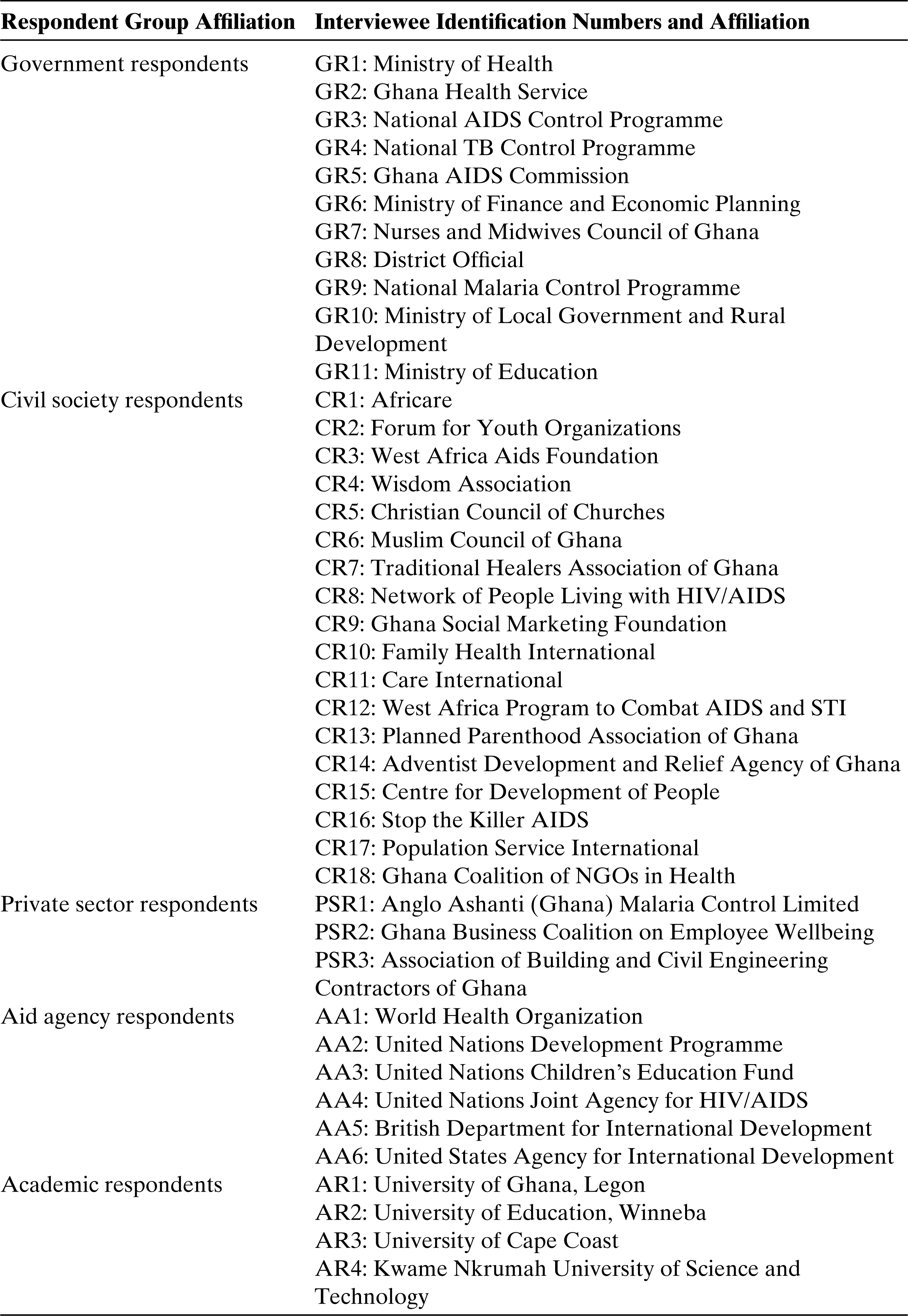
The main data collection method was semi-structured interviews. A total of 65 interviews were conducted with a range of stakeholders, including CCM members, health sector leaders, grant recipients, civil society leaders, activists, donor officials, and knowledgeable observers. Interviewees were selected using a combination of purposive and snowball sampling. To protect interviewees’ anonymity, respondents’ names are not used. Table 1 describes the interviewees’ characteristics and the way in which they will be referenced in the rest of this article. Where there was more than one respondent from a particular agency/organization, this is indicated using “a,” “b,” etc. For example, respondents from the Ministry of Health will be referred to as GR1a, GR1b, etc. All interviews took place between February and May 2018.
Interview Respondents’ Group Affiliations and Their Identification Numbers
The information garnered through interviews was supported by direct observation and documentary evidence. While it was not possible to observe formal meetings of the CCM, it was possible to observe the activities and interactions of the CCM members. Documentation from the Ghanaian government and the Global Fund was also collected and analyzed. The Global Fund makes its policy documents and other publications available on its website.
A manual theme identification process was employed to analyze the data. Interviews were transcribed and organized along thematic lines, by probing for words, connotations, and common phrases. These themes were re-examined to search for linkages, patterns, and meanings. The interview results were then considered alongside analysis of primary documents provided by the Ghanaian state and the Global Fund.
Findings
The Ghanaian CCM, which was established in 2002, is responsible for developing and submitting grant proposals and managing Global Fund grants in Ghana. The CCM nominates principal recipients (PRs) from among the CCM members as chief implementers of approved grants. Ghana’s CCM consists of 25 members drawn from three major constituencies: the Ghanaian public sector (7 members), Ghanaian civil society (14 members), and multilateral and bilateral agencies (4 members) (CCM Ghana, 2015). The dominance of civil society members is in line with the Global Fund’s requirement that civil society should constitute at least 40% of CCM membership (Tucker, 2012, p. 4). Further details of the CCM’s members are provided in Table 2.
Membership Composition of the Ghana CCM
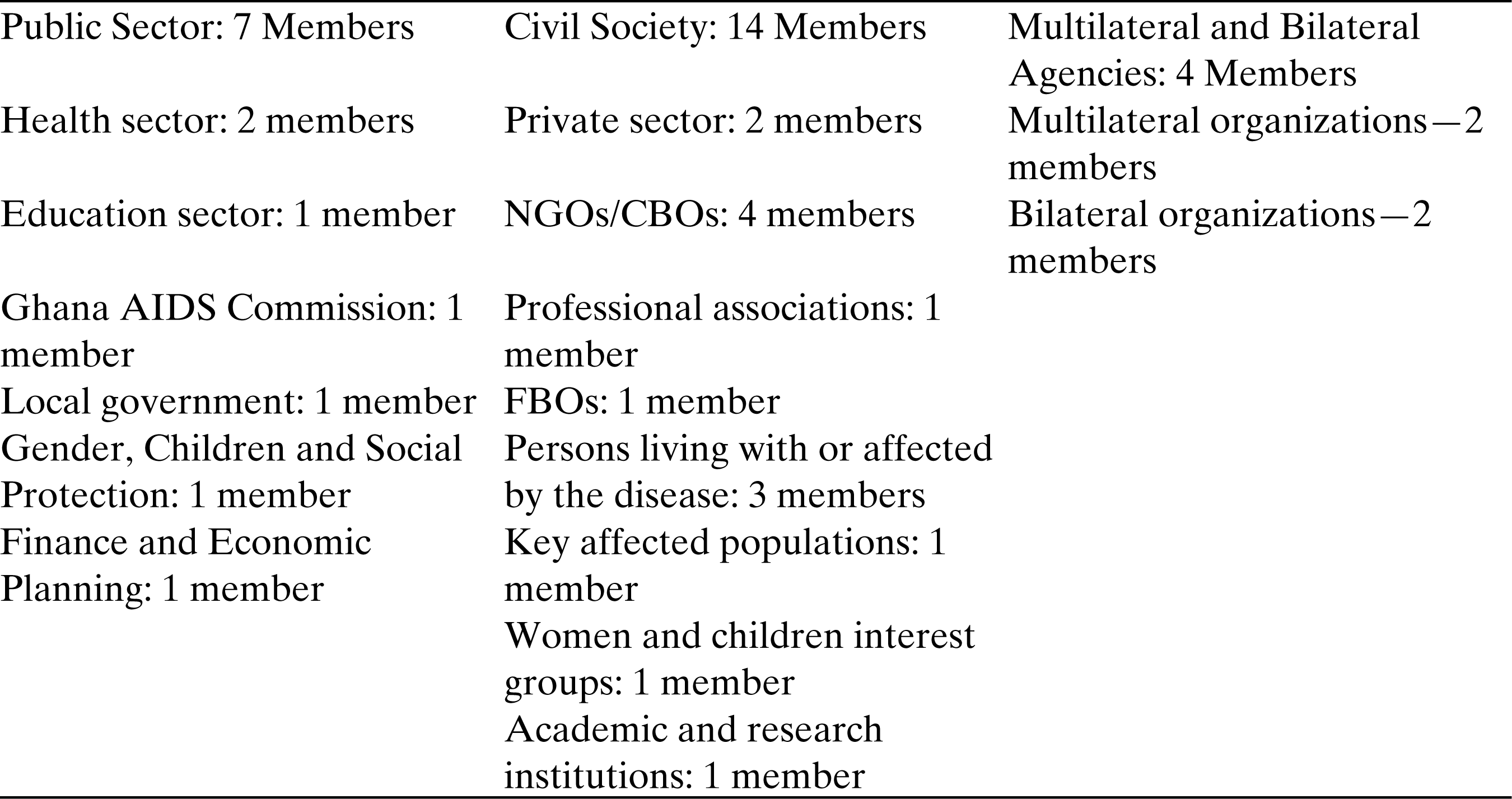
The composition of the CCM is thus dominated by Ghanaian actors. While donors are represented, they are outnumbered by local actors. This suggests the achievement of country ownership but, as will be shown in the following, those involved in the Ghanaian CCM do not necessarily perceive the CCM to function in a way that enables or advances country ownership.
Positive Perceptions of the Ghanaian Country Coordinating Mechanisms and Country Ownership
The study sought to see whether the functioning of Ghana’s CCM does indeed enable country ownership. To this end, interviewees were asked about their perceptions in relation to the CCM’s ability to enable country ownership. Some interviewees indicated that they believe that the CCM does indeed successfully facilitate country ownership. Certain government respondents expressed the view that country ownership is achieved by the CCM because there is government leadership of the national response. Some of the government respondents felt that the presence of and leadership by the Ghanaian government on the CCM implies country ownership (GR1a, GR2a). Government respondents also pointed out that the CCM constitution states that the CCM chair and vice-chair must be Ghanaian citizens, and that the CCM can therefore be said to promote country ownership (GR3, GR4, GR9). Such respondents interpret the CCM as being a Ministry of Health-led institution or even a quasi-government organization.
There were also civil society respondents who shared the view that the CCM enables country ownership, but who thought about country ownership in a different way. These respondents believe that the CCM successfully facilitates country ownership through its inclusive multi-sectoral outlook. In this context, some respondents described the CCM as a multi-sectoral platform that provides an avenue for civil society actors to be formally involved in health policy processes (CSR1, CSR3, CSR8). Other respondents noted that the CCM was a unique platform, which brings state and non-state actors together and credited the Global Fund for creating a plural platform that opens up the decision-making space to marginalized groups like civil society groups and Ghanaians living with HIV/AIDS, TB, and Malaria (CRS2, CRS4). Furthermore, some civil society respondents also credit the Global Fund for encouraging the representation of women in the CCM (CSR17, CSR18). There were also respondents from the private sector who felt that the Global Fund does promote country ownership by giving private sector actors a formal role in the CCM (PSR1, PSR2, PSR3). Overall, the perspectives of the aforementioned respondents discussed here suggest that the CCM is successful in achieving country ownership due to its multi-sectoral platform that captures a broad gamut of actors involved in the health policy process in Ghana.
Negative Perceptions of the Ghanaian Country Coordinating Mechanisms and Country Ownership
In contrast to the perspectives of the aforementioned respondents, a number of other respondents see the CCM as an externally conceived and designed instrument, which preserves existing donor influence in aid delivery and does not promote country ownership. Such respondents argue that underneath the policy claim of country ownership, paternalistic perceptions about development still prevail among donors. For instance, some respondents posited out that the CCM was externally conceived by the donor as a governance mechanism, and that recipient countries (Ghana in this context) had not requested it (GR1b, GR2b, AR1). In narrating their experience in relation to the CCM, two other respondents observed that the preparation of proposals was a key function of the CCM as, without it, no funding can come from the Global Fund (GR11, AR3). They viewed the role of the CCM to be reminiscent of traditional donor–recipient country relations in which donors design and designate implementation structures in recipient countries. Further criticism of the CCM as a donor imposition came from several respondents who saw the CCM as a duplication of already existing national coordination structures for the HIV/AIDS response in Ghana such as the Ghana AIDS Commission, the health sector-wide approach (SWAp), and the Multi-Donor Budget Support System (MDBSS) (GR5a, GR5b, GR6a, GR1a, GR2b GR6b, AR4).
The CCM’s ability to promote country ownership was also questioned by those who argued that the inclusion and funding of civil society actors in the CCM does not necessarily guarantee their democratic participation. They argued that the process whereby grant proposals are developed is driven by technical consultants, shutting out those who lack technical knowledge (AR2, AR3). These consultants are able to use their position to shape the agenda of the CCM in a way that reflects the international agencies or foreign governments they represent (AR1). Furthermore, another respondent indicated that the process of developing grant proposals was characterized by excessive English language technicalities (CR18). According to this respondent, the wording used makes it difficult for those at the grassroots to be informed and involved. Similarly, some respondents had misgivings about the technical assistance provided by donors when writing grant proposals as they felt that the nature of the technical assistance provided undermines country ownership (CR15, CR16). In particular, the Global Fund’s TRP was criticized for its overbearing role. Once the CCM has developed a grant application, it is sent to the TRP, which decides whether the proposal is to be approved or must be adjusted, resubmitted, or revised (Global Fund, 2019). The TRP is supposed to focus on the technical merits of the proposal, but respondents suggest that it exercises influence beyond this role. According to one respondent:
… the Technical Review Panel of the Global Fund helps to set and shape the agenda of the Ghana CCM, thereby influencing Ghanaian national health priorities irrespective of the role and headship of the Ministry of Health in the CCM … The TRP decides what to approve, accept or reject based on technical criteria and not necessarily based on knowledge of local contexts such as in Ghana. (AR2)
While the TRP, thereby, shapes Ghana’s health policy, there is no way through which the TRP is held accountable to the CCM or the Ghanaian government or Ghanaian citizens. The TRP is solely accountable to the Global Fund board (Global Fund, 2019).
Another concern raised was that it was not clear who the civil society organizations (CSOs) on the CCM really represent and to what extent there is consultation and dialogue between CSOs and their presumed constituents (AR1, AR2, AR3). According to one respondent, the ability of CSOs to meaningfully consult with the constituencies they ostensibly represent is limited by their weak financial positions and poor communication facilities (CR15). As it is difficult for them to reach remote local communities, they may consult principally with those in urban locations. Another respondent complained that the CSOs represented on the CCM are a kind of “old boys club” interested in maintaining their individual organizational interests by drawing on networks of influence and established relationships with other CCM members (CR16).
CSOs that are represented on the CCM can access Global Fund grants, which make CCM membership attractive. One respondent argued that the CSOs on the CCM end up focusing on seeking funding rather than undertaking the activist and advocacy roles that underpin their legitimacy (CR18). Similarly, some respondents argued that the CCM functions as a platform to apply for Global Fund grants rather than a space in which the voices of those living with HIV/AIDS, tuberculosis, or malaria can be heard (AR1, AR2, AR4). According to these respondents, the CCM lacks participation and direct representation from key affected populations (KAPs) who are only represented by proxy through advocacy groups. This concern was also highlighted in a “shadow report” written by Ghanaian civil society activists who argue that the KAPs have little input in the drafting of funding proposals, which are mostly developed by consultants (Arthur et al., 2017). Thus, the inclusion of civil society representatives on the CCM does not necessarily result in the inclusion of the voices of those most affected by the decisions that are ultimately made around what kinds of responses to HIV/AIDS, tuberculosis, and malaria are adopted.
Respondents raised both positive and negative comments regarding the CCM’s role in promoting women’s representation and participation in the CCM. The Global Fund encourages CCMs to pay attention to gender in the composition of the CCM’s membership (Global Fund, 2005, 2018). However, there is no stipulation regarding the representation of women on the CCM. Respondents pointed out that women who are on the CCM represent their organizations rather than being on the CCM in their personal capacity; therefore, the gender balance changes depending on who the organization sends to the CCM (CR17). Another respondent raised a different concern, saying that while the Ghanaian CCM does discuss gender issues, it does not collect enough gender-segregated data to guide gender-sensitive program implementation (CR18).
Discussion
The findings of our study suggest that those involved in and with knowledge of the Ghanaian CCM have mixed impressions regarding whether or not it enables country ownership. While some respondents feel that the active involvement of the Ghanaian government and civil society sector in the CCM demonstrates country ownership, others felt that there are various ways in which country ownership is undermined by the processes through which the CCM seeks funding for and implements programs. The concerns raised by respondents interviewed for this research raise several important issues, which are relevant beyond the Ghanaian context.
First, it is clear that there are different ways of interpreting what country ownership means, and that these differences in interpretation result in differences in perception about whether or not country ownership is achieved. As discussed earlier, some commentators interpret country ownership as national ownership, while others push for an expanded understanding of the concept, whereby ownership is only seen to be in place when civil society is involved in policy development or when citizens feel that the policies have been freely chosen by their representative (Johnson, 2005; Martinez-Alvarez, 2018). As shown earlier, some of those interviewed for this study interpreted ownership more narrowly and asserted that the Ghanaian CCM does promote ownership as the CCM includes (and gives a prominent role to) national actors. Others were more skeptical, pointing to ways in which the Global Fund still exercises influence over the development and approval of proposals. As Hasselskog and Schierenbeck (2017, p. 323) argue, talk of country ownership is “fundamentally ambiguous and paradoxical.” Clearer definitions and descriptions of what country ownership actually means are required if we are to determine whether or not it is being realized.
A second important concern highlighted in this study relates to the ways in which donors can continue to exercise influence over policies and programs even in the context of a commitment to ownership. Hasselskog and Schierenbeck (2017) argue that due to the technical demands of proposal writing and the lack of such expertise in many recipient countries, donors typically offer various forms of “technical assistance” in the development of funding proposals. This issue came up in our study in relation to the role of consultants in the writing of proposals and of the Global Fund’s TRP, which is supposedly concerned only with technical issues, but which is able to determine the fate of a particular funding proposal due to its powers of review. Furthermore, Brown (2017, p. 351) argues that donors form part of the “domestic policy space” such that they exercise influence within national policy-making spaces. According to Brown’s (2017, p. 351) interviewees, the Ghanaian government “tends to tell donors what they want to hear” in order to secure funding and, due to the long-standing influence of donors, Ghanaian policymakers know what it is that donors are likely to fund (see also Raffinot, 2010, p. 95). Similarly, Saliba-Couture (2011, p. 186) suggests that recipient countries might internalize the preferences of donors due to years of conditionalities, making it difficult to determine what it means for recipient countries to exercise ownership. Proposals for funding from the Global Fund are therefore written in a context where donor actors and interests are present even in CCM processes, which are supposedly locally owned.
A third concern relates to the general problem of representation. The CCM’s decision to include a number of civil society and private sector representatives indicates an acknowledgment that country ownership ought to mean the participation of a range of national actors rather than simply the presence of government officials. However, as pointed out by several respondents in our study, it is not clear as to what extent civil society representatives meaningfully represent those on whose behalf they have been chosen. The presence of NGO workers and other civil society representatives is no guarantee that the views of the ordinary Ghanaian citizens are really represented on the CCM. More generally, issues of representation create significant challenges for the idea of country ownership. If country ownership is understood to mean more than government ownership, it is necessary to think carefully about what kinds of representation and participation are needed for a program to be considered “country-owned.”
Conclusion
The Global Fund, like many other donor organizations today, is formally committed to the implementation of country ownership. The CCM is regarded as the principal tool, whereby country ownership is realized. In order to properly assess whether bodies like the CCM can advance country ownership, it is necessary to be attentive to the experience of those involved in a CCM on the ground. This study interviewed a range of actors with knowledge of the functioning of the Ghanaian CCM to determine their perceptions and experiences in relation to country ownership of Ghana’s health response. The study concludes that the Ghanaian CCM is reflective of conditional ownership, whereby the recipient countries exercise limited agency. While Ghanaian government agencies take a formal leadership role within the CCM, the CCM’s operation is mediated by the Global Fund’s funding stipulations and processes. In a context where consultants are employed to draw up proposals, where donor preferences are well known in the aid-recipient community and where technical assistance and review are driven by the donor, the recipient country can only exercise conditional ownership. As argued by Shah (2017, pp. 7–10) and Frank (2004, p. 179), donors impose conditionalities in order to safeguard the repayment of donor loans and strengthen recipient ownership of the assisted programs. However, as argued by Saliba-Couture (2011), donors are aware of the criticisms associated with conditionalities, and consequently, they try to portray conditionality policies as complementary to ownership. Recipient countries, on the other hand, work to maximize ownership in the context of conditionality. This creates tensions between paternalistic and partnership logics in a supposedly post-conditional era. Describing the relationship between donors and recipient countries as a partnership as detailed in the Paris Declaration rather than as a paternalistic relationship obfuscates the imbalance of power underscored and underpinned by the strong economic and fiscal dependence of aid-recipient countries (particularly those in Sub-Saharan Africa like Ghana) on their main aid donors. Our Ghanaian case study suggests that talk of country ownership by Global Fund officials functions as a rhetorical tool that disguises the continued use of the greater power of the international donors and does not represent a meaningful shift in power toward the agents of the recipient countries. This is because despite the mantra of country ownership espoused by donors like the Global Fund, they continue to call the shots in the design, control, and implementation of aid donations.
Footnotes
Declaration of Conflicting Interests
The authors declared no potential conflicts of interest with respect to the research, authorship, and/or publication of this article.
Funding
The authors disclosed receipt of the following financial support for the research, authorship, and/or publication of this article: This article is based on PhD research supported by a scholarship awarded by the Rhodes University African Studies Centre as part of its involvement in the Africa Multiple Cluster of Excellence at the University of Bayreuth, funded by the Deutsche Forschungsgemeinschaft (DFG, German Research Foundation) under Germany’s Excellence Strategy—EXC 2052/1—390713894. In addition, financial assistance from Rhodes University in relation to the Rhodes University Prestigious Doctoral Scholarship (2019) is hereby acknowledged.