




Abstract
Bidirectional day-to-day time-lagged tests of spillover processes between the marital and parenting subsystems are rare. The current study examines stability and spillover in daily negative marital behaviors and destructive parent–child conflict among mothers and fathers. We also tested for spillover moderation by coparenting alliance, as the likelihood of spillover across these family domains has been shown to vary between families. Participants included 143 families with a 5- to 8-year-old child. Parents reported daily on conflict with their child and marital interactions for 1 week. A dynamic structural equation model revealed significant stability in destructive father–child conflict, marginal stability in mothers’ negative marital behaviors, and spillover from fathers’ previous-day negative marital behaviors to subsequent destructive father–child conflict, particularly when coparenting alliance was low.
Parent–child conflicts, which involve contrasting viewpoints and impeded goals, are a common and developmentally normative experience. These conflicts range from simple differences of opinion to more complex and emotional arguments and can be collaborative or oppositional in nature. Constructive conflicts focus on problem-solving and are characterized by parental emotional receptiveness and a positive communicative climate to negotiate and resolve the conflict (Deutsch, 1973; Nelson et al., 2014). Destructive conflicts focus on placing blame and are characterized as hostile and contentious due to the harmful consequences of these behaviors on the parent–child relationship (Deutsch, 1973; Forgatch, 1989; Rinaldi & Howe, 1998). More destructive conflict interactions are linked with higher levels of family stress (Nelson et al., 2017) and a lower likelihood of resolution (Rueter & Conger, 1995). Some conflicts, particularly those characterized as contentious and unresolved, may continue to negatively impact relationships, with negativity carrying over from 1 day to the next (Prager et al., 2015). While previous research has examined this destructive conflict carryover in romantic partnerships (Prager et al., 2015), stability in destructive parent–child conflict interactions and day-to-day lagged links between negativity across multiple subsystems, such as the parent–child and marital subsystems, requires investigation.
Family Systems Theory
According to family systems theory, family units are organized systems. Within these systems are subsystems of relationships and behaviors, including the parent–child subsystem and the marital subsystem (Cox & Paley, 1997). The spillover hypothesis suggests that, because of interdependencies in the subsystems, affect and behavior in one domain carry over to impact other domains (Krishnakumar & Buehler, 2000; White & Klein, 2008). Spillover between the marital and parent–child relationships has been well established in the literature (e.g., Kouros et al., 2014; Nelson et al., 2009; Sears et al., 2016). For example, greater marital distress relates to more negative and less positive later parenting behaviors (Cui & Conger, 2008); greater marital conflict relates to increases in parent–youth conflict over time (Gerard et al., 2006); and positive problem-solving in the marital relationship relates to increases over time in positive problem-solving in the parent–adolescent relationship (Van Doorn et al., 2007). However, little is known about the direction of effects among time-lagged daily marital and parent–child behaviors when controlling for day-to-day stability in these interactions (Mastrotheodoros et al., 2020). This spillover process may, in fact, be bidirectional with effects not only from marital interactions to parent–child conflict but also from parent–child conflict to marital interactions. For example, stress in one’s parenting responsibilities may relate to next-day increased negativity toward one’s spouse due to self-regulatory depletion (Baumeister, 2002) or resentment that a partner is not sufficiently engaged and supportive of one’s parenting struggles (Bonds & Gondoli, 2007; Le et al., 2016). In a week-long study of time-lagged interparental conflict and parent–child conflict interactions, bidirectional effects were observed where the presence of interparental conflict predicted the occurrence of parent–child conflict 1 day later, and the presence of parent–child conflict predicted the occurrence of interparental conflict 1 day later (Sherrill et al., 2017).
Stability in Destructive Interactions
Destructive parent–child conflicts involve blame and avoidance, elicit contempt, and impede resolution (Rueter & Conger, 1995). They also relate to the experience of subsequent negativity, with rage and resentment serving as particularly salient mediators between parent–child conflict and child behavior problems (Yeh, 2011). Similarly, sequential analyses with parents and early adolescents show that long-lasting conflicts remain unresolved and predict defiant child behaviors (Moed et al., 2015). Still, destructive parent–child conflict interactions significantly vary day-to-day (Nelson et al., 2017), suggesting that some dyads are able to address conflicts without destructive qualities carrying over to the next disagreement. This stability has been demonstrated in research on marital conflicts. Prager and colleagues (2015) show that the day following a conflict, couples experience negative mood and less satisfaction than on other days. Relationship security and intimacy predicted a couple’s ability to recover positive affect and reduce negative affect on days following the conflict. However, explicit tests of this day-to-day stability in negative parent–child conflict interactions have yet to be explored. Cycles of negative parent–child interactions are difficult to break and often negatively impact the whole family (Eddy et al., 2001; Snyder et al., 1994). Therefore, a better understanding of day-to-day conflict exchanges and the negativity that may continue to linger is needed to understand the implications of conflicts and subsequent negativity in families.
Furthermore, the likelihood of stability and spillover in destructive parent–child conflict and negative marital interactions may differ for mothers versus fathers. Women tend to express more negativity during marital interaction than men (Christensen & Heavey, 1990) and experience more lingering negative affect and rumination in response to stress (Leger et al., 2018). Fathers also tend to report less day-to-day consistency in their parenting behaviors than mothers (Holub & Nelson, 2022). Together, this suggests stability in destructive parent–child conflict and negative marital behaviors may be more likely among mothers than fathers, but this prediction is tentative and exploratory. In terms of spillover likelihood, past literature has demonstrated a stronger concordance between parenting behaviors and marital quality among fathers than mothers (Belsky et al., 1991). Almeida and colleagues (1999) discovered reciprocal lagged effects between parent–adolescent negativity and marital negativity among fathers but not mothers. Varying parent gender effects in the links between parent–child conflict and negative marital behaviors may be clarified by coparenting alliance, which may act as a condition under which spillover between marital and parent–child roles is more or less likely to occur.
Coparenting Alliance
There is significant between-family variability in the strength of the link between marital and parent–child relationships (Krishnakumar & Buehler, 2000). This suggests that the likelihood and extent of spillover between these family domains depends on (i.e., is moderated by) other aspects of family functioning. For example, family distress, characterized by marital problems and child behavior problems, enhanced the likelihood of day-to-day spillover between marital and parent–child relationships (Margolin et al., 1996). In distressed families, conflict and negativity were more persistent, lasting days instead of hours. This persistence in negativity is conceptually similar to the day-to-day stability in negative marital behaviors and destructive parent–child conflict examined in the current study.
One key aspect of family functioning that relates to quality in both marital and parent–child relationships is coparenting (Bonds & Gondoli, 2007; Le et al., 2016). Coparenting is defined as the extent to which parents share responsibility for child-rearing and use supportive coordination to raise their child (Feinberg, 2003; Margolin et al., 2001). A close coparenting alliance may assist parents in navigating parenting challenges and prevent feelings of isolation or resentment toward a partner. Alternatively, a coparenting relationship that is inconsistent or disconnected may create a parenting condition under which stress and negativity permeate family relationships (Christopher et al., 2015; Kolak & Volling, 2007; Schoppe-Sullivan et al., 2004). For example, coparenting alliance buffered the spillover from fathers’ parenting stress to their marital satisfaction (Kwan et al., 2015). Thus, the present study argues that coparenting alliance may moderate bidirectional spillover between the marital and parent–child relationships, and the Kwan and colleagues study suggests this may be more likely for fathers than mothers. A closer concordance between the marital and parenting relationships among fathers than mothers (Belsky et al., 1991) may explain not only why spillover between the two domains is more likely for fathers but also why a poor coparenting alliance may create a maladaptive parenting context that exacerbates negative emotion spillover.
Present Study
Our first study aim was to investigate day-to-day stability and cross-variable time-lagged links between destructive parent–child conflict and negative marital behaviors. We examined daily behaviors across 1 week among mothers and fathers of a 5- to 8-year-old child. Our focus on parents of children in early middle childhood was motivated by key social-cognitive transitions during this age range that lead to children’s greater engagement in parent–child conflicts (Kerns, 2008). Early middle childhood is a developmental period where children begin to negotiate and problem-solve with parents during disagreements, representing the start of more complex dyadic exchanges about parents’ and children’s competing goals (Kerns, 2008). Greater parent–child conflict participation by children presents an important opportunity to evaluate stable characteristics of these interactions and their links to other family dynamics.
Although much of the literature has focused on how marital relationships prompt changes in parent–child interactions, parent–child conflict has been shown to predict the occurrence of next-day marital conflict (Sherrill et al., 2017). Also, stress in one’s parenting role, which is exacerbated by parent–child conflict, predicts poorer quality marital relationships (Kwan et al., 2015). Thus, consistent with family systems theory’s spillover hypothesis that subsystems are interdependent and links are often bidirectional, we hypothesized more negative marital behaviors would predict more subsequent destructive parent–child conflict, and more destructive parent–child conflict would predict more subsequent negative marital behaviors.
Previous work suggests spillover between the marital and parent–child subsystems is more likely among families where negativity persisted across days rather than hours, a situation that occurred among distressed families versus nondistressed families (Margolin et al., 2001). Thus, our second aim was to test a relationship condition affecting both the marital and parent–child subsystems under which spillover from negative marital behaviors to destructive parent–child conflict—and vice versa—may be more or less likely to occur. We tested coparenting alliance as a moderator of this time-lagged, bidirectional association and hypothesized that spillover from negative marital behaviors to more subsequent destructive parent–child conflict and from destructive parent–child conflict to more subsequent negative marital behaviors from 1 day to the next would be stronger among parents reporting poorer coparenting alliance. We expected parent gender differences in stability and spillover, with greater stability among mothers and greater spillover among fathers, and expected coparenting alliance moderation to occur for fathers, in light of greater concordance between parenting behaviors and marital quality among fathers than mothers (Belsky et al., 1984).
Method
Participants
One hundred forty-three families with 5- to 8-year-old children (M = 83.97 months, SD = 13.91) participated in a larger study on parents’ daily stress and parent–child conflict. Related publications using this data set have examined daily associations between mothers’ work, home, and relationship stress with constructive and destructive qualities of mother–child conflict interactions (Nelson et al., 2017) and profiles of mother–child conflict interactions based on mean levels and variability in constructive and destructive qualities over 1 week (Nelson et al., 2019). Parents were recruited through public elementary schools, and flyers were distributed in a large metropolitan area of the southwestern United States. If families had more than one child in this age range, they were asked to select one and report exclusively on their interactions with that child throughout the study. Approximately half of the children were female (52%), 59% were Caucasian, 20% were Hispanic, 9% were African American, and 6% were identified by mothers as multiple or other races/ethnicities. Maternal age ranged from 20 to 55 (M = 30.56 years, SD = 25.75), and paternal age ranged from 22 to 58 (M = 38.95 years, SD = 7.52). Most mothers were married (70%), and most were biologically related to the target child (93%), with the other 7% included stepmothers, adoptive mothers, or unrelated mother figures. Two-thirds of the mothers were partnered with the target child’s biological father. Family income-to-needs ratios accounting for family size were calculated using poverty thresholds during the year of data collection; 44% of families were considered low-income (ratios < 2), 47% of families were middle-income (ratios 2–5), and 9% of families were high-income (ratios > 5).
Mothers participated in all families, and residential fathers provided survey data in 60 of the families. Families with father participation had higher income-to-needs ratios than families without father participation, t = −2.18, p = .031; however, there were no significant differences between these groups on child age or number of children in the home. Approximately 63% of data from participating mothers were complete across the initial survey and daily diary for the current study variables; 37% were incomplete. Mothers’ missing data on the study variables were not systematic according to Little’s Missing Completely at Random (MCAR) test, χ2 = 1,389.78, p = .178. Among fathers, 56% of the data were complete, and 44% were incomplete; this missingness was not systematic, χ2 = 529.94, p = .789.
Procedure
Research assistants spoke with participants over the phone before enrolling them in the study to obtain contact and eligibility information. During the phone call, research assistants told parents what to expect during the study, answered questions, and provided the study’s definition of conflict with several examples of conflict interactions that ranged from mild to intense. Parents selected a typical week to complete surveys during which the parents and focal child would be in the home together. Families with two parents participating were asked to complete all surveys independently, separate from their partners. All survey links were unique and sent to separate email addresses for mothers and fathers in the same family. Families received an email the day before their participation reminding them of the information given to them on the call.
During the study, parents completed questionnaire measures online using Qualtrics survey software for 8 consecutive days. On the first day, participants received an email containing a link to an initial survey that included a Web-based consent form and various questionnaires assessing demographic and family information, parenting beliefs, and children’s behaviors. Participants completed daily surveys in the evening for the next 7 days following the initial survey assessing one specific salient parent–child conflict that occurred that day and other daily experiences. To maximize the likelihood that parental reports reflected events that happened that day, survey links expired at 3:00 a.m. the following morning.
Individuals were compensated $5 for each day they participated ($40 total for one initial survey and seven daily surveys) and entered into a $50 gift card drawing if all surveys were completed across the week. They were informed that participation required approximately 20 min of time per day. Research assistants monitored survey completion daily and contacted participants with reminders. The University of Texas at Dallas Institutional Review Board granted research ethics approval for this study (protocol #24-295, formerly #14-27).
Measures
One-Time Surveys
Coparenting Alliance
Within the initial survey packet, parents were asked to complete the Parenting Alliance Inventory questionnaire (Abidin & Brunner, 1995). The measure contained 20 parenting behaviors and asked parents to indicate how effective the behaviors were in describing the interactions between themselves and their child’s other parent (e.g., “My child’s other parent makes my job of being a parent easier.”). The responses were rated on a five-point Likert-type scale (1 = “Strongly Disagree,” 5 = “Strongly Agree”). The total sum of responses was used with higher scores indicating greater coparenting alliance. Reliability was assessed using Cronbach’s alpha for mother, α = .95, and father, α = .93. Because mothers’ and fathers’ coparenting alliance scores represent a single construct and were closely related (r = .43), we averaged couple members’ reports to create a single composite score.
Daily Surveys
Conflict Characteristics
In the conflict surveys, we asked parents to report on their behavior and their child’s behavior during a salient conflict interaction that day. We informed parents that “conflicts occur when parents and children express opposing viewpoints. They can range from serious arguments (e.g., getting in trouble at school, fighting with siblings) to minor disagreements (e.g., cleaning their room, doing homework).” This definition was consistent with past definitions of parent–child conflict (Laursen & Hafen, 2010). Parents who did not report a conflict on a given day received a reminder in the next day’s email about the range of interactions included in our definition of conflict, and all parents saw this definition of conflict at the start of each daily survey. Because parents were also reporting on other daily stressors each evening, we tried to minimize participant burden by measuring details about one significant parent–child conflict each day, rather than every disagreement that occurred. We asked parents to “pick the conflict that seems most salient to you.” If a single conflict topic was discussed repeatedly, research assistants asked parents to think of the longest or most significant portion of the conflict when providing details. If parents indicated that they did not have a conflict with the focal child that day, the conflict survey was not displayed, and thus, findings regarding conflict qualities should only be interpreted as occurring when conflicts arose. On average, mother–child conflicts were reported on 4 of the 7 days and father–child conflicts on 3 of the 7 days.
Qualities of conflict interactions were assessed using a measure developed for the current study (Nelson et al., 2017). Items were created based on past observational research of parent–child conflict discussions that facilitated resolution (Nelson et al., 2014) or positive child adjustment (Nelson, 2015). Parents who reported experiencing a conflict with their child that day were asked to complete a survey describing the interaction. The survey assessed structural (e.g., time of day) and behavioral elements of the conflict. For the behavioral elements of the conflict, parents were asked to report the degree to which each behavior was present during the interaction, ranging from 1 (not present at all) to 4 (clearly present). The destructive conflict scale was analyzed in this study. It included 20 items measuring negative emotional reactivity of parents and children (e.g., yelling), parents’ punitive behaviors and dismissal of the child’s distress (e.g., “When my child became upset/frustrated during the conflict, I punished him or her for getting too worked up”), and resentment (e.g., “This conflict has led to additional problems with my child”). Multilevel reliability was assessed using Cronbach’s alpha for mothers, α W = .84, α B = .81, and for fathers, α W = .81, α B = .83.
Marital Behaviors
To assess marital behaviors, parents completed the Relationship Behaviors Checklist (Buck & Neff, 2012; Nelson et al., 2017). The measure contained a list of five negative relationship behaviors (e.g., “You showed anger or impatience toward your spouse/partner”) and parents reported on whether or not they engaged in each behavior that day (either yes or no). Endorsed behaviors received a score of 1; we computed a sum score for each day’s total negative behaviors toward the partner. Multilevel reliability was acceptable for mothers, α W = .72, α B = .81, and for fathers, α W = .72, α B = .88.
Analysis Plan
To investigate associations between lagged parent–child conflict and marital behaviors with next-day parent–child conflict and marital behaviors, a dyadic Dynamic Structural Equation Model (DSEM; Asparouhov et al., 2018) was run in Mplus 8.11. DSEM combines structural equation modeling, multilevel modeling, and time-series analysis with variable disaggregation into within-person and between-person factors (McNeish & Hamaker, 2020). It models intraindividual changes over time and allows for the parameters to vary across participants using random effects. Time-lagged effects can be modeled where within-person variables (T) are regressed on the same variable at the previous timepoint (T − 1) as autoregressive carryover effects, on another variable at the previous timepoint (T −1) as cross-lagged effects, or on another variable on the same day (T) as concurrent effects. Tests of bidirectional cross-lagged effects from 1 day to the next are a unique advantage of DSEM analyses. We used latent variable centering in the DSEM model and Bayesian estimation with a minimum of 2000 iterations (50,000 maximum) where missing data were sampled from their conditional posterior distribution (McNeish & Hamaker, 2020; Schultzberg & Muthén, 2018 analysis code: https://osf.io/p9qa6/?view_only=58fd61b860bb47b1a96fabfb2b03284e). Although traditional fit indices are not available from the Bayesian models used for DSEM (Asparouhov et al., 2018; Hamaker & Asparouhov, 2023), total variance explained by the model in each study variable is available, and convergence can be determined by a Potential Scale Reduction (PSR) value close to 1 at the final iteration.
Because father reports were only available in 60 of the 143 families, a greater amount of information was available to estimate mother–child dynamics. Full information maximum likelihood estimation allowed all available information to be used to produce model estimates. Still, small sample sizes can be problematic with DSEM random effects (Schultzberg & Muthén, 2018). Therefore, we used McNeish and Hamaker’s (2020) approach of specifying admissible-range-restricted prior distributions, which is shown to improve performance of small sample DSEM models.
We ran one dyadic DSEM in Mplus. At the within level, we estimated time-lagged autoregressive effects for mother–child conflict and father–child destructive conflict and for mother and father negative marital behaviors. Within-day concurrent associations were estimated between all four variables (mother–child conflict, father–child conflict, mother negative marital behaviors, father negative marital behaviors). Cross-lagged slopes were also modeled at the within level to estimate spillover from lagged mother–child and father–child destructive conflict with the current day’s negative marital interactions, as well as spillover from lagged negative marital behaviors to mother–child and father–child destructive conflict.
At the between level, family income-to-needs ratios was a control variable entered in relation to conflict and relationship behaviors, and the conflict and relationship behaviors were, again, all related to one another. The coparenting alliance composite was tested as a moderator by using it as a predictor of the cross-lagged within-level slopes. This tested whether levels of the cross-lagged slopes varied as a function of the between-family coparenting alliance variable. Although mother and father variables were covaried to account for interdependence, we only estimated actor cross-lagged effects in our dyadic models due to practical (non-convergence when partner cross-lagged effects were also estimated) and conceptual reasons (our conceptual interest was within-person spillover from one relationship to another).
Results
Descriptive Statistics
Preliminary analyses on descriptive data and correlations among study variables are reported in Table 1. Notably, both mothers’ and fathers’ destructive conflict with the child was related to more of their own negative marital behavior toward their spouse. Mothers’ negative marital behavior was positively associated with fathers’ negative marital behavior. Parents’ reports of parenting alliance were related to negative marital behavior and destructive conflict.
Descriptive Statistics and Correlations among Study Variables.
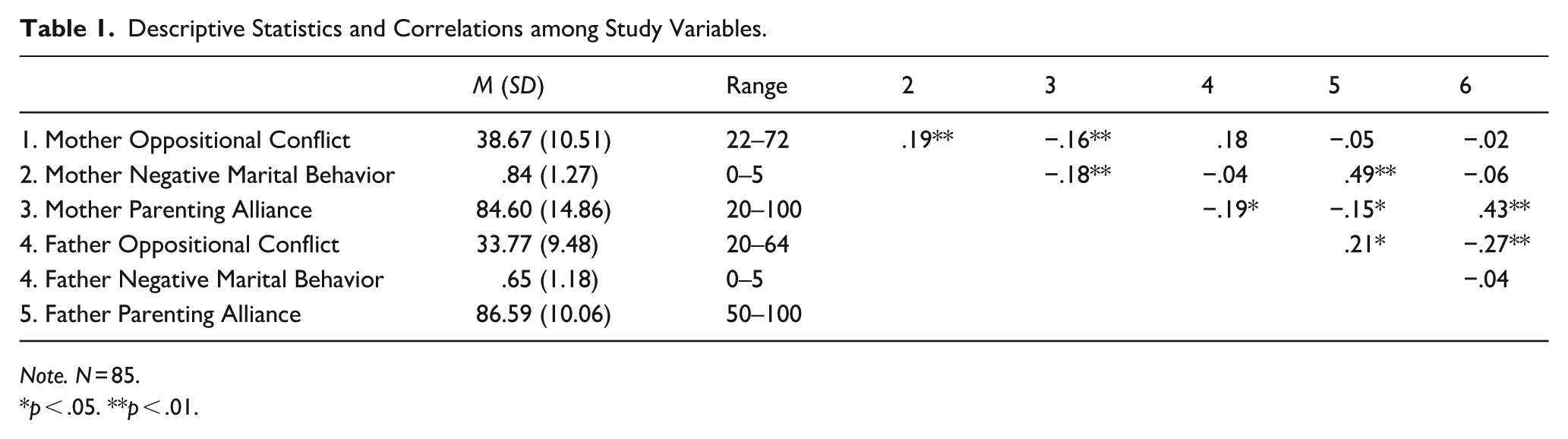
Note. N = 85.
p < .05. **p < .01.
Primary Analyses
DSEM estimates are shown in Table 2, and the model is illustrated in Figure 1. At the within-person level, daily mother–child destructive conflict was positively related to father–child destructive conflict; the number of daily maternal negative marital behaviors was positively related to paternal negative marital behavior; and father–child destructive conflict was positively related to paternal negative marital behaviors. One autoregressive slope was significant, and one was marginally significant. Father–child destructive conflict was stable from one day to the next. This indicates that higher levels of father–child destructive conflict the previous day (T − 1) were associated with more destructive conflict characteristics in the following day’s (T) father–child conflict interaction. This autoregressive effect was not significant for mother–child conflict. The autoregressive slope for mothers’ negative marital behaviors was marginally significant (p = .078). This indicates that more negative marital behaviors expressed by mothers on the previous day (T − 1) were somewhat associated with more maternal negative marital behaviors on the following day. This autoregressive effect was not significant for fathers.
Dynamic Structural Equation Modeling Autoregressive and Cross-Lagged Slopes.
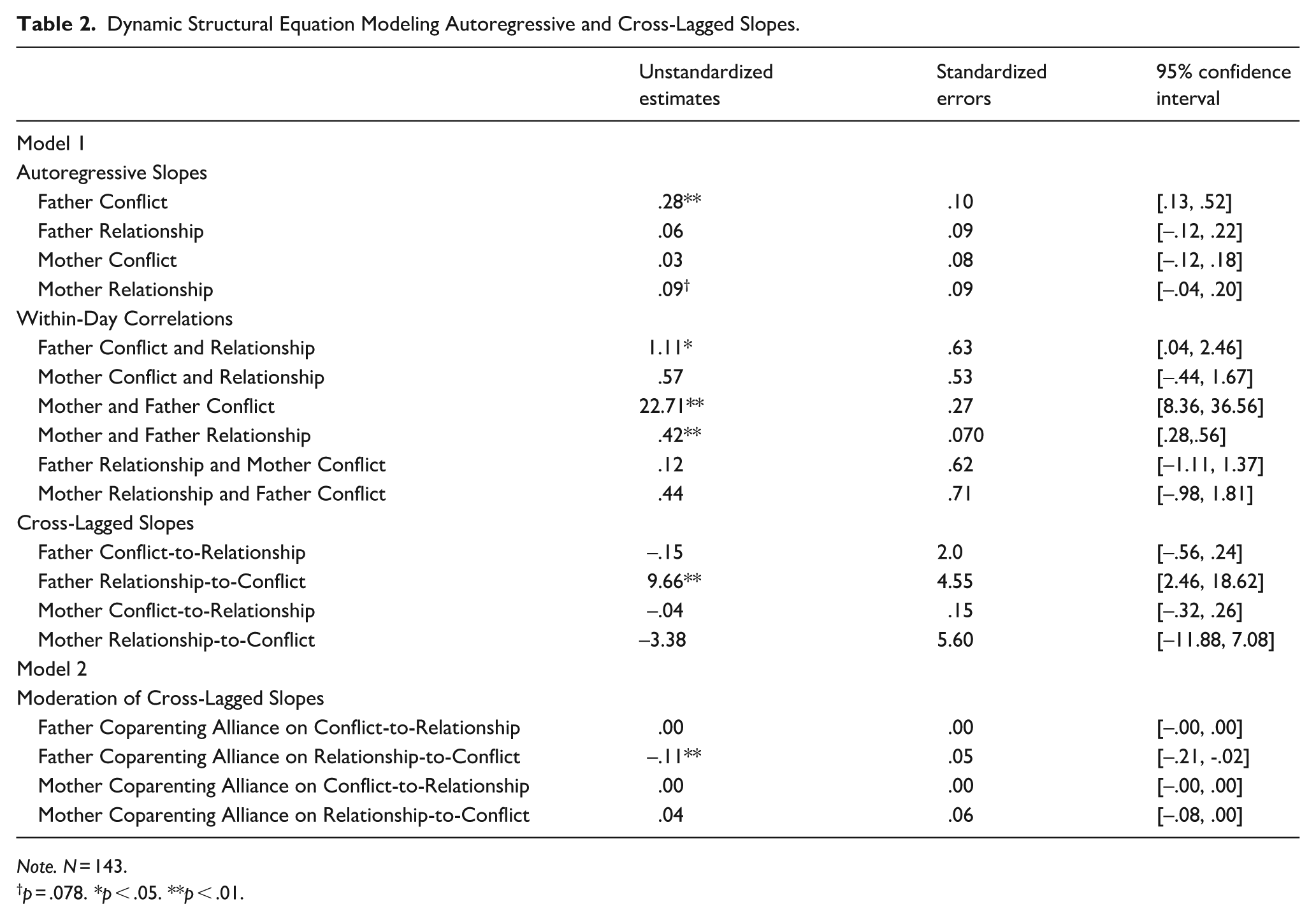
Note. N = 143.
p = .078. *p < .05. **p < .01.
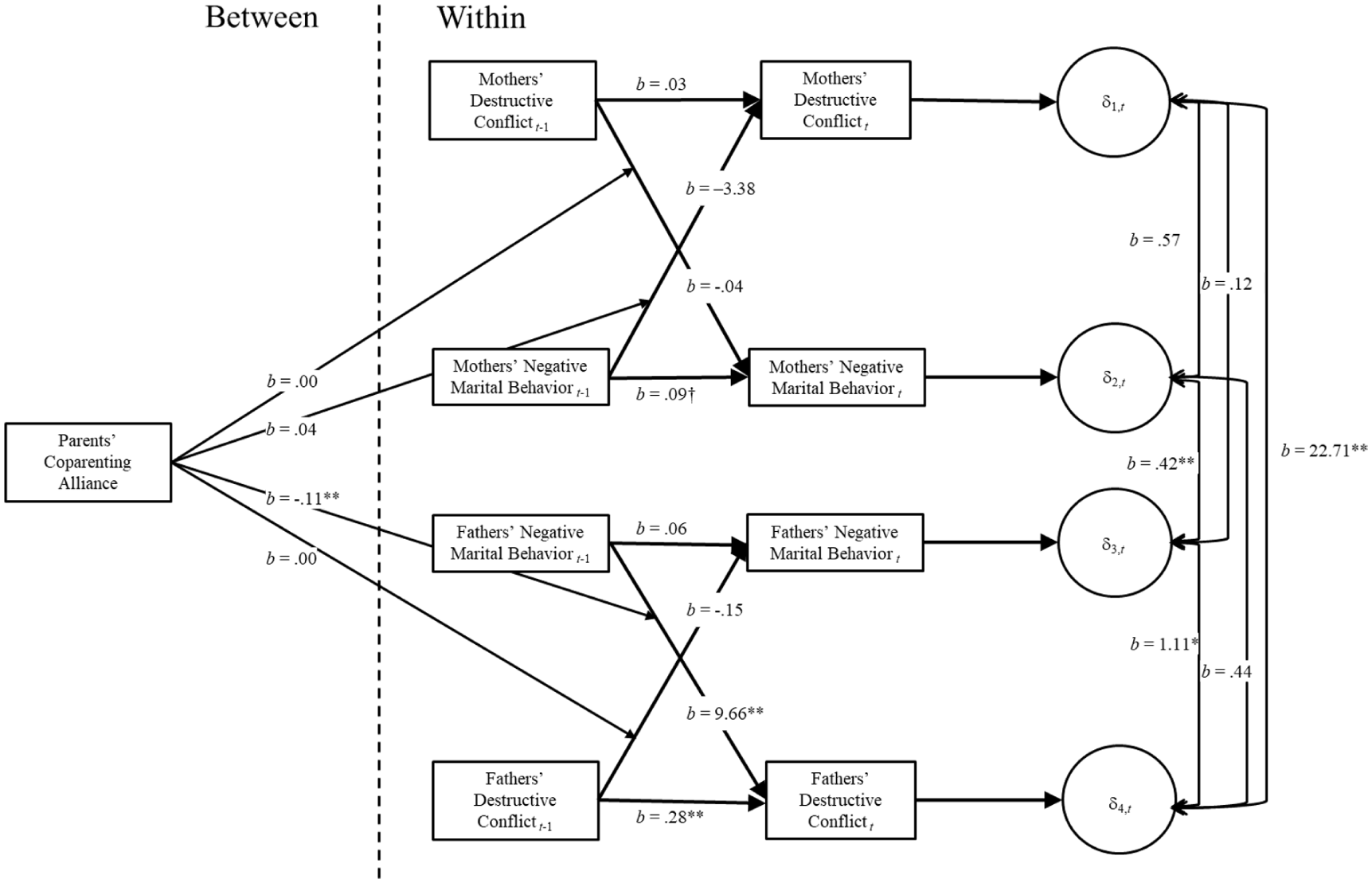
Dynamic structural equation model.
One cross-lagged slope was significant. Fathers’ lagged negative marital behaviors positively predicted subsequent destructive father–child conflict. However, this effect was qualified by a moderation effect (see Figure 2). Coparenting alliance negatively predicted the within-level cross-lagged slope, meaning the positive relation between the previous day’s negative marital behaviors and subsequent destructive father–child conflict was strengthened (i.e., greater spillover occurred) when coparenting alliance was low (1 SD below the mean).
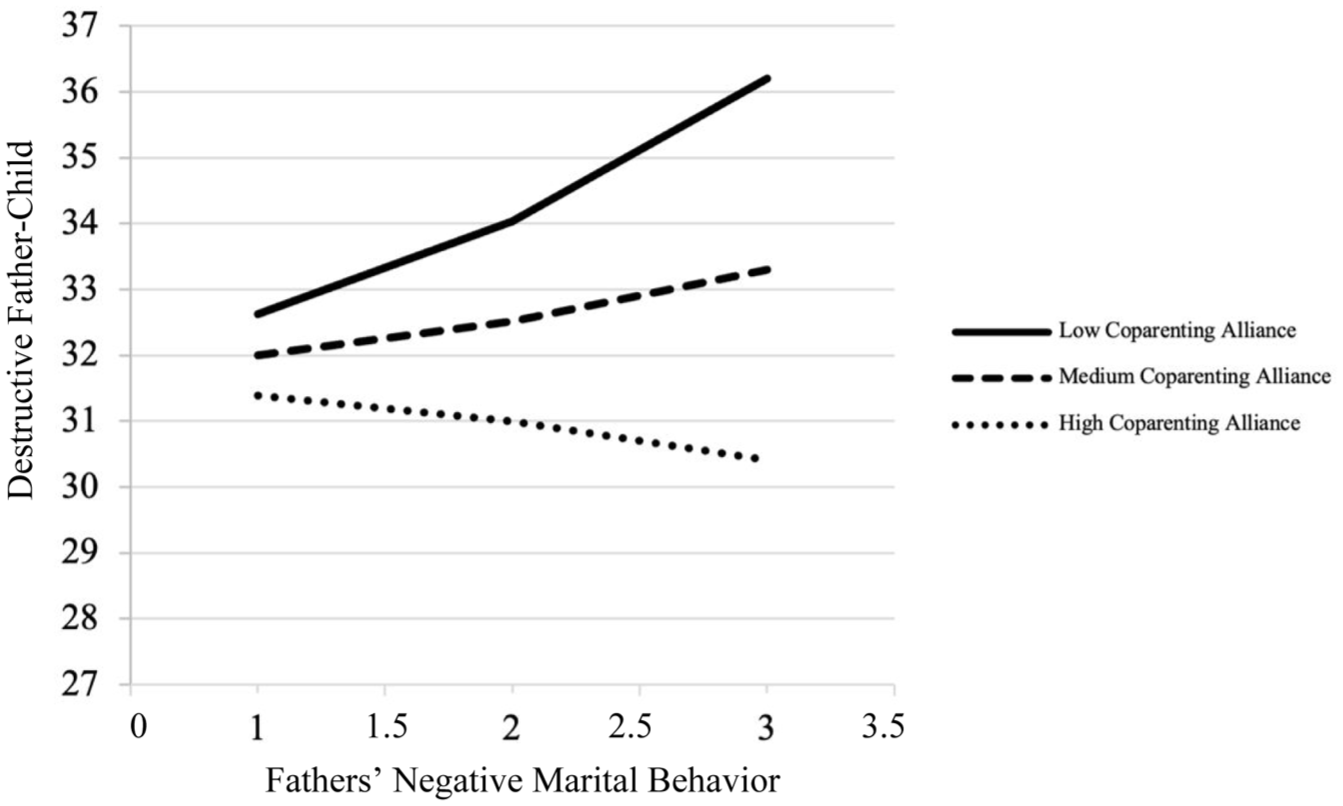
Coparenting Moderating the Effect of Negative Marital Behaviors on Destructive Conflict among Fathers.
At the between level, the only significant association was between mother–child destructive conflict and mothers’ negative relationship behaviors, r = .65, p = .002. Mothers who reported more destructive conflict across the week engaged in more negative relationship behaviors on average compared to mothers who reported fewer destructive conflict qualities.
A significant proportion of variance in each study variable was explained according to within-level R2 values. The model explained 7% of the variance in daily mother–child destructive conflict, 18% of the variance in daily father–child destructive conflict, 30% of the variance in mothers’ daily negative marital behaviors, and 52% of the variance in fathers’ daily negative marital behaviors.
Discussion
In the present study, we explored day-to-day lagged stability and spillover in destructive parent–child conflict and negative marital behaviors while also looking at coparenting alliance as a spillover moderator. Results revealed significant stability in destructive father–child conflict, marginal stability in mothers’ negative marital behaviors, and spillover from fathers’ previous negative marital behaviors to subsequent destructive father–child conflict, particularly when coparenting alliance was low. By using daily reports of family interactions across the week, we were able to test bidirectional time-lagged effects for a more thorough analysis of marital-parenting spillover, accounting for the day-to-day stability in each of these behaviors.
This study is the first to our knowledge to test day-to-day stability in mother–child and father–child destructive conflict qualities. Parent–child conflicts occur frequently, so an understanding of the lingering negativity in those interactions is useful for families, researchers, and practitioners. Although previous work shows fathers report less day-to-day consistency in their parenting behaviors than mothers (Holub & Nelson, 2022), our findings revealed significant stability in father–child destructive conflict. This means more destructive qualities of father–child conflict on 1 day were related to more destructive qualities during a conflict the next day. Fathers tend to use more oppositional conflict tactics with children than mothers (Mehlhausen-Hassoen, 2022; Shelton et al., 2006), and because of this, they may maintain negativity from father–child interactions more readily than mothers. Cycles of coercive parent–child interactions are well understood in parenting theory (Eddy et al., 2001; Patterson, 2016) and therapy (parent–child interaction therapy; Eyberg et al., 1995), but further exploration of the day-to-day stability in destructive father–child conflict dynamics is warranted to better understand whether this stability is due to lingering rumination and resentment from a previous disagreement or due to broader parenting goals around child obedience or punitive emotion socialization.
Interestingly, negative marital behaviors did not show significant daily lagged stability among mothers or fathers, contrary to previous research on partners’ experience of negativity the next day following a marital conflict (Prager et al., 2015). Mothers’ negative marital behaviors demonstrated marginal stability in this study. Women are more likely than men to express negativity during marital interaction (Christensen & Heavey, 1990) and to experience lingering negative affect and rumination in response to stress (Leger et al., 2018).
Although we expected bidirectional spillover due to past work demonstrating both time-lagged directions of effects for interparental conflict and parent–child conflict (Sherrill et al., 2017) and negativity across both domains (Almeida et al., 1999), only the negative marital behavior to destructive parent–child conflict direction was found in these analyses. Our expectation that spillover between these family domains would be more likely among fathers due to greater concordance between parenting and marital quality (Belsky et al., 1991) was supported. A daily time-lagged cross-variable slope was only significant among fathers.
However, this spillover slope was qualified by a significant moderation effect. Margolin and colleagues (1996) demonstrate that the likelihood of spillover between marital and parent–child relationships is enhanced under conditions of family distress. Our results extend to conditions where coparenting alliance is weak. Concordance in parents’ child-rearing behaviors and goals can serve as an important source of support for couples (Cox & Paley, 1997; Feinberg, 2003) and has been shown to buffer against spillover from fathers’ parenting stress to their marital satisfaction (Kwan et al., 2015).
Limitations
There are some notable limitations to the present study. First, a relatively small number of couples over 7 days may have limited our ability to detect significant effects. Although parent–child conflicts were reported on 3–4 of 7 days, on average, in this study, 1 week may not have been enough time in some families to get an estimate of interindividual differences in the lagged effect. Second, because of the young target child age in this study (5–8 years), only parents reported on parent–child conflict interactions. However, it is possible that children have different perceptions of the conflicts, and parents’ reports may be biased. Future research utilizing multiple perceptions or observations of family interaction would be beneficial. Third, coparenting alliance was assessed once in the initial study survey, which prevented us from exploring day-to-day variation in this construct and in potential moderation effects. Similarly, parents reported on one conflict with their child each day, so we were unable to examine similarities and differences across multiple conflicts within a single day. Despite the fact that a large portion (44%) of families in this sample were low-income, couples were generally well-functioning, as seen from low average negative marital behaviors and high average coparenting alliance. These results may not replicate among couples experiencing greater stress and marital dysfunction. Finally, the larger study was only able to recruit female–male partnerships. Same-gender couples may experience distress from marital strain differently than different-gender couples, suggesting there may be differences in how same-gender couples navigate marital conflict (Garcia & Umberson, 2019). Future research should address other coparenting contexts.
Conclusions
The current findings on day-to-day destructive qualities of father–child conflicts highlight the importance of emphasizing parent emotion regulation and constructive conflict strategies with fathers in parenting therapy and interventions. Both previous destructive father–child conflicts and previous negative marital interactions pose a risk to constructive father–child interactions. This lingering negativity from multiple sources is an important target for intervention with fathers, and our findings suggest bolstering a strong coparenting alliance may be one way to protect father–child relationships from this lagged negativity so that dyads are better able to resolve disagreements (Nelson et al., 2014).
Footnotes
Ethical Approval
Ethical approval information is included in section “Method.”
Informed Consent
The Institutional Review Board at the University of Texas at Dallas approved this study (protocol #14-27), and informed consent was provided via a web consent form from all participants.
Funding
The authors received no financial support for the research, authorship, and/or publication of this article.
Declaration of Conflicting Interests
The authors declared no potential conflicts of interest with respect to the research, authorship, and/or publication of this article.
