




Abstract
Secure attachment relationships provide the foundation for lifelong emotional resilience and social flourishing. However, measuring attachment with observational methods is challenging at scale in low-resource settings. Caregiver-report questionnaires offer a feasible alternative but remain underutilized and insufficiently validated for Majority World contexts. This study aimed to address this gap by culturally adapting and validating the Attachment Relationship Inventory-Caregiver Perception 2–5 years Short Form Peru (ARI-SF-Peru) questionnaire for use in an Andean setting. Using a stepwise mixed-methods design, we employed qualitative methods to refine the questionnaire, followed by confirmatory factor analyses (CFA) to test its psychometric properties in a validation sample of N = 1,000 mothers. A simplified two-factor model (secure vs. insecure attachment) demonstrated strong reliability and predictive validity for child outcomes, though a four-factor model with all attachment styles can be used to provide additional theoretical insights. The final 21-item questionnaire provides a practical, culturally adapted, and valid tool for assessing mothers’ perceptions of their attachment relationships with their young children in an understudied population. The study also provides a framework for adapting self-report assessments in similar contexts, recommending simplified language, positive phrasing, and reduced response options to enhance clarity.
Keywords
Attachment, the deep emotional bond between a child and their caregiver, is crucial for psychosocial development (Ainsworth, 1978; Richter, 2015). Attachment relationships are broadly categorized as secure or insecure, with the latter subdivided into avoidant, ambivalent (anxious-resistant), and disorganized (Ainsworth & Bell, 1981; Carlson et al., 1989). Secure attachment forms when caregivers consistently respond to a child’s needs, providing comfort and safety, enabling children to manage stress, form trusting relationships, and engage with their environment (Ainsworth, 1982; Voort et al., 2014). Secure attachment relationships thus provide the foundation for neural and physiological systems that promote lifelong emotional resilience and social flourishing (Ranson & Urichuk, 2008; Richter, 2015).
Avoidant attachment, on the other hand, occurs when caregivers are emotionally distant, leading children to suppress emotional needs and struggle with closeness (Ainsworth, 1978). Ambivalent attachment is characterized by inconsistent caregiving. This unpredictability can result in clinginess and anxiety in children, making it difficult to develop autonomy and emotional stability (Cassidy & Berlin, 1994). Disorganized attachment stems from caregivers who are both comforting and frightening, often due to trauma, leading to contradictory behaviors in children (Carlson et al., 1989).
One of the central factors in fostering attachment is responsive parenting—a caregiver’s ability to accurately interpret and respond to a child’s signals (Voort et al., 2014). Sensitive responsiveness, which includes recognizing non-verbal signals such as facial expressions and vocal tone, is a core predictor of secure attachment and fosters a child’s emotional well-being (Ainsworth, 1982). Furthermore, responsive moment-to-moment parenting facilitates cognitive development by providing the internal sense of security necessary for exploration and learning (Voort et al., 2014).
In line with this evidence, modern large-scale parenting interventions aimed at improving early child development (ECD) in Majority World contexts (also referred to as low- and middle-income countries) increasingly promote high-quality parent–child interactions (Neuman & Okeng’o, 2019). Programs such as home visiting and parental education initiatives have proven effective in enhancing children’s cognitive, emotional, and physical outcomes, particularly when emphasizing responsive caregiving (Jeong et al., 2021). However, few studies explicitly assess whether these interventions strengthen secure attachment, despite attachment theory suggesting its critical role for optimizing developmental gains (Richter, 2015).
In Majority World contexts, families often face significant health and economic resource gaps that restrict children’s opportunities for positive psychosocial development. Targeting universal mechanisms of resilience, such as attachment-informed interventions, could enhance not only cognitive and emotional outcomes but also the formation of secure, resilient relationships (Alto & Petrenko, 2017).
Nevertheless, one critique of attachment-based interventions is their cultural applicability (Morelli et al., 2018). While core attachment hypotheses are considered universal, expressions of responsive caregiving vary widely across cultures (Mesman et al., 2018). Many non-Western societies emphasize physical closeness and non-verbal cues over verbal interactions, which are a focus of Western attachment frameworks (Fourment, Espinoza, et al., 2022). This difference adds complexity to cross-cultural studies, and attachment-based observational studies are scarce in rural communities in the Majority World (Fourment, Espinoza, et al., 2022).
The present study took place in three provinces of Cajamarca, Peru, a high-altitude region in the Andes. Predominantly rural and Spanish-speaking, Cajamarca has seen improvements in literacy and reductions in stunting, while national programs such as Cuna Más have expanded early childhood services (Silva Villalobos et al., 2019). Rates of breastfeeding are high, at over 96% in our sample. Culturally, caregiving norms include prolonged physical closeness between mothers and infants, as children are often carried on their mothers’ backs while they perform daily tasks (Ames, 2013a; Fourment et al., 2021). Caregiving is often communal, involving extended family members, and children are incorporated into daily routines early on (Ames, 2013b; Fourment et al., 2021). Finally, physical punishment is still accepted as a necessary aspect of child-rearing in many areas (Ames, 2013a). Given these cultural particularities, Western attachment measurement tools may not fully capture caregiver-child dynamics in Andean communities.
Traditionally, measuring attachment quality in early childhood has relied on observational methods, such as the laboratory-based Strange Situation Procedure (SSP) (Ainsworth & Bell, 1981) or the home-based Observer Attachment Q-Sort (Van IJzendoorn et al., 2004). While effective, these approaches are resource-intensive, requiring highly trained personnel and structured settings, making them impractical for large-scale studies in resource-constrained settings.
Caregiver-report questionnaires offer a more feasible alternative, requiring minimal training and allowing for large-scale data collection. They capture caregivers’ perspectives on the child’s attachment behaviors across different situations, providing insights that structured observations may miss (Spruit et al., 2021). Several questionnaires measuring perceptions of attachment or related parenting constructs suitable for preschool children exist. Examples include the Kinship Center Attachment Questionnaire, measuring perceived attachment to new caregivers in foster children (Kappenberg & Halpern, 2006), the Composite Caregiving Questionnaire, measuring five parenting constructs related to attachment security (Maxwell et al., 2020), and the Attachment Relationship Inventory—Caregiver Perception 2–5 years (ARI-CP 2-5; Spruit et al., 2021, see below).
Despite their potential benefits, caregiver-report questionnaires are underutilized in Majority World contexts, where a systematic review of tools for evaluating caregiver-child interactions found that only 13.5% of tools were self-reported (Bozicevic et al., 2024). One reason for this may be that validations of tools in Majority World contexts are lacking.
The Attachment Relationship Inventory—Caregiver Perception (ARI-CP 2-5) was developed in Europe to assess caregivers’ perceptions of attachment-related behaviors in children aged 2–5 years (Spruit et al., 2021). It consists of 48 items rated on a 5-point Likert-type scale, capturing behaviors linked to security, trust, and emotional closeness. Items include statements such as, “I immediately understand what my child needs from me” or “My child turns away when I cuddle him/her.” Unlike diagnostic tools, the ARI-CP 2-5 does not categorize children into attachment types but instead provides an indication of the extent to which caregivers describe behaviors indicative of all four attachment styles. This approach acknowledges that caregiver–child interactions fluctuate based on stress, context, and developmental stage. This makes the tool well suited for tracking changes over time and allows for tailored approaches that address specific needs.
Although promising, the ARI-CP 2-5 has yet to be adapted for use in Majority World contexts such as Andean Peru, where differences in caregiving practices, literacy levels, and familiarity with rating scales may affect how caregivers interpret and respond to questionnaire items (Fourment, Nóblega, & Mesman, 2022; Mesman et al., 2018). Likert-type scales, for example, may pose challenges in non-Western settings, where abstract self-assessment is less common (Bernal et al., 1997; Flaskerud, 2012). Caregivers may struggle with the phrasing of questions or the concept of ranking behaviors on a numerical scale, leading to response biases.
To improve the ARI-CP 2-5’s usability in rural Andean Peru, several key adaptations were necessary. First, simplifying language and incorporating visual aids could enhance accessibility (Fernández & Abe, 2018; Flaskerud, 2012). Second, emphasizing culturally relevant behaviors, such as physical proximity and touch, could better capture local caregiving styles. Third, reducing the questionnaire length could minimize respondent burden.
Attachment theory underscores the critical role of early caregiving for child development, aligning with ECD intervention goals. However, attachment remains an underexplored outcome in program evaluations, particularly in Majority World contexts where limited resources and cultural differences complicate measurement. There is a pressing need for efficient, culturally adapted tools to assess caregiver-reported attachment quality in large-scale studies. Adapting the ARI-CP 2-5 for Andean Peru presented an opportunity to bridge this gap.
This study thus aimed to develop the ARI-CP 2-5 for use in Andean Peru, with three specific aims:
Culturally adapt and shorten the ARI-CP 2-5 into a shorter version with simplified language and revised response options, the Peruvian ARI-CP 2-5 Short Form (ARI-SF-Peru).
Describe the psychometric properties, including internal consistency and factor structure of the ARI-SF-Peru.
Validate the ARI-SF-Peru by correlating scores with observed parent–child interactions and parent-reported caregiving measures (concurrent validity), and by regressing scores on observed and parent-reported ECD (predictive validity).
By developing a culturally responsive attachment measure for Andean Peru, this study enables the effective evaluation and optimization of attachment-focused interventions across diverse cultural settings, supporting children’s emotional and cognitive development worldwide.
Methods
Participants
The validation sample included N = 1,000 mothers of children aged 24–36 months, enrolled in an ongoing cluster randomized controlled trial (RCT) of a digital parenting intervention in Cajamarca, Peru (see Hartinger Pena et al., 2023, for recruitment details). The trial involved over 2,000 participants; for the purpose of this study, we extracted data for the first 1,000 mothers completing all relevant modules; a suitable sample size for factor analysis and scale development (Clark & Watson, 2016). Since participants were part of a randomized study, no post-stratification weighting was applied. All families were Spanish-speaking, the mean age of the children was 28.78 months (SD = 2.21) and 494 (49.4%) of children were female (see Table 1).
Demographic Characteristics of Participants (Validation Sample N = 1,000).
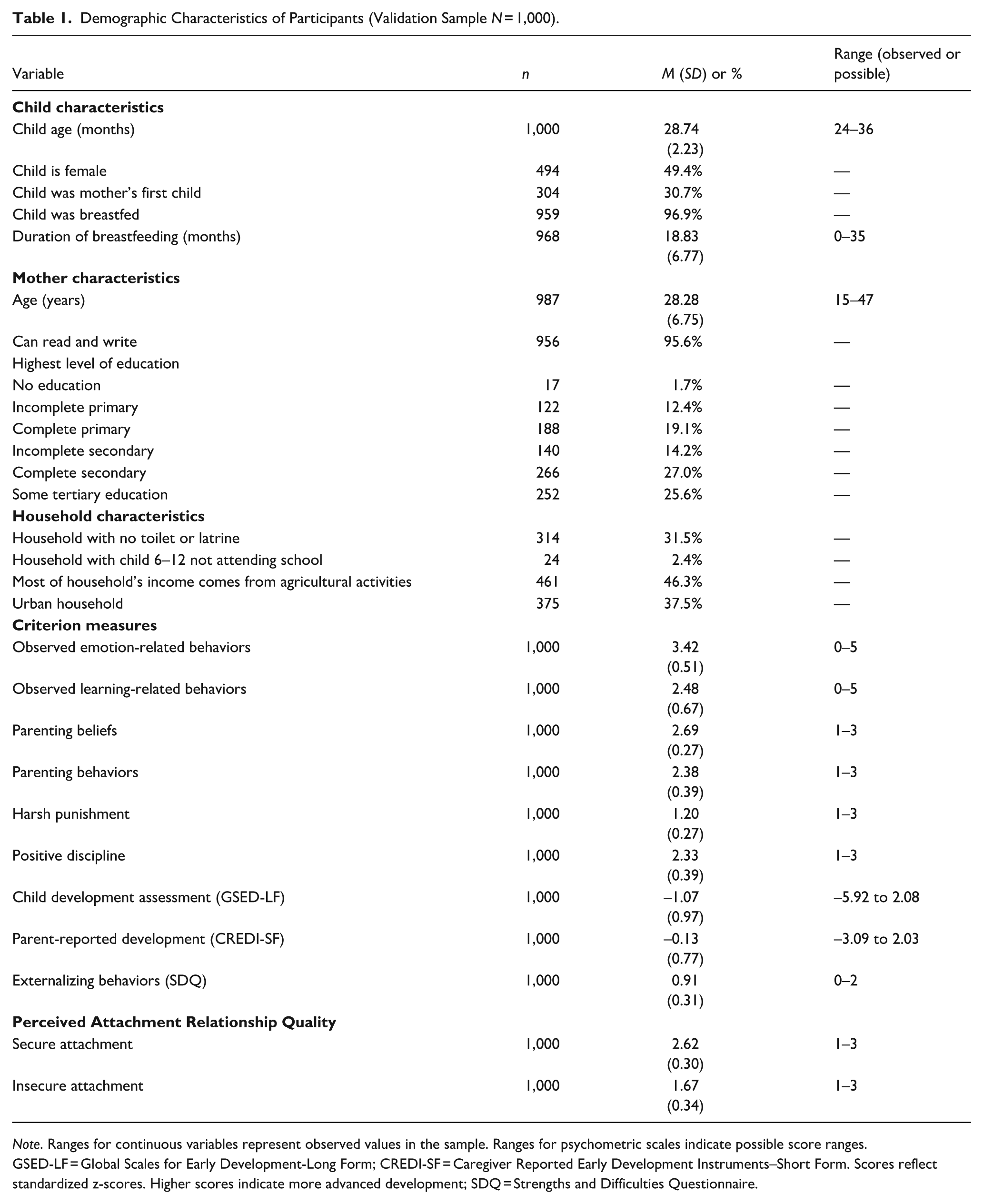
Note. Ranges for continuous variables represent observed values in the sample. Ranges for psychometric scales indicate possible score ranges. GSED-LF = Global Scales for Early Development-Long Form; CREDI-SF = Caregiver Reported Early Development Instruments–Short Form. Scores reflect standardized z-scores. Higher scores indicate more advanced development; SDQ = Strengths and Difficulties Questionnaire.
Measures
Development of the ARI-SF-Peru
We used a stepwise mixed-methods design to translate and adapt the instrument for cultural and linguistic relevance. The process incorporated both expert-driven translation procedures and field-based validation activities. All item modifications are summarized in Supplementary Table 1, and Figure 1 presents a visual summary of the full adaptation and validation process.
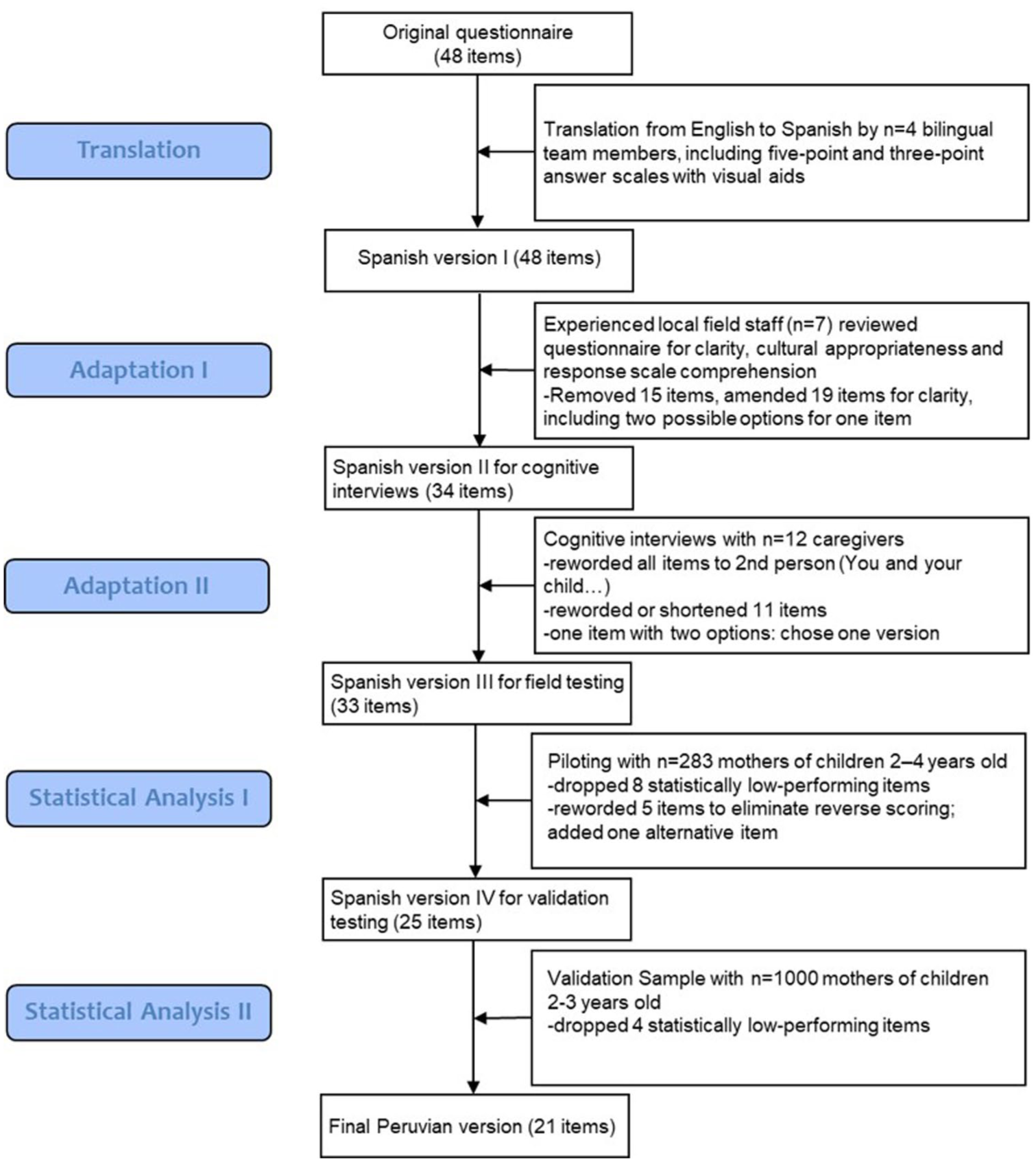
Flowchart of Questionnaire Development.
First, bilingual psychologists and culturally knowledgeable child development specialists on the team conducted independent forward and backward translations of all 48 original items and both 3- and 5-point response scales into Spanish. Discrepancies were resolved in consensus meetings.
Next, we conducted multiple rounds of qualitative feedback from data collectors to ensure semantic, idiomatic, and conceptual equivalence. Specifically, we asked five data collectors who had conducted extensive fieldwork with mothers of young children in the region, to review introduction, items, and answer options for clarity and cultural resonance. The focus group (n = 6 participants) was conducted in person and facilitated by a bilingual early child development specialist. It primarily focused on reactions to the different answer options, and finding consensus on the wording of previously flagged items in the draft questionnaire. As a result, wording was amended and 15 items, for example where abstract terms (e.g., “boundaries”) lacked local equivalents, were dropped. Given consistent prior observations of difficulties with 5-point Likert-type scales among local mothers (Hinckley et al., in press), we tested both 3- and 5-point versions with visual aids. Data collectors provided detailed feedback on usability and preference. The simplified 3-point scale with visual aids was unanimously preferred and selected for continuing versions.
A trained local psychologist then field tested the draft items in cognitive interviews with 12 caregivers of children under 5, recruited using purposive and snowball sampling. Caregiver participants represented varied education levels and came from both rural (8) and peri-urban (4) areas. Four did not complete primary, five completed primary and three secondary education, but all were literate, reflecting the population involved in the larger validation sample. Participants verbalized their interpretation of 8–9 items (three participants per item) and responded to follow-up probes about meaning and clarity. Based on this feedback, we reworded all items into second person (“you and your child”), and further simplified items, though none were dropped at this stage. Interviews confirmed general comprehension and cultural acceptability of the instrument.
We then piloted the revised 33-item questionnaire, including visual aids illustrating the answer options, with 283 mothers of children aged 2–4 years, using the 3-point scale. Mothers received an informational leaflet on play-based child development for participation. Descriptive analyses and Confirmatory Factor Analyses (CFA) of the original four-factor structure (secure, avoidant, ambivalent, and disorganized attachment) guided item refinement. Eight low-performing items (low variance, reduced α, and factor loadings < 0.3) were removed, and five were reworded to eliminate reverse scoring.
The resulting 25-item version was tested in the validation sample. Items were scored on a 3-point Likert-type scale (1 = never applies, 2 = sometimes applies, 3 = always applies), with subscales calculated as averages (higher scores reflecting more secure or insecure attachment behaviors, respectively). Interviewers administered all questionnaires verbally on a tablet in the families’ homes. All participants signed an informed consent. The study was approved by the University Peruana Cayetano Heredia institutional review board in Lima, Peru (SIDISI: 202522, 210652) and the Ethics Commission for Northwest and Central Switzerland (EKNZ: AO_2021-00002, AO_2022-00078).
Observed Mother–Child Interactions
We used an adapted version of the Observation of Mother-Child Interactions (OMCI; Rasheed & Yousafzai, 2015) to assess mothers’ emotion- and learning-related behaviors during naturalistic interactions with their children. A trained local interviewer observed a 4-min mother–child interaction with a picture book, recording the frequency of specific behaviors: three emotion-related (e.g., positive facial expressions) and four learning-related (e.g., asking questions). Tallies were top-coded at 5, and total scores reflect the average within each domain (emotion vs learning; range: 0–5). Preliminary validation in this sample suggests the adapted OMCI demonstrates adequate internal consistency and concurrent validity with other parenting measures (McCoy et al., under review).
Parenting Beliefs and Behaviors
We used the Nurturing Parenting Beliefs and Behaviors Scale (NPBBS) as a measure of parenting beliefs (beliefs, attitudes, knowledge, 15 items) and behaviors (11 items) regarding responsive caregiving and early learning for caregivers of children aged 2–5 years old (Hinckley et al., in press). The 26-item self-report instrument was originally developed in Spanish in Cajamarca, Peru and has strong validity evidence for use in this local study context. Each item was scored following a 3-point Likert-type scale, with response options depending on item content (e.g., “In your opinion, can young children learn through play? 1 = not at all, 2 = a little, 3 = a lot”). The beliefs and behaviors subscales were each scored as the average of their respective items. Higher scores indicate more alignment with principles of positive parenting.
Discipline Behaviors
We used adapted parent-reported discipline items from the MICS-7 (United Nations Children’s Fund [UNICEF], 2024) as a locally relevant measure of harsh punishment (5 items) and non-violent discipline (4 items) behaviors. Each item was scored on a 3-point Likert-type scale (1 = never, 2 = at least once, 3 = every day). Harsh punishment and non-violent discipline were calculated as the average of their respective items, with higher scores indicating more frequent use in the last 3 days.
Early Childhood Development
We assessed ECD with three measures. First, the Global Scales for Early Development-Long Form (GSED-LF) is a direct assessment of children under 3 years, designed for culturally diverse, low-resource settings. It measures developmental milestones across multiple domains, producing a single overall d-score (GSED Team, 2023). Children are asked to complete an age- and ability-appropriate subset of 155 items.
Second, the Caregiver Reported Early Development Instruments-Short Form (CREDI-SF) is a caregiver-reported ECD measure for children from birth to 3 years designed for global use (McCoy et al., 2018). It includes age-specific sets of 20 items covering various developmental domains, each scored as yes = 1 or no = 0.
Third, the preschool version of the Strengths and Difficulties Questionnaire (SDQ) is a caregiver-report tool for children aged 2–4 years. The externalizing problems score combined conduct problems and hyperactivity/inattention subscales (10 items, 3-point Likert-type scale: 0–2; Youthinmind, 2022). The final score was the average of all items.
Covariates
In correlational and regression analyses, child age (months) was continuous, while mother’s education was ordinal (six categories). Household socioeconomic status (SES), derived via principal components analysis, was categorized into a quintiles index based on overcrowding, consumer durables, and housing characteristics (Vyas & Kumaranayake, 2006). For measurement invariance analyses, SES was dichotomized at the sample median. Child gender and urbanicity were binary variables.
Statistical Analysis
In our validation sample (N = 1,000 mothers), we examined descriptive statistics, (item-level means, SDs, range, histograms) and regressions using Stata/SE 18.0 (StataCorp, 2023).
CFA were conducted in R (v. 4.3.2; (R Core Team 2023)) using Lavaan (v. 0.6-17; Yves, 2012) and semTools (v. 4.3.2) was used to compute reliability statistics. Given the ordinal, non-normal data, we employed the WLSMV estimator with delta parameterization (Li, 2016). Three theoretical models were tested: (1) the original four-factor model (secure, avoidant, ambivalent, disorganized); (2) a simplified two-factor model (secure vs insecure); and (3) a one-factor model (overall attachment). Prior to model comparisons, we dropped three items with factor loadings < .4. Model fit was assessed using scaled RMSEA (<.06), scaled CFI and TLI (⩾.95), and SRMR (<.08) (Hu & Bentler, 1999). Robust chi-square difference tests compared nested models, while fit indices compared non-nested models. Internal consistency was evaluated using Cronbach’s alpha, ordinal alpha, and McDonald’s omega.
Next, measurement invariance of the best-performing two-factor model was tested across child gender, urbanicity, and SES (Gregorich, 2006). Configural, metric, and scalar invariance were assessed using criteria: ΔCFI ⩾ .010, ΔRMSEA ⩾ .015, and ΔSRMR ⩾ .030 (metric) or ⩾ .010 (scalar) (Chen, 2007).
Finally, concurrent validity was assessed via correlations with observed emotion- and learning-related interactions (OMCI) and parent-reported parenting (NPBBS, discipline practices). Predictive validity was examined through multiple regressions predicting parent-reported child behavior (SDQ), development (CREDI-SF), and a developmental assessment (GSED-LF), controlling for child age, child sex, maternal education, and SES.
Results
Qualitative Findings From Measure Development (Aim 1)
Qualitative feedback from both mothers and interviewers highlighted significant challenges with the original questionnaire items, leading to numerous adaptations to enhance cultural relevance and clarity. A primary issue was the difficulty participants faced in interpreting abstract terms such as “closeness,” or “boundaries,” which are not commonly conceptualized in the local context. Similarly, mothers struggled with negatively worded items and 5-point Likert-type scales, necessitating the use of positive wording and 3-point response options. Many revisions thus focused on rephrasing or removing items that were confusing or culturally inappropriate. For instance: The item “My child has no respect for my boundaries” was removed due to a lack of cultural relevance and understanding of the concept. Items with overly universal interpretations, such as “My child needs my help with everything,” were also removed based on feedback that they did not make sense, as “all children need help with everything.” “My child does not listen to me” was reworded to “It takes a long time before your child listens to you,” a positively worded alternative that aligned better with mothers’ experiences. Finally, all items were adapted to include the child’s name, making them more personalized and relatable for mothers. See Supplemental Table 2 for more illustrative examples of item adaptations.
Quantitative Findings (Aim 1)
Table 1 reports descriptive statistics of the validity sample of N = 1,000 mother–child dyads. The sample spanned diverse urbanicity contexts, with more than a third (37.5%) urban households. On the other hand, nearly half (46.3%) of the families reported that most of their household income came from agricultural activities, with a significant reliance on subsistence farming in the rural areas. The vast majority of children in the sample were breastfed (96.9%), with a long average breastfeeding duration of 18.83 months. High rates of literacy were observed among mothers, with 95.6% reporting the ability to read and write, and the majority having completed at least some secondary education.
Factor Structure (Aim 2)
The refinement process resulted in a 25-item questionnaire, which was tested in the full validation sample. Descriptive statistics revealed sufficient variability across items, ensuring robust measurement properties. CFA resulted in a reduced 21-item questionnaire where all items loaded > .4 on their respective factor. The final Spanish language questionnaire with visual aids and English translation is included in Supplemental Table 3.
Model fit analyses indicated that both the 21-item four-factor and two-factor models fit the data well. The four-factor model demonstrated a slightly improved fit (RMSEA = .03, CFI = .96, TLI = .95, SRMR = .05) compared to the two-factor model (RMSEA = .04, CFI = .95, TLI = .94, SRMR = .05). The one-factor overall attachment model showed the worst fit (RMSEA = .07, CFI = .79, TLI = .77, SRMR = .09). However, the four-factor model yielded high correlations between the insecure factors (.81–.95), and lower reliability within the insecure subscales (Avoidant: Cronbach’s α = .65, ordinal α = .76 and McDonald’s ω = .66; Ambivalent: α = .54 ordinal α = .62 and ω = .54; Disorganized: α = .57, ordinal α = .66 and ω = .57) compared to the two-factor model: These secure and insecure factors were correlated at −.31 (two-factor model) and showed acceptable to strong internal consistency (Secure: Cronbach’s α = .62, ordinal α = .75 and ω = .64; Insecure: α = .79, ordinal α = .85 and ω = .79), particularly when examining reliability estimates suited to ordinal, non-normal data. Supplemental Table 4 shows an overview of all full and reduced models with item factor loadings and model fit information. The two-factor model demonstrated configural, metric, and scalar measurement invariance across gender, urban versus rural, and high versus low SES-groups, confirming its applicability across these subgroups. A summary of model comparisons with fit indices are included in Supplemental Table 5. Thus, while the four-factor model remains viable for studies requiring finer distinctions among insecure attachment styles, we continued our analyses with the two-factor solution due to its simplicity and superior subscale reliability. However, both models demonstrated broad applicability, with measurement invariance confirmed across key demographic subgroups.
Correlations and Regression Analyses (Aim 3)
Bivariate correlations between the two ARI-SF-Peru subscales and a variety of other parenting measures revealed meaningful patterns of association, as shown in Table 2. These correlations were consistent with theoretical expectations: Secure attachment demonstrated sizable positive correlations with self-reported parenting beliefs (r = .37) and behaviors (r = .38), as well as positive discipline behaviors (r = .29). Smaller but statistically significant correlations were noted with observed learning-related behaviors (r = .14). However, secure attachment did not show a statistically significant relationship with observational measures of emotion-related behaviors (r = .08). In contrast, Insecure attachment correlated strongly and positively with harsher disciplinary behaviors (r = .30) and negatively with positive parenting beliefs (r = −.28) and behaviors (r = −.19). Smaller negative correlations were found with observational measures of emotion-related behaviors (r = −.13) and learning-related behaviors (r = −.12). The two subscales correlated with each other at r = .18.
Bivariate Correlations Between ARI-SF-Peru Subscales and Criterion Measures of Parenting (N = 1,000).
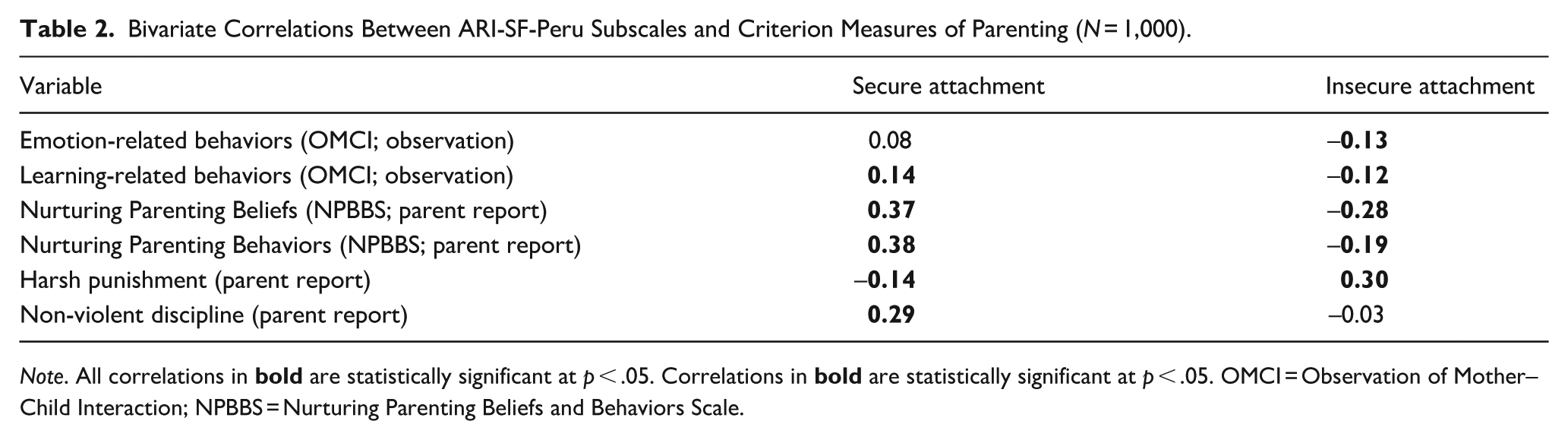
Note. All correlations in
Regression analyses (Table 3) highlighted the predictive utility of the Secure and Insecure subscales for child outcomes. Secure attachment behaviors positively predicted directly assessed child development (GSED-LF: β = 0.08, p < .01) parent reports of developmental milestones (CREDI-SF: β = 0.18, p < .001), and less externalizing behaviors (SDQ: β = −0.15, p < .001), though effect sizes were small. Insecure attachment behaviors were not significantly related to overall child development outcomes, but were strongly associated with behavior problems (SDQ: β = 0.31, p < .001).
Results of Multiple Regression Analyses Predicting Child Development and Behavior (N = 981).
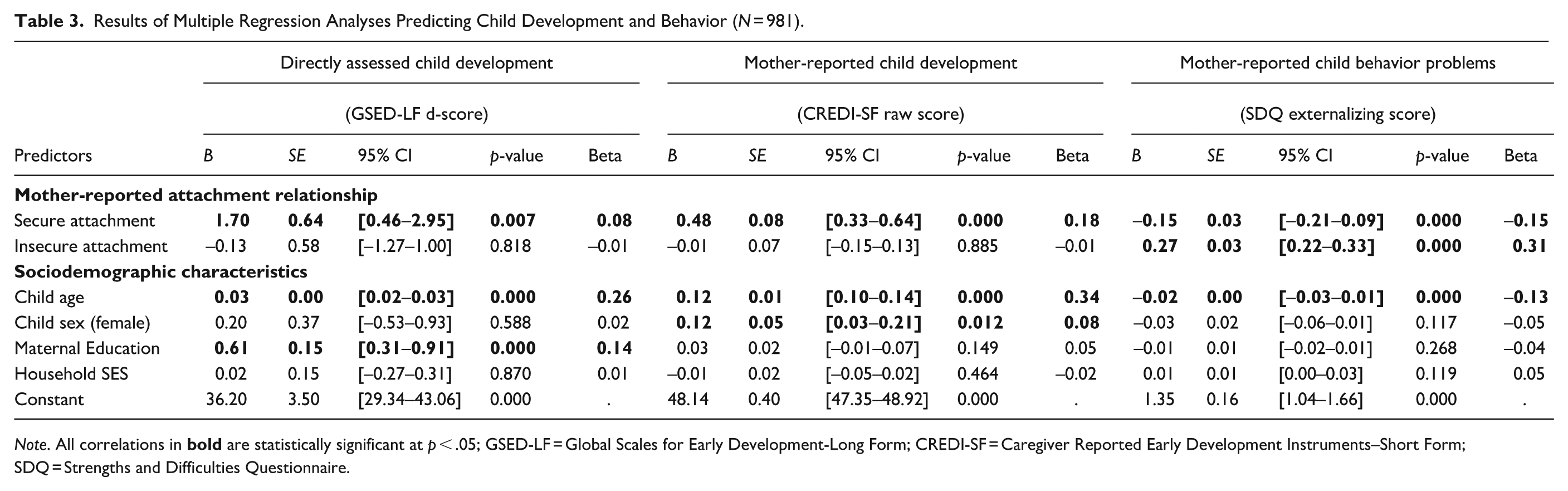
Note. All correlations in
Discussion
The primary aim of this study was to develop and validate the ARI-SF-Peru for use in a non-Western, low-resource setting, ensuring cultural appropriateness. Using qualitative and quantitative methods, we refined the questionnaire and assessed its validity and reliability in measuring attachment relationships. Specifically, we compared a four-factor theoretical model and a simplified two-factor model, tested measurement invariance across subgroups, and analyzed associations with parenting and child development outcomes.
This process resulted in a practical and scalable 21-item questionnaire with robust psychometric properties and meaningful associations with measures of parenting and ECD, both observed and parent-reported. The ARI-SF-Peru is suitable to assess mothers’ perceptions of attachment quality in the context of large-scale quantitative data collection efforts in Andean Peru and similar rural and urban Majority World contexts.
Lessons Learned for Questionnaires in Majority World Populations
Significant adaptation is needed when using questionnaires in low-resource settings, particularly where literacy challenges and limited exposure to rating scales exist (Fernández & Abe, 2018; Flaskerud, 2012; Shah, 1999). Our analyses identified key challenges and opportunities for improving questionnaire design.
One key issue was difficulty using 5-point Likert-type scales. Interviewers consistently reported that participants struggled to distinguish between response options, even with visual aids. Cognitive interviews confirmed that 3-point scales were more intuitive, leading to the elimination of 5-point scales in testing. This finding aligns with prior research recommending fewer response options in similar populations (Espejo et al., 2022; Fernández & Abe, 2018).
Negative clauses also led to misinterpretation. For instance, the item “I prefer to NOT hug and console my child when they are sad” was answered with “always” to indicate that mothers would always console a crying child. Quantitative analyses confirmed that negatively worded items performed poorly, aligning with findings from Latin American migrant populations in the United States (Flaskerud, 2012).
Model Selection and Validation
We tested both a four-factor model (secure, avoidant, ambivalent, disorganized attachment) and a two-factor model (secure vs insecure). While the four-factor model aligned with theoretical frameworks and demonstrated better model fit, the two-factor model offered practical advantages, including higher reliability and robust predictive relationships with developmental outcomes. For most applications the two-factor model is thus preferred due to its simplicity. However, the four-factor model remains valuable for distinguishing between insecure attachment behaviors.
Key Findings
The ARI-SF-Peru successfully captures perceptions of mother–child attachment relationships in a low-resource context. Secure attachment demonstrated positive associations with positive parenting beliefs and behaviors, and non-violent discipline, and predicted better child development outcomes, albeit with small effect sizes. In contrast, insecure attachment correlated strongly with harsh punishment and was a significant predictor of child behavior problems, reflecting its relevance in identifying challenges in parent–child dynamics. Observational parenting measures, however, showed weaker correlations, and no association between secure attachment and emotion-related behaviors. Given the subtle nature of some attachment behaviors, this finding is not unexpected. Stronger associations with mother-reported measures were unsurprising, due to shared variance with the same reporter.
The correlations of the two subscales with externalizing behaviors are similar to previous studies with the original ARI-CP 2-5 and SDQ measures, though slightly smaller in magnitude, further supporting the validity of the present short form (Spruit et al., 2021). Furthermore, the finding that a two-factor solution fit better than a one-factor solution aligns with previous research and suggests that attachment is not binary; dyads may exhibit behaviors associated with both secure and insecure attachment (Spruit et al., 2021).
The 21-item structure captures these nuances between secure and insecure attachment, which are both important for understanding parent–child dynamics.
Limitations and Future Directions
A key limitation is the narrow age range of the sample (around 2.5 years). While the ARI-CP 2-5 was designed for ages 2–5, further validation across this entire range is needed. However, for early childhood stimulation interventions, which often target children aged 2–3 years, the current findings are highly applicable. In addition, only mothers’ perceptions were assessed; future research should include fathers and other caregivers, particularly in cultures with shared caregiving in extended family networks.
Although the present study followed many best practices regarding the validation of measures in diverse cultural contexts, we acknowledge that future work is needed to provide further detail and depth. For example, content validation using CVI or Aiken’s V could be used. In addition, we note several limitations of our convergent and criterion validity analyses. First, some validation measures relied on parent report, which may introduce shared method bias. Second, associations were based on cross-sectional correlations, limiting causal inference and precluding examination of temporal stability in test–retest reliability. Third, while the selected instruments are commonly used and culturally relevant, conceptual overlap between measures may inflate observed relationships. Our observational assessment of mother–child interaction added valuable convergent evidence, but future studies should include longitudinal designs, multiple informants, and validation against observational measures such as the SSP (Ainsworth & Bell, 1981). Expanding testing to other Majority World contexts is also needed. Finally, assessing the tool’s sensitivity to intervention effects is a critical next step, which we plan to pursue in future studies.
Implications for Questionnaire Design
This study highlights the importance of iterative adaptation and testing to ensure cultural and linguistic appropriateness for assessing attachment quality in low-resource settings. The 21-item questionnaire takes approximately 4 min to complete and requires minimal training for administration. Using visual aids further helps make the questionnaire easier for participants to understand, making it practical for diverse contexts. Based on our findings we have three concrete recommendations for researchers and practitioners who wish to adapt questionnaires to local context:
Complex or multi-clause items should be broken down into shorter, single-clause statements. Similarly, negatively worded or reverse-scored items should be replaced with positively framed alternatives to reduce misinterpretation.
To further increase participant comprehension, questions should use simplified response formats, for example 3-point Likert-type scales.
Incorporating qualitative methods, such as cognitive interviewing and interviewer feedback, throughout the adaptation process is indispensable for identifying and addressing comprehension issues and to ensure items align with local norms and values.
Conclusion
This study provides important scientific and practical insights into adapting psychological measures in understudied populations, offering a framework for research in similar contexts. The ARI-SF-Peru provides a valid, culturally adapted, and practical tool for assessing mothers’ perceptions of their attachment relationships with their young children in low-resource settings. The two-factor model is well suited for large-scale studies, while the four-factor model offers additional distinctions if needed. This work contributes to the growing literature on adapting psychological measures for use in diverse, Majority World contexts.
Supplemental Material
sj-docx-1-jbd-10.1177_01650254251368797 – Supplemental material for A Short Parent-Reported Attachment Relationship Questionnaire: Development and Cultural Validation for a Majority World Context
Supplemental material, sj-docx-1-jbd-10.1177_01650254251368797 for A Short Parent-Reported Attachment Relationship Questionnaire: Development and Cultural Validation for a Majority World Context by Lena Jäggi, Dana Charles McCoy, Günther Fink, Kristen Hinckley, Milagros Alvarado, Marta Dormal, Stella Hartinger Pena, Daniel Mäusezahl and Marc J. Noom in International Journal of Behavioral Development
Supplemental Material
sj-docx-2-jbd-10.1177_01650254251368797 – Supplemental material for A Short Parent-Reported Attachment Relationship Questionnaire: Development and Cultural Validation for a Majority World Context
Supplemental material, sj-docx-2-jbd-10.1177_01650254251368797 for A Short Parent-Reported Attachment Relationship Questionnaire: Development and Cultural Validation for a Majority World Context by Lena Jäggi, Dana Charles McCoy, Günther Fink, Kristen Hinckley, Milagros Alvarado, Marta Dormal, Stella Hartinger Pena, Daniel Mäusezahl and Marc J. Noom in International Journal of Behavioral Development
Supplemental Material
sj-docx-3-jbd-10.1177_01650254251368797 – Supplemental material for A Short Parent-Reported Attachment Relationship Questionnaire: Development and Cultural Validation for a Majority World Context
Supplemental material, sj-docx-3-jbd-10.1177_01650254251368797 for A Short Parent-Reported Attachment Relationship Questionnaire: Development and Cultural Validation for a Majority World Context by Lena Jäggi, Dana Charles McCoy, Günther Fink, Kristen Hinckley, Milagros Alvarado, Marta Dormal, Stella Hartinger Pena, Daniel Mäusezahl and Marc J. Noom in International Journal of Behavioral Development
Supplemental Material
sj-docx-4-jbd-10.1177_01650254251368797 – Supplemental material for A Short Parent-Reported Attachment Relationship Questionnaire: Development and Cultural Validation for a Majority World Context
Supplemental material, sj-docx-4-jbd-10.1177_01650254251368797 for A Short Parent-Reported Attachment Relationship Questionnaire: Development and Cultural Validation for a Majority World Context by Lena Jäggi, Dana Charles McCoy, Günther Fink, Kristen Hinckley, Milagros Alvarado, Marta Dormal, Stella Hartinger Pena, Daniel Mäusezahl and Marc J. Noom in International Journal of Behavioral Development
Supplemental Material
sj-docx-5-jbd-10.1177_01650254251368797 – Supplemental material for A Short Parent-Reported Attachment Relationship Questionnaire: Development and Cultural Validation for a Majority World Context
Supplemental material, sj-docx-5-jbd-10.1177_01650254251368797 for A Short Parent-Reported Attachment Relationship Questionnaire: Development and Cultural Validation for a Majority World Context by Lena Jäggi, Dana Charles McCoy, Günther Fink, Kristen Hinckley, Milagros Alvarado, Marta Dormal, Stella Hartinger Pena, Daniel Mäusezahl and Marc J. Noom in International Journal of Behavioral Development
Footnotes
Acknowledgements
We thank the Botnar Research Center for Child Health for providing funding support for this project and the families participating in the trial for their engagement and willingness to participate in this study. We also thank the project’s field team for their relentless efforts to obtaining the data.
ORCID iDs

Ethical approval and informed consent statements
The study was approved by the University Peruana Cayetano Heredia institutional review board in Lima, Peru (SIDISI: 202522 and 210652) and the Ethics Commission for Northwest and Central Switzerland (EKNZ: AO_2021-00002). All participants signed an informed consent.
Funding
The author(s) disclosed receipt of the following financial support for the research, authorship, and/or publication of this article: This work was supported by the Botnar Research Center for Child Health (BRCCH) through a multi-investigator grant.
Declaration of conflicting interests
The author(s) declared no potential conflicts of interest with respect to the research, authorship, and/or publication of this article.
Data availability statement
The datasets generated during and/or analyzed during the current study are available from the corresponding author on reasonable request.
Supplemental material
Supplemental material for this article is available online.
References
Supplementary Material
Please find the following supplemental material available below.
For Open Access articles published under a Creative Commons License, all supplemental material carries the same license as the article it is associated with.
For non-Open Access articles published, all supplemental material carries a non-exclusive license, and permission requests for re-use of supplemental material or any part of supplemental material shall be sent directly to the copyright owner as specified in the copyright notice associated with the article.
