




Abstract
This research focused on the transactions between the social competence of the child, positive maternal parenting, and the maternal perception of the father’s support for the mother from early childhood to adolescence. Specifically, whether the transactions between these domains are consistent or limited to certain developmental periods and whether they impact the development of social competence. Prior research found inconsistent transactional effects between these three domains. Accordingly, this study tested the hypothesis of whether such transactional effects are more intense during periods of rapid development and transformation of roles. It also tested whether transactional effects between the three domains and other unobserved evocative effects of social competence resulted in widening individual differences in social competence. A random intercept cross-lagged panel model identified the between-family differences and within-family changes in the three domains of interest. The data came from a nationally representative sample of 919 families from Turkiye, a society where traditional gender roles prevailed. Although the correlations between the stable components of the three domains were substantial, transactional effects between the three processes were evident only during periods of developmental change, that is, in early childhood and during the transition to school. Nevertheless, large and significant contemporaneous associations between maternal positive parenting and social competence suggested mutual influences on real-time micro-level interactions. The model predicted a substantial widening of individual differences in social competence and positive maternal parenting during childhood.
Keywords
Social competence, defined as effectiveness in social interactions (Rose-Krasnor, 1997), is one of the indicators of positive development. As such, its lifelong development and its adaptiveness depend on interaction partners, interaction context, and the prevailing cultural criteria for positive interactions (Rose-Krasnor, 1997). Although social competence develops through adulthood, individual differences in social competence tend to stabilize sometime during late childhood to adolescence (Monahan & Steinberg, 2011). This study focuses on the transactions between the social competence of the child, positive maternal parenting, and paternal support for the mother from early childhood to adolescence. Specifically, whether the transactions between those domains are consistent or limited to certain developmental periods and whether they substantially impact the development of social competence. Using a random intercept model, between-individual differences and within-individual changes in social competence are identified between ages 3 and 15. This study used nationally representative data from Turkiye (formerly Turkey), a society where patriarchal values and gendered division of family responsibilities prevail, and divorce rates are extremely low in families with children. There are few if any, longitudinal studies focusing on the relative role of fathers in positive social development in a similar cultural context.
The Cultural Context of this Study
This study was conducted between 2008 and 2020. The economic status of the population of Turkiye is modest, with per capita GDP of just under $14,000 in 2008 (compared to about $47,000 in the United States). Hierarchies exist by gender, age, and social class. Patriarchal values prevail, with household and family care responsibilities expected of women but not men. Accordingly, female employment rates are low (25.2% among women with a child under 18; Turkish Statistical Institute [Turkstat], 2022). In the current sample, almost all mothers reported that housework and motherhood were their most important responsibilities (95% and 96%), and earning an income was their husbands’ most important responsibility (95%).
Two consequences of this socio-cultural context are relevant to this study. First, the sample of children who were followed up in this research were cared for and socialized almost exclusively by their mothers in early childhood. In line with these norms, attendance to formal child care or preschool programs was low (10.5% at age 3; Organisation for Economic Co-operation and Development [OECD], 2023). Most children started school at ages 6 to 7. In the current sample, when the children were 5, 88% of the mothers reported that they were the person responsible for correcting their children’s unwanted behaviors, 87% reported that they were their children’s conversation partners, and only about one-half of the mothers (53%) acknowledged the fathers’ contribution to these aspects of parenting. Second, the divorce rate was low. When the target children were three, 99.3% of the mothers were married to the biological fathers. Only 9% of those mothers were separated or divorced by the time the target children were 15 years old.
Theoretical Background
The transactions between a child’s social competence, positive maternal parenting, and the father’s support for the mother are processes central to the adaptive functioning of the family (a microsystem). Here, positive maternal parenting is defined as a combination of warmth, responsiveness, and support of emotion regulation. Bronfenbrenner (2001), in his late career, described a blueprint that situated the developmental outcomes of the child in the microsystems (family, school), in the institutions (the exosystem), and in the cultural context (the macrosystem). According to this framework, the development of social competence in early childhood is supported by the proximal processes between the mother (i.e., the primary caregiver who has a strong mutual attachment with the child) and the child. Those processes become increasingly more complex and are shaped by the characteristics of the mother and the child (Bronfenbrenner, 2001). The attachment between the mother and the child motivates the child to effectively model maternal behaviors and internalize her goals of socialization (Bronfenbrenner, 2001). At the same time, the child’s social competence evokes further positive parenting. Hence, the mother’s positive parenting behaviors and the child’s social competence are expected to influence one another throughout childhood bidirectionally, resulting in increasing individual differences in both social competence and maternal parenting.
Bronfenbrenner (2001) also proposed that maintaining the proximal processes between the mother and the child required the support of a “third party,” preferably the father. Accordingly, the father’s support for the mother facilitates the proximal processes by supporting the positive parenting of the mother and providing a positive emotional climate within the microsystem. Nevertheless, the types of support expected from the fathers tend to depend on the cultural norms (i.e., the macrosystem) and the specific circumstances of the family (Cabrera et al., 2000). Therefore, culturally aligned maternal perceptions of the father’s support are expected to benefit maternal positive parenting (Bronfenbrenner, 2001).
As children get older, the characteristics of their interactions, their interaction partners, and the contexts of their interactions diversify. These changes are usually triggered by qualitative changes in the child’s developmental characteristics or exposure to new settings (i.e., microsystems, such as the school) and are labeled “ecological transitions.” They often require the enactment of new roles or changes in the current roles of the child and the others in the extant microsystem (Bronfenbrenner, 1986; Rosa & Tudge, 2013). Theoretically, the strength of the connections between the microsystems (i.e., the mesosystem) contributes to the child’s adaptive development (Bronfenbrenner, 1979). Therefore, parenting during ecological transitions is likely to be challenging due to the demands of new roles, and the support that the mother receives during these transitions may be particularly beneficial. In conclusion, the transactions in the microsystem (i.e., transactions between the child’s social competence, maternal positive parenting, and the mother’s perception of support from the father) are expected to be more influential during ecological transitions. In the period spanned by this study, those transitions consist of (1) the period of rapid social development in early childhood (ages 3–4), (2) the transition to school (ages 5–7), and (3) early adolescence. The data presented here allow the investigation of the first two ecological transitions but are limited for shedding light on the third.
Empirical Evidence of Transactional Effects Between Positive Maternal Parenting and Child Social Competence
Research accumulating over the past two decades has shown that positive parenting is strongly and positively associated with the development of social competence (Lansford et al., 2018; Lengua et al., 2007; Rispoli et al., 2013) and that this association is stronger than the negative association of negative (i.e., punitive or harsh) parenting with social competence (Altschul et al., 2016; Liu et al., 2024; Wang et al., 2024). In line with the theoretical expectations, the provision of models of prosocial behaviors (e.g., Grusec & Davidov, 2015), the internalization of positive social behaviors (e.g., Laible & Carlo, 2004), and the development of executive and regulatory functions (e.g., Hung & Wang, 2024) were found to account for the strong link between positive maternal parenting and child social competence. Longitudinal studies from different countries (e.g., Boyer & Nelson, 2015; Cucinella et al., 2022; Pastorelli et al., 2021; Wang et al., 2024) and studies with genetically informed designs (e.g., Van Ryzin et al., 2015) validated the causal association of positive parenting with social competence.
A few studies found that children’s social competence was reciprocally associated with subsequent maternal parenting. Evidence pointed to inconsistent and age-dependent strength of the child-to-mother effects. Some studies attributed this evocative effect to socially competent children’s ability to reduce parenting stress and contribute to parenting self-efficacy (Barbot et al., 2014; Van Lissa et al., 2019). Ding et al. (2020), in a study spanning 54 months to fifth grade, concluded that positive parenting tended to stabilize during early childhood while children’s social competence developed throughout childhood. However, they found child-to-mother effects during the transition to first grade. A nine-country longitudinal study of children between ages 9 and 12 and another of children ages 10–12 presented compelling evidence that child-to-parent effects at those ages were not significant (Carlo et al., 2011; Putnick et al., 2018). Studies with adolescents indicated that child-driven transactions were substantial at ages 12–13 (Padilla-Walker et al., 2012) but non-significant in late adolescence (ages 15–18; Van Lissa et al., 2019). Taken together, findings from these longitudinal studies supported the theoretical expectation that the evocative effects of child social competence on maternal parenting would be stronger in early childhood, during the transition to first grade, and in early adolescence, that is, during periods of ecological transitions, but not during periods of ecological stability (i.e., middle childhood, late childhood, and late adolescence).
The Role of the Father’s Support for the Mother in the Development of Social Competence
This study focuses on the mother’s perception of support from the father regardless of whether or not that support is directly associated with parenting. This focus diverges from the studies on the effects of coparenting. The operationalization of coparenting – though not consistent in the literature – excludes general functional or emotional support, and often includes the presence of mutual support and the absence of conflict over parenting (Schoppe et al., 2001). Consequently, supportive marital relationships were found to be associated with but not synonymous with coparenting (Lee et al., 2023). Empirical research indicated that coparenting and positive relationships of parents were related to positive parenting, which, in turn, was associated with indicators of positive social development in cross-sectional (e.g., Zou & Wu, 2020) and longitudinal studies (Mehall et al., 2009; Neppl et al., 2019; Perrier et al., 2020; Ratcliffe et al., 2016).
In societies where traditional gender roles are valued and practiced, a balanced sharing of parenting responsibilities and direct involvement of the father in parenting is not normative or expected (Cabrera et al., 2009; Hosokawa & Katsura, 2017; Zhu et al., 2023). As such, the fathering role is more weakly defined than the mothering role. Consequently, previous studies found that positive marital relationships were associated with paternal parenting (Jia et al., 2012; Lee et al., 2023) but not maternal parenting.
The effects of the father’s support for the mother on social competence could operate via two routes: directly through the provision of a positive family climate and a positive relationship model and indirectly through maternal parenting. Three related studies that tested both direct and indirect effects had inconsistent findings. Finger et al. (2010) and McCoy et al. (2013) found support for the indirect but not the direct effect of marital conflict and constructive marital conflict (not positive marital relationship) on positive social development at ages 1–3 and 5–9, respectively. On the other hand, Lee et al. (2023) found evidence for both direct and indirect effects of the father’s support for the mother on social competence at ages 3–5 (transition to kindergarten).
Few studies investigated the effects of positive maternal parenting and children’s social competence on marital support. A longitudinal study testing the spillover hypothesis between positive parenting and marital relationship quality found no evidence that positive parent–child relationships predicted marital quality (Kouros et al., 2014). On the contrary, a prior study suggested that support from the father may increase when maternal parenting is severely compromised (Taraban et al., 2017). Most studies on the spillover effects of child behaviors on marital relationships considered the positive association of behavior problems with marital conflict (e.g., Jenkins et al., 2005). However, paternal responses to a child’s undesirable behaviors may not allow valid inferences to his responses to positive behaviors because fathers often play the role of the disciplinarian in patriarchal societies (Sunar & Fisek, 2005). A study investigating the effects of changes in social competence on subsequent father involvement at ages 10–12 found no such evidence (Carlo et al., 2011). Another study suggested that a negative development in the child might evoke a positive change in supportive behaviors from both parents to the child (i.e., a compensatory effect; Kouros et al., 2014).
Hypotheses
In line with a large body of empirical research, including meta-analyses (Liu et al., 2024; Wong et al., 2021), the stable (trait-like) components of social competence, positive maternal parenting, and maternal perception of father’s support (MPFS) are expected to be strongly correlated because of the relative stability of those characteristics due to genetic, personality, and stable environmental effects. The focus of this study, however, is on transactional associations, that is, whether a change in one domain predicts a change in another domain, especially during ecological transitions, and the cumulative impact of those transactions.
First, the strength of the transactions between the three domains will be stronger in early childhood (when executive functions and empathy develop; Carlson, 2005; Simon & Nader-Grosbois, 2023) or during a major ecological transition (i.e., transition to school) than in periods of developmental and ecological stability (Rosa & Tudge, 2013). During such periods, role expectations are transformed, and all members of the microsystem have heightened needs for support.
Second, in line with a recent meta-analysis (Wong et al., 2021) and the theoretical framework presented earlier, consistent but modest positive effects of increases in positive maternal parenting on increases in child social competence are expected. Based on studies showing the evocative nature of social competence (Carlo et al., 2011; Deater-Deckard & O’Connor, 2000), positive social interactions are expected to elicit positive reciprocity from the mother. This proximal process will increase the individual differences in social competence over time (Bronfenbrenner & Ceci, 1994; Rose-Krasnor, 1997).
Third, the MPFS will have positive effects on mothers’ positive parenting. The theoretical foundation of this study and empirical evidence from previous studies on the effects of marital adjustment on parenting support this hypothesis. In the context of the gendered division of parenting responsibilities, the father’s support for the mother may be the extent of parenting expectations from the father, especially in early childhood. Furthermore, there will be small direct effects of the MPFS on the child’s social competence, especially during the transition to school.
Fourth, in line with prior research, the effects of child social competence and positive maternal parenting on the MPFS will be small or insignificant because of an absence of direct paternal parenting roles in patriarchal societies (Sunar & Fisek, 2005), except for an ecological transition. In addition, the effects of positive maternal parenting on the MPFS will also be small or insignificant (McCoy et al., 2013) unless the mother elicits such support.
Methods
Sample and Procedure
Our data came from the Early Childhood Developmental Ecologies in Turkiye study (institutional IRB number 2018.157.IRB3.113), a 12-year longitudinal study of a nationally representative sample of 1,052 thirty-six to forty-seven-month-old children and their families from Turkiye. If the family had more than one child in the specified age range (n = 13), one child was chosen randomly as the target child. The sampling procedure and the sample’s representativeness were discussed elsewhere (Baydar & Akcinar, 2015). The participants were mothers who could speak sufficient Turkish to respond to the survey questions (an additional language was spoken by 5.8% of the families).
Among the mother figures who were first interviewed when the children were 3 years old, 20 (1.9%) were eliminated because they were not the biological mothers of the target children. Among the remaining 1,032 mothers, 98.2% (n = 1,013) were married to the biological father, but 94 had at least one marital status change prior to attriting from the sample or the last interview. The remaining 919 families constituted the sample for this research, regardless of their attrition status during the 12 years of follow-up. The first five waves (ages 3–7) were conducted with 12- to 13-month intervals, on average, to track the developmental trajectories through transition to school. The final wave of interviews was conducted about 8 years after the age 7 interviews when funding could be secured. The sample sizes for the interviews were 793 (age 4), 754 (age 5), 712 (age 6), 693 (age 7), and 810 (age 15). The participants who missed at least one interview and those who were present at all interviews were compared based on their socio-demographic characteristics and characteristics that were analyzed in the current research. The only significant difference was the smaller mean household size at age 3 (M = 4.25) for those who attrited than those who remained in the study (M = 4.96).
The first five waves of data collection (ages 3–7) were done during in-home visits that lasted approximately 2 hr. The researchers trained the interviewers to administer informed consent, conduct the interviews, and observe and code the home environment. Small gifts were given to the mothers and the children for their participation. The last wave of data collection (age 15) was done via telephone interviews that lasted about 45 min with the mothers and about 20 min with the adolescents. No observations could be conducted during the last wave. Participating mothers received gift certificates.
Measures
The data spanned children’s development between early childhood and adolescence. As such, the measures of social competence and parenting varied to be age-appropriate. The measures of parenting included reports from mothers, observers (age 3–7), and children (age 15). The methods for combining measures from multiple informants are presented following the description of the measures.
Social Competence
Social competence was measured by the maternal reports with the Turkish adaptation of the Adaptive Social Behavior Inventory at ages 3–7 (ASBI-TR; Kumru et al., 2011) and the Turkish adaptation of the Strengths and Difficulties (S&D) scale at age 15 (Bourdon et al., 2005; Güvenir et al., 2008). The original 30-item ASBI (Hogan et al., 1992) included items that addressed helping, empathy, approach, sharing, compliance, expressiveness, flexibility, and turn-taking (e.g., “My child speaks to others in a friendly and pleasant manner”), as well as items assessing the absence of negative behaviors such as bossy, needy, and disruptive behaviors (e.g., “My child gets upset if he or she does not get attention”). The rating scale represented the frequency of each behavior during the last 6 months (Cronbach’s α between 0.86 and 0.88 for ages 3–7). At age 15, nine items of S&D were used, each rated 1–5, that described adaptive social competencies (e.g., “is considerate of others’ feelings”; Cronbach’s α = .70).
MPFS
This measure came from 10 items of the Marital Quality Scale (Baydar & Yumbul, 2004). It assessed whether the mother thought her husband provided her with functional, emotional, and autonomy support. The scale consisted of statements that described specific behaviors of husbands and were rated on 3-point scales (e.g., demonstrate love, express appreciation for her efforts, be understanding if unable to meet her responsibilities, help with the housework; Cronbach’s α between .84 and .86 at six assessments).
Positive Maternal Parenting
Information about parenting came from two sources of data at ages 3–7: the Turkish adaptations of the Home Observation for Measurement of the Environment (HOME-TR; Baydar & Akcinar, 2015) and the Child Rearing Questionnaire (CRQ-TR; Yagmurlu & Sanson, 2009). The HOME-TR included maternally reported and observational items (Bradley et al., 2001), similar to the original HOME developed for large-scale surveys. Some of its items were coded as Likert-type rating scales, and others were coded as yes/no. To maintain equal weights, each item score was expressed on a scale of 0–1 (with possible fractional values). Some HOME-TR items were the same at ages 3–5 and 6–7. Two subscales were used: the warmth-support and the responsiveness subscales. The warmth-support subscale had nine items for ages 3–5 and 10 items for ages 6–7. All of the items were reported by the interviewer (e.g., “the mother praised the child at least twice during the home visit”; Cronbach’s α between .82 and .91). The responsiveness subscale had eight items for ages 3–5 and seven items for ages 6–7. For ages 3–5, most of the items were reported by the interviewer (e.g., “mother responded to the child using a positive tone of voice during the home visit”; Cronbach’s α between .82 and .84). For ages 6–7, most of the items were maternal reports (e.g., “When my child is upset, I listen to her/him and try to understand the reason”; Cronbach’s α between .65 and .70).
The items of CRQ-TR were identical across ages 3–7. The inductive reasoning and warmth subscales were used. The inductive reasoning subscale had seven items (e.g., “I explain the consequences of his/her actions to my child”; Cronbach’s α between .77 and .83). The warmth subscale had nine items (e.g., “I express my love to my child by hugging and kissing”; Cronbach’s α between .88 and .91).
At age 15, the mothers and the children reported on maternal parenting using measures developed for this study. Maternal report on positive parenting consisted of nine items, each item rated on a scale of 1–5 (e.g., “I spare time to support my child’s school work”; Cronbach’s α = .68). Children reported on their perception of maternal parenting through the Turkish adaptation of the 30-item Parent Practices Questionnaire (Devereux et al., 1969). The 13-item supportive parenting scale was used in this study where each item was rated 1–5 (e.g., “When I talk to my mother, I feel like she really listens”; Cronbach’s α = .90).
Covariates
The following characteristics were considered as covariates of social competence, MPFS, and positive maternal parenting: the child’s gender, difficult temperament, maternal and paternal levels of education, and maternal employment. All covariates were reported by the mother during the first wave of data collection. The difficult temperament score was based on the Turkish adaptation of the nine-item reactivity subscale (rated 1–5) of the 30-item Short Temperament Scale for Children (Prior et al., 1989; Yagmurlu & Sanson, 2009; e.g., “When (s)he resists something such as brushing her or his hair, it can go on for months”; α = .75).
Standardization of the Measures
To proceed with modeling, the issue of the equivalence of social competence and positive maternal parenting measures needed to be established. Both social competence and maternal parenting were assessed with different items and different informants at different ages.
This research was not focused on the overall trend or age-specific change in social competence and positive parenting. Rather, the focus was on the within-individual changes in each domain that could be accounted for by the changes in the other domains. As such, purging age-related trends did not compromise these aims. Therefore, age-standardized social competence and positive parenting measures were used, similar to other long-term developmental research (e.g., Flouri et al., 2019). The sample children were approximately the same age at each round of data collection. The social competence and positive parenting measures for each round were regressed on linear and quadratic terms of age in months, and the standardized residuals were computed. This procedure yielded a social competence score at each age with a mean of zero and an SD of one. The values of these scores represented the relative position of a child among others of the same age, and they had the advantage of being easy to interpret as z-scores.
This standardization approach (i.e., using z-scores) with potentially time-varying raw standard deviation values could inflate or deflate the differences between raw scores (Moeller, 2015). In this case, the raw scores of social competence had identical rating scales (1–5) and similar SDs (between 0.4 and 0.6). Nevertheless, as suggested by Denissen et al. (2007), as a robustness check, the “proportion of maximum scaling” was also used, which preserved the age-specific trends, and the transactional model was re-estimated (see Supplementary Materials A). The results did not differ in the sign, significance, or approximate effect sizes. The results presented here used the age-standardized residuals. They were interpreted as de-trended z-scores.
Confirmatory factor analysis (CFA) models were estimated for the age-standardized measures of positive maternal parenting from multiple informants. Then, factor scores were estimated and used in transactional models. This approach yielded positive maternal parenting factor scores for each age (M = 0, SD = 1). Furthermore, this approach eliminated the unshared measurement errors across multiple positive maternal parenting scores for each age. The results of these CFAs are presented in Supplementary Materials B.
Statistical Methods
A standard random intercept cross-lagged panel model (RI-CLPM) was used to estimate the transactions between the children’s social competence, positive maternal parenting, and MPFS (e.g., Flouri et al., 2019; Van Lissa et al., 2019). This model partitioned the between-individual and within-individual components of variance using a stable “trait” component (i.e., the random intercept) and a transient “state” component (i.e., time-specific components representing the deviations from the overall “trait” component). Note that the age-standardization of children’s social competence and positive parenting measures rendered the inclusion of a between-individual trajectory component obsolete. The time-specific deviations of the three processes (social competence, positive maternal parenting, and the MPFS) were the components that could mutually influence one another. These models were estimated with MPLUS version 8.9 (L. K. Muthén & Muthén, 2023) using the robust full information maximum likelihood estimator. This method yielded unbiased estimates, used all available data regardless of attrition, and assumed missingness at random conditional on the available data for each participant (B. Muthén et al., 1987).
The model estimation proceeded in four steps. First, models for each process were estimated with a random intercept (the “trait”), the latent within-individual deviations from the intercept at each observation (the “state”), autoregressive time series associations between those deviations, and random errors in the observed indicators. The autoregressive coefficients and the residual variances across observations were allowed to vary freely. The first step established the best-fitting parsimonious model for each process. Second, using the model specifications achieved in the first step, models for two processes at a time were estimated (see Supplementary Materials C). Third, a model including all three processes was estimated. Fourth, covariates of the random intercepts were added to the model.
The interpretation of the coefficients of the RI-CLPM model differs from that of a CLPM model. A positive cross-lagged parameter in RI-CLPM indicates that a positive deviation in a domain at time T predicts a further positive deviation in another domain at time T + 1. The same positive coefficient predicts that a negative deviation at time T predicts a further negative deviation in another domain at time T + 1. Therefore, a positive cross-lagged coefficient results in increasing between-individual differences over time. In contrast, a negative coefficient predicts a reduction of the between-individual differences over time (Sorjonen et al., 2023). An illustration of the interpretation of the RI-CLPM coefficients is provided in Supplementary Materials D.
Results
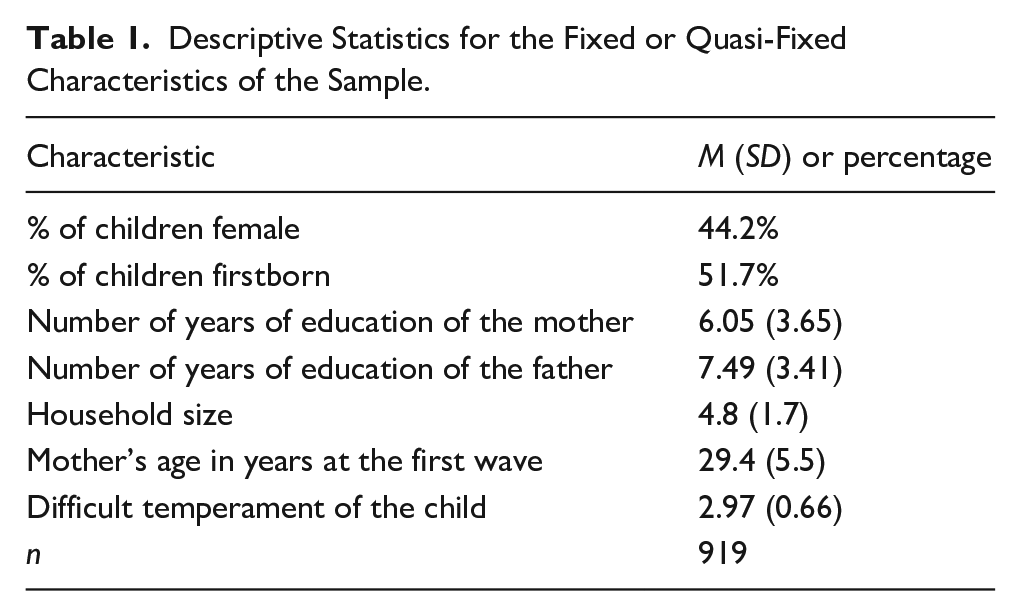
Tables 1 and 2 present the descriptive statistics for the (quasi) fixed and time-varying variables, respectively. The mean raw scores of social competence between the ages of 3 and 7 evidence a gradual upward trend, but the largest increase in the mean level of social competence (about a quarter of an SD) occurred between the ages of 3 and 4, confirming this period as one of rapid social development. Between the ages of 3 to 7, maternal responsiveness and inductive reasoning increased, while the observer reports of warmth declined slightly. The mean levels of MPFS indicated some fluctuations but not a trend.
Descriptive Statistics for the Fixed or Quasi-Fixed Characteristics of the Sample.
Descriptive Statistics for the Time-Varying Characteristics of the Sample.
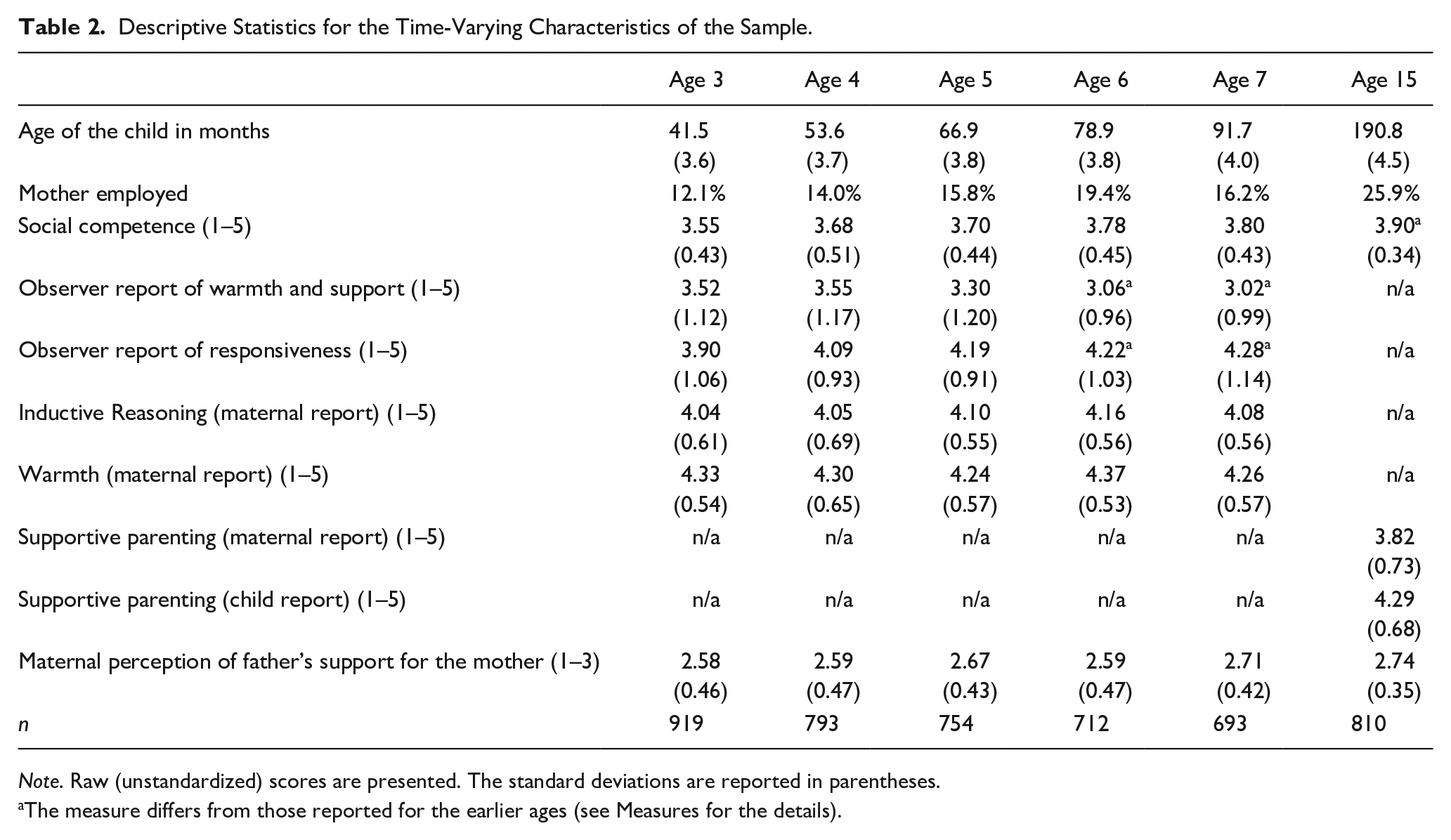
Note. Raw (unstandardized) scores are presented. The standard deviations are reported in parentheses.
The measure differs from those reported for the earlier ages (see Measures for the details).
The correlations between the measures from all six waves are presented in Supplementary Materials E. The magnitudes of the correlations between the ages 7 and 15 were low compared to the first five waves. The autocorrelations of age-standardized social competence were around 0.4 for the measures that were 1 year apart. This indicated some, but not substantial, stability of children’s social competence relative to their peers. The autocorrelations of positive maternal parenting and MPFS led to similar conclusions. The autocorrelations of the child’s social competence and positive maternal parenting between ages 3 and 4 were lower than those between subsequent assessments for ages 4–7 (r = .35 and .33, respectively), suggesting qualitative change at ages 3–4. As expected, the correlations of social competence with positive maternal parenting were substantially higher (r between .44 and .55, ages 3–7) than those with MPFS (r between .12 and .27). However, positive maternal parenting was weakly correlated with the child’s social competence at age 15 (r = .08). The correlations of positive maternal parenting with the MPFS were also low (r between .13 and .23).
Results of the RI-CLPM
The goodness of fit statistics and estimated coefficients of the bivariate RI-CLPM are presented in Supplementary Materials C. The trivariate RI-CLPM (Figure 1) fit the data well, χ2(94) = 193.0, p < .001, χ2/df = 2.05, root mean square error of approximation (RMSEA) = .034, 90% confidence interval (CI) = [.027, .041], comparative fit index (CFI) = .97, standardized root mean square residual (SRMR) = .063, Tucker–Lewis index (TLI) = .95.
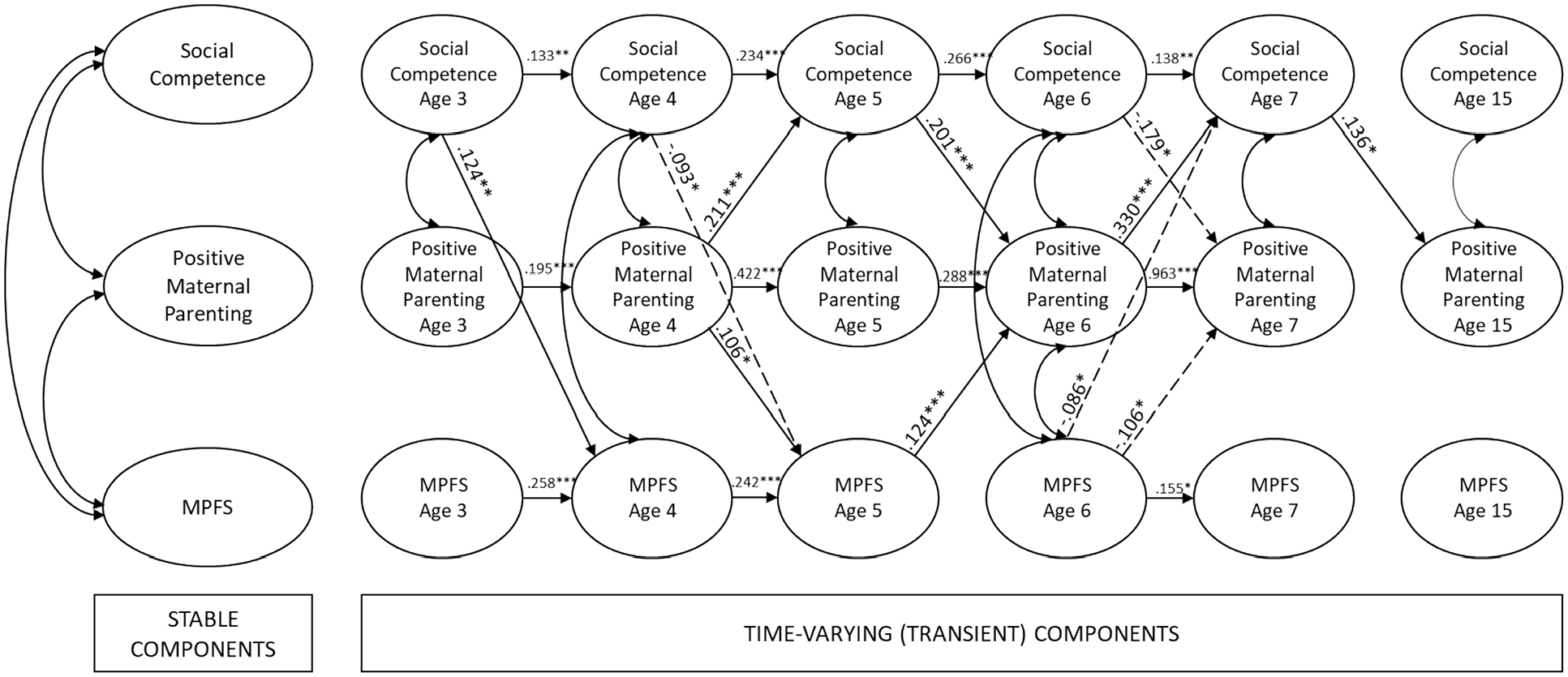
Random Intercept Cross-Lagged Panel Model (RI-CLPM) for Social Competence, Positive Maternal Parenting, and the Maternal Perception of the Father’s Support for the Mother (MPFS).
The correlations between the stable components (the random intercepts) of children’s social competence, positive maternal parenting, and the MPFS were positive. The intercept of social competence was strongly correlated with the intercept of positive maternal parenting (r = .626, p < .001) and moderately correlated with the intercept of the MPFS (r = .419, p < .001). The intercepts of positive maternal parenting and the MPFS were also moderately correlated (r = .466, p < .001).
The contemporaneous correlations of the deviations of the three processes from their respective random intercepts are presented in Table 3. The correlations of positive maternal parenting with child social competence were large and significant at ages 3–7, but not in adolescence. The contemporaneous correlations of the MPFS with the child’s social competence at ages 4 and 6 (r = .216 and .125, respectively), and with positive maternal parenting at age 6 (r = .185), were significant but low, indicating weak contemporaneous alignment of those domains in childhood.
Contemporaneous Correlations of the Age-Specific Deviations From the Random Intercepts for the Child’s Social Competence, Positive Maternal Parenting, and the Maternal Perception of the Father’s Support (MPFS) (n = 919).
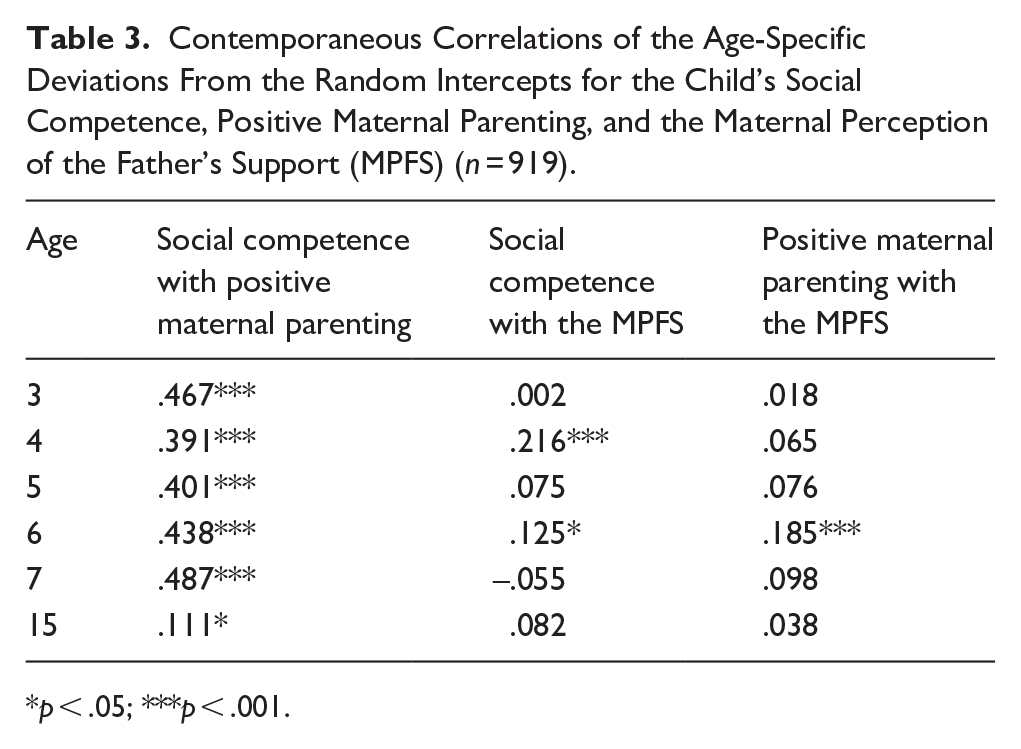
p < .05; ***p < .001.
Table 4 presents the unstandardized and standardized autoregressive and cross-lagged coefficients of the RI-CLPM, and Figure 1 presents the significant standardized coefficients. The transactions between the three processes intensified at ages 5–6 and 6–7. There were no transactions that were consistently significant across all ages.
The Results of the RI-CLPM Model Including All Three Transactional Processes (n = 919).
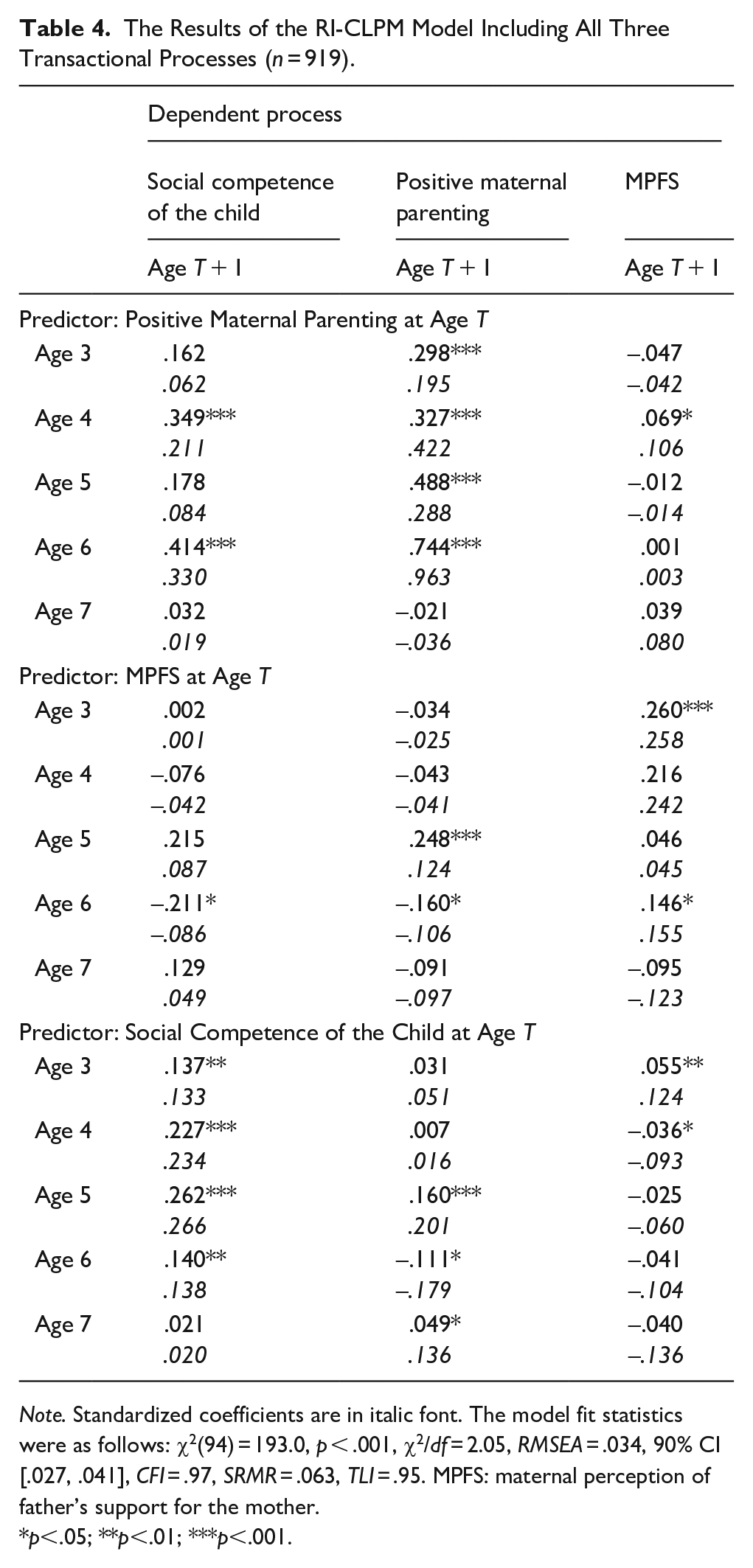
Note. Standardized coefficients are in italic font. The model fit statistics were as follows: χ2(94) = 193.0, p < .001, χ2/df = 2.05, RMSEA = .034, 90% CI [.027, .041], CFI = .97, SRMR = .063, TLI = .95. MPFS: maternal perception of father’s support for the mother.
p<.05; **p<.01; ***p<.001.
At ages 3 to 4, the child’s social competence had a positive effect on the MPFS (standardized β = .124, p < .001), although the coefficient of this transaction was not large. This positive transaction was followed by a weak negative effect between those two domains at ages 4–5 (standardized β = −.093, p = .05). Positive maternal parenting had a weak positive effect on the MPFS (standardized β = .106, p = .03) and a substantial positive effect on the child’s social competence (standardized β = .211, p < .001) at ages 4–5. Hence at ages 3–4 and 4–5, prior to transition to school, only four of 12 transactional effects were statistically significant, and only one, the mother-to-child effect was substantial.
At ages 5–6, the transactional coefficients from both the child’s social competence and the MPFS positively predicted positive maternal parenting (standardized β = .201 and .124, p < .001, respectively), contributing to the increases in between-person differences in positive maternal parenting. This trend was further strengthened by a strong positive autoregression coefficient between positive maternal parenting between ages 5 and 6 (standardized β = .288, p < .001). However, at ages 6–7, the transactional coefficients from both the child’s social competence and the MPFS negatively predicted positive maternal parenting (standardized β = −.179 and −.106, p < .05, respectively), indicating that positive maternal parenting levels approached their stable levels after diverging relatively strongly at ages 5 to 6. This trend was partially counteracted by a strong positive autoregressive effect of positive maternal parenting (standardized β = .963, p < .001). At ages 6–7, there was also a relatively strong positive effect of positive maternal parenting on the child’s social competence (standardized β = .330, p < .001). There were no transactions between the three domains between the ages 7 and 15 except for a weak positive effect of the child’s social competence on positive maternal parenting (standardized β = .136, p = .043).
Four-fifths of the estimated significant coefficients of the trivariate RI-CLPM were positive, suggesting that the inter-family differences increased over time. The estimates of the model were used to simulate predicted values for two hypothetical families for whom social competence, maternal positive parenting, and MPFS differed by 1 SD at age 3. The model predicted an increase in the difference in social competence of those hypothetical children to 1.6 SD by age 6. That difference was maintained at age 7 and declined to 1.1 SD at age 15. The difference in positive maternal parenting of 1 SD at age 3 increased to 3.2 SD by age 6 and declined thereafter. A similar difference in MPFS at age 3 increased very little, to 1.3 SD at ages 4 and 5, and declined thereafter.
Effects of the Covariates
We re-estimated the RI-CLPM model, adding covariates predicting the between-family stable components (i.e., the intercepts) of the model, χ2(174) = 441.3, p < .001, χ2/df = 2.54, RMSEA = .041, 90% CI = [.036, .046], CFI = .94, SRMR = .074, TLI = .91. Table 5 presents the coefficients of this model.
The Results of the RI-CLPM Model With Covariates Predicting the Stable Components of the Social Competence of the Child, Positive Maternal Parenting, and the Maternal Perception of the Father’s Support for the Mother (MPFS) (n = 919).
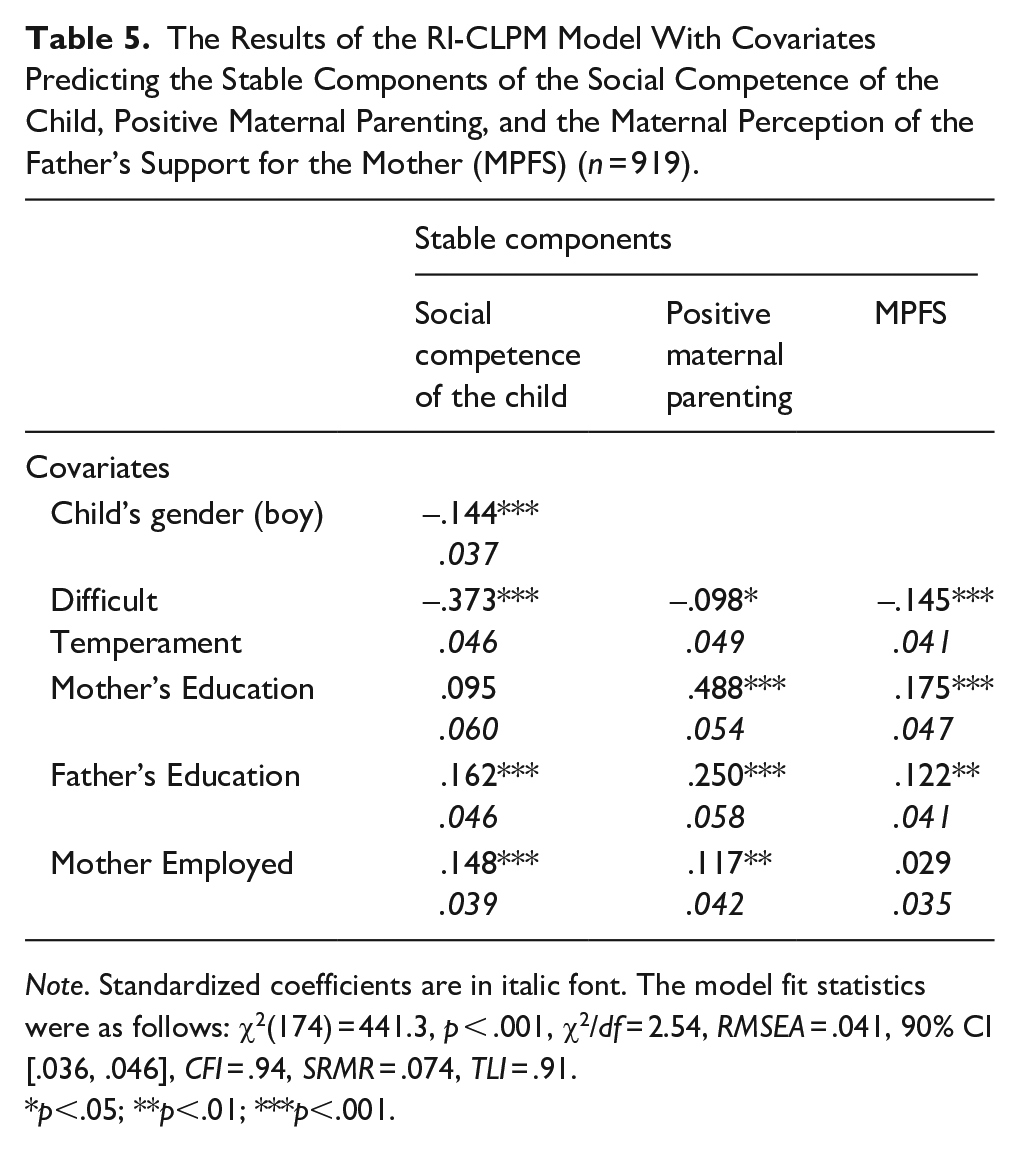
Note. Standardized coefficients are in italic font. The model fit statistics were as follows: χ2(174) = 441.3, p < .001, χ2/df = 2.54, RMSEA = .041, 90% CI [.036, .046], CFI = .94, SRMR = .074, TLI = .91.
p<.05; **p<.01; ***p<.001.
All covariates were significantly associated with the intercept of social competence in the expected directions, with the standardized coefficient of difficult temperament two to four times the magnitude of the standardized coefficients of the other covariates. All covariates were also significantly associated with the intercept of positive maternal parenting: the standardized coefficient for maternal education was two to five times the magnitude of the coefficients of the other covariates. The associations of maternal education and paternal education with the intercept of MPFS were positive but small. The negative coefficient for the child’s difficult temperament for the intercept of positive maternal parenting was smaller than that for the MPFS. Maternal employment was not associated with the intercept of MPFS.
Discussion
This research aimed to estimate within-family processes that could influence the development of a child’s social competence between ages 3 and 15 while accounting for stable between-family differences. The hypotheses were based on Bronfenbrenner’s (2001) ecological systems framework: the focus was on the proximal processes in the microsystem between the child and the mother, between the mother and the father, and the potential influence of the latter proximal process on the mother and the child. Transactional effects between these three domains were hypothesized to be stronger during periods of rapid development (e.g., early childhood) and major changes in roles labeled “ecological transitions.” The cultural context of the study was patriarchal, leading to the expectation that most of the care and socialization would be carried out by the mother, and there would be limited participation of the father in routine parenting.
This study re-affirmed that the stable aspects of child social competence, positive maternal parenting, and MPFS were highly correlated, in line with the previous cross-sectional studies (Liu et al., 2024; Wong et al., 2021). However, time-lagged correlations of social competence with positive maternal parenting were primarily due to the underlying stable factors and not so much due to substantial transactional effects between the two domains. The use of the RI-CLPM model allowed the disentanglement of stable, transient, and transactional components of the domains of interest.
The contemporaneous associations of the three domains and their transactional effects, net of the stable components, constitute the engines of change. The contemporaneous correlations between the transient components in a RI-CLPM model could represent the similarity of the experiences of the persons involved or their mutual influences at the micro time scale. Those correlations were positive, high, and consistent (>.4) for the child’s social competence and positive maternal parenting prior to adolescence and low but positive at age 15. For children with limited preschool experience before age 6, these correlations can be due to the proximal processes. In adolescence, the mother and the child probably did not share many experiences due to the adolescent’s exposure to multiple different microsystems, and they also probably interacted less than in childhood, resulting in a low contemporaneous correlation.
The contemporaneous associations of MPFS with positive maternal parenting and child social competence, net of the stable components, were small, inconsistent, and significant only at ages 4 and 6. It was expected that during periods of rapid social development (ages 3–4) and ecological transitions (ages 5–7), there might be an increased need for the father’s supportive roles, requiring a short-term response. The increases in the contemporaneous associations of the MPFS with those two domains were consistent with this hypothesis. The non-significance of those associations outside of ages 4 and 6 suggested limited similarity of experiences or mutual influences at the micro time scale between the father, on the one hand, and the mother and the child on the other, consistent with the norm of gendered responsibilities of child-rearing in the cultural context of this research.
On the developmental time scale, positive effects of positive maternal parenting on child social competence were expected, which, in the aggregate, could result in the widening of individual differences. This hypothesis was partially supported. Despite consistent contemporaneous positive reciprocity between the two domains (as described above), time-lagged effects were present only from age 4 to 5 and 6 to 7. The transactional effects between the MPFS and the other two domains were also inconsistent between ages 3 and 15. In line with the empirical findings of others (Ding et al., 2020) and the hypothesis that ecological transitions might trigger transactions, there were more cross-domain effects between ages 5 and 7, the period when children transitioned to school, than at other ages. High MPFS at age 5 was associated with a positive cascade: increased positive maternal parenting at age 6, followed by increased social competence at age 7. The same cascade (represented by positive coefficients) resulted in a progressive decline in social competence for children whose social competence was lower than their peers. Transition to school might have been particularly impactful in this sample because most children had no preschool experience, about one-half started school at age 6, and the remaining at age 7.
There was empirical evidence of evocative effects of social competence, described as “demand characteristics” by Bronfenbrenner and Morris (2007). Interestingly, a positive effect of social competence on the MPFS (ages 3–4) and maternal positive parenting (ages 5–6) were followed by negative effects during the following interval. This pattern can be interpreted as a return toward stable levels in these domains following a period of change when interpersonal differences increased. For example, the positive coefficient from social competence to positive maternal parenting at age 5 to 6 indicated that a child with a higher than average level of social competence at age 5 received a higher than average level of positive maternal parenting at age 6. However, between ages 6 and 7, this difference narrowed to some extent, as evidenced by a negative but smaller transactional coefficient. The negative coefficients representing “course corrections” were consistently smaller than the positive coefficients that they followed.
The positive autoregression coefficients between the deviations from the stable components of all three domains implied a widening of inter-family differences. Specifically, the results suggested that more socially competent children might evoke more opportunities to improve their competencies and vice versa, in microsystems that remained unobserved in this study (e.g., the extended family, peers in the neighborhood, siblings). Similar evocative processes were observed for positive maternal parenting and MPFS.
Despite inconsistent transactional effects of modest magnitude compared to the contemporaneous correlations, the net effects of these transactions and positive autoregressive effects resulted in the substantial widening of individual differences in social competence at age 7. Specifically, a difference of 1 SD in early childhood increased to 1.6 SD at age 7. These results were consistent with the hypothesis that widening individual differences in social competence could be partly due to processes inherent to social competence and partly due to the mobilization of the family system to support the child who had higher than normative social competence, and further diminish the support for the child who had lower than normative social competence.
The reciprocal effects between the child’s social competence, positive maternal parenting, and the MPFS weakened in adolescence (see also Ding et al., 2020), which might have been a time when peer influences exceeded parental influences. Regrettably, this research could not address the transactional associations during the transition to adolescence. Based on the patterns of transactions that emerged during periods of developmental change, one could speculate that the transition to adolescence would have been another period of intensifying transactions.
The cultural context of this study was a society that upheld traditional gender roles where mothers were primarily responsible for parenting, and coparenting was uncommon (Sunar & Fisek, 2005). The analyses highlighted the consequences of this context: the MPFS did not have strong contemporaneous associations with positive maternal parenting, and there were few transactional effects between the two domains. The only evidence of connections between those two domains was during the transition to school, highlighting the potential influence of ecological transitions and the mesosystem on the microsystem. The limited analyses of covariates also indicated that an undesirable characteristic of the child (i.e., difficult temperament) had a more negative effect on the stable aspects of the MPFS than on maternal parenting. These findings, taken together, suggested that fathers might be making decisions about whether or not to contribute to child-related responsibilities.
Limitations of this Study
This study had four important limitations. First, longitudinal data on the fathering behaviors were not available. Maternal reports on fathering when the children were 5 years old indicated very limited direct involvement of the fathers in the physical care or socialization of the children. Nevertheless, paternal self-reports would have validated the implications of the current findings.
Second, data on the father’s support for the mother and child’s social competence were maternal reports. This raised the possibility that there could be systematic informant bias. A limited test of this possibility was conducted by defining a “maternal bias” latent variable. That effort did not yield any evidence of shared measurement error in child social competence and the MPFS.
Third, the informants for positive maternal parenting changed between ages 7 and 15. The availability of observer reports for ages 3 to 7 rendered strength to the measurement of that domain. However, maternal and child reports on parenting were available at age 15, rather than observer reports. This shift in measurement might have been partly the reason for the observed discontinuity in positive parenting between ages 7 and 15.
Fourth, using long-term longitudinal data to study the development of social competence through several developmental stages presented unique challenges. As children got older, newly emerging competencies required changes in the measurement of social competence and the processes that supported it. This issue was addressed by age-standardizing the measures of social competence and positive parenting. The focus of this study was the transactions between three domains rather than age-related shared trends in social competence. This focus was not compromised due to standardization. However, the interpretations of the quantitative evidence were limited to the status of the child relative to peers and maternal parenting relative to other mothers of same-aged children.
Conclusion
By separating the stable and time-varying transient components of the processes that contributed to social competence, the results showed that the stable characteristics of the members of the family and the family ecology, rather than mutual influences, strongly contributed to the cross-sectional positive associations between social competence, positive maternal parenting, and marital support from the father to the mother (as perceived by the mother). Furthermore, the transient contemporaneous processes, that is, the proximal processes, between the mother and the child further augmented the association of positive maternal parenting with child social competence. Change in social competence was driven by limited transactional effects between the three domains of interest (social competence, positive maternal parenting, and MPFS) especially during transition to school, and the positive autoregressive effects in each domain. These “engines of change” increased the inter-individual differences in social competence through childhood, rendering socially competent children increasingly competent and less competent children further less competent. Considering the effects of social competence on academic outcomes (Perry et al., 2018), these findings had implications for children’s long-term social development and, potentially, achievement. The results of this study pointed to the need for interventions prior to ecological transitions that target improvements in real-time micro-level interactions between the mother and the child, as well as between the father and the mother, to remedy the trend for an ever-widening gap in children’s social competencies.
Supplemental Material
sj-docx-1-jbd-10.1177_01650254251337738 – Supplemental material for Positive transactional processes from age 3 to 15: Social competence, maternal parenting, and fathers’ support for mothers
Supplemental material, sj-docx-1-jbd-10.1177_01650254251337738 for Positive transactional processes from age 3 to 15: Social competence, maternal parenting, and fathers’ support for mothers by Nazli Baydar in International Journal of Behavioral Development
Footnotes
Funding
The author disclosed receipt of the following financial support for the research, authorship, and/or publication of this article: This research was funded by the Scientific and Technological Research Council of Turkiye grant 119K365.

Supplemental Material
Supplemental material for this article is available online.
References
Supplementary Material
Please find the following supplemental material available below.
For Open Access articles published under a Creative Commons License, all supplemental material carries the same license as the article it is associated with.
For non-Open Access articles published, all supplemental material carries a non-exclusive license, and permission requests for re-use of supplemental material or any part of supplemental material shall be sent directly to the copyright owner as specified in the copyright notice associated with the article.
