




Abstract
To inform the tripartite structure of subjective well-being (SWB), national longitudinal studies from the United States, Germany, and Australia were used to estimate random-intercept cross-lagged panel models (RI-CLPM) in which between- and within-individual variation in life satisfaction (LS), positive affect (PA), and negative affect (NA) was examined over periods of up to two decades. The RI-CLPMs incorporated a hierarchical conceptualization in which LS, PA, and NA are indicators of a latent SWB factor and a causal systems conceptualization in which PA and NA are inputs to LS. Results from all three samples indicated substantial loadings from LS, PA, and NA on latent SWB factors between and within individuals. Cross-lagged effects were observed among all three SWB components, rather than unidirectional from PA and NA to LS. The present findings provide valuable new insights concerning the tripartite structure of SWB between and within individuals over extended periods of time.
Heralding a new area of psychological inquiry into the concepts of happiness and well-being, Diener (1984) introduced a three-part formulation for “subjective well-being” (SWB), comprising individuals’ evaluations of their lives overall (referred to as life satisfaction, or LS), along with their positive and negative affective (PA and NA, respectively) experiences. This tripartite formulation is among the most widely employed approaches to studying well-being (Disabato et al., 2016; Martela & Sheldon, 2019). However, despite thousands of research studies examining SWB, uncertainty remains concerning its structure, that is, how LS, PA, and NA together comprise, reflect, or define the construct of SWB. To address this issue, the present work draws on findings from three national-level samples which together comprise the largest and long-running longitudinal studies in which all three SWB components are assessed at multiple waves. Using a random-intercept cross-lagged panel model (RI-CLPM; Hamaker et al., 2015), prominent conceptualizations of the tripartite structure of SWB were evaluated in the same analytic model. Findings provide important new insights concerning the structure of SWB, particularly with respect to a hierarchical conceptualization, in which SWB is conceptualized as an underlying sense of well-being and operationalized by a latent factor indicated by LS, PA, and NA; and a causal system approach, in which PA and NA are considered to be inputs to LS.
The Uncertain Tripartite Structure of SWB
Studies conducted over the past 40 years have produced an enormous amount of empirical evidence concerning SWB. Much of this research has focused on individual differences in SWB and has provided important information concerning several fundamental issues, including measurement; stability and change; correlates, predictors, and outcomes; as well as interventions and applications (Diener et al., 1999, 2018). One consistent theme to emerge from this research is that higher (vs. lower) levels of SWB are linked with more positive indicators of functioning across a variety of domains (e.g., mental, physical, interpersonal, economic; Eid & Larsen, 2008; Sheldon & Lucas, 2014). With good reason, therefore, many individuals aspire to live a happy and satisfying life (Balestra et al., 2018; Diener, 2009).
Despite the enormous amount of research that has been conducted, however, fundamental issues concerning SWB have yet to be resolved, including with respect to its structure, that is, how its three main components together comprise, reflect, or define the construct of SWB. The structure of SWB has been conceptualized and operationalized in multiple ways and these various conceptualizations have fundamental, and yet somewhat conflicting, implications (for a detailed review, see Busseri & Sadava, 2011). One common approach is to conceptualize SWB as a broad area of inquiry encompassing LS, PA, and NA (Joshanloo, 2016; Kapteyn et al., 2015; Lucas & Diener, 2015). From this perspective, any study providing information about at least one of its three components provides information about SWB. Accordingly, even if all three components are assessed in the same study, analyses usually focus on each component separately (Helzer & Jayawickreme, 2015; Joshanloo, 2016; Luhmann et al., 2016). This separate components approach is widely employed and is also the most commonly used approach to synthesizing SWB-related findings (e.g., Anglim et al., 2020; Buecker et al., 2023; Zell & Lesick, 2022).
In contrast, according to the causal systems conceptualization, PA and NA serve as inputs to LS (Costa & McCrae, 1980; Schimmack et al., 2002; Schimmack & Oishi, 2005). From this perspective, individuals rely on their affective experiences when evaluating their lives overall, consistent with models emphasizing the role of affective reactions and emotional tendencies in shaping global life evaluations (e.g., Costa & McCrae, 1980; Schwarz & Clore, 1983; Watson & Tellegen, 1985; Willroth et al., 2020). Supporting evidence would indicate that PA and NA predict (or lead to) changes in LS over time (positively and negatively, respectively), but that LS is not an input to PA and NA (Jayawickreme et al., 2017; Jovanović & Joshanloo, 2022; Luhmann & Kalitzki, 2018). 1
Alternatively, from a hierarchical construct perspective, SWB refers to an underlying sense of well-being reflected in individuals’ evaluations and emotional experiences of their lives (Campbell et al., 1976; Diener et al., 1995; Larsen et al., 1985). Accordingly, studying SWB requires estimating a latent SWB factor indicated by LS, PA, and NA (e.g., Chmiel et al., 2012; Molnar et al., 2009; Olesen et al., 2015). 2 Knowledge concerning SWB would thus accrue from examining the characteristics, correlates, predictors, and consequences of such a latent factor. Importantly, a latent SWB factor would not be expected to explain all of the variation in its components, given that LS, PA, and NA are not considered to be interchangeable (Busseri, 2018; Busseri & Sadava, 2011). Thus, in addition to focusing on their underlying commonality, the variance in each component that is independent of the latent tendency is also important (Busseri, 2015; Busseri et al., 2007; Busseri & Erb, et al., 2023).
Despite the conflicting assumptions that these prominent approaches entail, most research on SWB adopts just one particular structural conceptualization, typically without acknowledging, justifying, or addressing the implications of this choice. This state of affairs is problematic because conclusions concerning basic issues such as the associations between SWB and demographic factors (such as age, sex, and income) or personality traits may vary substantially depending on which structural conceptualization is employed (Busseri, 2015, 2023; Savahl et al., 2021; Suar et al., 2019). Furthermore, as we review later, studies directly examining competing structural conceptualizations of SWB have produced important evidence concerning the viability of the various prominent approaches.
Evaluating the Structure of SWB Using a Longitudinal Approach
Understanding the associations among LS, PA, and NA is critical to informing the structure of SWB. Such information is most commonly available from studies in which individual differences in SWB are assessed in terms of self-reports of LS, PA, and NA at a single point in time (e.g., Joshanloo, 2016; Keyes et al., 2002; Savahl et al., 2021). Findings from such cross-sectional research are helpful for describing the directions and magnitudes of the correlations among the three SWB components in various samples, populations, and contexts. With respect to the structure of SWB, however, such studies cannot inform the viability of the key assumption of the causal systems conceptualization—that is, that PA and NA serve as inputs to LS, but not vice versa. Cross-sectional studies also cannot inform how well structural conceptualizations (including a hierarchical approach) account for other key aspects of SWB, including stability and change (Sheldon & Lucas, 2014). Rather, empirical evaluation of structural conceptualizations is needed based on the associations among LS, PA, and NA within and across time. To this end, longitudinal studies in which LS, PA, and NA are assessed together at multiple time points are of paramount importance.
Although SWB has been examined in multiple longitudinal studies, typically researchers have examined links between LS, PA, or NA (rather than all three components) and other variables of interest separately (Santos & Grossmann, 2021; Tian et al., 2014; Wu et al., 2020). Accordingly, such findings inform the individual components of SWB but ignore the associations among SWB components that are central to the causal systems and hierarchical conceptualizations. Other longitudinal studies have examined predictive associations among LS, PA, and NA (e.g., Busseri, 2015; Casas & González, 2022; Spindler et al., 2016). Such studies have provided evidence for cross-lagged effects among all three SWB components, rather than the unidirectional effects from PA and NA to LS as hypothesized by the causal systems conceptualization. Longitudinal studies have also been used to model the covariation among the three SWB components by estimating a latent SWB factor indicated by LS, PA, and NA at two or more waves (Joshanloo, 2018; Lin & Yi, 2019; Molnar et al., 2009). In such studies, researchers have examined links between a latent SWB factor and other variables of interest (e.g., social well-being, psychological well-being, and alcohol use, respectively).
Whereas longitudinal studies typically adopt one structural conceptualization of SWB, a small number of studies have examined various structural models for SWB within the same sample. For example, Busseri (2015) and Metler and Busseri (2017) reported results based on longitudinal designs comprising two waves separated by various time intervals ranging from one week to one decade. Contrary to the causal system approach, both studies indicated inconsistent cross-lagged effects among all three SWB components, including effects from LS to PA and NA over time, rather than positive and negative unidirectional effects from PA and NA (respectively) to LS. Furthermore, each study found substantial loadings from LS, PA, and NA on a latent SWB factor at each wave, and strong correlations between latent SWB factors across waves. Together, these findings provide much stronger support for conceptualizing SWB as a hierarchical construct than as a causal system. Indeed, evidence to date in support of a causal system in which PA and NA influence LS, but not vice versa, appears to be limited to cross-sectional analyses in which PA and NA are specified as predictors of LS (e.g., Schimmack, 2008; Schimmack et al., 2002, 2005). It may thus seem surprising that this particular structural model continues to be widely used despite the lack of stronger supporting evidence, for example from studies based on longitudinal (or experimental) designs in which the hypothesized unidirectional effects from PA and NA to LS are directly tested alongside possible bidirectional effects.
Importantly, however, even in longitudinal studies comparing structural approaches, the hierarchical and causal systems conceptualizations have been examined in separate statistical models, thus preventing joint evaluation of the main features of each structural approach within the same model. This limitation is noteworthy because the main features of these two prominent structural conceptualizations are not necessarily incompatible or mutually exclusive (as noted by Busseri & Newman, 2022). For example, it is possible that there exists both a general tendency toward higher (vs. lower) SWB, as reflected in a latent SWB factor, as well as causal (or predictive) connections from PA and NA to LS over time. Furthermore, longitudinal studies comparing structural conceptualizations of SWB to date have been based on just two waves of data (e.g., Busseri, 2015; Metler & Busseri, 2017). Methodological research has indicated that longitudinal analyses based on just two (vs. three or more) waves have important limitations with respect to accounting for stability in each variable of interest. In particular, longitudinal analyses estimated using two waves of data may produce estimates of auto-regressive and cross-lagged effects that are biased with respect to the magnitude and direction of each effect (Berry & Willoughby, 2017; Hamaker et al., 2015). Indeed, CLPMs may even produce spurious cross-lagged effects under a variety of realistic scenarios (Lucas, 2023). The solution to such limitations is to employ alternative statistical models based on multiple (i.e., three or more) waves of data.
An Integrative Approach to Evaluating the Structure of SWB
The RI-CLPM (Hamaker et al., 2015) is a state-of-the-art approach that accounts for stability across multiple waves through specifying a latent random intercept factor for each variable of interest. These latent random intercepts represent individual differences in the stable (i.e., trait-like) aspects of each variable. Independent of such between-individual stability, wave-specific variation in each variable is used to estimate within-individual associations within time (representing wave-specific covariation) and across time using auto-regressive and cross-lagged effects between adjacent waves (representing “carry-over” and “spill-over” effects, respectively; Mulder & Hamaker, 2021). The RI-CLPM thus allows researchers to account for between-individual differences in the stable aspects of each variable of interest, along with both wave-specific and across-wave variation and covariation based on within-individual variability in each variable over time.
Estimates of auto-regressive and cross-lagged effects in RI-CLPM are generally smaller in magnitude (and less consistent in statistical significance) than corresponding estimates based on the traditional CLPM (Hamaker et al., 2015; Hudson et al., 2019 see also Orth et al., 2024). Such differences arise in part because standard CLPMs do not fully account for stability in each variable reflected in the underlying commonality across multiple waves (Hamaker, 2023; Lucas, 2023). In contrast, such underlying commonality is directly addressed in a RI-CLPM via the latent random intercept factors. A RI-CLPM approach has been employed in a growing number of studies to address issues and constructs of interest to a wide range of researchers in social and personality psychology, including personality stability and change (Costa et al., 2019), links between self-esteem and depression (Orth et al., 2021), psychopathic traits (Zettler et al., 2021), daily life events (Maciejewski et al., 2021), and social environment (Krauss et al., 2020).
With respect to present purposes, using a RI-CLPM would permit joint evaluation of the main features of the causal systems and hierarchical conceptualizations of the structure of SWB over extended periods of time in the same statistical model. Specifically, in longitudinal studies comprising three or more waves, a RI-CLPM could be used to estimate simultaneously a CLPM—that is, auto-regressive and cross-lagged effects among LS, PA, and NA critical to testing the causal systems model, and a hierarchical model—that is, latent SWB factors indicated by LS, PA, and NA. Such an integrative approach would yield direct evidence concerning the key features of these structural conceptualizations, and thus would provide valuable new information concerning the structure of SWB. In particular, at both the “between-individual” and “within-individual” levels, loadings from LS, PA, and NA on latent SWB factors would directly inform the viability of a hierarchical conceptualization in which SWB is operationalized as a latent factor. Furthermore, at the within-individual level, findings concerning the cross-lagged effects would directly inform the viability of a causal systems conceptualization in which PA and NA are thought to be inputs (i.e., positive and negative, respectively) to LS, but not vice versa. Thus, employing such an approach would inform the viability of each structural conceptualization of SWB, including the possibility of undercovering evidence in support of both models, that is, a latent tendency indicated by LS, PA, and NA, as well as unidirectional cross-component predictive effects from PA and NA to LS.
For example, recently Busseri and Quoidbach (2022) used a RI-CLPM to evaluate a large-scale experience-sampling study of French adults based on momentary reports of LS, PA, and NA. Whereas this study examined four assessments of SWB encompassing an average of 25 days, Busseri and Newman (2022) examined the structure of daily SWB in a large sample of American university students who provided daily ratings of LS, PA, and NA for 14 days. Notably, both studies provided robust support for a hierarchical conceptualization of the structure of SWB, including strong loadings on a higher-order latent SWB factor from the (between-level) random intercept factors for LS, PA, and NA and strong loadings on the daily latent SWB factors from the (within-level) daily ratings of LS, PA, and NA. However, contrary to the causal systems model, the (within-level) cross-lagged effects from PA and NA to LS were inconsistent in magnitude, direction, and statistical significance—rather than consistent unidirectional effects from PA and NA (positive and negative, respectively) to LS. Together, therefore, these two studies provide direct evidence based on a joint examination of competing structural conceptualizations of momentary and daily SWB in the same analytic model. Notably, results provided strong support for the main features of the hierarchical conceptualization and yet little support for the causal systems approach.
Critically, however, these studies were based on momentary or daily reports of SWB across a relatively short period of time (i.e., less than 1 month and 2 weeks, respectively). Momentary or daily reports of SWB are not synonymous with the type of global ratings of LS, PA, and NA that are typically collected in longitudinal studies of SWB based, for example, on annual assessments over multi-year periods. Furthermore, momentary (or daily) ratings are (at least) moderately correlated with, but are empirically distinct from global assessments (Anusic et al., 2017; Lucas et al., 2021; Newman et al., 2021) and may be based on different types of information (e.g., episodic vs. semantic; Robinson & Clore, 2002). In addition, estimates of stability and change in SWB are likely to vary as a function of the length of time across which such estimates are derived (Sheldon & Lucas, 2014). At present, therefore, it is unclear whether findings concerning the structure of SWB based on momentary and daily ratings apply over longer periods of time. Indeed, it is possible that evidence based on an integrative analytic approach, like a RI-CLPM using data from large-scale, long-term longitudinal studies, would suggest that an optimal approach for conceptualizing and studying SWB over time would encompass features of both the hierarchical and causal systems models.
Thus, a critical next step to informing the structure of SWB would be to estimate a RI-CLPM based on longitudinal studies encompassing multiple assessments over extended periods of time. Such an approach would provide valuable new information concerning the structure of SWB based on associations among LS, PA, and NA both between and within individuals, and both within and across time. Testing the structure of SWB within and across time using the same analytic model as previous studies but based on different types of repeated-measures designs (e.g., Busseri & Newman, 2022; Busseri & Quoidbach, 2022) would provide an important opportunity to evaluate the reliability and robustness of previous results. Such findings would thus also provide new insights with respect to conceptualizing, studying, and (ultimately) understanding SWB as a tripartite construct.
The Present Work
The primary goal of the present work was to further inform the structure of SWB using data from large-scale longitudinal studies from three countries: the United States, Germany, and Australia. Each of these longitudinal studies encompassed thousands of individuals assessed at multiple waves separated by annual intervals or longer, and over periods of up to two decades. Together, these three studies represent the world’s largest and longest-running national longitudinal studies in which all three components of SWB are assessed at multiple waves. Notably, whereas the German and Australian studies were based on annual assessments, in the American study the survey waves were each separated by 9 or 10 years. Prominent theoretical models of SWB emphasis the possibility of shorter-term deviations in individuals’ typical SWB levels (e.g., Cummins, 2014), as well as longer-term changes, for example, in reaction to major life events or experiences (e.g., Sheldon & Lyubomirsky, 2019). Given this, although the optimal timing for assessing the structure of SWB over time may vary depending on one’s research goals, the three longitudinal studies examined in the present work provide an important opportunity to test the structure of SWB based on durations encompassing up to two decades, based on relatively shorter (i.e., one year) and extended (i.e., one decade) temporal separation. Such design features should thus be sensitive to both relatively quicker and slower changes in SWB over time (Sheldon & Lucas, 2014).
The designs of such studies permitted an integrative statistical model based on a RI-CLPM, combining key features of the hierarchical and the causal systems structural conceptualizations of SWB. The following hypotheses were derived based on previous longitudinal studies examining structural conceptualizations of SWB (Metler & Busseri, 2015; Busseri & Newman, 2022; Busseri & Quoidbach, 2022). At the “between” level, moderate to strong loadings were expected within each SWB component on their respective latent random intercept factors (indicating moderate to strong stability in LS, PA, and NA over time; Hypothesis 1), along with strong loadings from the three latent random intercept factors on a higher-order latent SWB factor (indicating moderate to strong stability in SWB over time; Hypothesis 2). At the “within” level, moderate to strong loadings were expected from the wave-specific LS, PA, and NA variables on each wave-specific latent SWB factor (Hypothesis 3). In contrast, cross-lagged predictive effects among SWB components were expected among all three components, albeit inconsistent in direction and statistical significance, rather than indicating consistent unidirectional predictive effects from PA (positive) and NA (negative) to LS (Hypothesis 4).
Method
Transparency and Openness
We report how we determined sample size, all data exclusions, and all measures analyzed from each sample examined in the present study. Data and study materials from the Midlife in the United States Study (MIDUS, Sample 1) are publicly available at http://midus.wisc.edu/. Data and materials from the German Socio-Economic Panel (GSOEP, Sample 2) are available at https://www.diw.de/en/soep. Data and materials from the Household Income and Labor Dynamics in Australia study (HILDA, Sample 3) are available at https://melbourneinstitute.unimelb.edu.au/hilda. Multiple studies have employed each of these datasets in previous publications (see http://midus.wisc.edu/findings/index.php; https://www.diw.de/en/diw_01.c.626116.en/research_at_the_soep.html; https://melbourneinstitute.unimelb.edu.au/hilda/publications); however, none have evaluated competing structural models of SWB based on all three components across multiple waves. In the present work, data were analyzed using Mplus software, version 8 (Muthén & Muthén, 1998–2017); analysis code is available as online supplemental material at https://osf.io/r768h/?view_only=083d69ed3214441bbae69a0d3723f683. Methods and analyses were not pre-registered.
Participants and Procedures
Sample 1—Midlife in the United States (MIDUS)
The MIDUS study is a large-scale longitudinal survey of American adults (Brim et al., 2004). Telephone interviews and self-report surveys were employed at each of the three waves, each separated by roughly 9 years: Wave 1 in 1995/96, Wave 2 in 2004/05, and Wave 3 in 2013/14. The baseline (Wave 1) MIDUS sample comprised 7,108 participants. Present analyses were based on the 6,203 participants who completed the SWB measures (described below) at Wave 1, of whom 3,795 also completed the measures at Wave 2, and 2,537 completed the measures at Wave 3 (note that 2,367 participants provided ratings for all three SWB components at each wave). Across all three waves, data for a total of 68% of the expected SWB measures were available from the 6,203 participants in the analysis sample (see Supplemental Table 1 for details concerning the amount of observed vs. missing data, per sample). A sensitivity power analysis indicated that this sample size provided a power of .80 to detect as statistically significant (α = .05, two-tailed) a correlation of .04 (absolute value) or greater. Demographic information is summarized for each sample in Table 1.
Demographic Information by Sample.
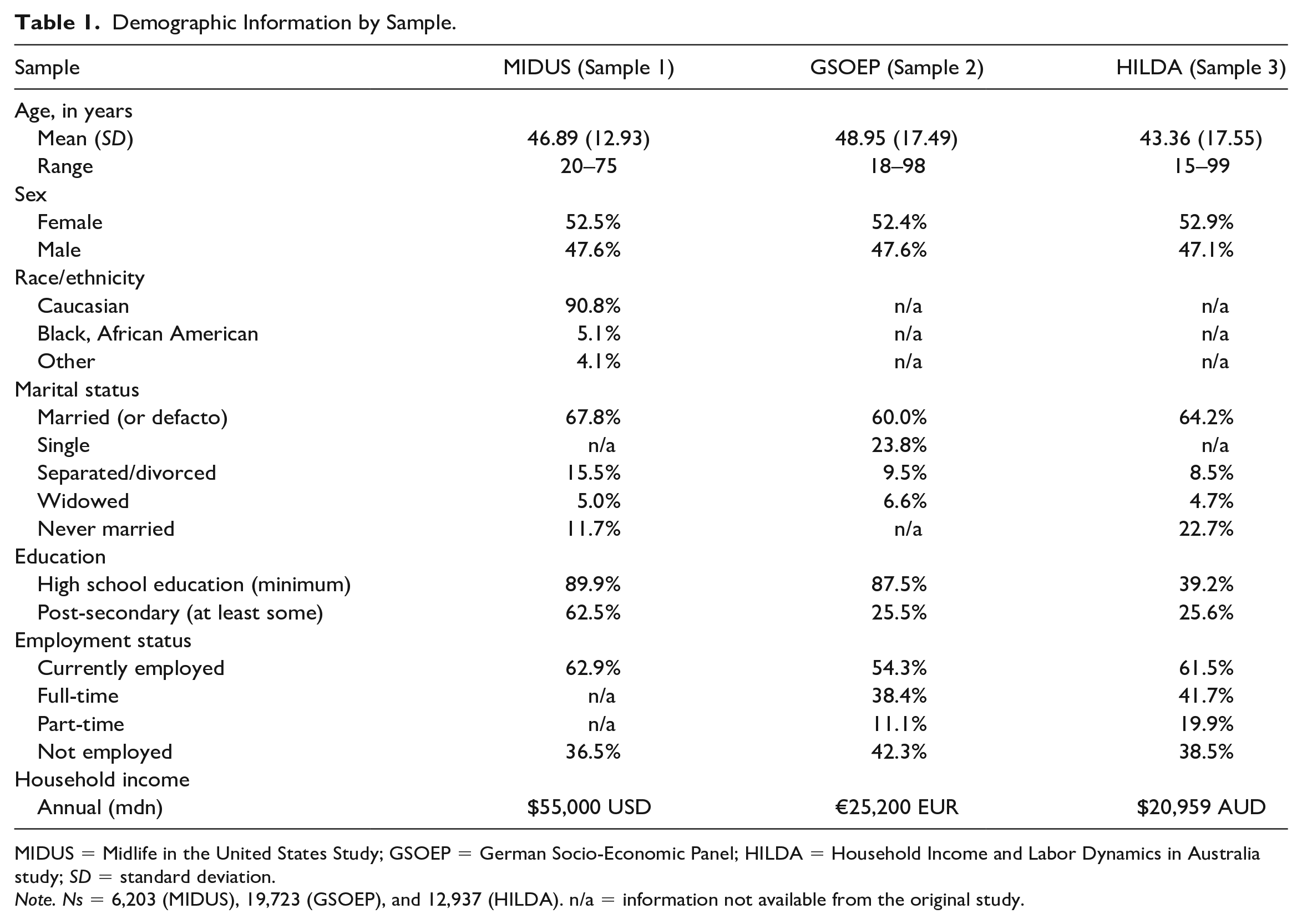
MIDUS = Midlife in the United States Study; GSOEP = German Socio-Economic Panel; HILDA = Household Income and Labor Dynamics in Australia study; SD = standard deviation.
Note. Ns = 6,203 (MIDUS), 19,723 (GSOEP), and 12,937 (HILDA). n/a = information not available from the original study.
Sample 2—German Socioeconomic Panel (GSOEP)
The GSOEP study is a nationally representative longitudinal survey of German adults (Goebel et al., 2019). The GSOEP is a household-based panel which, beginning in 1984, employs face-to-face interviews in annual assessments of individuals 16 years and over in each household. Data from Waves 24 through 36 were examined in the present work. Whereas LS has been assessed at each wave, measures of PA and NA were included beginning in Wave 24 (2007). At Wave 24, the survey comprised 19,837 individuals. The present analysis was based on the 19,723 participants who completed the SWB measures (described below) at Wave 24, of whom between 6,328 and 17,773 also completed the measures at subsequent waves (5,421 participants provided ratings for all three SWB components at all 13 waves). Across the 13 waves, a total of 60.3% of the expected SWB measures were available from the 19,723 participants in the analysis sample. A sensitivity power analysis indicated that this sample size provided a power of .80 to detect as statistically significant (α = .05, two-tailed) a correlation of .02 (absolute value) or greater.
Sample 3—Household Income and Labor Dynamics in Australia (HILDA)
The HILDA study is a nationally representative longitudinal survey of Australian adults (Wooden & Watson, 2007). HILDA is a household-based panel which, beginning in 2001, employs telephone interviews, face-to-face interviews, and self-report surveys in annual assessments of individuals 15 years and over in each household. Data from Waves 1 through 20 were examined in the present work. At Wave 1, the survey comprised 19,914 individuals. The present analysis was based on the 12,937 participants who completed the SWB measures (described below) at Wave 1, of whom between 6,153 and 11,306 also completed the measures at subsequent waves (3,529 participants provided ratings for all three SWB components at each wave). Across the 20 waves, a total of 64.0% of the expected SWB measures were available from the 12,937 participants in the analysis sample. A sensitivity power analysis indicated that this sample size provided a power of .80 to detect as statistically significant (α = .05, two-tailed) a correlation of .03 (absolute value) or greater.
Measures
Exact item wording for each SWB measure from each sample is provided in Supplemental Table 2.
Life Satisfaction
In all three longitudinal studies, LS was measured using a single rating of one’s current life overall, ranging from 0 = worst life possible/completely dissatisfied to 10 = best life possible/completely satisfied (based on Kilpatrick & Cantril, 1960). Thus, in each sample higher scores indicated higher LS.
Positive and Negative Affect
In the MIDUS (Sample 1), PA and NA were each assessed using six items pertaining to the frequency of one’s affective experiences in the past month (e.g., cheerful, sad), each rated on a scale from 1 = all of the time to 5 = none of the time (Mroczek & Kolarz, 1998). Separate scores for PA and NA were computed by averaging the six relevant ratings separately at each wave and reverse scoring the PA items (αs ranged across waves from .90 to .91 for PA, and from .83 to .86 for NA).
In the GSOEP (Sample 2), PA was assessed with a single-item rating of happiness, and NA was assessed using three items (anger, worried, and sad), each rated using a scale from 1 = very rarely to 5 = very often, based on how often the individual experienced each feeling over the last 4 weeks (Schimmack, 2009). NA ratings were averaged separately at each wave. Higher scores indicate more frequent PA and NA, respectively (for NA, αs ranged across waves from .66 to .68).
In the HILDA (Sample 3), PA and NA were assessed using four and five items, respectively, based on the frequency of one’s affective experiences in the past 4 weeks (e.g., happy, down in the dumps), each rated on a scale from 1 = all of the time to 6 = none of the time (Ware & Sherbourne, 1992). Separate scores for PA and NA were computed by averaging the relevant PA (reverse-scored) and NA ratings at each wave (αs ranged across waves from .84 to .88 for PA, and from .82 to .86 for NA). Thus, in each sample, higher scores indicated more frequent PA and NA.
Model Specification and Estimation Details
As shown in Figure 1, a RI-CLPM was estimated in each sample. The specifications for this model (Model 1) were based on specifications employed by Busseri and Newman (2022; modified from Mulder & Hamaker, 2021) to test an integrative RI-CLPM for the structure of SWB-based LS, PA, and NA. At the “between” level, latent intercept factors were estimated for LS, PA, and NA, with fixed loadings of 1 for all corresponding scores (e.g., in Sample 1, fixed loadings of 1 for Wave 1, Wave 2, and Wave 3 LS scores on the latent LS intercept factor). These latent intercept factors represent individual differences in the stable (trait-like) variance in LS, PA, and NA over time (the loadings on these latent intercepts would inform Hypothesis 1). The three latent intercept factors were specified as loading onto a latent higher-order SWB factor; variance was fixed to 1 for identification purposes. This latent higher-order SWB factor represents individual differences in the stable (trait-like) variance in SWB over time. Loadings from the three latent random intercepts were freely estimated to allow for differences in the extent to which each component was reflective of the higher-order latent SWB factor (the loadings on this higher-order latent factor would inform Hypothesis 2).
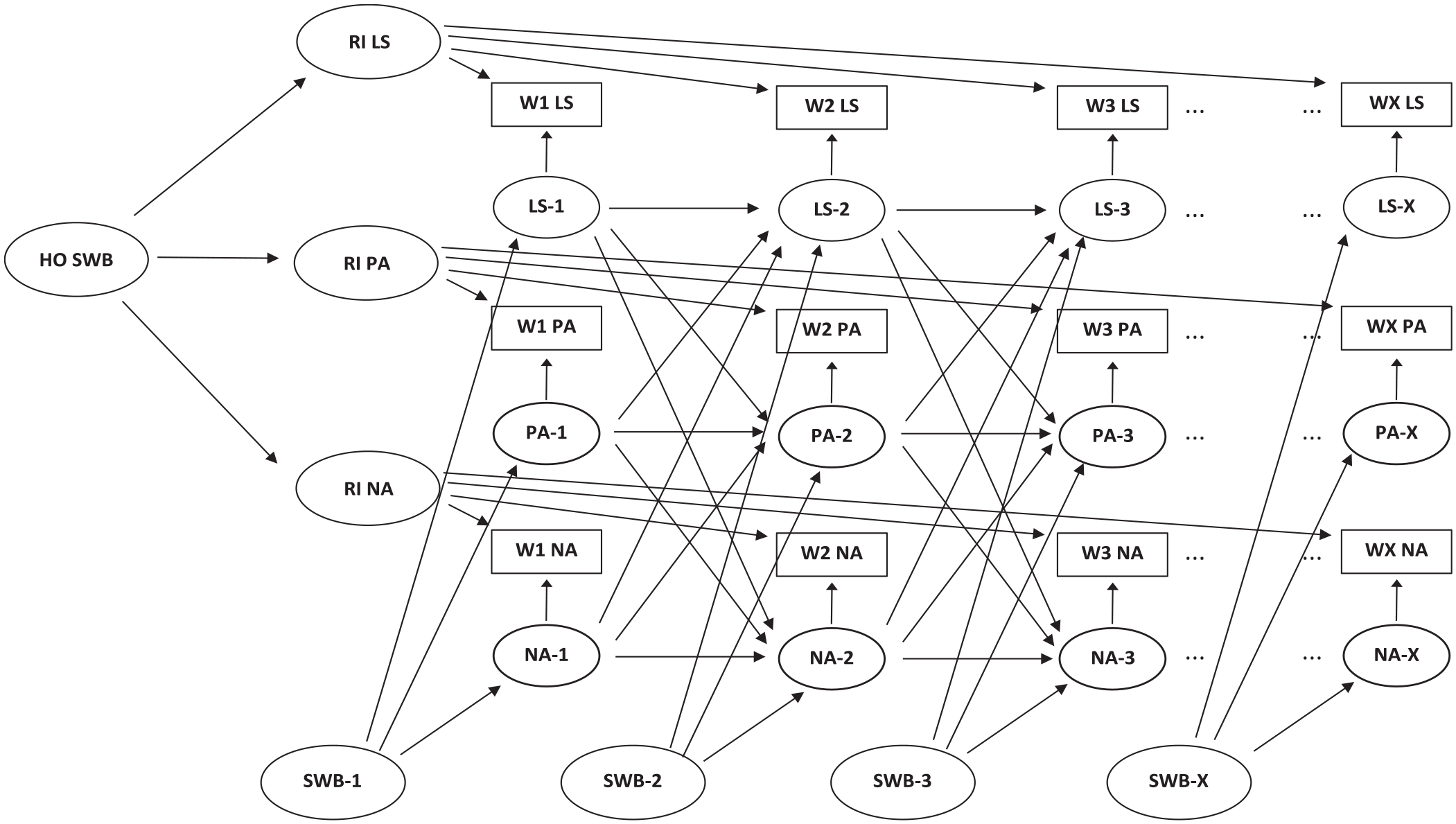
Random Intercept Cross-Lagged Panel Model (RI-CLPM).
At the “within” level in Model 1, the LS, PA, and NA scores from each wave were specified with residual (error) variance terms fixed to 0, and a latent time-specific variable was estimated corresponding to each score and wave (e.g., a latent Wave 1 LS variable was indicated by the Wave 1 LS rating and the variance for the Wave 1 LS rating was fixed to 0). This specification decomposes the variation in each repeatedly measured variable into two orthogonal sources: (a) between-individual and (b) within-individual variation (Hamaker et al., 2015). Residual variances were estimated for each wave-specific latent variable and constrained to equality within each SWB component across waves. The wave-specific latent LS, PA, and NA variables were specified as loading onto a wave-specific latent SWB factor; variance was fixed to 1. These latent variables and latent SWB factors represent wave-specific variability in SWB and its components. Loadings from the wave-specific latent LS, PA, and NA variables on the latent SWB factor were freely estimated across components (but constrained to equality within components, across waves) to allow for differences in the extent to which each wave-specific component was reflective of the wave-specific latent SWB factor (the loadings on the wave-specific higher-order latent factors would inform Hypothesis 3).
Also at the within level, auto-regressive and cross-lagged predictive effects were estimated between the wave-specific latent LS, PA, and NA variables from one occasion to the next. The auto-regressive effects inform whether wave-specific experiences of each SWB component “carry-over” to the subsequent wave; cross-lagged effects inform whether wave-specific experiences of LS, PA, and NA “spill-over” from one component to the other components by the subsequent wave (the cross-lagged effects which would inform Hypothesis 4).
Note that the wave-specific means were constrained to be equal across waves within each SWB component, as were the variances for each of the wave-specific latent variables, along with the loadings of the corresponding latent SWB components on the wave-specific latent SWB factors, and the corresponding auto-regressive effects and cross-lagged effects. In total, 24 parameters were estimated in the RI-CLPM. As demonstrated by Busseri and Newman (2022), with such specifications and constraints in place, the RI-CLPM provides parameter estimates that are identical to those derived from a multi-level model (estimated using dynamic structural equation modeling, or DSEM, to allow for latent factors; Asparouhov et al., 2018) comprising between-level and fixed (rather than random) within-individual effects. Missing values were imputed using FIML.
Note that imposing such constraints (vs. freely estimating effects within each wave and for each adjacent pair of waves) provides more robust estimates of the parameters of interest, provided that such stationarity constraints are tenable (Hamaker, 2023; Hamaker et al., 2015; Mulder & Hamaker, 2021). Such constraints also permit a more straightforward interpretation of the within- and between-level effects based on their comparability with level-1 (within, fixed) and level-2 (between) effects estimated in multi-level models with latent variables (e.g., using DSEM, Asparouhov et al., 2018). For exploratory purposes, the RI-CLPM was also re-estimated in each sample without such equality constraints imposed (Model 2). Doing so provided a test of the suitability of the stationarity and consistency assumptions in Model 1, as well as the robustness of the present findings in a model assuming stationarity and consistency (Model l) versus a model in which such constraints were not imposed (Model 2). 3
Results
Descriptive statistics for the three SWB measures at each wave are shown by the sample in Supplemental Table 3. Correlations are shown in Supplemental Table 4. In each sample, correlations among the SWB components were statistically significant, moderate to large in magnitude, and in the expected directions (i.e., positive correlations between LS and PA; negative correlations between LS and NA, and between PA and NA). 4
As summarized in Table 2, in each sample the RI-CLPM model provided a good model fit. As shown in Table 3, at the between-individual level, in each sample each latent intercept factor had statistically significant and strong loadings from the corresponding wave-specific LS, PA, or NA scores in the expected directions (in support of Hypothesis 1). Squaring these factor loadings indicates that roughly half of the variance in the LS, PA, and NA scores was explained by the between-individual (vs. within-individual) portion of the models, ranging across samples from 46% to 52% of the variance in the LS ratings, 45% to 56% of the variance in the PA scores, and 46% to 56% of the variance in the NA scores. Also at the between level, in each sample, statistically significant and strong loadings were observed for all three latent random intercept factors on the higher-order latent SWB factor, and in the expected directions (in support of Hypothesis 2). Squaring these latter factor loadings indicated that the higher-order latent SWB factor—reflecting individual differences in stable (trait-like) SWB over time—explained substantial between-individual variance in the latent LS, PA, and NA intercept factors, ranging from 45% to 98% for LS, 48% to 94% for PA, and 36% to 72% for NA.
Model Fit Information by Sample.
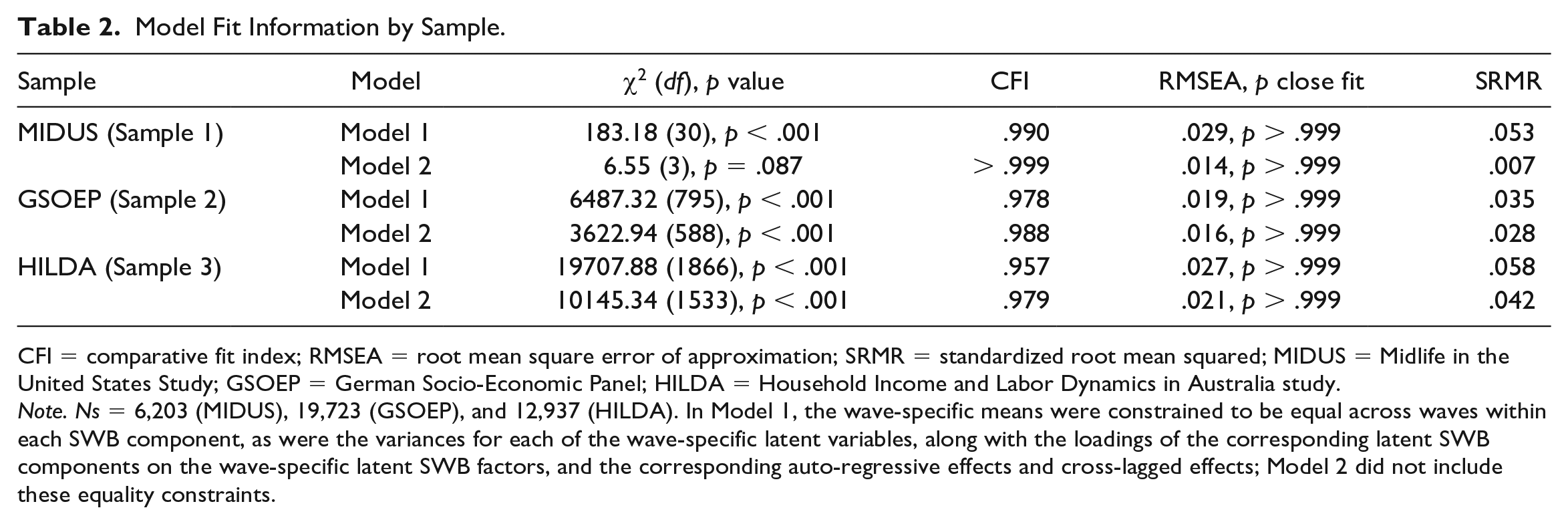
CFI = comparative fit index; RMSEA = root mean square error of approximation; SRMR = standardized root mean squared; MIDUS = Midlife in the United States Study; GSOEP = German Socio-Economic Panel; HILDA = Household Income and Labor Dynamics in Australia study.
Note. Ns = 6,203 (MIDUS), 19,723 (GSOEP), and 12,937 (HILDA). In Model 1, the wave-specific means were constrained to be equal across waves within each SWB component, as were the variances for each of the wave-specific latent variables, along with the loadings of the corresponding latent SWB components on the wave-specific latent SWB factors, and the corresponding auto-regressive effects and cross-lagged effects; Model 2 did not include these equality constraints.
Standardized Parameter Estimates from Random Intercept Cross-Lagged Panel Models (RI-CLPM)—Model 1 by Sample.
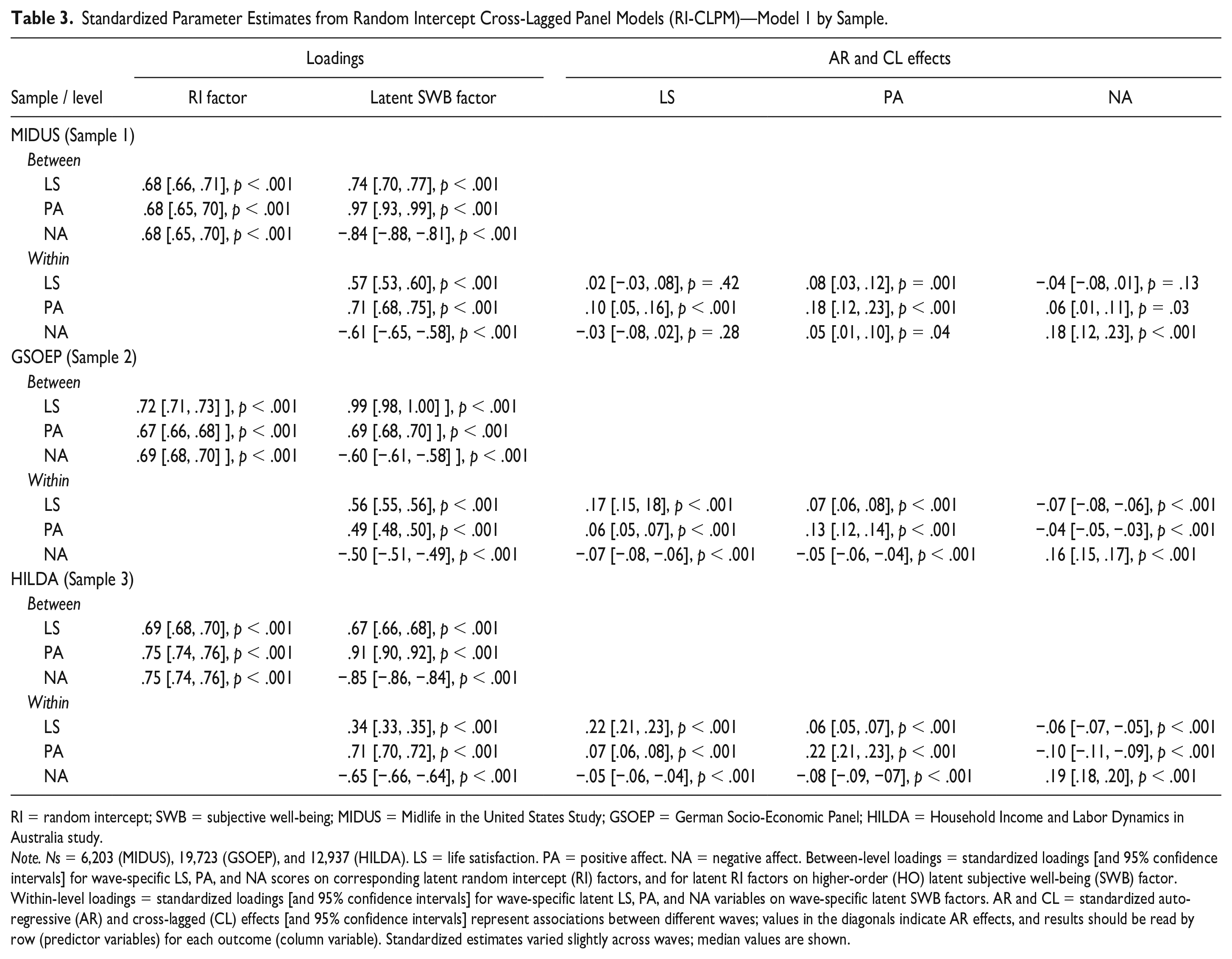
RI = random intercept; SWB = subjective well-being; MIDUS = Midlife in the United States Study; GSOEP = German Socio-Economic Panel; HILDA = Household Income and Labor Dynamics in Australia study.
Note. Ns = 6,203 (MIDUS), 19,723 (GSOEP), and 12,937 (HILDA). LS = life satisfaction. PA = positive affect. NA = negative affect. Between-level loadings = standardized loadings [and 95% confidence intervals] for wave-specific LS, PA, and NA scores on corresponding latent random intercept (RI) factors, and for latent RI factors on higher-order (HO) latent subjective well-being (SWB) factor. Within-level loadings = standardized loadings [and 95% confidence intervals] for wave-specific latent LS, PA, and NA variables on wave-specific latent SWB factors. AR and CL = standardized auto-regressive (AR) and cross-lagged (CL) effects [and 95% confidence intervals] represent associations between different waves; values in the diagonals indicate AR effects, and results should be read by row (predictor variables) for each outcome (column variable). Standardized estimates varied slightly across waves; median values are shown.
At the within-individual level, in each sample statistically significant and moderate to strong loadings from the wave-specific latent LS, PA, and NA variables were observed on the wave-specific latent SWB factors (see Table 3), and in the expected directions (in support of Hypothesis 3). Squaring these factor loadings indicated that the wave-specific latent SWB factors—reflecting wave-specific experiences of SWB—explained substantial within-individual variance in the latent LS, PA, and NA variables, ranging from 12% to 32% for LS, 24% to 50% for PA, and 25% to 42% for NA. Also at the within level, in each sample, the auto-regressive effects—reflecting carry-over effects within SWB components across adjacent waves—were statistically significant (see Table 3). Cross-lagged effects—reflecting spill-over effects between SWB components across adjacent waves—were moderate in magnitude (on average) but were inconsistent in direction and statistical significance, and did not indicate a unidirectional flow of (positive and negative, respectively) predictive effects from PA and NA to LS (thus supporting Hypothesis 4). Nonetheless, abstracting across all three samples, there was some evidence for cross-lagged effects among all three SWB components, wherein higher LS, higher PA, and lower NA at one wave each predicted higher LS, higher PA, and lower NA (respectively) at the subsequent wave.
Notably, these findings were based on a RI-CLPM that was specified with equality constraints comparable to a multi-level model comprising orthogonal between- and within-level effects (as detailed earlier). For exploratory purposes, the RI-CLPM was re-estimated in each sample without such equality constraints imposed (Model 2). As shown in Table 2, the overall model fit was superior for Model 2 with respect to the chi-square tests, but comparable between Model 1 and Model 2 with respect to comparative fit index (CFI), root mean square error of approximation (RMSEA), and (in two of three samples) standardized root mean squared (SRMR) indices. Furthermore, with few exceptions, findings from Model 2 were consistent with results from the constrained models (Model 1); see Table 4 for parameter estimates from Model 2. The main difference in results between models was that in each sample, the auto-regressive and cross-lagged effects were less consistent across waves in magnitude, direction, and statistical significance in the unconstrained model (Model 2) compared to the constrained model (Model 1), providing further support for Hypothesis 4 in terms of the lack of unidirectional within-level effects from PA and NA to LS over time. Results concerning the other main features of the model—including loadings for LS, PA, and NA on the latent SWB factors at the between and within levels—were consistent across models, thus providing additional support for Hypotheses 1, 2, and 3.
Standardized Parameter Estimates From Random Intercept Cross-Lagged Panel Models (RI-CLPM)—Model 2 by Sample.
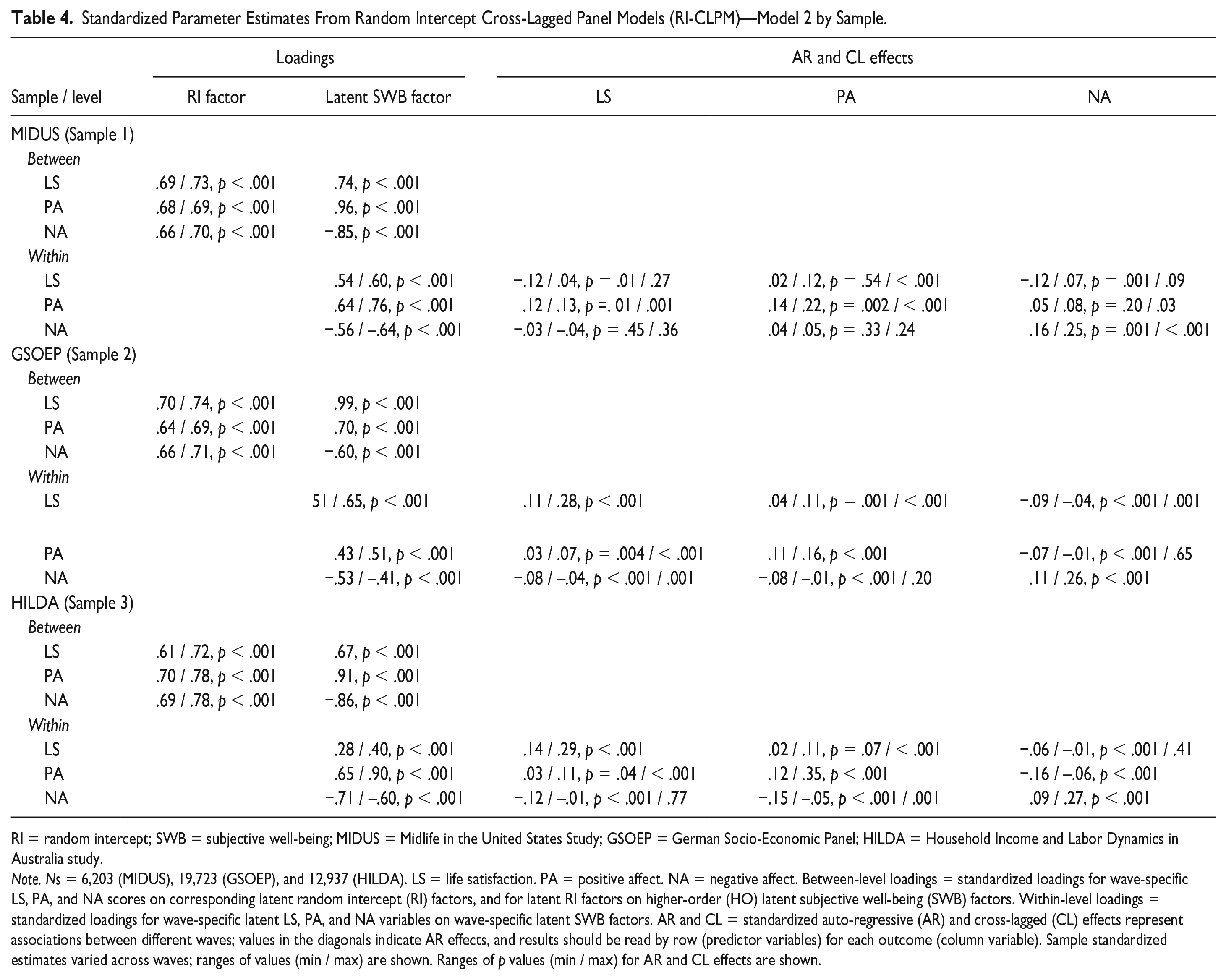
RI = random intercept; SWB = subjective well-being; MIDUS = Midlife in the United States Study; GSOEP = German Socio-Economic Panel; HILDA = Household Income and Labor Dynamics in Australia study.
Note. Ns = 6,203 (MIDUS), 19,723 (GSOEP), and 12,937 (HILDA). LS = life satisfaction. PA = positive affect. NA = negative affect. Between-level loadings = standardized loadings for wave-specific LS, PA, and NA scores on corresponding latent random intercept (RI) factors, and for latent RI factors on higher-order (HO) latent subjective well-being (SWB) factors. Within-level loadings = standardized loadings for wave-specific latent LS, PA, and NA variables on wave-specific latent SWB factors. AR and CL = standardized auto-regressive (AR) and cross-lagged (CL) effects represent associations between different waves; values in the diagonals indicate AR effects, and results should be read by row (predictor variables) for each outcome (column variable). Sample standardized estimates varied across waves; ranges of values (min / max) are shown. Ranges of p values (min / max) for AR and CL effects are shown.
Discussion
Support for a Hierarchical Structural Conceptualization of SWB
The present results provided strong support for a hierarchical conceptualization of SWB over the long term, in which LS, PA, and NA are indicators of an underlying (latent) sense of well-being—both with respect to stable (i.e., trait-like) individual differences in LS, PA, and NA, and in terms of within-individual variability in these experiences over time (thus supporting Hypotheses 1, 2, and 3). Such support was consistent across all three samples and over periods of up to 20 years. Nonetheless, the latent SWB factors (whether estimated at the between- or within-level) did not account for all of the variations in LS, PA, and NA. Some of this residual variation is likely a reflection of measurement error (i.e., random and wave- or component-specific). Even if so, it appears that some meaningful variation in LS, PA, and NA is partially independent of the latent SWB factors. Furthermore, in each sample, within-individual auto-regressive effects were observed for each SWB component (with the exception of LS in Sample 1), suggesting some carry-over within LS, PA, and NA from one wave to the next. Such findings highlight the importance of considering both the underlying commonality shared between LS, PA, and NA, as well as aspects of LS, PA, and NA that are unique from an underlying sense of SWB (Busseri et al., 2007; Busseri & Sadava, 2011).
In addition, the present findings provided limited support for a causal systems model of SWB in which higher PA and lower NA are assumed to be primary inputs to greater LS. In particular, in support of Hypothesis 4, the cross-lagged effects did not reveal a unidirectional flow of predictive effects from PA and NA at one wave to LS at a subsequent wave (and not vice versa). Similar conclusions were reached in recent studies evaluating the structure of momentary and daily SWB using RI-CLPMs (Busseri & Newman, 2022; Busseri & Quoidbach, 2022). That is, these studies provided robust support for the hierarchical structure of SWB (i.e., moderate to strong loadings from LS, PA, and NA on latent SWB factors at the between and within levels), along with unique variability in LS, PA, and NA, as well as somewhat inconsistent (i.e., in direction, magnitude, and statistical significance) cross-lagged effects, rather than consistent unidirectional effects from PA and NA (positive and negative, respectively) to LS. Taken together with the present findings, therefore, it appears that a hierarchical structural conceptualization may be viable with respect to understanding individuals’ experiences of SWB over random moments, daily experiences, annual assessments, and decades. 5
Nonetheless, within-level cross-lagged effects have been observed among all three SWB components in each study to date employing RI-CLPMs to evaluate the tripartite structure of SWB (i.e., Busseri & Newman, 2022; Busseri & Quoidbach, 2022; along with the present work). Based on the empirically derived benchmarks proposed by Orth et al. (2024), such cross-lagged effects can be considerate moderate in magnitude (on average), ranging from small to large depending on the SWB component and sample. Together, the available evidence thus suggests that cross-over effects among all three SWB components need to be accounted for (both in terms of empirical model testing and theoretical model building) to fully describe the structure of SWB—including the within-individual temporal dynamics among LS, PA, and NA implied by such effects. Indeed, all three studies to date employing a RI-CLPM approach to examine the structure of SWB (i.e., Busseri & Newman, 2022; Busseri & Quoidbach, 2022 the present work) have provided evidence of a pattern of cross-lagged effects in terms of the signs/directions of such effects (leaving aside the statistical significance of such effects, given differences in sample sizes) which are consistent with typical associations observed among SWB components (i.e., positive for LS-PA, negative for LS-NA and PA-NA). However, given the limited number of studies examining such issues, further work is needed to replicate this pattern of crossed-lagged predictive effects using different types of repeated-measures designs, including multi-wave longitudinal and experimental designs, along with an analytic model that separates between- and within-level variation in LS, PA, and NA, both within and across time.
Generalizability Across Three Samples
The general patterns of findings were highly consistent across the three national longitudinal studies. Nonetheless, there were some notable differences. With respect to Hypothesis 2, at the between-individual level, the strongest loadings on the higher-order latent SWB factor were from PA and NA in Sample 1 (MIDUS, the United States) and Sample 3 (HILDA, Australia), but from LS in Sample 2 (GSOEP, Germany). Furthermore, with respect to Hypothesis 3, at the within-individual level, the relative pattern of loadings on the wave-specific latent SWB factors varied by sample. In Sample 1 and Sample 3, the strongest loading was from PA, whereas in Sample 2 the relative strength of the loadings was more consistent across components.
Such differences between samples might reflect unique aspects of each national study. For example, research has revealed cultural differences in the meaning of the terms “happy” and “happiness,” including an emphasis on luck and good fortune in many cultures including Germany, rather than pleasant affective experiences, as is more typical in the United States (Oishi et al., 2013). Differences between German and American samples have also been observed when testing scalar invariance based on responses to multi-item scales, particularly with respect to the NA component of SWB, including items used in each of the samples examined in the present work (Jovanović et al., 2022). Consequently, differences observed in the present study between findings based on the PA and NA components of SWB in the GSOEP sample compared to the other samples may reflect, at least in part, cultural differences in participants’ interpretation of the term happiness as well as the various NA-relevant items.
There may also be cultural differences in individualism, which may impact the relative importance and frequency of affective experiences in America (Sample 1) and Australia (Sample 3), compared to Germany (Sample 2; Diener & Suh, 1999; Westerhof & Barrett, 2005). Furthermore, a multi-item measure of PA was used in Sample 1 and Sample 3, whereas a single-item measure was employed in Sample 2. Other considerations include factors that might influence the overall amount of stability in SWB over time, such as social, economic, historical, or political events (Diener et al., 2013) across the various years encompassed by the three national studies. Future studies could seek to further inform the structure of SWB by systematically exploring such issues related to national-level differences in culture, measurement, and socio/political/historical events.
Implications
The present findings have important implications concerning various aspects of studying and understanding SWB. According to a hierarchical conceptualization, a full understanding of SWB requires understanding both the commonality among, and the unique variance in, LS, PA, and NA. Examining SWB from this perspective requires assessing all three components to estimate and study the commonality among LS, PA, and NA, as well as their unique aspects. Such an approach will allow researchers to examine the correlates, predictors, and potential consequences of such a latent factor, along with testing the potential limits of the generalizability of a latent SWB factor (e.g., across samples, locations, experiences, etc.). Such steps are also necessary for understanding the unique aspects of LS, PA, and NA, as reflected in associations involving the unique variances in LS, PA, and NA (i.e., independent of a latent SWB factor) in relation to other variables of interest. For example, given the growing interest in identifying positive psychological interventions that could help individuals boost their well-being (e.g., Folk & Dunn, 2023; Heintzelman et al., 2020), such an approach can be used to assess whether an intervention impacts individuals’ underlying SWB as a latent factor and/or impacts the unique aspects in LS, PA, or NA. This approach would provide valuable information concerning the potential shorter- versus longer-term changes in SWB following the intervention. To that end, the present findings also suggest that addressing the potential within-level auto-regressive and cross-lagged predictive effects among all three SWB components may also provide additional insights concerning experimental interventions aimed at positively impacting one or more of the SWB components.
Furthermore, with respect to systematic efforts aimed at synthesizing knowledge about SWB, major meta-analyses typically summarize findings concerning LS, PA, and NA separately (e.g., Anglim et al., 2020). Consequently, it remains unclear from such meta-analyses how, for example, factors such as basic aspects of personality relate to an underlying sense of well-being as reflected in a latent SWB factor, as well as whether any aspects of personality have unique associations with LS, PA, or NA independent of a latent SWB factor. More generally, from the perspective of a hierarchical conceptualization of SWB, synthesizing and tabulating information requires an approach in which SWB is examined both with respect to the underlying commonality among LS, PA, and NA, as well as the unique aspects of its three components. As the number of meta-analyses examining the components of SWB in relation to other variables and phenomenon grows, such an approach would provide valuable information concerning links with SWB as a hierarchical construct, rather than with respect to (just) its components.
Notwithstanding the consistent support for a hierarchical conceptualization of SWB identified in each of the studies examined in the present work, information is needed concerning predictors of a latent SWB factor to shed light on what accounts for individual differences in an underlying sense of SWB. Such considerations would include factors that might be relatively stable over time (e.g., personality traits and characteristics, socioeconomic conditions) and those that vary (e.g., positive and negative life events). Such research could seek to inform both the predictors of stability in SWB and the occasion-specific experiences of SWB. Equally important would be evaluating the correlates and predictors of the unique aspects of each SWB component.
In addition, research is needed to better understand the potential carry-over and spill-over effects between assessment periods as reflected in the cross-lagged effects among all three SWB components. For example, research informing the potential sources of such lagged effects would provide helpful information concerning potential interventions aimed at boosting (or modifying) SWB, even if such changes are short-term, rather than long-lasting. Toward these ends, each of the three longitudinal studies examined in the present work contains dozens of variables beyond the SWB components, including demographics, socioeconomic conditions, life events, physical and mental health, interpersonal functioning, personality traits, and other individual differences. Thus, there remains ample opportunities to explore such issues in future studies.
Limitations
Given that the present findings were based on subsamples of the full samples from each longitudinal study, results may not generalize to all participants from each sample, nor to all individuals living in the respective countries upon which the longitudinal studies are based. Furthermore, it is unclear whether similar findings would be obtained based on participants from other nations around the world. Recent meta-analyses have found robust evidence for the pattern of correlations among LS, PA, and NA predicted by the hierarchical conceptualization of SWB based on studies encompassing tens of thousands of participants, conducted in multiple countries around the world (Busseri, 2018; Busseri, 2023). Such findings, in combination with the present longitudinal results, are consistent with the possibility that a hierarchical structure for SWB is generalizable around the world. However, further work is needed, particularly multi-wave longitudinal studies from non-Western nations (e.g., Joshanloo, 2018), before stronger conclusions can be drawn about the universality of the structure of SWB.
The use of single-item LS ratings in each of the samples examined in the present work precluded evaluation of the reliability of the resulting assessments (but see Jovanović & Lazić, 2020). In future work, it would be valuable to replicate the present findings in large-scale longitudinal samples in which multi-item ratings were employed for each component of SWB. Doing so would also allow for estimating a measurement model for each wave-specific assessment of LS, PA, and NA using latent factors, rather than observed scores, to account for measurement error. Such an approach may provide more robust estimates of the various parameters of interest, both at the between- and within-individual levels.
Another limitation concerning measurement is that in the GSOEP study, PA is assessed using a single-item rating of happiness (as noted earlier), in contrast to the multi-item scales employed to assess PA in the other two samples. Consequently, the variance in PA may have been constrained in the GSOEP, relative to the other two samples. Furthermore, although the single-item PA rating from the GSOEP has been shown to be highly correlated with a multi-item measure of affect (Schimmack, 2009), whether this single-item rating of happiness is comparable to either of the multi-item ratings of PA employed in the other two samples is unclear, thus potentially limiting the generalizability of the present findings. More generally, the measurement of all three SWB components differed across studies, making the direct comparison of results across samples difficult. This variability in measurement also limits conclusions concerning the precise parameter estimates for the various effects estimated in the present work. Thus, future longitudinal studies based on a common set of multi-item measures for LS, PA, and NA (e.g., Diener et al., 1985, 2009) would be extremely valuable.
In addition, the timing of the SWB assessments (i.e., approximately 9 years between waves in the MIDUS, annual assessments in the GSOEP, and HILDA) was determined by the organizations responsible for conducting the national longitudinal studies. The consistency of the present findings supporting a hierarchical structure for SWB across temporal intervals provides compelling evidence in support of the generalizability of the present findings. Nonetheless, it is unclear which temporal interval or spacing between assessments is optimal for evaluating structural conceptualizations of SWB. This issue may be particularly relevant to evaluating the causal systems model, given the presumption that affective information and emotional reactions influence global life evaluations. The optimal temporal interval for testing the implied temporal dynamics has yet to be determined and is in need of further research. At present, however, the cumulative empirical evidence encompassing experimental, longitudinal, daily diary, and experience sampling methodologies across multiple different time scales (e.g., Busseri, 2015; Busseri & Newman, 2022; Metler & Busseri, 2017) provides limited evidence of the unidirectional causal flow implied by this model.
Finally, the statistical models examined were consistent with the analytic approach employed in recent research examining the structure of SWB using RI-CLPMs (based on Mulder & Hamaker, 2021) to test an integrative statistical model combining the main features of the hierarchical and causal system models for the structure of SWB (i.e., Busseri & Newman, 2022; Busseri & Quoidbach, 2022). However, the present methods and statistical modeling were not pre-registered. Thus, it would be valuable in future studies examining the structure of SWB to pre-registered the intended analytic approach to provide greater transparency and confidence in the findings. Furthermore, other analytic approaches are available for estimating within-level auto-regressive and cross-lagged predictive effects (e.g., lag-2 and lag-3 effects), and for estimating both between- and within-level effects more generally (e.g., Lüdtke & Robitzsch, 2022). Employing the same analytic model across multiple studies, samples, and research designs (i.e., the present work along Busseri & Quoidbach, 2022; with Busseri & Newman, 2022) provides an important opportunity to test the reliability and robustness of the findings. However, alternative statistical models might also have been evaluated (e.g., Rohrer & Murayama, 2023; Zyphur et al., 2020), including models that incorporated both time-invariant and time-varying predictors and confounders of the associations among LS, PA, and NA. Thus, further work is needed to determine whether other integrative statistical models could provide additional insights (if not more robust findings) concerning the structure of SWB within and across time.
Conclusion
Competing and conflicting conceptualizations of Diener’s (1984) tripartite formulation of SWB have proliferated, creating inconsistencies with respect to how SWB is defined, conceptualized, measured, and analyzed, as well as how SWB-related findings are interpreted, synthesized, and applied. The present work provides compelling new evidence from three multi-year, long-term, national longitudinal studies and is based on a state-of-the-art statistical approach (RI-CLPM; Hamaker et al., 2015). In support of a hierarchical conceptualization of SWB, across samples there was strong evidence for a latent SWB factor, both at the between-individual level (reflecting trait-like stability in individual differences) and at the within-individual level (reflecting occasion-specific experiences and within-individual variation over time). Cross-lagged effects among SWB components were moderate in magnitude overall (ranging from small to large) and suggested links among all three components, rather than unidirectional effects from PA and NA to LS (contrary to the causal systems model). Thus, the present work demonstrates how the tripartite structure of SWB could be studied using longitudinal designs to better understand both stable (between-individual) differences and time-varying (within-individual) aspects of this fundamental human experience.
Supplemental Material
sj-xlsx-1-psp-10.1177_01461672241233433 – Supplemental material for Evaluating the Structure of Subjective Well-Being: Evidence From Three Large-Scale, Long-Term, National Longitudinal Studies
Supplemental material, sj-xlsx-1-psp-10.1177_01461672241233433 for Evaluating the Structure of Subjective Well-Being: Evidence From Three Large-Scale, Long-Term, National Longitudinal Studies by Michael A. Busseri in Personality and Social Psychology Bulletin
Footnotes
Author’s Note
The findings presented in this work have not previously been disseminated by the author. There has been no prior dissemination by the author, in whole or in part, of the data or narrative interpretations of the research appearing in this manuscript (e.g., through conferences or meetings, posting on a listserv or website, or through academic social networks.)
Declaration of Conflicting Interests
The author(s) declared no potential conflicts of interest with respect to the research, authorship, and/or publication of this article.
Funding
The author(s) disclosed receipt of the following financial support for the research, authorship, and/or publication of this article: This research was supported by an Insight Grant from the Social Sciences and Humanities Research Council of Canada to the first author.
Ethics Statement
The data examined in the present work were drawn from anonymized, publicly available datasets. Accordingly, ethics clearance from the first author’s Research Ethics Board was not required, as detailed in Article 2.4 of the governing ethics policy, the Tri-Council Policy Statement: Ethical Conduct for Research Involving Humans—TCPS 2 (2018), available here:  .
.
Open Science Statement
The methods, hypotheses, and analyses reported in the present work were not preregistered. We describe all measures examined in each sample; no other measures were examined and not reported. Sample 1: Data and study materials available from the Midlife in the United States Study (MIDUS) are publicly available at: http://midus.wisc.edu/. Sample 2: Data and materials from the German Socioeconomic Panel (GSOEP) study are available at: https://www.diw.de/en/soep. Sample 3: Data and materials from the Household Income and Labor Dynamics in Australia (HILDA) study are available at: https://melbourneinstitute.unimelb.edu.au/hilda. The analysis code is available at .
Supplemental Material
Supplemental material is available online with this article.
Notes
References
Supplementary Material
Please find the following supplemental material available below.
For Open Access articles published under a Creative Commons License, all supplemental material carries the same license as the article it is associated with.
For non-Open Access articles published, all supplemental material carries a non-exclusive license, and permission requests for re-use of supplemental material or any part of supplemental material shall be sent directly to the copyright owner as specified in the copyright notice associated with the article.
