




Abstract
Self-regulation is a set of skills that are important for development across the life course. Unfortunately, most research in this area has been conducted in WEIRD (Western, Educated, Industrialized, Rich, Democratic) countries, which limits our understanding of how these skills develop and can be promoted in other contexts, particularly in Eastern cultures. Adopting a self-regulation framework derived from social cognitive theory, this study aimed to examine the relationship between parent and child self-regulation and its connections with parenting practices in Indonesia. A cross-sectional study design was employed, with survey data collected from 396 Indonesian parents (77.3% mothers; Mage = 36.1 years) of typically developing 3–12-year-old children. Path analysis revealed a positive association between parent self-regulation and child self-regulation, which was partially mediated by parenting practices. Among parenting practices, the parent–child relationship and coercive parenting were found to be significantly associated with child self-regulation. The findings emphasize the crucial role of a nurturing environment in cultivating children’s self-regulation, which will shape their life trajectories. Insights into strategies to facilitate child self-regulation development within the specific cultural context of Indonesia are also discussed.
Self-regulation—defined as a purposive endeavor to modulate thought, emotion, and action for goal attainment (Moilanen, 2007; Trommsdorff, 2009)—is important to one’s lifelong functioning. Individuals with high self-regulation have been found to perform better in life, have better relationships and be more likely to have a healthy developmental trajectory (Moffitt et al., 2011; Robson et al., 2020; Shonkoff et al., 2011; Tangney et al., 2004). Conversely, many studies have noted that poorer self-regulation skills have been related to negative outcomes, such as smoking (Daly et al., 2016), substance abuse (Holtmann et al., 2011; Wills & Stoolmiller, 2002), criminality (Moffitt et al., 2011), and also predict lower quality of academic achievement (Blair et al., 2010; Gawrilow et al., 2014; Morrison et al., 2010), economic and career outcomes (Daly et al., 2015), social competence (Aro et al., 2012), and health outcomes (Barnes et al., 2017).
Given its crucial role in shaping individual life trajectories, self-regulation is an important area for research investigation. This line of inquiry is even more relevant in today’s world, where ample evidence indicates a strong link between self-regulation and various contemporary temptations and challenging global events (e.g., the instant gratification culture driven by increased technology exposure, the proliferation of social media, climate change, and so on; Hoang et al., 2024). Developing self-regulatory skills is, therefore, critical for children, as it enables them to modulate their impulses, emotions, and thoughts to achieve their developmental goals while navigating an uncertain future. Recognizing how vital self-regulation is in shaping one’s quality of life, investing in early prevention and interventions to support child self-regulation development may yield a greater return on investment than addressing a lack of self-regulation later in life.
As a construct, self-regulation is complex and multi-faceted. Self-regulation has been approached through different perspectives (such as emotional, cognitive and behavioral lenses) and across disciplines (Morawska et al., 2019). Consequently, various terminologies have been used to refer to the self-regulation umbrella term, such as executive function (Best & Miller, 2010), effortful control (Rothbart & Rueda, 2005), self-control (Tangney et al., 2004), emotional regulation (Morelen et al., 2016), or delay of gratification (Schlam et al., 2013). In this study, we use a more holistic framework in describing self-regulation, encompassing cognitions, emotions, and behavior. We mainly refer to self-regulation terminology in the context of social cognitive theory (SCT; Bandura, 1991), which posits that self-regulation is learned and developed by reciprocal processes from external observation (social) and internal subjective thinking (cognitive).
Self-regulation is a complex human function that involves a sequence of psychological elements, such as self-agency, self-efficacy, self-awareness, to eventually engage in a voluntary act (Bandura, 1991; Zimmerman, 2000). Derived from SCT, Sanders and Mazzucchelli (2013) operationalized self-regulation through five domains: (1) self-management (Do I have a clear change goal, and am I able to manage my behavior and reaction in the change process?); (2) personal agency (Do I perceive myself as the change agent?); (3) self-efficacy (Do I have the belief that I can make the change?); (4) self-sufficiency (Do I have sufficient resources to make the change, so I can be less dependent on others in the process?), and; (5) problem-solving (Am I able to evaluate and identify alternatives when the initial plan doesn’t work to make the change I aim for?). These domains can be seen as cyclical processes, although not necessarily in sequence, that form self-regulated behavior (Mazzucchelli & Ralph, 2019).
Through this self-regulation operationalization, we may visualize that someone with good self-regulatory capacity will have a clear vision of a goal (e.g., skills to accomplish, behaviors to develop), a sense of agency and confidence that they are in charge of goal attainment, a willingness to put in effort to equip themselves to be less dependent on others, the ability to monitor progress in the goal attainment process, and, finally, the capacity to identify alternatives when the initial plan does not work. In children, this complex inner psychological process may manifest in behaviors such as persistence in challenging tasks, confidence to try new things, following rules, or the ability to wait patiently without being fussy. From the SCT lens, all these self-regulatory behaviors are shaped and developed by the mutual influence of parent and child interaction.
In an endeavor to promote healthy self-regulation, it is important to understand what malleable factors create individual differences in self-regulation capability. Consistent findings have referred to parenting as one of the main factors for self-regulation development in children (Bridgett et al., 2015; Mueller et al., 2023). Poor parent self-regulation is a risk factor for poor child self-regulation. This relation can be explained through genetic transmission (Willems et al., 2019), and through parenting behavior when interacting with children (Karreman et al., 2006; Zhang et al., 2023). An adoption study by Bridgett et al. (2018) found that a lower index of the biological mother’s self-regulation was related to adopted children’s lower self-regulation, while negative parenting by the adoptive parents was also related to lower adopted child self-regulation. This finding implies both influence of nature and nurture to child self-regulatory skills development. Furthermore, parents with good self-regulatory capacity do not only increase the probability of their child inheriting the self-regulatory capacity, but also, according to SCT, provide a good role model (Zimmerman, 2000) and are more likely to implement positive parenting strategies that foster self-regulation in children (Bakermans-Kranenburg & Van Ijzendoorn, 2011; Belsky & Beaver, 2011).
There is strong evidence that parenting practices can predict children’s self-regulatory behavior. A meta-analysis (Karreman et al., 2006) included 41 studies and showed positive parenting (e.g., giving clear limits and guidance) was positively related to better child self-regulation, and in contrast, negative parenting (e.g., using coercive behaviors or critical comments) was associated with poorer child self-regulation. Other positive parenting practices such as warmth (Spinrad et al., 2012), sensitivity (Conradt & Ablow, 2010), gentle control (Kopystynska et al., 2016), and authoritative approaches (Piotrowski et al., 2013) have been deemed to be able to foster child self-regulation development. Positive parenting that implements clear boundaries, appropriate praise, and good relationships may provide a safe space to learn and acquire new behaviors, where children feel accepted and supported to explore, make errors, and learn from them, which is crucial in forming self-regulation skills.
Consistent findings have demonstrated the role of parenting practices in children’s self-regulation. However, there are still limited studies examining the role of parenting as the mediator between parent and child self-regulation. One of the few existing studies indicated that there is a bidirectional relationship between parents’ capacity to self-regulate and their parenting behavior (Bridgett et al., 2017). The authors confirmed a model, where mothers who had received negative parenting tended to have a poorer capacity for self-regulation (i.e., executive function) and subsequently tended to engage in negative parenting behavior toward their own children. This finding aligned with other studies that highlight the role of parenting in mediating parent and child self-regulatory capacity (Morelen et al., 2016; Valiente et al., 2007). From these studies, it can be inferred that parents with good self-regulatory capacity are more likely to be calm and rational in a challenging situation (e.g., being consistent and non-coercive), allowing them to choose a more helpful way to support children and preventing them from implementing harsh parenting behavior that may hinder the development of children’s self-regulation abilities.
Currently, the majority of studies on self-regulation, both in adults and children, have predominantly focused on WEIRD populations (Western, Educated, Industrialized, Rich, and Democratic; Haslam et al., 2019). Given the substantial variations in how self-regulation is perceived and interpreted across cultures, there is a pressing need for further research on self-regulation in children across diverse cultural contexts, especially in non-WEIRD countries, such as Indonesia. Indonesia is the fourth most populous country in the world with 278.8 million people dispersed across more than 17,000 islands (Badan Pusat Statistik, 2023). According to recent statistics, children aged 0–14 years constitute nearly a quarter of the population (23.89%; Badan Pusat Statistik, 2023). As a developing, multicultural archipelagic country with more than 1,300 ethnicities, Indonesia is still aiming to enhance the quality of its human capital. Better understanding about the relationship between parent and child self-regulation not only expands the cross-cultural literature, but also may contribute to policy-making and improvement of parenting programs in Indonesia that benefit Indonesian families.
To the authors’ knowledge, there have been very few studies in Indonesia that investigate the role of parenting in linking parent and child self-regulation. A few studies have examined the relationship between parenting styles and emotion regulation (Boediman & Desnawati, 2019; Haslam et al., 2020) but not children’s self-regulation in a broader conceptualization comprising cognitive and behavioral aspects. In addition, parental self-regulation has barely been explored. A recent study in Indonesia by Yovita and Hendrawan (2023) indicated that one domain of parent self-regulation, self-efficacy, was associated with child self-regulatory capacity (i.e., executive function). However, a comprehensive examination of the association between overall parent and child self-regulation remains unexplored. Further investigations are needed to better understand the contribution of parent self-regulation on parenting practices and consequently to their children’s self-regulation development in Indonesia.
This Study
This study explored the relationship between parent self-regulation, parenting practices, and child self-regulation in Indonesia. We aimed to determine if parenting practices mediate between parent and child self-regulation. Our hypothesis suggests that parental self-regulation significantly influences child self-regulation, and parenting practices mediate this influence. Specifically, parents with strong self-regulation skills are more likely to engage in positive parenting practices (thus, less likely to adopt negative parenting practices) associated with better child self-regulation. Previous studies have established a significant association between child self-regulation and factors such as child gender, age, parent education, and socio-economic status (Kim & Holloway, 2018; Sanchis-Sanchis et al., 2020; Yovita & Hendrawan, 2023; Zeytinoglu et al., 2017); therefore, in this study, we tested these variables as covariates in our model.
Method
Participants
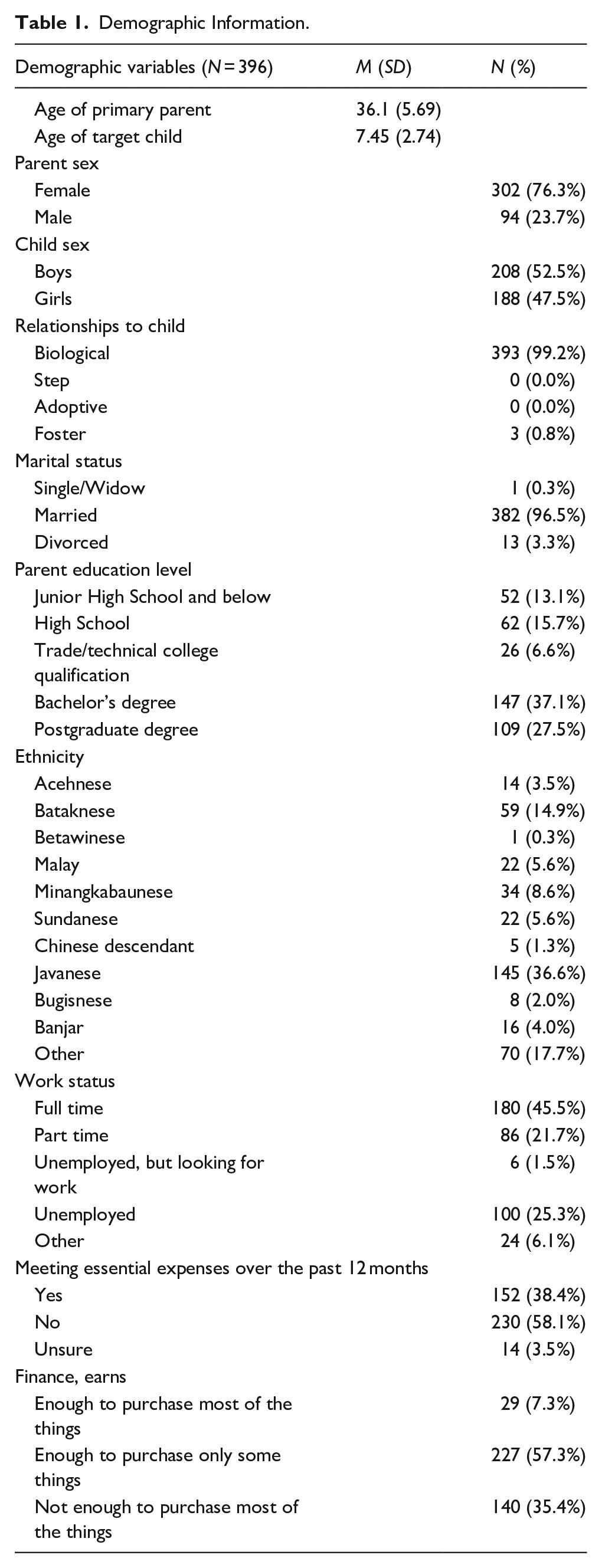
Table 1 provides details about the demographic profile of the participants. Participants included 396 Indonesian parents of typically developing children, consisting of 77.3% (n = 302) mothers, with Mage = 36.1 (SD = 5.69). Inclusion criteria were parents (i.e., biological, step, adoptive, or foster) who resided with the child at least in the past and upcoming 6 months. The distribution of the target children was 52.5% (n = 208) boys with Mage = 7.45 (SD = 2.74). Out of the total participants, 96.5% were married, and 99.2% were biological parents to the child. Most parents held at least a bachelor’s degree (37.1%), were employed full-time (45.2%), and reported no financial difficulties with basic expenses in the last year (58.1%). In terms of ethnicity, the sample was diverse, with a predominance of Javanese (36.6%), which is the majority ethnic group in Indonesia, followed by Bataknese (14.4%), Minangkabaunese (8.9%), Malay (5.5%), and Sundanese (5.3%) families.
Demographic Information.
Procedure
We used a cross-sectional design in this study. Convenience sampling through social media and author’s networking was used to recruit participants. Online websites containing participant information, consent, and a set of Qualtrics questionnaires were provided and distributed along with the participant recruitment announcement. Participation was voluntary and only consented participants proceeded to complete the questionnaires. To access participants from low-income background with limited internet access, field assistants were employed. These assistants were trained by the first author to aid participants in completing online questionnaires. Ethical clearance was obtained from the University of Queensland, Australia (identifier number: 2022/HE001013).
Measures
The Family Background Questionnaire (FBQ; Sanders & Morawska, 2010) was used to gather demographic data on participants and their families. This included the gender and age of parents, partners, and children, the occupation and educational level of the parents, marital status, the parent’s relationship to the child, the family’s economic situation, and any developmental concerns of the child.
The Parenting and Family Adjustment Scales (PAFAS; Sanders et al., 2014) assessed parenting practices. The Indonesian version of PAFAS (Sumargi et al., 2017) contains 23-items, which comprises 15 items assessing parenting practices and 8 items assessing family adjustment. For this study, we focused on parenting practices, using only the PAFAS-parenting subscale, which includes four sub-scales: parental consistency (e.g., “If my child doesn’t do what they’re told to do, I give in and do it myself”), coercive parenting (e.g., “I shout or get angry with my child when they misbehave”), positive encouragement (e.g., “I praise my child when they behave well”), and parent–child relationship (e.g., “I have a good relationship with my child”). Total score of PAFAS parenting ranges from 0 to 45, where higher scores indicate more negative parenting behavior. For clarity, we refer to the parenting sub-scales as parenting inconsistency, coerciveness, poor parent–child relationships, and lack of positive encouragement in our interpretations. An Indonesian validation study of PAFAS demonstrated good internal consistency (overall alpha coefficient across subscales is above 0.67; Sumargi et al., 2017). In this study, we only used the PAFAS-parenting subscales (α = 0.82).
Parent Self-Regulation Scale (PSRS; Tellegen et al., 2022) was used to measure parental self-regulation. It consists of 12 items on a 7-point Likert-type scale ranging from “strongly disagree” (1) to “strongly agree” (5). The scale is unidimensional and based on the self-regulatory domains described earlier (self-management, self-efficacy, self-sufficiency, personal agency, and problem-solving). Example items were “I know what behaviours and skills I want to encourage in my child” and “I have a major influence over my child’s behaviour.” This study is part of the validation study in Indonesia (encompassing PSRS and CSRS). The translation into Bahasa Indonesia and the validation process are reported in a separate article and have demonstrated good construct validity and reliability (Asmara et al., 2024a). Scores range from 12 to 84, where a higher score indicates better parental self-regulation. The scale showed good reliability within the sample in this study (α = 0.89).
Child Self-Regulation Scale (CSRS; Asmara et al., 2024b) initially developed in Bahasa Indonesia as a parent report to assess children’s self-regulatory capacity ages 3 to 12 years old. It consists of 19 items with a 7-point Likert-type scale, comprising five subscales: self-management (e.g., “My child can find a way to self-soothe when upset or sad”), self-sufficiency (e.g., “My child can do things for themselves”), self-efficacy (e.g., “My child is confident in their ability to achieve their goals”), personal agency (e.g., “My child says there is little they can do when faced with a difficult situation”) and problem-solving (e.g., “My child can apply things they learn to different situations”). CSRS produces a single score; higher scores indicate better child self-regulating capacity. CSRS has been tested in Indonesia context and found to be psychometrically sound (Asmara et al., 2024b). The internal reliability of CSRS within the current sample was α = 0.89.
Analytic Strategy
Data screening was conducted to check that demographic criteria met the study requirements; only participants within the inclusion criteria were retained. Data missingness was examined and treated according to guidance by Newman (2014). Average scores within the same sub-scale were placed in an item-level missingness analysis. Missing responses above 10% and person-level missingness (not filling an entire scale), were removed from analysis. No substantial item or construct missingness was found.
To examine the relationship between variables, bivariate correlation analyses were run using SPSS 29 for Windows. Subsequently, multiple-mediation analysis using path analysis was employed to examine the relationship among variables. Path analysis is useful as it provides estimates of the magnitude and significance of prespecified causal model that involves multiple variables (Stage et al., 2004). To test the goodness of fit of the hypothesized path model and the mediation effect, we conducted a regression path analysis using AMOS Graphic 29 for Windows. Bootstrapping from 5,000 samples with 95% bias-corrected confidence intervals (CIs) were employed. We used five fit indices for each model suggested by Boateng et al. (2018), Chi-square, root mean square error of approximation (0.06 ⩽ RMSEA as indicative of good fit; 0.05 ⩽ RMSEA ⩽ 0.08 as indicative of fair fit), Tucker–Lewis Index (TLI ⩾ 0.95 as excellent fit; TLI ⩾ 0.90 as a good fit), Comparative Fit Index (CFI ⩾ 0.95 as indicative of an acceptable fit), and standardized root mean square residual (SRMR ⩽ 0.08).
Results
Preliminary Analysis
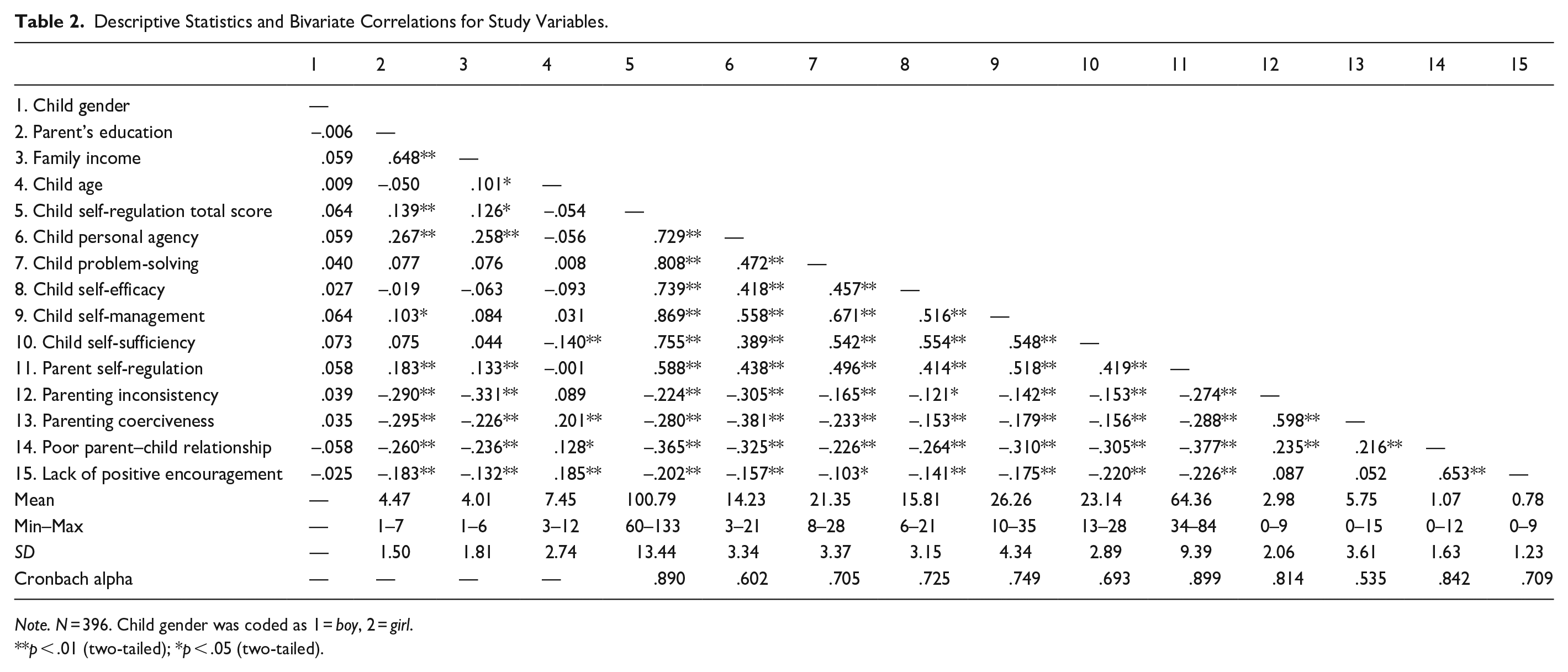
Descriptive statistics and bivariate correlations are provided in Table 2. Almost all bivariate correlations between study variables had significant relationships as expected. Parents who reported greater self-regulation rated their children as having greater self-regulation. The significant negative relationships observed across the PAFAS sub-scales with parent self-regulation indicate that higher levels of perceived parent self-regulation were associated with less negative parenting behaviors. Furthermore, parents who reported less negative parenting practices rated their children as having greater self-regulation. Almost all parenting practices had a significant relationship to each other, except lack of positive encouragement, which had no significant relationship with parenting inconsistency and coercive parenting.
Descriptive Statistics and Bivariate Correlations for Study Variables.
Note. N = 396. Child gender was coded as 1 = boy, 2 = girl.
p < .01 (two-tailed); *p < .05 (two-tailed).
The bivariate correlation coefficients were also inspected to check the covariate variables. Significant positive relationships were found between parent’s education level and family income and parent self-regulation, parenting practices, and child self-regulation. No significant associations were found between child age and child and parent self-regulation; child age was associated with parenting practices except for parenting inconsistency. No significant relationship was found between child gender and the study variables. We included the significant covariates in the hypothesized model.
Path Analysis
As shown in Figure 1, our model consists of six manifest variables: parent self-regulation as an exogenous variable, child self-regulation as an endogenous variable, and four parenting practices as mediators. As suggested by Hair et al. (2021), the best approach to test multiple mediation is by analyzing all the relevant mediators simultaneously. Theoretical considerations and preliminary results indicated that some demographic variables were significantly associated with one or more main variables. Therefore, we included covariates such as parent education, family income, and child age in the model as exogenous variables to predict parenting practices and child self-regulation. We then evaluated the significance of each covariate in the model to determine which needed to be retained.
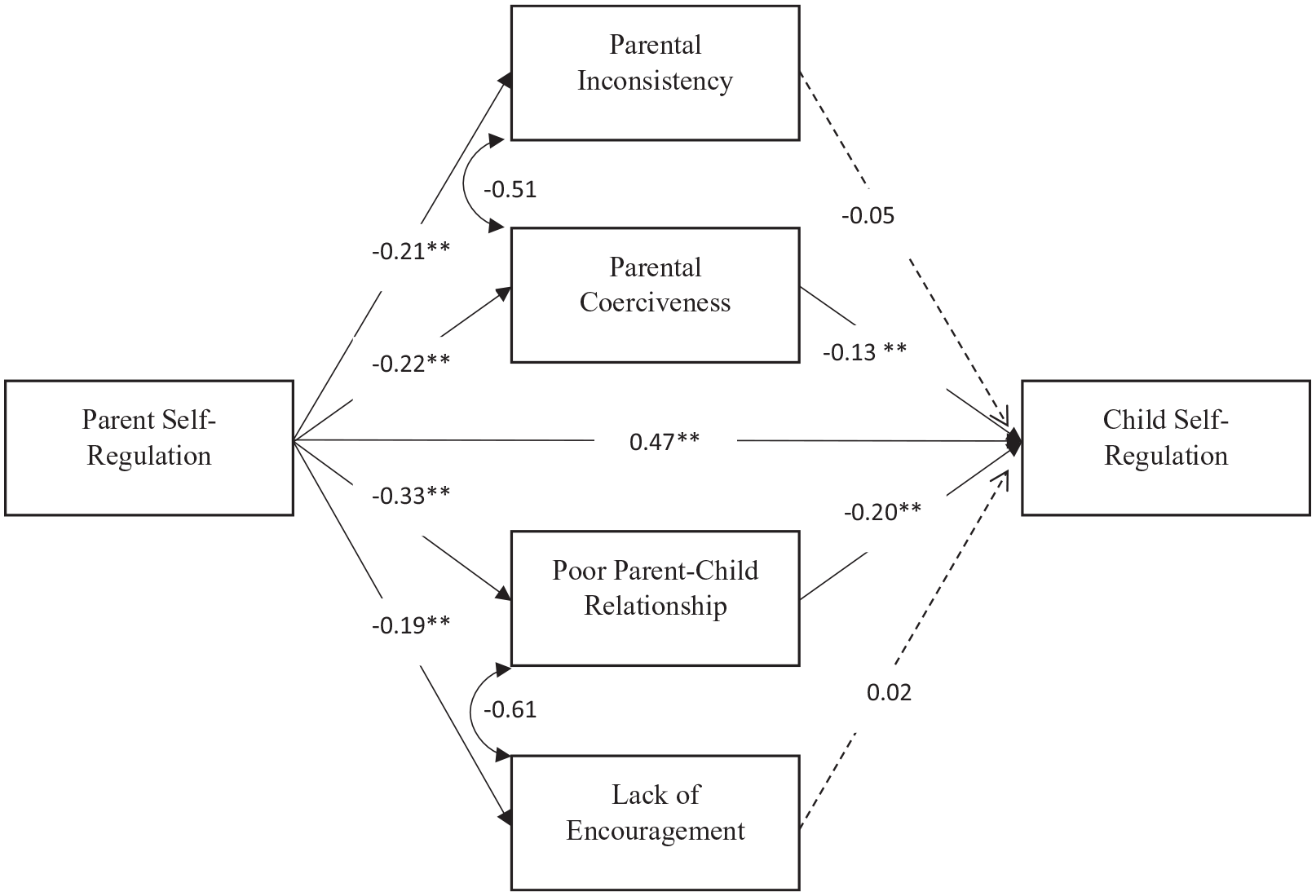
Standardized Estimates of Mediation Relationship Model Among Parent Self-Regulation, Parenting Practices, and Child Self-Regulation. N = 396. For the clarity of the model, the covariates (i.e., child’s age and parent education) were not shown in this figure.
Regression analysis showed that both parent education and child age were consistently significant predictors of parenting practices, while family income was only significantly associated with parenting inconsistency. None of the covariates significantly predicted child self-regulation. Thus, we incorporated parent education and child age into the path model as exogenous variables. However, for clearer presentation, the covariates are not displayed in the figure.
The initial path model with these covariates included did not fit the data well, showing χ2 (6) = 307.913, p < .001, CFI = 0.626, TLI = −0.745, RMSEA = 0.357, 90% CI = [0.324, 0.391], SRMR = 0.110. Examining the modification indices (MIs) suggested that a parameter should be estimated between the residuals of poor parent–child relationship and lack of positive encouragement (MI = 127.798). We modified the model by correlating the residual of both variables, the model was improved but still not meeting the goodness criteria (χ2 (5) = 128.326, p < .001, CFI = 0.854, TLI = 0.184, RMSEA = 0.250, 90% CI = [0.214, 0.288], SRMR = 0.0708. Next, we inspected the modification indices again, which suggested that adjusting the parameter between parenting inconsistency and parenting coerciveness could substantially improve the model (MI = 81. 638). Modifying the model by correlating these two variables resulted in a substantial improvement and satisfactory goodness-of-fit indicators: χ2 (4) = 13.268, p < .001, CFI = 0.989, TLI = 0.920, RMSEA = 0.077, 90% CI = [0.034, 0.124], SRMR = 0.021. The final model and all standardized estimates are detailed in Figure 1. A previous study also showed a similar relationship among the four parenting practices on the PAFAS scale (Sumargi et al., 2017). They classified parenting inconsistency and coerciveness as ineffective parenting, while parent–child relationship and positive encouragement as effective parenting.
Mediation Analysis
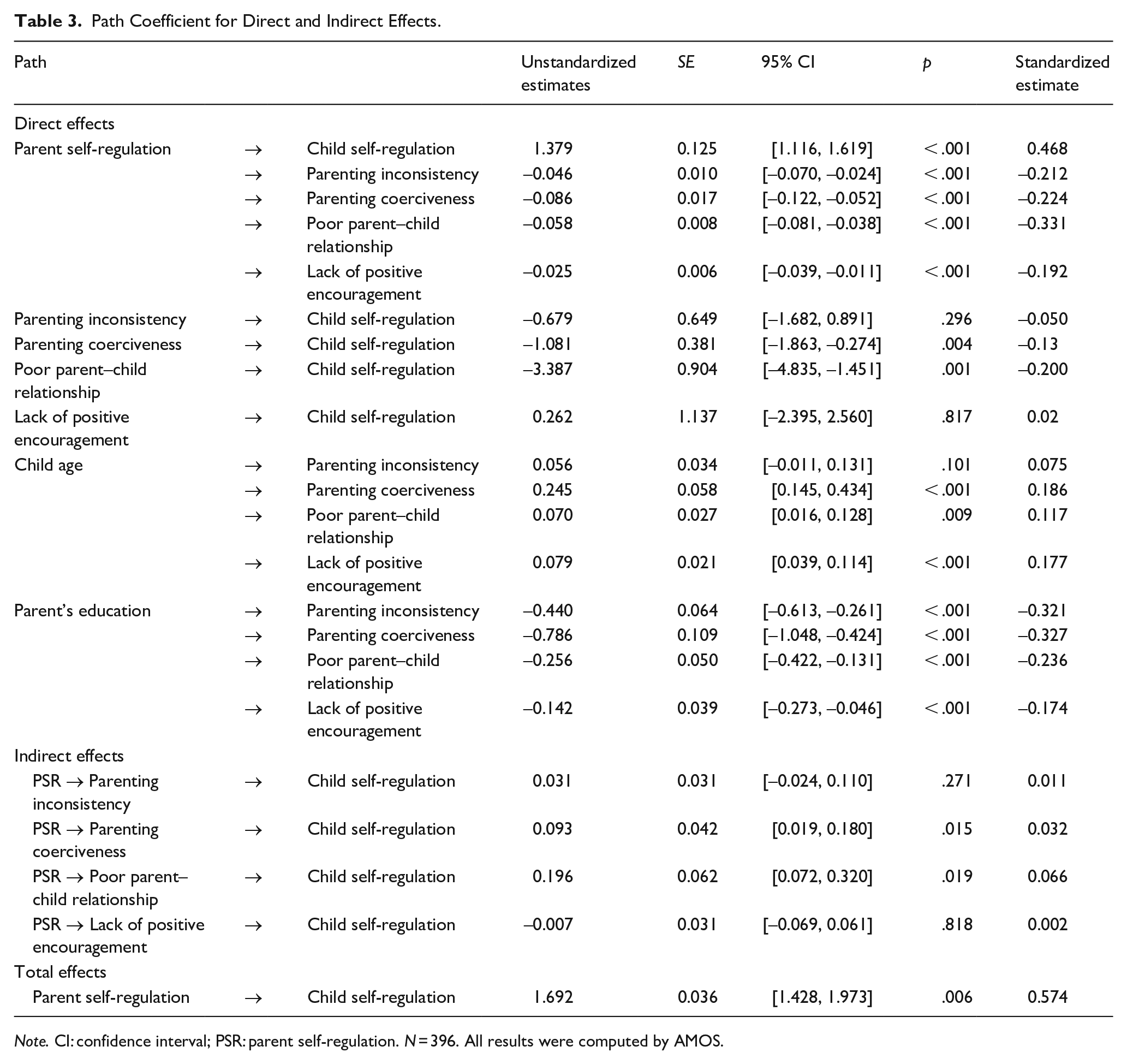
All path coefficients from parent self-regulation to parenting practices were significantly negative (p < .001), but only two parenting practices (poor parent–child relationship and coercive parenting) significantly predicted child self-regulation. Further inspection revealed that the total indirect effect (all mediators together) was significant, B = 0.106, p = .013. However, only parenting coerciveness and poor parent–child relationship significantly mediated the relationship, as demonstrated in Table 3. In contrast, parenting inconsistency and lack of positive encouragement did not act as significant mediators. Parents who reported greater self-regulation were likely to have a better relationship with their child and were less likely to implement coercive parenting, which, in turn, predicted higher child self-regulation. However, as significant direct effects between parent and child self-regulation remained, neither the parent–child relationship nor coercive parenting fully mediated the relationship. Hence, there may be other underlying mechanisms that link parent and child self-regulation. All path coefficients are presented in Table 3.
Path Coefficient for Direct and Indirect Effects.
Note. CI: confidence interval; PSR: parent self-regulation. N = 396. All results were computed by AMOS.
Discussion
Despite its pivotal role in shaping developmental outcomes, self-regulation has been under-explored in non-WEIRD countries. In this study, we aimed to examine the relationship between parent and child self-regulation and whether this is mediated by parenting practices. To the best of our knowledge, this is the first study in Indonesia examining the interconnectedness between parent and child self-regulation and parenting practices. Most parenting studies in Indonesia have been conducted within the framework of Baumrind (1971) parenting styles, and they generally do not delve into specific parenting behaviors (Alfaeni & Rachmawati, 2023). In this study, we found that parenting practices, particularly the parent–child relationship and parenting coerciveness, partially mediated the link between parent and child self-regulation.
To begin with, our study found a strong direct relationship between reported parent and child self-regulation. This underscores the parental role in child self-regulation development, which confirms previous studies (Bridgett et al., 2018; Rosenblum et al., 2021). In general, parental behavior has an important influence on child development outcomes, including self-regulation. Whether deliberately or not, parents play a role as a socialization agent for their child, where the child adopts values and behavior through observation (Bandura, 1991). Thus, the way parents exhibit their self-regulation (whether they react adaptively to certain stimuli or not, including in parenting tasks) will likely influence the quality of their child’s self-regulation development.
In this study, we were interested to study the indirect relationship of parent and child self-regulation through parenting practice. Our results support our hypothesis that parenting practices mediate the link between parent and child self-regulation. Parenting practice involve specific behaviors or strategies that are utilized by the parent to teach and support their child’s development. Positive parenting specifically has been considered to benefit child self-regulation (Planalp et al., 2022). The way a parent provides a safe, predictable, and supportive environment can encourage child self-regulation development, while negative parenting characterized by hostility and unpredictability may hinder child self-regulation. This is consistent with a previous study by Morelen et al. (2016), which found that a parent’s negative reaction to their child’s negative emotion was associated with child emotional dysregulation. Another finding regarding the role of parenting in mediating parent and child self-regulation capacity was also found by Distefano et al. (2018), showing that parent’s executive functioning influenced parent support for child autonomy, and that in turn predicted child self-regulation.
Despite the finding of parent–child self-regulation link through parenting, we found partial mediation effects, meaning parenting practices are not the only mean of transmitting self-regulation from parent to child. Other means are likely to play a role in transmitting parent–child self-regulation link, such as genetic effects and co-regulation. Indeed, in a comprehensive review of intergenerational transmission of self-regulation, genetic factors were recognized as one of the key factors in individual differences in self-regulatory capacity (Bridgett et al., 2015). This notion has been supported by a meta-analysis study investigating the heritability of self-control. By analyzing 31 studies, it was found that around 60% of individual differences in self-control can be attributed to genetic factors (Willems et al., 2019).
Furthermore, parent–child co-regulation may also play essential roles of transmitting self-regulation (Lobo & Lunkenheimer, 2020), which was not represented via parenting practices measure in this study. Co-regulation is a dyadic interaction, which seeks ways to self-regulate in the context of disturbance or conflict (Lobo & Lunkenheimer, 2020). In the co-regulation process, parents not only model self-regulation, but also act to scaffold the interaction to facilitate a child to understand, express, and modulate their thoughts, feelings, and behavior (Murray et al., 2015). It is likely that parents with good self-regulation will be better at engaging in co-regulation with their child. For example, in a situation when a child experiences tantrums, being calm parents will not only be a model to the child but also prompt the child to self-regulate by engaging in self-soothing behaviors (e.g., taking slow deep breaths).
Our path analysis showed that parent self-regulation did influence each of the parenting practices, yet only the parent–child relationship and parenting coerciveness (not inconsistent parenting and positive encouragement) influenced child self-regulation. This suggests that the connection between parent and child self-regulation relies upon the quality of parent–child interaction rather than other aspect of parenting. Non-coercive parenting, characterized by a lower tendency to show anger in negative expression (e.g., “less likely to shout or get angry with my child when they misbehave”) and a higher level of assertiveness (e.g., “less likely to argue with my child about their behaviour / attitude”), reflects parents’ ability to manage their emotions and behaviors, even in frustrating situations. This self-regulation by the parent probably acts as a model for their children, helping them learn to manage their own behavior. Coupled with a positive parent–child relationship, this combination might have created an ideal setting for children to observe and develop their self-regulation skills. The negative influence of coercive parenting and positive influence of a good parent–child relationship on positive child outcomes is consistent with previous findings from Indonesia (Sumargi et al., 2017), Korea (Kim & Holloway, 2018), and Western countries (Lunkenheimer et al., 2023; Pinquart, 2021; von Suchodoletz et al., 2011).
Theoretically, consistent parenting and positive encouragement may support the development of child self-regulation. From an operant learning perspective, these parenting strategies can provide predictability that may strengthen child behavior and habit shaping. However, at least in our sample, the impact of these parenting strategies may be less discernible when compared to the effects of non-coercive parenting and a positive parent–child relationship on the child’s ability to self-regulate. A little can be said on this weak of association, due to data limitation and lack of previous evidence. However, we assume being consistent may be a particular challenge for Indonesian parents. Some values that are upheld by an interdependent culture such as Indonesia (i.e., similarity, harmony, dependence on others, and receptiveness to influence; Vignoles et al., 2016) can be a particular challenge to apply consistent parenting. As one is seeking harmony and susceptible to the influence of others, they are likely to avoid conflict to prevail such values under certain contexts. For example, giving extra screen time to avoid child whining and screaming when attending a family gathering. On the contrary, positive encouragement such as giving praise has been found to have inconsistent associations with child compliance (Owen et al., 2012), consistent with our findings.
One of the novelties of this study is in the way we approached the self-regulation construct. Specifically, this study referred to a more comprehensive self-regulation construct incorporating cognitive, emotional, and behavioral operationalizations. Previous research has predominantly focused on cognitive (Rosenblum et al., 2021) or emotional facets (Boediman & Desnawati, 2019; Morelen et al., 2016; Tan & Smith, 2019). Furthermore, we also sought to expand our understanding of self-regulation beyond WEIRD countries by conducting the study in Indonesia, where self-regulation research is still overlooked. Thus far, our results show patterns consistent with findings in other contexts including the United States (Distefano et al., 2018; Morelen et al., 2016), and Korea (Kim & Holloway, 2018). These findings confirm Trommsdorff (2009) proposition that the expression or orientation of self-regulation may vary depending on contextual values and cultures, but the prerequisite conditions for its development may be similar, such as an adequate role model and a nurturing and positive emotional climate, which was illustrated in this study.
Our study emphasizes the crucial impact of parent self-regulation on child self-regulation, with positive parenting acting as a mediator. Indonesian traditional practices, such as those of fathers who often maintain a distance from their children to assert authority and promote polite behavior (Serad, 2012), may need re-evaluation. The predominant parenting approach in Indonesia is parent-centered, where parents hold the authority to set rules and expectations (Haslam et al., 2020; Riany et al., 2022). Establishing boundaries is a sound practice in child-rearing; however, to promote child self-regulation development, parents need to be mindful that being firm does not necessarily entail being harsh and damaging to the parent–child relationship. One strategy that parents can use to nurture strong connections with their children is to have a dedicated quality time together.
As we understand how crucial self-regulation capacity is in shaping one’s long-life outcomes, an effort to prevent its deficit and promote its development is imperative. An endeavor to promote child self-regulation can be via parenting intervention. The modifiable nature of self-regulation becomes a vital modality to facilitate parenting behavior change (Sanders & Mazzucchelli, 2022). An effective parenting program not only presents knowledge but also supports parents in strengthening their inner capacity. Self-regulation has been known to be sensitive to parenting practices. However, the role of parent self-regulation to parenting has been rarely studied. This study added knowledge on how parent self-regulation can contribute to parenting practices, and in turn influence the child self-regulation development.
Limitations and Future Directions
Despite various strengths, there are some limitations to our study. First, testing mediation analysis with a cross-sectional design must be interpreted with caution as the data did not allow for testing of a causal relationship over time. Therefore, the findings in this study need to be approached as a tentative association that could be clarified in future longitudinal studies. Second, we used parent reports for all study variables. While this is the most efficient and widely used method, it has some drawbacks such as susceptibility for bias. The scores may not accurately represent the actual variables since it relies on parents’ perceptions, particularly when evaluating child self-regulation. To address this potential issue, future research can use multiple raters, such as both parents, teachers, or independent observers to assess the study variables.
Finally, even though we realized the influence of culture in shaping one’s self-regulation, we did not specifically measure its direct impact. We believe self-regulation differs based on how one assigns meaning to goals (which is central in the self-regulation process) that will likely be influenced by culture. In this study, we aimed to see what contributes to a child’s self-regulation development, and the formation process remains similar across cultures. Yet, to better understand how self-regulation expression may differ across cultures, a bottom-up study, gaining information from the ground by using qualitative approach may be suitable to explore how Indonesian parents perceive self-regulated parents, self-regulated children, or even positive parenting. Considering the ethnic diversity in Indonesia that may bring their unique cultural values in child rearing practice, future research involving parents from different ethnic backgrounds is also recommended.
Conclusion
Every parent yearns for a resilient child. Yet, it is often said that the apple does not fall far from the tree, suggesting that children tend to resemble their parents. This does not mean that change is impossible. Indeed, to raise children who embody good self-regulation, parents must exemplify this capacity themselves and foster these skills through nurturing parenting practices within a warm and loving environment where children can practise self-regulation skills. With an awareness of the importance of self-regulation, promoting it through various forms of media or parenting programs to support parents’ self-regulation—and, in turn, enhance children’s self-regulation—should be considered. Future studies could further explore the complexity of parent–child self-regulation and its relationship with parenting practices in Indonesia, employing a mixed-methods and multi-rater approach.
Footnotes
Acknowledgements
The authors sincerely thank all the Indonesian parents who participated in the study. They would also like to extend their gratitude to the editor and two anonymous reviewers for their highly valuable feedback on an earlier version of the article.
Declaration of Conflicting Interests
The author(s) declared the following potential conflicts of interest with respect to the research, authorship, and/or publication of this article: The Parenting and Family Support Centre is partly funded by royalties stemming from published resources of the Triple P—Positive Parenting Program, which is developed and owned by The University of Queensland (UQ). Royalties are also distributed to the Faculty of Health and Behavioural Sciences at UQ and contributory authors of published Triple P resources. Triple P International (TPI) Pty Ltd is a private company licensed by Uniquest Pty Ltd on behalf of UQ, to publish and disseminate Triple P worldwide. The authors of this report have no share or ownership of TPI. TPI had no involvement in the study design, or analysis or interpretation of data, or writing of this report. Prof A. Morawska, and Dr Hoang are employees at UQ. Dr Riany is an honorary research fellow at UQ. Mrs. Asmara is a student at UQ.
Funding
The author(s) disclosed receipt of the following financial support for the research, authorship, and/or publication of this article: This research was funded by Indonesia Endowment Fund for Education (known as LPDP) as part of the first author’s PhD scholarship and the Australian Research Council Centre of Excellence for Children and Families over the Life Course (A.M. and A.H.; CE200100025).
