




Abstract
Self-regulation has mostly been studied as an intrapersonal trait which fluctuates across time and impacts everyday behavior related to individual goal pursuit and achievement. Although it is plausible that self-regulation affects not only individuals but also their social network, there is less research on how self-regulation levels and fluctuations are linked to social processes in daily life, such as interactions between children and their parents. To this end, this study tracked children’s (aged 9 to 11 years; N = 70) self-regulation, and their daily interaction quality with parents, across 54 days, using child and parental self-reports. Participants reported higher interaction quality in dyads in which children showed higher self-regulation levels in comparison to others, as well as on days on which children showed higher self-regulation compared to their typical levels. The extent of this association varied between dyads, which needs to be addressed in future studies. As self-regulation and parent-child interaction quality fluctuate in parallel, this study suggests that researchers should aim to understand the underlying mechanisms in order to develop dynamic self-regulation interventions in family contexts and improve family well-being.
Keywords
The psychological trait of self-regulation has been frequently studied to account for interindividual differences in behavior. Self-regulation describes the ability to shape and orchestrate one’s actions, feelings, and thoughts to pursue long-term goals (e.g., reducing weight, achieving good grades; Inzlicht et al., 2021). High trait self-regulation is considered beneficial for psychosocial adjustment and health outcomes, including better well-being, and lower risk for obesity, alcohol abuse, and deviant behavior (de Ridder et al., 2012; Tangney et al., 2004). Moreover, higher trait self-regulation is related to children’s academic success (e.g., de Ridder et al., 2012; Gawrilow, Fäsche, et al., 2014). Beyond individual outcomes, self-regulation also impacts relational outcomes. For example, relationship satisfaction is highest in couples where both partners exhibit high trait self-regulation (Vohs et al., 2011). In children, high trait self-regulation is predictive of positive relationships with peers and adults (e.g., Eisenberg et al., 2014). Hence, self-regulation intersects with a broad range of intra- and interpersonal life domains across the life course. The present study investigates self-regulation in childhood while considering trait-like differences in children’s self-regulation as well as day-to-day fluctuations and links them to daily interactions between children and parents.
Daily fluctuations in self-regulation
Several theoretical models proposed that while some people might exhibit higher self-regulation than others (i.e., between-person differences), people can also show fluctuations in self-regulation over time (i.e., within-person differences). For example, Baumeister (2007) proposed that self-control depletes and restores dynamically across time, and van der Meere (2005) links fluctuations in self-regulation problems with current activation levels for individuals with pathological self-regulation deficits such as attention-deficit hyperactivity disorder.
Empirically, lab studies showed within-person fluctuations under presumably constant contextual conditions, as well as following manipulations of motivational and social factors (Kofler et al., 2013; vanDellen & Hoyle, 2010; Wieber et al., 2011). These laboratory conditions mirror how self-regulation changes in daily life, where self-regulation fluctuates under far more complex contextual conditions. An increasing number of ecological momentary assessment studies investigates such ‘real-life’ fluctuations in adults’ self-regulation (e.g., Hofmann, Baumeister, et al., 2012), as well as their situational correlates, such as subjective well-being (Buyukcan-Tetik et al., 2018). The number of studies tracking children’s and adolescents’ self-regulation in everyday life is far more restricted. Initial studies showed substantial day-to-day variability in the self-regulation of children (Blume et al., 2022; Leonard et al., 2021; Ludwig et al., 2016; McCoy et al., 2022), and adolescents (Berg et al., 2014; Schmid et al., 2020). However, little is known about the circumstances under which young people’s self-regulation is attenuated or increased. Some experience sampling studies in the area of romantic relationships consider ups and downs in couples’ relational outcomes (Totenhagen et al., 2012) as covariates of self-regulation fluctuations in daily life (e.g., Buck & Neff, 2012). However, to our knowledge, there are no comparable studies in the area of parent-child relationships.
Children’s self-regulation and parent-child interactions
The development of self-regulation is an important milestone of early child development. The family environment plays a fundamental role within this process (Bridgett et al., 2018; Posner et al., 2014). For example, parental self-regulation is theorized to influence children’s self-regulation through genetic and socialization processes (Bridgett et al., 2015). Socially, children’s self-regulation is influenced by their parents as models of regulatory behaviors, as well as through parenting behavior (Morris et al., 2017). Empirical studies show that children’s self-regulation is strengthened by warm, consistent, and responsive parenting and undermined by overly directive and critical parenting (e.g., Morawska et al., 2019). Likewise, higher trait self-regulation in children is associated with parents' encouragement and guidance, as well as setting boundaries (Karreman et al., 2006; Piotrowski et al., 2013).
How parents interact with their children also influences children’s social functioning (Eisenberg et al., 2014). For example, non-hostile and warm parenting contributes to children’s prosocial skills besides self-regulation (Williams & Berthelsen, 2017), so that children can build new social relationships, but also maintain a secure and attuned relationship with their parents (Davis et al., 2017; Herd et al., 2018). Thus, the relationship between children’s self-regulation and the quality of their social interactions is, in parts, reciprocal. For example, in one quasi-experimental study, mothers with poor executive functioning (i.e., low working memory capacity, which is correlated with self-regulation abilities; Hofmann, Schmeichel, et al., 2012) showed more negative reactivity towards challenging child behavior than mothers with better executive functioning (Deater-Deckard et al., 2010). Also, in one longitudinal study, children with higher self-regulation deficits at baseline perceived their mothers to be more hostile and less accepting one year later (Lifford et al., 2009). Taken together, such studies indicate a negative influence of the child’s dysregulated behavior on dysregulated parenting behavior—which, in turn, can continue to negatively affect the child’s self-regulation and perpetuate differences in children’s self-regulation and family problems across development (Feldman, 2015).
Overall, the links between self-regulation and outcomes related to parent-child interactions are typically studied in parent-child dyads, applying either cross-sectional or longitudinal designs across longer developmental periods. Given that children’s self-regulation fluctuates substantially on a daily level, we consider this a substantial shortcoming. Thus far, it is unknown whether and how such daily fluctuations in children’s self-regulation translate into relational outcomes within the parent-child relationship.
The present study
As part of one self-regulation system (Fitzsimons et al., 2015), self-regulation fluctuations in children are likely to influence both child and parent on a daily level. For example, on days the child exhibits high self-regulation, it might rely less on support from the parent to engage in tedious tasks (i.e., finishing their homework) relevant for long-term goal pursuit (i.e., receive good grades at schools). Thus, fluctuations in children’s self-regulation are likely to be directly reflected in relational outcomes. To this end, our study uses an ambulatory assessment design (Trull & Ebner-Priemer, 2013) to capture day-to-day fluctuations in children’s self-regulation and to better understand the daily link between self-regulation and parent-child interaction quality. We consider the ambulatory assessment approach suitable to track such within-person fluctuations in the real world (i.e., within natural environments that cannot be recreated in laboratories) and in real time (i.e., through momentary ratings instead of retrospective reports). We apply both children’s self-reports and parental reports of children’s self-regulation (cf. Berg et al., 2014).
Replicating previous findings, we aim to test the hypothesis that there is a positive between-person relationship between children’s self-regulation and interaction quality, i.e., children with higher self-regulation than others should report more positive interactions with their parents, and parents who perceive their child to have higher self-regulation than others should report more positive interactions with their child. In addition, we establish and test the novel hypothesis that there is also a positive within-person relationship between children’s self-regulation and interaction quality. That is, on days on which children report higher self-regulation than they usually do, they should also report more positive interactions with their parents, and on days on which parents perceive their children to have higher self-regulation than they usually do, they should report more positive interactions with their children.
Method
Study design and sample
This study used a dyadic ambulatory assessment design with measurement bursts (Sliwinski, 2008). We followed children and one of their parents (the same parent across the whole study period) for a maximum of 54 days, distributed across three bursts of 18 days spaced out over 13 months. Thus, this design balances fine-grained daily assessment and its corresponding participant burden to capture everyday experiences over a longer developmental period. Throughout the study period, we asked children and parents to rate children’s self-regulation and parent-child interaction quality on a daily basis. So far, there are no comparable studies to derive meaningful starting values for powering the hypothesized within-person effect (Bolger et al., 2012), so that the current study will provide the necessary estimates for power analysis in future ambulatory assessment studies. Therefore, we powered the study to collect sufficient data for detecting a between-person effect of medium effect size (r = .35; i.e., Tangney et al., 2004, for family cohesion and self-control), with 80% power and α = .05. The power analysis resulted in a required sample of at least 61 participants. Expecting cases where data are only available for the child or only for the parent, we aimed to recruit 15% more dyads (n = 9).
Thus, in total, 70 parent-child dyads participated in our study. All children (39 girls, M = 10; 9 years, SD = 5.7 months) attended Grade 5 at the beginning of Burst 1 and were recruited from six different secondary or comprehensive schools. Eight children were diagnosed with attention-deficit hyperactivity disorder (ADHD), all of which were receiving medical treatment. Participating parents were typically children’s biological mothers (n = 65, 93%). They had different education levels with 41% (n = 29) having obtained a university entrance qualification. Figure 1 gives an overview of the recruitment and retention of these 70 dyads throughout the study period. We successfully recruited 55 dyads for Burst 1, missing the targeted recruitment goal, and thus recruited 15 more dyads in Burst 2. Diagram of parent-child dyad’s study participation throughout all bursts. While n = 21 parent-child dyads dropped out after Burst 1, two of them re-enrolled for Burst 3, resulting in n = 26 parent-child dyads (37% of all dyads considered for data analysis) that participated in all three measurement bursts.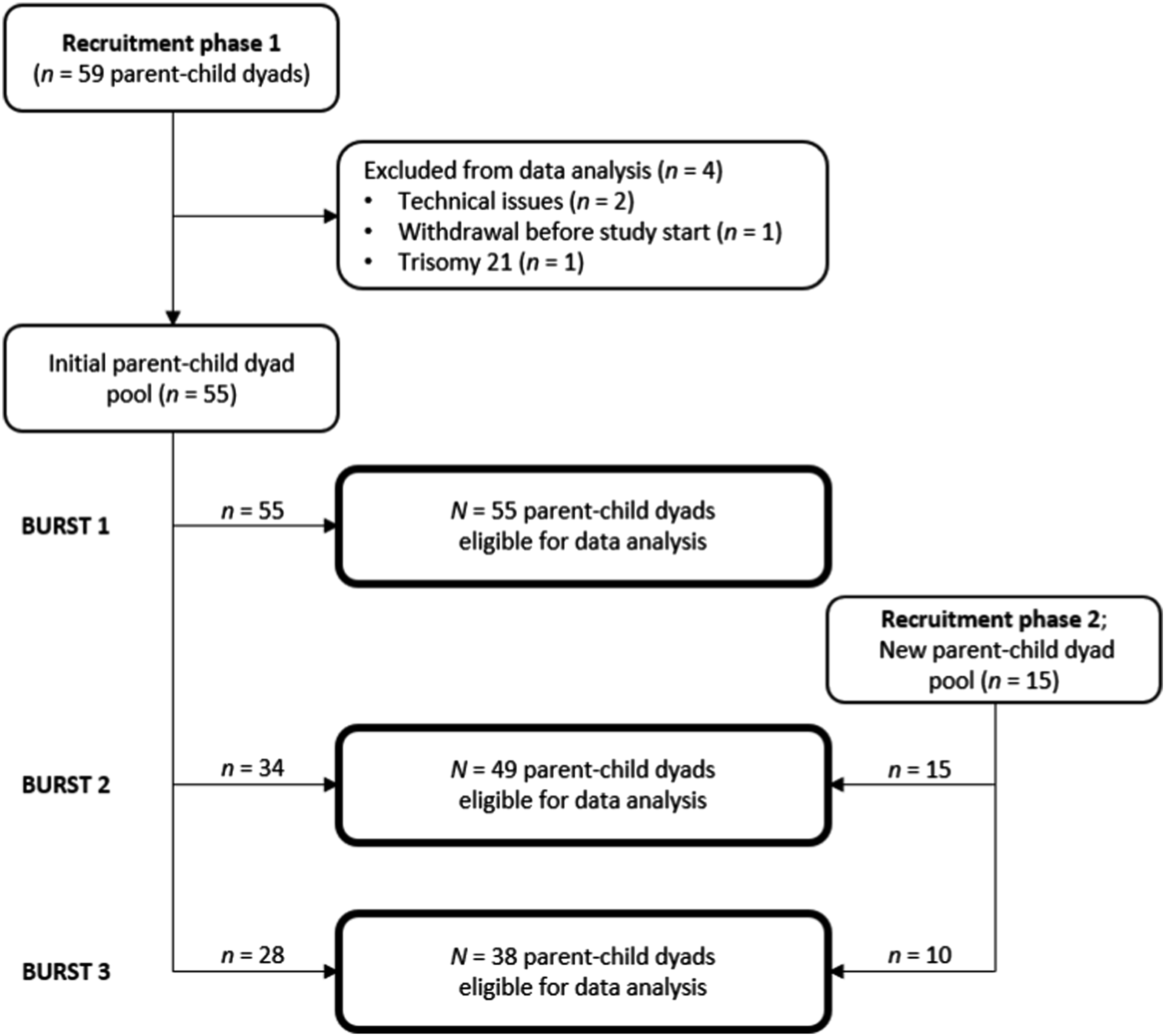
All parents gave written informed consent for their child and themselves to participate in this study and received a €40 voucher after each burst for a self-chosen excursion with the family. The overarching research project was approved by the ethics committee of the German Psychological Society (DGPs). The Ministry of Culture, Youth and Sport in Baden-Württemberg approved recruitment at schools.
Procedure
At each burst, a study team visited the schools and provided participating children with mobile phones (Moto G5 plus smartphones by Motorola, Libertyville, Illinois) for daily data collection. The phones were programmed to only allow access to the study contents and no other phone functions. Children were instructed to use these phones to fill out short diaries, asking about their experiences, including self-regulation and interaction quality, three times a day for 18 consecutive days. Filling out these diaries took about 5 minutes per occasion. Items were presented in a predefined order with only one item on screen at a time. Children were able to navigate through items using arrow buttons, and could choose to deny responses for any item.
Every participating child was asked to fill out the first diary on a Wednesday morning. We used a time-contingent sampling method with the phones prompting children via a ringtone to respond. Each time the phone rang children had 30 minutes to respond, otherwise their answers were recorded as missing. We asked children to fill out the diaries shortly after waking up in the morning, after school in the afternoon, and before going to bed in the evening. Response prompts followed individual timetables adapted to children’s daily schedules and thus differed slightly between children. For example, in the evenings, most children were prompted at 8 pm, varying between 7:30 and 9:30 pm before school days, and 7:30 and 11 pm on Fridays and Saturdays.
In parallel, every evening between 8 pm and 12 am, we asked parents to fill out a short questionnaire about their children’s daily experiences, including self-regulation and interaction quality. This took about 3 minutes per occasion. Parents could choose whether they would fill out these questionnaires online or use paper-pencil versions of the questionnaire to submit by mail at the end of each burst. Within each burst, approximately 50% of parents chose to fill out the questionnaire online. They also participated in a telephone interview before each burst, to collect background information about family socio-demographics, children’s characteristics, and their everyday lives.
The procedure was repeated for each measurement burst. 1 Burst 1 took place from November to December 2017, Burst 2 from April to July 2018, and Burst 3 from November to December 2018. For organizational reasons, children from different schools had individual assessment periods within these time frames.
Measures
Self-regulation in everyday life
Children’s daily self-regulation was measured using a total of seven items adapted for daily use, drawing on the Self-Control Scale (SCS-K-D; Bertrams & Dickhäuser, 2009, original: Tangney et al., 2004; 3 items) to assess core self-regulation, and Conners 3 (Lidzba et al., 2013; 4 items) to assess self-regulation deficits (e.g., impulsiveness, or lack of concentration; Schmid et al., 2020). Children filled out these items three times a day, while parents did so once a day—that is, we modified the items to record state self-regulation with shorter time frames for children (e.g., Since the last alarm, I had difficulty concentrating), and a longer time frame for parents (e.g., Today, my child had difficulty concentrating; see Table A1). To allow participants to respond in a more nuanced way, we changed the response scale, using a six-point Likert scale ranging from 1 (Not at all) to 6 (Exactly). We recoded reverse items before data analysis, so that higher scores represent higher self-regulation. Children and parents answered slightly different item sets, which were chosen based on a proof-of-concept trial and proved to be most suitable to track self-regulation fluctuations. To obtain mean self-regulation scores, we calculated averages across all items for each occasion a child or a parent answered at least four of the seven items. Also, to be able to compare children and parent reports, we calculated daily self-regulation scores across all three occasions per day for child reports. These daily scores were used for all statistical analyses. We computed multilevel reliability estimates (Shrout & Lane, 2012) to determine the reliability of these scores to capture individual differences as well as day-to-day fluctuations in self-regulation. Between-person reliability was .99 for child reports and parental reports, respectively, and within-person reliability was .62 (child report) and .70 (parental report).
Background information on self-regulation
To confirm the validity of the self-regulation scores obtained within the daily assessment, we compared the average scores across all study days with full baseline scores on the SCS-K-D (Rauch et al., 2014; higher scores imply higher self-regulation), as well as Conners 3 (Lidzba et al., 2013; higher scores imply lower self-regulation). Both questionnaires were administered at the beginning of each burst in telephone interviews with parents. For children’s self-reports, self-regulation scores from the daily assessment were associated with SCS-K-D at Burst 1 (r = .12) and 3 (r = .09) with small correlations, but not at Burst 2 (r = -.02). Also, they were associated with Conners 3 with small to moderate correlations at each measurement burst (all r < -.13). For parents, daily scores showed moderate to large negative correlations with SCS-K-D scores at each measurement burst (all r > .38), as well as with Conners 3 (all r < -.35). Overall, these results indicate that children and parents provide unique and distinct perspectives on children's everyday experiences.
Parent-child interaction quality
Quality of parent-child interactions was measured once a day in the evening, using a single item (“Today I got along well with my parents/my child”) on a six-point Likert scale ranging from 1 (Not at all) to 6 (Exactly) with higher scores representing better interaction quality.
Statistical analysis
In this study, we repeatedly collected data on self-regulation and parent-child interaction. Thus, the data are nested within participants. To account for this hierarchical structure, we tested our hypotheses using mixed linear models (Bolger & Laurenceau, 2013) implemented in the nlme package (version 3.1–153) in R (version 4.1.1). To dissociate effects on the between-person and within-person level, daily reported self-regulation scores were decomposed into a stable between-person score, bpSR i —that is, a child i’s average self-regulation score across all study days, centered at the grand mean—and a time-varying within-person score, wpSR ij —that is, a child i’s higher or lower self-regulation score on study day j, fluctuating around child i’s average self-regulation score.
To test our hypotheses, we fitted mixed models to child-reported data (child model) and parent-reported data (parent model), respectively. Both models examined whether and how children’s between-person differences and within-person fluctuations in self-regulation (predictors) and interaction quality (PCI ij ; outcome) are related across time.
We conducted full random slope models using the following equations:
Level 1: PCI ij = β0i + β1i time ij + β2i wpSR ij + e ij
Level 2: β0i = γ00 + γ01 bpSR i + u0i
β1i = γ10
β2i = γ20 + u1i
The Level 1 equation represents the within-person level, while the Level 2 equations represent the between-person level. Accordingly, for both the child model and the parent model, we considered the following fixed effects: the intercept, γ00, indicating the starting point for the typical child in the sample on Day 1; an average linear time trend, γ10, indicating a possible change in interaction quality across time; the average between-person slope for self-regulation, γ01, indicating a between-person association of self-regulation and interaction quality; and the average within-person slope for self-regulation, γ20, indicating a within-person association of fluctuations in self-regulation and interaction quality. Additionally, we considered two random effects to account for individual shifts from the sample’s average: children’s deviation from the average intercept, u0i; and children’s deviation from the average within-person slope for self-regulation, u1i; as well as the residual error e ij .
The models were calculated using maximum likelihood estimation and α = .05, and were controlled for a continuous auto-correlation of Level 1 residuals (e.g., Bolger & Laurenceau, 2013). 2 To obtain standardized regression coefficients and thus facilitate the interpretation of results in terms of effect sizes, as well as comparisons of within- and between-person effects across informants, both model predictors (between-person differences and within-person fluctuations in self-regulation) were divided by the between-person standard deviation of self-regulation scores.
Results
Descriptive statistics
On average, children provided data on self-regulation and interaction quality on a median of 28 days (range: 7–53 days). Among parents, three did not report any data, while the remaining provided data on a median of 25 days (range: 3–54 days). For self-regulation, children provided 66% (n = 2314), and parents 56% (n = 1965) of possible observations (55 dyads with 54 study days, and 15 dyads with 36 study days = 3510 possible observations). For interaction quality, children provided 58% (n = 2027), and parents 56% (n = 1960) of 3510 possible observations. Information on both variables, self-regulation and interaction quality, was present for 57% (n = 2006), and 56% (n = 1960) of observations respectively from children and parents.
Descriptive statistics across all 54 study days for self-regulation and parent-child interaction quality in both children’s self-reports and parent-reports.
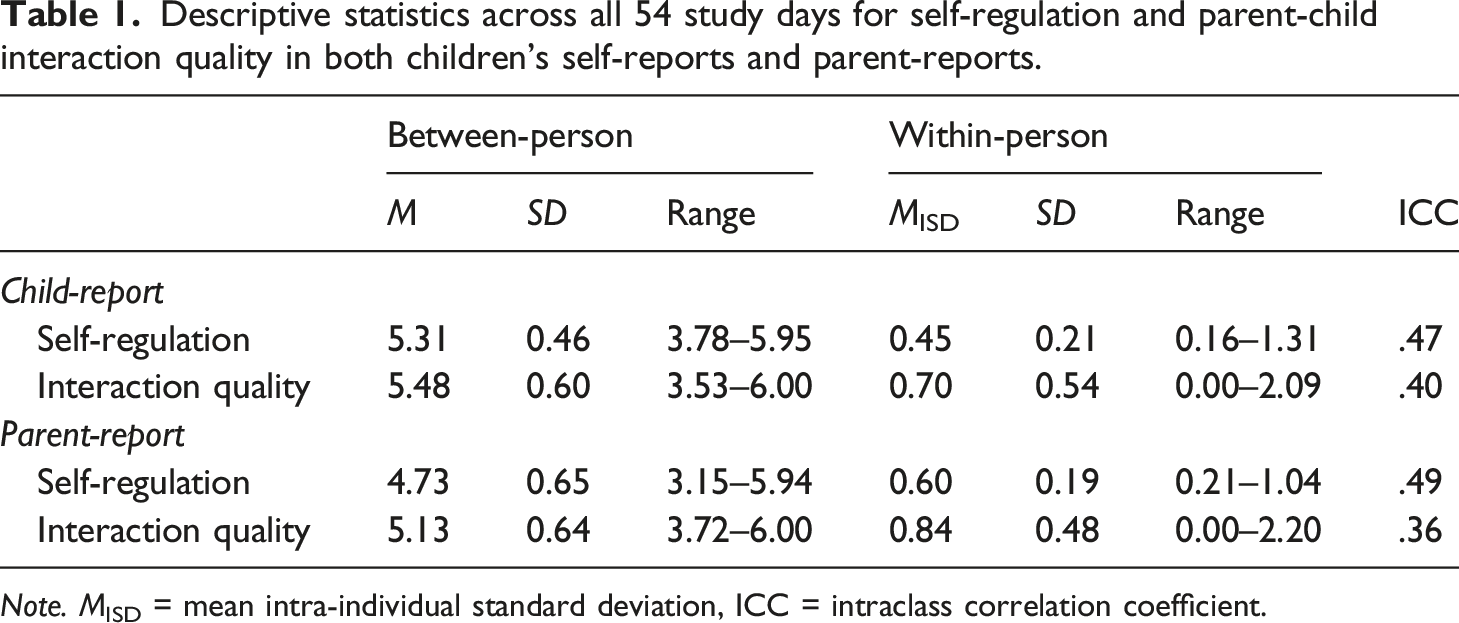
Note. MISD = mean intra-individual standard deviation, ICC = intraclass correlation coefficient.
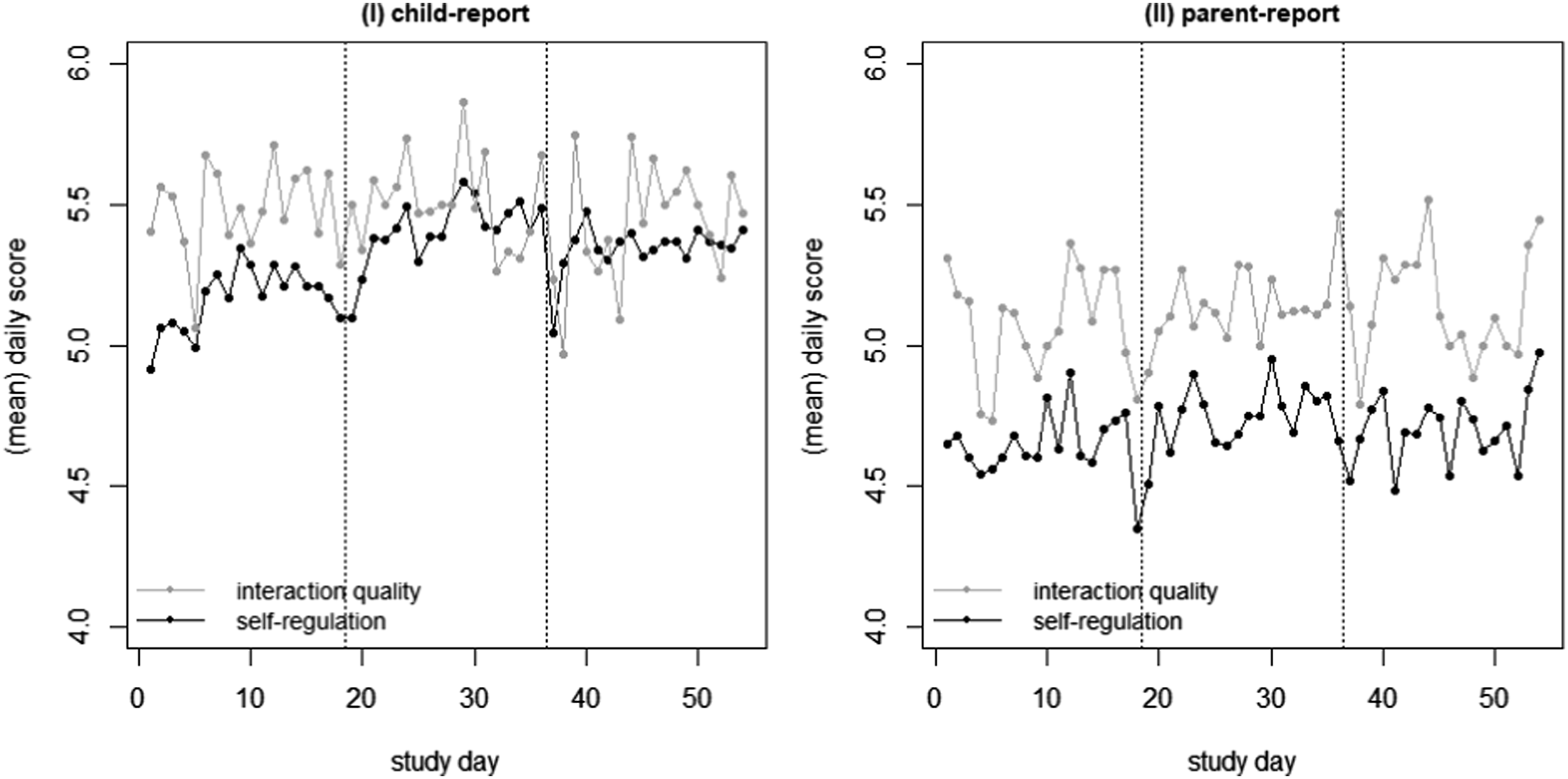
Time course of child-reported (left) and parent-reported (right) self-regulation and parent-child interaction quality across all 54 study days. The dashed lines indicate breaks between each burst.
Hypotheses testing
Mixed linear model to test the within- and between-person association between self-regulation and parent-child interaction quality for child-reported data.
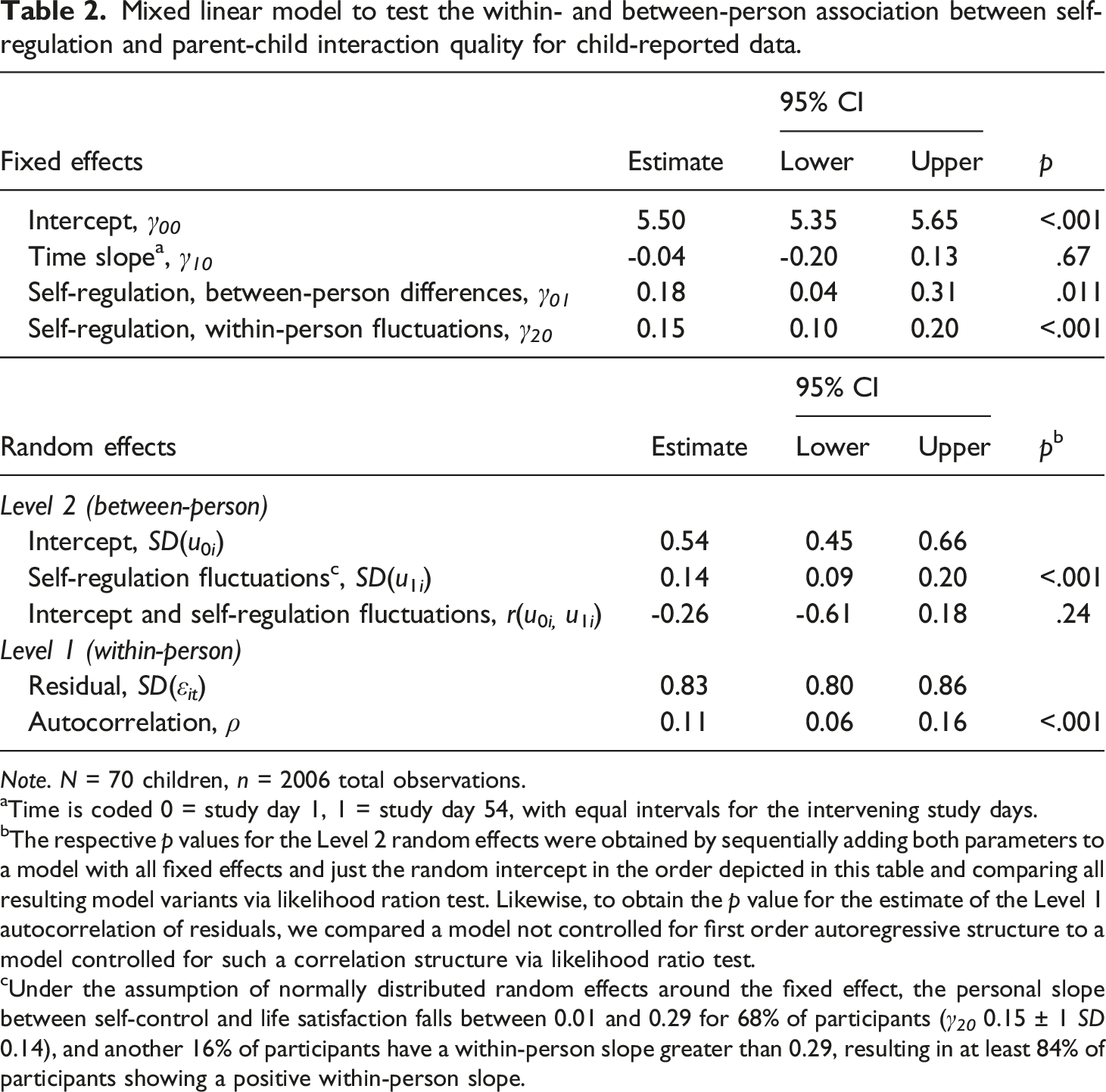
Note. N = 70 children, n = 2006 total observations.
aTime is coded 0 = study day 1, 1 = study day 54, with equal intervals for the intervening study days.
bThe respective p values for the Level 2 random effects were obtained by sequentially adding both parameters to a model with all fixed effects and just the random intercept in the order depicted in this table and comparing all resulting model variants via likelihood ration test. Likewise, to obtain the p value for the estimate of the Level 1 autocorrelation of residuals, we compared a model not controlled for first order autoregressive structure to a model controlled for such a correlation structure via likelihood ratio test.
cUnder the assumption of normally distributed random effects around the fixed effect, the personal slope between self-control and life satisfaction falls between 0.01 and 0.29 for 68% of participants (γ 20 0.15 ± 1 SD 0.14), and another 16% of participants have a within-person slope greater than 0.29, resulting in at least 84% of participants showing a positive within-person slope.
Mixed linear model to test the within- and between-person association between self-regulation and parent-child interaction quality for parent-reported data.
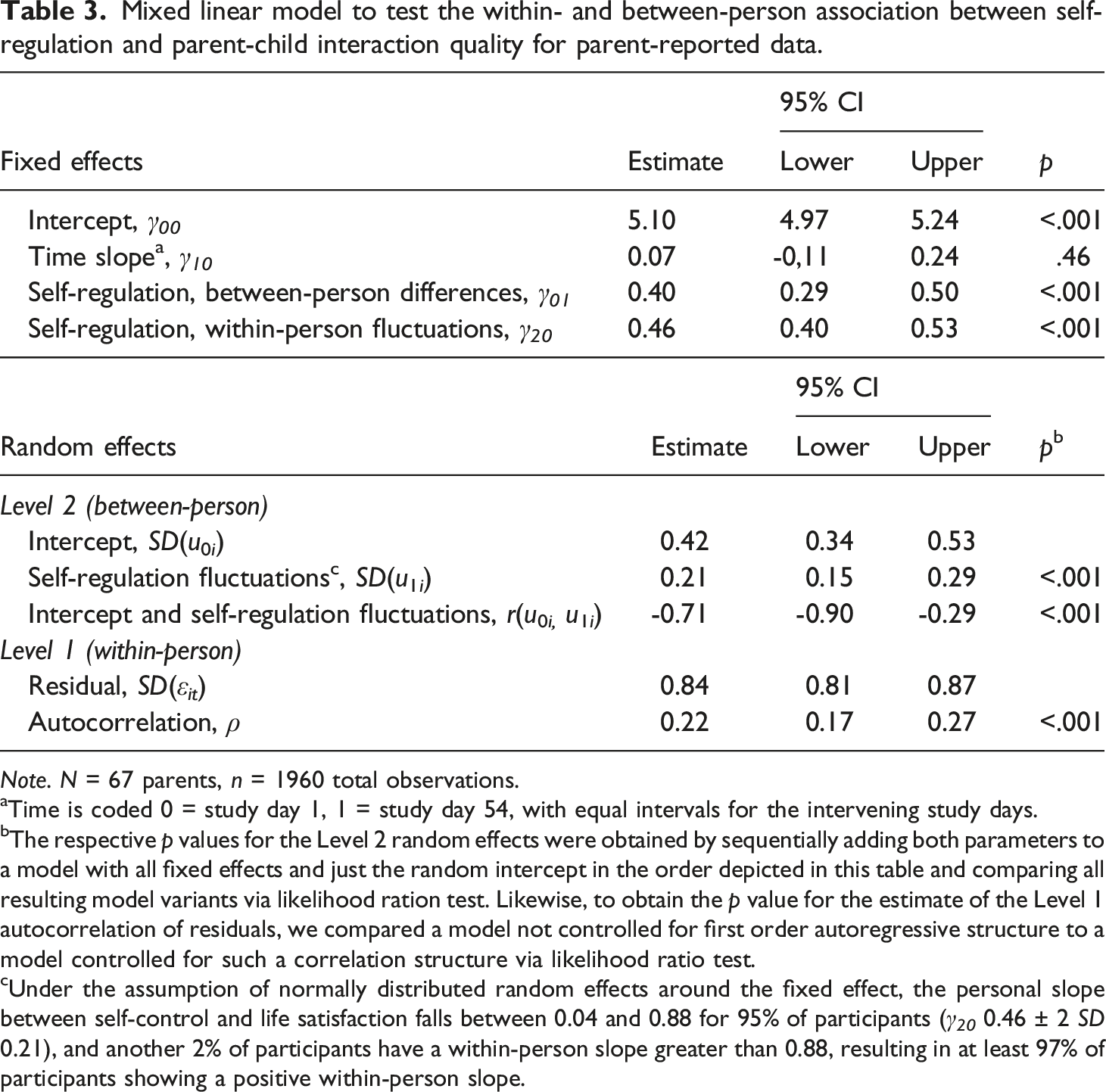
Note. N = 67 parents, n = 1960 total observations.
aTime is coded 0 = study day 1, 1 = study day 54, with equal intervals for the intervening study days.
bThe respective p values for the Level 2 random effects were obtained by sequentially adding both parameters to a model with all fixed effects and just the random intercept in the order depicted in this table and comparing all resulting model variants via likelihood ration test. Likewise, to obtain the p value for the estimate of the Level 1 autocorrelation of residuals, we compared a model not controlled for first order autoregressive structure to a model controlled for such a correlation structure via likelihood ratio test.
cUnder the assumption of normally distributed random effects around the fixed effect, the personal slope between self-control and life satisfaction falls between 0.04 and 0.88 for 95% of participants (γ 20 0.46 ± 2 SD 0.21), and another 2% of participants have a within-person slope greater than 0.88, resulting in at least 97% of participants showing a positive within-person slope.
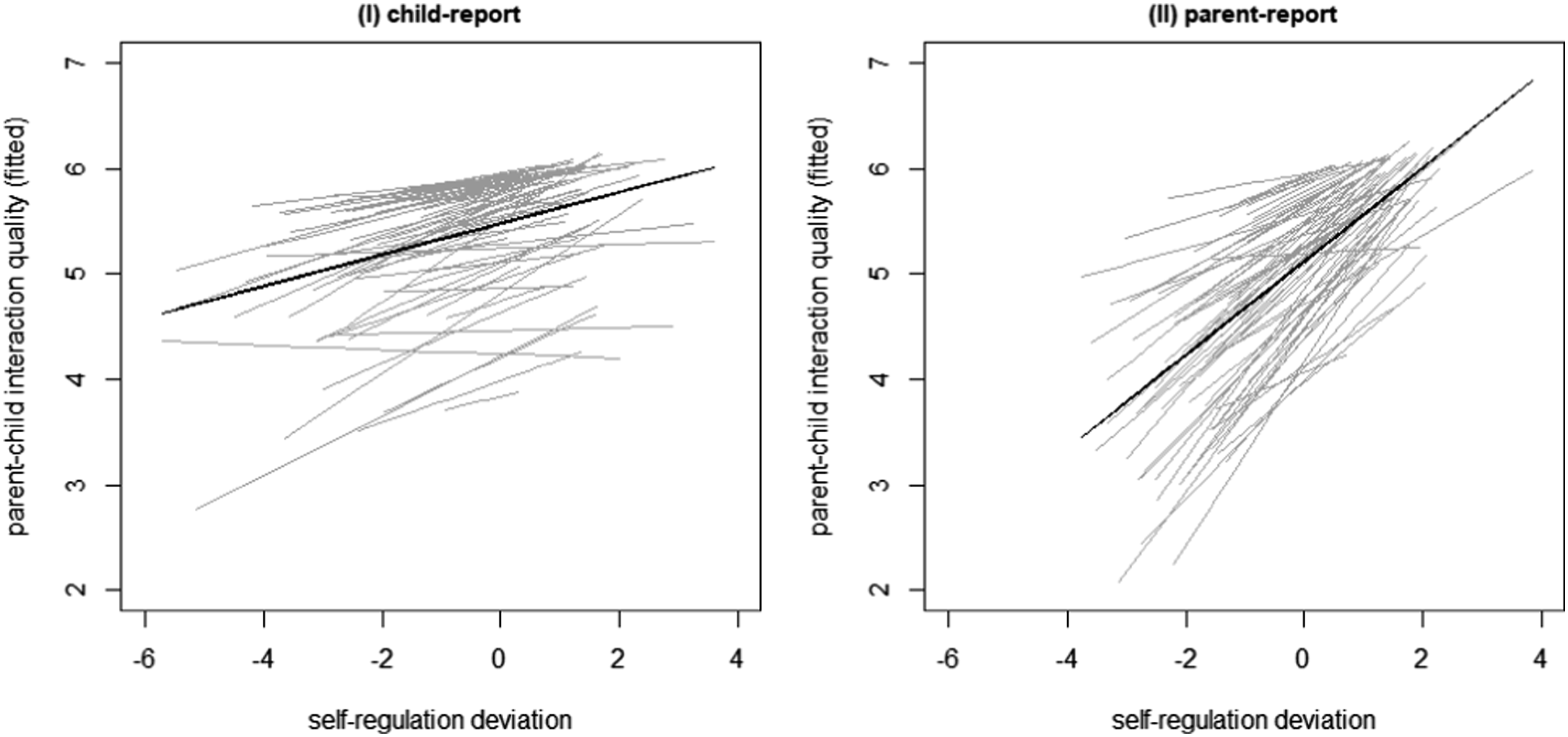
Spaghetti plot of average (black lines) and subject-specific (grey lines) regression lines for child- (left) and parent-reported (right) parent-child interaction quality as a function of a children’s daily deviations from their average self-regulation. The daily deviations from their average self-regulation are represented in units of the between-person standard deviation in self-regulation.
Discussion
As the first of its kind, this study aimed to investigate school children’s self-regulation in association with parent-child interaction quality in everyday life, considering daily self-regulation fluctuations in children (e.g., Blume et al., 2022; Ludwig et al., 2016). The use of ambulatory assessment across several days within 13 months allowed us to reliably capture between-person differences, as well as day-to-day within-person variations in children’s self-regulation within shorter time frames (i.e., on a day-to-day basis) and across a longer developmental period (i.e., within one school year). In accordance with our hypotheses, we found significant associations between children’s self-regulation and interaction quality on a between-person level. That is, children characterized by higher self-regulation compared to the sample’s average had better interactions with their parents. This is in line with previous research, theorizing that self-regulation is a key element in social functioning, with low self-regulation impairing interactions between parents and children (e.g., Eisenberg et al., 2014; Tangney et al., 2004). The association we found was evident across informants: Both children characterizing themselves as having higher self-regulation, and parents characterizing their children as having higher self-regulation, reported to get along better with each other. This is somewhat surprising, considering that children’s self-rated self-regulation and parent-rated self-regulation across all study days were only correlated moderately, and highlights the need for dyadic assessments of children’s self-regulation in the context of family environment.
On a daily within-person level, our results indicate that short-term fluctuations in self-regulation were positively related to parent-child interaction quality. On days on which children reported better self-regulation than usual, they reported to get along better with their parents. This relationship was also reflected in parental reports. Our finding is in line with initial evidence from romantic relationships showing that self-regulation dynamically relates to relationship quality in everyday life (Buck & Neff, 2012). They also complement previous findings showing that children’s self-regulation during daily activities (i.e., toothbrushing) varied from day-to-day in accordance to changes in parental instructions (Leonard et al., 2021).
Comparing the effect sizes in our study, it appears that the link between children’s self-regulation and parent-child interaction quality is stronger in parents’ view than in children’s view. While we want to point out that these effects should be compared cautiously as they have not been estimated within the same statistical model, we believe there might be two main explanations for this difference. First, children—especially those with higher self-regulation deficits on a trait level—might hold positively biased perceptions of themselves and thus rate their self-regulation, as well as their interactions, as overly positive compared to their parents (Volz-Sidiropoulou et al., 2016). Indeed, on the aggregated level, reports of self-regulation and parent-child interaction quality were higher in children’s self-reports than parental reports. Consequently, the estimated effect sizes in the child model might be diminished due to a ceiling effect. Second, children might be less receptive of the consequences of their actions on their social interactions. Thus, although they might have experienced fluctuations in their self-regulation, they might have been less observant of the concurrent changes in their social surroundings.
Furthermore, for some parent-child dyads, children’s self-regulation was more strongly interlinked with interaction quality than in others. Several moderators might explain this variability. First, children’s self-regulation capacity varies between different domains, for example school and interpersonal relationships (Tsukayama et al., 2013). Some children are particularly impulsive when it comes to schoolwork, while others show self-regulation deficits in social interactions. Thus, for some children in our study, fluctuations in self-regulation might have mainly affected the academic domain (i.e., lower academic success on days of low self-regulation; Blume et al., 2022), while for other children, such fluctuations might have predominantly affected interpersonal behavior (i.e., talking back to the parent on days with lower self-regulation). Second, deficits in children’s self-regulation challenge parents to put additional effort into helping their children achieve their goals (i.e., helping out with their homework), which might be particularly difficult for parents with low executive control (Deater-Deckard et al., 2010). Third, early attachment, is a common predictor for both self-regulation and relationship quality. For example, high trait self-regulation is related positively to secure attachment, and negatively to avoidant and anxious attachment (Tangney et al., 2004). Subsequently, the co-variability in children’s self-regulation and parent-child relationship quality is possibly more pronounced in insecurely attached children (and parents). In sum, the self-regulation-interaction link may differ between dyads for many reasons, including the domains affected by children’s self-regulation (non-social vs. social), differences in parental regulatory capacities, and parent and child attachment styles. Therefore, the current study provides evidence that no “general law” (Hamaker, 2012, p. 43) can be deduced declaring that children’s self-regulation and interaction quality are associated similarly within each parent-child dyad, supporting a more idiographic approach to researching individual experiences and relationships (Molenaar & Campbell, 2009).
Limitations
The current study has several limitations regarding the study procedures. First, for planning this study there were no meaningful starting values available to determine sample sizes regarding participants and repeated assessments to reach adequate statistical power for the within-person effects (Bolger et al., 2012). The current study is a starting point for conducting these power analyses for future studies. Second, we worked with a restricted number of items to assess children’s self-regulation. Even though these items were adapted from existing scales, more sophisticated and standardized items for self-regulation would have been preferable. Thus, the available data cannot capture different components of self-regulation (i.e., cognitive control, or emotion regulation; Inzlicht et al., 2021), as well as different self-regulation domains (Tsukayama et al., 2013), which limits the generalizability of our results. Third, children and parents answered somewhat different self-regulation scales. We chose the items for informants based on a preceding proof-of-concept trial, selecting only those items that showed considerable intraindividual fluctuations for the final study protocol. This limits the comparability of children and parent ratings. Fourth, we assessed parent-child interaction quality using a single item. Although we found significant associations of self-regulation with this global rating, specific aspects of how children and parents get along with each other (such as closeness or conflict) might relate distinctly to children’s self-regulation. Fifth, the item used to assess child-reported parent-child interaction quality referred to more than one parent. Thus, the item does not assess the specific relationship with the parent who filled in the parent questionnaire. We might assume that the parent participating in the study also spent more time with their child in everyday life. Thus, child-reports regarding the parent-child interactions quality would mostly reflect interaction quality with this parent. However, we have no means to check this assumption. Sixth, our study mainly focused on the variability in children’s experiences, which we assessed using children’s self-reports and parental reports. By limiting our focus to children, we missed to collect important parental predictors and outcomes (i.e., parental stress, parenting style, attachment style, self-regulation) that should be included in future studies.
Overall, the procedures we adopted in this study were mainly motivated by the aim to keep participant burden manageable. Having to participate in a study which requires to repeatedly fill out a lengthy questionnaire impedes study uptake, increases drop-out rates, and interferes considerably with participant’s everyday life. This issue might have been avoided by using passive assessments. For example, low self-regulation in everyday life (e.g., lack of motoric control) was successfully studied using accelerometers (Gawrilow, Kühnhausen, et al., 2014), while audio recordings of everyday interactions can be used to study daily social behaviors (Mehl, 2017). However, the latter is currently vastly limited by data protection laws. Therefore, the research community should seek to establish procedures to capture such sensitive data in line with legal requirements.
Finally, we would like to discuss how our results are also limited to their specific research location, which was the south of Germany. Throughout our manuscript, we argue that ‘getting along’ with each other influences, but also requires a child’s self-regulation. In general, this is achieved by accommodating one’s thoughts, feelings, and behavior to certain cultural values, rules, and norms, which differ across cultures. While children’s self-regulation is interculturally predictive of academic success (Wanless et al., 2011), self-regulation deficits might be experienced as more disruptive of interpersonal norms in certain cultural settings (Trommsdorff, 2009; Wei et al., 2013). We therefore highly recommend conducting cross-cultural studies to test such cultural hypotheses, to reproduce our results and evaluate their generalizability.
Implications and future research
The present study informs future research to further develop, apply and evaluate appropriate measures and designs to study children’s behavioral and family functioning in everyday life. For example, everyday life interaction between parents and children could be better understood by including a broader approach to assess children’s self-regulation while also considering predictors and outcomes on the parental side. This has the potential to unveil the mechanisms underlying our results. As discussed above, one possibility is that children’s low self-regulation on a particular day burdens parent-child relationships because it demands more parenting effort to support the child’s goal pursuit. This, in turn, might enhance parental stress under circumstances where supporting the child in daily life activities (i.e., doing their homework) is harder to coordinate with the parent’s goals for themselves (i.e., working longer hours), or the child (i.e., becoming independent). Enhanced parental stress might then account for adverse parenting behaviors, increasing the likelihood of parent-child conflicts and reducing relationship satisfaction. Thus, we suggest that future studies should prioritize investigating such transactive goal dynamics (Fitzsimons et al., 2015) as well as variables that predict whether and how children’s self-regulation problems translate into parental stress, parent-child conflict, and relational disruptions (i.e., How much support did parents have to give to the child throughout the day? What did this ‘cost’ them?). Moreover, as parental self-regulation presumably transmits to children’s self-regulation through parenting behavior (Bridgett et al., 2015), it is essential to consider parental self-regulation to understand how parent-child interactions in everyday life shape and are shaped by children’s self-regulation. Such interdependencies in children’s and parental self-regulation should also be addressed in future studies, using a fully dyadic design and data analysis (e.g., actor-partner interdependence model; Kenny & Ledermann, 2010).
In general, zooming into daily life and studying family dynamics in such a way has the potential to uncover what parent-child transactions lead to the developmental stability of children’s self-regulation problems and dysfunctional interaction patterns across child development (Feldman, 2015), and derive tailored interventions to break up such dynamics. For example, one previous study found that on days of more parental praise, and less parental instruction, children brushed their teeth longer, which can be considered an important indicator for personalized interventions to enhance children’s self-regulation in everyday life (Leonard et al., 2021). Additionally, intervention outcomes could be promoted by identifying which individual or family parameters contribute to a more pronounced reactivity between children’s regulatory deficits and relational outcomes. For example, previous studies suggest that emotional reactivity to their child’s behavioral problems is higher in mothers with lower executive control (Deater-Deckard et al., 2010). Future studies should also address which dispositional factors on the children’s side (i.e., academic vs. interpersonal self-regulation; early attachment style) moderate the extent of the within-person link between self-regulation and parent-child interaction quality. For example, future studies should address the interplay between momentary fluctuations in self-regulation and dispositional self-regulation deficits, such as attention-deficit hyperactivity disorder (ADHD). Our sample included eight children with ADHD, which is why we considered children’s ADHD diagnosis as a covariate in our models. Yet, we encourage future studies to systematically test whether and how our results generalize to, or are influenced by ADHD patients. Considering that there are differences in the prevalence and symptom variations of ADHD between boys and girls, we would also suggest testing gender differences in future studies.
Finally, our results further question theories and assessment methods treating self-regulation as only a stable personality trait (i.e., Whiteside & Lynam, 2001). Seeing that children experience day-to-day variations in self-regulation calls for a more dynamic assessments of self-regulation. Furthermore, our results complement research highlighting the role of self-regulation for successful social interactions (e.g., Eisenberg et al., 2014), suggesting that children’s self-regulation and parent-child interaction quality fluctuate in parallel in families’ everyday lives. However, our results cannot primarily be used to infer judgments about causality. In general, the relationship between self-regulation and parent-child interaction quality is possibly bidirectional. That is, warm and supportive interactions with parents are key elements in the development of children’s self-regulation (Karreman et al., 2006; Morawska et al., 2019; Piotrowski et al., 2013), and higher self-regulation in children contributes to better social interactions (Williams & Berthelsen, 2017). Following the helpful suggestion of one of the reviewers of this article, we did perform additional analyses on our data, applying random-intercept cross-lagged panel models (Hamaker et al., 2015) to get insight in the direction of effects. The analyses yielded no clear cross-lagged relationships between children’s self-regulation and parent-child interaction quality across bursts and across informants (children, parents). As we did not consider these analyses in our pre-registered analysis plan, we report these results as supplementary online material. However, we would like to point out that even though such models are used to infer casual relationships, their use for this purpose is widely discussed (e.g., Lüdtke & Robitzsch, 2021). After all, the gold standard to reach robust conclusions regarding causal relationships between two variables are experiments and randomized controlled trails. Thus, to gain further insight into the underlying causal mechanisms, future studies should adapt the current study by adding experimental manipulations of children’s self-regulation or interaction quality at certain points within the assessment period.
Conclusion
In sum, our study extends previous research findings on the role of self-regulation for social functioning. While individuals exhibiting high self-regulation are able to establish better relationships in the long run, intraindividual fluctuations of self-regulation also seem to translate into relational outcomes on a daily level. This study revealed that children and their parents are getting along better on days children’s self-regulation is particularly high. Thus, children’s self-regulation and parent-child interaction quality oscillate simultaneously in everyday lives. Although this might appear very much obvious for some researchers and practitioners, it does rarely manifest in research or clinical practice, where children’s self-regulation is commonly evaluated based on one-time assessments, and in isolation of environmental factors. Likewise, parenting practice commonly lacks awareness of the dynamic interplay between children’s self-regulation and social processes, culminating in strained parent-child relationships, instead of mutual understanding and support. Overall, our findings help to describe children’s and parents’ everyday experiences, which is useful to elaborate our understanding on how children develop and maintain good social relationships.
Footnotes
Author Note
This research was part of the AttentionGO project conducted at the Department of Psychology, University of Tübingen, Germany, in cooperation with the Center for Research on Individual Development and Adaptive Education of Children at Risk (IDeA), Frankfurt am Main, Germany, and LEAD Graduate School & Research Network, University of Tübingen, Germany. The project was funded by the German Research Foundation (GA1277/9-1). In addition, Gertraud Stadler is funded by Berlin’s program for the promotion of gender equity (Berliner ChancengleichheitsProgramm – BCP). This research has been presented earlier during the 35th Annual Conference of the European Health Psychology Society (EHPS) in August 2021, as well as the Society of Ambulatory Assessment (SAA) Conference in June 2022.
Acknowledgements
We especially thank Jan Kühnhausen, Merle Reuter, and Ulrike Schwarz, for their contributions to the research project.
Declaration of conflicting interests
The author(s) declared no potential conflicts of interest with respect to the research, authorship, and/or publication of this article.
Funding
The author(s) disclosed receipt of the following financial support for the research, authorship, and/or publication of this article: This study is supported by Deutsche Forschungsgemeinschaft (GA1277/9-1).
Open research statement
As part of IARR's encouragement of open research practices, the authors have provided the following information: This research was pre-registered. The aspects of the research that were pre-registered were data analysis. The registration was submitted to OSF ( ). The data used in the research are available. The data can be obtained by emailing:
Notes
Appendix
List of items used to assess the children’s self-regulation skills and parent-child interactions quality by children themselves, and their parents. Note. All items had the same ‘response scale’: (1) not at all (trifft gar nicht zu) to (6) exactly (trifft ganz genau zu); the complete list of study items used in children and parent diaries is available as online supplemental material (translated into English by the first author of this study.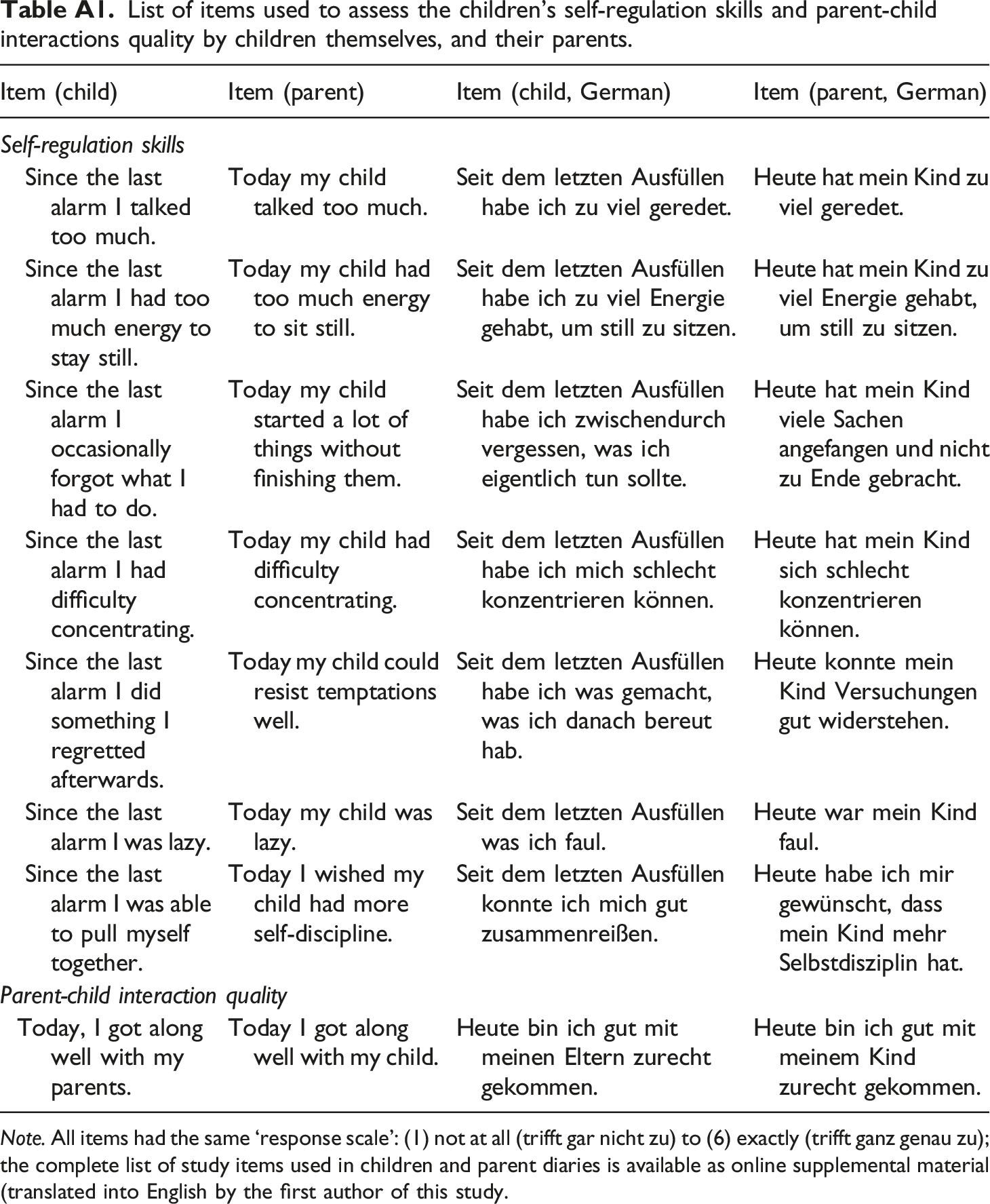
Item (child)
Item (parent)
Item (child, German)
Item (parent, German)
Self-regulation skills
Since the last alarm I talked too much.
Today my child talked too much.
Seit dem letzten Ausfüllen habe ich zu viel geredet.
Heute hat mein Kind zu viel geredet.
Since the last alarm I had too much energy to stay still.
Today my child had too much energy to sit still.
Seit dem letzten Ausfüllen habe ich zu viel Energie gehabt, um still zu sitzen.
Heute hat mein Kind zu viel Energie gehabt, um still zu sitzen.
Since the last alarm I occasionally forgot what I had to do.
Today my child started a lot of things without finishing them.
Seit dem letzten Ausfüllen habe ich zwischendurch vergessen, was ich eigentlich tun sollte.
Heute hat mein Kind viele Sachen angefangen und nicht zu Ende gebracht.
Since the last alarm I had difficulty concentrating.
Today my child had difficulty concentrating.
Seit dem letzten Ausfüllen habe ich mich schlecht konzentrieren können.
Heute hat mein Kind sich schlecht konzentrieren können.
Since the last alarm I did something I regretted afterwards.
Today my child could resist temptations well.
Seit dem letzten Ausfüllen habe ich was gemacht, was ich danach bereut hab.
Heute konnte mein Kind Versuchungen gut widerstehen.
Since the last alarm I was lazy.
Today my child was lazy.
Seit dem letzten Ausfüllen was ich faul.
Heute war mein Kind faul.
Since the last alarm I was able to pull myself together.
Today I wished my child had more self-discipline.
Seit dem letzten Ausfüllen konnte ich mich gut zusammenreißen.
Heute habe ich mir gewünscht, dass mein Kind mehr Selbstdisziplin hat.
Parent-child interaction quality
Today, I got along well with my parents.
Today I got along well with my child.
Heute bin ich gut mit meinen Eltern zurecht gekommen.
Heute bin ich gut mit meinem Kind zurecht gekommen.