




Abstract
It is well established that parents’ own self-regulation is related to adaptive parenting practices (such as warmth and sensitivity) as well as to maladaptive ones (such as laxness and over-reactivity). However, parenting practices are not solely determined by parents’ self-regulation. We discuss how broad personality dimensions (drawn from the Big-Five model) relate to temperamental self-regulation (effortful control) and to parenting practices. Considering the limited empirical literature linking these three constructs, we present extant evidence for each of the dyadic connections between these three constructs. We then propose a comprehensive model that includes the plausible moderation/mediation role of different personality dimensions (such as conscientiousness and agreeableness) on the connection between self-regulation and parenting practices. This systematic review summarizes the extant empirical findings from 74 studies, linking effortful control, character and parenting practices. It is the first to systematically review and organize the accumulating knowledge regarding their relations. Based on the reviewed literature, a conceptual framework is proposed for predicting parenting practices, which are, in turn, a crucial concept predicting children’s behavioral and cognitive outcomes. In doing so, it provides a theoretical basis for the importance of parental character traits, specifically conscientiousness and agreeableness, as mediators between the parent’s effortful control and their actual parenting practices.
Introduction
Parenting is one of the main and most important tasks in adult life; as Tolstoy wrote in War and Peace: “Everything depends on upbringing”. While keeping in mind that the influence between parents and children is much more interactive and transactional than what is expressed in this quote (Belsky, 1984; Bridgett et al., 2015; Sameroff, 2010), vast theoretical and empirical literature supports the significance of parenting on the development of the child. The transition to parenthood involves neurophysiological, hormonal, and psychological changes that facilitate caretaking and are reflected in parenting practices (Rutherford et al., 2015). These changes make parenthood a distinct life period that requires a separate and thorough investigation. As reviewed (Power, 2013), the literature addresses parenting practices as a particular practice (such as warmth, hostility, laxness, etc.) or as parental style (such as authoritarian, authoritative or permissive). However, all of these variables do converge into two main categories: adaptive and maladaptive parenting practices, depending on their implication on the child. Hence, the current review will separate between adaptive and maladaptive practices.
Important variables that seem to affect the implementation of parenting practices are the parents’ own self-regulation and their personality traits; however, the literature in this regard is quite dispersed. In their review, Bridgett et al. (2015) offered an extensive model for the transgenerational transmission of self-regulation, but they did not fully address the possibility of moderation/mediation effects in the relation between a parent’s self-regulation and their parenting practices. Hence, the aim of this paper is to elaborate on and discuss the empirical and theoretical relations among self-regulation, personality, and parenting practices, integrating all these concepts into a comprehensive framework.
Defining Self-Regulation
Self-regulation refers to the flexible regulation of cognition, action, and emotion (Berger, 2011; Nigg, 2017; Posner & Rothbart, 2000), including conscious or unconscious efforts to control one’s inner state (Vohs & Baumeister, 2016). Self-regulation develops and consolidates mainly during childhood as neurocognitive and neuro-emotional systems develop and interact with the environment, resulting in a positive or negative developmental cascade (Nigg, 2017; Posner & Rothbart, 2000; Sapienza & Masten, 2011). Temperamental self-regulation, generally referred as effortful control (EC), is mainly composed of inhibitory control and attention shifting (Eisenberg, 2017; Rothbart & Bates, 2006; Rothbart et al., 2003). The implementation of self-regulation also involves more high-level top-down processes – such as long-term planning (Eisenberg, 2017), reasoning, and coping strategies – in the face of future or internally represented conflict (Nigg, 2017). Self-regulation maintains an inherent bidirectional connection with bottom-up processes, mainly appetitive approach (sensitivity to positive affect, excitement, and hope), avoidance level (fear, negative affect, anxiety), reflexes, learning (conditioning), and activity level. These processes both impose challenges on self-regulation and/or are moderated by it (Nigg, 2017). As can be seen, self-regulation is a complex theoretical and empirical construct. Although the understanding more high-level self-regulation mechanisms and their relation to personality and parenting is important, there is an equal (if not greater) importance to understand these relations with more temperamental, low-level, constructs, as they are the basis of self-regulation development. Hence, the current review will focus on the temperamental cognitive aspect of it, as defined by one of the main conceptual models of self-regulation, suggested by Rothbart (2011), that is, EC. Both conceptually and empirically, the main scales comprising EC are inhibitory control (IC), which is an executive function generally defined as the ability to plan and actively inhibit or delay a dominant response under instructions or in uncertain situations (Miyake et al., 2000; Rothbart, 2011), and executive attention (Putnam & Stifter, 2008; Rothbart et al., 2011). It is generally defined as a supervising system responsible for inhibition of undesired responses required for conflict monitoring, target detection and for focal attention (Petersen & Posner, 2012).
The Relevance of Parents’ Self-Regulation for Parenting Practices
A parent’s ability to self-regulate is likely to be reflected in their parenting practices and is one of the most powerful mechanisms for intergenerational transmission of self-regulation (Baker & Brooks-Gunn, 2020; Bridgett et al., 2015). Parents’ ability to control thoughts, emotions, and behaviors is important for appropriate parenting practices (Rutherford et al., 2015; Sanders et al., 2019; Sanders & Mazzucchelli, 2013; Sanders & Morawska, 2018). Well-regulated parents are likely to experience more confidence in their ability to parent and are more likely to be supportive and sensitive to their child’s needs (Distefano et al., 2018; Sanders et al., 2019; Shaffer & Obradović, 2017). Parents who regulate their negative emotions have shown better parenting practices (Jones et al., 2014; Shaffer et al., 2018). Their parenting is more sensitive and involved (Crandall et al., 2015; Lorber, 2012), yet they clearly establish their expectations for their children and encourage them to self-regulate themselves (Shaffer et al., 2018).
In contrast, research has found that a low level of parental self-regulation is related to an indulgent and permissive parenting style (i.e., providing excessive material goods, overly protective behaviors, and holding few expectations for responsible behaviors; Baumrind, 1967; Crandall et al., 2016; Cui et al., 2016) as well as to difficulties in parents mentalizing their child’s emotional state and adjusting their behavioral response to their child’s affective needs (Jones et al., 2014; Schultheis et al., 2019), which might even result in increased risk of child maltreatment (Crandall et al., 2015). The relation between difficulties with parental emotional self-regulation and parenting practices has also been found for mothers who experience posttraumatic stress symptoms (Gurtovenko & Katz, 2020). Alongside these findings, poor parental EC has been indicative of frequent engagement in dysphoric, lax, over-reactive, and ineffective parenting (Bridgett et al., 2011, 2013; Davenport et al., 2011). More specifically, lower parental inhibitory control is a significant predictor of more parental intrusiveness, anger, hostile tone of voice, and criticism of the child (Bridgett et al., 2017) and to overall ineffective parenting (Meldrum et al., 2018).
Most of the literature reviewed here is quite homogeneous regarding the race and culture of the participants (mostly Caucasian samples from a Western culture); therefore, more research with more diverse samples is needed. Still, this literature supports the notion that better parental self-regulation (i.e., a better ability to regulate bottom-up processes and more developed top-down processes) is more likely to be manifested in more adaptive parenting practices (i.e., more sensitive and involved parenting) and less maladaptive ones (e.g., indulgent, lax, over-reactive, intrusive, and hostile behavior). Yet, parental practices are not solely determined by parental self-regulation, and it is important to be mindful of additional and important aspects of the human personality that can interact with self-regulatory components (or function as mediating dimensions) affecting parental practices. For example, acceptance of others, which has been defined as cooperativeness by Cloninger and Svrakic (1997), seems to be highly relevant for parenting practices; however, and quite surprisingly, no research has been conducted exploring the relation among the three variables of cooperativeness, self-regulation, and parenting. The only personality dimension that has been mentioned in the extant literature in relation to self-regulation and parenting practices is Conscientiousness (as described in the Big-Five model of personality; Soto & John, 2017). Research suggests that there is a mediating role of Conscientiousness in the effect of self-regulation on parenting practices (Bridgett et al., 2015; Eisenberg et al., 2014). However, this relation has not been tested empirically.
Method
Research Protocol and Scope of Review
In line with the guidelines offered by Wright et al. (2007), the systematic review was directed to answer how parent’s personality characteristics moderate/mediate the relation between temperamental self-regulation and parental practices. Hence, the current paper offers a systematic review regarding the literature relating personality, self-regulation, and parenting practices. In our review, we zoom in on a broad model of personality and refer to the relevant literature detailing the relations between self-regulation, parenting practices and the Big Five model (Soto & John, 2017), which is highly discussed in the literature.
Inclusion Criteria
The inclusion criteria for the current systematic review included: (1) quantitative studies or mixed design; (2) peer-reviewed empirical manuscripts with observational or self-reported studies, in cross-sectional or longitudinal designs; (3) study participants had to be parents, either fathers or mothers, except when reviewing the relation between personality and effortful control; (4) studies that researched cognitive self-regulation (i.e., effortful control); and (5) studies that were written in English.
Exclusion Criteria
The exclusion criteria included: (1) qualitative studies; (2) electrophysiological studies; (3) non-parents samples, except for the relation between personality and self-regulation; (4) studies that researched emotion regulation and similar constructs; and (5) studies that were not written in English.
Terms and Search Engines
The extraction of studies was done up to February 2022 via four main search engines: Google Scholar, PsychNet, Sage Journals, and Science Direct. Search terms used were: • Effortful control: effortful-control, effortful control (without hyphen), inhibitory-control, inhibitory control (without hyphen), inhibition, executive functions, self-control, and self-regulation. In each study, similar (not necessarily the same) theoretical definitions for effortful control (EC) were ensured. EC is defined as the ability to inhibit a dominant response (inhibitory control) in order to perform a subdominant response (activation control), to detect errors, and to engage in planning. Another theoretical definition that was used was for inhibitory control (IC), which is an executive function generally defined as the ability to plan and actively inhibit or delay a dominant response under instructions or in uncertain situations. • Personality characteristics: Big-Five, Big Five (without hyphen), Extraversion, Neuroticism, Agreeableness, Conscientiousness, and Openness to experience. Initially, the words “personality” and “personality traits” were also used, however that search was too wide and gave mostly irrelevant results. • Parenting practices: parenting, parental support, parental acceptance, warmth, authoritative parenting, parental control, hostility, lax parenting, over-reactive parenting, dysphoric parenting, neglect, restrictive parenting, ineffective parenting, intrusive parenting, criticism, authoritarian parenting, and permissive parenting.
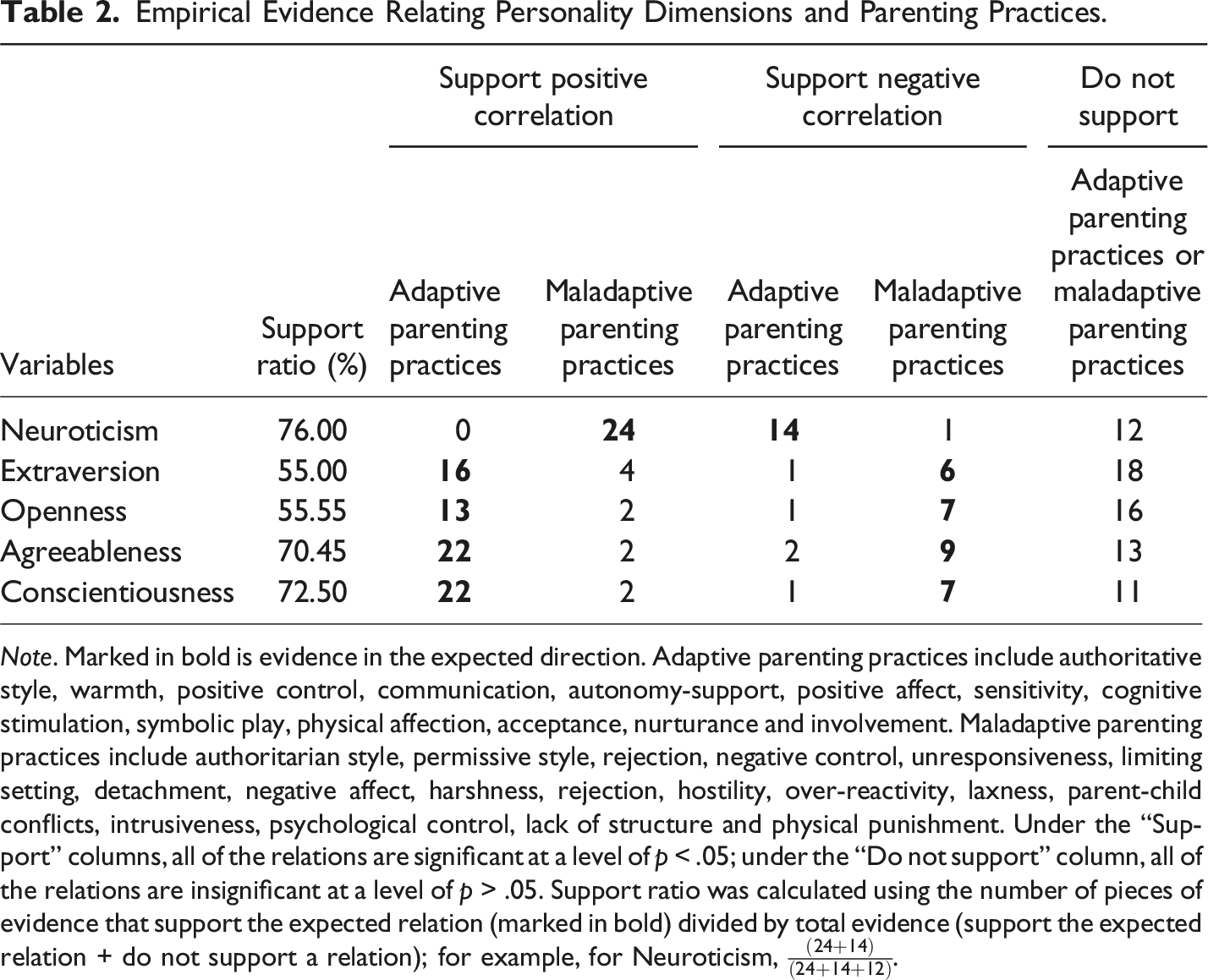
Given that no empirical studies were found linking all three constructs together in the suggested empirical model, we separately present the studies on (1) self-regulation and parenting practices, (2) personality dimensions and self-regulation, and (3) personality and parenting practices. Given the systematic methodology that was set, 74 studies were reviewed (Figure 1 presents the diagram of the selection procedure); 13 about self-regulation and parenting practices, 17 about self-regulation and personality dimensions, and 44 about personality dimensions and parenting practices. Table 1 and Table 2 provide the summaries of all studies and findings reviewed. In a few cases, the relevant correlations reviewed here were not the main aim of the studies in which they were found, and the finding may have only appeared in the tables and figures of those publications. Based on the collected literature, we present a comprehensive hypothetical model combining all three variables, pointing out the gaps in the literature and the potential leads for future investigations. PRISMA flow diagram of the selection procedure. Summary of the Reviewed Studies. Empirical Evidence Relating Personality Dimensions and Parenting Practices. Note. Marked in bold is evidence in the expected direction. Adaptive parenting practices include authoritative style, warmth, positive control, communication, autonomy-support, positive affect, sensitivity, cognitive stimulation, symbolic play, physical affection, acceptance, nurturance and involvement. Maladaptive parenting practices include authoritarian style, permissive style, rejection, negative control, unresponsiveness, limiting setting, detachment, negative affect, harshness, rejection, hostility, over-reactivity, laxness, parent-child conflicts, intrusiveness, psychological control, lack of structure and physical punishment. Under the “Support” columns, all of the relations are significant at a level of p < .05; under the “Do not support” column, all of the relations are insignificant at a level of p > .05. Support ratio was calculated using the number of pieces of evidence that support the expected relation (marked in bold) divided by total evidence (support the expected relation + do not support a relation); for example, for Neuroticism, 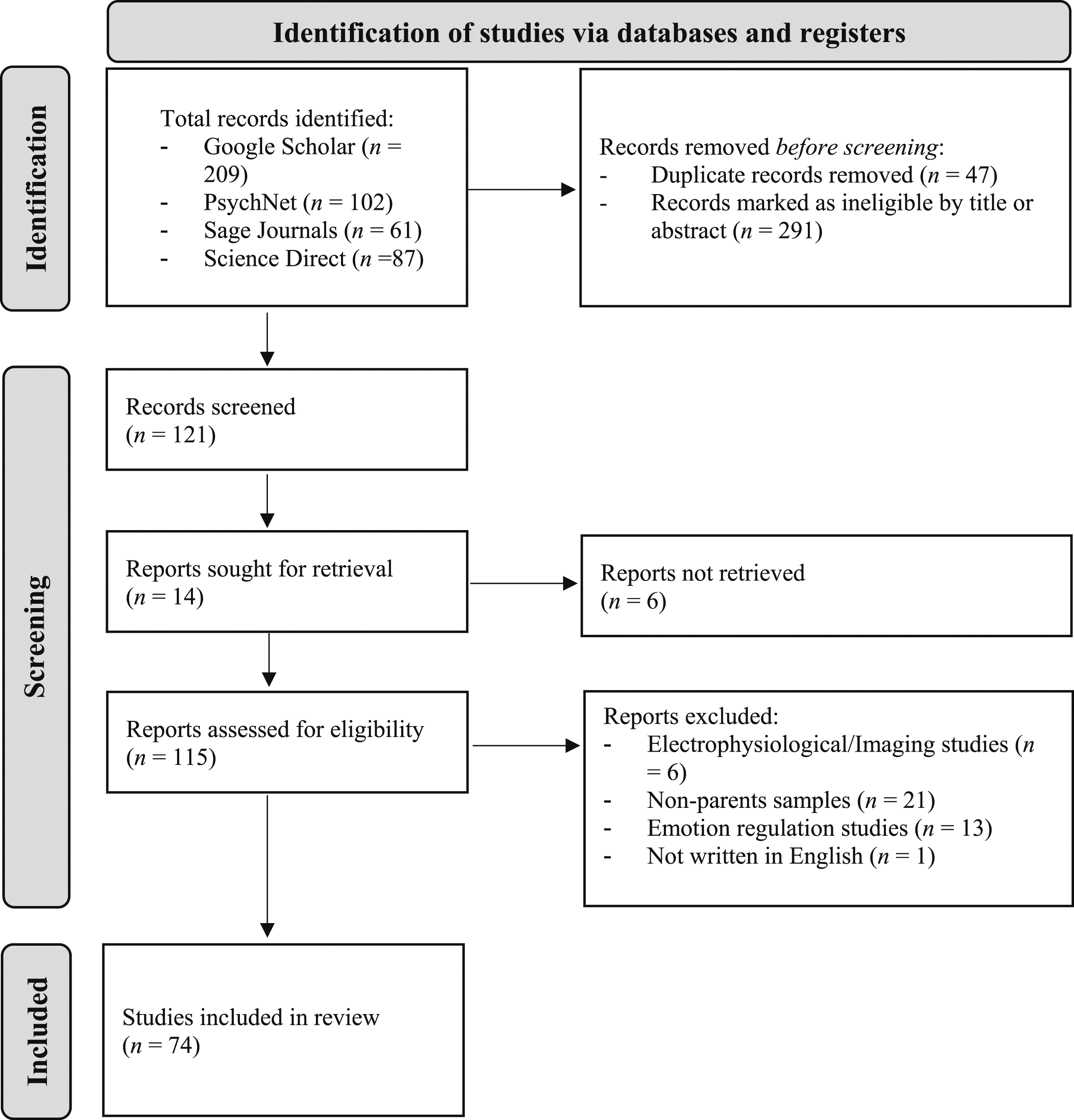

Transparency and Openness
All the procedures used for conducting this systematic review are revealed and explained in the manuscript. No code was used and the study design and analysis were not pre-registered.
Literature Review
Personality Dimensions and Their Relevance to Self-Regulation
Personality refers to the internally based psychological characteristics that often correspond to adjectives such as shy, mean, outgoing, dominant, and so forth (Allen, 2015) and the relatively enduring patterns of thoughts, feelings, and behaviors (Roberts, 2009). One of the main personality models in the literature is the Big-Five model. The Big-Five model (Goldberg, 1992; Soto & John, 2017) conceptualizes personality into five dimensions: Openness to experience, Extraversion, Neuroticism, Agreeableness, and Conscientiousness (see Appendix 1 for theoretical definitions). Only one study relating the Big-Five to EC and IC with a parents’ sample was found (Gartstein et al., 2013). This illustrates the need for more studies that investigate these relations among parents. Hence, the following review is focused on non-parent adult samples.
Conceptually, when the Big-Five model was created (see historical reviews by Goldberg, 1992, 1993) and validated (Soto & John, 2017), it was not divided into temperamental dimensions (which emerge early in life) and character dimensions (which are consolidated later in life when self-concepts are reorganized; Cloninger et al., 1993). This kind of differentiation better characterizes the hierarchical structure of personality, as basic temperamental dimensions that emerge early (as in infancy) are the core constructs for later layers of personality dimensions, such as character traits. In relation to the Big-Five, Openness to experience, Extraversion and Neuroticism can be seen as temperamental dimensions, as the individual differences between them can be seen at infancy (Ahadi & Rothbart, 2014). However, Agreeableness and Conscientiousness are more mature dimensions that emerge later in life. This notion was validated as there is to some extant an overlap between them and the character dimensions from Cloninger et al.'s (1993) model (Capanna et al., 2012).
Two dimensions that the literature is divided and indecisive on regarding their relations to EC and IC are Openness to experience and Extraversion. Openness has a strong positive empirical correlation with orienting sensitivity (Evans & Rothbart, 2007, 2009) and adults who are more extraverted tend to have a higher appetitive approach (positive affect, excitement, hope) and to be less avoidant (feelings of negative affect, fear, anger, frustration, and sadness; Evans & Rothbart, 2007, 2009). These findings correspond with the notion that these dimensions are part of bottom-up processes and function as reactive dimensions of personality.
Higher Extraversion and Openness are associated with better EC in general (Alessandri et al., 2014; Tortella-Feliu et al., 2013; Wiltink et al., 2006). Extraversion, specifically, was found to be related with a better ability to inhibit inappropriate responses in difficult tasks but with less ability to switch between different task goals (i.e., set shifting; Campbell et al., 2011). On the other hand, there is some evidence showing that there is no empirical relation between Extraversion or Openness and EC or IC (Gartstein et al., 2013; Johann & Karbach, 2022; Laverdière et al., 2010; Padilla & Andres, 2021; Rothbart et al., 2000; Tangney et al., 2004) or even a reversed correlation between them (Landman-Peeters, 2007). These contradictory findings regarding the relation between Extraversion, Openness and EC suggest that there is a need for further investigation to clarify the role of Extraversion and Openness and effortful control, especially in the context of parenting.
Regarding Neuroticism, which is another bottom-up process that is related to a lower appetitive approach and more avoidance (Evans & Rothbart, 2007, 2009), most of the literature reviewed here supports a negative correlation between EC/IC and Neuroticism (Alessandri et al., 2014; Bridgett et al., 2013; Evans & Rothbart, 2007, 2009; Landman-Peeters, 2007; Laverdière et al., 2010; Rothbart et al., 2000; Tangney et al., 2004; Tortella-Feliu et al., 2013; Wiltink et al., 2006).
The last two dimensions, Conscientiousness and Agreeableness, capture more mature characteristics of personality (see Appendix 1). Regarding Conscientiousness, the literature addresses it as the mature overlay of effortful control (Bridgett et al., 2015; Jackson & Hill, 2019). Meaning, effortful control is a core construct of Conscientiousness that is highly important for the crystallization of full and mature Conscientiousness; however, they are separate constructs (Costantini et al., 2015; Roberts et al., 2005). More support for this notion was provided by showing that higher EC and IC have a strong and positive correlation with Conscientiousness and a medium correlation to Agreeableness (Alessandri et al., 2014; Bell et al., 2020; Jensen-Campbell et al., 2002; Laverdière et al., 2010; Rothbart et al., 2000; Tangney et al., 2004; Tortella-Feliu et al., 2013; Wiltink et al., 2006). Despite the findings described above, these connections have not been fully studied beyond self-reports, and they have not been studied in the context of parenting; therefore, more research is still needed.
Interim Conclusions
High levels of parental Agreeableness and Conscientiousness and lower levels of Neuroticism seem to be related to better parents' self-regulation. More research is needed to better understand the relations between Extraversion, Openness and effortful control. More research is needed in more diverse samples and especially in the parental context. Moreover, it is important to note that no previous study has addressed the theoretical and empirical overlaps between some of the personality dimensions and self-regulation. For example, one of the items that measures Conscientiousness, according to the BFI (Big Five Inventory), is “Perseveres until the task is finished”, which clearly overlaps with the theoretical and empirical measures of EC (e.g., the reverse item from the ATQ [Adult Temperament Questionnaire]: “I often make plans that I do not follow through with”). Theoretically, Conscientiousness is supposed to be a more developed and mature construct that relies on the person’s EC; however, this idea requires further investigation. Another gap in the relevant extant literature reviewed above is that it mainly relies on self-reports. Self-report biases (Chan, 2010; Paulhus & Vazire, 2007) could hinder the validity of the findings; thus, future studies should include other measures (like a partner report) to validate these findings.
The Big-Five Model and Parenting Practices
All five factors outlined by the Big-Five model have been empirically correlated with parenting practices (see meta-analyses by Prinzie et al., 2009; Rueger et al., 2011; review by Taraban & Shaw, 2018). Studies show that parents who have high levels of Agreeableness, Openness to experience, and Extraversion tend to be warmer and to exert more adaptive parenting practices (e.g., Bradley & Corwyn, 2019; Clark et al., 2018; Krupić et al., 2023; see meta-analysis by Prinzie et al., 2009; more studies are summarized in Table 1). Also, more emotionally stable parents (i.e., less neurotic) tend to exhibit more positive emotions and cooperation (Kochanska et al., 2007; Koenig et al., 2010), more warmth, and more sensitivity to their children (Bornstein et al., 2011; Koenig et al., 2010). Moreover, those who have high levels of Agreeableness and Extraversion are experienced as warmer (de Haan et al., 2009) and rate themselves as having a more authoritative parenting style (i.e., a more democratic climate with a high supportive attitude alongside strict control; Coplan et al., 2009; de Haan et al., 2012; Huver et al., 2010; Prinzie et al., 2009).
Regarding maladaptive parenting practices, parents who have low levels of Agreeableness self-report more erratic, harsh, and over-reactive (e.g., screaming or yelling) practices (Browne et al., 2012; de Haan et al., 2009, 2012) and indicate they are behaviorally more unresponsive, passive and withdrawn (Bailes & Leerkes, 2021). A neurotic parent (i.e., less emotionally stable) tends to exhibit more rejection (Aluja et al., 2007), over-reactiveness and strict practices, with a less supportive attitude (Browne et al., 2012; de Haan et al., 2012; Huver et al., 2010; Koenig et al., 2010). As well as exhibiting less positive affect and warmth (Belsky et al., 1995; Brummelman et al., 2015; Cohrdes & Göbel, 2022), and having more parent-child conflicts (Hutteman et al., 2014), they are characterized by authoritarian and uninvolved parenting style (Davis et al., 2021; Gao & Wang, 2022; Hart et al., 2017; Oliver et al., 2009). All of the above may result in higher risk for parental burnout (Le Vigouroux et al., 2017).
However, here, as well as in the previous section, most of the literature reviewed supports the existence of relations between adaptive and maladaptive practices and Neuroticism, Agreeableness, and Conscientiousness (see Table 2 for support ratios). When inspecting the findings relating adaptive and maladaptive practices with Extraversion and Openness, the results are mixed.
Interim Conclusions
All five dimensions of the Big-Five model have been linked to parental practices (see the summary in Table 2) in the expected directions. However, the results are still mixed and might imply more complex relations between these constructs. Moreover, it is important to note that most of the literature reviewed here is ambiguous regarding the race and culture of the participants; therefore, future studies should address sample cultural and racial diversity. In general, higher levels of Agreeableness, Extraversion, Openness, Conscientiousness, and emotional stability (as opposed to Neuroticism) are related to more adaptive parenting and less maladaptive ones. The literature does point out the importance of Neuroticism, Agreeableness and Conscientiousness. Another important notion is the differential associations between mothers and fathers when inspecting the relation between the Big-Five and parenting practices.
A Comprehensive Model
Based on the literature reviewed above and the theoretical meaning of the personality dimensions, a model linking the different dimensions with temperamental self-regulation and parenting practices is proposed here (see Figure 2). We divided the dimensions into two clusters: (1) temperamental dimensions that are intrinsic aspects of self-regulation and (2) dimensions that might mediate or moderate, at least partially, the effect of self-regulation on parenting practices. This model focuses on the hypothesized relation between parents' self-regulation and parenting practices, expanding upon and elaborating this relation, which appears in the conceptual framework suggested by Bridgett et al. (2015). Our model’s suggestion of mediation/moderation roles of the specific personality traits requires empirical testing, meaning that the model provides a plausible platform that can guide future research. Given the critical role of parenting practices in the development of children, the importance of further research in this field is indisputable. We hope that the proposed model can contribute to this effort. A Conceptual Framework for the Relations Between Effortful Control, Personality, and Parenting Practices. Note. Rectangles represent observed variables, based on self-reported/behavioral/physiological measures. Circles represent latent theoretical factors. The relation between the bottom-up processes factor and the self-regulation factor is bidirectional; self-regulation can regulate and be regulated by bottom-up processes. Full lines represent hypothesized connections that have already been, at least partially, empirically established. The dashed lines and question marks present the possible moderating/mediating effects that are yet to be defined and require empirical investigation.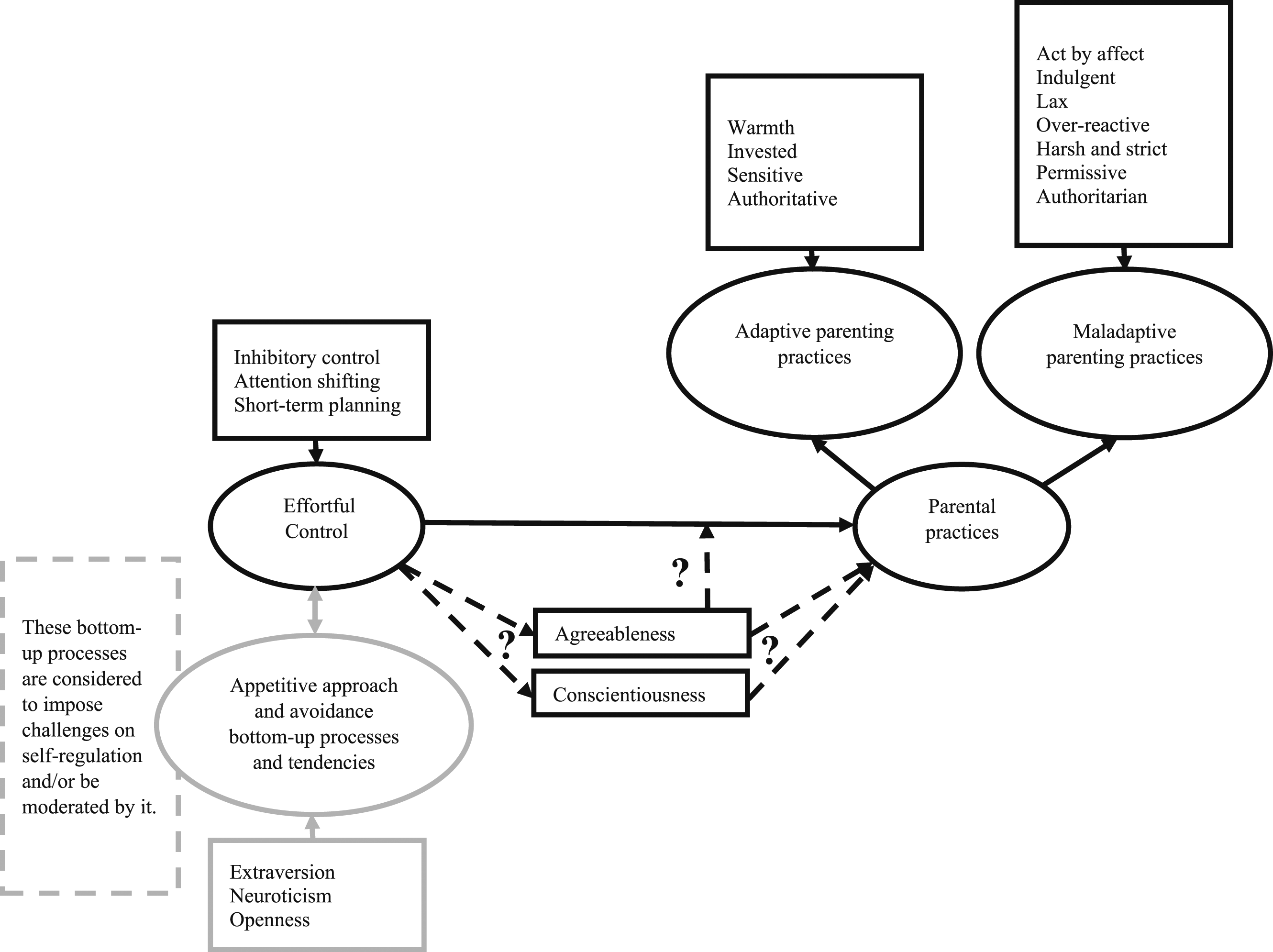
Temperamental Dimensions of Self-Regulation
As reviewed, parental EC and parenting practices are correlated with temperamental personality factors of the parent, such as Extraversion, Openness to experience and Neuroticism. Here we suggest that these temperamental dimensions are part of the bottom-up processes that are being regulated and that regulate the individual, meaning that the appetitive approaches and avoidance tendencies of an individual are determined by these temperamental personality dimensions. For example, if a person is highly extraverted (i.e., very sociable, assertive, and energetic) then their appetitive approach will be bolstered. The bolstering of the appetitive approach will not necessarily lead to a lower level of self-regulation because the opposing force of EC and high-level top-down processes can down-regulate it. This suggestion can explain how parents who are well regulated could also be more extraverted and open to experience and less neurotic. This elaboration supports and adds to the conceptual models of Rothbart et al. (2001) and Nigg (2017); specifically, that some temperamental dimensions function as regulated/regulating processes that counteract the ability to top-down regulate (see latent temperamental component of self-regulation in Figure 2).
Dimensions that Might Mediate or Moderate, at Least Partially, the Effect of Self-Regulation on Parenting Practices
We agree with the literature that suggests that Conscientiousness is greatly determined by self-regulation (see Bridgett et al., 2015; Jackson & Hill, 2019). Hence, it might mediate the connection between self-regulation and more adaptive parenting practices, as well as less maladaptive ones. In other words, better parental top-down regulation could be manifested in the preference for order and structure, work ethic, and commitment to goals, which are the different facets of Conscientiousness. When conscientious people become parents, they will be committed to the parental role and will strive to achieve order and structure for their children, resulting in adaptive parenting practices.
We suggest that, in a similar way, Agreeableness might be a mediator of the relation between self-regulation and parenting practices. As reviewed above, Agreeableness has been associated with better self-regulation as well as with more adaptive parenting practices and less maladaptive ones. When looking at the theoretical meaning of the dimension, it becomes apparent that it relies on self-regulation. By definition, the ability to be respectful (a facet of Agreeableness, which upholds the ability to inhibit antagonistic and aggressive impulses) requires EC, thus self-regulation affects it. This dimension, in turn, enables a parent to be warm and compassionate toward their child in the face of antagonistic feelings that might arise in different parenting situations. For example, a parent will need to down-regulate negative feelings after their child makes a scene. If the parent self-regulates, then it will be easier for them to be more agreeable (i.e., to feel more active emotional concern for the child’s well-being, treating them with regard for their personal preference and rights, while inhibiting antagonistic and aggressive impulses). By being more agreeable and self-directed, a parent can show more warmth and sensitive care toward their child.
Agreeableness not only might mediate the relation, this dimension might moderate it as well. Parents’ self-regulation would determine their ability to change their behaviors, thoughts, and emotions to achieve a goal (Berger, 2011). On the one hand, a moderation effect is possible because self-regulation would not determine whether the “goal” of self-regulation is to help others or to help oneself. The beneficiary of the self-regulation would be determined by the level of Agreeableness. A parent who is highly agreeable and highly self-regulated might want to regulate themselves to help others without selfish benefits, as part of being respectful toward them. In contrast, a parent who is less agreeable might want to self-regulate only if they can benefit from it. These two examples can lead to various outcomes, including adaptive or maladaptive parenting practices. In other words, the level of Agreeableness might act as a moderating personality dimension on self-regulation and result in the type of parenting style. When looking at parents with low levels of self-regulation, the agreeable parent will try to assist the child. However, if the child has difficulties or if the assistance takes a long time, then the parent probably will not be patient for long.
As pointed out in Belsky’s (1984) transactional model (Taraban & Shaw, 2018), it is important to remember that just as parents shape the traits of their children, children shape their parents’ reactions and behavior. An empirical support for such transactional conceptualization has been found, for instance, in a study by Browne et al. (2012), who pointed out the potential effect of Agreeableness on differential responsivity to different children of the same parent. Children’s characteristics evoke responses from the social and physical environments and therefore partially determine the specific environment in which they develop (see Scarr & McCartney’s, 1983 theoretical model regarding gene-environment correlations and its empirical support reviewed in Jaffee & Price, 2007).
Limitations
Some limitations of our review and proposed model should be pointed out. First, in addition to the personality dimensions that were addressed in the review, there are many narrower personality traits that were not addressed, such as perfectionism, self-compassion, need for control, self-esteem, and so forth. For example, perfectionism correlates with self-regulation (Uzun Ozer et al., 2014) and authoritarian parenting (Gong et al., 2015). Higher self-compassion is correlated with more authoritative and less authoritarian and permissive parenting (Gouveia et al., 2016). The plausible relations among those traits and self-regulation and parenting certainly deserve further investigation but were out of the scope of the present review. Due to clarity and length considerations, we focused the review on a main and prevailing conceptual model of personality. Second, our review focused on reported measures because studies addressing personality dimensions and parenting practices that employed neurophysiological measures are extremely scarce. A comprehensive review of the literature regarding self-regulation and parenting at the physiological levels, including genetic and animal model work, can be found in Bridgett et al. (2015).
Footnotes
Acknowledgements
The authors would like to acknowledge professor Ada H. Zohar and Dr Gidon Anholt for their experts opinion and notes. Moreover, We would like to thank Mrs Desiree Meloul for the review and formatting of the manuscript.
Declaration of Conflicting Interests
The author(s) declared no potential conflicts of interest with respect to the research, authorship, and/or publication of this article.
Funding
The author(s) disclosed receipt of the following financial support for the research, authorship, and/or publication of this article: This study was partially supported by the Israel Scientific Foundation (ISF; Grant number 533/20).

Data Availability Statement
Data sharing not applicable to this article as no datasets were generated or analyzed during the current study.
Appendix
A Definitions Summary of the Big-Five Model Factors Note. The definitions were drawn from Soto and John (2017) for the Big-Five Model.
Factor
Definition
Extraversion
Sociability – desire to socially approach and engage with others.
Assertiveness – willingness to express personal opinions and goals in social situations.
Energy levels – experience of positive affect and high levels of physical activity.
Agreeableness
Compassion – active emotional concern for others’ well-being.
Respectfulness – treating others with regard for their personal preference and rights, while inhibiting antagonistic and aggressive impulses.
Trust – holding positive generalized beliefs about others.
Conscientiousness
Organization – preference for order and structure.
Productiveness – work ethic and persistence while pursuing goals.
Responsibility – commitment to meeting duties and obligations.
Neuroticism/negative emotionality
A tendency to feel anxiety, depression, sadness, and emotional volatility.
Openness to experience
Intellectual curiosity and enjoyment of thinking, aesthetic sensitivity, and creative imagination.