




Abstract
Globally, one in three women experiences domestic violence over their lifetimes. Yet, the factors that shape adult behavior toward domestic violence remain poorly understood. We examine the effect of exposure to political violence in early stages of life on likelihood of domestic violence in marital life. Combining household level survey with political violence datasets from 1988 to 2018, our findings show that it is the exposure of men to political violence that matters, but not the exposure of their wives. Furthermore, we show that the critical age bracket is between 4 and 6 years of age in which exposure to political violence seems to shape adult behavior toward domestic violence. This is true for physical and emotional violence. Moreover, exposure to political violence at almost any point in male individuals’ life increases their likelihood to perpetrate sexual violence on their wives.
Introduction
Globally, one out of every three women experiences domestic violence during their lifetime. 1 Literature demonstrates that earlier exposure to political violence has a profound impact on shaping individual’s behaviors, influencing their propensity for violence and even cultural norms (Couttenier et al., 2019; Noe & Rieckmann, 2013). The connection between perpetrating or witnessing violence in the past and reproducing violence in the future is attributed to various mechanisms. These include psychological trauma, erosion of trust and moral values, compromised well-being, and behavioral implications such as anxiety, depression, stress disorders, suicidal thoughts, diminished educational achievements, feelings of revenge, and economic deprivation (Averdijk et al., 2016; Couttenier et al., 2019; Hamdan & Hallaq, 2021; Peckins et al., 2012).
On the other hand, research indicates that women’s exposure to political violence in early-life can increase the likelihood of experiencing domestic violence in their marital life (Ekhator-Mobayode et al., 2022; Gutierrez & Gallegos, 2016; Lafta & Hamid, 2021; Shemyakina & La Mattina, 2017; Stith et al., 2000; Svallfors, 2021). Several potential mechanisms underpin this connection. Women experience decreased autonomy and decision-making power while facing an increase in controlling behavior from men (Hui, 2019). In addition, imbalances in sex ratios within the marriage market (La Mattina, 2017) and permanent losses in human capital accumulation contribute to differences in education and earnings between partners (Leon, 2012). Moreover, it is important to note that exposure to political violence in early life has distinct effect on gender. Men often exhibit violent behavior and a heightened sense of perceived threats, while women tend to internalize the effect of exposure to violence such as manifesting in self-blame, hopelessness, anxiety, and depression (Cohn, 1991; Gavranidou & Rosner, 2003; Kerig, 1999).
Domestic violence poses a serious and escalating challenge in Pakistan (Fikree et al., 2005). In addition, the World Bank Report 2017 revealed that one in three married Pakistani women reported experiencing domestic violence. 2 Moreover, Pakistan ranked second from the bottom on the World Economic Forum’s Global Gender Gap Index of 2018, 3 and the Women Peace and Security Index of 2019–2020 placed Pakistan at a dismal 164th out of 167 countries. 4
Alongside domestic violence, political violence remains prevalent throughout Pakistan, varying in intensity (see Figure 1). According to the Global Terrorism Index (GTI) reports of 2020 and 2011, Pakistan was ranked seventh and second, respectively, among the top 10 countries most affected by terrorism. 5 Similarly, the Global Peace Index (GPI) report of 2020 ranked Pakistan at 152nd out of 163 countries, placing it second to last in the South Asia region. 6
This study explores the link between early-life exposure to political violence and adult behavior toward domestic violence, with a specific focus on spouses, whose exposure to political violence matters more in domestic violence, 7 and seeking to identify critical age brackets during early life that significantly shape the adult behavior. Previous research has largely focused on the connection between women’s early-life exposure to political violence and their likelihood of experiencing domestic violence. For example, Gutierrez and Gallegos (2016) have suggested that women affected by the civil conflict were more susceptible to domestic violence at home compared to those unaffected by the conflict. Similarly, La Mattina and Shemyakina (2017) found that women who experienced armed conflict during childhood were more prone to reporting domestic violence in their lives.
We collected data from Pakistan Demographic and Health Survey (PDHS) (two waves: 2012–2013 and 2017–2018) to investigate domestic violence-related variables of interest. Since PDHS 2012–2013 started including domestic violence modules. Our sample comprised 7,772 successfully interviewed women. The data on political violence are collected from the British Forces Resettlement Services (BFRS) and the Armed Conflict Location & Event Data (ACLED) project spanning from 1988 to 2018, which were aggregated yearly at the district level and merged with the PDHS dataset.
To understand the relationship between political violence and domestic violence, we employed the ordinary least square (OLS) technique while controlling for year of birth, survey, and district-fixed effects. The outcome variables—domestic violence, emotional violence, and sexual violence—were represented as a binary variable with a value of 1 if the interviewee responded affirmatively to questions on specific type of domestic violence, 0 otherwise. The main independent variable of interest, political violence, was measured as the sum of events aggregated yearly per 1,000 people at the district level. The descriptive statistics table (see Supplemental Table A2) based on the PDHS data revealed that, on average, 37.4% of ever-married women experienced domestic violence at some point in their marital life. However, the regression results showed that women’s exposure to political violence did not have significant impact on perpetrating domestic violence.
To gain further insights, we introduced the husband’s prior exposure to political violence at various ages as additional regressors in the models. Surprisingly, we found that husbands’ exposure to political violence during the ages of 4 to 6 years significantly increased the likelihood of domestic violence and emotional violence toward their wives. Moreover, husbands’ exposure to political violence across different age brackets in life led to an increase in sexual violence against their wives.
To ensure the robustness of our findings, we conducted several additional tests, all of which supported the main conclusions drawn from our analysis. In conclusion, our research suggests that husbands’ exposure to political violence during certain stages of their lives can have a lasting impact on domestic violence, emotional violence, and sexual violence against their wives.
In terms of implications, our findings underscore the urgent need for policymakers to prioritize interventions aimed at addressing and preventing domestic violence, particularly in regions affected by political violence. The psychological disruption caused by exposure to political violence may significantly influence parenting behaviors, thereby affecting children’s emotional well-being. This highlights the multifaceted and intergenerational consequences of violence exposure, warranting further investigation. Exposure to domestic violence adversely impacts various aspects of children’s developmental outcomes, including social, emotional, behavioral, cognitive, and general health functioning. However, there is a notable scarcity of empirical studies that adequately control for confounding variables and are grounded in robust theoretical frameworks. Future research should prioritize the collection of large-scale longitudinal data and the development of theoretically guided approaches that consider relevant contextual factors, and also explore the relationship between parental exposure to political or domestic violence during their early lives and their children’s social-emotional development.
Method
To examine the impact of early-life exposure to political violence on domestic violence, we estimate the baseline regression model as below:

whereas DVidkt is a binary outcome variable representing domestic violence, emotional violence, and sexual violence, for an individual i who was born in year k and was living in district d at the time of interview t. The variable politicalviolencedka takes the number of events per 1000 people occurred in district d when individuals born in year k were of the age a. The exposure to political violence is considered into six age brackets; birth to 3 years, 4 to 6 years, 7 to 9 years, 10 to 12 years, 13 to 15 years, and above 15 years. δk are the year of birth fixed effects (year of birth of woman and her husband), 8 it accounts for the time-invariant unobservable shocks for all the individuals born in the same year. γd are the district fixed effects that capture the time-invariant factors across the districts. θt is a year of survey fixed effects, it captures time effects and accounts for changes in spouse’s behavior in domestic violence that could occur over time. Xi is the set of controls that can affect the incidence of domestic violence. These controls are: difference of age between husband and wife; age at the time of first marriage; the number of children up to the age of 5 years in a household; wife’s educational attainment as given in the PDHS, no education, incomplete primary, complete primary, incomplete secondary, complete secondary and higher education; husband’s education level as given in the PDHs, no education, primary, secondary and higher education; husband’s alcohol drinking habits, which may be a cause of unpleasant behavior; and wealth index as given in PDHS, poorest, poor, middle, richer richest that shows the financial status of the household.
Data and variables
The main dataset used in this study is compiled from three distinct sources, each contributing specific information. Political violence data are collected from the BFRS dataset and ACLED, while domestic violence data are collected from the PDHS. The BFRS dataset covers incident-level political violence data spanning January 1988 to November 8, 2011, whereas the ACLED dataset encompasses data in case of Pakistan from January 1, 2010, onwards. For the purposes of this study, the analysis of political violence encompasses the period from January 1988 to December 2018. Consequently, the BFRS dataset covers the time frame from January 1988 to December 2009, while the ACLED dataset spans January 2010 to December 2018. This was a secondary data analysis of publicly available datasets and therefore no IRB approval was needed.
Both the BFRS and ACLED datasets provide information on event types, agents, event location, dates, and other characteristics of political violence, demonstrations and select politically relevant non-violent events. These datasets document incidents across multiple administrative tiers, ranging from country level down to tehsil (taluka) level, with details about event locations and occurrence dates.
The categorization of political violence events include terrorism, violence against civilians, remote violence, assassinations, attacks on the state, and various types of battles, 9 are established in accordance with the codebooks provided by the BFRS 10 and ACLED 11 datasets. There is high correlation in event types between the ACLED and BFRS datasets, particularly evident during the overlapping time period from January 2010 to November 2011. This correlation is notably strong, with a coefficient of 0.842, underscoring the coherence between political violence data sourced from ACLED and BFRS (see Supplemental Appendix Table A1).
The BFRS and ACLED datasets contribute data pertaining to the actual locations of political violence incidents. To facilitate integration with the PDHS dataset, which records data showing administrative unit at minimum district. Therefore, we aggregated political violence data annually at the district level per 1000 people. To ensure alignment, population figures at the district level are obtained from Pakistan’s Population Censuses, which were conducted in 1981, 1998, and 2017. These population figures are calculated using the annual average growth rate (AAGR), consistent with the approach employed in the population censuses. 12 The calculation of population figures for newly established districts are based on proportional allocation from their parent districts.
The data on domestic violence are taken from PDHS (two waves: 2012–2013 and 2017–2018). The PDHS a nationally representative survey targeting ever-married women aged 15 to 49, serves as a comprehensive data source, offering insights beyond shelter- based samples of abused women. Notably, the sample size comprises 7772 successfully interviewed women, encompassing 3687 women from the PDHS 2012–2013 wave and 4085 from the PDHS 2017–2018 wave. However, the PDHS 2012–2013 wave does not collect data on sexual violence.
The PDHS provides information about interviewees’ permanent residency or visiting status, yet it does not delve into their migration history. To ensure robustness in measuring prior exposure to political violence, this study focuses exclusively on women who report permanent residency—since birth—in their respective districts, resulting in a sample size of 7613 women.
The questionnaire for the domestic violence module includes an extensive array of inquiries designed to uncover instances of domestic violence experienced by the respondent. During the interview, the woman is presented with a series of queries tailored to each subcategory of domestic violence. For the investigation into “less severe physical violence,” these questions were posed: (i) did someone push, shake, or throw something at you? (ii) were you slapped? (iii) were you punched with a fist or any object that could cause harm? (iv) did someone twist your arm or pull your hair? To delve into “severe physical violence,” these questions were posed: (i) were you kicked, dragged, or beaten up? (ii) were you choked or deliberately burned? (iii) were you threatened or attacked with a knife, gun, or other weapon? For the exploration of “emotional violence,” these questions were asked: (i) has someone humiliated you in front of others? (ii) have you been threatened or harmed, or has someone you care about been threatened? (iii) have you been insulted or made to feel bad about yourself? And regarding “sexual violence,” these questions were asked: (i) were you physically forced into sexual intercourse against your will? (ii) were you physically forced into any other unwanted sexual acts? (iii) were you coerced or threatened to engage in unwanted sexual activities?
These various forms of domestic violence are organized into three subcategories: (i) domestic violence: which is the combination of less severe physical violence, severe physical violence, emotional violence and sexual violence; (ii) emotional violence, and (iii) sexual violence. Each category is an outcome variable (binary) in our analyses.
Our analytical approach incorporates control variables, including the respondent’s current age, square of the respondent’s age, age difference between spouses, woman’s age at first cohabitation, number of children below 5 years in the household, respondent’s education level, husband or partner’s education level, their alcohol consumption habits, and the wealth index. While individual income data is absent in the PDHS, information on household assets is available, allowing for the calculation of a wealth index using principal components analysis. This wealth index is categorized into five groups: poorest, poor, middle, richer, and richest.
To explore the critical age brackets that shape adult behavior, this study investigates the impact of exposure to political violence within different age brackets, namely infancy to toddler-hood, preschool years, middle childhood, and early adolescence. Dr. Maria Montessori’s framework of child development, segmented into birth to 3 years, 3 to 6 years, and 6 to 9 years (Feez, 2009). It is highlighted that the most critical age bracket for child development is from birth to 6 years, encompassing gross and fine motor development from birth to 2.5 years and the coordination of movement from 2.5 to 6 years. 13 Each age group exhibits a distinct internal drive motivating the exploration of objectives and relationships within the environment.
Consequently, the variable of interest, “politicalviolence” as introduced into the regression equation, captures the exposure to political violence across various age brackets: birth to 3 years, 4 to 6 years, 7 to 9 years, 10 to 12 years, 13 to 15 years, and above 15 years. The exposure within each age bracket is determined based on the birth year of the respondent and her husband.
Figure 1 shows the political violence over time in Pakistan. The political violence events reached various intensities at different times from 1988 to 2018.
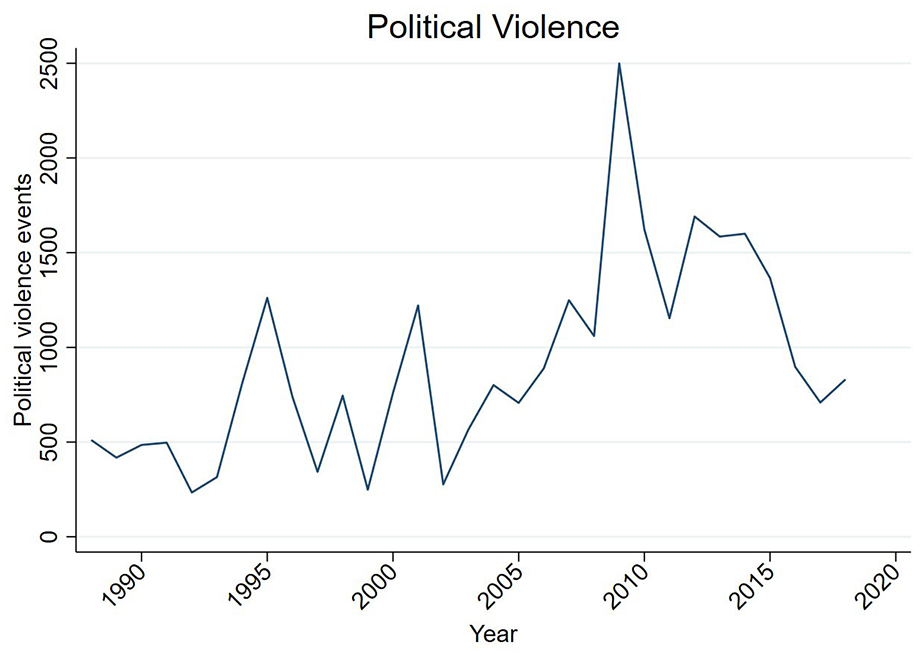
Political Violence Over Time in Pakistan.
The descriptive statistics for all variables used in this article are shown in Supplemental appendix Table A2. It shows that in the sample, on average, 37.4% and 31% of women have experienced domestic violence and emotional violence, respectively, at any point in their life. The questions related to sexual violence were asked only in one wave (PDHS 2017–2018), in the sample on average 4.5% of women have experienced sexual violence by their partner at any point in their life.
Results
Our analyses are based on the equation (1). In regression results tables, each column incorporates fixed effects such as year of birth, survey, and district fixed effects. Column (1) encompasses no additional controls; column (2) adds in wife-related control variables, such as educational attainment and age at the time of first marriage. Furthermore; column (3) adds in husband-related control variables, such as the husband’s level of education and alcohol consumption habits; column (4) adds in household-related control variables, such as age difference between spouses, number of children under 5 years residing in the household, and the wealth index.
The regression results presented in Table 1 indicate that women’s lifetime exposure to political violence does not have statistically significant effect on domestic violence, emotional violence, or sexual violence. The coefficient estimates lack statistical significance, suggesting that there is no direct association between women’s political violence exposure of and the various forms of domestic violence analyzed.
Effect of Exposure to Political Violence on Domestic Violence.
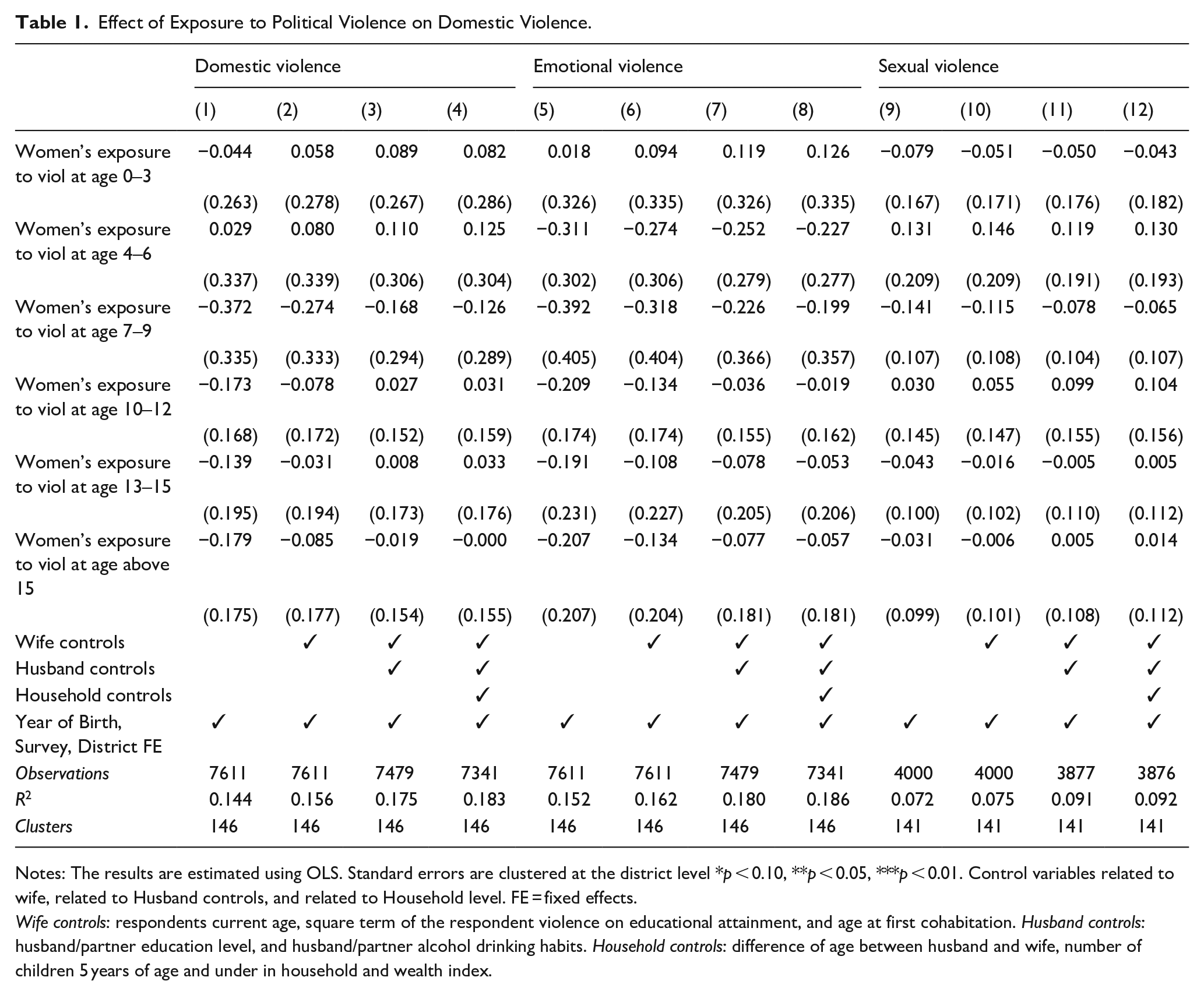
Notes: The results are estimated using OLS. Standard errors are clustered at the district level *p < 0.10, **p < 0.05, ***p < 0.01. Control variables related to wife, related to Husband controls, and related to Household level. FE = fixed effects.
Wife controls: respondents current age, square term of the respondent violence on educational attainment, and age at first cohabitation. Husband controls: husband/partner education level, and husband/partner alcohol drinking habits. Household controls: difference of age between husband and wife, number of children 5 years of age and under in household and wealth index.
Our analyses demonstrated no statistically significant correlation between women’s early-life exposure to political violence and subsequent domestic violence (Table 1). To further explore this, we replicated the regression analyses using equation (1) but substituted women’s past political violence exposure with that of their husbands. The results, presented in Supplemental Table A6 of the appendix, show that a husband’s prior exposure to political violence significantly impacts his wife’s reporting of domestic violence.
Subsequent regression analyses incorporating the husband’s exposure to political violence at various ages revealed that earlier exposure to political violence plays a more critical role in the manifestation of domestic violence within marital partnerships. The empirical findings in Table 2 indicate that husbands’ exposure to political violence between the ages of 4 to 6 significantly increases domestic violence in their marital lives. The coefficient estimates in columns (1) to (8) exhibit a positive and statistically significant association at the 1% and 5% levels.
Effect of Exposure to Political Violence on Domestic Violence.
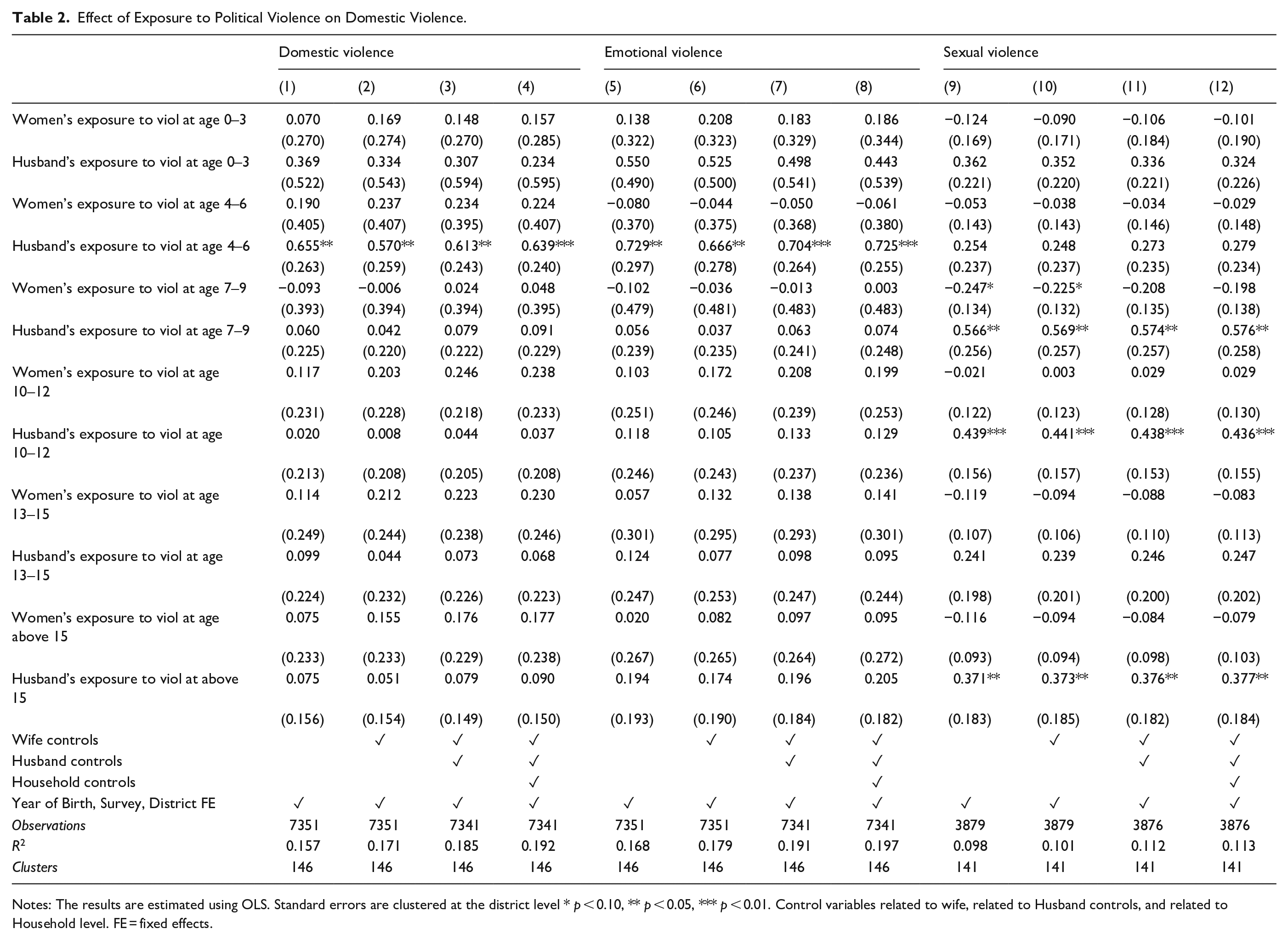
Notes: The results are estimated using OLS. Standard errors are clustered at the district level * p < 0.10, ** p < 0.05, *** p < 0.01. Control variables related to wife, related to Husband controls, and related to Household level. FE = fixed effects.
In the full specification model (columns [4] and (8)), an increment of one standard deviation in husbands’ exposure to political violence leads to a 0.025 standard deviation increase in domestic violence and a 0.030 standard deviation increase in emotional violence toward their wives. This corresponds to a 1.2 percentage point rise in the probability of a wife experiencing domestic violence and 1.4 percentage point increase in emotional violence likelihood. 14
Columns (9) to (12) of Table 2 show the effect of political violence exposure on sexual violence. Results in column (12) indicate that while women’s exposure to political violence has no effect on sexual violence, husbands’ exposure at ages 7 to 9, 10 to 12, and above 15 significantly increases sexual violence against their wives. The one standard deviation increase in husbands’ exposure at these ages corresponds to increases of 0.075, 0.099, and 0.546 standard deviations in sexual violence, respectively, with coefficients statistically significant at the 1 and 5% levels. Specifically, one standard deviation increase in husbands’ exposure between ages 10 and 12 corresponds to a 1.7 percentage point rise in the probability of sexual violence toward their wives, notable given the 4.5% overall incidence of sexual violence in the sample. 15
Heterogeneous / robustness test
Duration of exposure to political violence
The duration of exposure to political violence is a crucial factor in understanding its long- term effects on individuals and communities. Within three-year age brackets, individuals may experience political violence in varying duration. Some may endure prolonged exposure over the entire three-year period, while others may face condensed exposure within a few months. This variability in the time-frame of exposure can significantly impact individuals’ psychological and behavioral development, potentially shaping their attitudes and behaviors in adulthood. By measuring the number of months of exposure to political violence for each age bracket, our study aims to capture this nuanced relationship and provide insights into how the duration of exposure influences the manifestation of violent behavior later in life. Understanding these nuances is crucial for developing targeted interventions and policies to address the complex interplay between political violence and its long-term consequences on individuals and societies.
The time-frame of exposure to political violence can vary among individuals within the same age group, potentially impacting their behavior in adulthood. To capture this, we measured the number of months of exposure to political violence for each age bracket. However, our analysis, as detailed in Supplemental appendix Table A3, did not reveal any significant differences. 16,17
Intensity of exposure to political violence
The high-intensity political violence events may capture public attention and incite fear, may play a more substantial role in shaping attitudes and behaviors within the domestic sphere. The intensity of exposure to political violence (measured by the incidents resulting in at least one fatality) is a critical factor in understanding its impact on societal dynamics. However, it is essential to acknowledge the inherent limitations and potential noise in data regarding fatalities. Despite these challenges, our study reveals a noteworthy finding: while the intensity of exposure to political violence is a significant aspect of the broader social context, it appears to have less direct influence on shaping violent behavior within marital relationships compared to overall exposure to political violence. Thus, while caution is warranted in interpreting our results due to data noise, they underscore the relationship between political violence and its repercussions on interpersonal dynamics, emphasizing the need for comprehensive approaches to address the broader societal impact of such violence.
It is important to note that data on fatalities can be subject to very noisy, leading us to interpret our results with caution. Nonetheless, our findings indicate that the intensity of exposure to political violence appears to have less significance in shaping violent behavior in marital life compared to overall exposure to political violence. These results are outlined in Supplemental appendix Table A4.
Difference of education between partners
Prior research has indicated that early childhood exposure to political violence can result in enduring losses in human capital accumulation (Leon, 2012), contributing to disparities in education and earnings between partners. Resource perspectives, resource theory, posit that the distribution of power within relationships is determined by relative resources rather than social norms, potentially increasing the risk of domestic violence (Gage & Hutchinson, 2006). Key factors contributing to control within relationships include unequal social distribution of power, particularly economic dependence and gender inequality (Jenkins, 2000). Cools and Kotsadam (2017) have argued that couples with differing levels of education are more prone to domestic violence. Similarly, Bertrand et al. (2015) have suggested that marriages in which the wife outearns the husband are associated with lower marital satisfaction and an elevated risk of divorce. The increase in a woman’s income and education, as highlighted by Srinivasan and Bedi (2007), can challenge traditional gender norms, potentially leading to an increase in domestic violence. Our focus thus shifts to examining the impact of partner’s education disparities on domestic violence.
Wife has the same or higher education than her husband
We investigate the influence of exposure to political violence on domestic violence among women who possess equal or higher education levels compared to their husbands. In Supplemental appendix Table A5, our analysis reveals a significant increase in the likelihood of domestic violence perpetrated by husband who had experienced political violence between the ages of 4 and 6 years. This effect remains pronounced even if the wife’s education exceeds or matches her husband’s.
Husband has the same or higher education than his wife
Turning our attention to husbands’ exposure to political violence across various age brackets significantly heightens the probability of domestic violence toward their wives, irrespective of whether the husband possesses equal or higher education. Refer to Supplemental Appendix Table A5 for a comprehensive overview. These findings align with existing literature that explores the link between education and earnings disparities among partners and domestic violence (Bertrand et al., 2015; Cools & Kotsadam, 2017; La Mattina, 2017).
Components of domestic violence
To analyze the effects of couples’ prior exposure to political violence on various components of domestic violence, we conducted regressions for each question within the subcategories of domestic violence. This approach aims to elucidate whether exposure to political violence influences the behaviors associated with sub-types of domestic violence. Our findings on each component showed broadly the similar conclusion. However, it is crucial to note the limited variation in responses within each subcategory of domestic violence. The results, presented in Supplemental Appendix Tables A7 and A8, demonstrate that husbands’ exposure to political violence significantly impacts the occurrence of domestic violence.
Theoretical concepts
Some theoretical concepts are offered for the causes of domestic violence. One of such theoretical explanations is the feminist theory that underscores how societal power imbalances, especially in patriarchal societies, validate male dominance, often leading to men exerting control over women (Johnson, 2017). This paradigm asserts that domestic violence is culturally supported male aggression, reinforcing male dominance and female subordination (Dobash & Dobash, 1979; Dutton & Nicholls, 2005).
The patriarchal perspectives suggest that violence can stem from a man’s sense of powerlessness or fear of losing control over an independent spouse (Sugihara & Warner, 2002). Resource perspectives, resource theory, posit that the distribution of power within relationships is determined by relative resources rather than social norms, potentially increasing the risk of domestic violence (Gage & Hutchinson, 2006). Key factors contributing to control within relationships include unequal social distribution of power, particularly economic dependence and gender inequality (Jenkins, 2000). Studies indicate that relationships characterized by equal dependence and egalitarian decision- making tend to have lower levels of domestic violence (Kaukinen, 2004; Nock, 2001). Deviation from societal gender roles, particularly challenging traditional masculinity, may provoke control tactics and violence from partners (Macmillan & Gartner, 1999). The social exchange theory emphasizes decision-making autonomy as a dimension of power within relationships, where greater power is wielded by the partner controlling their counterpart’s actions and decisions. The appraisal theorists suggest that emotional responses influence risk perception, with angry individuals perceiving situations as less risky compared to fearful individuals, potentially facilitating violent actions, while fear tends to inhibit such behavior (Averdijk et al., 2016; Lerner & Keltner, 2000).
According to Eagly (1987) social-role Theory, men and women interact according to societal role expectations, with women expected to be passive and thus more likely to report symptoms, while men, expected to be healthier and stronger, may under-report illness. From a sociological perspective, men and women experience different social worlds, with men engaging in more physically aggressive activities such as competitive sports and aggressive driving behaviors (Kolip, 1997).
Discussion
Women’s early life exposure to political violence does not show a statistically significant effect on domestic violence. This finding aligns with existing literature that highlights differential effects of early life exposure to political violence based on gender. The exposure to political violence influences adult behavior differently in men and women. Men are more likely to exhibit aggressive behaviors and heightened perceptions of threats following exposure to political violence (Cohn, 1991; Gavranidou & Rosner, 2003; Gjerde et al., 1988; Kerig, 1999). In contrast, women tend to internalize the blame for such violence, leading to increased feelings of hopelessness, anxiety, and depression rather than outward aggression (Nolen-Hoeksema et al., 1991).
These gender-specific responses associated with exposure to political violence might explain why the regression results do not show a significant impact of political violence on domestic, emotional, or sexual violence among women. Women’s tendency to internalize trauma could lead to psychological distress that manifests in non-violent ways, rather than contributing directly to the dynamics of domestic violence. The literature suggests that while men’s responses to political violence may translate into more aggressive behaviors, women’s responses are more likely to involve internal psychological struggles, potentially impacting their emotional well-being and mental health rather than directly increasing the likelihood of perpetrating domestic violence.
Furthermore, exposure to political violence diminishes women’s autonomy and decision-making power, while concurrently augmenting men’s tendencies toward controlling behavior (Hui, 2019). The disruption of education during periods of political violence may contribute to women’s higher acceptance of domestic violence (La Mattina, 2017).
Our findings contribute to a nuanced understanding of how political violence affects individuals differently based on gender, emphasizing the need for tailored interventions that address the specific psychological and behavioral outcomes for men and women exposed to such violence. Several studies have indicated a noteworthy connection between early-life exposure to political violence and an elevated likelihood of subsequent domestic violence within marital relationships (Ekhator-Mobayode et al., 2022; Lafta & Hamid, 2021; Shemyakina & La Mattina, 2017; Svallfors, 2021). In addition, prior studies have shown that such exposure shapes adult behavior differently across genders (Gavranidou & Rosner, 2003; Kerig, 1999).
Our findings suggest that husbands’ exposure to political violence significantly increases the likelihood of sexual violence against their wives, aligning with literature that shows early-life exposure to political violence shapes adult behavior to be more violence-prone (Couttenier et al., 2019) and increases men’s controlling behavior (Hui, 2019). Studies have shown a positive link between men’s controlling behavior and sexual violence (Antai, 2011; Gage & Hutchinson, 2006). In patriarchal societies, sexual violence against women is more common as men use it to display and maintain dominance and power (Hadi, 2017).
Conclusion
This article makes significant contributions to two sets of literature. First, it enriches the discourse on the relationship between exposure to political violence during early life and subsequent adult behavior, attitudes, and beliefs. This topic has been explored by researchers such as Couttenier et al. (2019); Gutierrez and Gallegos (2016); La Mattina (2017); Noe and Rieckmann (2013); Stojetz and Brück (2023), shedding light on the potential influence of early-life experiences on individuals’ perspectives. Second, the article adds to the literature concerning the determinants of attitudes toward and experiences of domestic violence in developing countries, with a specific focus on Pakistan. Scholars including Ekhator-Mobayode et al. (2022), Gutierrez and Gallegos (2016), Lafta and Hamid (2021), Shemyakina and La Mattina (2017), Stith et al. (2000) and Svallfors (2021) have contributed to this field.
Our study investigates the impact of early-life exposure to political violence on domestic violence within marital relationships, while also identifying critical age brackets during early life that play a pivotal role in shaping adult behavior. Using data from the Pakistan Demographic and Health Survey (PDHS) for domestic violence and from the BFRS and ACLED for political violence, our findings unveil interesting insights. Specifically, we observe that women’s exposure to political violence in their early years does not significantly correlate with their engagement in domestic violence perpetration. However, a noteworthy impact is found when considering husbands’ exposure to political violence, highlighting their pivotal role in this context. Furthermore, we identify the age bracket of 4 to 6 years as particularly influential in shaping individuals’ tendencies toward domestic violence.
Interestingly, this study also reveals that women’s early-life exposure to political violence may elevate their vulnerability to becoming victims of domestic violence. This susceptibility emerges due to an increased tolerance toward such violence, emphasizing the enduring impact of early experiences. Particularly, gender differences come to the forefront, indicating that men are more predisposed to exhibit violent behavior in adulthood, whereas women tend to adopt a more passive stance. These findings closely align with previous studies that underscore the varying effects of political violence exposure on men and women (Abdullahi & Kumar, 2016; Cohn, 1991; Gavranidou & Rosner, 2003; Gjerde et al., 1988; Hui, 2019; Kerig, 1999; Lane et al., 2017; Nolen-Hoeksema et al., 1991).
In terms of implications, our findings underscore the urgency for policymakers to prioritize interventions aimed at both addressing and preventing domestic violence, particularly within areas affected by political violence. Future research avenues could explore the link between parental exposure to political violence or domestic violence during their own early lives and their children’s social-emotional development. The psychological turbulence caused by exposure to violence might significantly influence parenting patterns, potentially impacting the emotional well-being of their children. This emphasizes the multifaceted and intergenerational consequences of violence exposure, suggesting further investigation.
Supplemental Material
sj-docx-1-jbd-10.1177_01650254241287494 – Supplemental material for Early-life exposure to political violence and domestic violence
Supplemental material, sj-docx-1-jbd-10.1177_01650254241287494 for Early-life exposure to political violence and domestic violence by Akseer Hussain and Sumit Mazumdar in International Journal of Behavioral Development
Footnotes

References
Supplementary Material
Please find the following supplemental material available below.
For Open Access articles published under a Creative Commons License, all supplemental material carries the same license as the article it is associated with.
For non-Open Access articles published, all supplemental material carries a non-exclusive license, and permission requests for re-use of supplemental material or any part of supplemental material shall be sent directly to the copyright owner as specified in the copyright notice associated with the article.
