




Abstract
Children and young people (henceforth referred to as young people) are one of the groups most affected by climate change and are at the forefront of climate action. Yet, there is scarce evidence on how young people navigate the challenges presented by climate change using their personal strengths and the resources accessible to them. This study aimed to address this gap by drawing on qualitative data from workshops with 31 young people between 12 and 22 years of age from metropolitan Melbourne and a bushfire-risk region in Victoria, Australia. An inductive thematic analysis of workshop transcripts showed that participants had progressively become aware of climate change in an increasingly uncertain world and sought to gain a sense of connection, agency, and hope. Participants aimed to achieve the latter by becoming aware of opportunities for climate actions in everyday life and developing themselves as agents of change. We discussed our findings from a developmental perspective to gain a better understanding of how supporting young people in learning about and acting on climate change can benefit their mental health and sense of agency.
Keywords
The global mental health burden for children and adolescents (from now on referred to as young people) is rapidly increasing due to climate change (Hellden et al., 2021; Hickman et al., 2021; Vergunst & Berry, 2022). From a developmental perspective (Vergunst & Berry, 2022), the negative impacts of climate change on young people’s mental health are the result of multiple factors (biological, psychological, social, environmental) that are affected by climate change and interact with each other. For example, young people are more exposed than previous generations to disasters that severely disrupt their health, home, family, education, and community (Thiery et al., 2021). Young people are also increasingly worried and anxious about climate change and how it will affect them in the future (Vergunst & Berry, 2022), with rising levels of eco-anxiety and solastalgia (distress caused by changes and damages on the environment) among global youth (Burke & Blashki, 2020). These impacts are additive, cumulative, and interact with each other, increasing young people’s vulnerability to mental health problems in the short and long terms.
A developmental approach also helps us address young people’s mental health as a dynamic and adaptive capacity (Vergunst & Berry, 2022). The available literature shows that young people actively cope with climate change (Clark et al., 2020), and that critically reflecting and acting on climate change can help them develop a stronger sense of agency and wellbeing (Eilam et al., 2020; Ma et al., 2022; Parry et al., 2022). Conversely, young people can feel more distressed when their voices, efforts, and contributions are dismissed (Hickman et al., 2021; Lawrance et al., 2022). Yet, young people’s agency and decision-making capacities are typically not covered in the literature about climate-related health impacts for young people (Connon & Dominelli, 2022).
This study focused on the experiences of a group of young people from Victoria, Australia, a region affected by the increasing frequency and severity of climate-change-induced disasters (Department of Environment, Land, Water and Planning, 2019), such as the 2019–2020 Black Summer bushfires and 2021–2022 floods (Lawrence et al., 2022). In response to the gap in supportive and empowering tools for young people, the Your Climate Superpowers project aimed to examine young people’s experiences of navigating climate change while growing up in the midst of the climate crisis. As a step in the development of this project, we carried out a qualitative study to explore how young people in the Your Climate Superpowers project understood the challenges that climate change presented to them in their everyday lives and the strengths, resources, and strategies they found the most useful to deal with them. In the following sections, we explain the methods and findings of this study.
Method
Participants
Young people in the Your Climate Superpowers project had roles as both research participants and co-designers. As research participants, young people participated in group discussions about their personal experiences dealing with climate change and consented for these discussions to be recorded and analyzed for research purposes. Young people as co-designers helped develop a website and participated in decisions about the contents and design of this new resource. This article focuses on the first part of the project, involving young people as participants.
We recruited four groups of young people (n = 31) across Metropolitan Melbourne and a regional community close to the city that is exposed to bushfire risk. We used purposive sampling based on the following inclusion criteria: (a) aged between 12 and 25 years, (b) living in Victoria, and (c) interested in climate change (with different degrees of experience in climate action). Participants were recruited through a range of avenues including a local council that had a Youth Advisory Committee, a school sustainability group, and an existing Children & Disasters Advisory Committee at the Child & Community Wellbeing Unit, University of Melbourne. Participants were compensated with a gift voucher for each workshop they attended based on the average hourly rate that young people are normally paid in Australia.
Procedure
Four workshops (one per group of young people) were held between 31 March and 14 May 2022. The workshops were designed and conducted based on the principles of participatory health research with children (Gibbs et al., 2018) so that researchers shared power for key decisions with young people across the whole process.
During workshops, participants discussed their personal experiences navigating climate change. The workshops were based on a strengths-based, holistic framework consisting of seven capitals—social, natural, built, political, human, cultural, and financial—which originated in the field of community development (Emery et al., 2006) and has been applied in contexts of disaster resilience and recovery (Quinn et al., 2022). Participants discussed young people’s “capitals” (variously referred to during the workshops as strengths, resources, or superpowers) for navigating the climate crisis. Based on these conversations, young people and the university-based researchers developed a website with activities and advice for other young people. Workshops were audio-recorded, and the recordings transcribed verbatim.
Analysis
Qualitative data were subjected to an iterative and inductive thematic analysis (Braun & Clarke, 2006), supported by the NVivo software. After each workshop, one member of the research team, who was also a workshop facilitator, analyzed the data and generated codes and themes that were then incorporated into the discussion with the next workshop group. The preliminary findings from the qualitative analysis of data were discussed with the rest of the investigating team during our monthly meetings. In addition, young people in this project had the opportunity to give feedback on the interpretation of our research findings during the final workshop.
Ethics
This study was approved by the Human Ethics Sub-Committee (HESC) at the University of Melbourne (project ID 22912).
Results
Table 1 summarizes the main characteristics of study participants.
Summary of Participants in This Study (n = 31).
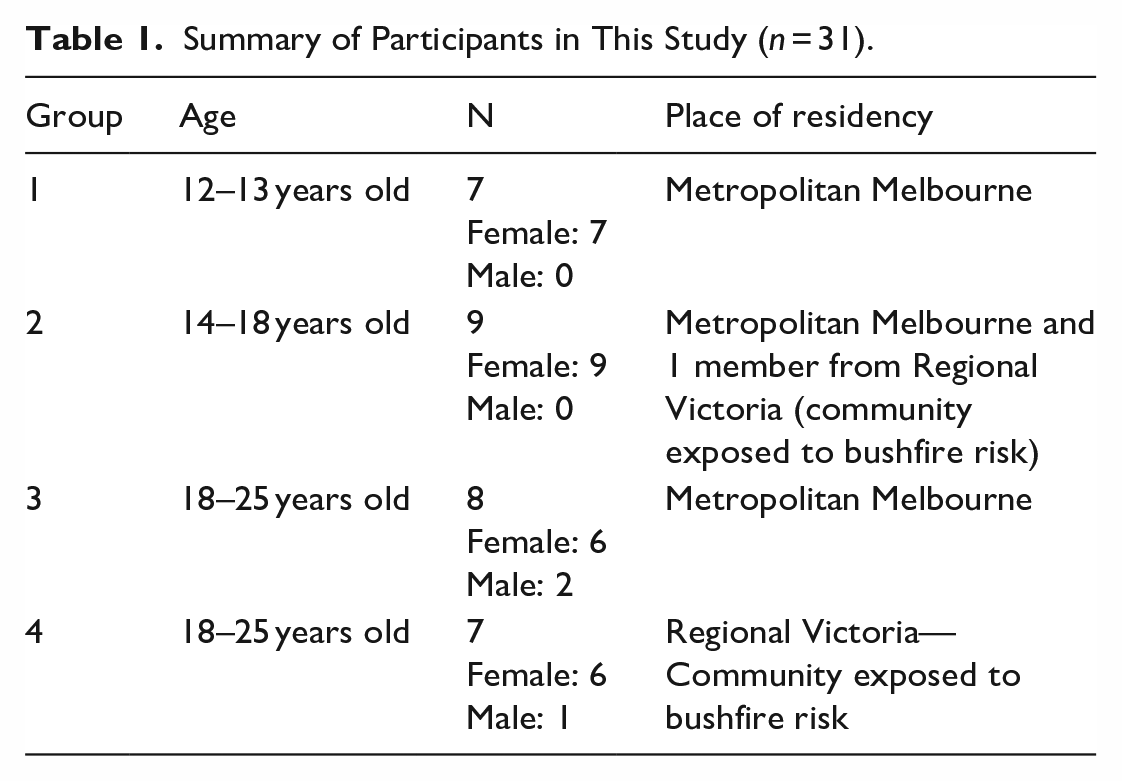
Among participants, 90% identified as female, and 3% as male (no participants identified as non-binary). Twenty-four of the participants lived in Metropolitan Melbourne, while one group lived in a bushfire-prone area in regional Victoria. Three of this group had been directly affected by the 2009 Black Saturday bushfires. One participant reported being affected by the 2019–2020 Black Summer bushfires, having lost her family’s vacation house on the coast. Meanwhile, many participants were affected by the bushfire smoke that covered a large part of Victoria during December 2019 and January 2020. Everyone was affected by the COVID-19 pandemic, with young people in Metropolitan Victoria spending 263 days under strict lockdown (Lockdown Stats Melbourne, 2022).
All participants shared a strong interest in climate change and climate action, but there was diversity in terms of their levels of involvement. Some had been directly involved in climate action, at home, through extracurricular activities, attending School Strikes 4 Climate, or taking part in Clean Up Australia Day. One group was formed mainly by peers from a school sustainability group. Another group was formed by members of a “young citizens jury” at a local council, who addressed climate change, among other topics, in their local area. Two participants were previously involved in disaster risk and recovery programs after being directly impacted by bushfires. While participants were keen to share their stories and tips to help peers navigate climate change, a strong theme that emerged from the data was that they engaged in this project as a way to develop their own knowledge and skills.
In the following sections, we present our findings on how participants became aware of climate change and how this awareness affected their views about the world and themselves. Our analysis showed that participants were conscious of the impacts of climate change on other people’s wellbeing as well as their own. In response, they developed strategies to cope with climate change by developing more in-depth knowledge about it; seeking a higher sense of connection, agency, and hope; taking personal choices to live more sustainably; and developing as communicators, citizens, and agents of change.
Developing Awareness About Climate Change
Becoming aware about climate change was often a source of anxiety for participants, but gaining deeper knowledge about it was also seen as a way of coping with it. Participants talked about becoming aware of climate change from an early age, often during their primary school years. While some reported that their home and family environment were an important source of values and practices for helping create a more sustainable future, others grew up surrounded by adult family members who were skeptical about climate change.
Participants had diverse experiences at school and tertiary education. Some reported learning about climate change in class or from their peers and engaging in climate action through extracurricular activities like sustainability groups and growing vegetable gardens. In contrast, others reported having few or no opportunities to do this at school or university. Participants’ increasing awareness of climate change was also the result of watching news and documentaries and rapidly growing environmental activism, including youth-led movements. Participants emphasized that they used the internet, social media, and streaming services to self-direct their learning: So there’s this brand, Shein (. . .) And a lot of my friends are buying from them because it’s cheap, and easy to get. I wanted to see if it was good for the environment. And I read this thing [online]. (. . .) I was like, Yeah, this isn’t good for the environment. Apparently 50% of the clothing [waste] is from (. . .) fast fashion brands like them. (12–13 yo, Metropolitan Melbourne).
However, participants were critical that information about climate change was usually not communicated in a youth-friendly way and expressed the need for more resources specially targeted to them.
Seeking Connection, Agency, and Hope to Combat Grief and Anxiety
Participants talked about how to improve support for young people in an uncertain world. Many reported feeling anxious about the future due to the negative impacts of climate change, especially after witnessing (in person or in the media) the increasingly frequent and severe disasters happening in Victoria and the rest of the world: We travel a lot, like drive to Queensland and along the way we went through a place that had been recently burnt by the bushfires. And like, as far as you can see, it was just like dead, black sticks. We touched the tree, and it was just ash. (12–13 yo, Metropolitan Melbourne).
In this context, participants talked about how their feelings of climate anxiety and grief intensified during and after the 2019–2020 Black Summer Bushfires. Some participants living in metropolitan Melbourne also reflected on their privilege of being less directly affected by climate change than other young people: Our school is in the city. A lot of people don’t really understand the gravity of what’s happening in places outside of the city. I think [it’s] very important for like kids or young people who live in the city to understand what it’s like to experience the natural disasters and stuff that we aren’t directly affected by. (14–15 yo, Metropolitan Melbourne).
Participants discussed that, while there was more interest in climate action in the aftermath of emergencies, the ongoing stress of successive disasters could be detrimental to climate action in the longer term. This is because some people might feel the need to avoid the topic to reduce the burden of negative emotions: This general omniscient sense of doom [sic] around the world is just too much for humans to physically handle. I got so depressed when there was smoky haze over the sky every day. (. . .) And [then] it’s like, “Oh, whatever, it’s not there anymore.” (18–25 yo, Metropolitan Melbourne).
Despite understanding why some people may avoid or ignore climate issues, participants disapproved of schools that did not teach enough about climate change and governments for not taking more action. This often left them feeling angry and frustrated. Participants also felt lonely and powerless when they received little support from their family, school, and friends and emphasized the importance of strengthening a sense of connection, agency, and hope for the future: “Knowing that you are not alone, like you are not the only person in the whole wide world trying to fight climate change” (12–13 yo, Metropolitan Melbourne). One participant, who had been severely affected in her childhood during the Black Saturday Bushfires of 2009 talked about how she used her lived experience to support other young people: The resilience that I’ve built up, through having that experience and then working with other committees and teams and young people to use my experiences and my knowledge to then build resources and projects. My aim is to help other people. (14–15 years old, Regional Victoria).
Personal Choices
Participants felt compelled to live their everyday lives in a way that contributed to a more sustainable society. They were often critical of the status quo and the behaviors and attitudes of those around them. Some were critical of family members and peers who did not believe in climate change, did not pay much attention to it, or whose behaviors were inconsistent or in contradiction to their knowledge: The same person who spent $400 on Shein, will also try and write an angry letter to get Shein shut down. It’s really weird . . . I’m friends with people who are like impulse buyers, and they have, like, such weird cognitive dissonance. (14–18 yo, Metropolitan Melbourne).
Participants dealt with important challenges when trying to put their values into practice in everyday life. They did not always have the material resources for shopping ethically and sustainably. Since climate change is such a big and complex issue, participants sometimes found it difficult to remain consistent and hopeful: I know a lot of people who go, “Well, if there’s no ethical consumption under capitalism, (. . .) what’s the difference. I’m just gonna live in the moment.” (14–18 yo, Metropolitan Melbourne).
Participants highlighted the importance of the cumulative impact of small daily actions: “If a significant proportion of the people on this planet do something every day, (. . .) it’s going to help make a difference.” (18–25 yo, Regional Victoria). Participants also acknowledged that every young person has unique interests, skills, and approaches, all necessary to solve such a complex and global problem: There’s also like taking into account the different levels of climate justice. Like, some people interpret [it] as like, literally striking every day, or like talking to their politicians, (. . .). And then there’s also like stop eating meat. (14–18 yo, Metropolitan Melbourne).
Participants identified a wide range of everyday actions they could take, including shopping sustainably (e.g., buying organic, local, and reusable), encouraging the use of clean energy and sustainable building, and better waste management at home and school (reducing, recycling, and reusing). Two forms of connection played important roles in young people’s ability to take such actions in their everyday lives: connection to other people and connection to nature. Encouragement and support from family, friends, and community was crucial in supporting their everyday efforts to be climate conscious: “You feel like you’re surrounded by people that also try to make a difference.” (18–25 yo, Metropolitan Melbourne). Connecting with nature (e.g., being outdoors, gardening, picking up litter) also helped participants feel motivated to act on climate change: If you’re going to care about nature, you also have to be with nature. You can’t just go, “I’ll just fight for this random thing I don’t even know about.” You have to be around it, appreciate it. Without nature, we wouldn’t be alive. So if nature protects us, like it gives us water, food, then why don’t we protect nature? (12–13 yo, Metropolitan Melbourne).
Developing as Communicators, Citizens, and Social Agents of Change
Participants felt responsible for communicating about climate change and promoting climate action among friends and family: So, my parents are very supportive (. . .) but my grandmother, she kind of didn’t really understand it. And so, (. . .) relating it to (. . .) how it will affect me and like my brothers and like, my friends (. . .) so she can (. . .) understand that (. . .) even the things that she does can affect us, even after she’s long gone, (. . .) that was really useful. (. . .) Now, she like collects all the soft plastics and, like, sends me a message to say that she was, you know, recycling them. It’s really good to just like relate it back to something that they kind of care about. (14–15 yo, Metropolitan Melbourne).
Participants felt frustrated that their calls for action were often dismissed and sometimes even directly opposed by adults (i.e., politicians, family members, educators, companies): Last year we missed Clean Up Australia Day. (. . .) And I said we should organize another Clean Up Australia Day. (. . .) I was talking to all my friends about it (. . .) and our teacher overheard us. And she’s like, “You guys shouldn’t be doing anything about this. You’re too young.” (12–13 yo, Metropolitan Melbourne).
Because of this, participants expressed their admiration for Greta Thunberg, who consistently defied the status quo despite the backlash against her based on her age, gender, and neurodivergence: She literally sounds like one of us, and she was rejected by everybody around her, who didn’t think that what she was fighting for was worth it. (12–13 yo, Metropolitan Melbourne). And let’s not forget she’s a she. That would have been extra hard for her as well, being a girl. (. . .) When girls have their own opinions, they’re called bossy. (12–13 yo, Metropolitan Melbourne).
Participants were especially concerned about how to navigate difficult conversations about climate change. They were aware that because climate change is a highly politicized topic, some people were skeptical and resistant to talk about it. To stand up for what they believed in, participants were keen on developing their communication skills to become more persuasive and better listeners.
Participants emphasized the importance of building trust and personal connections to establish meaningful dialogue, and others advised being strategic when promoting climate action and targeting groups that were more open to changing their minds. Some highlighted the importance of using different modes of communication, listening to different perspectives, and understanding the reasons behind people’s beliefs and behaviors: I feel like one of the major barriers to taking action against climate change is that people in society come from all different perspectives. And one of the main reasons why people might oppose taking action or changing the status quo is that they think it will affect their livelihoods (18–25 yo, Metropolitan Melbourne).
Participants also recommended starting with proposing feasible and specific actions and then moving on to the larger issues: You can’t be like, “You’re wrong, this is happening, wake up” that sort of thing, because they [people] just shut off and they don’t want to hear anything about it. You have to go with the little issues and be like, “Look, you can do this. So why don’t you try doing this?” Just small things like recycling and start going from there. I found this really helpful, rather than going straight to the big issues. (18–25 yo, Regional Victoria).
In addition, participants highlighted the importance of engaging in youth-led collective action to learn from their peers, surround themselves by like-minded people, and feel more empowered. Participants identified as agents of change at different levels. At the local level, some participants joined or created sustainability groups at school, contributed to developing and monitoring waste management plans, and grew vegetable gardens. At a wider level, participants wanted to develop as national and global citizens who directly or indirectly influenced decision makers. Those who were old enough to vote were keen to support candidates who included climate action in their agendas, and some had already engaged with politicians (e.g., by writing letters or joining Youth Advisory Committees).
There was wide agreement that the School Strikes 4 Climate movement was the main outlet for youth climate action because of its global scope in terms of mobilizing social change and promoting a higher sense of empowerment, connection, and inspiration among youth. Participants often came up with creative ways to navigate the challenges they sometimes faced to attend rallies, such as organizing local strikes. Sometimes they sought support from their parents when there were important geographic barriers or when schools and the government opposed their participation in events.
Discussion
In line with previous research (Burke & Blashki, 2020; Hickman et al., 2021; Lawrance et al., 2022; Ma et al., 2022), this study found that becoming aware of climate change, as well as witnessing disasters and the destruction of nature, generated anxiety, hopelessness, and grief in participants. In response to this, participants actively developed strategies to regain a sense of hope, agency, and connection. A bioecological model of development helps explain that young people are not passive recipients of the impacts of climate change (Ojala, 2022; Sanson et al., 2022; Vergunst & Berry, 2022). Young people’s development results from the interplay between themselves and their microsystems (family, friends, school), the mesosystem (interactions between microsystems), the exosystem (spaces in the wider community where children do not participate directly), and the macrosystem (cultural, economic, political, and physical environment). From this perspective, climate change can be understood as taking place over time in the macrosystem and influencing young people’s development and wellbeing directly and indirectly. Since young people’s mental health results from individual processes that occur in the context of their home, school, and the wider community (Sanson et al., 2022; Vergunst & Berry, 2022), they need support across these contexts to actively develop skills, capacities, and strategies required to make sense of and respond to climate change.
For participants, becoming aware of climate change caused distress, but gaining a deeper understanding empowered participants and improved their mental health and wellbeing. They stressed the importance of open and constructive conversations about climate change with family, friends, classmates, and teachers, but not all had access to such opportunities in their daily lives. Participants found value in self-directed learning through the internet and social media but criticized the lack of empowering and youth-friendly information available. Previous studies have highlighted the significance of digital technologies in informing and motivating young people about climate change, but that exposure to information without positive stories, actionable advice, and critical thinking support can increase eco-anxiety (Parry et al., 2022). The updates to the Australian curriculum to include more climate change topics represent progress in this direction (Beasy et al., 2022). However, further efforts are required to enhance the curriculum’s content (Eilam et al., 2020). One effective approach is to provide pre-service and in-service training to teachers on empowering youth to consider and contribute to a sustainable future (Aksela & Tolppanen, 2022; Baker et al., 2021).
Supporting young people in addressing climate change positively impacts their mental health and overall wellbeing, particularly for adolescents who are crucially developing their identity, social connections, and competence (Vergunst & Berry, 2022). Increased awareness of climate change processes and values, such as intergenerational injustice, drives adolescents’ interest in expressing their views and participating in climate action within various contexts like home, school, and community. Youth-led groups and meaningful participation mechanisms play a significant role in empowering young people to engage in climate action effectively (Ojala, 2022). Participants prioritized connecting with nature and participating in collective climate action to protect their wellbeing and drive societal transformation. Studies in Australia have demonstrated that climate anxiety can motivate for young people to get involved in climate action, leading to a stronger sense of hope and agency (Gunasiri et al., 2022). The School Strikes for Climate movement and Australian Youth Climate Action Coalition (AYCC) are recognized for demonstrating that young people are legitimate political actors in the climate crisis (Hilder & Collin, 2022; Sanson & Bellemo, 2021).
Engaging in climate activism, mitigation, and adaptation has proven to be beneficial for young people’s mental health, fostering empowerment, solidarity, courage, and active hope. In addition, their involvement helps develop essential skills such as resilience, self-regulation, conflict resolution, teamwork, leadership, and citizenship (Ojala, 2012, 2022; Sanson & Bellemo, 2021). Climate action also instills a sense of belonging to a greater cause and promotes values related to social justice (Sanson & Bellemo, 2021), and meaning-focused coping in relation to climate change has been found to promote wellbeing (Ojala, 2022). But for young people to truly benefit from climate action, they require adequate support from family, friends, school, and the broader community (Moore & Duffin, 2020; Moula et al., 2022). Instances of dismissal or backlash from adults and authorities, along with government inaction on climate change, contribute to the distress experienced by young activists (Hickman et al., 2021). Sanson and Bellemo (2021) found that young climate activists often experience loneliness, anxiety, hopelessness, and burnout. Conversely, with adequate support, young people can better manage their emotions and engage in meaningful daily actions related to climate action. By creating an environment of understanding and encouragement, society can alleviate the burden young activists may feel and empower them to effectively contribute to addressing the climate crisis (Sanson & Bellemo, 2021).
Our findings offer an in-depth insight into the perspectives and experiences of a group of young people that can lead to further research on the views of youth from more diverse backgrounds. Given that this study was based on a co-design project, we would like to highlight the benefits of actively collaborating with youth from a strengths-based perspective to co-develop knowledge and action about their wellbeing in the context of climate change. However, there are important limitations that need to be considered when interpreting our findings. While the analysis of data was discussed during our regular team meetings and young people had a chance to give their feedback during our last workshop, the process was carried out by the Univesity-based research team and largely led by one member. Our sample size was relatively small (n = 31), and although Melbourne is a multicultural city and we aimed to recruit participants from different places and organizations, there was limited representation of youth from diverse geographic, ethnic, gender, and socioeconomic backgrounds. The literature on participatory approaches to research with young people shows that projects with limited resources find it challenging to recruit larger groups of young people that represent their peers while achieving a group size that is manageable (Ozer et al., 2010). Researchers may also face important challenges in making research accessible and inclusive for young people from oppressed and marginalized groups and for those who are less keen to engage due to negative past experiences of participation (Ozer et al., 2010). In addition, young people interested in participating in this study may have been more climate conscious than many of their peers.
Moreover, the research participants overwhelmingly consisted of girls and young women, and our university-based research team also comprises solely women. Existing evidence suggests that while both men and women acknowledge human-caused climate change, women tend to exhibit greater concern about it (Ballew et al., 2018) and are more environmentally conscious consumers (Brough et al., 2016). The gender gap in girls and young women’s attitudes toward climate change is attributed to their heightened awareness of its personal impact and socialization around altruism and compassion (Ballew et al., 2018). In addition, boys may encounter gender-related barriers in engaging with the topic as they might feel social pressure to conform to certain norms and perceive caring about climate change as uncool (Abbott et al., 2019). It is essential to recognize the limitations of our study, which may impact the generalizability and validity of our results, as they might not represent the views and experiences of Victorian youth at large.
Academics must continue working to make research a safe, inclusive, and engaging space for young people of diverse backgrounds. For example, researchers could build sustainable strategic partnerships with organizations that work with diverse groups of young people to include their perceptions about climate change and engaging in climate action. Despite its limitations, we hope this study contributes to future research on collaborating with young people to develop practical interventions to promote awareness and strategies for addressing climate change. This includes future studies that can help assess the impacts of the Your Climate Superpowers website (www.climatesuperpowers.org) that grew out of this project. We hope this resource can help boost young people’s knowledge about climate change, their personal strengths, and resources to cope with the climate crisis and engagement in climate action that is protective of their wellbeing.
Footnotes
Author Contributions
Karen Block, Claire Leppold, Janet Stanley, and Dianne Vella-Brodrick equally contributed to this publication.
Funding
The author(s) disclosed receipt of the following financial support for the research, authorship, and/or publication of this article: K.M.C. is supported by the Wildfires Futures Hallmark Research Initiative, The University of Melbourne.
